
Life, 1926-09-23 · page 18 of 40
Life — September 23, 1926 — page 18: what you’re looking at
What you’re looking at
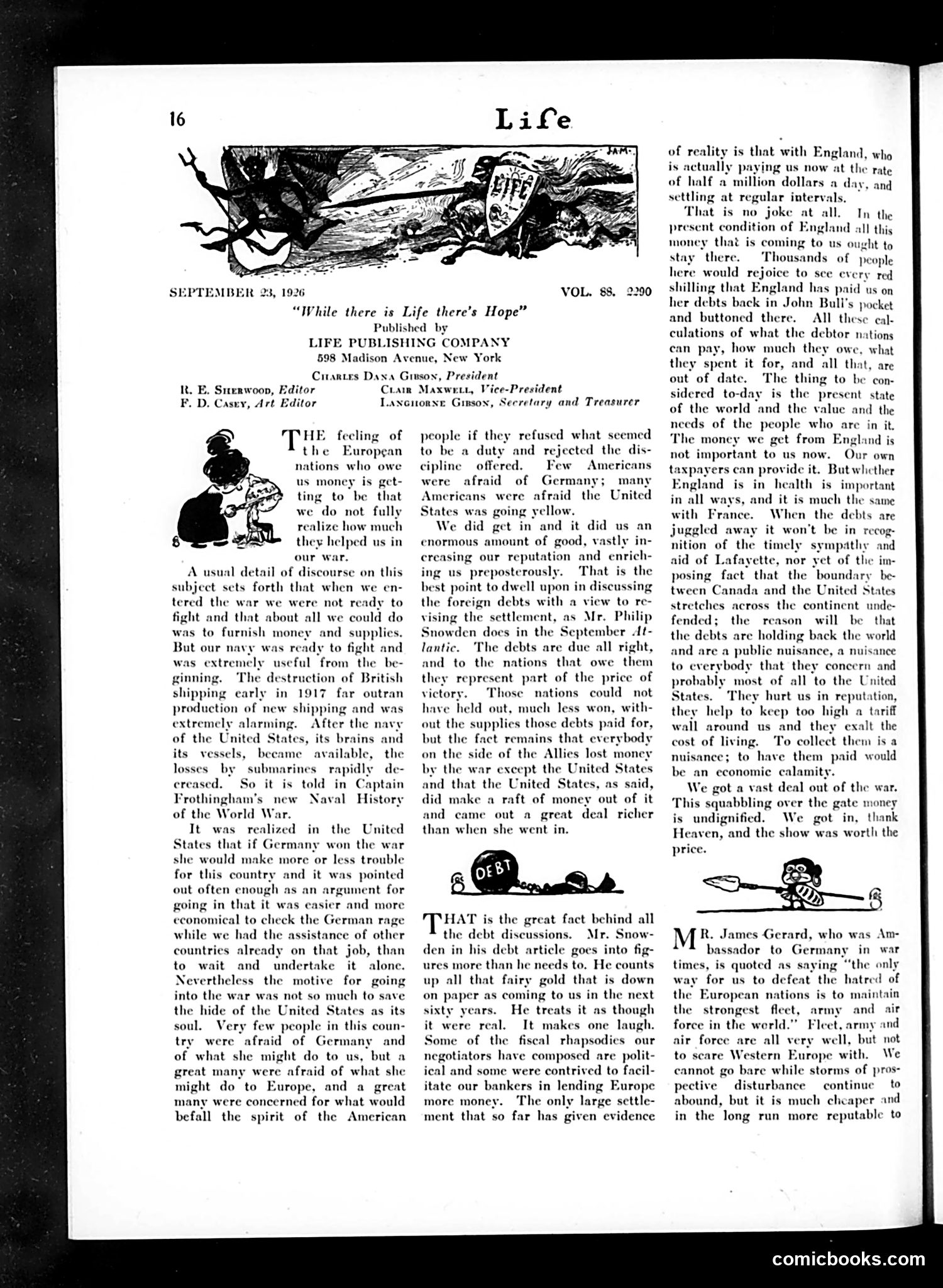
This page contains editorial commentary on post-World War I war debts owed by European nations to the United States. The text discusses whether America should forgive these debts or demand repayment. The small cartoon (labeled "DEBT") shows a figure buried or crushed under financial obligations—a visual metaphor for Europe's crushing war debt burden. The article argues that while Germans feared American economic power and some Americans feared Germany's potential resurgence, the real issue is Europe's unpaid debts. The author contends that collecting these debts is a "nuisance" but necessary, and that forgiving them would set a dangerous precedent for American creditors. The piece advocates maintaining a hard line on debt collection while acknowledging the political sensitivity of the issue.
📄 Transcribed text from this page (OCR, searchable)
Machine-transcribed from the original scan — historical spelling and the odd misread are preserved.
SEPTEMBER 23, 1926 “While there is Life there’s Hope” Published by LIFE PUBLISHING COMPANY 598 Madison Avenue, New York Crrartes Dasa Giuson, President R. E. Sierwoon, Editor F. D. Casey, Art Editor Lane HE. feeling of the European nations who owe us money is get- ting to be that we do not fully realize how much they helped us in our war. A usual detail of discourse on this subject sets forth that when we en- tered the war we were not ready to fight and that about all we could do was to furnish money and supplies. But our navy was ready to fight and was extremely useful from the be ginnin The destruction of British shipping early in 1917 far outran production of new shipping and w: extremely After the navy of the United States, its brains and its vessels, became available, the losses by submarines rapidly de- creased.” So it is told in Captain Frothingham’s new Naval History of the World War. It was realized in the United States that if Germany won the war she would make more or less trouble for this country and it was pointed out often enough as an argument for going in that it was easier and more cconomical to check the German rage while we had the assistance of other countries already on that job, than to wait and undertake it alone. Nevertheless the motive for going into the war was not so much to save the hide of the United States as its soul. Very few people in this coun- try were afraid of Germany and of what she might do to us, but a great many were afraid of what she might do to Europe, and a great many were concerned for what would befall the spirit of the American Cram Maxw: J -President onne Ginson, Secretary and Treasurer people if they refused what seemed to be a duty and rejected the dis- cipline offered. Few Americans were afraid of Germany; many Americans were afraid the United ates was going yellow. We did get in and it did us an enormous amount of good, vastly in- creasing our reputation and enrich- ing us preposterously. That is the best point to dwell upon in discussing the foreign debts with a view to re- vising the settlement, as Mr. Philip Snowden does in the September At- lantic. The debts are due all right, and to the nations that owe them they represent part of the price of victory. Those nations could not have held out, much less won, with- out the supplies those debts paid for, but the fact remains that everybody on the side of the Allies lost money by the war except the United States and that the United States, as said, did make a raft of money out of it and came out a great deal richer than when she went in. HAT is the great fact behind all the debt discussions. Mr. Snow- den in his debt article goes into fig- ures more than he needs to. He counts up all that fairy gold that is down on paper as coming to us in the next i He treats it as though real. It makes one laugh. Some of the fiscal rhapsodies our negotiators have composed are polit- ical and some were contrived to facil- itate our bankers in lending Europe more money. The only large scttle- ment that so far has given evidence it were of reality is that with England, who is actually paying us now at the rate of half a million dollars a day, and settling at regular interv: That is no joke at all. In the present condition of England all this money that is coming to us ought to stay there. Thousands of people here would rejoice to sce every red shilling that England has paid us on her debts back in John Bull's pocket and buttoned there. All these eal- culations of what the debtor nations can pay, how much they owe, what they spent it for, and all that, are out of date. The thing to be con- sidered to-day is the present. state of the world and the value and the needs of the people who are in it, The money we get from England is not important to us now. Our own taxpayers can provide it. But whether England is in health is important in all ways, and it is much the same with France. When the debts are juggled away it won't be in recog- nition of the timely sympathy and aid of Lafayette, nor yet of the im- posing fact that the boundary be- tween Canada and the United States stretches across the continent unde- fended; the will be that the debts are holding back the world and are a public nuisance, a nuisance to everybody t they concern and probably most of all to the United States. They hurt us in reputation, they help to keep too high a tariff wall around us and they exalt the cost of living. To collect them is a nuisance; to have them paid would be an economic calamity. We got a vast deal out of the This squabbling over the gate money is undignified. We got in, thank Heaven, and the show was worth the price. reason R. James Gerard, who was Am- bassador to Germany in war times, is quoted as saying “the only way for us to defeat the hatred of the European nations is to maintain the strongest fleet, army and ait force in the world.” Fleet, army and air force are all very well, but not to scare Western Europe with. We cannot go bare while storms of pros- pective disturbance continue to abound, but it is much cheaper and in the long run more reputable to comicbooks.com