
A complete issue · 36 pages · 1926
Life — August 12, 1926
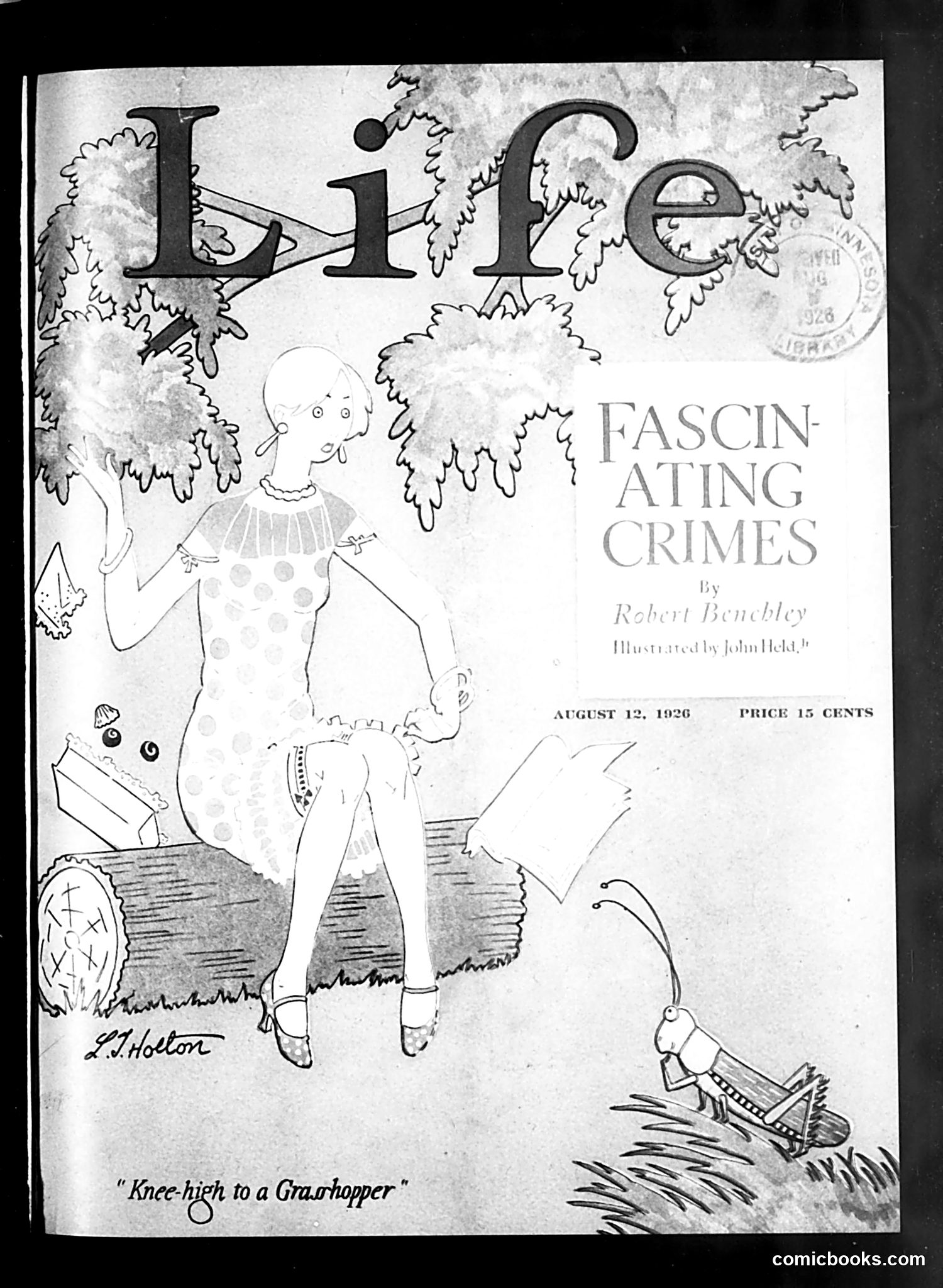
This is the cover for "Life" magazine's issue featuring "Fascinating Crimes" by Robert Benchley, illustrated by John Held Jr. The central cartoon depicts a flapper-style woman in 1920s dress standing in a woodland setting with a grasshopper nearby. The caption reads "Knee-high to a Grasshopper." The image appears to be a humorous visual pun or wordplay joke typical of 1920s satirical illustration. The woman's pose and the exaggerated grasshopper suggest a playful take on the phrase. This reflects the era's characteristic wit and the magazine's focus on contemporary social commentary, fashion, and absurdist humor that appealed to urban readers during the Jazz Age.
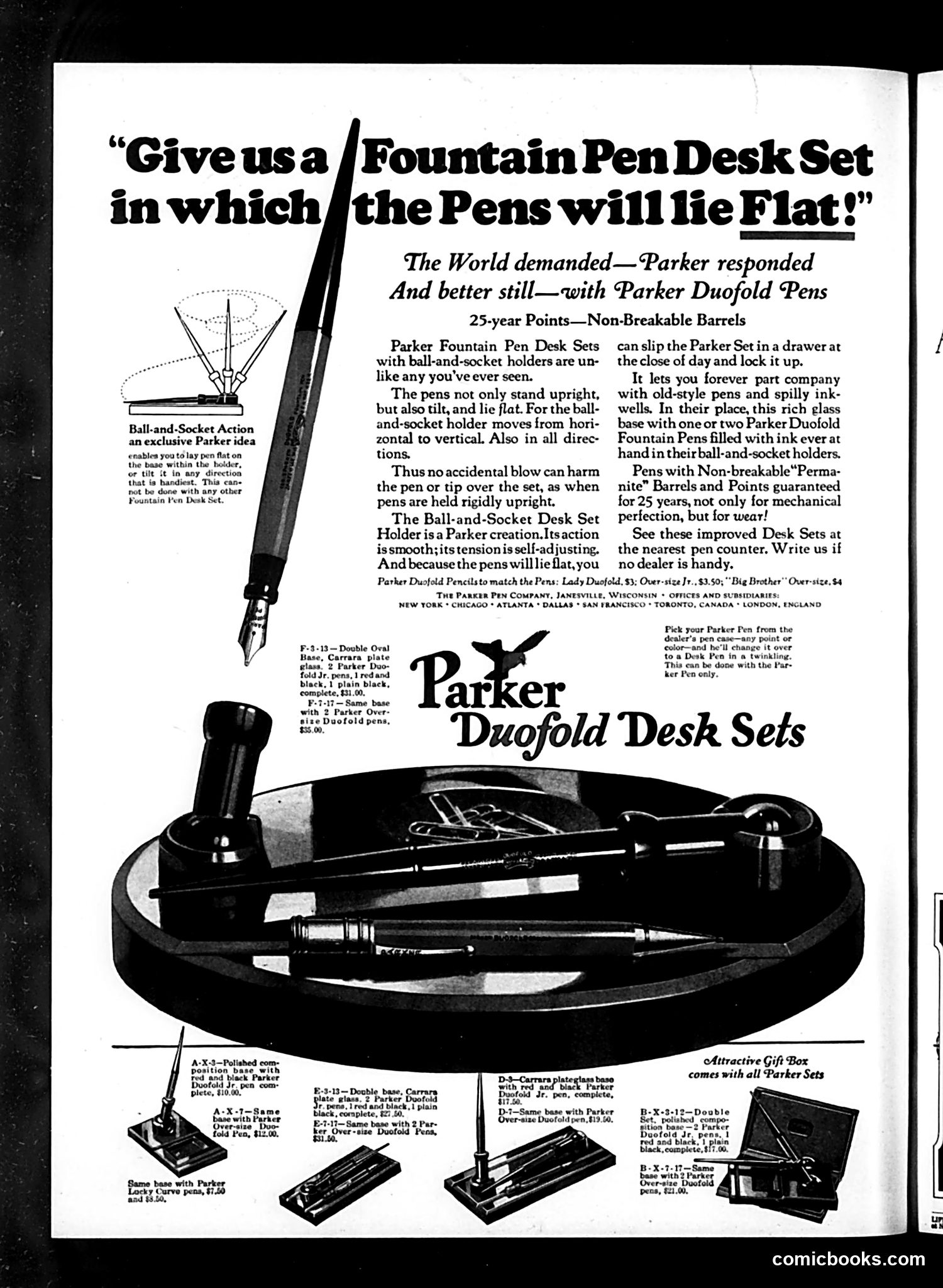
This is **not a satirical cartoon page** but rather a **vintage advertisement** for Parker Duofold fountain pen desk sets, likely from the 1920s-1930s based on the styling and typography. The ad responds to a consumer demand: "Give us a Fountain Pen Desk Set in which the pens will lie Flat!" Parker's solution features a ball-and-socket holder mechanism allowing pens to rest horizontally while remaining upright in the holder. The copy emphasizes practical benefits: non-breakable barrels, self-adjusting tension, and a 25-year guarantee. Multiple desk set configurations are displayed at bottom with price variations. This is commercial marketing, not satire—no political commentary or social critique is present. The page functions as a product catalog page.
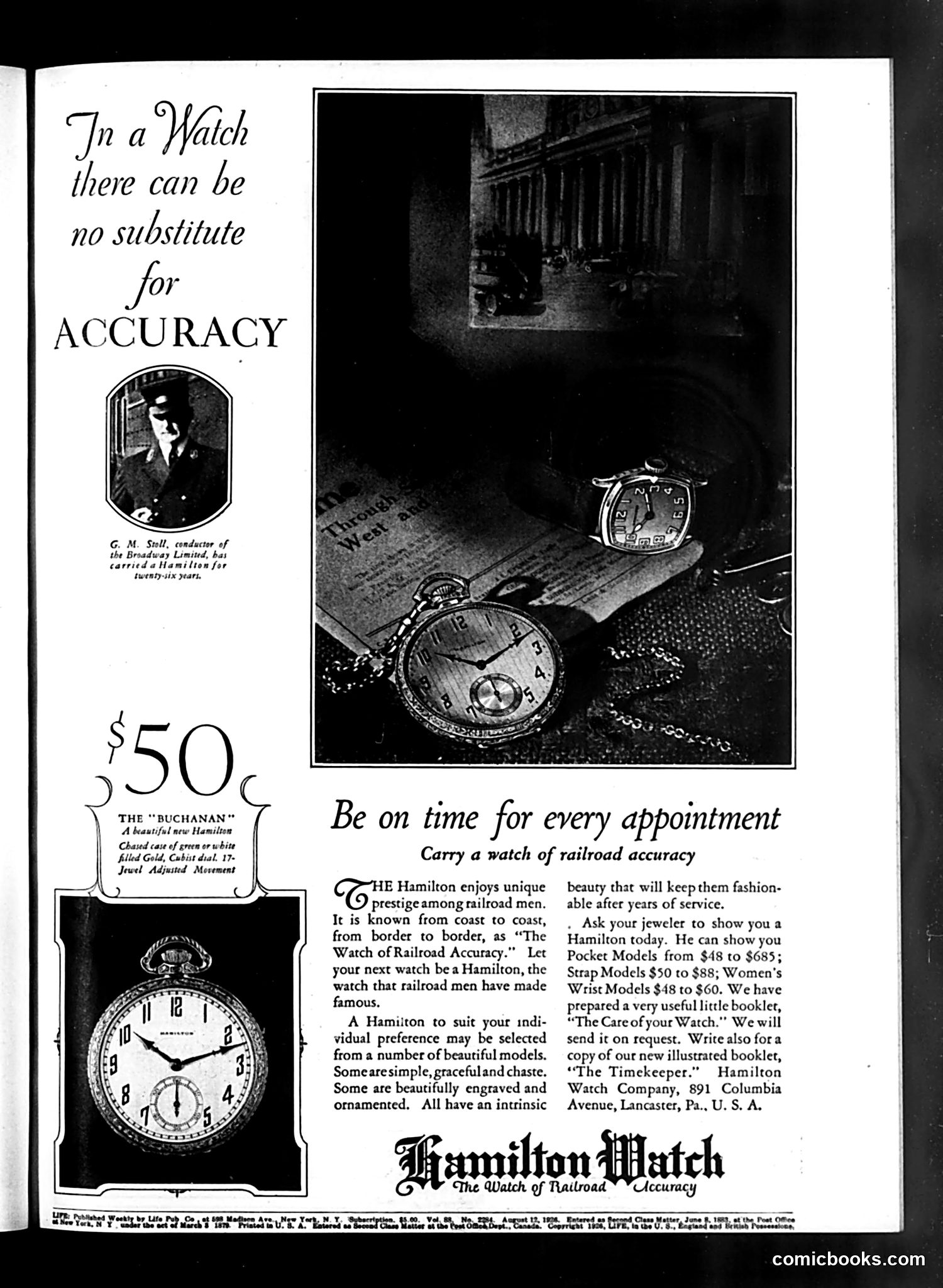
This is primarily a **Hamilton Watch Company advertisement**, not political satire. The page promotes Hamilton pocket watches and wristwatches marketed to railroad workers and professionals who need precise timekeeping. The advertisement features: - A testimonial from G.M. Stull, a Broadway Limited conductor who has carried a Hamilton for twenty-five years - Images of two Hamilton watches (pocket watch and wristwatch models) - The tagline "The Watch of Railroad Accuracy" The appeal is to **professional reliability and prestige**—Hamilton watches were marketed as the standard timepiece for railroad employees, whose job depended on precise scheduling. The phrase "no substitute for accuracy" emphasizes this professional necessity. Pricing ranges from $48 to $685 depending on model. This represents typical early-20th-century trade advertising in *Life* magazine.
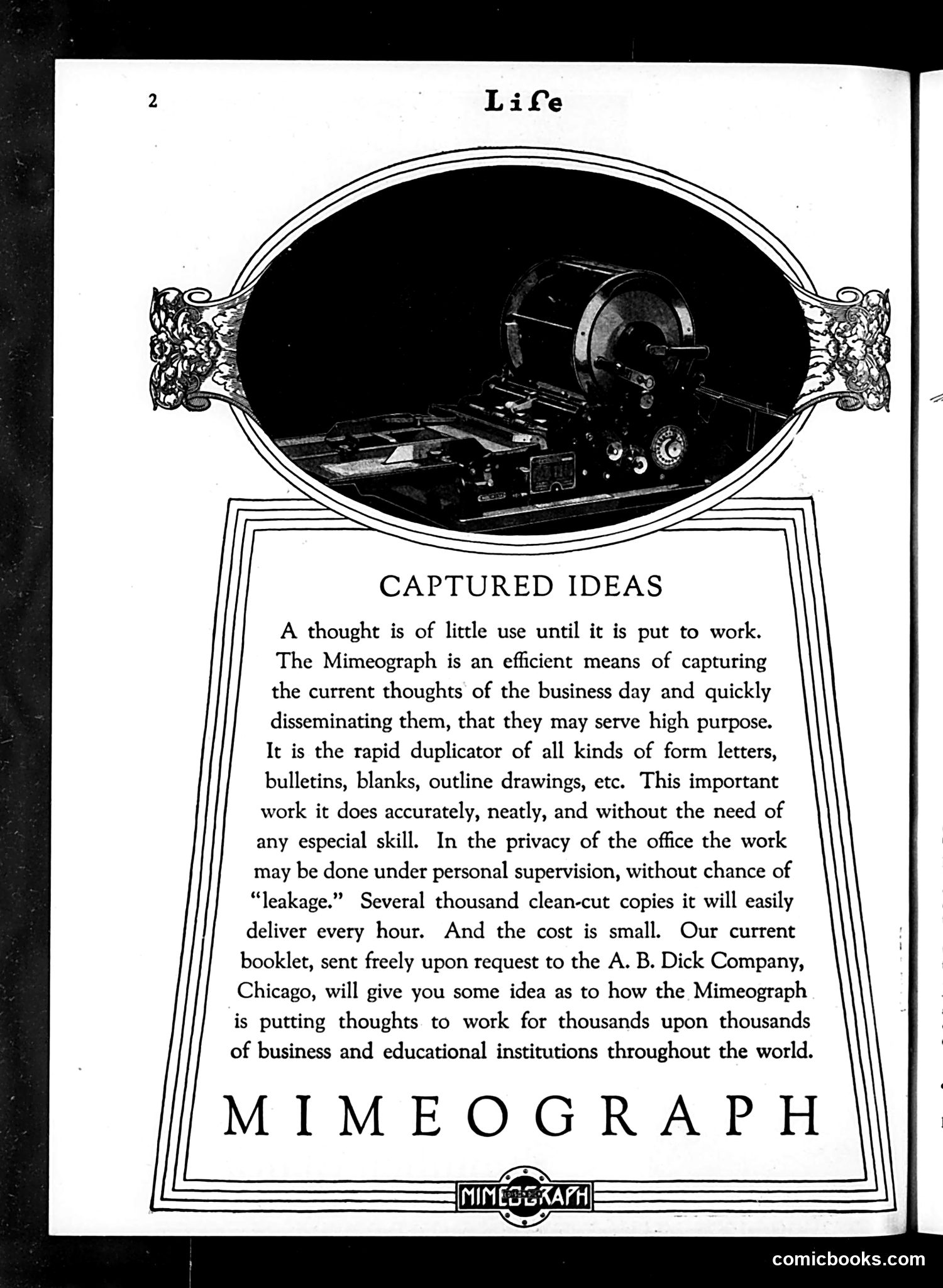
This page is primarily **advertising, not satire or editorial content**. It's a full-page advertisement for the Mimeograph machine by the A.B. Dick Company of Chicago. The ad uses the headline "CAPTURED IDEAS" to promote the mimeograph as a business tool for duplicating documents efficiently and privately. The accompanying image shows the mechanical device itself. The marketing pitch emphasizes practical benefits: rapid copying of letters, bulletins, and drawings without special skill, with low cost and high output (thousands of copies hourly). The ad promises confidentiality for office work and directs readers to request a booklet from A.B. Dick. This represents early 20th-century office technology marketing rather than political or social commentary.
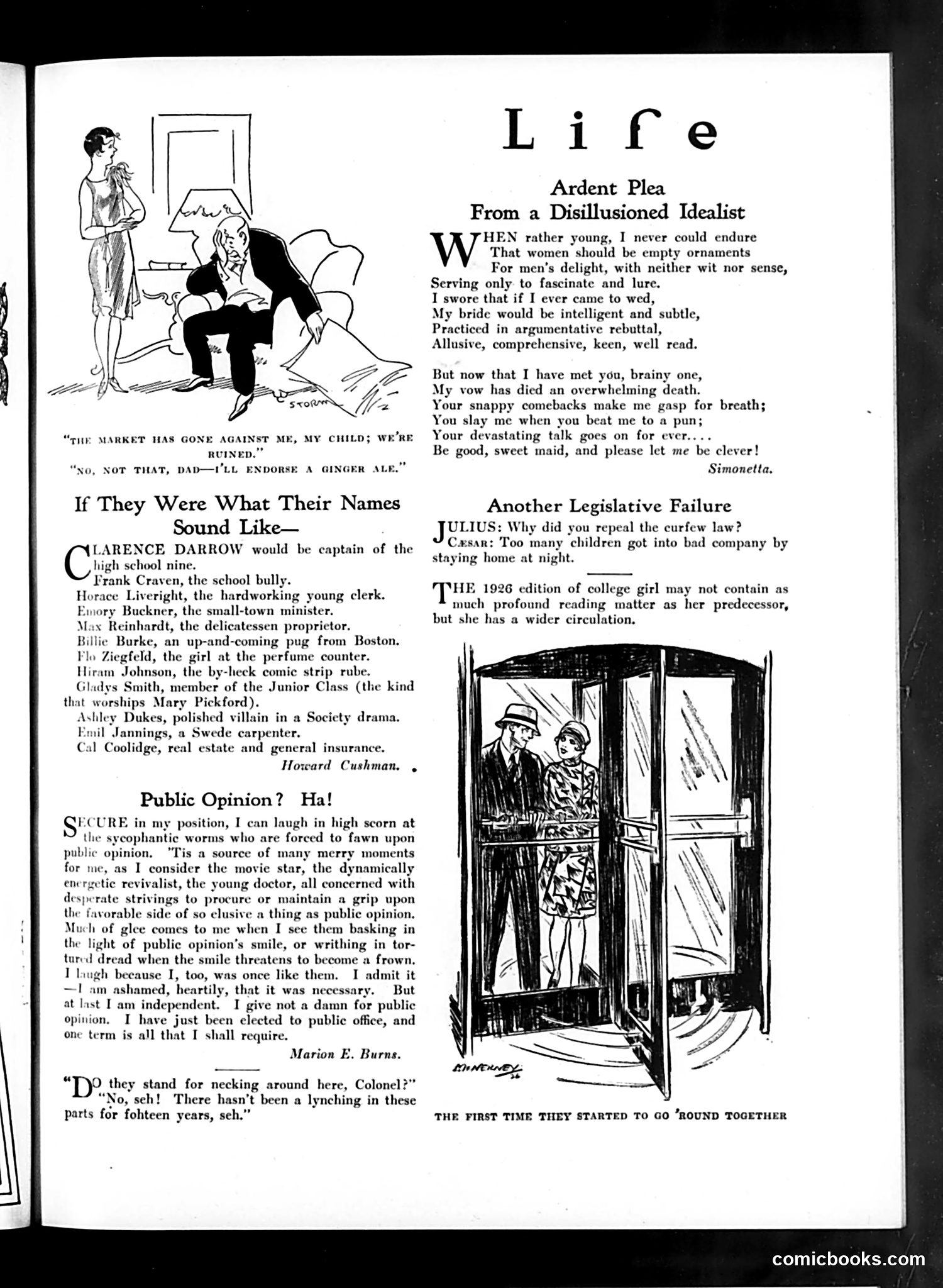
This page contains satirical humor pieces typical of 1920s Life magazine. The main cartoon shows a disgruntled man in a chair while a woman stands nearby—illustrating "Ardent Plea From a Disillusioned Idealist," where the speaker laments his bride isn't the intellectual companion he imagined. The satire mocks romantic idealism meeting marital reality. "If They Were What Their Names Sound Like" humorously redefines names (Clarence Darrow as "captain of the high school nine," etc.), typical wordplay humor of the era. "Public Opinion? Ha!" presents a cynical monologue about dismissing public opinion—reflecting 1920s intellectual skepticism toward mass sentiment. The bottom illustration shows a couple on their first outing together, captioned with romantic undertones. Overall, these pieces satirize romance, marriage, and social pretensions.
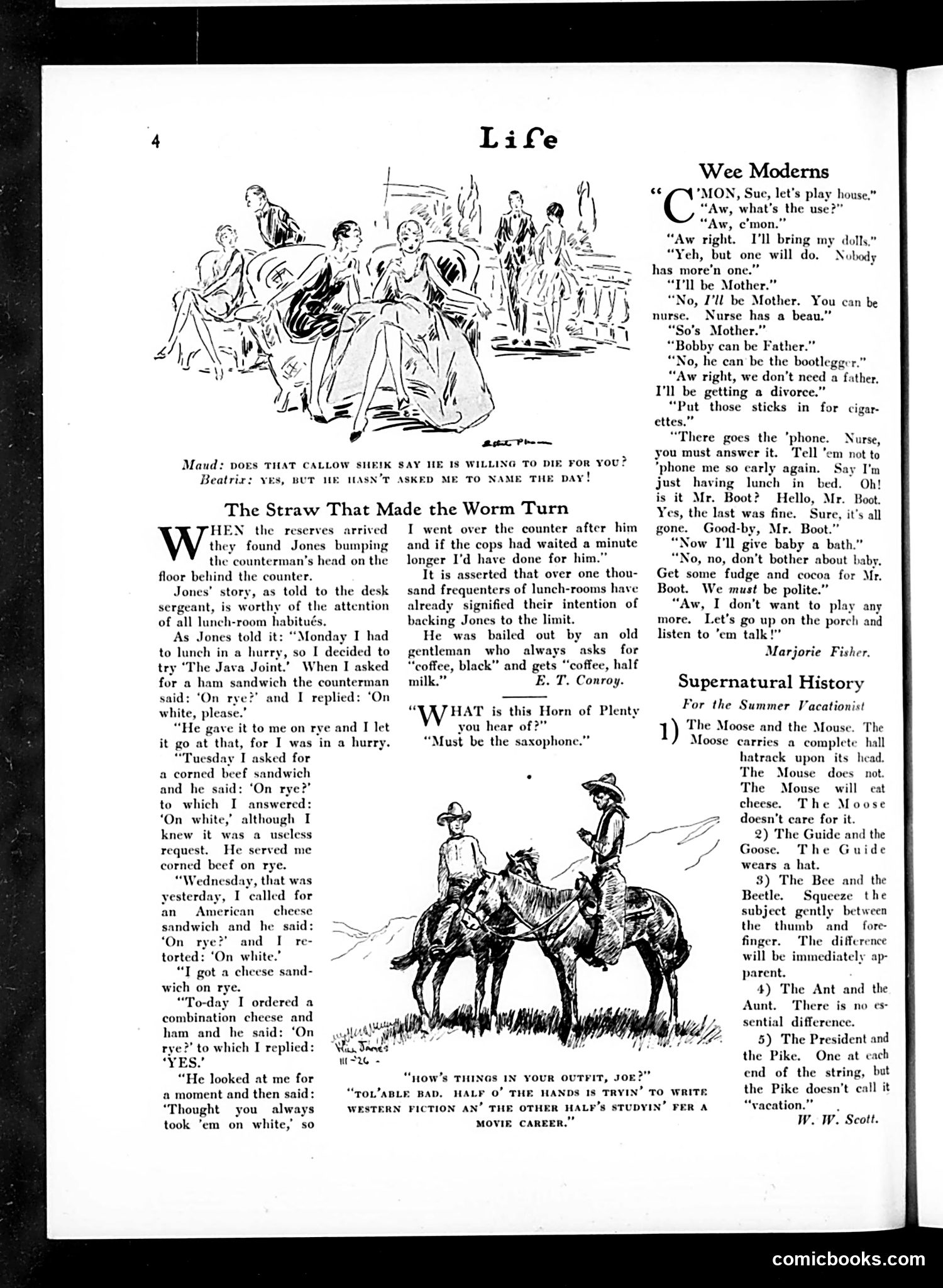
This page contains three separate humor pieces from Life magazine: 1. **"Wee Moderns"** (top right): A dialogue satirizing modern children's progressive attitudes. Kids reject traditional family roles—refusing to play "Mother" or "Father," with one declaring "I'll be getting a divorce." The satire targets what the era viewed as dangerously modern, independent-minded youth abandoning conventional family structures. 2. **"The Straw That Made the Worm Turn"** (center): A humorous anecdote about a lunch-counter customer repeatedly requesting rye bread, only to be served white. The joke mocks both the customer's persistence and the counterman's stubbornness—everyday frustration rendered absurd through escalation. 3. **"Supernatural History"** (right): Whimsical definitions of animal pairs (Moose and Mouse, Guide and Goose, etc.), playing on "supernatural" as natural history absurdities for summer vacation entertainment.
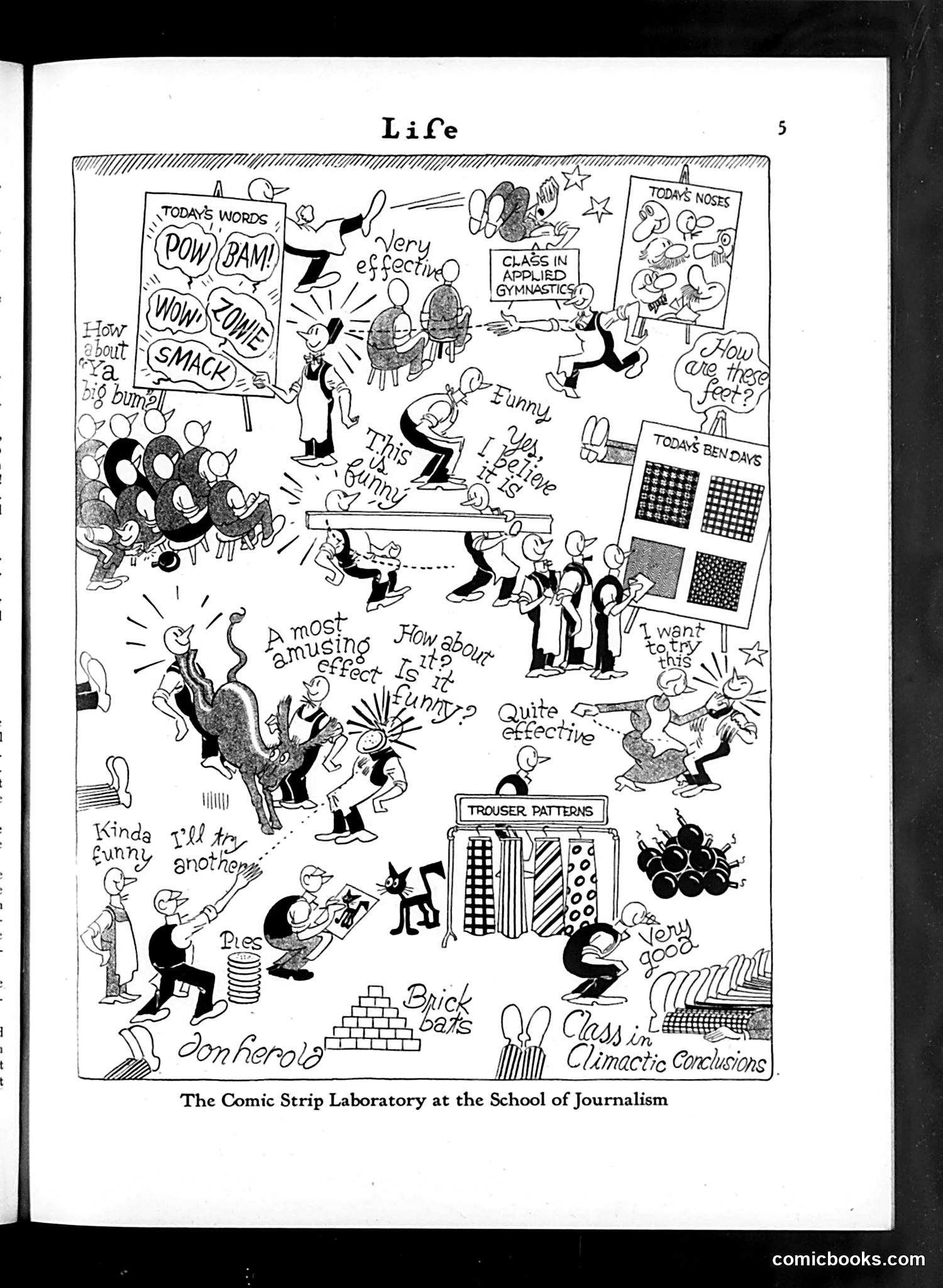
This page is titled "The Comic Strip Laboratory at the School of Journalism" and appears to be a humorous guide to comic strip techniques and conventions. Rather than political satire, it's instructional satire aimed at aspiring cartoonists. The page demonstrates various comic strip elements: "Today's Words" (onomatopoeia like "POW" and "BAM"), "Today's Noses" (character design variations), "Today's Bending" (action poses), and "Trouser Patterns" (clothing design shortcuts). Text annotations include jokes about comic strip clichés: "Very effective," "Funny," "This is funny," "Most amusing effect," and "Kinda silly." Characters demonstrate exaggerated gymnastics, slapstick violence, and standardized poses. The satire mocks how mass-produced comics rely on repetitive formulas, stock expressions, and visual shortcuts rather than originality—critiquing commercial comic strip production's mechanical, formulaic nature.
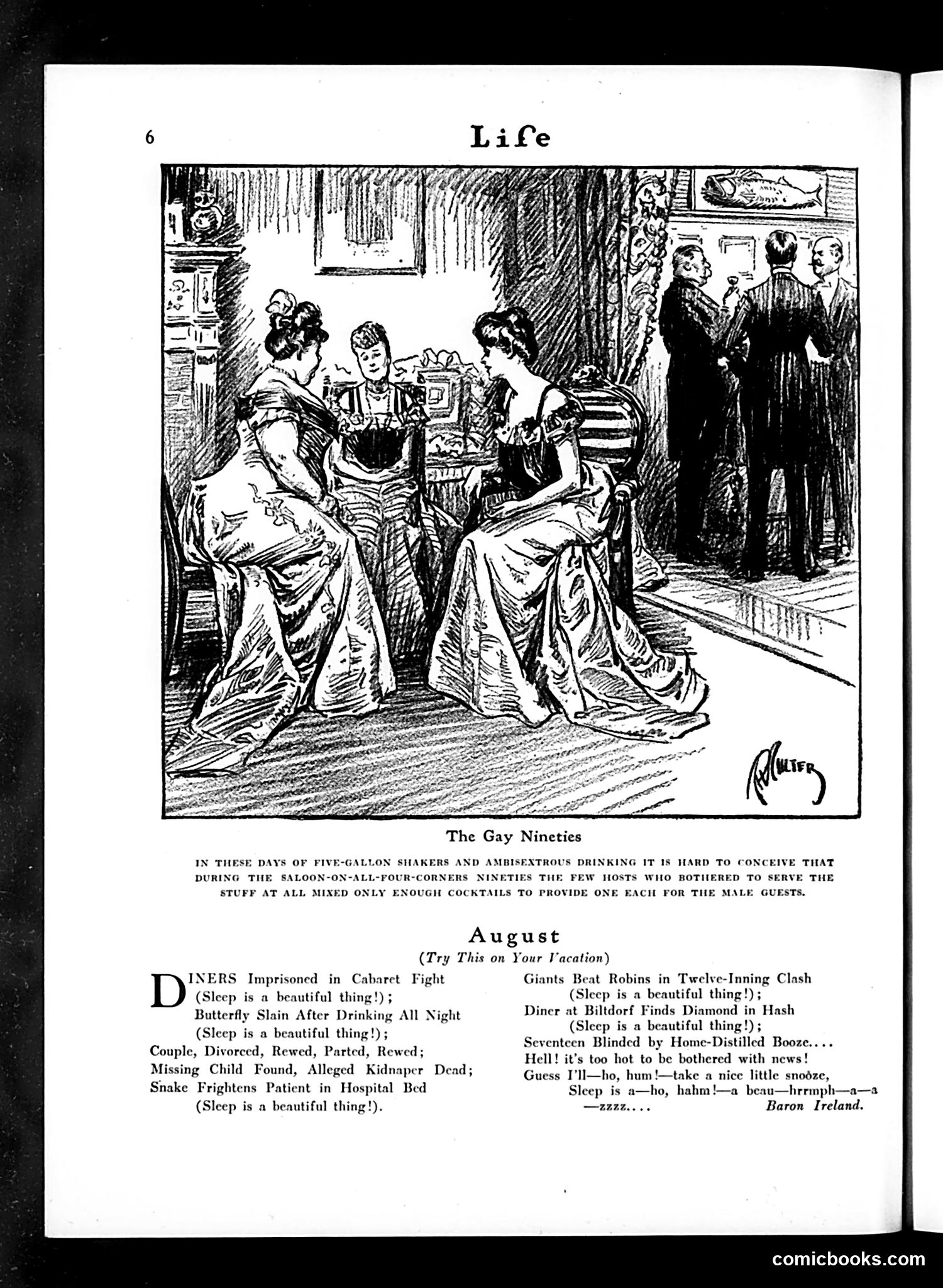
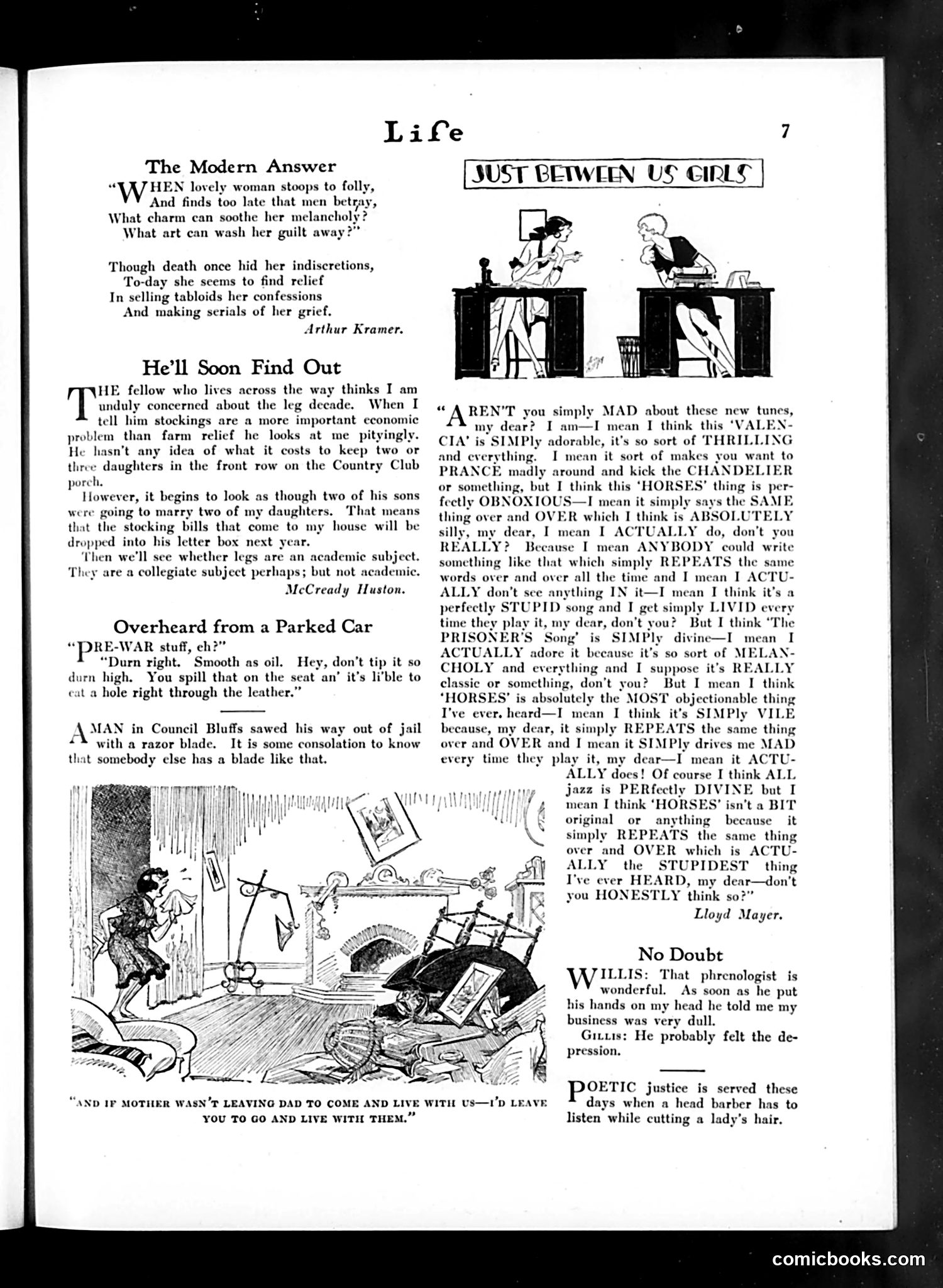
This page contains satirical commentary on 1920s social issues and popular culture: **"The Modern Answer"** — A poem mocking a woman seeking absolution for infidelity, suggesting contemporary society offers shallow solutions (selling tabloid confessions) rather than genuine moral redemption. **"He'll Soon Find Out"** — Satirizes a man's economic obliviousness regarding the costs of courtship and marriage, particularly regarding daughters' social obligations. **"Just Between Us Girls"** — Features two women at desks discussing modern jazz music (specifically songs like "Horses" and "Prisoner's Song"), with one woman sarcastically criticizing the repetitive, melancholic nature of contemporary popular songs. **"Overheard from a Parked Car"** and the accompanying cartoon mock marital disputes and domestic financial tensions. The page reflects Jazz Age anxieties about changing morality, gender roles, consumerism, and popular music culture.
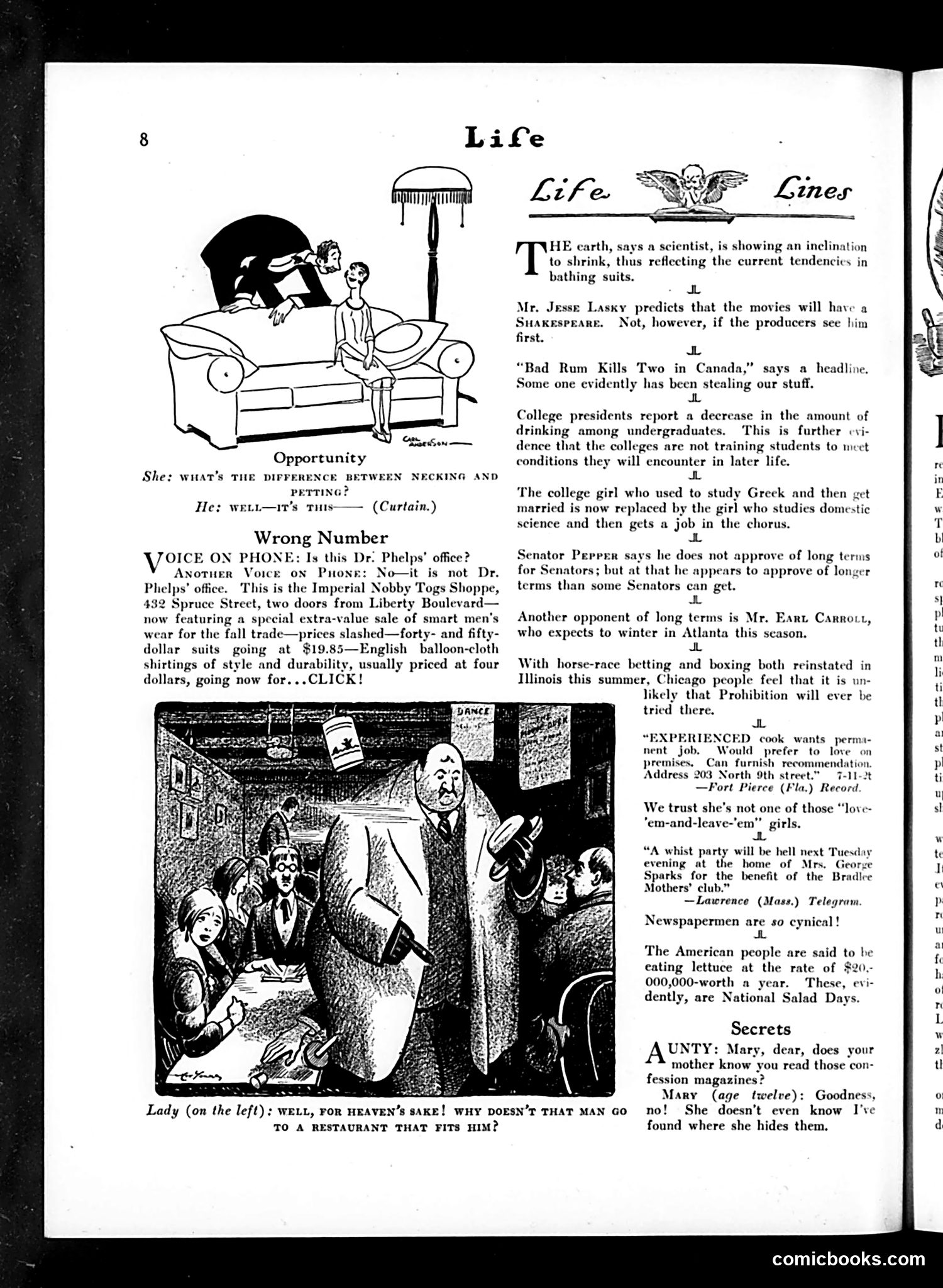
This page contains humor and social commentary typical of early 20th-century Life magazine. **"Opportunity" cartoon**: Shows a woman on a large sofa with a man, referencing the distinction between "necking" and "petting"—period slang for levels of physical intimacy. The joke plays on dating behavior of the era. **"Wrong Number" section**: A humorous phone mix-up at Dr. Phelps' office, with an advertisement for men's suits at discounted prices. **Main cartoon**: Depicts a well-dressed man at what appears to be a crowded, modest establishment (possibly a speakeasy during Prohibition), with the caption sarcastically asking why he doesn't go to a proper restaurant. The satire comments on social class and where different people dine. The "Life Lines" section contains brief social observations about college drinking, long political terms, and dating trends.
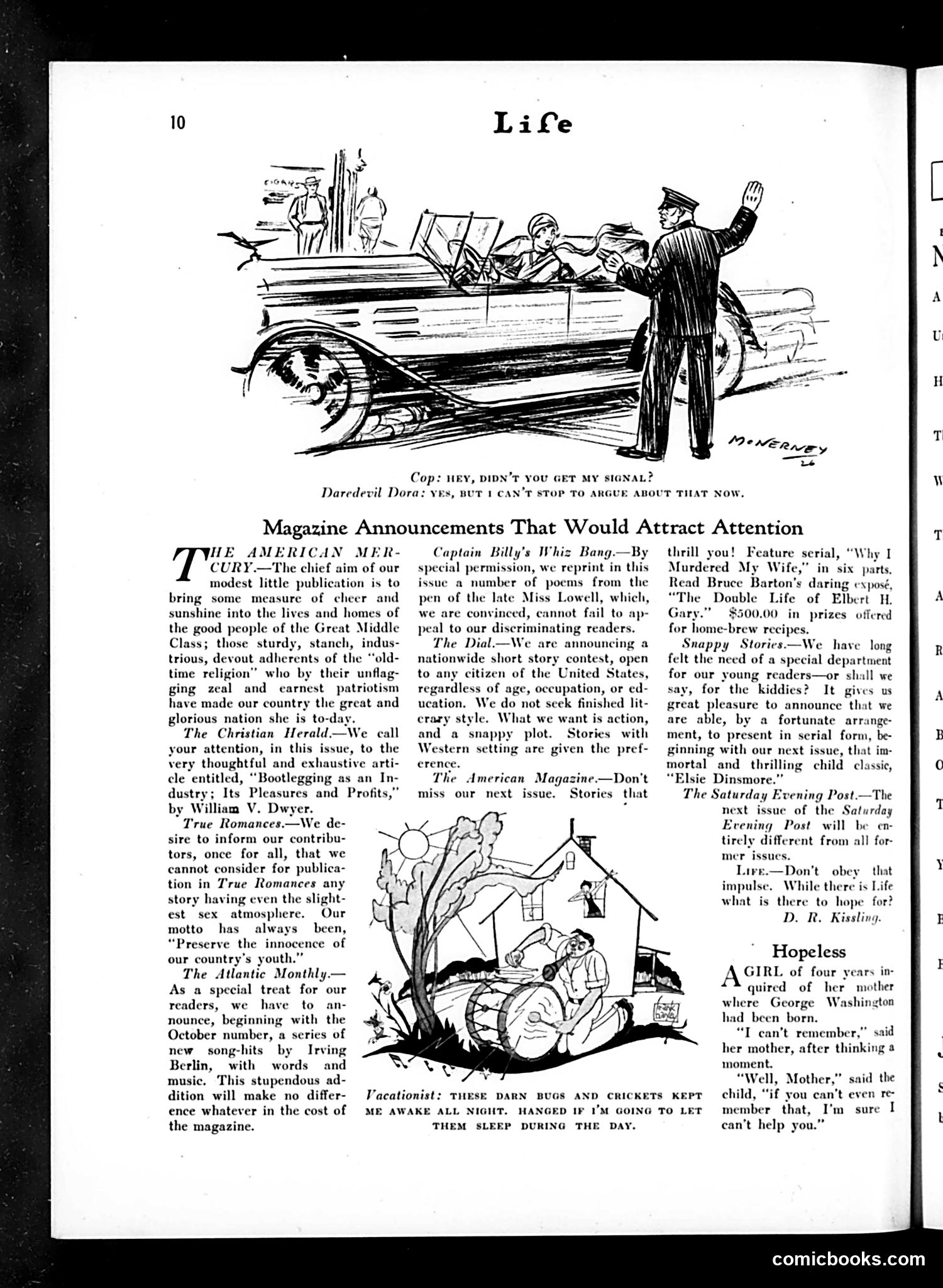
The top cartoon depicts a traffic stop where a police officer signals a driver who appears to be operating an early automobile. The caption reads: "Cop: HEY, DIDN'T YOU GET MY SIGNAL? Daredevil Dora: YES, BUT I CAN'T STOP TO ARGUE ABOUT THAT NOW." This satirizes early 1900s motorist behavior—specifically reckless drivers ignoring traffic signals. "Daredevil Dora" appears to be a female driver, reflecting contemporary anxieties about women operating automobiles. The joke mocks both dangerous speeding and the dismissive attitude of careless motorists toward law enforcement. The remainder of the page contains magazine announcements and fiction advertisements, not political satire.
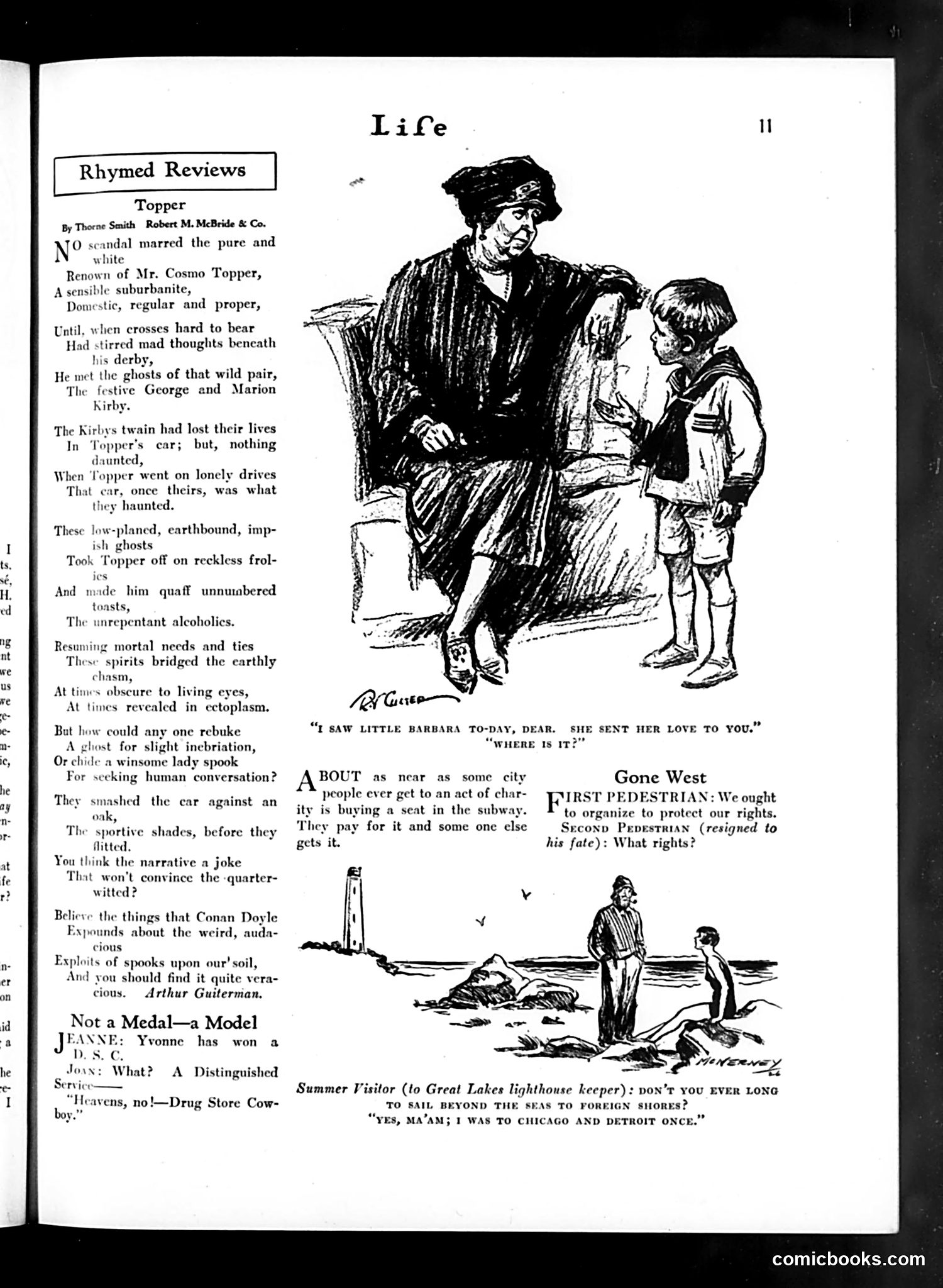
This page contains three distinct pieces of humor content: **"Topper"** (rhymed review by Thorpe Smith): A satirical poem mocking a suburban character named Cosmo Topper who encounters ghosts of "festive George and Marion Kirby" during lonely car drives. The joke plays on the supernatural elements disrupting mundane suburban life. **"Gone West"** (cartoon): Depicts a lighthouse keeper and child on a barren shore. The humor involves a summer visitor bragging about visiting Chicago and Detroit, with the keeper's sardonic response suggesting these industrial cities are less exotic than claimed. **"Not a Medal—a Model"** (brief joke): A wordplay exchange where "Yvonne has won a D.U.S.C." is misheard as "Distinguished Service" when it's actually a "Drug Store Cowboy"—mocking shallow achievements. All pieces reflect 1920s-30s era American humor focused on suburban life, travel pretension, and social status.
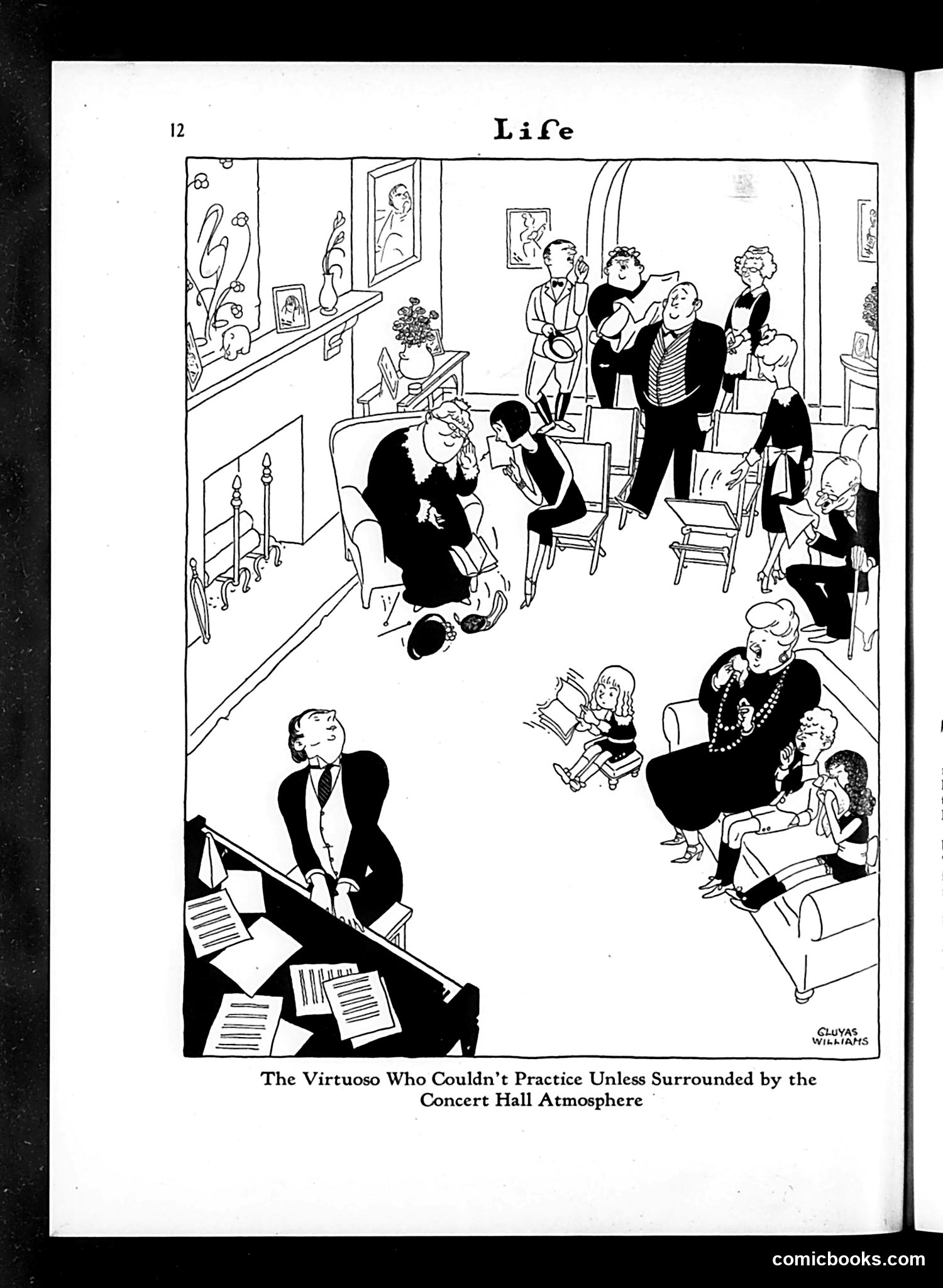
This single-panel cartoon by Cluyas Williams satirizes an overly particular musician's need for elaborate staging to practice. The scene depicts a violin player in a formal living room surrounded by an audience sitting in chairs—recreating a concert hall environment within a home. The joke targets artistic pretension: the "virtuoso" apparently cannot simply practice their instrument in normal domestic conditions but requires the full trappings of a concert performance—formal dress, seated spectators, elegant furnishings—to work productively. This appears to mock both affected artistic temperament and the absurdity of someone who prioritizes atmosphere and appearance over actual musical discipline and practice.
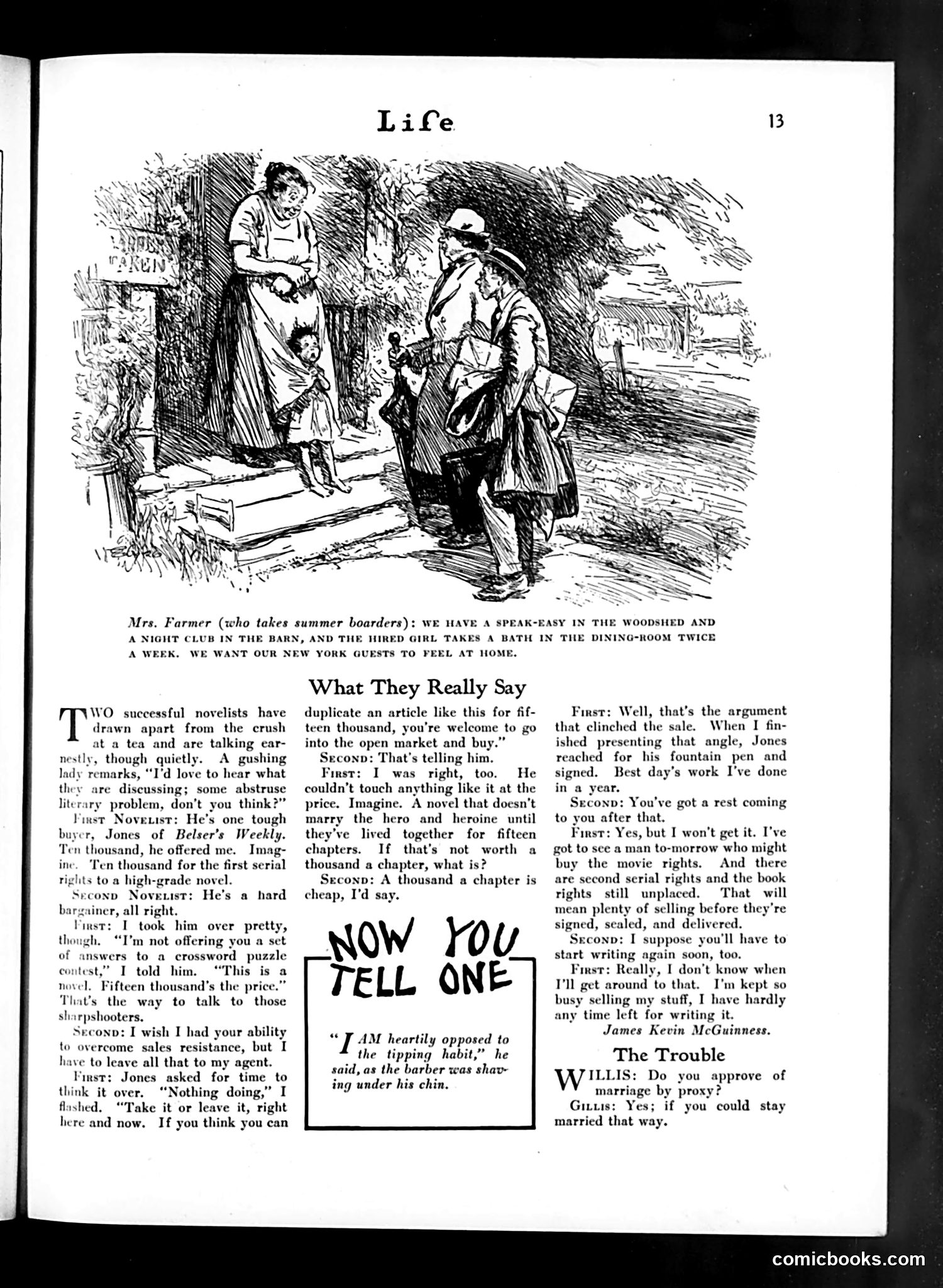
This page from *Life* magazine satirizes literary commerce and author negotiations. The top illustration shows a farmwoman greeting two traveling salesmen, with text mocking summer boarders and rural hospitality. The main content—"What They Really Say"—contrasts polite euphemisms with crude negotiations between novelists and publishers. First Novelist claims to have rejected a lucrative offer to preserve artistic integrity, while Second Novelist openly acknowledges selling serial rights for money. The satire exposes the gap between authors' public claims of artistic purity and their actual mercenary motivations. The boxed quote about tipping barbers adds another layer of middle-class hypocrisy. The final section, "The Trouble," presents a brief comic exchange on proxy marriage, likely referencing contemporary marriage law debates. The satire targets author pretension and commercial dishonesty in publishing.
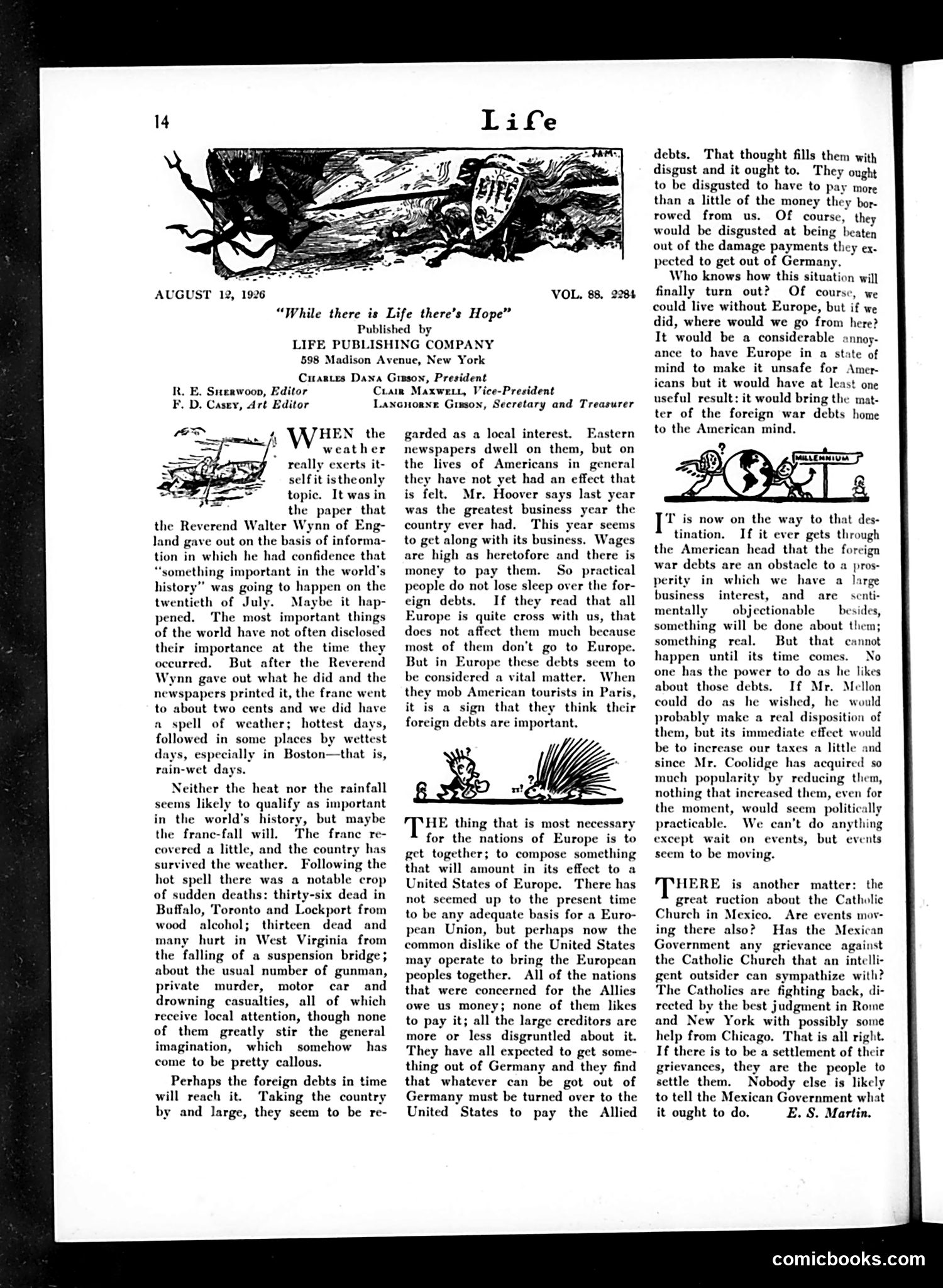
This editorial page discusses post-WWI European war debts owed to America. The main cartoon (top) depicts Death as a skeletal figure emerging from a coffin marked "1914"—representing casualties from World War I. The article argues that European nations, while concerned about repaying American loans, seem indifferent to the human cost of the war itself. The writer suggests that if European debts prove insurmountable, America should accept this rather than expect payment that might destabilize Europe economically. The second smaller cartoon (middle-right) appears to show a porcupine—likely representing America's defensive posture regarding debt collection. The satire critiques both European financial irresponsibility and American insistence on repayment, questioning whether monetary concerns should override post-war reconstruction priorities.
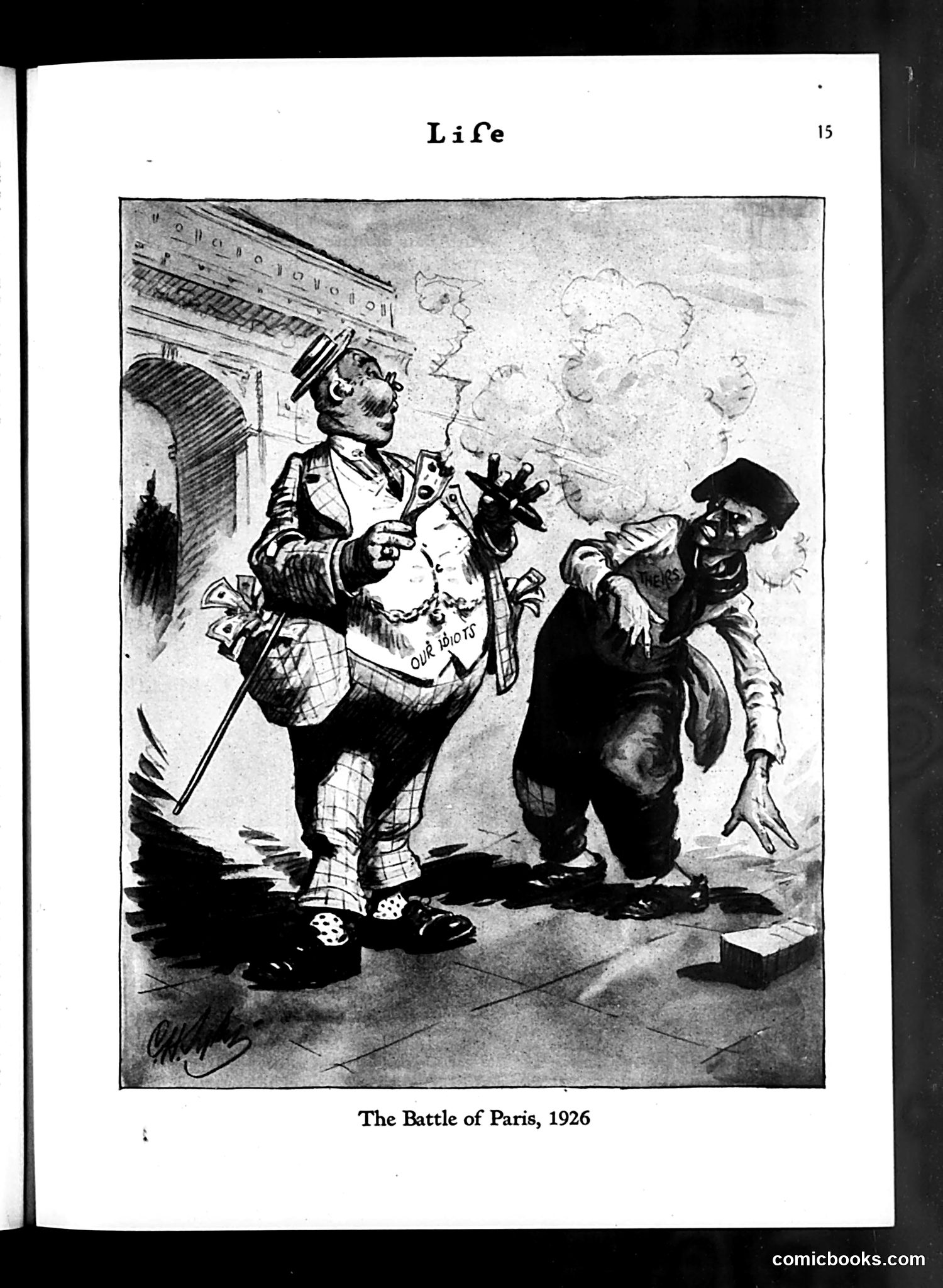
This cartoon satirizes a commercial or cultural conflict occurring in Paris in 1926. The central figure—a well-dressed man with an exaggerated profile wearing a top hat—appears to be labeled "Our Halo" (visible on his clothing). He's engaged in what looks like a confrontation with a smaller, less refined figure on the right. The "battle" likely references competitive tensions between American and European commercial interests or cultural influence during the 1920s. The caricatured styles and exaggerated features suggest commentary on class, nationality, or business rivalry. The exact identities of the figures remain unclear without additional context, though the American-styled dress of the central figure suggests he represents American commercial interests invading or competing in Paris.
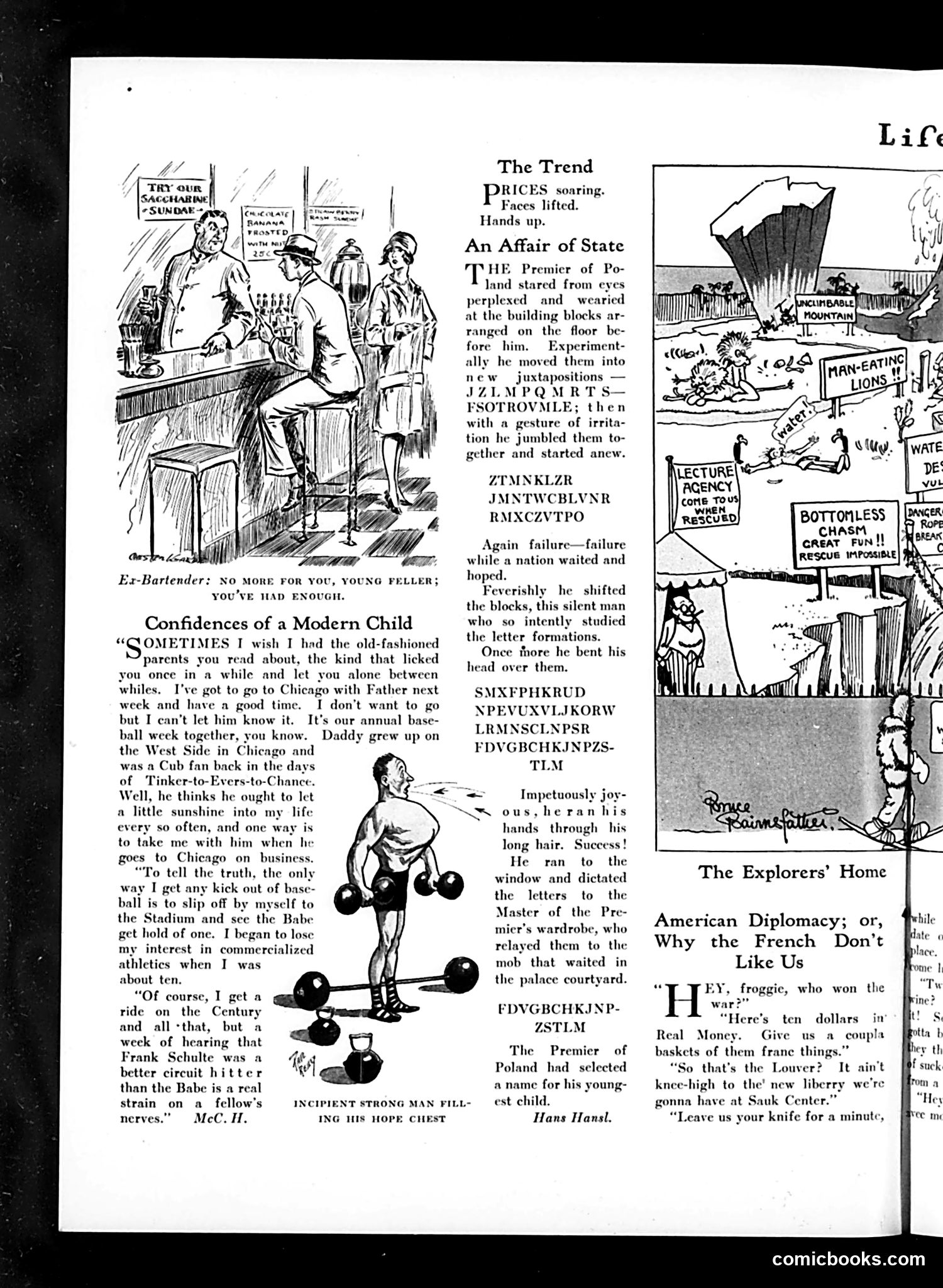
This page contains three distinct pieces of satire: 1. **"Ex-Bartender"** (top left): A cartoon mocking a bartender being ejected, likely referencing Prohibition-era tensions around alcohol service. 2. **"Confidences of a Modern Child"** (center): A monologue from a child describing recreational activities with their father, contrasting old-fashioned parenting with modern approaches. The father mentions growing up in Chicago as a Cubs fan, suggesting this reflects 1920s-30s American leisure culture and changing parenting philosophies. 3. **"American Diplomacy"** (bottom right): Tourists mockingly discussing French culture, with the caption's French phrase suggesting Americans' dismissive attitudes toward European sophistication—satirizing American cultural attitudes abroad. The scrambled letter sequences appear to be typographical jokes or coded messages characteristic of Life's experimental humor style.
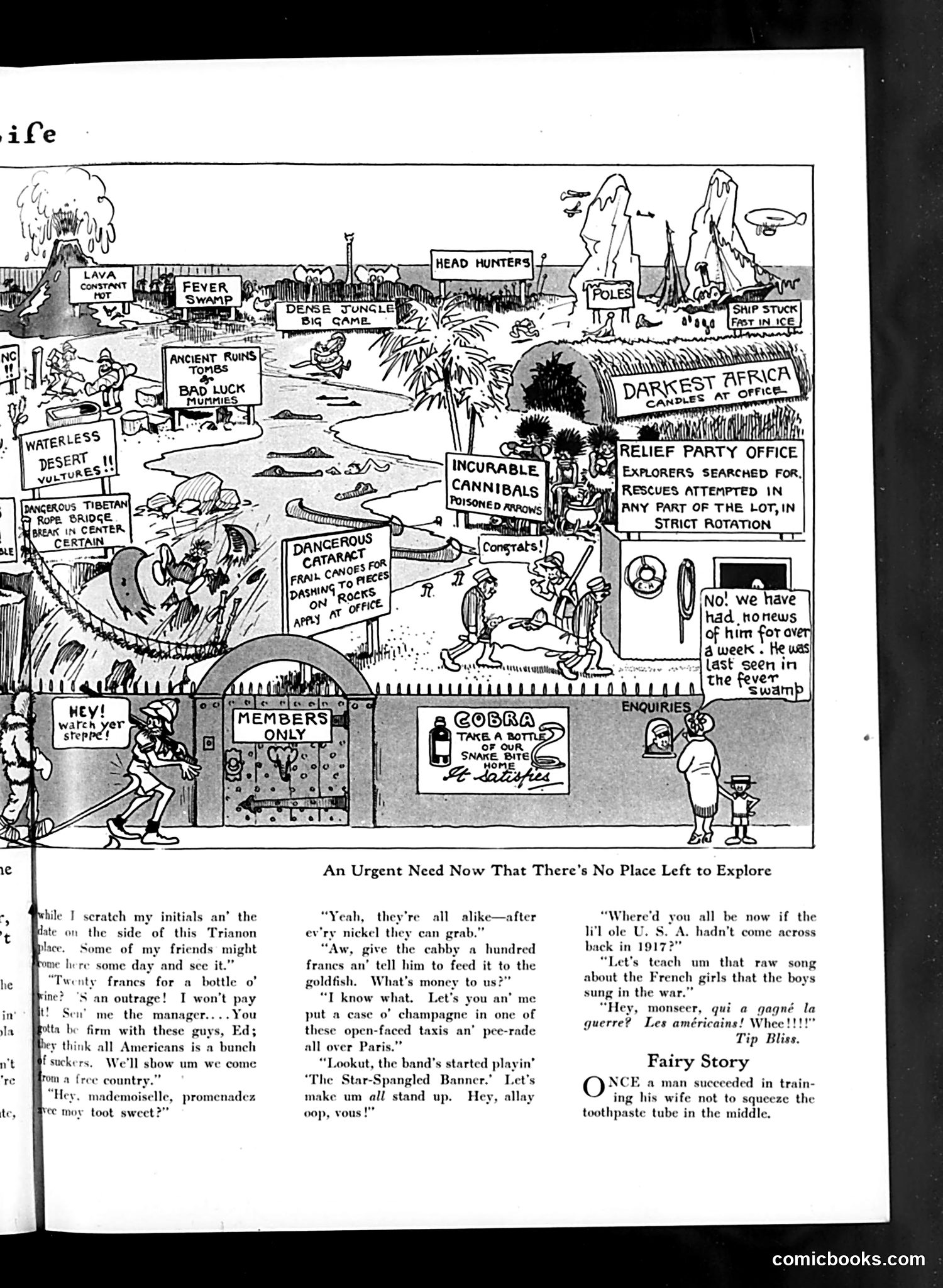
This page satirizes American tourists in post-WWI Paris. The main comic strip depicts wealthy Americans abroad behaving arrogantly and boorishly—throwing money around carelessly, demanding service in broken French, and boasting about America's role in winning World War I ("Where'd you all be now if the li'l ole U.S.A. hadn't come across back in 1917?"). The humor targets American cultural stereotypes: ignorance of foreign customs, loud behavior, excessive spending, and jingoistic superiority. Phrases like "all Americans is a bunch of suckers" (spoken by the tourists themselves) and their condescending attitude toward French people reinforce the mockery. The surrounding satirical "attractions" (Head Hunters, Incurable Cannibals, Darkest Africa) mock the era's exotic tourist destinations and colonial attitudes. The small "Fairy Story" at bottom—about training a wife not to squeeze toothpaste—provides light domestic humor, unrelated to the main satire. Overall, Life magazine uses this to critique American travelers' behavior and attitudes during the prosperous 1920s.
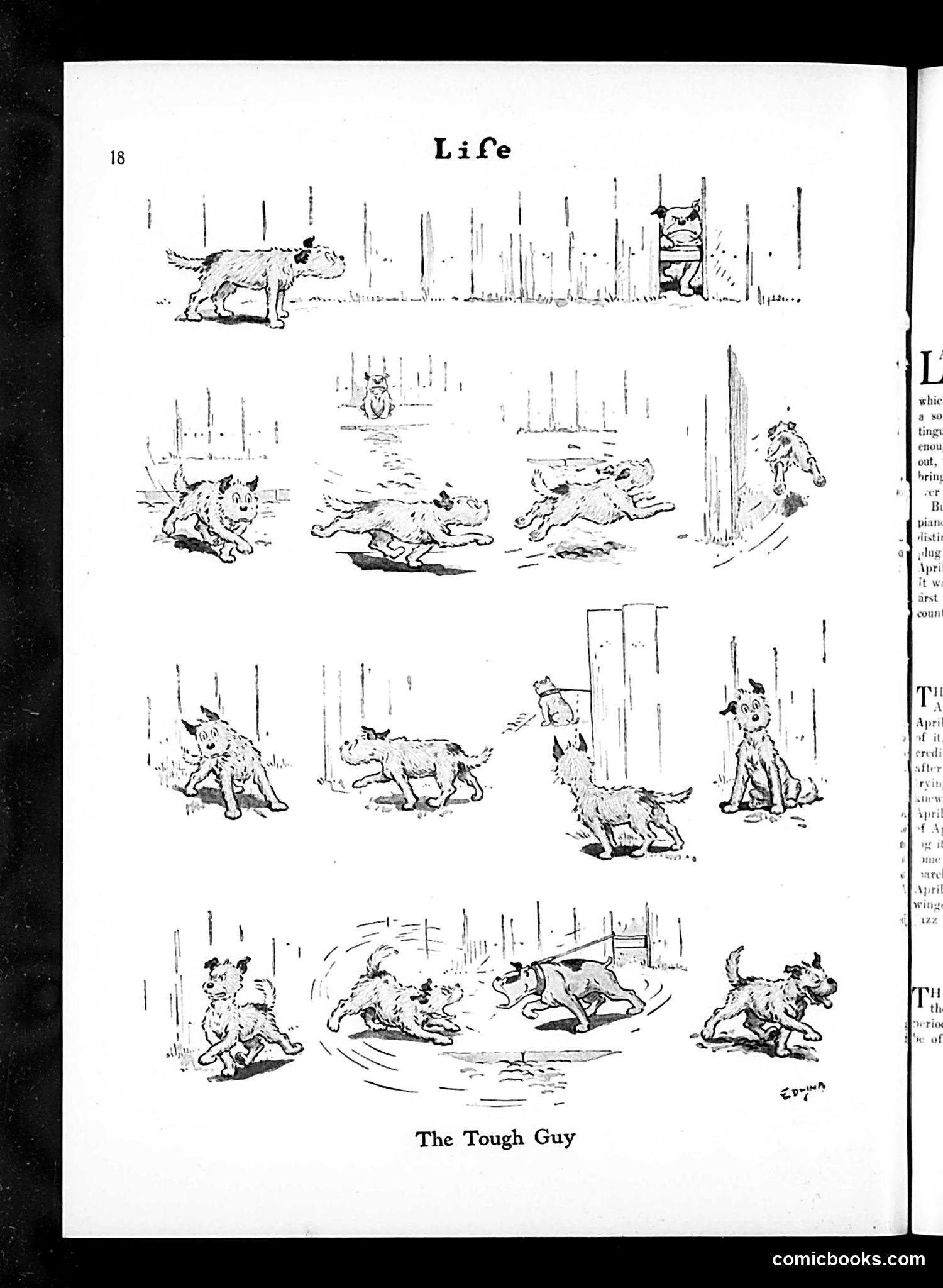
This page presents a sequential comic strip titled "The Tough Guy" featuring a scrappy, aggressive dog character in various confrontational situations. The strip depicts the dog getting into fights and altercations with other animals and potentially people, showing increasingly rowdy behavior across multiple panels. The satire appears to mock the archetype of the "tough guy" — a character who relies on aggression and fighting as their primary means of interaction. Through the dog's increasingly absurd and exaggerated confrontations, the cartoonist humorously critiques this macho posturing as foolish and self-destructive. The character's persistent scrappiness despite apparent disadvantages creates comedic commentary on those who maintain aggressive personas regardless of consequences.
This article satirizes the sudden, overwhelming American craze for the song "Valencia" in spring 1926. The author describes how the French song was virtually unknown on April 1st but became ubiquitous by April 14th—played by every orchestra and becoming a source of domestic discord. The satire targets: 1. **Mass cultural hysteria**: The inexplicable overnight adoption of a mediocre French song, spread through venues like the Moulin Rouge and subsequently Broadway productions. 2. **Marital conflict**: The song becomes so omnipresent that it drives couples to distraction—husbands and wives disagreeing on whether to play it, with one anecdote claiming it caused divorces. 3. **American cultural dependency**: The piece mocks how America imports French entertainment trends uncritically, then saturates them beyond reason. The "cloud of winged 'Valencias'" image represents the song's invasive spread as punishment for American jazz spreading to France. It's a humorous complaint about faddish, uncontrollable popular culture consumption.
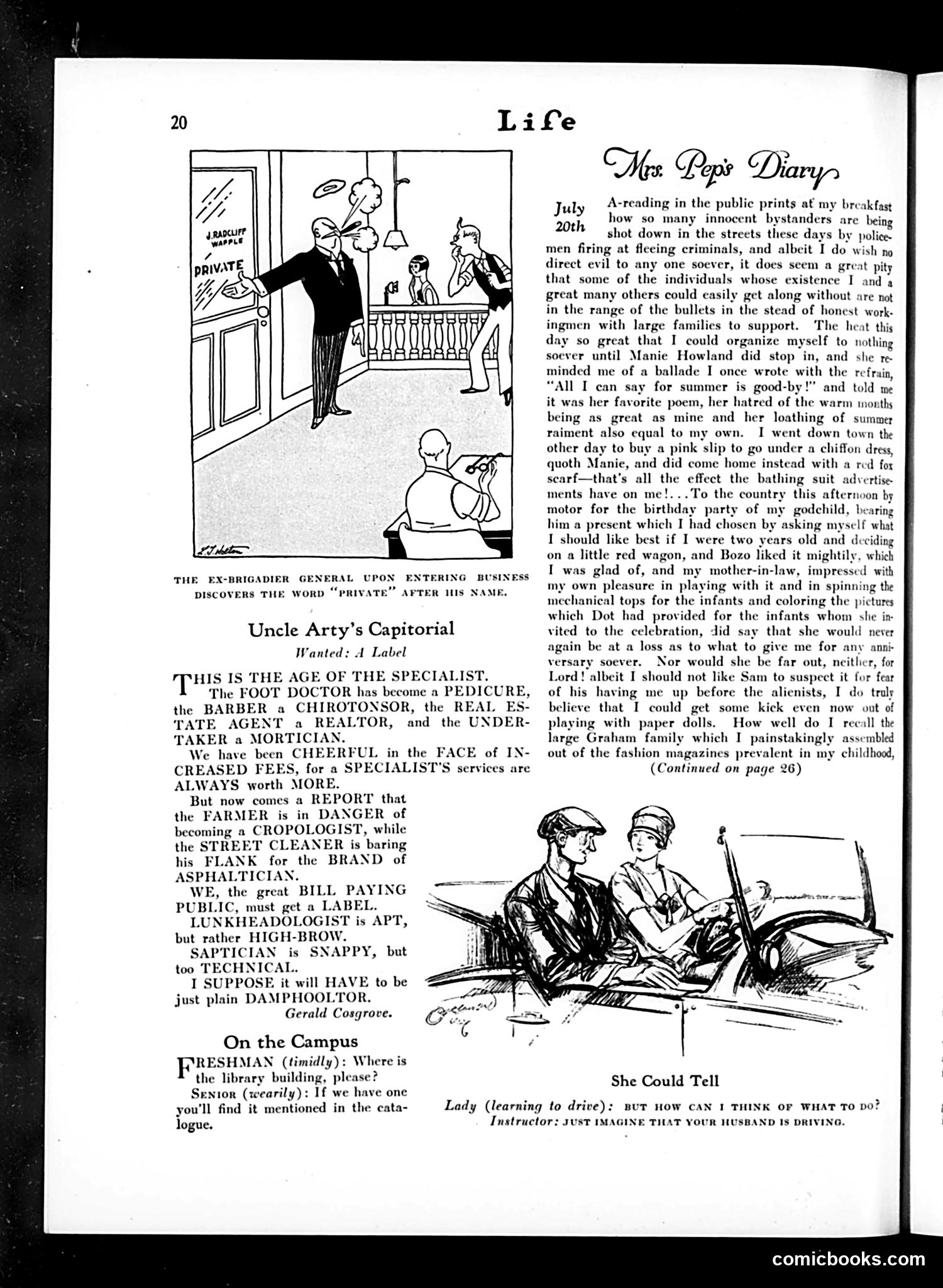
**Top Cartoon:** "The Ex-Brigadier General Upon Entering Business Discovers the Word 'Private'" satirizes a military officer confronting civilian business signage. The joke plays on "private" having different meanings in military versus commercial contexts—a visual pun about the culture clash between military and business life. **"Uncle Arty's Capitorial"** column mocks the era's obsession with creating pretentious professional titles. It notes that occupations now have specialized labels (pedicure, realtor, mortician) and jokingly suggests even common workers need fancy names—proposing "damphooltor" for ordinary citizens, satirizing how unnecessary jargon inflates professional status. **"On the Campus"** joke: A freshman asks a senior where the library is; the senior dismissively suggests checking the catalog, implying the library may not exist or is so underused nobody knows. **"She Could Tell"** cartoon jokes that a driving instructor tells a nervous student to imagine her husband driving—implying husbands are typically poor, inattentive drivers, so the comparison should calm her. All reflect 1920s-era social satire about American pretension and gender stereotypes.
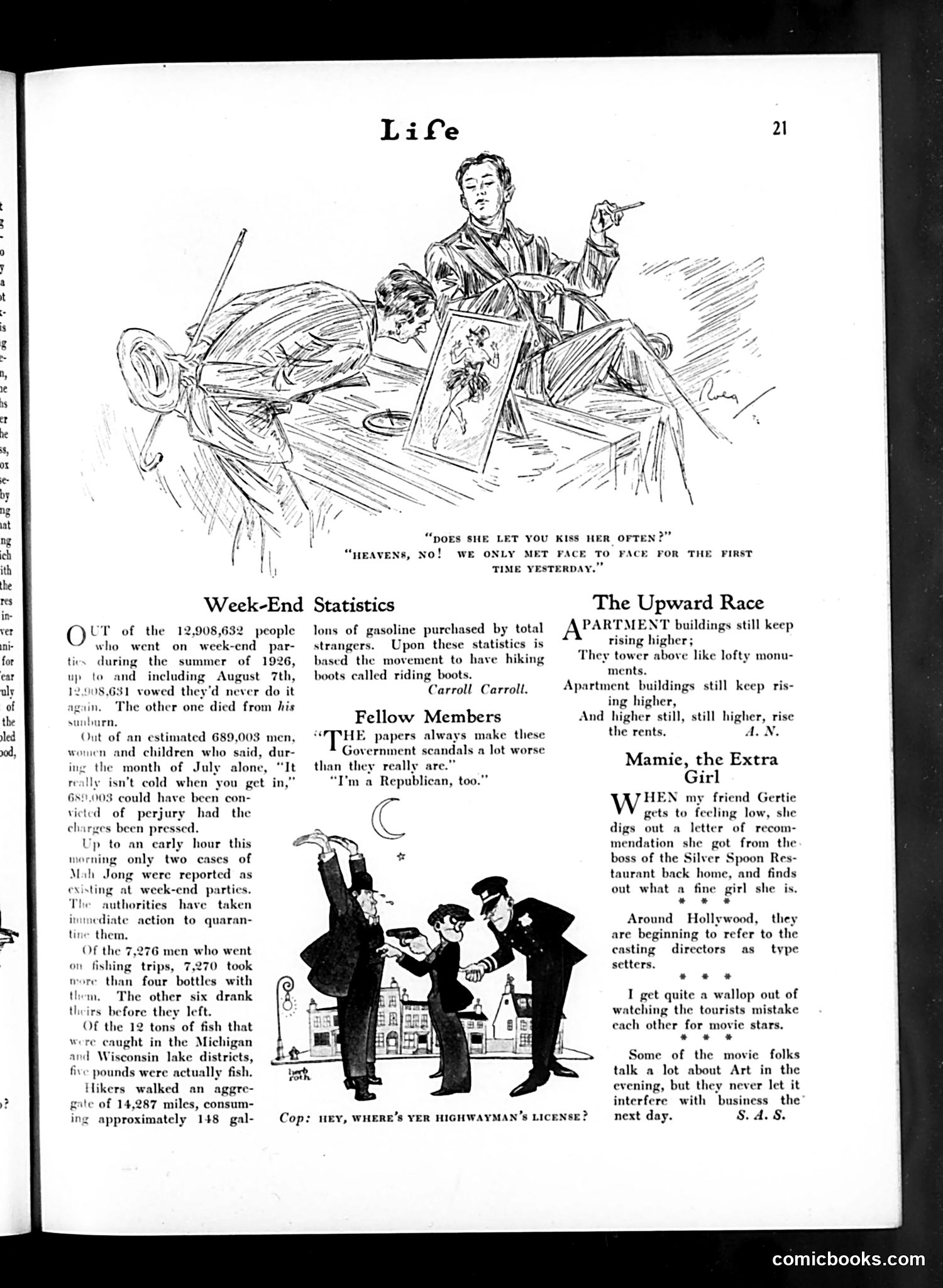
This 1926 *Life* magazine page satirizes summer leisure culture and urban growth through humor and statistics. **Top cartoon:** A couple in a car; the caption jokes that they've only met once—mocking the casual dating customs of the "Roaring Twenties." **"Week-End Statistics":** Faux-scientific humor about summer parties, fishing trips, and hiking. The joke: people lie about enjoying these activities ("It really isn't cold when you get in"), get drunk, and catch barely any fish despite consuming vast amounts of gasoline. **"Fellow Members" cartoon:** Shows a cop questioning a highwayman about a "license"—satirizing how both Republicans and newspapers blamed government scandals on corruption, yet both ignore actual crime. **"The Upward Race":** A short poem mocking how apartment building rents keep rising as fast as construction. **"Mamie, the Extra Girl":** Hollywood humor about casting directors treating actors as interchangeable "types," and how movie people prioritize business over artistic discussion. The overall tone: sophisticated mockery of 1920s consumer culture, dating, and urban expansion.
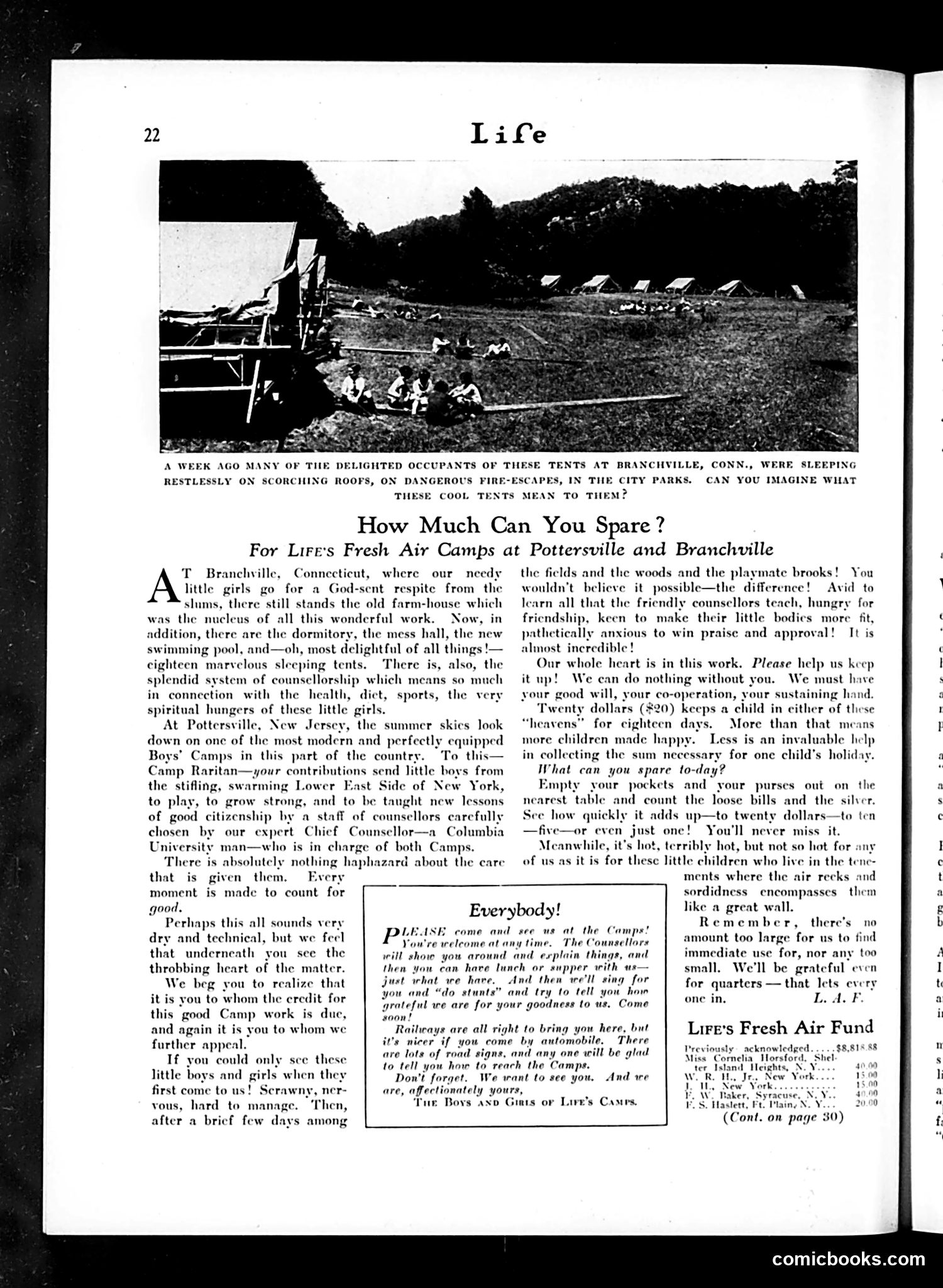
This is a **fundraising appeal**, not a political cartoon. Life magazine solicits donations for two summer camps—one at Branchville, Connecticut for girls and one at Pottersville, New Jersey for boys—serving impoverished children from New York City's Lower East Side tenements. The photograph shows tents housing slum children enjoying rural conditions. The text emphasizes the transformative effect: malnourished, nervous urban children become healthier and happier through outdoor recreation, proper nutrition, and counselor mentorship. The appeal requests donations (suggested $20 per child for an 18-day stay) using emotional rhetoric about "scrawny, nervous" children discovering "heavens" in nature. It reflects Progressive Era philanthropy—the belief that middle-class charity and exposure to healthy environments could reform impoverished urban youth. The tone assumes readers possess both disposable income and moral obligation to support such work.
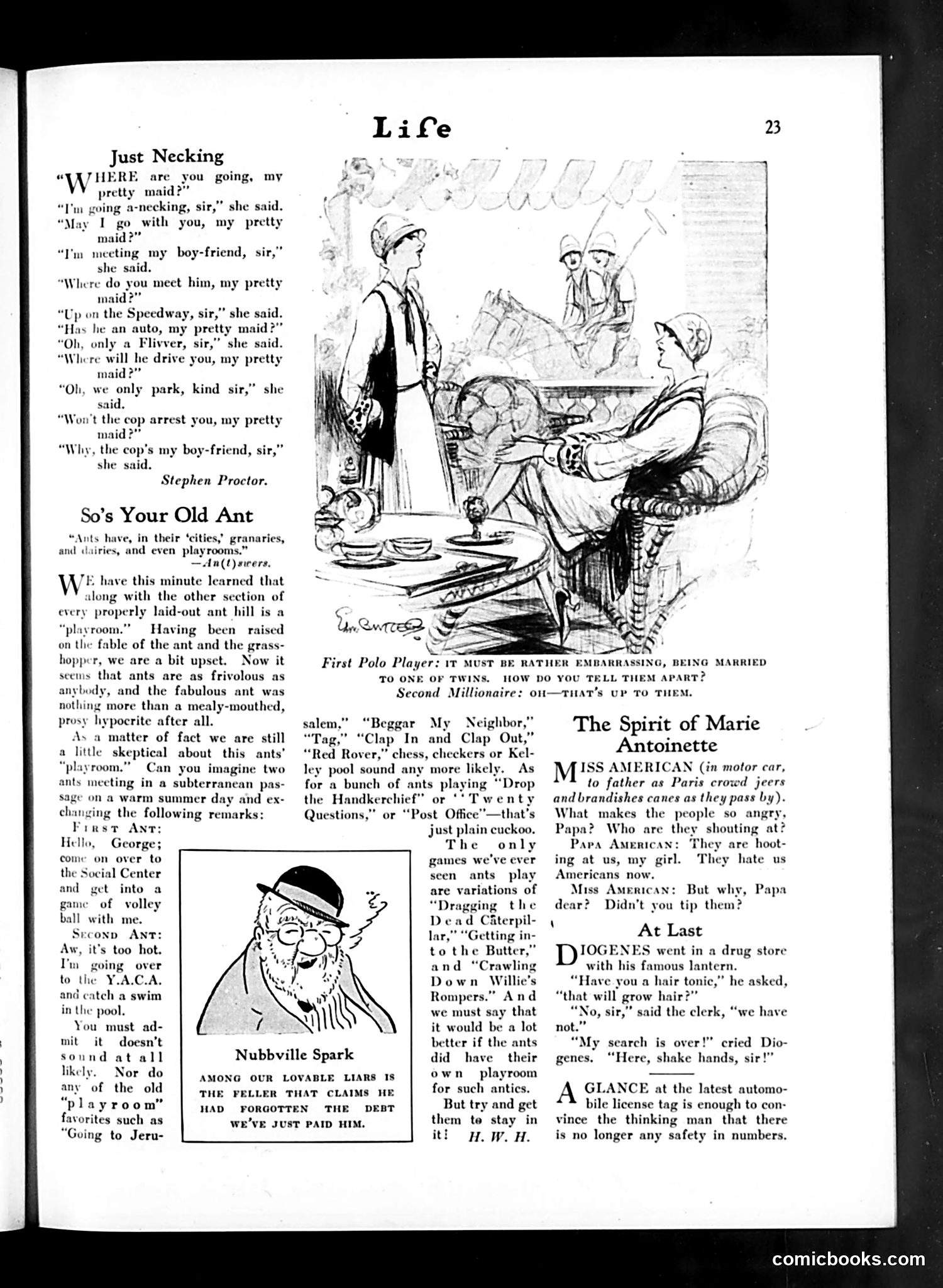
This page contains several short satirical pieces typical of 1920s Life magazine humor: **"Just Necking"** mocks young couples' dating customs on the "Speedway" in automobiles ("Flivvers"—cheap Model T Fords). The joke's punchline—that the girl's boyfriend is a cop who won't arrest them for parking—satirizes both youth culture's casual rule-breaking and police corruption. **"So's Your Old Ant"** ridicules popular pseudo-scientific claims about ant "cities" having "playrooms." The humor lies in anthropomorphizing ants with human leisure activities (volleyball, swimming) while mocking the implausibility of such behavior. **"The Spirit of Marie Antoinette"** references the French Revolution figure, comparing an American tourist's naive question about why Parisians are angry to historical anti-aristocratic sentiment. The satire targets American tourists' cultural insensitivity and assumption that tipping solves all social problems. These pieces reflect 1920s preoccupations: automobile culture, scientific fads, and American abroad stereotypes.
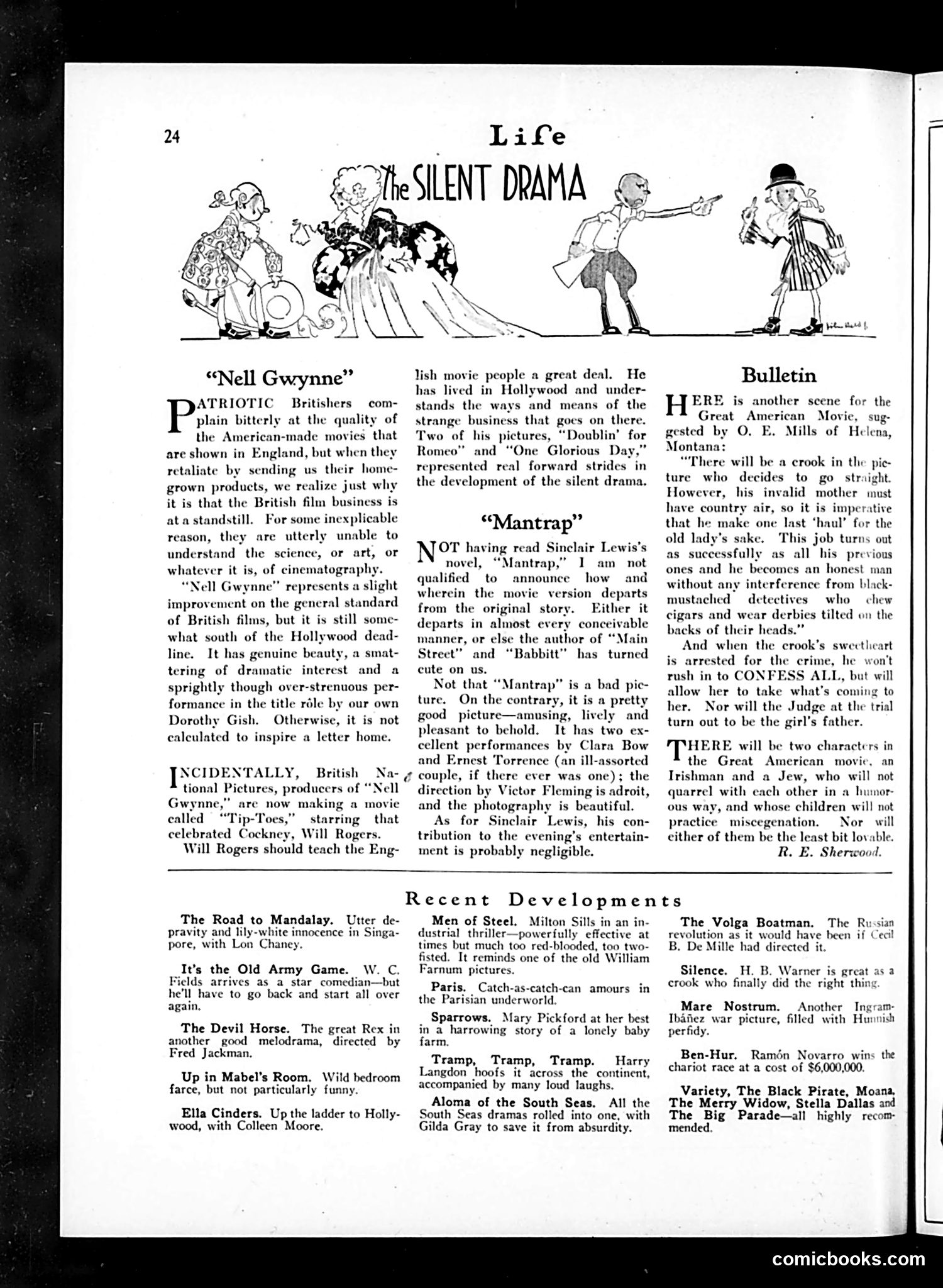
This page reviews silent films, critiquing both British and American cinema. The header cartoon illustrates "The Silent Drama" with four stylized figures representing different film character types or acting styles. The main text attacks British film quality, specifically "Nell Gwynne," suggesting British producers fundamentally misunderstand cinematography. It praises American comedian Will Rogers as superior and recommends he teach the British filmmaking craft. The "Mantrap" review dismisses Sinclair Lewis's contribution to the film adaptation, implying the novel's famous author is irrelevant to movie success—a jab at literary pretension in cinema. The "Bulletin" section contains reader suggestions for more authentic "Great American Movie" plots, satirizing Hollywood clichés: the reformed criminal, the convenient parental sacrifice, and stereotypical ethnic character conflicts. The satire suggests Hollywood relies on predictable melodrama rather than nuanced storytelling.
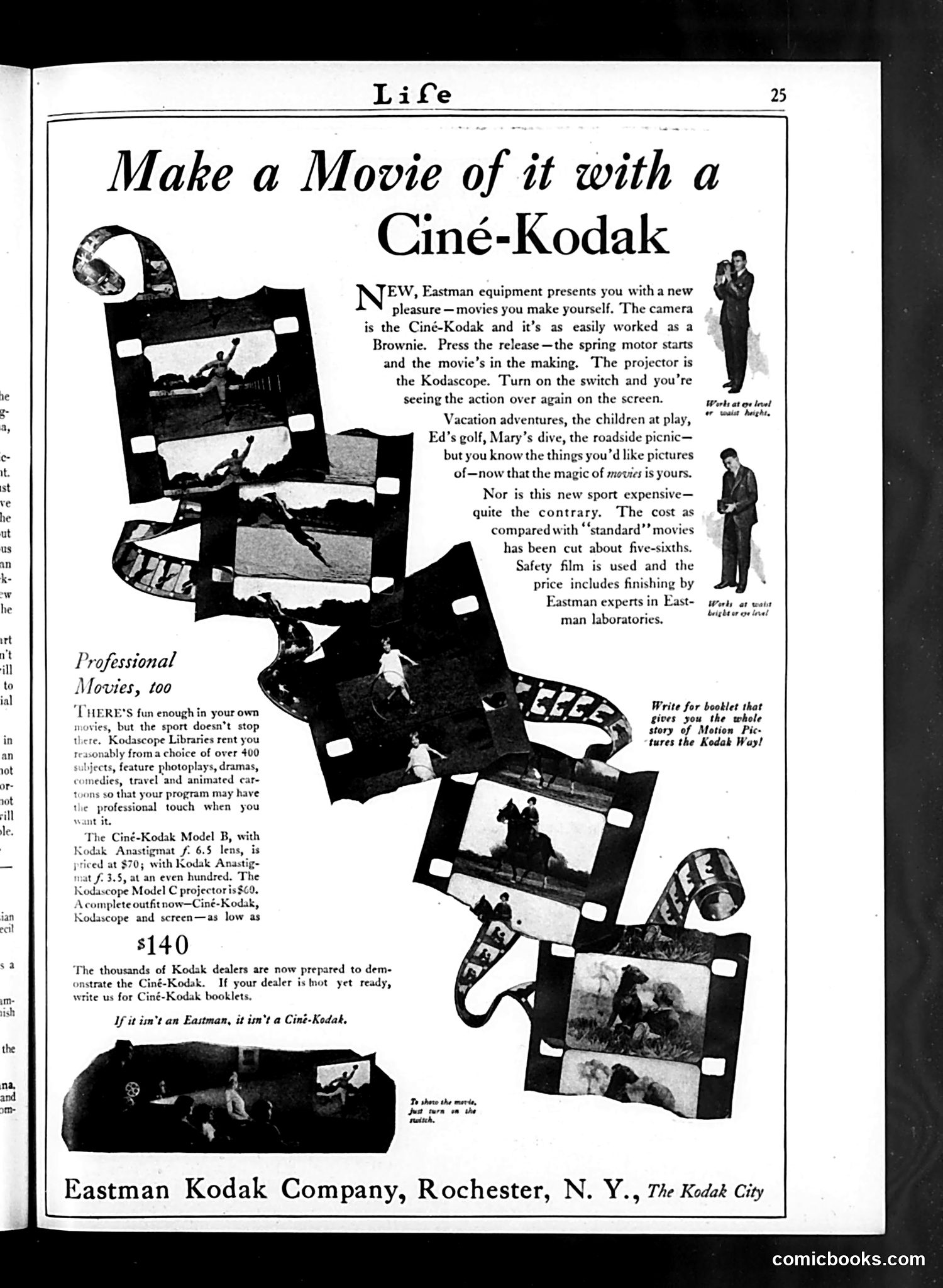
This is primarily **advertising, not satire or editorial content**. It's a full-page Eastman Kodak Company advertisement promoting the Ciné-Kodak home movie camera system. The page markets consumer filmmaking as an accessible luxury. The visual shows film strips displaying domestic scenes—vacations, children playing, golf, picnics—emphasizing that ordinary families can now create their own movies using the affordable Ciné-Kodak camera and Kodascope projector. The pitch emphasizes democratization: movie-making is no longer expensive or professional-only. The complete outfit costs as little as $140, with film finishing included. A secondary section mentions professional-quality rental films available through "Kodascope Libraries" for those wanting pre-made content. There is **no political cartoon or satire** here—it's straightforward product marketing aimed at middle-class consumers in the early home-cinema era, positioning Kodak equipment as essential for capturing family moments.
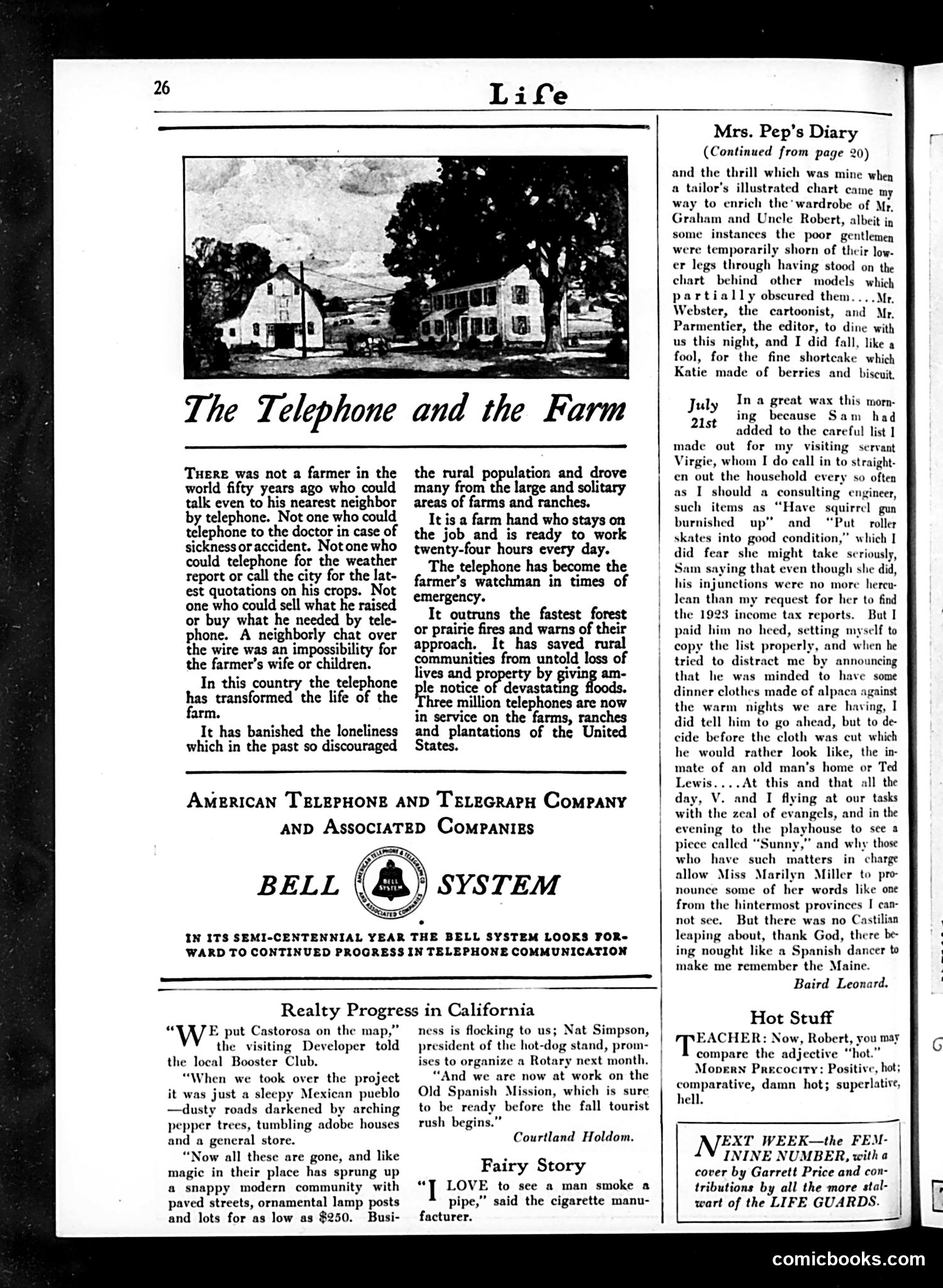
This page combines corporate advertising with satirical content. The main feature is a Bell System advertisement promoting rural telephone adoption. The text argues that telephones have transformed farm life by eliminating isolation, enabling emergency communication, and connecting farmers to markets—three million phones now serve American farms. The surrounding content satirizes American life: "Realty Progress in California" mocks real estate developers who transform modest towns into commercial developments; "Fairy Story" offers dark humor about a cigarette manufacturer praising pipe-smoking. Mrs. Pep's Diary provides gossipy social commentary. The overall message: while technology modernizes rural America, American society remains fundamentally absurd. The issue advocates progress while gently ridiculing those promoting it.
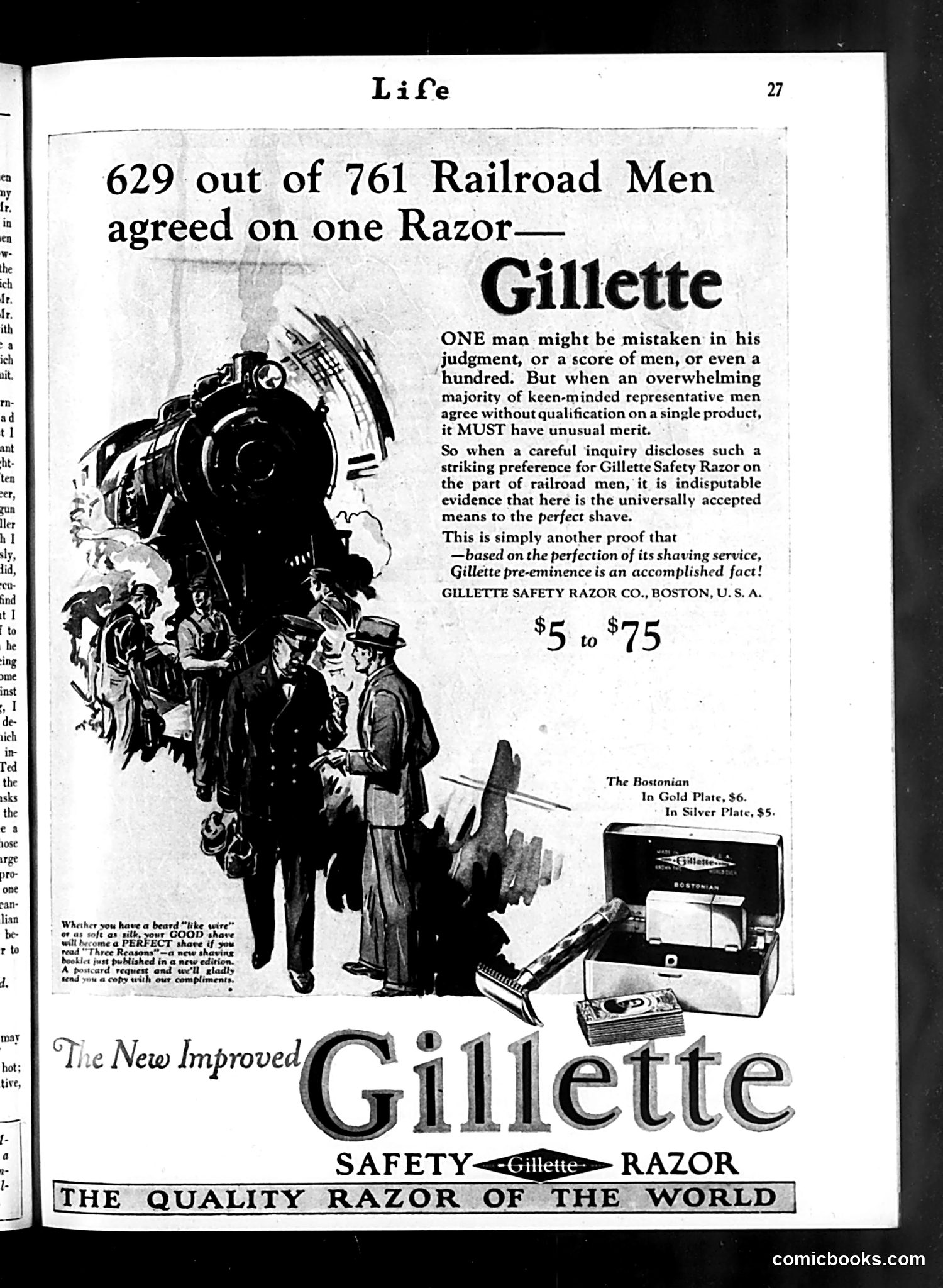
This is primarily a **product advertisement**, not political satire. It promotes Gillette Safety Razors by claiming that 629 of 761 railroad workers surveyed agreed the product was superior—using this statistic as proof of quality. The large illustration depicts railroad workers (identifiable by their uniforms and work setting) gathered around a locomotive, establishing the "working man" demographic the ad targets. The appeal is to masculine authority and practical judgment: if tough, experienced laborers agree, the product must be trustworthy. The ad includes product images showing "The Bostonian" razor set in gold and silver plate versions, priced $5-$7.50. **The satire element** (typical of Life magazine's style) lies in the exaggerated logic: the ad humorously suggests that overwhelming numerical agreement among any group "MUST" indicate superior merit—a tongue-in-cheek commentary on advertising's persuasive tactics, even as it uses exactly that technique to sell razors.
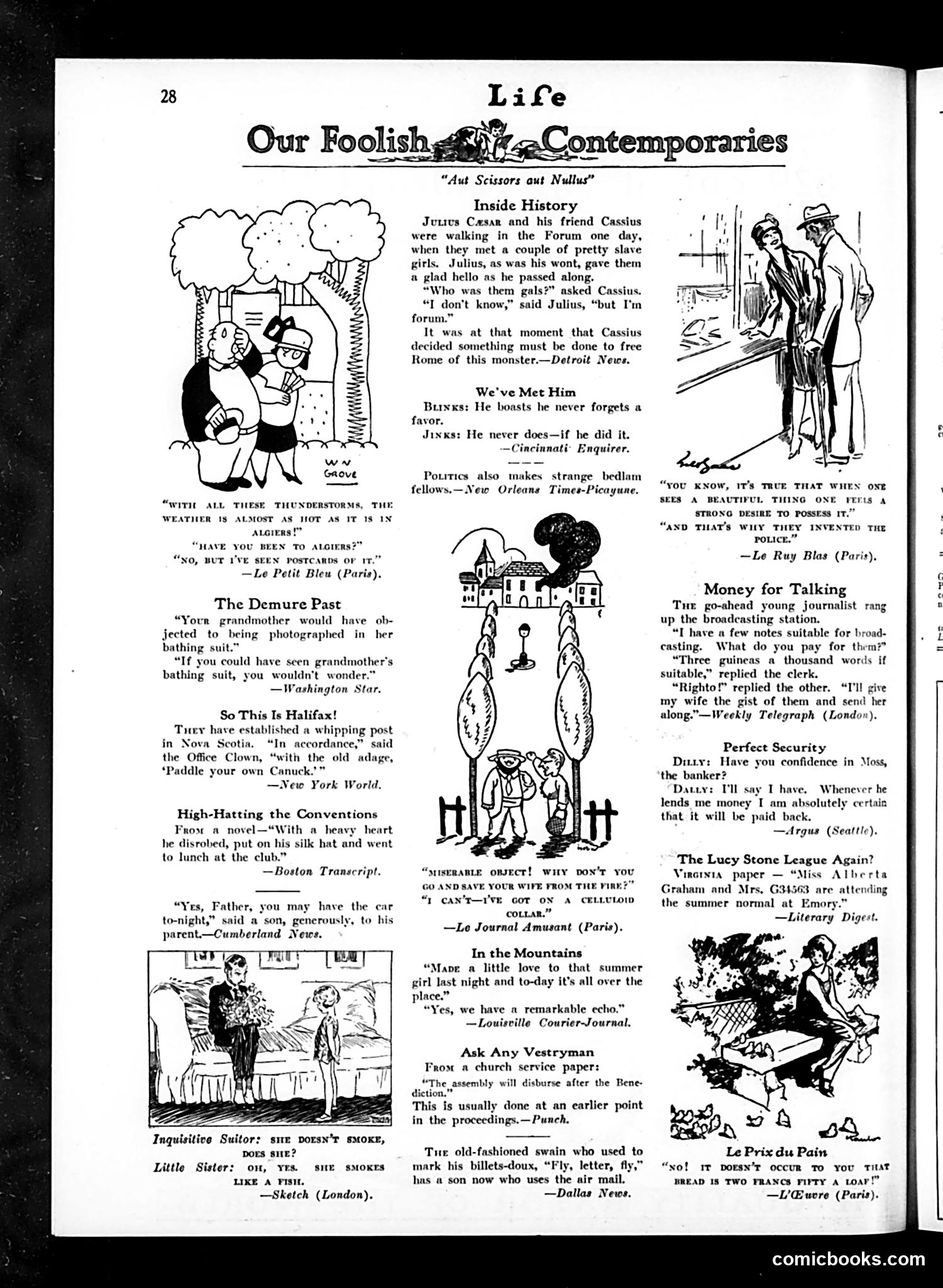
This page collects brief humorous anecdotes and jokes from newspapers worldwide, mocking contemporary social absurdities. Key examples: **"Inside History"** presents Julius Caesar meeting slave girls in the Forum—a crude joke implying Caesar's casual treatment of women motivated Cassius to assassinate him, satirizing how trivial male vanity shapes history. **"So This Is Halifax!"** jokes about Nova Scotia establishing a whipping post, mocking harsh colonial discipline with wordplay on "paddle your own canoe." **"High-Hatting the Conventions"** ridicules the absurdity of wearing formal silk hats to casual lunches. **The celluloid collar cartoon** satirizes masculine vanity—a man won't rescue his wife from fire because his fashionable rigid collar prevents action, mocking prioritization of appearance over morality. **"Money for Talking"** mocks radio broadcasting's payment rates for brief news commentary. The page's title, "Aut Scissors aut Nullus" (Latin: "Scissors or Nothing"), suggests sharp editorial critique. These are lightweight social satires targeting everyday human foolishness across cultures—fashion obsession, vanity, bureaucratic absurdity, and economic inequality.
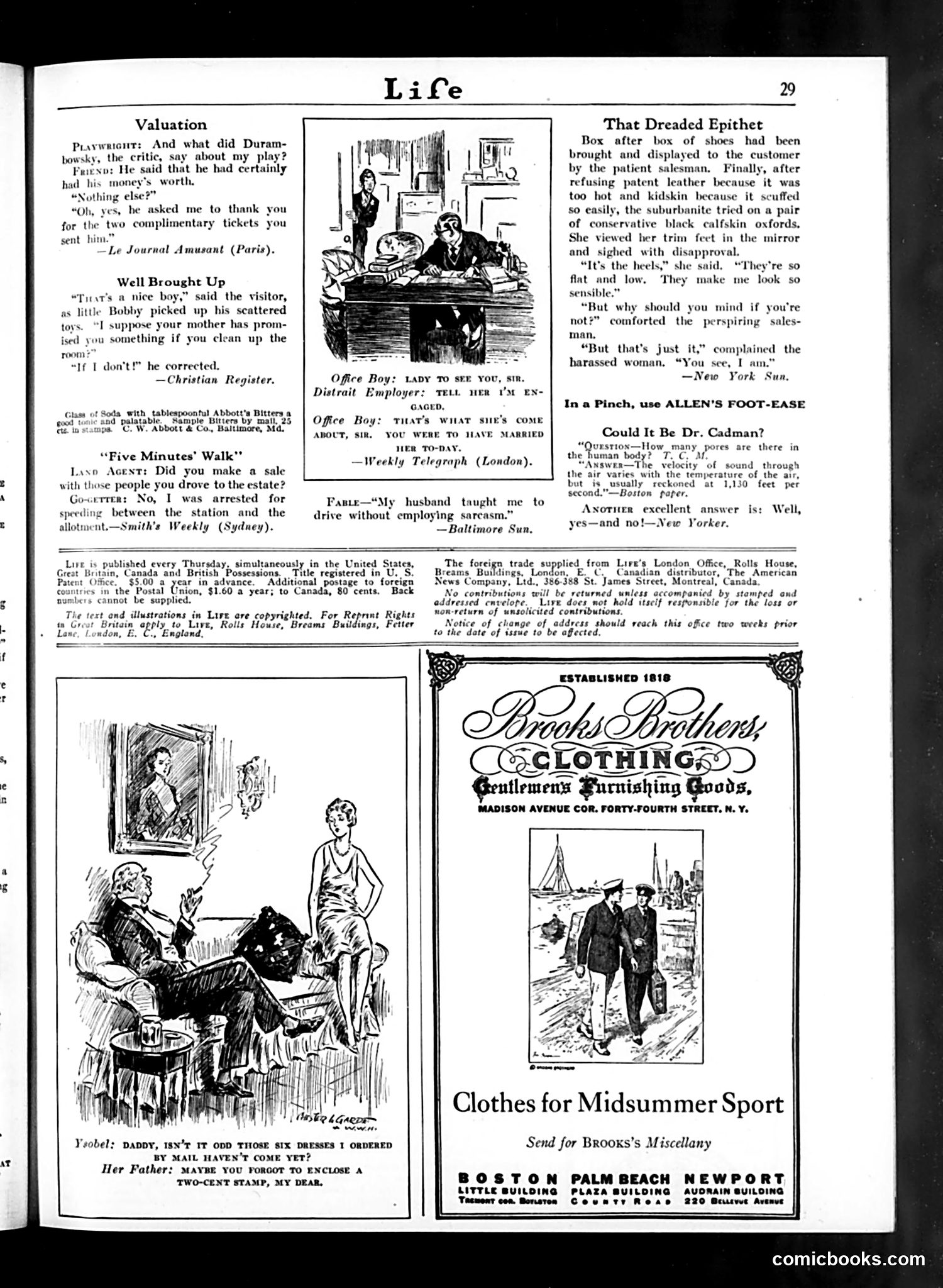
This page from *Life* magazine contains several short humorous anecdotes satirizing early 20th-century social behavior and gender relations. **"That Dreaded Epithet"** mocks a female customer obsessed with appearance. After rejecting multiple shoe styles, she finally complains that her chosen oxfords make her look "sensible"—viewing this as an insult. The salesman's retort—"But why should you mind if you're not?"—suggests she *is* sensible, delivering a backhanded insult. The joke ridicules women's vanity and prioritization of fashion over practicality. **"Well Brought Up"** uses a child's correction to mock parental discipline. When praised for cleaning toys, young Bobby corrects the visitor: his mother threatens *punishment* if he doesn't clean, not reward if he does—suggesting negative motivation supersedes positive reinforcement. Other brief jokes target workplace inefficiency, marital expectations, and bureaucratic absurdity (the "Dr. Cadman" piece mocks nonsensical educational answers). The page reflects period attitudes: patronizing views of women, children as amusing innocents, and workplace frustrations presented as universal comedy.
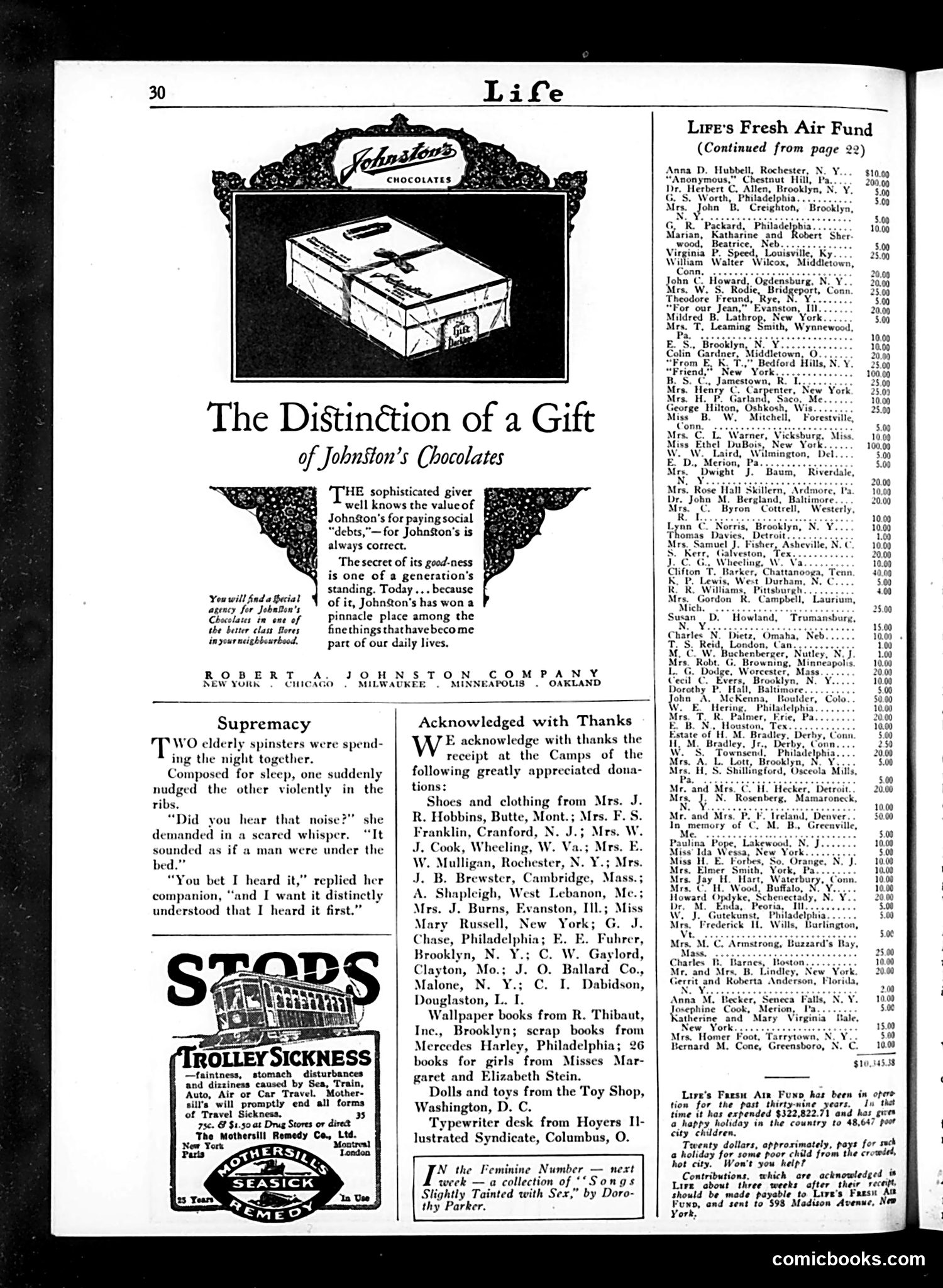
This page is primarily **advertising and charitable notices** rather than political satire or comics. The main content consists of: 1. **Johnston's Chocolates advertisement** (top): A luxury goods ad emphasizing that premium chocolate is an appropriate gift for "paying social debts" among the upper classes—reflecting early 20th-century etiquette and consumer culture. 2. **"Supremacy" joke** (middle-left): A mild humor piece about two elderly women competing over who heard a mysterious noise first—likely suggesting female vanity or competitiveness. 3. **Charitable notices** (right side): Lists of donors and donations to "Life's Fresh Air Fund," a charity providing country vacations for poor children. These donation acknowledgments reflect Progressive-era philanthropic efforts. 4. **Period advertisements**: Including Mothersill's Travel Sickness remedy and other consumer products. The page reflects early 1900s concerns: consumerism among the affluent, women's social anxieties, and genteel charity work—not political cartoons or satire.
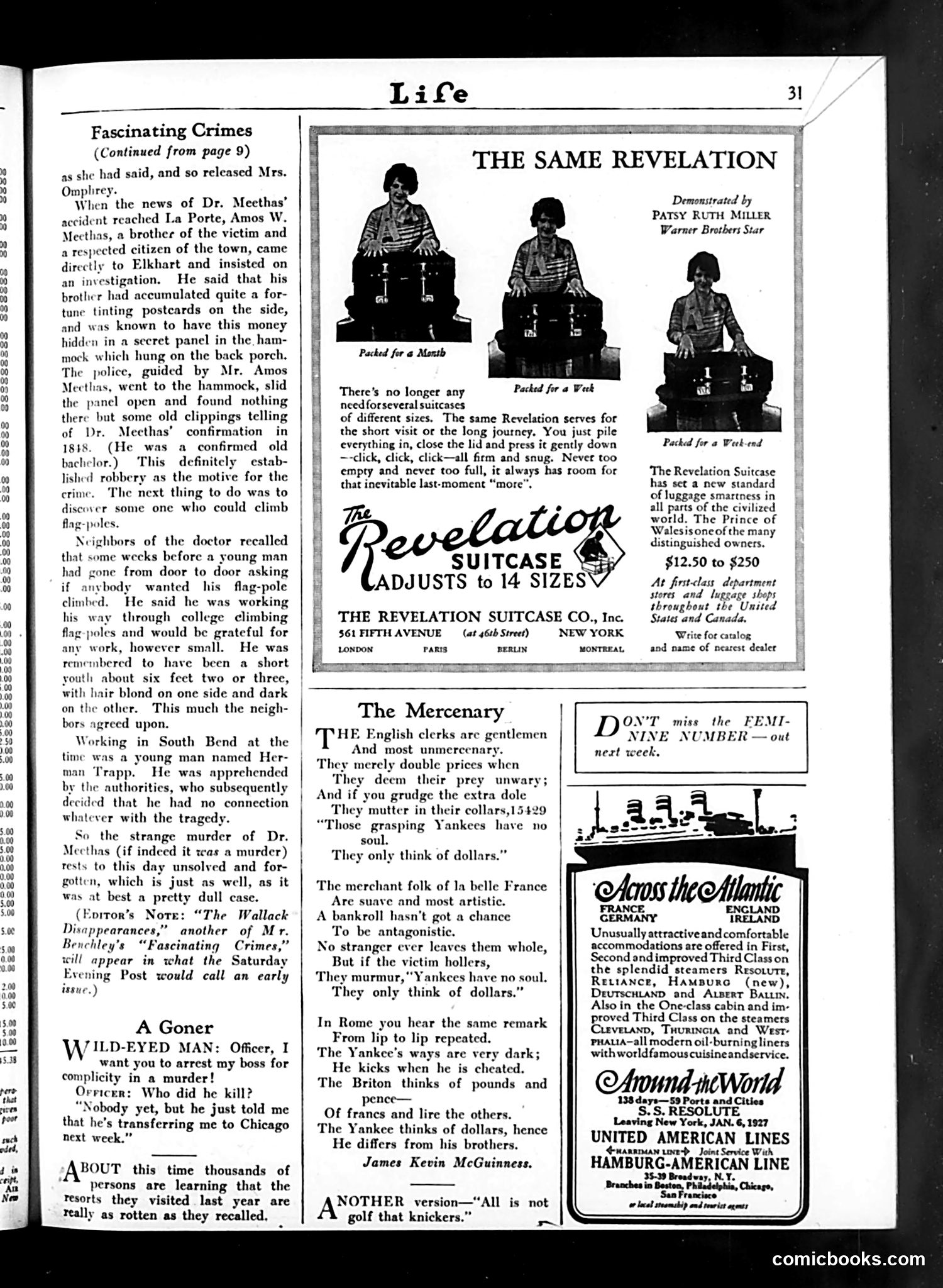
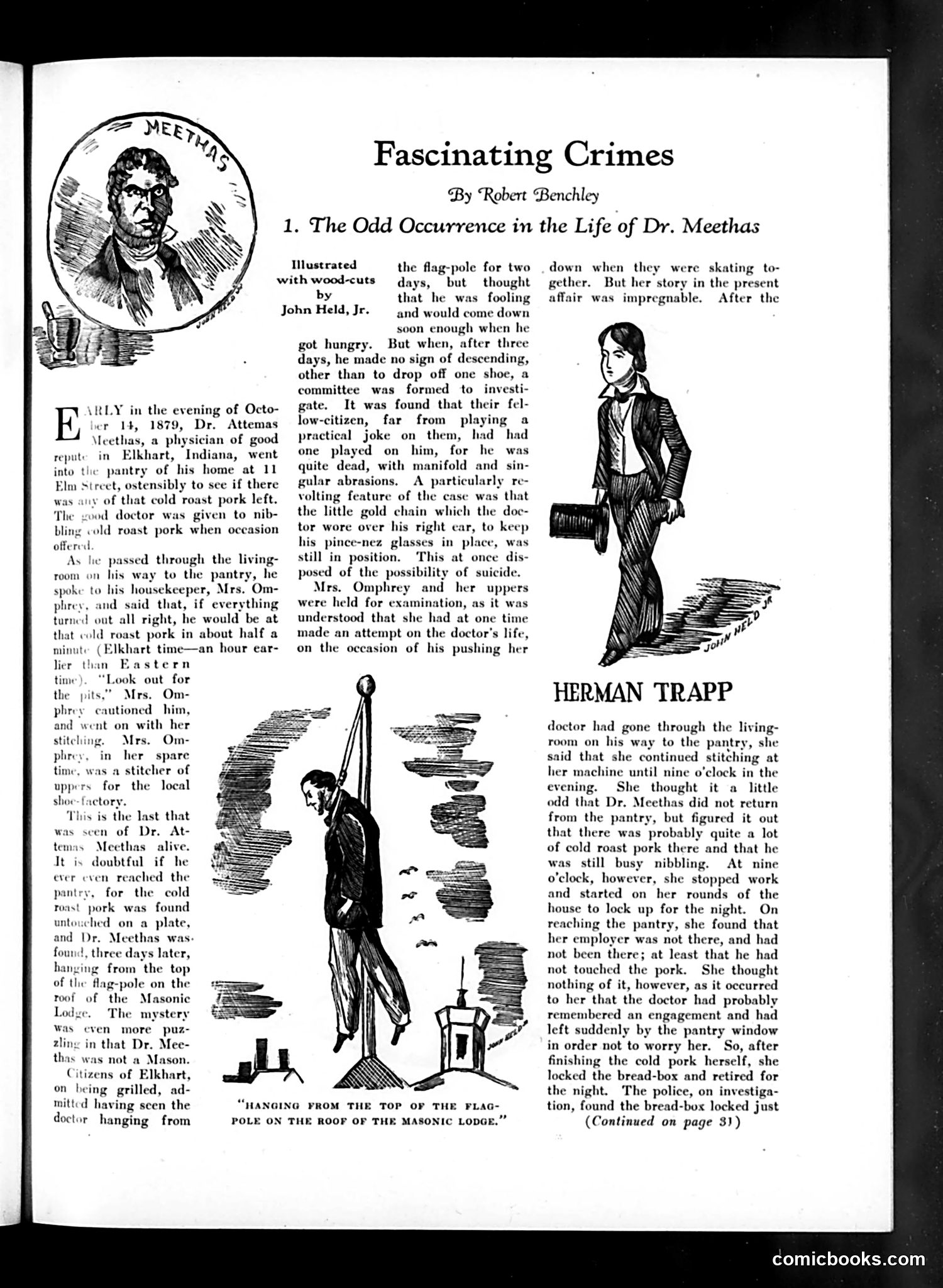
This page contains several distinct items: **"Fascinating Crimes" (left column):** A humorous crime narrative by Robert Benchley about the unsolved "murder" of Dr. Meethas. The joke is that the investigation into this allegedly mysterious death unravels into absurdity—the only clue is a vague description of a young man who climbed flagpoles for college money, leading nowhere. It's satirical commentary on sensationalized true-crime coverage. **"The Same Revelation" (center):** An advertisement for the Revelation Suitcase, featuring actress Patsy Ruth Miller demonstrating how one expandable suitcase adjusts to different trip lengths. The accompanying text plays on the phrase "revelation"—suggesting travelers have the epiphany that expensive luggage isn't necessary. **"A Goner" (bottom left):** A one-panel joke about workplace anxiety: a man wants to arrest his boss for "complicity in murder"—the "murder" being the boss transferring him to Chicago. It's dark humor about job transfers. **"The Mercenary":** A poem mocking the stereotypical greed of English and French merchants toward American tourists, suggesting they exploit visitors through inflated prices. The page blends satire, advertising, and light humor typical of 1920s Life magazine.
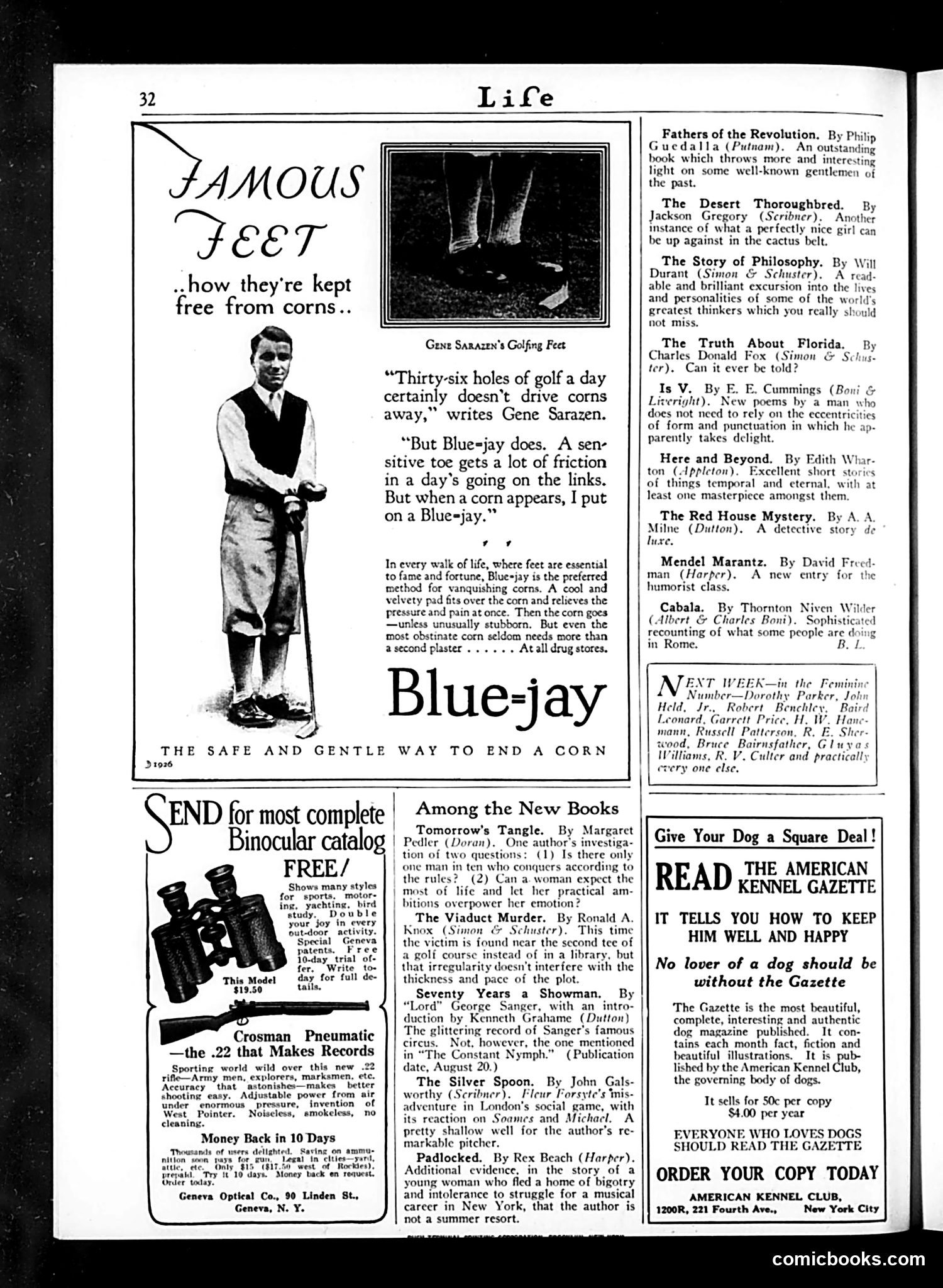
This is primarily a **product advertisement**, not a political cartoon. The page features a endorsement ad for Blue-Jay brand corn plasters, using golfer **Gene Sarazen** as the celebrity spokesperson. The "joke" is straightforward: Sarazen, a famous golfer of the era, plays 36 holes daily—demanding physical activity that causes foot friction and corns. The ad humorously contrasts golf's inability to prevent corns with Blue-Jay plasters' effectiveness in removing them once they appear. The context modern readers need: In the 1920s, corn plasters were common drugstore remedies. Using prominent athletes to endorse consumer products was an emerging advertising strategy. Sarazen was a legitimate sports celebrity, making his testimonial credible to consumers. The remainder of the page shows typical 1926 *Life* magazine content: book reviews, binocular and rifle advertisements, and a dog magazine promotion—no satire intended.
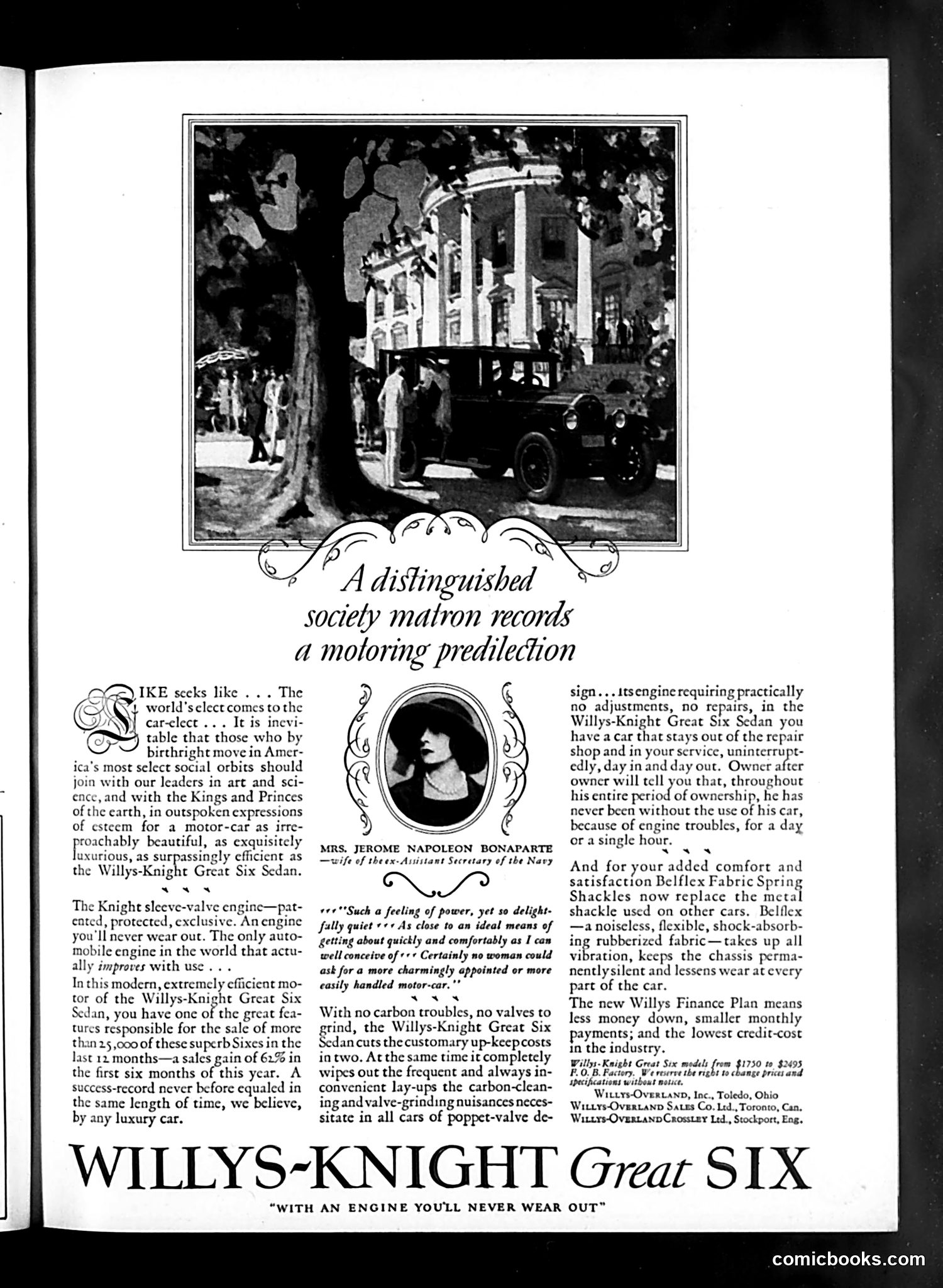
This is primarily **automobile advertising**, not political satire. The page promotes the Willys-Knight Great Six Sedan by featuring an endorsement from "Mrs. Jerome Napoleon Bonaparte," identified as wife of a former Assistant Secretary of the Navy. The "satire" is subtle social commentary: the advertisement mocks wealthy society matrons by suggesting that even the most exclusive, aristocratic women recognize the car's superiority. The phrase "A distinguished society matron records a motoring predilection" uses deliberately flowery language to parody how upper-class women discuss consumer choices. The endorsement quote—praising the car's power, quietness, and ease of handling—is framed as coming from someone of such elevated social status that her approval should convince other wealthy buyers. The photograph shows the elegant sedan near a classical mansion with well-dressed figures, reinforcing the "luxury for the elite" messaging. This reflects 1920s marketing strategy: using prominent society figures to validate consumer products for aspirational middle-class readers.
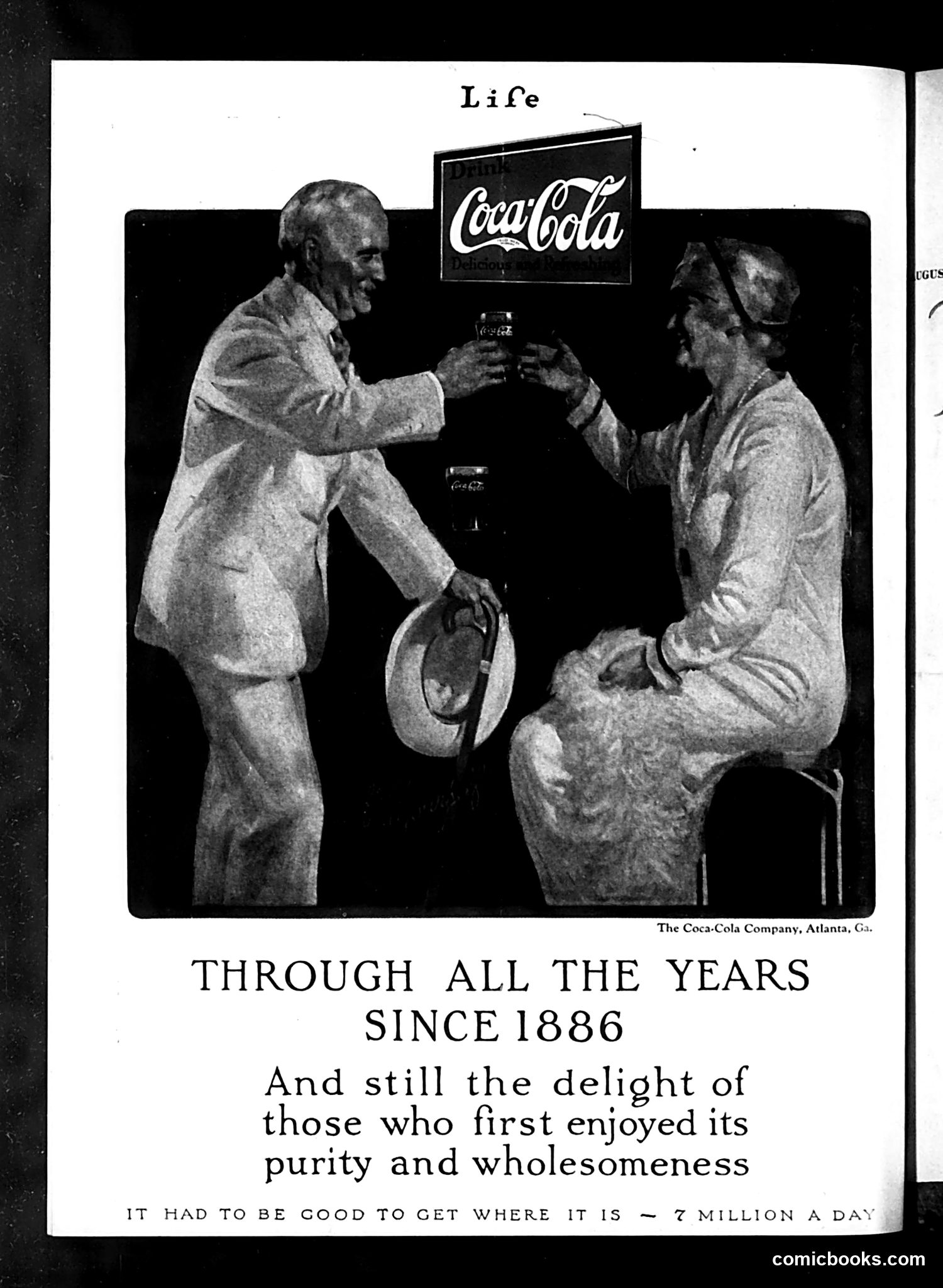
This is a **Coca-Cola advertisement**, not satire or political commentary. The page shows two men in casual dress toasting with Coca-Cola bottles beneath a prominent Coca-Cola sign. The text celebrates the brand's longevity since 1886 and claims its continued popularity proves quality. The ad's argument is straightforward: Coca-Cola's 37-year success and current consumption rate of 7 million servings daily demonstrate the product's inherent goodness and wholesomeness. The two figures appear to represent ordinary consumers across generations—embodying the brand's claim to universal appeal and timeless satisfaction. This reflects early 20th-century advertising strategy: using product longevity as proof of superiority, rather than describing actual qualities.