
Life, 1926-08-12 · page 16 of 36
Life — August 12, 1926 — page 16: what you’re looking at
What you’re looking at
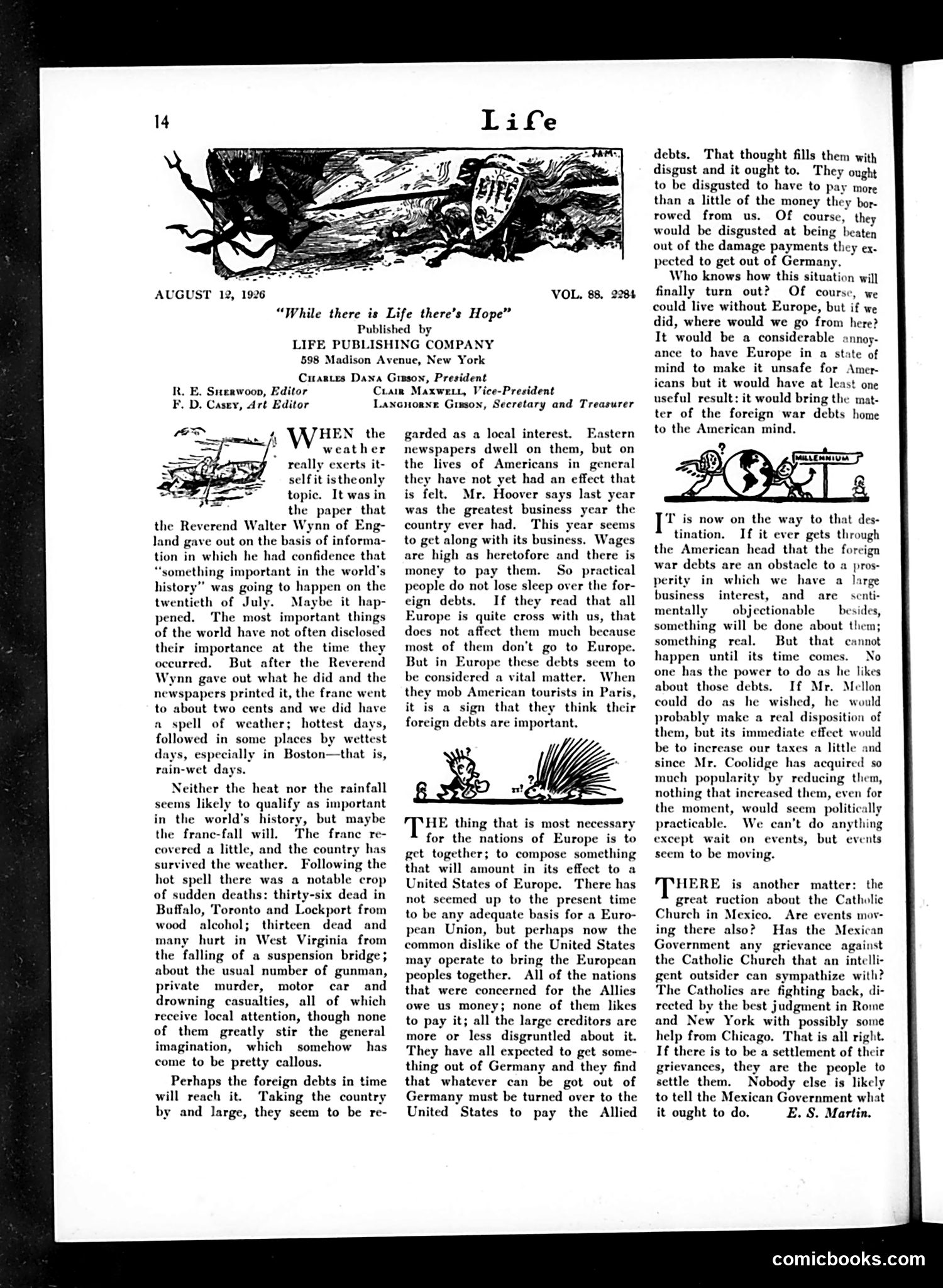
This editorial page discusses post-WWI European war debts owed to America. The main cartoon (top) depicts Death as a skeletal figure emerging from a coffin marked "1914"—representing casualties from World War I. The article argues that European nations, while concerned about repaying American loans, seem indifferent to the human cost of the war itself. The writer suggests that if European debts prove insurmountable, America should accept this rather than expect payment that might destabilize Europe economically. The second smaller cartoon (middle-right) appears to show a porcupine—likely representing America's defensive posture regarding debt collection. The satire critiques both European financial irresponsibility and American insistence on repayment, questioning whether monetary concerns should override post-war reconstruction priorities.
📄 Transcribed text from this page (OCR, searchable)
Machine-transcribed from the original scan — historical spelling and the odd misread are preserved.
AUGUST 12, 1926 VOL, 88, 2284 “While there is Life there’s Hope” Published by LIFE PUBLISHING COMPANY 598 Madison Avenue, New York Curartes Dana Gipson, President R. E. Sneawoop, Editor F. D. Casey, Art Editor 4 WHEN the weather really exerts it- selfit istheonly topic. It was in the paper that the Reverend Walter Wynn of Eng- land gave out on the b of informa- tion in which he had confidence that ing important in the world’s was going to happen on the twentieth of July. Maybe it hap- pened. The most important things of the world have not often disclosed their importance at the time they occurred, But after the Reverend Wynn gave out what he did and the newspapers printed it, the franc went to about two cents and we did have a spell of weather; hottest da followed in some places by wette ys, especially in Boston—that is, -wet day: Neither the heat nor the rainfall seems likely to qualify as important in the world’s history, but maybe the frane-fall will. The frane re- covered a little, and the country has survived the weather. Following the hot spell there was a notable crop of sudden deaths: thirty-six dead in Buffalo, Toronto and Lockport from wood alcohol; thirteen dead and many hurt in West Virginia from the falling of a suspension bridge; about the usual number of gunman, private murder, motor car and drowning casualties, all of which receive local attention, though none of them greatly stir the general imagination, which somehow has come to be pretty callous. Perhaps the foreign debts in time will reach it. Taking the country by and large, they seem to be re- Cuaim Maxwett, Vice-President Laxcnonxe Ginson, Secretary and Treasurer garded as a local interest. Eastern newspapers dwell on them, but on the lives of Americans in general they have not yet had an effect that is felt. Mr. Hoover says last year was the greatest business year the country ever had. This year seems to get along with its business. Wages are high as heretofore and there is money to pay them. So practical people do not lose sleep over the for- eign debts. If they read that all Europe is quite cross with us, that does not affect them much because most of them don’t go to Europe. But in Europe these debts seem to be considered a vital matter. When they mob American tourists in Paris, it is a sign that they think their foreign debts are important. HE thing that is most necessary for the nations of Europe is to get together; to compose something that will amount in its effect to a United States of Europe. There has not seemed up to the present time to be any adequate basis for a Euro- pean Union, but perhaps now the common dislike of the United States may operate to bring the European peoples together. All of the nations that were concerned for the Allies owe us money; none of them likes to pay it; all the large creditors are more or less disgruntled about it. They have all expected to get some- thing out of Germany and they find that whatever can be got out of Germany must be turned over to the United States to pay the Allied debts. That thought fills them with disgust and it ought to. They ought to be disgusted to have to pay more than a little of the money they bor- rowed from us. Of course, they would be disgusted at being beaten out of the damage payments they ex- pected to get out of Germany. Who knows how this situation will finally turn out? Of course, we could live without Europe, but if we did, where would we go from here? It would be a considerable annoy- ance to have Europe in a state of mind to make it unsafe for Amer- icans but it would have at least one useful result: it would bring the mat- ter of the foreign war debts home to the American mind. T is now on the way to that des- tination. If it ever gets through the American head that the foreign war debts are an obstacle to a pros- perity in wl we have a large business interest, and are senti- mentally — objectionable _ besides, something will be done about them; something real. But that cannot happen until its time comes. No one has the power to do as he likes about those debts. If Mr. Mellon could do as he wished, he would probably make a real disposition of them, but its immediate effect would be to increase our taxes a little and since Mr. Coolidge has acquired so much popularity by reducing them, nothing that increased them, even for the moment, would seem _ politically practicable. We can’t do anything except wait on events, but events seem to be moving. HERE is another matter: the great ruction about the Catholic Church in Mexico. Are events mov- ing there also? Has the Mexican Government any grievance against the Catholic Church that an intelli- gent outsider can sympathize with? The Catholics are fighting back, di- rected by the best judgment in Rome and New York with possibly some help from Chicago. That is all right. If there is to be a settlement of their grievances, they are the people to settle them. Nobody else is likely to tell the Mexican Government what it ought to do. E. S. Martin. comicbooks.com