
Life, 1926-08-12 · page 21 of 36
Life — August 12, 1926 — page 21: what you’re looking at
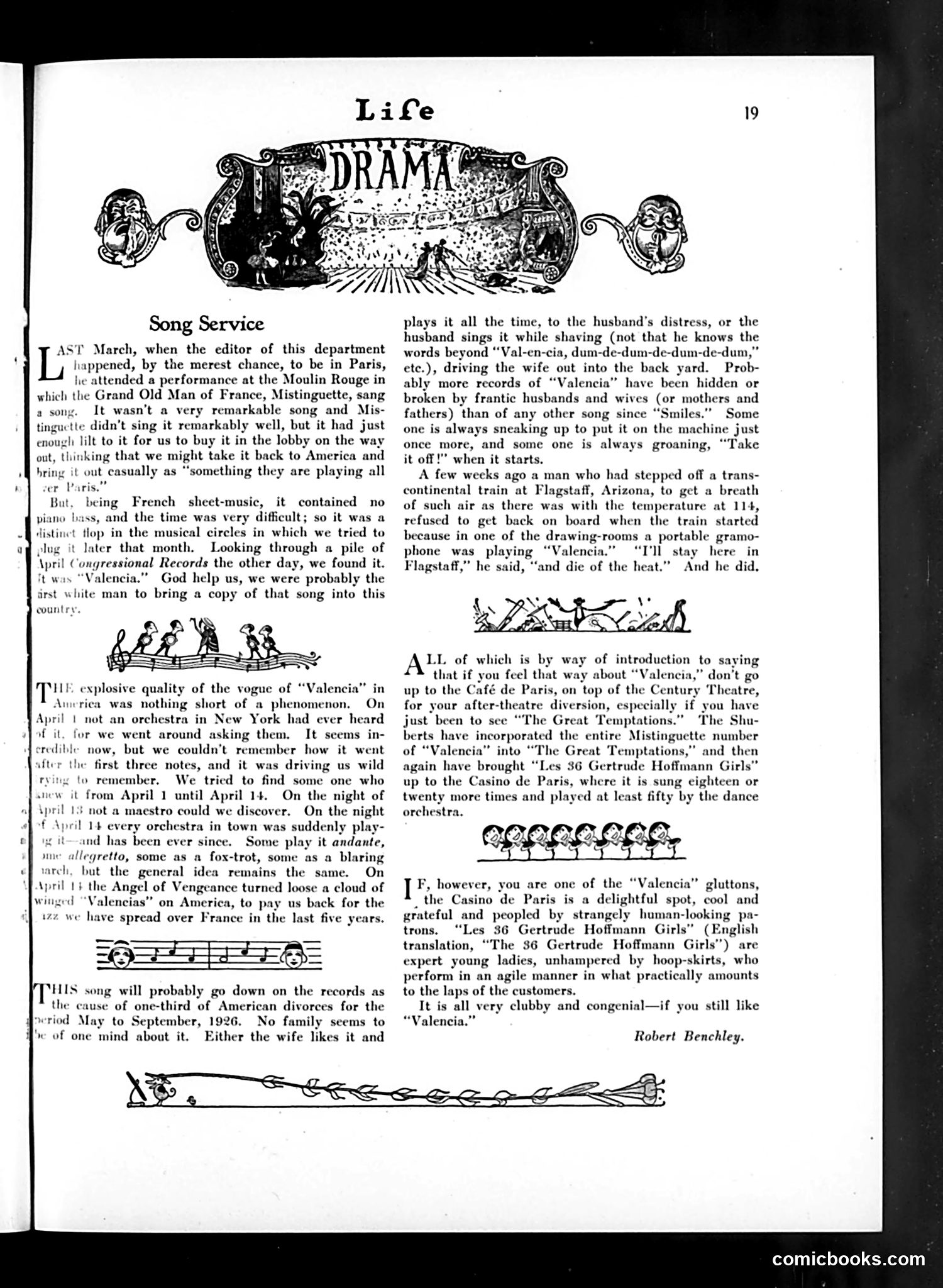
What you’re looking at
This article satirizes the sudden, overwhelming American craze for the song "Valencia" in spring 1926. The author describes how the French song was virtually unknown on April 1st but became ubiquitous by April 14th—played by every orchestra and becoming a source of domestic discord. The satire targets: 1. **Mass cultural hysteria**: The inexplicable overnight adoption of a mediocre French song, spread through venues like the Moulin Rouge and subsequently Broadway productions. 2. **Marital conflict**: The song becomes so omnipresent that it drives couples to distraction—husbands and wives disagreeing on whether to play it, with one anecdote claiming it caused divorces. 3. **American cultural dependency**: The piece mocks how America imports French entertainment trends uncritically, then saturates them beyond reason. The "cloud of winged 'Valencias'" image represents the song's invasive spread as punishment for American jazz spreading to France. It's a humorous complaint about faddish, uncontrollable popular culture consumption.
📄 Transcribed text from this page (OCR, searchable)
Machine-transcribed from the original scan — historical spelling and the odd misread are preserved.
AST March, when the editor of this department L happened, by the merest chance, to be in Paris, he attended a performance at the Moulin Rouge in which the Grand Old Man of France, Mistinguette, sang a song. It wasn’t a very remarkable song and Mis- tinguetle didn’t sing it remarkably well, but it had just enough lilt to it for us to buy it in the lobby on the way out, thinking that we might take it back to America and bring it out casually as “something they are playing all cer Paris.” But, being French sheet-music, it contained no piano bass, and the time was very difficult; so it was a distinct tlop in the musical circles in which we tried to plug it later that month, Looking through a pile of \pril Congressional Records the other day, we found it. it was “Valencia.” God help us, we were probably the irst white man to bring a copy of that song into this country. TH! explosive quality of the vogue of “Valencia” in Aierica was nothing short of a phenomenon. On April | not an orchestra in New York had ever heard for we went around asking them. It seems in- v now, but we couldn't remember how it went first three notes, and it driving us wild rying to remember. We tried to find some one who suew it from April 1 until April 14. On the night of \pril 13 not a maestro could we discover. On the night f April 14 every orchestra in town was suddenly play- ind has been ever since. Some play it andante, illegretto, some as a fox-trot, some as a blaring but the general idea remains the same. On April 1+ the Angel of Vengeance turned loose a cloud of winged “Valencias” on America, to pay us back for the izz we have spread over France in the last five years. tareh YHIS song will probably go down on the records as the cause of one-third of American divorces for the ypcriod May to September, 1926. No family seems to Je of one mind about it. Either the wife likes it and plays it all the time, to the husband's distress, or the husband sings it while shaving (not that he knows the words beyond “Val-en-cia, dum-de-dum-de-dum-de-dum,” ut into the back yard. Prob- ably more records of “Valencia” I been hidden or broken by frantic husbands and wives (or mothers and fathers) than of any other song since “Smiles.” Some one is always sneaking up to put it on the machine just once more, and some one is always groaning, “Take it off!” when it starts. A few weeks ago a man who had stepped off a trans- continental train at Flagstaff, Arizona, to get a breath of such air as there was with the temperature at 114, refused to get back on board when the train started because in one of the drawing-rooms a portable gramo- phone was playing “Valencia.” “I'll stay here in Flagstaff,” he said, “and die of the heat.” And he did. LL of which is by way of introduction to saying that if you feel that way about “Valencia,” don’t go up to the Café de Paris, on top of the Century Theatre, for your after-theatre diversion, especially if you have just been to see “The Great Temptations.” The Shu- berts have incorporated the entire Mistinguette number of “Valencia” into “The Great Temptations,” and then again have brought “Les 36 Gertrude Hoffmann Girls” up to the ino de Paris, where it is sung eighteen or twenty more times and played at least fifty by the dance orchestra. “Valencia” gluttons, _ the Casino de Paris is a delightful spot, cool and grateful and peopled by strangely human-looking pa- trons, “Les 36 Gertrude Hoffmann Girls” (English translation, “The 36 Gertrude Hoffmann Girls”) are expert young ladies, unhampered by hoop-skirts, who perform in an agile manner in what practically amounts to the laps of the customers. It is all very clubby and congenial—if you still like “Valencia.” I F, however, you are one of the Robert Benchley. comicbooks.com