
Life, 1926-08-12 · page 26 of 36
Life — August 12, 1926 — page 26: what you’re looking at
What you’re looking at
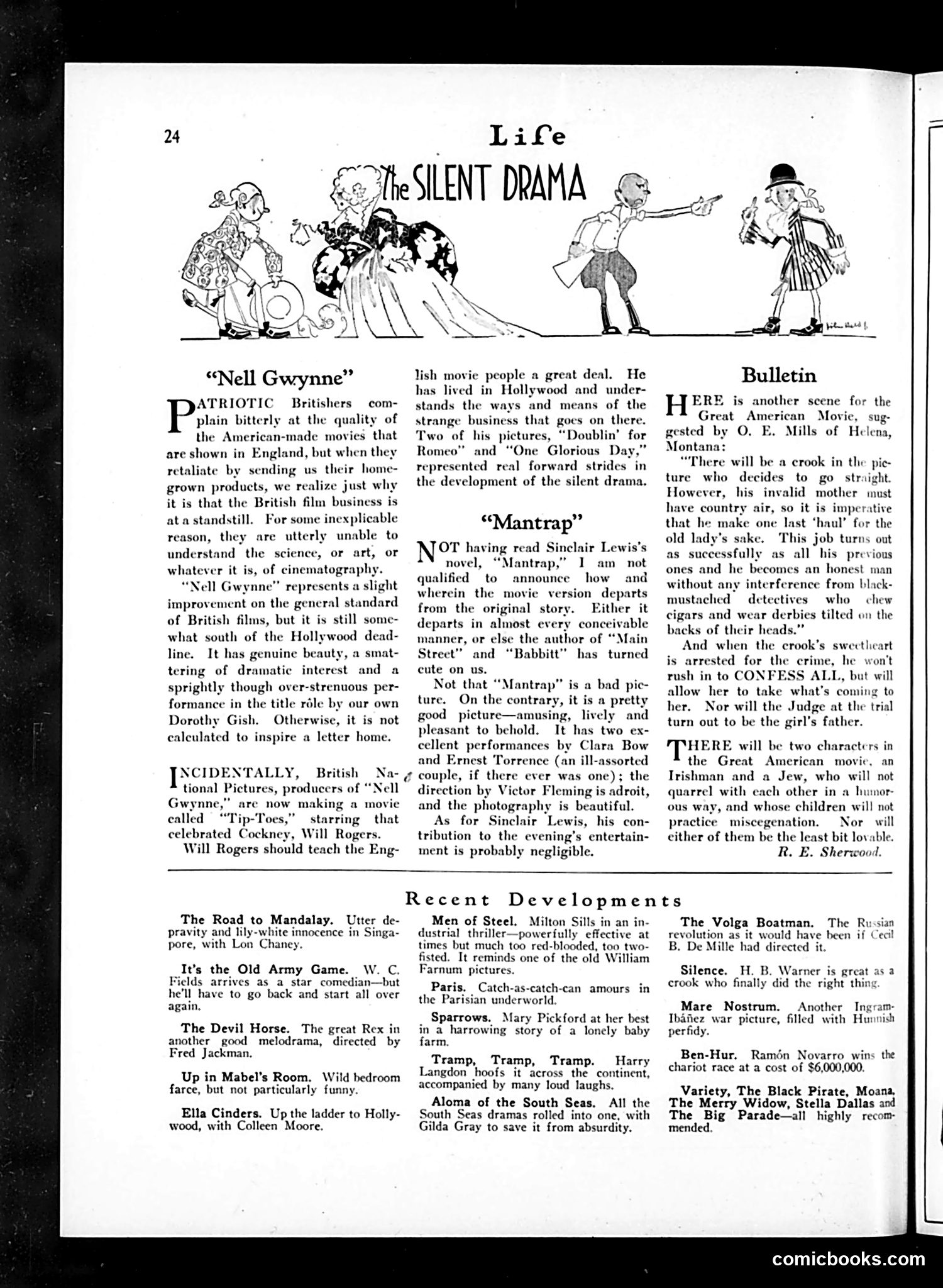
This page reviews silent films, critiquing both British and American cinema. The header cartoon illustrates "The Silent Drama" with four stylized figures representing different film character types or acting styles. The main text attacks British film quality, specifically "Nell Gwynne," suggesting British producers fundamentally misunderstand cinematography. It praises American comedian Will Rogers as superior and recommends he teach the British filmmaking craft. The "Mantrap" review dismisses Sinclair Lewis's contribution to the film adaptation, implying the novel's famous author is irrelevant to movie success—a jab at literary pretension in cinema. The "Bulletin" section contains reader suggestions for more authentic "Great American Movie" plots, satirizing Hollywood clichés: the reformed criminal, the convenient parental sacrifice, and stereotypical ethnic character conflicts. The satire suggests Hollywood relies on predictable melodrama rather than nuanced storytelling.
📄 Transcribed text from this page (OCR, searchable)
Machine-transcribed from the original scan — historical spelling and the odd misread are preserved.
“Nell Gwynne” ATRIOTIC Britishers com- plain bitterly at the quality of the American-made movies that are shown in England, but when they retaliate by sending us their home- grown products, we realize just why it is that the British film business is ata standstill. For some inexplicable reason, they are utterly unable to understand the science, or art, or whatever it is, of cinematography. Nell Gwynne” represents a slight improvement on the general standard of British films, but it is still some- what south of the Hollywood dead- line. It has genuine beauty, a smat- tering of dramatic interest and a sprightly though over-strenuous per- formance in the title réle by our own Dorothy Gish. Otherwise, it is not calculated to inspire a letter home. NCIDENTALLY, British Na- é tional Pictures, producers of “Nell Gwynne,” are now making a movie called ““Tip-Toes,” starring that celebrated Cockney, Will Rogers. Will Rogers should teach the Eng- Life The SILENT DRAMA lish movie people a great deal. He has lived in Hollywood and under- stands the ways and means of the strange business that goes on there. Two of his pictures, “Doublin’ for Romeo” and ‘One Glorious Day,” represented real forward strides in the development of the silent drama. “Mantrap” NOT hs having read Sinclair Lewis's novel, “‘Mantrap,” I am_ not qualified to announce how and wherein the movie version departs from the original story. Either it departs in almost every conceivable manner, or else the author of “Main Street” and “Babbitt” has turned cute on us, Not that “Mantrap” is a bad pic- ture. On the contrary, it is a pretty good picture—amusing, lively and pleasant to behold. It has two ex- cellent performances by Clara Bow and Ernest Torrence (an ill-assorted couple, if there ever was one); the ection by Victor Fleming is adroit, and the photography is beautiful. As for Sinclair Le: his con- tribution to the evening's entertain- ment is probably negligible. Bulletin ERE is another scene for the Great American Movie, sug- gested by O. E. Mills of Helena, Montana: “There will be a crook in the pic- ture who decides to go straight. However, his invalid mother must have country air, so it is imperative that he make one last ‘haul’ for the old lady's sake. This job turns out as successfully as all his previous ones and he becomes an honest man without any interference from black- mustached detectives who chew cigars and wear derbies tilted on the backs of their heads.” And when the crook’s swectlicart is arrested for the crime, he won't rush in to CONFESS ALL, but will allow her to take what's coming to her. Nor will the Judge at the trial turn out to be the girl’s father. HERE will be two characters in the Great American movie, an Irishman and a Jew, who will not quarrel with each other in a humor- ous way, and whose children wil! not practice miscegenation. Nor will cither of them be the least bit lovable. R. E. Sherwood. The Road to Mandalay. Utter de- pravity and lily-white innocence in Singa- pore, with Lon Chaney, It’s the Old Army Game. W. C. Fields arrives as a star comedian—but he'll have to go back and start all over again. The Devil Horse. The great Rex in another good melodrama, directed by Fred Jackman, Up in Mabel’s Room. Wild bedroom farce, but not particularly funny. Ella Cinders. Up the ladder to Holly- wood, with Colleen Moore. Recent Men of Steel. Milton Sills in an in- dustrial thriller—powerfully effective at times but much too red-blooded, too two- fisted. It reminds one of the old William Farnum pictures. Paris. Catch-as-catch-can amours in the Parisian underworld. Sparrows. Mary Pickford at her best in a harrowing story of a lonely baby farm. Tramp, Tramp, Tramp. Harry Langdon hoofs it across the continent, accompanied by many loud laughs. Aloma of the South Seas. All the South Seas dramas rolled into one, with Gilda Gray to save it from absurdity. Developments The Volga Boatman. The Russian revolution as it would have been if Cecil B. De Mille had directed it. Silence. H. B. Warner is grea crook who finally did the right thi Mare Nostrum. Another Ingram- Ibafiez war picture, filled with Hunnish perfidy. Ben-Hur. Ramén Novarro wins the chariot race at a cost of $6,000,000. Variety, The Black Pirate, Moana. The Merry Widow, Stella Dallas and The Big Parade—all highly recom- mended. comicbooks.com