
Life, 1926-08-12 · page 5 of 36
Life — August 12, 1926 — page 5: what you’re looking at
What you’re looking at
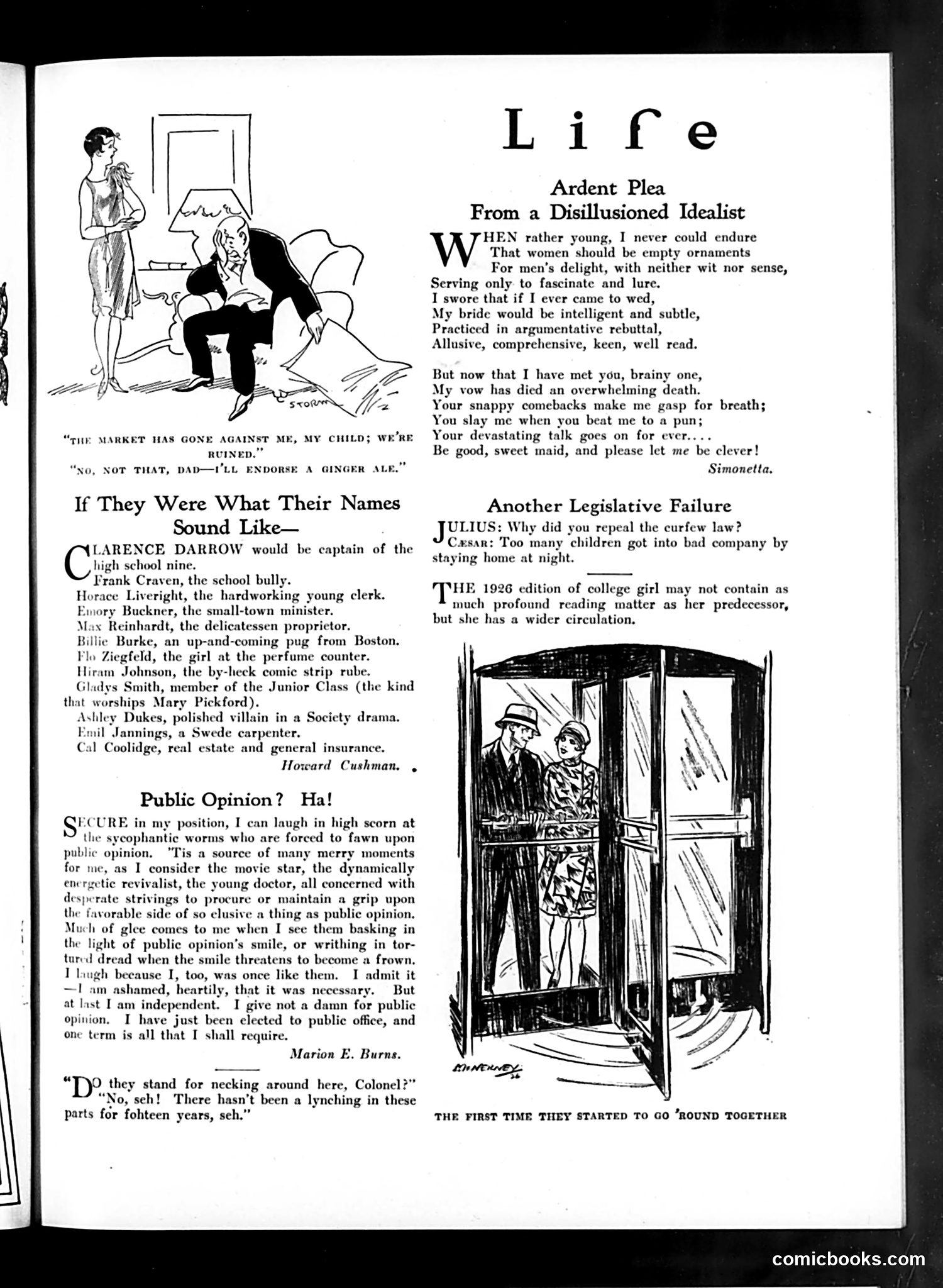
This page contains satirical humor pieces typical of 1920s Life magazine. The main cartoon shows a disgruntled man in a chair while a woman stands nearby—illustrating "Ardent Plea From a Disillusioned Idealist," where the speaker laments his bride isn't the intellectual companion he imagined. The satire mocks romantic idealism meeting marital reality. "If They Were What Their Names Sound Like" humorously redefines names (Clarence Darrow as "captain of the high school nine," etc.), typical wordplay humor of the era. "Public Opinion? Ha!" presents a cynical monologue about dismissing public opinion—reflecting 1920s intellectual skepticism toward mass sentiment. The bottom illustration shows a couple on their first outing together, captioned with romantic undertones. Overall, these pieces satirize romance, marriage, and social pretensions.
📄 Transcribed text from this page (OCR, searchable)
Machine-transcribed from the original scan — historical spelling and the odd misread are preserved.
“No, If They Were What Their Names Sound Like— LARENCE DARROW would be captain of the high school nine. Frank Craven, the school bully. ce Liveright, the hardworking young clerk. Emory Buckner, the small-town minister. Max Reinhardt, the delicatessen proprietor. Billie Burke, an up-and-coming pug from Boston. Flo Ziegfeld, the girl at the perfume counter. Hiram Johnson, the by-heck comic strip rube, Gladys Smith, member of the Junior Class (the kind that worships Mary Pickford). Ashley Dukes, polished villain in a Society drama, Emil Jannings, a Swede carpenter. Cal Coolidge, real estate and general insurance. Howard Cushman. , Public Opinion? Ha! ECURE in my position, I can laugh in high scorn at the sycophantic worms who are forced to fawn upon public opinion, "Tis a source of many merry moments for me, as I consider the movie star, the dynamically encrgetic revivalist, the young doctor, all concerned with desperate strivings to procure or maintain a grip upon the favorable side of so elusive a thing as public opinion. Much of glee comes to me when I see them basking in the light of public opinion’s smile, or writhing in tor- tured dread when the smile threatens to become a frown. I liugh because I, too, was once like them. I admit it —I am ashamed, heartily, that it was necessary. But at lust Iam independent. I give not a damn for public opinion, I have just been elected to public office, and one term is all that I shall require. “De Marion E. Burns. they stand for necking around here, Colone No, seh! There hasn’t been a lynching in these parts for fohteen years, seh.” Life Ardent Plea From a Disillusioned Idealist HEN rather young, I never could endure \ \ That women should be empty ornaments For men’s delight, with neither wit nor sense, Serving only to fascinate and lure. I swore that if I ever came to wed, My bride would be intelligent and subtle, Practiced in argumentative rebuttal, Allusive, comprehensive, keen, well read. But now that I have met you, brainy one, My vow has died an overwhelming death. Your snappy comebacks make me gasp for breath; You slay me when you beat me to a pun; Your devastating talk goes on for ever.... Be good, sweet maid, and please let me be clever! Simonetta. Another Legislative Failure JULIUS: Why did you repeal the curfew law? Cxsar: Too many children got into bad company by staying home at night. (THE 1926 edition of college girl may not contain as much profound reading matter as her predecessor, but she has a wider circulation. THE FIRST TIME THEY STARTED TO GO "ROUND TOGETHER comicbooks.com