
A complete issue · 37 pages · 1926
Life — July 22, 1926
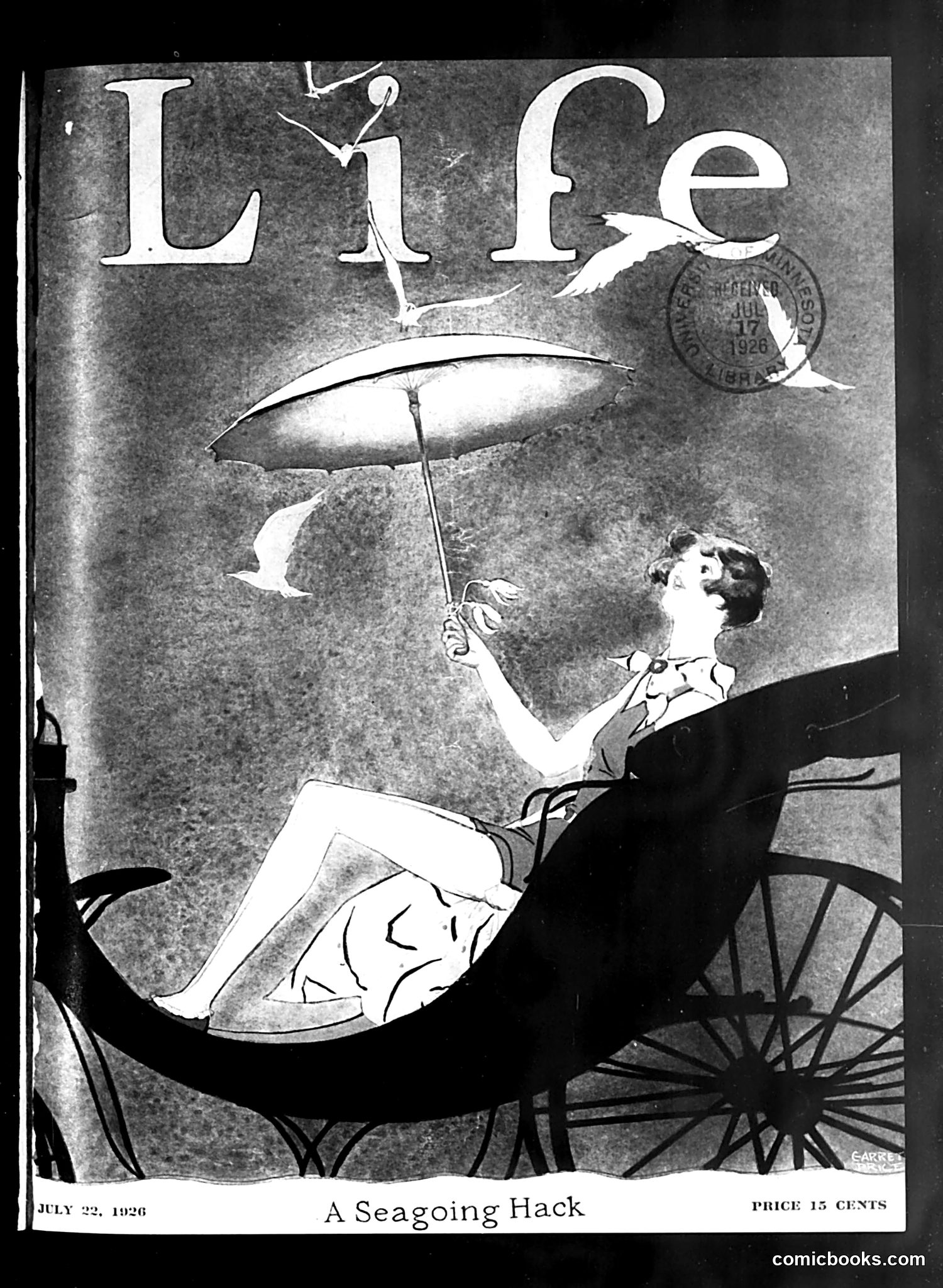
This satirical cover depicts a woman relaxing in a baby carriage while holding an umbrella shaped like a fish, titled "A Seagoing Hack." The term "hack" likely refers to a taxi cab (a common colloquialism), so the joke plays on the pun: a "seagoing hack" combines nautical and transportation imagery absurdly. The illustration appears to mock either fashionable leisure culture or perhaps critiques women's leisure activities of the 1920s. The incongruous image—a carriage-like setting at sea with whimsical accessories—exemplifies Life magazine's surreal humor typical of the era. The specific social commentary remains unclear without additional context, but it likely satirizes contemporary trends, fashion, or social pretensions of the Jazz Age.
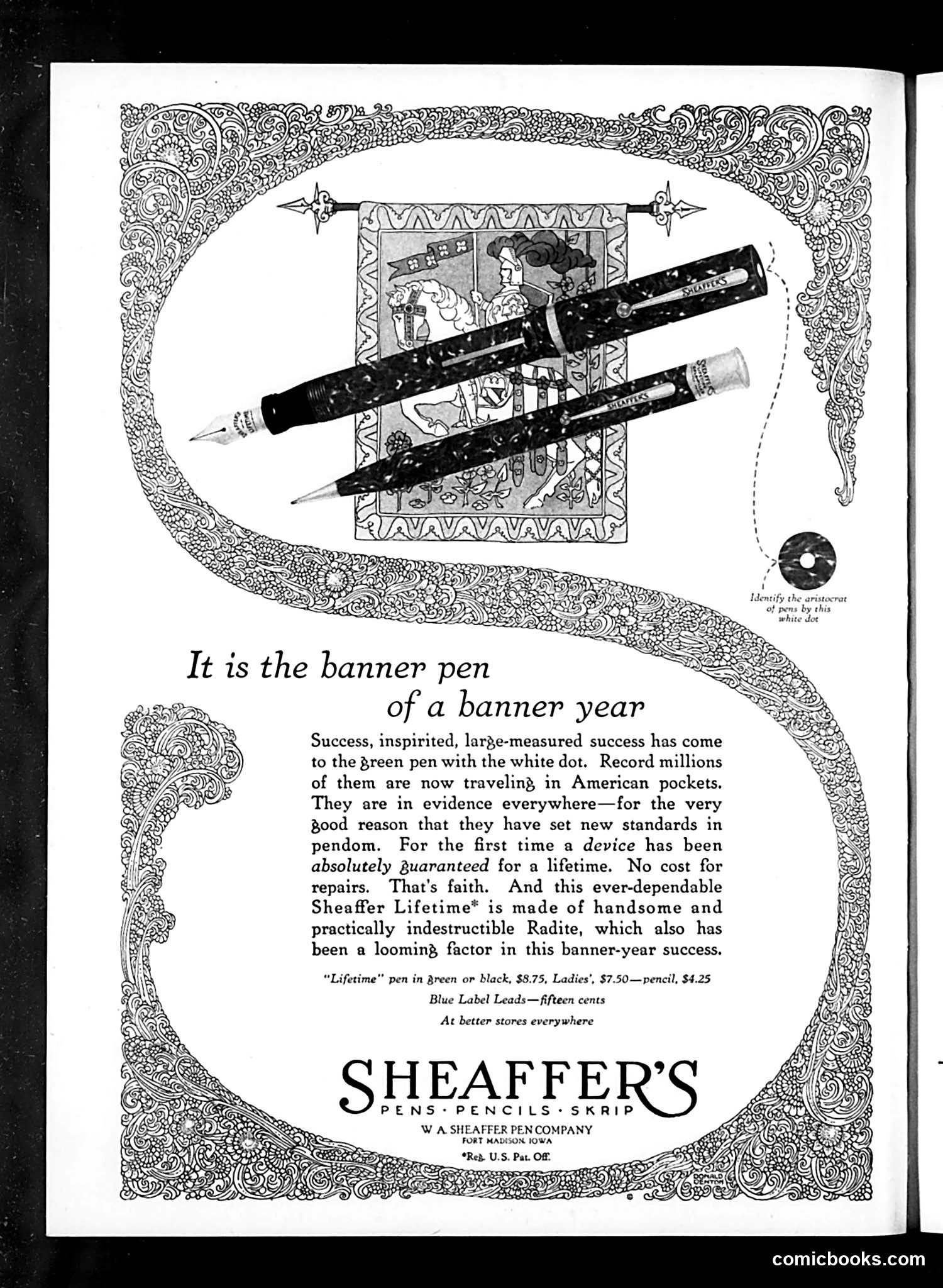
This is primarily a **Sheaffer pen advertisement**, not political satire. The page promotes the "Sheaffer Lifetime" pen as "the banner pen of a banner year," claiming record sales and popularity among American consumers. The decorative ornamental border and the small illustration showing writing instruments are purely aesthetic design elements typical of 1920s-30s advertising. The text emphasizes the pen's durability (guaranteed lifetime, "no cost for repairs") and its construction from "Radite," positioning it as a premium, reliable product. There is **no political cartoon or satire content** on this page—it is straightforward commercial advertising for writing instruments, albeit with elaborate period design flourishes.
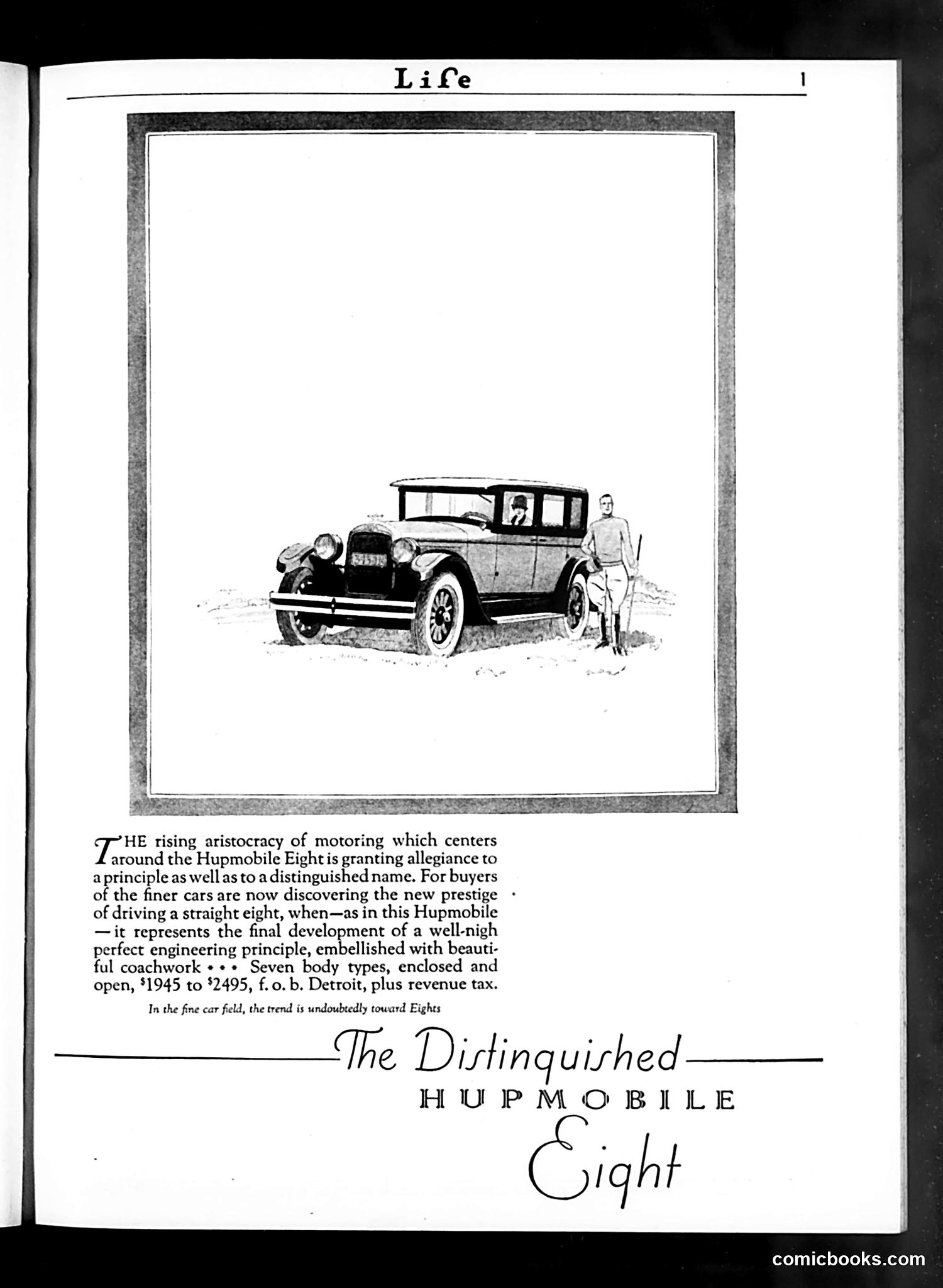
This page is primarily **advertising content**, not satire or political commentary. It's a Hupmobile automobile advertisement from Life magazine. The ad promotes the "Distinguished Hupmobile Eight"—a straight-eight engine car priced between $1,945-$2,495 (plus tax) in Detroit. The illustration shows a 1920s-era sedan with a well-dressed man standing beside it. The text emphasizes that eight-cylinder engines represent the latest prestige in automobiles and that the Hupmobile offers "final development of a well-nigh perfect engineering principle" with quality coachwork. There is **no political cartoon or satire** on this page. It's straightforward product marketing aimed at upper-middle-class buyers interested in luxury automobiles during the automotive industry's expansion in the 1920s.
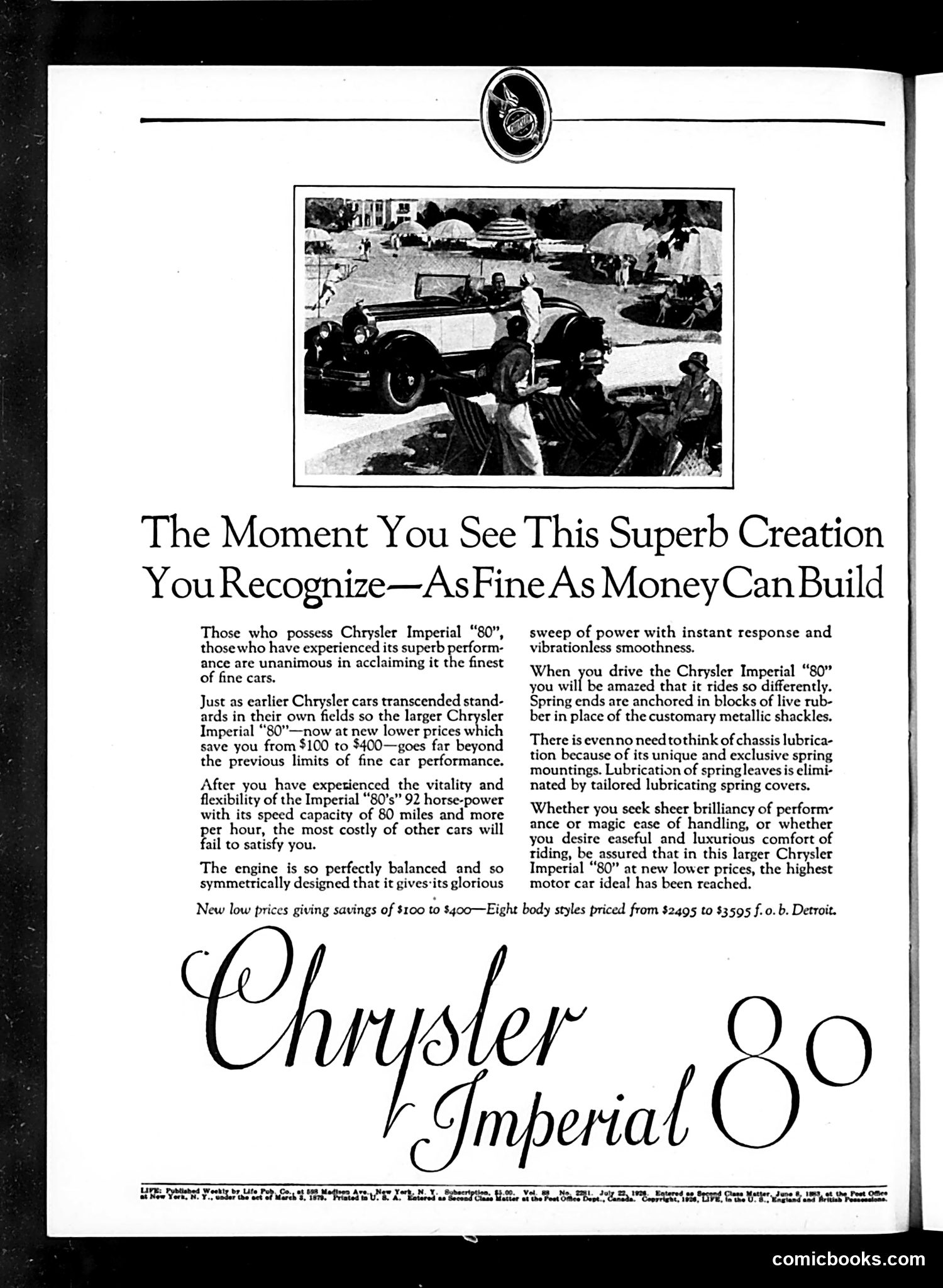
This page is **not a cartoon or satirical content** — it's a **straightforward automobile advertisement** for the Chrysler Imperial "80" model. The image shows a 1920s-era luxury car at what appears to be a social gathering or picnic, with well-dressed people nearby. The ad emphasizes the car's performance (80+ horsepower, 80+ mph capability), mechanical innovations (balanced engine, special spring suspension), and affordability — pricing from $2,495 to $3,595. The headline's phrasing ("Fine As Money Can Build") is promotional hyperbole typical of period advertising. There is no political satire, caricature, or social commentary here — this is a commercial product endorsement positioned to appeal to affluent buyers seeking luxury and performance at competitive prices.
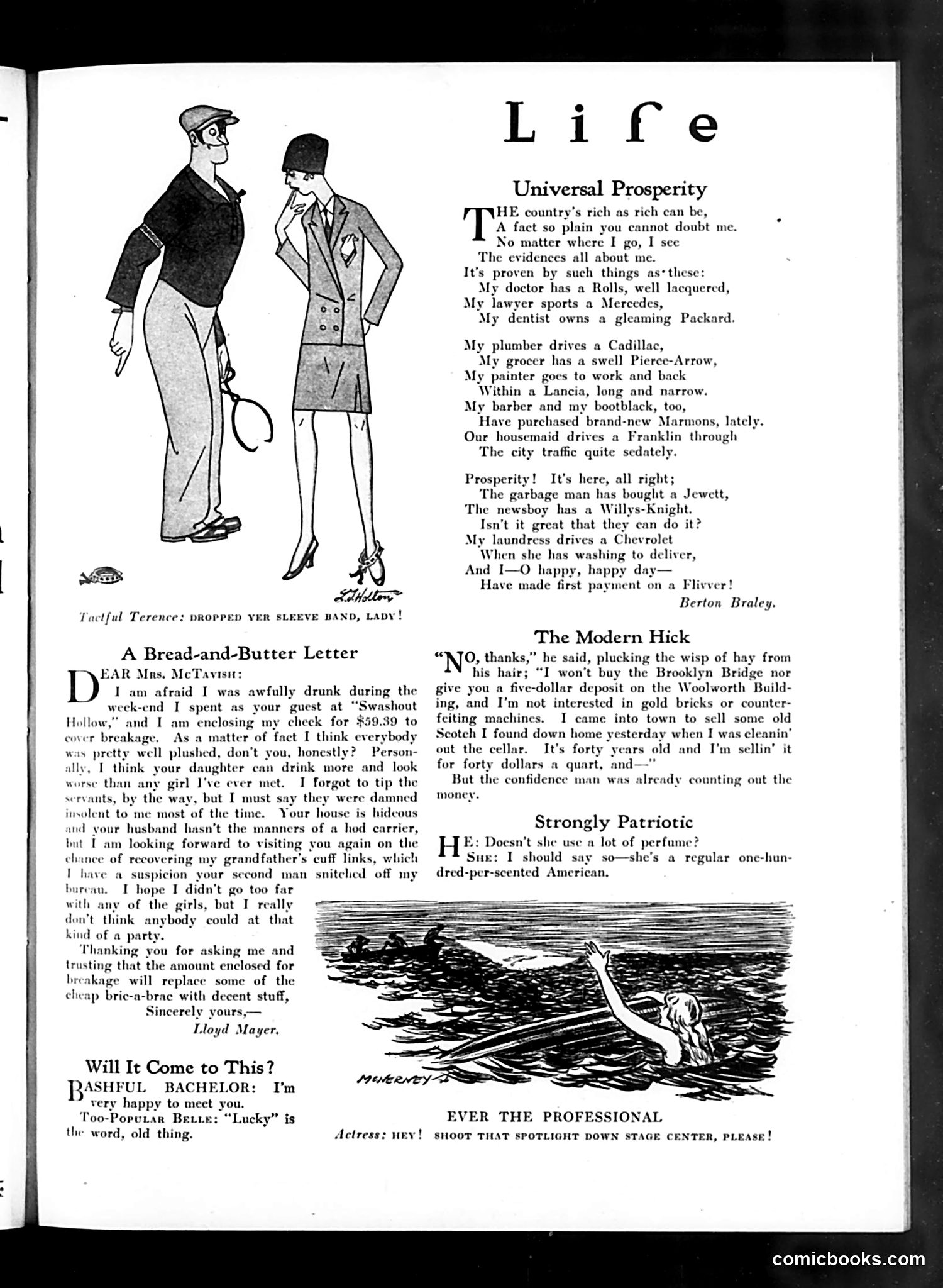
This page contains several satirical pieces from Life magazine's humor section. **"Universal Prosperity"** (top): A poem by Berton Braley mocking 1920s consumerism. It sarcastically catalogs evidence of wealth: doctors owning Rolls-Royces, lawyers driving Mercedes, plumbers in Cadillacs. The joke targets the era's material excess and the absurdity of working-class professionals suddenly affording luxury goods—likely reflecting post-WWI economic booms and installment-buying culture. **"A Bread-and-Butter Letter"**: A humorous complaint about houseguest behavior, depicting social etiquette violations. **"The Modern Hick"** and **"Strongly Patriotic"**: Brief comedic dialogues poking fun at rural Americans and nationalist sentiment. The illustration (top-left) shows fashionably-dressed 1920s figures, reinforcing the era's focus on modern consumer culture and social pretension.
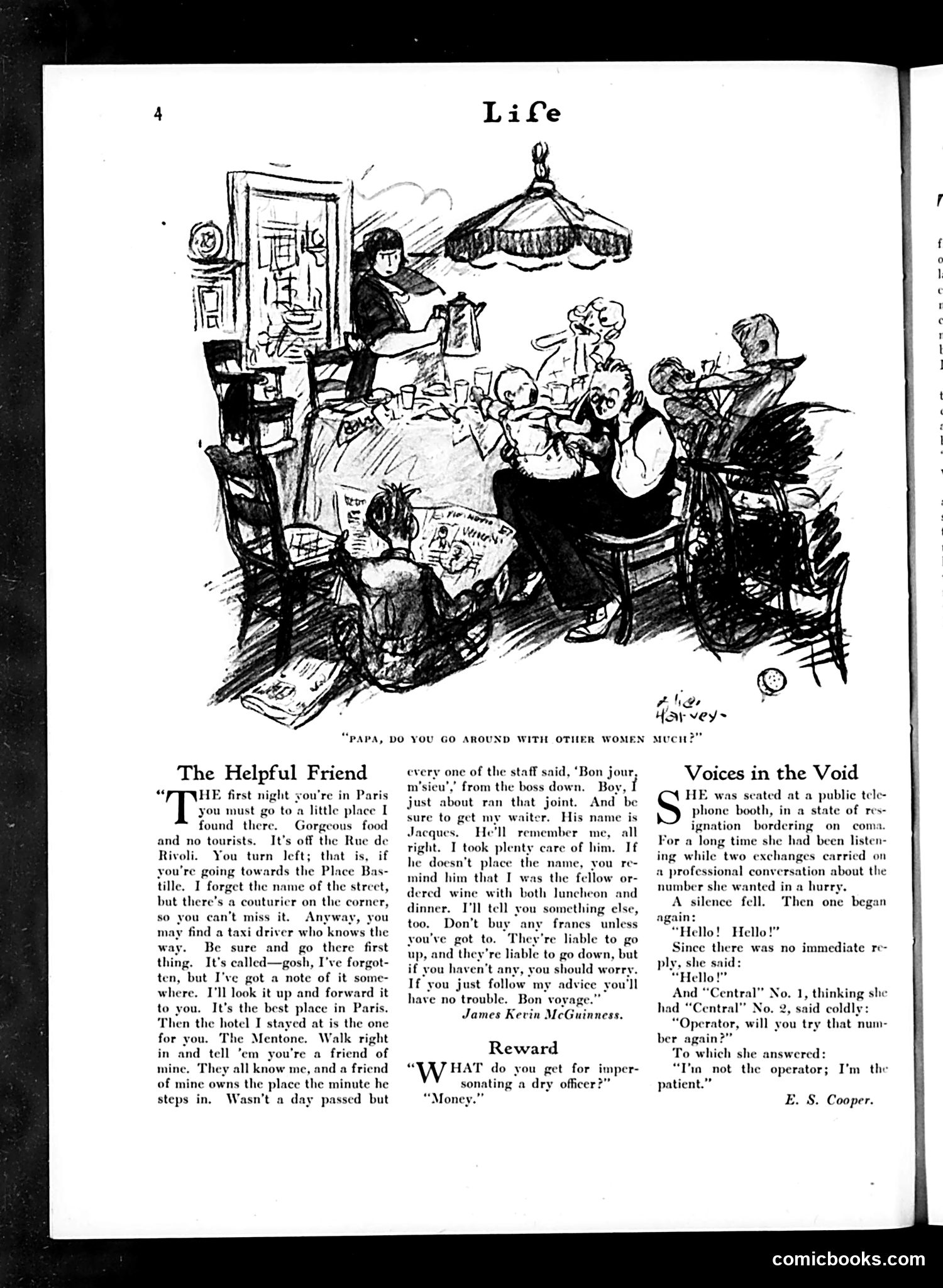
The main cartoon depicts a domestic scene with a man seated at a table surrounded by women and children, with one woman standing and asking: "Papa, do you go around with other women much?" This appears to be satirizing early 20th-century gender dynamics and marital concerns. The joke targets anxious wives questioning their husbands' fidelity—a common social anxiety of the era. The crowded domestic setting emphasizes the woman's public nature of the accusation. Below are three brief humorous pieces: "The Helpful Friend" (satirizing unsolicited Paris travel advice), "Voices in the Void" (mocking telephone operator confusion), and "Reward" (a quick joke about compensating dry officers). These represent typical Life magazine humor: light social observation and domestic comedy rather than political satire.
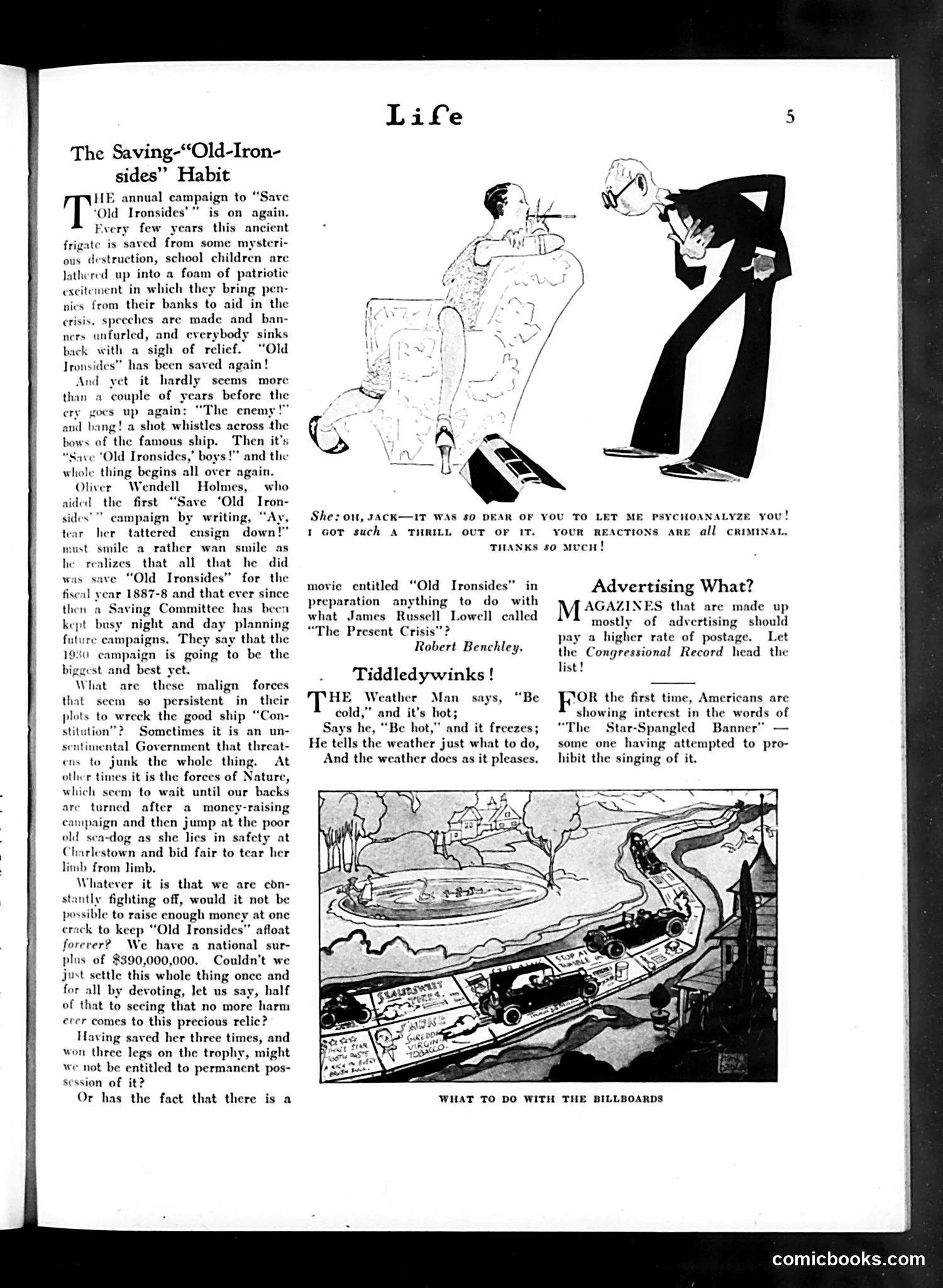
This page contains three separate pieces of satire: 1. **"The Saving 'Old-Ironsides' Habit"**: A humorous article mocking the recurring campaign to preserve the USS Constitution ("Old Ironsides"), noting it's saved every few years from destruction. The cartoon shows a man psychoanalyzing another, with the caption suggesting obsessive behavior over the ship's preservation. 2. **"Tiddledywinks!"**: A short satirical piece about weather forecasting, mocking meteorologists' inability to predict conditions accurately. 3. **"What to Do with the Billboards"**: A cartoon illustration (bottom) showing billboards along a waterway, apparently satirizing advertising's intrusion into natural landscapes and public spaces. The overall tone is light political/social commentary typical of *Life* magazine's satirical style.
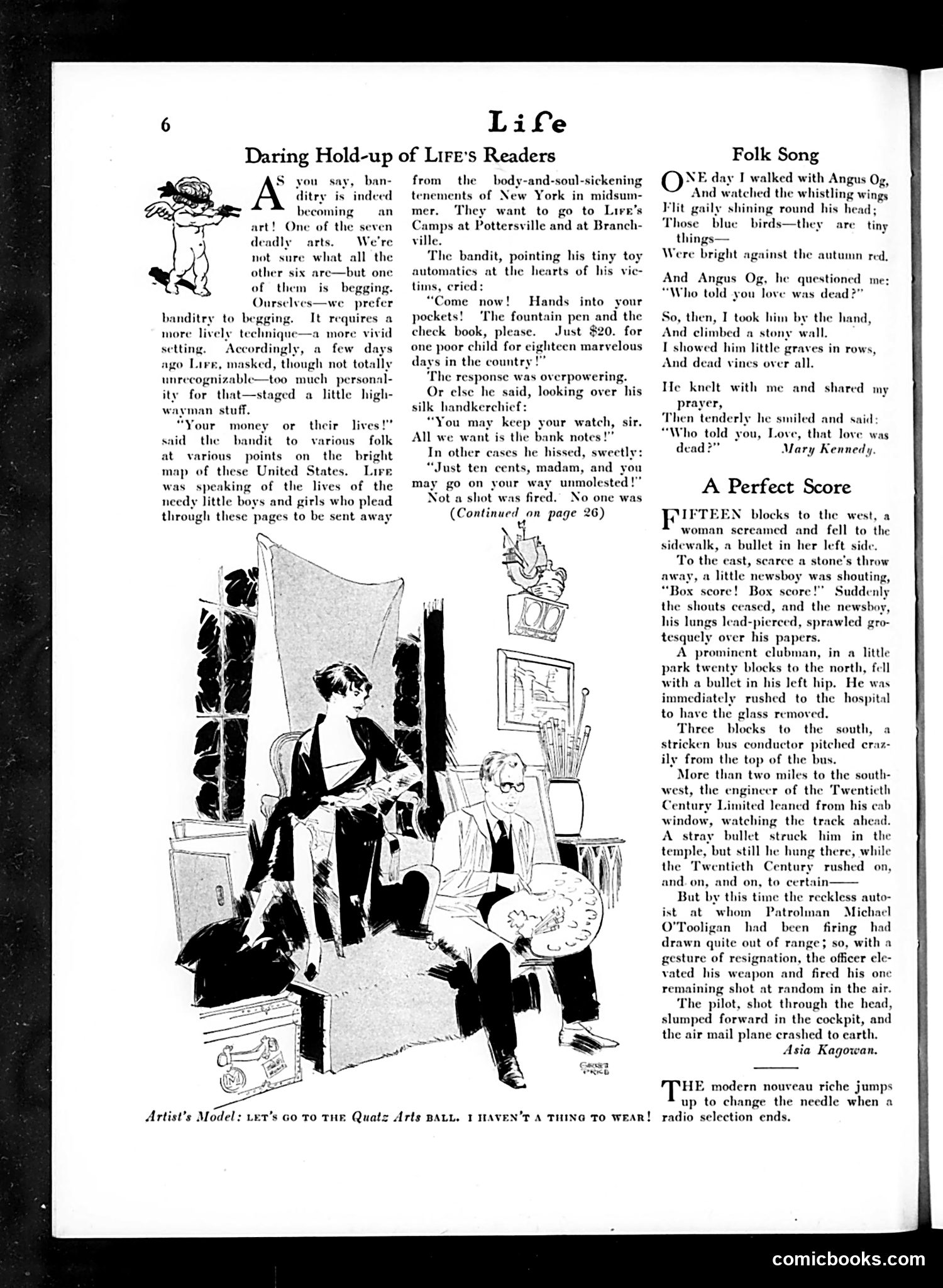
This page contains three distinct pieces of satirical content: **"Daring Hold-up of Life's Readers"** (top left): A humorous article with illustration mocking beggars soliciting donations from Life's readership. The cartoon depicts a ragged child with outstretched hand—satire targeting the persistence of poverty appeals and charitable solicitation. **"Artist's Model" cartoon** (bottom left): Shows an elegantly dressed woman in an artist's studio telling companions "Let's go to the Quatz Arts Ball. I haven't a thing to wear!"—satirizing the wealthy's complaints about having insufficient clothing despite obvious affluence. This reflects pre-1920s social satire about class pretension. **"A Perfect Score" and other pieces** (right): Short stories and anecdotes, appearing to be typical Life magazine content blending humor with social observation. The page exemplifies Life's satirical approach to American class dynamics and social pretension.
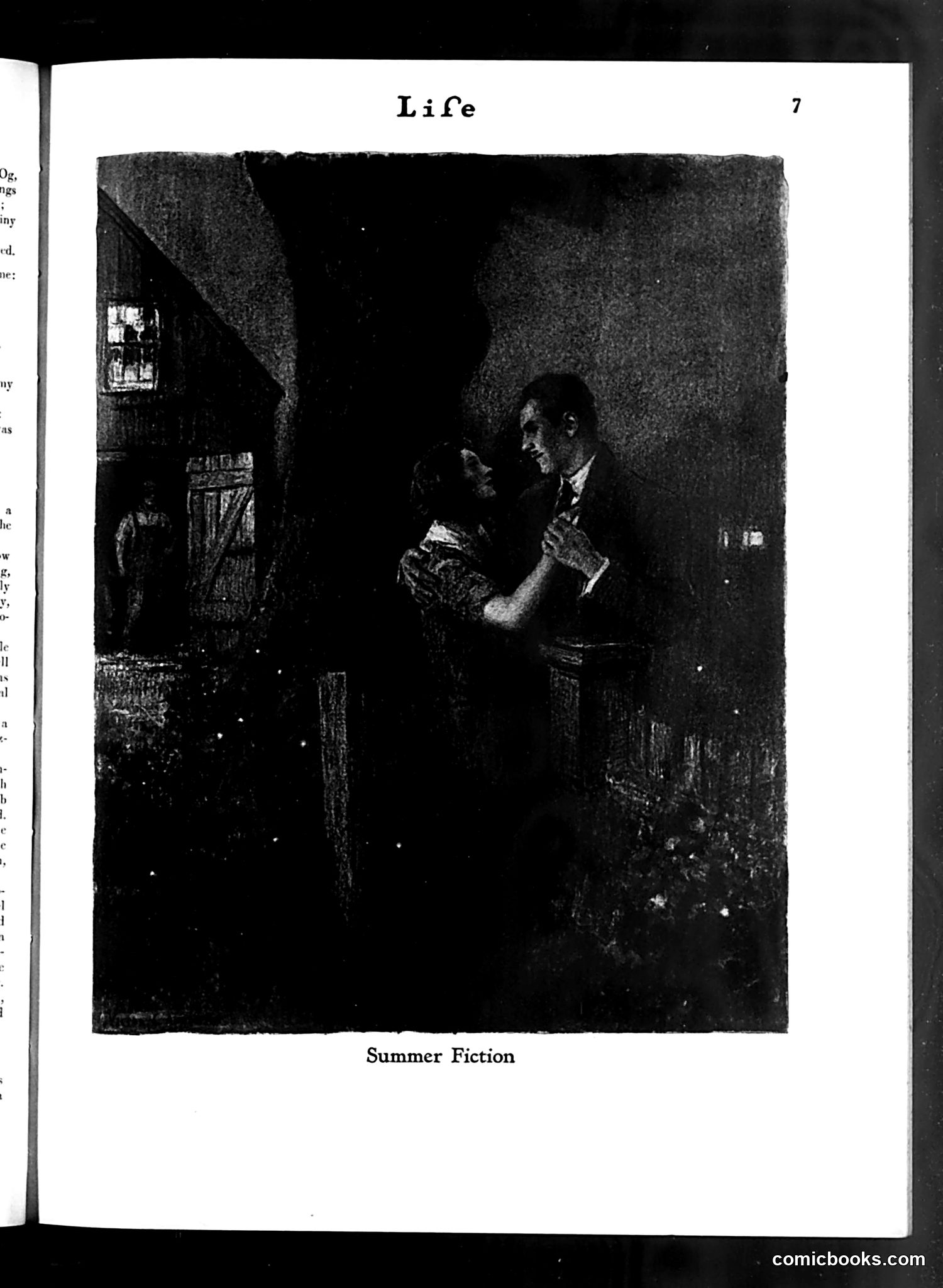
This page from *Life* magazine presents a darkly comedic illustration titled "Summer Fiction." The image depicts what appears to be a shadowy domestic scene in an interior space, with two figures in dramatic lighting. One figure on the right appears to be reading or holding a document, while another silhouetted figure looms in the background. The caption "Summer Fiction" suggests satirical commentary on popular summer entertainment or literature of the era. The stark, noir-like imagery and mysterious atmosphere parody the melodramatic tone typical of summer pulp fiction or serialized stories popular with readers during warm months. The illustration's shadowy style contrasts with the typically lighter, escapist nature of seasonal reading material, creating ironic commentary on the genre's dramatic pretensions.
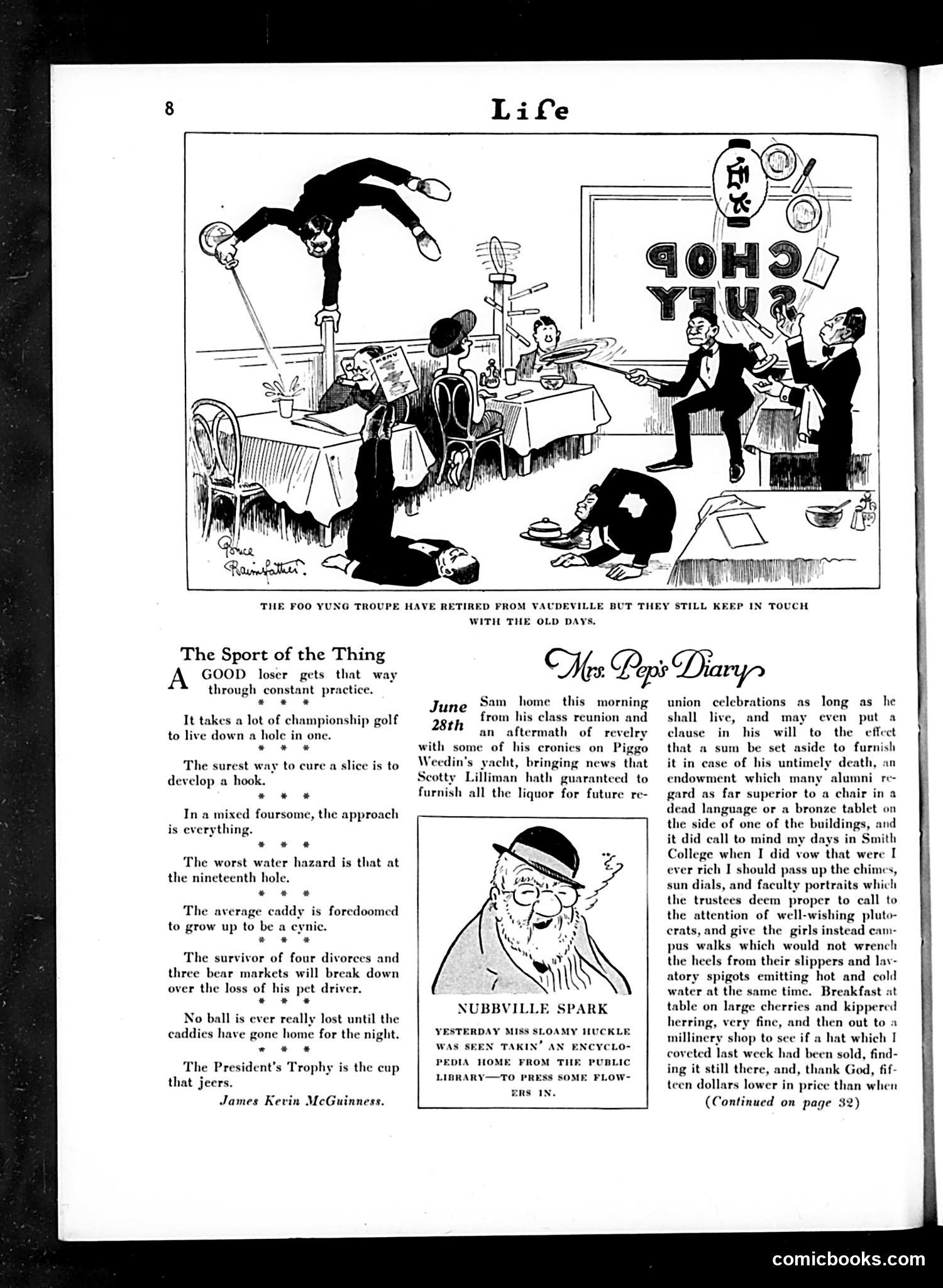
The top cartoon depicts members of the "Foo Young Troupe" at a Chinese restaurant reunion, having retired from vaudeville but maintaining old friendships. The "CHOP SUEY" sign and Chinese décor are period details referencing early 20th-century American Chinatown entertainment. Below, "The Sport of the Thing" is a humorous column by James Kevin McGuinness offering satirical golf advice—poking fun at golfers' pretensions and poor skills ("The worst water hazard is that at the nineteenth hole," meaning the bar). "Mrs. Pep's Diary" (dated June 28th) recounts a college class reunion and discusses endowing a memorial, likely satirizing alumni sentimentality and upper-class charitable posturing. The small illustration shows "Nubbville Spark," apparently a local character spotted riding a bicycle, suggesting small-town gossip content.
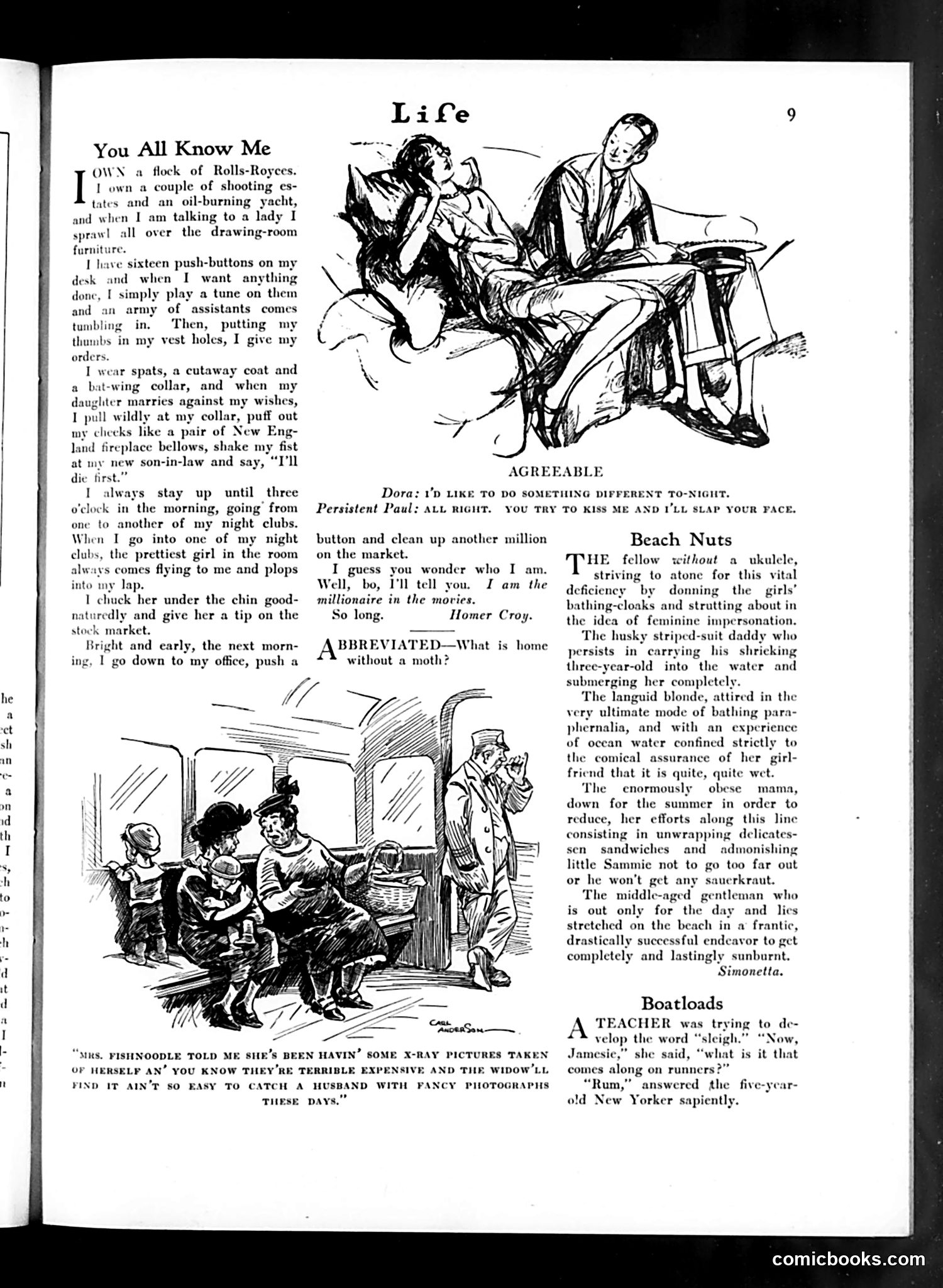
This page contains three separate humor pieces typical of early 20th-century Life magazine: 1. **"You All Know Me"**: A first-person monologue by a wealthy, ostentatious man boasting of his possessions (Rolls-Royces, yachts, push-buttons) and casual cruelty (threatening his son-in-law). The satire mocks nouveau riche excess and arrogance. 2. **"Agreeable"** (top cartoon): Shows a couple where the woman (Dora) proposes doing "something different" and the man (President Paul) dismissively refuses with threatened violence. It's satirizing male domination in relationships. 3. **"Beach Nuts"** and **"Boatloads"**: Brief humorous observations about summer vacation behavior and teaching anecdotes. The page satirizes wealth, masculine privilege, and social pretension through exaggeration and irony—standard Life magazine fare.
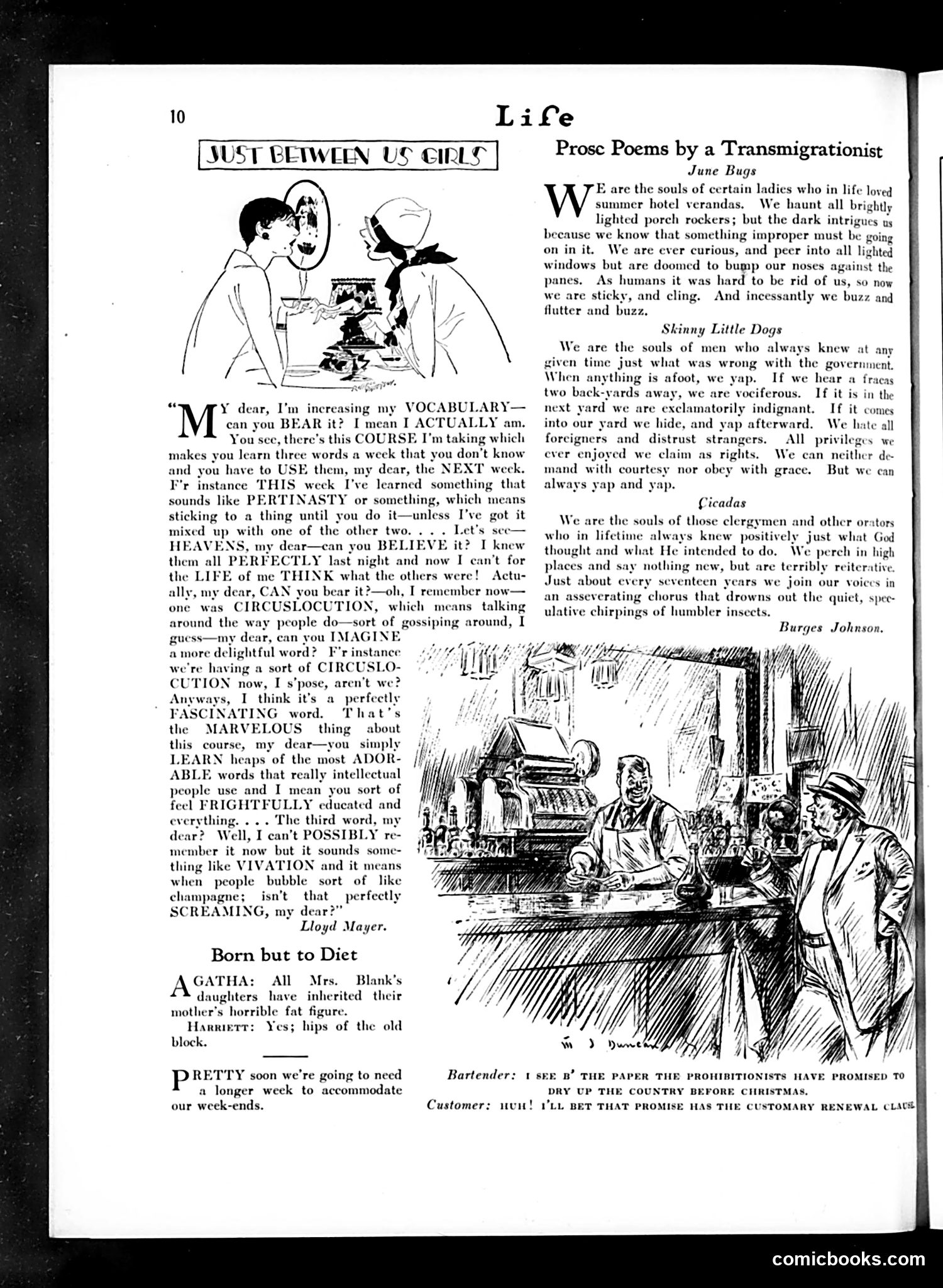
This page from *Life* magazine contains satirical prose poems and humor pieces. The main cartoon shows a bartender and customer discussing Prohibition—the constitutional ban on alcohol (1920-1933). The customer remarks that he'll "bet that promise has the customary renewal clause," sarcastically suggesting that prohibitionists' promises to "dry up the country before Christmas" are as reliable as business renewal clauses (i.e., repeatedly broken). The accompanying prose poems mock various social types: gossiping women ("June Bugs"), argumentative men ("Sining Little Dogs"), and clergy who pontificate without offering new ideas ("Cicadas"). The "Born but to Diet" section jokes about inherited fatness. The overall tone is cynical about political promises and human nature.
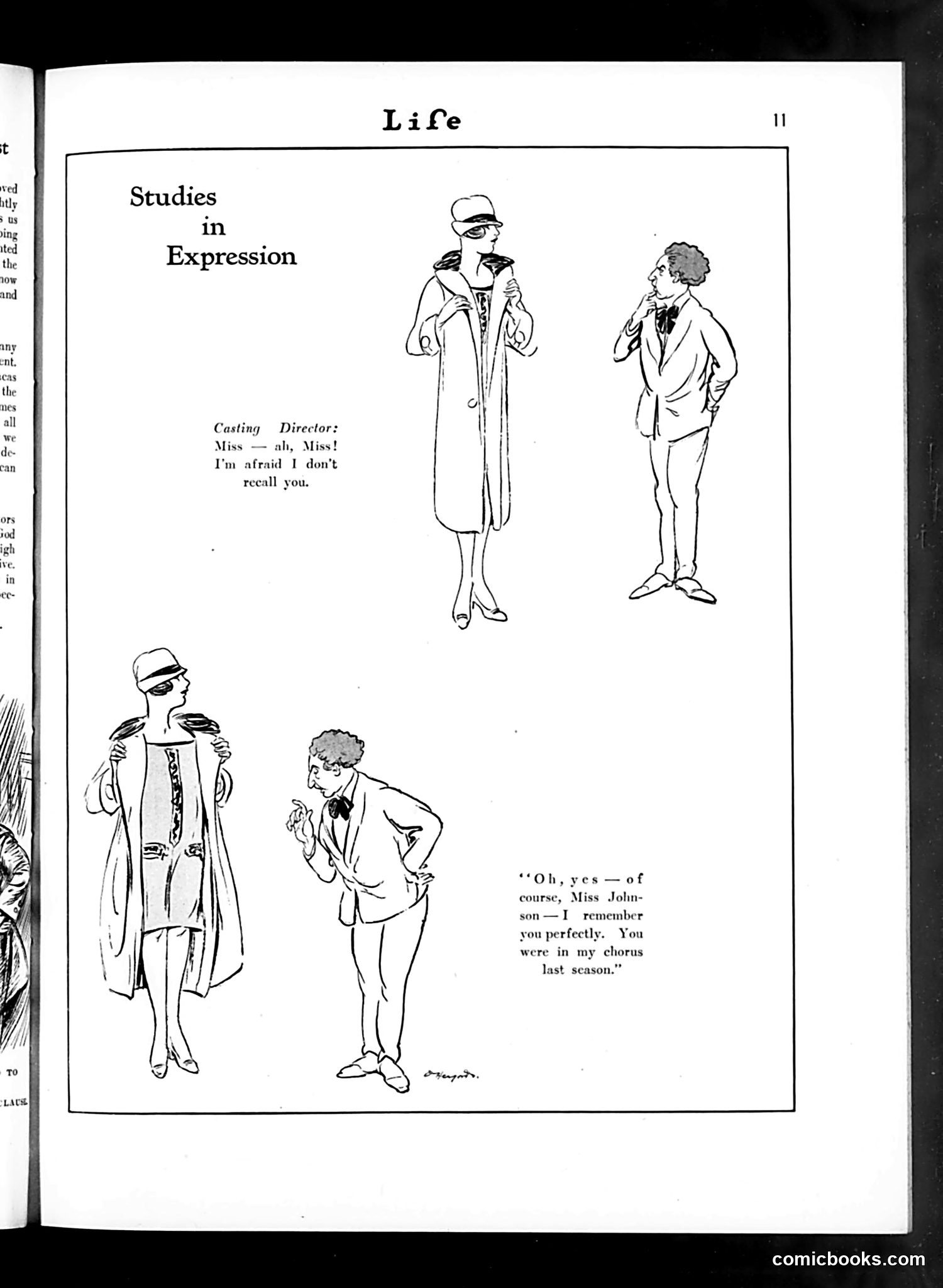
This is a satirical sketch about theatrical casting, titled "Studies in Expression." It depicts four figures in what appears to be an audition or casting scenario, showing different emotional expressions and body language. The humor centers on a casting director's dismissive treatment of an actress. Despite claiming not to remember her, he then contradicts himself by recalling she was "in my chorus last season"—exposing his pretense of forgetfulness as a thin lie. The four sketches show varying poses and expressions, likely illustrating different dramatic interpretations the actress might attempt during her audition. The satire mocks both theatrical vanity and the power imbalance between casting directors and performers, common themes in early 20th-century Life magazine humor about show business.
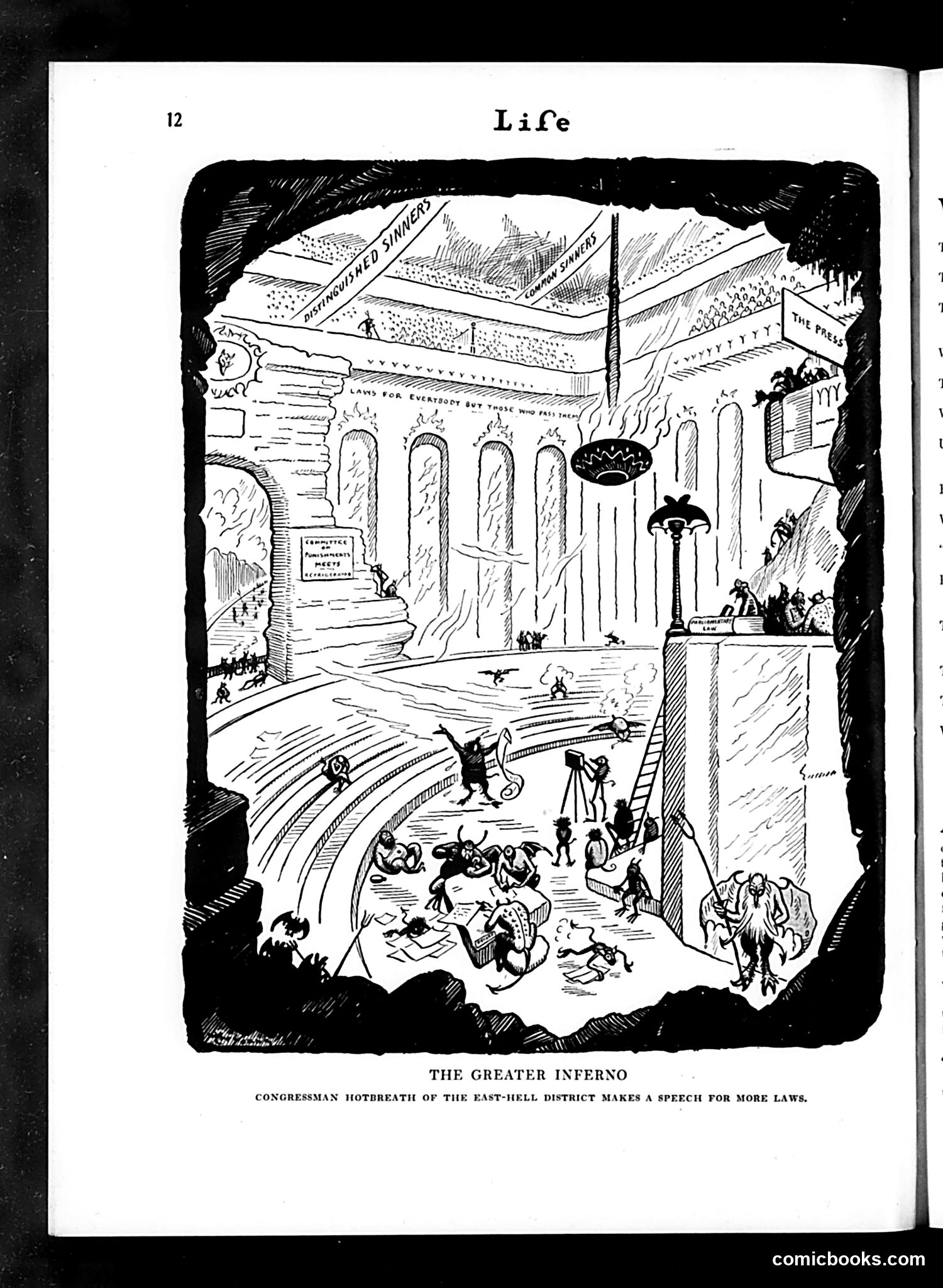
This political cartoon satirizes congressional corruption, specifically targeting a congressman from the "East-Hell District" who is making a speech demanding more laws. The visual metaphor depicts Hell as a massive underground cavern filled with demonic figures, chaos, and suffering—a clear reference to Dante's *Inferno*. The congressman, positioned prominently, appears to be addressing this pandemonium while advocating for additional legislation. The satire suggests that Congress itself operates like Hell, and that this particular representative's calls for more laws only add to the disorder and bureaucratic chaos. The cartoon critiques both governmental corruption and the proliferation of ineffective or self-serving legislation. The hellish setting implies that politics in this district is morally bankrupt and dysfunctional.
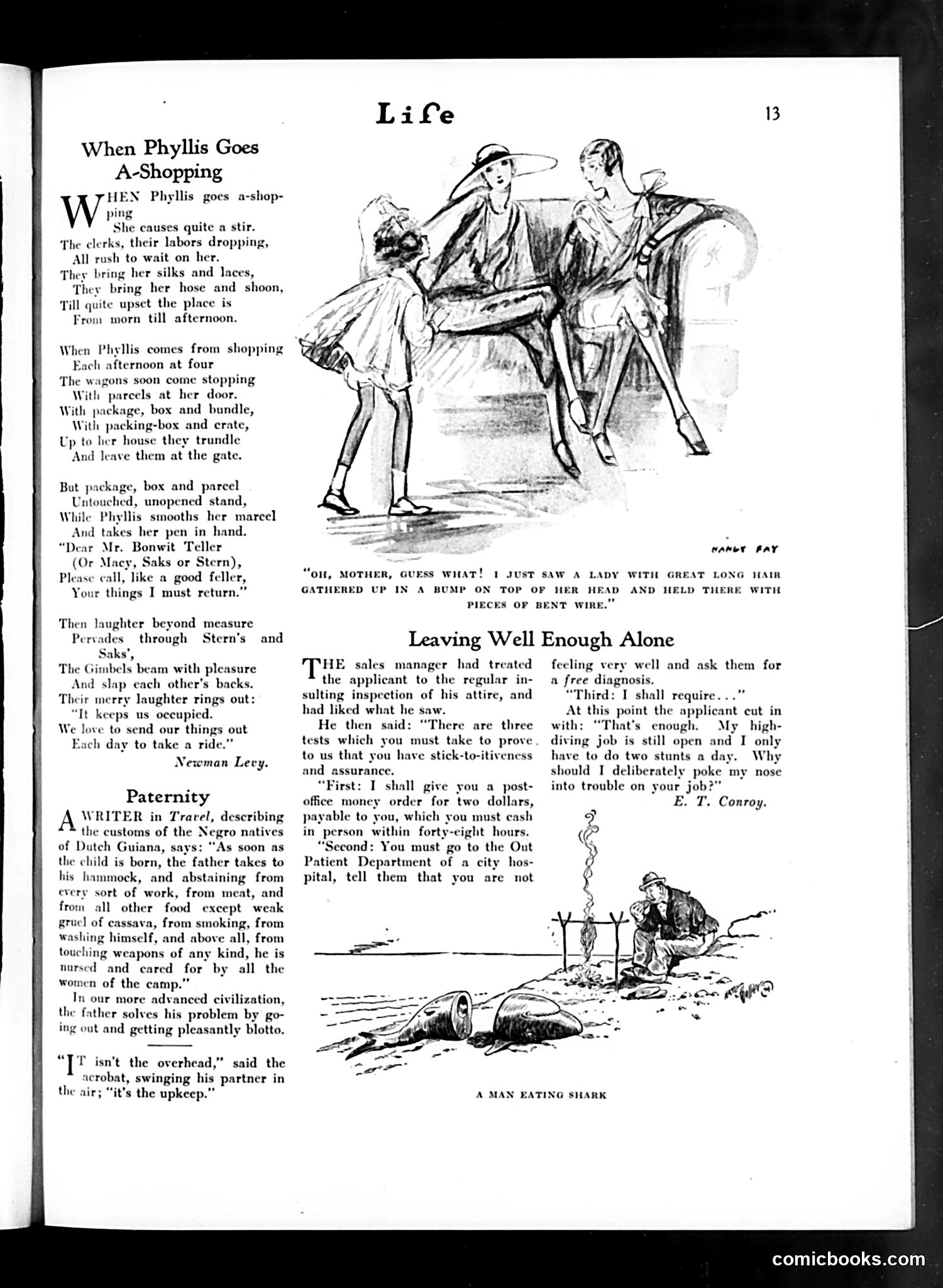
This page contains three separate humorous pieces: 1. **"When Phyllis Goes A-Shopping"** - A poem satirizing the disruption caused when a woman goes shopping. The accompanying sketch shows a woman returning home laden with packages, causing domestic chaos as servants scramble to manage her purchases. 2. **"Leaving Well Enough Alone"** - An anecdote mocking an overzealous job applicant undergoing medical inspection. The applicant deliberately provokes the doctor by poking his nose to prove he can take punishment, demonstrating absurd eagerness to prove his fitness for work. 3. **"Paternity"** - A brief piece contrasting Dutch colonial childrearing practices (involving abstinence from various activities) with modern "civilized" parenting, humorously concluding that fathers prefer "getting pleasantly blotto." The humor relies on domestic situations and class-based observations typical of early 20th-century satirical magazines.
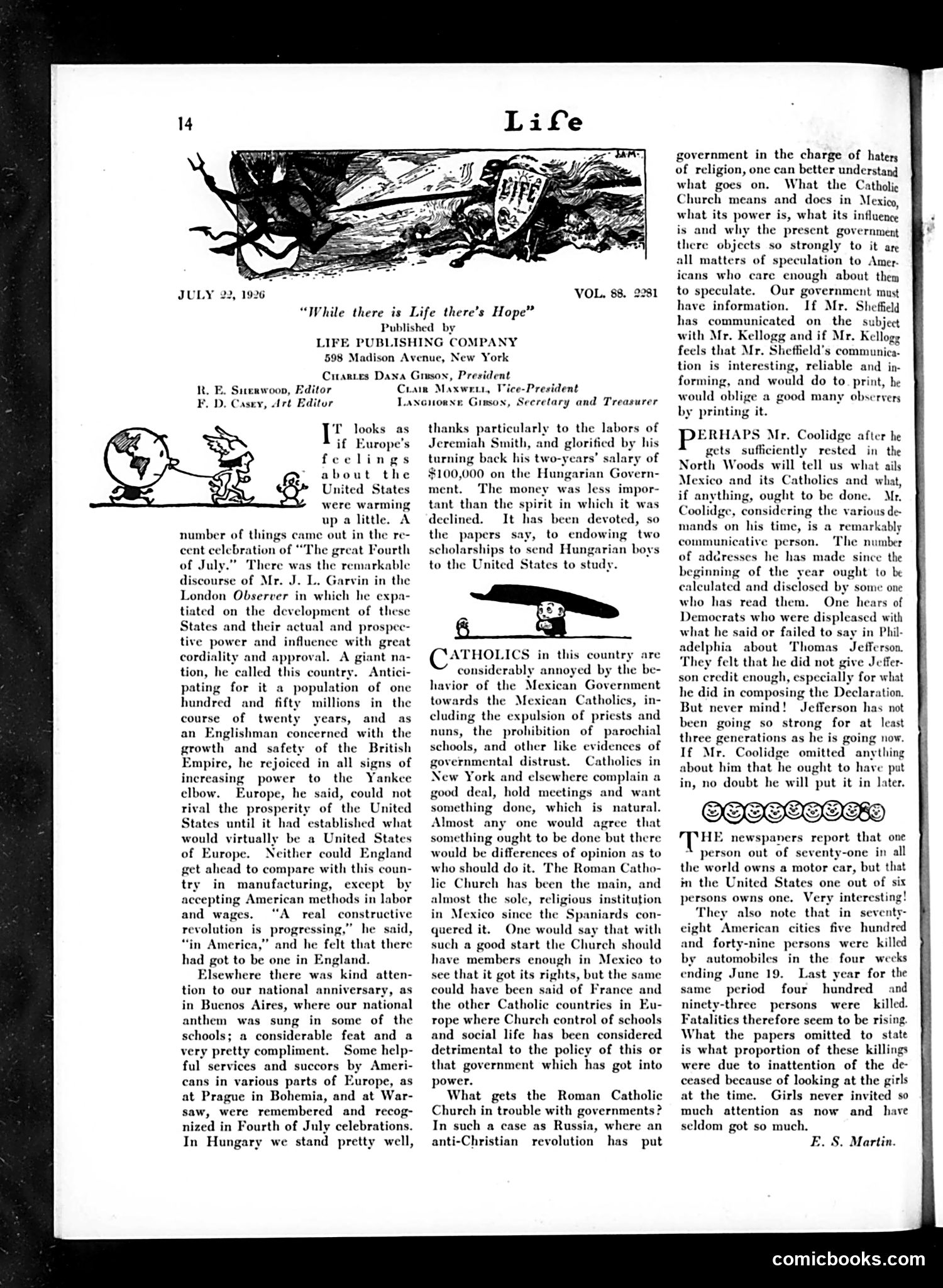
The page contains two editorial cartoons addressing 1920s political concerns: 1. **Top cartoon** (unlabeled): Depicts a skeletal Death figure with a scythe next to what appears to be a gravestone marked "LIFE," likely satirizing threats to the magazine itself or to American values the publication championed. 2. **Lower cartoon**: Shows a figure in a small boat or vessel, seemingly distressed or struggling—the exact meaning is unclear from the image alone. The accompanying article discusses Hungary's financial recovery through borrowed American funds and U.S. government information-gathering regarding Mexico's treatment of Catholics. The text references concerns about Mexican government hostility toward the Catholic Church, including restrictions on priests and parochial schools—a significant 1920s political controversy in both countries.
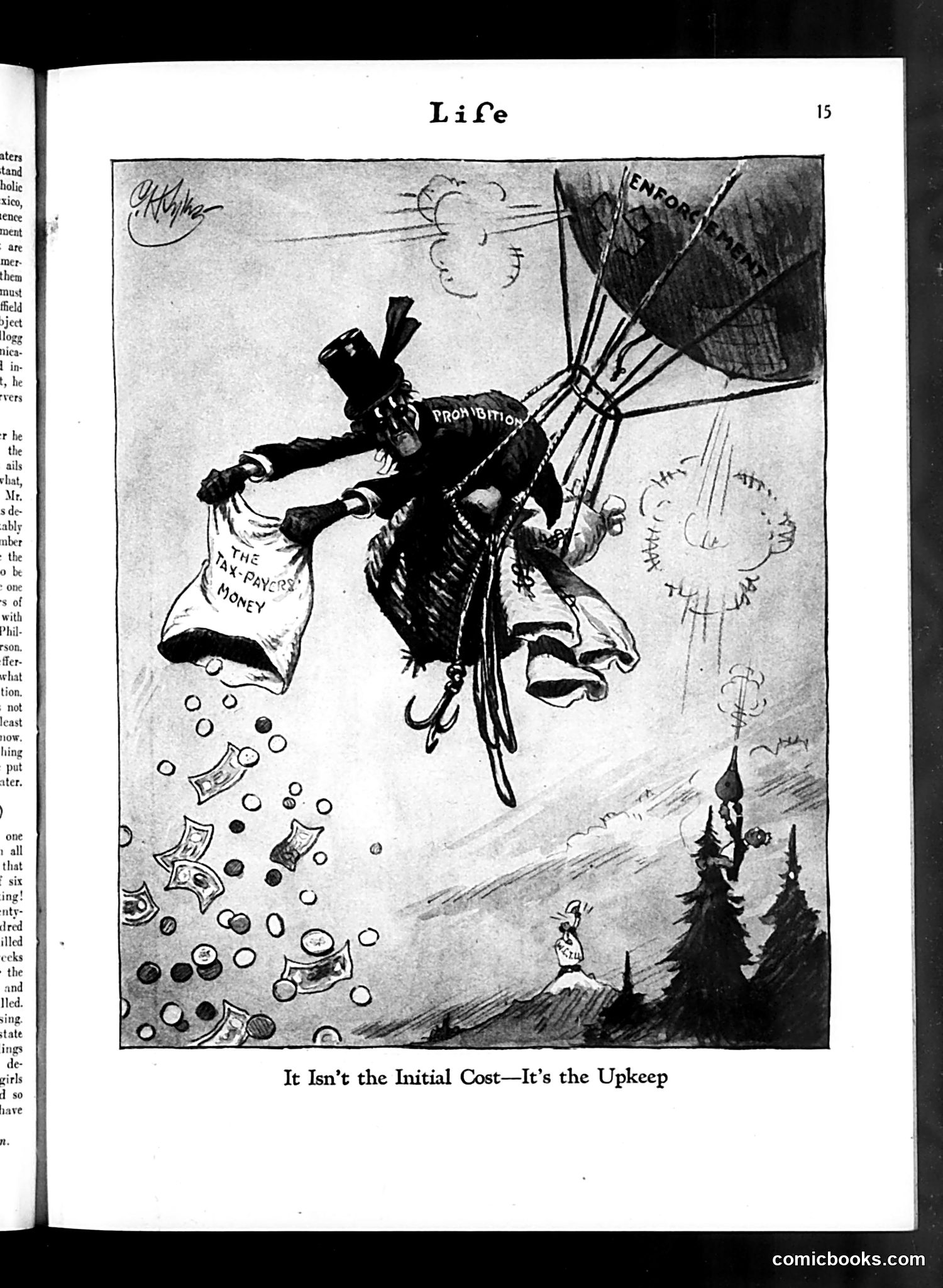
This satirical cartoon depicts a figure labeled "Prohibition" as a man in a top hat suspended by a parachute, dropping money below. The bag he carries is labeled "THE TAXPAYERS' MONEY," and coins and bills scatter downward. The cartoon critiques the economic burden of enforcing Prohibition (the alcohol ban in effect 1920-1933). The caption—"It Isn't the Initial Cost—It's the Upkeep"—suggests that while Prohibition seemed like a good idea initially, its *ongoing enforcement costs* drain public finances unsustainably. The figure descending toward a landscape below appears to represent the government or law enforcement struggling with implementation. This reflects contemporary criticism that Prohibition was expensive to enforce, fueling organized crime rather than eliminating alcohol consumption.
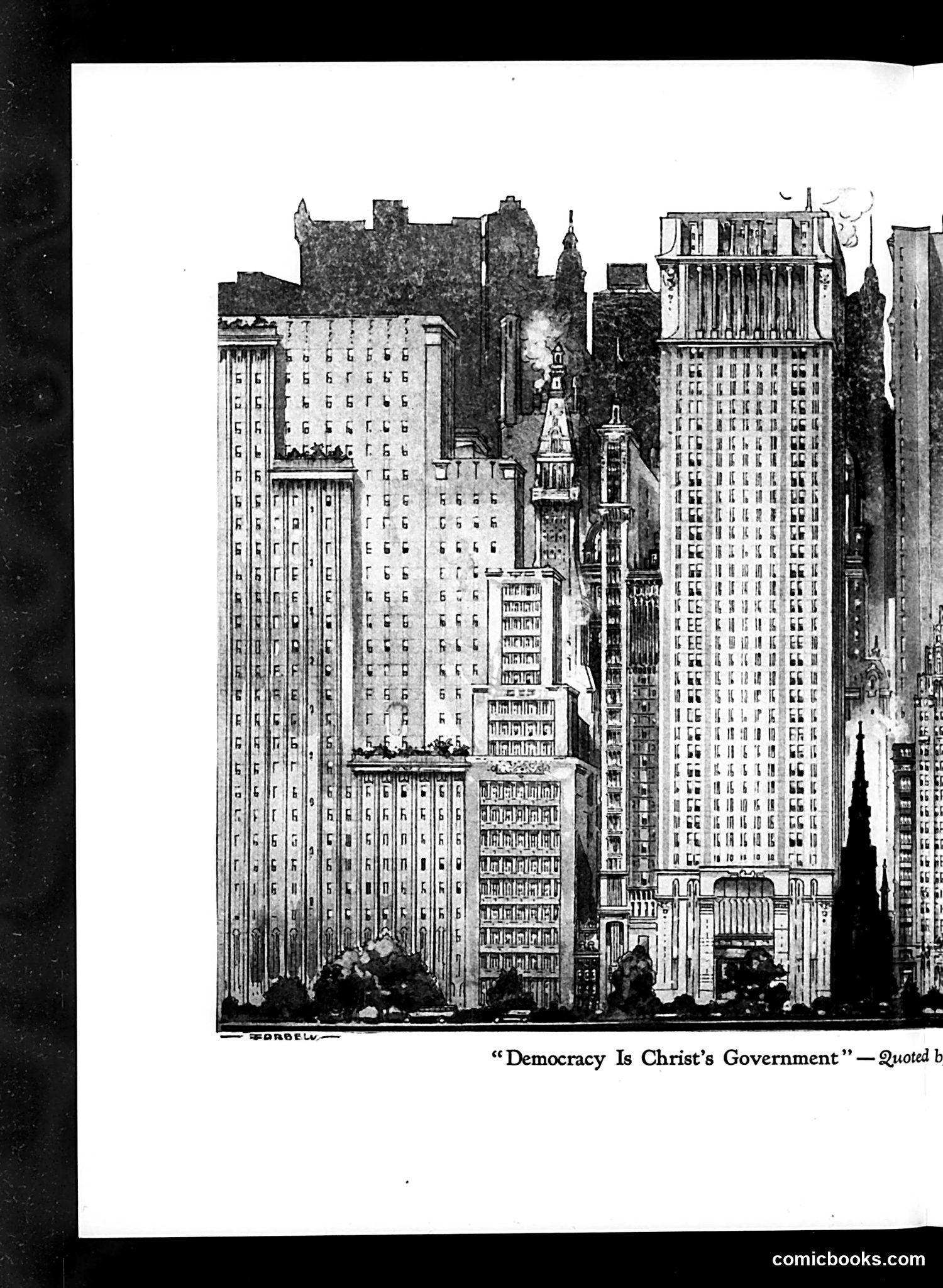
This is an architectural illustration of a modern city skyline featuring tall skyscrapers typical of early-to-mid 20th century American urban design. The image is signed "CESARE" (or similar) and includes the caption: "Democracy Is Christ's Government"—Quoted b[y] The illustration appears to be commentary on American urban development and modernism, likely from Life magazine's satirical tradition. The juxtaposition of the quote—attributing Christian values to democracy—with an image of towering commercial architecture suggests irony about American materialism and capitalism presented under the guise of Christian democratic ideals. Without additional context, the specific historical moment and target remain unclear, though this style of visual satire was common in early-to-mid 20th century American publications critiquing the relationship between religious rhetoric and commercial interests.
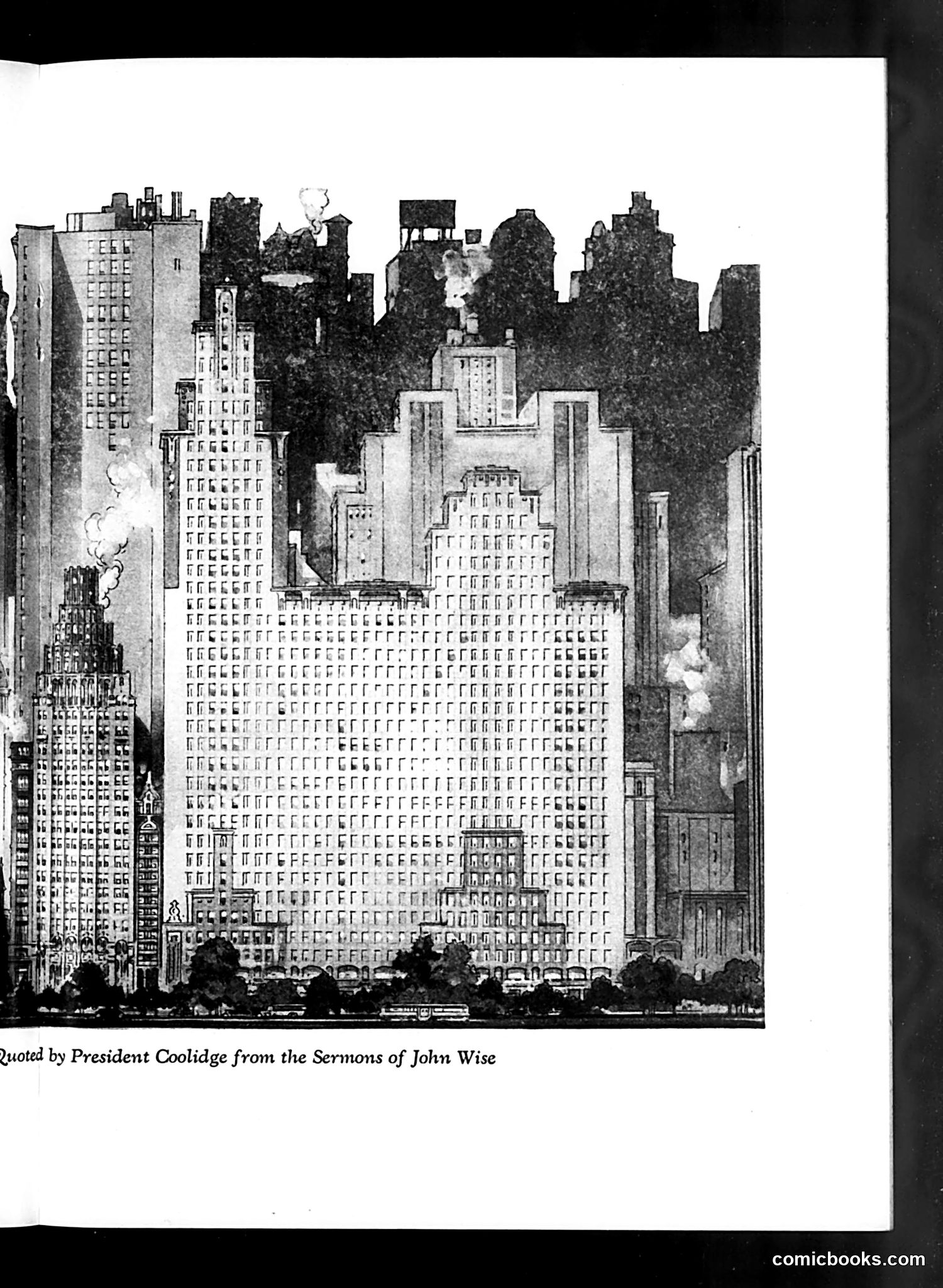
This page features a striking architectural illustration of a densely packed Manhattan skyline dominated by tall office and apartment buildings. The image presents an urban landscape characteristic of 1920s New York City. The caption attributes a quote to President Coolidge drawn from sermons by John Wise (likely a historical religious figure). However, the OCR text is largely corrupted and unreadable, making it impossible to determine the exact quote or its satirical intent. The likely satirical point appears to contrast Coolidge's invocation of religious authority with the raw materialism and commercial intensity represented by the towering cityscape. This may critique either Coolidge's policies favoring business interests, or comment on American capitalism's dominance over spiritual values during the prosperous but spiritually questionable 1920s. Without legible text, the precise target and message remain unclear.
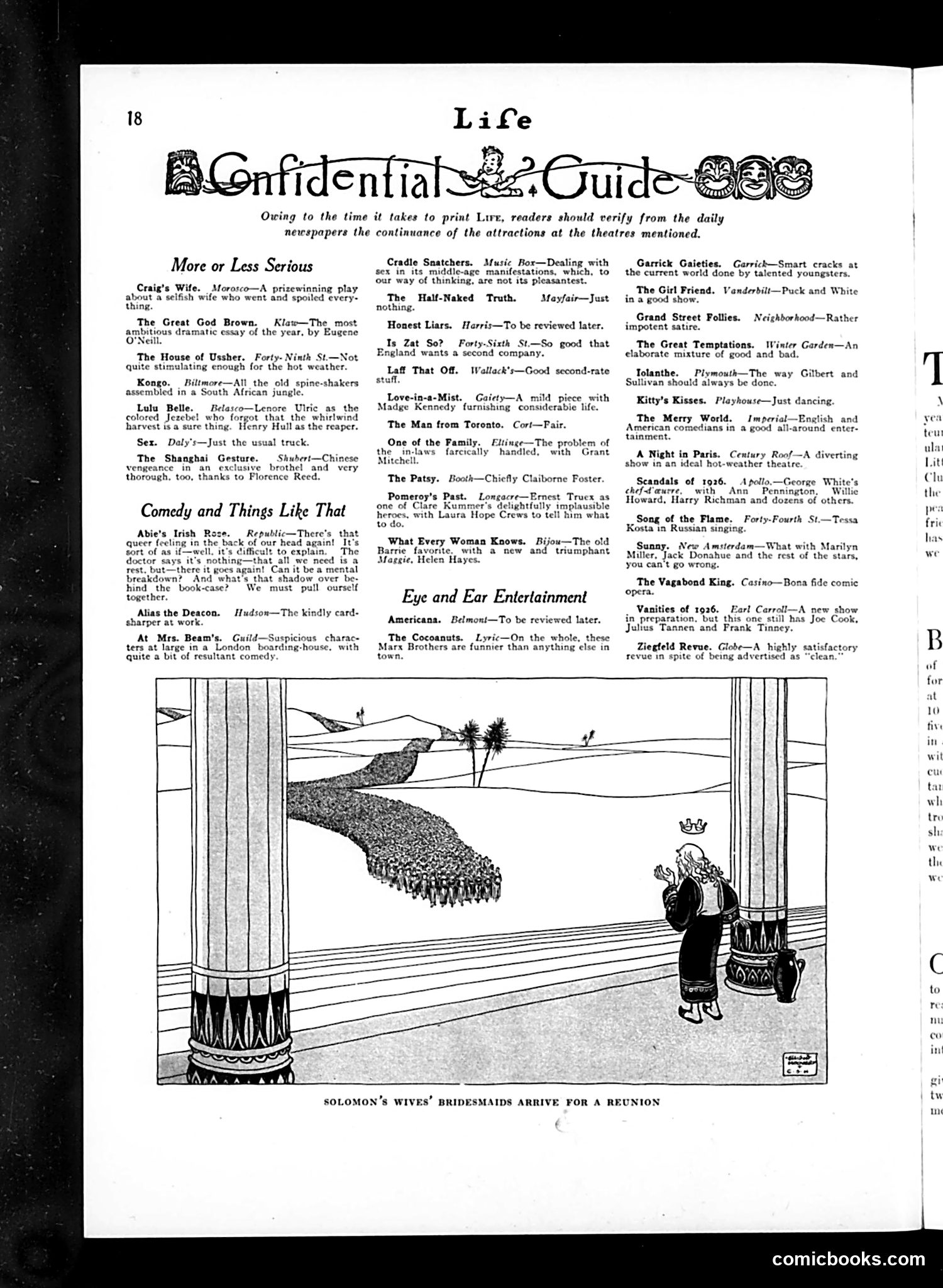
This page from *Life* magazine contains theater reviews and a cartoon titled "Solomon's Wives' Bridesmaids Arrive for a Reunion." The cartoon illustrates a biblical reference: King Solomon, famous for his many wives, is being visited by their bridesmaids arriving for a reunion. The image shows women in elaborate dress approaching ornate palace columns, with a peacock (symbol of opulence) visible in the background window. The joke plays on the absurdity and excess of Solomon's legendary marital situation—the notion that bridesmaids from *all his wives* would reunite creates comic imagery of overwhelming numbers and elaborate ceremony. It's a lighthearted mockery of both biblical excess and the social pretensions of formal gatherings. The rest of the page comprises brief theater reviews typical of 1920s entertainment criticism, rating current Broadway productions with casual, gossipy commentary.
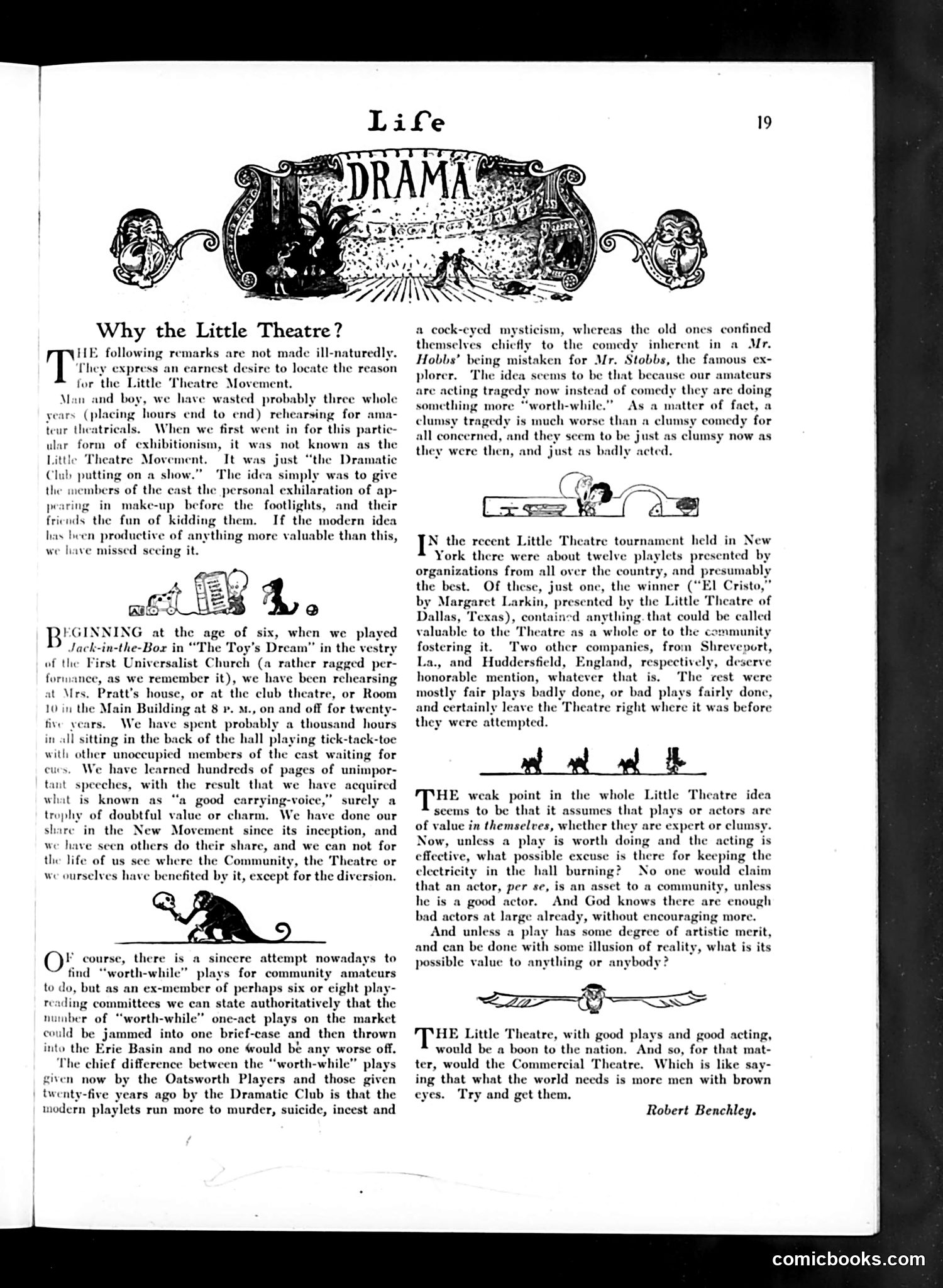
This article critiques the early 20th-century "Little Theatre Movement"—amateur theatrical clubs staging plays in community spaces. The author (Robert Benchley, bylined at bottom) argues the movement lacks genuine value beyond personal ego gratification for amateur actors. **Key points:** The article uses self-deprecating humor about the author's own decades in amateur theater, admitting they've wasted years rehearsing without benefiting "the Community, the Theatre or ourselves." The satire targets the movement's pretension: modern amateur groups claim moral superiority by staging "serious" dramas (murder, suicide, incest) instead of old comedies, yet perform them equally badly. Clumsy tragedy is actually *worse* than clumsy comedy. At a recent Little Theatre tournament in New York, only one winning play ("El Cristo" from Dallas) had genuine artistic merit; most were mediocre. **The core joke:** Community theater hasn't evolved—it's just amateur actors seeking validation through increasingly dark subject matter, mistaking ambition for improvement. The small decorative illustrations are generic theatrical vignettes, not specific political cartoons.
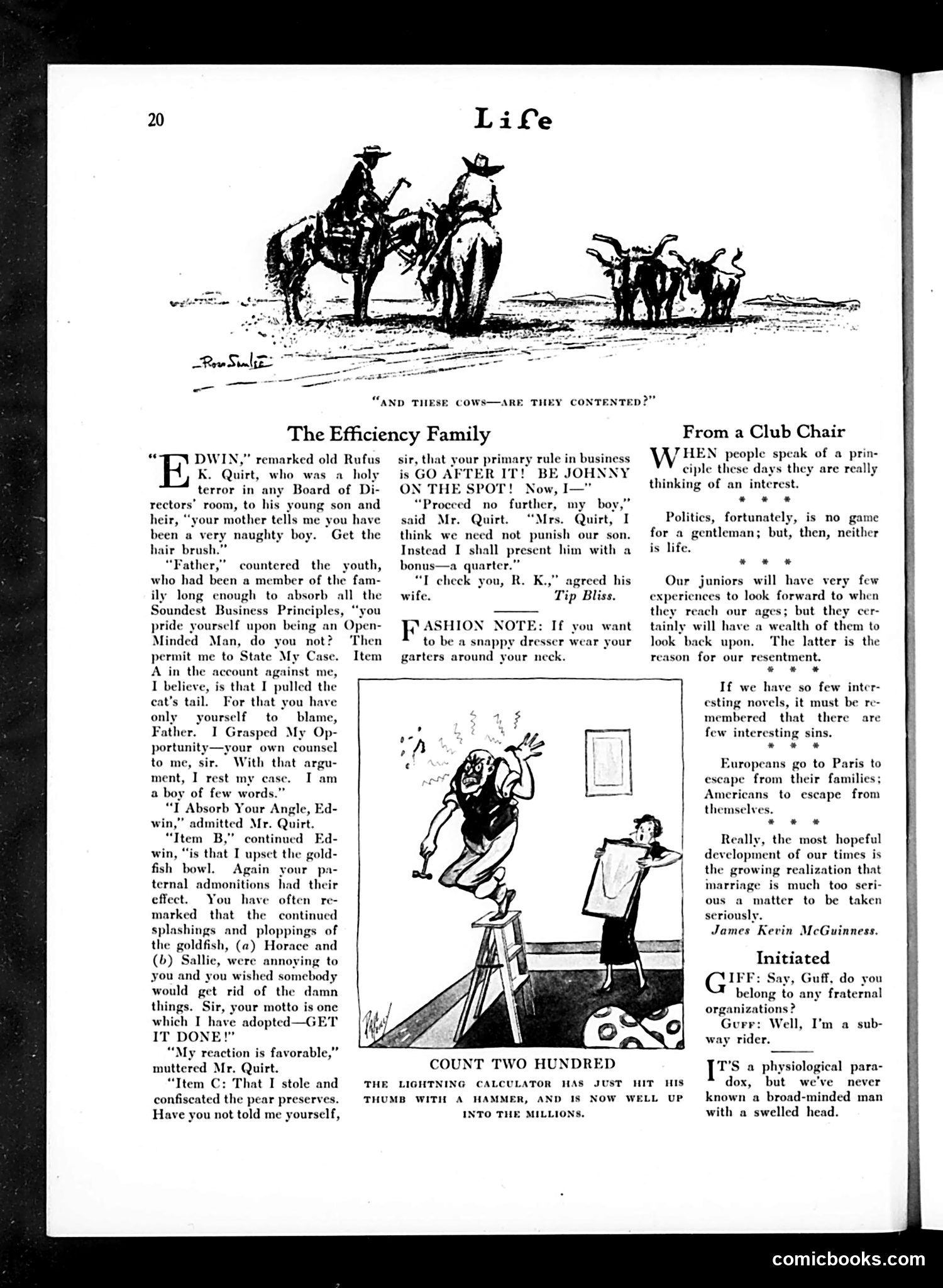
This page satirizes early 20th-century American business culture's obsession with "efficiency" and ruthless pragmatism. The main cartoon shows young Edwin defending his misbehavior (pulling the cat's tail, upsetting the goldfish bowl, stealing pear preserves) by citing his father Rufus K. Quirt's own business maxims back at him: "Go After It!", "Be Johnny on the Spot!", and "Get It Done!" The joke is that the father's aggressive business principles, applied literally by his son to domestic life, produce chaos—yet the father rewards him with a bonus for such "efficient" logic. The satire critiques how American businessmen internalized ruthless competition as moral philosophy, then hypocritically objected when children applied those same principles at home. It mocks the contradiction between preaching efficiency/ambition and expecting normal family conduct. The sidebar content reinforces the theme with cynical observations about modern life replacing genuine principles with mere self-interest.
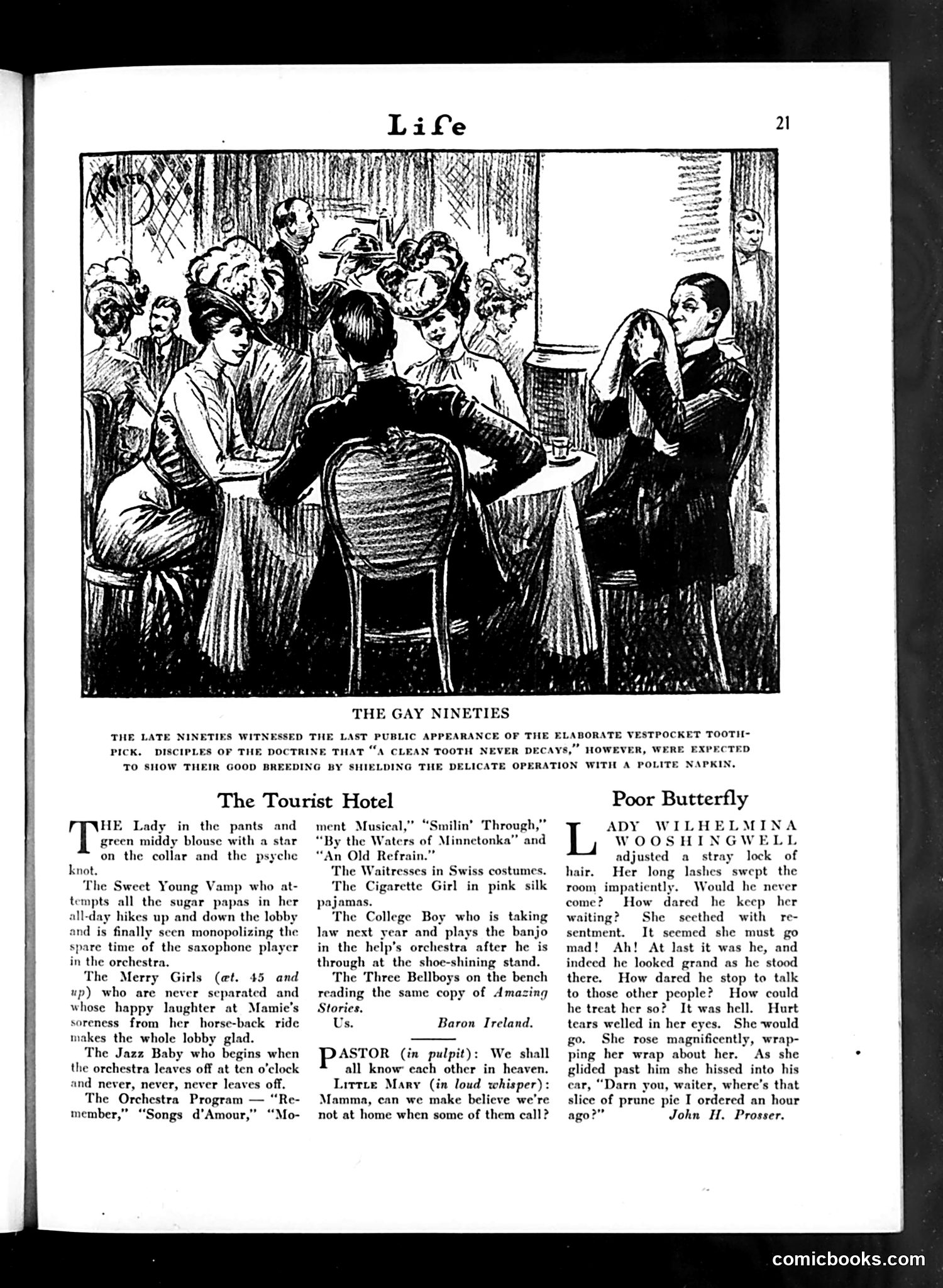
The top illustration satirizes 1890s social etiquette and dental hygiene trends. The caption explains that late-nineteenth-century dentists promoted tooth-picking as a health practice, but genteel society—concerned with appearances—would shield this "delicate operation" behind a napkin to maintain propriety. The joke targets the absurd gap between health advice and social convention: people would perform necessary hygiene only if they could hide it from view. The accompanying text sketches stereotypical hotel characters from that era (the "Jazz Baby," "Sweet Young Vamp," etc.), capturing period social types. The "Poor Butterfly" section below is a brief comedic story: a woman named Wilhelmina dramatically awaits someone, building romantic tension through her emotional turmoil—only to reveal she's been waiting for a *waiter* to bring her prune pie. The humor derives from deflating melodramatic romance with mundane reality.
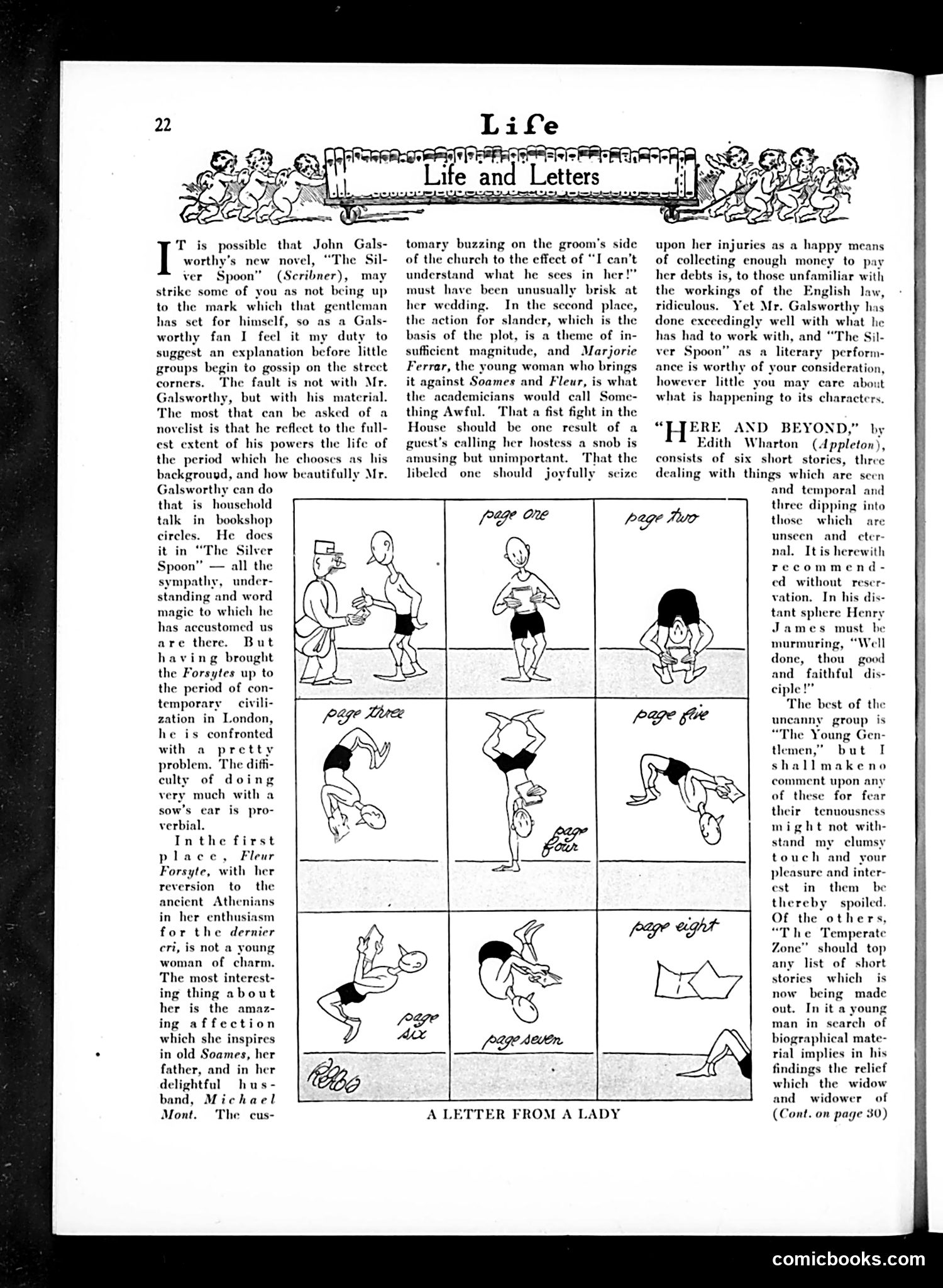
This page features literary criticism of recent novels, primarily John Galsworthy's *The Silver Spoon*. The reviewer acknowledges Galsworthy's talent but criticizes his subject matter as insufficiently substantial—comparing the difficulty of elevating contemporary material to making a silk purse from a sow's ear. The centerpiece is a comic strip titled "A Letter From a Lady" depicting acrobatic/gymnastic exercises or physical comedy sequences across eight panels. This appears to be humorous illustration rather than narrative comics. The page also reviews Edith Wharton's *Here and Beyond*, a short-story collection praised for supernatural tales, with particular commendation for "The Young Gentlemen" and "The Temperate Zone." The cartoon/illustrations serve as visual entertainment accompanying these literary reviews, typical of Life magazine's blend of satirical commentary and illustrated humor for educated readers interested in contemporary literature.
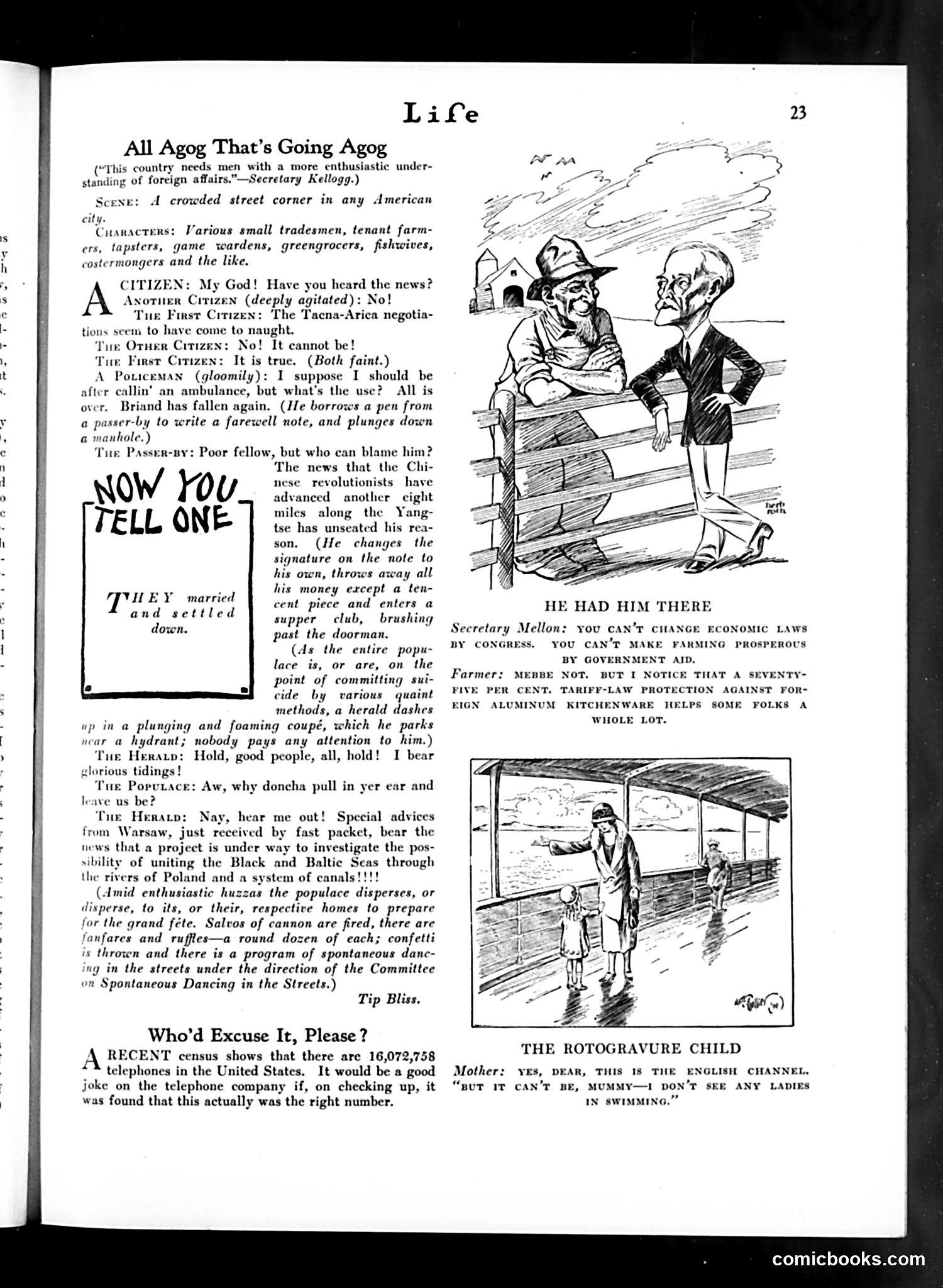
This satire mocks Americans' obsession with foreign affairs despite having no real understanding of them. The sketch depicts ordinary citizens (tradesmen, police officers) becoming hysterically distraught over obscure international news: failed Tacna-Arica negotiations between Peru and Chile, French political instability, Chinese civil war developments, and Polish canal projects. Each revelation sends them closer to suicide until a herald announces a canal project, suddenly reversing their despair into celebration. The joke targets Secretary of State Kellogg's call (quoted in the epigraph) for better foreign affairs understanding. Instead, average Americans treat incomprehensible diplomatic minutiae as matters of personal crisis—performing theatrical emotional responses to events they couldn't explain. The satire suggests Americans are performatively patriotic about foreign policy while remaining fundamentally ignorant of its actual significance or their ability to influence it.
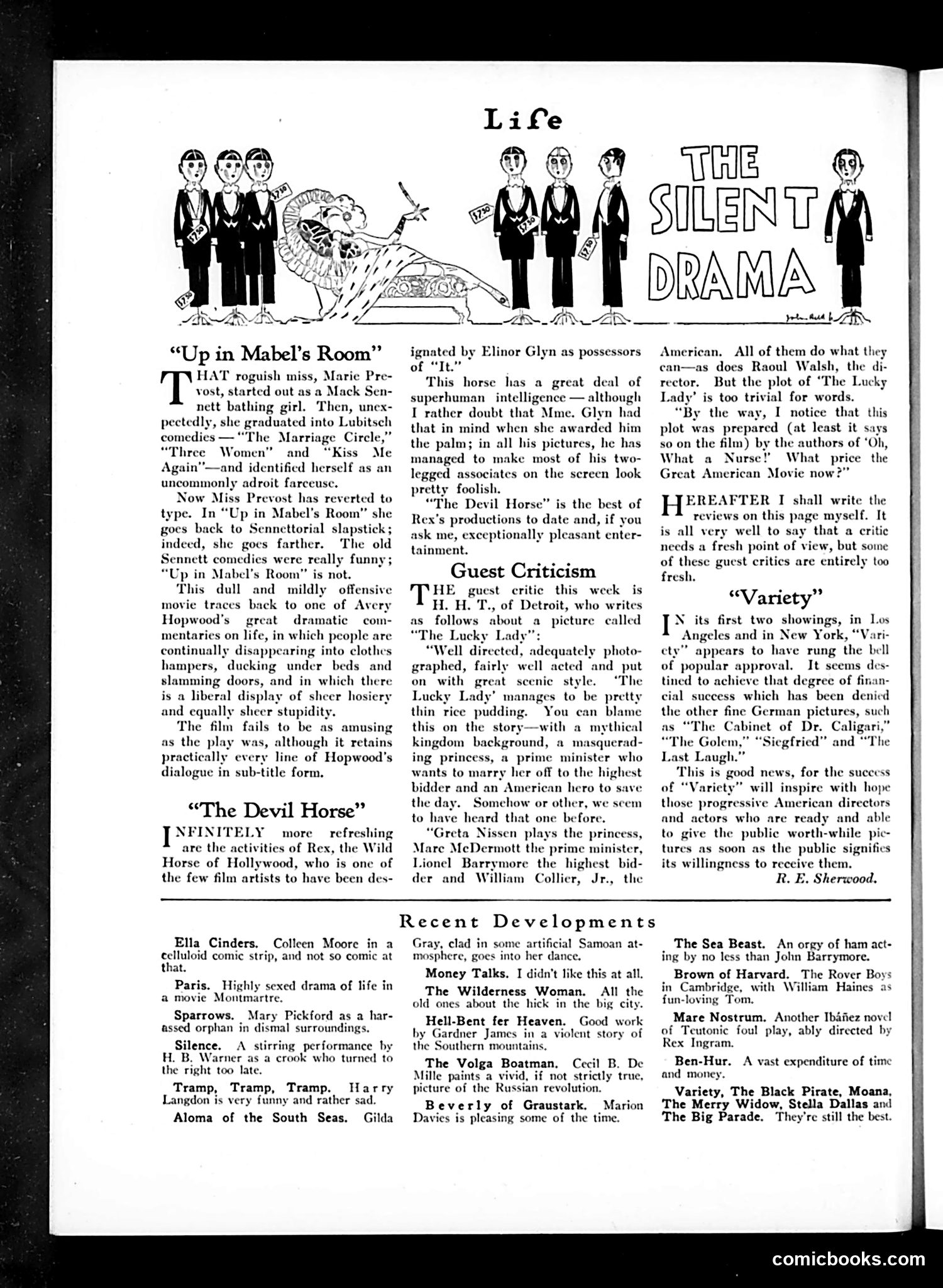
This page presents film criticism from Life's entertainment section, circa the 1920s silent film era. The masthead cartoon satirizes the film industry by depicting men in formal wear reacting to a rearing horse labeled "The Devil Horse"—referencing the article below about a horse actor who allegedly possesses "It" (sex appeal, per contemporary critic Elinor Glyn). The reviews critique recent silent films: Marie Prevost's "Up in Mabel's Room" is dismissed as unfunny slapstick; "The Devil Horse" is praised for its equine star outperforming human actors; and a guest critic from Detroit mocks "The Lucky Lady" for its tired, derivative plot involving a princess rescue. The satire targets Hollywood's creative bankruptcy—recycled storylines, B-list casting, and the absurdity of promoting animal actors. The editor's concluding jab at "guest critics" being "entirely too fresh" adds self-aware humor about amateur reviewing.
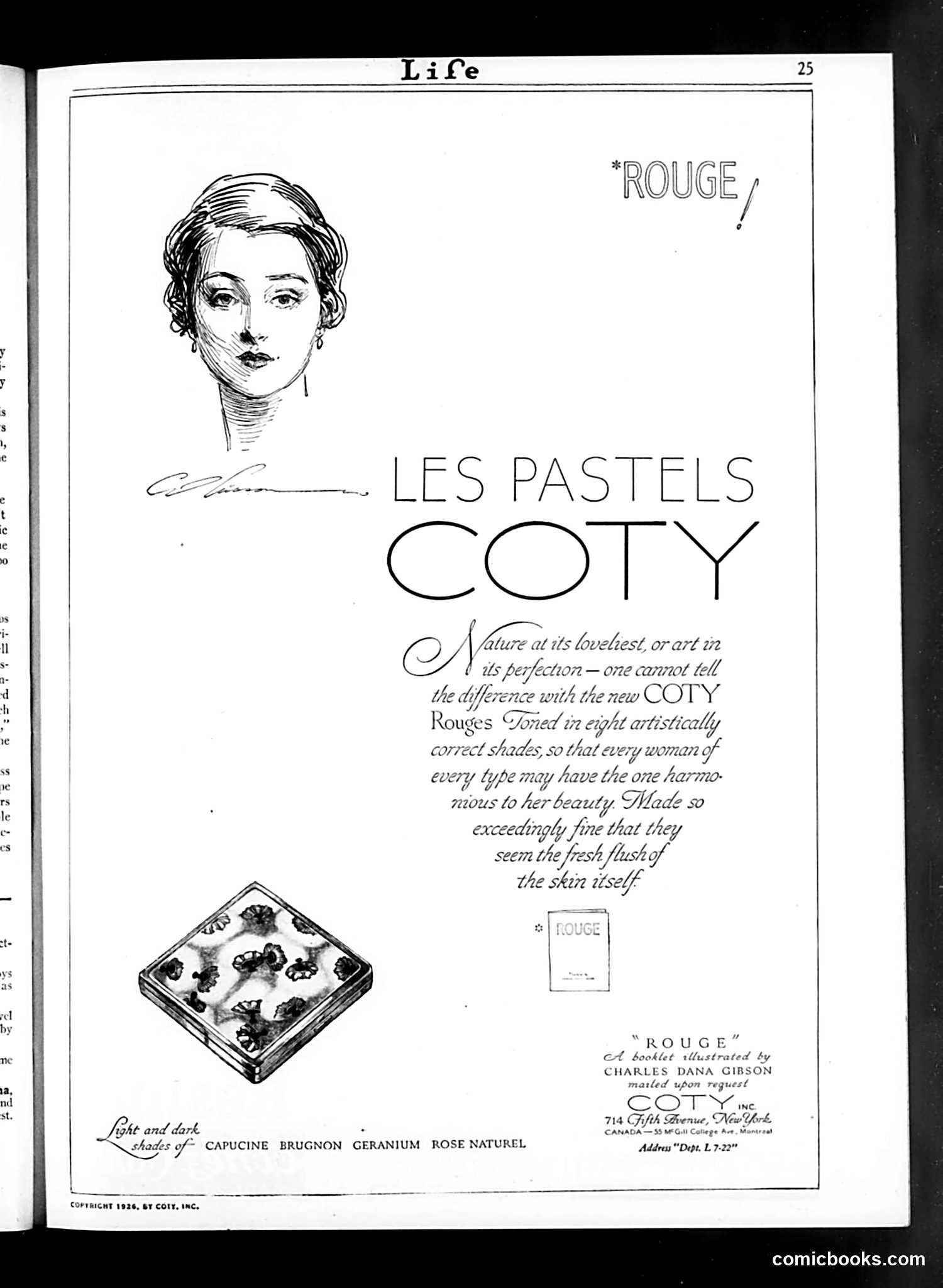
This is **not a cartoon or satire page**, but rather a **full-page advertisement** for Coty brand rouge makeup, appearing in Life magazine (1926). The page features: - A sketch portrait of a woman's face by illustrator Charles Dana Gibson (famous for his idealized "Gibson Girl" drawings) - Marketing copy claiming Coty's eight rouge shades match "every woman of every type," with colors formulated to appear like natural skin flush - A product photograph showing the palette of rouge colors - Available shades listed: Capucine, Brugnon, Geranium, Rose Naturel **For modern readers:** This exemplifies 1920s beauty advertising that emphasized cosmetics as enhancing natural beauty rather than transforming it—note the language about "fresh flush of the skin itself." The Gibson Girl association lent prestige. The eight shade range was a selling point suggesting inclusivity for different complexions, though viewed through a 1920s lens that likely meant lighter skin tones only.
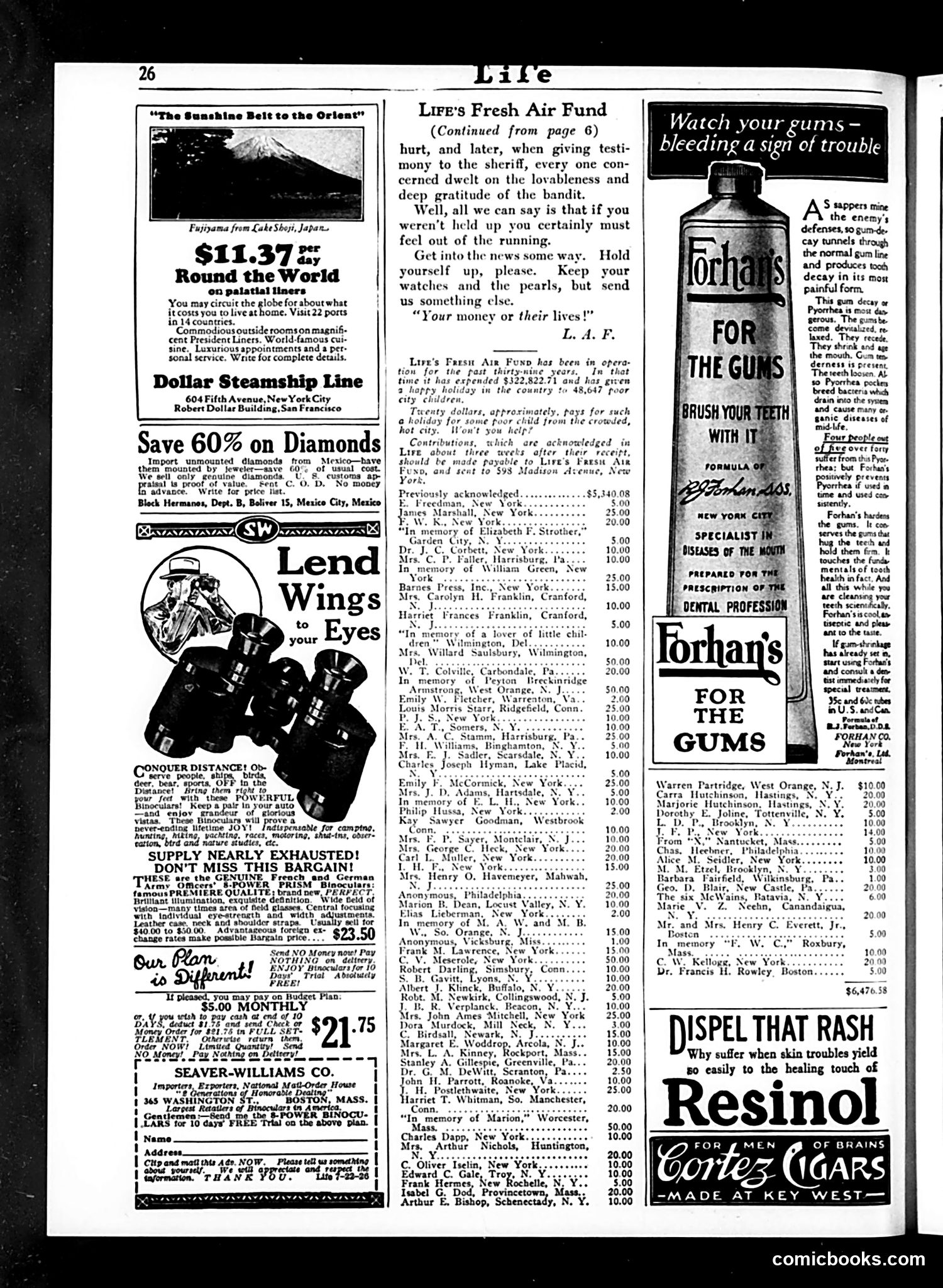
This page is primarily **advertising and charitable content**, not political satire. The main features are: **Life's Fresh Air Fund** (center): A charitable appeal for donations to send poor city children to the countryside. It lists contributors and amounts donated over the fund's 39-year history. The accompanying text uses humor to encourage donations—suggesting readers "get into the news" by contributing, playfully contrasting charity with recent bandit holdups mentioned in the opening ("Your money or their lives!"). **Advertisements** dominate the page, including: - Dollar Steamship Line cruises - Diamond importing service - French/German Army binoculars at a "bargain" price - Forhan's toothpaste and gum products - Resinol and Cortez Cigars The binoculars ad references "French and German Army Officers'" equipment—likely appealing to post-WWI nostalgia or surplus military goods. Overall, this reflects 1920s consumer culture and philanthropic messaging, not political commentary.
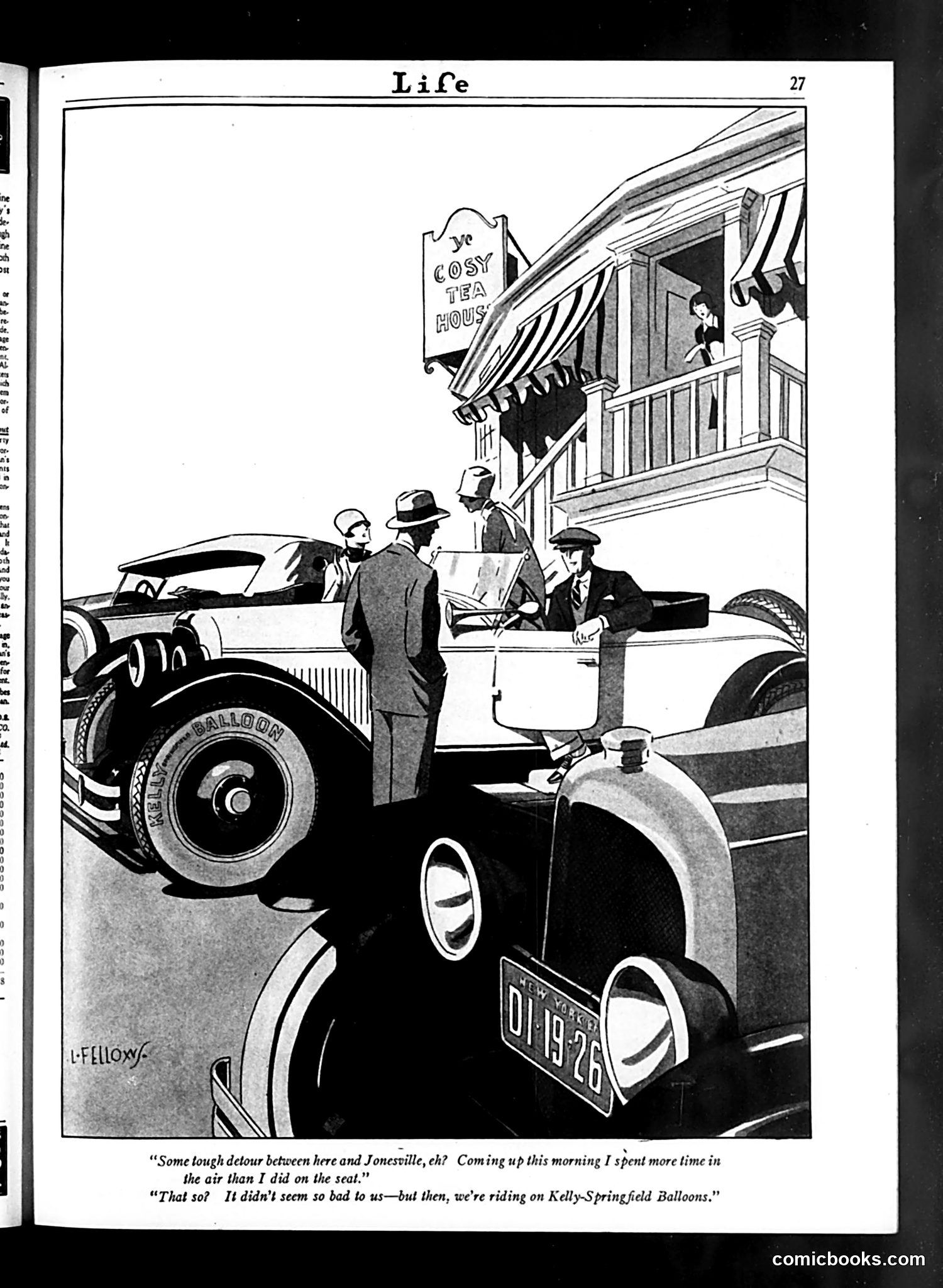
This is a **Kelly-Springfield Balloons tire advertisement** disguised as humorous cartoon content. The scene shows well-dressed men outside "Ye Cosy Tea House," discussing a rough car journey. One man complains about a bumpy detour that left him airborne more than seated; another credits his smooth ride to Kelly-Springfield Balloons (an actual tire brand). The joke plays on the phrase "balloons"—both the tire's pneumatic quality and the literal sensation of bouncing. The cartoon's purpose is to humorously demonstrate the tire's superior shock absorption by contrasting one driver's poor experience with another's comfort, making it an early example of lifestyle advertising in Life magazine's satirical format.
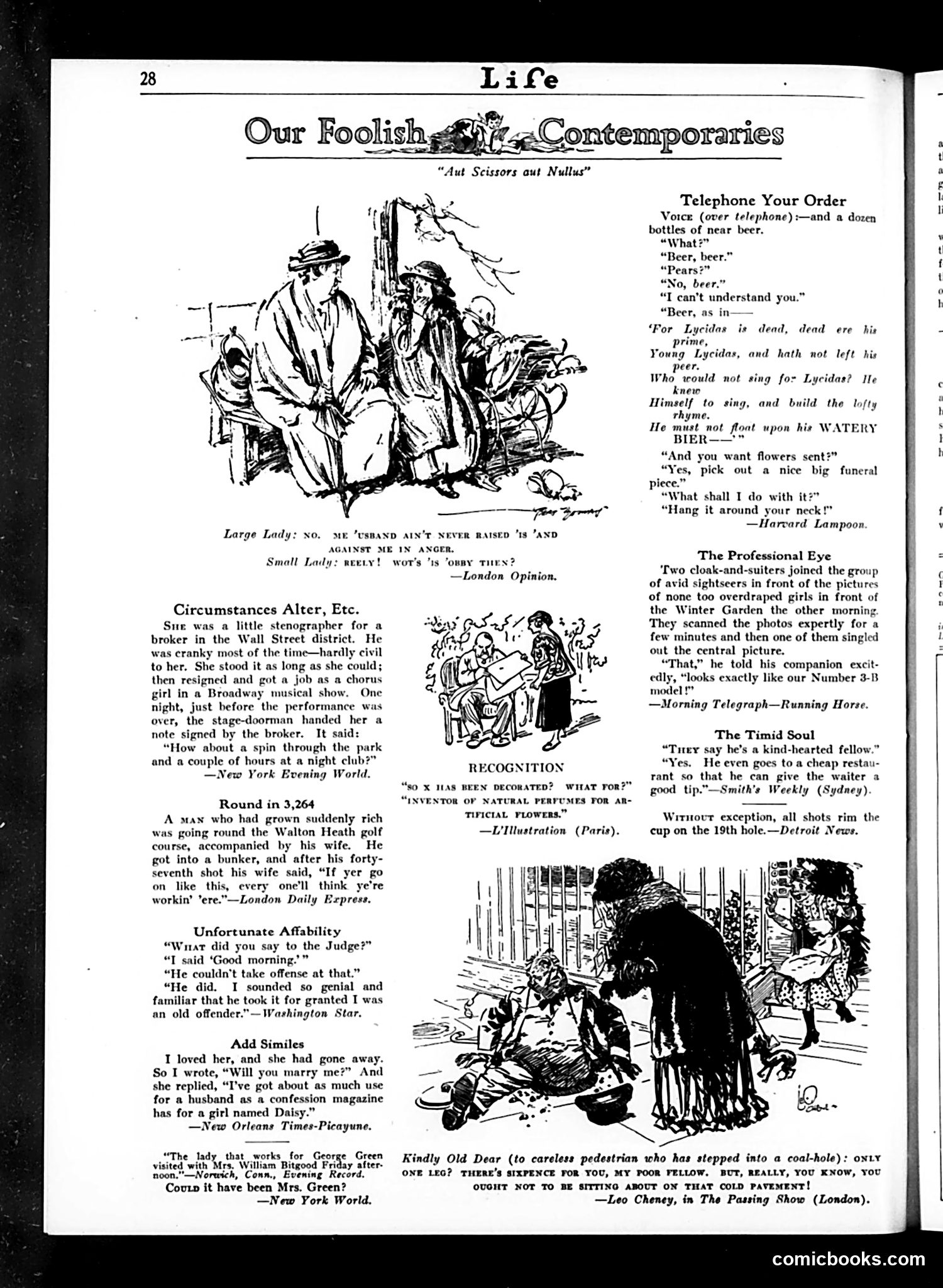
This page collects brief humorous anecdotes and cartoons satirizing everyday social absurdities. Key pieces include: **"Circumstances Alter, Etc."**: A Wall Street broker's secretary quits her job after mistreatment, becomes a chorus girl, and the broker—suddenly interested—pursues her romantically. The satire mocks male hypocrisy and changing behavior based on circumstances. **"Round in 3,264"**: A newly wealthy golfer plays terribly while his wife sarcastically suggests he's "workin'" there. This ridicules nouveau riche pretension. **The "Telephone Your Order" section**: Someone trying to order beer over a telephone is misheard repeatedly, leading to a absurdist Shakespearean recitation about Lycidas (a lament for the dead). This satirizes modern communication failures and the absurdity of mixing high literature with mundane orders. **"Kindly Old Dear"**: An elderly woman encountering someone fallen into a coal-hole offers sixpence but chides them for sitting on cold pavement—mocking oblivious upper-class sentimentality. The overall theme: satirizing foolish contemporary behavior across class lines, from workers to the wealthy.
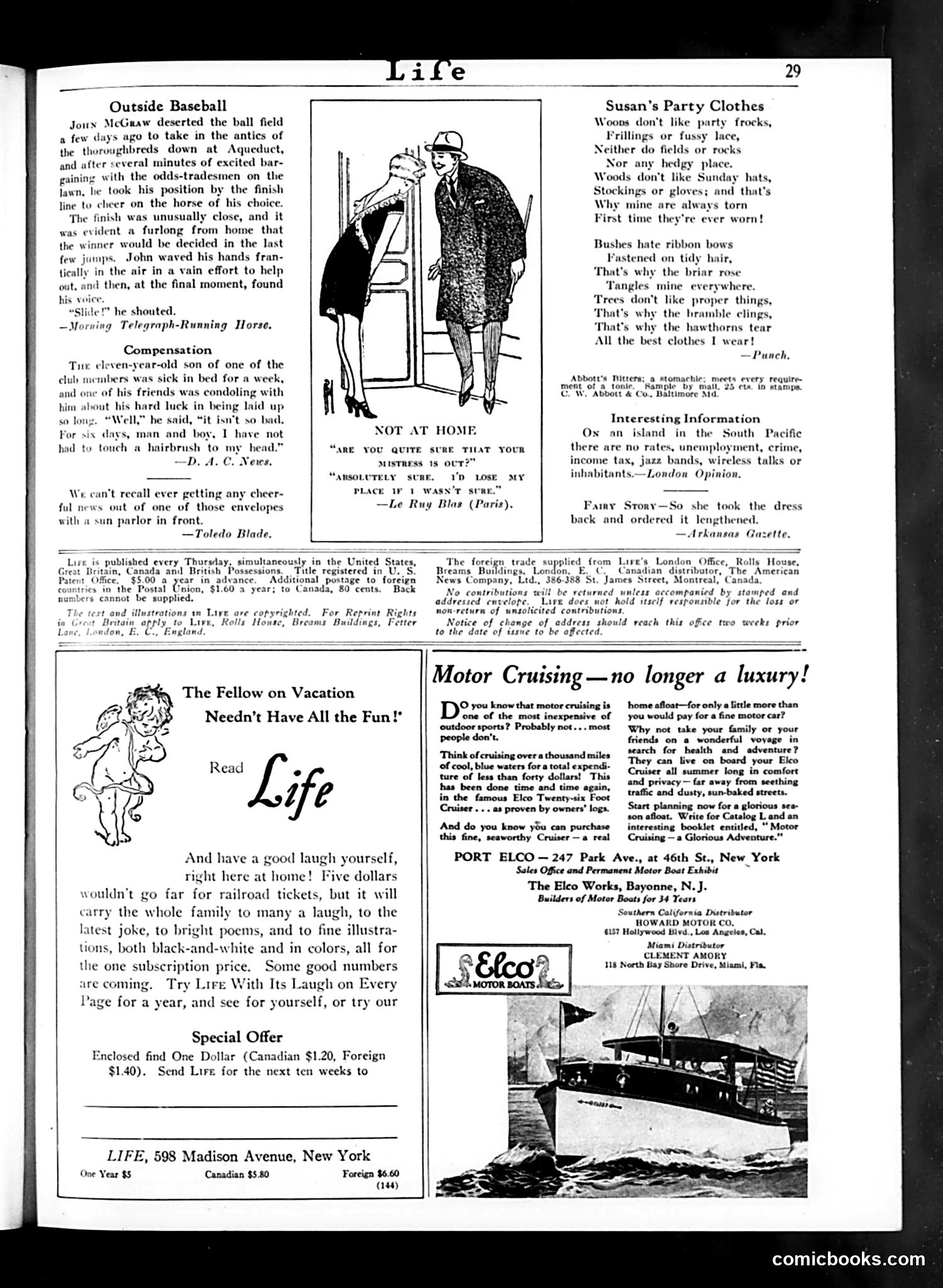
This page contains several short humorous pieces typical of Life magazine's satirical format: **"Outside Baseball"** describes John McGraw (a famous baseball manager) abandoning his sport to gamble on horse racing at Aqueduct. The joke: at the climactic finish, McGraw loses his composure and shouts encouragement to his horse—an absurd, desperate gesture that has no effect on the race outcome. **"Not at Home"** is a brief visual joke about someone claiming they're unavailable. **"Susan's Party Clothes"** is a whimsical poem explaining why a girl's fine clothing is perpetually torn—nature (woods, bushes, trees, brambles) conspires against proper dress. The page also contains advertisements for Abbott's Bitters tonic and Elco motor boats, plus subscription promotions for Life itself. A brief "Interesting Information" item satirizes an imaginary island paradise with no social problems. The overall tone reflects 1920s-era humor: genteel satire, light verse, and gentle social observation rather than hard political commentary.
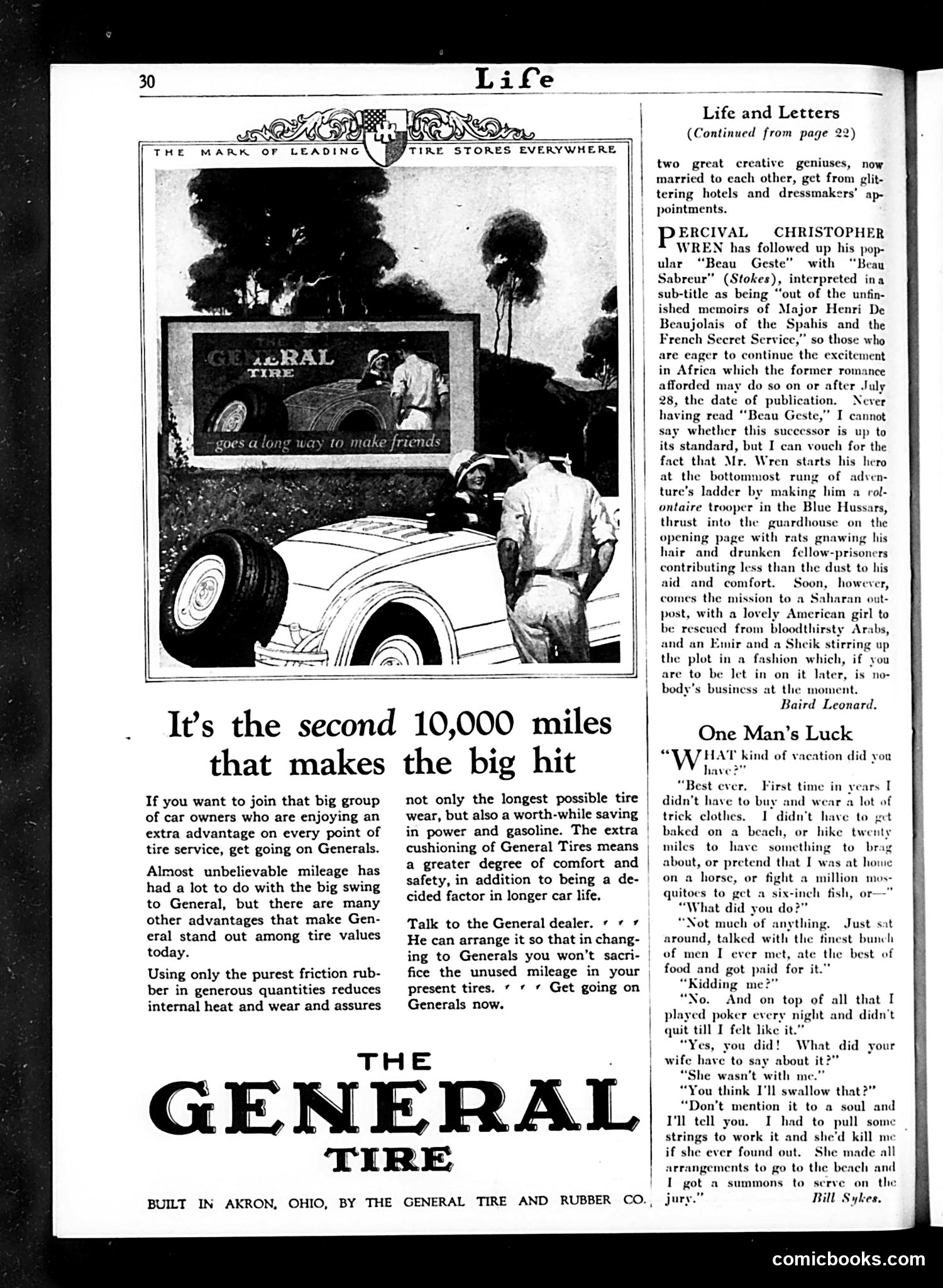
This page contains **advertising and literary content**, not political satire. The dominant element is a **General Tire advertisement** featuring a car and movie-theater setting with the slogan "It's the second 10,000 miles that makes the big hit." This is a straightforward commercial pitch emphasizing tire durability and value—typical 1920s automotive marketing. The right column contains two separate pieces: 1. **"Life and Letters"** — A book review by Baird Leonard of P.C. Wren's novel "Beau Sabreur," a sequel to "Beau Geste." The reviewer describes adventure fiction set in French North Africa involving the Foreign Legion, Saharan settings, and romantic intrigue. 2. **"One Man's Luck"** — A humorous dialogue (by Bill Sykes) about a man's vacation, where he admits to jury duty rather than a beach trip, having concealed it from his wife. The joke plays on marital deception and the unexpected pleasure of escape. No political cartoons or caricatures appear on this page. It's primarily commercial and entertainment content typical of Life magazine's mixed format.
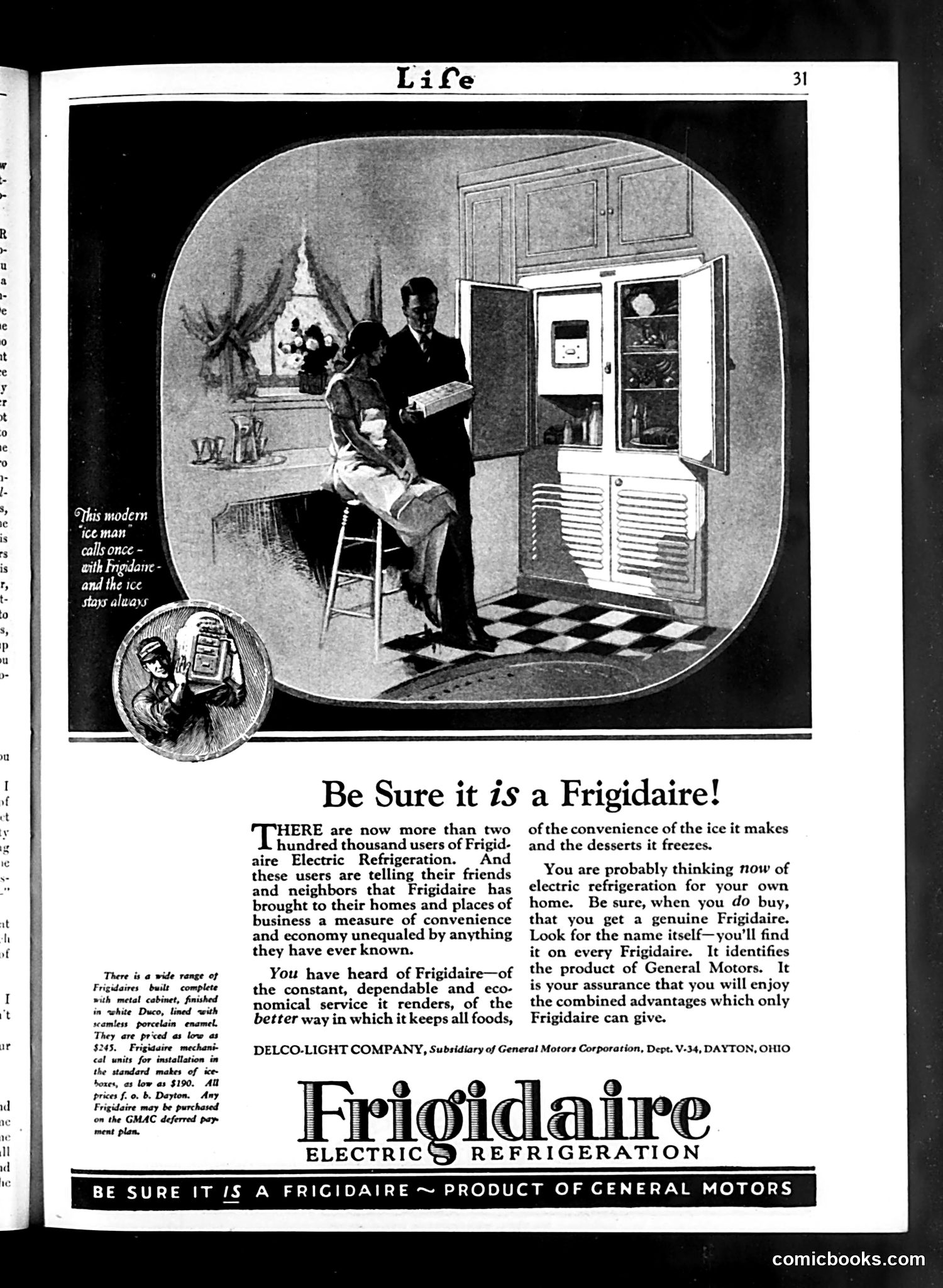
This is a **Frigidaire refrigerator advertisement**, not political satire. The page promotes electric refrigeration to American consumers, likely from the 1920s-early 1930s. The illustration shows a man delivering ice to a woman at home—a reference to the obsolete "ice man" profession. The ad's key message: buy a Frigidaire, and you'll never need the ice man again. The jingle "calls once—with Frigidaire—and the ice stays always" means the refrigerator provides perpetual ice-making, eliminating the need for regular ice deliveries. The ad emphasizes that over 200,000 users already own Frigidaires and praise their convenience and economy. It warns buyers to verify they're purchasing a genuine Frigidaire (made by General Motors' Delco-Light Company), not a counterfeit, suggesting brand confusion existed in the emerging refrigeration market. The pricing ($245 and up) and installment payment options indicate this was a luxury appliance being marketed to middle-class consumers.
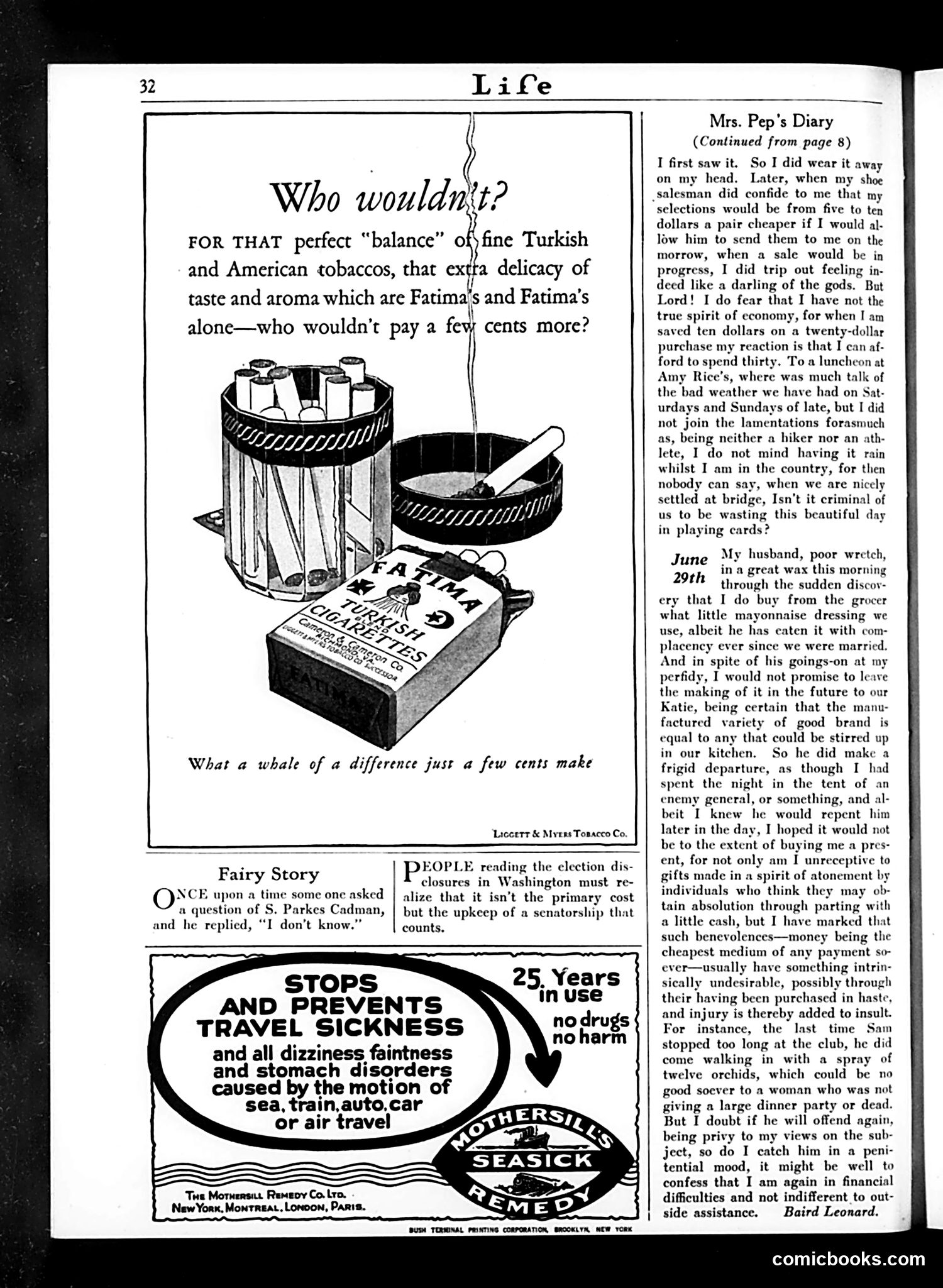
This page contains **three distinct advertisements and satirical content** from Life magazine: 1. **Fatima Cigarettes ad**: A straightforward tobacco advertisement asking consumers to pay extra for premium Turkish-American blend tobacco. 2. **Political satire**: A brief joke mocking U.S. Senate corruption, suggesting that maintaining a Senate seat costs far more than initially winning it—a reference to early 20th-century concerns about wealthy men buying political power. 3. **Motherill's Seasick Remedy ad**: A patent medicine advertisement claiming 25 years of use with "no drugs" or harm, targeting motion sickness from various transportation methods. 4. **"Mrs. Pep's Diary"**: A humorous column satirizing upper-middle-class women's vanity, domestic squabbles, and materialism—her husband's anger over store-bought mayonnaise, her shopping habits, and gift-giving as relationship currency. The page reflects early 20th-century consumer culture, patent medicine marketing (largely unregulated then), and satirical commentary on wealth and gender dynamics.
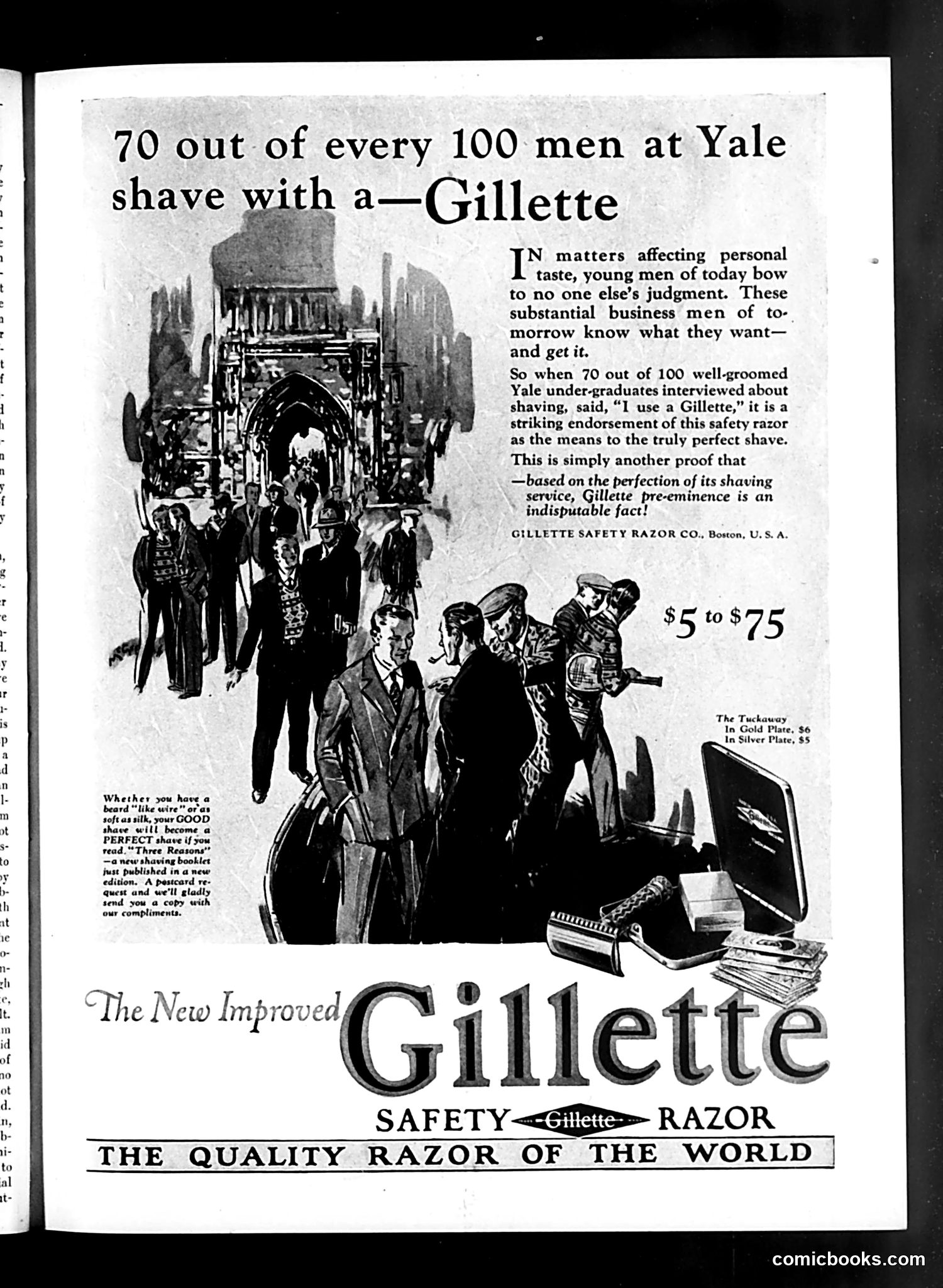
This is primarily a **Gillette razor advertisement**, not political satire. It uses aspirational marketing targeting young men. The "cartoon" element consists of illustrations of Yale undergraduates and businessmen in formal attire, depicted as sophisticated "men of tomorrow." The ad claims that 70 out of 100 Yale students use Gillette razors, positioning the product as endorsed by elite, educated men with refined taste. The key appeal: by purchasing a Gillette, ordinary men could adopt the grooming standards of privileged Yale students. The price range ($5–$6.75, substantial in this era) emphasizes quality and exclusivity. The text's rhetoric about young men knowing "what they want" and bowing to "no one else's judgment" attempts to flatter readers as independent thinkers, while the Yale statistic functions as social proof—implying that success-bound men choose Gillette. This is **consumer advertising dressed in the language of sophistication and aspiration**, not editorial commentary.
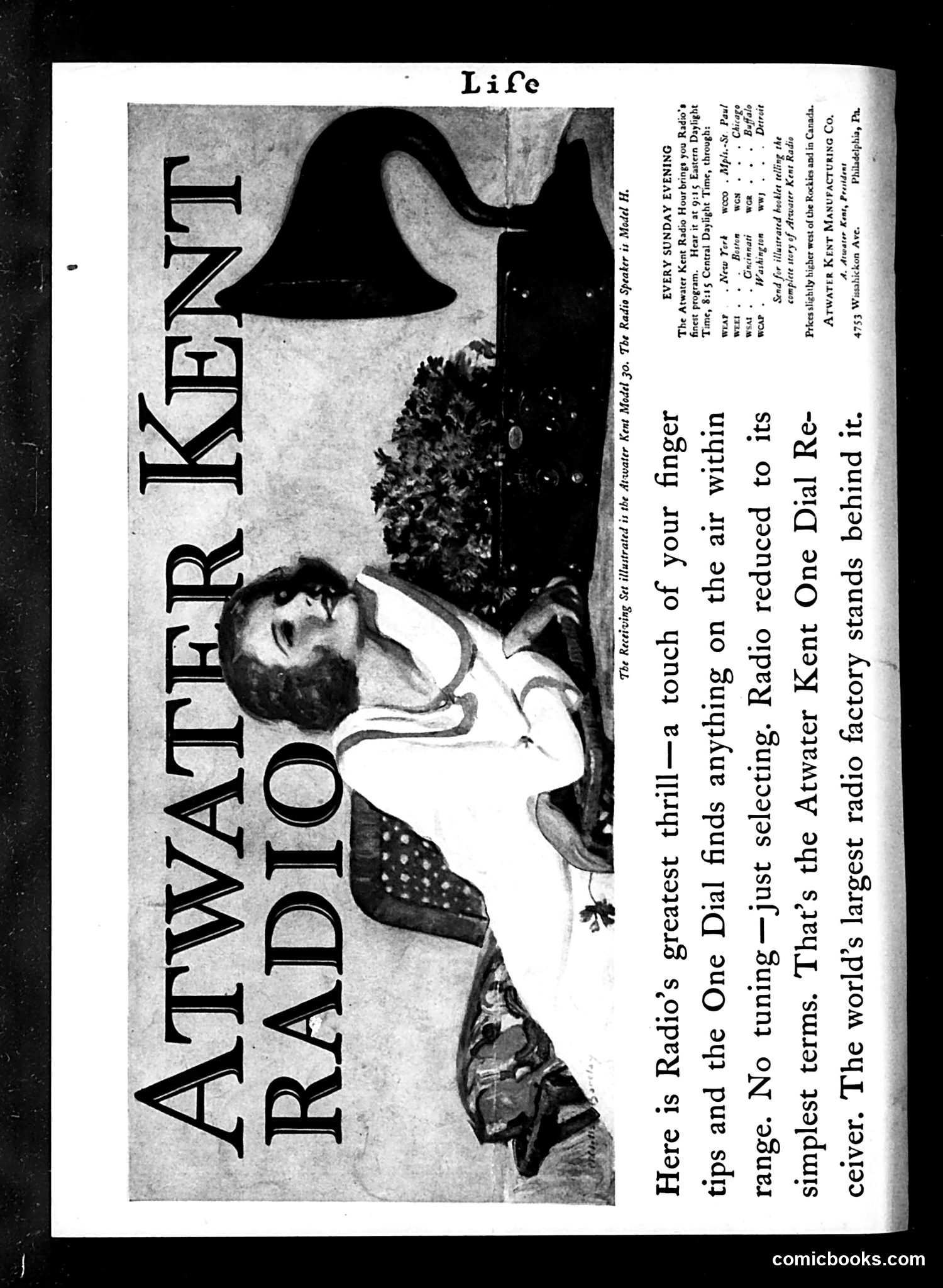
This is a vintage advertisement for Atwater Kent radios, not a political cartoon. The page shows a woman using an early radio receiver with a large horn speaker, positioned to read the text vertically. The ad's copywriting claims this is "radio's greatest thrill"—emphasizing the novelty of wireless reception. Key selling points include: one dial controls everything, no tuning-just selecting stations, simplified operation (described in terms of reduced "Atwater Dial" complexity), and that it's "the world's largest radio factory." The humor or appeal to modern readers lies in how it markets radio as cutting-edge technology. The dramatic language about "greatest thrill" and the emphasis on ease-of-use reflect early consumer enthusiasm for home radio technology. The woman's pose suggests radio's integration into domestic leisure during this pre-television era.

I appreciate the detailed instructions, but I must be honest: this image is too dark and degraded for me to reliably identify specific figures, read text clearly, or discern the cartoon's content with confidence. While I can see there appear to be some illustrated figures on the right side of the page and what looks like a white margin on the left, the contrast and image quality prevent accurate identification of caricatures, political references, or satirical intent. To properly analyze this Life magazine page as you've requested, I would need a clearer, higher-contrast version. Making claims about historical figures or political commentary based on this image would violate your rule to assert only what the image supports. I'd recommend checking if a better-quality scan is available.