
Life, 1926-07-22 · page 26 of 37
Life — July 22, 1926 — page 26: what you’re looking at
What you’re looking at
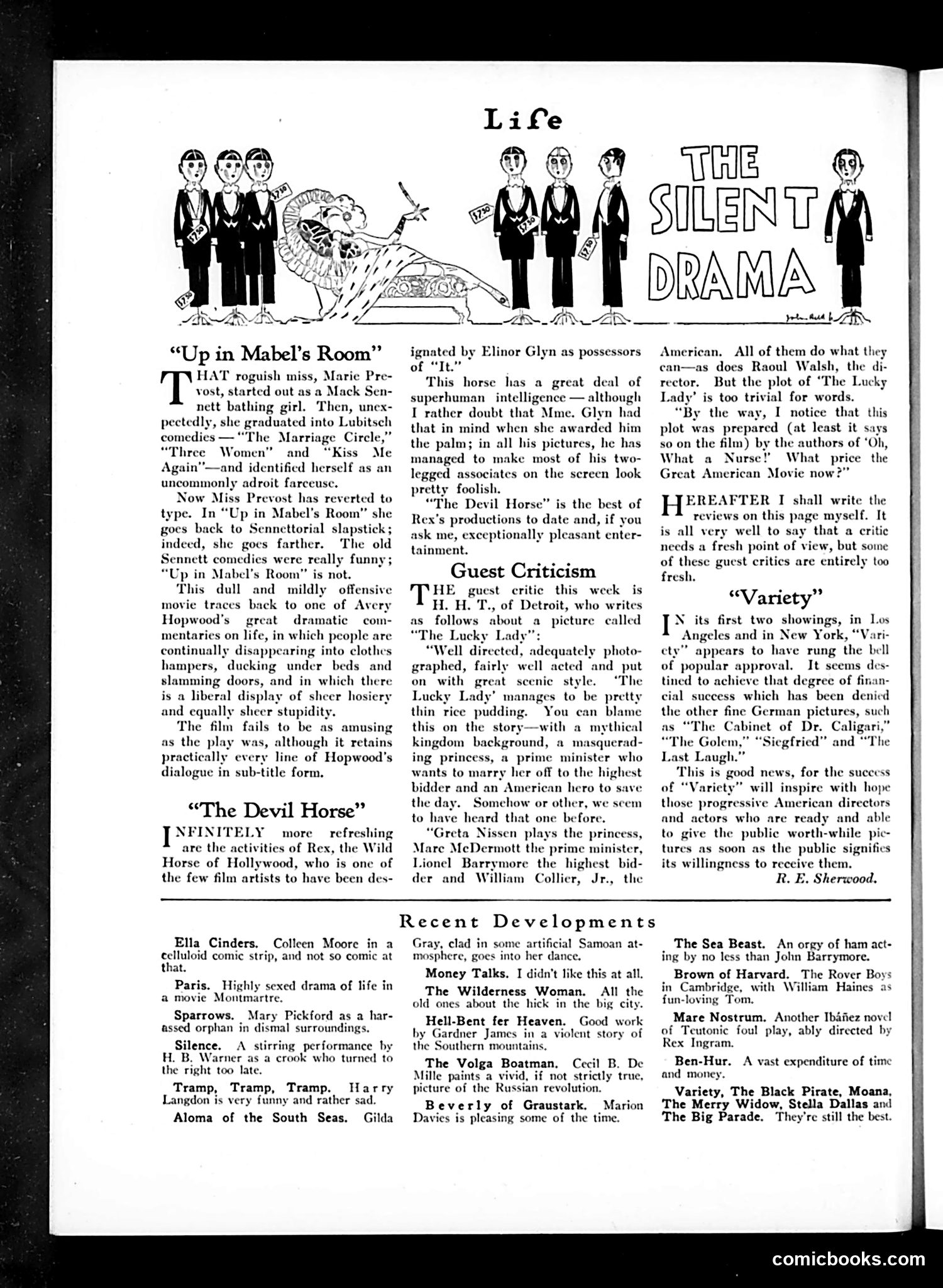
This page presents film criticism from Life's entertainment section, circa the 1920s silent film era. The masthead cartoon satirizes the film industry by depicting men in formal wear reacting to a rearing horse labeled "The Devil Horse"—referencing the article below about a horse actor who allegedly possesses "It" (sex appeal, per contemporary critic Elinor Glyn). The reviews critique recent silent films: Marie Prevost's "Up in Mabel's Room" is dismissed as unfunny slapstick; "The Devil Horse" is praised for its equine star outperforming human actors; and a guest critic from Detroit mocks "The Lucky Lady" for its tired, derivative plot involving a princess rescue. The satire targets Hollywood's creative bankruptcy—recycled storylines, B-list casting, and the absurdity of promoting animal actors. The editor's concluding jab at "guest critics" being "entirely too fresh" adds self-aware humor about amateur reviewing.
📄 Transcribed text from this page (OCR, searchable)
Machine-transcribed from the original scan — historical spelling and the odd misread are preserved.
AN GDS. “Up in Mabel’s Room” HAT roguish miss, Marie Pre- vost, started out Mack Sen- nett bathing girl. Then, unex- pectedly, she graduated into Lubitsch comedies — ‘The Marriage Circle,” “Three Women” and “Kiss Me Again’’—and identified herself as an uncommonly adroit farceuse. Now Miss Prevost has reverted to type. In “Up in Mabel’s Room” she goes back to Senncttorial slapstick ; indeed, she goes farther. The old Sennett comedies were really funny ; “Up in Mabel’s Room” is not. This dull and mildly offensive movie traces back to one of Avery Hopwood’s great dramatic com- mentaries on life, in which people are continually disappearing into clothes hampers, ducking under beds and slamming doors, and in which there is a liberal display of sheer hosiery and equally sheer stupidity, The film fails to be as amusing as the play was, although it retains practically ev line of Hopwood’s dialogue in sub-title form, “The Devil Horse” NFINITELY more _ refreshing are the activities of Rex, the Wild Horse of Hollywood, who is one of the few film artists to have been des- ignated by Elinor Glyn as possessors of “It.” This horse has a great deal of superhuman _ intelligence — although I rather doubt that Mme. Glyn had that in mind when she awarded him the palm; in all his pictures, he has managed to make most of his two- legged associates on the screen look pretty foolish. “The Devil Horse” is the best of Rex's productions to date and, if you ask me, exceptionally pleasant enter- tainment. Guest Criticism HE guest critic this week is H. H. T., of Detroit, who writes as follows about a picture called “The Lucky Lady”: “Well directed, adequately photo- graphed, fairly well acted and put on with great scenic style. ‘The Lucky Lady’ manages to be pretty thin rice pudding. You can blame this on the story—with a mythical kingdom background, a masquerad- ing princess, a prime minister who wants to marry her off to the highest bidder and an American hero to save the day. Somehow or other, we scem to have heard that one before. “Greta Nissen plays the princess, Mare McDermott the prime minister, Lionel Barrymore the highest bid- der and William Collier, Jr., the Ella Cinde: Colleen Moore in a celluloid comic strip, and not so comic at that. Paris. Highly sexed drama of life in a movie Montmartre. Sparrows. Mary Pickford as a har- assed orphan in dismal surroundings. A stirring performance by ner as a crook who turned to the right too late. Tramp, Tramp, Tramp. Harry Langdon is very funny and rather sad. Aloma of the South Seas. Gilda The Wilderness Woman. old ones ‘ All the about the hick in the big city. Hell-Bent fer Heaven. Good work by Gardner James in a violent story of the Southern mountains. The Volga Boatman, Cecil B. De Mille paints a vivid, if not strictly true, picture of the Russian revolution, Beverly of Graustark. Marion Davies is pleasing some of the time. THE SILENT B DRAMA Pe rn LR American. All of them do what they can—as does Raoul Walsh, the di- rector, But the plot of “The Lucky Lady’ is too tri for words. “By the way, I notice that this plot was prepared (at least it says so on the film) by the authors of ‘Oh, What a Nurse!’ What price the Great 4 an Movie now?” FTER I shall write the on this page myself. It is all very well to say that a critic needs a fresh point of view, but some of these guest critics are entirely too fresh, “Variety” N its first two showings, in 1.os Angeles and in New York, “Vari- ” appears to have rung the bell popular approval, It seems des- tined to achieve that degree of finan- cial success which has been denied the The Cabinet of Dr. Ca “The Golem,” “Siegfried” and L ast Laugh. for the success pire with hope those it American directors and actors who are ready and able to give the public worth-while pic- tures as soon as the public signifies its willingness to receive them. R. E, Sherwood, Recent Developments Gray, clad in some artificial Samoan at- mosphere, goes into her dance. Money Talks. I didn’t like this at all. The Sea Beast. An orgy of ham act- ing by no less than John Barrymore. Brown of Harvard. The Rover Boys in Cambridge, with William Haines as fun-loving Tom, Mare Nostrum. Another Ibafiez novel of Teutonic foul play, ably directed by Rex Ingram. Ben-Hur. and money. Variety, The Black Pirate, Moana, The Merry Widow, Stella Dallas and The Big Parade. They're still the best. A vast expenditure of time comicbooks.com