
Life, 1926-07-22 · page 15 of 37
Life — July 22, 1926 — page 15: what you’re looking at
What you’re looking at
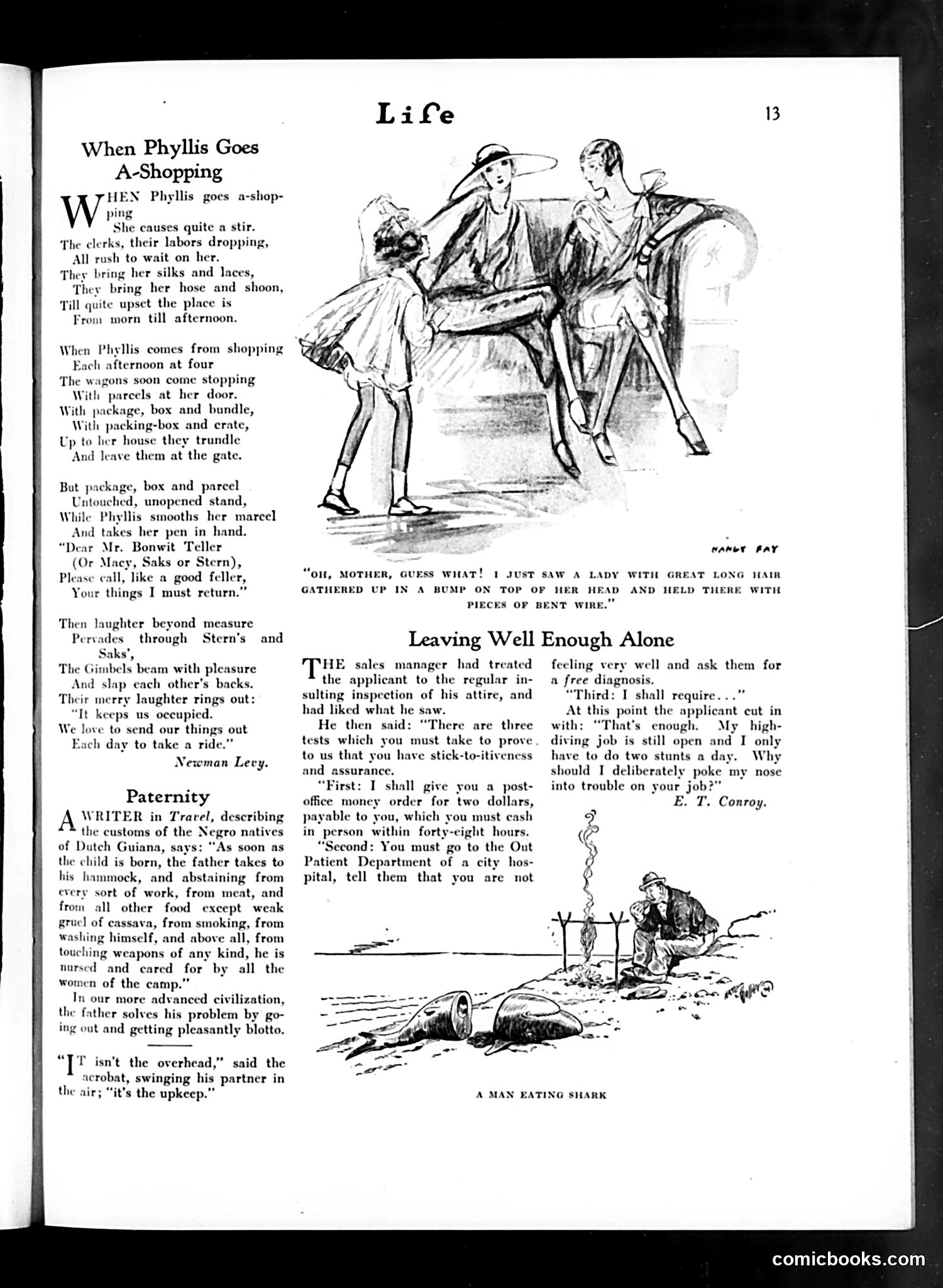
This page contains three separate humorous pieces: 1. **"When Phyllis Goes A-Shopping"** - A poem satirizing the disruption caused when a woman goes shopping. The accompanying sketch shows a woman returning home laden with packages, causing domestic chaos as servants scramble to manage her purchases. 2. **"Leaving Well Enough Alone"** - An anecdote mocking an overzealous job applicant undergoing medical inspection. The applicant deliberately provokes the doctor by poking his nose to prove he can take punishment, demonstrating absurd eagerness to prove his fitness for work. 3. **"Paternity"** - A brief piece contrasting Dutch colonial childrearing practices (involving abstinence from various activities) with modern "civilized" parenting, humorously concluding that fathers prefer "getting pleasantly blotto." The humor relies on domestic situations and class-based observations typical of early 20th-century satirical magazines.
📄 Transcribed text from this page (OCR, searchable)
Machine-transcribed from the original scan — historical spelling and the odd misread are preserved.
When Phyllis Goes A-Shopping HEN Phyllis goes a-shop- She causes quite a stir. The clerks, their labors dropping, All rush to wait on her. They bring her silks and laces, They bring her hose and shoon, Till quite upset the place is From morn till afternoon. When Phyllis comes from shopping Each afternoon at four The wagons soon come stopping With parcels at her door. With package, box and bundle, With packing-box and crate, Up to her house they trundle And leave them at the gate. ge, box and parcel While Phyllis smooths her marcel And takes her pen in hand. “Dear Mr. Bonwit Teller (Or Maey, Saks or Stern), Please call, like a good feller, Your things I must return.” Then laughter beyond measure Pervades through Stern's Saks’, The Gimbels beam with pleasure And slap each other's backs. Their merry laughter rings out: “Tt keeps us occupied. We love to send our things out Each day to take a ride.” Newman Levy. and Paternity WRITER in Travel, describing the customs of the Negro natives of Dutch Guiana, say: As soon as the child is born, the father takes to his hammock, and abstaining from every sort of work, from meat, and from all other food except weak gruel of cassava, from smoking, from washing himself, and above all, from touching weapons of any kind, he is nursed and cared for by all the women of the camp.” In our more advanced civilization, the father solves his problem by go- ing out and getting pleasantly blotto. “JT isn't the overhead,” said the acrobat, swinging his partner in the air; “it’s the upkeep.” “OH, MOTHER, GUESS WHAT! wAney FAY 1 JUST SAW A LADY WITH GREAT LONG HAIR GATHERED UP IN A BUMP ON TOP OF HER HEAD AND HELD THERE WITH PIECES OF BENT WIRE.” Leaving Well Enough Alone THE sales manager had treated the applicant to the regular in- sulting inspection of his attire, and had liked what he saw. He then said: “There are three tests which you must take to prove to us that you have stick-to-itiveness and assurance. “First: I shall give you a post- office money order for two dollars, payable to you, which you must cash in person within forty-eight hours. “Second: You must go to the Out Patient Department of a city hos- pital, tell them that you are not feeling very well and ask them for a free diagnosis. “Third: I shall require..." At this point the applicant cut in with: “That's enough. My high- diving job ll open and I only have to do two stunts a day. Why should I deliberately poke my nose into trouble on your job?” E. T. Conroy. A MAN EATING SHARK comicbooks.com