
Life, 1926-07-22 · page 25 of 37
Life — July 22, 1926 — page 25: what you’re looking at
What you’re looking at
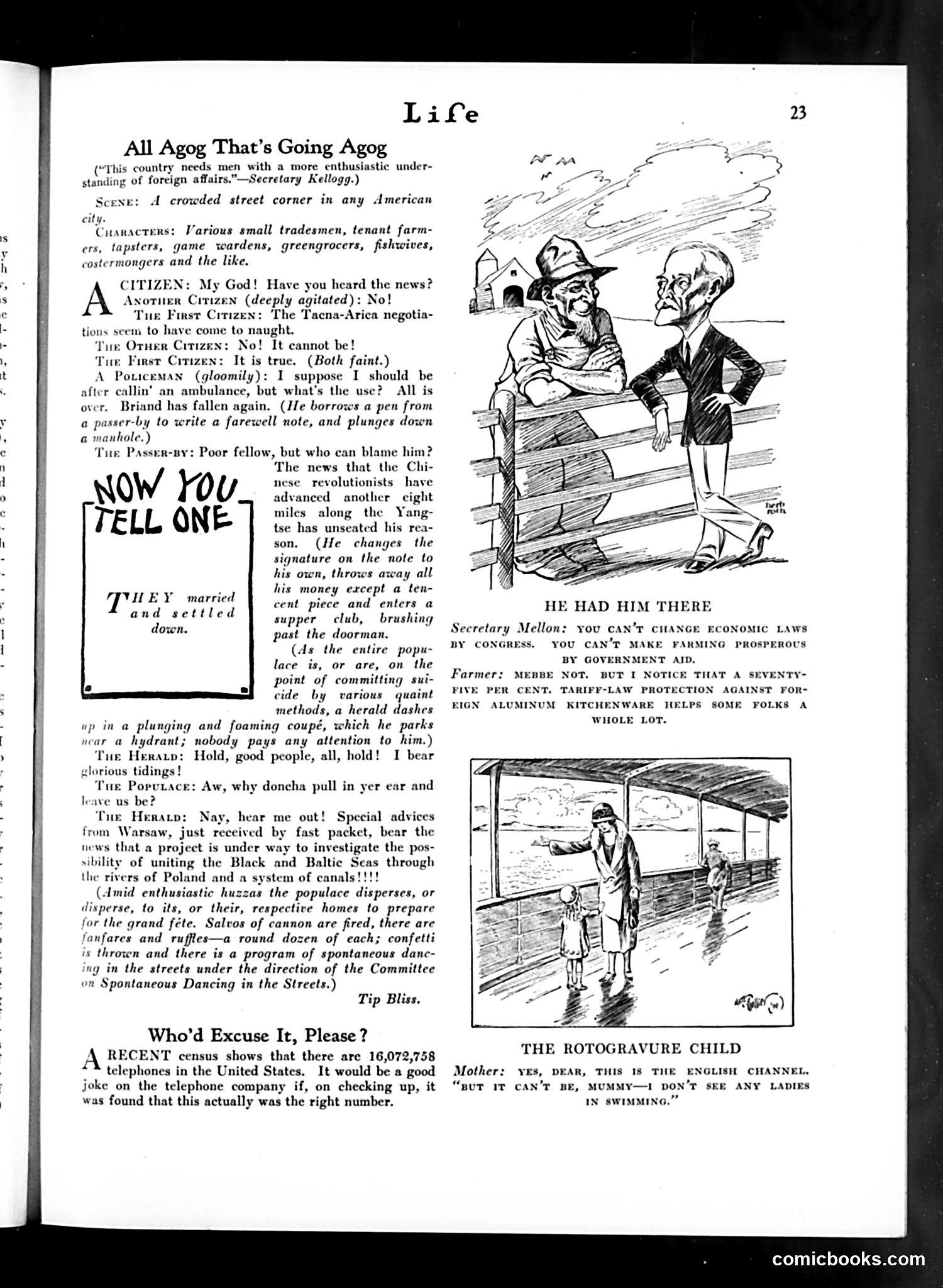
This satire mocks Americans' obsession with foreign affairs despite having no real understanding of them. The sketch depicts ordinary citizens (tradesmen, police officers) becoming hysterically distraught over obscure international news: failed Tacna-Arica negotiations between Peru and Chile, French political instability, Chinese civil war developments, and Polish canal projects. Each revelation sends them closer to suicide until a herald announces a canal project, suddenly reversing their despair into celebration. The joke targets Secretary of State Kellogg's call (quoted in the epigraph) for better foreign affairs understanding. Instead, average Americans treat incomprehensible diplomatic minutiae as matters of personal crisis—performing theatrical emotional responses to events they couldn't explain. The satire suggests Americans are performatively patriotic about foreign policy while remaining fundamentally ignorant of its actual significance or their ability to influence it.
📄 Transcribed text from this page (OCR, searchable)
Machine-transcribed from the original scan — historical spelling and the odd misread are preserved.
Life ’ : All Agog That’s Going Agog (“This country needs men with a more enthusiastic under- standing of foreign affairs.”—Secretary Kellogg.) Scene: A crowded street corner in any American city. | Cuaracters: Various small tradesmen, tenant farm- ers, tapsters, game wardens, greengrocers, fishwives, costermongers and the like. CITIZE My God! Have you heard the news? A Ayotuer Cite (deeply agitated): No! Tue First Crtizen: The Tacna-Arica negotia- tions seem to have come to naught. Tur Orner Crtiz: No! It cannot be! Tue First Crriz It is true. (Both faint.) A Poticeman (gloomily): I suppose I should be after callin’ an ambulance, but what’s the use? All is over. Briand has fallen again. (He borrows a pen from a passer-by to write a farewell note, and plunges down g manhole.) Tue Passer-sy: Poor fellow, but who can blame NOW You TELL ONE him ? The news that the Chi- nese revolutionists have advanced another eight miles along the Yang- tse has unseated his rea- son. (He changes the signature on the note to his own, throws away all his money except a ten- cent piece and enters a supper club, brushing past the doorman, (As the entire popu- lace is, or are, on the point of committing sui- cide by various quaint methods, a herald dashes up in a plunging and foaming coupé, which he parks near a hydrant; nobody pays any attention to him.) Tue Heratp: Hold, good people, all, hold! I bear TJYH EY = married and settled down. : Aw, why doncha pull in yer ear and leave us be? Tur Herarp: Nay, hear me out! Special advices from Warsaw, just received by fast packet, bear the news that a project is under way to investigate the pos- sibility of uniting the Black and Baltic Seas through the rivers of Poland and a system of canals!!!! (Amid enthusiastic huzzas the populace disperses, or disperse, to its, or their, respective homes to prepare for the grand féte. Salvos of cannon are fired, there are fanfares and ruffles—a round dozen of each; confetti is thrown and there is a program of spontaneous danc- ing in the streets under the direction of the Committee on Spontaneous Dancing in the Streets.) Tip Bliss. Who’d Excuse It, Please? A RECENT census shows that there are 16,072,758 ~ ™ telephones in the United States. It would be a good joke on the telephone company if, on checking up, it was found that this actually was the right number. HE HAD HIM THERE Secretary Mellon: you CAN’? CHANGE ECONOMIC LAWS BY CONGRESS. YOU CAN’T MAKE FARMING PROSPEROUS BY GOVERNMENT AID. Farmer: MrEBBE NOT. BUT I NOTICE THAT FIVE PER CENT. TARIFF EIGN ALUMINUM A SEVENTY- LAW PROTECTION AGAINST FOR- NWARE HELPS SOME FOLKS A WHOLE LOT. THE ROTOGRAVURE CHILD Mother: yes, DEAR, THIS 18 THE ENGLISH CHANNEL. “BUT IT CAN’T BE, MUMMY—I DON’T SEE ANY LADIES IN SWIMMING.” comicbooks.com