
Life, 1926-07-22 · page 21 of 37
Life — July 22, 1926 — page 21: what you’re looking at
What you’re looking at
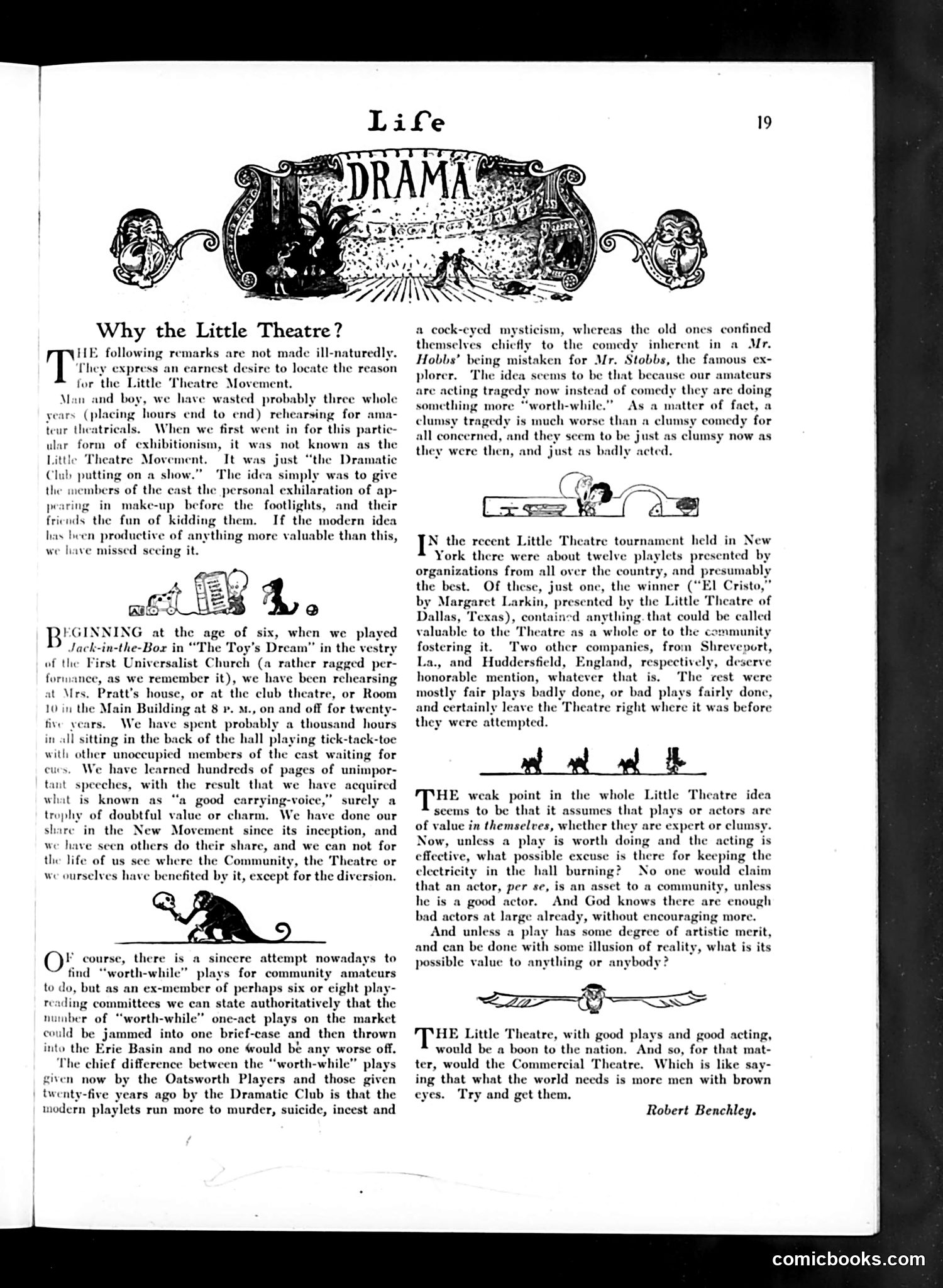
This article critiques the early 20th-century "Little Theatre Movement"—amateur theatrical clubs staging plays in community spaces. The author (Robert Benchley, bylined at bottom) argues the movement lacks genuine value beyond personal ego gratification for amateur actors. **Key points:** The article uses self-deprecating humor about the author's own decades in amateur theater, admitting they've wasted years rehearsing without benefiting "the Community, the Theatre or ourselves." The satire targets the movement's pretension: modern amateur groups claim moral superiority by staging "serious" dramas (murder, suicide, incest) instead of old comedies, yet perform them equally badly. Clumsy tragedy is actually *worse* than clumsy comedy. At a recent Little Theatre tournament in New York, only one winning play ("El Cristo" from Dallas) had genuine artistic merit; most were mediocre. **The core joke:** Community theater hasn't evolved—it's just amateur actors seeking validation through increasingly dark subject matter, mistaking ambition for improvement. The small decorative illustrations are generic theatrical vignettes, not specific political cartoons.
📄 Transcribed text from this page (OCR, searchable)
Machine-transcribed from the original scan — historical spelling and the odd misread are preserved.
Why the Little Theatre? Ti following remarks are not made ill-naturedly. hey express an carnest desire to locate the reason for the Little Theatre Movement. Man and boy, we have wasted probably three whole years (placing hours end to end) rehearsing for am teur theatric When we first went in for this pa: form of exhibitionism, it was not known as the Theatre Movement. It was just “the Dramatic putting on a show.” The idea simply was to give the members of the cast the personal exhilaration of ap- pearing in make-up before the footlights, and_ their friends the fun of kidding them. If the modern idea has been productive of anything more valuable than this, we have missed seeing it. ular Little Club I at the age of six, when we played Jack-in-the-Box in “The Toy’s Dream” in the vest: of the First Universalist Church (a rather ragged pe formance, as we remember it), we have been rehearsing at Mrs. Pratt’s house, or at the club theatre, or Room 10 in the Main Building at 8 ». M., on and off for twenty- s. We have spent probably a thousand hours in all sitting in the back of the hall p! ig tick-tack-toe with other unoccupied members of the cast waiting for We have learned hundreds of pages of unimpor- tant speeches, with the result that we have acquired what is known as “a good carrying-voice,” surely a trophy of doubtful value or charm, We have done our in the New Movement since its inception, and we have seen others do their share, and we can not for the life of us see where the Community, the Theatre or we ourselves have benefited by it, except for the diversion. five yen curs, share F course, there is a sincere attempt nowada find “worth-while” plays for community amateurs to do, but as an ex-member of perhaps six or eight play reading committees we can state authoritatively that the number of “worth-while” one-act plays on the market could be jammed into one brief-case and then thrown into the Erie Basin and no one ould be any worse off. The chief difference between the “worth-while” pl. given now by the Oatsworth Players and those given twenty-five years ago by the Dramatic Club is that the modern playlets run more to murder, suicide, incest and ticism, whereas the old ones confined chiefly to the comedy inherent in a Hobbs’ being mistaken for Mr. Stobbs, the famous plorer. The idea seems to be that because our amate are acting tragedy now instead of comedy they are doing something more rth-while.” As a matter of fact, a clumsy tragedy is much worse than a clumsy comedy for all concerned, and they seem to be just as clumsy now as they were then, and just as badly acted. 8% N the recent Little Theatre tournament held in New York there were about twelve playlets presented by organizations from all over the country, and presumably the best. Of these, just one, the winner (“El Cristo,” by Margarct Larkin, presented by the Little Theatre of Dallas, Texas), contained anything. that could be called valuable to the Theatre as a whole or to the community fostering it. Two other companies, from Shreveport, La., and Huddersfield, England, respectively, deserve honorable mention, whatever that is. The rest were mostly fair plays badly done, or bad plays fairly done, and certainly leave the Theatre right where it was before they were attempted. A wk nt HE weak point in the whole Little Theatre idea seems to be that it assumes that plays or actors are of value in themselves, whether they are expert or clumsy. Now, unless a play is worth doing and the acting is effective, what possible excuse is there for keeping the electricity in the hall burning? No one would claim that an actor, per se, is an asset to a community, unless he is a good actor. And God knows there are enough bad actors at large already, without encouraging more. And unless a play has some degree of artistic merit, and can be done with some illusion of reality, what is its possible value to anything or anybody? 7 HE Little Theatre, with good plays and good acting, would be a boon to the nation. And so, for that mat- ter, would the Commercial Theatre. Which is like say- ing that what the world needs is more men with brown eyes. Try and get them. Robert Benchley. comicbooks.com