
A complete issue · 44 pages · 1926
Life — June 17, 1926
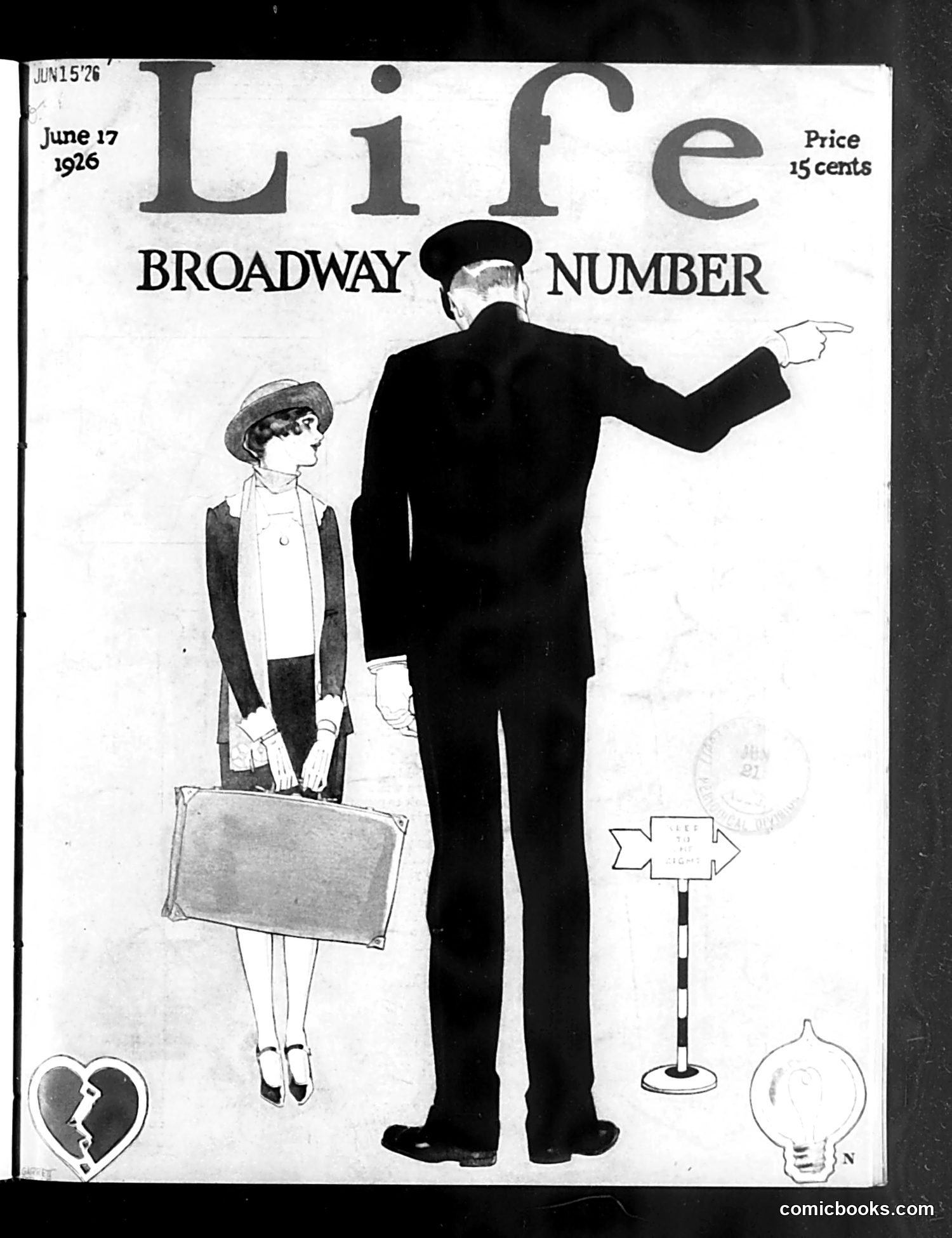
This is the Broadway Number cover of Life magazine, a satirical publication. The illustration depicts a tall man in formal attire (likely a theatrical producer or impresario) pointing directions to a young woman carrying a suitcase—the archetypal "starlet" arriving in New York seeking Broadway fame. The satire comments on the entertainment industry's exploitation system: the small figure of the ambitious young woman contrasts sharply with the looming authority figure directing her path. The suitcase and her modest appearance suggest a newcomer's vulnerability, while his commanding gesture implies the industry's power to shape (or mislead) aspirants' careers. The surrounding symbols—the broken heart, directional sign, and lightbulb—reinforce themes of romantic disappointment, uncertainty, and the seductive but illusory promises of Broadway success.
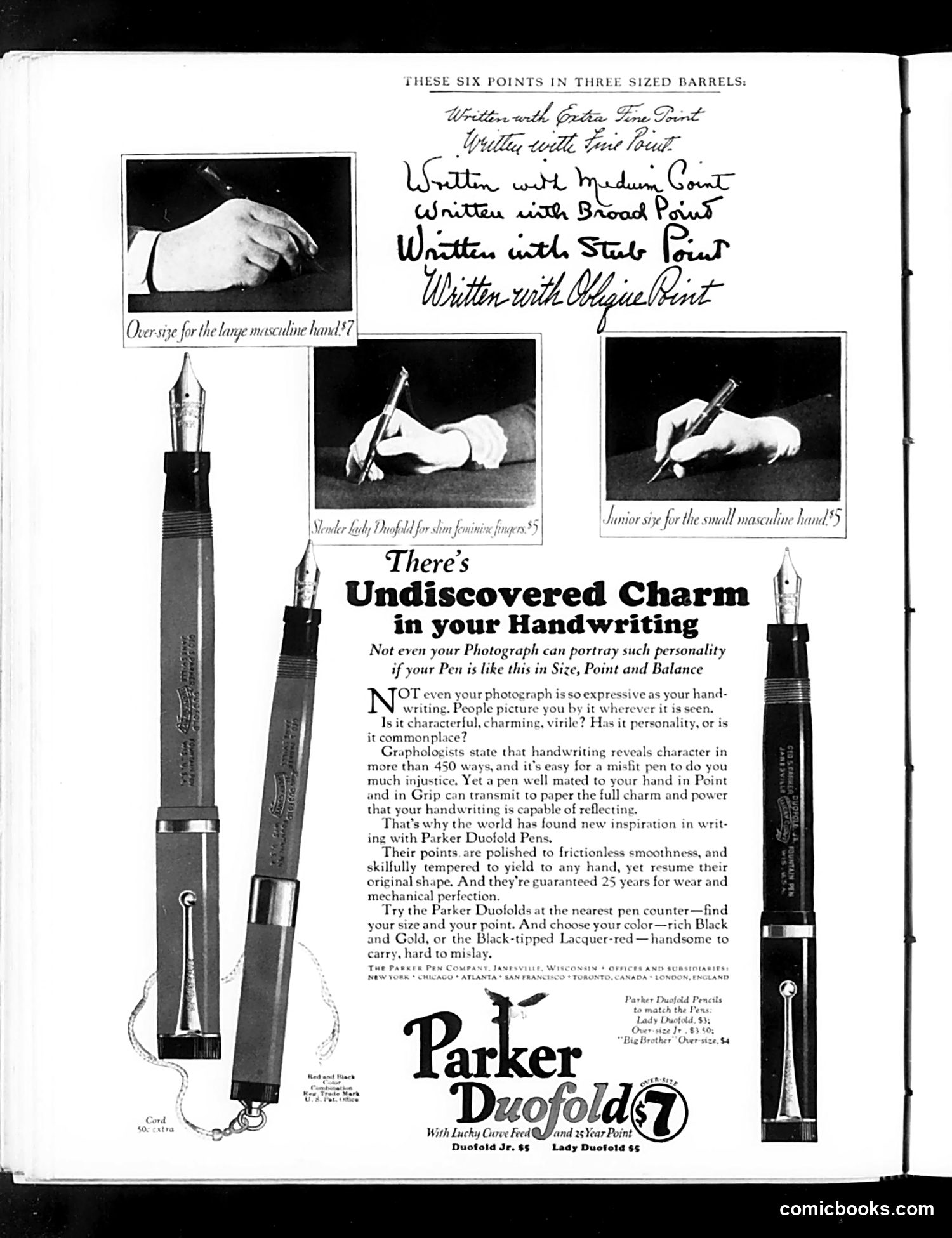
This is a **fountain pen advertisement**, not political satire. It's a Parker Duofold marketing page from what appears to be the 1920s-30s era, using Life magazine's platform to promote writing instruments. The ad emphasizes that handwriting reveals character and personality more effectively than photography. It displays six different pen grip styles and sizes available in Parker's "three sized barrels"—catering to different hand sizes and writing preferences. The advertisement claims graphologists can identify 450+ character traits through handwriting, positioning the pen as essential for expressing one's authentic self. It promotes the pen's durability (25-year guarantee) and smooth writing quality, encouraging readers to visit pen counters to find their ideal size and point preference. The marketing appeals to vanity and self-presentation concerns of the era.
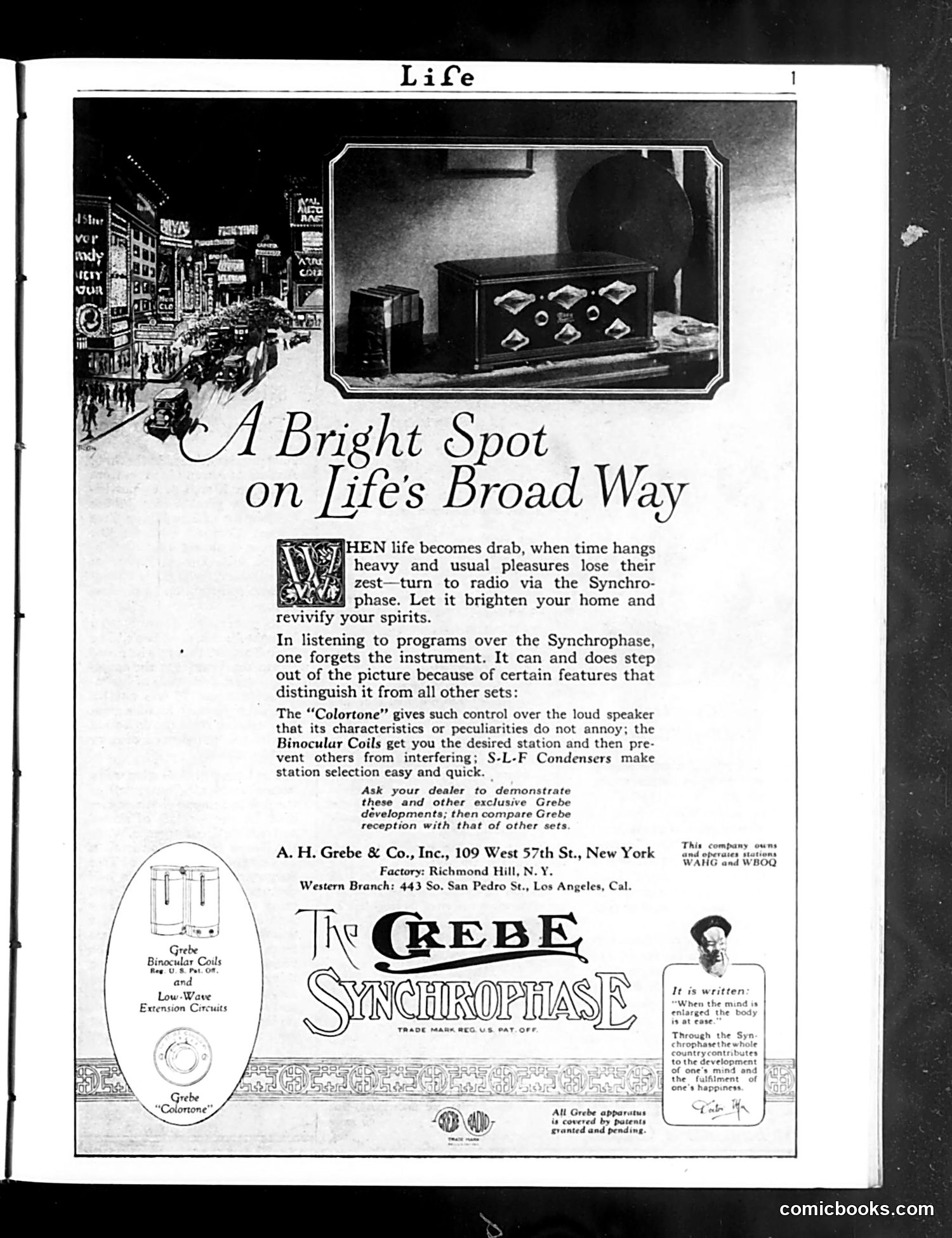
This page is primarily **advertising, not satire or political commentary**. It's a full-page advertisement for the Grebe Synchrophase radio, published in *Life* magazine. The ad promotes radio listening as entertainment for when "life becomes drab" and "time hangs heavy." The left image shows a busy urban street scene (establishing the need for home entertainment), while the right shows the Synchrophase radio itself. The copy highlights technical features: a "Colortone" loud speaker, "Binocular Coils" for station selection, and "S-L-F Condensers" for ease of tuning. The manufacturer, A.H. Grebe & Co., located in New York with a Los Angeles branch, positions this as superior to competing radio sets. There is no political cartoon or satire present—this is straightforward 1920s consumer marketing.
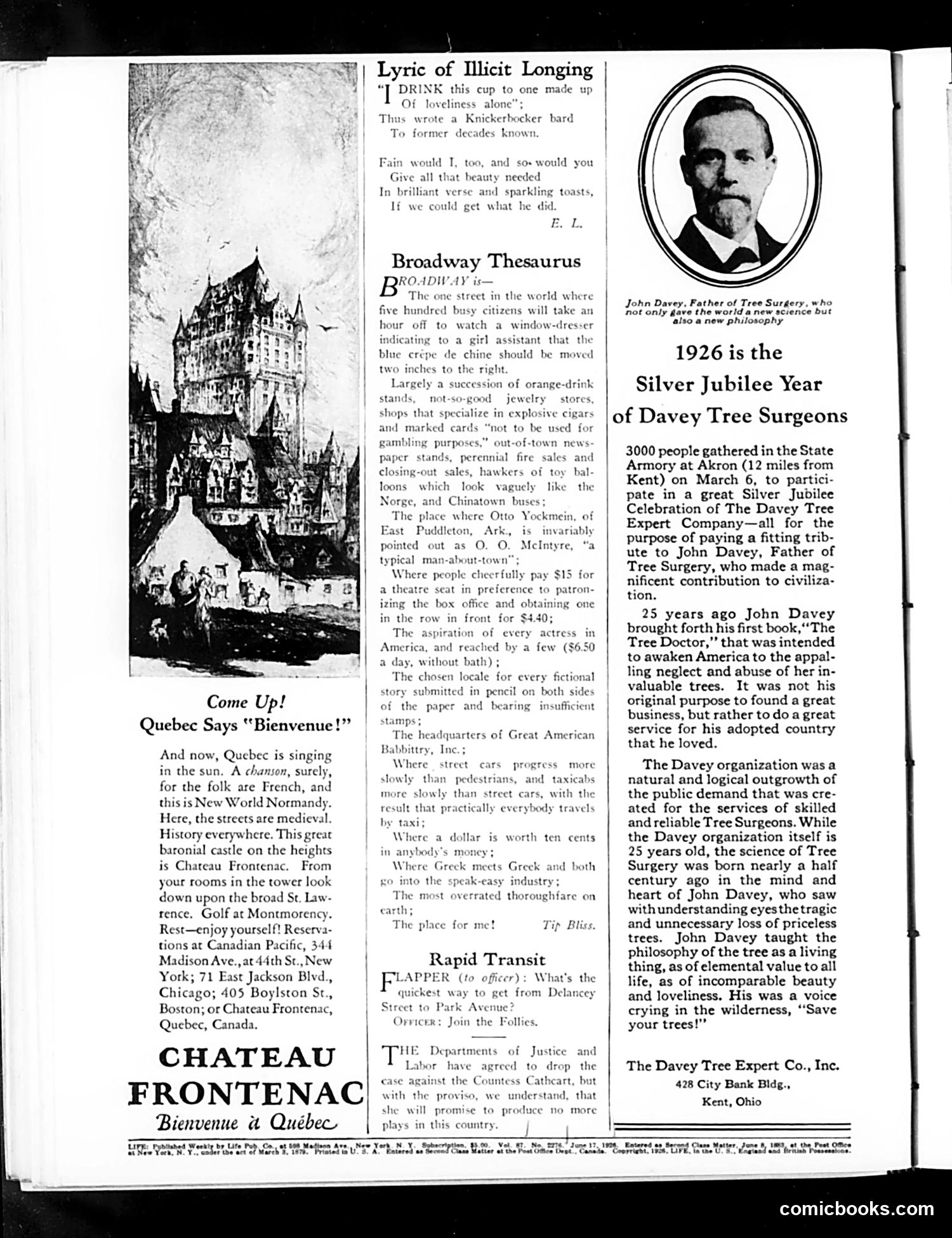
This page is primarily **advertising and promotional content** rather than political satire. The main elements include: 1. **"Come Up! Quebec Says 'Bienvenue!'"** - A travel advertisement for Quebec, emphasizing medieval charm and French culture to attract American tourists. 2. **"Broadway Thesaurus"** - A humorous column defining Broadway theater district landmarks and practices (orange-drink stands, fire sales, box office pricing), written as satirical commentary on the commercialization of theater. 3. **"1926 is the Silver Jubilee Year of Davey Tree Surgeons"** - A commemorative feature celebrating John Davey's tree surgery company's 25-year anniversary and his philosophy of tree conservation. 4. **"Rapid Transit"** - A brief joke about getting from Delancey Street to Park Avenue. The page reflects 1920s consumer culture, tourism promotion, and business celebration rather than political commentary.
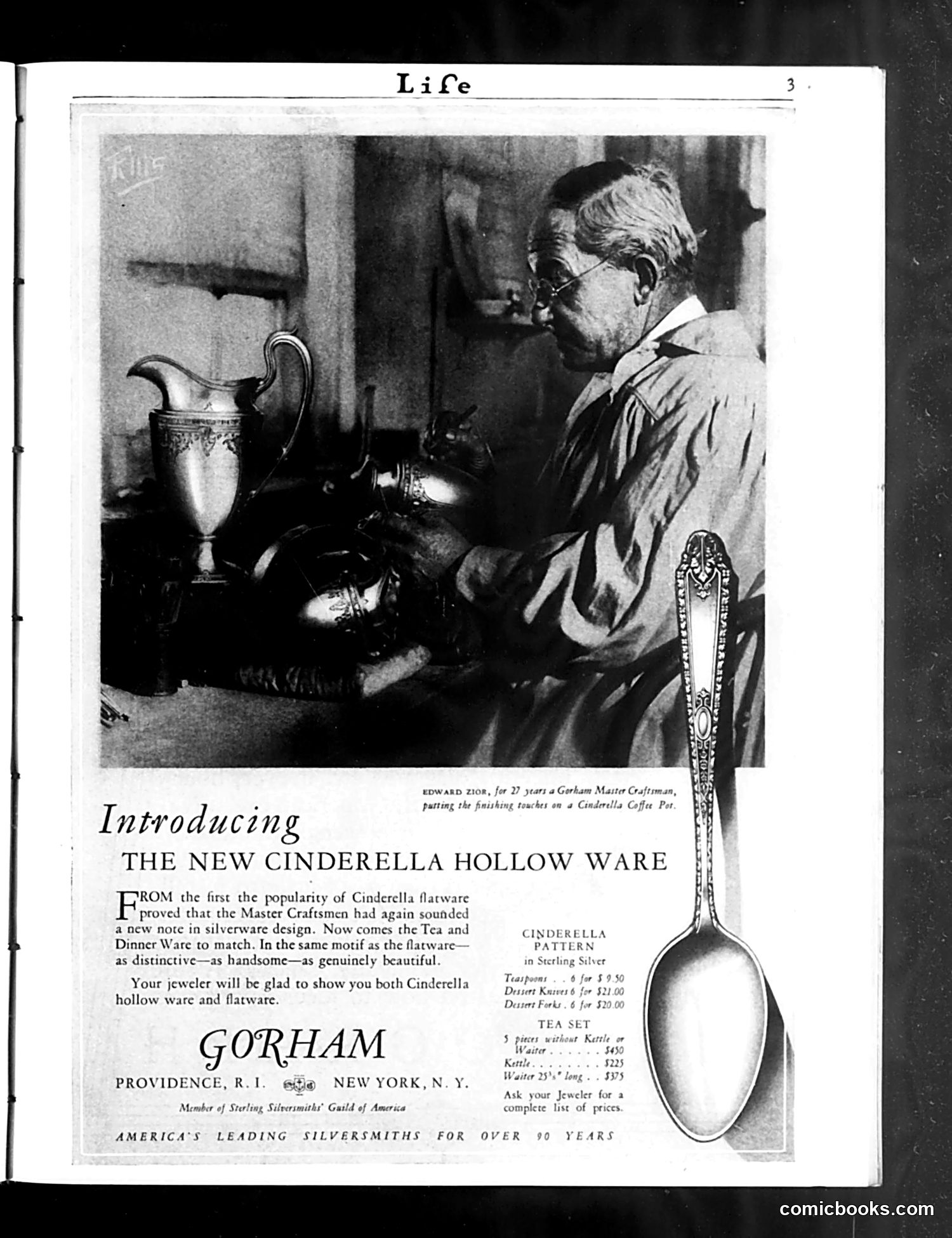
This page is primarily **advertising, not satire or political commentary**. It features an advertisement for Gorham silverware, specifically introducing "The New Cinderella Hollow Ware" tea and dinner service. The image shows an elderly craftsman (identified as Edward Zios, a Gorham Master Craftsman of 27 years) examining or working on decorative silver pieces. The advertisement emphasizes that Gorham's established reputation for quality flatware has now extended to hollow ware with matching Cinderella pattern designs. The "Cinderella" reference appears to be purely a product name suggesting elegance and transformation—not a political or satirical reference. Gorham positions itself as "America's Leading Silversmiths for Over 90 Years," appealing to consumers' desire for quality domestic craftsmanship and matching silverware sets.
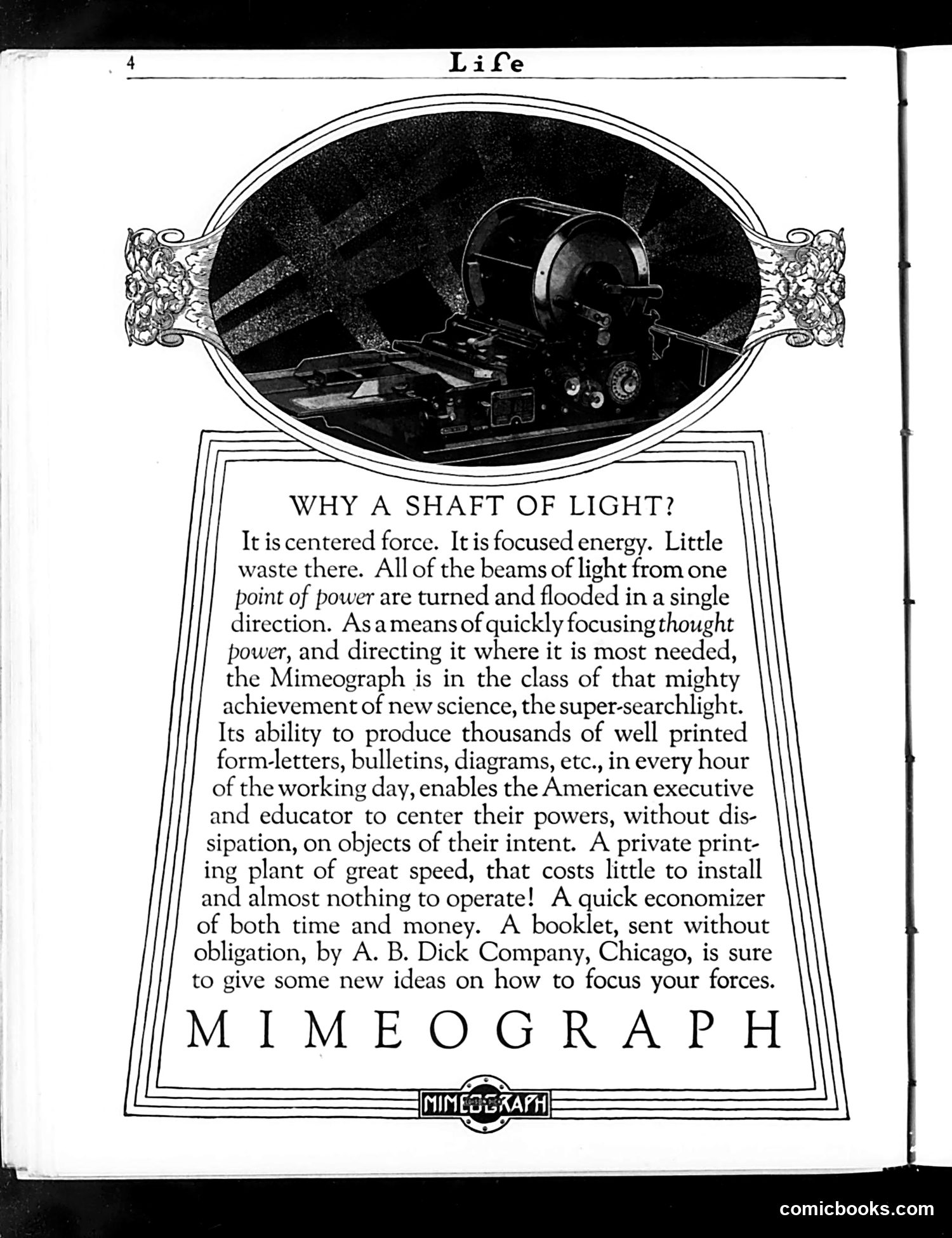
This page is **entirely an advertisement**, not satire or editorial content. It promotes the Mimeograph machine by the A.B. Dick Company of Chicago. The ad uses a metaphor comparing the mimeograph to a "shaft of light"—concentrated, focused energy with no waste. The text argues the machine enables American executives and educators to efficiently produce thousands of printed materials (form letters, bulletins, diagrams) daily at minimal cost and effort. The image shows the actual mimeograph device. The advertisement positions this copying technology as a modern scientific achievement that helps professionals "focus their powers" on important work, framing office automation as progress. This reflects early-20th-century enthusiasm for business efficiency technology.
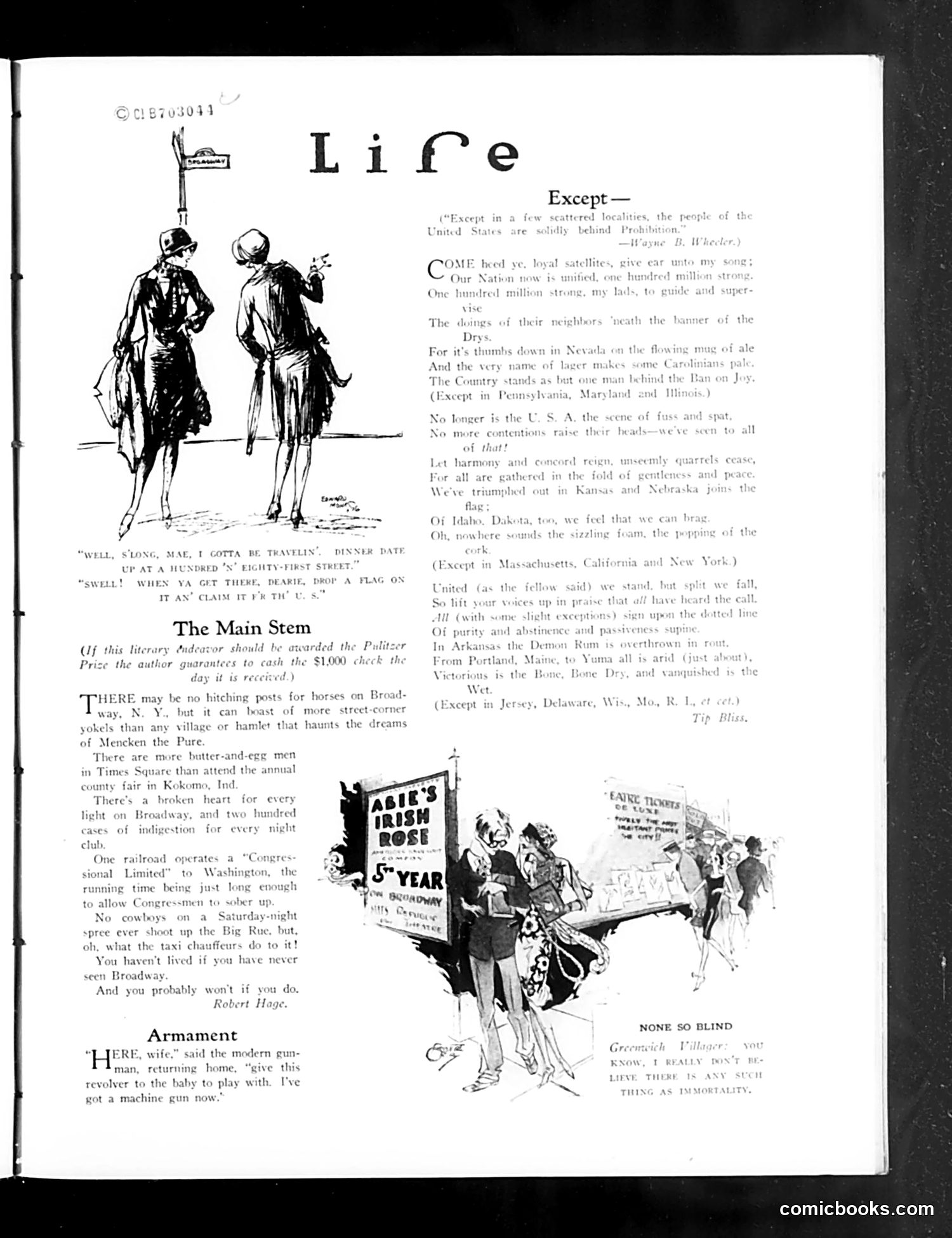
This page satirizes **Prohibition** (the nationwide ban on alcohol). The top poem "Except" mocks how Prohibition fails everywhere except a few states—people continue drinking despite the law. It references specific states like Nevada, Pennsylvania, and Maryland where enforcement supposedly works. "The Main Stem" describes Broadway's continued nightlife and illegal activity despite Prohibition's intent. The central cartoon shows someone reading "Sadie's Irish Rose" (a popular 1920s play) while holding a lottery ticket, satirizing how Americans seek entertainment and quick money during Prohibition's economic disruption. "Armament" jokes darkly about domestic gun violence, suggesting Americans arm themselves against family members. The overall theme: Prohibition is universally ignored and has created unintended social chaos.
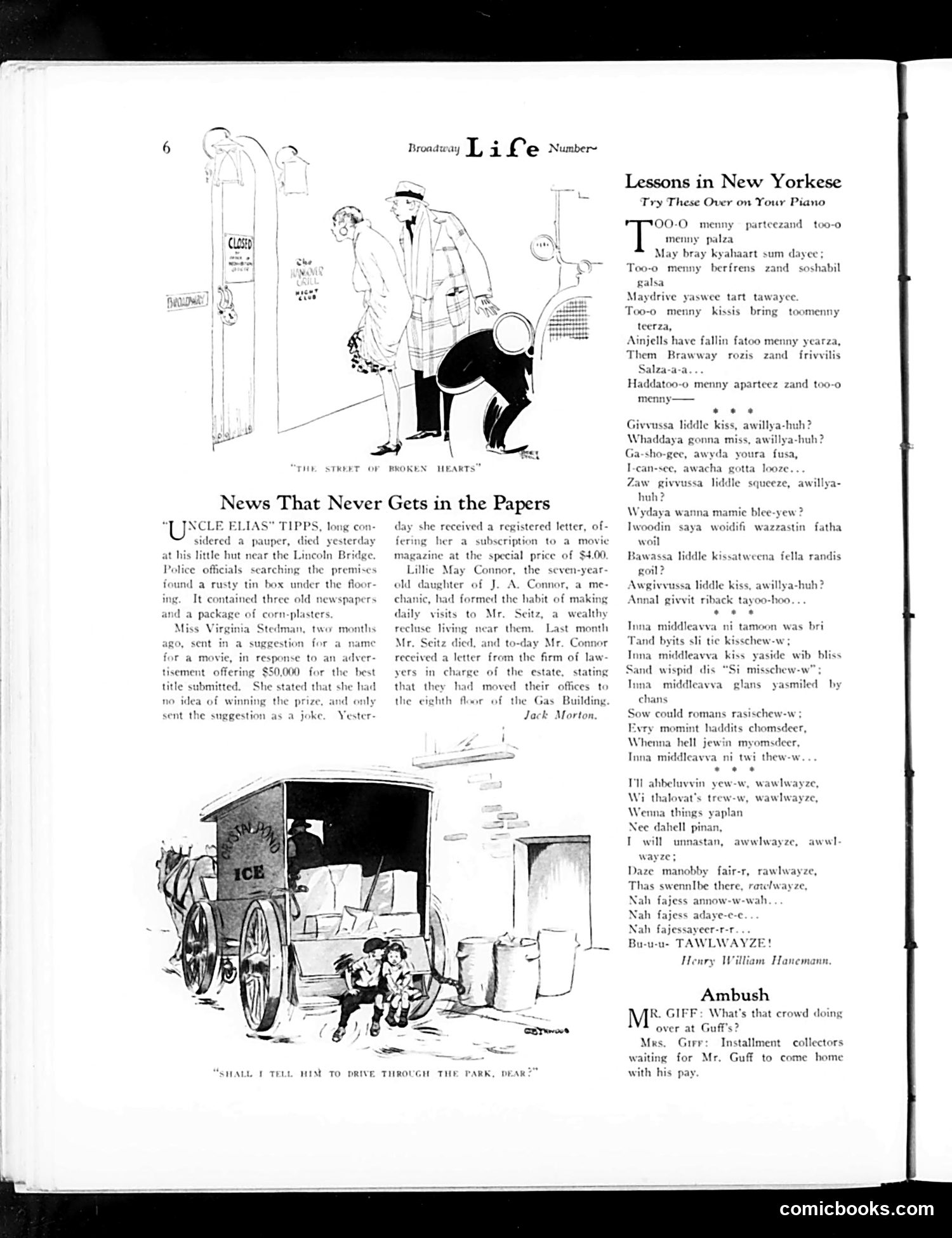
This page contains three satirical pieces reflecting early 20th-century urban life: **"The Street of Broken Hearts"** (top cartoon): Shows a man in formal attire bent over, examining something on the street while a woman passes. The title suggests romantic disappointment in city life. **"News That Never Gets in the Papers"** (middle section): A humorous anecdote about a woman who submitted a movie name suggestion and received a registered letter offering $50 for it—only to later learn the suggestion was submitted as a joke. The satire mocks both the woman's gullibility and perhaps movie studios' practices. **"Ambush"** (bottom): A brief dialogue joke about installment collectors waiting for "Mr. Guff" to come home with his paycheck—satirizing the common working-class struggle with debt and creditors during this era.
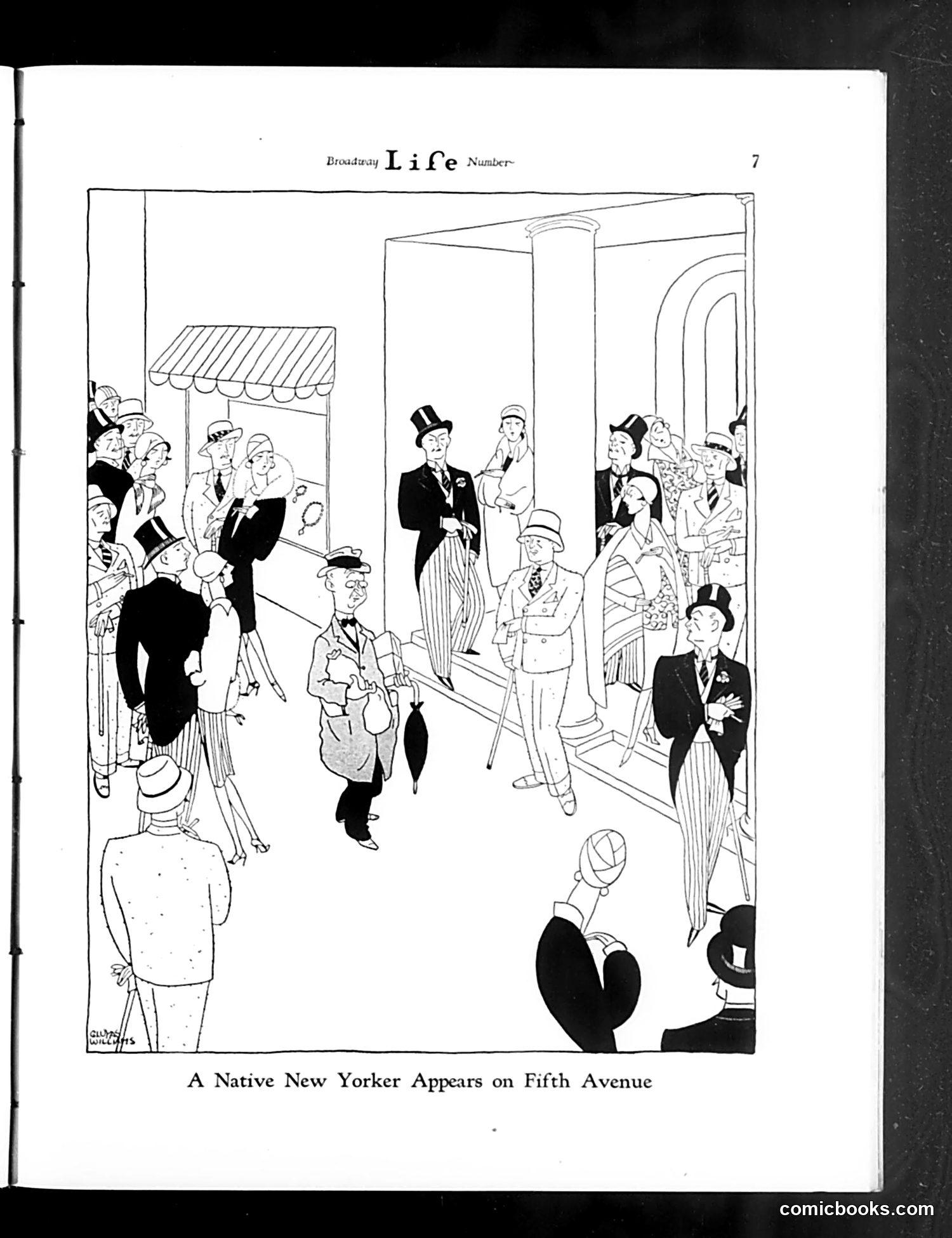
This cartoon satirizes the contrast between old-money New York society and a self-proclaimed "native New Yorker." The figure in the center—dressed in exaggerated formal attire with a top hat and cane—appears to be a nouveau riche or working-class person attempting to blend into Fifth Avenue's elite social scene. The surrounding well-dressed pedestrians react with varying degrees of amusement or skepticism. The satire mocks both social pretension and class anxiety: the "native New Yorker" is overdressed and self-conscious, trying too hard to fit into an exclusive world. The joke plays on early 20th-century American anxieties about social mobility, suggesting that genuine Fifth Avenue sophistication cannot be purchased or performed—it's inherited. The comic exaggerates the figure's theatrical posture to emphasize the awkwardness of the attempt.
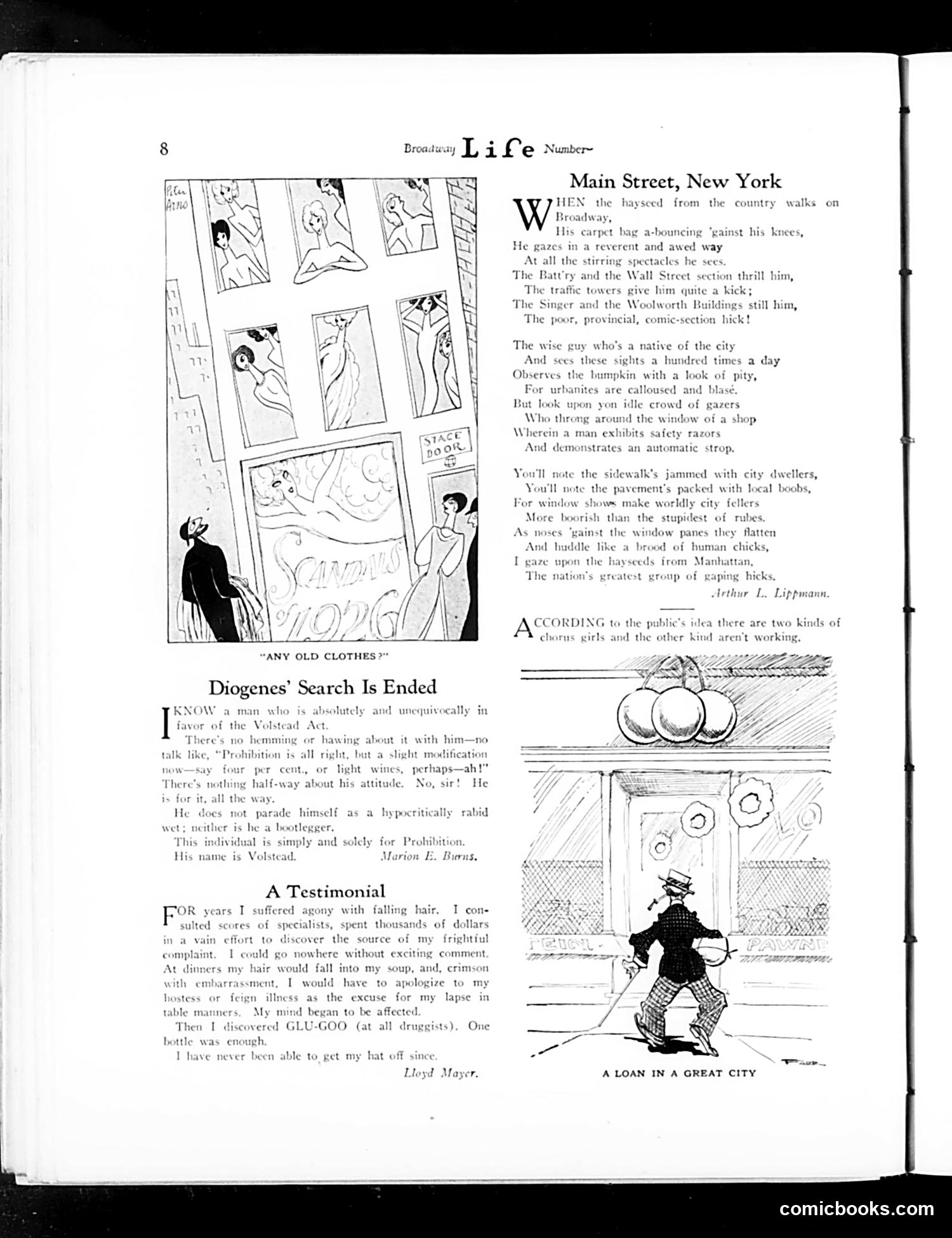
This satirical poem by Arthur L. Lippmann mocks a naive country visitor overwhelmed by Broadway's sensory chaos—the "Battery and Wall Street," traffic noise, street performers, and window displays. The accompanying cartoon "Any Old Clothes?" shows a well-dressed man accosted by a ragman, inverting expectations: typically the poor solicited the wealthy, but here the visual suggests the city's hustlers target everyone. The broader page includes commentary on Prohibition ("Diogenes' Search Is Ended") and a testimonial about hair loss remedies. The humor targets urban overstimulation, commercial exploitation, and the bewildering collision of different social classes on crowded city streets—quintessential early 20th-century American anxieties about modern metropolitan life.
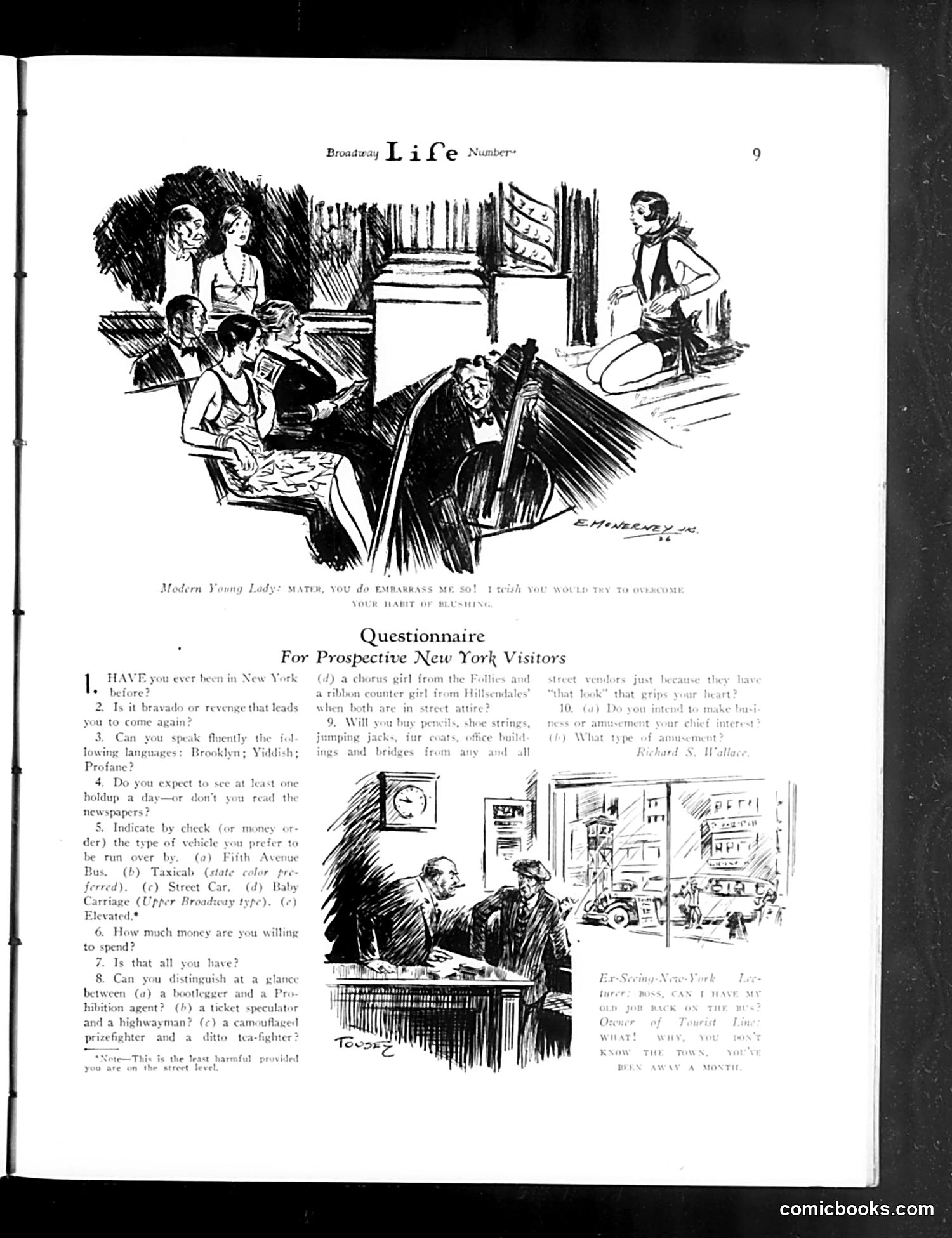
**Top Cartoon:** Titled "Modern Young Lady," this sketch mocks a fashionable woman's alleged rudeness. A man in formal wear appears embarrassed or scandalized by her behavior—likely her crossing her legs or sitting in an unladylike pose—while other figures observe. The caption suggests she's breaching Victorian-era standards of female propriety and decorum. **Lower Section:** A "Questionnaire for Prospective New York Visitors" humorously surveys tourists about their spending habits, transportation preferences, and tolerance for urban chaos. The accompanying sketch shows two men discussing New York sightseeing, with the caption joking about a tourist bus tour operator refusing days off—satirizing both tourist culture and exploitative working conditions in early 20th-century New York.
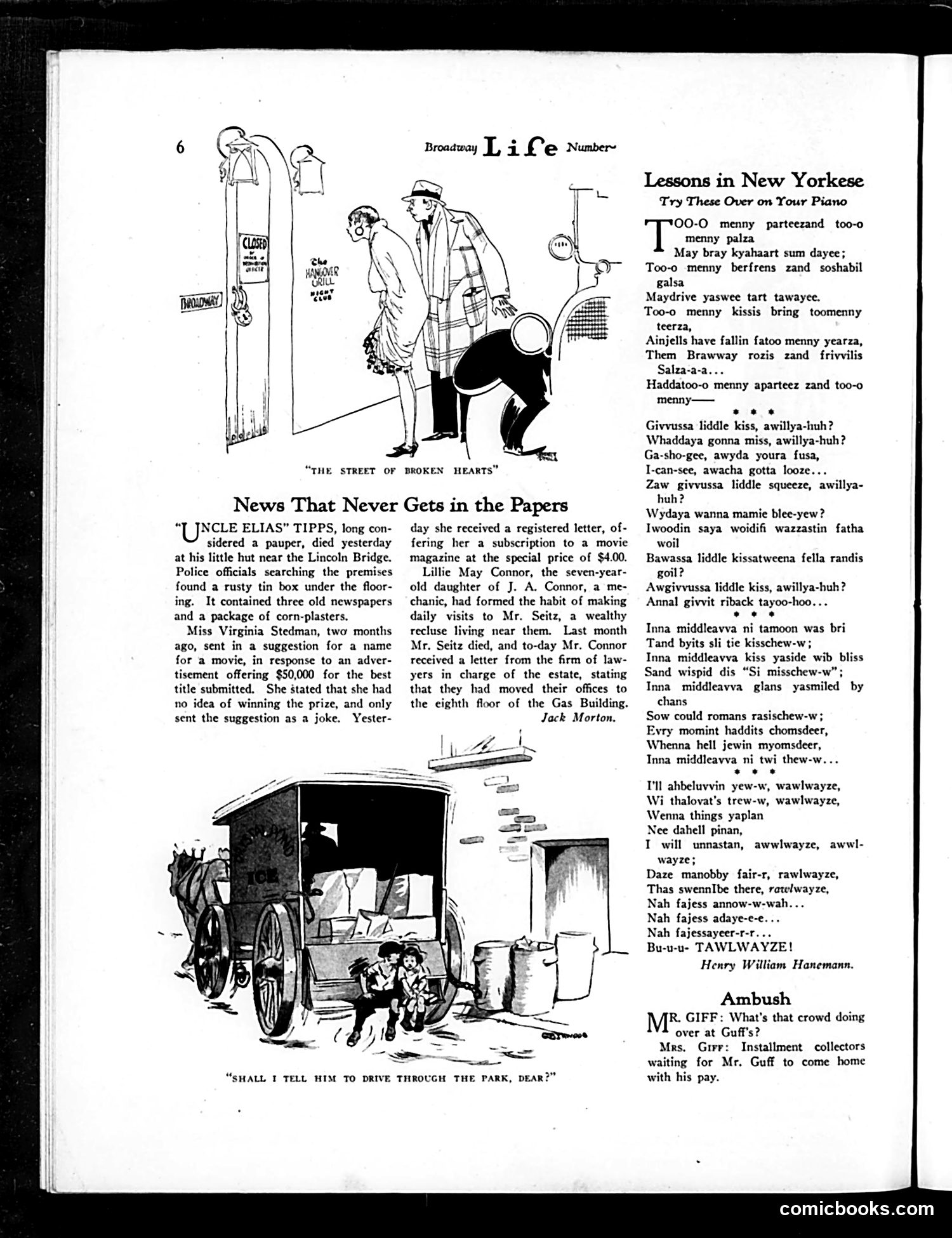
This page contains two satirical cartoons and humorous news items from *Life* magazine. **"The Street of Broken Hearts"** shows a man in a bowler hat appearing to proposition a young woman near a theater—a satirical jab at urban moral decay and the entertainment district's seediness. **"Shall I Tell Him to Drive Through the Park, Dear?"** depicts a couple in an old automobile with a child, with the woman asking whether to take a scenic route. This likely jokes about courting customs and the automobile's role as a private space for romance—a scandal for the era. The page also includes "Lessons in New Yorkese," dialect humor mocking how New Yorkers supposedly speak, and a brief comedic piece called "Ambush" about debt collectors. All reflect early 20th-century urban American life and class anxieties.
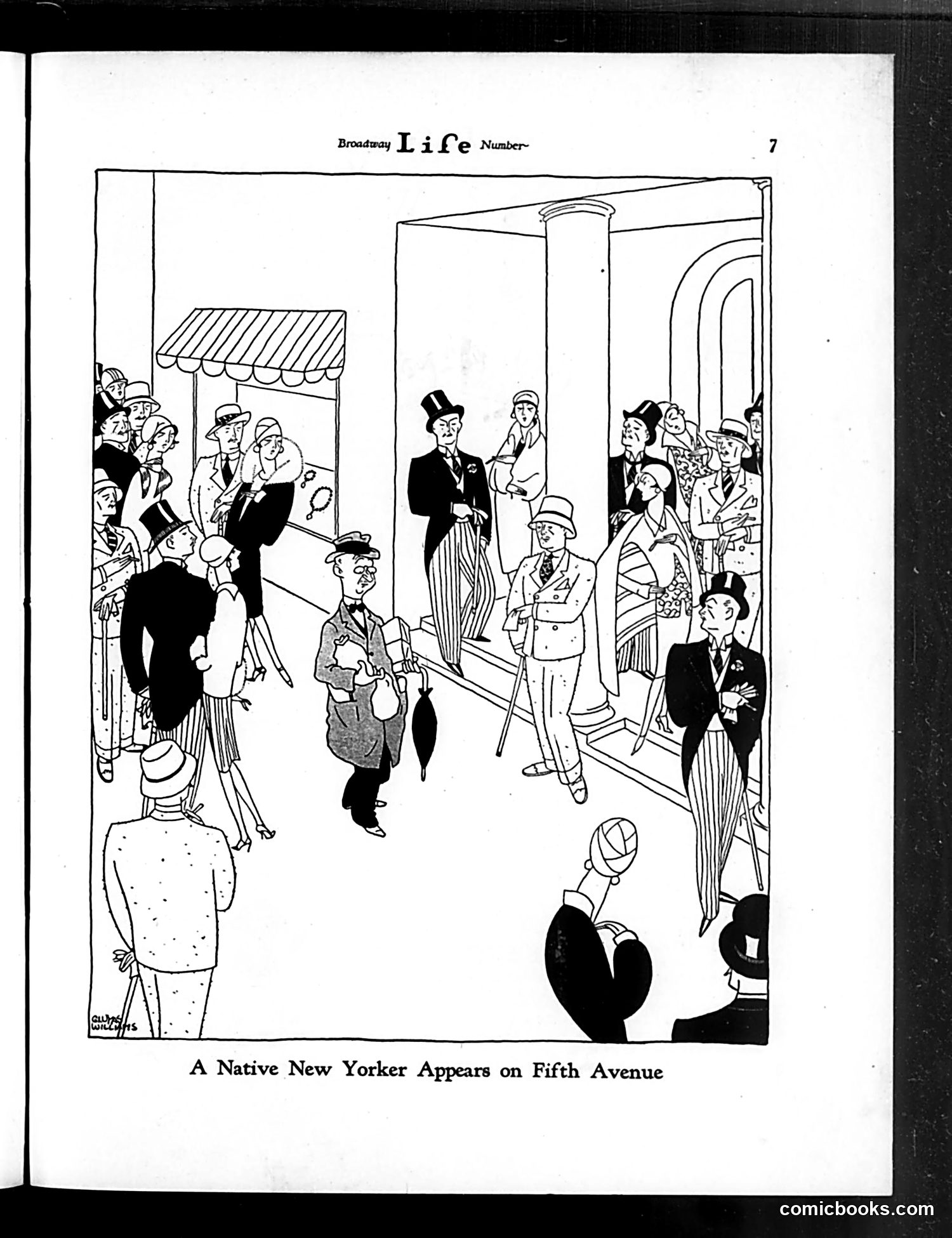
This cartoon satirizes the rarity of encountering an actual native New Yorker on Fifth Avenue, Manhattan's most prestigious shopping district. The joke operates through visual contrast: the central figure in plain, spotted clothing appears conspicuously out of place amid well-dressed crowds of what are presumably tourists, visitors, and transplants in fashionable attire and formal wear. The satire reflects early 20th-century anxieties about New York City's demographic change and the displacement of native-born residents by immigrants and outsiders. The caption treats a genuine New Yorker as a curiosity—something so unusual on Fifth Avenue that their appearance warrants comment, implying the avenue had become dominated by non-natives and the wealthy transient class rather than authentic New Yorkers.
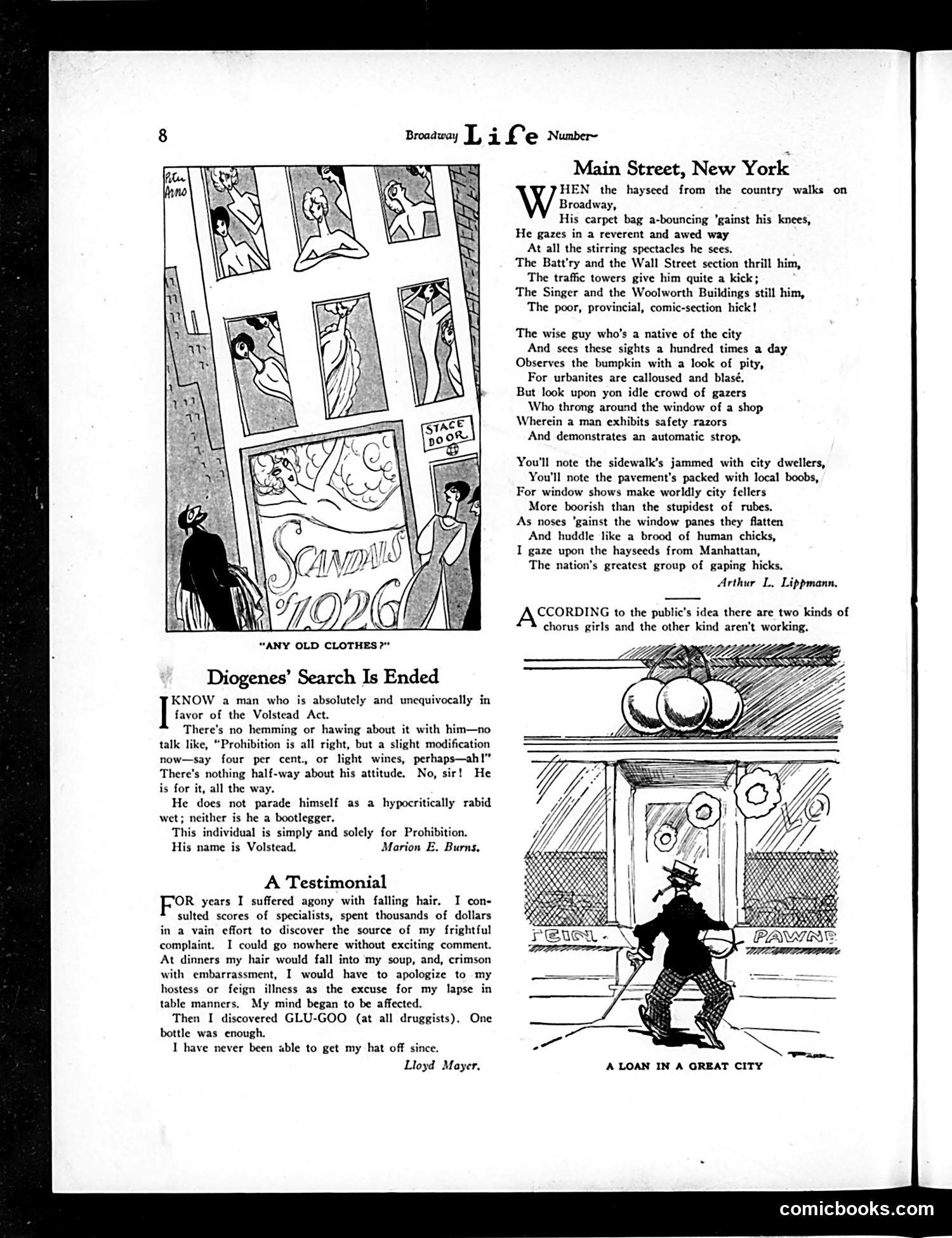
This page features satirical poetry and illustrations about urban life in 1920s New York City. The main cartoon, "Any Old Clothes?," shows a figure in old-fashioned dress among theatrical posters, likely satirizing rural visitors overwhelmed by Broadway's commercial spectacle. The accompanying poem mocks the "hayseeds" from the country gawking at city sights—window displays, safety razor demonstrations, and chorus girls—calling them "the nation's greatest group of gaping hicks." Two shorter pieces follow: "Diogenes' Search Is Ended" satirizes a strict Prohibitionist named Volstead (likely referencing the Volstead Act), and "A Testimonial" humorously advertises GLU-GOO hair product. The bottom cartoon, "A Loan in a Great City," appears to show a street-level financial transaction or pawnshop scene.
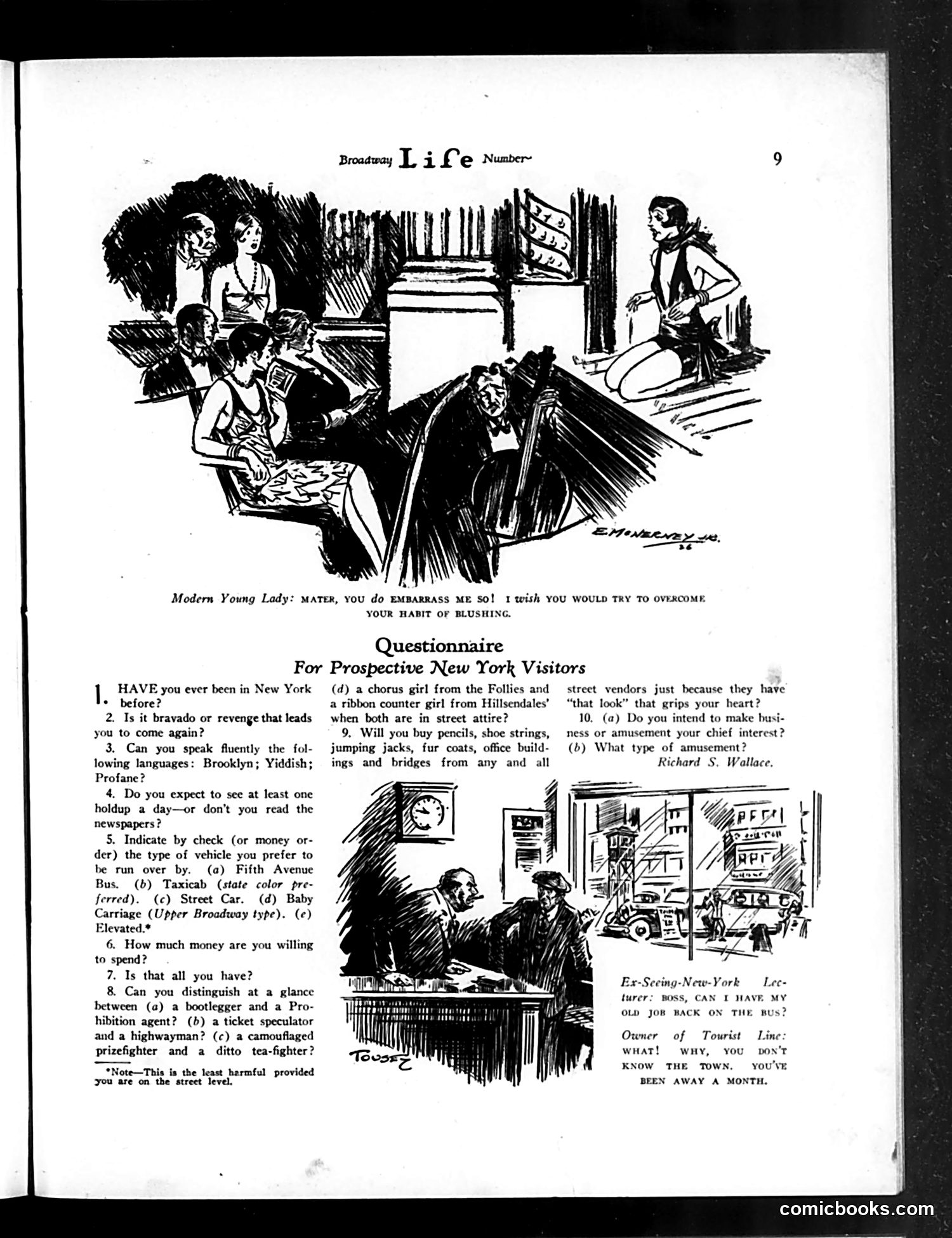
**Top Cartoon:** A young woman is embarrassed by a man in formal wear dramatically gesturing. The caption reads: "Modern Young Lady: MATER, YOU DO EMBARRASS ME SO! I WISH YOU WOULD TRY TO OVERCOME YOUR HABIT OF BLUSHING." The satire inverts expectations: rather than the daughter blushing at her mother's outdated behavior, the mother blushes at her daughter's modern conduct. This reflects 1920s generational conflict, mocking the "Modern Young Lady" lifestyle—her scandalous attire and behavior that shocked Victorian-era parents. The joke targets both the bold younger generation and their flustered elders struggling to adapt. **Below:** A questionnaire mocking tourists visiting New York, with humorous illustrations depicting city stereotypes and con artists preying on visitors unfamiliar with urban life.
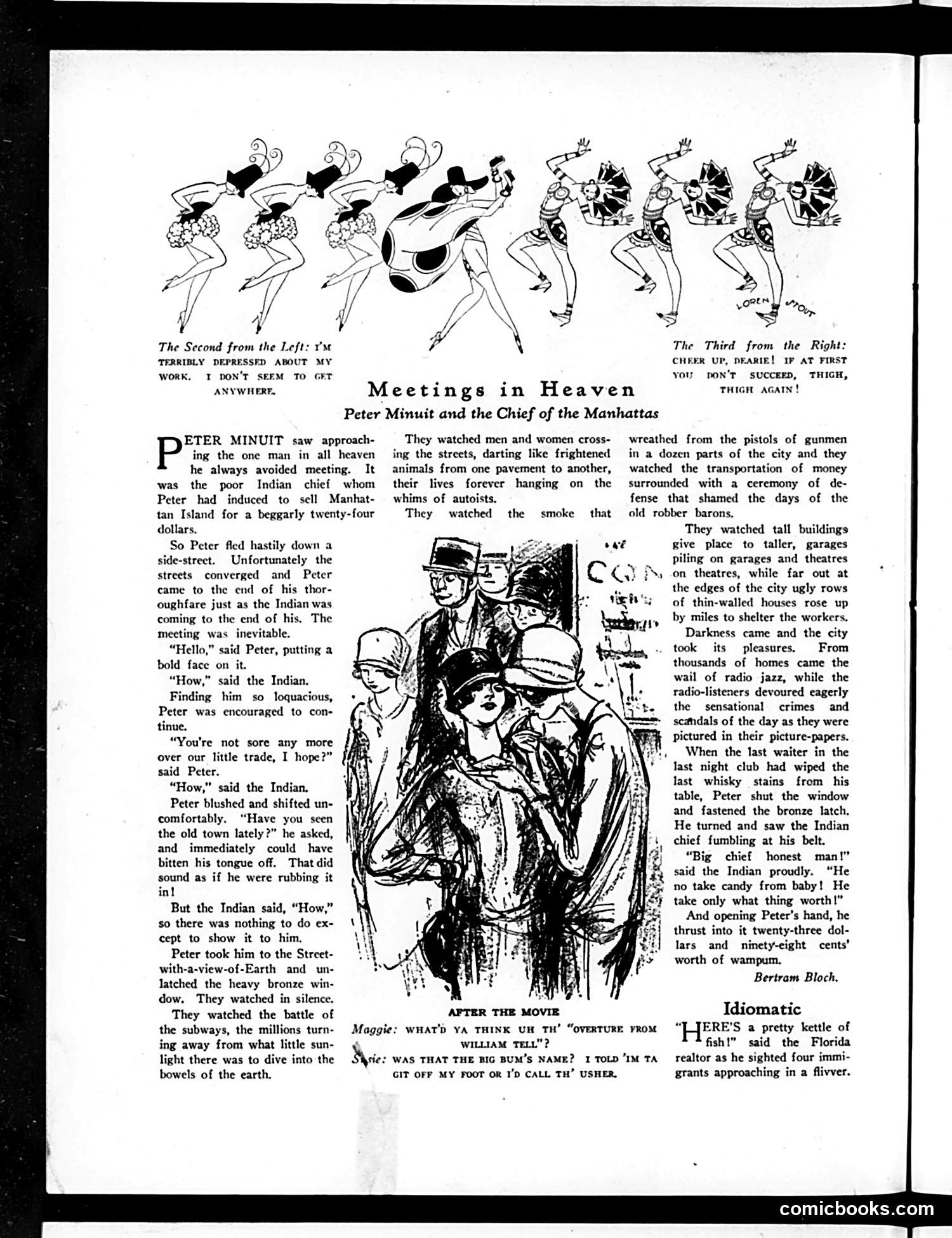
This is a satirical short story by Bertram Block about Peter Minuit (historical figure who purchased Manhattan from Native Americans in 1626) meeting a poor Indian chief in heaven. The satire critiques **colonial exploitation**: Minuit induced the chief to sell Manhattan Island for "$24" — a famously lopsided historical transaction. In heaven, they encounter modern Manhattan's chaos: crowded streets, automobile traffic, radio jazz, crime reports in newspapers, and night clubs. The joke is bitter: the Indian chief, observing the noisy, commercialized urban sprawl that replaced his land, remarks that Minuit—who bilked him with worthless wampum—deserves no better than this chaotic city. The story uses heaven as a device to highlight how poorly the land deal served either party. The accompanying illustration shows the two figures observing 1920s city life.
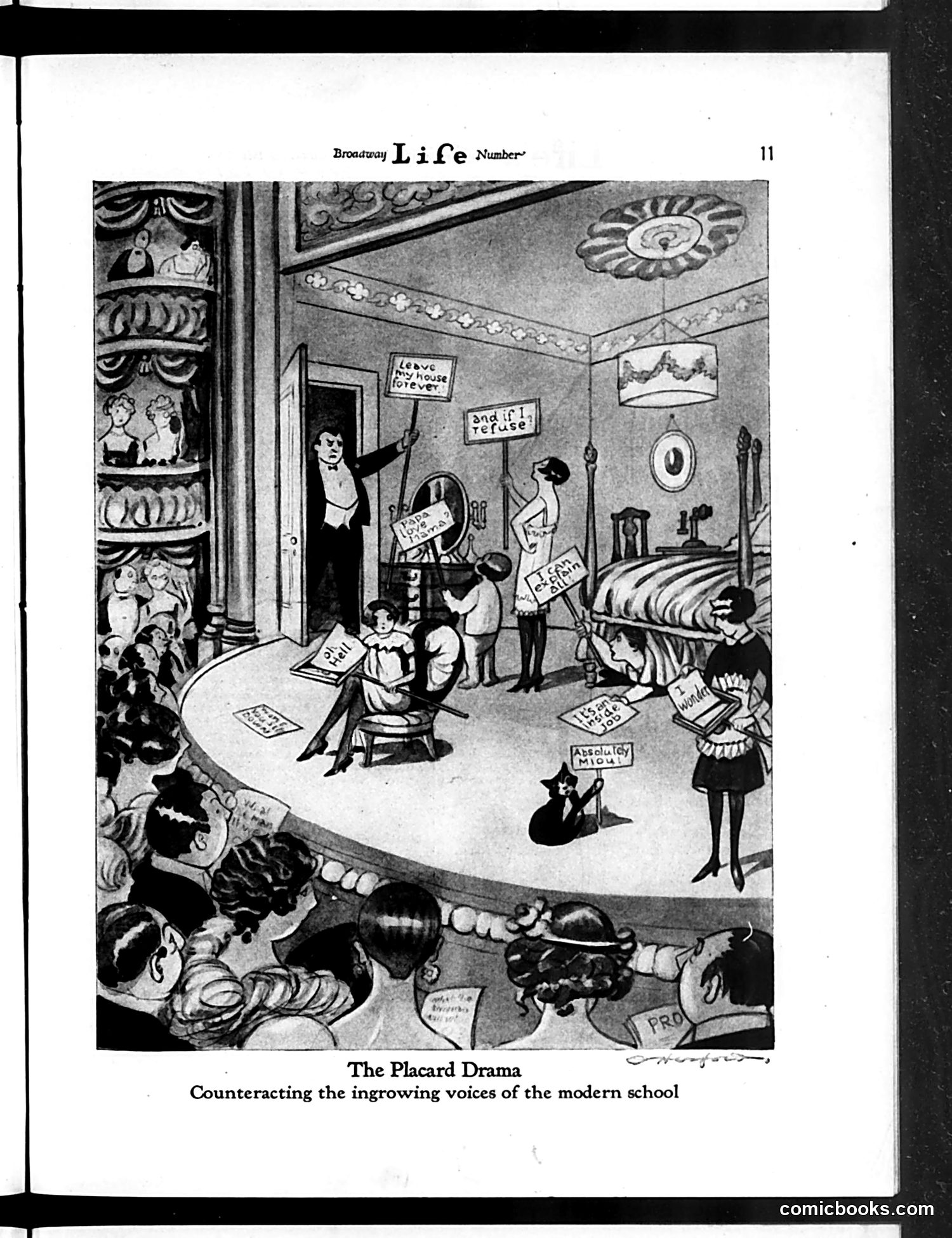
This cartoon satirizes modern educational practices through a theatrical scene. Students hold protest placards with demands like "Leave us alone," "and I refuse," and "I protest"—suggesting student activism or resistance movements in schools. The caption's subtitle, "Counteracting the ingrowing voices of the modern school," indicates the cartoon critiques how schools attempt to manage or suppress student dissent and independent thinking. The theatrical staging—with an audience watching from ornate theater boxes—frames student activism as performance or spectacle rather than genuine expression. The overall satire appears to mock either the growing student voice in schools or institutional attempts to control it, reflecting early-to-mid 20th-century anxieties about youth rebellion and educational authority.
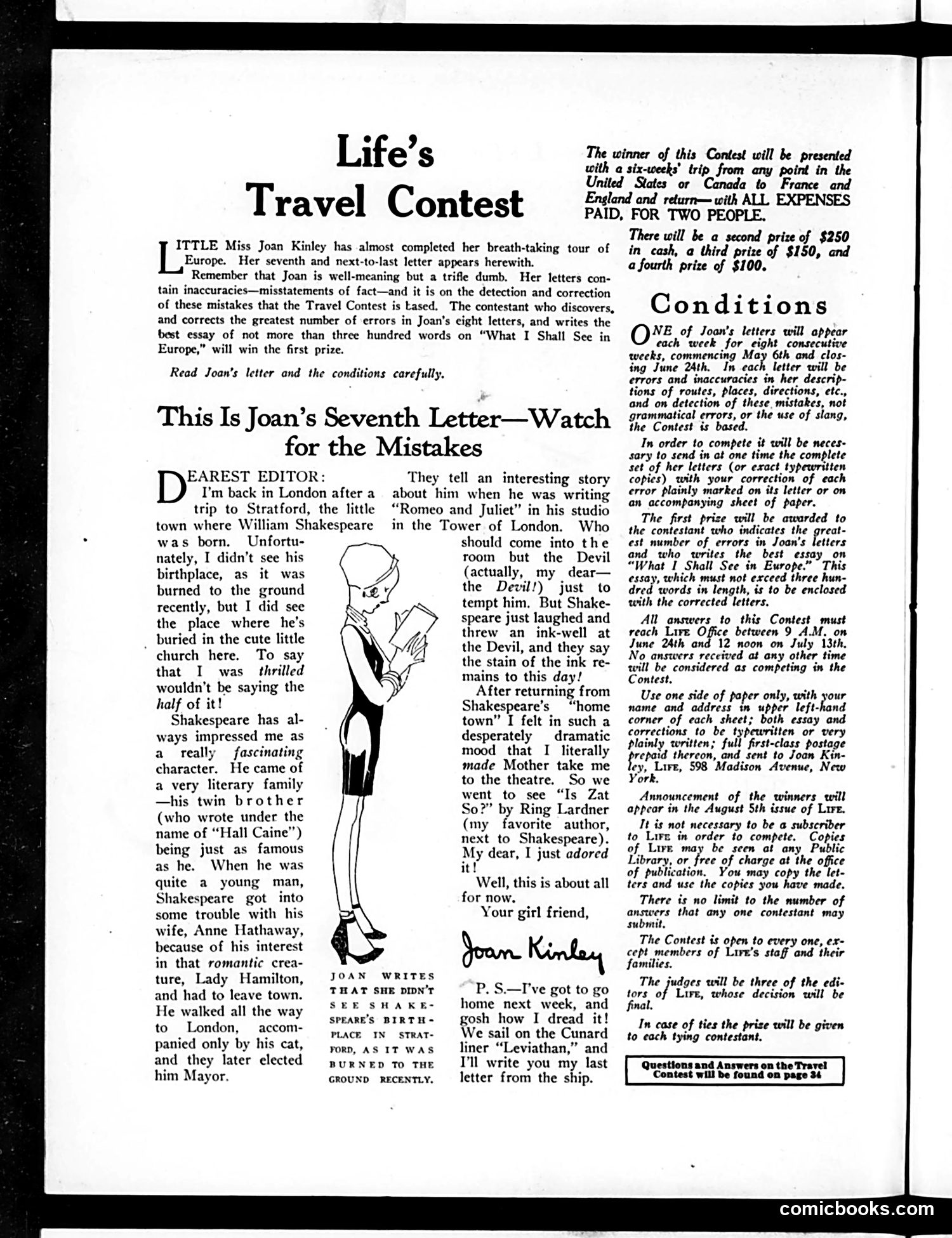
This page announces a literary contest where readers submit essays identifying errors in letters from "Little Miss Joan Kinley," who is touring Europe. The winner receives an all-expenses-paid trip for two to England and return. The illustration shows a stylized young woman in 1920s fashion (short hair, long legs, art-deco lines) writing or reading, representing the correspondent. Joan's seventh letter describes visiting Shakespeare's birthplace in Stratford-upon-Avon and attending theatrical performances in London. The letter is deliberately riddled with factual errors—misstatements about historical facts, places, and literary details—which readers must identify. This was a popular interactive entertainment format for the era, combining travel glamour, literary knowledge, and reader participation as a competitive game.
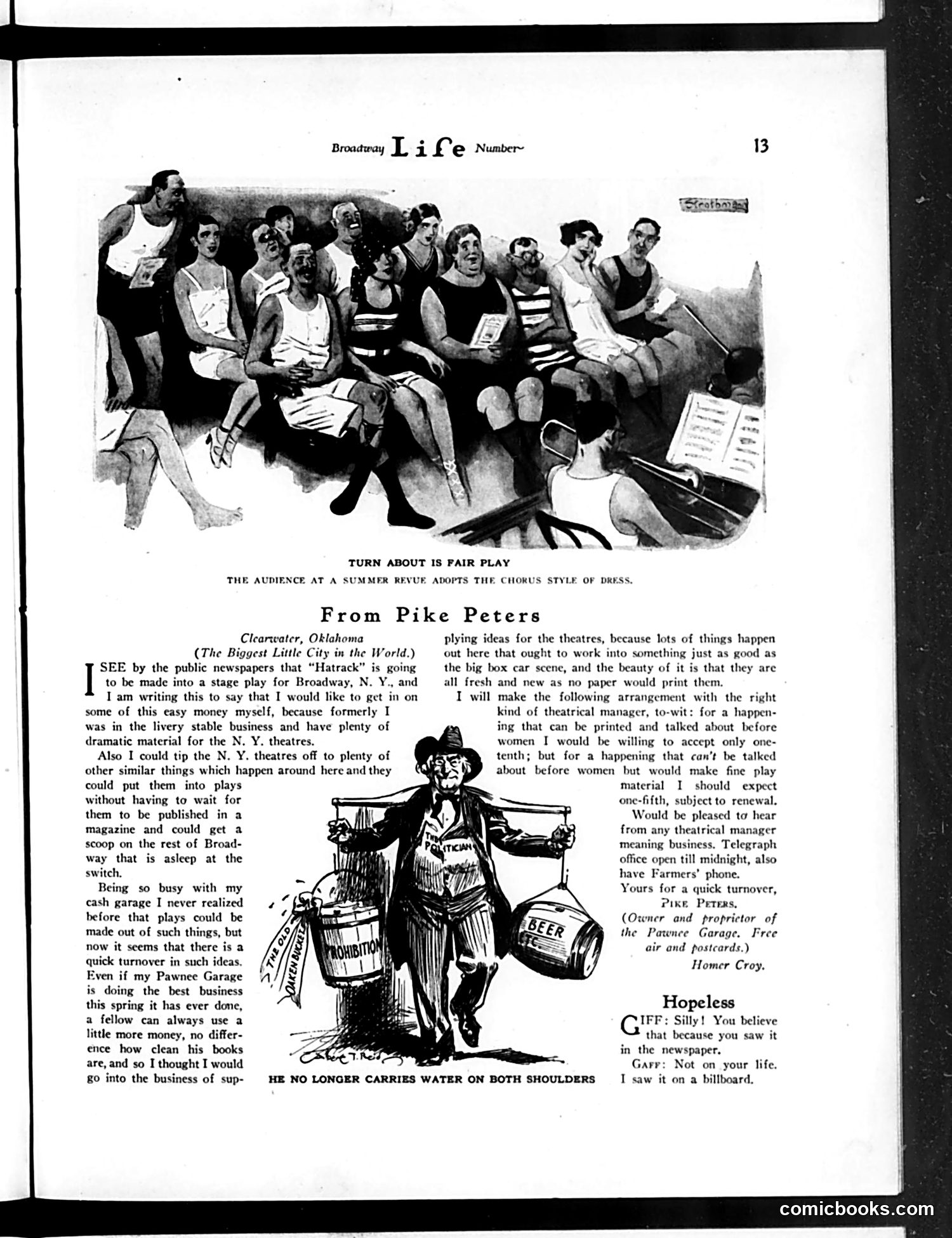
The top illustration satirizes summer theater audiences adopting scanty "chorus girl" fashion. The joke is "turn about is fair play"—if chorus girls expose themselves on stage, audiences will reciprocate by dressing similarly, creating an absurd visual. The main article is a humorous letter from Pike Peters, a garage owner in Oklahoma, who wants to sell theatrical ideas to Broadway. He's inspired by "Hatrack" (a scandalous 1926 H.L. Mencken story adapted for stage) and offers a pricing scheme: one-tenth royalties for "printable" scandals, one-fifth for material "that can't be talked about before women." The satire mocks both small-town entrepreneurship and Broadway's appetite for salacious content. The bottom cartoon shows the irony of modern credulity: one character dismisses newspaper reports as unreliable, yet believes whatever appears on billboards—a jab at advertising's persuasive power over journalism.
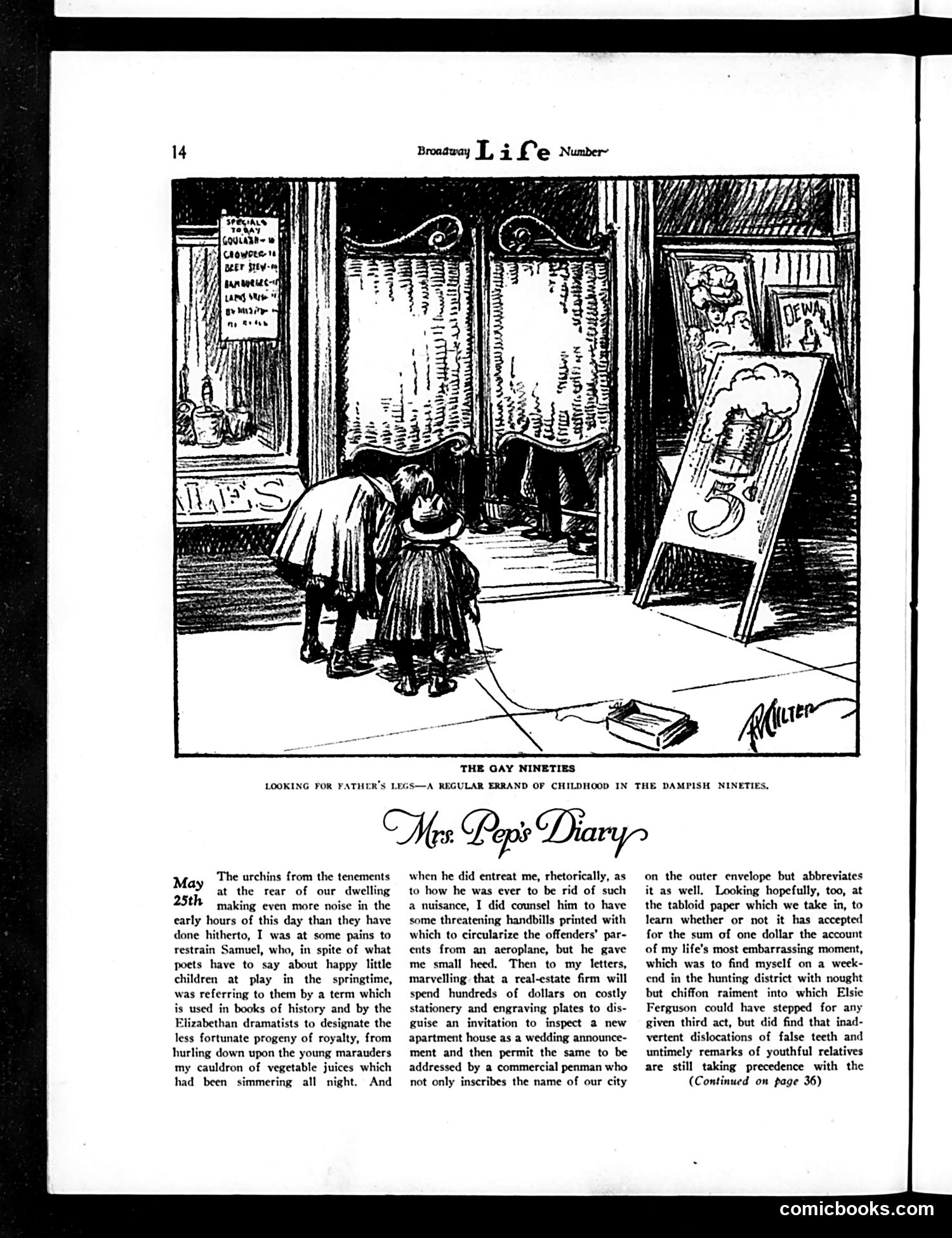
This page features a satirical cartoon and diary entry mocking the "Gay Nineties" (1890s). The cartoon shows a man and woman looking at a storefront display, searching for "father's legs"—a humorous reference to children's mischievous errands during that era. The accompanying diary entry by "Mrs. Pep" is written in exaggerated, pretentious language, satirizing upper-class complaints about noisy tenement children and ridiculous commercial practices. She describes wanting to throw vegetable juice at neighborhood kids, suggests threatening handbills delivered by aeroplane (clearly absurd for the 1890s), and complains about real-estate companies disguising advertisements as wedding announcements. The satire targets both the insufferable wealthy and the absurdity of period conventions, using overwrought prose to mock pretension and social anxiety about class boundaries in the era.
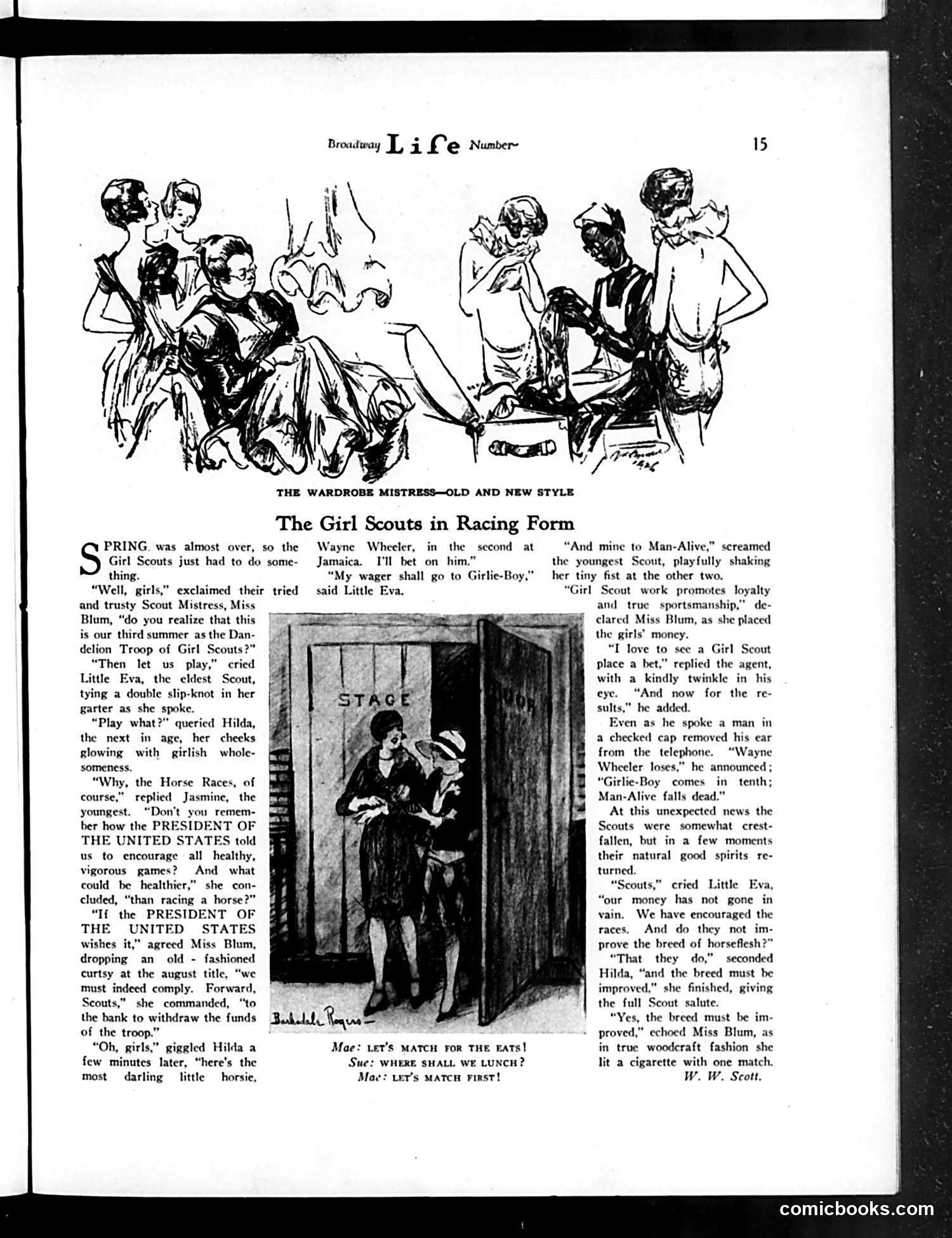
This satirical piece mocks Girl Scouts for gambling on horse races. The humor relies on the incongruity of wholesome youth organizations engaging in betting—the Scouts justify their wagering by citing President Theodore Roosevelt's promotion of "healthy, vigorous games." The satire targets two groups: Girl Scout leadership for corrupting youth morality, and Roosevelt (referenced as "the PRESIDENT") for rhetoric that could be twisted to endorse vice. The figure "Wayne Wheeler" likely references a real contemporary, possibly a horse or racing personality. The final joke—Miss Blum lighting a cigarette with a match during a discussion of "improving the breed"—adds a layer of adult hypocrisy: the authority figure modeling questionable behavior while preaching virtue. The overall message: institutional leadership uses noble-sounding rhetoric to justify or enable morally dubious activities, particularly gambling, which 1920s America increasingly associated with corruption and social decay.
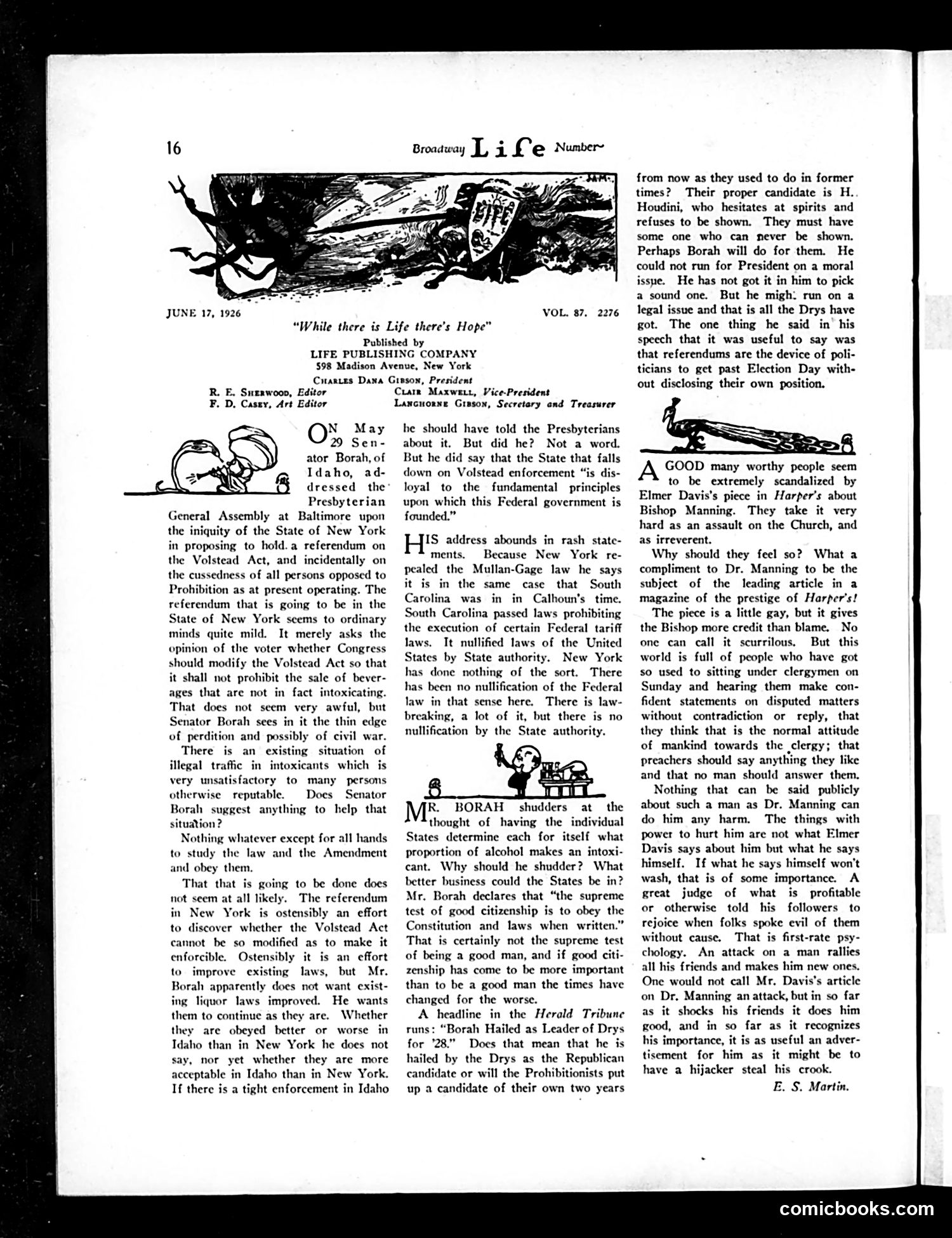
This page attacks Senator William Borah of Idaho for his zealous defense of Prohibition enforcement. The article critiques Borah's speech to the Presbyterian General Assembly, where he condemned New York's proposed referendum on modifying the Volstead Act (Prohibition law). The satire's key points: Borah demands absolute obedience to Prohibition laws while offering no solutions to widespread illegal liquor trafficking. The author mocks his comparison of New York to nullifying South Carolina, arguing New York merely repealed a state law—not defying federal authority. The piece culminates in sharp wit: suggesting Houdini (the famous illusionist who specialized in "never being shown") would be the Prohibitionists' ideal candidate, implying Borah himself—who won't acknowledge Prohibition's obvious failures—fits that description perfectly. The cartoon likely caricatures Borah or Prohibition advocates, though specific details are unclear from the image.
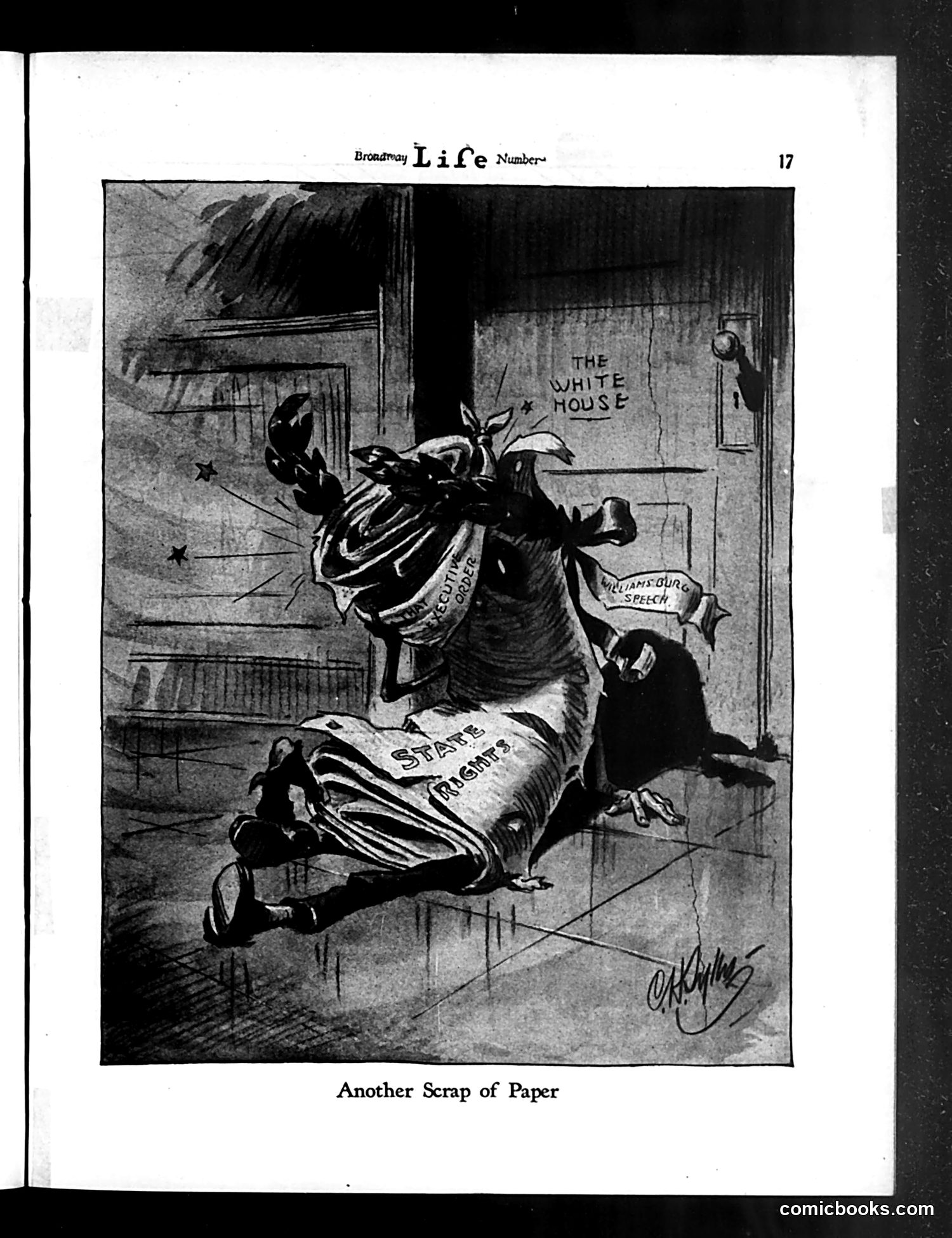
This political cartoon depicts a disheveled figure being ejected from the White House, carrying papers labeled "STATE PROPAGANDA" and "GAG ON FREE SPEECH." The figure appears to represent government censorship or propaganda efforts being forcibly removed from the executive residence. The title "Another Scrap of Paper" likely references broken agreements or discarded principles. The cartoon satirizes government attempts to control information and suppress free speech, portraying these efforts as incompatible with the White House's ideals. Stars scattered around suggest chaos or explosive controversy. Without a visible date, the specific historical moment is unclear, but this reflects broader American debates about censorship, propaganda, and First Amendment rights—likely from the early-to-mid 20th century when such tensions were particularly acute.
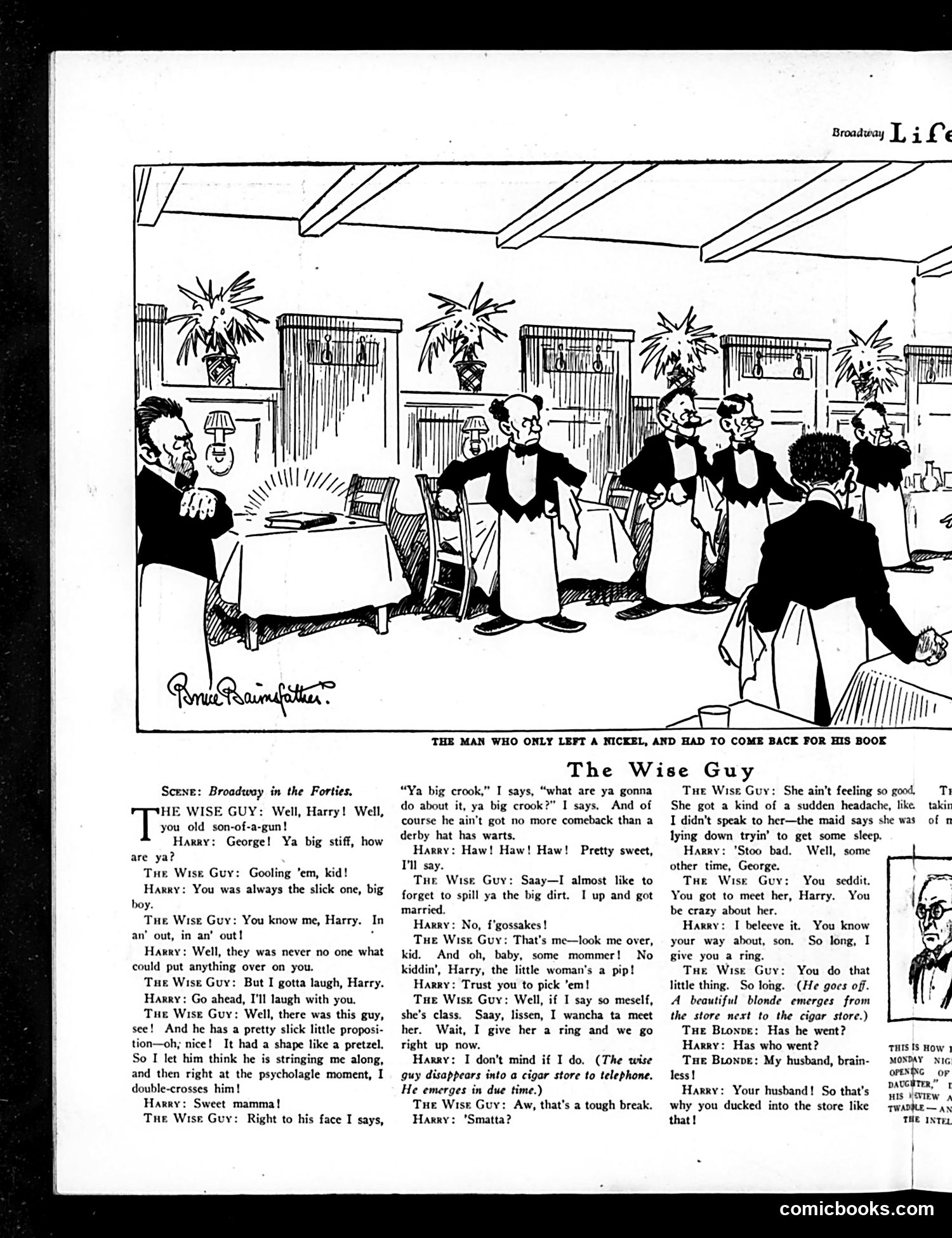
This is a satirical comedy sketch from *Life* magazine depicting a classic "con man" character type popular in early 20th-century American humor. The scene shows two street-smart men ("The Wise Guy" and Harry) reuniting on Broadway. The Wise Guy boasts about his schemes, including tricking someone and recently getting married. The joke's punchline reveals his wife is unhappy (claiming a headache), and when a blonde woman emerges from a nearby store, Harry recognizes her as the Wise Guy's wife—who ducked into the store specifically to avoid her own husband. The satire targets the boastful con artist archetype: someone who prides himself on outsmarting others but is himself cuckolded or evaded by his own wife. The humor relies on irony—the "slick" operator is fooled by the people closest to him. The working-class dialect and Broadway setting emphasize this as urban American comedy of that era.
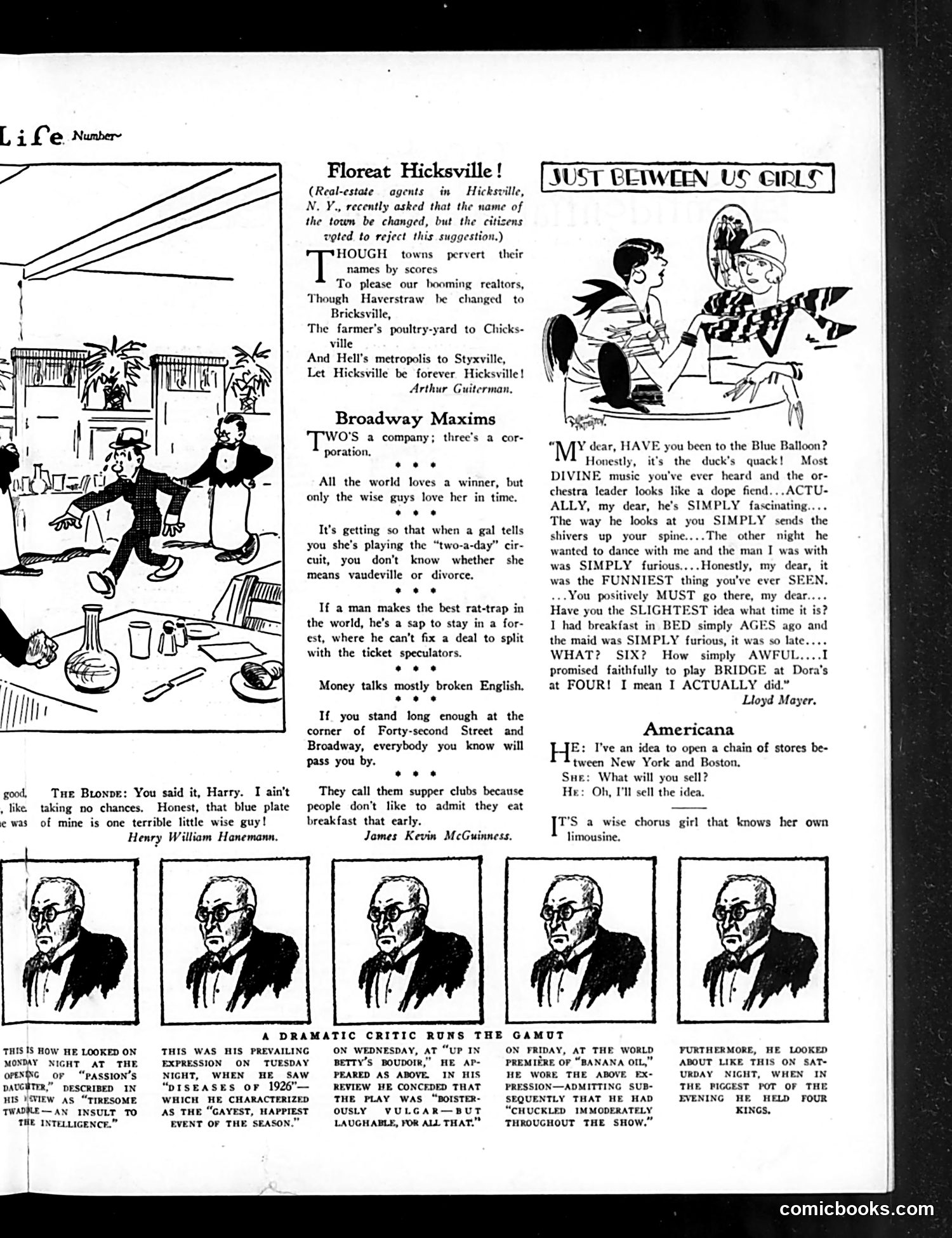
This page from Life magazine (1920s) contains several satirical pieces mocking contemporary American society: **"Floreat Hicksville"**: A poem satirizing real-estate developers who rename towns to sound more appealing to buyers—changing "Haverstraw" to "Bricksville," for example. The joke critiques commercialism disguising mundane places with fancier names. **"Broadway Maxims"**: Cynical one-liners about American business culture, divorce, and urban life. "Money talks mostly broken English" mocks newly wealthy immigrants; references to "two-a-day" circuits and "supper clubs" target entertainment industry pretension. **"Just Between Us Girls"**: A woman breathlessly describes a nightclub (The Blue Balloon) and its orchestra leader, using excessive emphasis ("SIMPLY," "ACTUALLY"). The satire targets upper-class women's superficial social climbing and gossiping. **"A Dramatic Critic Runs the Gamut"**: Five identical sketches of a theater critic with captions showing his contradictory reviews of plays—praising vulgar shows while condemning serious work. This mocks critical inconsistency and hypocrisy. The overall theme: satirizing 1920s American materialism, social pretension, and dishonesty across real estate, entertainment, and criticism.
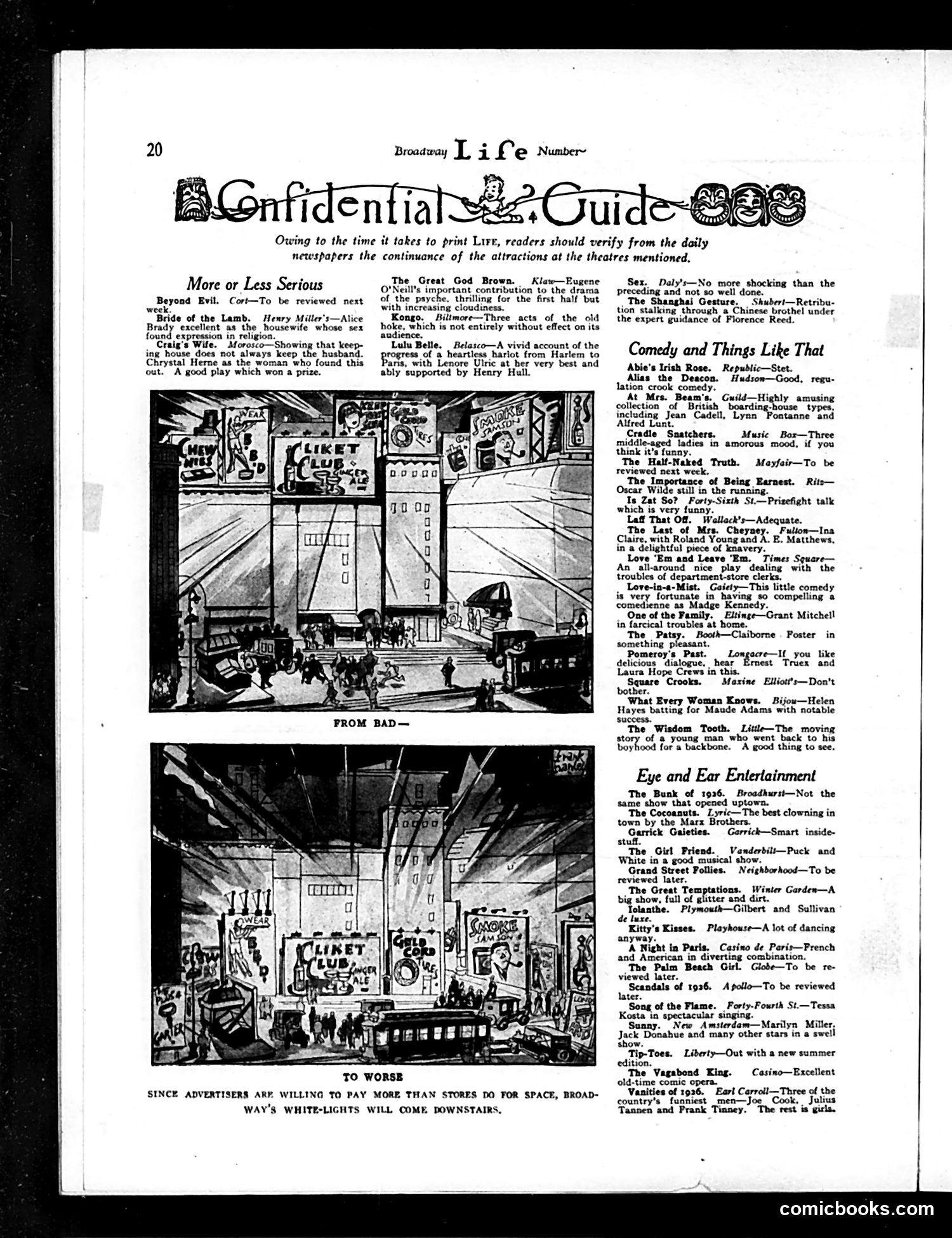
This page is a theatre review guide for Broadway shows, not a political cartoon. The two illustrated panels labeled "FROM BAD—" and "—TO WORSE" are **architectural drawings** satirizing Broadway's transformation, not caricatures of political figures. The satire's point: the caption explains that advertisers pay more for marquee space than retail stores pay for storefronts, so Broadway's street level is being colonized by commercial signage at the expense of the theatres' architectural integrity. The drawings show how neon signs and advertisements increasingly dominate the streetscape, literally pushing legitimate theatre architecture downward. The rest of the page consists of brief critical capsules reviewing current Broadway productions—both serious dramas (O'Neill's *The Great God Brown*, *Lulu Belle*) and comedies (*Abie's Irish Rose*, Marx Brothers in *The Cocoanuts*). This is entertainment journalism, not political satire.
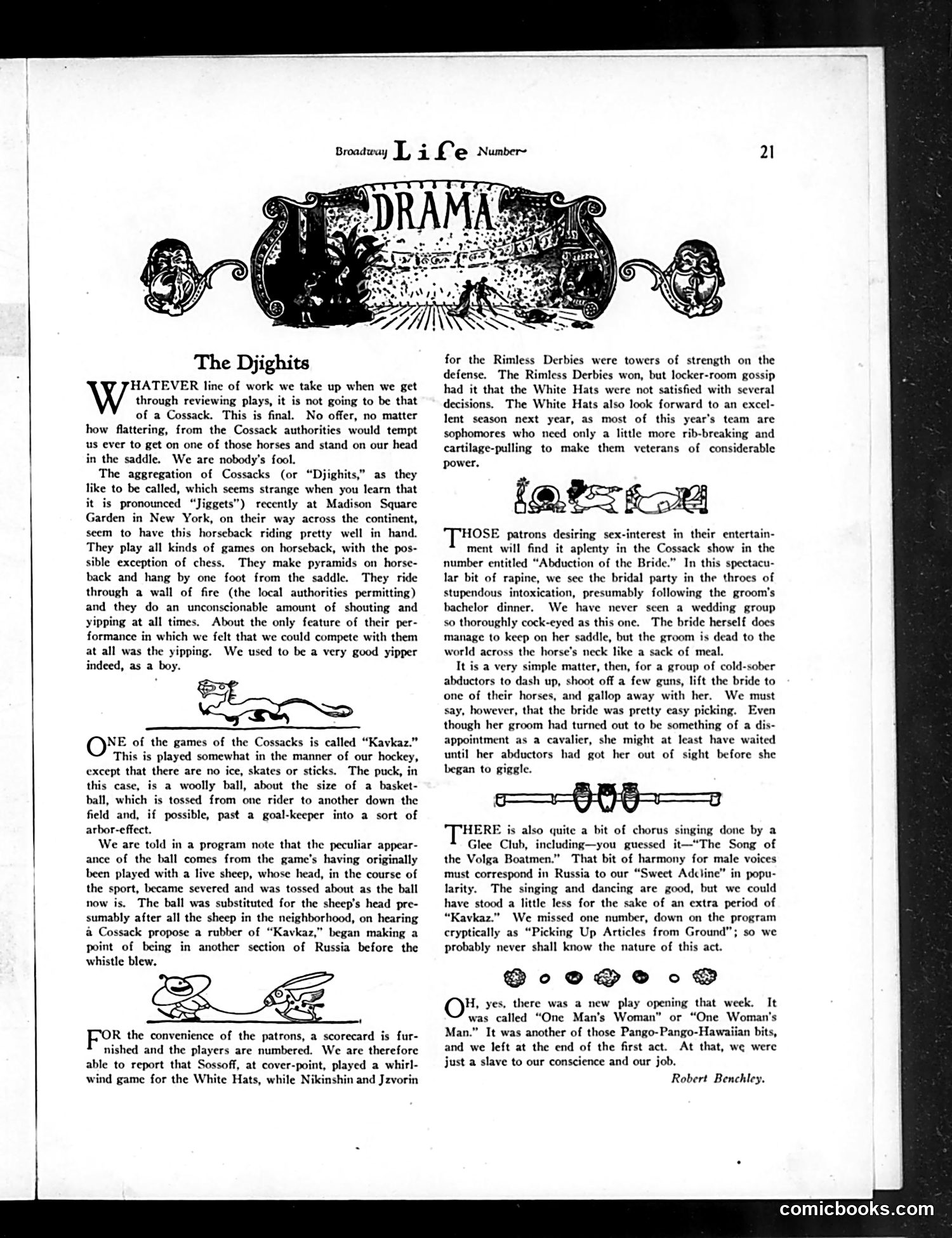
This is a humorous theater review of a Cossack horsemanship exhibition at Madison Square Garden in New York. The author satirizes the performers' elaborate stunts—pyramid formations, riding through fire, the game "Kavkaz" (played with a woolly ball, formerly a sheep's head), and a comedic sketch called "Abduction of the Bride." The satire works through mock-serious sports commentary: the author treats the Cossack games like athletic competitions with team names ("White Hats" vs. "Rimless Derbies") and player statistics. The joke lies in applying American sporting conventions to bizarre equestrian displays. The review also gently mocks the "Abduction" sketch's absurdity—a bride so drunk she can't resist kidnapping, an equally intoxicated groom, and her giggling compliance—presenting it as entertainment spectacle while subtly critiquing its tastelessness.
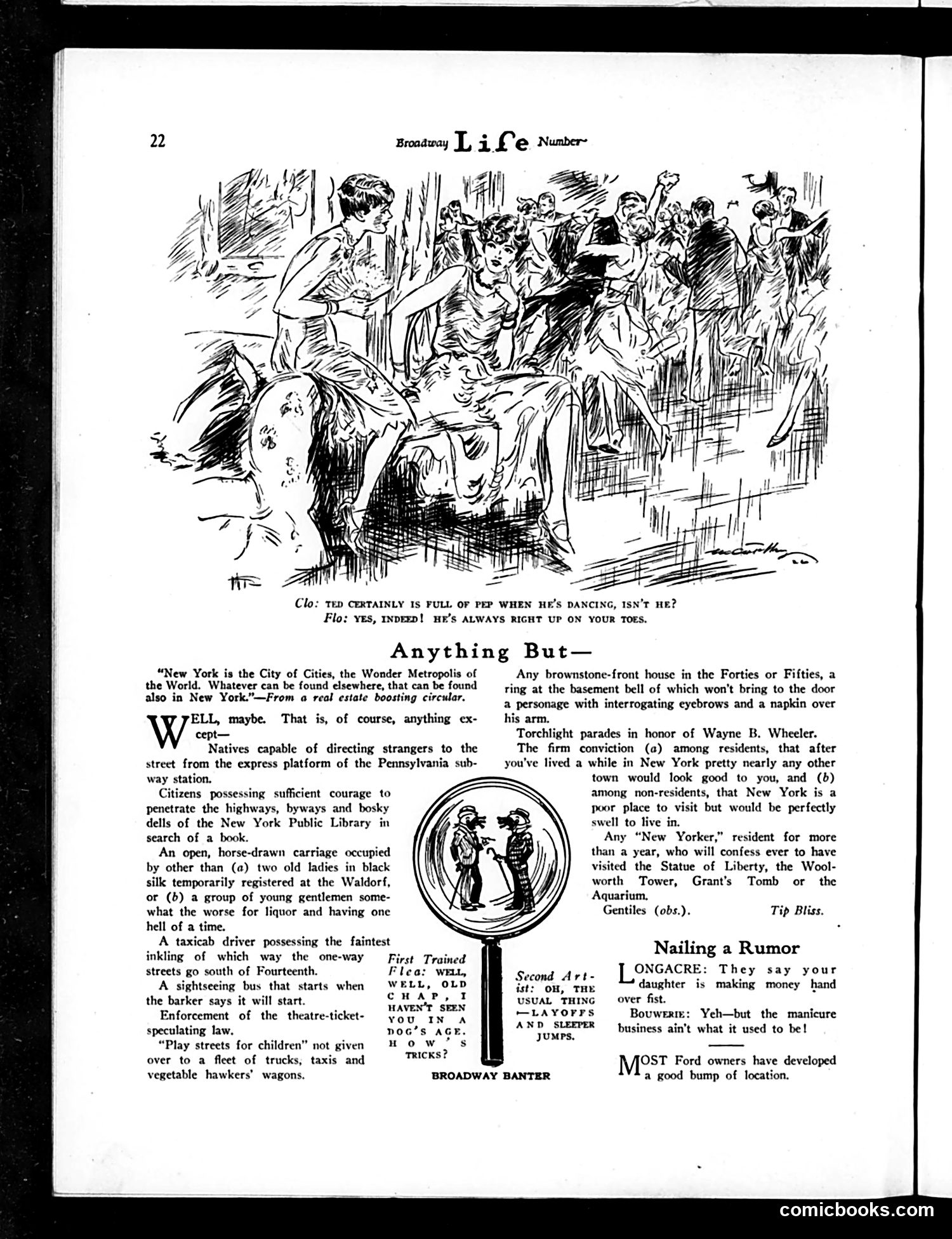
This page from *Life* magazine contains two main satirical pieces mocking New York City life. **"Anything But—"** is a humorous essay satirizing New York's self-promotion. It lists things supposedly unavailable in the city despite boasts of having "everything"—including natives who can give directions, courage to explore the Public Library, honest taxi drivers, and residents who've actually visited famous landmarks like the Statue of Liberty or Grant's Tomb. The piece references **Wayne B. Wheeler**, a Prohibition activist, mocking torchlight parades held in his honor. The satire captures post-Prohibition New York cynicism and the gap between the city's grand image and mundane reality. The top cartoon shows a couple dancing, with dialogue suggesting the male partner is energetic and somewhat clumsy on the dance floor—a simple domestic joke about dancing ability. **"Nailing a Rumor"** is a brief anecdote about spreading false gossip regarding a woman's manicure business income, lamenting that "the manicure business ain't what it used to be."
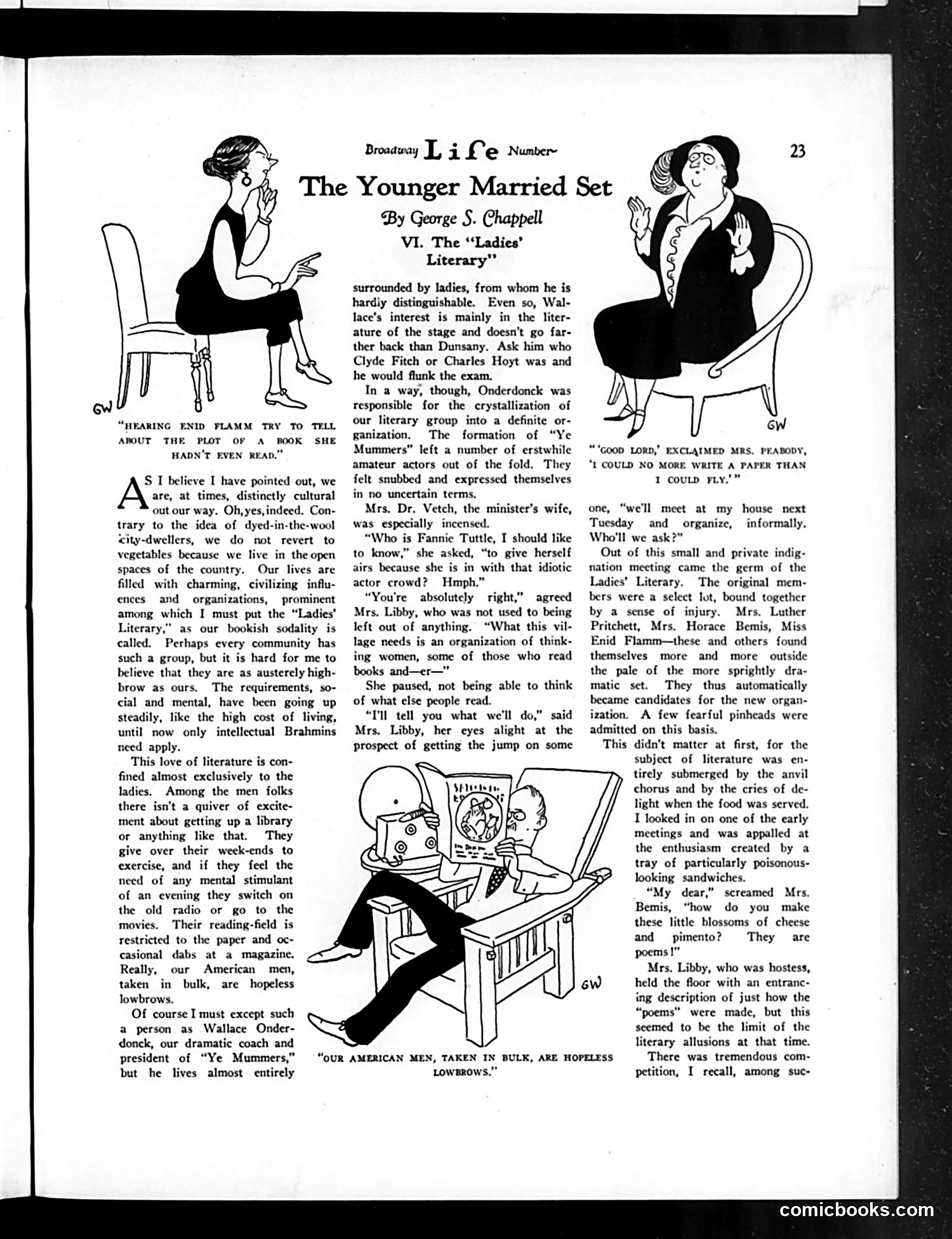
This 1920s satirical article mocks suburban wives' pretensions to intellectualism. The "Ladies' Literary" club ostensibly forms to discuss serious literature, but the text reveals its actual purpose: social status-seeking and exclusion. The cartoons illustrate the absurdity: one woman tries to discuss a book she hasn't read; another exclaims she could no more write a paper than fly—yet both belong to this supposedly highbrow group. The satire targets: - **Male indifference**: American men are "hopeless lowbrows" who prefer radio and movies to books - **Female pretension**: Women organize an intellectual club motivated by wounded pride (exclusion from a drama group) rather than genuine literary interest - **Class anxiety**: Members obsess over who deserves membership, treating the club as exclusive social currency The joke is that beneath claims of cultural sophistication lies shallow social climbing and performative intellectualism—women performing "serious" pursuits to appear cultivated while actually caring more about gossip, food, and status.
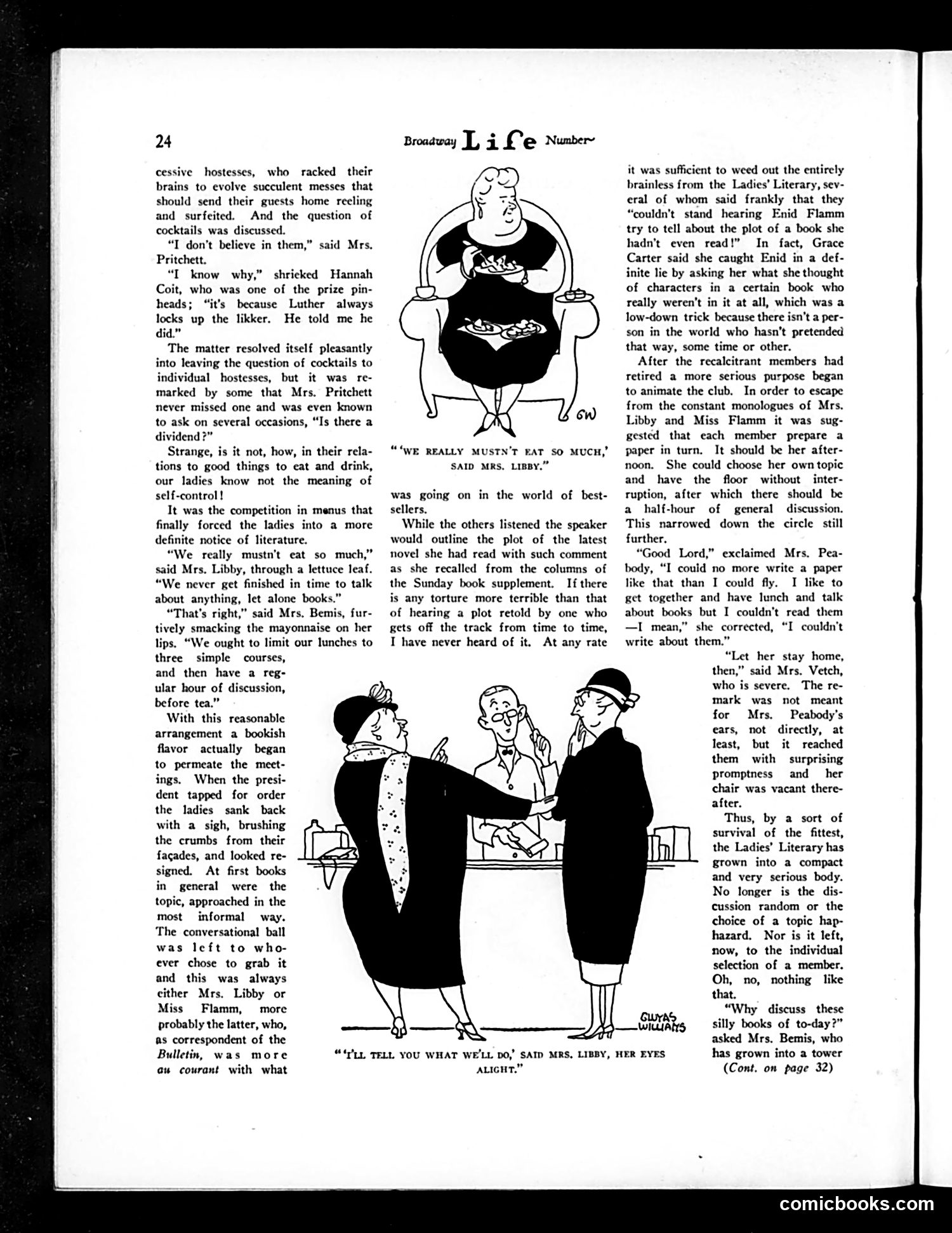
This satirical piece mocks the "Ladies' Literary" club—a social organization that pretends intellectual seriousness while revealing its members' contradictions. **The Satire:** The women claim they need to discuss books instead of eating, yet they're constantly eating while talking. Mrs. Libby and Miss Flamm dominate conversations by summarizing bestsellers from Sunday newspaper supplements, often inaccurately. When one member (Grace Carter) catches Enid Flamm lying about a book's characters, the text notes everyone pretends to have read books they haven't—making the accusation hypocritical. **The Point:** The club evolves from chaotic lunch discussion into a "serious body," but this seriousness is performative. Members panic when required to write original papers, revealing they attend for social status and gossip, not genuine intellectual engagement. **The Cartoons:** Show Mrs. Libby eating while insisting they mustn't eat much, and the women eagerly planning their new "serious" structure—illustrating the gap between stated intentions and actual behavior. This reflects early 20th-century satire on women's clubs and performative intellectualism.
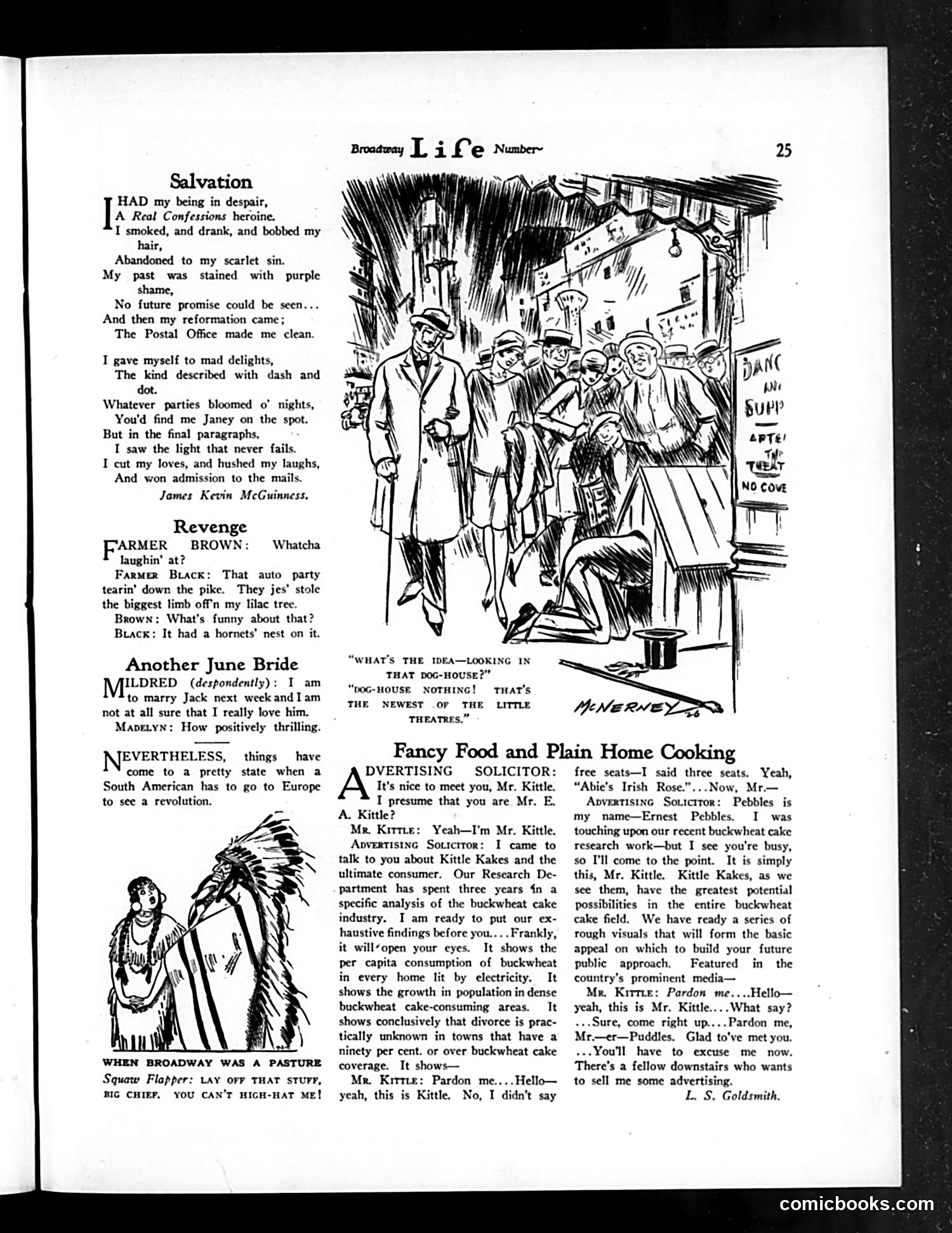
This page contains several short humorous pieces satirizing 1920s American culture: **"Salvation"** mocks sentimental confessional stories popular in magazines, where a woman reformed from a scandalous life through—absurdly—the Post Office making her "clean." **"Revenge"** is a brief rural joke about a farmer amused that a speeding car knocked a hornet's nest off his lilac tree, eliminating his pest problem accidentally. **"Another June Bride"** gently ridicules women marrying without love, treating it as socially thrilling rather than concerning. **The cartoon** shows men examining what appears to be a tiny theater ("dog-house"), labeled the "newest of the little theatres"—mocking New York's experimental theater boom. **"Fancy Food and Plain Home Cooking"** satirizes advertising's absurd pseudo-scientific approach: a salesman badgers a businessman with elaborate research about buckwheat cake consumption, divorce rates, and electricity usage, only to be repeatedly interrupted by phone calls about a play ("Abie's Irish Rose"). The satire targets advertising's inflated claims and modern commerce's intrusion into daily life.
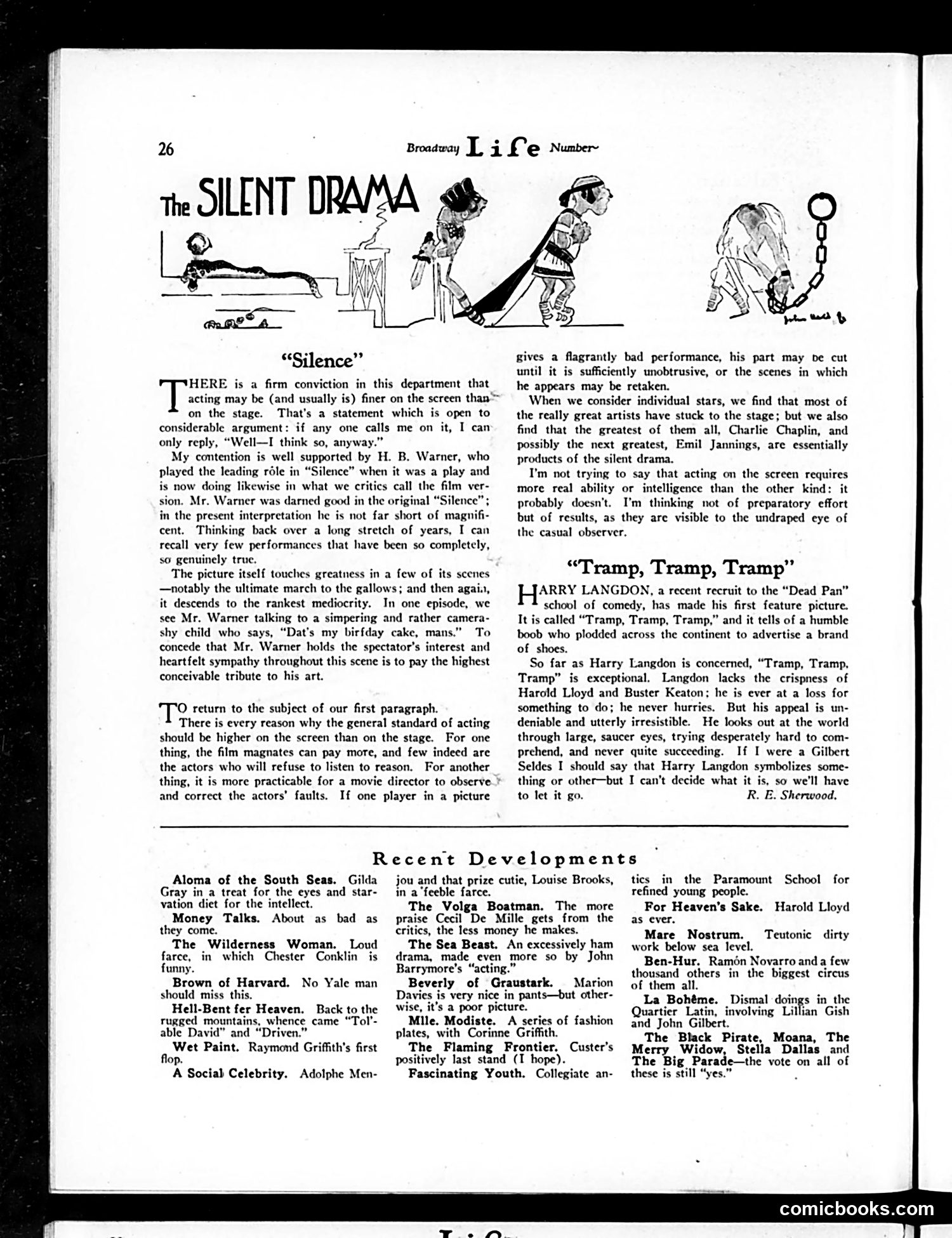
This page from *Life* magazine discusses silent film acting, comparing screen performance to stage work. The cartoons at the top illustrate the article's theme through visual gags about silent acting—showing exaggerated physical comedy and pantomime that characterized silent films. The main article praises H.B. Warner's performance in the film version of "Silence," arguing that screen acting can surpass stage acting because directors can edit out poor performances or reshoot scenes. The author highlights Charlie Chaplin and Emil Jannings as cinema's greatest actors. A secondary review discusses Harry Langdon's film "Tramp, Tramp, Tramp," comparing him unfavorably to Harold Lloyd and Buster Keaton but praising his "saucer eyes" and desperate attempts at comprehension—physical comedy traits essential to silent film's appeal. The "Recent Developments" section briefly reviews current films, using quick, often sardonic assessments typical of *Life*'s humorous criticism style.
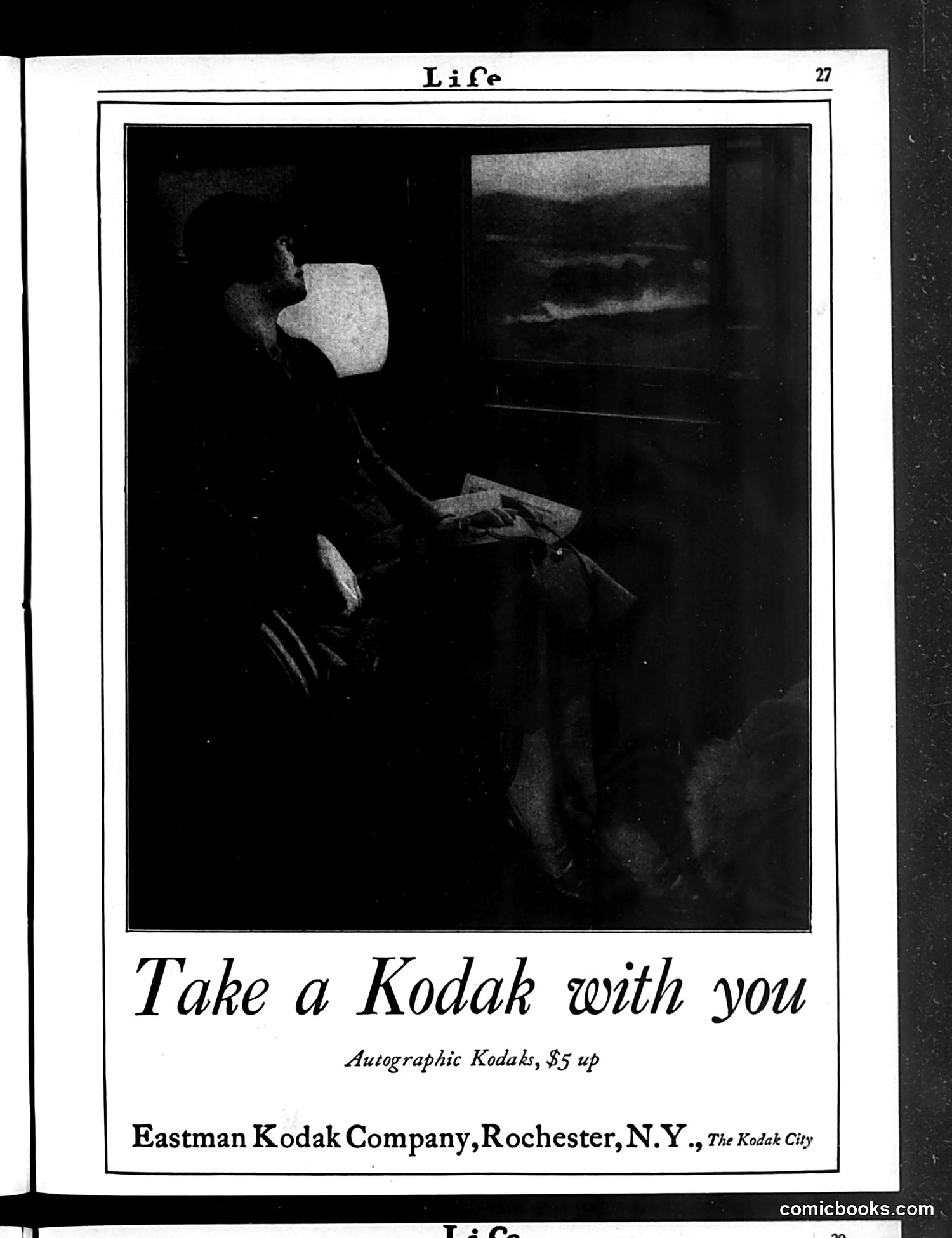
This page is primarily a Kodak advertisement rather than political satire or editorial cartoon. It depicts a silhouetted figure in a darkened theater or cinema, holding an "Autographic Kodak" camera while watching a film on screen. The advertisement's message is straightforward product promotion: encouraging readers to bring portable Kodak cameras along on outings and vacations to photograph their experiences. The theatrical setting suggests capturing memories during entertainment or travel. The tagline "Take a Kodak with you" emphasizes portability and convenience. Priced at "$5 up," these were affordable consumer cameras aimed at the growing amateur photography market. This represents early 20th-century marketing positioning photography as an accessible leisure activity for middle-class Americans. There is no apparent political or social satire present on this page.
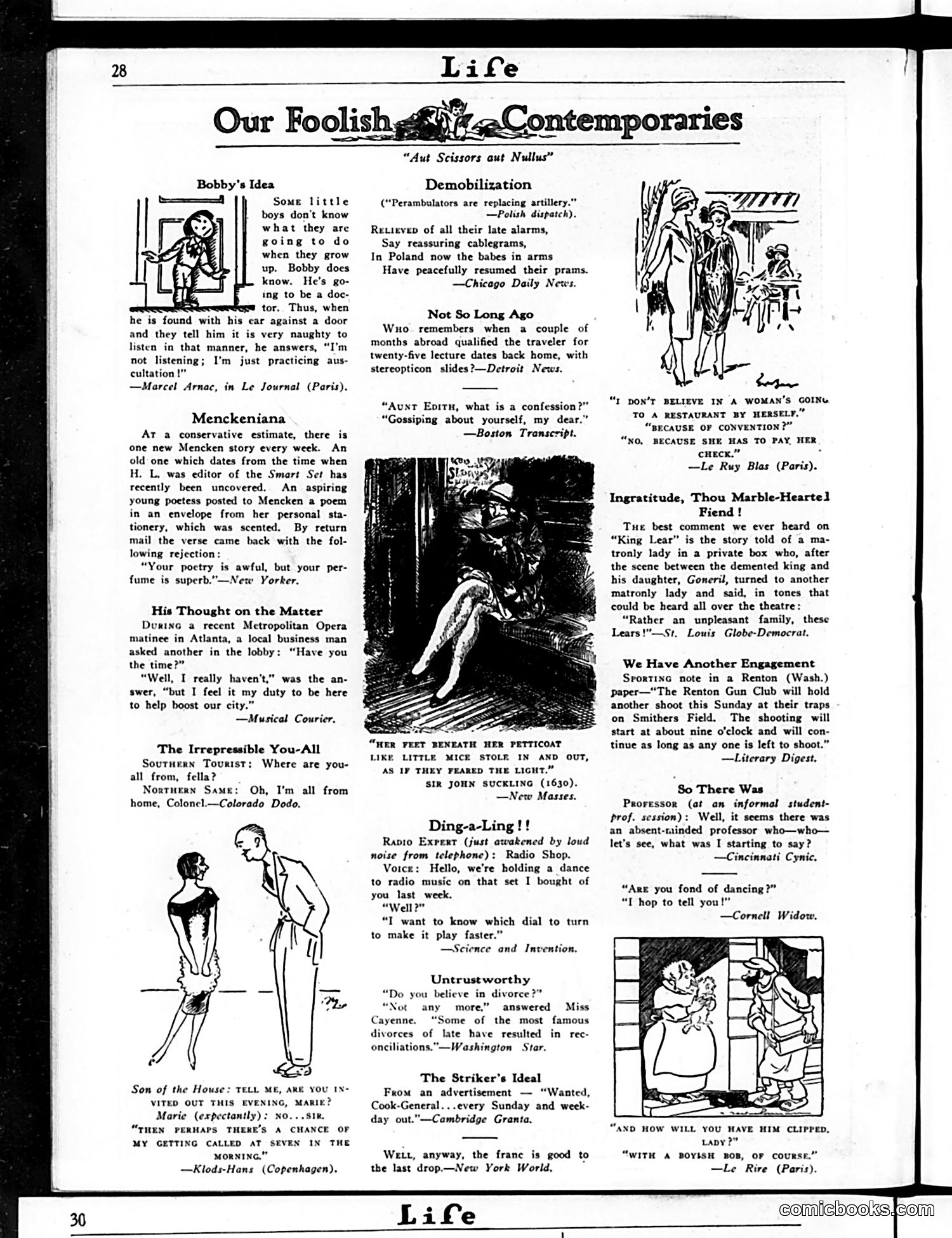
This page from Life magazine collects brief humorous anecdotes and cartoon jokes from various sources, mostly European newspapers. The satire targets everyday social absurdities: **"Bobby's Idea"**: A child mimics adult behavior, using medical jargon ("auscultation") to justify eavesdropping—mocking both childish imitation and pretentious language. **"Menckeniana"**: Anecdotes about H.L. Mencken, the famous critic. One jokes that he rejected a poetess's poem while praising her perfumed stationery—satirizing superficiality and vanity in literary circles. **The cartoons** (illustration of couple, mother and child) use visual humor about gender relations and domestic expectations typical of 1920s satire. **"Ding-a-Ling"**: A radio caller wants to adjust the dial to make music play "faster"—mocking technological ignorance. **"King Lear" anecdote**: A theater patron dismisses Shakespeare's tragedy as simply "an unpleasant family"—satire of philistine audience members. The page reflects post-WWI American humor: skepticism toward pretension, technology confusion, and social convention.
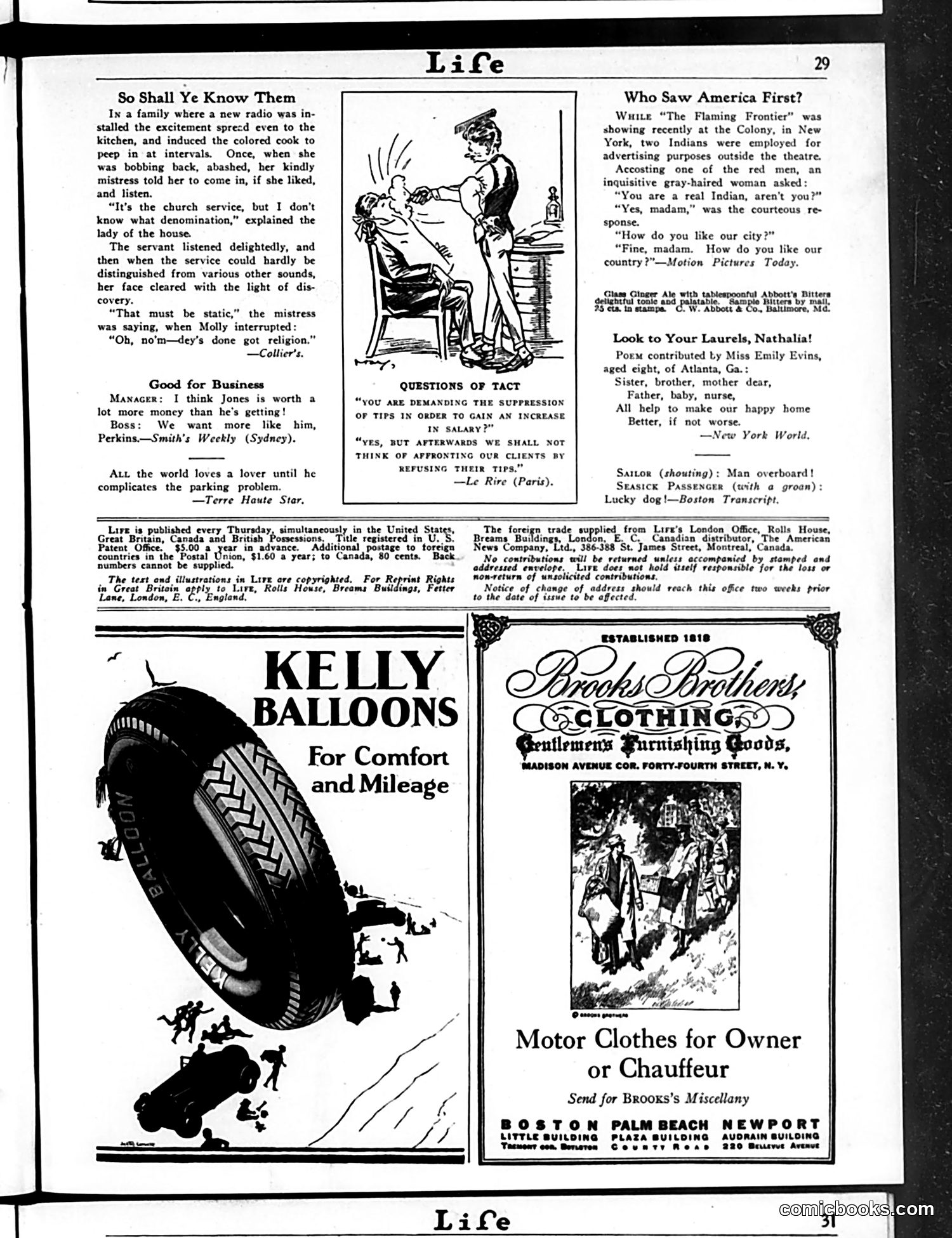
This page contains several short humorous pieces and advertisements typical of early 20th-century satirical magazines: **"So Shall Ye Know Them"** jokes about a Black servant misinterpreting radio static as religious fervor. The humor relies on the racist stereotype that Black people are superstitious and overly emotional about religion—a deeply offensive premise today. **"Questions of Tact"** presents a labor dispute where workers demand higher wages *and* the right to refuse tips. The irony suggests their true motivation is financial rather than principled. **"Who Saw America First?"** depicts an exchange between a tourist and a Native American performer outside a theater, with the punchline reversing who should be claiming ownership of America—a gentle joke about colonization. **"Good for Business"** and other brief quips fill space with workplace humor. The remainder is advertising for Kelly Balloons and Brooks Brothers clothing. This is primarily an advertising-heavy page with period-specific satirical content reflecting early 20th-century attitudes.
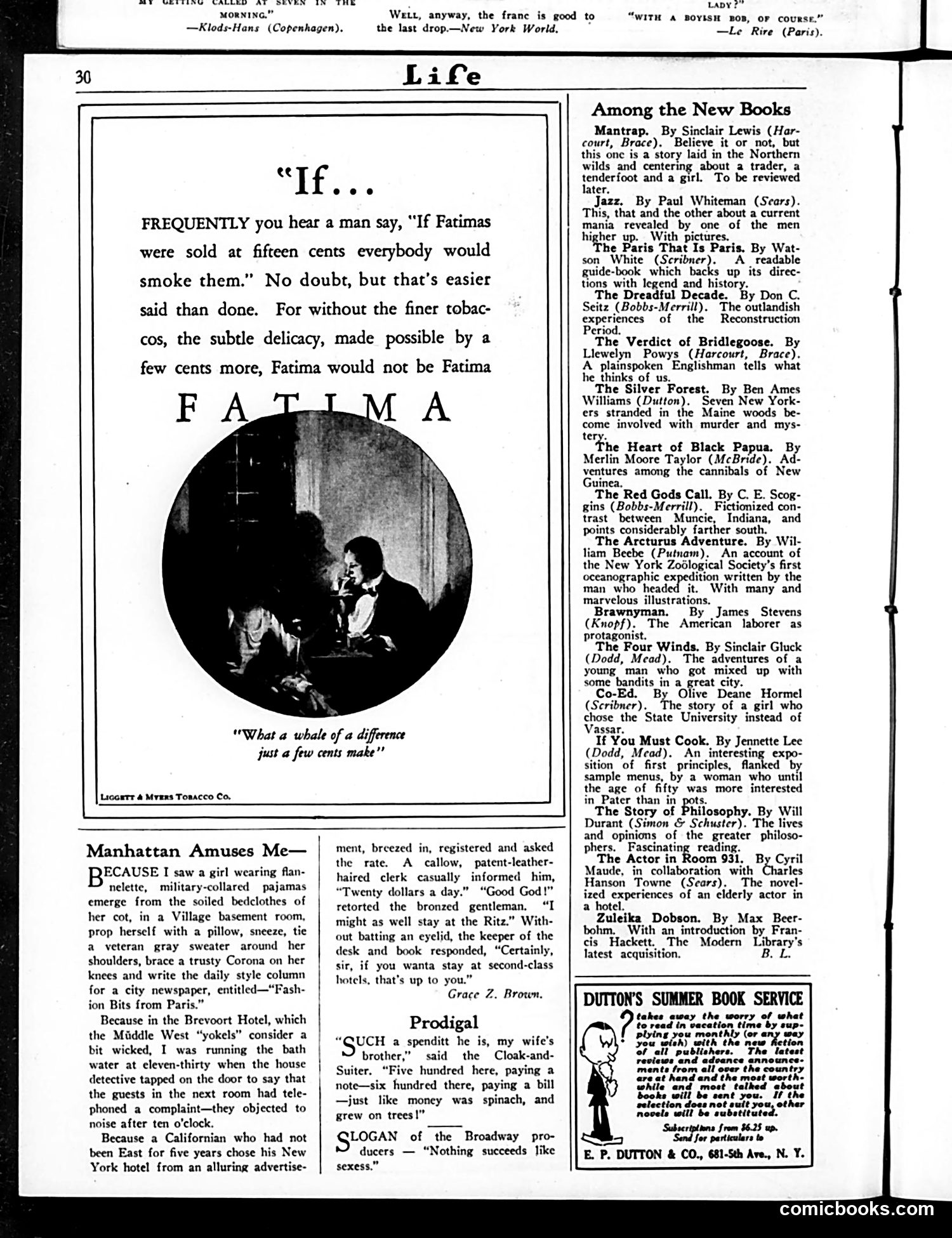
This page centers on a **Fatima cigarette advertisement** by Liggett & Myers Tobacco Co. The ad argues that while people claim they'd smoke Fatimas if they cost only fifteen cents, the brand's superior quality—achieved through expensive tobaccos—justifies its higher price. The tagline "What a whale of a difference just a few cents make" emphasizes that cheaper alternatives cannot replicate Fatima's delicacy. Below is Grace Z. Brown's humorous "Manhattan Amuses Me" column, describing absurdities of New York life: a journalist writing "Fashion Bits from Paris" from a shabby basement apartment, hotel staff dismissing complaints from guests, and a hotel clerk's deadpan insult comparing the Ritz to "second-class hotels." The humor derives from contrasting pretense with mundane reality—the gap between Manhattan's sophisticated image and its actual conditions.
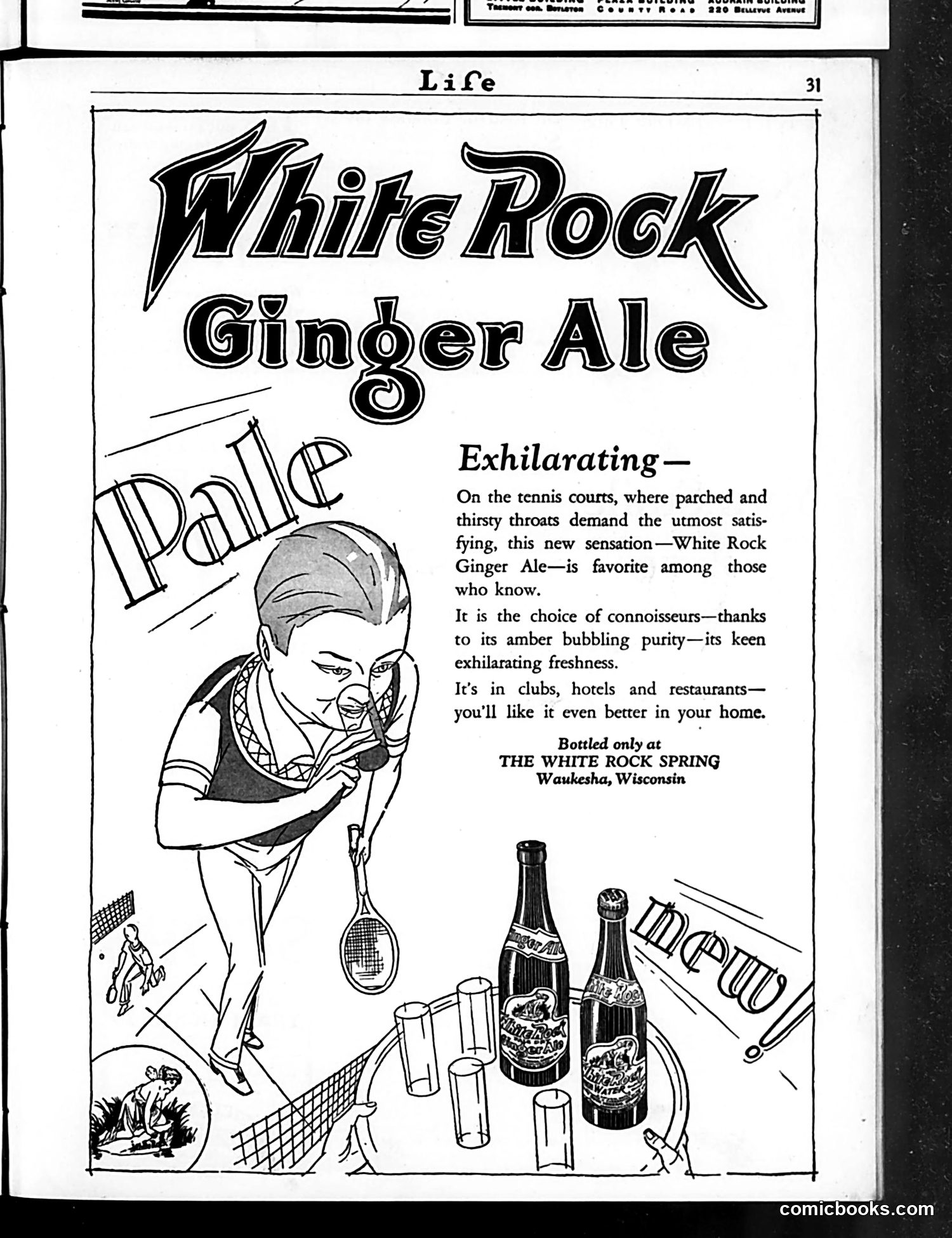
This is a full-page advertisement for White Rock Ginger Ale, bottled in Waukesha, Wisconsin. It's not satire or political commentary—it's a commercial product advertisement. The illustration depicts a female tennis player in athletic wear, shown mid-game with a tennis racket. The "Pale" label and tennis court setting serve as the advertisement's visual hook: the ad associates the beverage with athletic refreshment and leisure activities appealing to upscale consumers. The copy emphasizes the product as "the choice of connoisseurs," positioning it as a premium beverage suitable for clubs, hotels, restaurants, and homes. The emphasis on "amber bubbling purity" and "exhilarating freshness" reflects early 20th-century advertising language promoting ginger ale as a sophisticated, health-conscious drink. The gendered imagery of an active woman suggests marketing to a demographic that viewed sports and leisure activities as aspirational lifestyle markers.
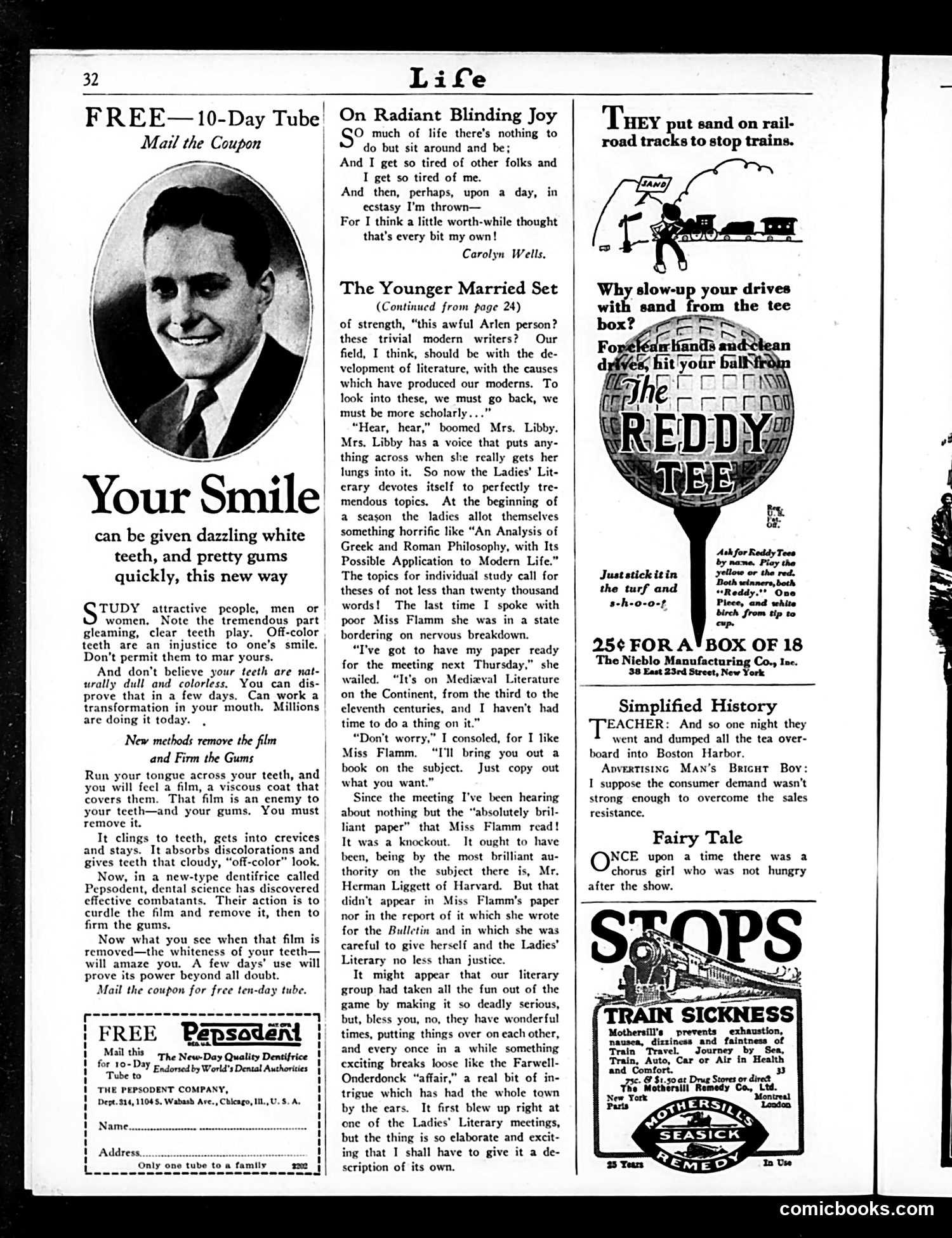
This page contains **advertisements and satirical social commentary** typical of Life magazine's format. The main satire appears in "The Younger Married Set" column, which mocks pretentious literary clubs. The unnamed narrator describes a women's book club that adopts absurdly ambitious topics—"Greek and Roman Philosophy" requiring 20,000-word theses—to appear intellectually serious. The joke: Miss Flamm, overwhelmed by her assigned essay on Medieval Literature, is secretly given a ready-made paper by Harvard scholar Herman Liggett. She presents it as her own work and receives praise for being "brilliant," while the club members remain unaware they're celebrating plagiarism. The satire targets both the performative intellectualism of such clubs and the dishonesty lurking beneath their pretensions. The page also includes typical period advertisements: Pepsodent toothpaste (promoting "film removal") and Reddy Tee golf equipment, plus anti-train-sickness remedies—standard commercial content for Life magazine of this era.
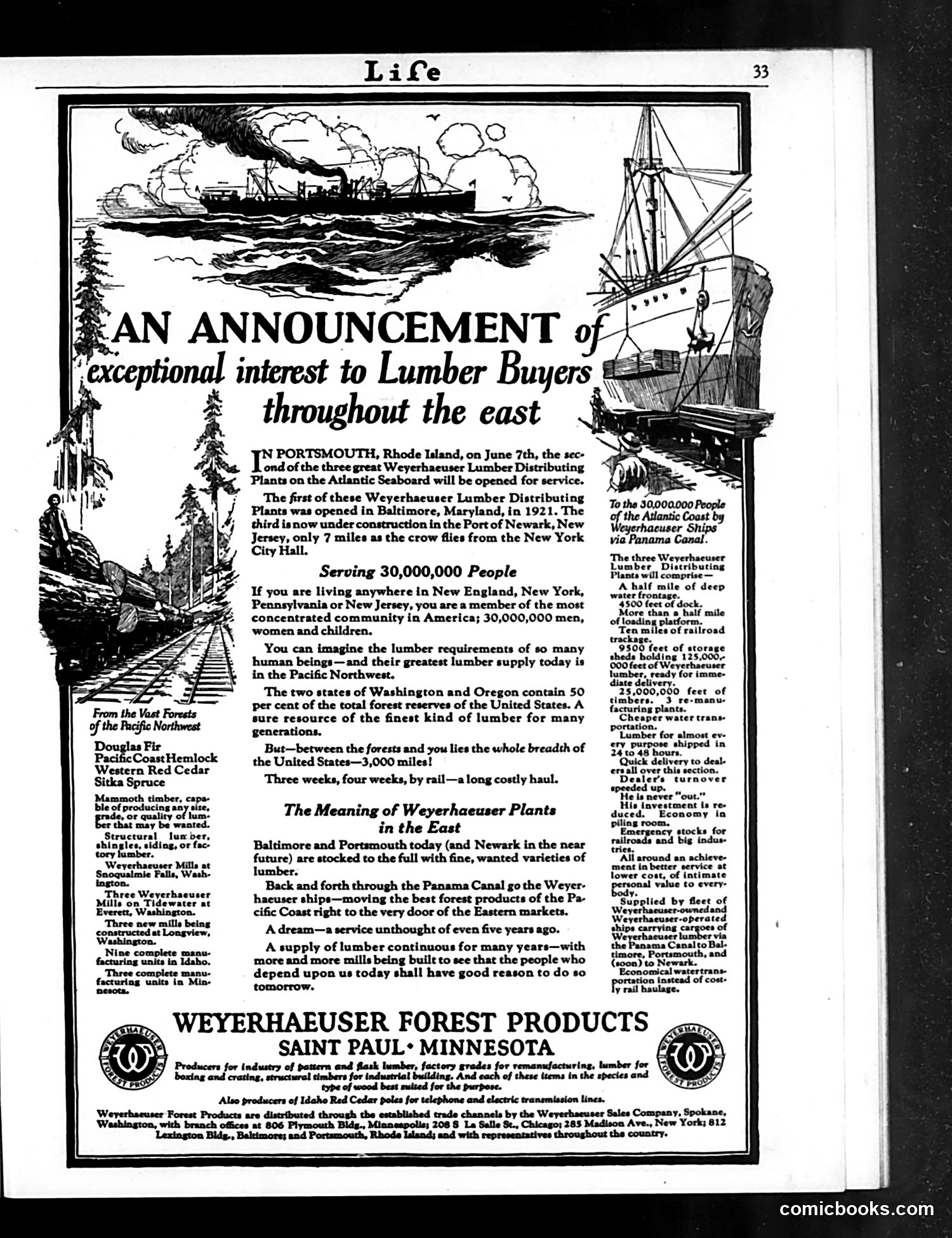
This is primarily a **corporate advertisement**, not political satire or a cartoon. It announces the opening of Weyerhaeuser Lumber Company's Portsmouth, Rhode Island distribution plant (the second of three on the Atlantic Seaboard). The page uses **illustrative graphics**—a steamship, sailing vessel, and logged forest scenes—to convey the company's logistics narrative: lumber from Pacific Northwest forests travels via Panama Canal to eastern ports, solving a 3,000-mile transportation problem that previously took "three to four weeks by rail." The ad targets **lumber buyers** serving the densely populated Northeast (30 million people in New England, New York, Pennsylvania, New Jersey), emphasizing: - Continuous supply reliability - Faster delivery via water transport - Lower costs and better inventory management for dealers - Modern distribution infrastructure (docks, storage, rail connections) No satirical content is present. This represents straightforward early-20th-century industrial marketing emphasizing efficiency, supply chain innovation, and regional economic integration—themes appropriate to Life magazine's audience of businessmen and professionals.
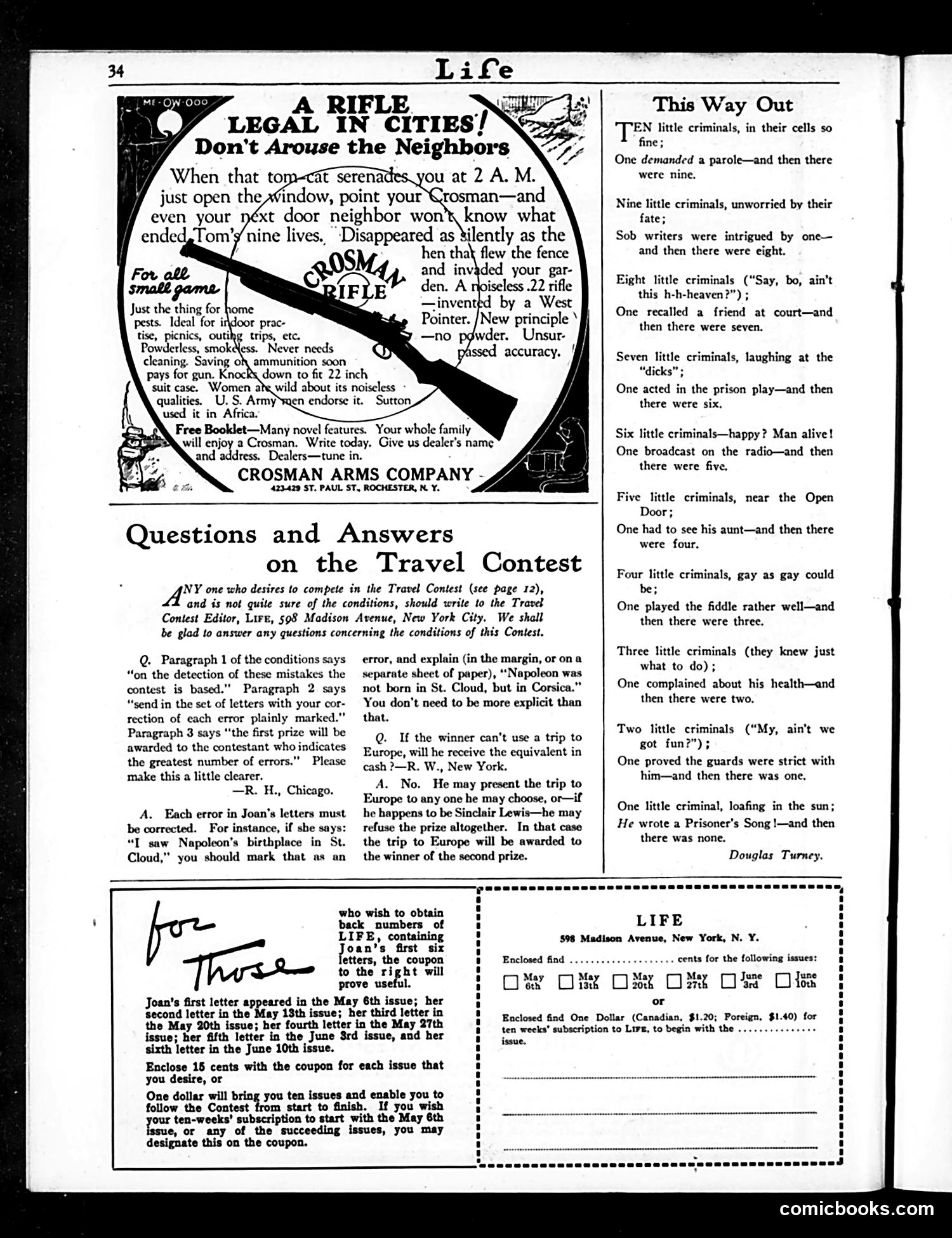
**The Crosman Rifle Advertisement** (left): This is a straightforward commercial for a silent .22 rifle marketed for "small game" hunting and pest control. The ad emphasizes the gun is "noiseless" and "smokeless," requiring no powder—novel features for the era. It targets home users and sportsmen, noting the U.S. Army endorsed it. No satire is present; this is genuine product marketing. **"This Way Out" Poem** (right): A darkly comedic piece by Douglas Turney using the "Ten Little" counting-down format (similar to "Ten Little Indians"). Each stanza describes a prisoner escaping through various means—parole, connections, entertainment opportunities, radio broadcasts, family visits, musical talent, health complaints, and strict guard exploitation—until one finally achieves freedom by writing "A Prisoner's Song." The satire targets prison system failures: the ease of escape through bureaucratic loopholes, corruption, and sympathetic public interest rather than actual rehabilitation. **Travel Contest Q&A**: Administrative clarification answering reader questions about contest rules and prize eligibility.
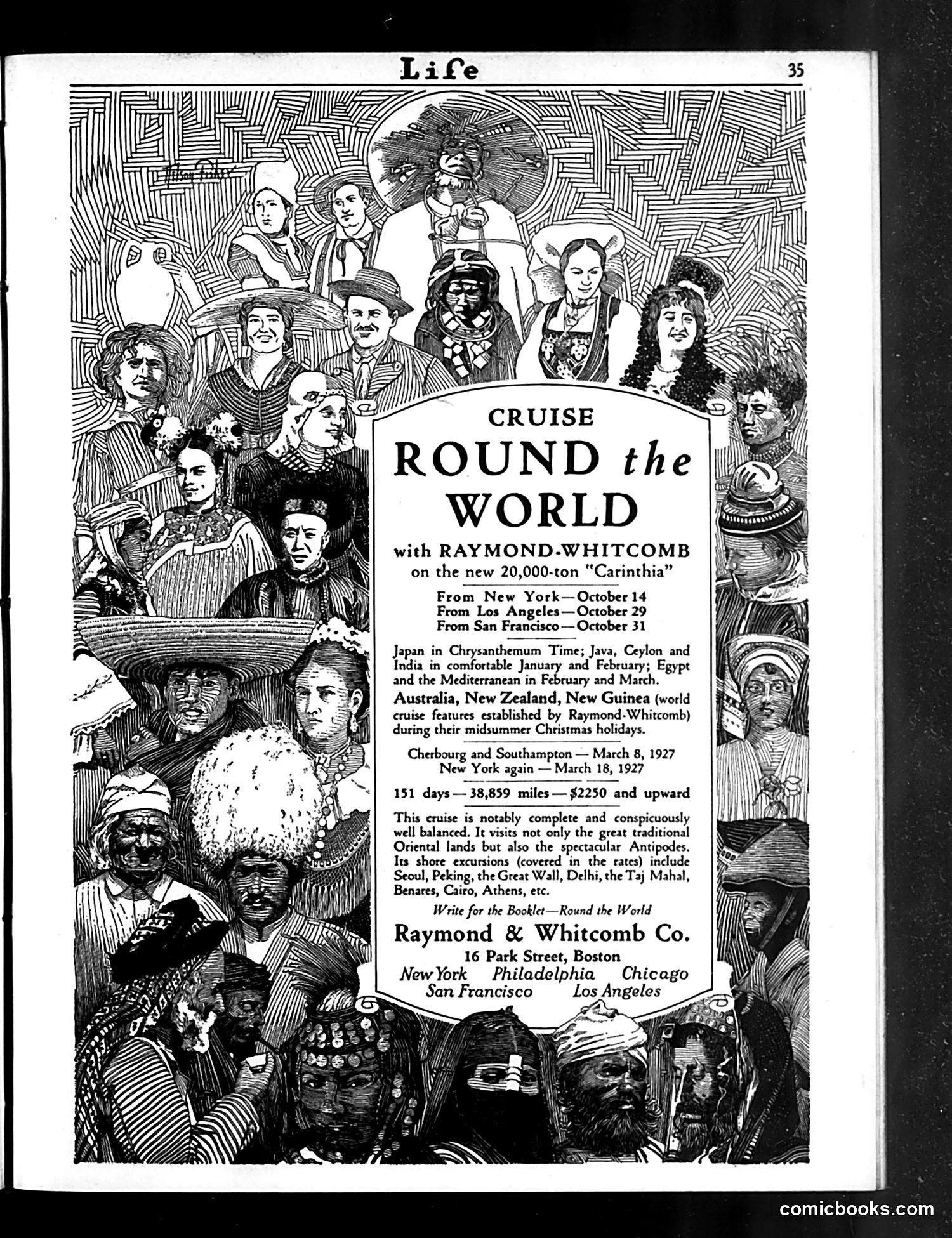
This is **not a cartoon or satirical commentary**, but rather a **cruise ship advertisement** from Life magazine (page 35). Raymond & Whitcomb Co. advertises a 151-day around-the-world luxury cruise on the S.S. Carinthia, departing October 1926 from three U.S. ports. The elaborate illustration surrounds the ad with figures representing various world cultures and destinations—people in traditional dress from Japan, India, Egypt, the Middle East, and other ports of call. The appeal is to wealthy travelers seeking exotic tourism. At $2,250 and upward (substantial money in 1926), this targeted affluent Americans interested in seeing "the great traditional Oriental lands" and "spectacular Antipodes" with guided shore excursions to famous sites: the Great Wall, Taj Mahal, pyramids, etc. The decorative ethnographic imagery reflects 1920s attitudes toward non-Western cultures as exotic spectacles for Western consumption—a colonial-era tourist perspective now considered problematic.
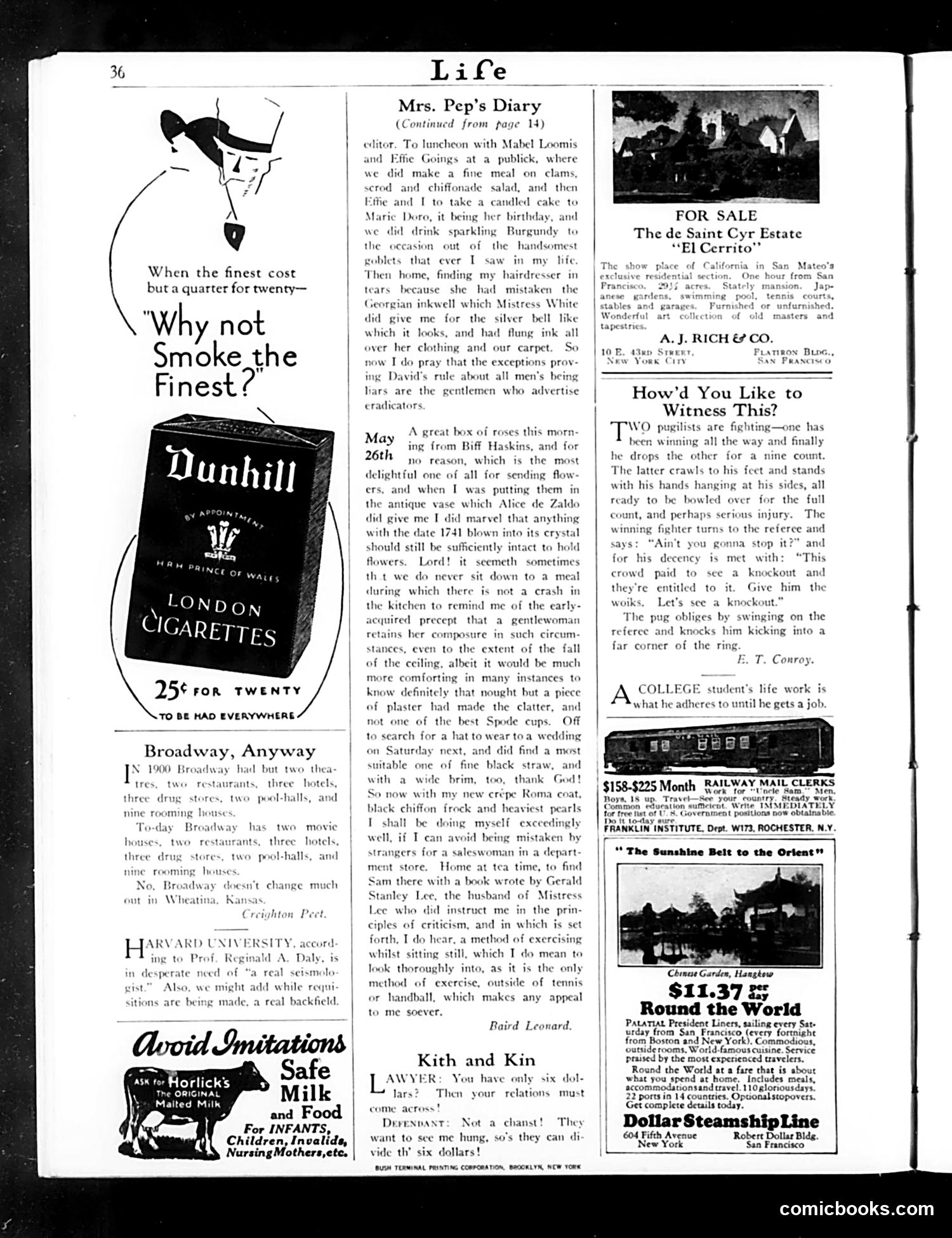
This page is primarily **advertising and miscellaneous content** rather than political satire. The main cartoon advertises **Dunhill cigarettes**, using a stylized illustration of a well-dressed man in a tuxedo. The joke plays on **class aspiration**: cigarettes costing only 25 cents for twenty ("finest cost but a quarter") are positioned as accessible luxury goods—an appeal to middle-class consumers wanting to appear sophisticated and wealthy. **Mrs. Pep's Diary** is a **humor column** satirizing upper-class pretension through the mundane social anxieties of a wealthy woman—mistaken identities, household disasters, and obsessive social ritual. The remaining content includes: - A note on **Harvard University** needing a "real seismologist" (unclear reference) - **"Kith and Kin"**: a legal joke about inheritance and relatives - Various advertisements (Horlick's Malted Milk, steamship lines, real estate) The page reflects **1920s consumer culture** and genteel humor aimed at affluent readers.
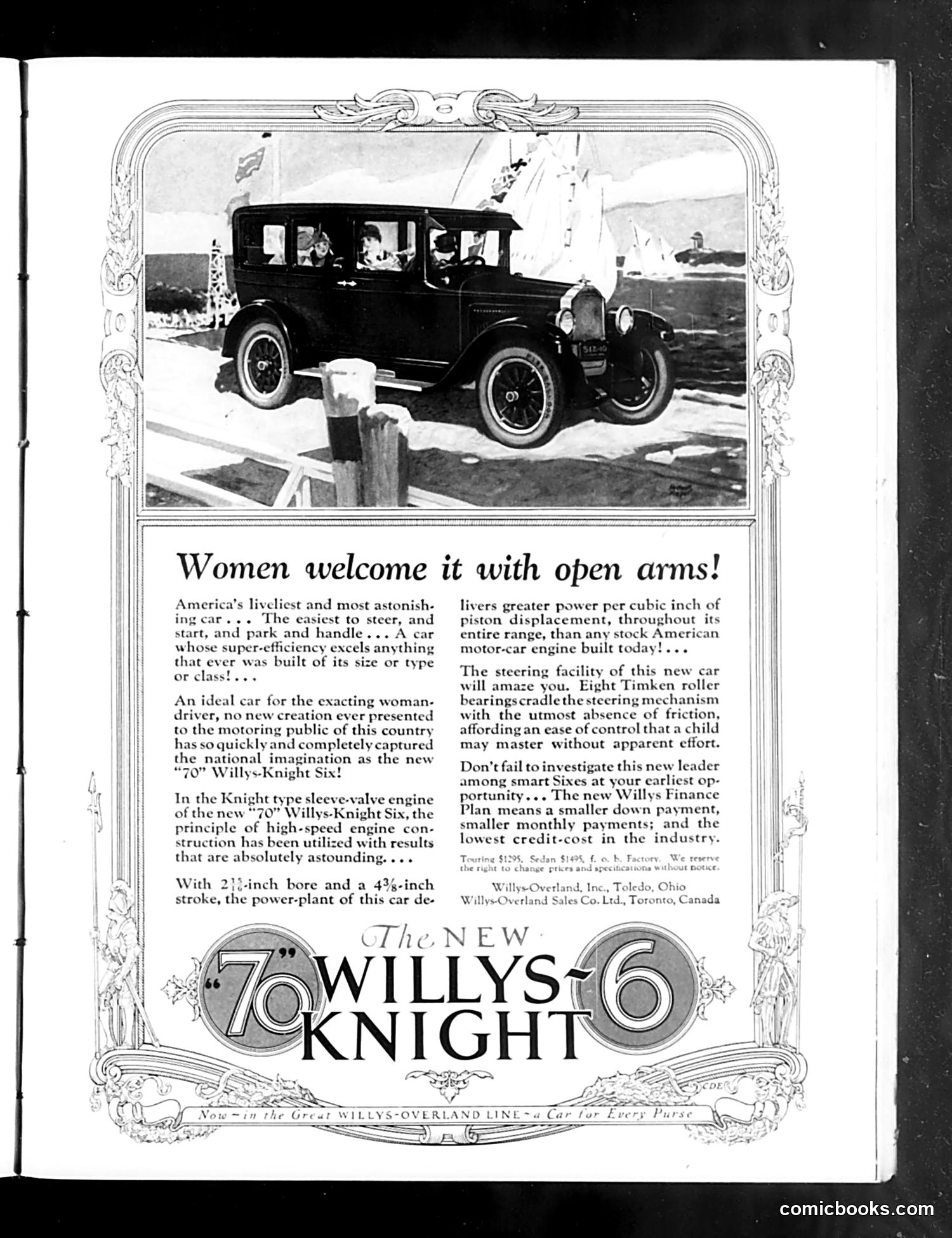
This is primarily a **car advertisement**, not political satire. It markets the new Willys-Knight "70" automobile to female drivers, a notable marketing choice for the era. The headline "Women welcome it with open arms!" targets women as consumers—a relatively progressive approach for early automotive advertising. The text emphasizes features marketed specifically to women: ease of steering, parking, and handling ("a child may master without apparent effort"). The accompanying photograph shows the elegant sedan with well-dressed passengers, positioning it as aspirational and modern. The financing plan mention ("smallest down payment") suggests marketing to middle-class buyers. **Historical context:** This likely dates to the 1920s-early 1930s, when automobiles were becoming consumer goods and manufacturers began explicitly targeting female buyers, reflecting women's growing economic independence and driving participation. There is no political cartoon or satire present on this page.
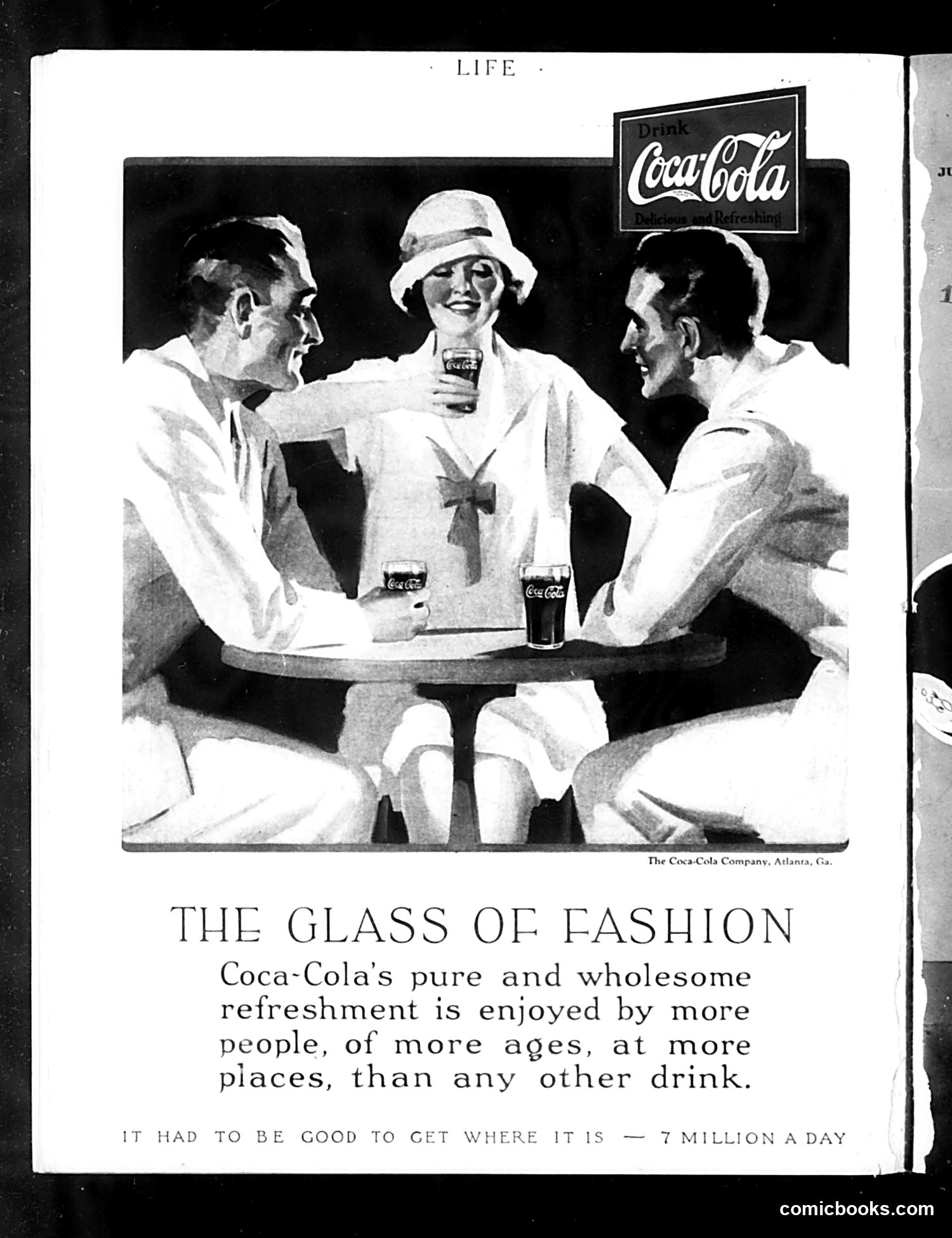
This is a Coca-Cola advertisement disguised as editorial content in Life magazine. The image shows three men in casual 1920s attire gathered around a table with Coca-Cola bottles, with a fashionably dressed woman in a cloche hat (period-appropriate flapper styling) as the centerpiece of their attention. The headline "The Glass of Fashion" suggests Coca-Cola is a trendy, socially desirable product consumed across all demographics. The tagline claims 7 million servings daily, positioning it as universally popular. The advertisement uses social aspiration and fashion consciousness to market the drink, implying that consuming Coca-Cola is fashionable and sophisticated—a common advertising strategy of the era that blurred the line between journalism and marketing.