
Life, 1926-06-17 · page 36 of 44
Life — June 17, 1926 — page 36: what you’re looking at
What you’re looking at
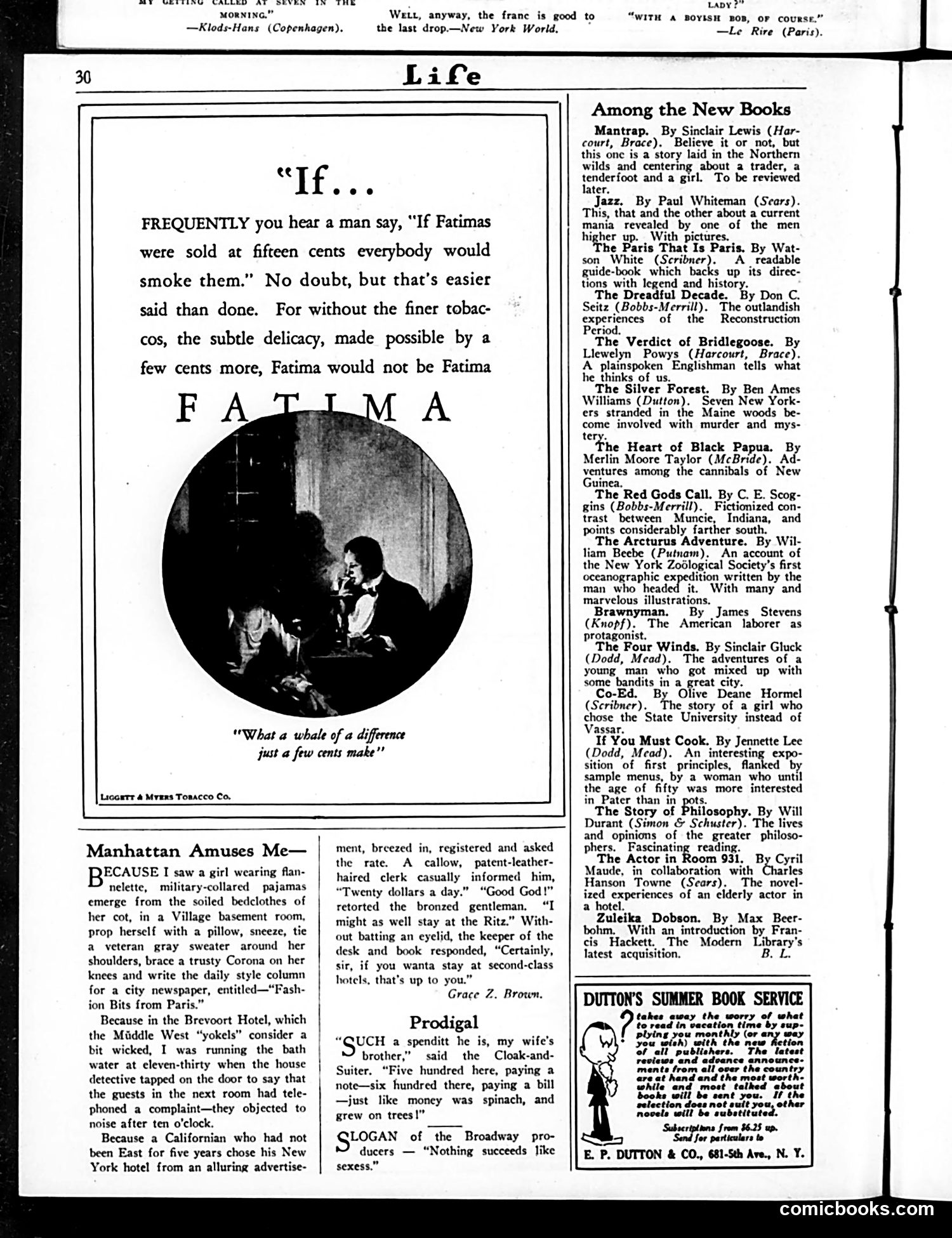
This page centers on a **Fatima cigarette advertisement** by Liggett & Myers Tobacco Co. The ad argues that while people claim they'd smoke Fatimas if they cost only fifteen cents, the brand's superior quality—achieved through expensive tobaccos—justifies its higher price. The tagline "What a whale of a difference just a few cents make" emphasizes that cheaper alternatives cannot replicate Fatima's delicacy. Below is Grace Z. Brown's humorous "Manhattan Amuses Me" column, describing absurdities of New York life: a journalist writing "Fashion Bits from Paris" from a shabby basement apartment, hotel staff dismissing complaints from guests, and a hotel clerk's deadpan insult comparing the Ritz to "second-class hotels." The humor derives from contrasting pretense with mundane reality—the gap between Manhattan's sophisticated image and its actual conditions.
📄 Transcribed text from this page (OCR, searchable)
Machine-transcribed from the original scan — historical spelling and the odd misread are preserved.
ee teas eee he ee MORNING.” _— —Klods-Hans (Copenhagen). = Wett, anyway, the franc is good to ‘New York World, the last drop.— Lapy f" SE 2... FREQUENTLY you hear a man say, “If Fatimas were sold at fifteen cents everybody would smoke them.” said than done. No doubt, but that’s easier For without the finer tobac- cos, the subtle delicacy, made possible by a few cents more, Fatima would not be Fatima “What a whale of a difference just a few cents make” Liccerr 4 Mraxs Toaacco Co. Manhattan Amuses Me— ECAUSE I saw a girl wearing flan- nelette, military-collared pajamas emerge from the soiled bedclothes of her cot, in a Village basement room, prop herself with a pillow, sneeze, tie a veteran gray sweater around her shoulders, brace a trusty Corona on her knees and write the daily style column for a city newspaper, entitled—“Fash- ion Bits from Paris.” Because in the Brevoort Hotel, which the Miiddle West “yokels” consider a bit wicked, I was running the bath water at eleven-thirty when the house detective tapped on the door to say that the guests in the next room had tele- phoned a complaint—they objected to noise after ten o'clock. Because a Californian who had not been East for five years chose his New York hotel from an alluring advertise- ment, breezed in, registered and asked the rate. A callow, patent-leather- haired clerk casually informed him, “Twenty dollars a day.” “Good God!” retorted the bronzed gentleman. “I might as well stay at the Ritz.” With- out batting an eyelid, the keeper of the desk and book responded, “Certainly, sir, if you wanta stay at second-class hotels, that’s up to you.” Grace Z. Brown. Prodigal UCH a spenditt he is, my wife's brother,” said the Cloak-and- Suiter. “Five hundred here, paying a note—six hundred there, paying a bill —just like money was spinach, and grew on trees!” LOGAN of the Broadway pro- ducers — “Nothing succeeds like sexess.” Among the New Books Mantrap. By Sinclair Lewis (Har- court, Brace). Believe it or not, but this one is a story laid in the Northern wilds and centering about a trader, a tendrsioce and a girl. To be reviewed ater. Jazz. By Paul Whiteman (Sears). This, that and the other about a current mania revealed by one of the men higher up. With pictures. ‘he Paris That Is Paris. By Wat- son White (Scribner). A readable guide-book which backs up its direc- tions with legend and History. The Dreadful Decade. By Don C. Seitz (Bobbs-Merrill). The outlandish experiences of the Reconstruction Period. The Verdict of Bridlegoose. By Llewelyn Powys (Harcourt, Brace). A plainspoken Englishman tells what he thinks of us. The Silver Forest. By Ben Ames Williams (Dutton). Seven New York- ers stranded in the Maine woods be- come involved with murder and mys- te he Heart of Black Papua. By Merlin Moore Taylor (McBride). Ad- ventures among the cannibals of New Guinea. The Red Gods Call. By C. E. Scog- gins (Bobbs-Merrill). Fictionized con- trast between Muncie, Indiana, and points considerably farther south. The Arcturus Adventure. By Wil- liam Beebe (Putnam). An account of the New York Zodlogical Society’s first oceanographic expecting written by the man who headed it. With many and marvelous illustrations. Brawnyman. By James Stevens (Knopf). The American laborer as protagonist. The Four Winds. By Sinclair Gluck (Dodd, Mead). The adventures of a young man who got mixed up with sone) bandits i in a a reat city. live Deane Hormel (Soe). ey story of a girl who chose the State University instead of Vassar. If You Must Cook. By Jennette Lee (Dodd, Mead). An interesting expo- sition of first principles, flanked sample menus, by a woman who until the age of fifty was more interested in Pater than in The Story of Bhilosophy. By Will Durant (Simon & Schuster). The lives and opinions of the greater philoso- phers. Fascinatiny reading. e Actor in Room 931, By Cyril Maude, in collaboration with Charles Hanson Towne (Sears). The novel- ined experiences of an elderly actor in * Zuleika Dobson. By Max Beer- bohm. With an introduction by Fran- cis Hackett. The Modern Library's latest acquisition. BL. DUTTON’S SUMMER BOOK SERVICE takes away the worry of what to read in vacation time by sup- plyin; Ly (6 way you wish) with the new fiction of all publishers. The latest reviews and adeance announce- mente from all over the country are at hand and the most worth: ‘and most talked about Soaks will be'vent zou. If the selection does not suit you, other novels will be sub . Subseriplions from 36.25 up. for particulars to E. P. DUTTON & CO., 681-Sth Ave., N. Y. “WITH A BOYISH BOB, OF coURSE.” —Le Rire (Paris). comicbooks.com