
Life, 1926-06-17 · page 26 of 44
Life — June 17, 1926 — page 26: what you’re looking at
What you’re looking at
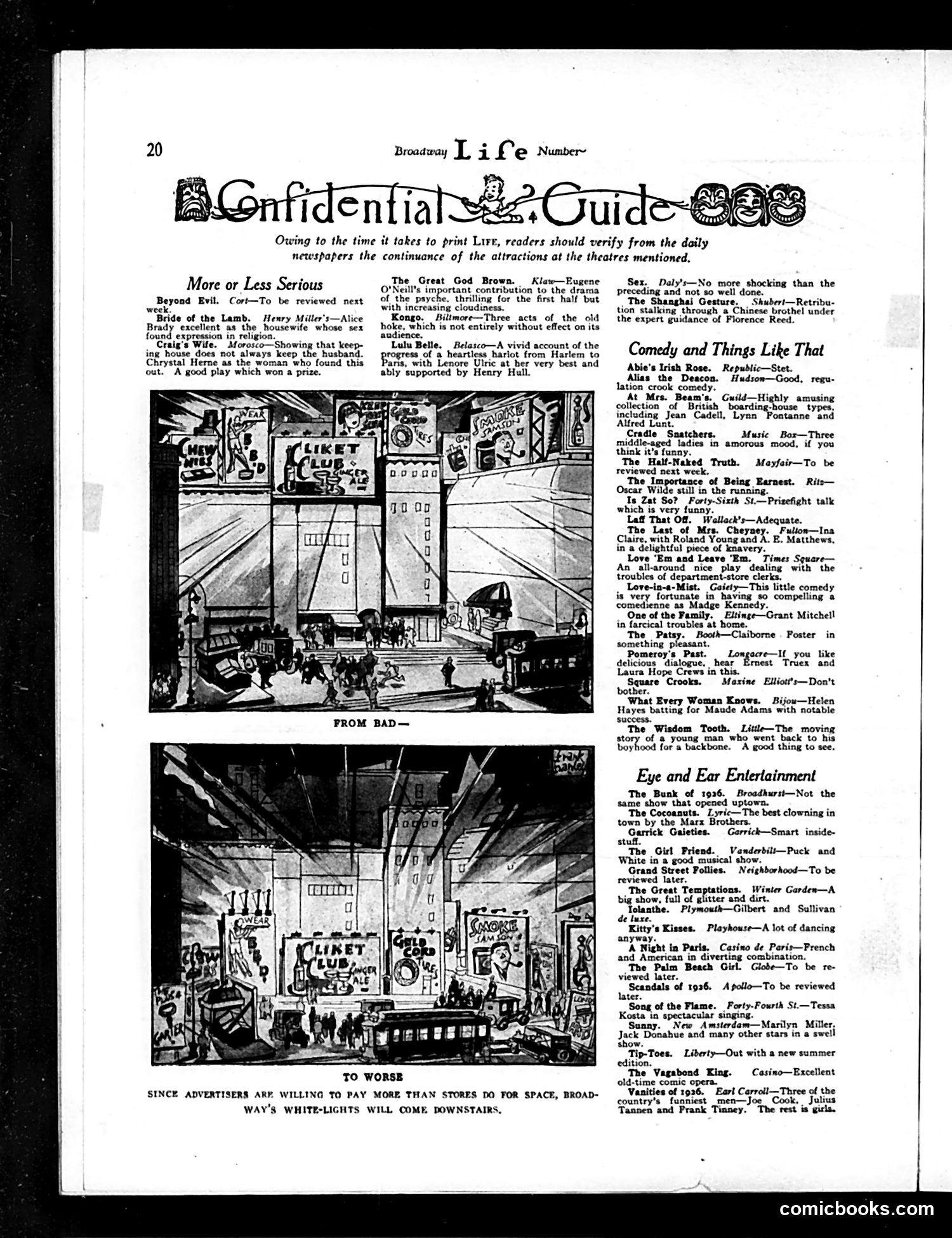
This page is a theatre review guide for Broadway shows, not a political cartoon. The two illustrated panels labeled "FROM BAD—" and "—TO WORSE" are **architectural drawings** satirizing Broadway's transformation, not caricatures of political figures. The satire's point: the caption explains that advertisers pay more for marquee space than retail stores pay for storefronts, so Broadway's street level is being colonized by commercial signage at the expense of the theatres' architectural integrity. The drawings show how neon signs and advertisements increasingly dominate the streetscape, literally pushing legitimate theatre architecture downward. The rest of the page consists of brief critical capsules reviewing current Broadway productions—both serious dramas (O'Neill's *The Great God Brown*, *Lulu Belle*) and comedies (*Abie's Irish Rose*, Marx Brothers in *The Cocoanuts*). This is entertainment journalism, not political satire.
📄 Transcribed text from this page (OCR, searchable)
Machine-transcribed from the original scan — historical spelling and the odd misread are preserved.
Broadway L ie Nunber Owing to the time it takes to print Lire, readers should verify from the daily newspapers the continuance of the attractions at the theatres mentioned. More or Less Serious Beyond Evil, Cort—To be reviewed next week. Bride of the Lamb. Henry Miller's—Alice Brady excellent as the housewife whose sex found expression in religion. Craig's Wife. Morosco—Showing that keep- ing house does not always keep the husband. Chrystal Here as the woman who found this out. A good play which won a prize. The Great God Brown. Klaw—Eugene O!Neill’s important contribution to the drama of the psyche. thrilling for the first half but with increasing cloudiness. Kongo. Bilimore—Three acts of the old hoke, which is not entirely without effect on its audience. Lulu Belle, Belasco—A vivid account of the Progress. of a heartless harlot from Harlem to Pans, with Lenore Ulric at her very best and ably supported by Henry Hull. Wh ill ae 2118 BB ee = aes TO WORSE SINCE ADVERTISERS ARF WILLING TO PAY MORE THAN STORES DO FOR SPACE, BROAD- WAY’S WHITE-LIGHTS WILL COME DOWNSTAIRS, 3 — Sex. Daly’s—No more shocking than the preceding and not so well done. e Shanghai Gesture. Shubert—Retribu- tion stalking through a Chinese brothel under the expert guidance of Florence Reed. Comedy and Things Like That Abie’s Irish Rose. Republic—Stet. Alias the Deacon. Hudson—Good, regu- lation crook comedy. At Mrs. Beam's. Guild—Highly amusing collection of British boarding-house types, including Jean Cadell, Lynn Pontanne and Alfred Lunt. Cradle Snatchers. — Music Bor—Three middle-aged ladies in amorous mood, if you think it’s funny. The Half-Neked Truth. Mayfair—To be reviewed next week. The Im, ¢ of Being Earnest. Rits— Oscar Wilde still in the running. Is Zat So? Forty-Sixth St.—Prizefight talk which is very funny. Laff That Of, Wallack’s—Adequate. The Last of Mrs. Cheyney. Fulion—| Claire, with Roland Young and A. E. Matthe in a delightful piece of knavery. Love ‘Em and Leave ‘Em. Times Square— An all-around nice play dealing with the troubles of department-store clerks. Love-in-a-Mist. Gaiety—This little comedy is very fortunate in having so compelling a comedienne as Madge Kennedy. One of the Family. Eltinge—Grant Mitchell in farcical troubles at home. The Patsy. Booth—Claiborne . Poster in something p! nt. Pomeroy's Past. | Longacre—If you like delicious dialogue, hear Ernest Truex and Laura Hope Crews in this. Square Crooks. Maxine Elliott’s—Don't bother. ‘What Every Woman Knows. Bijou—Helen Hayes batting for Maude Adams with notable success. ; The Wisdom Tooth. Littlh—The moving story of @ young man who went back to his boyhood for a backbone. A good thing to see. Eye and Ear Entertainment The Bunk of 1926. Broadhurst—Not the same show that opened uptown. aa The Cocoanuts. Lyric—The best clowning in town by the Marx Brothers. Garrick Gaieties. Garrich—Smart inside- stuff. The Girl Priend. Vanderbili—Puck and White in a good musical show. Grand Street Follies. Neighborhood—To be reviewed later. The Great Temptations. Winter Garden—A big show, full of glitter and dirt. Tolanthe. Plymouth—Gilbert and Sullivan de luxe. Kitty's Kisses. Playhouse—A lot of dancing anyway. A Night in Paris, Casino de Paris—Prench and American in diverting combination. The Palm Beach Girl. Globe—To be re- viewed later. : Scandals of 1926. A pollo—To be reviewed later. Song of the Flame. Forty-Fourth St.—Tessa Kosta in spectacular singing. _ Sunny. New Amsterdem—Marilyn Miller. Jack Donahue and many other stars in a sweil ow. Tip-Toes. Liberty—Out with a new summer edition. The Vagabond King. old-time comic opera. Vanities of 1926. Earl Carroll—Three of the country’s funniest men—Joe Cook, Julius ‘annen a Tinney. The rest is girls. Ina ws, Casino—Excellent comicbooks.com