
Life, 1926-06-17 · page 22 of 44
Life — June 17, 1926 — page 22: what you’re looking at
What you’re looking at
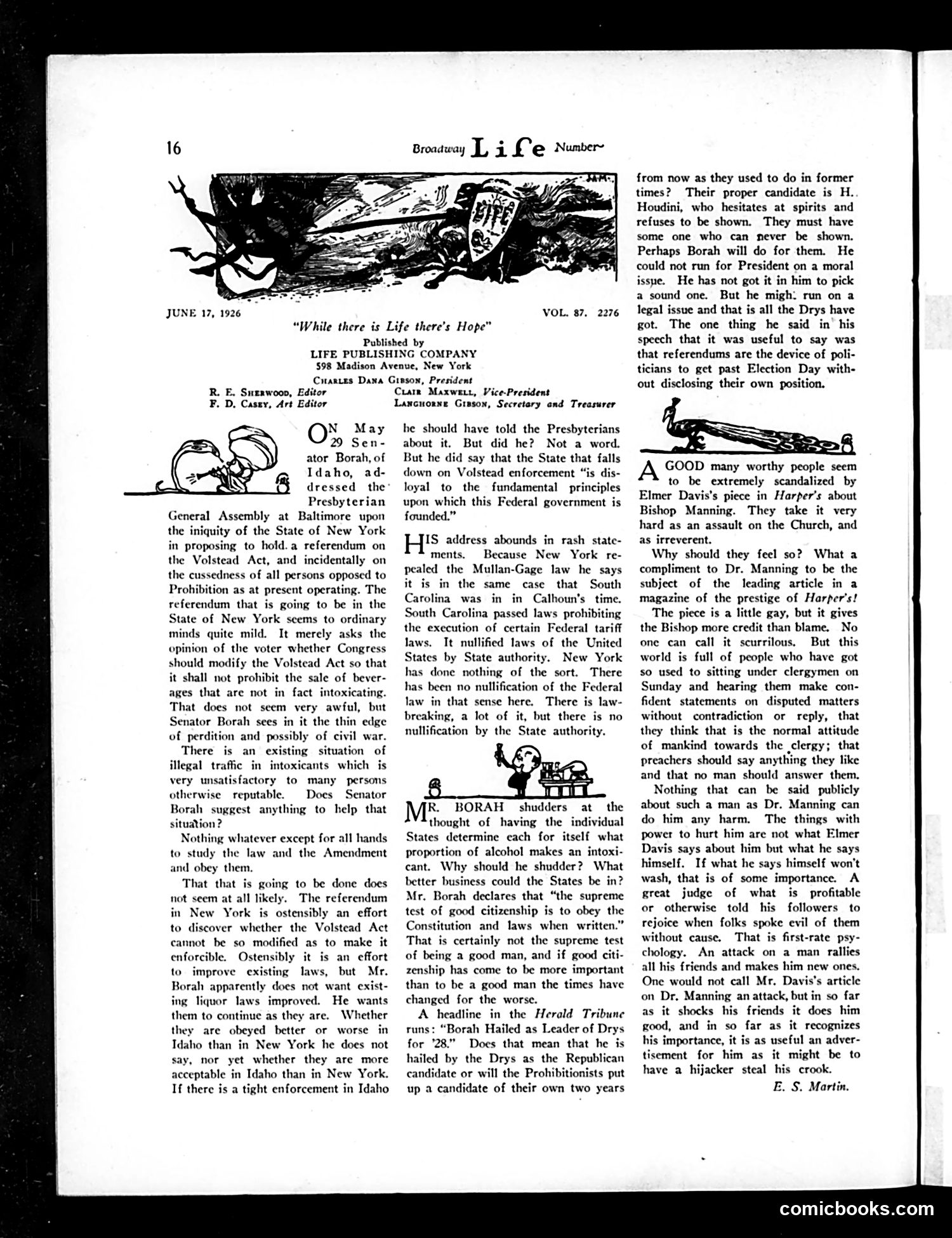
This page attacks Senator William Borah of Idaho for his zealous defense of Prohibition enforcement. The article critiques Borah's speech to the Presbyterian General Assembly, where he condemned New York's proposed referendum on modifying the Volstead Act (Prohibition law). The satire's key points: Borah demands absolute obedience to Prohibition laws while offering no solutions to widespread illegal liquor trafficking. The author mocks his comparison of New York to nullifying South Carolina, arguing New York merely repealed a state law—not defying federal authority. The piece culminates in sharp wit: suggesting Houdini (the famous illusionist who specialized in "never being shown") would be the Prohibitionists' ideal candidate, implying Borah himself—who won't acknowledge Prohibition's obvious failures—fits that description perfectly. The cartoon likely caricatures Borah or Prohibition advocates, though specific details are unclear from the image.
📄 Transcribed text from this page (OCR, searchable)
Machine-transcribed from the original scan — historical spelling and the odd misread are preserved.
JUNE 17, 1926 Broadway J, 3 f°@ Number VOL. 87, 2276 “While there is Life there’s Hope” Published by LIFE PUBLISHING COMPANY $98 Madison Avenue, New York Cuantas Dana Gtasom, President R. E. Suzrwoon, Editor F. D, Cassy, Art Editor N May 29 Sen- ator Borah, of Idaho, ad- dressed the Presbyterian General Assembly at Baltimore upon the iniquity of the State of New York in proposing to hold.a referendum on the Volstead Act, and incidentally on the cussedness of all persons opposed to Prohibition as at present operating. The referendum that is going to be in the State of New York scems to ordinary minds quite mild. It merely asks the opinion of the voter whether Congress should modify the Volstead Act so that it shall not prohibit the sale of bever- ages that are not in fact intoxicating. That does not seem very awful, but Senator Borah sees in it the thin edge of perdition and possibly of civil war. There is an existing situation of illegal traffic in intoxicants which is very unsatisfactory to many persons otherwise reputable. Does Senator Borah suggest anything to help that situation ? Nothing whatever except for all hands to study the law and the Amendment and obey them. That that is going to be done does not seem at all likely. The referendum in New York is ostensibly an effort to discover whether the Volstead Act cannot be so modified as to make it enforcible. Ostensibly it is an effort to improve existing laws, but Mr. Borah apparently does not want exist- ing liquor laws improved. He wants them to continue as they are. Whether they are obeyed better or worse in Idaho than in New York he does not say, nor yet whether they are more acceptable in Idaho than in New York. If there is a tight enforcement in Idaho Crate Maxwatt, Vice-President Lancuorne Grason, Secretary and Treasurer he should have told the Presbyterians about it. But did he? Not a word. But he did say that the State that falls down on Volstead enforcement dis- loyal to the fundamental principles upon which this Federal government is founded.” IS address abounds in rash state- ments. Because New York re- pealed the Mullan-Gage law he says it is in the same case that South Carolina was in in Calhoun's South Carolina passed laws prohibiting the execution of certain Federal tariff laws. It nullified laws of the United States by State authority. New York has done nothing of the sort. There has been no nullification of the Federal law in that sense here. There is law- breaking, a lot of it, but there is no nullification by the State authority. BORAH | shudders at the thought of having the individual States determine cach for itself what proportion of alcohol makes an intoxi- cant. Why should he shudder? What better business could the States be in? Mr. Borah declares that “the supreme test of good citizenship is to obey the Constitution and laws when written.” That is certainly not the supreme test of being a good man, and if good citi- zenship has come to be more important than to be a good man the times have changed for the worse. A headline in the Herald Tribune runs: “Borah Hailed as Leader of Drys for '28.” Does that mean that he is hailed by the Drys as the Republican candidate or will the Prohibitionists put up a candidate of their own two years from now as they used to do in former times? Their proper candidate is H. Houdini, who hesitates at spirits and refuses to be shown. They must have some one who can never be shown. Perhaps Borah will do for them. He could not run for President on a moral isspe. He has not got it in him to pick a sound one. But he migh: run on a legal issue and that is all the Drys have got. The one thing he said in’ his speech that it was useful to say was that referendums are the device of poli- ticians to get past Election Day with- out disclosing their own position. A GOOD many worthy people seem to be extremely scandalized by Elmer Davis’s piece in Harper's about Bishop Manning. They take it very hard as an assault on the Church, and as irreverent. Why should they feel so? What a compliment to Dr. Manning to be the subject of the leading article in a magazine of the prestige of Harper's! The piece is a little gay, but it gives the Bishop more credit than blame. No one can call it scurrilous, But this world is full of people who have got so used to sitting under clergymen on Sunday and hearing them make con- fident statements on disputed matters without contradiction or reply, that they think that is the normal attitude of mankind towards the clergy; that preachers should say anything they like and that no man should answer them. Nothing that can be said publicly about such a man as Dr. Manning can do him any harm. The things with power to hurt him are not what Elmer Davis says about him but what he says himself. If what he says himself won't wash, that is of some importance. A great judge of what is profitable or otherwise told his followers to rejoice when folks spoke evil of them without cause. That is first-rate psy- chology. An attack on a man rallies all his friends and makes him new ones. One would not call Mr. Davis's article on Dr, Manning an attack, but in so far as it shocks his friends it does him good, and in so far as it recognizes his importance, it is as useful an adver- tisement for him as it might be to have a hijacker steal his crook. E. S. Martin. comicbooks.com