
Life, 1926-06-17 · page 30 of 44
Life — June 17, 1926 — page 30: what you’re looking at
What you’re looking at
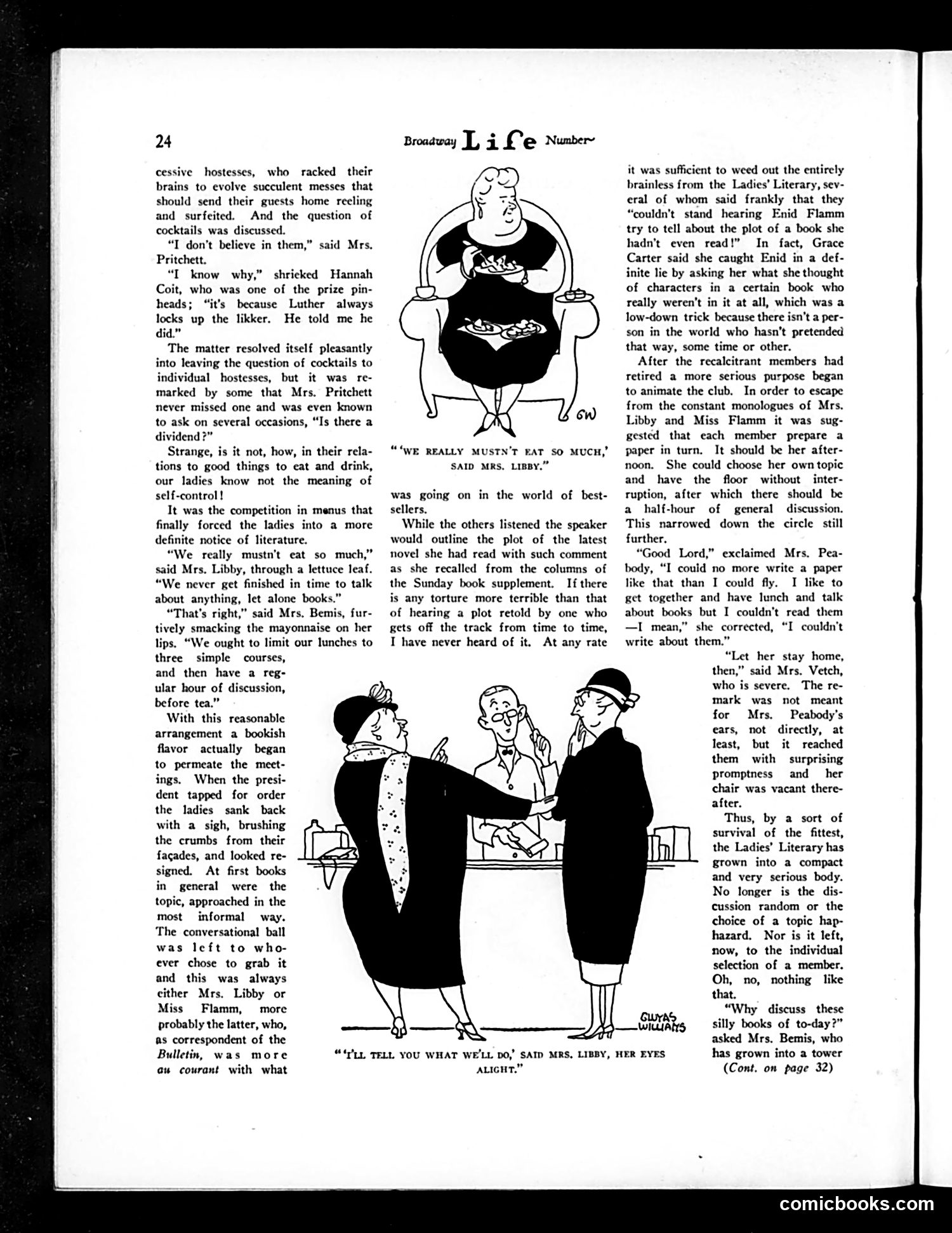
This satirical piece mocks the "Ladies' Literary" club—a social organization that pretends intellectual seriousness while revealing its members' contradictions. **The Satire:** The women claim they need to discuss books instead of eating, yet they're constantly eating while talking. Mrs. Libby and Miss Flamm dominate conversations by summarizing bestsellers from Sunday newspaper supplements, often inaccurately. When one member (Grace Carter) catches Enid Flamm lying about a book's characters, the text notes everyone pretends to have read books they haven't—making the accusation hypocritical. **The Point:** The club evolves from chaotic lunch discussion into a "serious body," but this seriousness is performative. Members panic when required to write original papers, revealing they attend for social status and gossip, not genuine intellectual engagement. **The Cartoons:** Show Mrs. Libby eating while insisting they mustn't eat much, and the women eagerly planning their new "serious" structure—illustrating the gap between stated intentions and actual behavior. This reflects early 20th-century satire on women's clubs and performative intellectualism.
📄 Transcribed text from this page (OCR, searchable)
Machine-transcribed from the original scan — historical spelling and the odd misread are preserved.
24 cessive hostesses, who racked their brains to evolve succulent messes that should send their guests home reeling and surfeited. And the question of cocktails was discussed. “I don’t believe in them,” said Mrs, Pritchett. “I know why,” shricked Hannah Coit, who was one of the prize pin- heads; “it’s because Luther always locks up the likker. He told me he did.” The matter resolved itself pleasantly into leaving the question of cocktails to individual hostesses, but it was re- marked by some that Mrs. Pritchett never missed one and was even known to ask on several occasions, “Is there a dividend ?” Strange, is it not, how, in their rela- tions to good things to eat and drink, our ladies know not the meaning of self-control! It was the competition in menus that finally forced the ladies into a more definite notice of literature. “We really mustn't eat so much,” said Mrs. Libby, through a lettuce leaf. “We never get finished in time to talk about anything, let alone books.” “That's right,” said Mrs, Bemis, fur- tively smacking the mayonnaise on her lips. “We ought to limit our lunches to three simple courses, and then have a reg- ular hour of discussion, before tea.” With this reasonable arrangement a bookish flavor actually began to permeate the mect- ings. When the presi- dent tapped for order the ladies sank back with a sigh, brushing the crumbs from their fagades, and looked re- signed. At first books in general were the topic, approached in the most informal way. The conversational ball was left to who- ever chose to grab it and this was always either Mrs, Libby or Miss Flamm, more probably the latter, who, as correspondent of the Bulletin, was more Gu courant with what Broadway L i Le Numbery WE REALLY MUSTN'T EAT SO MUCH, SAID MRS. LIBBY.” was going on in the world of best- sellers. While the others listened the speaker would outline the plot of the latest novel she had read with such comment as she recalled from the columns of the Sunday book supplement. If there is any torture more terrible than that of hearing a plot retold by one who gets off the track from time to time, I have never heard of it. At any rate “PLL TELL YOU WHAT WE'LL DO,’ SAID MRS, LIBBY, HER EYES ALIGHT.” it was sufficient to weed out the entirely brainless from the Ladies’ Literary, sev- eral of whom said frankly that they “couldn't stand hearing Enid Flamm try to tell about the plot of a book she hadn't even read!” In fact, Grace Carter said she caught Enid in a def- inite lie by asking her what she thought of characters in a certain book who really weren't in it at all, which was a low-down trick because there isn’t a per- son in the world who hasn't pretended that way, some time or other. After the recalcitrant members had retired a more serious purpose began to animate the club. In order to escape from the constant monologues of Mrs. Libby and Miss Flamm it was sug- gested that each member prepare a paper in turn. It should be her after- noon. She could choose her own topic and have the floor without inter- ruption, after which there should be a half-hour of general discussion. This narrowed down the circle still further. “Good Lord,” exclaimed Mrs. Pea- body, “I could no more write a paper like that than I could fly. I like to get together and have lunch and talk about books but I couldn't read them —I mean,” she corrected, “I couldn't write about them.” “Let her stay home, then,” said Mrs. Vetch, who is severe. The re- mark was not meant for Mrs. Peabody's ears, not directly, at Teast, but it reached them with surprising promptness and her chair was vacant there- after. Thus, by a sort of survival of the fittest, the Ladies’ Literary has grown into a compact and very serious body. No longer is the dis- cussion random or the choice of a topic hap- hazard. Nor is it left, now, to the individual selection of a member. Oh, no, nothing like that. “Why discuss these silly books of to-day?” asked Mrs. Bemis, who has grown into a tower (Cont, on page 32) comicbooks.com