
Life, 1926-06-17 · page 32 of 44
Life — June 17, 1926 — page 32: what you’re looking at
What you’re looking at
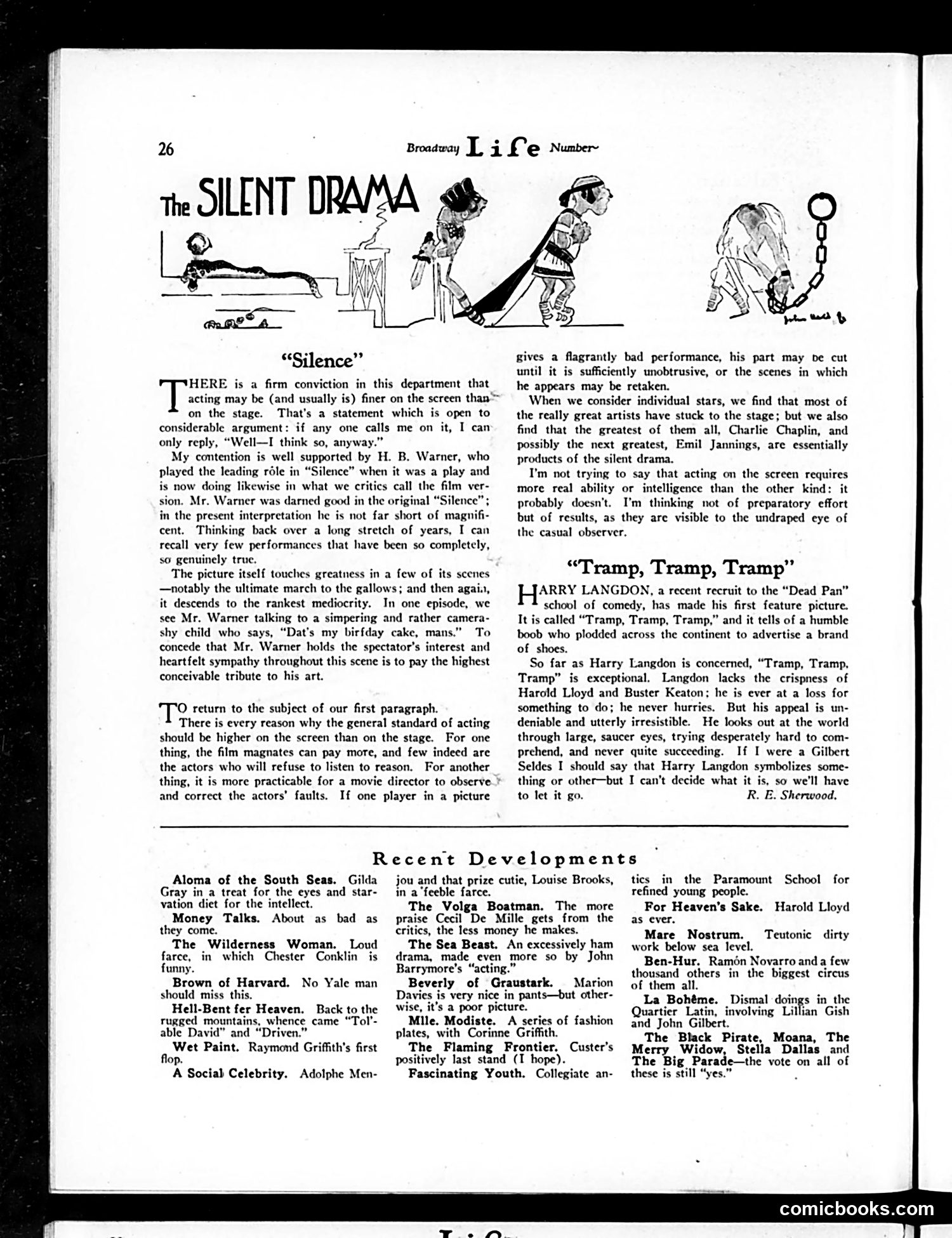
This page from *Life* magazine discusses silent film acting, comparing screen performance to stage work. The cartoons at the top illustrate the article's theme through visual gags about silent acting—showing exaggerated physical comedy and pantomime that characterized silent films. The main article praises H.B. Warner's performance in the film version of "Silence," arguing that screen acting can surpass stage acting because directors can edit out poor performances or reshoot scenes. The author highlights Charlie Chaplin and Emil Jannings as cinema's greatest actors. A secondary review discusses Harry Langdon's film "Tramp, Tramp, Tramp," comparing him unfavorably to Harold Lloyd and Buster Keaton but praising his "saucer eyes" and desperate attempts at comprehension—physical comedy traits essential to silent film's appeal. The "Recent Developments" section briefly reviews current films, using quick, often sardonic assessments typical of *Life*'s humorous criticism style.
📄 Transcribed text from this page (OCR, searchable)
Machine-transcribed from the original scan — historical spelling and the odd misread are preserved.
2% Broadway TL i (@ Number the SILENT DRAMA acting may be (and usually is) finer on the screen than= "Twine is a firm conviction in this department that on the stage. That's a statement which is open to considerable argument: if any one calls me on it, I can only reply, “Well—I think so, anyway.” My contention is well supported by H. B. Warner, who played the leading rdle in “Silence” when it was a play and is now doing likewise in what we critics call the film ver- sion. Mr. Warner was darned good in the original “Silence” ; in the present interpretation he is not far short of magnifi- cent. Thinking back over a long stretch of years, I can recall very few performances that have been so completely, so genuinely true. The picture itself touches greatness in a few of its scenes —notably the ultimate march to the gallows; and then again, it descends to the rankest mediocrity. In one episode, we see Mr. Warner talking to a simpering and rather camera- shy child who says, “Dat's my birfday cake, mans.” To concede that Mr. Warner holds the spectator’s interest and heartfelt sympathy throughout this scene is to pay the highest conceivable tribute to his art. T° return to the subject of our first paragraph. There is every reason why the general standard of acting should be higher on the screen than on the stage. For one thing, the film magnates can pay more, and few indeed are the actors who will refuse to listen to reason. For another thing, it is more practicable for a movie director to observe gives a flagrantly bad performance, his part may be cut until it is sufficiently unobtrusive, or the scenes in which he appears may be retaken. When we consider individual stars, we find that most of the really great artists have stuck to the stage; but we also find that the greatest of them all, Charlie Chaplin, and possibly the next greatest, Emil Jannings, are essentially products of the silent drama. I'm not trying to say that acting on the screen requires more real ability or intelligence than the other kind: it probably doesn’t. I'm thinking not of preparatory effort but of results, as they are visible to the undraped eye of the casual observer, “Tramp, Tramp, Tramp” ARRY LANGDON, a recent recruit to the “Dead Pan” school of comedy, has made his first feature picture. It is called “Tramp, Tramp, Tramp,” and it tells of a humble boob who plodded across the continent to advertise a brand of shoes. So far as Harry Langdon is concerned, “Tramp, Tramp, Tramp” is exceptional. Langdon lacks the crispness of Harold Lloyd and Buster Keaton; he is ever at a loss for something to do; he never hurries. But his appeal is un- deniable and utterly irresistible. He looks out at the world through large, saucer eyes, trying desperately hard to com- prehend, and never quite succeeding. If I were a Gilbert Seldes I should say that Harry Langdon symbolizes some- thing or other—but I can’t decide what it is, so we'll have and correct the actors’ faults. If one player in a picture to let it go. R. E. Sherwood. Recent Developments Aloma of the South Seas. Gilda Gray in a treat for the eyes and star- vation diet for the intellect. Money Talks. About as bad as they come. The Wilderness Woman. Loud farce, in which Chester Conklin is funny. Brown of Harvard. No Yale man should miss this. Hell-Bent fer Heaven. Back to the rugged mountains, whence came “Tol’- able David” and “Driven.” A Wet Paint. Raymond Griffith's first lop. A Social Celebrity. Adolphe Men- jou and that prize cutie, Louise Brooks, in a ‘feeble farce. The Volga Boatman. The more praise Cecil De Mille gets from the critics, the less money he makes. The Sea Beast. An excessively ham drama, made even more so by John Barrymore's “acting.” Beverly of Graustark. Marion Davies is very nice in pants—but other- wise, it’s a poor picture. Mile. Modiste. A series of fashion plates, with Corinne Griffith. The Flaming Frontier, Custer’s positively last stand (I hope). Fascinating Youth. Collegiate an- tics in the Paramount refined young people. For Heaven's Sake. as ever. Mare Nostrum. work below sea level. Ben-Hur. Ramon Novarro anda few thousand others in the biggest circus of them all. La Bohéme. Dismal doings in_the Quartier Latin, involving Lillian Gish and John Gilbert. The Black Pirate, Moana, The Merry Widow, Stella Dallas and The Big Parade—the vote on all of these is still “yes.” School for Harold Lloyd Teutonic dirty comicbooks.com