
Life, 1926-06-17 · page 29 of 44
Life — June 17, 1926 — page 29: what you’re looking at
What you’re looking at
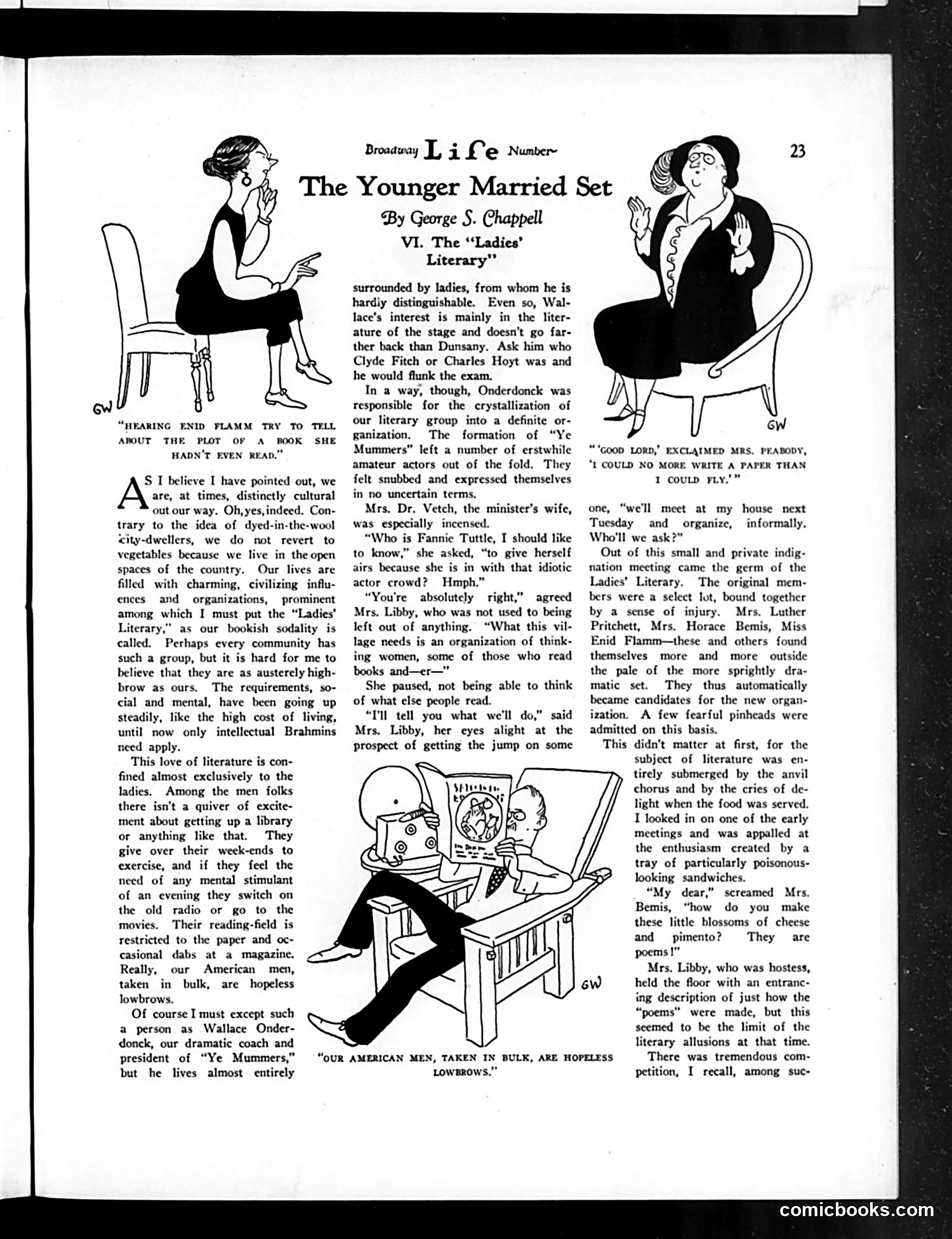
This 1920s satirical article mocks suburban wives' pretensions to intellectualism. The "Ladies' Literary" club ostensibly forms to discuss serious literature, but the text reveals its actual purpose: social status-seeking and exclusion. The cartoons illustrate the absurdity: one woman tries to discuss a book she hasn't read; another exclaims she could no more write a paper than fly—yet both belong to this supposedly highbrow group. The satire targets: - **Male indifference**: American men are "hopeless lowbrows" who prefer radio and movies to books - **Female pretension**: Women organize an intellectual club motivated by wounded pride (exclusion from a drama group) rather than genuine literary interest - **Class anxiety**: Members obsess over who deserves membership, treating the club as exclusive social currency The joke is that beneath claims of cultural sophistication lies shallow social climbing and performative intellectualism—women performing "serious" pursuits to appear cultivated while actually caring more about gossip, food, and status.
📄 Transcribed text from this page (OCR, searchable)
Machine-transcribed from the original scan — historical spelling and the odd misread are preserved.
Broadway L ife Number~ The Younger Married Set “HEARING ENID FLAMM TRY TO TELL APOUT THE PLOT OF A BOOK SHE HADN'T EVEN READ.” S I believe I have pointed out, we A« at times, distinctly cultural out our way. Oh,yes, indeed. Con- trary to the idea of dyed-in-the-wool <ity-dwellers, we do not revert to vegetables because we live in the open spaces of the country. Our lives are filled with charming, civilizing influ- ences and organizations, prominent among which I must put the “Ladies’ Literary,” as our bookish sodality is called. Perhaps every community has such a group, but it is hard for me to believe that they are as austerely high- brow as ours. The requirements, so- cial and mental, have been going up steadily, like the high cost of living, until now only intellectual Brahmins need apply. This love of literature is con- fined almost exclusively to the ladies. Among the men folks there isn’t a quiver of excite- ment about getting up a library or anything like that. They give over their week-ends to exercise, and if they feel the need of any mental stimulant of an evening they switch on the old radio or go to the movies. Their reading-field is restricted to the paper and oc- casional dabs at a magazine. Really, our American men, taken in bulk, are hopeless lowbrows. Of course I must except such a person as Wallace Onder- donck, our dramatic coach and president of “Ye Mummers,” but he lives almost entirely By George S. Chappell VI. The ‘‘Ladies’ Literary” surrounded by ladies, from whom he is hardly distinguishable. Even so, Wal- lace’s interest is mainly in the liter- ature of the stage and doesn't go far- ther back than Dunsany. Ask him who Clyde Fitch or Charles Hoyt was and he would flunk the exam. In a way, though, Onderdonck was responsible for the crystallization of our literary group into a definite or- ganization. The formation of “Ye Mummers” left a number of erstwhile amateur actors out of the fold. They felt snubbed and expressed themselves in no uncertain terms. Mrs. Dr. Vetch, the minister’s wife, was especially incensed. “Who is Fannie Tuttle, I should like to know,” she asked, “to give herself airs because she is in with that idiotic actor crowd? Hmph.” “You're absolutely right,” agreed Mrs. Libby, who was not used to being left out of anything. “What this vil- lage needs is an organization of think- ing women, some of those who read books and—er—"” She paused, not being able to think of what else people read. “I'll tell you what we'll do,” said Mrs. Libby, her eyes alight at the prospect of getting the jump on some “OUR AMERICAN MEN, TAKEN IN BULK, ARE HOPELESS LOwBROWS.” ‘GOOD LORD,’ EXCLAIMED MRS, PEABODY, “1 COULD NO MORE WRITE A PAPER THAN 1 couLp FLy.’” one, “we'll meet at my house next Tuesday and organize, informally. Who'll we ask?” Out of this small and private indig- nation mecting came the germ of the Ladies’ Literary. The original mem- bers were a select lot, bound together by a sense of injury. Mrs. Luther Pritchett, Mrs. Horace Bemis, Miss Enid Flamm—these and others found themselves more and more outside the pale of the more sprightly dra- matic set. They thus automatically became candidates for the new organ- ization. A few fearful pinheads were admitted on this basis. This didn’t matter at first, for the subject of literature was en- tirely submerged by the anvil chorus and by the cries of de- light when the food was served. I looked in on one of the early meetings and was appalled at the enthusiasm created by a tray of particularly poisonous- looking sandwiches. “My dear,” screamed Mrs. Bemis, “how do you make these little blossoms of cheese and pimento? They are poems!" Mrs, Libby, who was hostess, held the floor with an entranc- ing description of just how the “poems” were made, but this seemed to be the limit of the literary allusions at that time. There was tremendous com- petition, I recall, among suc- comicbooks.com