
A complete issue · 52 pages · 1926
Life — May 13, 1926
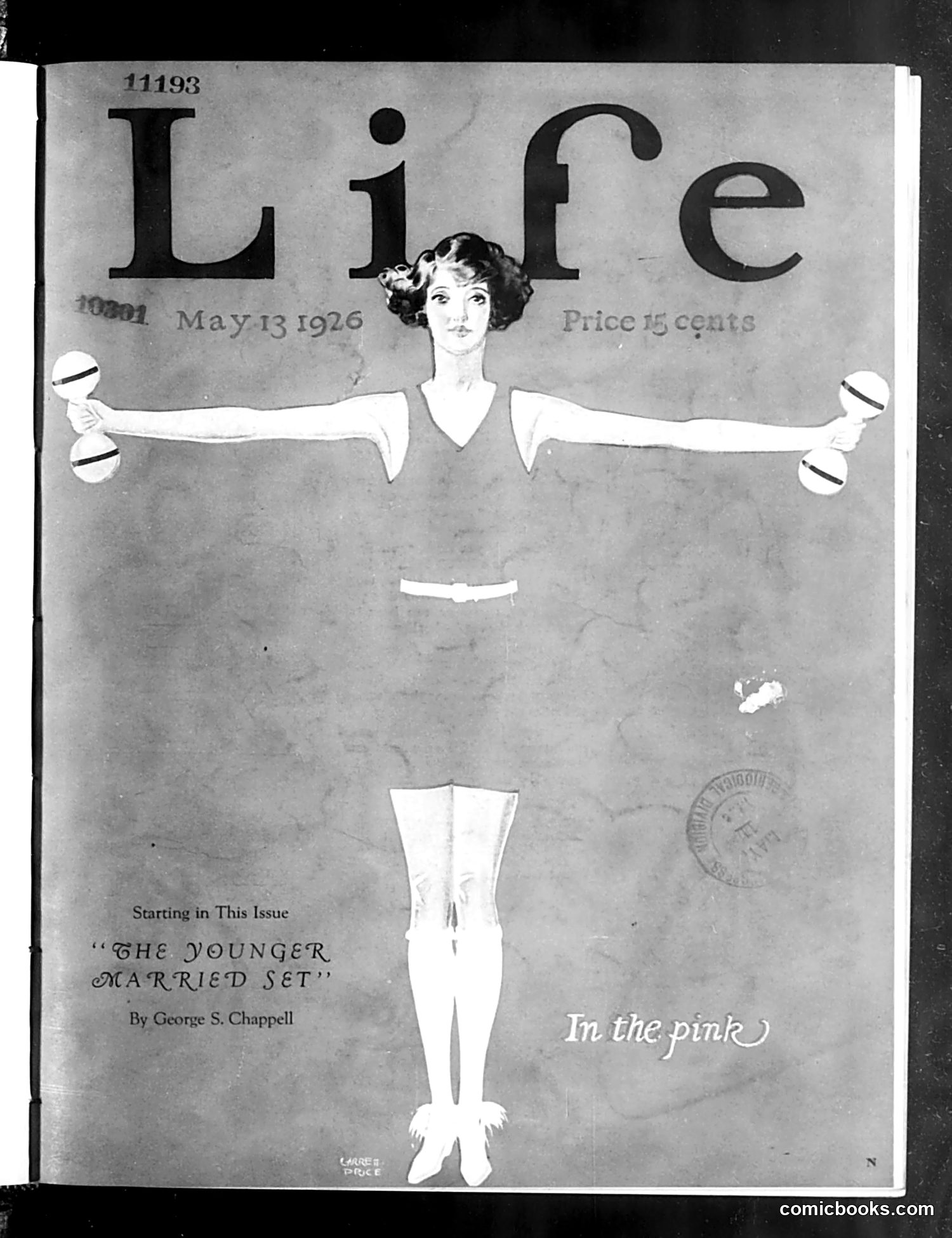
This is a cover illustration, not a political cartoon. It depicts a stylized 1920s woman in a sleeveless athletic pose, holding dumbbells with outstretched arms. The design exemplifies the "modern woman" aesthetic of the Jazz Age—athletic, confident, and liberated from Victorian constraints. The phrase "In the pink" (meaning in excellent health/condition) connects the image to contemporary wellness culture. The cover advertises a serialized story, "The Younger Married Set" by George S. Chappell, suggesting the magazine's focus on contemporary social life and modern relationships. The illustration reflects 1920s fascination with physical fitness, women's independence, and the cultural shift toward more active, less corseted femininity—themes central to the era's social commentary.
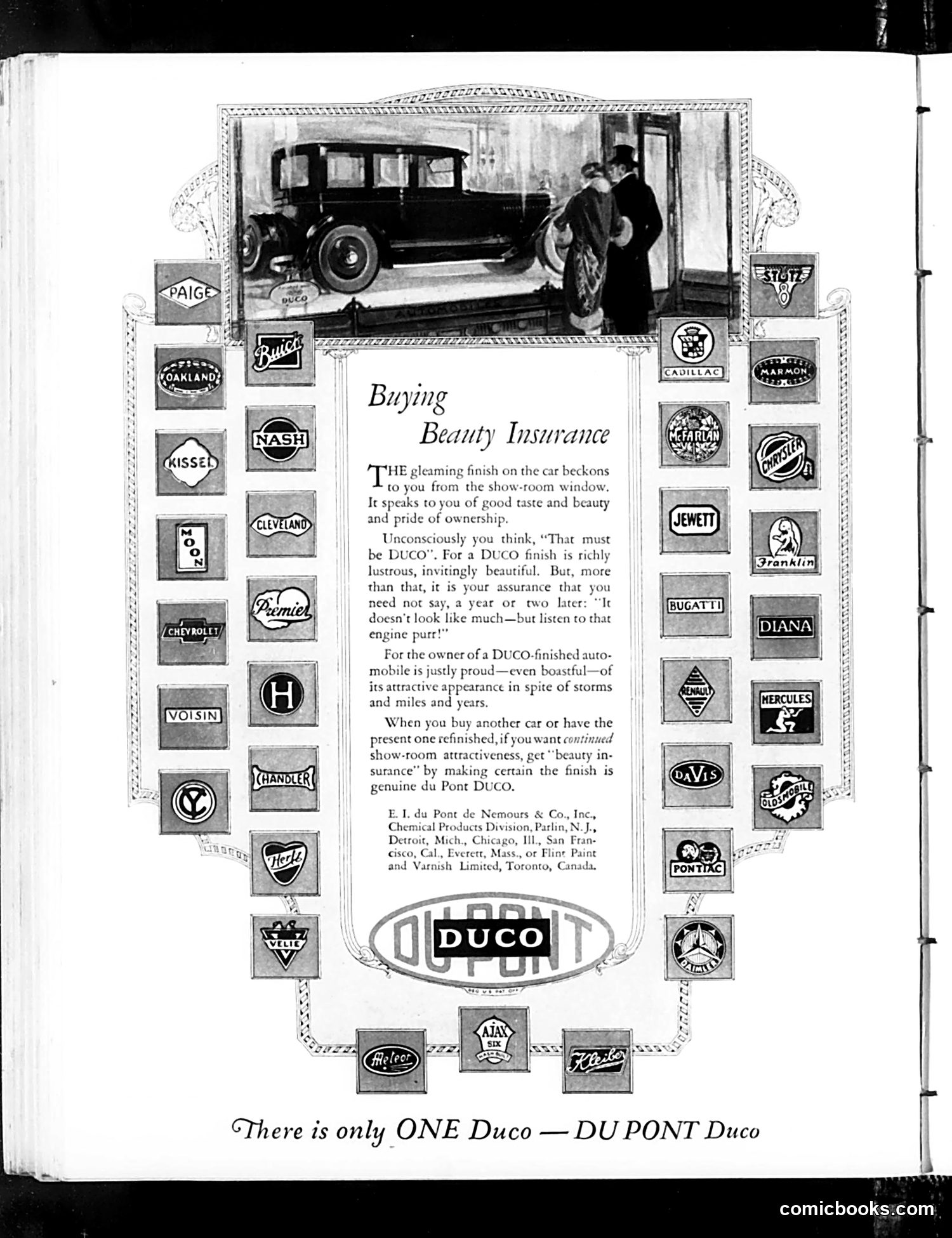
This is **not a political cartoon** but rather a **full-page advertisement** for DuPont's Duco automotive lacquer finish. The page promotes Duco as a premium car coating that provides both aesthetic beauty and practical protection. The central image shows a well-dressed couple admiring a glossy black automobile in a showroom, emphasizing how the finish conveys "good taste and beauty and pride of ownership." Surrounding the text are logos of major automobile manufacturers (Cadillac, Packard, Buick, Franklin, etc.) who used Duco finishes. The satirical element is minimal—the phrase "beauty insurance" humorously frames the coating as protective assurance rather than mere cosmetics. The ad targets wealthy car buyers concerned with maintaining their vehicles' showroom appearance.
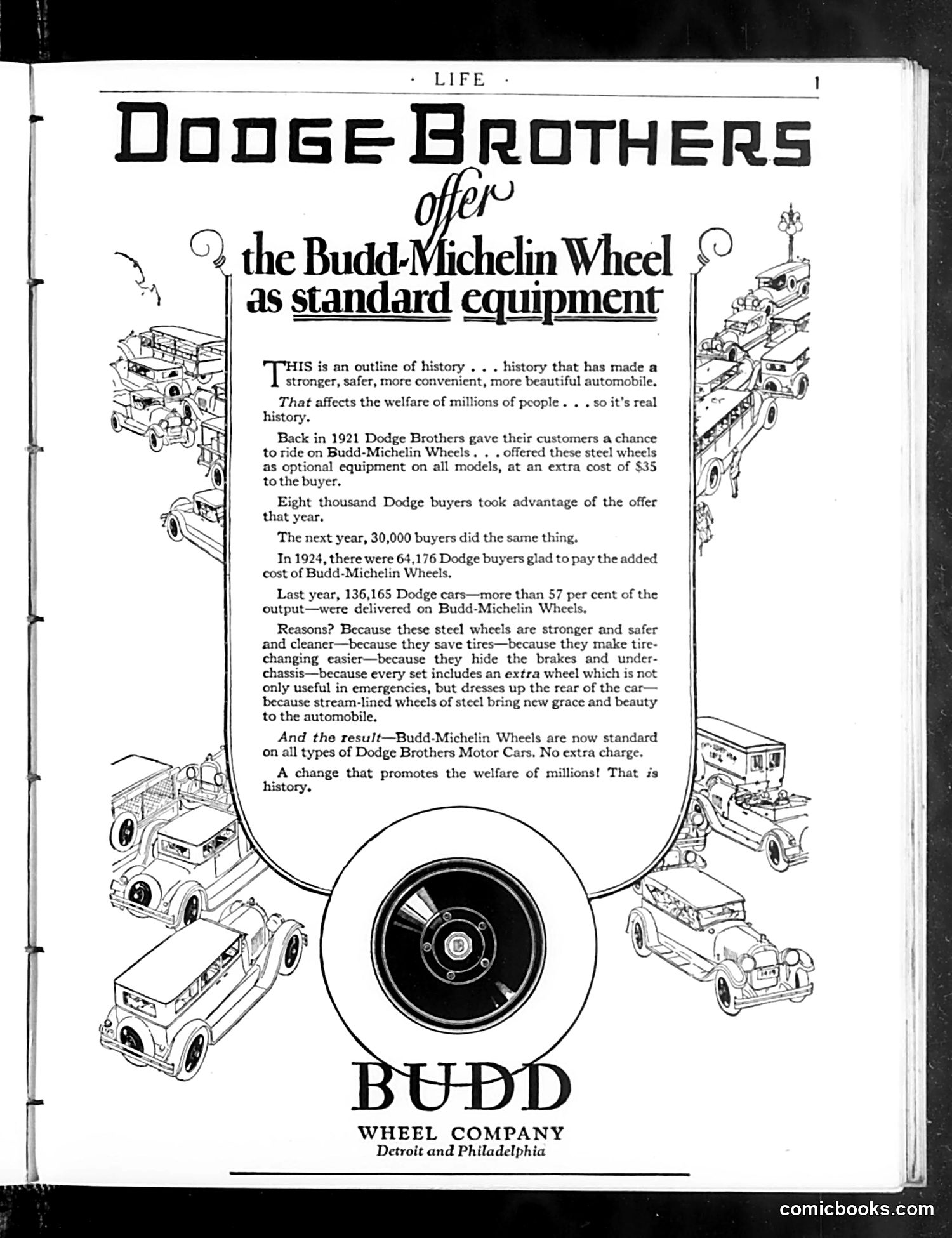
This is **not satire or a cartoon**—it's a straightforward **advertisement** for Budd-Michelin Wheels as optional equipment for Dodge Brothers automobiles. The page presents a business history: Dodge Brothers offered steel wheels in 1921 ($35 extra), and adoption grew dramatically (8,000 buyers first year, 30,000 the next, 64,176 by 1924, then 136,165 by "last year"). The ad argues these wheels became so popular they're now **standard equipment at no extra cost**. The surrounding illustrations show various Dodge vehicle models. The central wheel image dominates the composition, emphasizing the product's importance. This reflects early automotive marketing: documenting a feature's growing consumer acceptance to justify standardization. No satire is present—Life magazine ran advertisements alongside editorial content.
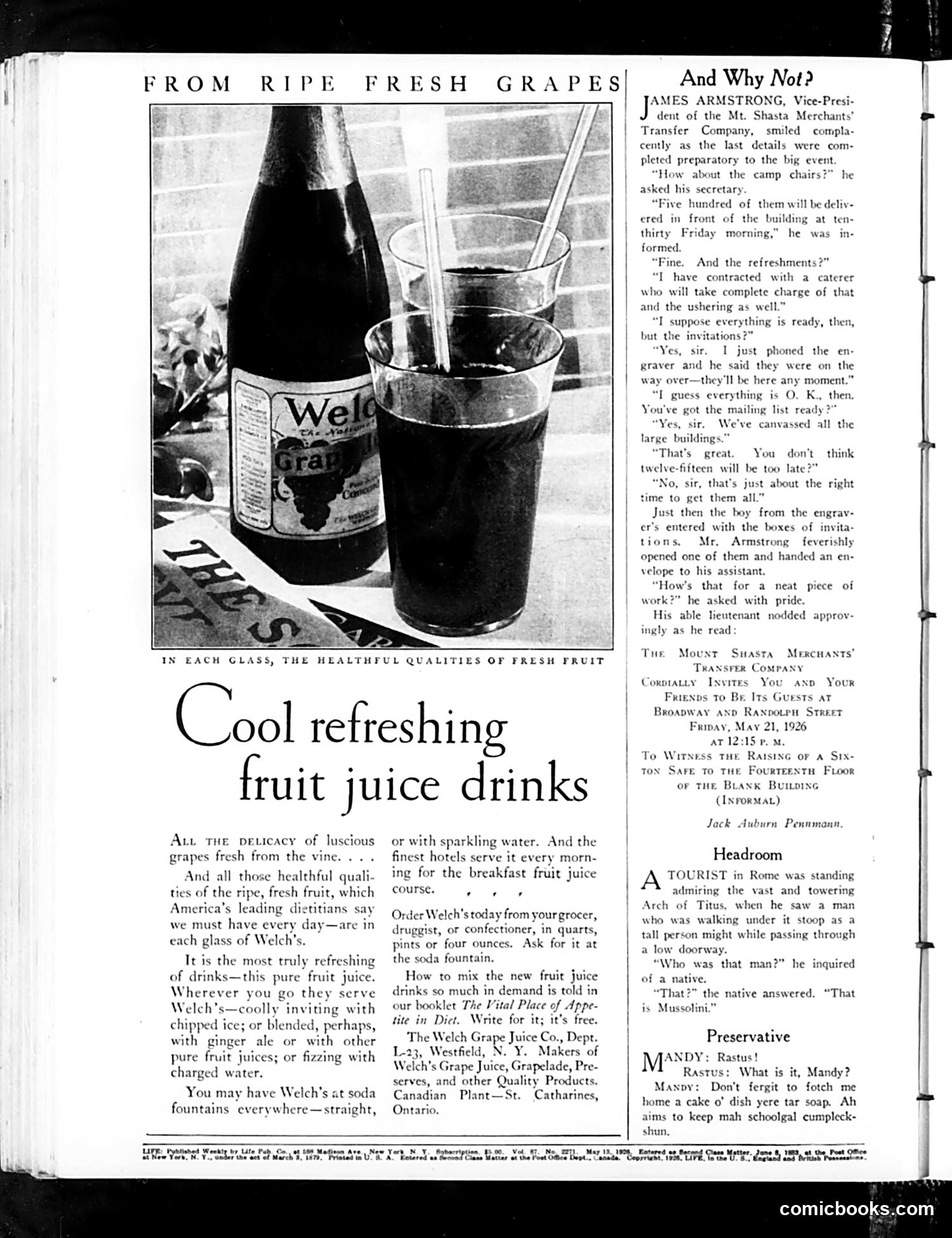
This page is primarily **advertising**, not political satire. The left side features a Welch's Grape Juice advertisement promoting "cool refreshing fruit juice drinks" available at soda fountains and through grocers. The copy emphasizes the product's healthful qualities and refreshment value. The right side contains three unrelated short items: a humorous dialogue about business event planning by James Armstrong; a society invitation to a building dedication on May 21, 1926; and two brief humor pieces titled "Headroom" and "Preservative"—standard filler content for Life magazine. There is no political cartoon or significant satire present. This represents typical 1920s magazine layout mixing advertisements with light comedic pieces.
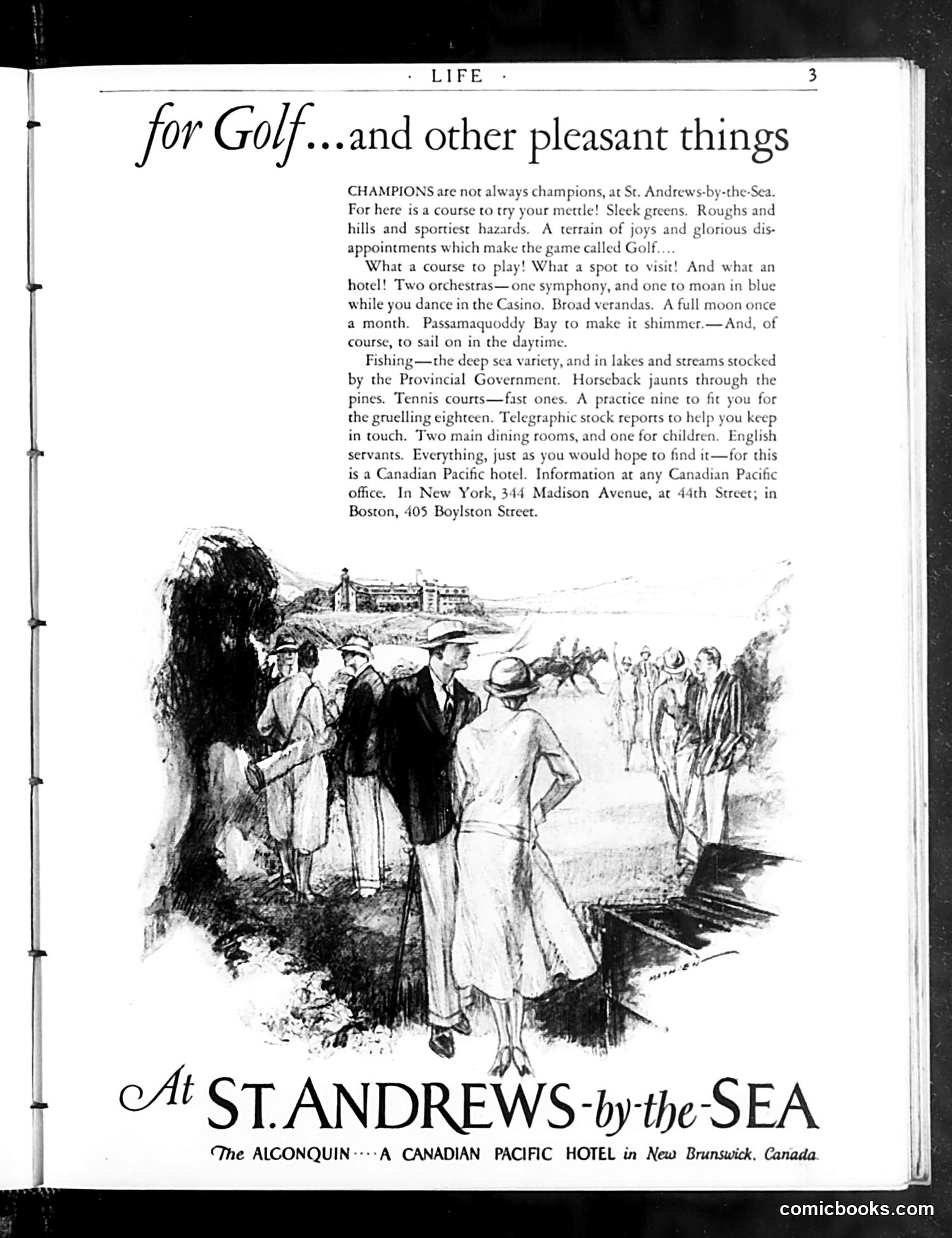
This page is **primarily an advertisement**, not satirical content. It promotes the Alconquin, a Canadian Pacific Hotel at St. Andrews-by-the-Sea in New Brunswick, Canada. The sketch depicts well-dressed golfers and spectators at a golf course, with the hotel visible in the background. The accompanying text emphasizes leisure activities—golf, dancing, fishing, tennis, horseback riding—positioning the resort as an exclusive destination for affluent travelers. The "satire" is gentle and commercial rather than political: the headline jokes that even golf champions will find the course challenging ("not always champions"). This is simply aspirational marketing aimed at wealthy Americans, highlighting the hotel's amenities and featuring period-appropriate fashion and leisure pursuits typical of 1920s-era advertising in *Life* magazine.
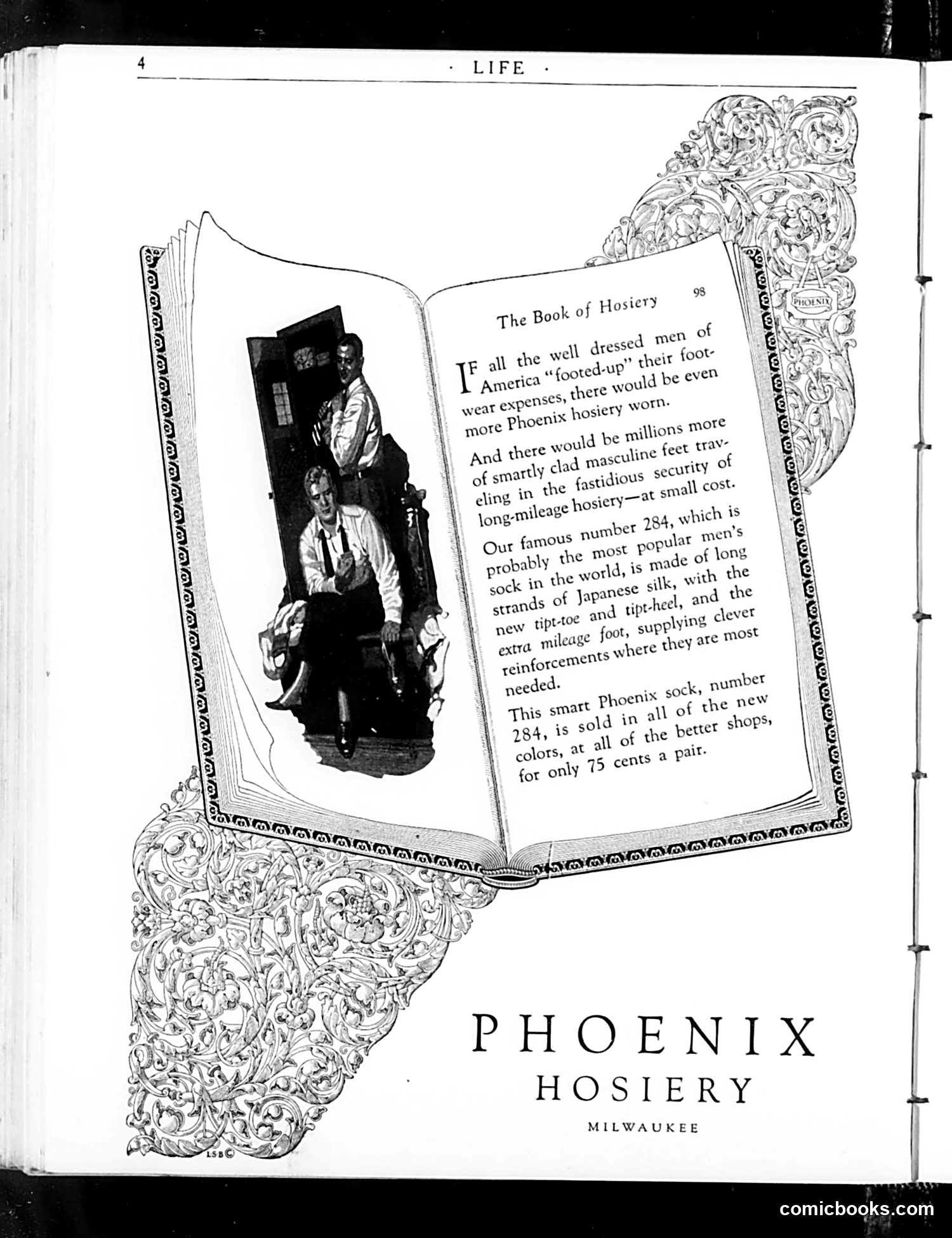
This page is primarily **advertising, not satire or political commentary**. It's a full-page advertisement for Phoenix Hosiery from Milwaukee. The image shows an illustration of well-dressed men in formal attire (appearing to be from the early 1900s based on style). The accompanying text is a sales pitch promoting Phoenix brand socks, specifically their famous "number 284" model made from Japanese silk. The advertisement uses hyperbolic language typical of early 20th-century marketing—claiming that if all well-dressed American men wore Phoenix hosiery, there would be "millions more" smartly-clad masculine feet. The product costs 75 cents per pair. This is straightforward commercial content, not editorial cartooning or satire.
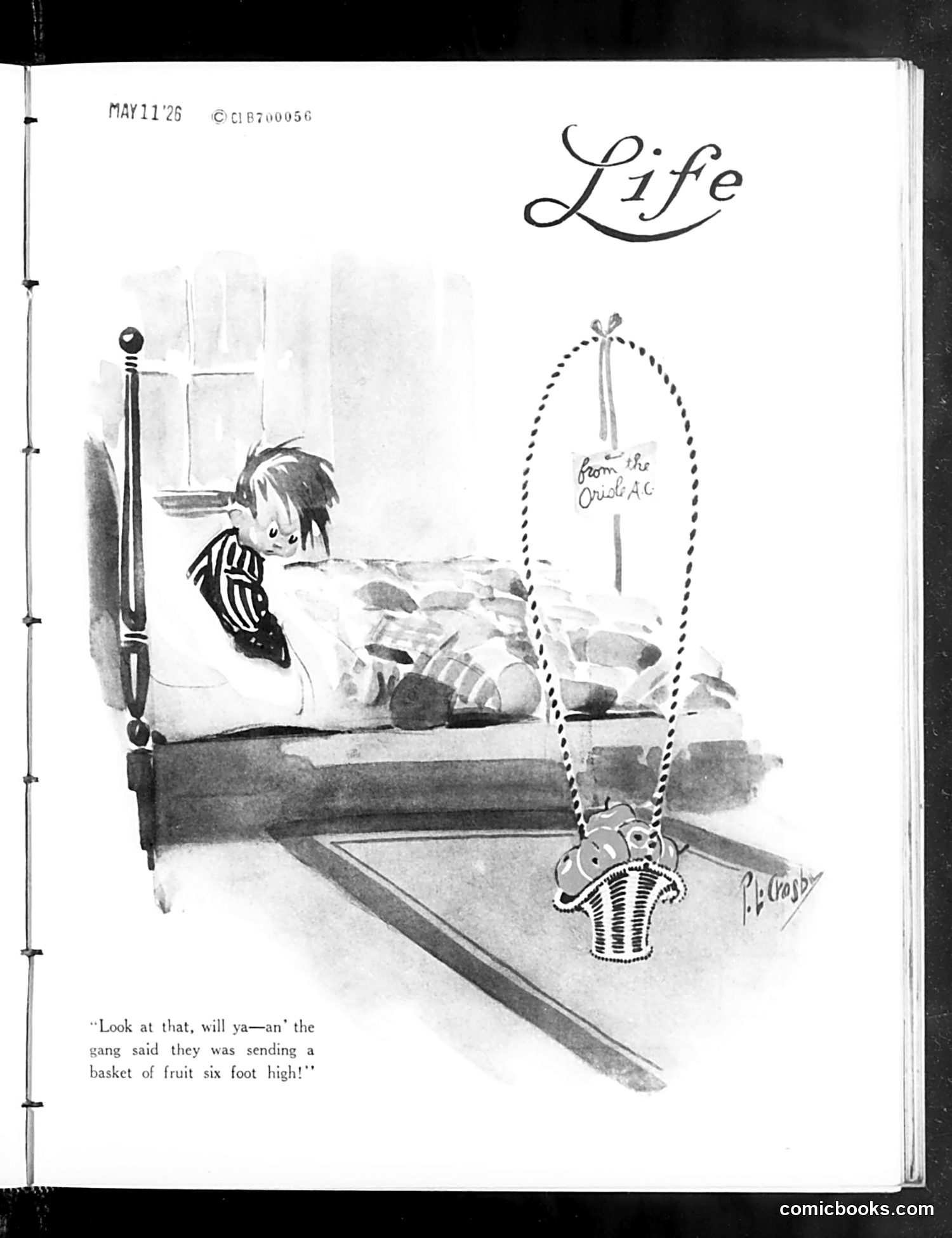
This page from *Life* magazine features a satirical cartoon about a funeral or memorial service. A young boy kneels beside a coffin marked "From Orsie A.C." (likely a sports club or organization), while an ornate flower basket hangs above. The caption quotes gang members mocking the excessive gesture: "Look at that, will ya—an' the gang said they was sending a basket of fruit six foot high!" The satire targets the contrast between criminals' pretensions to respectability and their actual uncouth nature. The gang members attempt to show honor through an absurdly oversized floral tribute, revealing their fundamental lack of taste and understanding of proper funeral etiquette. The joke plays on working-class/criminal culture's exaggerated displays meant to demonstrate sophistication or loyalty.
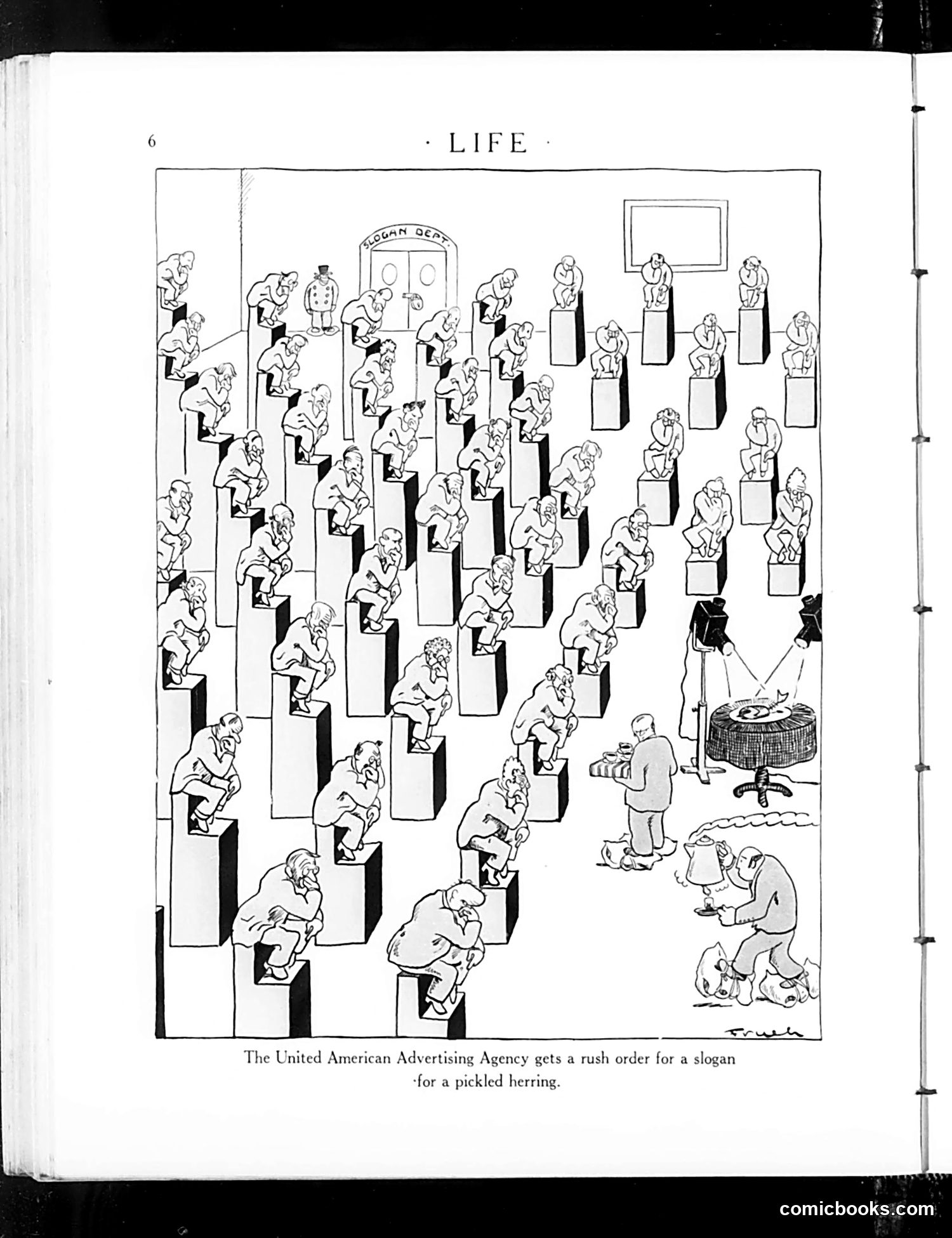
This is a satirical cartoon from *Life* magazine depicting the United States Advertising Agency receiving "a rush order for a slogan for a pickled herring." The humor works on multiple levels: The cartoon shows dozens of businessmen in cubicles, all hunched over in identical poses of deep concentration—suggesting the absurdity of applying industrial-scale corporate problem-solving to a trivial marketing task. The elaborate office infrastructure and serious demeanor of workers contrast sharply with the mundane product (pickled herring). The satire mocks 1920s-30s advertising culture: the notion that any consumer good, no matter how ordinary, requires intense creative effort and corporate machinery to sell. It's a commentary on American consumer capitalism and advertising's inflated self-importance during this era.
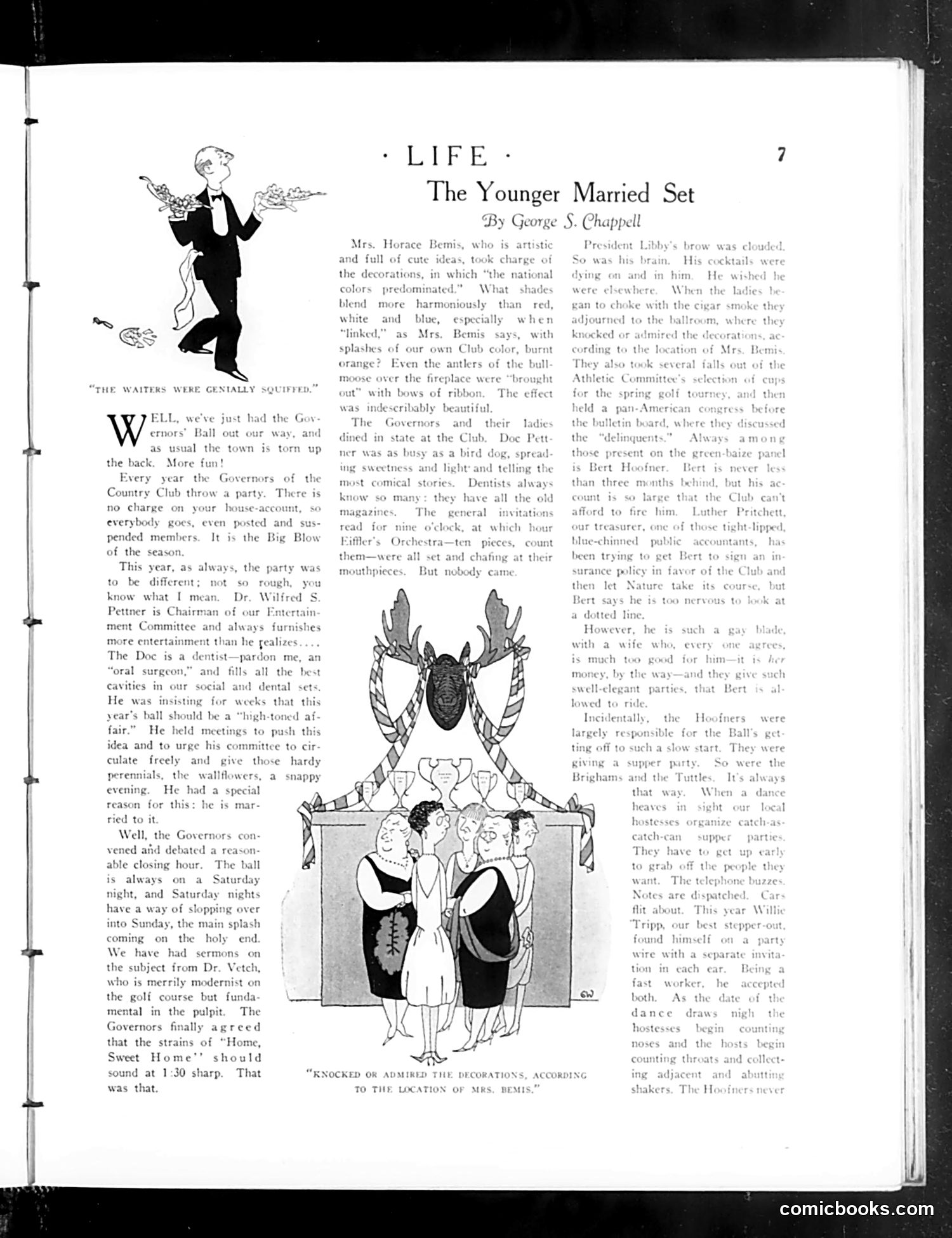
This satirical article describes the annual Governors Ball at an unnamed country club. The text mocks the "younger married set"—affluent young couples who attend such social events. The satire targets their pretentiousness: elaborate decorations using the club's colors, cocktail culture, and their self-important behaviors. Specific jabs include mocking a dentist member for boasting endlessly, critiquing wives who organize elaborate parties, and ridiculing "fast workers" who aggressively pursue social connections via telephone. The illustrations show decorative details and couples admiring the ballroom decorations. The humor lies in exposing the superficiality and status-anxiety of upper-class social climbers obsessed with elaborate entertaining and social positioning. It's vintage *Life* magazine social satire targeting American club society.
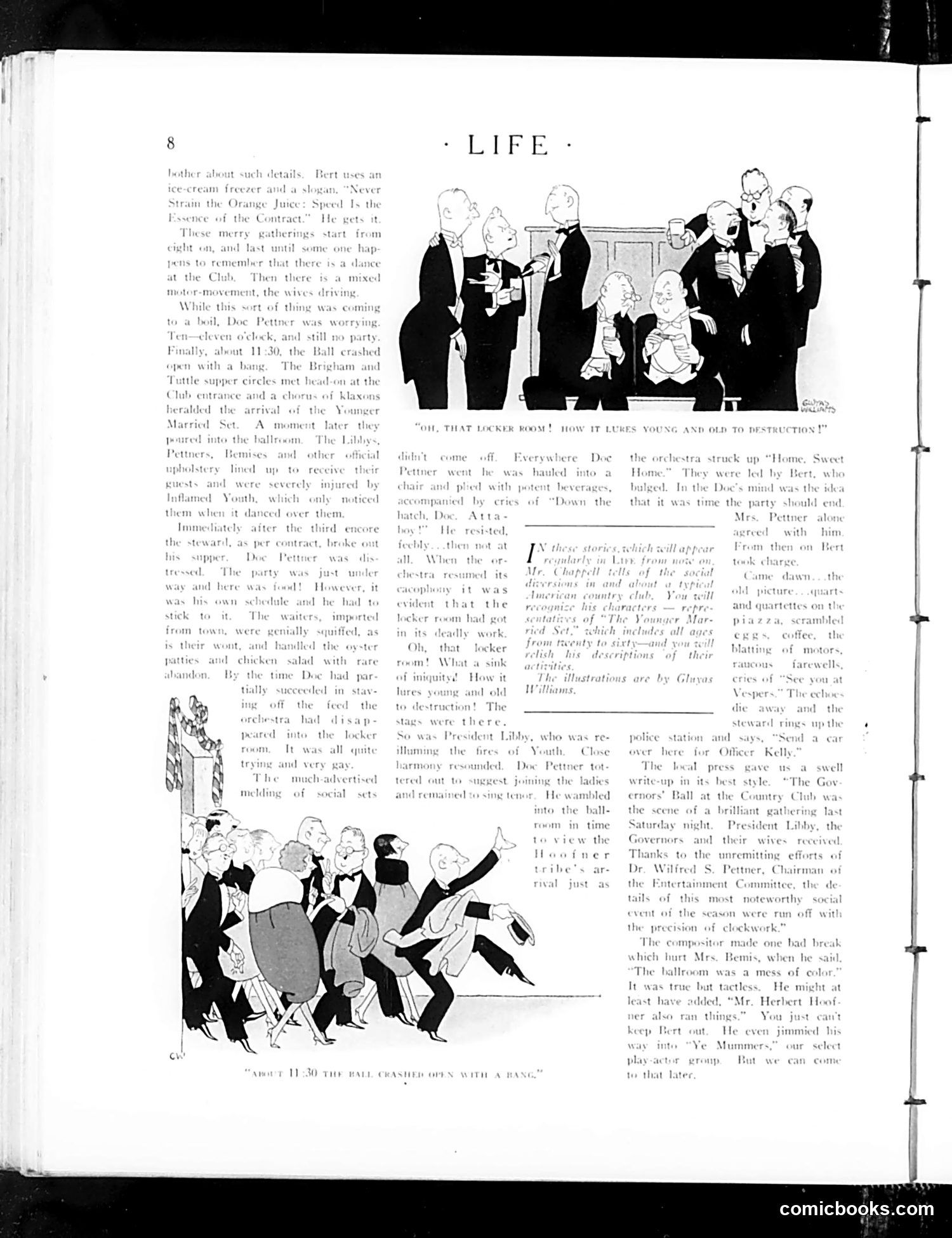
This page satirizes an upper-class party that descended into chaos. The top cartoon shows well-dressed guests at what appears to be an exclusive club gathering, with the caption "Oh, that locker room! How it lures young and old to destruction!" The bottom illustration depicts the aftermath: the ball "crashed open with a bang" at 11:30, showing formally-dressed partygoers in disarray and physical chaos. The article mocks the pretensions of high society, describing how respectable guests—including wives of prominent men—became rowdy and destructive. The satire targets the hypocrisy of the wealthy elite: their formal dignity masks uncontrolled behavior once alcohol and informal settings loosen social constraints. The magazine ridicules both the excessive drinking and the moral decay it reveals.
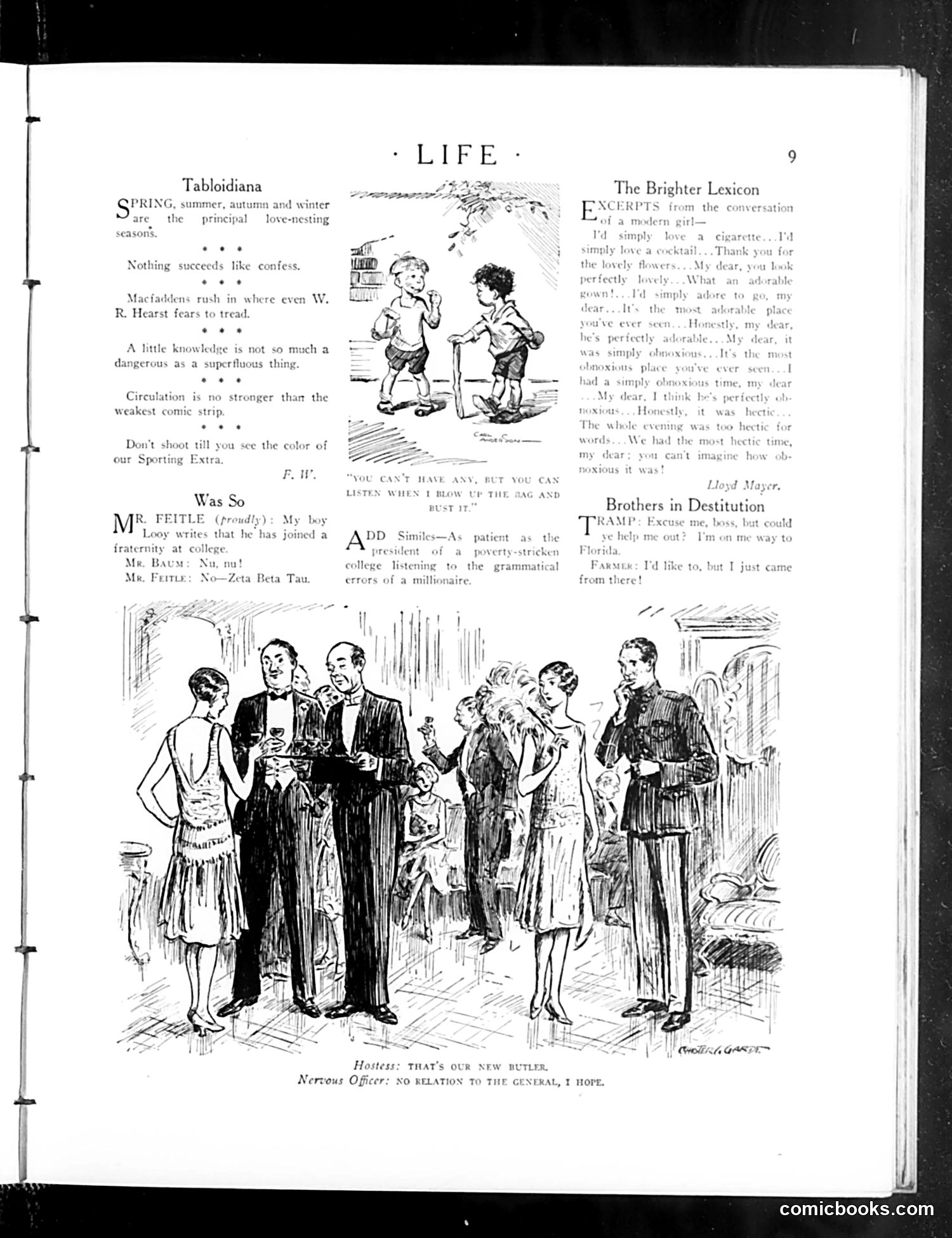
This page contains several short humorous pieces and illustrations typical of Life's satirical format. **"Tabloidiana"** section includes brief quips mocking tabloid journalism and society gossip—referencing W.R. Hearst's publishing empire and frivolous celebrity coverage. The main cartoon depicts a formal social gathering with well-dressed guests. The caption reads: "THAT'S OUR NEW BUTLER" / "SO NO RELATION TO THE GENERAL, I HOPE." This joke plays on class anxiety—the nervous officer fears the butler might be related to a General, implying concern about someone of lower social status having connections to military authority, a social embarrassment to the host. **"The Brighter Lexicon"** and **"Brothers in Destitution"** are conversational humor pieces about modern social situations and linguistic pretension, common satirical targets of the era. The cartoons mock 1920s upper-class social conventions and status consciousness.
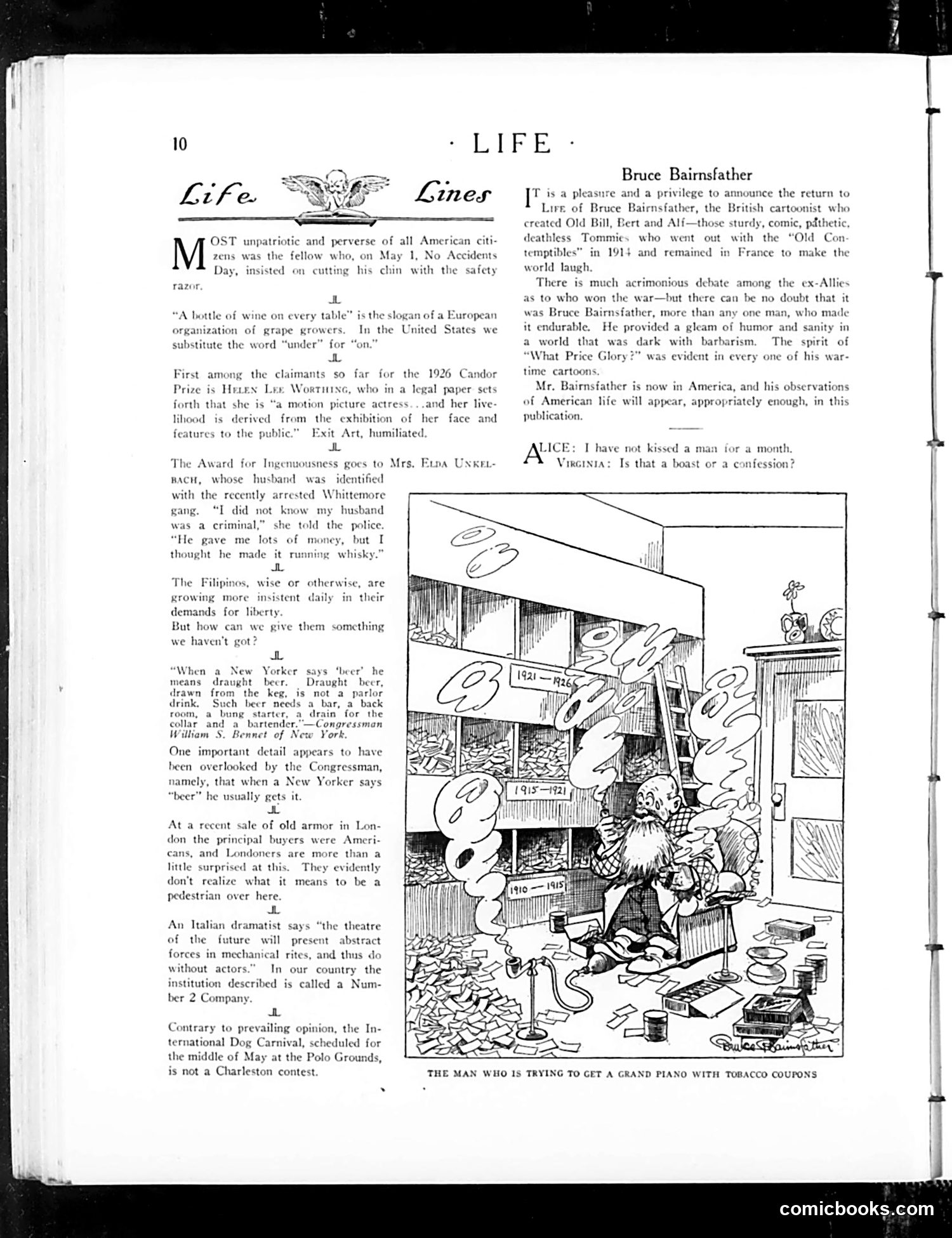
This Life magazine page features a satirical cartoon titled "The Man Who Is Trying to Get a Grand Piano with Tobacco Coupons." The cartoon depicts a cluttered interior where a man surrounded by accumulated tobacco coupons and boxes attempts to redeem them for a grand piano—an absurdly ambitious goal. The satire mocks the tobacco industry's coupon-redemption marketing schemes, which promised valuable prizes in exchange for collected coupons. The cartoon suggests the ridiculousness of expecting to obtain an expensive luxury item like a grand piano through such programs. It's commentary on consumer culture and misleading advertising tactics common in 1920s America, when tobacco companies aggressively promoted their products through elaborate redemption offers.
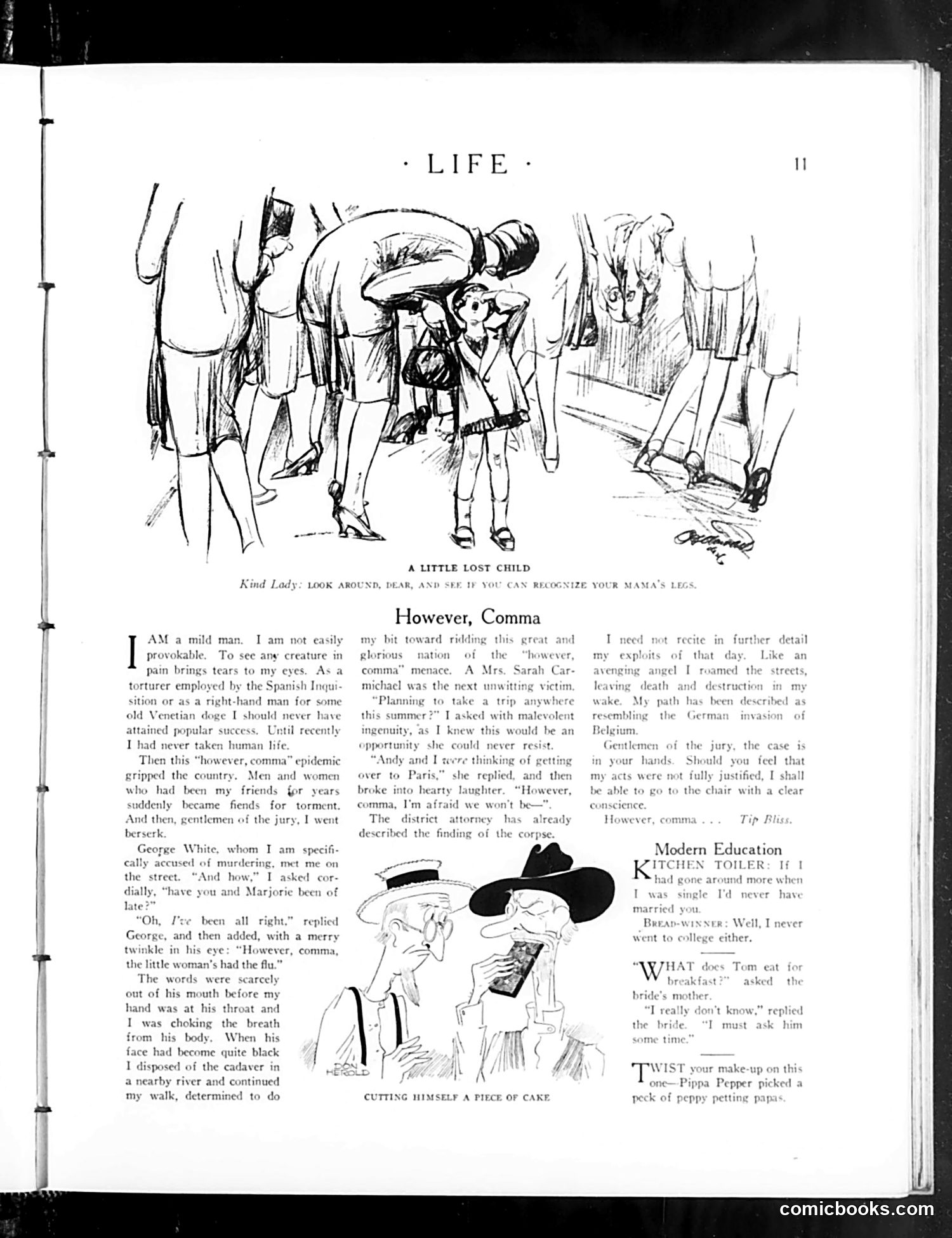
This page from *Life* magazine contains satirical commentary on contemporary social issues: **"A Little Lost Child"**: The top cartoon depicts a child among well-dressed adults on a city street, with the caption suggesting the child cannot identify her mother by her legs alone—a joke about women's fashion, likely referring to the exposure of women's legs in 1920s shorter hemlines, which was scandalous by previous standards. **"However, Comma"**: The main text piece appears to be a humorous essay about the word "however, comma" as a legal/grammatical menace, discussing how it was used in courtroom testimony regarding a crime. **"Modern Education" and "Cutting Himself a Piece of Cake"**: Additional small cartoons and humorous dialogues satirize contemporary social customs and education. The overall tone mocks modern manners and changing social conventions of the era.
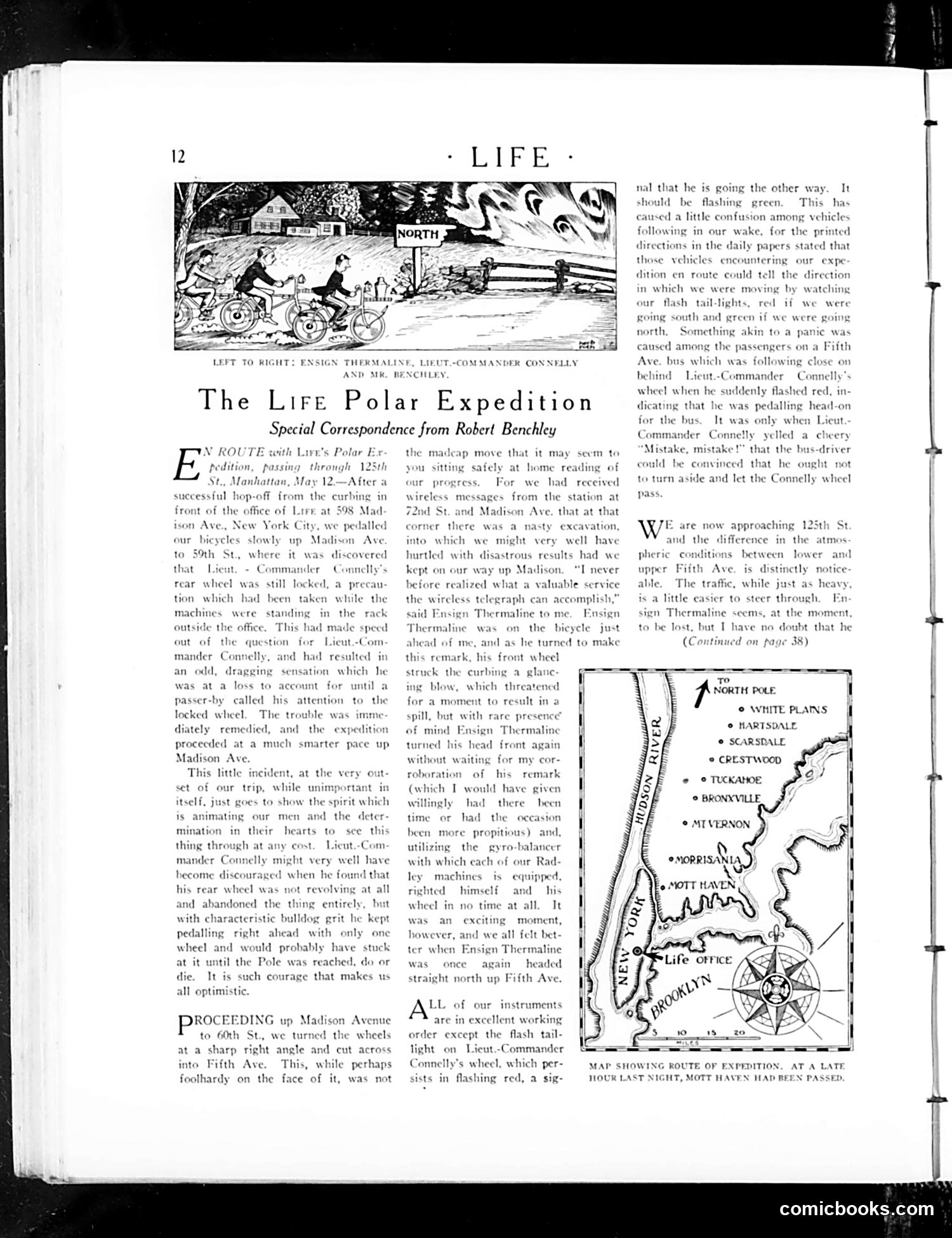
This page documents "The Life Polar Expedition," a special correspondence series by Robert Benchley describing a humorous journey northward through Manhattan on bicycles. The article satirizes the mundane reality of urban travel as mock-heroic adventure—treating a bicycle trip up Fifth Avenue as though it were an Arctic expedition. The cartoon at top shows cyclists navigating city streets while a signpost points "NORTH," literalizing the conceit. The accompanying map depicts the route from Brooklyn through Manhattan neighborhoods (Mott Haven, Norrisania, Mt. Vernon, etc.) with "North Pole" marking the destination. The satire mocks both grandiose travel narratives and the contrast between metropolitan New York and actual polar exploration—treating ordinary urban cycling as genuinely perilous adventure.
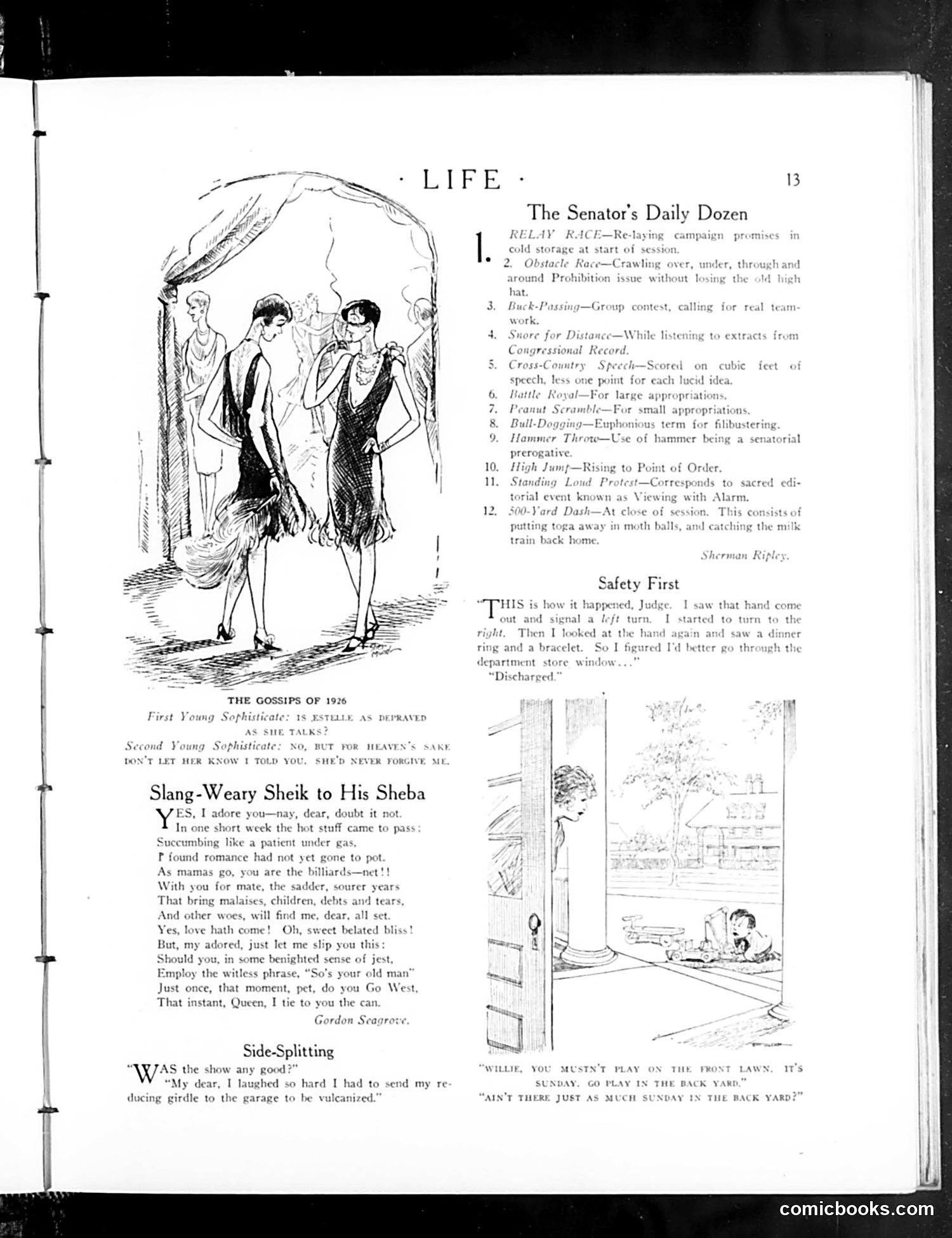
This page satirizes U.S. senators' daily activities through humorous descriptions like "Relay Race," "Obstacle Race," and "Ball-Dogging" (euphemism for filibustering). The accompanying sketch depicts three young women, captioned as gossiping sophisticates discussing Senate proceedings. The cartoons below—"Safety First," "Slang-Weary Sheik to His Sheba," and "Side-Splitting"—appear to be unrelated domestic humor pieces typical of 1920s Life magazine, featuring domestic arguments and comedic situations. The overall page mocks Senate inefficiency and procedural obstruction while the magazine's other content provides light social comedy about contemporary 1920s life, relationships, and manners. The tone is satirical but genteel, reflecting the magazine's sophisticated audience.
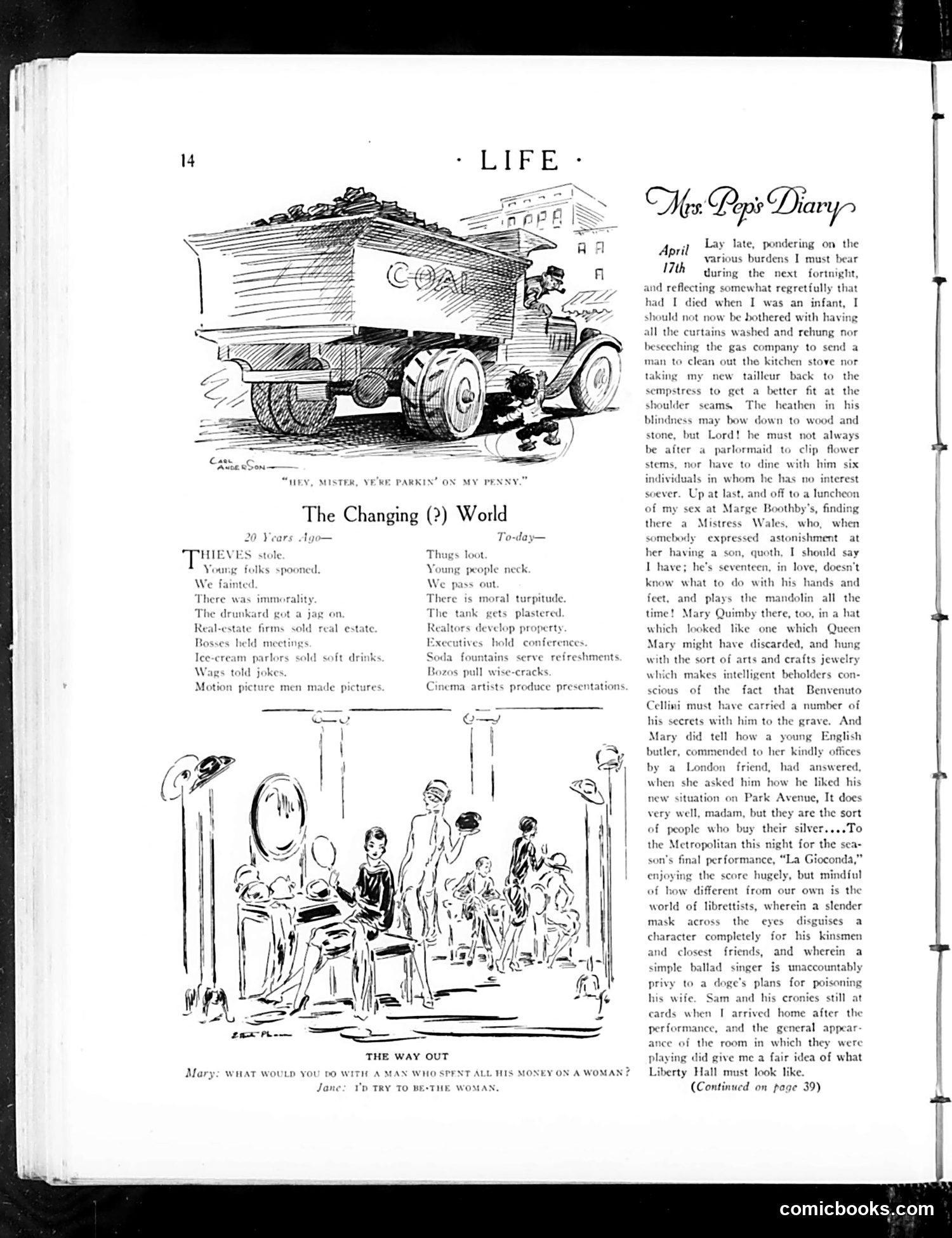
This page from *Life* magazine contains social commentary about changing times. "The Changing (?) World" contrasts past and present through parallel lists—what was true "20 Years Ago" versus "To-day." The satire mocks how society has evolved: young people now "neck" instead of being spooned to; there's "moral turpitude" rather than immortality; executives hold conferences; soda fountains serve refreshments. The cartoon "The Way Out" depicts a domestic dispute, with the caption satirizing infidelity: Mary asks what one would do with a man who spent all his money on a woman; Jane replies to "try to be the woman"—a joke about gold-digging and marriage mercenary motives common in 1920s social satire. The coal wagon sketch humorously depicts working-class urban life.
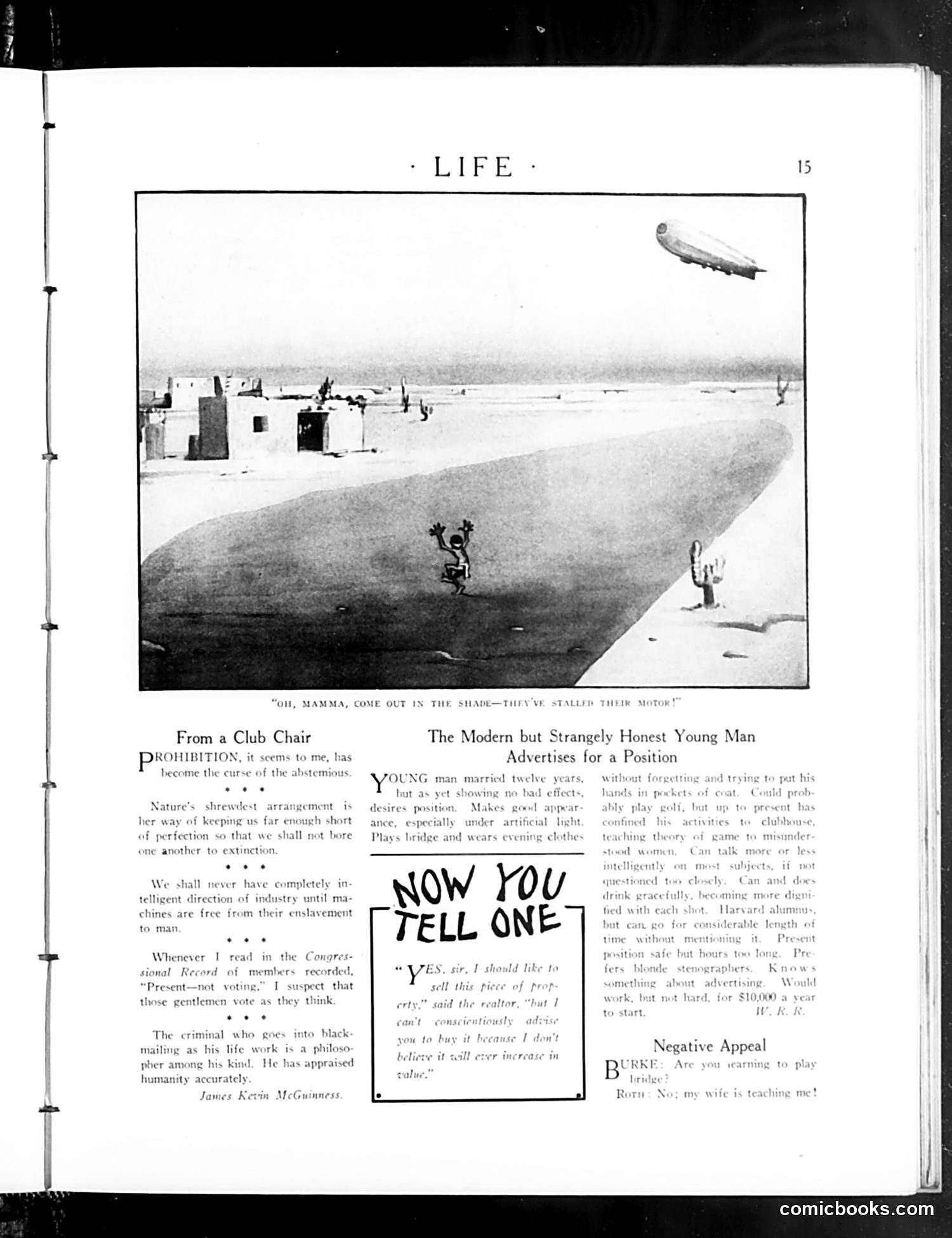
This is page 15 of *Life* magazine featuring social commentary and humor pieces. The main cartoon shows a zeppelin or airship above a beach scene with structures and figures below, captioned "Oh, mamma, come out in the shade—they've stalled their motor!" This appears to satirize early aviation anxiety—the sight of a disabled airship would have been genuinely alarming to beachgoers. The text includes three brief editorial pieces: one on Prohibition's effects, one on honest young men seeking employment (with a mock advertisement where a young man ironically promotes himself as lacking ambition), and a final joke about bridge lessons. The "Now You Tell One" section invites reader participation in joke-telling. The overall tone mixes satire about contemporary social issues with light humor.
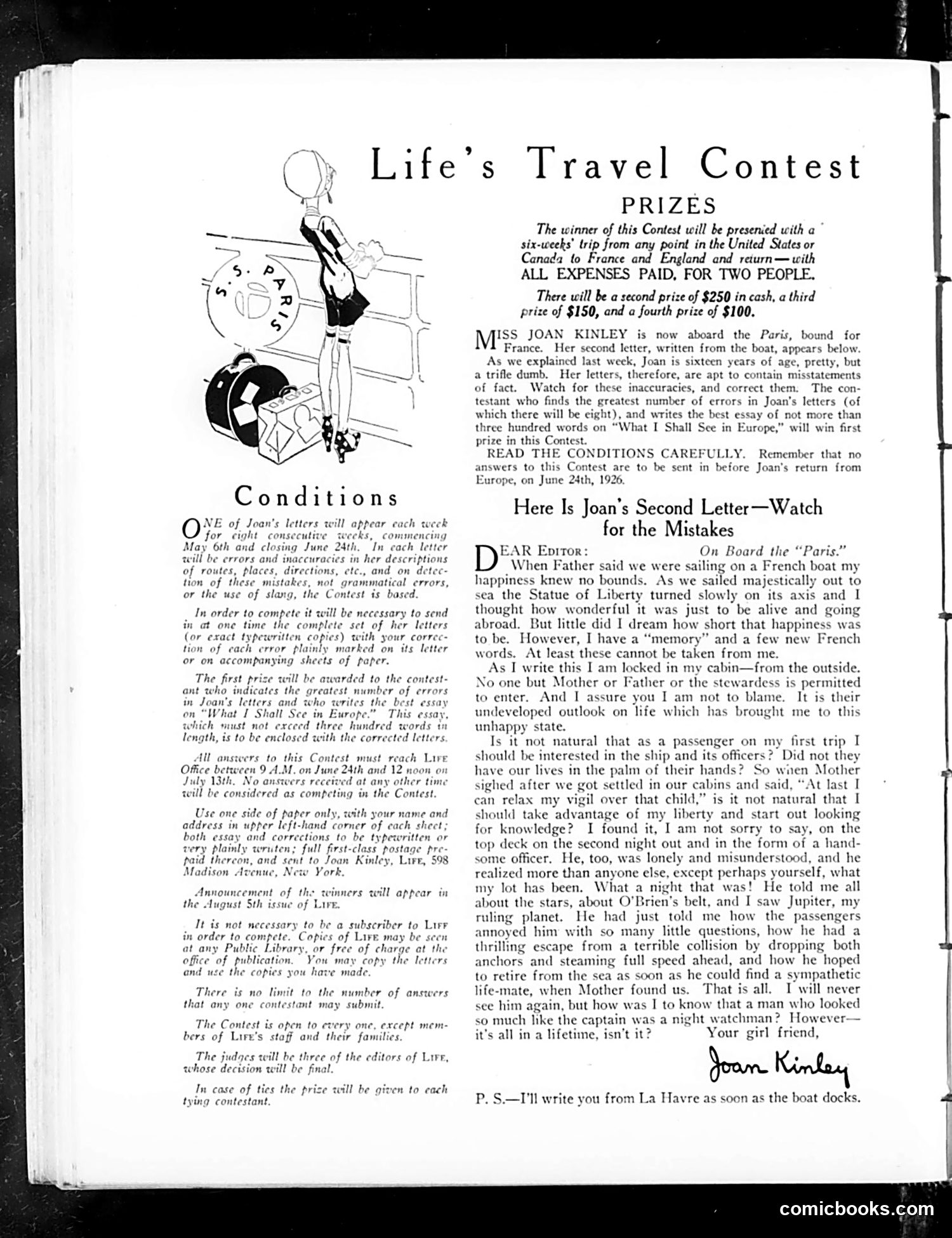
This is a contest announcement page featuring "Life's Travel Contest," not a political cartoon. The illustration shows a stylized female figure at a ship's wheel, representing the contest's travel theme. The contest invites readers to find errors in letters written by "Miss Joan Kinley," supposedly aboard the *Paris* ship bound for France. Contestants who identify the most mistakes (up to eight) and write the best essay on "What I Shall See in Europe" win prizes, with the first prize being a six-week European trip. The page includes Joan's actual second letter, which intentionally contains errors for readers to spot. This was a popular early 20th-century magazine engagement strategy—combining travel promotion with reader participation games.
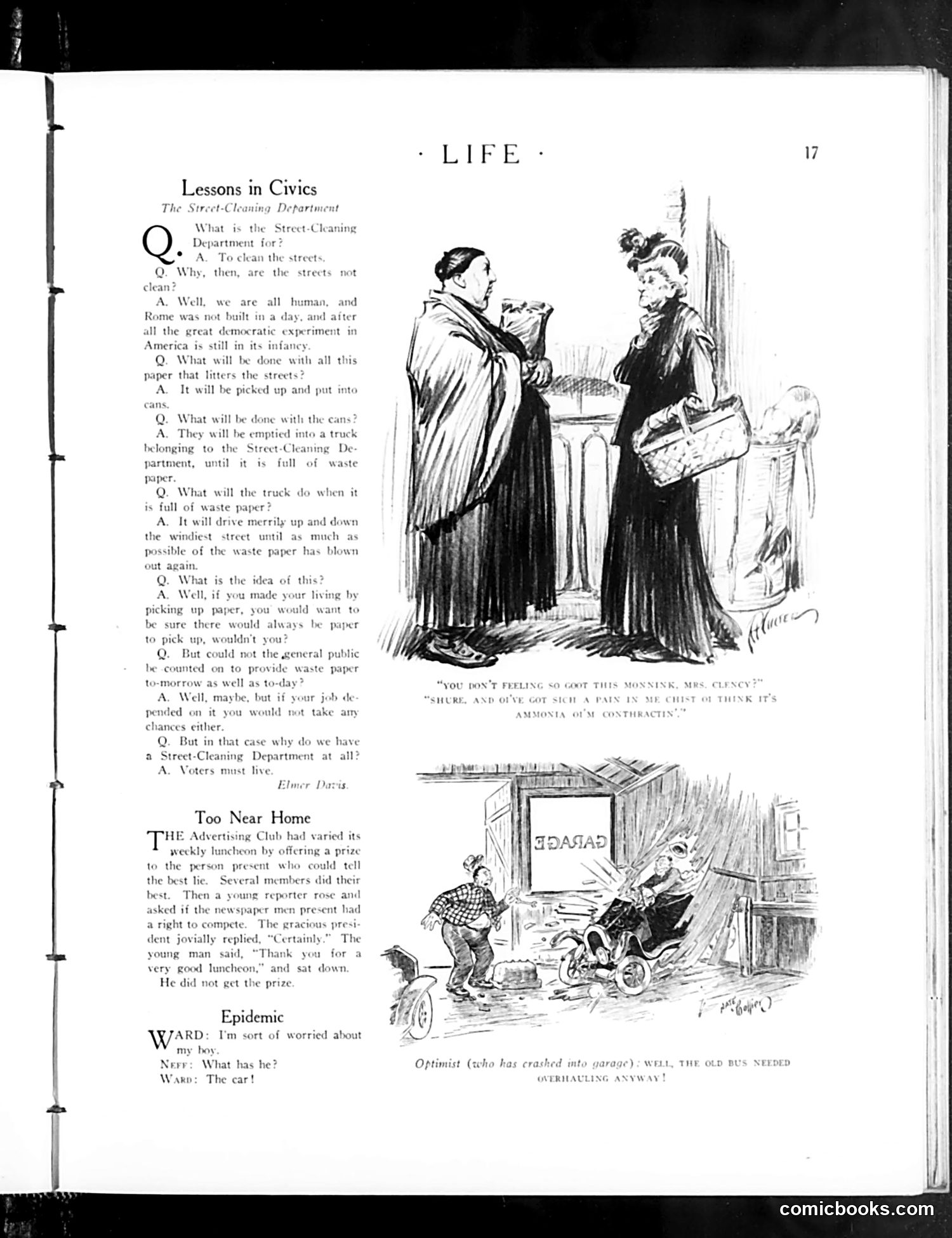
This page contains satirical "Lessons in Civics" mocking municipal inefficiency. The Street-Cleaning Department Q&A exposes a circular system: trash gets picked up into cans, then trucks, but the trucks dump waste back onto windy streets—undoing the work. The satire's point: the department perpetuates its own job by creating the mess it's meant to solve. The cynical final answer suggests voters tolerate this because they don't care enough to demand better. Below, "Too Near Home" jokes about an Advertising Club prize for the best lie. A young reporter asks if newspapers can compete; allowed to enter, he simply thanks them and wins—implying newspapers are professional liars, a jab at press credibility. "Epidemic" is a brief dialogue where a worried father mentions "the car" as his son's affliction, satirizing the new automobile craze's hold on young people.
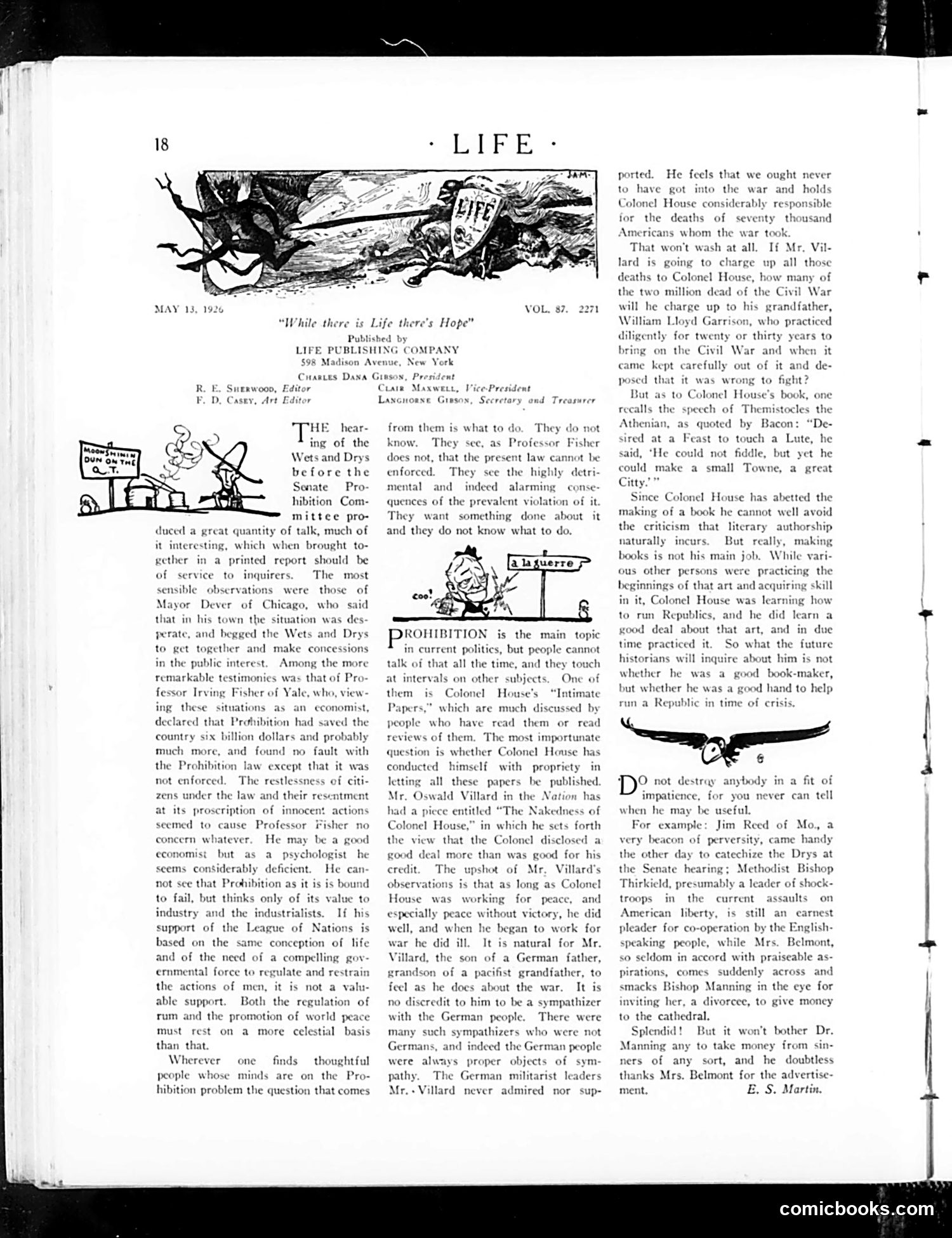
This page combines two distinct critiques of contemporary American politics and public figures. **The Prohibition Cartoon:** The top illustration mocks ongoing Senate hearings about Prohibition enforcement. The text criticizes economist Irving Fisher's testimony supporting Prohibition's economic benefits while ignoring that citizens violate it constantly and face resentment. The satire suggests Fisher prioritizes industrial gains over practical human psychology—a "celestial basis" for law-making won't work. **The Colonel House Controversy:** The longer article discusses criticism by Oswald Villard (editor of *The Nation*) regarding Colonel Edward House's published diplomatic papers from World War I. Villard, whose German father and grandfather are noted, argues House disclosed too much. The author defends House, sarcastically pointing out Villard cannot blame House for 70,000 American war deaths while his own grandfather escaped blame for two million Civil War deaths. The satire targets selective moral reasoning and ethnic bias in political criticism.
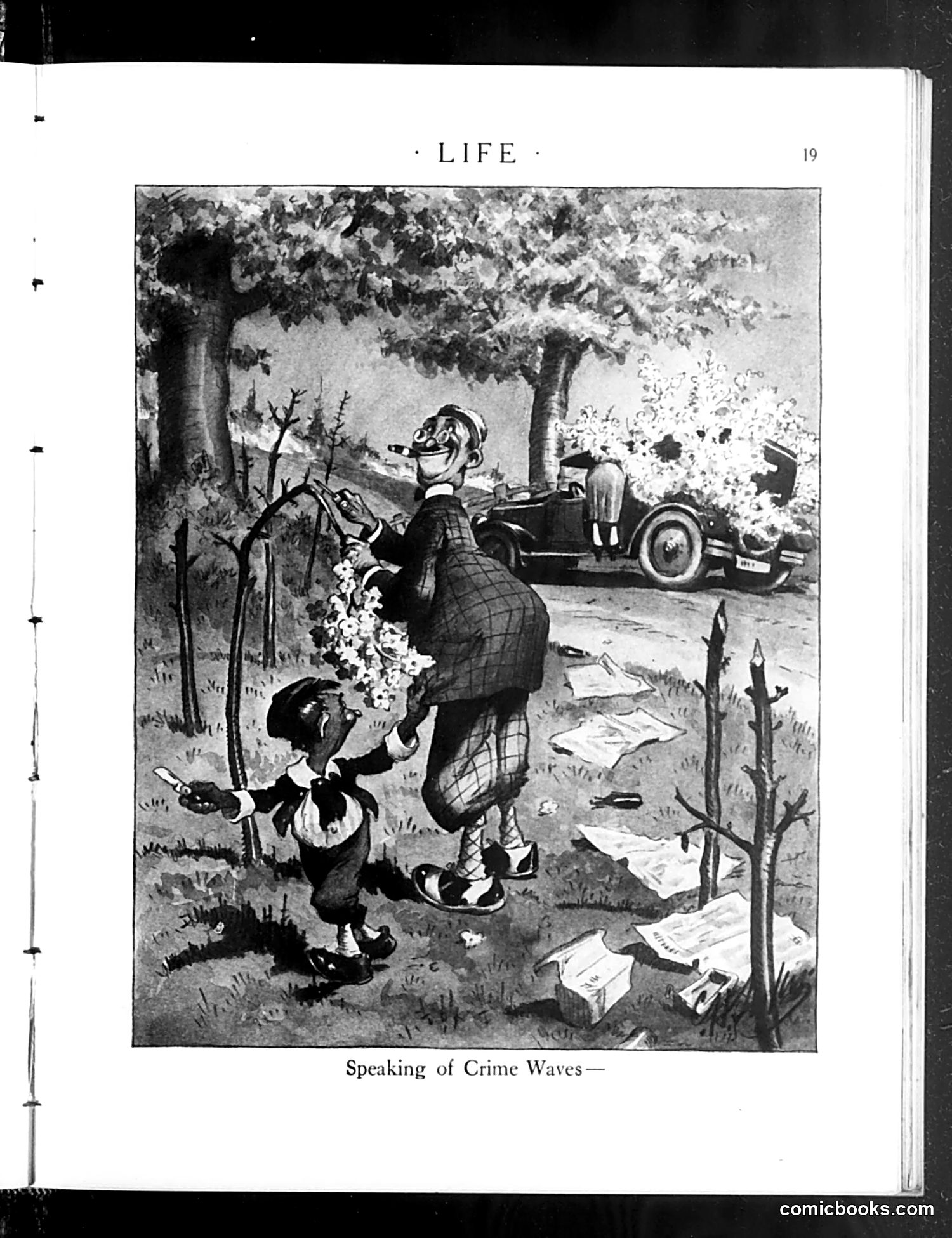
This satirical cartoon depicts a woman scattering papers labeled as crime statistics or reports across a picnic area, while a man in a hat picks flowers nearby. A vintage automobile appears in the background under trees. The cartoon satirizes public discourse about "crime waves"—likely referencing 1920s-1930s anxieties about rising crime. The joke appears to be that people casually disregard or "litter" crime statistics and warnings, treating serious criminal data as disposable waste during leisure activities. The woman's careless distribution of papers suggests the public's indifference to crime warnings, while the man's oblivious flower-picking represents distraction from or denial of social problems. The title sardonically frames this casual dismissal as merely "speaking of" crime—treating grave issues with apathy.
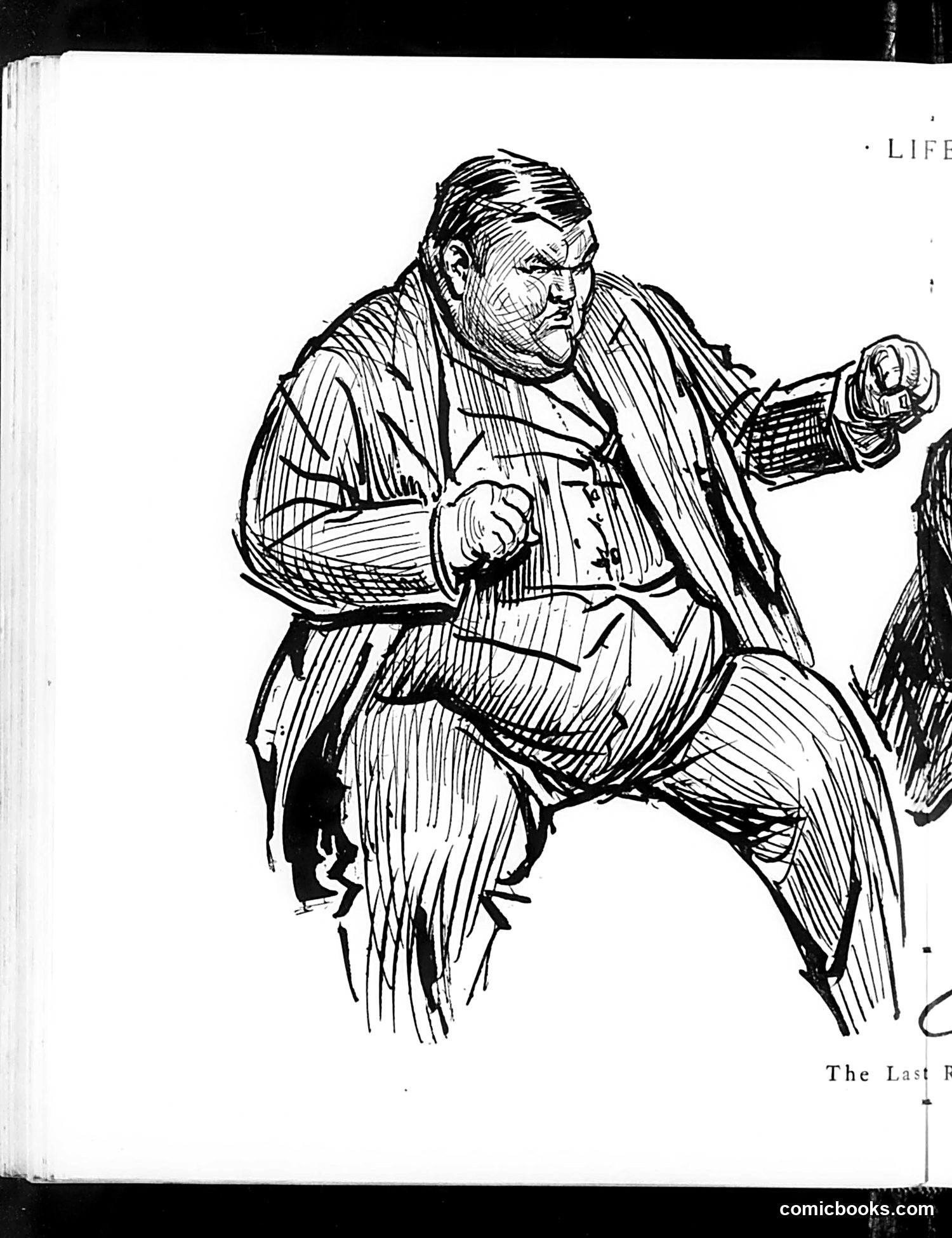
The OCR text appears to be corrupted/unreadable, so I'm relying on the image alone. This is a sketch-style political cartoon showing a heavyset man in a suit in an aggressive, lunging pose with his fists raised. The artistic style—bold ink lines with cross-hatching—is characteristic of early 20th-century American editorial illustration. The figure's confrontational stance and exaggerated facial features suggest this depicts someone engaged in conflict or controversy. The page header reads "LIFE," confirming this is from that satirical publication. The partially visible caption at bottom reads "The Last..." but is cut off. Without the complete caption or clearer OCR text, I cannot definitively identify the specific figure or historical event being satirized. The image suggests political conflict or personal scandal, but the exact reference remains unclear.
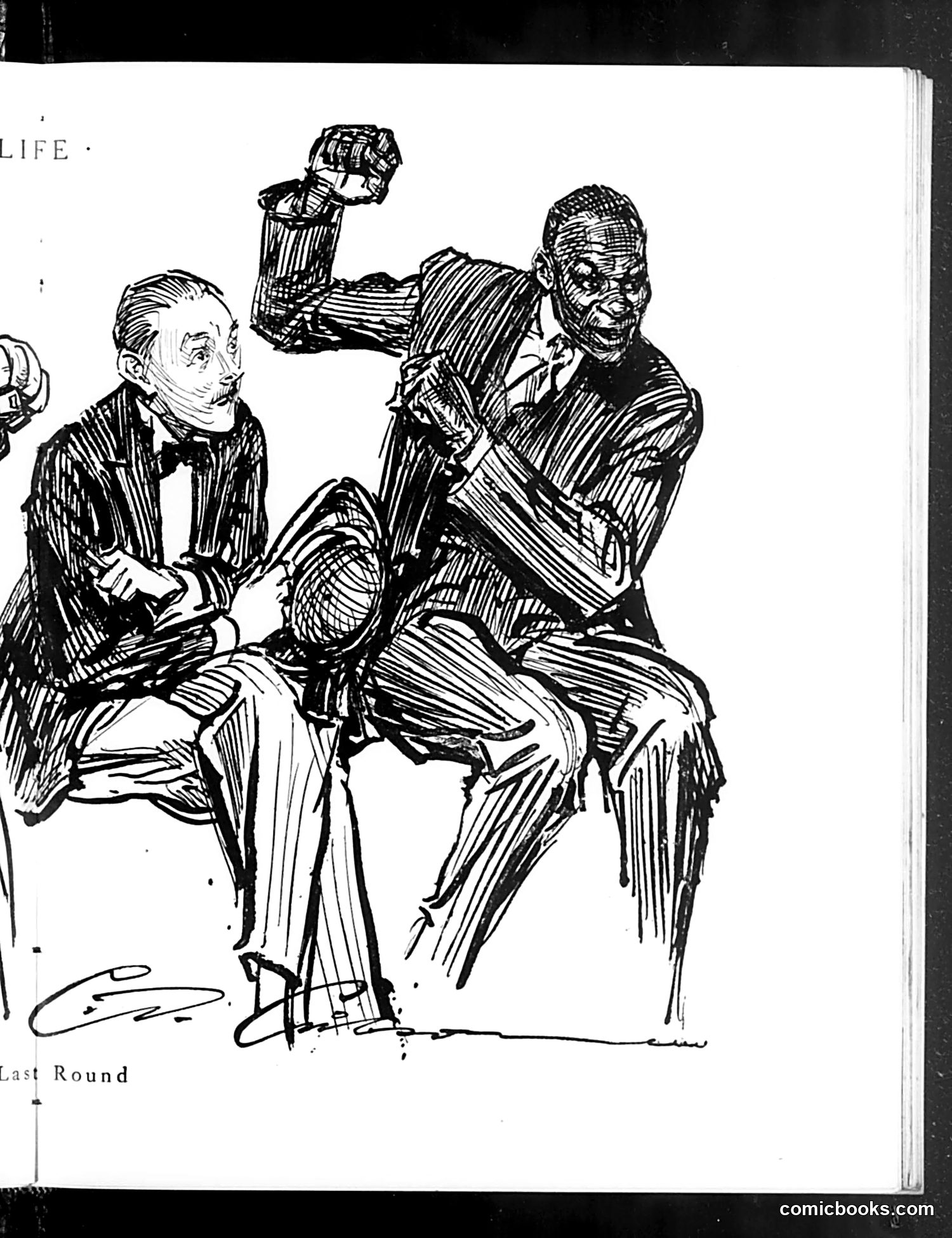
This appears to be a boxing or fighting scene satirizing political or social conflict. Two men in formal attire (suits and bow ties) are depicted in what looks like a physical altercation, with one figure raising his fist overhead in an aggressive pose. A third figure appears in the background. The title "Last Round" suggests this depicts the final confrontation in some ongoing dispute. The formal dress and the magazine's satirical nature indicate this likely comments on a contemporary political or social controversy, though without additional context or a visible date, the specific figures and conflict cannot be definitively identified. The aggressive physical imagery suggests serious conflict being treated with dark humor.
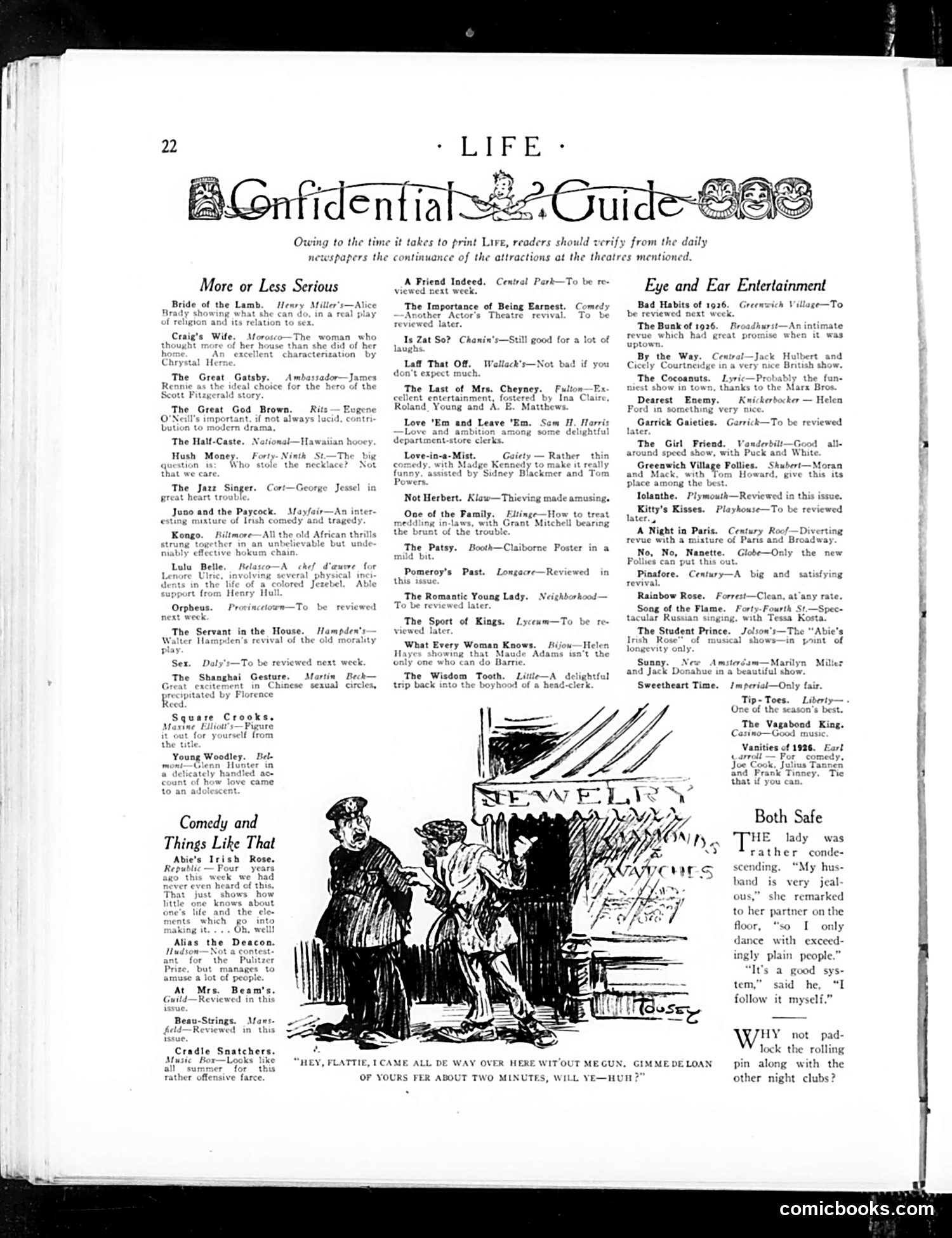
This page is a **theater listings and entertainment guide** for Life magazine, featuring two cartoons with social commentary. The main cartoon depicts a **working-class immigrant couple** (identifiable by dialect and appearance) at what appears to be a nightclub or entertainment venue. The man's speech—"HEY, PLATTIE, I CAME ALL DE WAY OVER HERE WIT'OUT MEGUN. GIMMEDELOAN OF YOURS FER ABOUT TWO MINUTES"—uses exaggerated ethnic stereotyping (Irish/Eastern European immigrant dialect) common to 1920s satire. The joke satirizes **nightclub culture and materialism**: the man has come specifically to borrow his girlfriend's jewelry temporarily, suggesting working-class patrons felt pressure to display wealth they didn't possess to fit into trendy entertainment venues. The smaller cartoon "Both Safe" mocks **gender dynamics and jealousy**, with the wife reassuring her jealous husband that she only dances with "exceedingly plain people"—safe choices that won't provoke his insecurity. Both reflect 1920s anxieties about social climbing, immigrant assimilation, and changing gender/class relations during the Jazz Age.
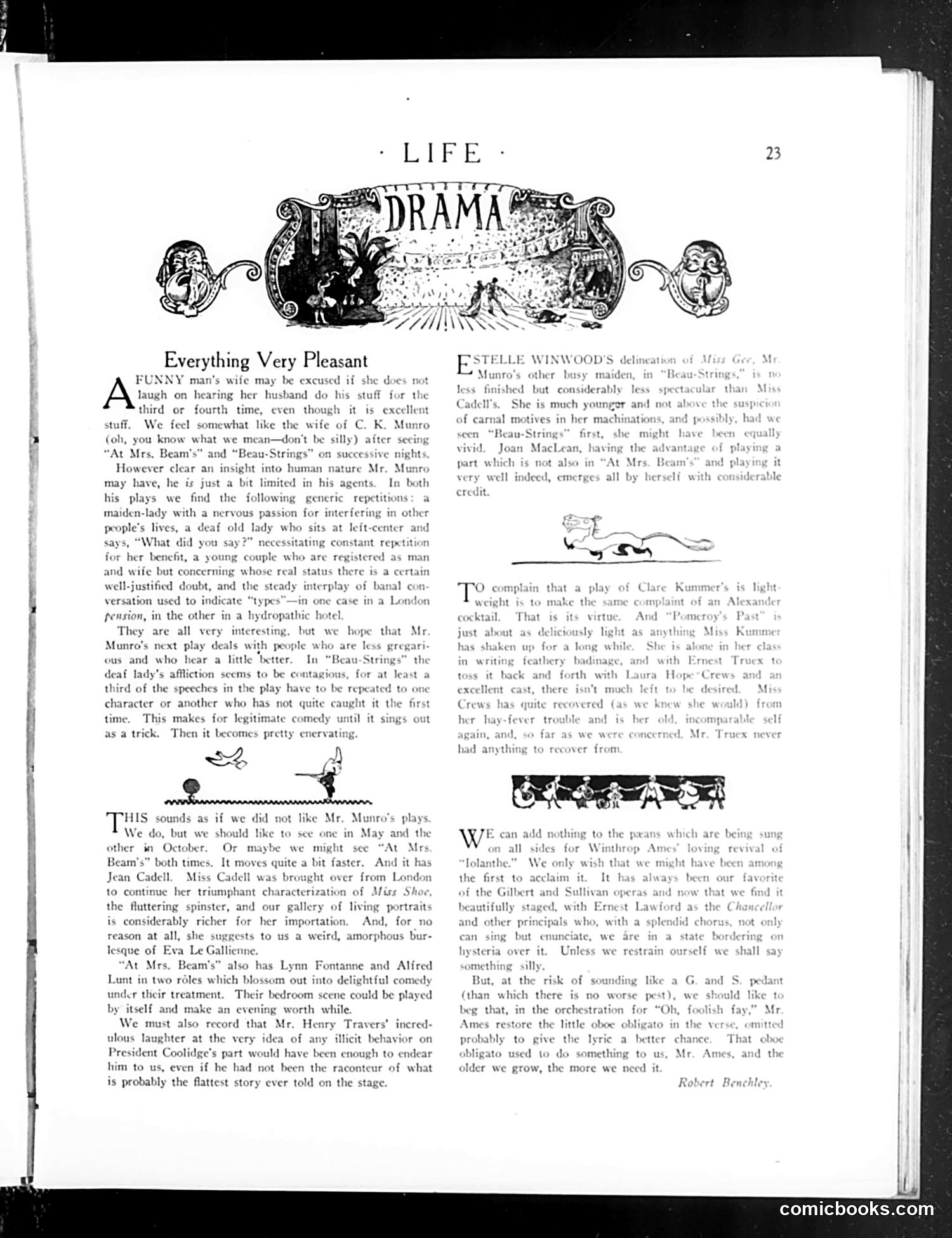
This page reviews several theatrical productions, primarily C.K. Munro plays ("At Mrs. Beam's" and "Beau-Strings"). The text is a drama critique rather than political satire. **Key points:** The reviewer critiques Munro's formulaic plotting—his plays repeatedly feature the same stock characters: an interfering maiden-lady, a deaf elderly woman positioned stage-left, and couples whose marital status is ambiguous. The repetition of dialogue (characters constantly asking "What did you say?" due to the deaf woman) becomes tedious. **Performers mentioned include:** Estelle Winwood, Jean Cadell (praised for elevating the material), Lynn Fontanne, and Alfred Lunt. **The satire:** The review gently mocks both Munro's lazy dramaturgy and President Coolidge (referenced humorously as having told "probably the flattest story ever told on the stage"), suggesting even political figures are less entertaining than Munro's repetitive plays. Byline: Robert Benchley, the magazine's drama critic.
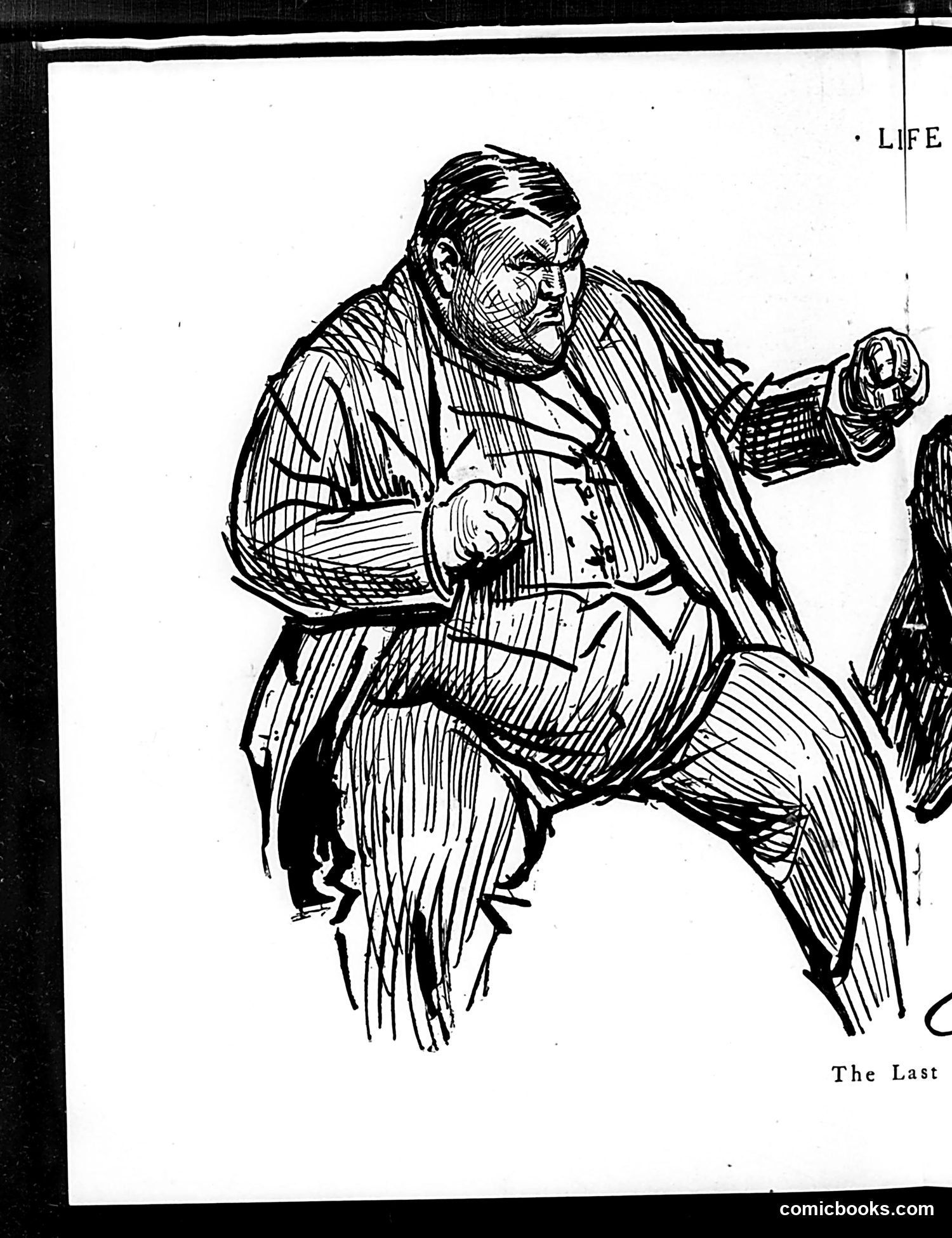
This appears to be a page from *Life* magazine showing a political cartoon titled "The Last" (text visible at bottom right). The illustration depicts a heavyset man in a suit shown in an exaggerated, caricatured style—a common technique in early 20th-century satirical cartooning. However, without additional context clues visible on this page (such as a caption, date, or accompanying article text), I cannot definitively identify which specific political figure this represents or what particular event or policy it's satirizing. The aggressive posture and exaggerated features suggest criticism of someone in power, but the specific target and satirical point remain unclear from the image alone.
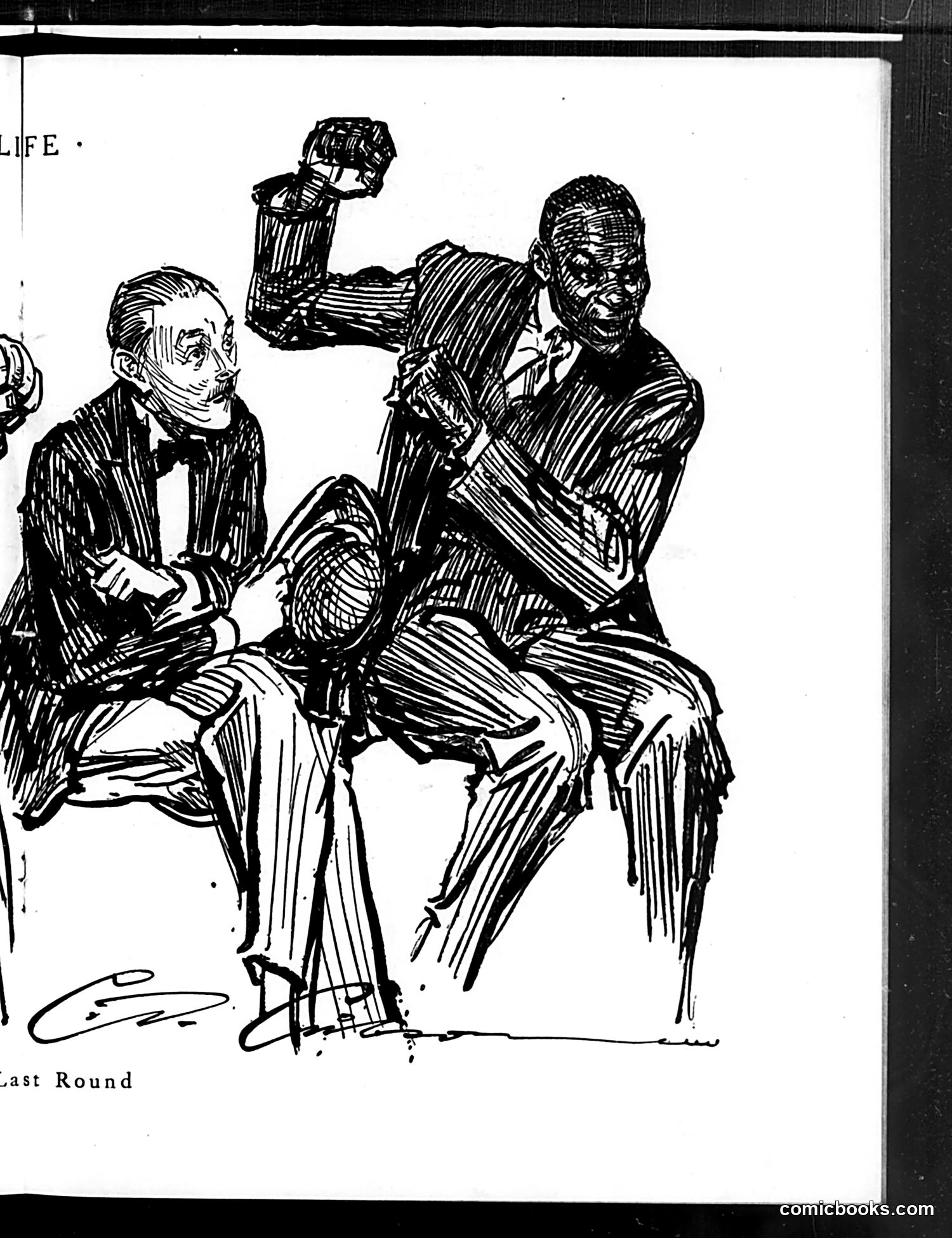
This political cartoon depicts two men in formal attire engaged in what appears to be a physical altercation or boxing match. The title "Last Round" suggests this represents a final confrontation between political or public figures. The style and composition indicate this is satirical commentary on a contemporary dispute, likely from the early 20th century based on the artistic technique and clothing. The aggressive posturing and the caption "Last Round" suggest the cartoonist is depicting what they view as a decisive or concluding moment in some conflict. However, without additional context visible on the page—such as names, dates, or clearer identifying features—I cannot definitively identify which specific figures or political situation this cartoon references. The satire's specific meaning would require knowing the contemporary political context of the issue.
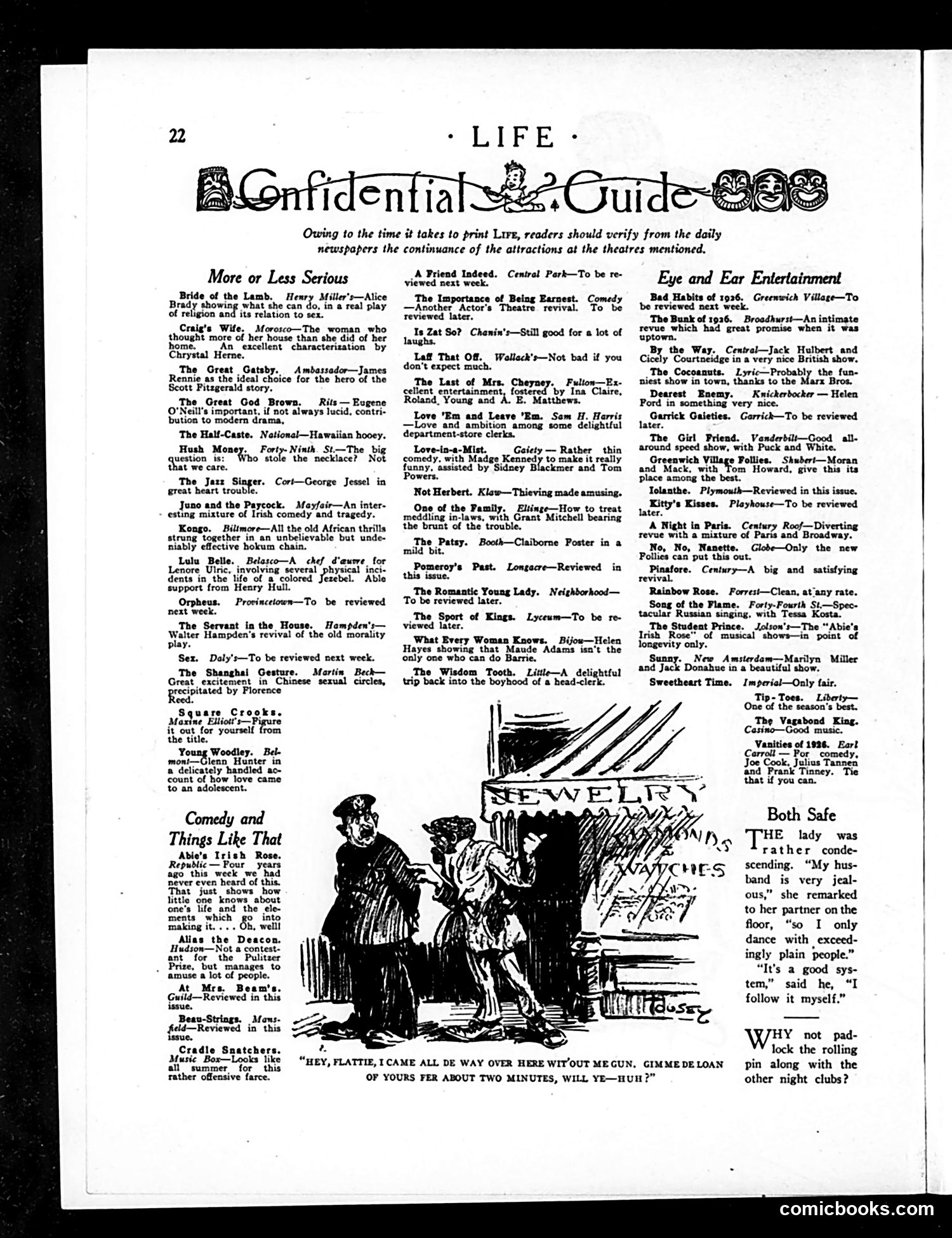
This page is primarily a **theater review guide** for Broadway shows, with one cartoon illustrating contemporary humor. ## The Cartoon The illustration depicts a stereotypical street criminal (indicated by "FLATTIE"—slang for a police officer's flat-brimmed hat) approaching a cop without a gun, asking to borrow the officer's firearm "for about two minutes." The exaggerated dialect ("WITOUT MEGUN," "YE—HUH?") and crude characterization reflect 1920s working-class New York street culture. The joke satirizes petty criminals' brazen audacity and the casual criminality of urban life during Prohibition—a period marked by gang violence and gun violence. ## Context This appears from the "Comedy and Things Like That" section, treating urban crime as entertainment fodder. The cartoon mocks both criminal desperation and police vulnerability, reflecting Jazz Age anxieties about urban lawlessness that were topical during the mid-1920s. The rest of the page consists of Broadway theater listings and brief reviews, standard Life magazine content of the era.
This is a theater review page from *Life* magazine's drama section, circa 1920s. The critic discusses three plays: 1. **"At Mrs. Beam's" and "Beau-Strings"** by C.K. Munro are praised but criticized for repetitive character types—a meddling spinster, a deaf elderly woman (whose deafness becomes a tired comedic device), and ambiguously-married couples. The reviewer finds this formulaic. 2. **Cast praise** includes Jean Cadell (imported from London), Lynn Fontanne, Alfred Lunt, and Henry Travers, whose incredulous reaction to "any illicit behavior on President Coolidge's part" draws humor from Coolidge's known puritanical reputation. 3. **"Pomeroy's Past"** by Clare Kummer is celebrated as "deliciously light" entertainment, with Ernest Truex and Laura Hope Crews delivering witty badinage. The overall tone is that these are pleasant but lightweight comedies—entertaining for one viewing but repetitive on successive nights. The decorative "Drama" header with theatrical masks frames the content as serious criticism of popular stage entertainment.
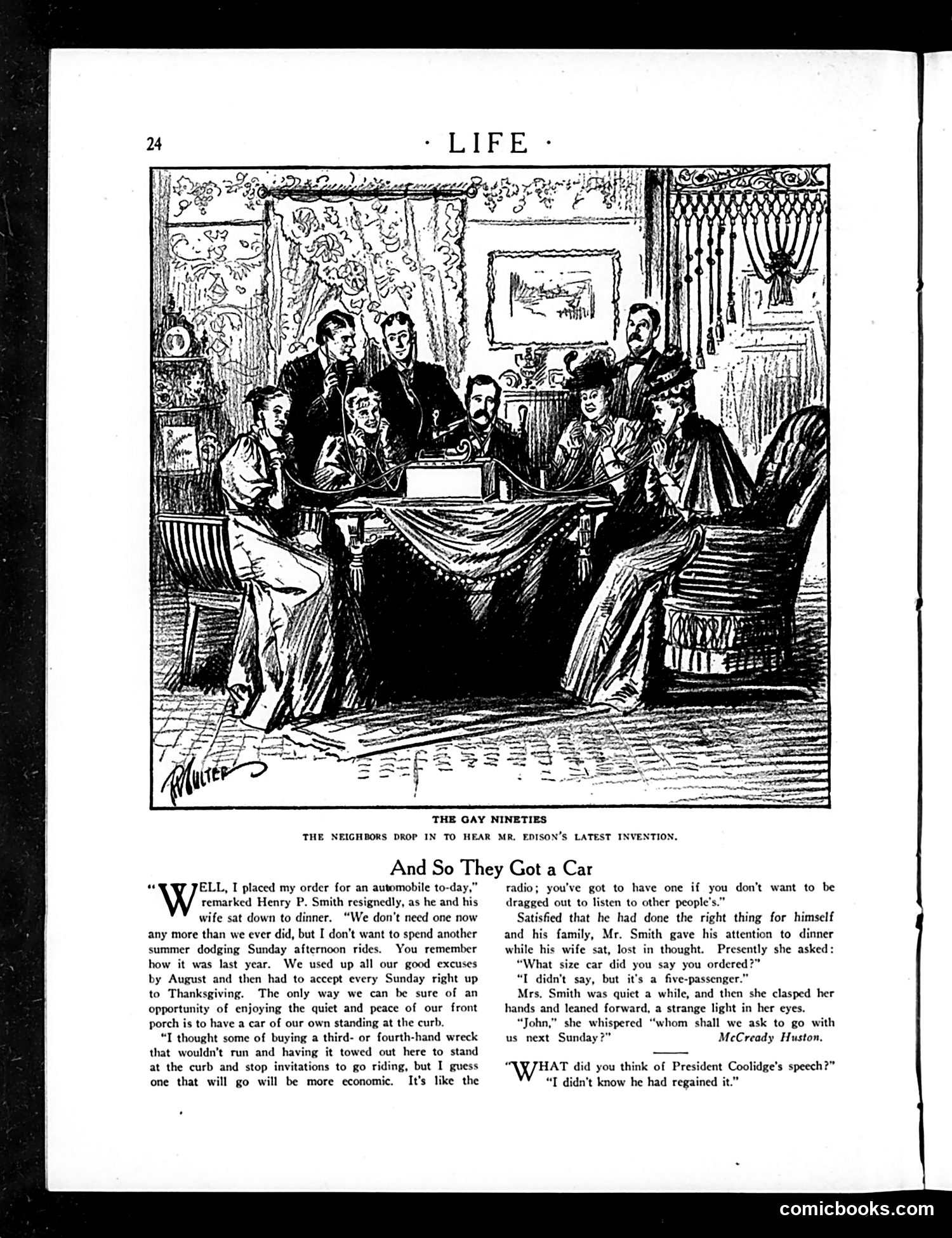
This 1920s-era piece satirizes the rapid adoption of automobiles and radios as status symbols and social obligations rather than genuine desires. **The Setup:** Henry P. Smith buys a car specifically to *avoid* being invited on neighbors' Sunday drives—a common social pressure. Paradoxically, he reasons that owning his own automobile will protect him from having to ride in others' vehicles. **The Joke:** The satire cuts deeper when his wife immediately grasps the real problem: now that they own a car, they're socially obligated to invite *others* along, perpetuating the same cycle he sought to escape. **The Reference:** The cartoon's title, "The Gay Nineties," ironically contrasts that quieter era with the modern 1920s invasion of technology-driven social expectations. The mention of radio enforces this theme—people felt compelled to own modern conveniences whether they wanted them or not. **The Point:** Ownership doesn't bring freedom; it creates new social obligations and peer pressure in an increasingly consumer-driven society.
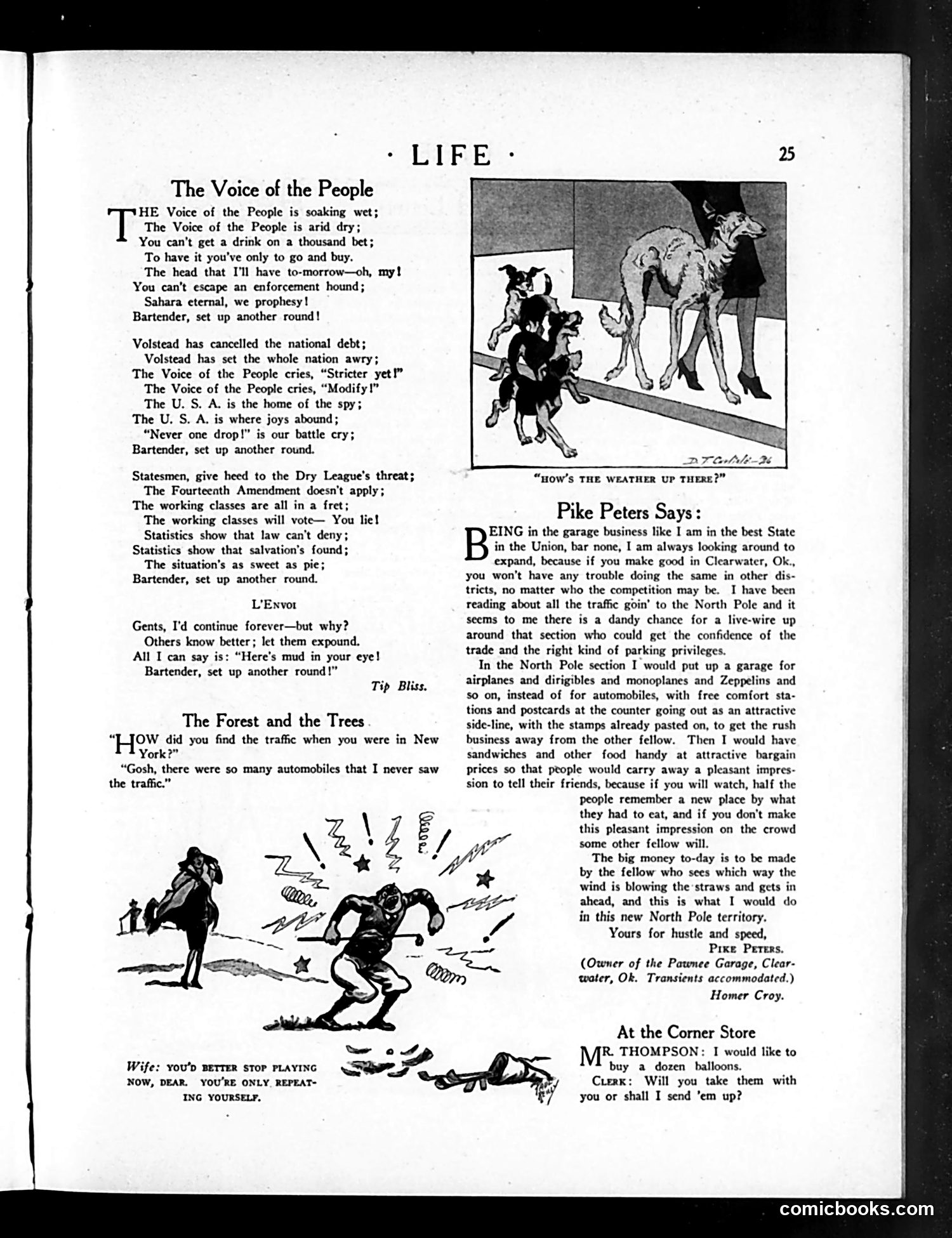
This page satirizes **Prohibition** (the Volstead Act banning alcohol), the dominant political controversy of the era referenced throughout. "The Voice of the People" poem mocks the contradictory demands citizens place on government during Prohibition: people simultaneously demand stricter enforcement and modifications to the law, claim they want no alcohol yet complain about inability to drink, and deny the law works while accepting it does. The repetition of "Bartender, set up another round" undercuts the hypocrisy—Americans violate Prohibition while debating it. **"The Forest and the Trees"** cartoon depicts someone literally unable to see obvious reality (traffic) amid surrounding chaos, likely critiquing how Prohibition blinds people to obvious social consequences. **Pike Peters' column** is humorous business advice about establishing a North Pole garage for aircraft—absurdist commentary on overconfident American entrepreneurship and expansion. **"At the Corner Store"** makes a dry joke: the balloon transaction appears innocent but "send 'em up" suggests delivering contraband alcohol via balloon—a sly reference to creative bootlegging methods during Prohibition. The overall message: Prohibition creates widespread hypocrisy and lawbreaking across American society.
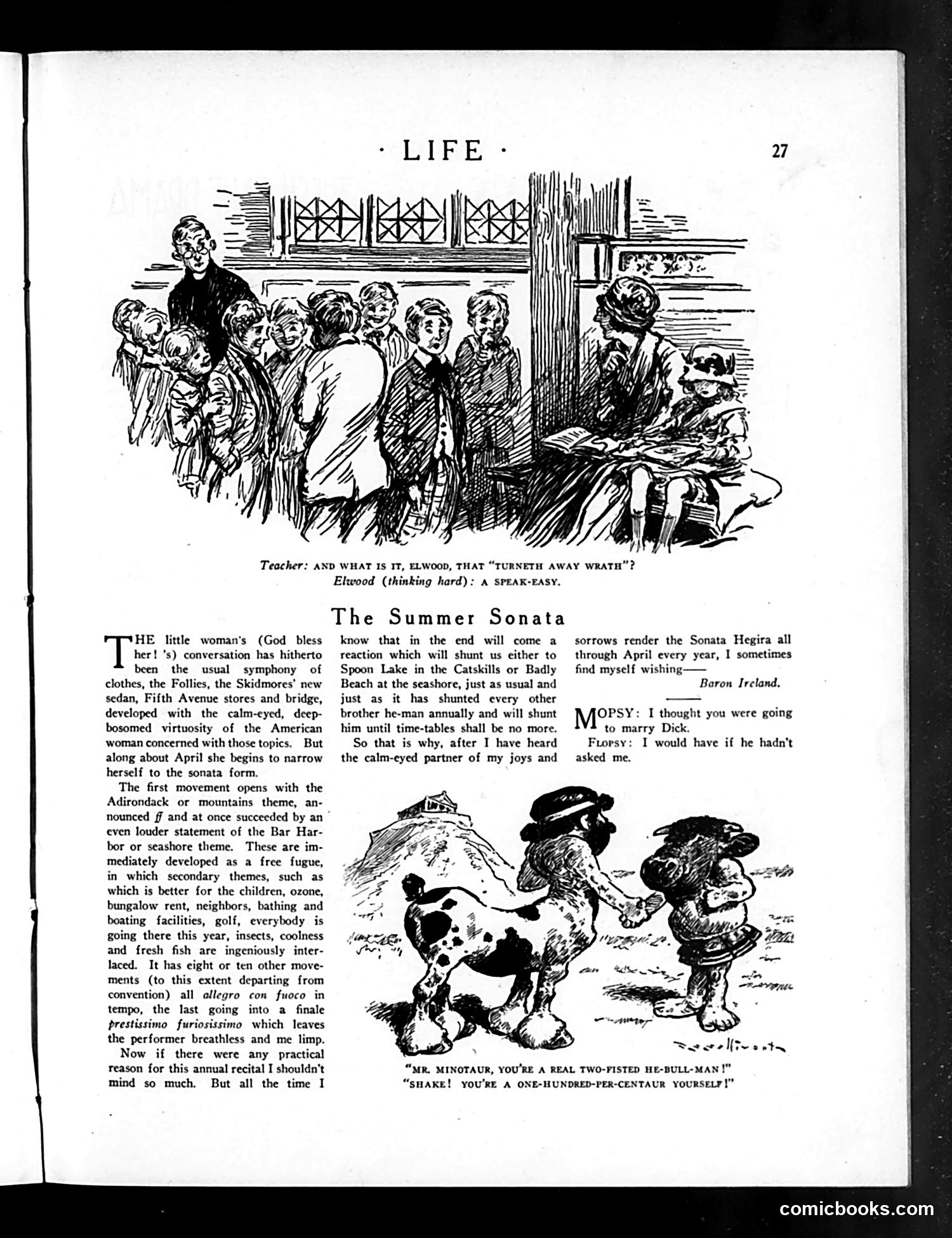
This page contains three satirical pieces targeting American social conventions: **Top cartoon**: A schoolroom joke where a teacher asks what "turneth away wrath" (biblical reference to gentle answers). A boy named Elwood answers "a speak-easy"—mocking Prohibition-era hypocrisy by suggesting alcohol, not virtue, prevents conflict. **"The Summer Sonata"**: A husband's extended complaint about his wife's annual spring monologue about vacation destinations (mountains vs. seashore). He satirizes her elaborate, breathless persuasive tactics while noting the outcome remains predetermined anyway. The joke: her elaborate rhetorical "performance" is pointless theater since he'll be dragged to the same place yearly. **Bottom cartoon**: Two small dogs engage in exaggerated tough-guy posturing, calling each other "two-fisted he-bull-man" and "one-hundred-per-centaur"—mocking masculine bravado and overblown ego in miniature form. All three pieces target predictable human behavior: moral compromise, marital dynamics, and inflated self-importance.
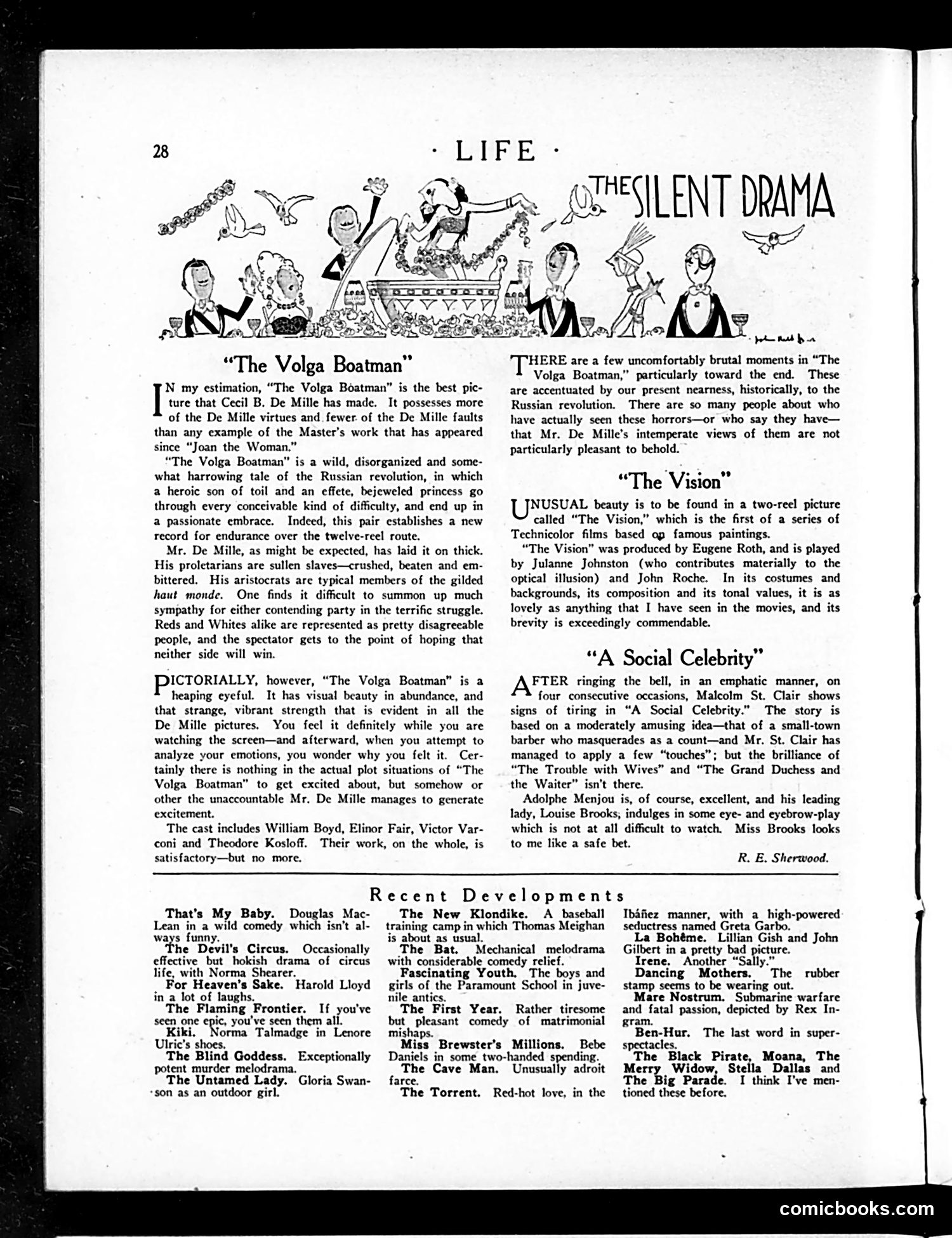
This page reviews recent silent films, dominated by Cecil B. DeMille's "The Volga Boatman." The reviewer praises its visual spectacle while criticizing its plot and politics. **Key Content:** The main critique concerns DeMille's depiction of the Russian Revolution. The reviewer notes the film shows both "Reds and Whites" as "disagreeable people," presenting aristocrats as gilded and shallow, workers as brutalized slaves. Notably, the reviewer suggests this heavy-handed portrayal is problematic given that "many people about who have actually seen these horrors" in the recent Russian Revolution could testify to its reality—implying DeMille's dramatization seems insensitive or exploitative to contemporary audiences who experienced actual violence. The page also briefly reviews lighter fare: "The Vision" (a Technicolor adaptation), "A Social Celebrity" (a comedy with Adolphe Menjou), and other recent releases. **The Satire:** The cartoon header depicts theatrical chaos, mocking silent film melodrama's excess—fitting for criticism of DeMille's "laid it on thick" approach.
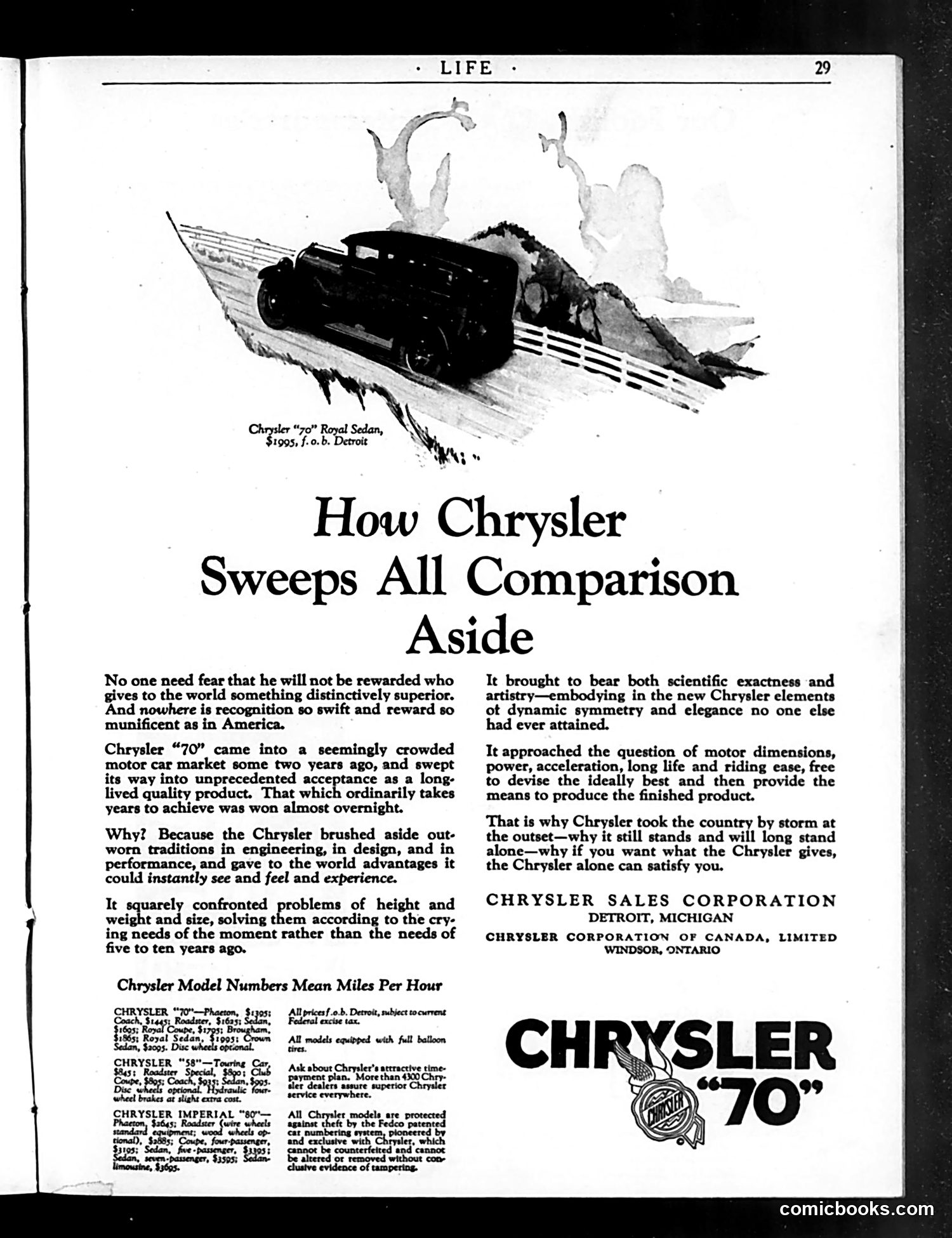
This is a **car advertisement**, not satire or political commentary. The page promotes Chrysler's "70" model, which apparently dominated the automobile market upon its 1923 launch despite an already crowded field. The illustration shows a sleek black sedan speeding past outdated competitors and traditions, visually reinforcing the ad's central claim: Chrysler's superior engineering and design "swept aside outworn traditions" to achieve unprecedented market success "almost overnight." The text emphasizes innovation in "height and weight and size" and engineering excellence, positioning Chrysler as the car that solved modern automotive problems better than established competitors. The model numbers ("70," "80") refer to horsepower ratings—a marketing strategy highlighting performance metrics. This represents early 1920s corporate advertising rhetoric celebrating American industrial superiority and rapid technological progress—genuine marketing, not satire.
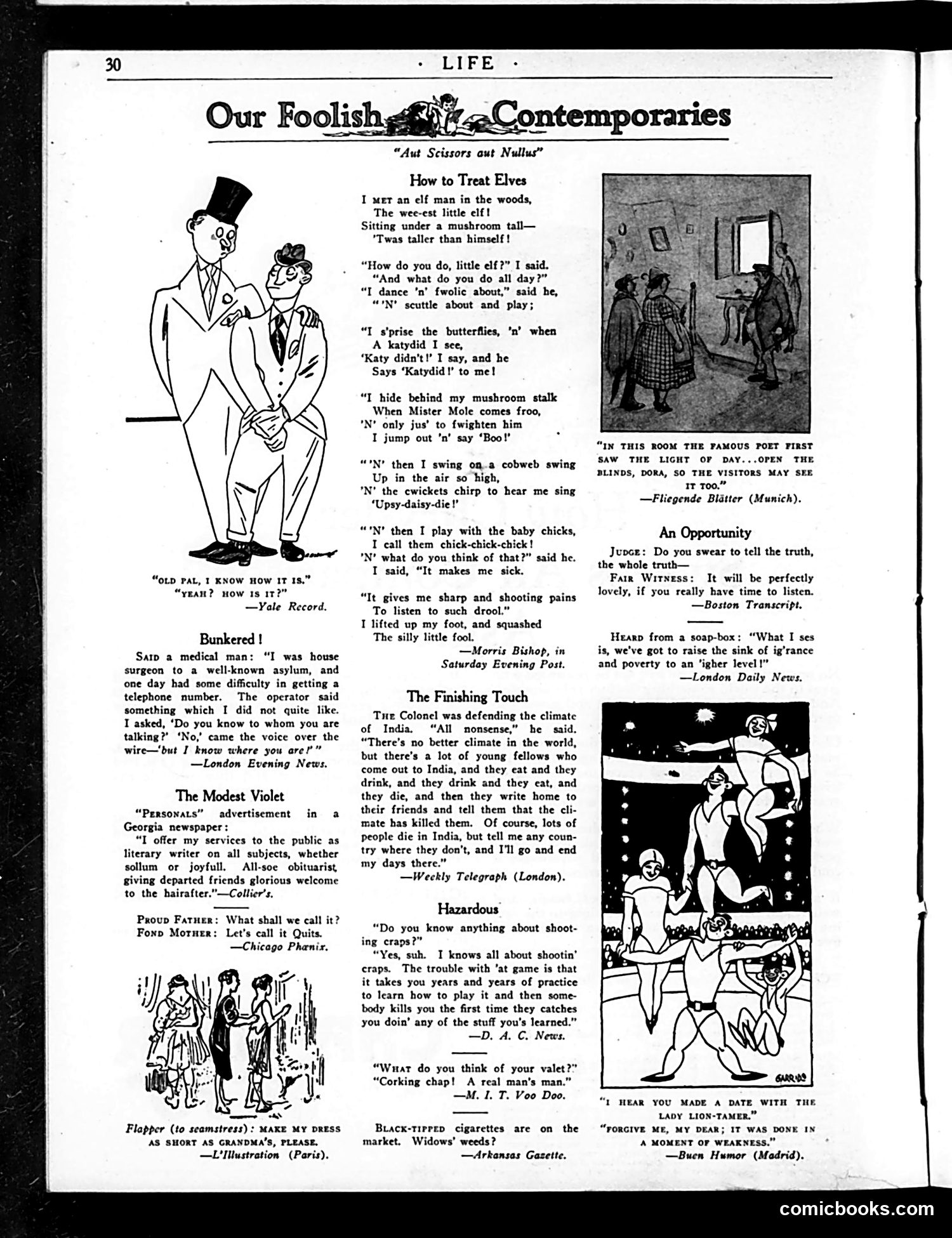
This page collects humorous short jokes and quips from various newspapers and magazines, satirizing contemporary social foibles. Key targets include: **"How to Treat Elves"**: A lengthy whimsical poem mocking sentimentality toward nature, culminating in dark humor—the narrator crushes the elf, finding its cheerful prattle unbearable. **"Bunkered"** and other brief jokes: Mock pompous professionals (doctors, operators), pretentious job advertisements, and social pretense through witty one-liners. **Visual cartoons**: Include a flapper requesting a scandalously short dress ("as short as Grandma's"), satirizing 1920s fashion rebellion. **"The Finishing Touch"**: A colonel's circular logic about India's climate defensively dismisses colonial deaths as universal rather than climate-related. The page ridicules contemporary affectation, professional pomposity, changing social mores (particularly women's fashion), and self-deception. The format—collecting "foolish" items from other publications—positions *Life* as cleverly above its subjects.
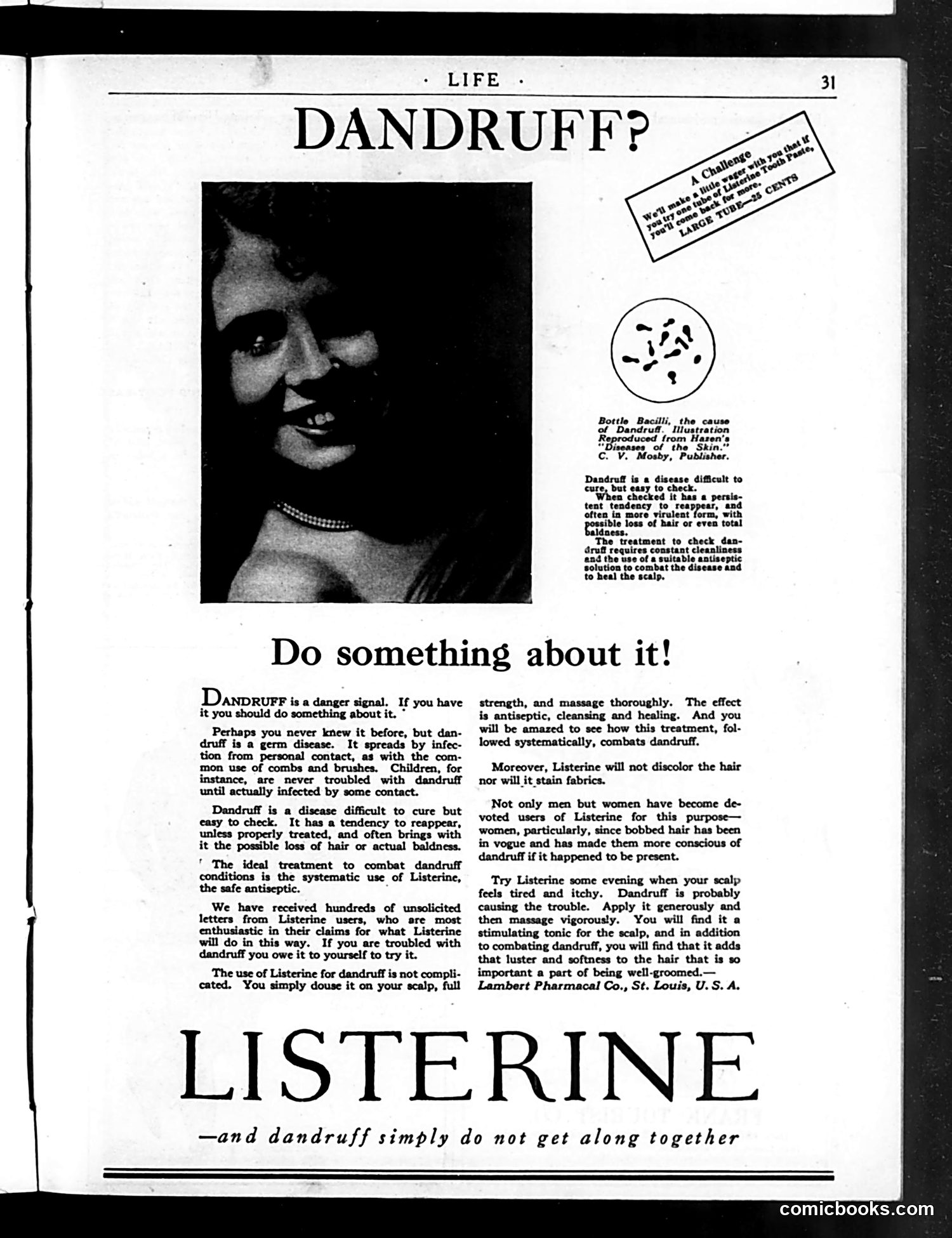
This is a **Listerine advertisement disguised as health journalism**, not satire. The page uses fear-based marketing targeting 1920s-30s readers by: 1. **The image**: A woman's face showing dandruff flakes—presented as a medical concern affecting appearance and social acceptability. 2. **The "science"**: References to "bacilli" (bacteria) and germ theory to legitimize dandruff as a disease requiring treatment. This reflects period anxieties about invisible germs. 3. **The social angle**: Notes that women became "more conscious of dandruff" since adopting bobbed hair, suggesting the product targets appearance-conscious modern women. 4. **The pitch**: Frames Listerine—already a mouthwash—as a scalp treatment, claiming it won't stain hair or fabric. This represents early **advertorial marketing**: blending advertising with authoritative-sounding medical content to persuade readers a cosmetic concern is a genuine health problem requiring the advertiser's product.
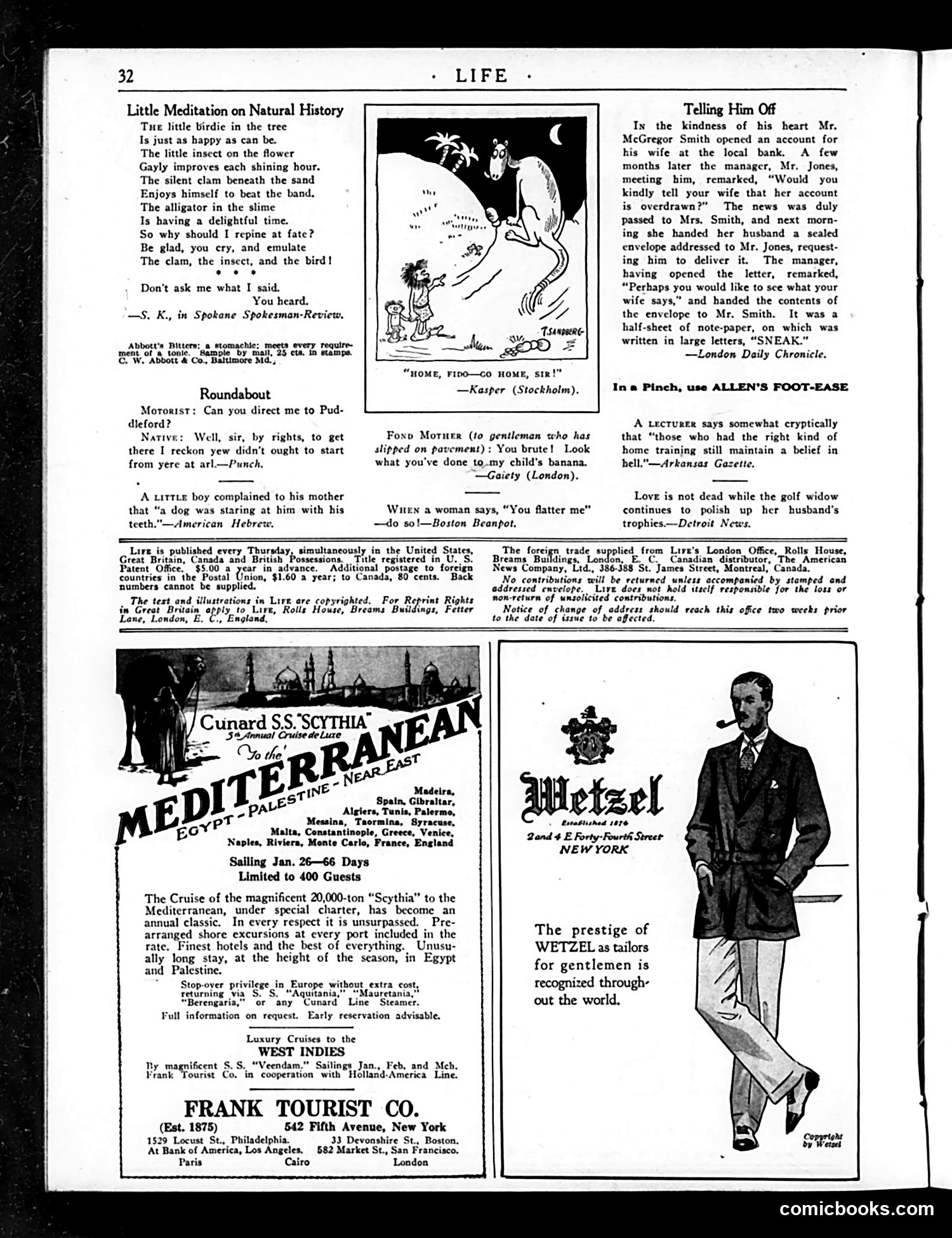
This page combines **humor shorts** with **period advertising**. The cartoon depicts a child being sent home by an adult (captioned "HOME, FIDO—GO HOME, SIR!"), illustrating a joke about obedience and boundaries—likely poking fun at either undisciplined children or overly familiar social behavior. The main humor pieces are brief anecdotes mocking middle-class social conventions: a husband opening a bank account for his wife (who responds to the manager's complaint about overdrafts by calling him a "SNEAK"), motorists asking directions, and observations about women, dogs, and golf widows. These satirize domestic relationships, gender dynamics, and emerging consumer banking. The advertisements—for Mediterranean cruises, tailoring (Wetzel), and foot powder—target affluent readers. The "Telling Him Off" anecdote specifically reflects early 20th-century anxieties about wives managing household finances independently, treated here as comedic material rather than serious social commentary. This is vintage *Life* magazine satire: genteel, focused on urban middle/upper-class foibles, and fundamentally conservative in tone.
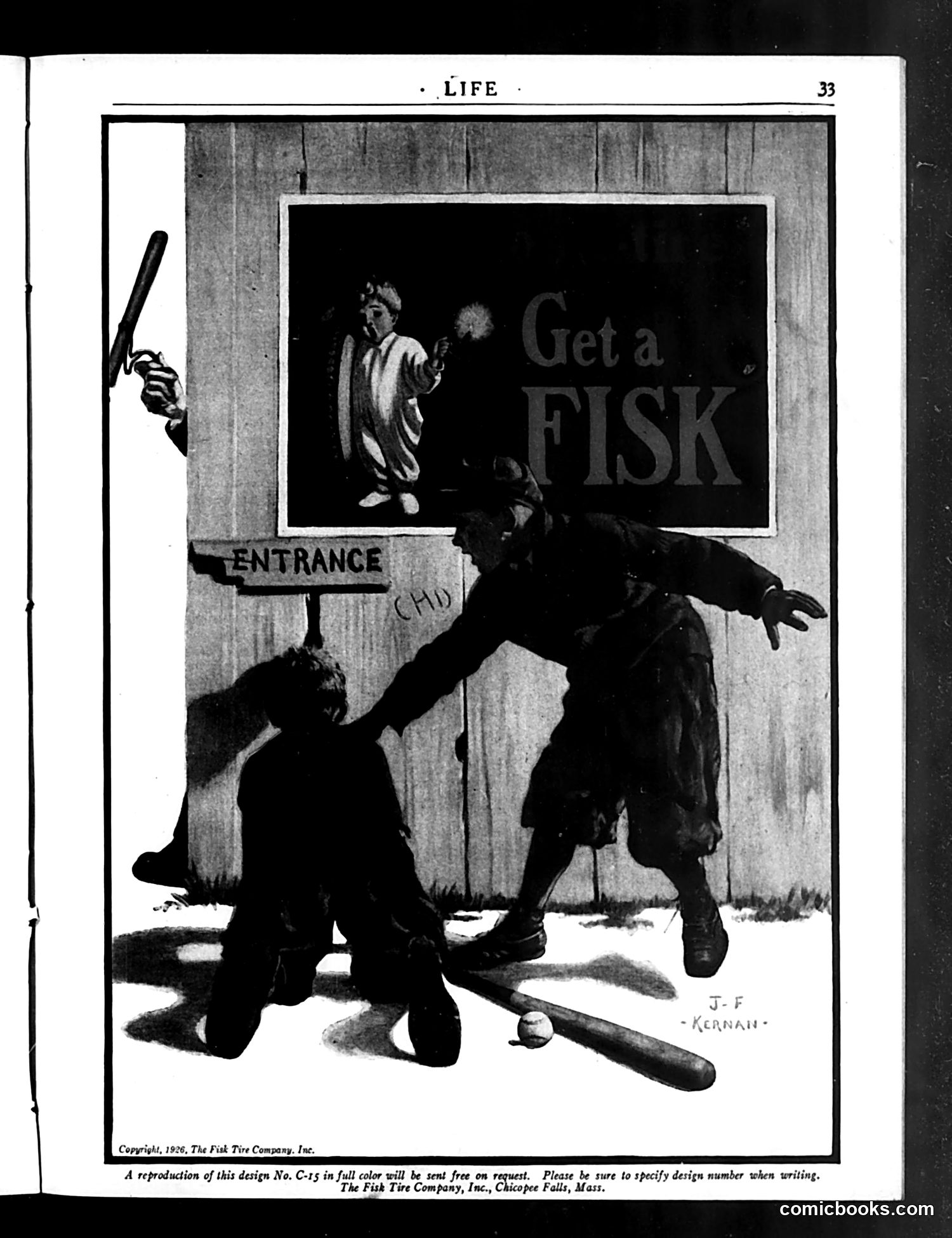
This is a Fisk Tire Company advertisement, not political satire. The image shows two figures in silhouette appearing to fight or struggle near a theater entrance, with a movie screen advertising "Get a FISK" visible above. The joke relies on a visual pun: the violent scene mimics melodramatic movie theater content of the era, while the advertisement suggests that getting Fisk tires will help you "beat" competitors or obstacles (the theatrical struggle serving as humorous exaggeration). The "ENTRANCE" sign and theater setting frame this as entertainment-themed advertising. The design was offered free in full color to interested customers, suggesting this appeared in *Life* magazine as a promotional piece circa 1926.
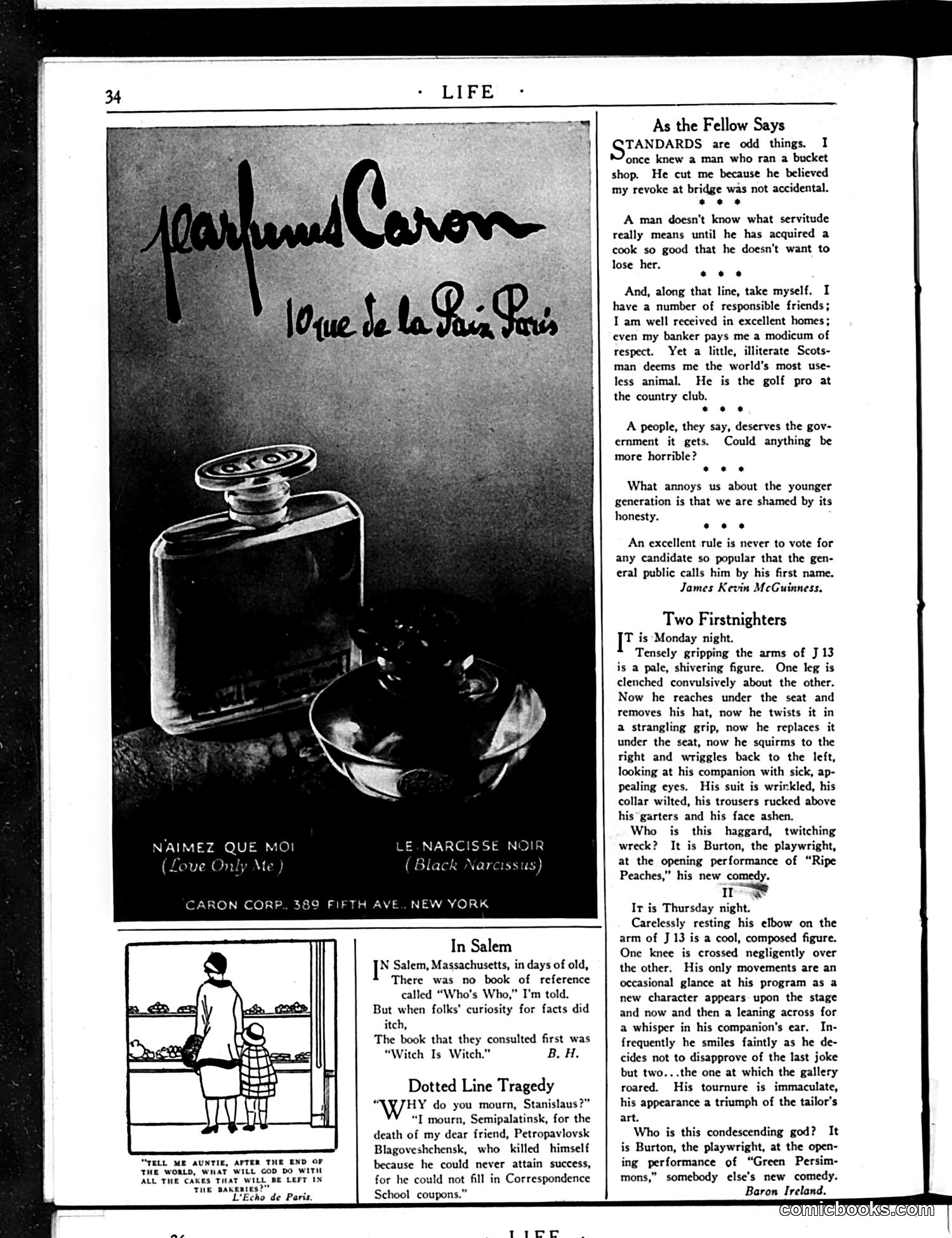
This page contains several distinct humor pieces typical of Life's satirical approach: **The Perfume Advertisement** (top) presents "Aimé de la Rôse, Paris" as a luxury product—standard 1920s advertising masquerading as editorial content. **"In Salem"** is a pun-based joke about witch hunts, playing on "Witch Is Witch" as a reference book title—contemporary wordplay rather than political commentary. **"Dotted Line Tragedy"** mocks Russian place-names (Semipalatinsk, Petropavlovsk, Blagoveshchensk) in a darkly comedic story about a man who kills himself because he cannot complete correspondence-school coupons. It's absurdist humor exploiting both Russian exoticism and American self-improvement culture. **"Two Firstnighters"** satirizes playwright Burton's contrasting behavior at his own play's opening (nervous, disheveled) versus a competitor's opening (cool, composed). The joke exposes professional jealousy and ego. **"As the Fellow Says"** offers observational humor on class, servants, and social pretension—the golf pro being the ultimate put-down. All reflect 1920s American magazine humor: wordplay, social satire, and light mockery of contemporary life rather than hard political commentary.
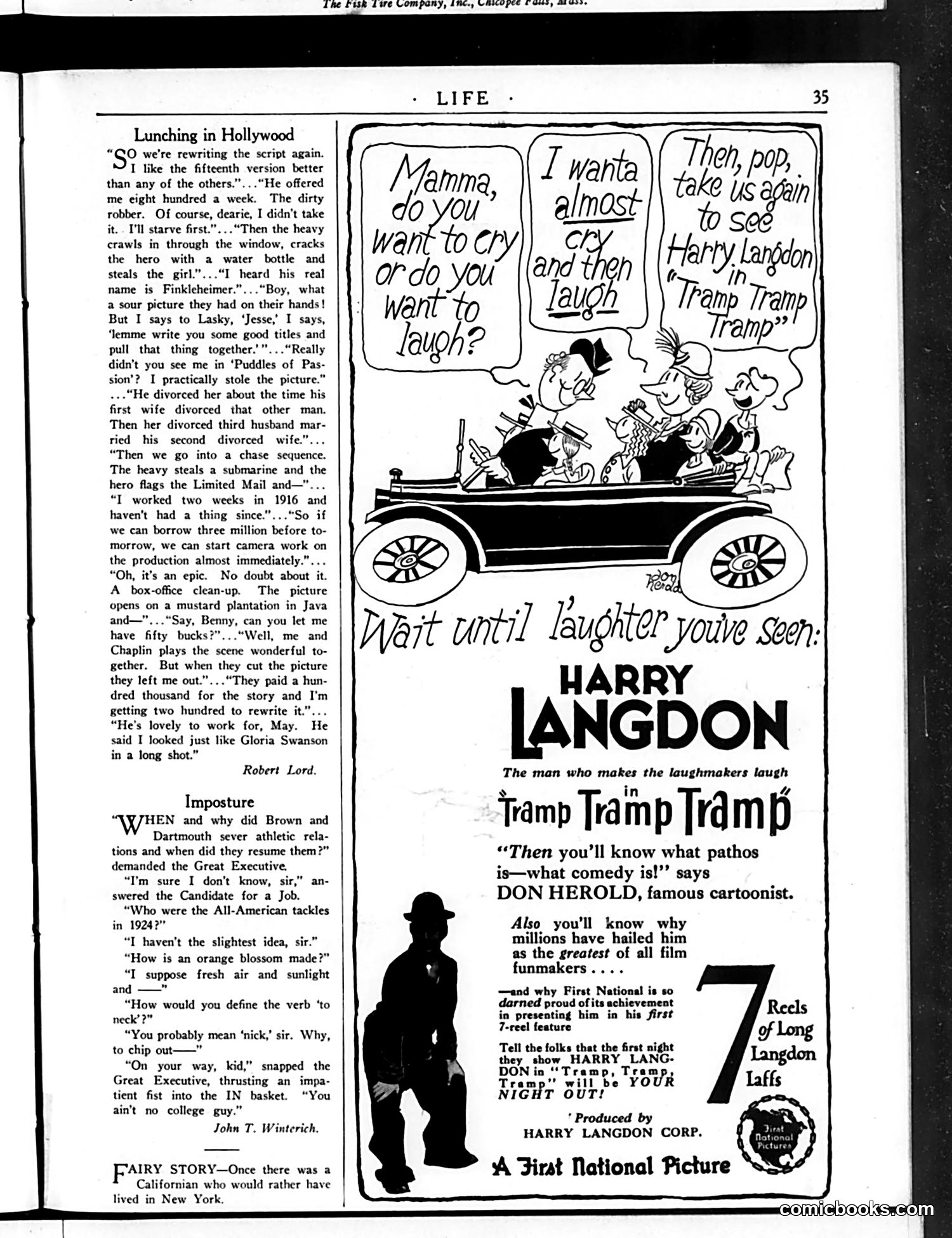
This page contains multiple satirical pieces about 1920s Hollywood and a film advertisement. **"Lunching in Hollywood"** (Robert Lord): A satirical dialogue capturing the absurdity of film industry conversations—writers pitching increasingly implausible plots, actors exaggerating minor roles, and financiers desperately borrowing money for productions. It mocks the pretension, desperation, and dishonesty pervasive in early cinema. **"Imposture"** (John T. Winterich): A short piece satirizing job interviews where a candidate for a position fails every question—about college athletics, basic science, and slang—yet is rejected for "not being a college guy," exposing the illogic of hiring standards. **Advertisement**: The right side features a full-page ad for Harry Langdon's film "Tramp Tramp Tramp," a First National picture. It emphasizes Langdon as a great "funmaker" and promises audiences will experience both pathos and comedy. The page reflects 1920s skepticism toward both Hollywood's chaotic creative process and rigid social gatekeeping in professional hiring.
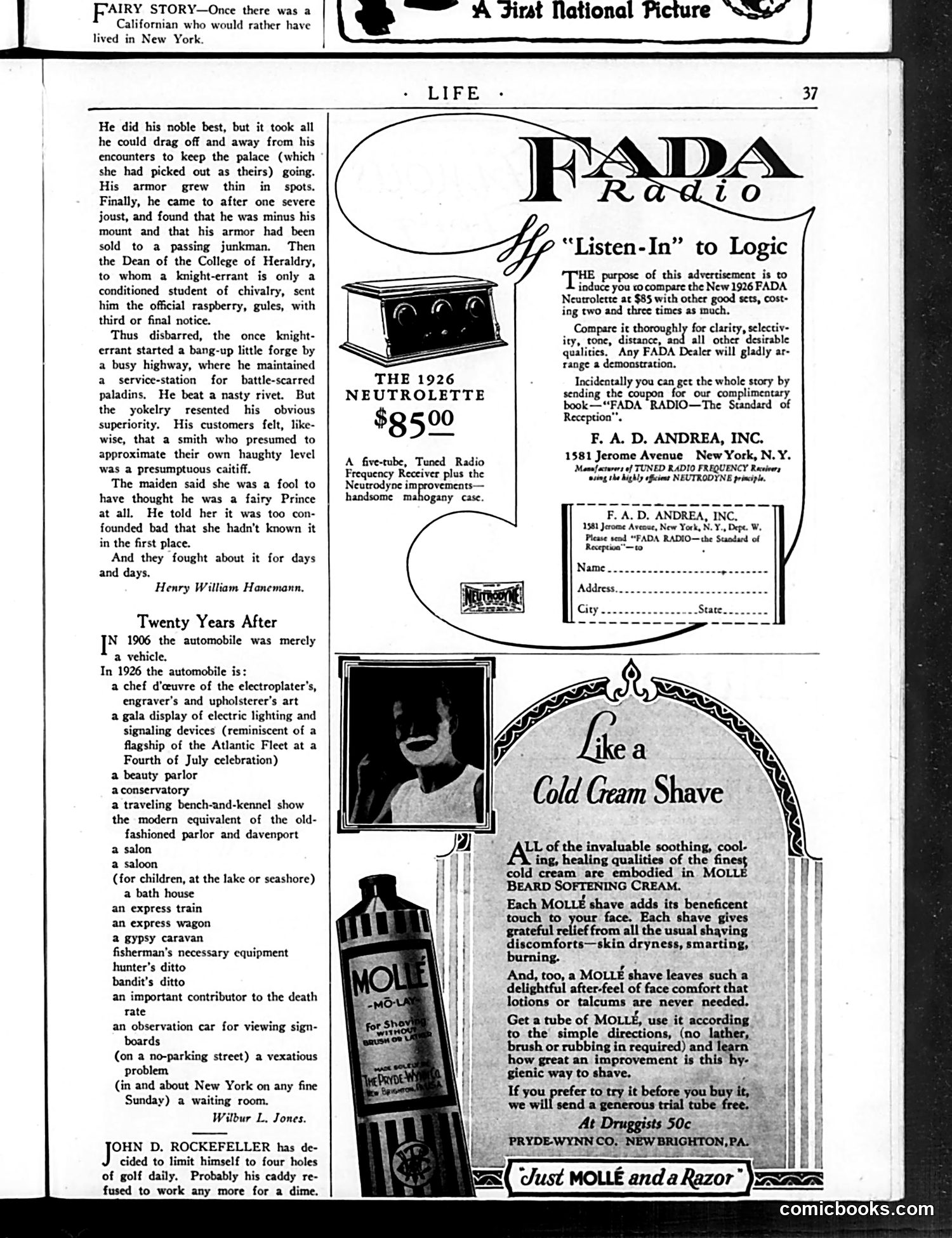
This 1926 *Life* magazine page contains three main pieces: **"Fairy Story"** (top): A satirical tale by Henry William Hanemann mocking the California gold-rush fantasy. A Californian knight tries to maintain a luxurious lifestyle his wife demands, but fails financially. He becomes a blacksmith, yet locals resent his "obvious superiority." The couple quarrels endlessly. The joke ridicules both the myth of easy California wealth and the presumption that refined people can simply relocate and prosper. **"Twenty Years After"** (middle): Wilbur L. Jones humorously catalogs how automobiles transformed from mere transportation (1906) into status symbols and lifestyle accessories (1926)—beauty parlors, salons, observation platforms. It satirizes consumer culture's inflation of the car's social importance. **Brief note on Rockefeller**: A quip suggesting John D. Rockefeller's caddy quit over inadequate pay (a "dime"), mocking the wealthy's stinginess. The page is otherwise advertisements (FADA Radio, Mollé shaving cream). The satire targets 1920s materialism, status anxiety, and the automobile's cultural dominance.
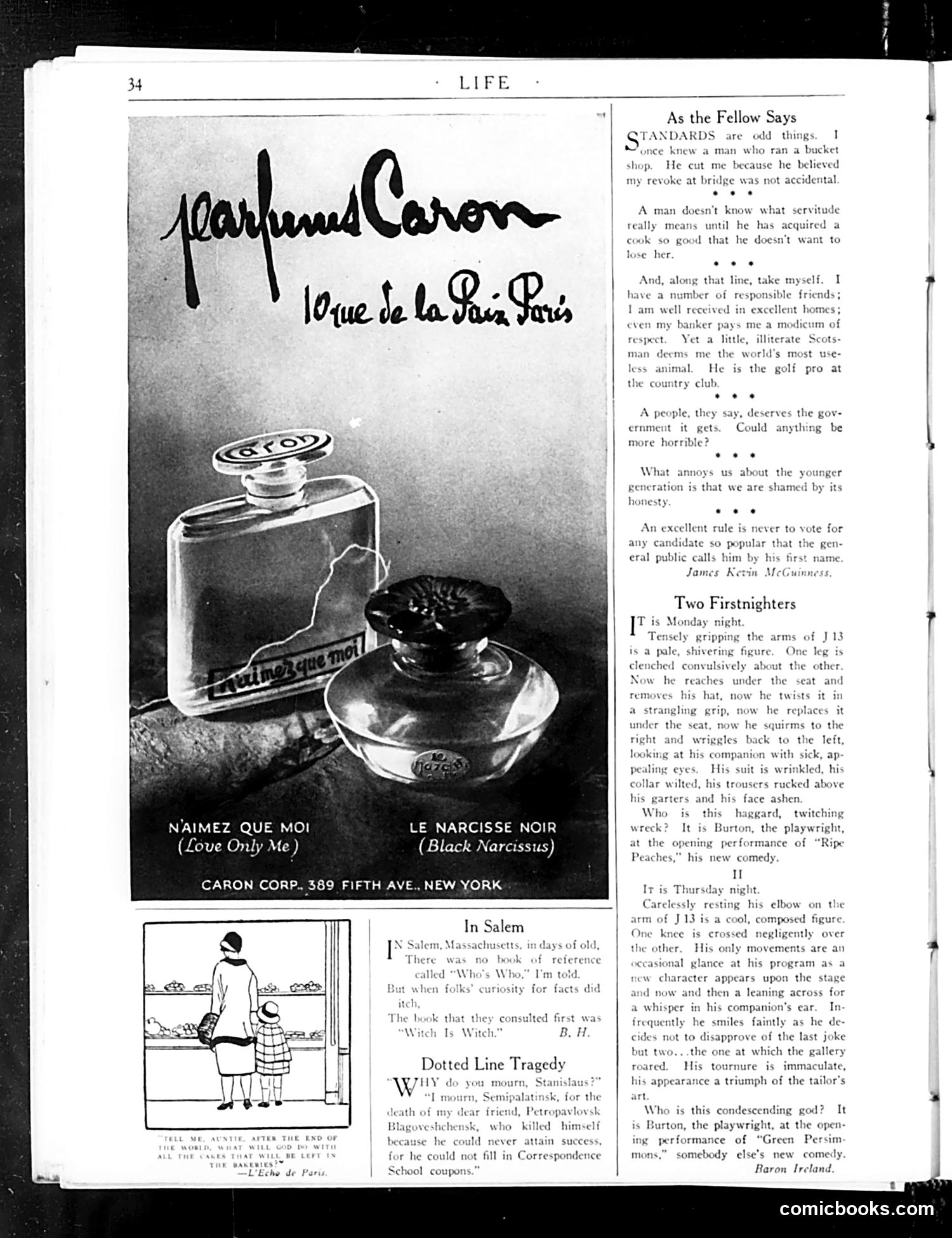
This page contains **advertising and social commentary** rather than traditional political cartoons. **The Advertisement (top):** A perfume ad for Caron Corp. featuring "Naimez Que Moi" (Love Only Me) and "Le Narcisse Noir" (Black Narcissus), endorsed with a signature by **Marl[ene] Caron** (likely a stage performer). The copy plays on vanity and narcissism—standard luxury advertising tropes. **The Editorial Content:** The right column contains satirical social observations about class, honesty in politics, and generational shame. The piece mocks a self-satisfied man who is respected in society but dismissed as "the world's most useless animal" by a Scottish golf club pro—humor based on the gap between social standing and character. **The Theater Reviews (bottom):** "Two Firstnighters" and other pieces critique recent comedies, with **Burton** identified as a playwright whose new show "Ripe Peaches" is being reviewed. The satire focuses on theatrical pretension and audience reactions. The page reflects 1920s-30s Life magazine's blend of advertising, society satire, and entertainment commentary.
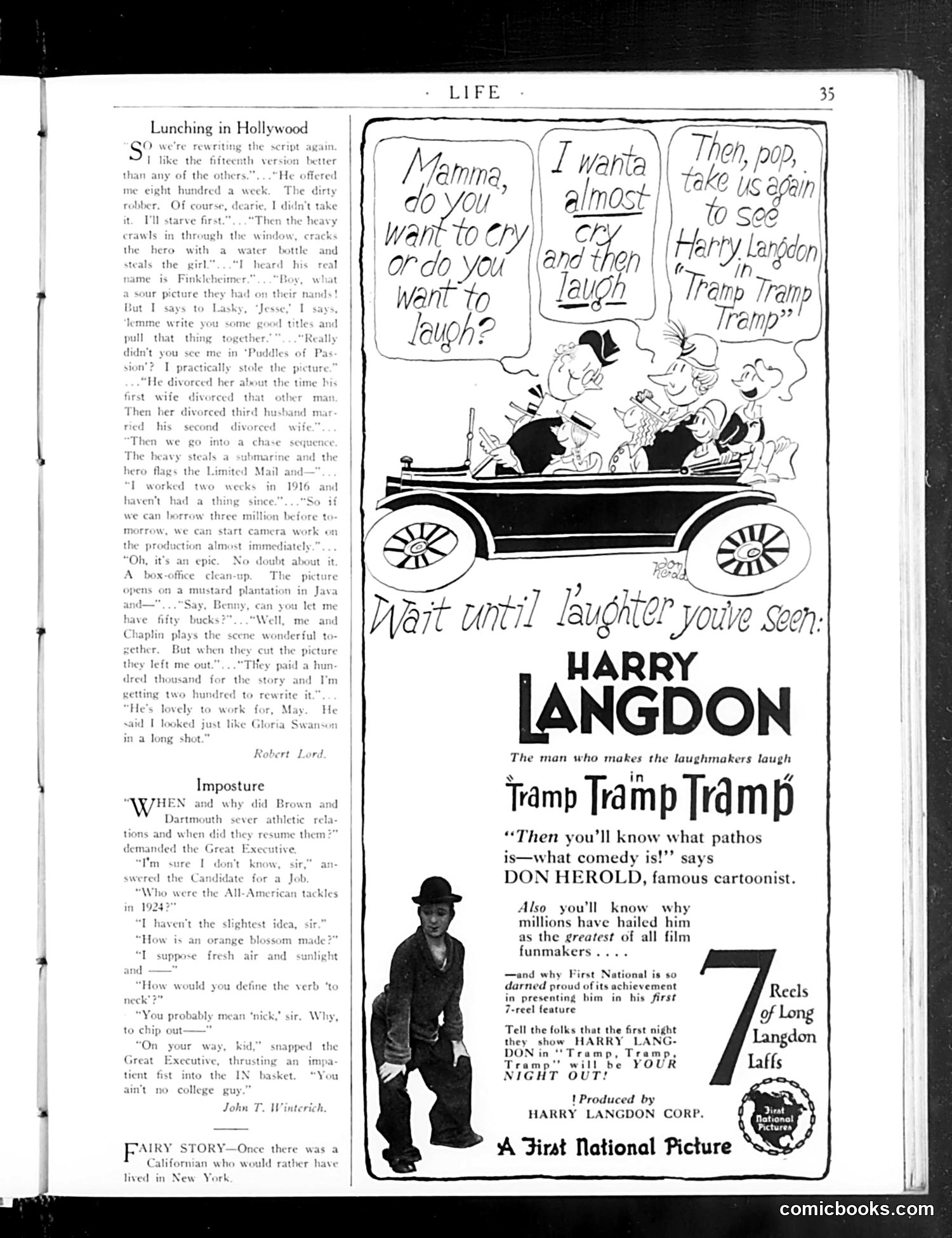
This page is primarily a **full-page movie advertisement** for Harry Langdon's silent film "Tramp Tramp Tramp" (First National Pictures). The top cartoon shows a family in a car; the child asks parents whether they want to cry or laugh, then requests they see the Langdon film—a visual advertisement gag showcasing the film's emotional range. **The key context**: Harry Langdon was a major silent-film comedian of the 1920s, comparable to Charlie Chaplin or Buster Keaton. The ad emphasizes his status as "the greatest of all film funmakers" and notes this is his first 7-reel feature—a significant production. Don Herold, a famous cartoonist quoted here, validates Langdon's ability to convey both pathos and comedy. The surrounding "Lunching in Hollywood" and "Imposture" columns contain industry gossip and anecdotes typical of Life magazine's satirical Hollywood coverage, but are secondary to the advertisement's primary purpose: promoting Langdon's film as a must-see entertainment event.
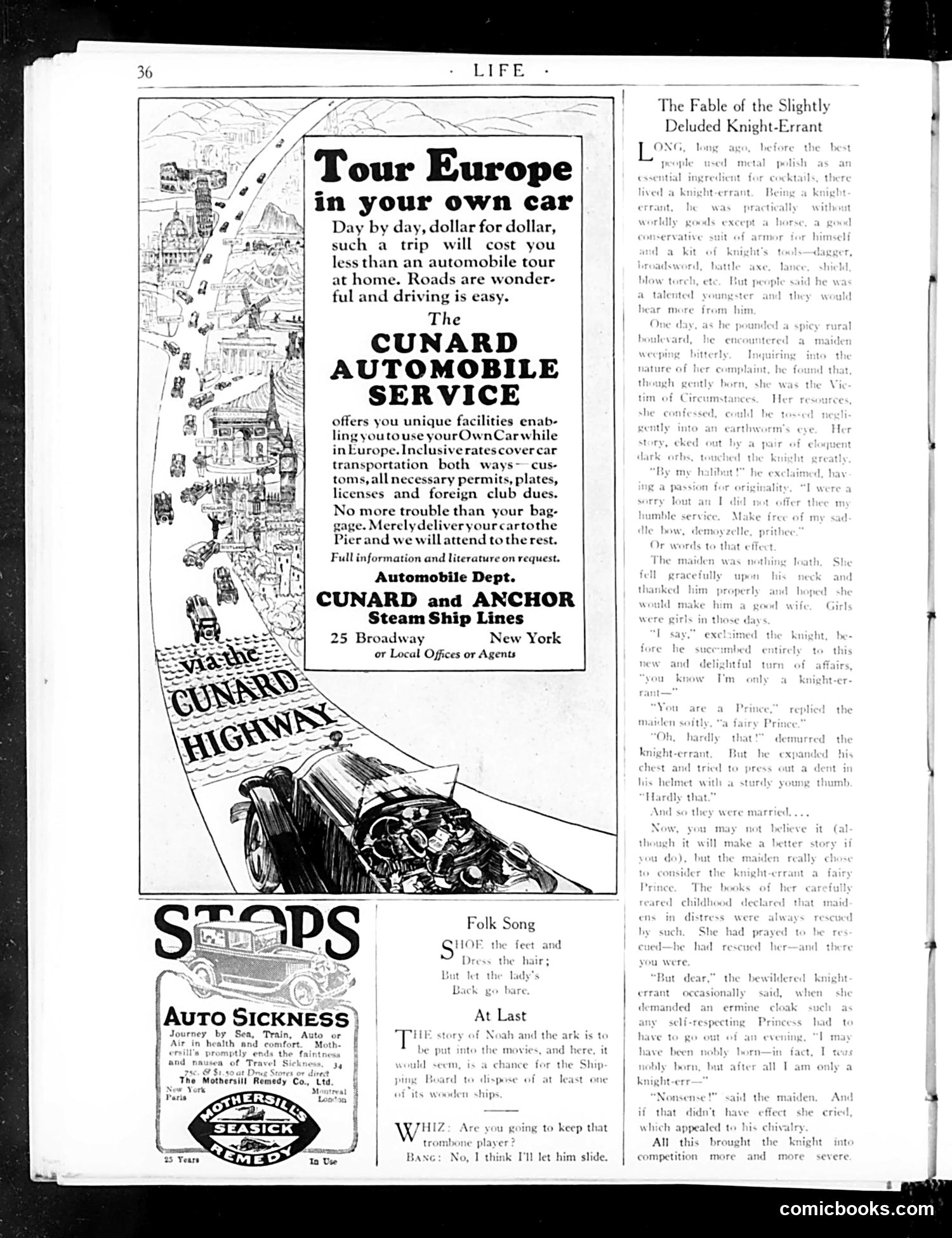
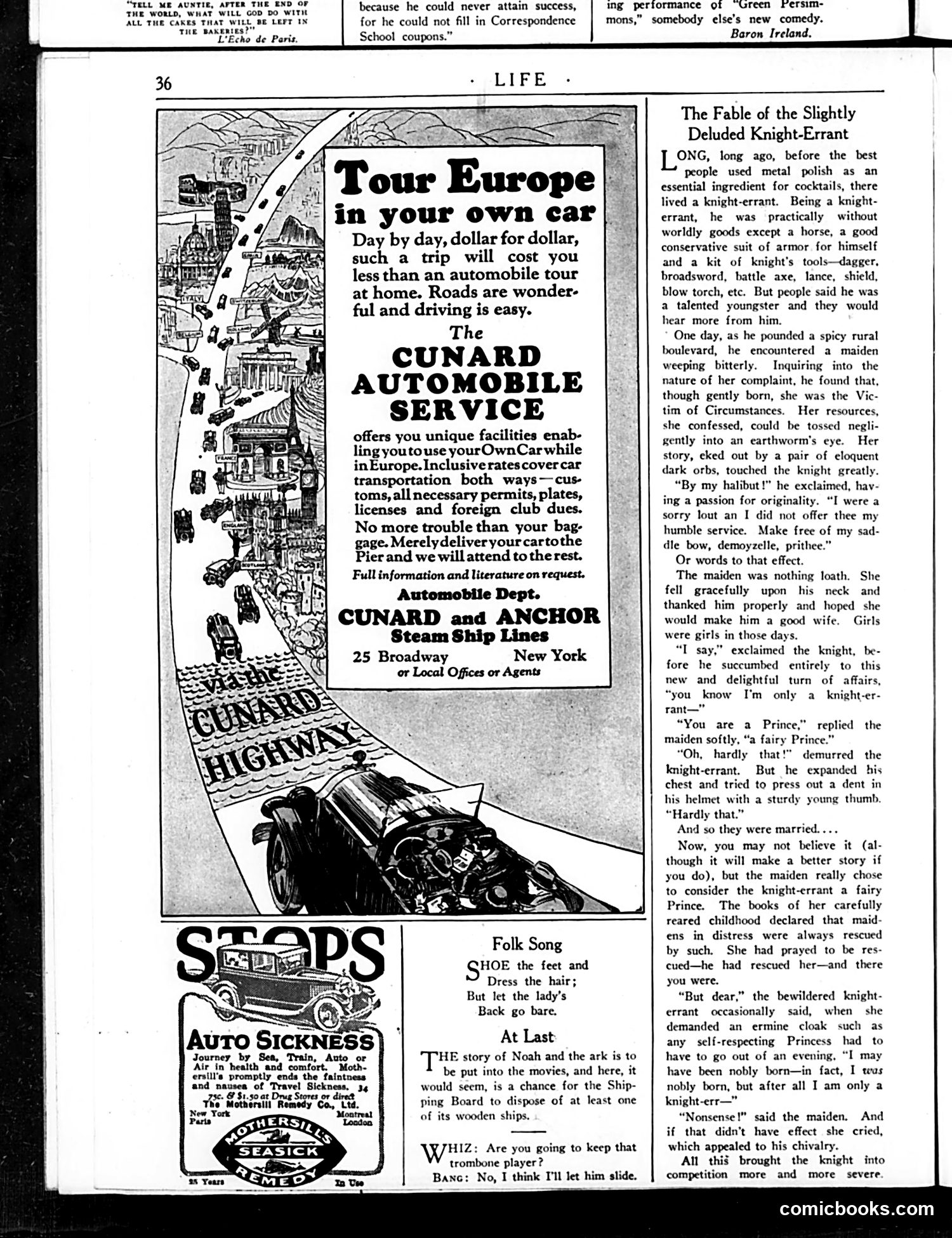
This page is primarily **advertising**, not political satire. The dominant content features: 1. **Cunard Automobile Service ad**: Promotes European tourism by car, emphasizing that driving through Europe costs no more than staying home. It highlights the convenience of Cunard's shipping service transporting your personal automobile across the Atlantic. 2. **"The Fable of the Slightly Deluded Knight-Errant"**: A short story (visible on the right) about a knight-errant who encounters a maiden and mistakes her for a fairy princess. The narrative appears to be humorous fantasy playing on outdated chivalric ideals. 3. **Minor ads**: Including Stops Auto Sickness remedy and Mothersill's Seasickness Remedy. The page reflects 1920s-era leisure culture—when automobile tourism to Europe was becoming accessible to middle-class Americans. The "knight-errant" story uses medieval romance conventions humorously, likely satirizing romanticized notions of the past, but the page is fundamentally a vehicle for travel and patent medicine advertising rather than political commentary.
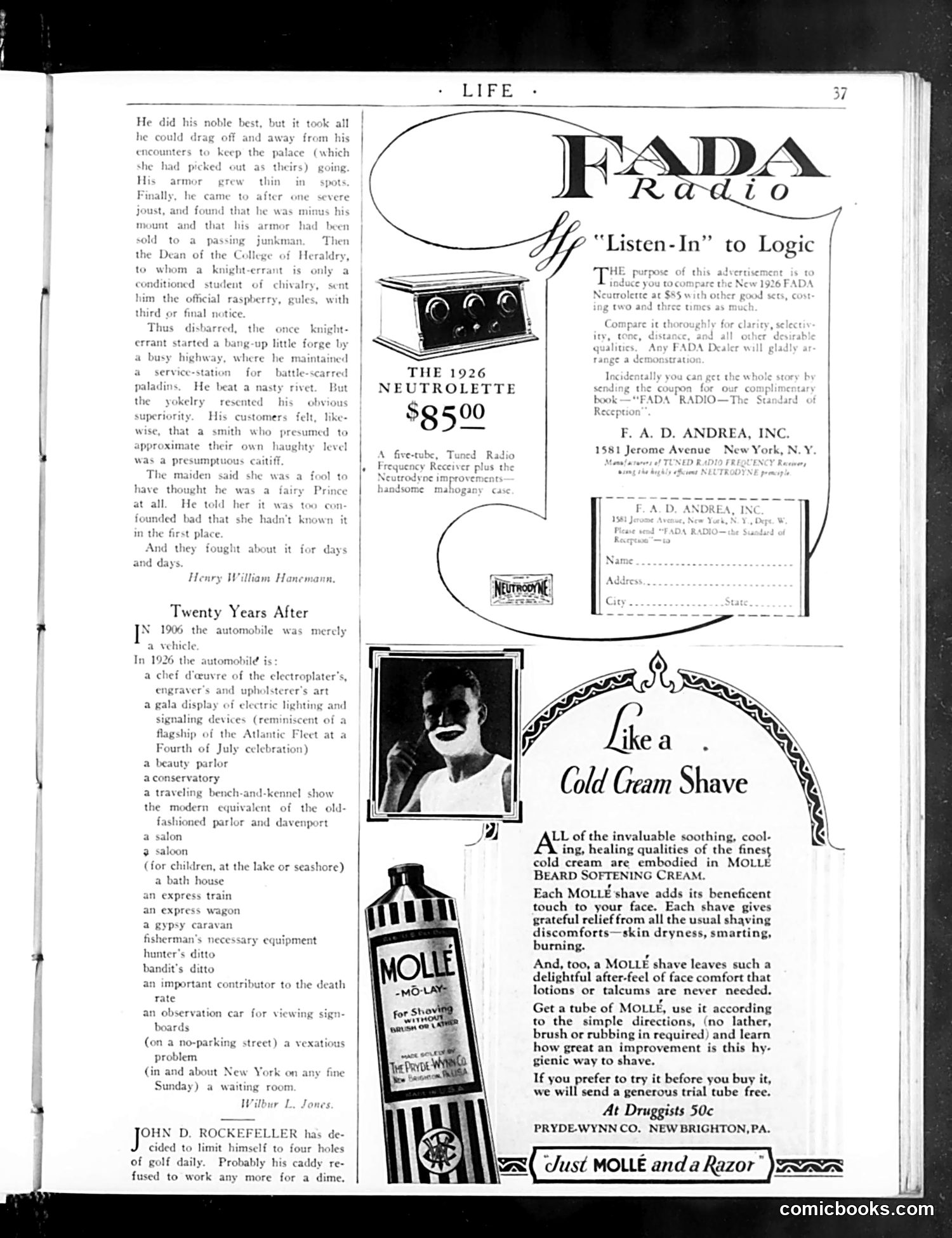
This page is primarily **advertising**, not political satire. The main content consists of three ads: 1. **FADA Radio** ($85): Promotes a 1926 "Neutrolette" radio receiver, emphasizing sound quality by encouraging readers to compare it to competitors. 2. **Molle Beard Softening Cream**: A shaving product advertisement claiming to soften beards and provide comfort without traditional lather or brush. 3. **Text snippets** titled "Twenty Years After" offer light social commentary. One jokes about John D. Rockefeller limiting his golf to four holes daily because his caddy refuses to work for minimal pay—a mild jab at Rockefeller's reputation for extreme frugality. Another lists how automobiles have replaced various transportation methods (carriages, trains, etc.), reflecting 1920s modernization. The page reflects typical Life magazine content: advertisements mixed with brief humorous observations about contemporary society and wealth disparities.
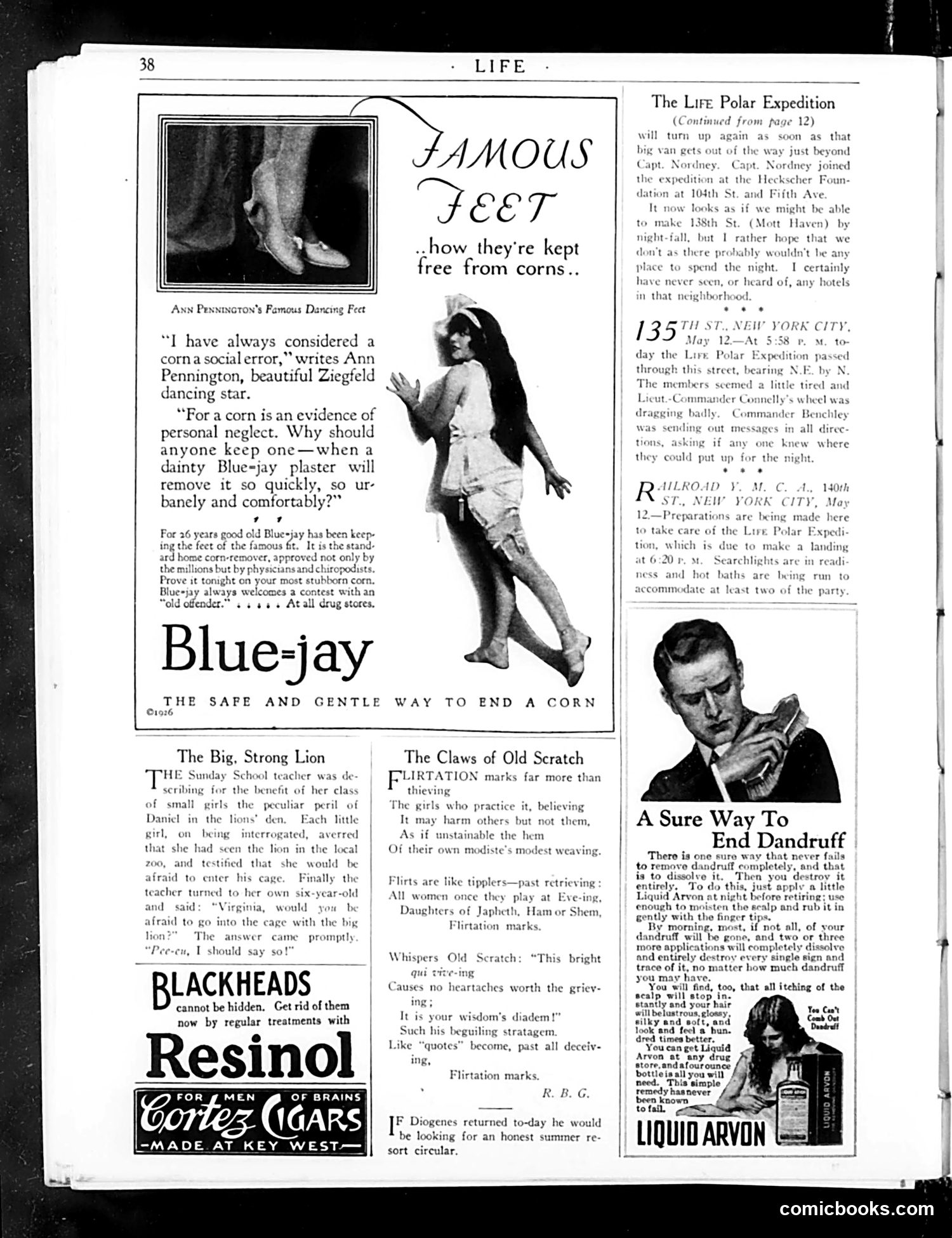
This page combines advertisements with satirical content typical of Life magazine's format. **Main Content:** The page features several product ads (Blue-Jay corn plasters, Resinol for blackheads, Liquid Arvon for dandruff) alongside brief humorous pieces and social commentary. **Notable Elements:** The **Ann Pennington feature** (a real Ziegfeld dancer) advertises corn plasters by having her claim corns are "a social error" showing "personal neglect." **"The Big, Strong Lion"** is a Sunday School joke: a teacher asks girls if they'd be afraid entering a lion's cage; the punchline suggests the teacher's own six-year-old would go in—implying the lion itself should fear *her*. **"The Claws of Old Scratch"** satirizes flirtation as a moral failing, using religious language ("daughters of Japheth, Ham or Shem") to mock women who flirt. **The Polar Expedition** column reports on Life magazine's own publicity stunt—tracking an expedition through New York City streets. The page reflects 1920s concerns: beauty standards, morality anxieties about women's behavior, and Life's self-promotional humor.
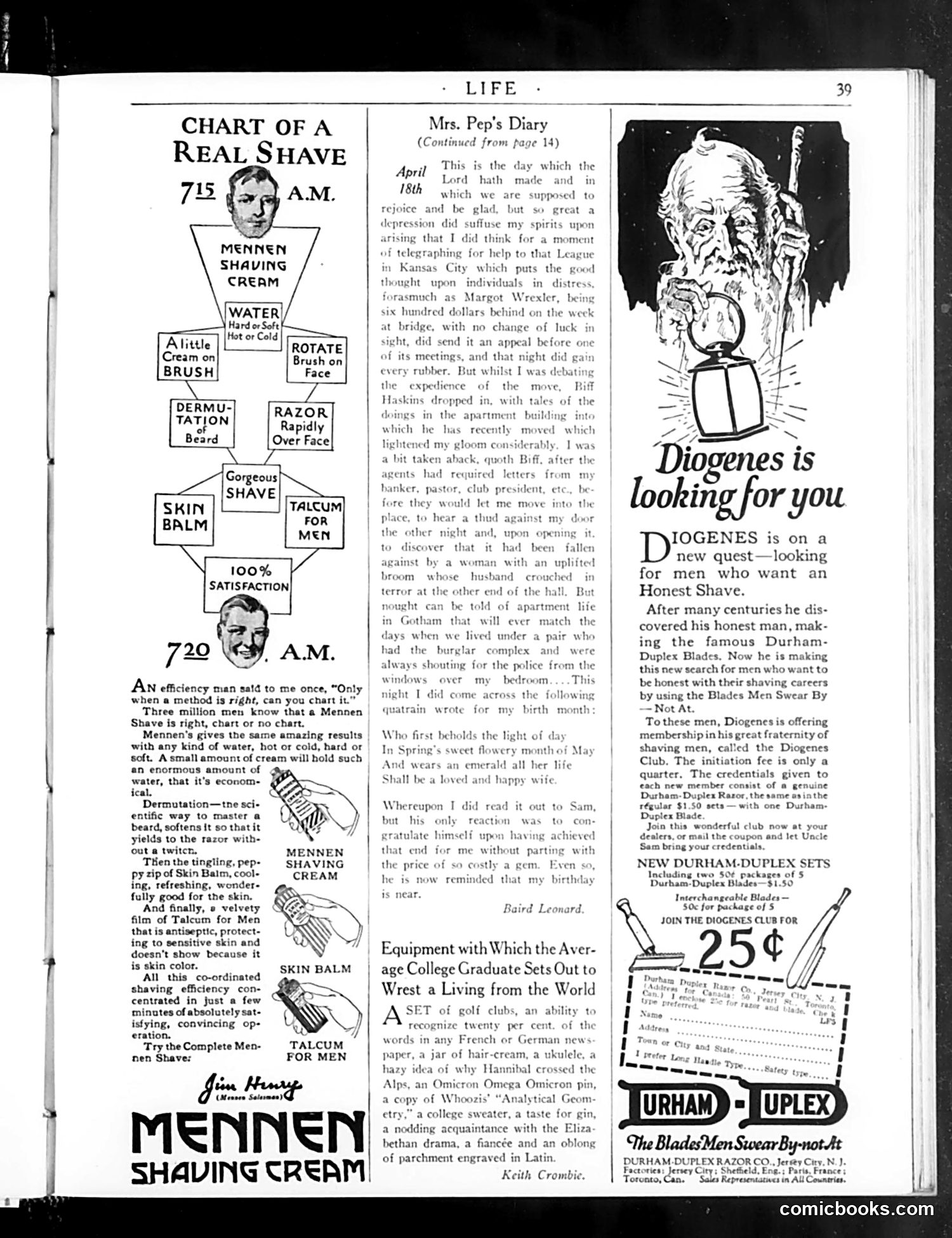
This page contains primarily **advertising content** rather than political satire. The main elements are: **Left side:** A flowchart-style advertisement for Mennen Shaving Cream, humorously titled "Chart of a Real Shave" showing the product's components (cream, water, brush, razor, dermutation balm, skin balm, talcum) leading to "100% Satisfaction" at 7:20 AM. The joke is applying pseudo-scientific "efficiency" language to a simple grooming routine. **Center:** "Mrs. Pep's Diary" (continued from previous issue)—a domestic humor column describing her frustrations with burglars and neighbors in Gotham (New York City). **Right side:** Advertisement for Durham-Duplex razor blades, using Diogenes (the ancient Greek philosopher famous for searching for an honest man) as a mascot to market blades as trustworthy and superior. The page's satire is mild and commercial rather than political—it mocks the era's obsession with efficiency systems and uses classical references for comedic advertising appeal.
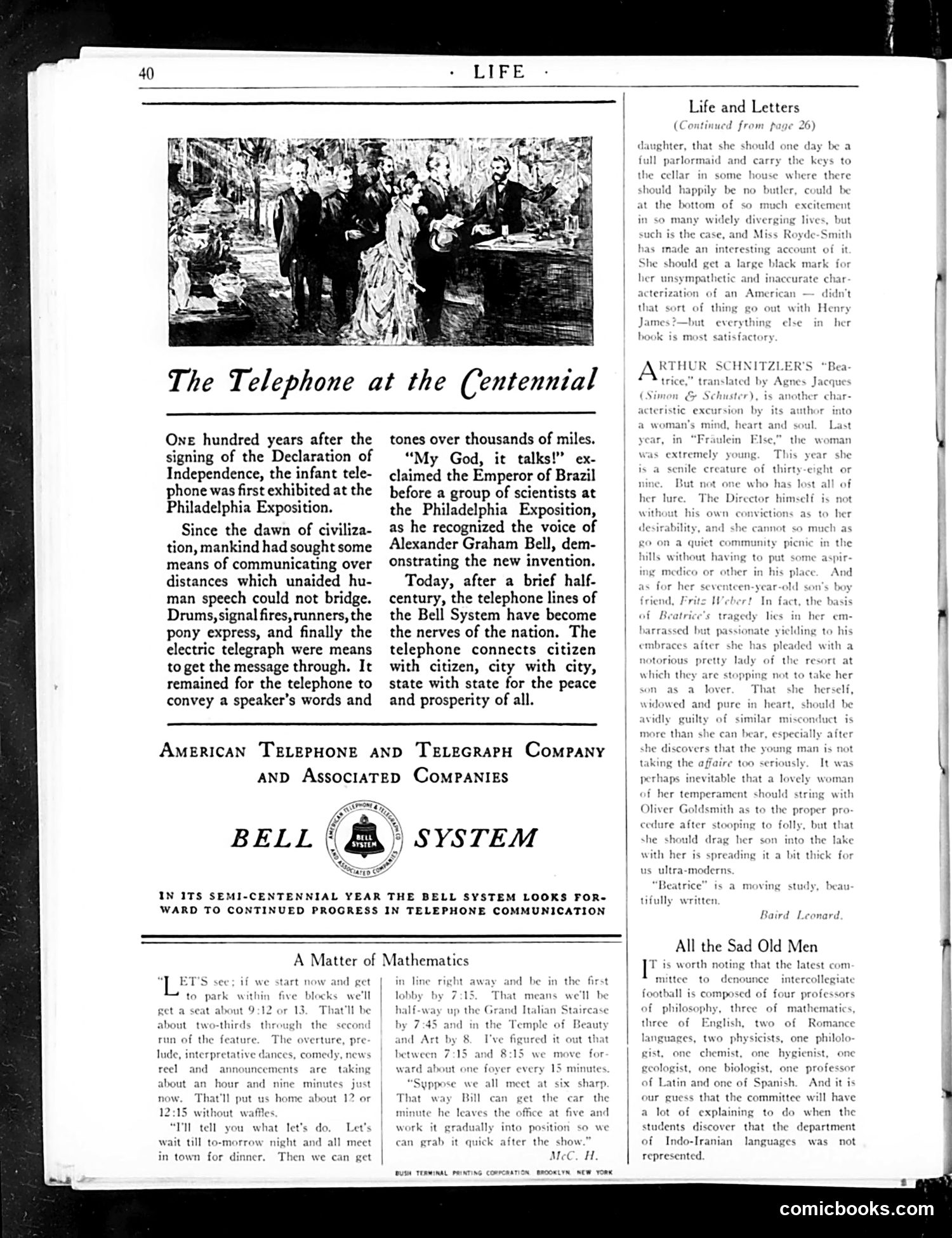
This page is primarily a **Bell System advertisement** dressed as editorial content. The photograph shows the famous 1876 Philadelphia Centennial Exposition, where Alexander Graham Bell demonstrated the telephone. The ad quotes the Emperor of Brazil's reaction: "My God, it talks!" — presenting the telephone as a miraculous technological breakthrough that, within fifty years, has become "the nerves of the nation." The piece celebrates American progress: the telephone overcomes what drums, signal fires, and the pony express could not — instantaneous long-distance communication. For a 1926 reader, this would reinforce Bell's dominance and the telephone's centrality to modern American life and prosperity. The surrounding "Life and Letters" section contains book reviews unrelated to the advertisement.
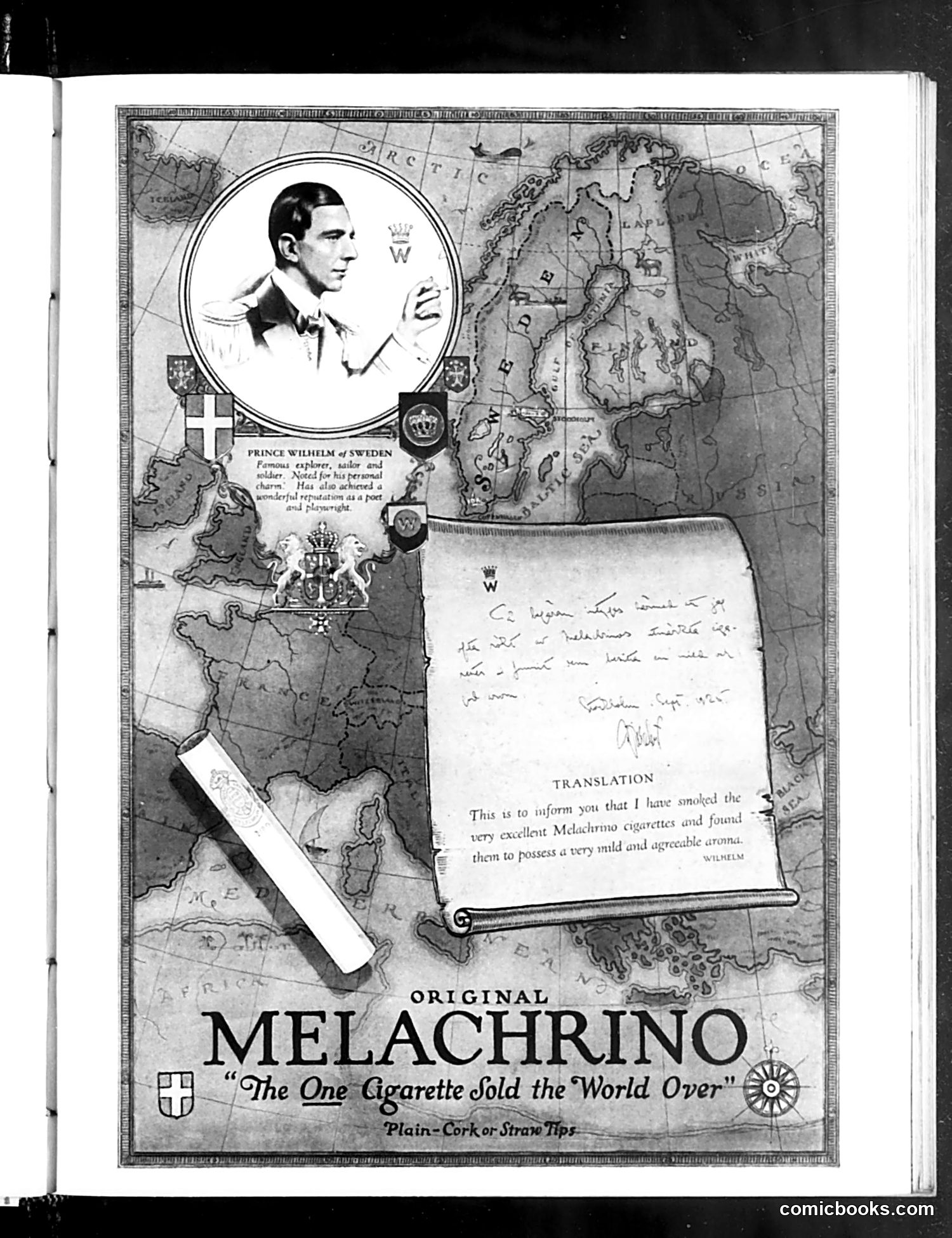
This is primarily a **cigarette advertisement** for Melachrino brand, using a celebrity endorsement strategy. The page features Prince Wilhelm of Sweden, identified as a "famous explorer, sailor and soldier," positioned as a high-status endorser. The "translation" presents a handwritten note allegedly from the Prince praising Melachrino cigarettes for their "mild and agreeable aroma." The accompanying map of Europe establishes his international credentials and world travels—suggesting that even a globally-experienced royal figure endorses this product. The satire is implicit rather than explicit: the ad humorously presents a royal figure as a cigarette promoter, exploiting his prestige to sell consumer goods. The tagline "The One Cigarette Sold the World Over" reinforces the global aspirations. This reflects early 20th-century advertising practices before modern restrictions on celebrity tobacco endorsements.
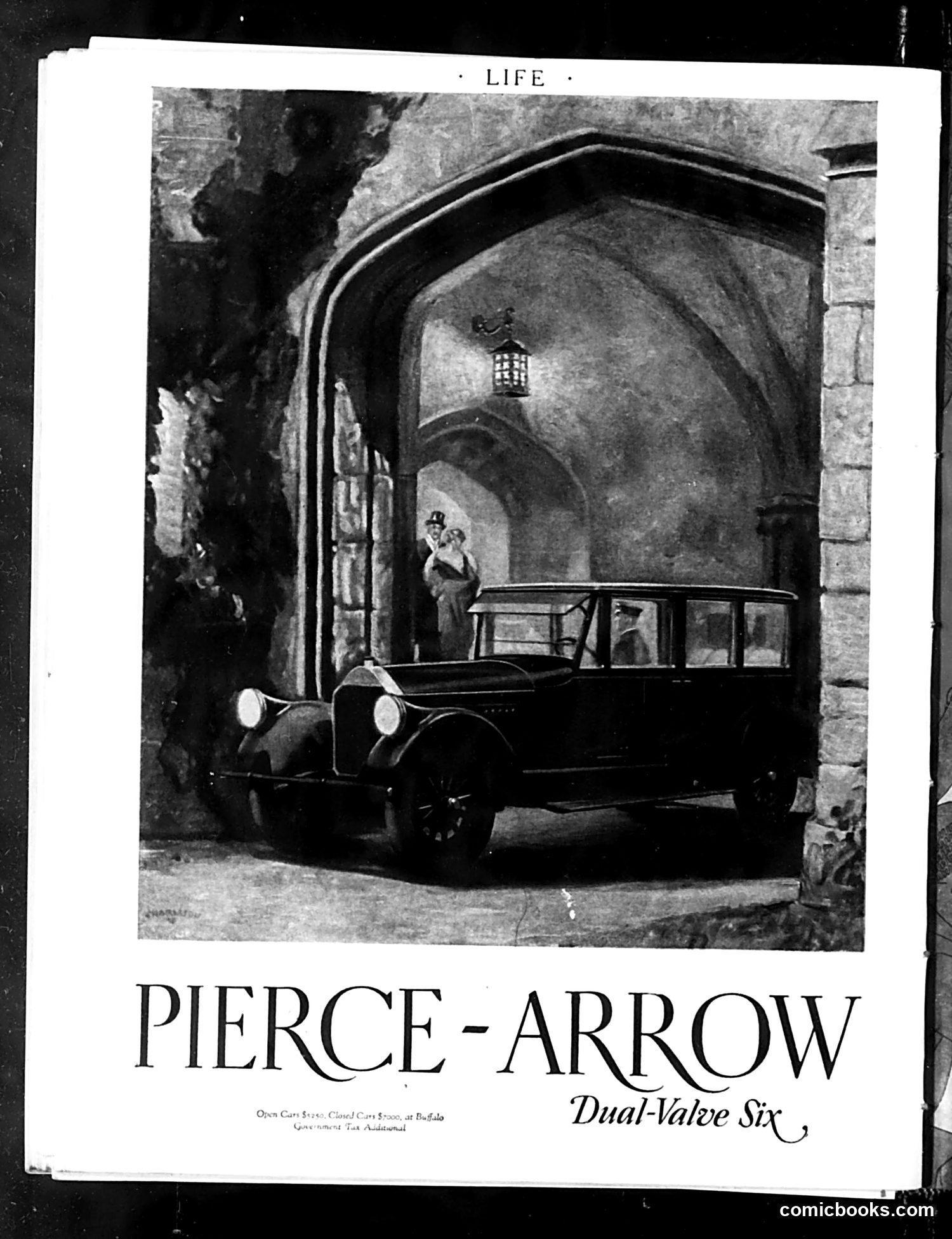
This is an advertisement for the Pierce-Arrow automobile, specifically their "Dual-Valve Six" model. The image shows a luxury car parked beneath an ornate stone archway, suggesting elegance and timeless quality. A well-dressed figure stands in the background near the arch's entrance. The advertisement is not political satire or a cartoon. Rather, it's a straightforward commercial promoting Pierce-Arrow automobiles to Life magazine's affluent readership. The classical architectural setting and refined composition emphasize the car's luxury positioning and sophisticated appeal to wealthy buyers during the early automobile era. The "Dual-Valve Six" designation highlights the engine's technical features as a selling point.