
Life, 1926-05-13 · page 20 of 52
Life — May 13, 1926 — page 20: what you’re looking at
What you’re looking at
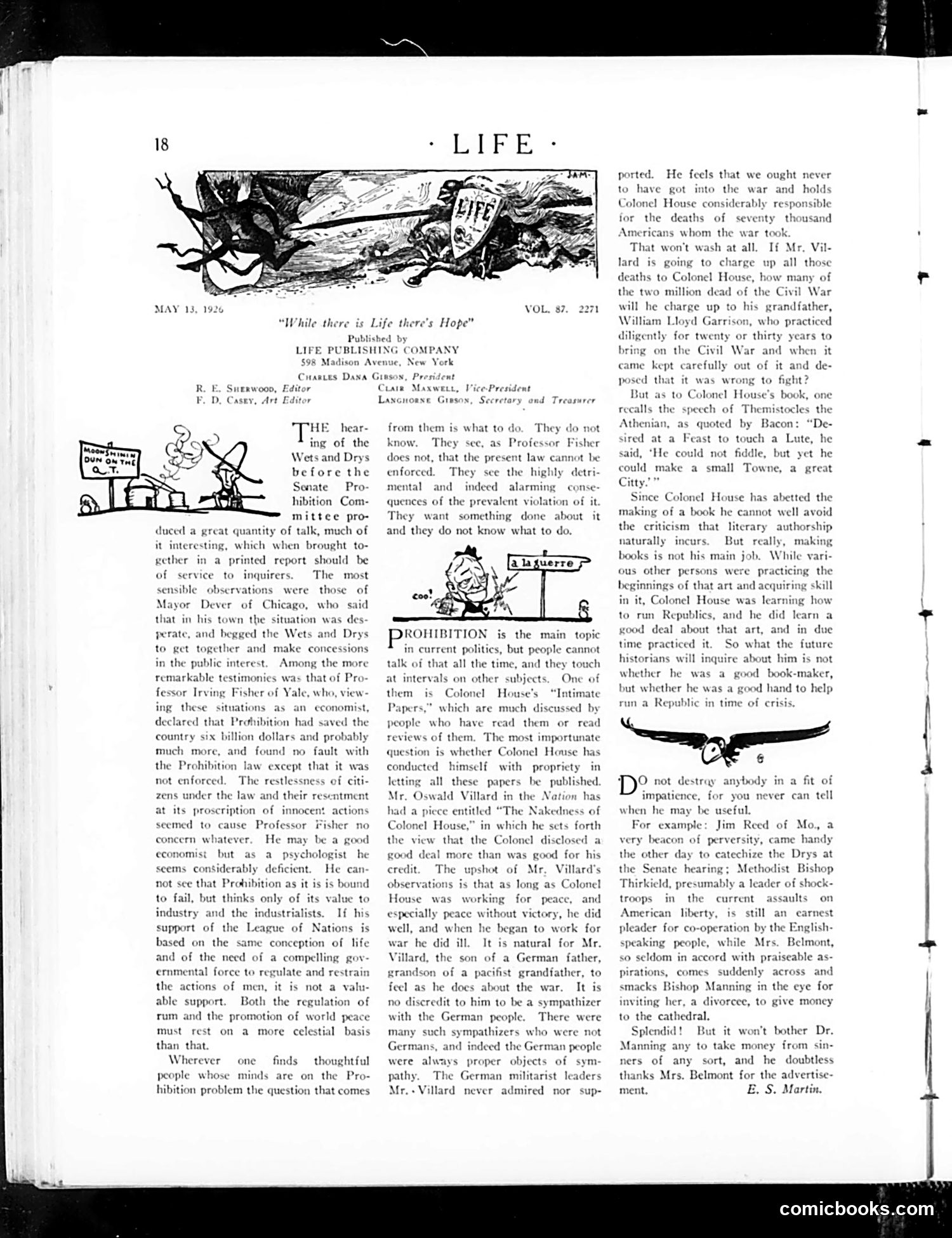
This page combines two distinct critiques of contemporary American politics and public figures. **The Prohibition Cartoon:** The top illustration mocks ongoing Senate hearings about Prohibition enforcement. The text criticizes economist Irving Fisher's testimony supporting Prohibition's economic benefits while ignoring that citizens violate it constantly and face resentment. The satire suggests Fisher prioritizes industrial gains over practical human psychology—a "celestial basis" for law-making won't work. **The Colonel House Controversy:** The longer article discusses criticism by Oswald Villard (editor of *The Nation*) regarding Colonel Edward House's published diplomatic papers from World War I. Villard, whose German father and grandfather are noted, argues House disclosed too much. The author defends House, sarcastically pointing out Villard cannot blame House for 70,000 American war deaths while his own grandfather escaped blame for two million Civil War deaths. The satire targets selective moral reasoning and ethnic bias in political criticism.
📄 Transcribed text from this page (OCR, searchable)
Machine-transcribed from the original scan — historical spelling and the odd misread are preserved.
Published by LIFE PUBLISHING son Aven 598 M YMPANY New York Curaaces Dana Ginsos, President R. E, Suerwooo, Editor F. D, Casny, Art Editor Ss HE hear- ing of the Wets and Drys before the Sonate Pro. hibition Com- mittee pro- duced a great quantity of talk, much of it interesting, which when brought to- gether in a printed report should be of service to inquirers. The most sensible ervations were those of Mayor Dever of Chicago, who said situation was des and begged the Wets and Drys to get together and make concessions in the public interest remarkable testimonies w that in his town the perate, Among the more s that of Pro- fessor Irving Fisher of Yale, wh view- these econom yations as an Jared that Prohibition had saved the country si billion dollars and probably 1 no fault with the Prohibition law except that it w much more, and fou not enforced. The restlessness of zens under the law and their resentment at its cription of innocent act seemed to cause Professor Fisher no concern whatever. He may good economist but as a_ psyche seems considerably deficient. He can not see that Prohibition as it is is bound to fail, but thinks only of its value to industry and the trialists. If his support of the League of Nations is based on the same conception of life and of the need of a compelling gov- ernmental force to reg ate and restrai the actions of men, it is able support. Both the regulation of rum and the promotion of world peace jot a valu- must rest on a more celestial basis than that. Wherever one finds thoughtful people whose minds are on the Pro- hibition problem the question that comes Care Maxwees, Vic Laxcuoaxe Gresox President ‘ecretary and Treasurer from them is what to do. They do not know. They see, as Professor Fisher does not, that the present law cannot be enforced. They sce the highly detri- mental and indeed a larming conse- quences of the prevalent violation of it They want something done abx and they do not know what to do. ROHIBITION is the main topic in current politics, but people cannot talk of that all the time, and they touch at intervals on other One of them is Colonel “Intimate are much discussed by Papers,” whic people who have read them or read reviews of them. The r »st importunate onel House has question is whether ( conducted himself with propriety in letting all these papers be published. Mr. Oswald Villard in the Nation has had a piece entitled “The Nakedness of Colonel House,” in which he sets forth the view that the Colonel disclosed a good deal more than was good for his he upshot of Mr. Villard’s observations is that as long as C credit. lonel House was working for peace, and he did well, and when he began to work for r he did ill. It is natural for Mr. Villard, the son of a German father, fist grandfather, to feel as he docs about the war. It is no discredit to him to be a sympathizer with the German people. There were many such sympathizers who were not Gern leed the Germ were always proper objects especially peace without victory w ans, and ir 1 people sym pathy. The German militarist leaders Mr.+V ard never admired nor sup- ported. He feels that we ought never to have got the war and holds mel House considerably responsible for the deaths of seventy thousand Americans whom the war took That won't wash at all. If Mr. V to charge up all those lard is goin, deaths to Colonel House, how many of the two million dead of the Civil War will he charge up to his grandfather, William L diligently for twenty or thirty years to br on the Civil War and when it came kept carefully out of it and de- yd Garrison, who practiced > fight? But as to Colonel House's book, om recalls the speech of Themistocles the Athenian, as quoted by Bacon: “De- sired at a Feast to touch a L sid not small Towne, a great posed that it was wrong said, ‘He « could mak City!" Since Colonel House has abetted the making of a book he cannot well avoid the criticism that literary authorship naturally incurs. But really, mak yet he books is not his main job. While vari- ous other persons were practicing the beginnings of that art and acquiring skill in it, jonel House was learning how to run Republics, and he did learn a good deal about that art, and in due time practiced it. So what the future historians will inquire about him is not whether he was a good book-maker, xd hand to help time of crisis. but whether he was a run a Republic 6 D° not destray anybody in a fit of impatience, for you never can tell when he may be useful. Jim Reed of Mo, a 1 of perversity, came handy very beac the other day to catechize the Drys at the Senate hearing; Methodist Bishop Thirkicld, presumably a leader of s ck- troops in the current assaults on American liberty, is still an carnest pleader for co-operation by the English- speaking people, while Mrs. Belmont, so seldom in accord with praiseable as- ross and ions, comes suddenly a cks Bishop Manning in the eye for sma inviting her, a divot to the cathedral, Splendid! But it won't bother Dr. Manning any to take money from s ¢, to give money 1 ners of any sort, and he doubtless thanks Mrs. Belmont for the advertise- ment. E, S. Martin. i comicbooks.com