
Life, 1926-05-13 · page 29 of 52
Life — May 13, 1926 — page 29: what you’re looking at
What you’re looking at
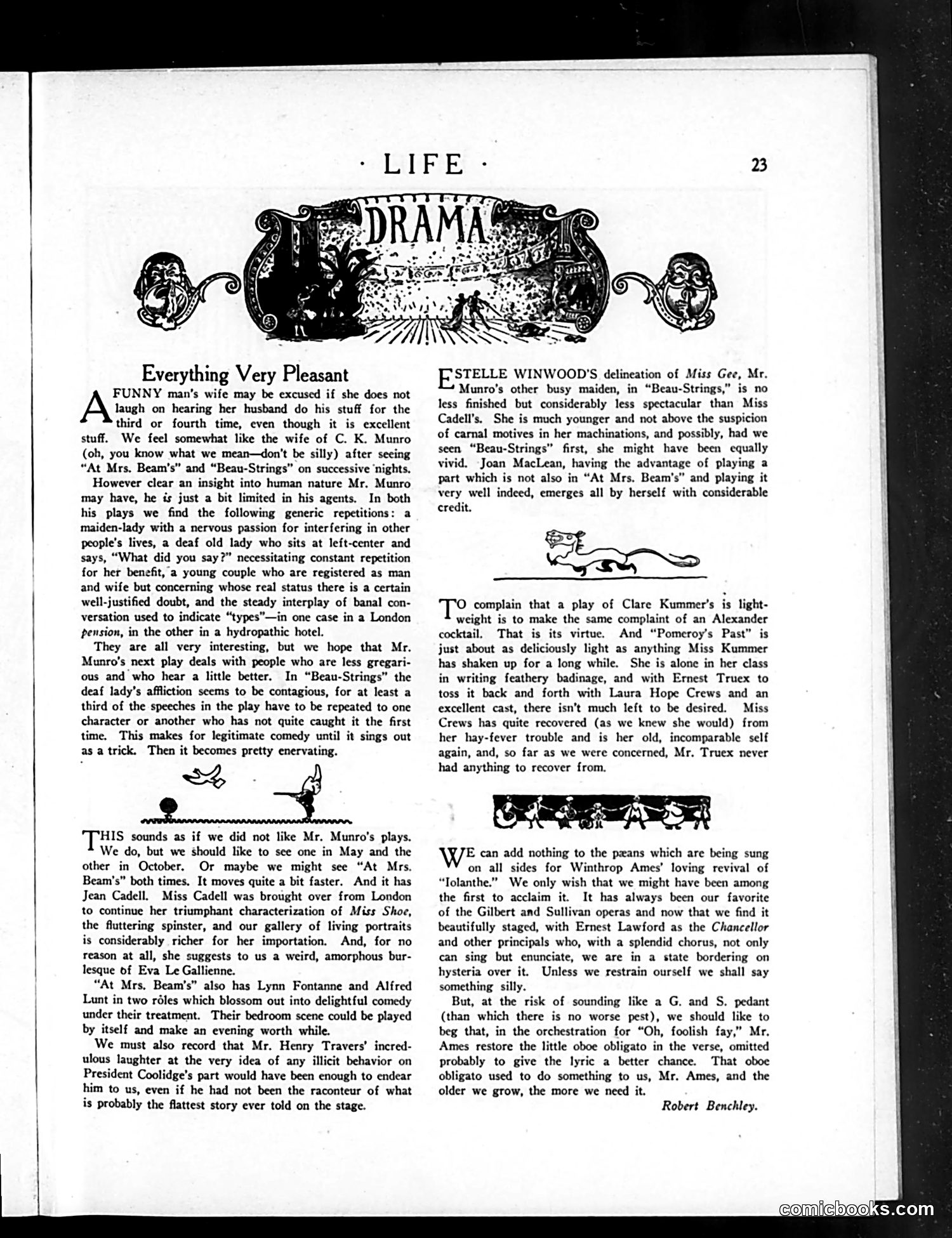
This is a theater review page from *Life* magazine's drama section, circa 1920s. The critic discusses three plays: 1. **"At Mrs. Beam's" and "Beau-Strings"** by C.K. Munro are praised but criticized for repetitive character types—a meddling spinster, a deaf elderly woman (whose deafness becomes a tired comedic device), and ambiguously-married couples. The reviewer finds this formulaic. 2. **Cast praise** includes Jean Cadell (imported from London), Lynn Fontanne, Alfred Lunt, and Henry Travers, whose incredulous reaction to "any illicit behavior on President Coolidge's part" draws humor from Coolidge's known puritanical reputation. 3. **"Pomeroy's Past"** by Clare Kummer is celebrated as "deliciously light" entertainment, with Ernest Truex and Laura Hope Crews delivering witty badinage. The overall tone is that these are pleasant but lightweight comedies—entertaining for one viewing but repetitive on successive nights. The decorative "Drama" header with theatrical masks frames the content as serious criticism of popular stage entertainment.
📄 Transcribed text from this page (OCR, searchable)
Machine-transcribed from the original scan — historical spelling and the odd misread are preserved.
Everything Very Pleasant FUNNY man’s wife may be excused if she does not Ase on hearing her husband do his stuff for the third or fourth time, even though it is excellent stuff. We feel somewhat like the wife of C. K. Munro (oh, you know what we mean—don't be silly) after seeing “At Mrs, Beam’s” and “Beau-Strings” on successive ‘nights. However clear an insight into human nature Mr. Munro may have, he is just a bit limited in his agents. In both his plays we find the following generic repetitions: a maiden-lady with a nervous passion for interfering in other people's lives, a deaf old lady who sits at left-center and says, “What did you say?” necessitating constant repetition for her benefit, a young couple who are registered as man and wife but concerning whose real status there is a certain well-justified doubt, and the steady interplay of banal con- versation used to indicate “types”—in one case in a London pension, in the other in a hydropathic hotel. They are all very interesting, but we hope that Mr. Munro's next play deals with people who are less gregari- ous and who hear a little better. In “Beau-Strings” the deaf lady’s affliction seems to be contagious, for at least a third of the speeches in the play have to be repeated to one character or another who has not quite caught it the first time, This makes for legitimate comedy until it sings out as a trick. Then it becomes pretty enervating. 3% THs sounds as if we did not like Mr. Munro's plays. We do, but we should like to see one in May and the other in October. Or maybe we might see “At Mrs. Beam’s” both times, It moves quite a bit faster. And it has Jean Cadell. Miss Cadell was brought over from London to continue her triumphant characterization of Miss Shoe, the fluttering spinster, and our gallery of living portraits is considerably richer for her importation. And, for no reason at all, she suggests to us a weird, amorphous bur- lesque of Eva Le Gallienne. “At Mrs. Beam’s” also has Lynn Fontanne and Alfred Lunt in two réles which blossom out into delightful comedy under their treatment. Their bedroom scene could be played by itself and make an evening worth while. We must also record that Mr. Henry Travers’ incred- ulous laughter at the very idea of any illicit behavior on President Coolidge’s part would have been enough to endear him to us, even if he had not been the raconteur of what is probably the flattest story ever told on the stage. STELLE WINWOOD'S delineation of Miss Gee, Mr. Munro’s other busy maiden, in “Beau-Strings,” is no less finished but considerably less spectacular than Miss Cadell’s. She is much younger and not above the suspicion of carnal motives in her machinations, and possibly, had we seen “Beau-Strings” first, she might have been equally vivid. Joan MacLean, having the advantage of playing a part which is not also in “At Mrs. Beam's” and playing it very well indeed, emerges all by herself with considerable credit. T° complain that a play of Clare Kummer’s is light- weight is to make the same complaint of an Alexander cocktail, That is its virtue. And “Pomeroy’s Past” is just about as deliciously light as anything Miss Kummer has shaken up for a long while. She is alone in her class in writing feathery badinage, and with Ernest Truex to toss it back and forth with Laura Hope Crews and an excellent cast, there isn't much left to be desired. Miss Crews has quite recovered (as we knew she would) from her hay-fever trouble and is her old, incomparable self again, and, so far as we were concerned, Mr. Truex never had anything to recover from. =n WE can add nothing to the pzans which are being sung on all sides for Winthrop Ames’ loving revival of “Tolanthe.” We only wish that we might have been among the first to acclaim it. It has always been our favorite of the Gilbert and Sullivan operas and now that we find it beautifully staged, with Ernest Lawford as the Chancellor and other principals who, with a splendid chorus, not only can sing but enunciate, we are in a state bordering on hysteria over it. Unless we restrain ourself we shall say something silly. But, at the risk of sounding like a G. and S. pedant (than which there is no worse pest), we should like to beg that, in the orchestration for “Oh, foolish fay,” Mr. Ames restore the little oboe obligato in the verse, omitted probably to give the lyric a better chance. That oboe obligato used to do something to us, Mr. Ames, and the older we grow, the more we need it. Robert Benchley. Omicbooks.com