
Life, 1926-05-13 · page 25 of 52
Life — May 13, 1926 — page 25: what you’re looking at
What you’re looking at
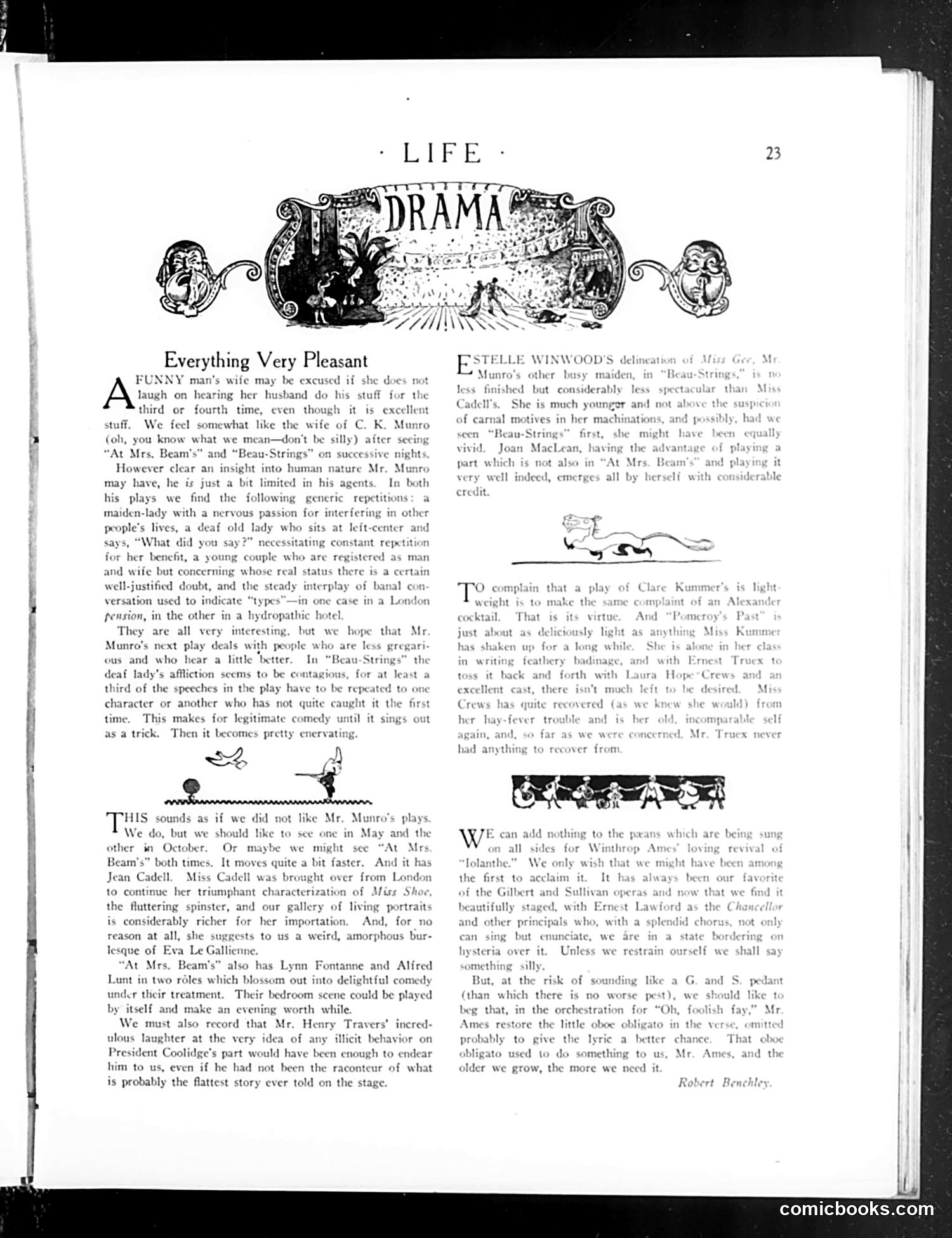
This page reviews several theatrical productions, primarily C.K. Munro plays ("At Mrs. Beam's" and "Beau-Strings"). The text is a drama critique rather than political satire. **Key points:** The reviewer critiques Munro's formulaic plotting—his plays repeatedly feature the same stock characters: an interfering maiden-lady, a deaf elderly woman positioned stage-left, and couples whose marital status is ambiguous. The repetition of dialogue (characters constantly asking "What did you say?" due to the deaf woman) becomes tedious. **Performers mentioned include:** Estelle Winwood, Jean Cadell (praised for elevating the material), Lynn Fontanne, and Alfred Lunt. **The satire:** The review gently mocks both Munro's lazy dramaturgy and President Coolidge (referenced humorously as having told "probably the flattest story ever told on the stage"), suggesting even political figures are less entertaining than Munro's repetitive plays. Byline: Robert Benchley, the magazine's drama critic.
📄 Transcribed text from this page (OCR, searchable)
Machine-transcribed from the original scan — historical spelling and the odd misread are preserved.
a nat) 23 Everything Very Pleasant ESTELLE Wixwoop's , 5 Ps Munr other busy maide ir Beau-Stri NY man’s wife may be excused if she does not . less finished but ec She is much you erably laugh on hearing her husband do his stu third or fourth time, even th We feel somewhat like the wife of C it is of carnal motives in her machinations, and possibly, | seen “Beau-String first, s might have MacLean, . you know what we mean—don't be silly) after seein “At Mrs. Beam’s Howev vivid. Ji “Beau-Strings” on successive nights re Mr. Mt , he is just a bit limited in his agents. In both part wl clear an insight into human may hav his plays we find the following generic repetitions maiden-lady with a nervous passion for interfering in o people’ says, “What did you s for her benefit, a yo lives, a deaf old lady who sits at left-center necessitating constant repctit ed as man ” are re couple wt and wife but concerning whose real status there is a certain and t versation used to indicate “types”—in one case in a Lon pension, in the other in a hydropathic hotel. r but we bh Th : well-justified doubt e steady interplay of banal cor are all very interes ext play deals with people who are ous and who hear a little better. In “Beau-Strings f at least a deaf lady's affliction seems to be contagious, for third of the speeches in the play have to be repeated to character or another who has not q time. This makes for leg as a trick. Then it becomes pretty enervating sZ S caught it the first imate comedy il it: sir HIS s We do, but we should like to see one in May and the see “At Mrs nd it has punds as if we did not like Mr. Munro's plays. other in October. Or maybe we mig Beam’s” both times. It moves quite a bit f Jean Cadell. Miss Cadell was bre to continue her triumph: the fluttering spinster, and our gall ortation. reason at all, she suggests to us a weird, amorphous lesque of Eva Le Gallienne. “At Mrs. Beam’s” also has Lynn Fonta: Lunt in two roles which ble delightful c under their treatment. Th the first t characteri portraits for no bur- is considerably richer for her im and fred medy som out i at the risk bedroom scene could be played hich the ng worth while. beg that, also record that Mr. Henry Travers’ incred- Ames re ter at the very idea of an: it t n the orchest the little by itself and make an ever We must ulous lay vior on —_probabl give the President lidge’s part would have been enough to endear obli sed to something to us, Mr and the him to us, even if he had not been the raconte of what older we grow, the more we need it is probably the flattest story ever told on the stage. Robert Benchley comicbooks.com