
Life, 1926-05-13 · page 34 of 52
Life — May 13, 1926 — page 34: what you’re looking at
What you’re looking at
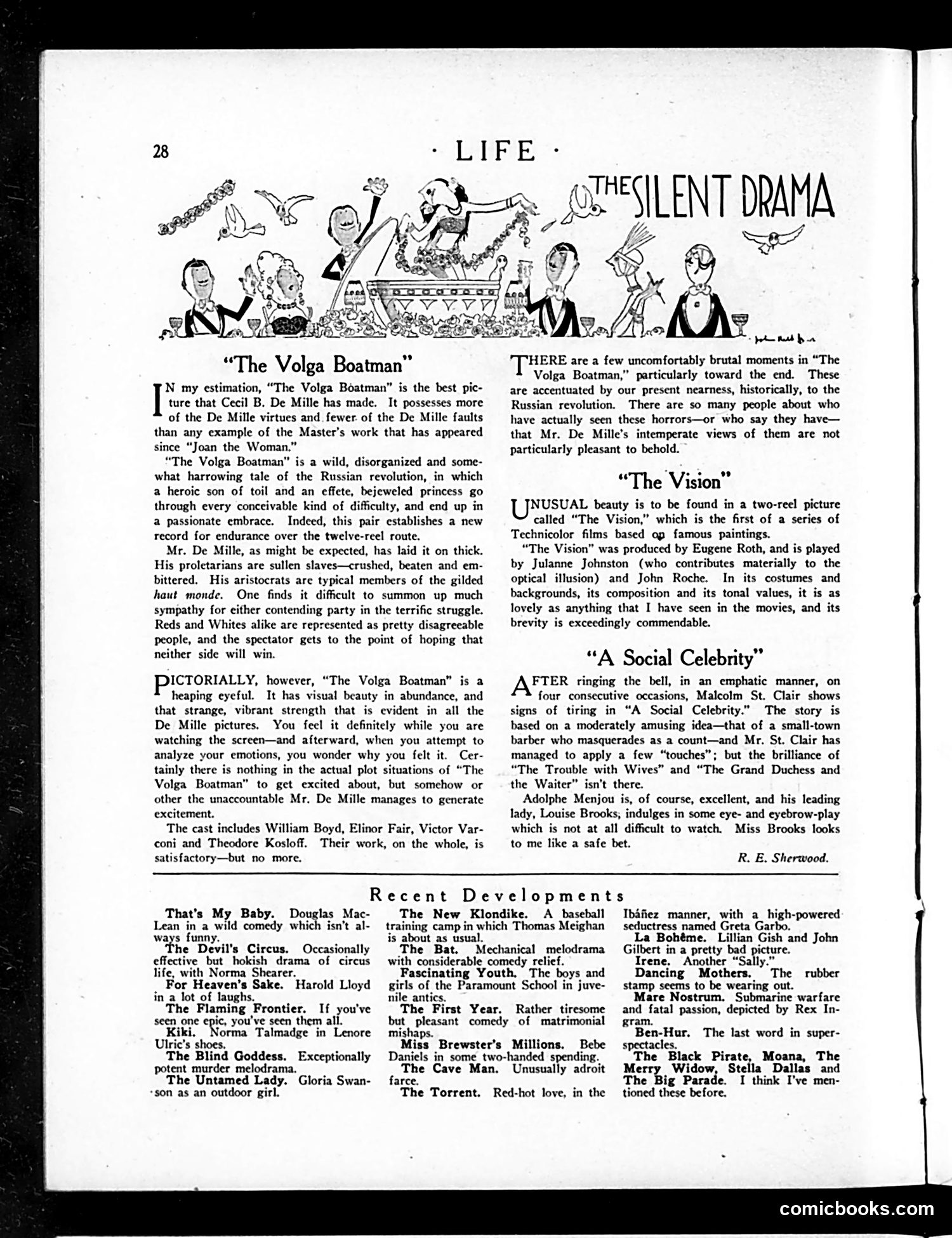
This page reviews recent silent films, dominated by Cecil B. DeMille's "The Volga Boatman." The reviewer praises its visual spectacle while criticizing its plot and politics. **Key Content:** The main critique concerns DeMille's depiction of the Russian Revolution. The reviewer notes the film shows both "Reds and Whites" as "disagreeable people," presenting aristocrats as gilded and shallow, workers as brutalized slaves. Notably, the reviewer suggests this heavy-handed portrayal is problematic given that "many people about who have actually seen these horrors" in the recent Russian Revolution could testify to its reality—implying DeMille's dramatization seems insensitive or exploitative to contemporary audiences who experienced actual violence. The page also briefly reviews lighter fare: "The Vision" (a Technicolor adaptation), "A Social Celebrity" (a comedy with Adolphe Menjou), and other recent releases. **The Satire:** The cartoon header depicts theatrical chaos, mocking silent film melodrama's excess—fitting for criticism of DeMille's "laid it on thick" approach.
📄 Transcribed text from this page (OCR, searchable)
Machine-transcribed from the original scan — historical spelling and the odd misread are preserved.
Hf, iE = ane & == Ne aren “The _— Boatman” N my estimation, “The Volga Boatman” is the best pic- I ture that Cecil B. De Mille has made. It possesses more of the De Mille virtues and. fewer. of the De Mille faults than any example of the Master’s work that has appeared since “Joan the Woman.” “The Volga Boatman” is a wild, disorganized and some- what harrowing tale of the Russian revolution, in which a heroic son of toil and an effete, bejeweled princess go through every conceivable kind of difficulty, and end up in a passionate embrace. Indeed, this pair establishes a new record for endurance over the twelve-reel route. Mr. De Mille, as might be expected, has laid it on thick. His proletarians are sullen slaves—crushed, beaten and em- bittered. His aristocrats are typical members of the gilded haut monde. One finds it difficult to summon up much sympathy for either contending party in the terrific struggle. Reds and Whites alike are represented as pretty disagreeable people, and the spectator gets to the point of hoping that neither side will win. PICTORIALLY, however, “The Volga Boatman” is a heaping eyeful. It has visual beauty in abundance, and that strange, vibrant strength that is evident in all the De Mille pictures. You feel it definitely while you are watching the screen—and afterward, when you attempt to analyze your emotions, you wonder why you felt it. Cer- tainly there is nothing in the actual plot situations of “The Volga Boatman” to get excited about, but somehow or other the unaccountable Mr. De Mille manages to generate excitement. The cast includes William Boyd, Elinor Fair, Victor Var- coni and Theodore Kosloff. Their work, on the whole, is satisfactory—but no more. eB I, Bon ASE Ste re e. Dar A I QO Leone HERE are a few uncomfortably brutal moments in “The Volga Boatman,” particularly toward the end. These are accentuated by our present nearness, historically, to the Russian revolution. There are so many people about who have actually seen these horrors—or who say they have— that Mr. De Mille’s intemperate views of them are not particularly pleasant to behold. Ve “The Vision Unusuat beauty is to be found in a two-reel picture called “The Vision,” which is the first of a series of Technicolor films based op famous paintings. “The Vision” was produced by Eugene Roth, and is played by Julanne Johnston (who contributes materially to the optical illusion) and John Roche. In its costumes and backgrounds, its composition and its tonal values, it is as lovely as anything that I have seen in the movies, and its brevity is exceedingly commendable. “A Social Celebrity” FTER ringing the bell, in an emphatic manner, on four consecutive occasions, Malcolm St. Clair shows signs of tiring in “A Social Celebrity.” The story is based on a moderately amusing idea—that of a small-town barber who masquerades as a count—and Mr. St. Clair has managed to apply a few “touches”; but the brilliance of “The Trouble with Wives” and “The Grand Duchess and the Waiter” isn’t there. Adolphe Menjou is, of course, excellent, and his leading lady, Louise Brooks, indulges in some eye- and eyebrow-play which is not at all difficult to watch. Miss Brooks looks to me like a safe bet. R. E. Sherwood. Recent Developments That’s My Baby. Douglas Mac- Lean in a wild comedy which isn’t al- ways funny. ‘the Devil’s Circus. Occasionally effective but hokish drama of circus life, with Norma Shearer. For Heaven's Sake. Harold Lloyd in a lot of laughs. ¢ Flaming Frontier. If you've seen one ic, you've seen them all. Kiki. forma Talmadge in Lenore Ulric’s shoes, The Blind Goddess. Exceptionally potent murder melodrama. The Untamed Lady. Gloria Swan- *son as an outdoor girl. The New Klondike. A baseball training camp in which Thomas Meighan is about as usual. The Bat. Mechanical melodrama with considerable comedy relief. fascinating Youth. The boys and girls of the Paramount School in juve- nile antics. The First Year. Rather tiresome but pleasant comedy of matrimonial mishaps. Miss Brewster’s Millions. Bebe Daniels in some two-handed spending. ; The Cave Man. Unusually adroit jarce. The Torrent. Red-hot love, in the Tbafiez manner, with a_ high-powered seductress named Greta Garbo. La Bohéme. Lillian Gish and John Gilbert in a pretty bad picture. Irene. Another “Sally.” Dancing Mothers. The rubber stamp seems to be wearing out. Mare Nostrum. Submarine warfare and fatal passion, depicted by Rex In- gram. Ben-Hur. spectacles. The Black Pirate, Moana, The Me: Widow, Stella Dallas and The Big Parade. I think I've men- tioned these before. The last word in super- comicbooks.com