
Life, 1926-05-13 · page 18 of 52
Life — May 13, 1926 — page 18: what you’re looking at
What you’re looking at
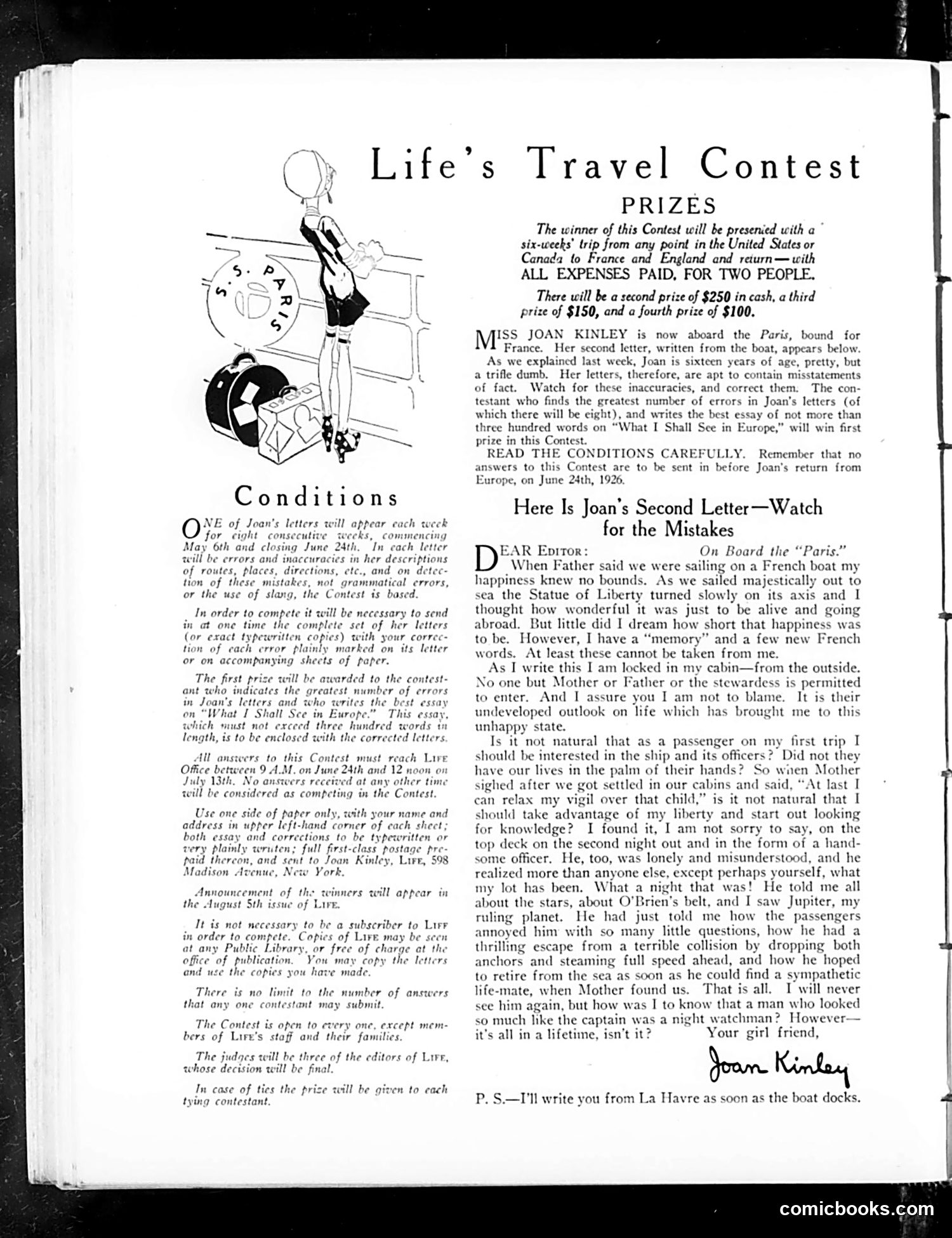
This is a contest announcement page featuring "Life's Travel Contest," not a political cartoon. The illustration shows a stylized female figure at a ship's wheel, representing the contest's travel theme. The contest invites readers to find errors in letters written by "Miss Joan Kinley," supposedly aboard the *Paris* ship bound for France. Contestants who identify the most mistakes (up to eight) and write the best essay on "What I Shall See in Europe" win prizes, with the first prize being a six-week European trip. The page includes Joan's actual second letter, which intentionally contains errors for readers to spot. This was a popular early 20th-century magazine engagement strategy—combining travel promotion with reader participation games.
📄 Transcribed text from this page (OCR, searchable)
Machine-transcribed from the original scan — historical spelling and the odd misread are preserved.
Life’s Travel Contest Conditions NE of Joan's letters will appear each week for cight consecutive % May 6th and closing Jv ll be errors and inaccuracies in her descriptions of routes, places, directions, and on detec- tion of these mistakes, not’ grammatical errors, or the use of slang, the Contest is based. In order to comp ill be necessary to send in at one time t set of her letters (or exact typewritten with your correc- tion of each errc marked on its letter or on accompanying sheets of paper. The first prise will be awarded to t atest number of “s the b Th ich must not exce ength, is to be enclose All answers to this Co il be considered as competing in the Contest. Use one side of paper only, with your name and address in upper left-hand corner of cach shect both essay an tions to be typewritten y pla full first-class postage pr paid thei ‘0 Joan Kinley, Lire, 598 Madison Avenue, Announcement of the the August Sth issue of Live It is not necessary to be a subscribi in order to compete. Copies of Lire » at any Public Library, or fre office of publication.” You and use the copies y« y copy the made. ¢ is no limit to the number of answers that any one contestant may submit. The Contest is open to every one, except mem- bers of Lire’s staff and their families. The judges will be three of the editors of Lire, whose decision will be final In case of ties the prise will be given to each tying contestant. PRIZES The winner of this Contest will be presenied with a six-weeks’ trip from any point in the United States or Canada to France and England and return— with ALL EXPENSES PAID, FOR TWO PEOPLE. There will be a second prize of $250 in cash, a third prize of $150, and a fourth prize of $100. MISS JOAN KINLEY is now aboard the Paris, bound for France. Her second letter, written from the boat, appears below. As we explained last week, Joan is sixteen years of age, pretty, but a trifle dumb. Her letters, therefore, are apt to contain misstatements fact. Watch for these inaccuracies, and correct them. The con- testant who finds the greatest number of errors in Joan's letters (of which there will be eight), and writes the best essay of not more than three hundred words on “What I Shall See in Europe,” will win first prize in this Contest. READ THE CONDITIONS CAR Y. Remember that no answers to this Contest are to be sent in before Joan's return from Europe, on June 24th, 1926. Here Is Joan’s Second Letter—Watch for the Mistakes EAR Eprtor: On Board the “Paris.” When Father said we were sailing on a French boat my happiness knew no bounds. As we sailed majestically out to sea the Statue of Liberty turned slowly on its axis and I thought how wonderful it was just to be alive and going abroad. But little did I dream how short that happiness was to be. However, I have a “memory” and a few new French words. At least these cannot be taken from me. As I write this I am locked in my cabin—from the outside. No one but Mother or Father or the stewardess is permitted to enter. And I assure you I am not to blame. It is their undeveloped outlook on life which has brought me to this unhappy state. Is it not natural that as a passenger on my first trip I should be interested in the ship and its officers? Did not they have our lives in the palm of their hands? So wien Mother red after we got settled in our cabins and said, “At last I can relax my vigil over that child,” is it not natural that I should take advantage of my liberty and start out looking for knowledge? I found it, I am not sorry to say, on the top deck on the second night out and in the form of a hand- some officer. He, too, was lonely and misunderstood, and he realized more than anyone else, except perhaps yourself, what my lot has been. W a night that was! He told me all about the stars, about O'Brien's belt, and I saw Jupiter, my ruling planet. He had just told me how the passengers annoyed him with so many little questions, how he had a thrilling escape from a terrible collision by dropping both anchors and steaming full speed ahead, and how he hoped to retire from the sea as soon as he could find a sympathetic life-mate, when Mother found us. That is all. I will never see him again, but how was I to know that a man who looked so much like the captain w nt watchman? However— it's all in a lifetime, isn’t it Your girl friend, Joan Kika P. S.—I'll write you from La Havre as soon as the boat docks. comicbooks.com