
A complete issue · 37 pages · 1925
Life — December 31, 1925
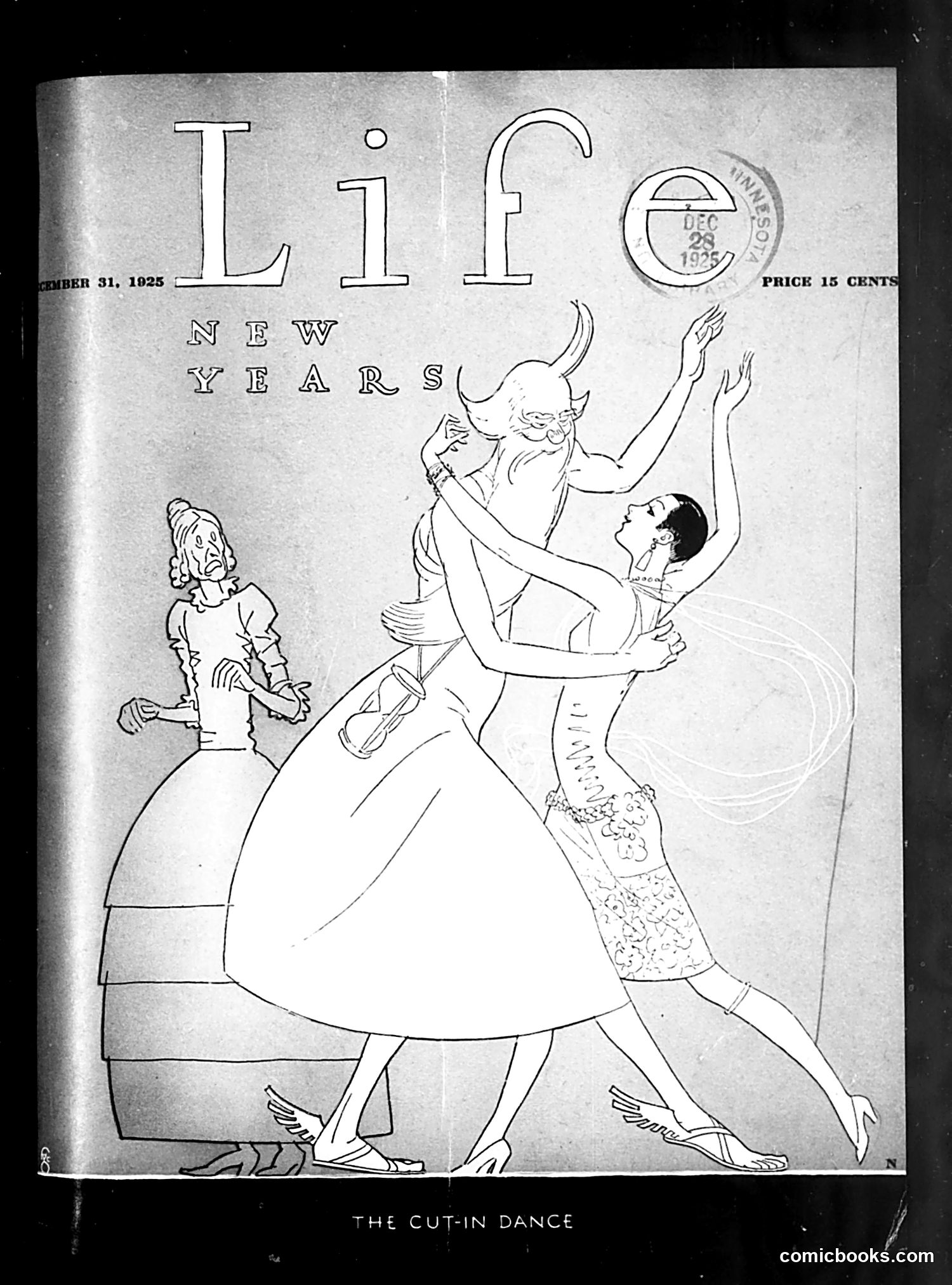
This New Year's Eve cover depicts "The Cut-In Dance," a popular 1920s social dancing practice where one dancer would interrupt a couple mid-dance to claim a partner. The cartoon shows a devil figure (representing mischief or temptation of the Jazz Age) engaging in this playful disruption at a New Year's celebration. The left figure appears distressed, while the devil and right figure participate in the cutting-in ritual. The image satirizes the social dynamics and somewhat scandalous dancing customs of the Roaring Twenties—a period of loosened social restrictions and youthful exuberance that older generations often viewed with alarm. The 15-cent price and dated stamp suggest this is an actual period publication.
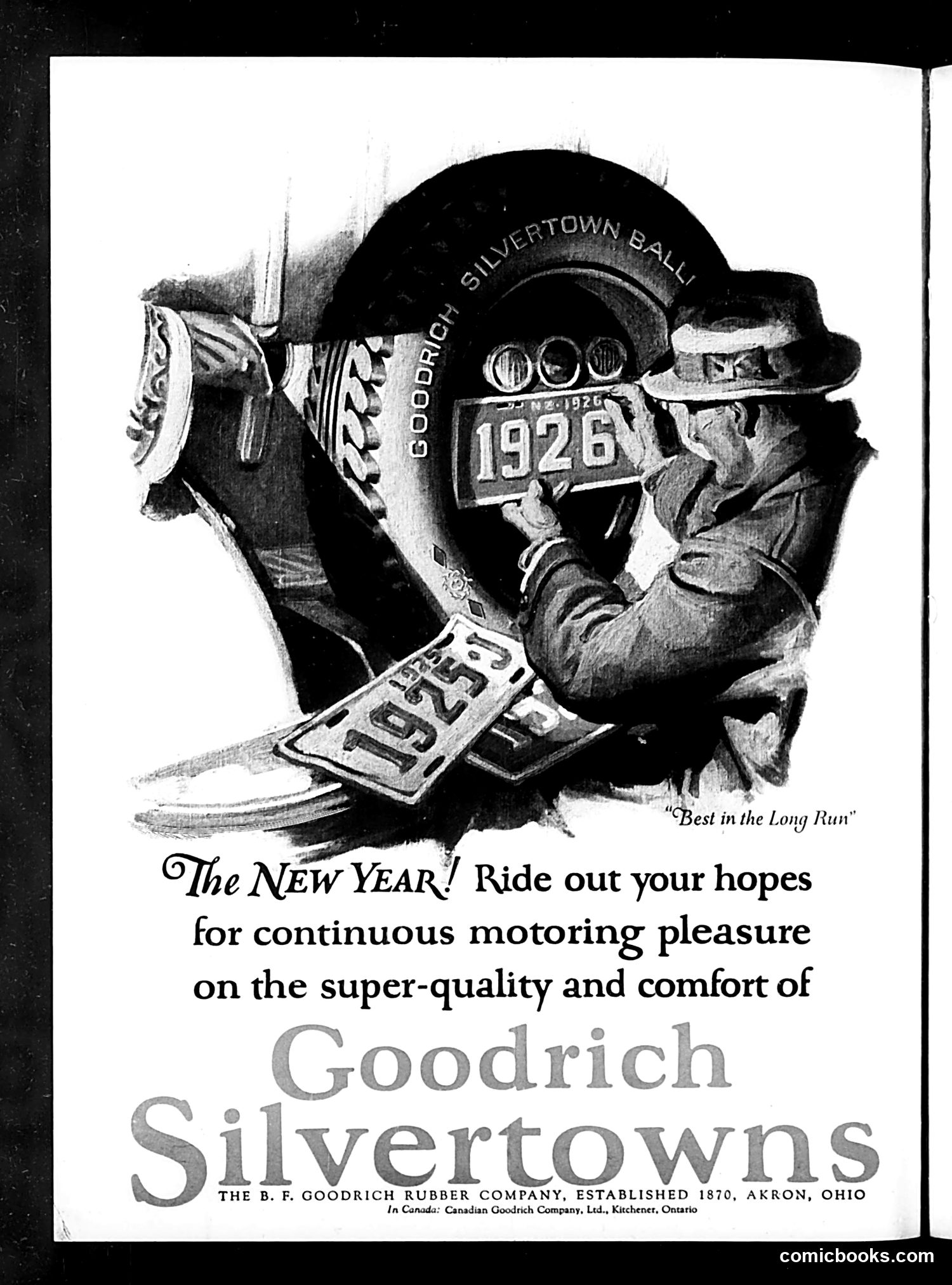
This page is primarily a **Goodrich Silvertown automobile tire advertisement** from 1926, not satire or political commentary. The image shows three men in 1920s attire (suits, hats) examining a large tire labeled "GOODRICH SILVERTOWN BALL" with visible license plates from 1925-1926. The tagline "Best in the Long Run" emphasizes tire durability. The advertisement's text urges readers to "Ride out your hopes for continuous motoring pleasure on the super-quality and comfort of Goodrich Silvertowns." It's a straightforward marketing appeal to prosperous 1920s consumers during the automobile boom, emphasizing reliability and comfort as selling points for the product. There is no apparent political satire or social commentary—this is commercial advertising typical of the era's Life magazine pages.
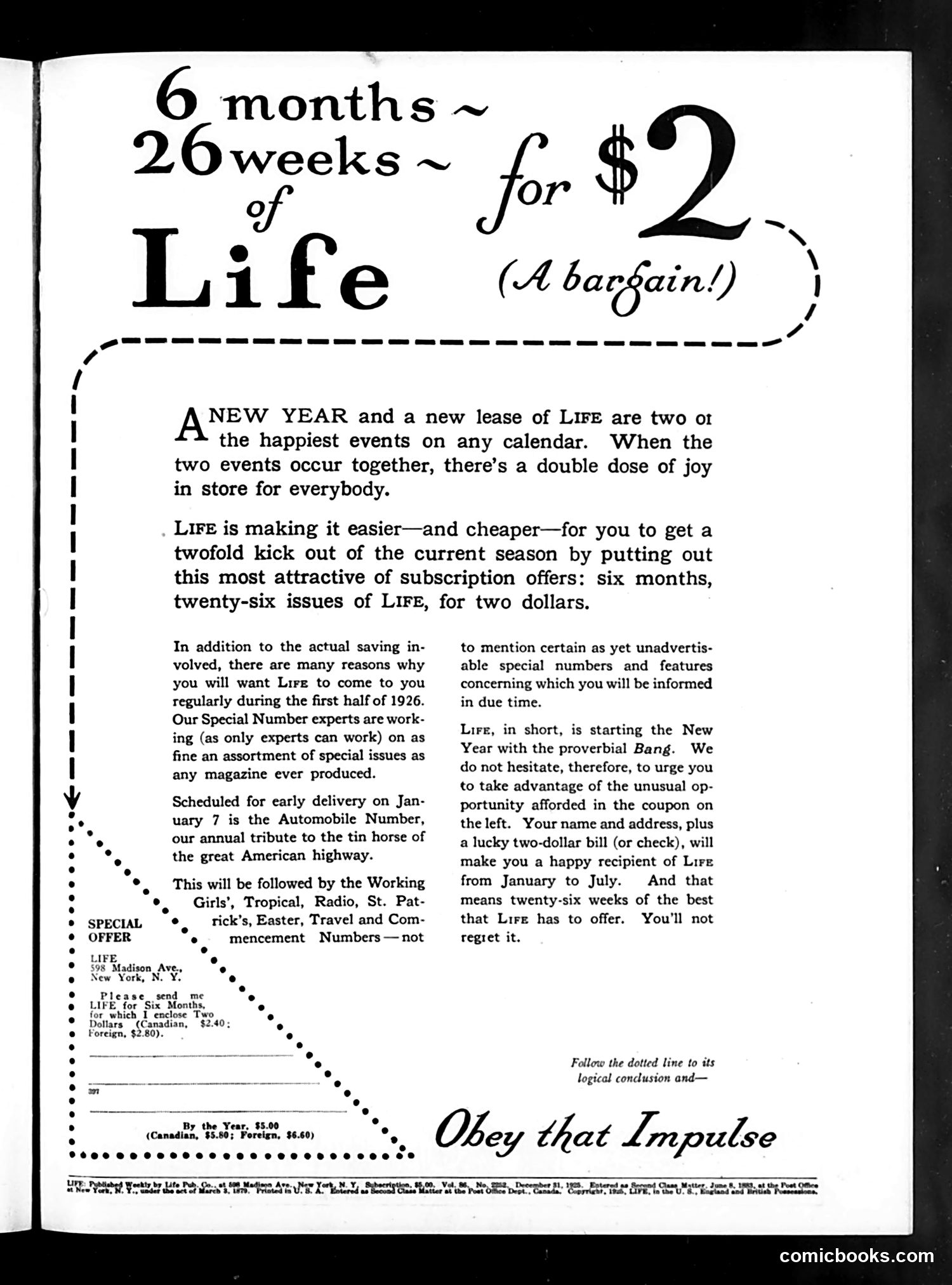
This page is primarily a **subscription advertisement**, not a political cartoon. It promotes a New Year offer from *Life* magazine: six months (26 weekly issues) for $2. The ad copy emphasizes timing—linking New Year's resolutions with magazine subscriptions as "two of the happiest events on any calendar." It highlights upcoming special issues including "Automobile Number" and features on "Working Girls," Tropical settings, Radio, and Easter. The only visual element beyond text is a **subscription coupon** on the left side. The phrase "Obey that Impulse" at the bottom is the sales pitch—urging readers to act immediately on the New Year momentum. There is no political satire or social commentary visible here; this is straightforward magazine marketing from the 1920s.
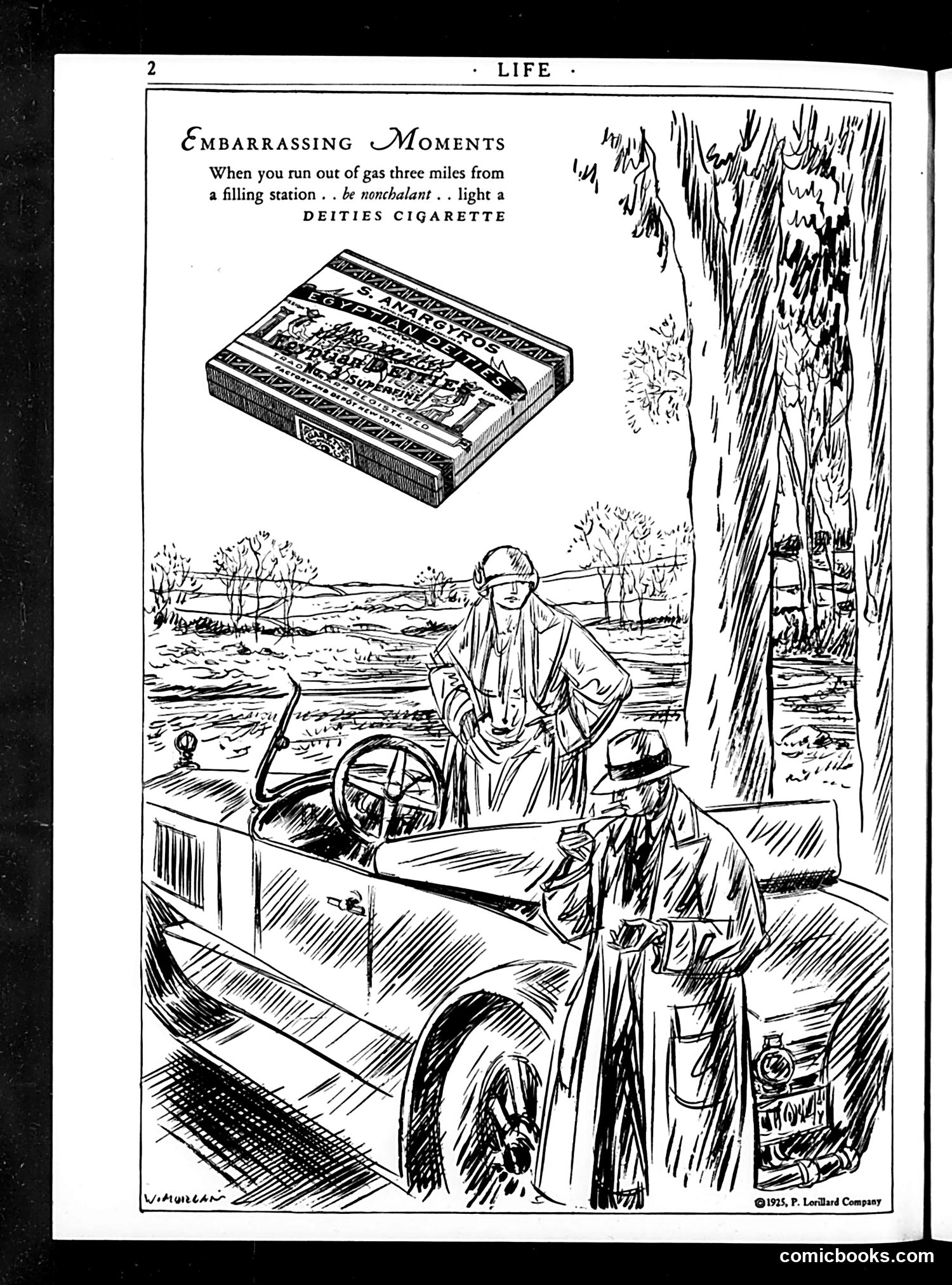
This is a vintage cigarette advertisement disguised as humor. The comic shows a motorist who has run out of gas three miles from a filling station—a genuinely awkward predicament for early automobile owners. The solution offered is to "light a DEITIES CIGARETTE," implying that smoking will make the embarrassing situation more bearable or help pass the time. The advertisement exploits social anxiety about public embarrassment to market cigarettes as a solution for uncomfortable moments. By framing smoking as a natural response to awkwardness, it normalizes cigarette use as a social coping mechanism—a common advertising strategy of that era before tobacco's health risks were widely acknowledged.
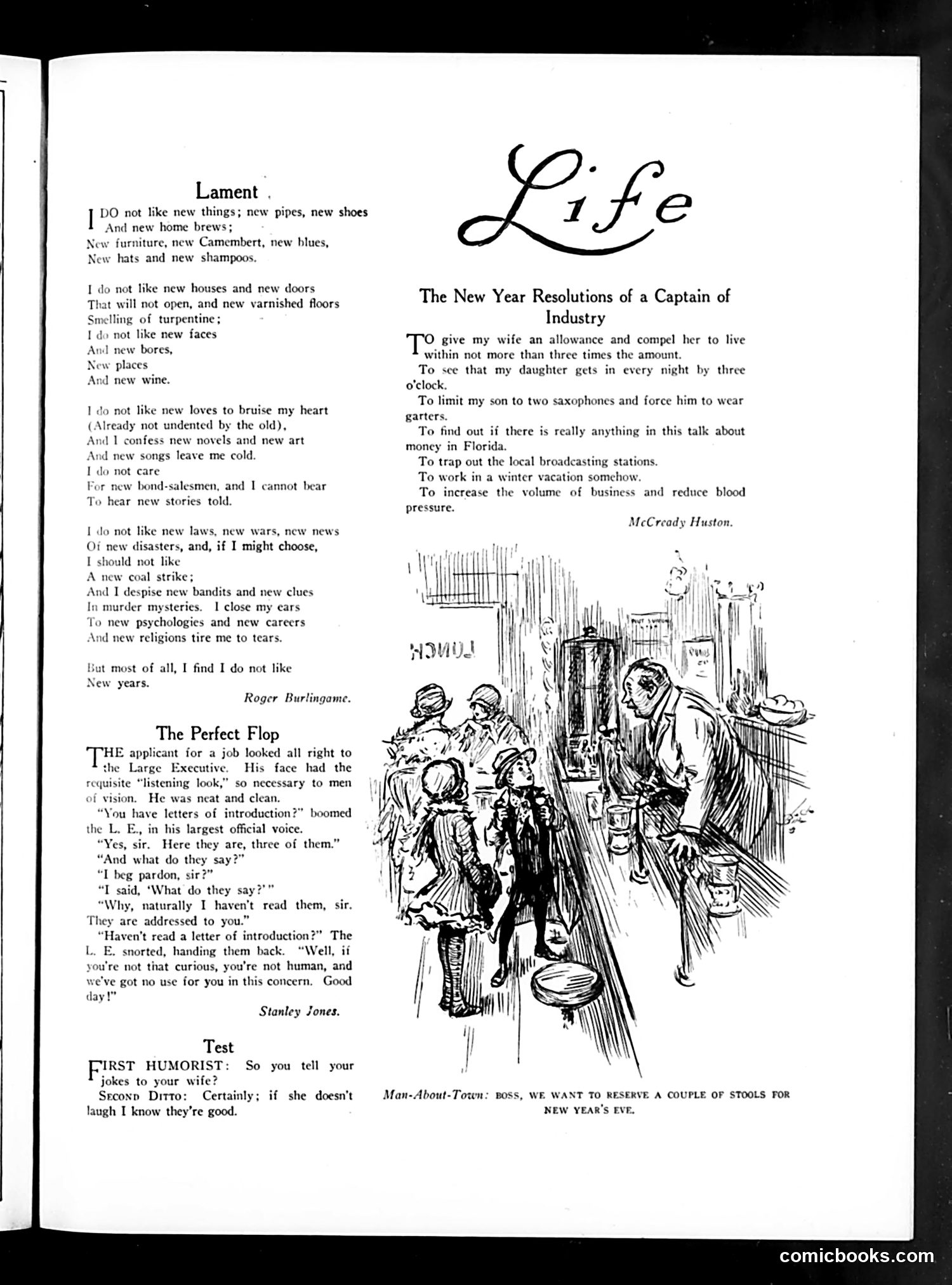
This page contains several pieces of humor commentary rather than political cartoons: **"Lament"** (Roger Burlingame) is a nostalgic poem complaining about modern changes—new fashions, homes, music, and social trends—ending with dislike of "New years" itself. **"The New Year Resolutions of a Captain of Industry"** by McCready Huston lists humorous self-improvement goals for a wealthy businessman: controlling his wife's spending, monitoring his daughter's curfew, limiting his son's saxophones, and investigating Florida money/broadcasting opportunities. **The accompanying sketch** shows what appears to be a working-class or poor family in cramped quarters, illustrating the class contrast with the captain's concerns. **"The Perfect Flop"** and **"Test"** are brief comedic dialogue pieces about workplace mishaps and joke-telling. The page satirizes wealth disparity, generational anxiety, and New Year's platitudes typical of 1920s American humor.
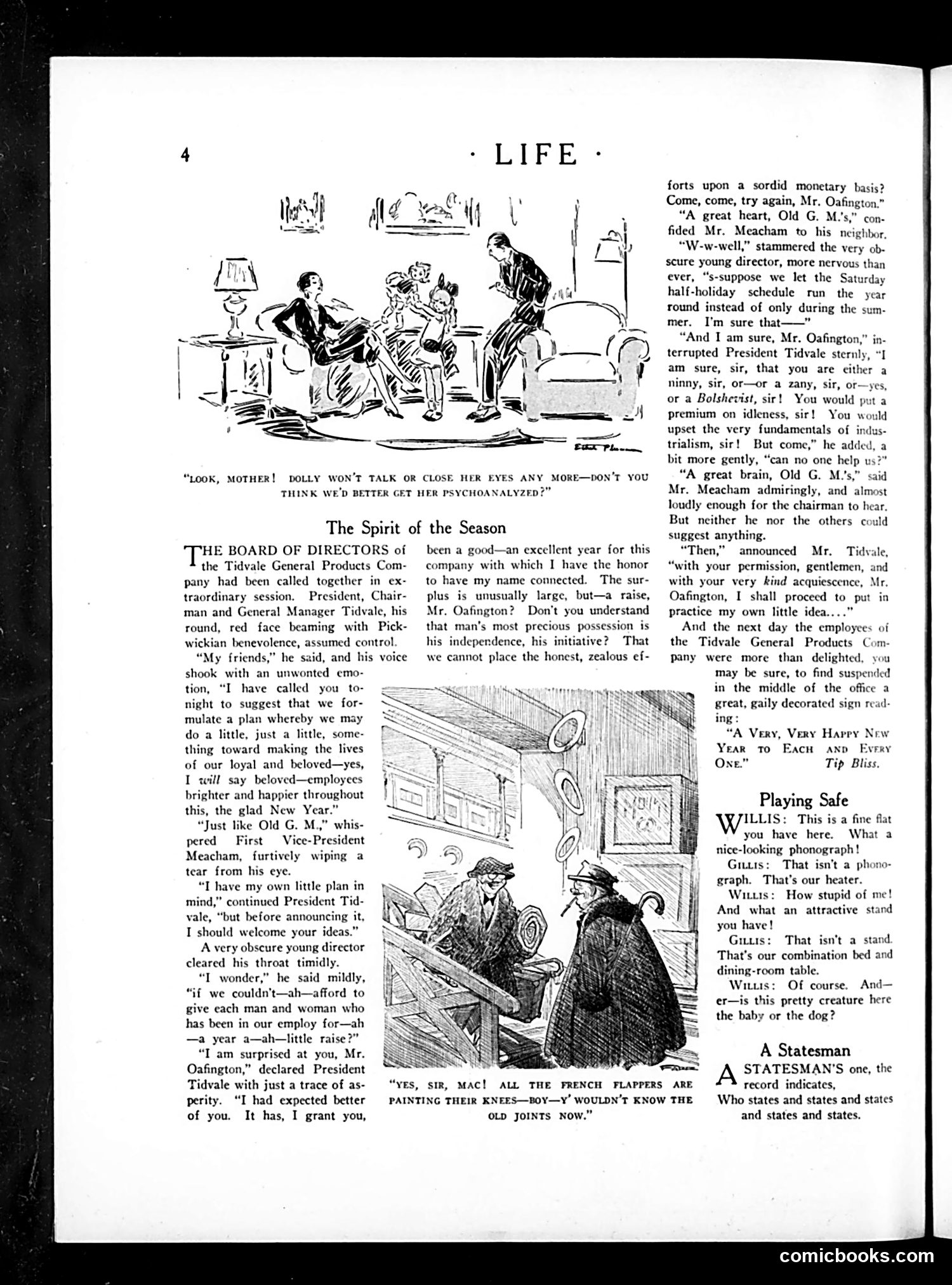
This page contains three separate items: 1. **Top cartoon**: Shows an office scene where a child won't close her eyes during what appears to be a hypnosis session. The joke mocks the ineffectiveness of the procedure on an uncooperative subject. 2. **"The Spirit of the Season"**: A business satire where President Tidvale of Tidvale General Products Company faces pressure from his board to give employees a raise for the New Year. The executives debate whether workers deserve higher pay, with Tidvale reluctantly agreeing to modest increases. It satirizes corporate reluctance to share profits with employees. 3. **Bottom section**: Contains two brief humorous dialogues ("Playing Safe" and "A Statesman") that appear to be joke fillers typical of Life's satirical format. The page reflects early-20th-century class tensions and corporate attitudes toward labor.
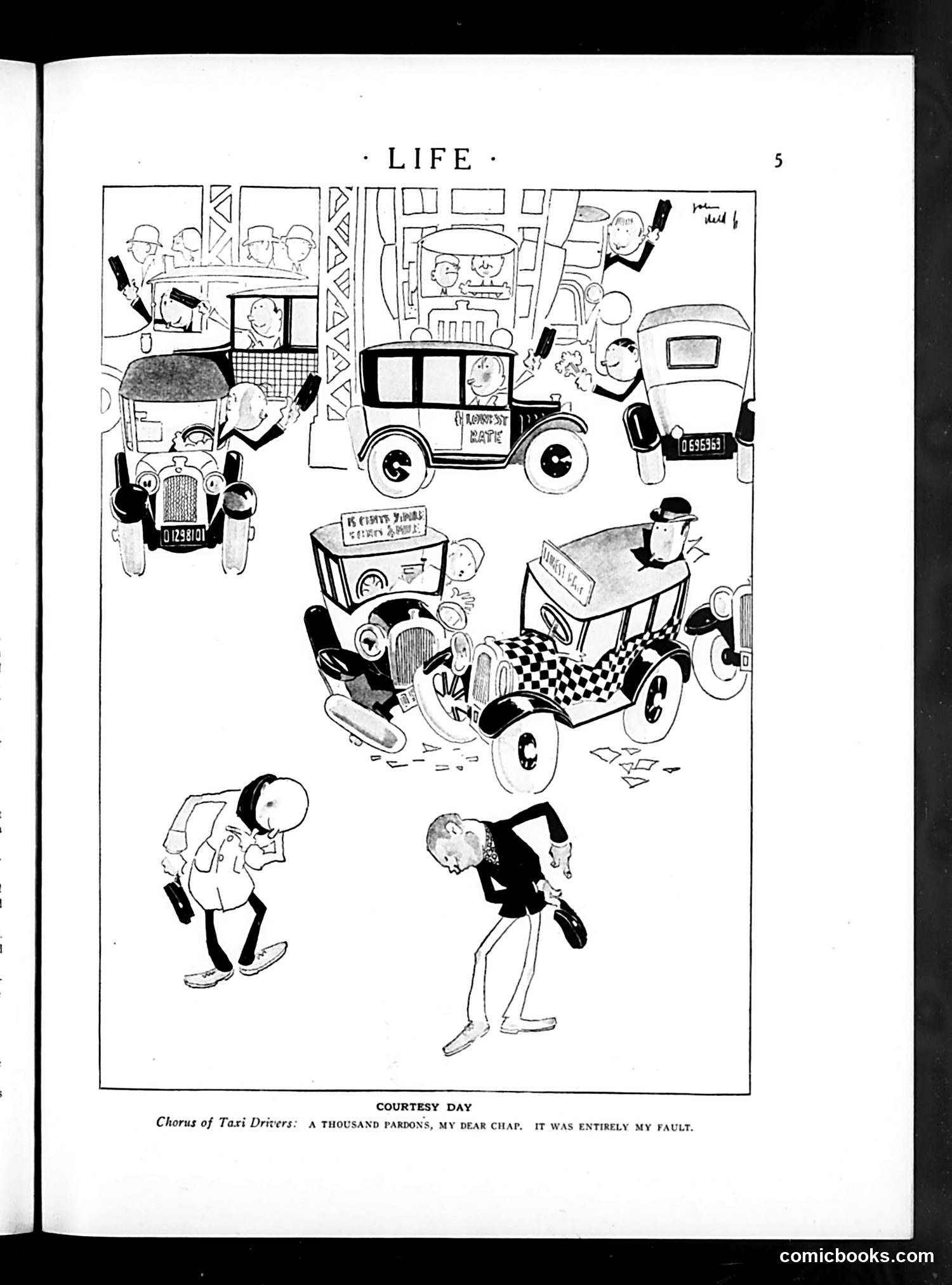
This Life magazine cartoon satirizes urban traffic chaos and driver rudeness. The title "Courtesy Day" is ironic—the scene depicts complete pandemonium on a city street, with multiple vehicles colliding, pedestrians fleeing, and general mayhem. The caption, a "Chorus of Taxi Drivers," reads: "A THOUSAND PARDONS, MY DEAR CHAP. IT WAS ENTIRELY MY FAULT"—clearly sarcastic, as taxi drivers were notorious for aggressive, discourteous driving. The joke contrasts the polite apology with the chaotic scene, suggesting that taxi drivers (and drivers generally) lacked basic courtesy. The cartoon satirizes both the impossibility of genuine courtesy among competitive drivers and perhaps a specific "Courtesy Day" public relations campaign, which the reality of the streets thoroughly belied.
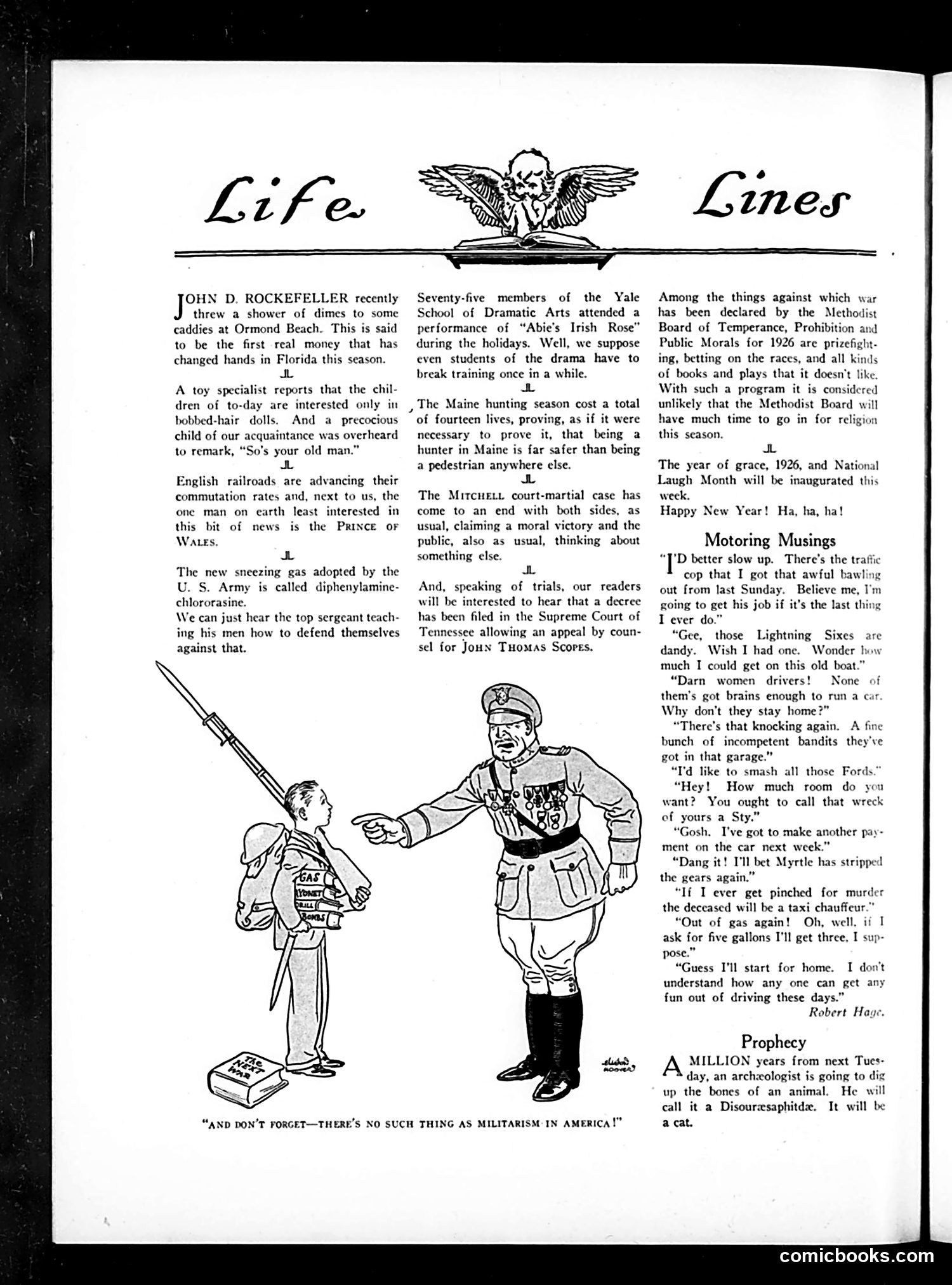
This page from *Life* magazine contains several satirical commentary pieces and one political cartoon. The main cartoon depicts a small boy (labeled with what appears to be "gas") confronting a military officer, with the caption: "AND DON'T FORGET—THERE'S NO SUCH THING AS MILITARISM IN AMERICA!" The satire targets American militarism in the 1920s, suggesting the nation harbored military attitudes despite claims otherwise. The child figure likely represents American youth being indoctrinated with military values. The surrounding "Life Lines" column contains brief humorous anecdotes about wealthy individuals (Rockefeller), hunting accidents in Maine, and court cases. These mock the absurdities of contemporary upper-class life and legal proceedings, typical of *Life*'s satirical approach to American society.
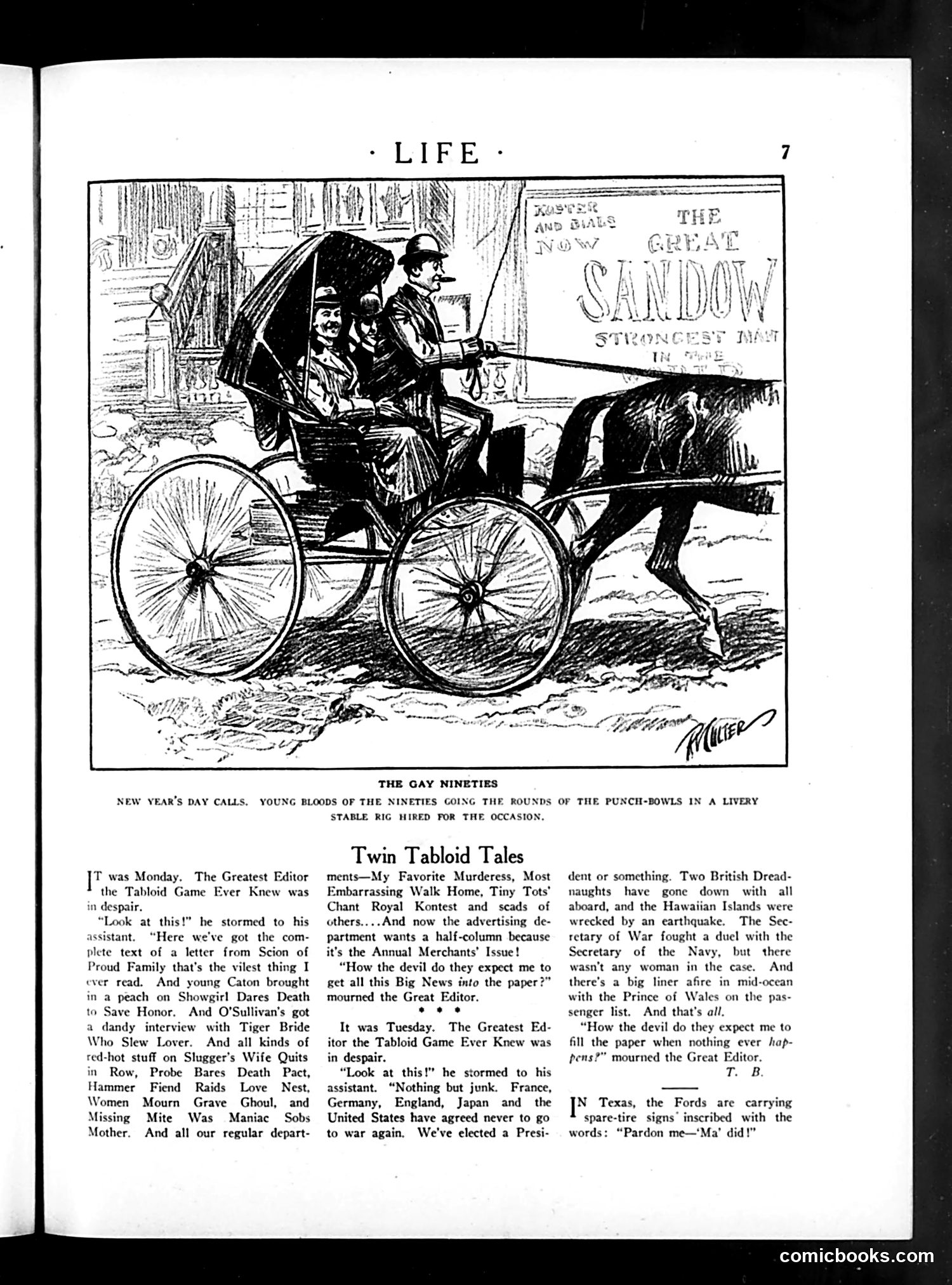
The illustration depicts young people in 1890s attire riding in a horse-drawn carriage, advertising "The Great Sandow—Strongest Man in the World." The caption reads: "New Year's Day Calls. Young bloods of the nineties going the rounds of the punch-bowls in a livery stable rig hired for the occasion." The satire mocks wealthy young men making fashionable New Year's Day social calls while hiring modest livery stable carriages to appear more impressive than they can afford. "Punch-bowls" references social drinking customs. The juxtaposition of promoting a circus strongman (Sandow) while showing dandyish, fragile-looking youths heightens the humor—these "young bloods" claim strength and vigor but are actually frivolous poseurs relying on hired appearances.
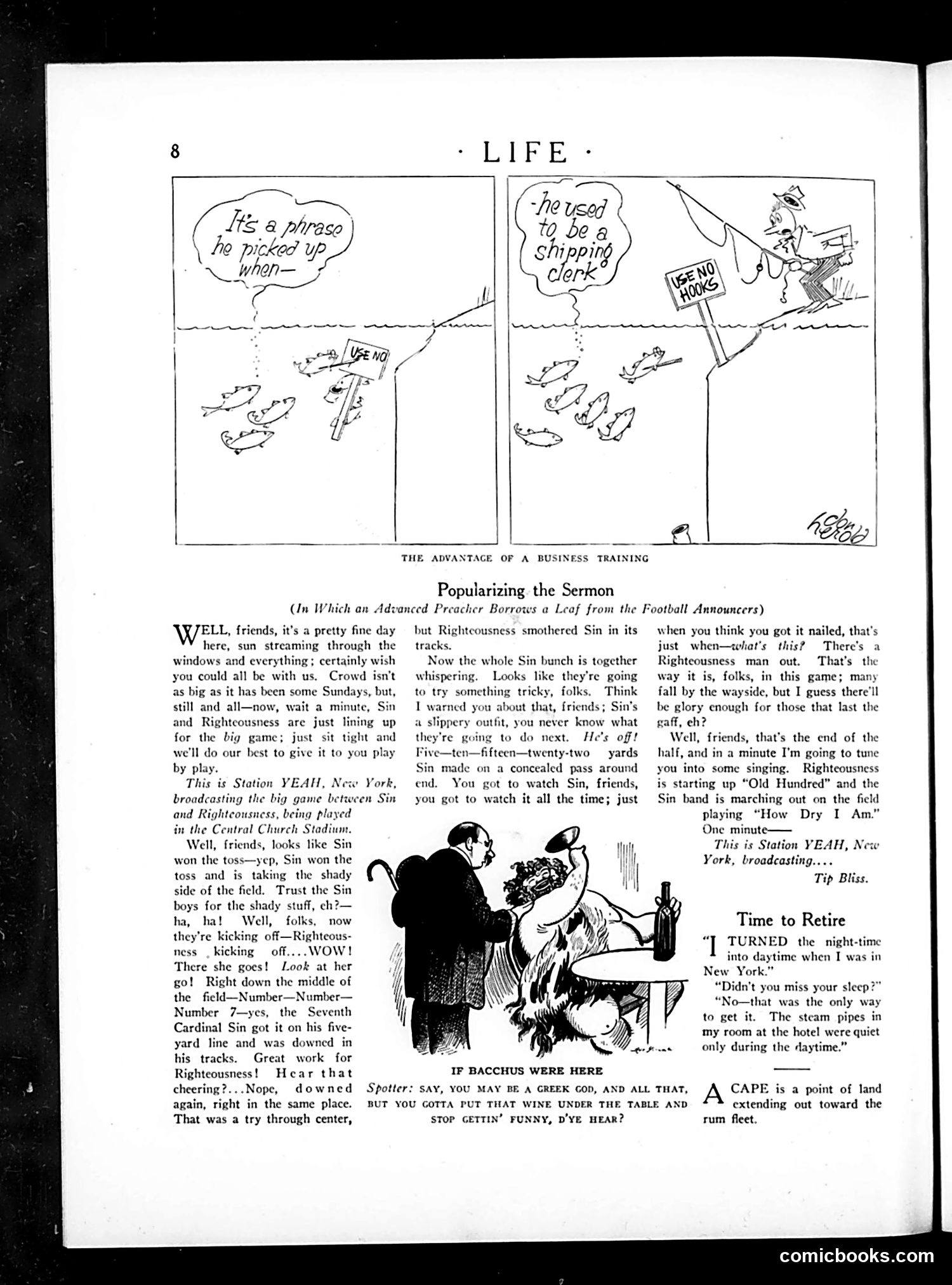
The top strip cartoon "The Advantage of a Business Training" shows fish underwater with signs reading "USE NO HOOKS." In the first panel, a figure says this is "a phrase he picked up when" employed as a shipping clerk. The second panel reveals he previously worked as a shipping clerk and now displays the same warning sign, suggesting he's applying learned caution to his current situation (likely fishing or business dealings). Below, "Popularizing the Sermon" describes a radio broadcast of a football game mixed with religious content. The satire mocks how modern entertainment dilutes serious subjects—here, a preacher borrowing football language to make sermons more "popular" and appealing to contemporary audiences rather than focusing on spiritual substance.
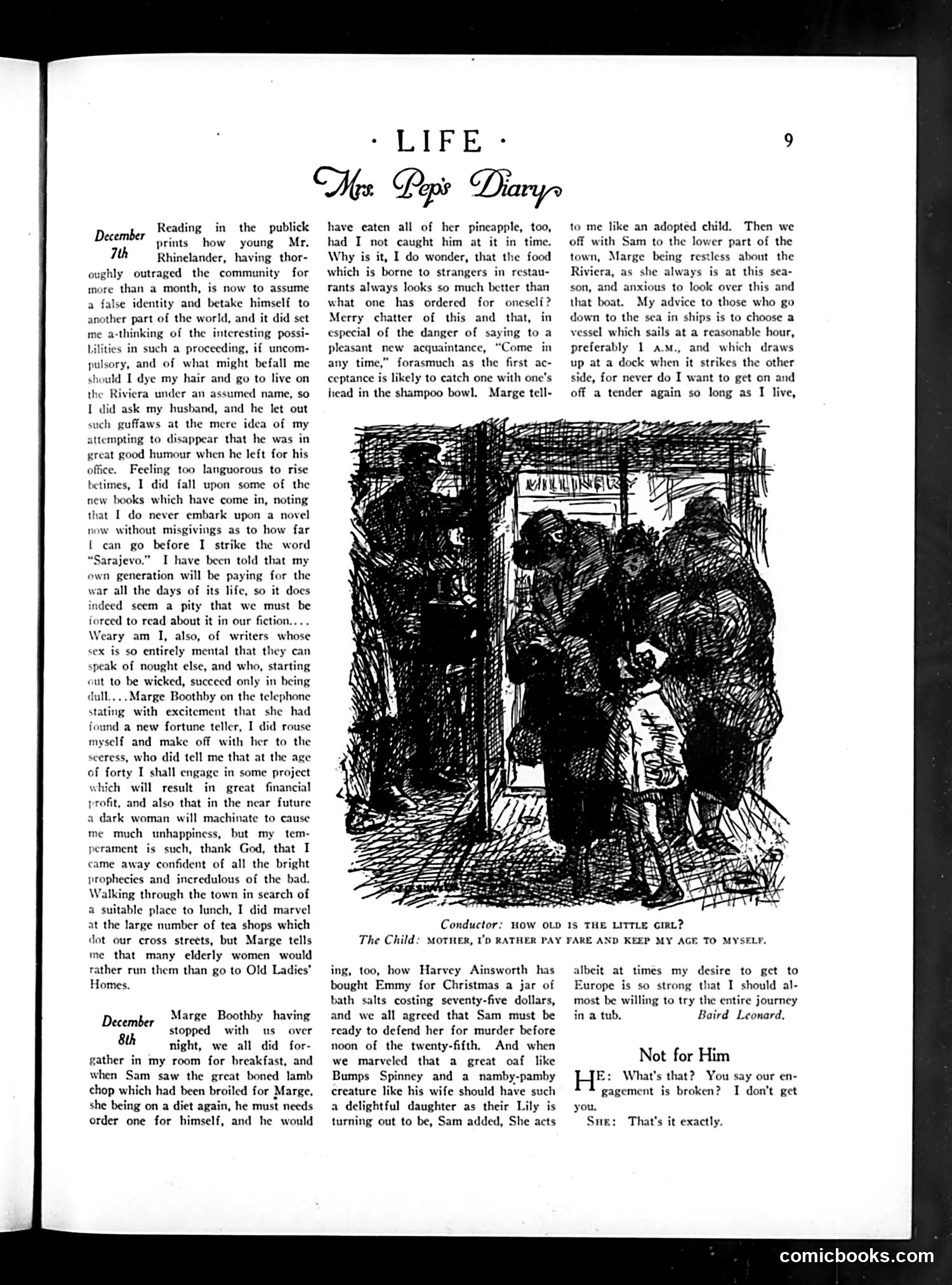
This page features a serialized diary entry and an illustration labeled "The Child: Mother, I'd Rather Pay Fare and Ship Myself to Myself." The diary entries (dated December 7th and 8th) discuss mundane domestic matters—pineapple at restaurants, fortune tellers, and Christmas gifts for servants. The illustration depicts what appears to be a conductor or transport worker speaking to a woman and child at what seems to be a train or ship entrance. The cartoon's humor appears to satirize middle-class anxieties about travel and family dynamics. The child's preference for paying her own fare and shipping herself suggests commentary on changing gender roles or children's independence—likely mocking either parental overprotection or the child's precocious modernity. The specific social context of early 20th-century transportation customs is key to understanding the satirical point.
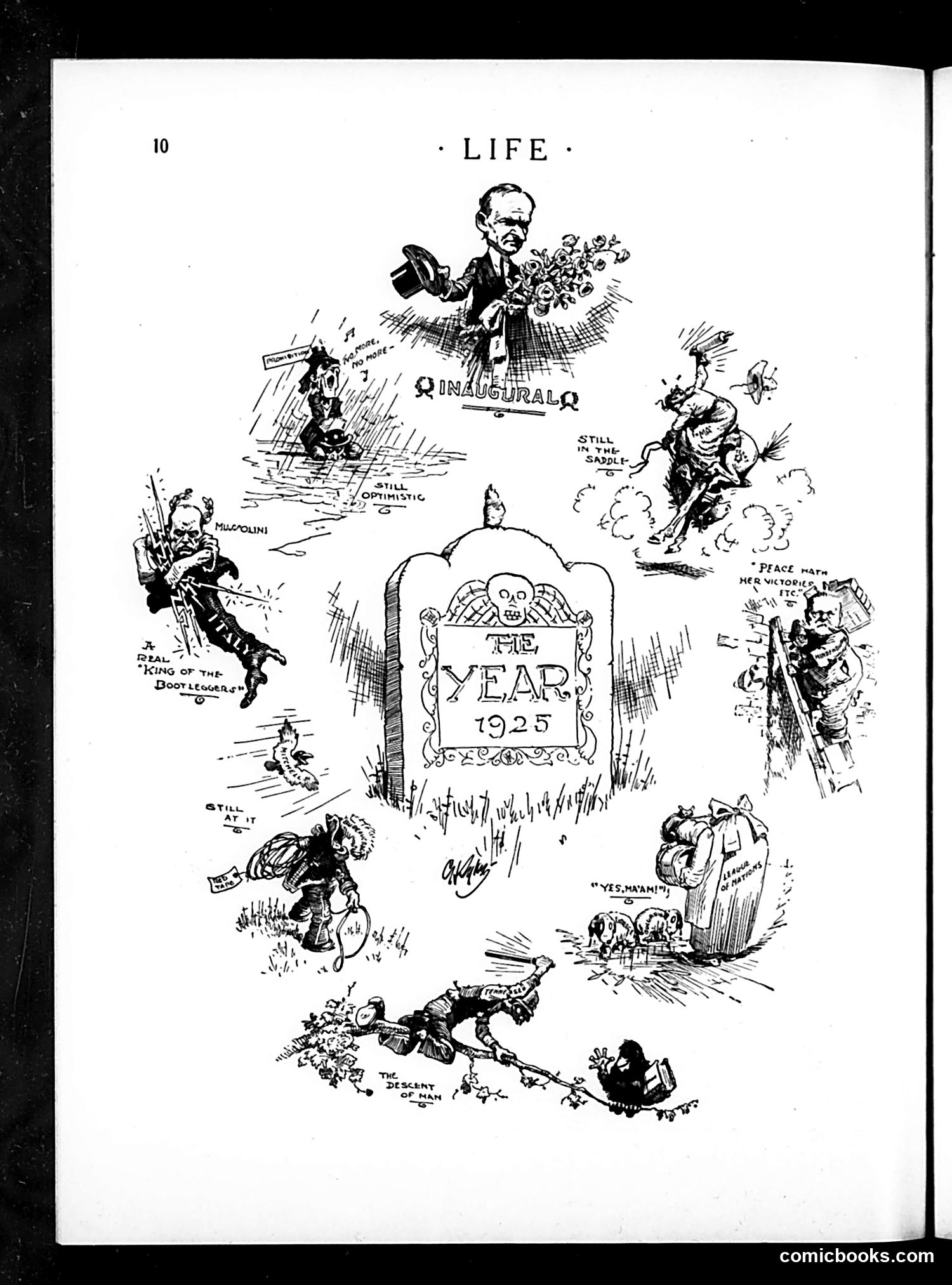
This is a satirical composite cartoon reviewing 1925's major events. At center is a tombstone reading "Year 1925" with a skull, surrounded by caricatured vignettes of the year's significant figures and incidents. The top figure appears to be an "inaugural" sketch, likely referencing a political figure. Other scenes are labeled with phrases like "Still Optimistic," "Still in the Saddle," "King of the Bootleggers," "Peace Hath Her Victories," and "The Descent of Man." The cartoon satirizes 1925's chaos: Prohibition-era bootlegging, political instability, optimism amid turmoil, and broader social decline. Without clearer labels on all figures, specific identifications are difficult, but the overall tone is dark comedic commentary on a troubled year.
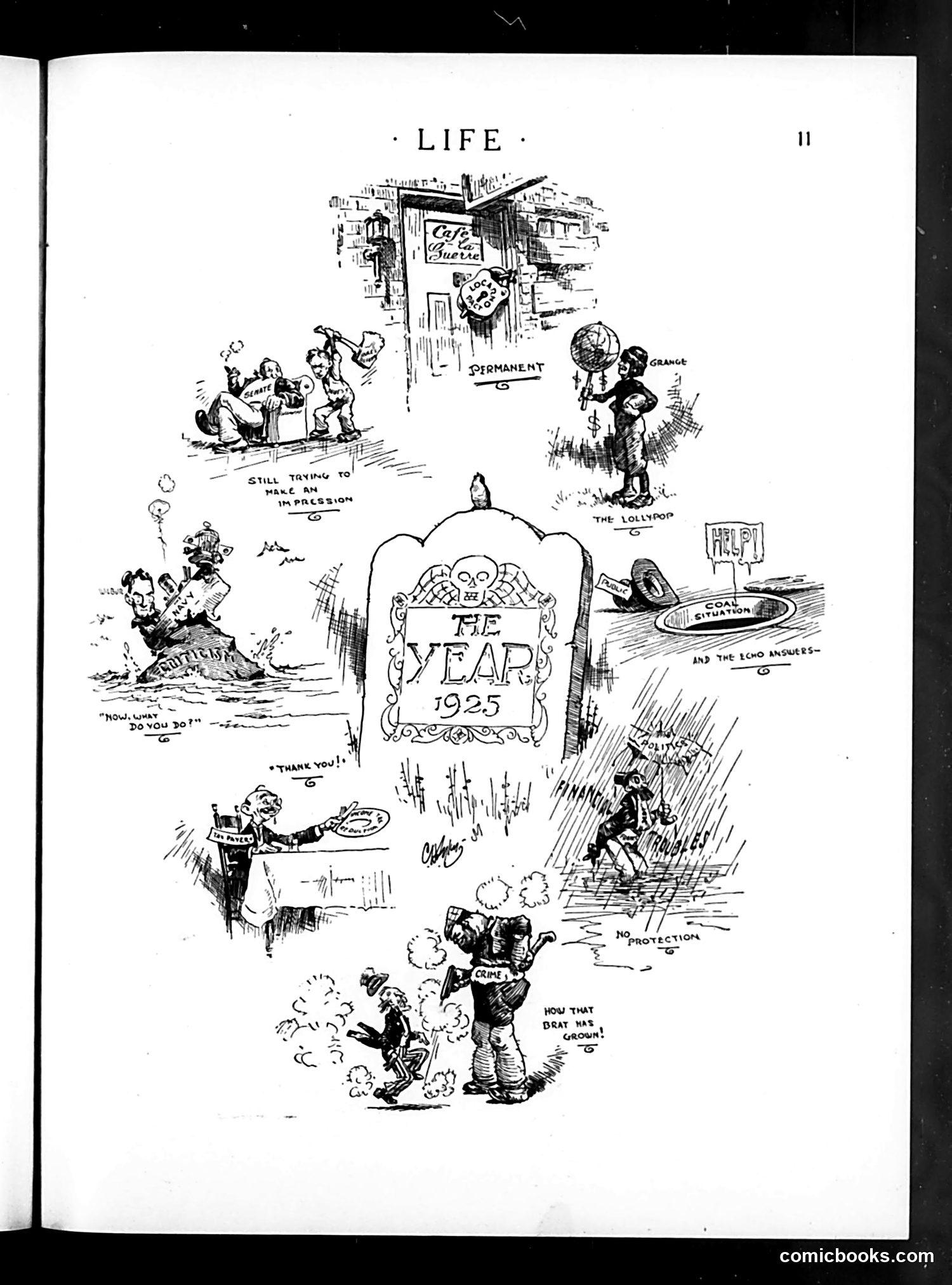
This is a satirical review page centered on "THE YEAR 1925," depicted as a tombstone. The surrounding vignettes mock various 1925 events and social phenomena: - "Still Trying to Make an Impression" - figures struggling with futility - "Café de Guéria" and "Permanent" - likely referencing trendy establishments or fashions - "The Lollipop" - appears to mock consumerism or frivolous pleasures - "No Protection" - suggests inadequate safeguards against some threat - "How That Boat Has Grown!" - likely referencing Prohibition-era smuggling vessels - "Crime" explosions - referencing organized crime's growth during Prohibition - "And The Echo Answers" - unclear specific reference The overall tone is cynical about 1925's social problems: crime proliferation, failed government protections, and materialistic pursuits masquerading as progress.
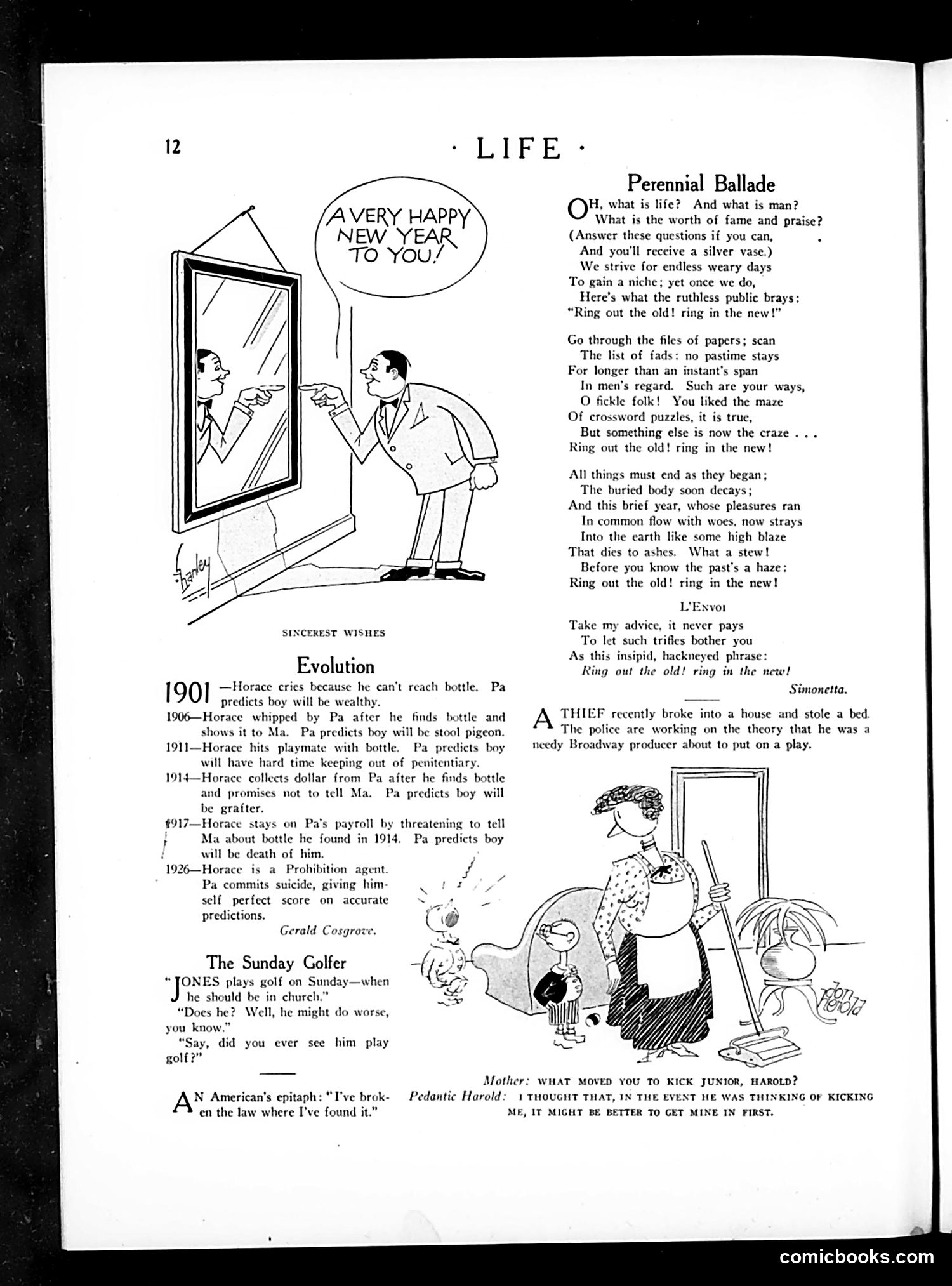
This page contains several unrelated satirical pieces typical of Life magazine's format: **Top cartoon** ("Sincere Wishes"): A man sees his reflection in a mirror wishing "A Very Happy New Year to You!" — the joke being the reflection appears as another person, satirizing New Year's superficial pleasantries. **"Evolution"** section: A humorous prediction sequence following "Horace" from 1901-1926, tracking how a boy's life trajectory changes based on his father's predictions—ending with Horace becoming a Prohibition agent, satirizing both prediction folly and Prohibition-era absurdities. **"The Sunday Golfer"**: A brief joke about a man playing golf on Sunday when he should attend church. **Bottom cartoon**: Shows a domestic scene where a boy kicked his brother; the mother's caption sardonically suggests he should have kicked her first—dark humor about household chaos. The page demonstrates Life's blend of topical satire, domestic humor, and social commentary.
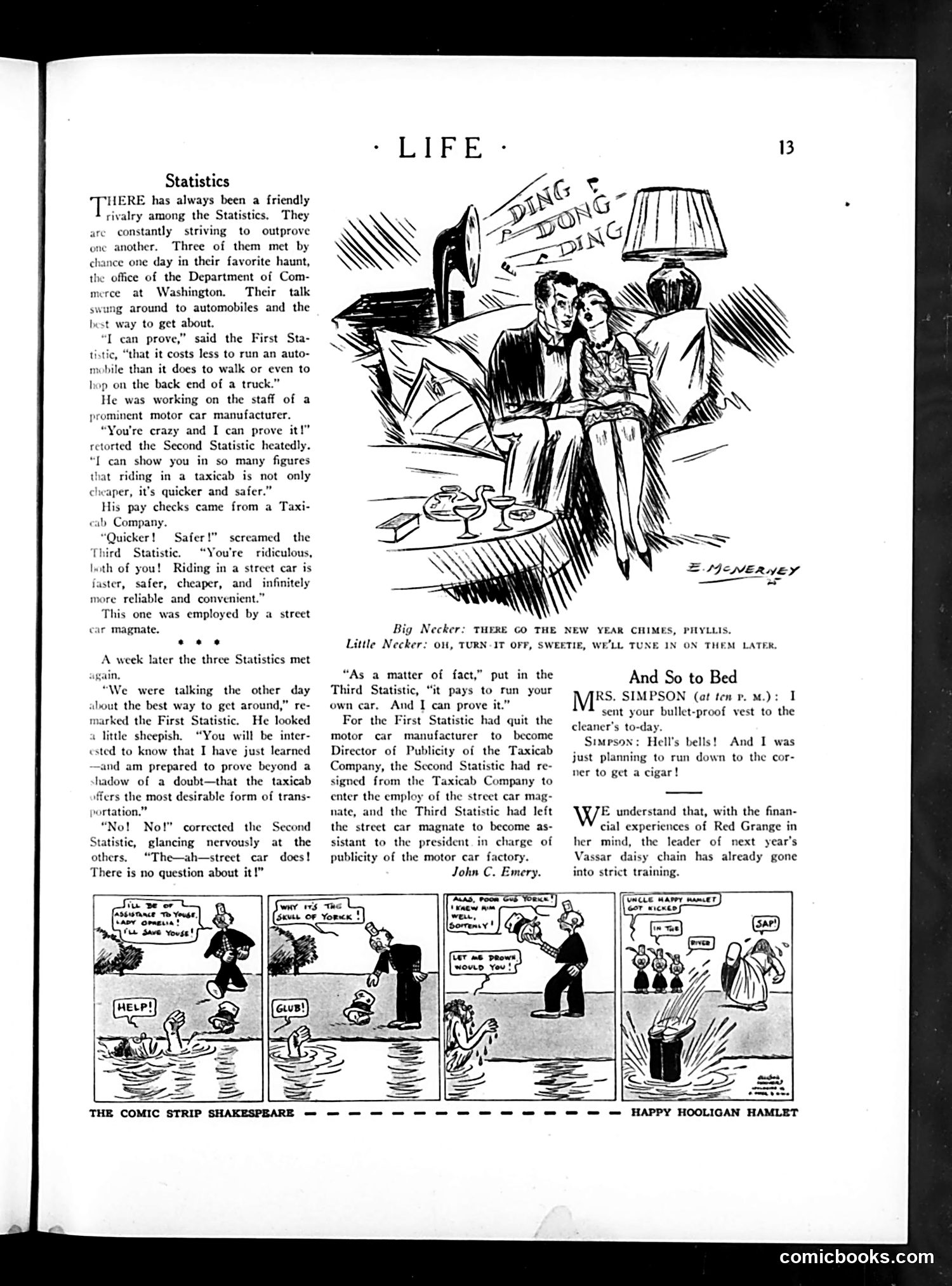
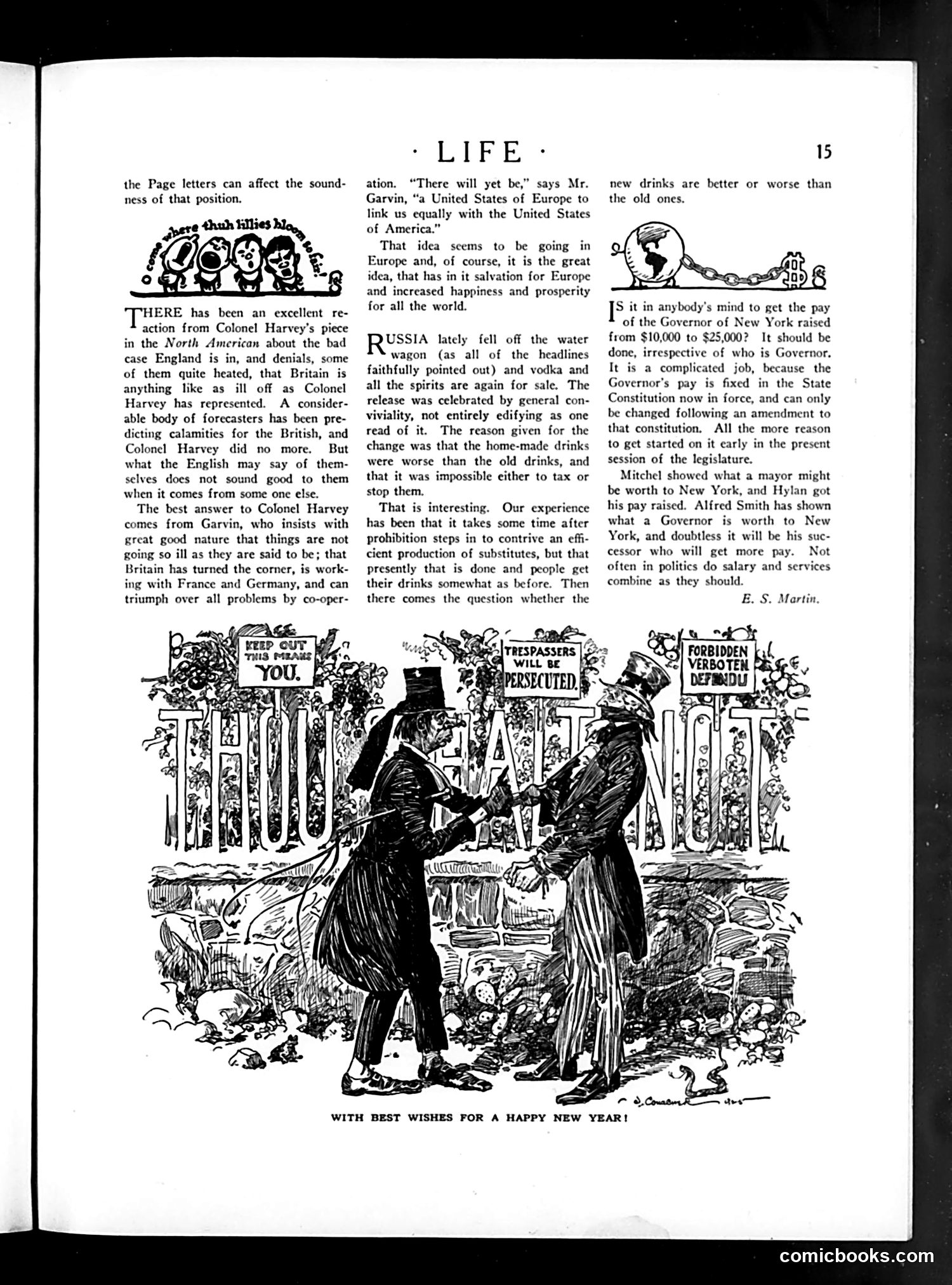
**Main Cartoon (Bottom):** The large illustration depicts two figures in formal attire shaking hands in front of gates labeled "KEEP OUT," "TRESPASSERS WILL BE PROSECUTED," and "FORBIDDEN." The caption reads "WITH BEST WISHES FOR A HAPPY NEW YEAR!" This is **political satire about international relations**, likely referencing post-WWI tensions. The contradictory message—cordial New Year wishes exchanged before closed, hostile gates—satirizes the hypocrisy of nations claiming peaceful intentions while maintaining restrictive policies. The specific borders or nations referenced are unclear without additional context, but the commentary critiques the gap between diplomatic pleasantries and actual isolationist or protectionist barriers between countries.
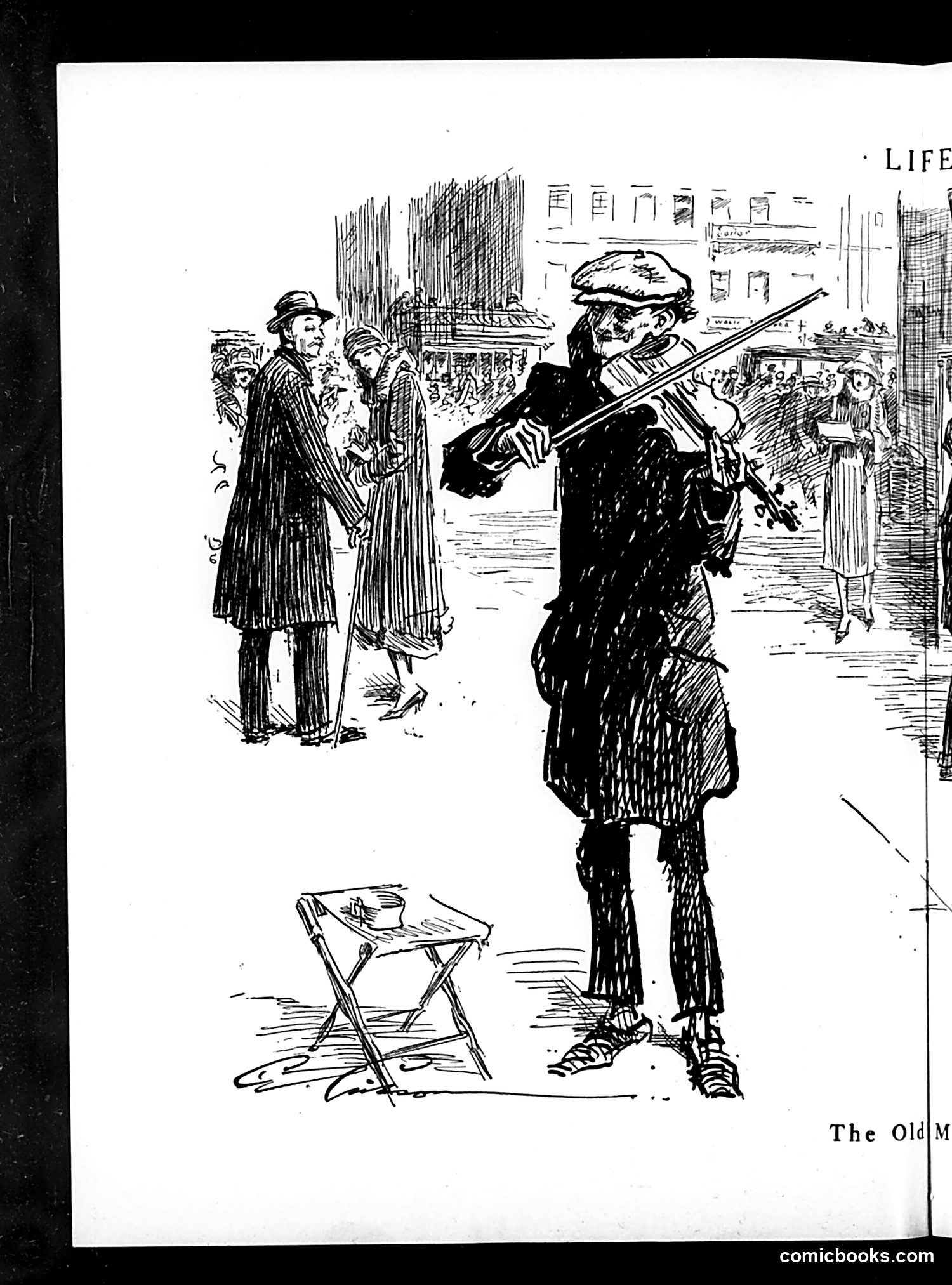
This ink sketch depicts a street musician playing violin in an urban setting, surrounded by pedestrians and city architecture. The musician is an older man in worn clothing and a cap, seated on a simple stool with his instrument case nearby—the typical setup of street performers from the late 19th/early 20th century. The partial caption "The Old M[usician]" (likely "Musician") suggests this is satirizing or depicting street performance culture. The contrast between the focused musician and the passing crowds implies commentary on poverty, artistic struggle, or the indifference of urban society to street performers. The detailed, sympathetic rendering of the figure suggests the cartoon critiques social conditions rather than mocking the musician directly.
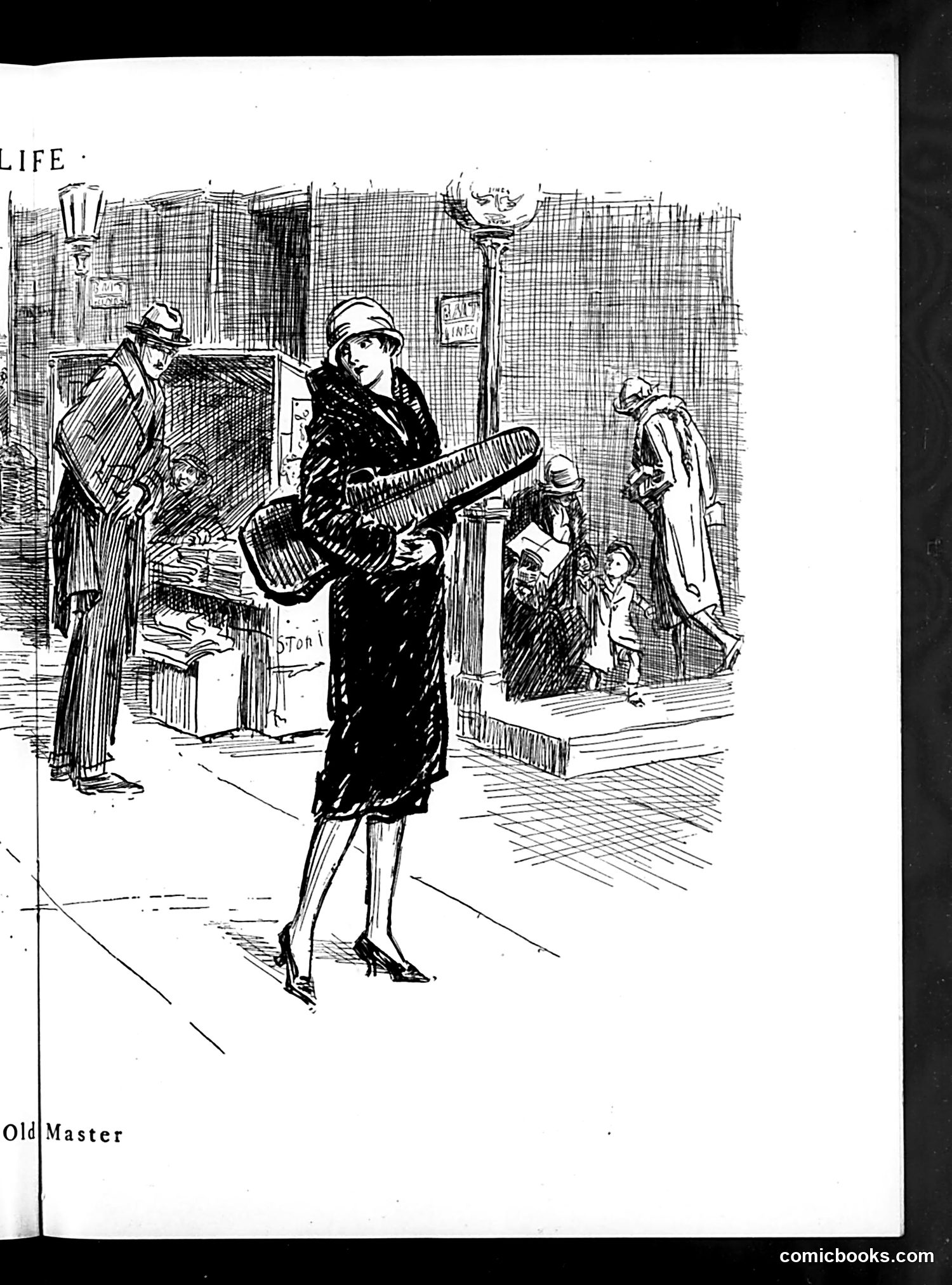
This appears to be a satirical cartoon from *Life* magazine titled "Old Master." The image shows a woman in 1920s-style clothing holding what appears to be a large baseball bat or club on a city street. Several men in period dress observe her, seemingly surprised or taken aback by her bold stance and demeanor. The satire likely comments on changing gender roles and female independence during the 1920s—the era of "flappers" and women's increased social freedom. The woman's assertive posture with the bat suggests she's not passively accepting traditional constraints. The onlookers' reactions emphasize how shocking such female assertiveness appeared to contemporary society. The "Old Master" title possibly references classical artistic traditions being disrupted by modern women's behavior.
This page reviews three experimental theatrical productions: "The Man Who Never Died," "The Fountain" by Eugene O'Neill, and "Merchants of Glory." The critic mocks the avant-garde plays for their pretension and incoherence. "The Man Who Never Died" is ridiculed for absurd plot logic—a husband claims the Riff uprising (a real colonial conflict) keeps him at work, and later a defendant argues he cannot be tried for murder because he's a "transcendental spirit." O'Neill's "The Fountain," about Ponce de León seeking the Fountain of Youth, is criticized as tediously self-important. The reviewer notes its one effective moment: Columbus being called a "crazy fool" for believing the world is round—a joke suggesting the audience smugly assumes their own superiority to past ignorance. The tone throughout is satirical toward Greenwich Village/Provincetown theatrical culture, dismissing "art productions" as pretentious failures.
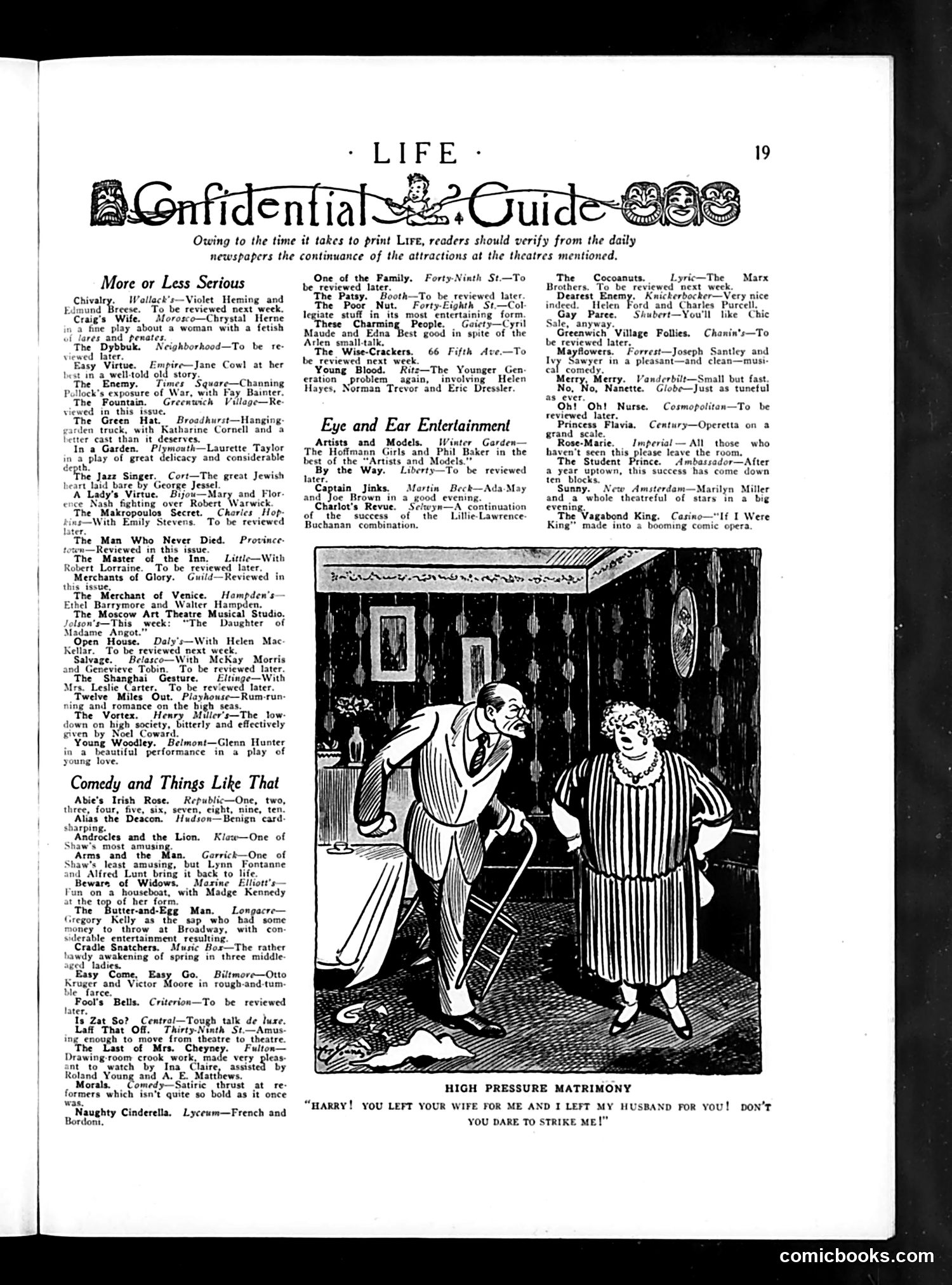
This single-panel cartoon satirizes extramarital affairs and infidelity among the wealthy. The illustration shows a man and woman in what appears to be a bedroom, caught mid-confrontation. The caption—"HARRY! YOU LEFT YOUR WIFE FOR ME AND I LEFT MY HUSBAND FOR YOU! DON'T YOU DARE TO STRIKE ME!"—depicts the absurd entanglement of their scandalous affair. The satire targets the hypocrisy and moral chaos of romantic infidelity: the woman threatens the man with violence while simultaneously acknowledging their mutually illicit relationship. It's a commentary on "high society" relationship drama, poking fun at the melodrama and irrationality of affairs conducted among the privileged classes. The cartoon appears amid theater reviews, suggesting such behavior was a familiar subject in contemporary stage comedies.
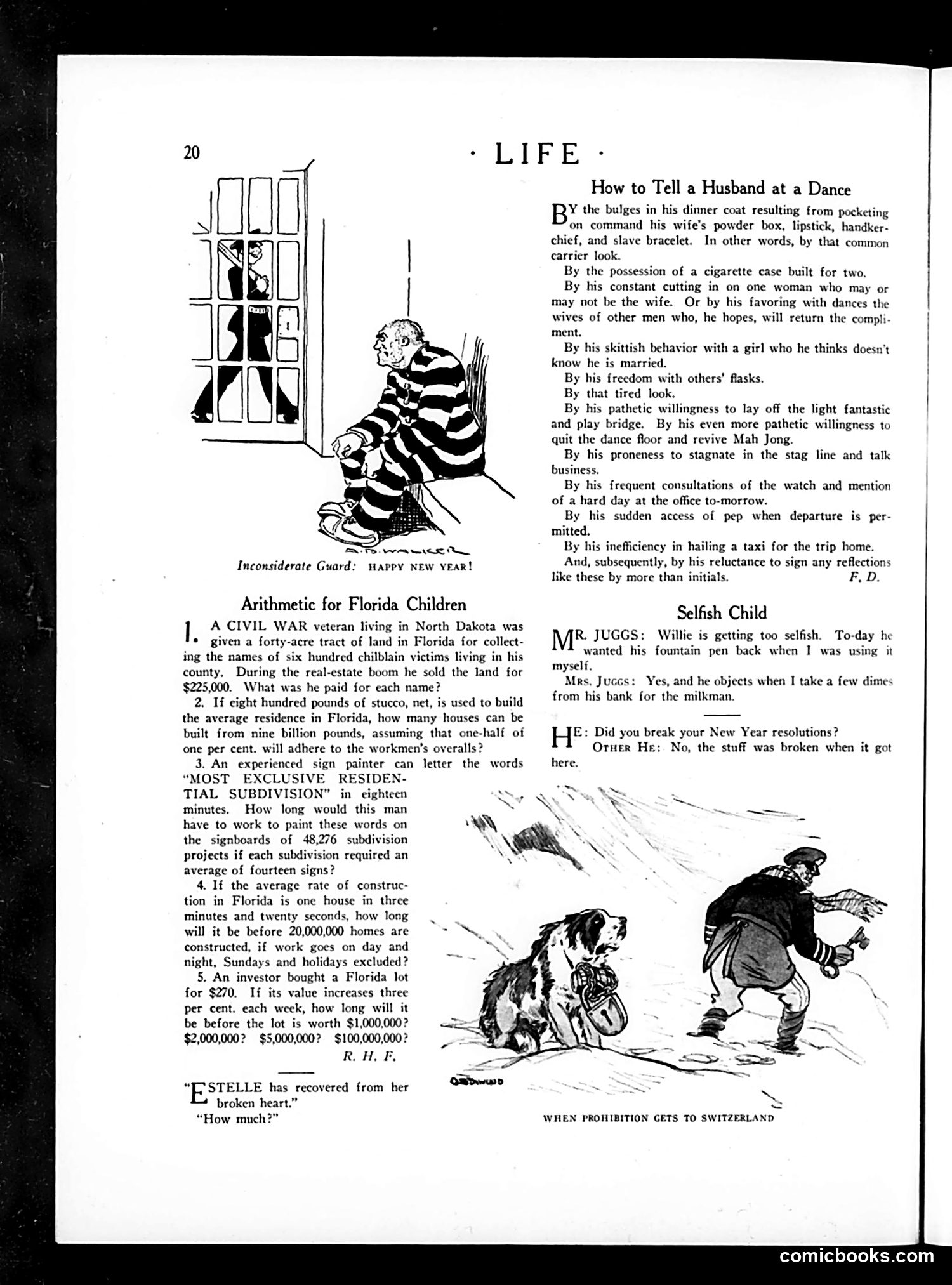
This page from *Life* satirizes 1920s American society across several pieces: **"How to Tell a Husband at a Dance"** mocks married men's behavior at social events—their infidelity (flirting with other women), sneaking drinks during Prohibition, reluctance to dance, and eagerness to leave early. The humor lies in cataloging transparent signs of a man's marital status and wandering attention. **"Arithmetic for Florida Children"** satirizes the Florida real-estate boom of the 1920s. The absurd math problems mock speculative land schemes, rapidly inflating property values, aggressive subdivision marketing, and the frenzy of construction. The joke is that these ridiculous scenarios actually reflected real market conditions. **"Selfish Child"** uses ironic role-reversal: parents who steal their son's money and possessions accuse *him* of selfishness, satirizing parental hypocrisy. The cartoons collectively critique Jazz Age infidelity, Prohibition-era drinking culture, and get-rich-quick real estate speculation—all prevalent 1920s concerns.
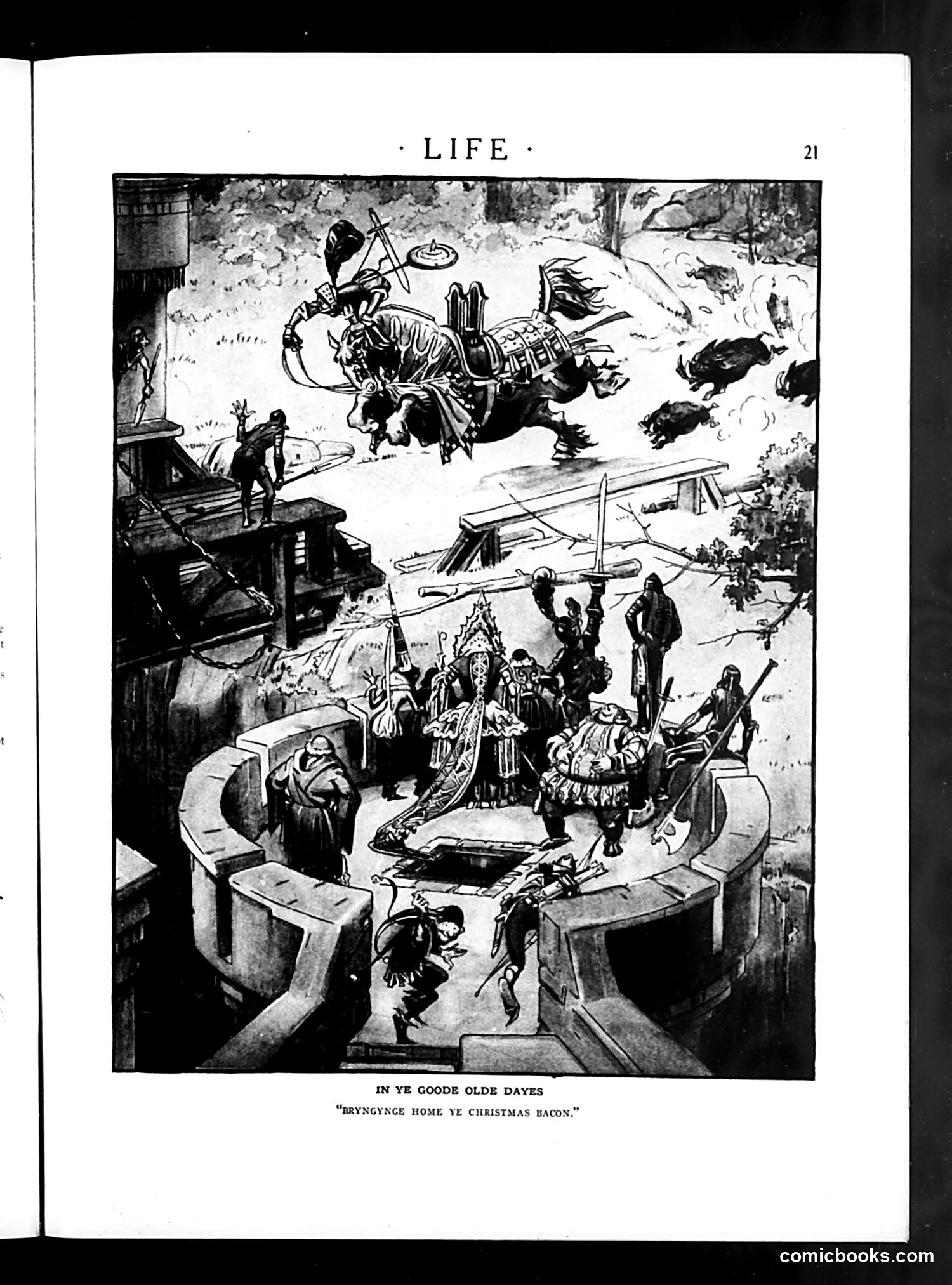
This satirical illustration depicts a chaotic medieval Christmas scene with the caption "Bryngynge Home Ye Christmas Bacon." The image shows an elaborate feudal procession centered around a roasted pig being carried ceremonially, surrounded by nobles, servants, and revelers in a fortified setting. A mounted figure on horseback dominates the upper portion. The satire mocks nostalgic romanticization of "the good old days." Life magazine presents medieval times as actually disorderly, violent, and crude—contrary to sentimental Victorian ideals. The mock-archaic spelling ("ye goode olde dayes," "bryngynge") reinforces the humor by suggesting people invented fanciful versions of history. The focus on transporting a single pig suggests commentary on scarcity, excess, or the absurdity of feudal pageantry around basic sustenance.
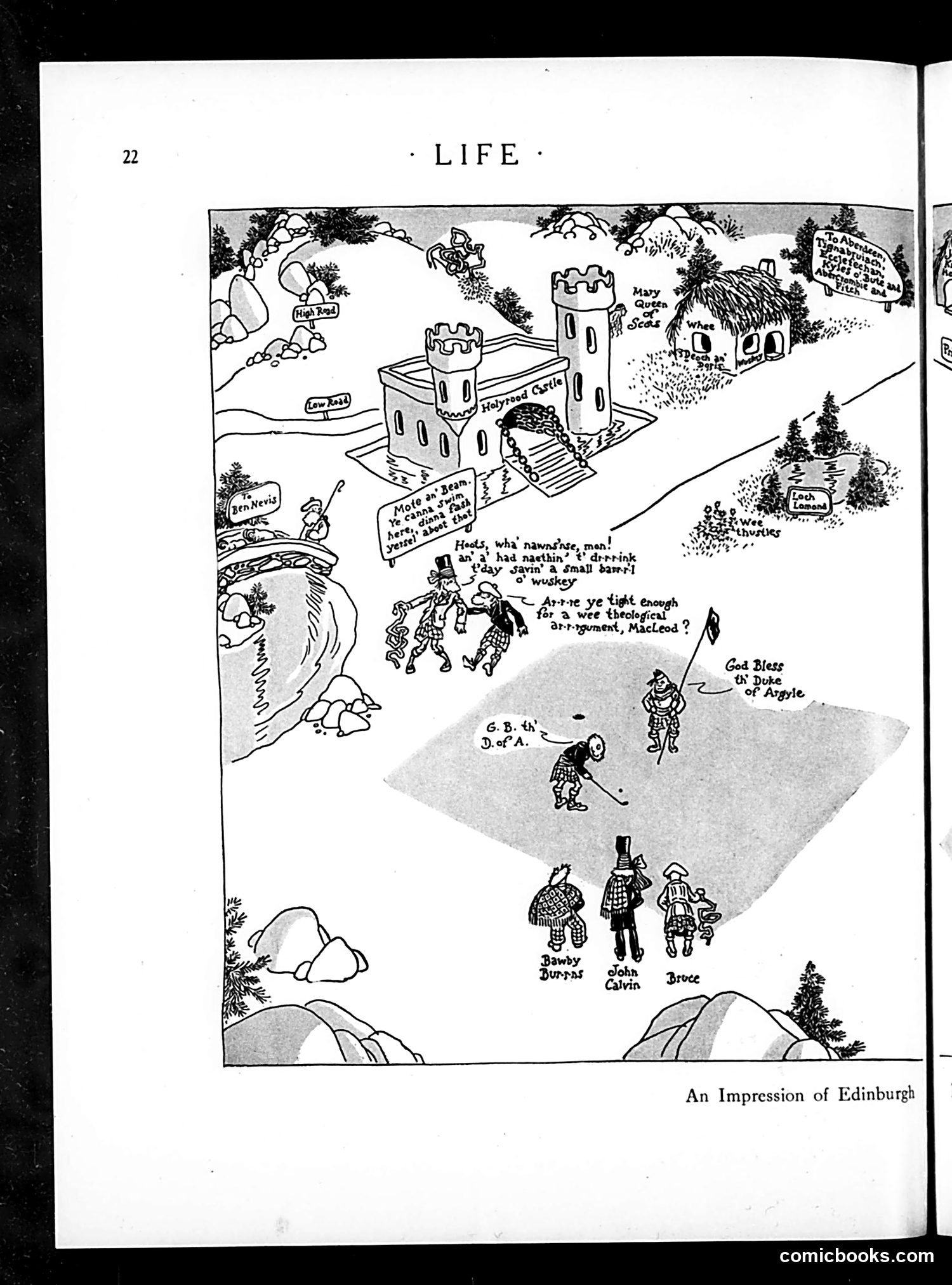
This is a humorous map of Edinburgh drawn in a whimsical, cartoon style. It depicts various Scottish landmarks and locations (including a castle, Mary Queen of Scots site, and local streets) alongside caricatured Scottish figures engaged in stereotypical behavior. The satire plays on common English perceptions of Scottish culture: the dialogue features exaggerated Scottish dialect, and the characters discuss drinking whisky and theological arguments—both traits associated with Scottish stereotypes of the era. The figures are labeled with Scottish names (Bawby, Dougal, Closh, Calvin, Bruce) and wear kilts. The cartoon appears to be gentle mockery of Scottish character and customs, presented as "An Impression of Edinburgh" for English readers of *Life* magazine. It relies on dialect humor and cultural stereotyping rather than sharp political satire.
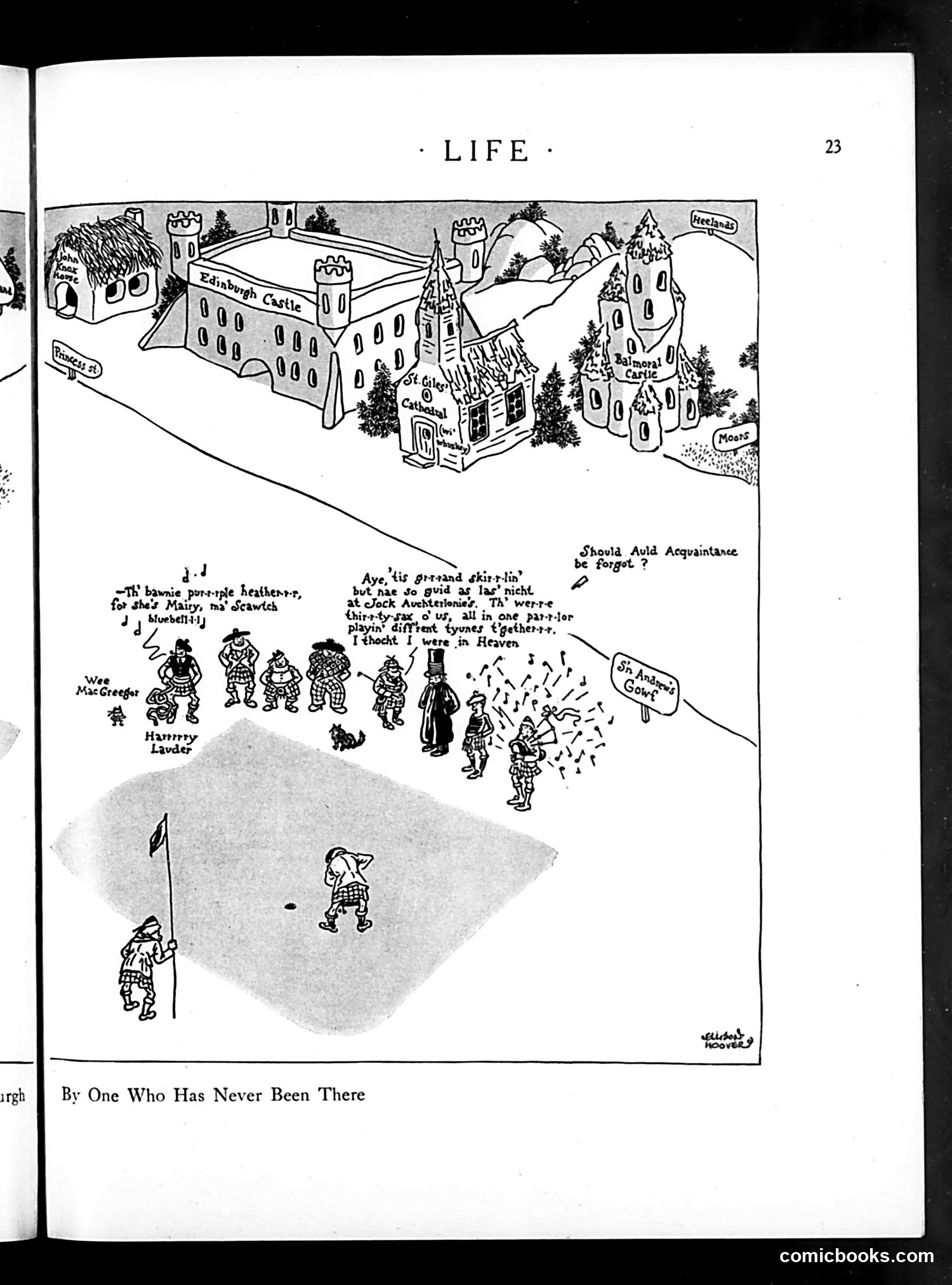
This cartoon satirizes Scottish tourism and cultural stereotyping. The top panel shows Edinburgh Castle and other Scottish landmarks labeled with their names. Below, a group of tourists (labeled with Scottish names like "Wee MacGregor" and "Hammy Lauder") discuss their visit in exaggerated Scottish dialect, emphasizing words with rolled r's ("grrrand," "skir-rlin," "par-r-lor"). The humor derives from the contrast between the romantic image of Scotland's historic sites and the tourists' vulgar, drunken behavior—they reference crowding thirty-six people into one room playing different songs simultaneously at "Jock Auchterlennie's" (likely a pub), yet claiming it felt heavenly. The title, "By One Who Has Never Been There," suggests the cartoonist is mocking both stereotypical Scottish tourist experiences and non-Scottish people's exaggerated perceptions of Scottish culture. The satire targets tourist-culture artificiality and ethnic caricature.
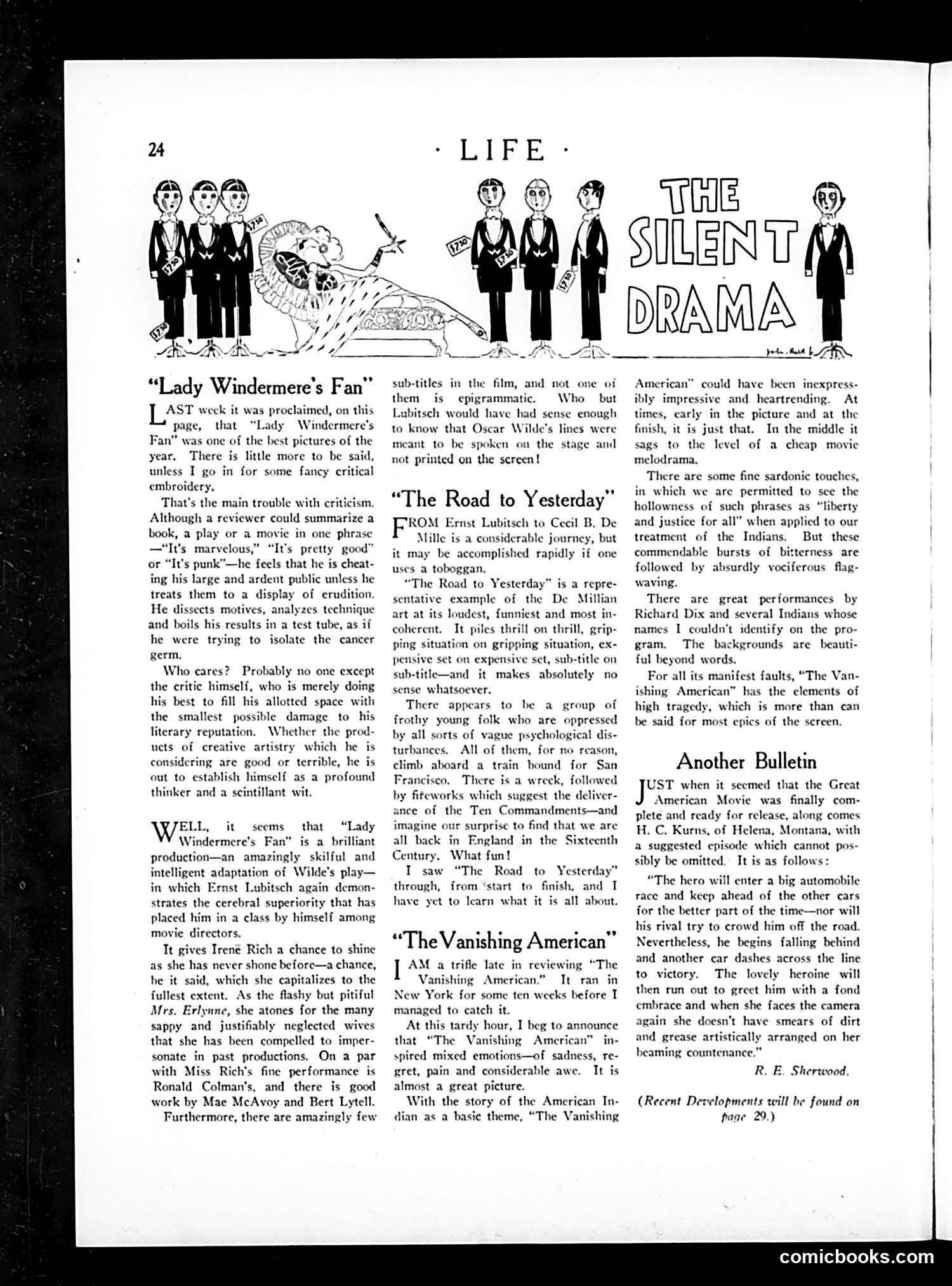
This page contains three film reviews satirizing both movies and film criticism itself. The opening section mocks pretentious film critics who use elaborate language to describe simple judgments, comparing their analysis to isolating "cancer germs." The reviewer suggests critics pad their columns with pseudo-intellectual flourishes to appear profound, regardless of a film's actual quality. **"Lady Windermere's Fan"** receives praise for Ernst Lubitsch's elegant direction and the performances of Irene Rich and Ronald Colman. Notably, it commends Lubitsch for minimizing subtitles—crucial context since this is a *silent film*, making the restraint from printed dialogue remarkable for adapting Oscar Wilde's witty stage play. **"The Road to Yesterday"** by Cecil B. DeMille is mocked as incoherent spectacle: young people board a train for no reason, it wrecks, fireworks suggest biblical deliverance, then suddenly the scene shifts to sixteenth-century England. The reviewer admits complete bewilderment about the plot. **"The Vanishing American"** receives mixed judgment—potentially powerful using Native American themes, but sagging into "cheap movie melodrama" in its middle section.
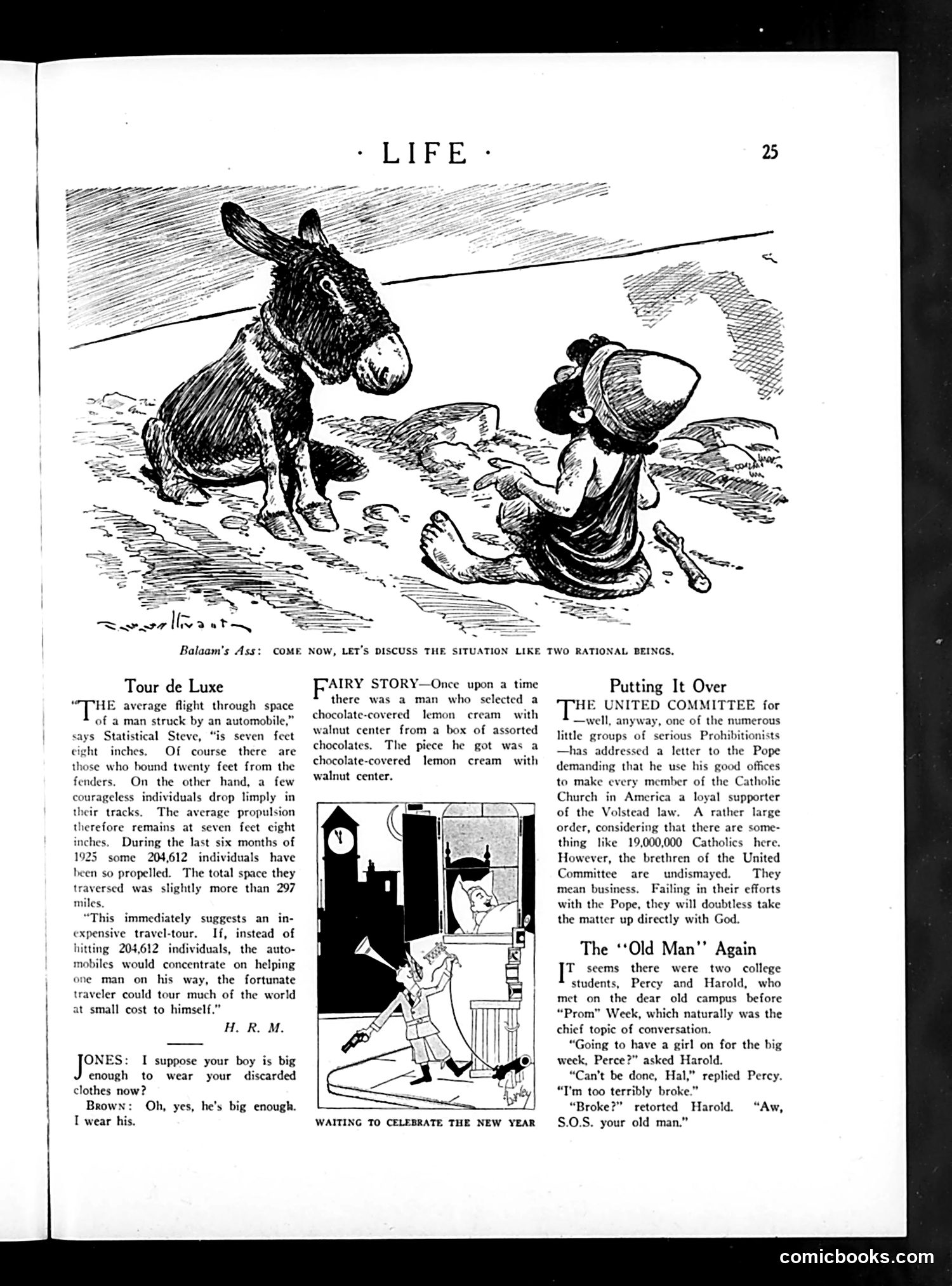
This page contains several unrelated humorous pieces typical of Life's format: **"Tour de Luxe"** mocks automobile safety statistics, sardonically suggesting that instead of hitting 204,612 people in 1925, cars could concentrate on one person to provide free world travel via the distance they'd be propelled. **"Fairy Story"** is a deadpan joke about selecting a chocolate—the humor lying in the tautological disappointment. **"Putting It Over"** satirizes Prohibition-era activism, mocking a committee of prohibitionists who petition the Pope to enforce the Volstead law on American Catholics (numbering ~19 million), suggesting they'd next appeal directly to God if the Pope refuses. **The college dialogue** jokes about financial desperation—a broke student advised to ask his father for prom money. **The top cartoon** (captioned "Balaam's Ass") shows a donkey and person discussing "the situation like two rational beings"—likely satirizing some contemporary political disagreement, though the specific reference is unclear.
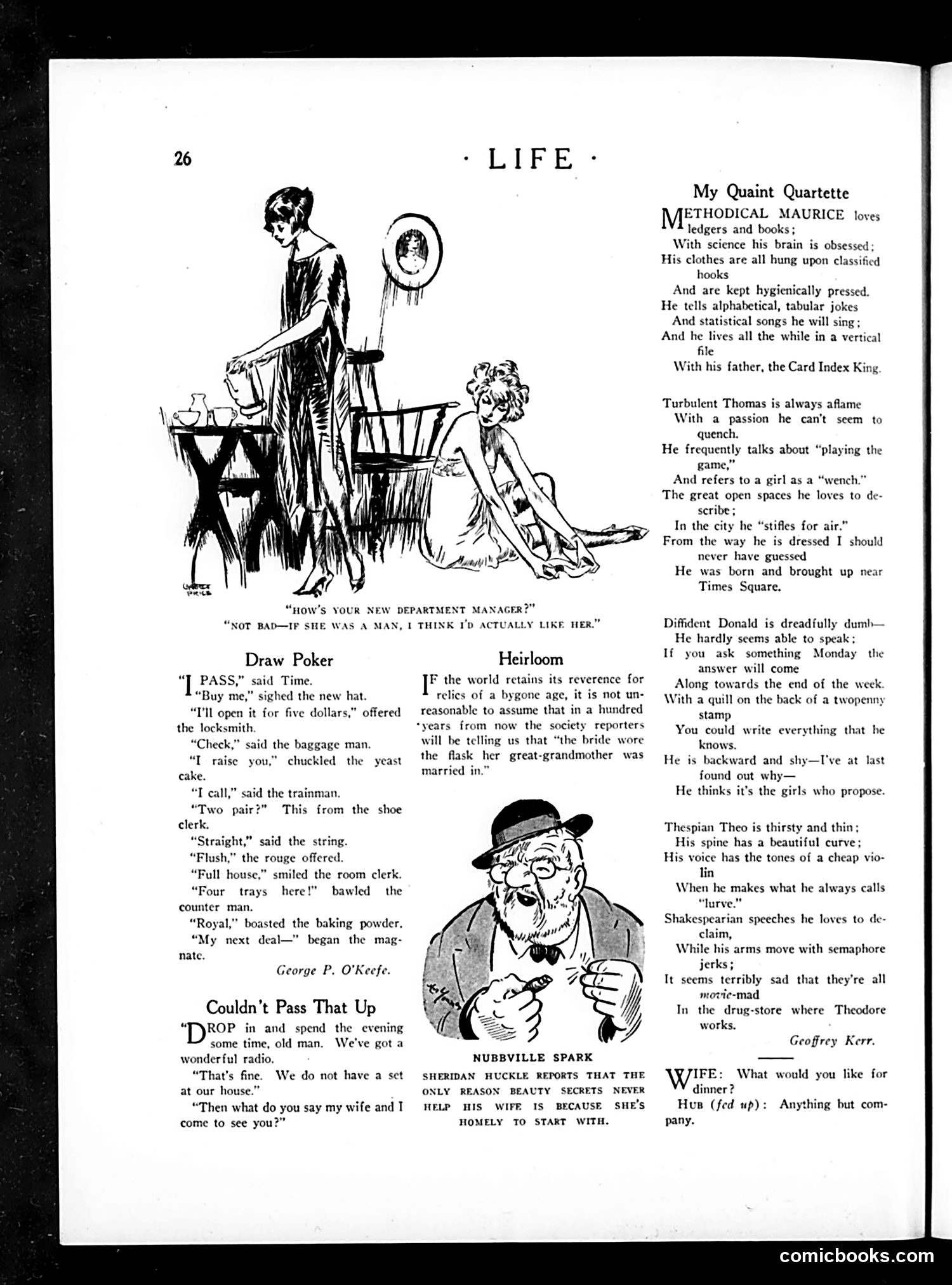
This page contains three satirical pieces reflecting 1920s social commentary: **"Draw Poker"** is a wordplay joke where inanimate objects (hat, locksmith, baggage man, yeast, trainman, shoe, string, rouge, room clerk, baking powder, magnate) participate in a poker game, each making bids using puns on their nature ("I'll open it for five dollars" from a locksmith, "Full house" from the room clerk). **"Couldn't Pass That Up"** satirizes social hypocrisy: a man invites a friend to spend the evening, but when asked to reciprocate the visit with his wife, suddenly claims they don't have a radio—revealing his wife's company is unwelcome. The implied insult is softened by the friend's response. **"My Quaint Quartette"** presents four male character types: Maurice (obsessively organized), Thomas (passionate but pretentiously bohemian despite being from Times Square), Donald (slow-witted), and Theo (aspiring theatrical). These are gentle personality sketches poking fun at recognizable social types of the era.
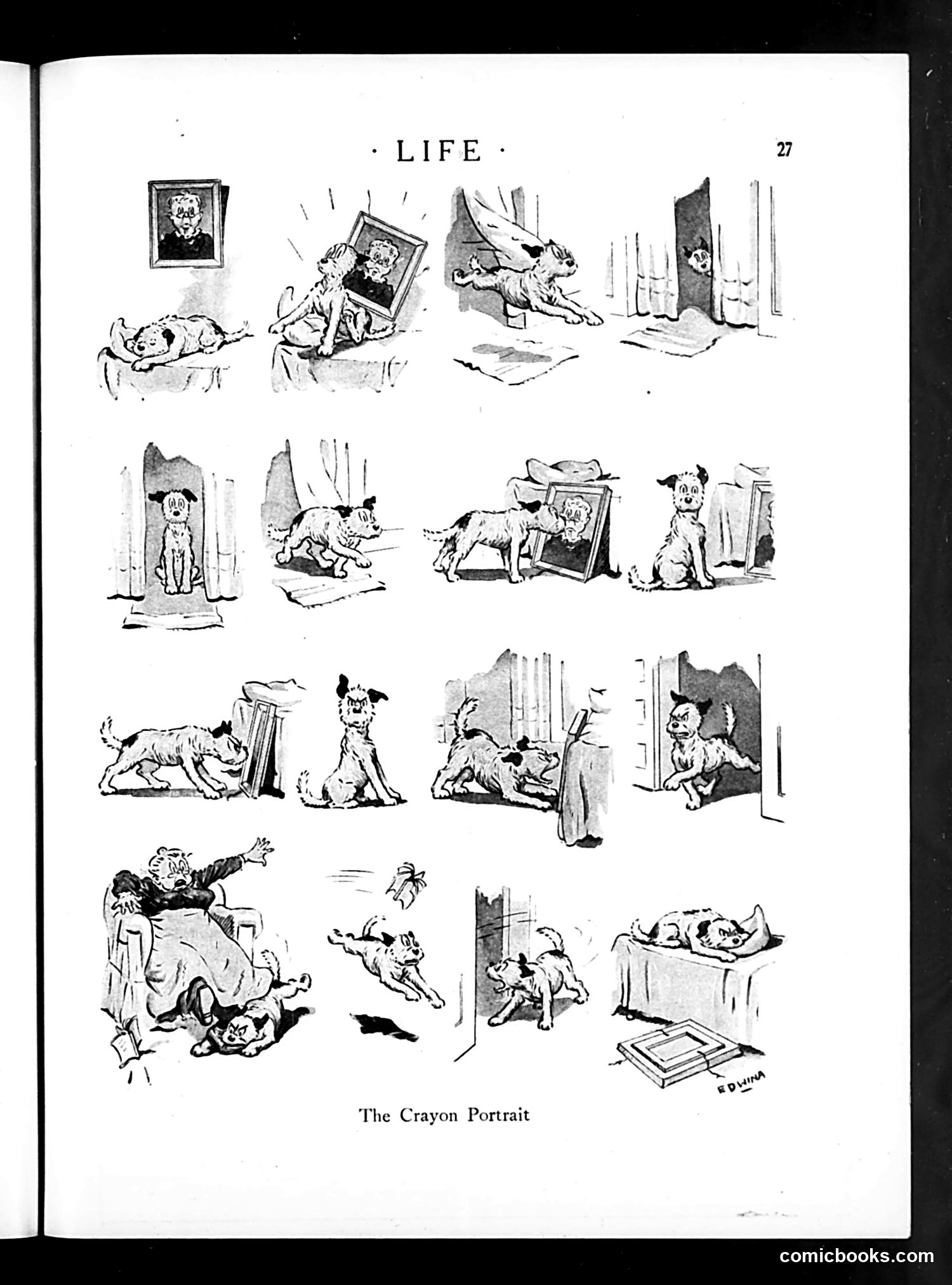
This comic strip depicts a humorous sequence about a child's drawing or "crayon portrait." The narrative follows what appears to be a young artist creating a portrait, likely of a parent or family member, with progressively chaotic results. The strip shows the child's growing frustration and the subject's reactions—ranging from bemusement to apparent distress—as the portrait takes shape. The humor derives from the universal experience of children's crude artistic attempts and adults' polite (or impolite) responses to them. The final panels suggest escalating chaos, with figures in disarray, capturing the comedic tension between a child's earnest creative effort and the reality of their limited artistic ability—a relatable domestic scene for *Life* magazine's early 20th-century audience.
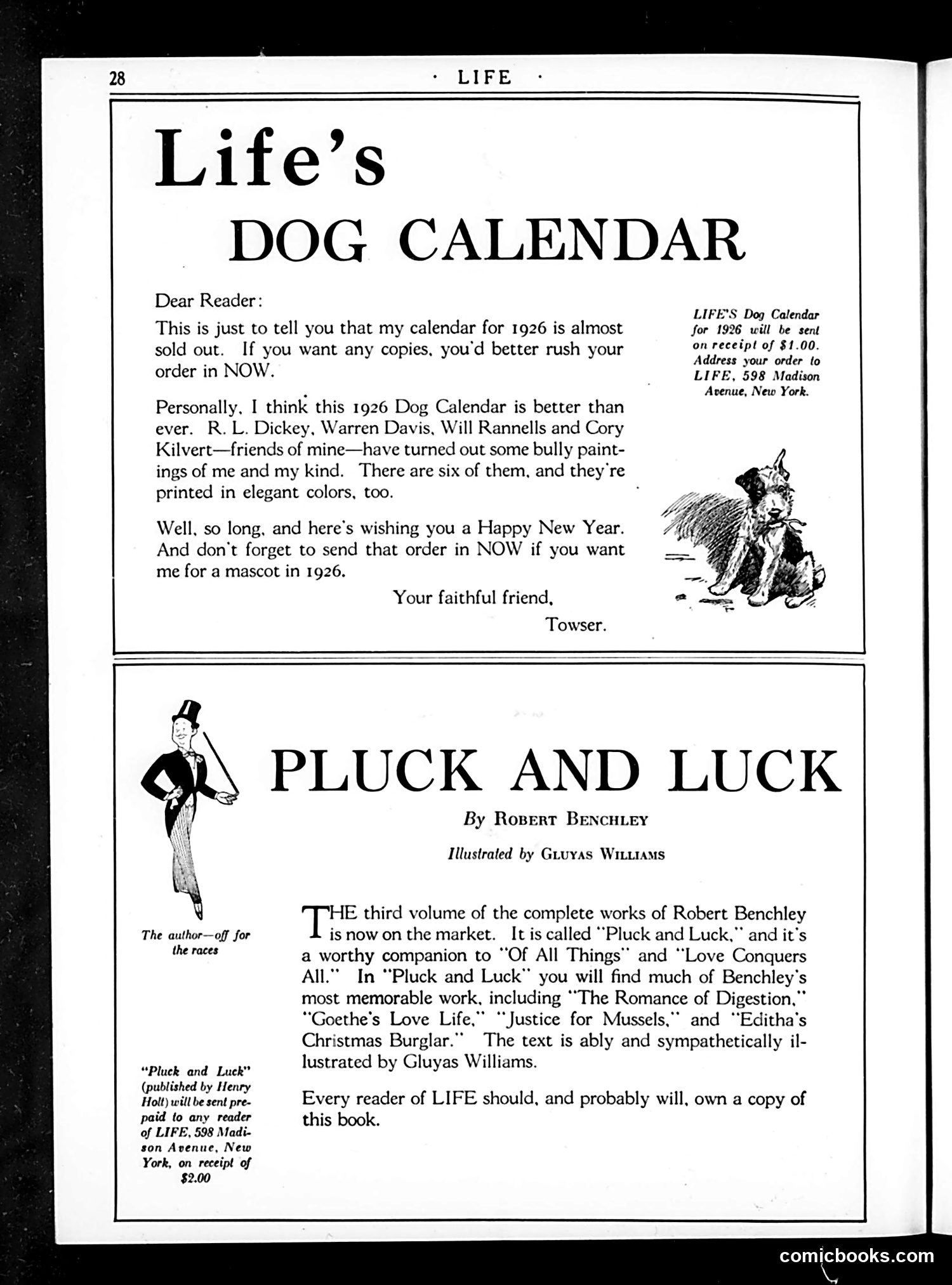
This page combines two promotional items from *Life* magazine's advertising section. **Life's Dog Calendar:** A humorous self-promotional piece where "Towser," the magazine's mascot dog, pitches the 1926 Dog Calendar. Four artists (Dickey, Davis, Rannells, Kilvert) created paintings of Towser for this product. The joke is anthropomorphic—a dog "writing" to readers to buy merchandise featuring himself. This was typical *Life* humor: self-aware, tongue-in-cheek marketing. The calendar cost $1.00. **Pluck and Luck Advertisement:** Promotes humorist Robert Benchley's third book collection, illustrated by Gluyas Williams. The ad lists essay titles ("The Romance of Digestion," "Justice for Mussels") that exemplify Benchley's absurdist humor style. The small illustration shows a fashionable figure, consistent with *Life*'s urbane, sophistication-focused audience. The book cost $2.00. Both items target *Life*'s affluent, literate readership interested in humor and contemporary satire.
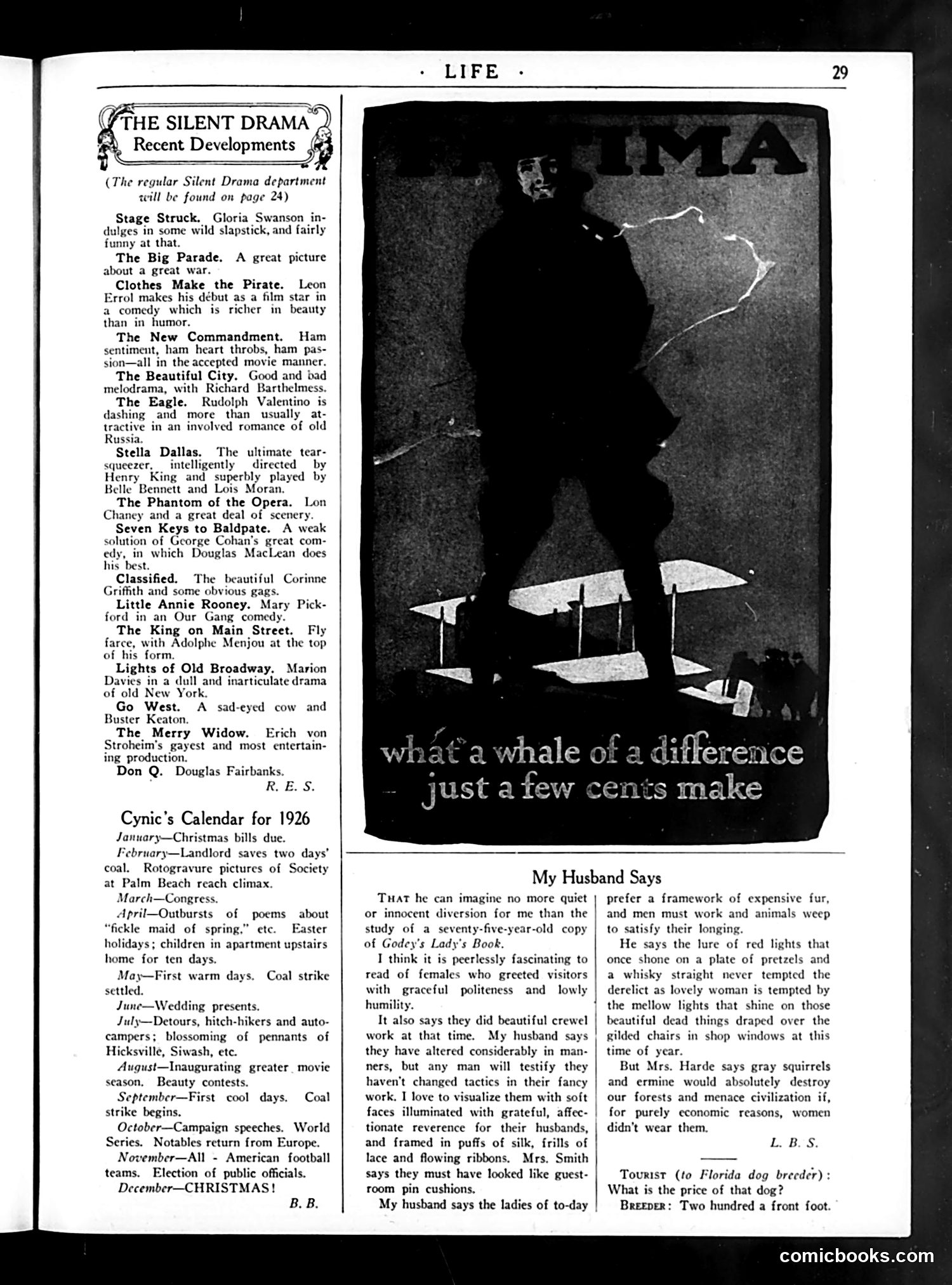
This page contains two distinct sections: **"The Silent Drama: Recent Developments"** reviews contemporary films—*The Big Parade*, *Stella Dallas*, *The Phantom of the Opera*, and others—noting their stars (Gloria Swanson, Rudolph Valentino, Mary Pickford, Douglas Fairbanks) and quality. This reflects the thriving 1920s silent film industry. **"My Husband Says"** is a humorous column satirizing gender dynamics. It contrasts Victorian-era women (from 1850s *Godey's Lady's Book*) who were graceful, deferential, and industrious with modern 1920s women who demand expensive furs and luxuries. The satire mocks husbands' nostalgic complaints about women's changing expectations, while also critiquing frivolous consumerism and environmental destruction (ermine/squirrel fur coats). The accompanying advertisement shows a whale—"just a few cents make what a whale of a difference"—using animal imagery to sell an unstated product, typical of era advertising.
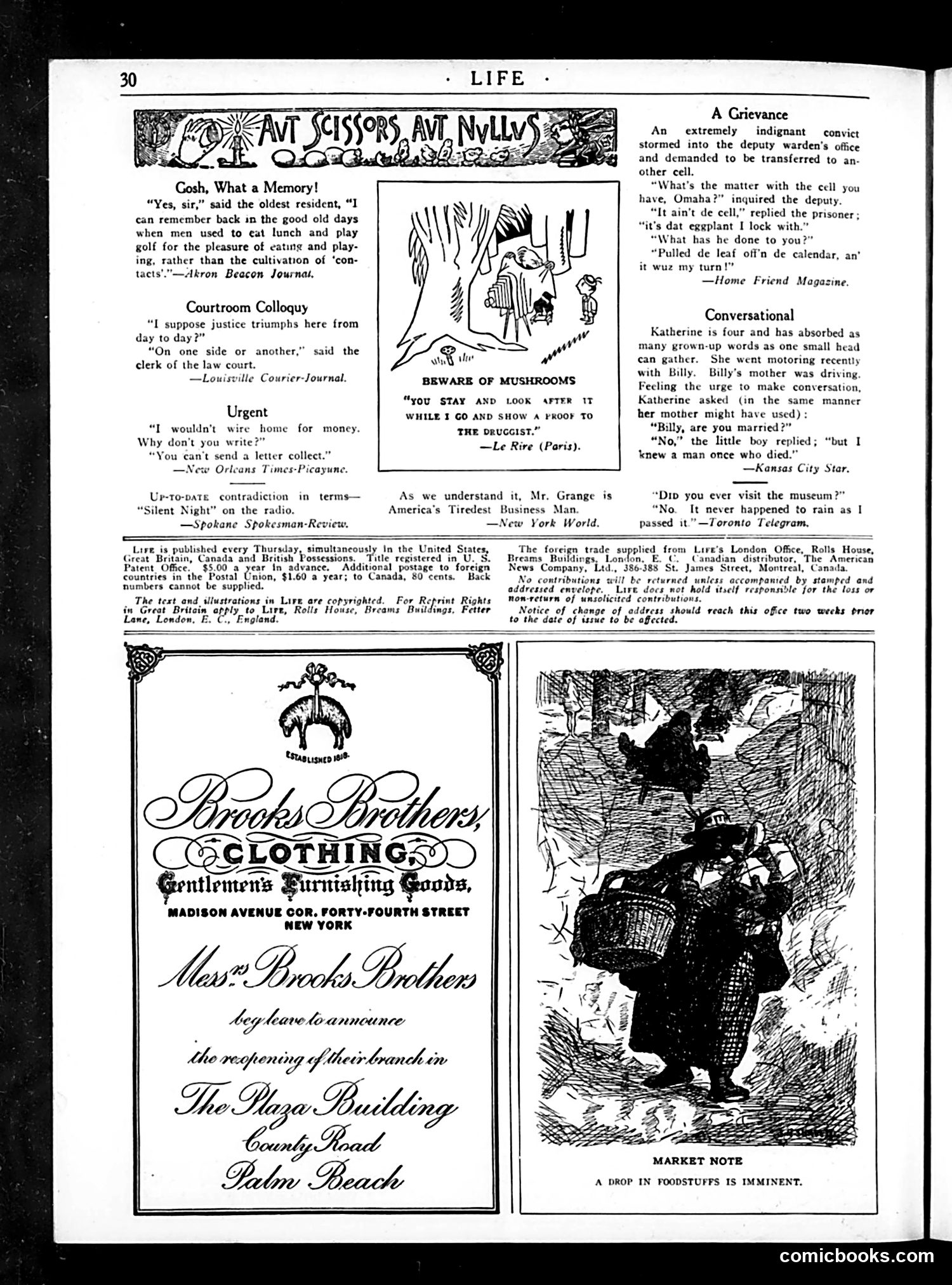
This page contains satirical humor typical of early 20th-century American magazines. The cartoon "Beware of Mushrooms" (center) depicts a man warning another away from mushrooms while he consults a druggist—likely a cautionary joke about poisoning, either accidental or intentional. The text items are brief humor pieces on contemporary themes: - **"Gosh, What a Memory"** satirizes how modern business culture has replaced leisure with networking ("cultivation of 'contacts'") - **"Courtroom Colloquy"** jokes cynically that justice favors whichever side argues better - **"Urgent"** puns on inability to send collect letters - **"Conversational"** and **"A Grievance"** feature innocent children's misunderstandings of adult speech The advertising section announces Brooks Brothers' new Palm Beach location. The "Market Note" illustration (lower right) appears to reference food price concerns, connecting to the text about "a drop in foodstuffs." The overall tone reflects 1920s urban American preoccupations: business ethics, legal skepticism, economic anxiety, and domestic humor.
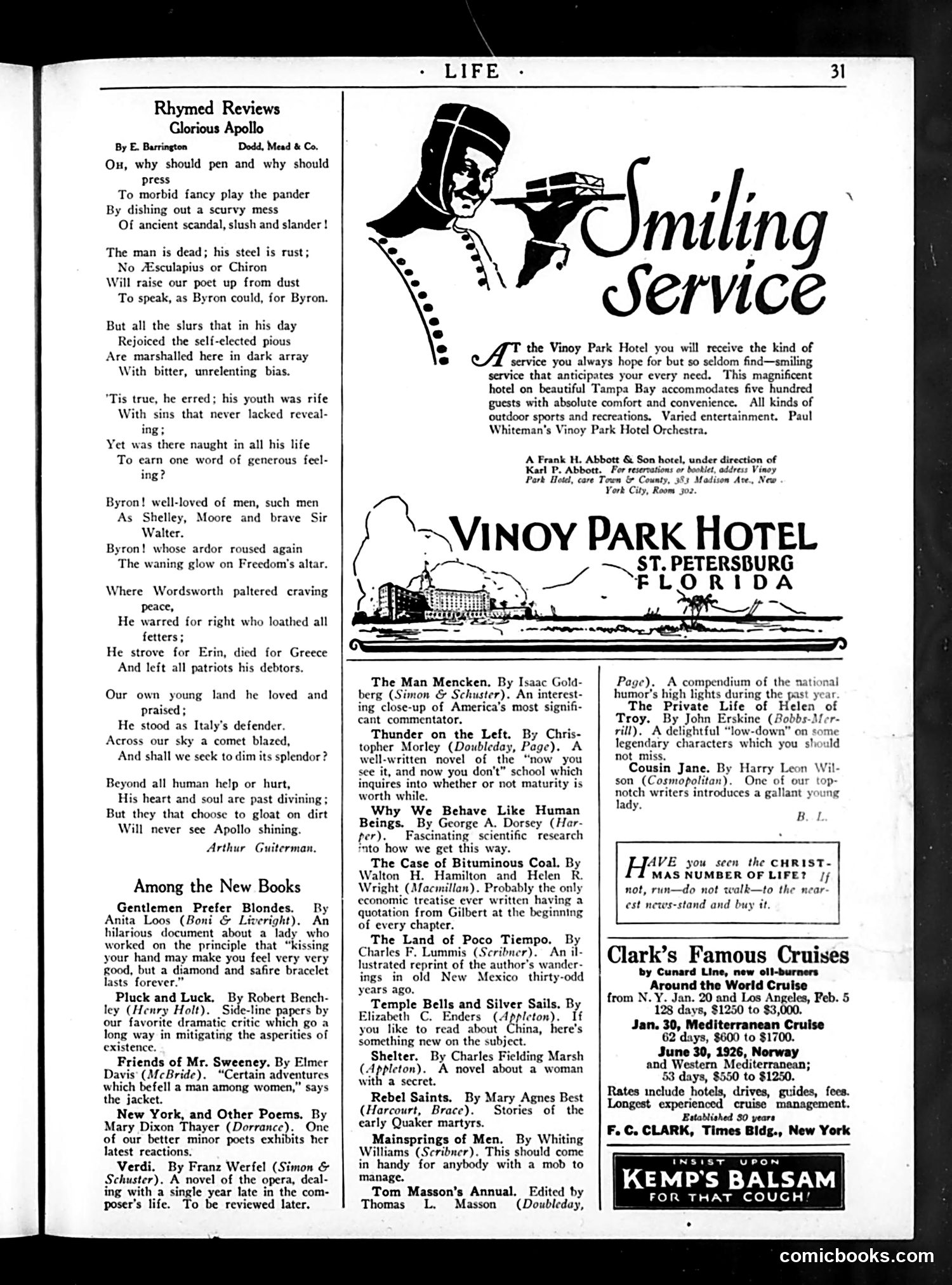
This page is primarily **book reviews and advertisements** rather than political satire. The content includes: **"Glorious Apollo"** - A poem reviewing E. Barrington's biography of Lord Byron, defending the poet's legacy against scandal-mongering. The satirist argues Byron deserves honor for his romantic idealism and support for freedom (Greek independence, Irish rights), not condemnation for youthful indiscretions. The reference to "Apollo" positions Byron as a heroic figure whose light shouldn't be dimmed by dwelling on his flaws. **"Among the New Books"** - Brief reviews of contemporary 1920s literature, including Anita Loos's "Gentlemen Prefer Blondes" (noted as humorous) and works on opera, economics, and biography. **Advertisements** - The page features hotel and cruise line ads (Vinoy Park Hotel, Clark's Famous Cruises) and Kemp's Balsam cough remedy—typical commercial content for the era. No political cartoons or caricatures appear on this page.
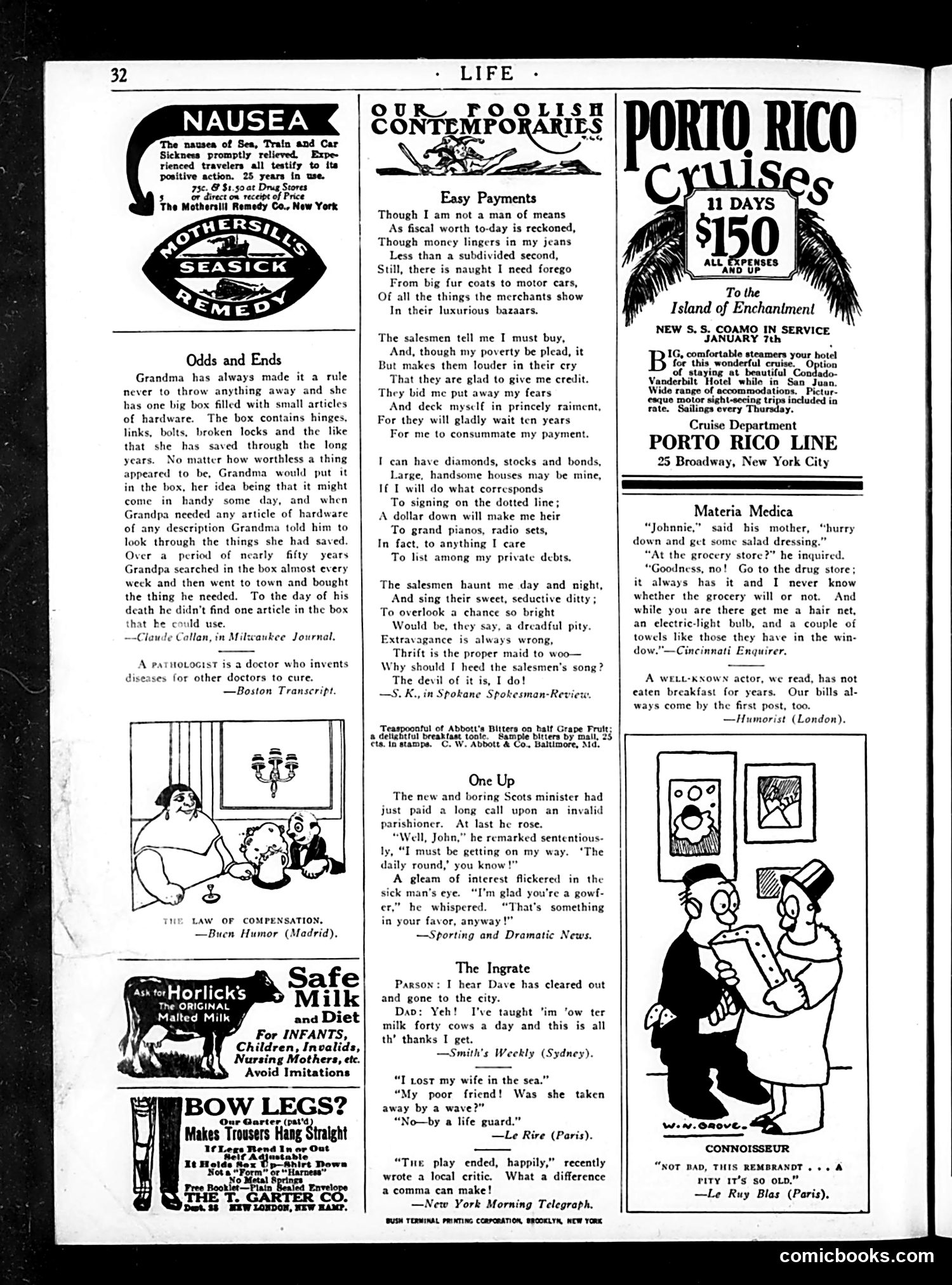
This page combines humor columns, advertisements, and satirical poetry typical of 1920s Life magazine. **Main Content:** The featured poem "Our Foolish Contemporaries" satirizes consumer credit culture and aggressive salesmanship. It mocks how salesmen pressure even poor customers to buy luxury goods (fur coats, motor cars, diamonds, pianos) on installment plans, with payment stretched over years. The poem's dark humor—"The devil of it is, I do!"—captures the speaker's helpless complicity in this consumption trap, likely reflecting post-WWI economic anxieties about debt and materialism. **Supporting Humor Sections:** Brief anecdotes mock various human foibles: a Scottish minister's pastoral visit (the parishioner cares only that he golfs), a farmer's ingratitude after teaching agricultural skills, and marital mishaps. These represent typical Life magazine's "slice-of-life" humor. **Advertisements** for seasickness remedies, malted milk, and leg braces occupy the margins—period products now obsolete. The overall tone critiques modern consumer society while maintaining light satirical distance.
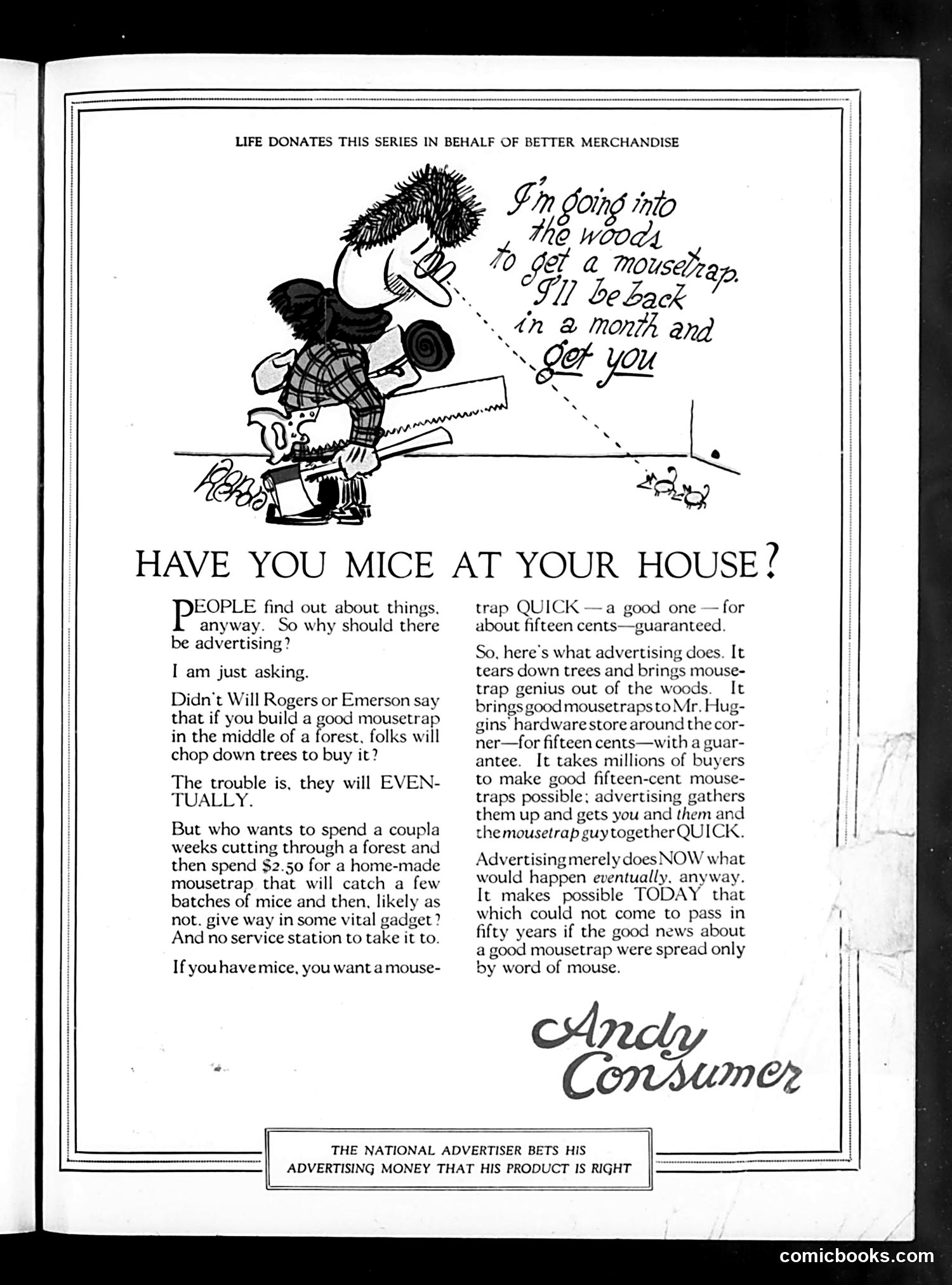
This page is a pro-advertising essay disguised as satire, signed by "Andy Consumer." It defends commercial advertising against skeptics by using the famous "better mousetrap" aphorism (often attributed to Ralph Waldo Emerson or Will Rogers). The argument: Yes, a superior product will eventually succeed through word-of-mouth alone—but advertising accelerates this by creating mass markets. Without advertising, a good fifteen-cent mousetrap might take fifty years to reach Mr. Huggins' hardware store. With it, consumers get quality products *today* at affordable prices. The cartoon shows a woodsman with traps, illustrating the old notion that genius products sell themselves. This is **industry propaganda** from Life magazine (which accepted advertising). It frames advertising not as manipulative but as a democratizing force bringing innovation to ordinary people quickly and cheaply. The skeptical opening ("I am just asking") makes it seem balanced, but the piece wholly endorses advertising's necessity and virtue.
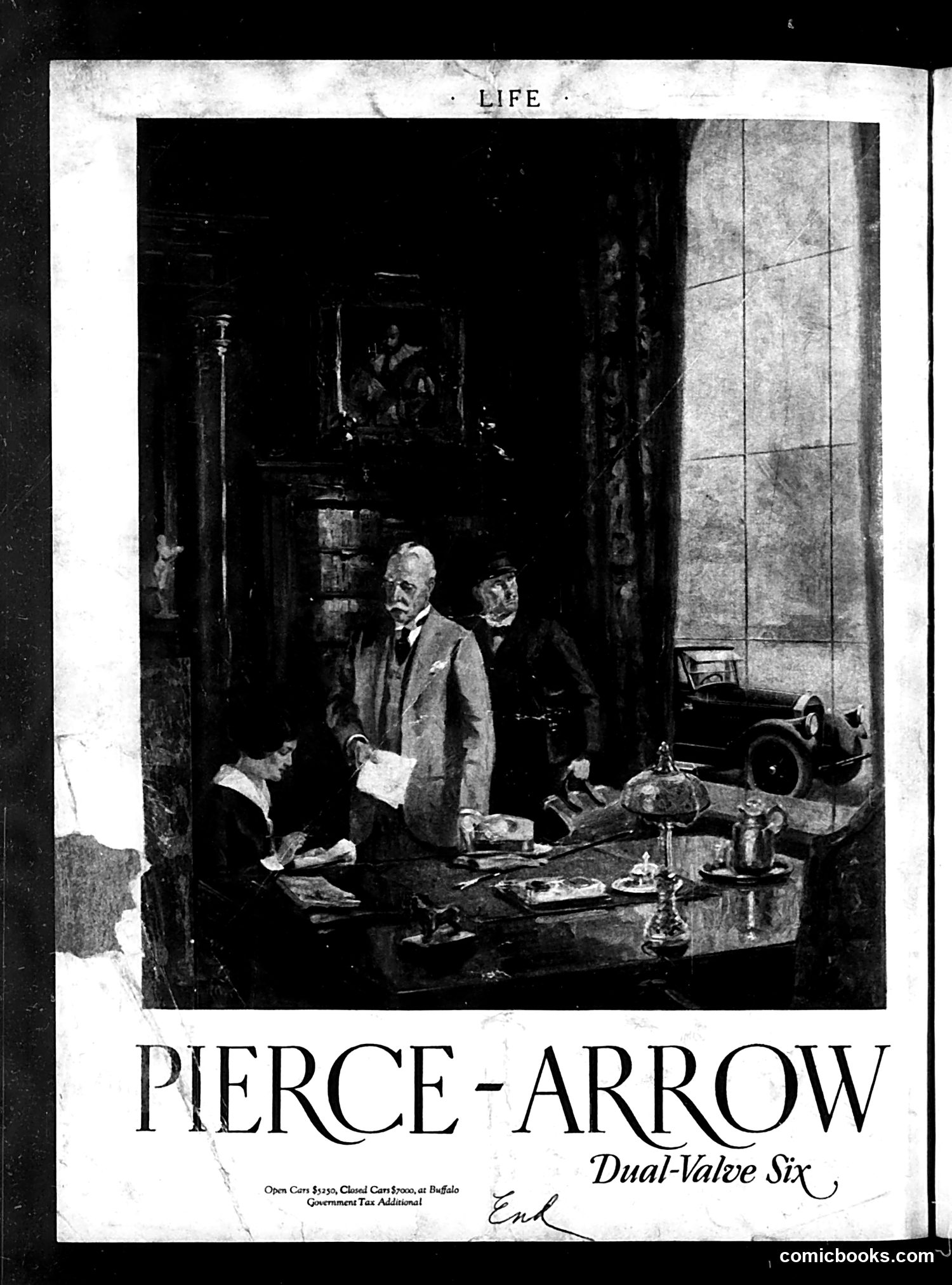
This is a **product advertisement**, not political satire. It promotes the Pierce-Arrow automobile's "Dual-Valve Six" model, priced at $5,250 for open cars and $7,000 for closed cars (plus government tax). The image depicts a wealthy businessman in an office setting, examining what appears to be toy automobiles on his desk—likely meant to suggest the Pierce-Arrow's appeal to successful professionals and the affluent. The scene conveys luxury and business success. Pierce-Arrow was a prestigious American automaker known for high-end vehicles. This ad targets wealthy buyers by associating the car with professional accomplishment and refined taste, a common advertising strategy for luxury goods during the early automotive era.

I can see this is a blank or nearly blank page from what appears to be a scanned document, with only "comicbooks.com" visible at the bottom as a watermark or source attribution. The page itself contains no visible cartoon, illustration, text content, or political satire to analyze. Without actual cartoon imagery or OCR'd text content to examine, I cannot identify figures, political references, or explain any satirical points. This appears to be either a blank page from the original publication, a scanning error, or a page that did not reproduce clearly in digitization. To provide meaningful historical analysis of Life magazine's satire, I would need a page with visible cartoon artwork and legible text.