
Life, 1925-12-31 · page 35 of 37
Life — December 31, 1925 — page 35: what you’re looking at
What you’re looking at
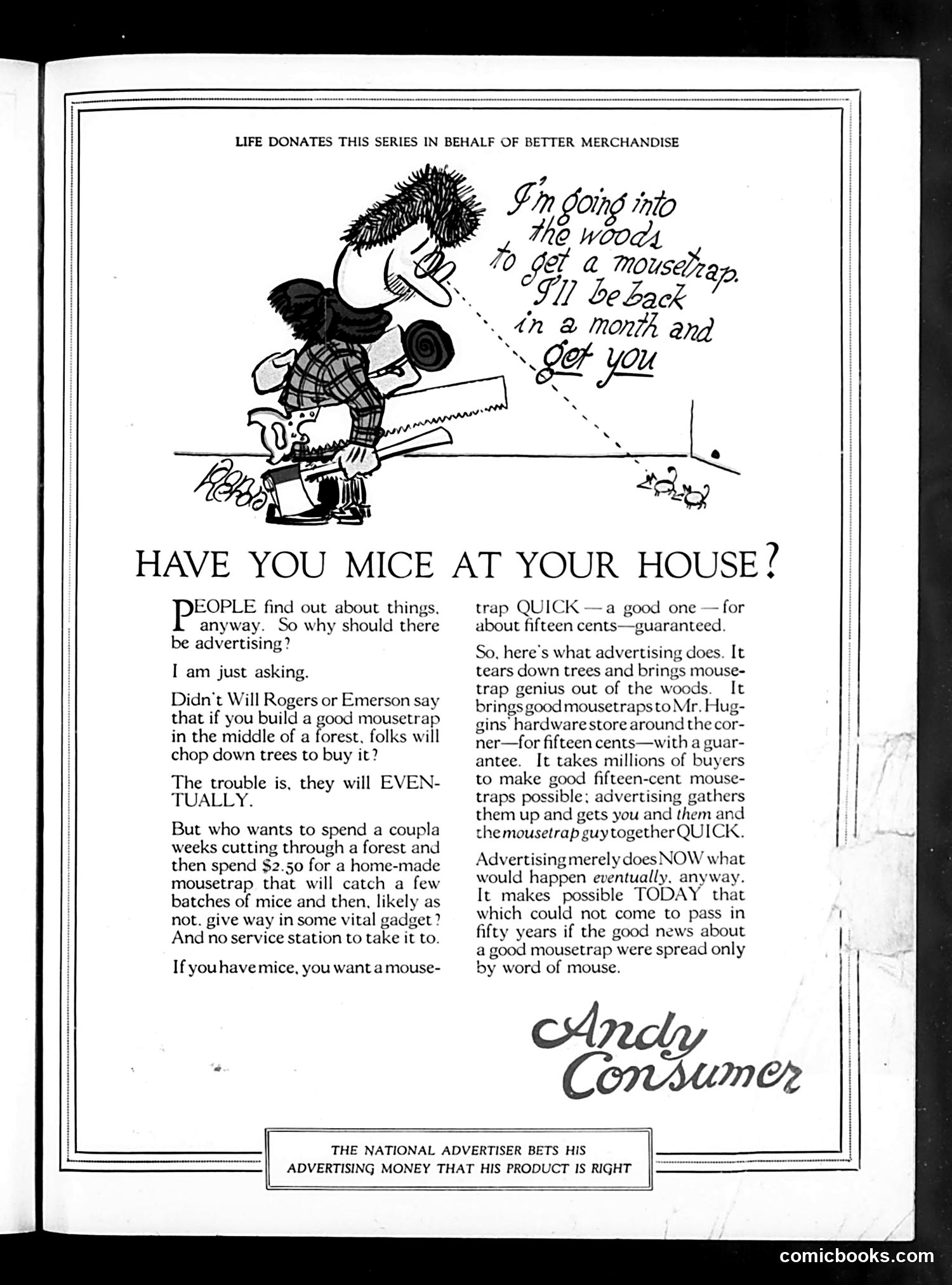
This page is a pro-advertising essay disguised as satire, signed by "Andy Consumer." It defends commercial advertising against skeptics by using the famous "better mousetrap" aphorism (often attributed to Ralph Waldo Emerson or Will Rogers). The argument: Yes, a superior product will eventually succeed through word-of-mouth alone—but advertising accelerates this by creating mass markets. Without advertising, a good fifteen-cent mousetrap might take fifty years to reach Mr. Huggins' hardware store. With it, consumers get quality products *today* at affordable prices. The cartoon shows a woodsman with traps, illustrating the old notion that genius products sell themselves. This is **industry propaganda** from Life magazine (which accepted advertising). It frames advertising not as manipulative but as a democratizing force bringing innovation to ordinary people quickly and cheaply. The skeptical opening ("I am just asking") makes it seem balanced, but the piece wholly endorses advertising's necessity and virtue.
📄 Transcribed text from this page (OCR, searchable)
Machine-transcribed from the original scan — historical spelling and the odd misread are preserved.
$i Mn } Going THO Ai ee x a Mouse Gy beback “dn & MONA ang GF you HAVE YOU MICE AT YOUR HOUSE? IEOPLE find out about things. anyway. So why should there be advertising? I am just asking. Didn't Will Rogers or Emerson say that if you build a good mousetrap in the middle of a forest, folks will chop down trees to buy it? The trouble is, they will EVEN- TUALLY. But who wants to spend a coupla weeks cutting through a forest and then spend $2.50 for a home-made mousetrap that will catch a few batches of mice and then, likely as not. give way in some vital gadget? And no service station to take it to. If youhavemice, you want a mouse- trap QUICK —a good one — for about fifteen cents—guaranteed. So, here's what advertising does. It tears down trees and brings mouse- trap genius out of the woods. It brings good mousetraps to Mr. Hug- gins hardware store around the cor- ner—for fifteen cents—with a guar- antee. It takes millions of buyers to make good fifteen-cent mouse- traps possible; advertising gathers them up and gets you and them and themousetrap g guy together QUICK. Advertising merely does NOW what would happen eventually, anyway. It makes possible TODAY that which could not come to pass in fifty years if the good news about a good mousetrap were spread only by word of mouse. cf THE NATIONAL ADVERTISER BETS HIS ADVERTISING MONEY THAT HIS PRODUCT IS RIGHT Cy omer comicbooks.com