
Life, 1925-12-31 · page 16 of 37
Life — December 31, 1925 — page 16: what you’re looking at
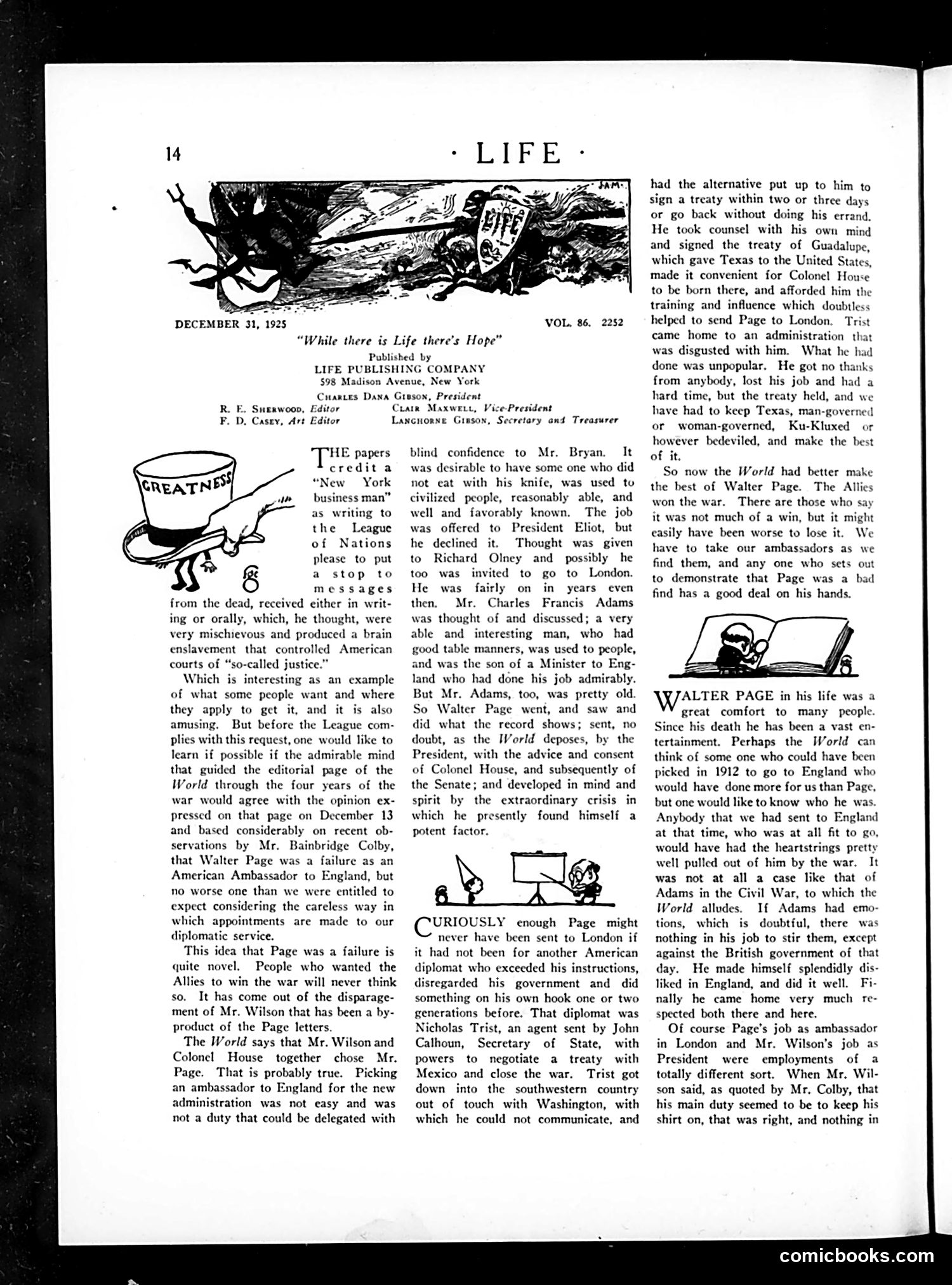
A restored page from Life, 1925-12-31. Page through the whole issue in the reader above.
📄 Transcribed text from this page (OCR, searchable)
Machine-transcribed from the original scan — historical spelling and the odd misread are preserved.
VOL, 86, 2252 “While there is Life there's Hope” Published by LIFE PUBLISHING COMPANY $98 Madison Avenue, New York Cuartes Dana Grason, President R. E, Sugrwoop, Editor F. D, Casey, Art Editor T! E papers credit a “New York business man” as writing to the League of Nations please to put a stop to messages from the dead, received either in writ- ing or orally, which, he thought, were very mischievous and produced a brain enslavement that controlled American courts of “so-called justice.” Which is interesting as an example of what some people want and where they apply to get it, and it is also amusing. But before the League com- plies with this request, one would like to learn if possible if the admirable mind that guided the editorial page of the World through the four years of the war would agree with the opinion ex- pressed on that page on December 13 and based considerably on recent ob- servations by Mr. Bainbridge Colby, that Walter Page was a failure as an American Ambassador to England, but no worse one than we were entitled to expect considering the careless way in which appointments are made to our diplomatic service. This idea that Page was a failure is quite novel. People who wanted the Allies to win the war will never think so. It has come out of the disparage- ment of Mr. Wilson that has been a by- product of the Page letters. The World says that Mr. Wilson and Colonel House together chose Mr. Page. That is probably true. Picking an ambassador to England for the new administration was not easy and was not a duty that could be delegated with Crate Maxwett, Vice-President Lancnorne C ‘ecretary and Treasurer blind confidence to Mr. Bryan. It was desirable to have some one who did not eat with his knife, was used to civilized people, reasonably able, and well and favorably known, The job was offered to President Eliot, but he declined it. Thought was given to Richard Olney and possibly he too was invited to go to London. He was fairly on in years even then. Mr. Charles Francis Adams was thought of and discussed; a very able and interesting man, who had good table manners, was used to people, and was the son of a Minister to Eng- land who had done his job admirably. But Mr. Adams, too, was pretty old. So Walter Page went, and saw and did what the record shows; sent, no doubt, as the World deposes, by the President, with the advice and consent of Colonel House, and subsequently of the Senate; and developed in mind and spirit by the extraordinary crisis in which he presently found himself a potent factor. URIOUSLY enough Page might never have been sent to London if it had not been for another American diplomat who exceeded his instructions, disregarded his government and did something on his own hook one or two generations before. That diplomat was Nicholas Trist, an agent sent by John Calhoun, Secretary of State, with powers to negotiate a treaty with Mexico and close the war. Trist got down into the southwestern country out of touch with Washington, with which he could not communicate, and had the alternative put up to him to sign a treaty within two or three days or go back without doing his errand, He took counsel with his own mind and signed the treaty of Guadalupe, which gave Texas to the United States, made it convenient for Colonel House to be born there, and afforded him the training and influence which doubtless helped to send Page to London. Trist came home to an administration that was disgusted with him. What he had done was unpopular. He got no thanks from anybody, lost his job and had a hard time, but the treaty held, and we have had to keep Texas, man-governed or woman-governed, Ku-Kluxed or however bedeviled, and make the best of it. So now the World had better make the best of Walter Page. The Allies won the war. There are those who say it was not much of a win, but it might easily have been worse to lose it. We have to take our ambassadors as we find them, and any one who sets out to demonstrate that Page was a bad find has a good deal on his hands. ALTER PAGE in his life was a great comfort to many people. Since his death he has been a vast en- tertainment. Perhaps the World can think of some one who could have been picked in 1912 to go to England who would have done more for us than Page, but one would like to know who he was. Anybody that we had sent to England at that time, who was at all fit to go, would have had the heartstrings pretty well pulled out of him by the war. It was not at all a case like that of Adams in the Civil War, to which the World alludes. If Adams had emo- tions, which is doubtful, there was nothing in his job to stir them, except against the British government of that day. He made himself splendidly dis- liked in England, and did it well. Fi- nally he came home very much re- spected both there and here. Of course Page's job as ambassador in London and Mr. Wilson's job as President were employments of a totally different sort. When Mr. Wil- son said, as quoted by Mr. Colby, that his main duty seemed to be to keep his shirt on, that was right, and nothing in comicbooks.com