
Life, 1925-12-31 · page 26 of 37
Life — December 31, 1925 — page 26: what you’re looking at
What you’re looking at
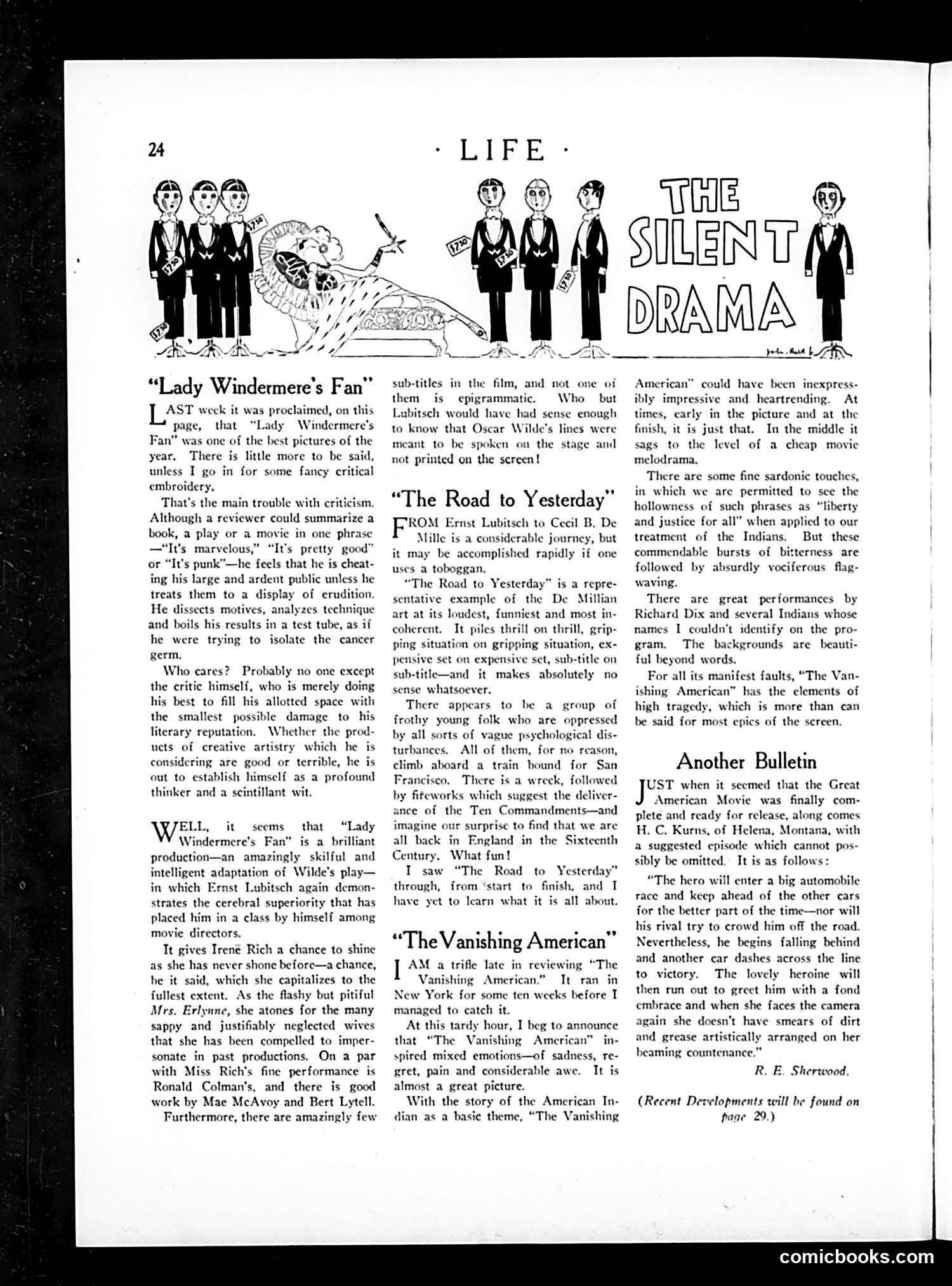
This page contains three film reviews satirizing both movies and film criticism itself. The opening section mocks pretentious film critics who use elaborate language to describe simple judgments, comparing their analysis to isolating "cancer germs." The reviewer suggests critics pad their columns with pseudo-intellectual flourishes to appear profound, regardless of a film's actual quality. **"Lady Windermere's Fan"** receives praise for Ernst Lubitsch's elegant direction and the performances of Irene Rich and Ronald Colman. Notably, it commends Lubitsch for minimizing subtitles—crucial context since this is a *silent film*, making the restraint from printed dialogue remarkable for adapting Oscar Wilde's witty stage play. **"The Road to Yesterday"** by Cecil B. DeMille is mocked as incoherent spectacle: young people board a train for no reason, it wrecks, fireworks suggest biblical deliverance, then suddenly the scene shifts to sixteenth-century England. The reviewer admits complete bewilderment about the plot. **"The Vanishing American"** receives mixed judgment—potentially powerful using Native American themes, but sagging into "cheap movie melodrama" in its middle section.
📄 Transcribed text from this page (OCR, searchable)
Machine-transcribed from the original scan — historical spelling and the odd misread are preserved.
“Lady Windermere’s Fan” L‘St week it was proclaimed, on this page, that “Lady Windermere'’s Fan” was one of the best pictures of the year. There is little more to be said, unless I go in for some fancy critical embroidery. That's the main trouble with criticism. Although a reviewer could summarize a book, a play or a movie in one phrase —‘It’s marvelous,” “It’s pretty good” or “It's punk”—he feels that he is cheat- ing his large and ardent public unless he treats them to a display of erudition. He dissects motives, analyzes technique and boils his results in a test tube, as if he were trying to isolate the cancer germ, Who cares? Probably no one except the critic himself, who is merely doing his best to fill his allotted space with the smallest possible damage to his literary reputation. Whether the prod- ucts of creative artistry which he is considering are good or terrible, he is out to establish himself as a profound thinker and a scintillant wit. ELL, it seems Windermere’s Fan" production—an amazingly skilful and intelligent adaptation of Wilde's play— in which Ernst Lubitsch again demon- strates the cerebral superiority that has placed him in a class by himself among movie directors, Tt gives Irene Rich a chance to shine as she has never shone before—a chance, be it said, which she capitalizes to the fullest extent. As the flashy but pitiful Mrs. Erlynne, she atones for the many sappy and justifiably neglected wives that she has been compelled to imper- sonate in past productions. On a par with Miss Rich's fine performance is Ronald Colman’s, and there is good work by Mae McAvoy and Bert Lytell. Furthermore, there are amazingly few that “Lady is a brilliant sub-titles in the film, and not one of them is epigrammatic. Who but Lubitsch would have had se enough to know that Oscar Wilde's lines were meant to be spoken on the stage and not printed on the screen! “The Road to Yesterday” ROM Ernst Lubitsch to Cecil B. De Mille is a considerable journey, but y be accomplished rapidly if one uses a toboggan. “The Road to Yesterday” is a repre- sentative example of the De Millian art at its loudest, funniest and most in- coherent. It piles thrill on thrill, grip- ping situation on gripping situation, ex- pensive set on expensive set, sub-title on sub-titlk—and it makes absolutely no sense whatsoever. There appears to be a group of frothy young folk who are oppressed hy all sorts of vague psychological dis- turbances, All of them, for no reason, climb aboard a train bound for San Francisco. There is a wreck, followed by fiteworks which suggest the deliver- ance of the Ten Commandments—and imagine our surprise to find that we are all back in England in the Sixteenth Century, What fun! I saw “The Road to Yesterday” through, from ‘start to finish, and I have yet to learn what it is all about. “The Vanishing American” | AM a trifle late in reviewing “The Vanishing American.” It ran in New York for some ten weeks before I managed to catch it. At this tardy hour, I beg to announce that “The Vanishing American” in- spired mixed emotions—of sadness, re- gret, pain and considerable awe. It is almost a great picture. With the story of the American In- dian as a basic theme, “The Vanishing American” could have been inexpress- ibly impressive and heartrending. At times, early in the picture and at the finish, it is just that. In the middle it sags to the level of a cheap movie melodrama, There are some fine sardonic touches, in which we are permitted to see the hollowness of such phrases as “liberty and justice for all” when applied to our treatment of the Indians, But these commendable bursts of bitterness are followed by absurdly vociferous flag- waving. There are great performances by Richard Dix and several Indians whose names I couldn't identify on the pro- gram. The backgrounds are beauti- ful beyond words. For all its manifest faults, “The Van- ishing American” the elements of high tragedy, which is more than can be said for most epics of the screen. Another Bulletin UST when it seemed that the Great American Movie was finally com- plete and ready for release, along comes H. C. Kurns, of Helena, Montana, with a suggested episode which cannot pos- sibly be omitted. It is as follows: “The hero will enter a big automobile race and keep ahead of the other cars for the better part of the time—nor will his rival try to crowd him off the road. Nevertheless, he begins falling behind and another car dashes across the line to victory. The lovely heroine will then run out to greet him with a fond embrace and when she faces the camera ain she doesn’t have smears of dirt and grease artistically arranged on her beaming countenance. R. E. Sherwood. (Recent Developments will be found on page 29.) comicbooks.com