
Life, 1925-12-31 · page 20 of 37
Life — December 31, 1925 — page 20: what you’re looking at
What you’re looking at
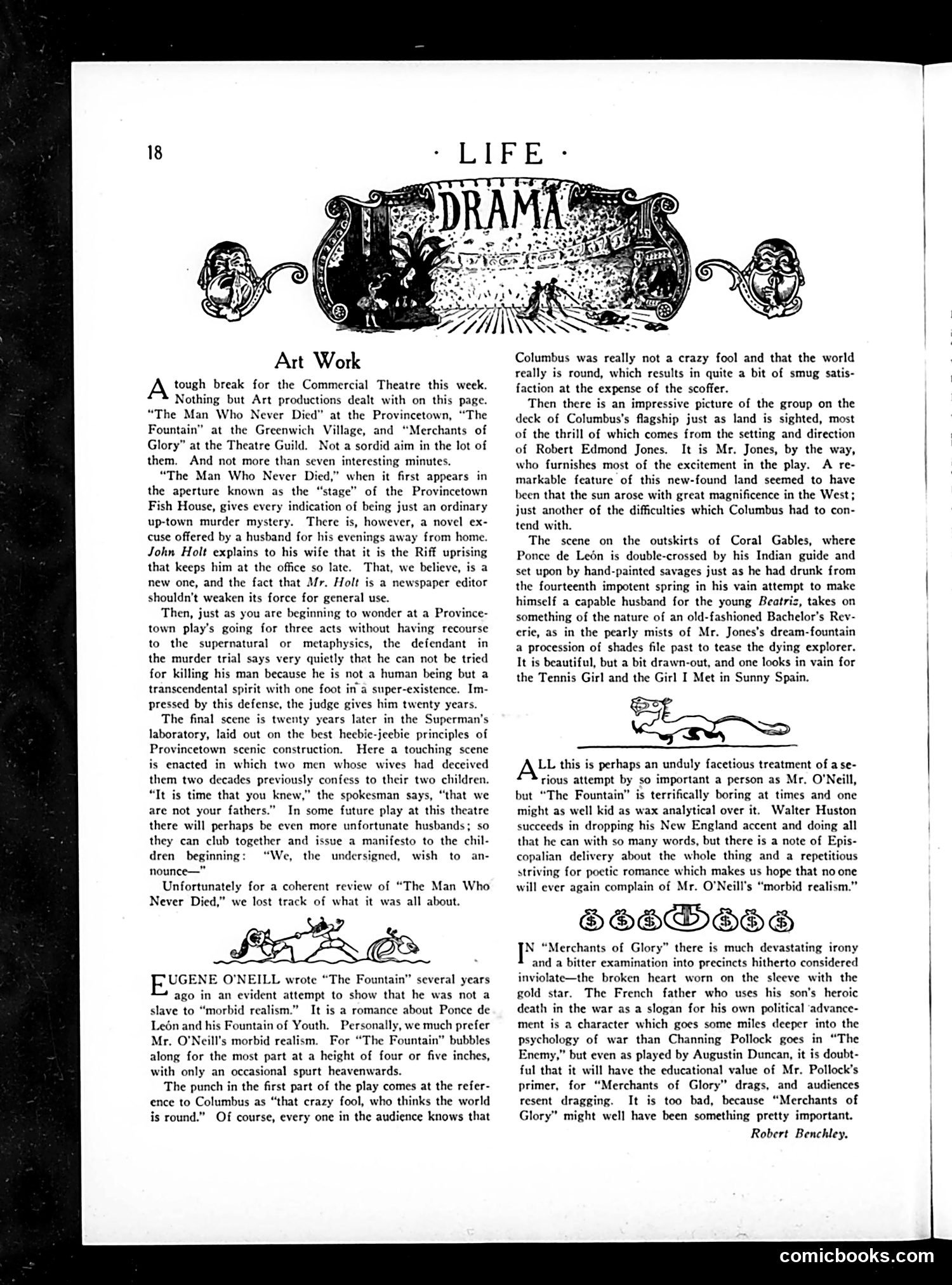
This page reviews three experimental theatrical productions: "The Man Who Never Died," "The Fountain" by Eugene O'Neill, and "Merchants of Glory." The critic mocks the avant-garde plays for their pretension and incoherence. "The Man Who Never Died" is ridiculed for absurd plot logic—a husband claims the Riff uprising (a real colonial conflict) keeps him at work, and later a defendant argues he cannot be tried for murder because he's a "transcendental spirit." O'Neill's "The Fountain," about Ponce de León seeking the Fountain of Youth, is criticized as tediously self-important. The reviewer notes its one effective moment: Columbus being called a "crazy fool" for believing the world is round—a joke suggesting the audience smugly assumes their own superiority to past ignorance. The tone throughout is satirical toward Greenwich Village/Provincetown theatrical culture, dismissing "art productions" as pretentious failures.
📄 Transcribed text from this page (OCR, searchable)
Machine-transcribed from the original scan — historical spelling and the odd misread are preserved.
18 Art Work A tough break for the Commercial Theatre this week. Nothing but Art productions dealt with on this page. “The Man Who Never Died” at the Provincetown, “The Fountain” at the Greenwich Village, and “Merchants of Glory” at the Theatre Guild. Not a sordid aim in the lot of them. And not more than seven interesting minutes. “The Man Who Never Died,” when it first appears in the aperture known as the “stage” of the Provincetown Fish House, gives every indication of being just an ordinary up-town murder mystery. There is, however, a novel ex- cuse offered by a husband for his evenings away from home. John Holt explains to his wife that it is the Riff uprising that keeps him at the office so late. That, we believe, is a new one, and the fact that Mr. Holt is a newspaper editor shouldn't weaken its force for general use. Then, just as you are beginning to wonder at a Province- town play’s going for three acts without having recourse to the supernatural or metaphysics, the defendant in the murder trial says very quietly that he can not be tried for killing his man because he is not a human being but a transcendental spirit with one foot in a super-existence. Im- pressed by this defense, the judge gives him twenty years. The final scene is twenty years later in the Superman's laboratory, laid out on the best heebie-jeebie principles of Provincetown scenic construction. Here a touching scene is enacted in which two men whose wives had deceived them two decades previously confess to their two children. “It is time that you knew,” the spokesman says, “that we are not your fathers.” In some future play at this theatre there will perhaps be even more unfortunate husbands; so they can club together and issue a manifesto to the chi dren beginning: “We, the undersigned, wish to an- nounce—" Unfortunately for a coherent review of “The Man Who Never Died,” we lost track of what it was all about. UGENE O'NEILL wrote “The Fountain” several years ago in an evident attempt to show that he was not a slave to “morbid realism.” It is a romance about Ponce de Leén and his Fountain of Youth. Personally, we much prefer Mr. O'Neill's morbid realism. For “The Fountain” bubbles along for the most part at a height of four or five inches, with only an occasional spurt heavenwards. The punch in the first part of the play comes at the refer- ence to Columbus as “that crazy fool, who thinks the world is round.” Of course, every one in the audience knows that Columbus was really not a crazy fool and that the world really is round, which results in quite a bit of smug satis- faction at the expense of the scoffer. Then there is an impressive picture of the group on the deck of Columbus's flagship just as land is sighted, most of the thrill of which comes from the setting and direction of Robert Edmond Jones. It is Mr. Jones, by the way, who furnishes most of the excitement in the play. A re- markable feature of this new-found land seemed to have been that the sun arose with great magnificence in the West; just another of the difficulties which Columbus had to con- tend with. The scene on the outskirts of Coral Gables, where Ponce de Leén is double-crossed by his Indian guide and set upon by hand-painted savages just as he had drunk from the fourteenth impotent spring in his vain attempt to make himself a capable husband for the young Beatriz, takes on something of the nature of an old-fashioned Bachelor's Rev- erie, as in the pearly mists of Mr. Jones’s dream-fountain a procession of shades file past to tease the dying explorer. It is beautiful, but a bit drawn-out, and one looks in vain for the Tennis Girl and the Girl I Met in Sunny Spain. All this is perhaps an unduly facetious treatment of ase- rious attempt by so important a person as Mr. O'Neill, but “The Fountain” is terrifically boring at times and one might as well kid as wax analytical over it. Walter Huston succeeds in dropping his New England accent and doing all that he can with so many words, but there is a note of Epis- copalian delivery about the whole thing and a repetitious striving for poetic romance which makes us hope that no one will ever again complain of Mr. O'Neill's “morbid realism.” S66O55S I “Merchants of Glory” there is much devastating irony and a bitter examination into precincts hitherto considered inviolate—the broken heart worn on the sleeve with the gold star. The French father who uses his son's heroic death in the war as a slogan for his own political ‘advance- ment is a character which goes some miles deeper into the psychology of war than Channing Pollock goes in “The Enemy,” but even as played by Augustin Duncan, it is doubt- ful that it will have the educational value of Mr. Pollock's primer, for “Merchants of Glory” drags, and audiences resent dragging. It is too bad, because “Merchants of Glory” might well have been something pretty important. Robert Benchley, comicbooks.com