
A complete issue · 36 pages · 1925
Life — September 17, 1925
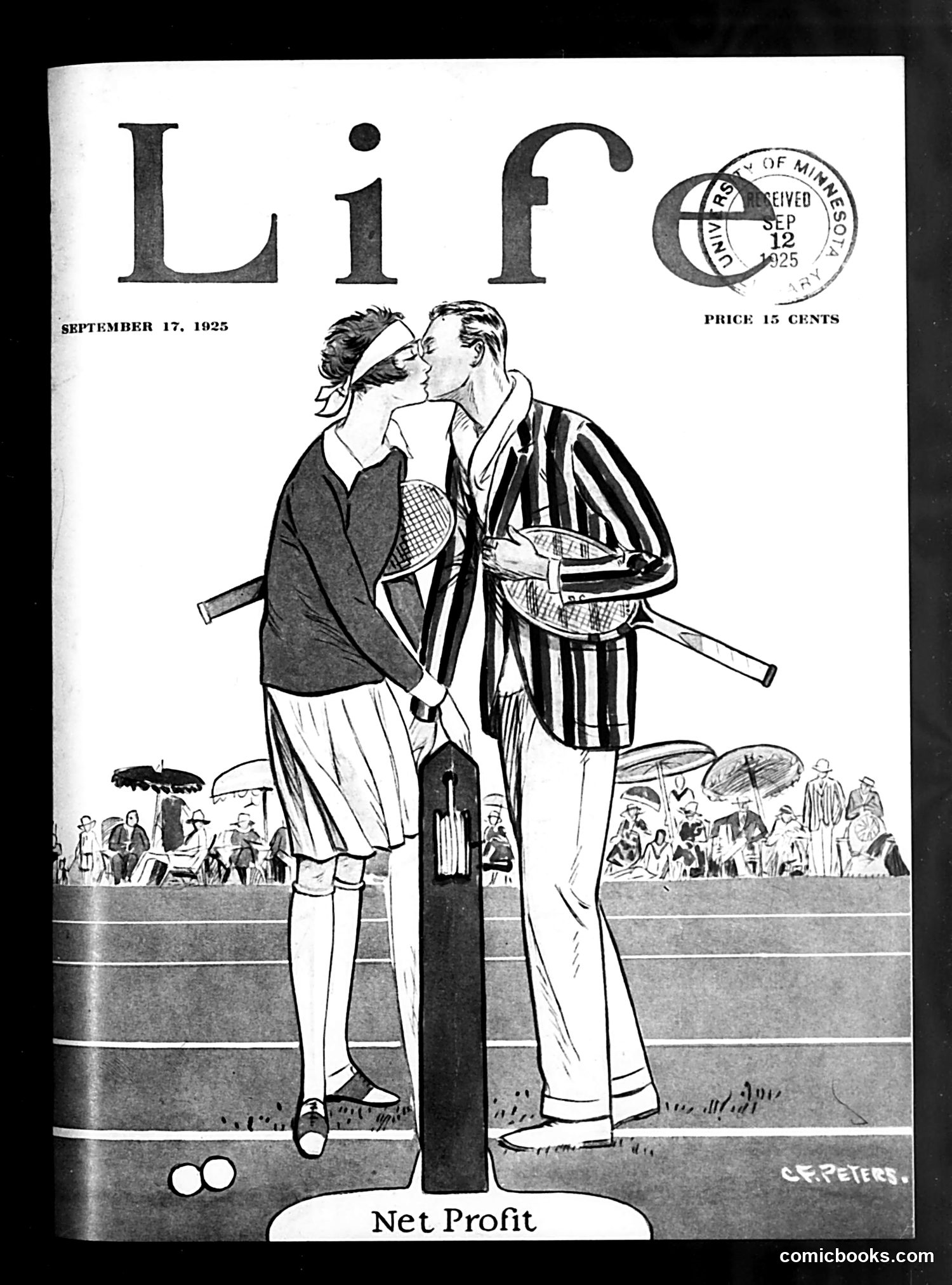
This September 17, 1925 *Life* cover satirizes tennis culture and romance. The illustration shows a young couple at what appears to be a tennis match—she holds a tennis racket and wears 1920s attire with a headband, he wears a striped blazer. They're kissing while spectators watch from the stands behind them. The caption reads "Net Profit," a pun combining tennis terminology ("net") with financial gain. The joke suggests that the real "profit" or benefit of attending tennis matches isn't the sport itself, but romantic opportunities—the couple has capitalized on the social setting by finding each other. This reflects 1920s leisure culture and courtship practices among the affluent.
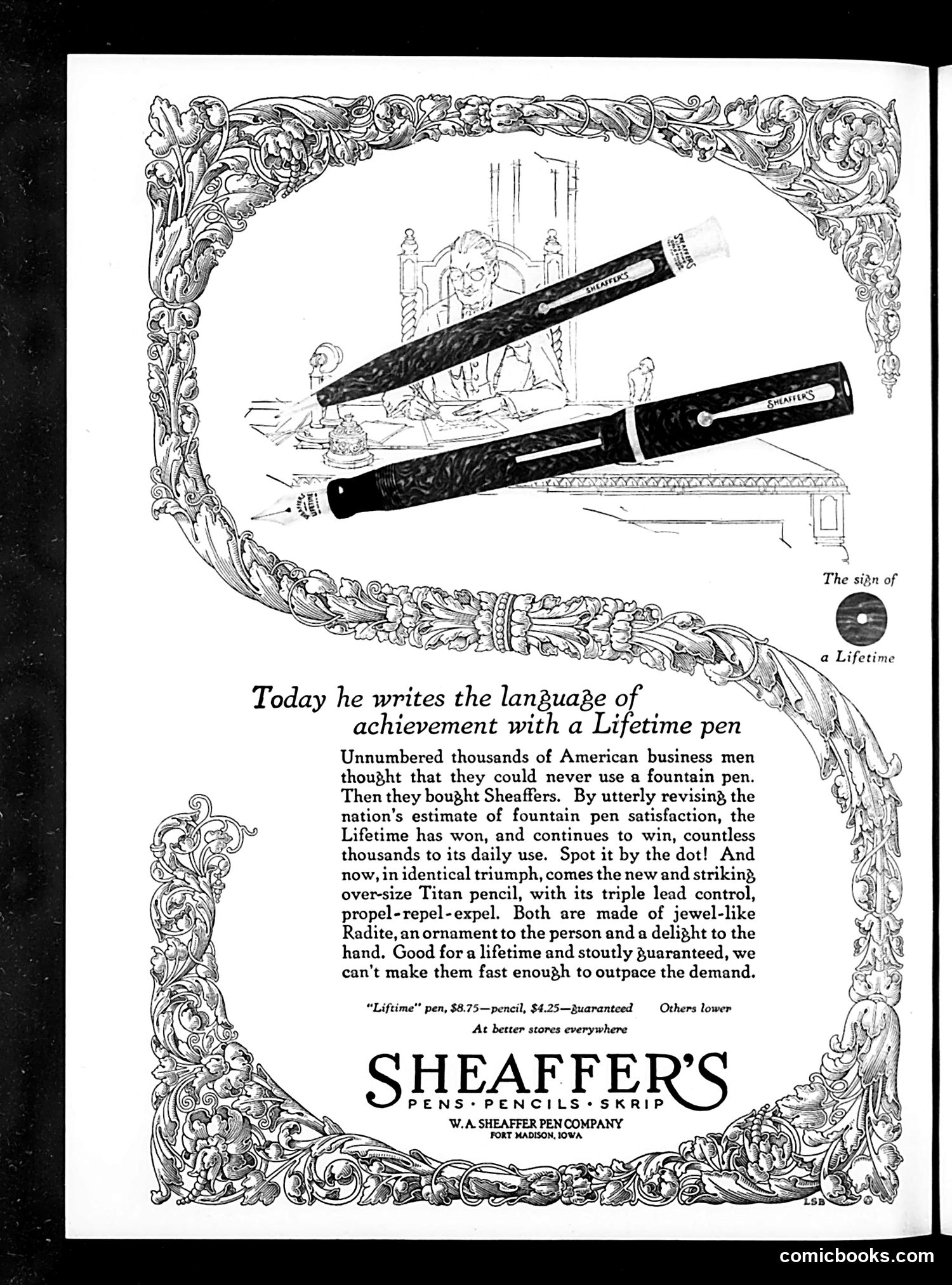
This is a **commercial advertisement**, not a political cartoon. It promotes Sheaffer fountain pens and pencils, specifically the "Lifetime" pen model and new "Titan" pencil. The ad claims that American businessmen initially doubted fountain pens could work reliably, but Sheaffer products changed their minds through superior performance. The ornate decorative border frames an illustration of a well-dressed man at a desk, suggesting professional achievement and respectability. The language emphasizes durability ("stoutly guaranteed") and quality materials ("jewel-like Radite"), positioning these writing instruments as status symbols befitting successful men. Prices are listed: $2.75 for pens, $1.25 for pencils. This reflects early-20th-century marketing strategies targeting middle and upper-class male professionals.
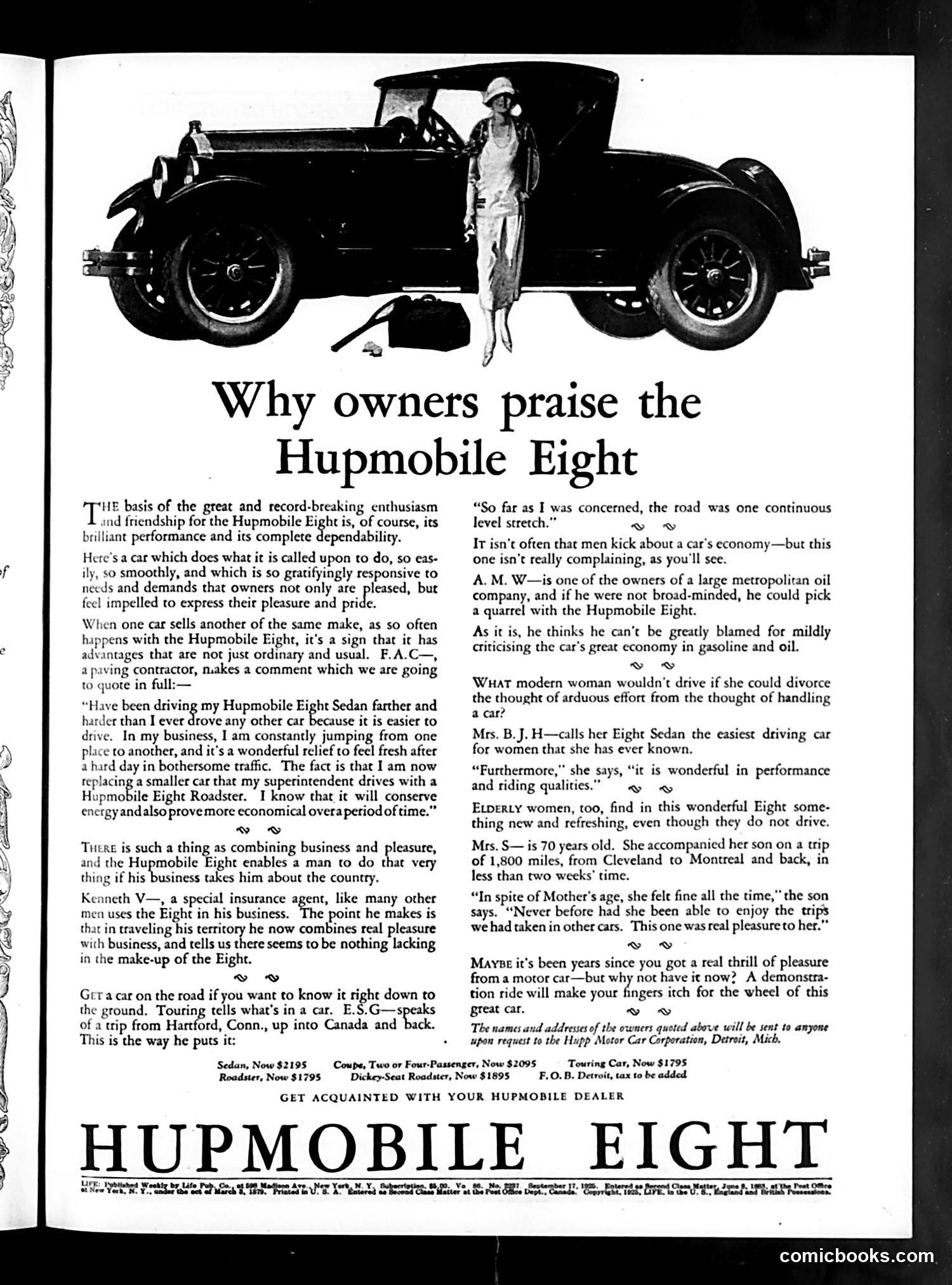
This is primarily **advertising**, not satire or political commentary. It's a Hupmobile automobile advertisement disguised as editorial testimonial content. The page features customer endorsements praising the Hupmobile Eight car for reliability, fuel economy, and ease of driving. The testimonials come from various professions: a contractor, an insurance agent, a businessman, and notably, a 70-year-old woman who drove 1,800 miles comfortably. The advertisement's strategy targets both practical concerns (business use, economy) and emotional appeals (particularly to women drivers by emphasizing the car's ease of handling). The illustration shows a stylish 1920s automobile with a woman in period dress beside it. This represents typical 1920s automotive marketing—positioning cars as practical, economical, and accessible to diverse buyers including women, who were an emerging market segment.
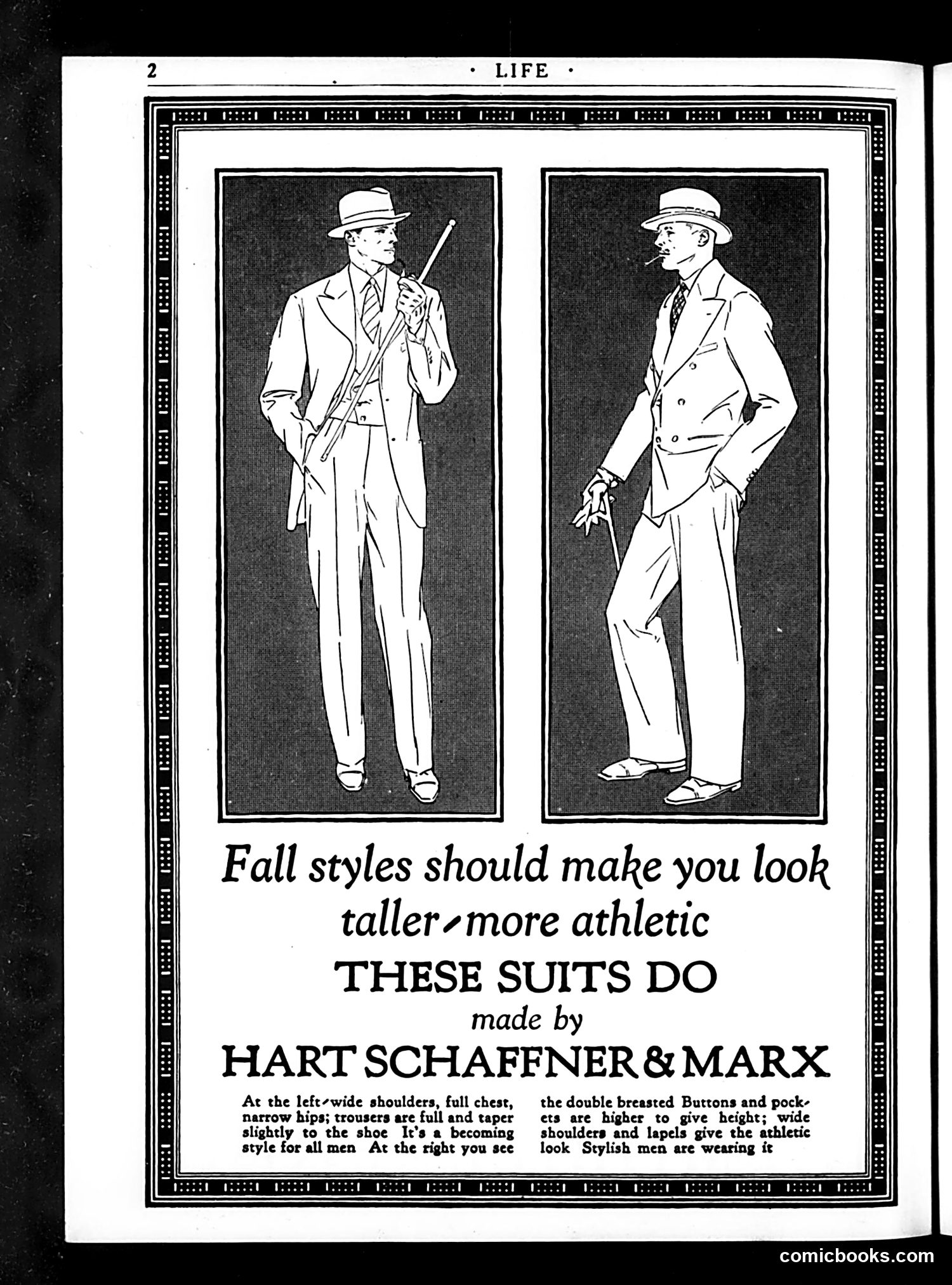
This is a **fashion advertisement**, not political satire. The page promotes fall men's suits by Hart Schaffner & Marx, a major American clothier. The ad shows two illustrated men in suits demonstrating design features meant to flatter the wearer. The left figure wears a suit with "wide shoulders, full chest, narrow hips; trousers are full and taper slightly to the shoe," creating a tall, athletic silhouette. The right suit features "double breasted buttons and pockets higher to give height; wide shoulders and lapels give the athletic look." The advertising appeal targets male insecurity about physique—suggesting these suits could make wearers appear taller and more athletic, a common mid-20th-century marketing strategy. This reflects period attitudes about masculine appearance and clothing's role in self-presentation.
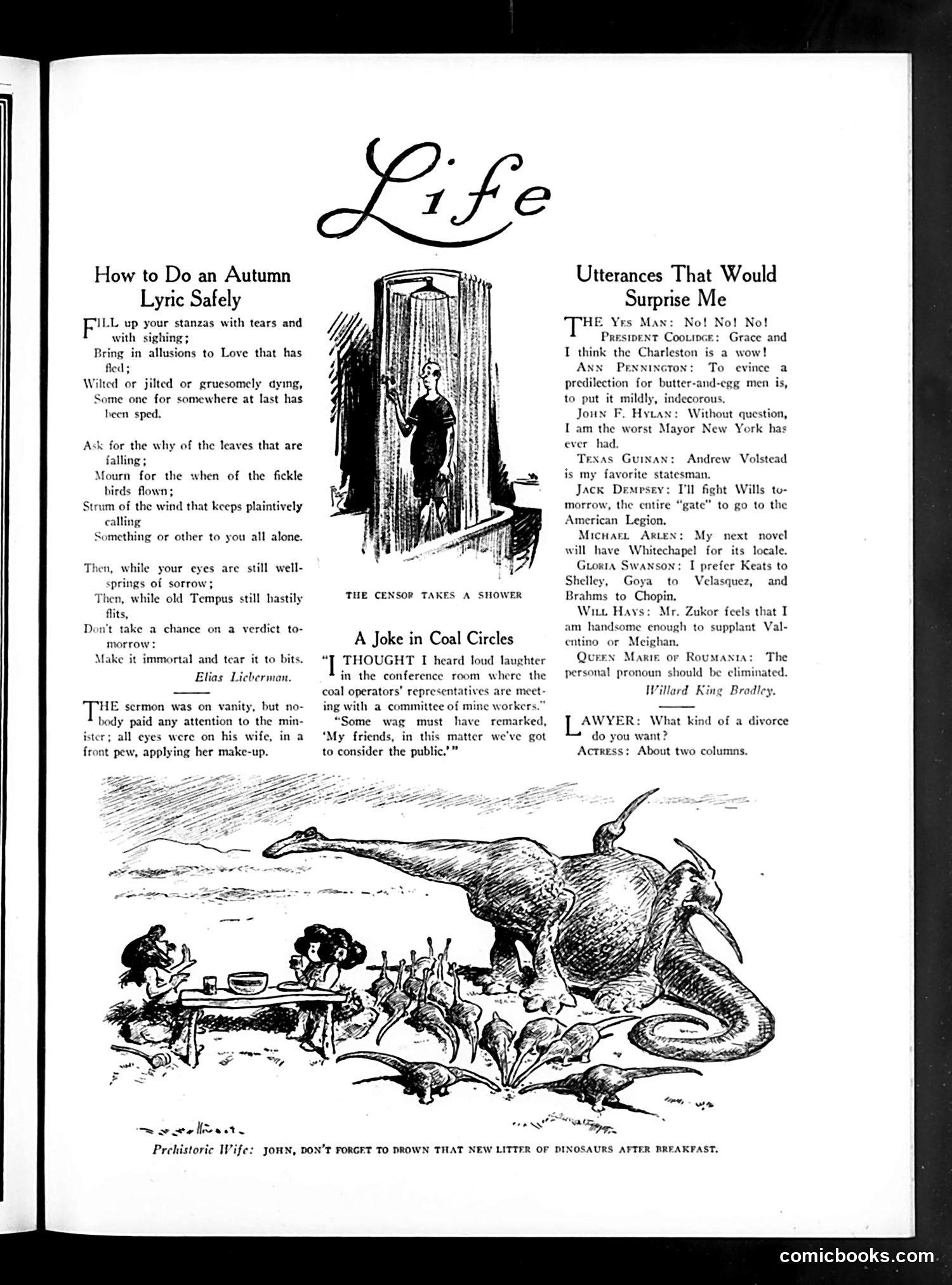
This page contains three distinct humor pieces: 1. **"How to Do an Autumn Lyric Safely"** — A poem mocking the sentimental clichés of autumn poetry, with the illustration "The Censor Takes a Shower" showing someone bathing behind a curtain. 2. **"Utterances That Would Surprise Me"** — A collection of one-liners featuring public figures (President Coolidge, Ann Pennington, Texas Guinan, Michael Arlen, and others), presenting absurd statements they'd never actually make—satirizing their public personas. 3. **"A Joke in Coal Circles"** — A brief anecdote about mine workers and coal operators discussing public relations. 4. **"Prehistoric Wife"** — A cartoon showing cavemen and dinosaurs, with the caption humorously depicting domestic life with the punchline about a wife reminding her husband to drown baby dinosaurs after breakfast. The page exemplifies Life's satirical approach to contemporary culture and personalities.
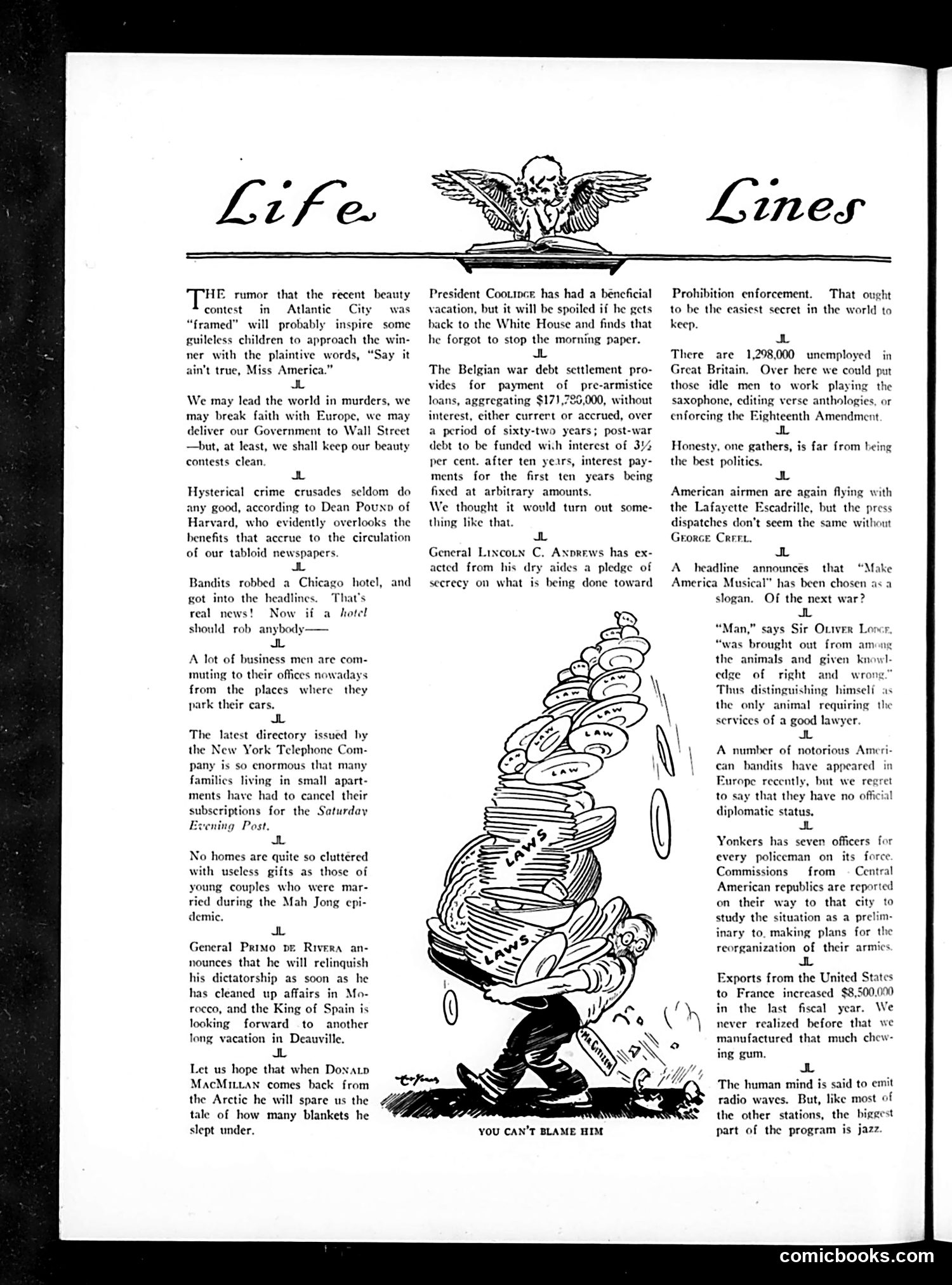
This satirical column page features a central cartoon labeled "YOU CAN'T BLAME HIM" depicting a man straining under an enormous stack of law books labeled "LAW." The image critiques legal complexity and bureaucratic burden—the joke being that ordinary citizens cannot reasonably be expected to know or follow such overwhelming legal systems. The surrounding brief commentary touches on various topics: beauty contests, crime, government finances, unemployment in Britain, aviation, and American bandits in Europe. The cartoon's point is straightforward social satire: the legal system has become so complicated that compliance is practically impossible for the average person, hence "you can't blame him"—presumably for breaking laws he cannot possibly understand.
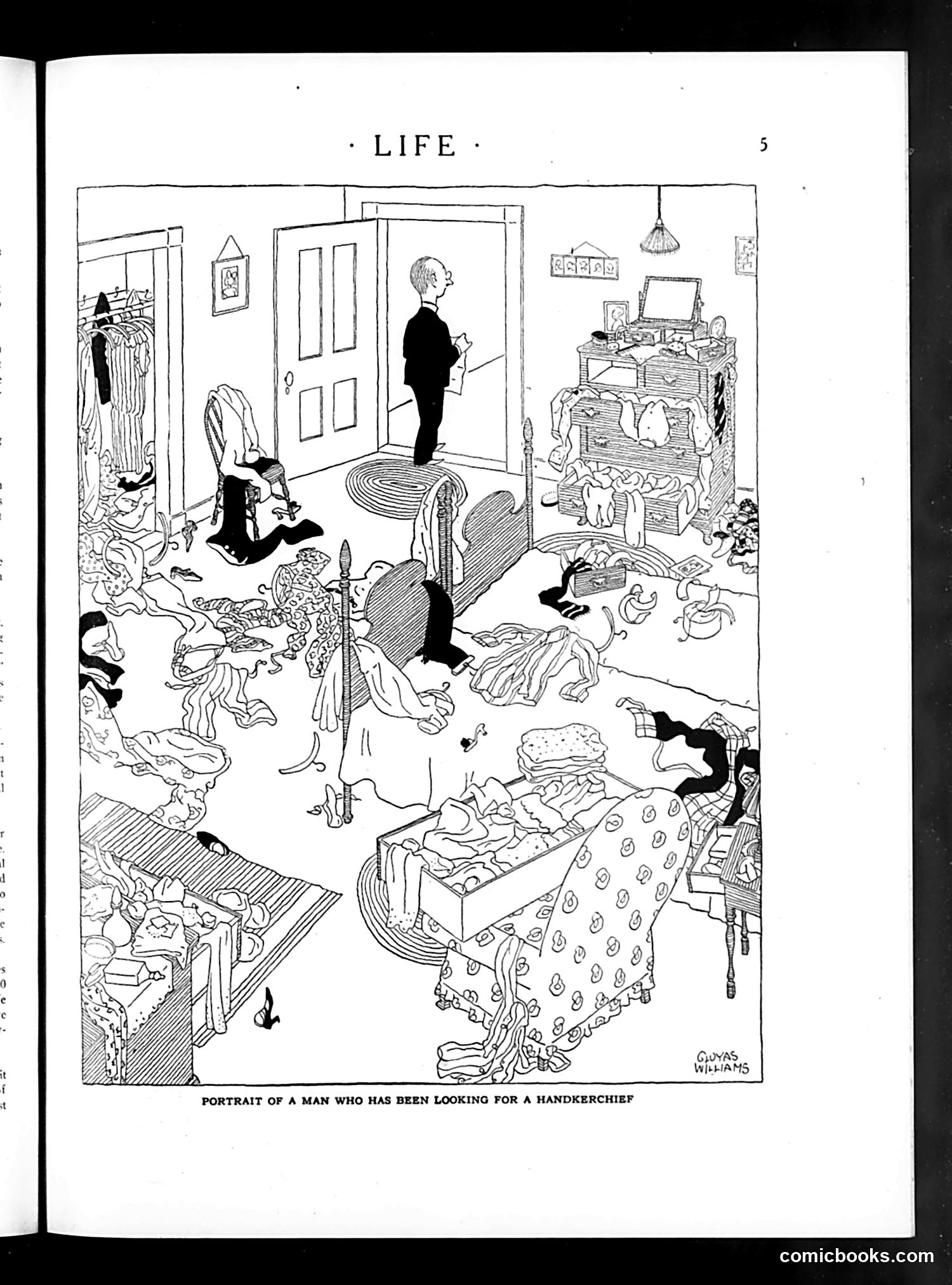
This cartoon by Ouyas Williams depicts a domestic interior in complete chaos. A well-dressed man stands calmly in the center while the room around him is utterly disheveled—clothes strewn everywhere, furniture overturned, drawers pulled open, items scattered across the floor. A woman sits amid the mess, and other figures search through the disorder. The satire satirizes the exasperation of searching for a single lost item in one's home. The joke is that the man's simple quest for a handkerchief has resulted in an entire household being turned upside down—a relatable domestic humor capturing the absurd disproportionality between a minor need and the massive disruption it causes to family life and order.
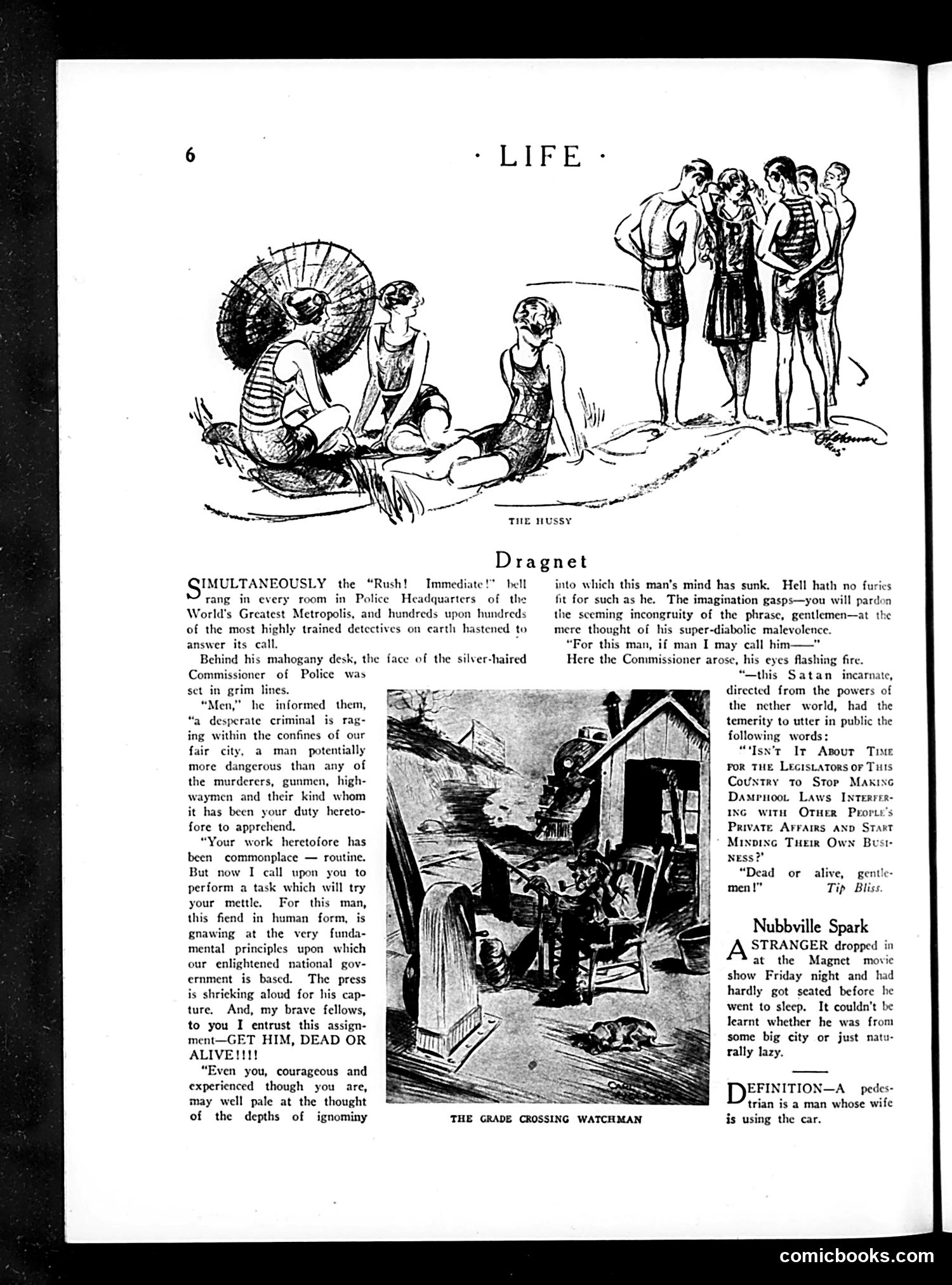
This page contains three distinct pieces: 1. **Top illustration**: "The Hussy" - depicts beachgoers, likely satirizing 1920s bathing suit fashion and changing social mores around women's clothing and public behavior. 2. **Main text article "Dragnet"**: A fictional narrative about a police commissioner ordering detectives to apprehend a criminal who committed a crime against "fundamental principles" of government. The piece critiques something Satan-like that "damnfool Laws interfering with other People's Private Affairs." 3. **Bottom illustration**: "The Grade Crossing Watchman" - shows a railway crossing guard, likely satirizing railroad safety or worker competence. 4. **Sidebar jokes**: "Nubbville Spark" and a definition joke about pedestrians and cars. The page appears to mock both moral panic about social change and government overreach, typical of Life magazine's satirical approach during this era.
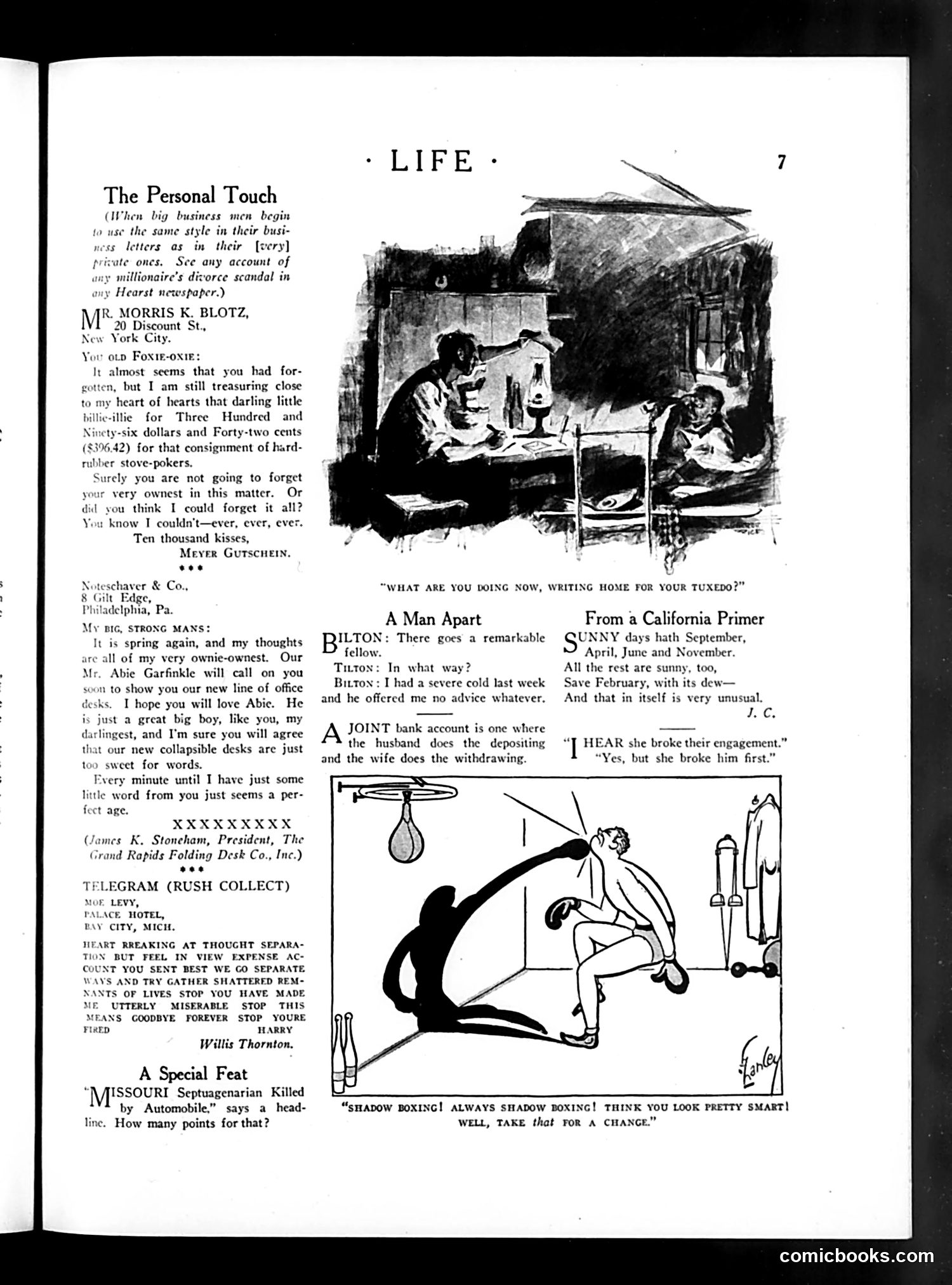
This page contains several satirical pieces typical of early 20th-century Life magazine. The main cartoon depicts a man shadow boxing while a woman watches, with the caption "Shadow boxing! Always shadow boxing! Think you look pretty smart! Well, take that for a chance." This appears to satirize domestic conflict—a husband engaged in pointless activity (literally shadow boxing) while his exasperated wife confronts him. The page also includes brief humorous items: "A Man Apart" presents witty one-liners about relationships; "From a California Primer" offers absurdist observations about seasonal naming; and "A Special Feat" jokes about a Missourian killed by an automobile. The overall tone reflects Life's characteristic blend of domestic comedy and social observation, targeting middle-class American life and gender relations.
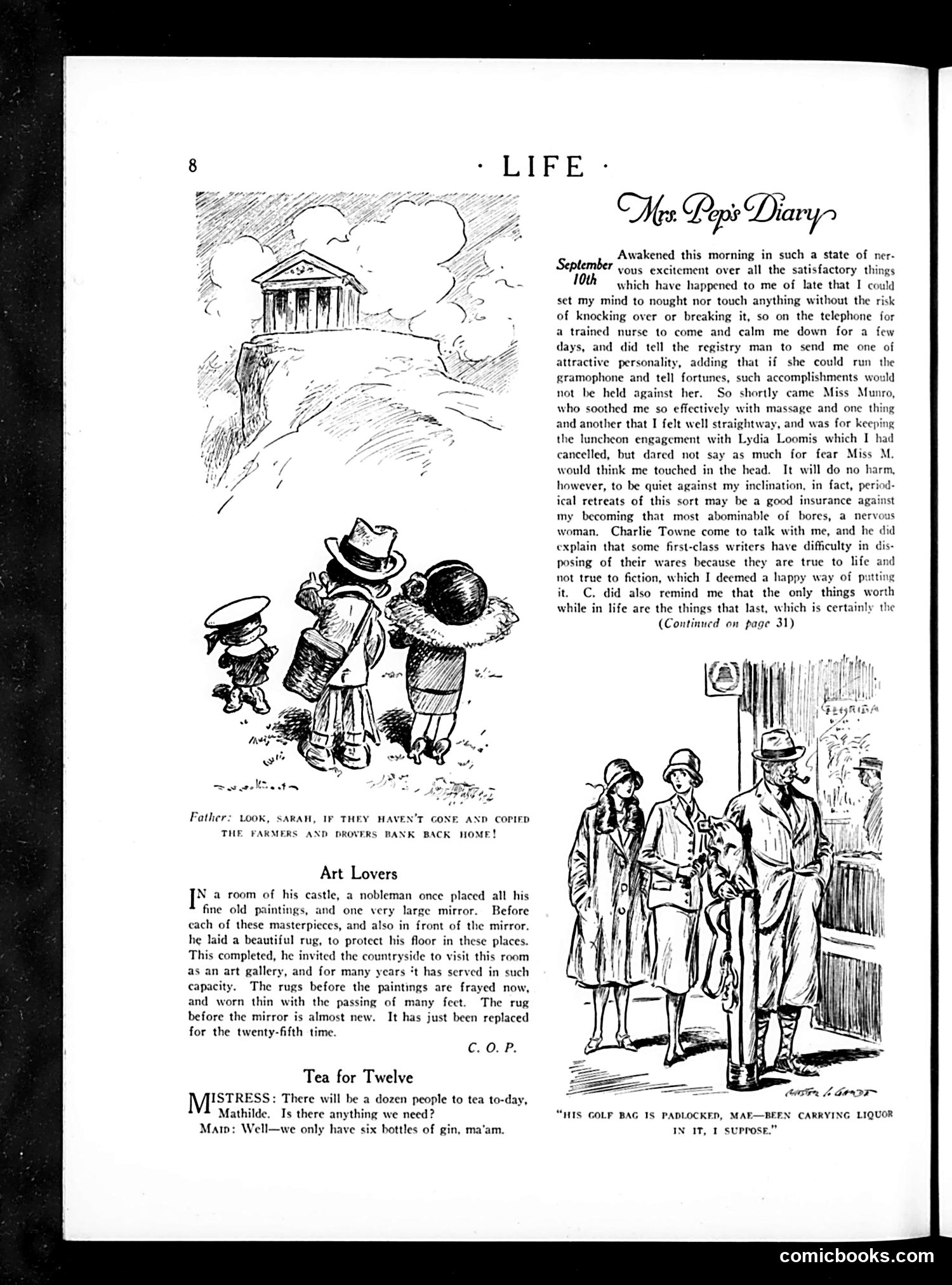
This page contains three separate humorous pieces typical of early 20th-century satirical magazines: 1. **Mrs. Pep's Diary** (top right): A personal column where the author describes nervous excitement about recent satisfactory events, consulting a nurse, and conversations with someone named Charlie Towne about writers' difficulties with autobiographical fiction. 2. **"Art Lovers"** (middle): A satirical anecdote about a nobleman who arranged his paintings before a mirror to protect the floor. The humor lies in the irony that the protective rug has worn thin from foot traffic while the mirror remains nearly new. 3. **"Tea for Twelve"** (bottom): A brief comic exchange between a mistress and maid about tea preparations for twelve guests, with the maid's deadpan response about limited gin supplies providing the punchline. The cartoons use simple line drawings to accompany these humorous scenarios.
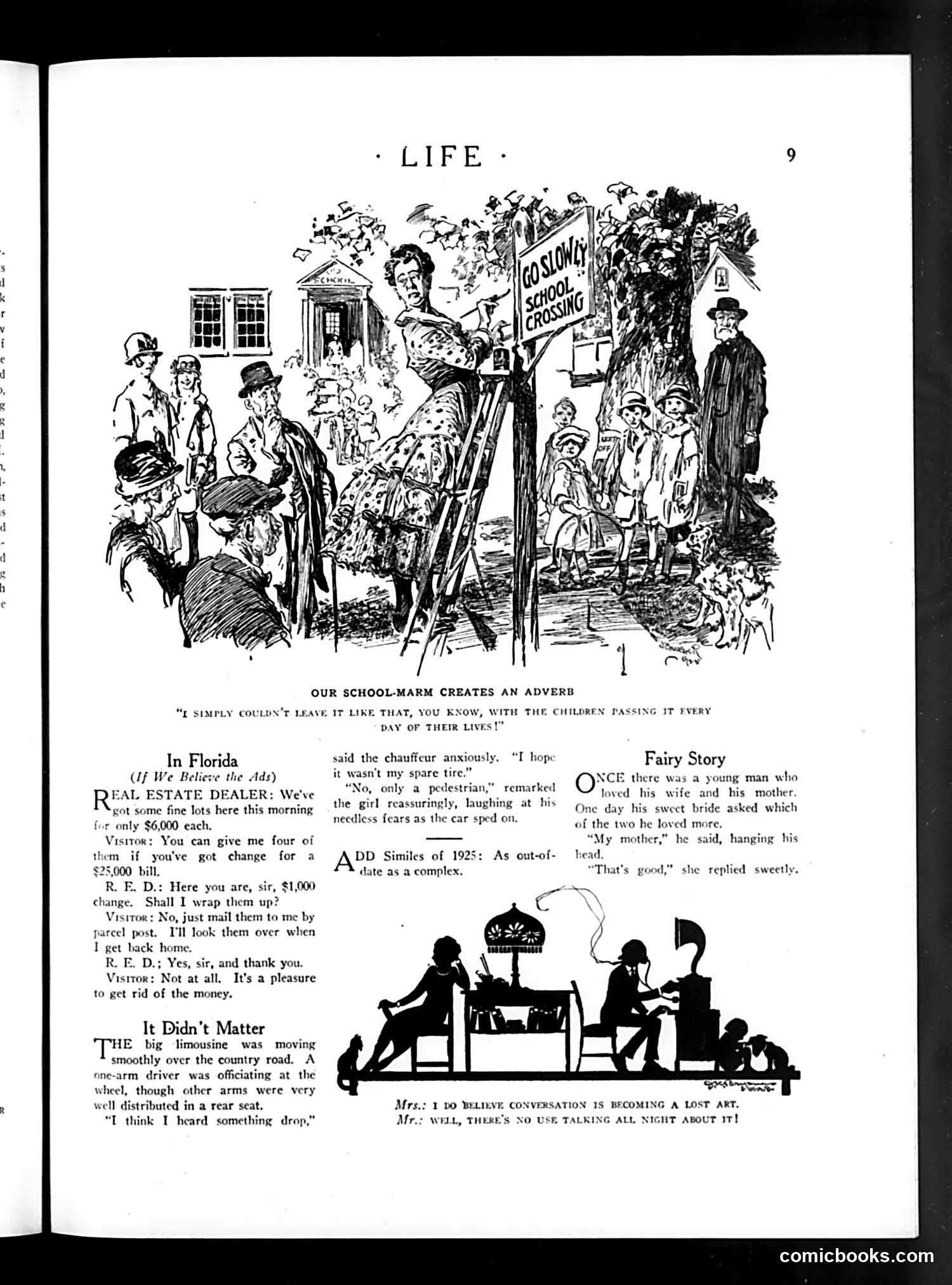
This page from *Life* magazine contains three separate humorous pieces: **Top cartoon**: Shows a woman posting a "Go Slowly School Crossing" sign while onlookers watch. The caption criticizes poorly-maintained school crossings, using the phrase "school-marm creates an adverb"—a grammatical joke about awkward language. **"In Florida"**: A brief real estate dealer/visitor dialogue mocking the Florida land boom, where a dealer tries to sell expensive property to a visitor unfamiliar with the area. **"Fairy Story" and "It Didn't Matter"**: Two short satirical narratives—one about a couple and mother, the other about a chauffeur mishap in a limousine. **Bottom silhouette**: Shows a couple where one complains conversation is becoming obsolete, satirizing modern social decline. The page targets early 1920s social foibles: real estate speculation, automotive culture, and deteriorating human communication.
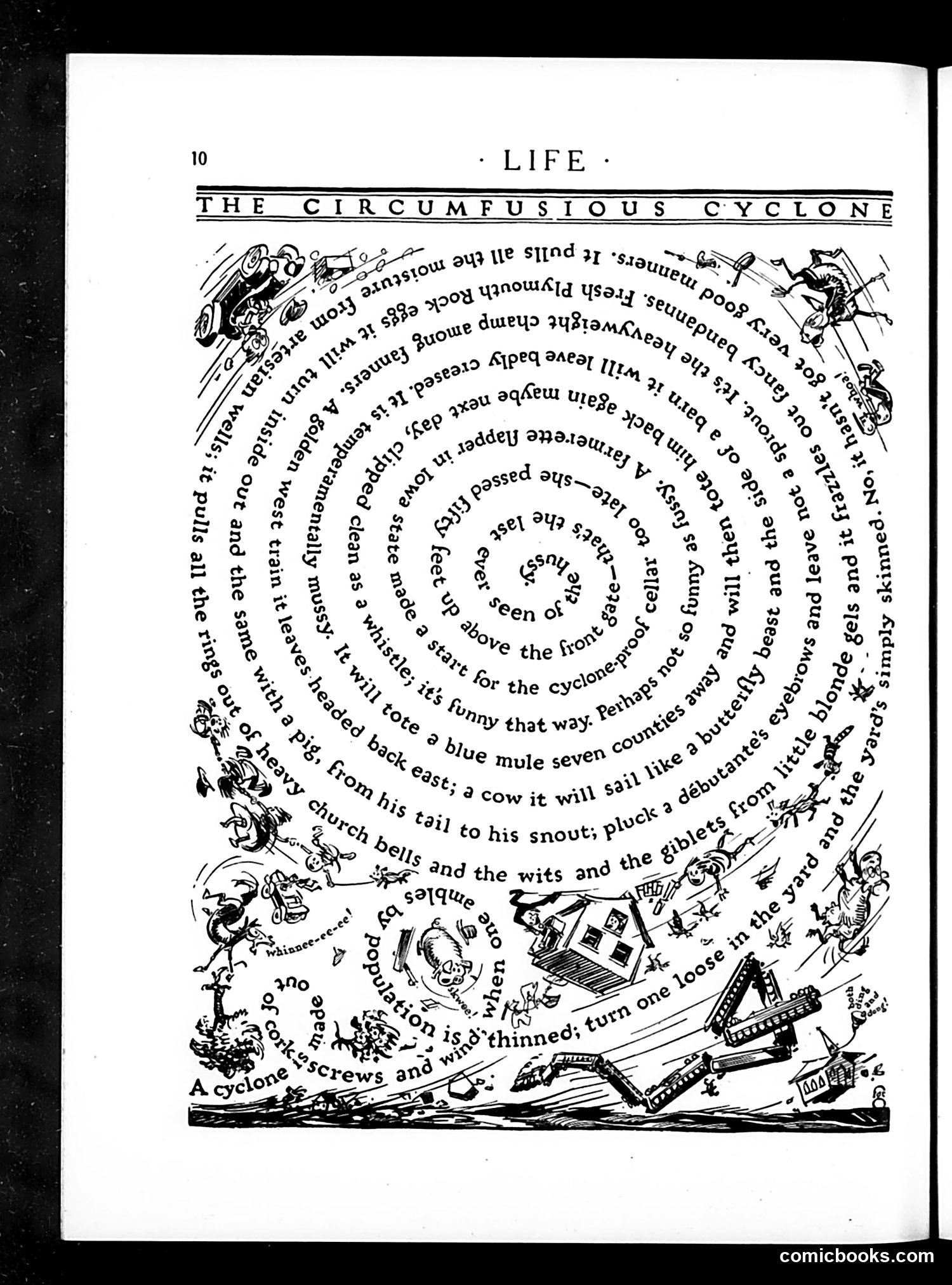
This is a humorous illustration satirizing the destructive chaos of a cyclone/tornado. The text, written in a spiral pattern following the cyclone's path, describes the storm's absurd devastation with exaggerated consequences: a blue mule traveling seven counties, a cow sailing away, church bells and debris scattered chaotically. The illustration shows buildings demolished, objects flying through the air, and general mayhem. The spiral text formation mirrors the cyclone itself, making the layout itself part of the joke. This appears to be pure comedic satire about natural disasters rather than political commentary—Life magazine often published such whimsical illustrated humor pieces. The satire lies in the over-the-top, ridiculous descriptions of the storm's effects rather than commentary on any political figures or events.
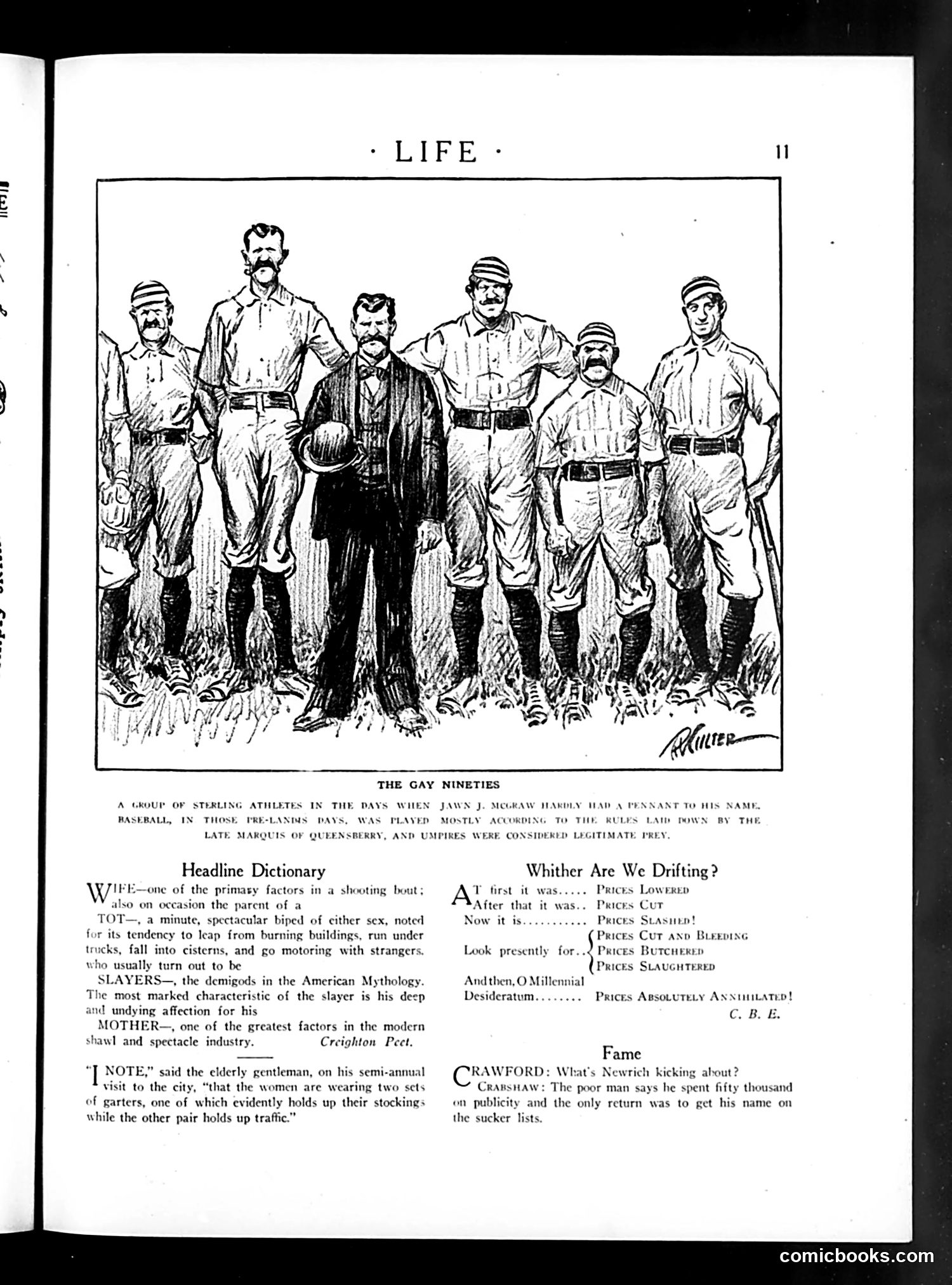
The main illustration depicts "The Gay Nineties," showing a man in formal dark clothing (identified as Jawn J. McGraw) surrounded by baseball players in period uniforms. The caption indicates this references early baseball history when McGraw was a notable figure and games were governed by rules established by the Marquis of Queensberry. The page contains three satirical sections: 1. **Headline Dictionary** – humorous definitions of contemporary terms, including social commentary about women and modern behavior 2. **Whither Are We Drifting?** – verse satirizing price inflation (prices cut, slashed, bleeding, slaughtered, and "absolutely annihilated") 3. **Fame** – a joke about someone named Crawford spending fifty thousand on publicity to get his name on "sucker lists" Overall, the page satirizes early 1900s American culture, economics, and the emerging celebrity industry.
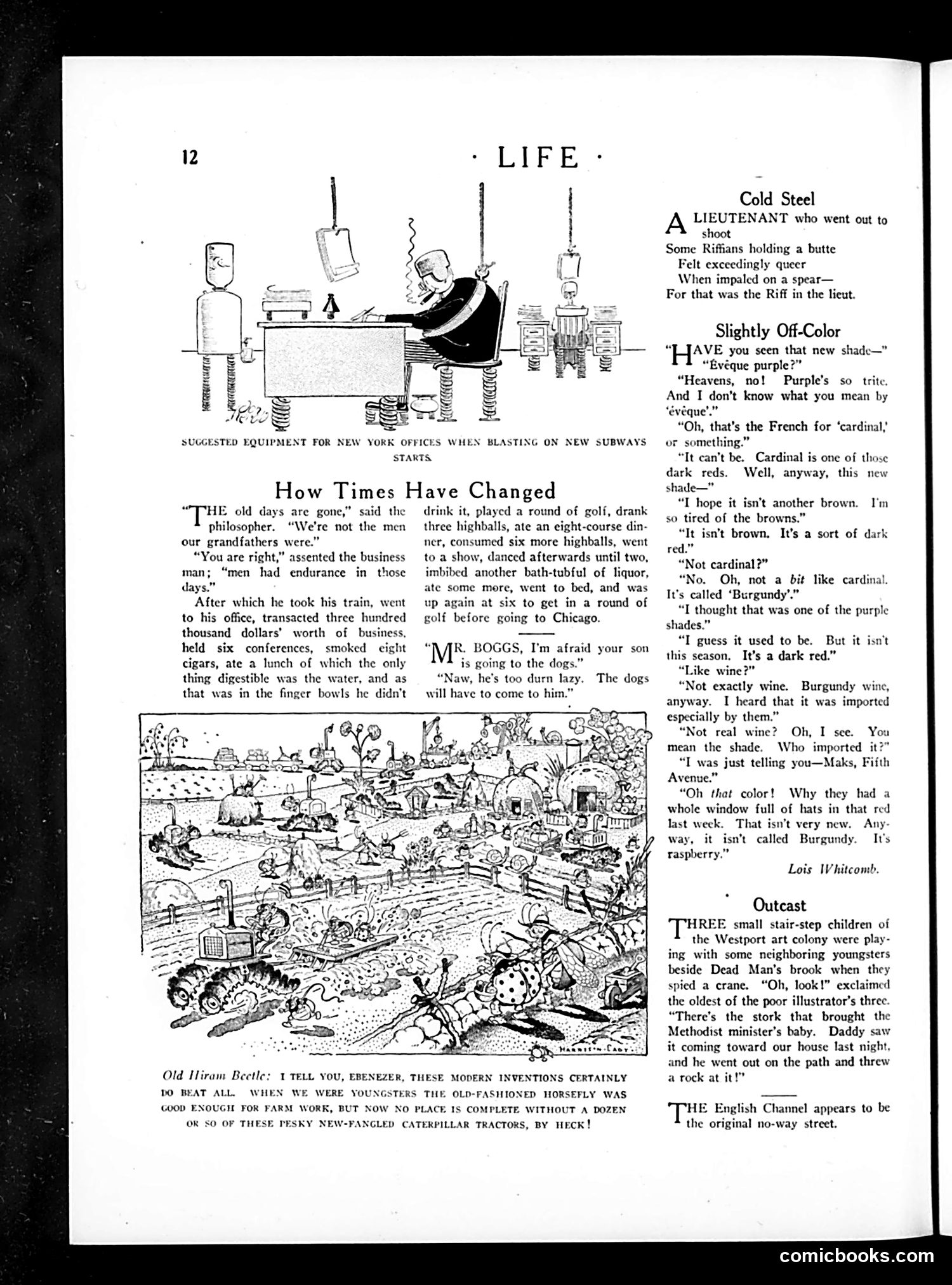
The main cartoon depicts "How Times Have Changed," contrasting old and new work habits. An elderly man recalls when workers had "endurance"—citing a grandfather who worked long days and "drank three highballs" after work. The implicit satire criticizes modern workers as lazy and soft. Below, a detailed illustrated scene shows chaotic construction/excavation work, labeled as "Suggested Equipment for New York Offices When Blasting on New Subways Starts"—satirizing the disruption caused by NYC's subway construction projects. The right column contains humorous short pieces about color naming ("Cold Steel," "Slightly Off-Color") and a brief anecdote about children discovering a stork, poking fun at genteel society's pretense about how babies arrive. The overall tone mocks both generational decline and modern urban inconveniences.
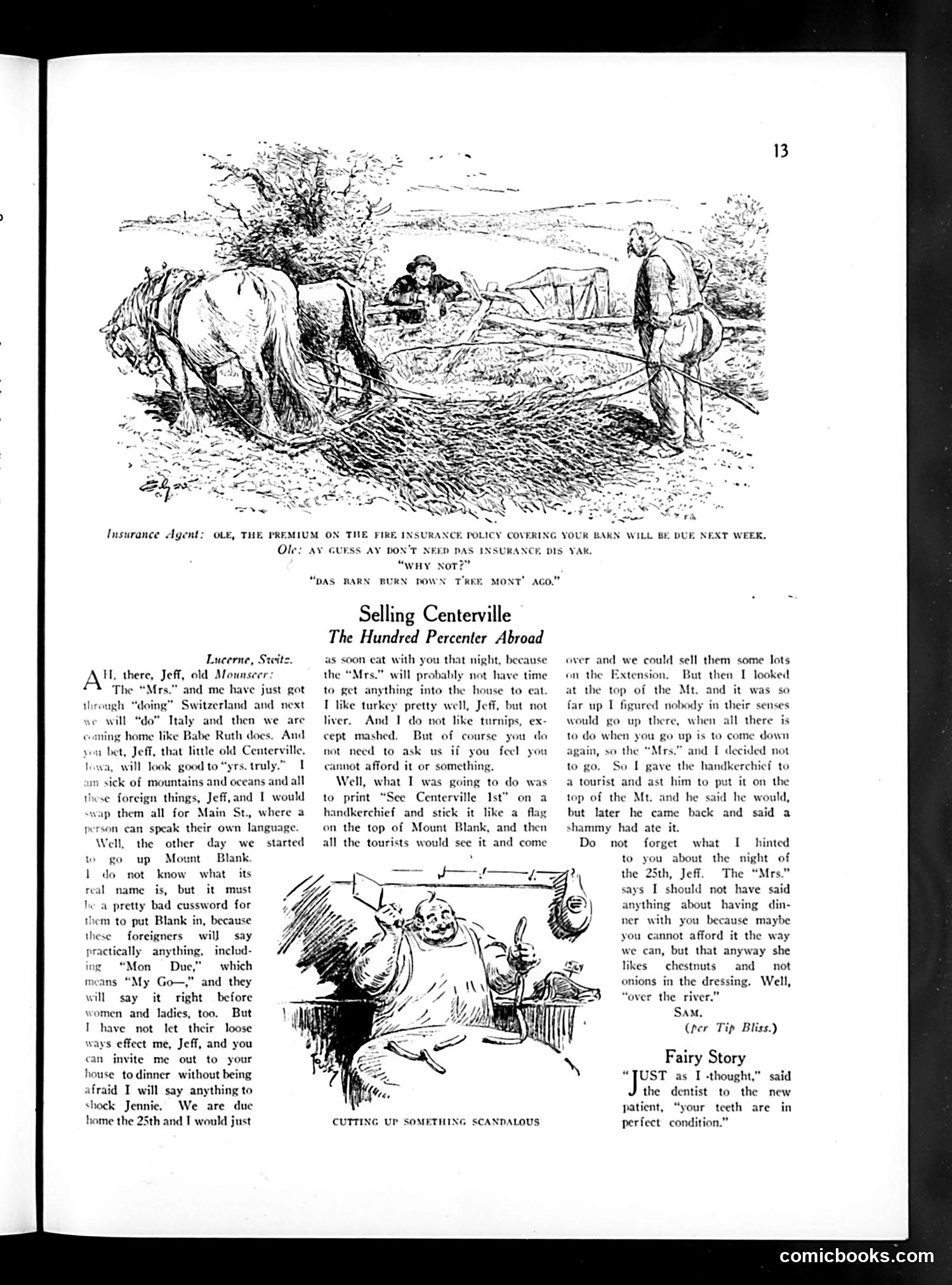
This page contains two satirical pieces from *Life* magazine: **Top cartoon**: An insurance agent discusses fire insurance with a farmer. The joke plays on rural dialect and practical concerns—the agent pushes insurance while the farmer skeptically asks "Why not?" The farmer's response, "Das barn burns down't'ree mont' ago," suggests he's already experienced a loss, making the timing of the insurance pitch darkly comedic. **"Selling Centerville"**: A humorous narrative about promoting a Swiss location to tourists. The writer describes printing "See Centerville!" on handkerchiefs to advertise the place, using absurdist tourist-marketing humor. **"Fairy Story"**: A brief joke setup about a dentist examining a patient's teeth. The page exemplifies *Life's* early 20th-century style: rural humor, satire of commercial schemes, and snappy punchline-driven stories.
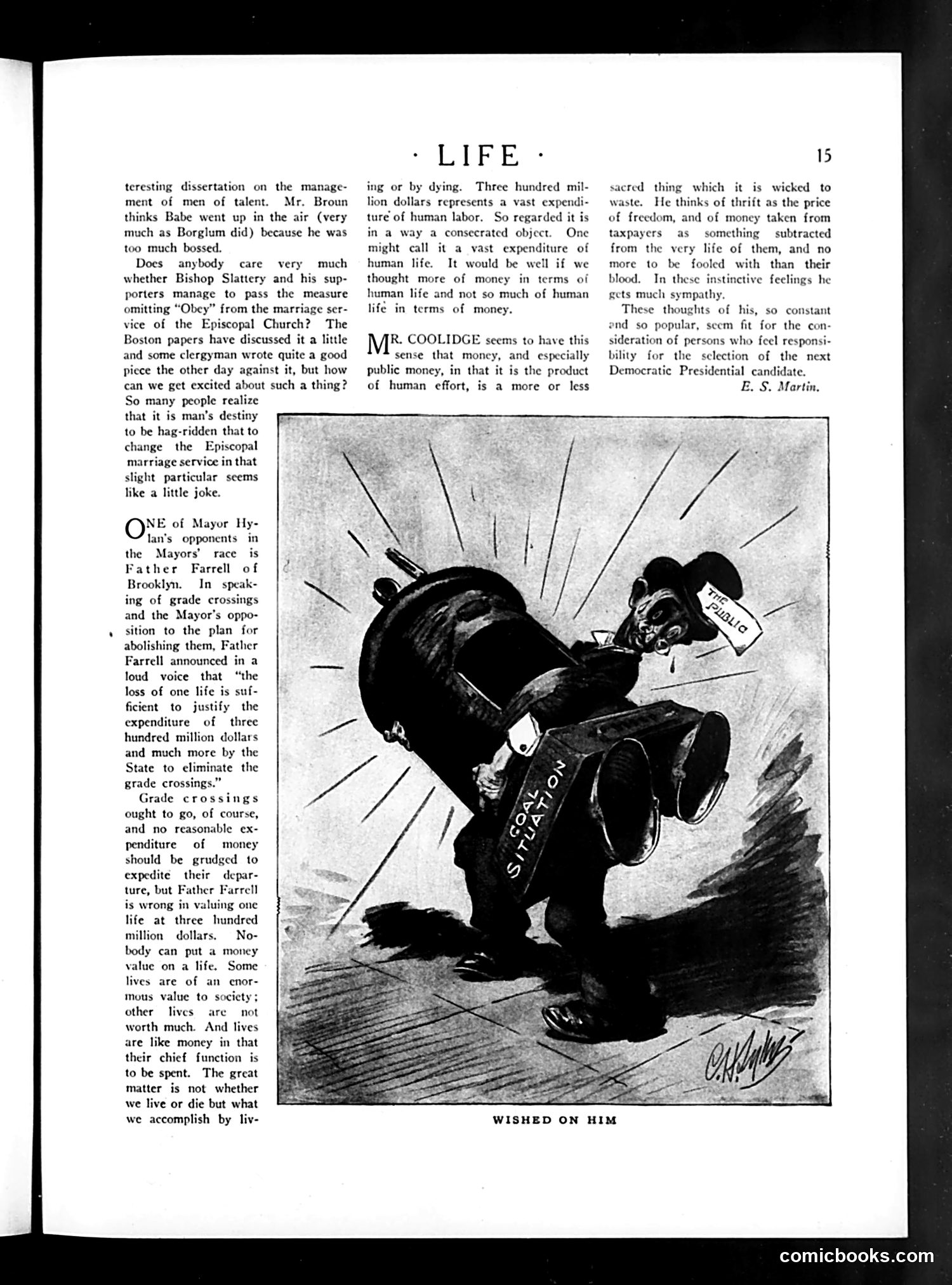
This editorial page critiques New York City Mayor John Hylan's administration, particularly regarding subway development and police management. The small cartoon at top-left (labeled "While there is Life there's Hope") appears to show a figure in distress, symbolizing the city's struggles. The text argues that while Hylan is competent, the police department under him suffers from politics and favoritism. The author criticizes Hylan for obstructing subway expansion—claiming he hasn't built adequate new lines despite Manhattan's growing population density. The piece suggests the city needs new leadership to address infrastructure and administrative failures, ultimately questioning whether Hylan should remain mayor in the upcoming election.
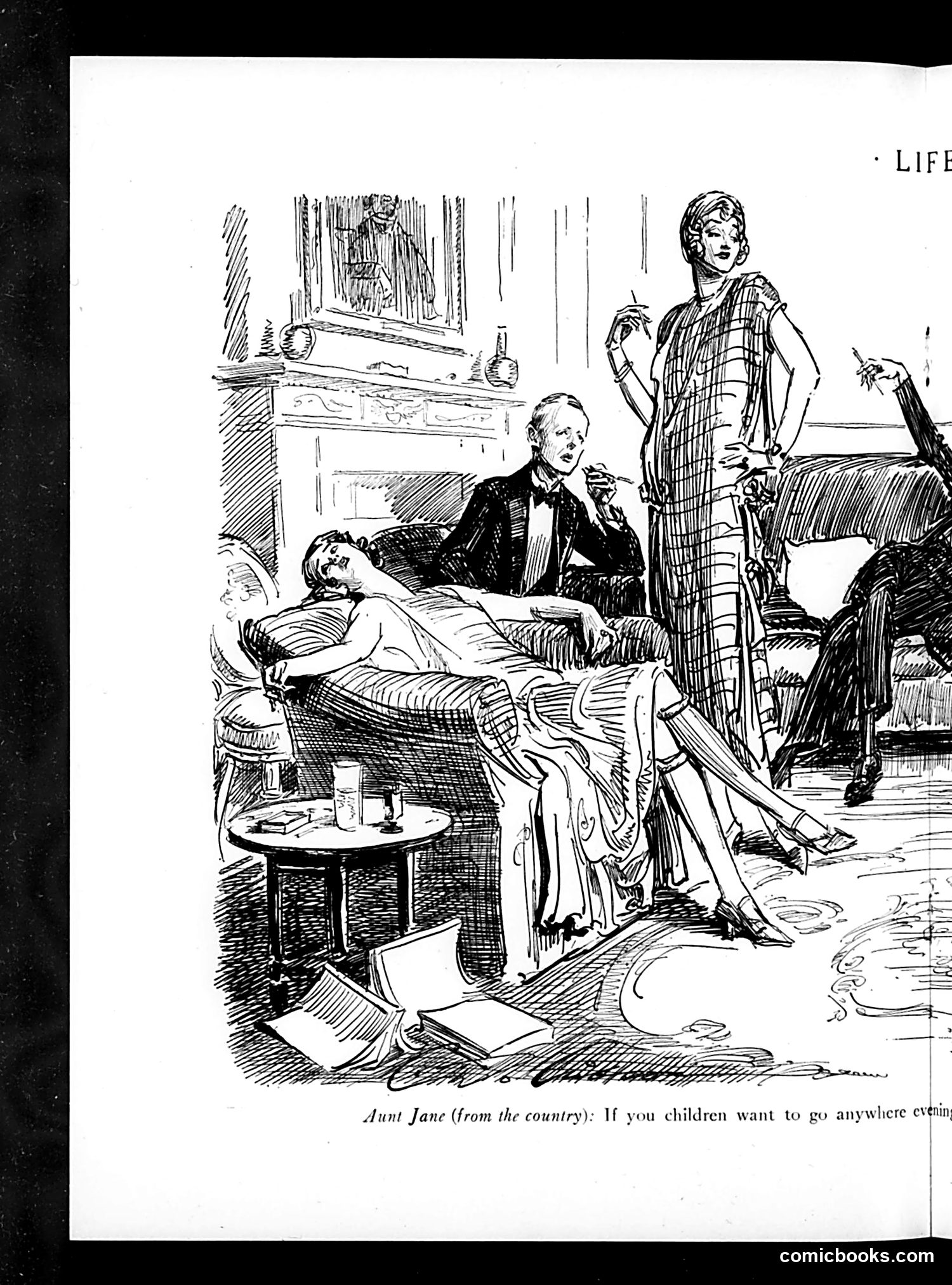
This appears to be a satirical cartoon from *Life* magazine depicting a scene titled "Aunt Jane (from the country)." The visible caption begins: "If you children want to go anywhere evening..." The sketch shows a bedroom scene with four figures: a woman reclining on a bed, a man in formal attire (tuxedo/bow tie) sitting nearby, a standing woman in a checkered dress, and another figure on the right. Papers are scattered on the floor. The satire likely mocks the contrast between rural propriety (represented by "Aunt Jane from the country") and urban sophistication. The incomplete caption suggests she's offering permissive advice about evening outings—presumably to city children—which would be humorously incongruous with country expectations of strict propriety. The joke depends on readers understanding early 20th-century class and regional stereotypes about moral standards.
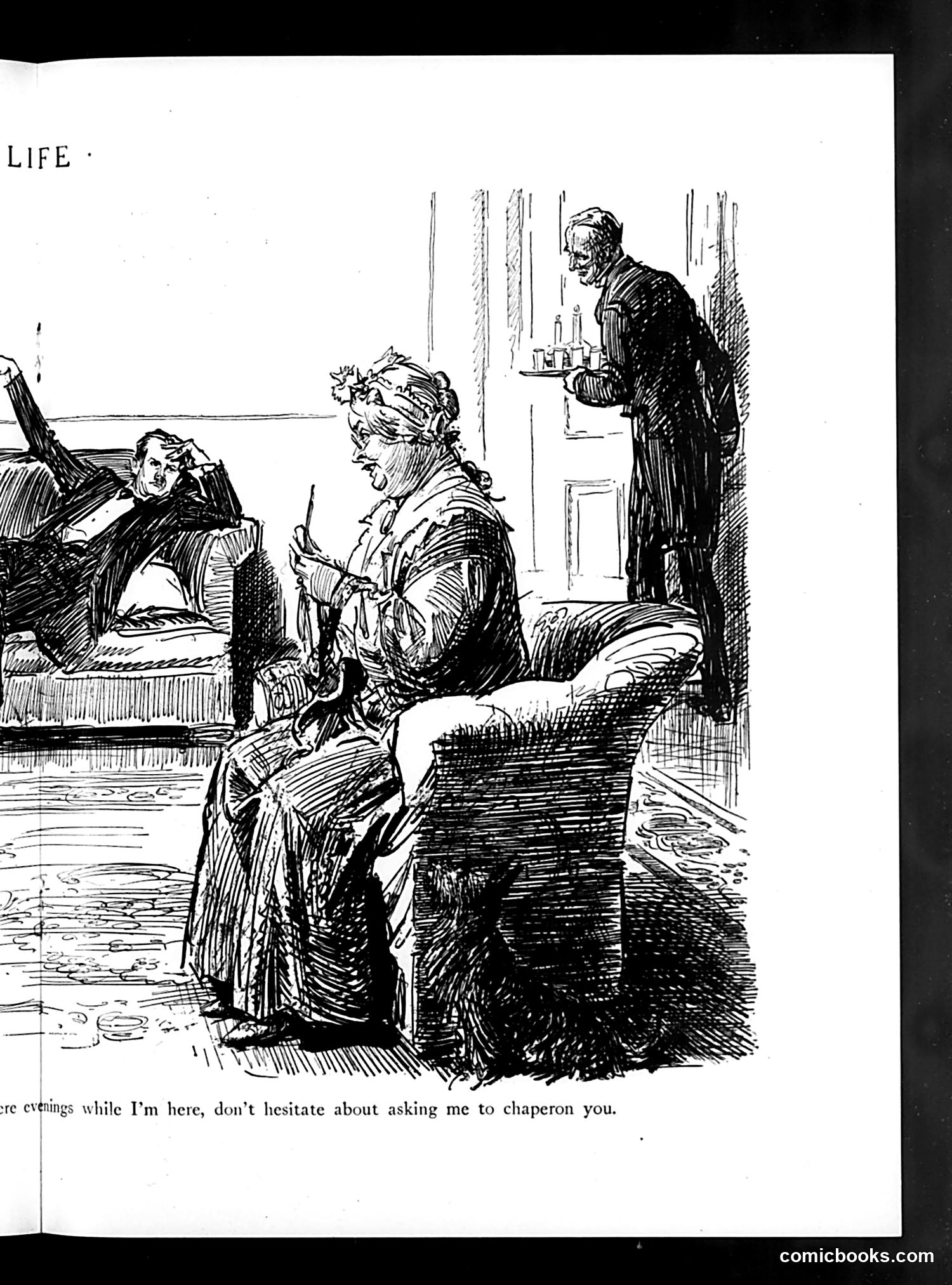
This is a satirical sketch from *Life* magazine depicting a domestic scene. The visible text reads: "ere evenings while I'm here, don't hesitate about asking me to chaperon you." The cartoon shows three figures in what appears to be a parlor setting: a woman seated, another woman standing in the center (appearing to be a guest or visitor), and a man in formal dress standing to the right. The joke appears to concern courtship etiquette and chaperonage—a social convention where unmarried couples required supervision. The humor likely centers on the speaker's offer to chaperon, suggesting either ironic willingness or an awkward social situation around Victorian-era dating protocols. Without the full surrounding text, the complete satirical point remains unclear, but it clearly comments on contemporary social customs regarding propriety and courtship.
This is a drama criticism page reviewing four Broadway plays. The critic uses biting wit to assess recent productions: **"The Mud Turtle"** receives qualified praise for Elliott Lester's playwriting facility, though his dialogue relies heavily on overwrought similes ("as uncomfortable as a Methodist minister at a burlesque show"). Helen MacKellar performs well. **"The Kiss in the Taxi"** is a French farce adaptation the critic admits to enjoying despite their "New England aversion to French farce." Arthur Byron's comedic performance carries the entire production. **"The Enchanted April"** starts promisingly but deteriorates after 9:30 PM. Actress Alison Skipworth's performance increasingly resembles Alexander Woollcott—a reference to the famous theater critic, suggesting she's become pretentious and overwrought. The small decorative illustrations show theatrical scenes. The critic's tone is sophisticated, self-aware mockery of their own prejudices while delivering sharp assessments of performers and playwrights' abilities.
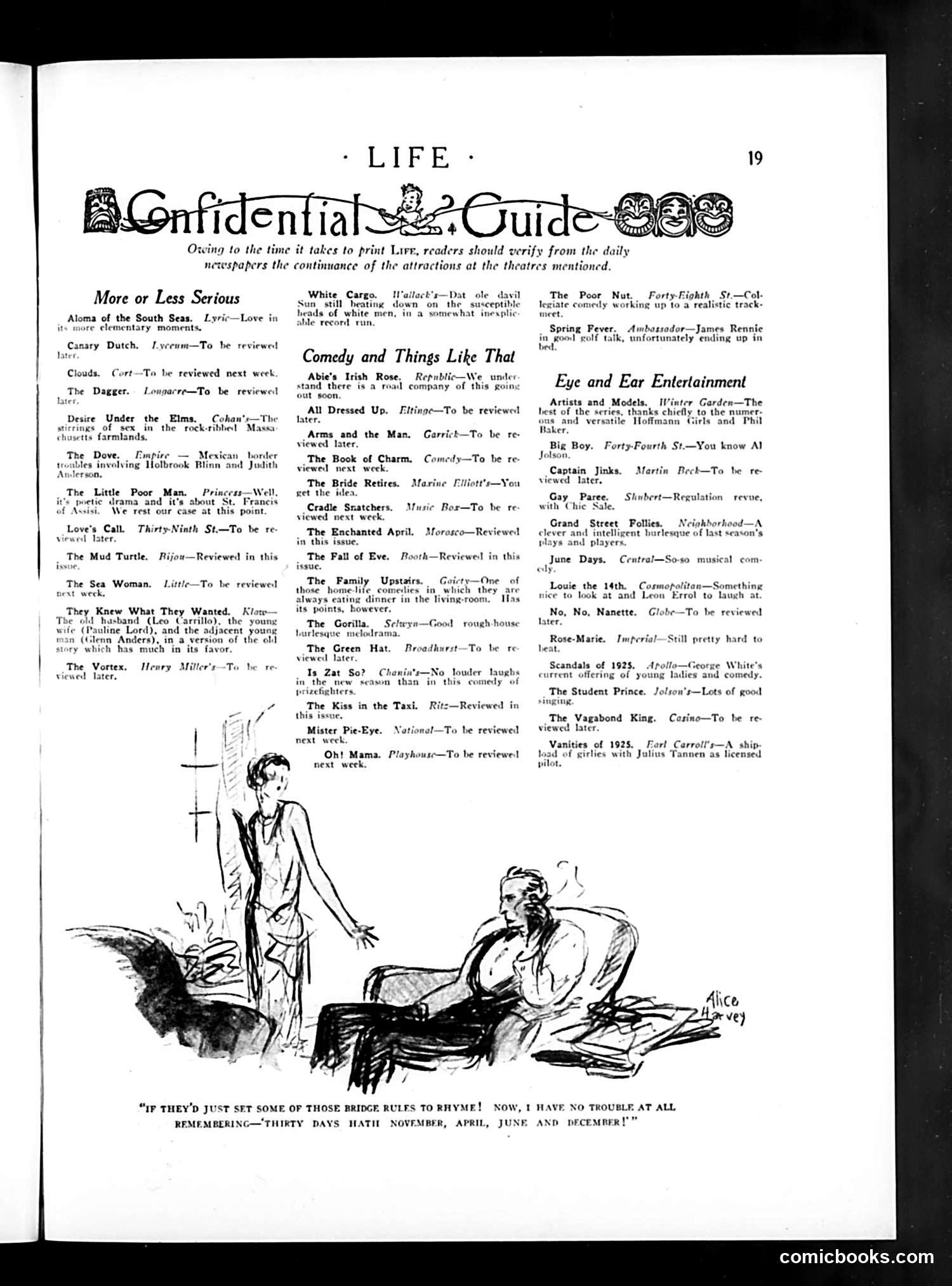
This is a theater review page from *Life* magazine listing Broadway shows opening that week. The single cartoon below depicts a woman standing while a man sits surrounded by papers, discussing how remembering the "thirty days hath" rhyme helps him recall which months have how many days—a mnemonic device for determining calendar dates. The joke is straightforward domestic humor: the woman suggests setting "bridge rules" (card game scoring conventions) to rhyme so they're equally easy to remember. The cartoon pokes gentle fun at memory aids and suggests that rhyming mnemonics are the solution to forgetfulness. The page itself serves as *Life's* weekly theater guide, noting which shows are being reviewed that issue and which will be covered later. This was a regular feature helping readers track Broadway entertainment—essentially a theater listing with critical notes, reflecting 1920s entertainment culture before modern media guides.
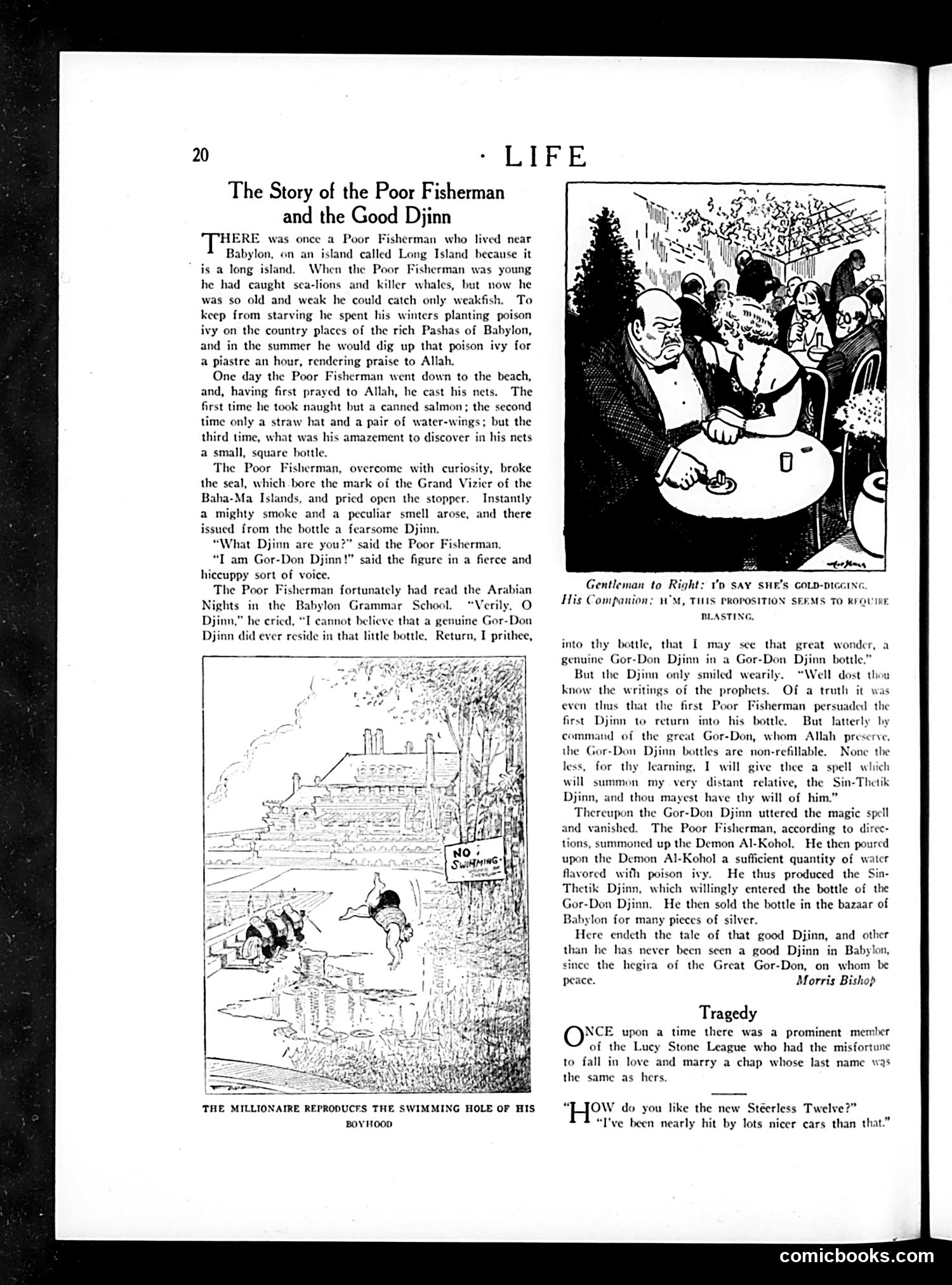
This *Life* magazine page contains two satirical pieces: **"The Poor Fisherman and the Good Djinn"** is a mock-Arabian Nights tale by Morris Bishop that parodies consumer culture. The "Gor-Don Djinn" appears to reference a real product (likely Gordon's gin), satirizing advertising claims. The joke: a poor fisherman finds a "non-refillable" bottle—a contemporary complaint about planned obsolescence and disposable goods. He then creates a substitute product (mixing alcohol with water), mocking how manufacturers trap consumers into replacement purchases. **"Tragedy"** is a brief satirical vignette about women's lib. The "Lucy Stone League" was a real 1920s feminist organization advocating women keep their maiden names after marriage. The joke: a League member ironically loses her identity anyway by marrying someone with the identical surname, defeating the purpose of the protest. The accompanying cartoon about the "Steerless Twelve" (a car model) shows unrelated gender commentary. Both pieces mock contemporary social anxieties: corporate manipulation and feminist identity politics.
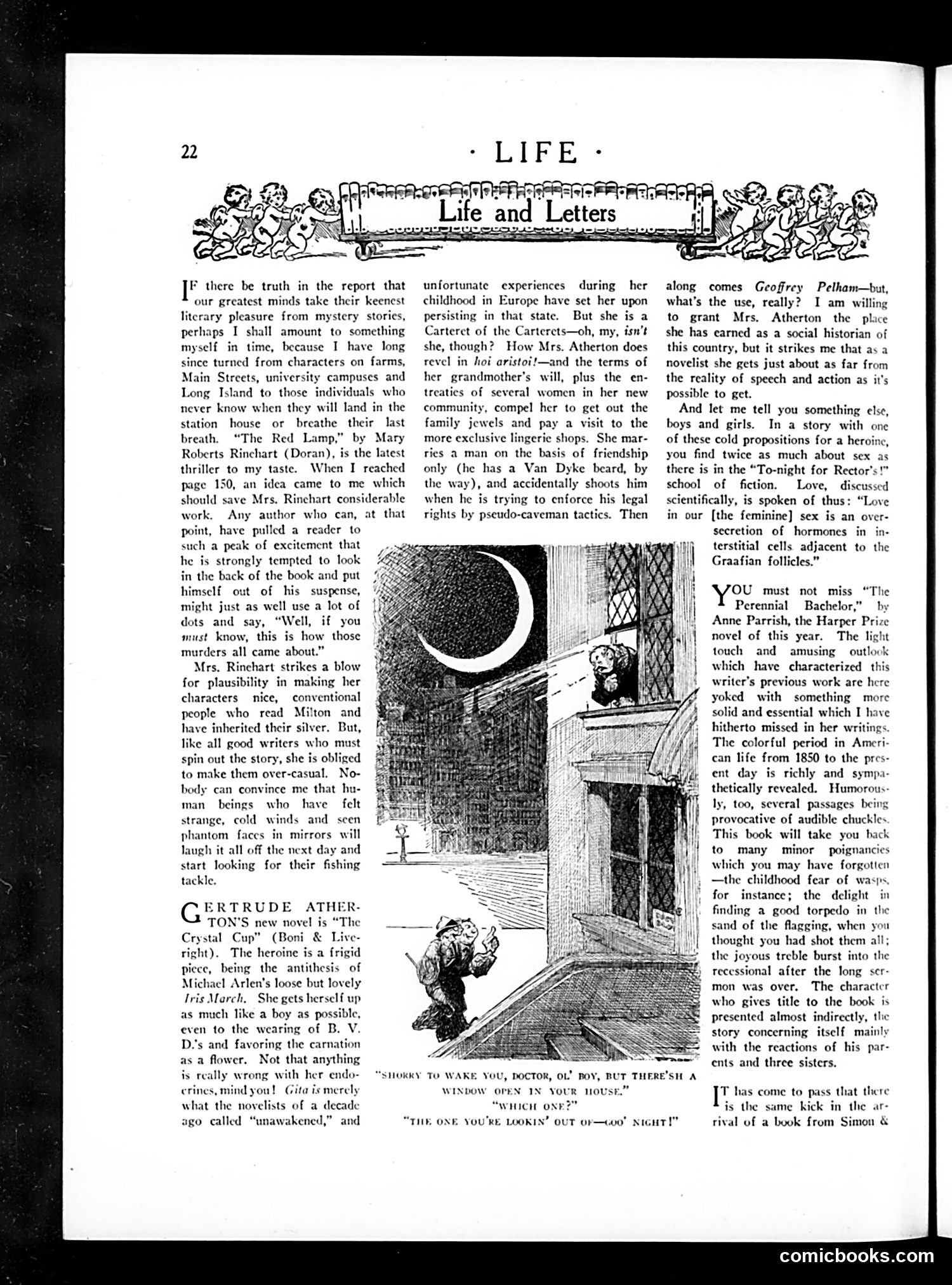
This page contains literary criticism of contemporary novels, illustrated with a charming line drawing of a figure at a window. The reviewer discusses three books: **"The Red Lamp"** by Mary Roberts Rinehart—a mystery thriller the critic praises for realistic characters, though noting the author artificially prolongs suspense. **"The Crystal Cup"** by Gertrude Atherton—criticized for its heroine who deliberately dresses and acts masculine ("unawakened" sexually). The reviewer mocks Atherton's pretentious focus on aristocratic lineage ("hoi aristoi") and her clinical, pseudo-scientific discussion of female sexuality using anatomical terminology rather than natural language. **"The Perennial Bachelor"** by Anne Parrish—praised as a Harper Prize winner with humor and historical depth about American life from 1850 onward. The overall tone is witty, somewhat gossipy criticism aimed at educated readers familiar with these popular authors. The reviews exemplify 1920s literary taste and attitudes toward women's sexuality in fiction.
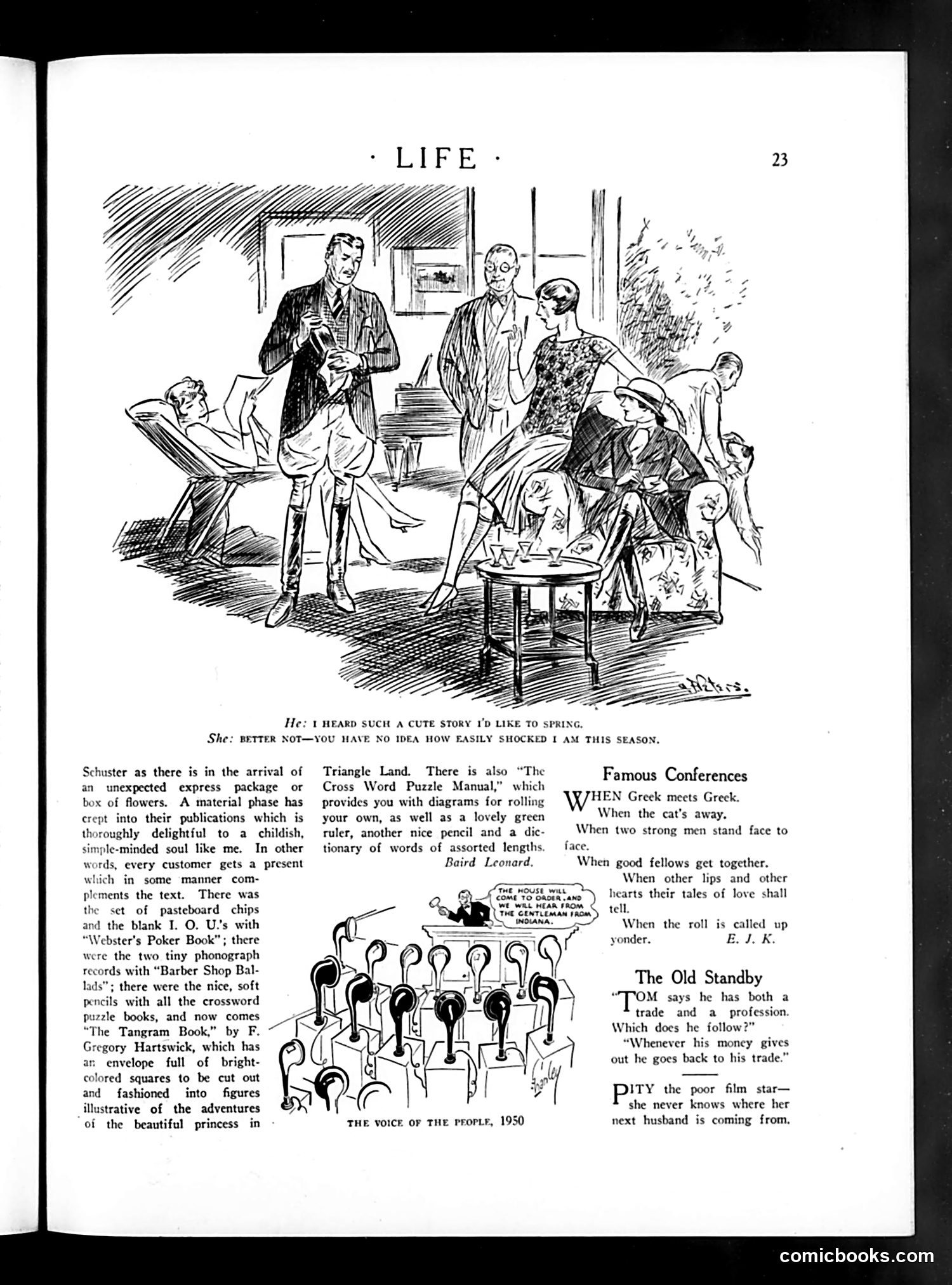
This page contains three distinct elements: **Top cartoon**: A social satire about storytelling. A man wants to share a "cute story," but the woman refuses, claiming she's easily shocked "this season." The joke mocks social propriety and suggests women's pretended delicacy is a passing fashion—implying hypocrisy about what constitutes acceptable conversation. **Middle cartoon**: "The Voice of the People, 1950" depicts a crowded assembly of identical figures at microphones, all seemingly speaking simultaneously. This satirizes mass democracy or public opinion as cacophonous noise—everyone talking but no one listening or being heard distinctly. **Right column**: Three brief humorous poems/quips about meeting ("When Greek meets Greek"), a man with both trade and profession (a joke about him switching jobs based on finances), and a dig at film actresses' multiple marriages. The page promotes gift books bundled with practical items (puzzles, pencils, records), emphasizing these as consumer pleasures for "simple-minded" readers.
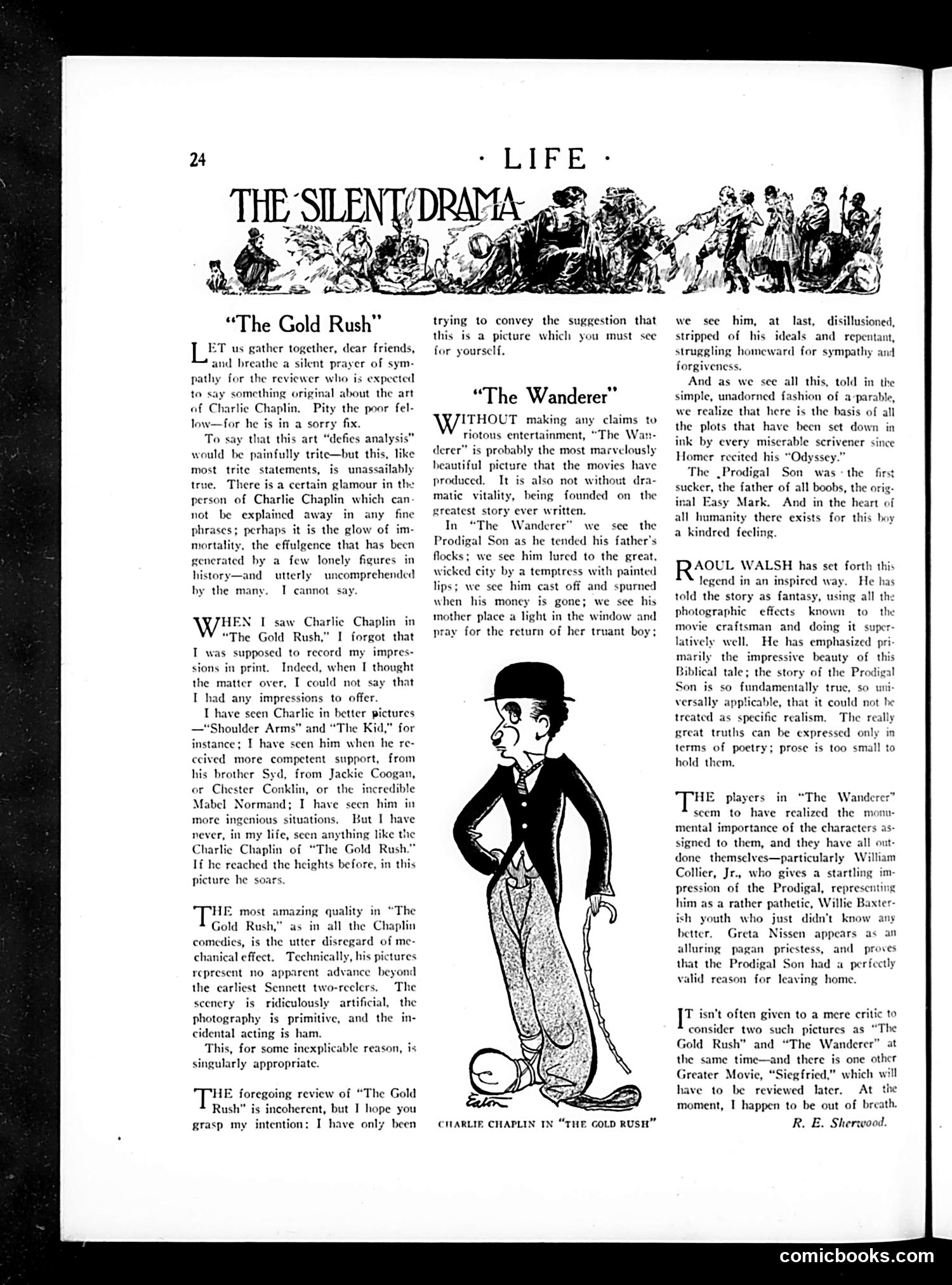
This page reviews two Charlie Chaplin films: **"The Gold Rush"** and **"The Wanderer."** The illustration shows **Chaplin's iconic "Tramp" character**—his bowler hat, cane, baggy pants, and mustache were his trademark silent-film persona. The reviewer (R.E. Sherwood) struggles to articulate Chaplin's appeal, acknowledging it's inexplicable yet undeniable. He praises *The Gold Rush* despite its technical primitiveness, arguing that Chaplin's star quality transcends mechanical filmmaking. The review of *The Wanderer* treats it as a faithful adaptation of the Biblical Prodigal Son parable, emphasizing that great truths require poetic rather than realistic treatment. The context: This appears to be from the 1920s, when silent films dominated cinema and Chaplin was arguably cinema's biggest star. The reverent tone reflects how seriously film criticism was emerging as a cultural medium.
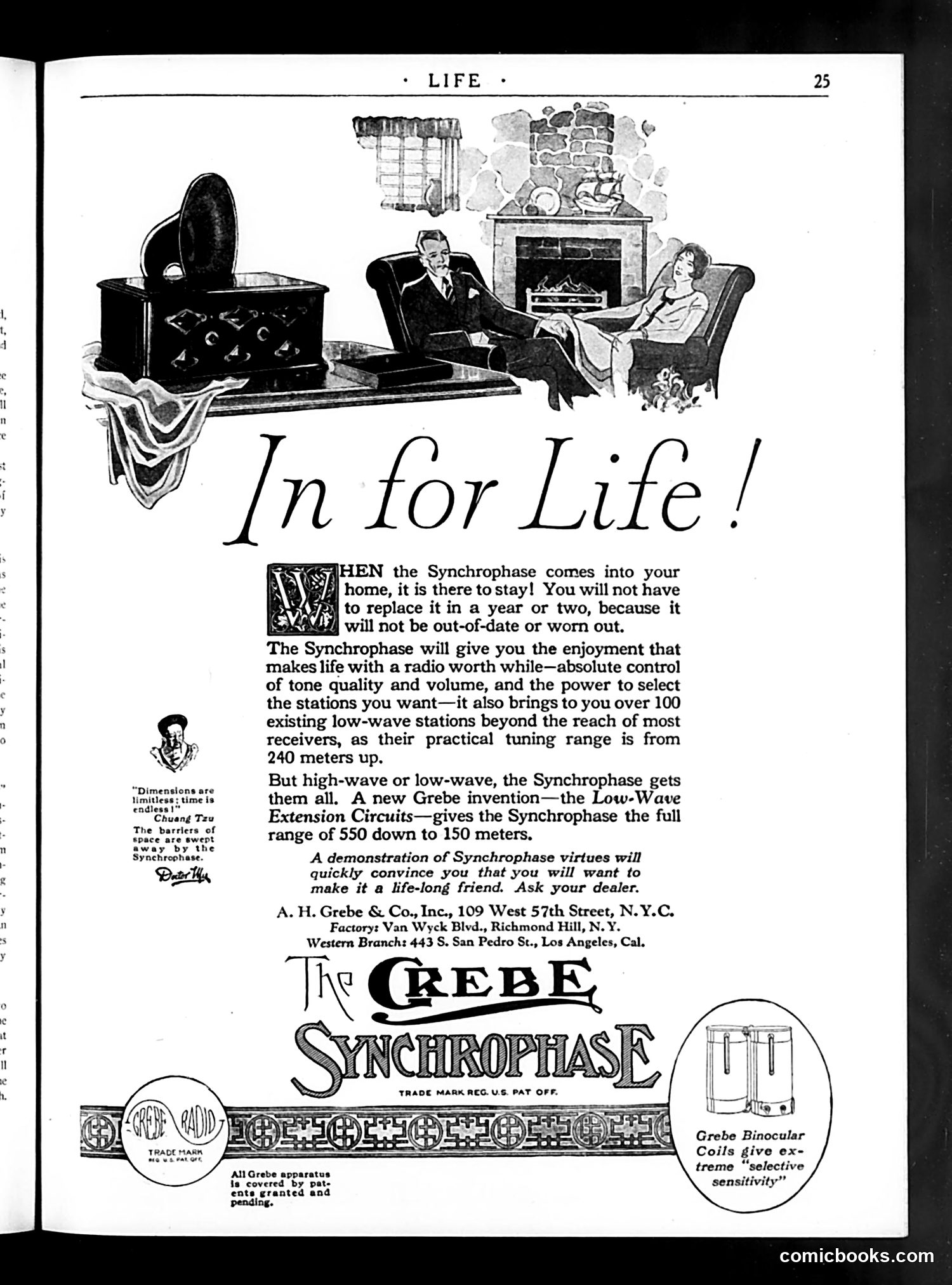
This is a **radio advertisement**, not a political cartoon. The page promotes the Grebe Synchrophase radio receiver. The illustration depicts a domestic scene where a man and woman relax by a fireplace while listening to radio—a lifestyle aspiration being marketed. The tagline "In for Life!" promises durability and permanence. The advertisement emphasizes technical superiority: the radio's ability to receive over 100 low-wave stations, its "absolute control of tone quality and volume," and a new "Low-Wave Extension Circuits" feature expanding the tuning range from 550 down to 150 meters. The philosophical quotes at left (attributed to Chuang Tzu and artist Pescly) frame radio reception as transcending spatial and temporal limitations—romanticizing what was then cutting-edge consumer technology. This represents early 1920s radio marketing, when owning a quality receiver signified modernity and cultured leisure.
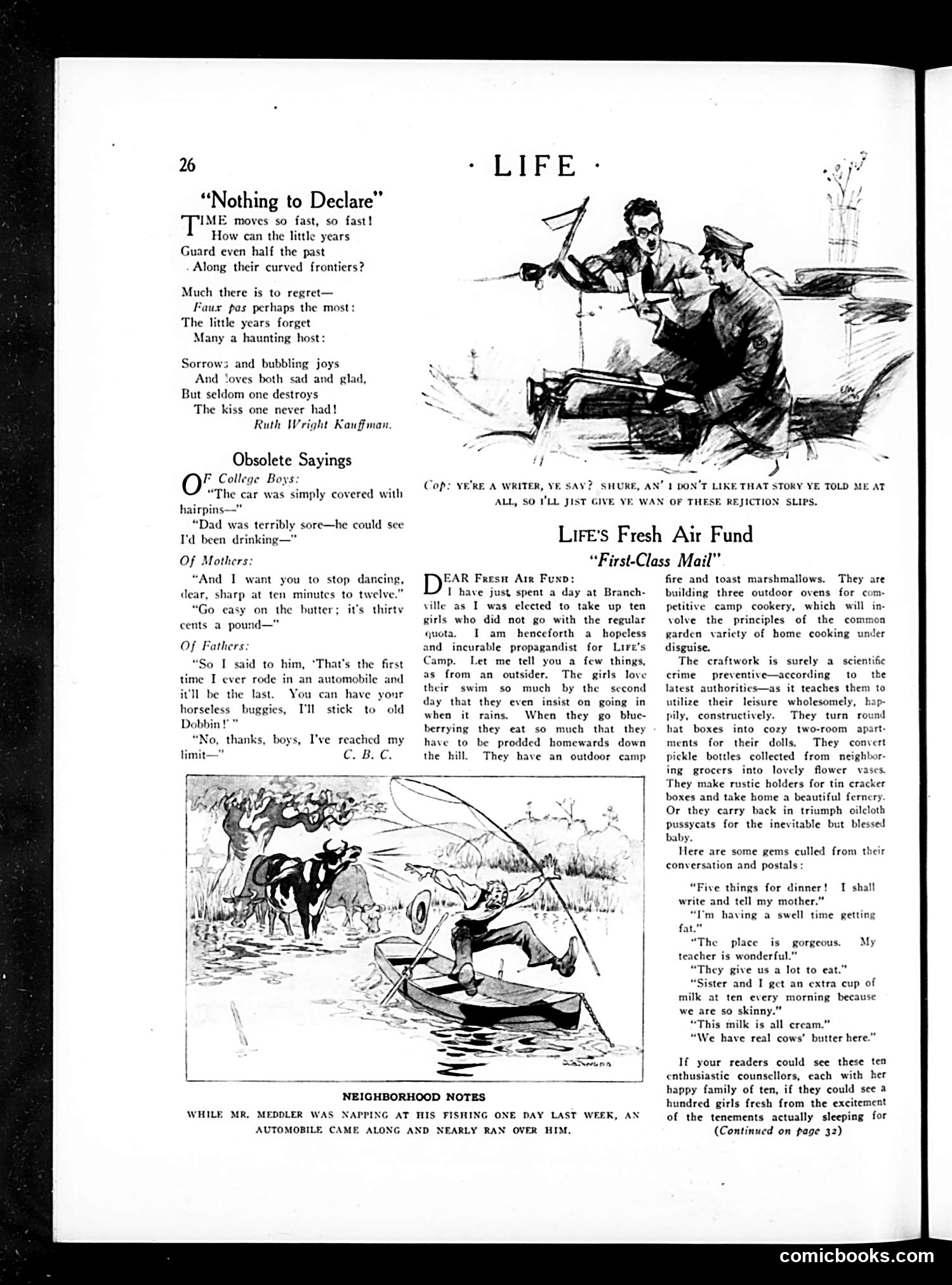
This page contains **poetry and social humor** rather than political cartoons, reflecting early 20th-century American life. **"Nothing to Declare"** is a nostalgic poem about time's passage and regret, by Ruth Wright Kauffman. **"Obsolete Sayings"** mocks outdated attitudes from older generations—college boys bragging about drinking and dating, mothers rationing butter during harder economic times, and fathers rejecting automobiles as unreliable fads. The humor lies in recognizing these views as quaint relics. **The cartoon** shows a cop confronting a writer, rejecting his story as unbelievable and offering "rejection slips" instead—satirizing harsh literary criticism. **"Life's Fresh Air Fund"** describes a charitable program sending tenement girls to summer camp. The girls' quoted comments reveal their excitement over simple luxuries (extra milk, cream butter, outdoor cooking) that working-class families couldn't afford—highlighting class disparities that contemporary readers would have recognized keenly. The page overall reflects Progressive-era social awareness mixed with gentle satire.
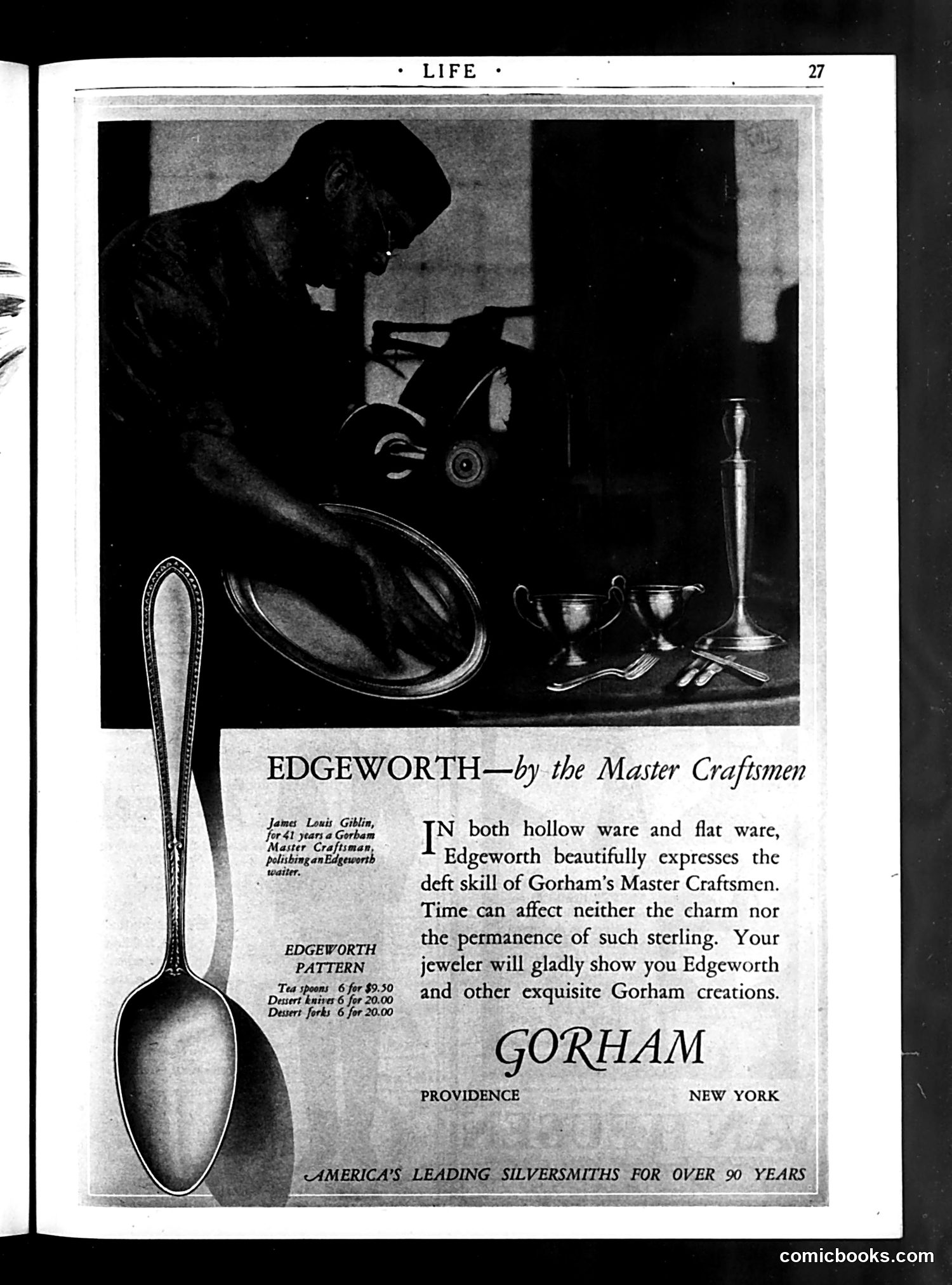
This is **not a cartoon or satire**—it's a straightforward advertisement for Gorham silverware, appearing on page 27 of *Life* magazine. The image shows James Louis Giblin, identified as a Gorham Master Craftsman with 41 years of experience, polishing silver pieces. The ad emphasizes skilled craftsmanship and product quality: Edgeworth pattern silverware in both hollow and flat ware, with pricing listed (tea spoons, dessert knives, forks). The advertisement positions Gorham as "America's Leading Silversmiths for Over 90 Years," appealing to consumers by highlighting the human expertise behind the products and claiming durability ("Time can affect neither the charm nor the permanence of such sterling"). This represents typical early-20th-century advertising strategy: humanizing luxury goods through visible skilled labor and brand heritage. There is no political or social satire present on this page.
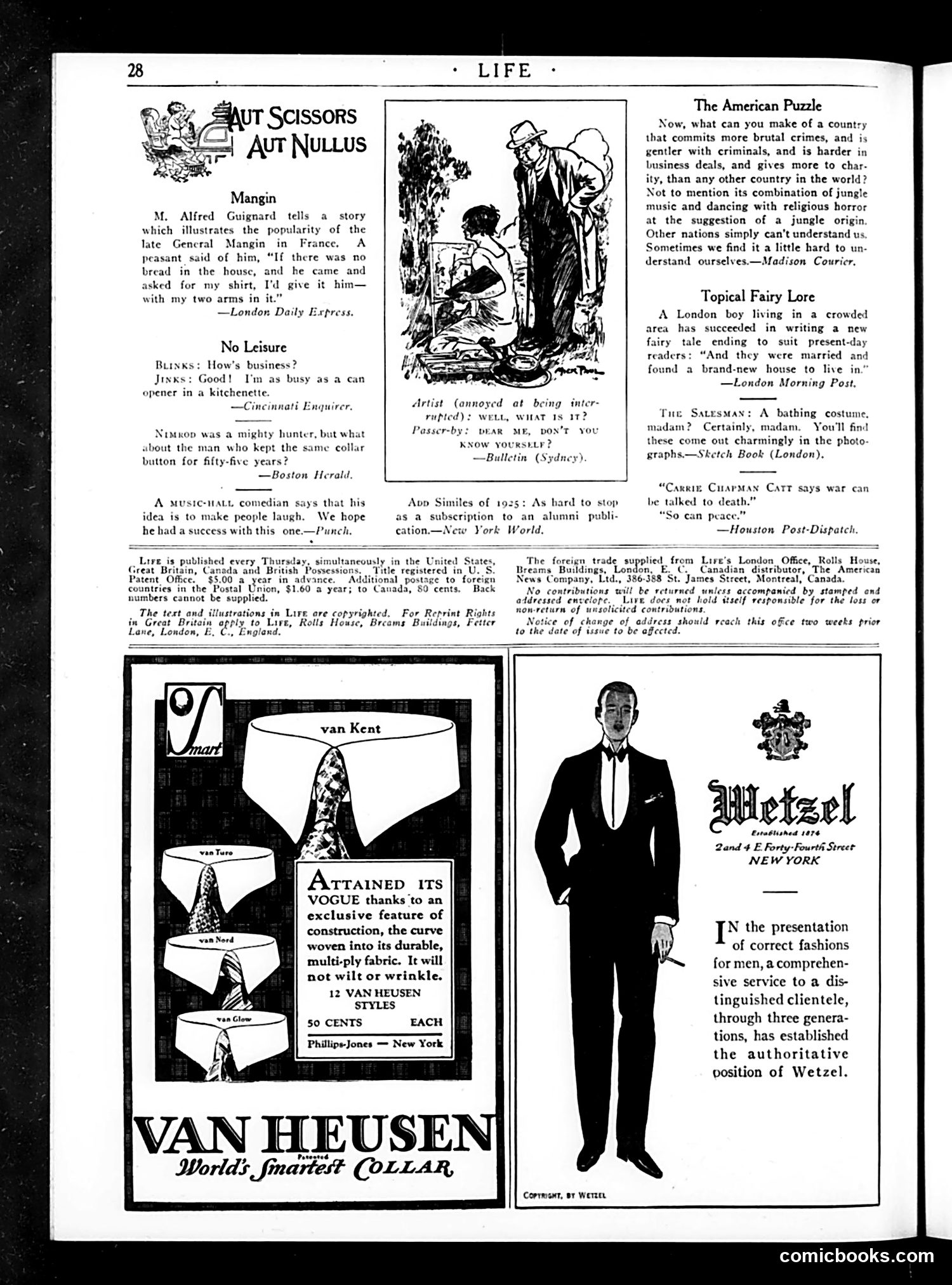
This page contains mostly **humor snippets and advertisements** rather than political cartoons requiring historical context. The central illustration depicts an **artist annoyed by a passerby**, with the caption suggesting the passer-by is interrupting work. This is a simple workplace humor joke. **"The American Puzzle"** is a brief editorial commentary satirizing American contradictions: the country is simultaneously brutal in crime yet lenient with criminals, ruthless in business yet generous in charity. It's gentle satire on American hypocrisy and inconsistency—noting that "sometimes we find it a little hard to understand ourselves." **"No Leisure"** jokes that a businessman is "as busy as a can opener in a kitchenette"—a simple pun about constant activity. The remaining content is primarily **period advertising**: Van Heusen collars and Wetzel formal wear, typical of 1920s Life magazine layout. No specific political figures or dated events are referenced; the humor is generic and sociological rather than topical.
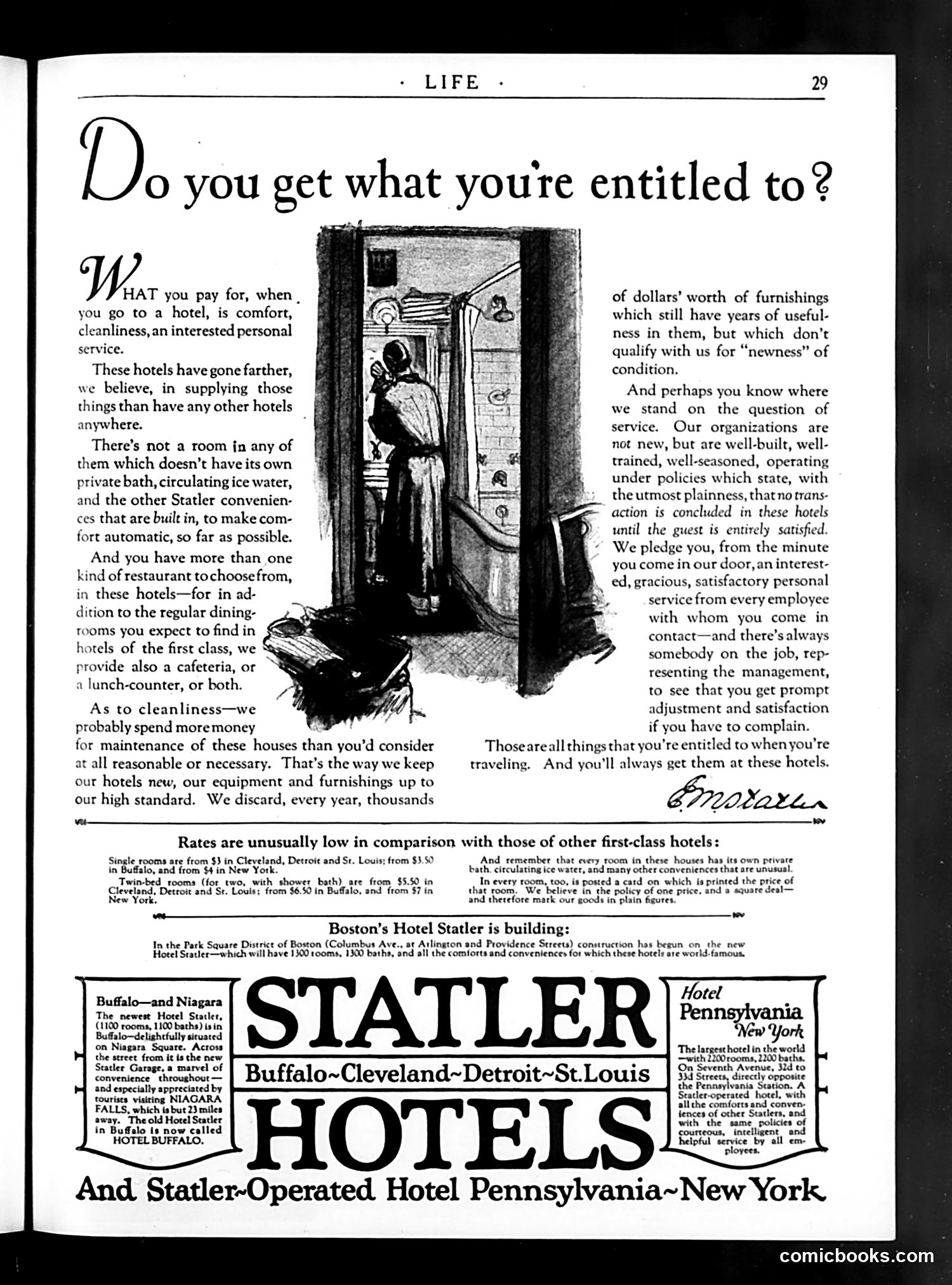
This is primarily a **hotel chain advertisement**, not satirical content. The page promotes Statler Hotels' amenities and service standards to potential guests. The illustration shows a **maid or housekeeper** attending to a guest's room, embodying the "interested personal service" the text emphasizes. This image illustrates the hotel's core selling point: attentive, individual care. The advertisement's argument addresses early 20th-century hotel expectations: private baths, circulating ice water, multiple dining options, and rigorous cleanliness standards (they claim to discard thousands of dollars in still-usable furnishings yearly to maintain "newness"). Notably, they emphasize transparent pricing ("one price, and a square deal") and a satisfaction guarantee—service continues "until the guest is entirely satisfied." The text positions Statler Hotels as superior competitors through operational excellence and customer-centered policies, not luxury excess. This reflects Progressive Era business values: efficiency, transparency, and service standardization as markers of quality.
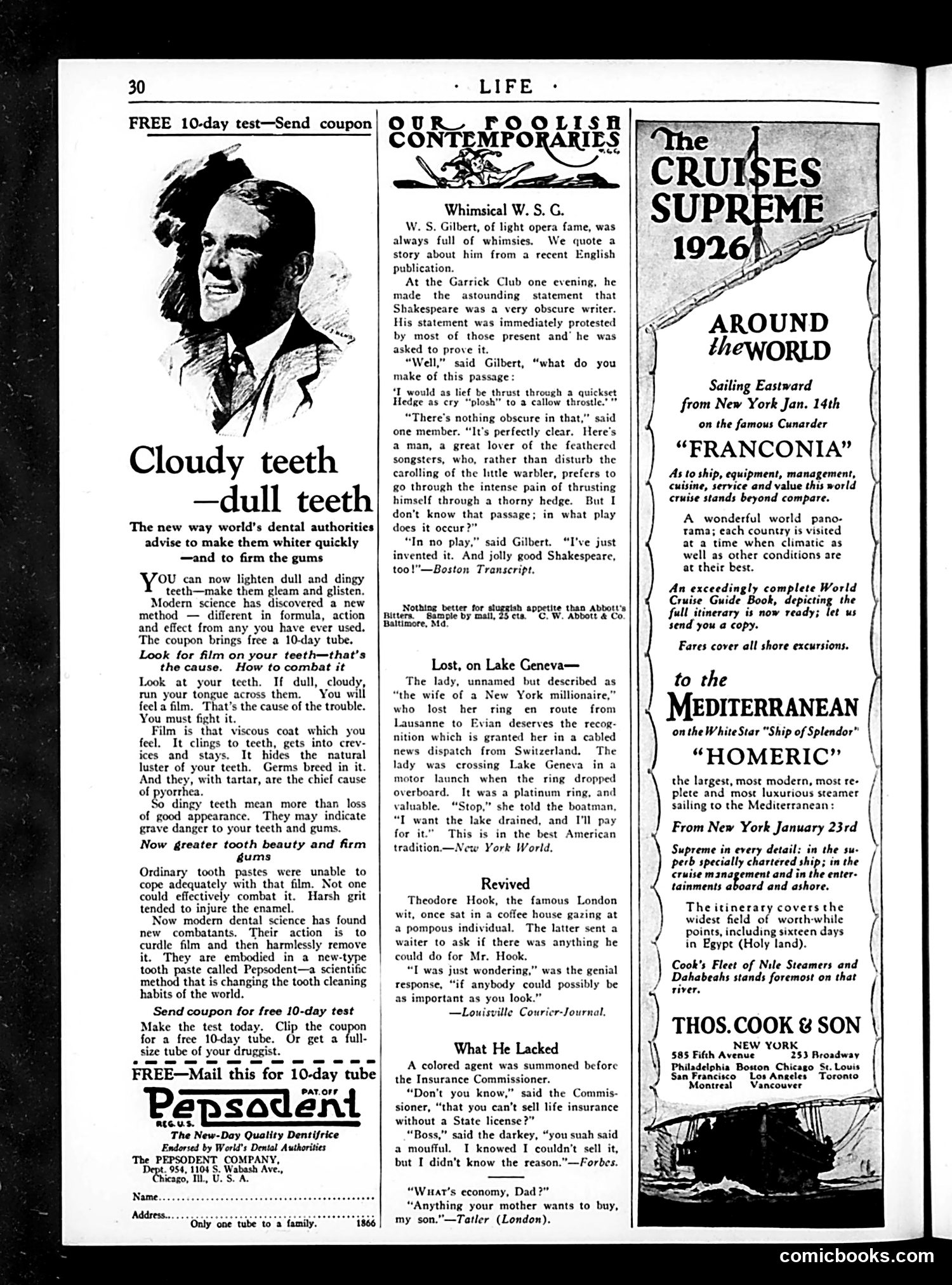
This page is primarily **advertising and light humor columns**, not political cartooning. The main content includes: **Pepsodent Advertisement**: A full-page dental product ad promoting a new toothpaste formula that claims to remove "film" from teeth, causing dullness. The copy emphasizes scientific advancement in tooth-cleaning. **"Our Foolish Contemporaries"**: Three short humorous anecdotes: 1. **W.S. Gilbert's Shakespeare joke**: The famous light opera composer claims Shakespeare is "obscure," then tricks his listeners by quoting a passage that doesn't actually exist—satirizing pretentious literary criticism. 2. **Lake Geneva anecdote**: A wealthy American woman's extravagant demand to drain a lake to recover her lost platinum ring, presented as typical American excess and entitlement. 3. **Theodore Hook's wit**: A famous London wit responds to a pompous man's offer of help with a cutting observation about his self-importance. The page also advertises cruise services. The humor is gentle social satire targeting pretension, wealth-obsession, and pomposity rather than specific political figures or events.
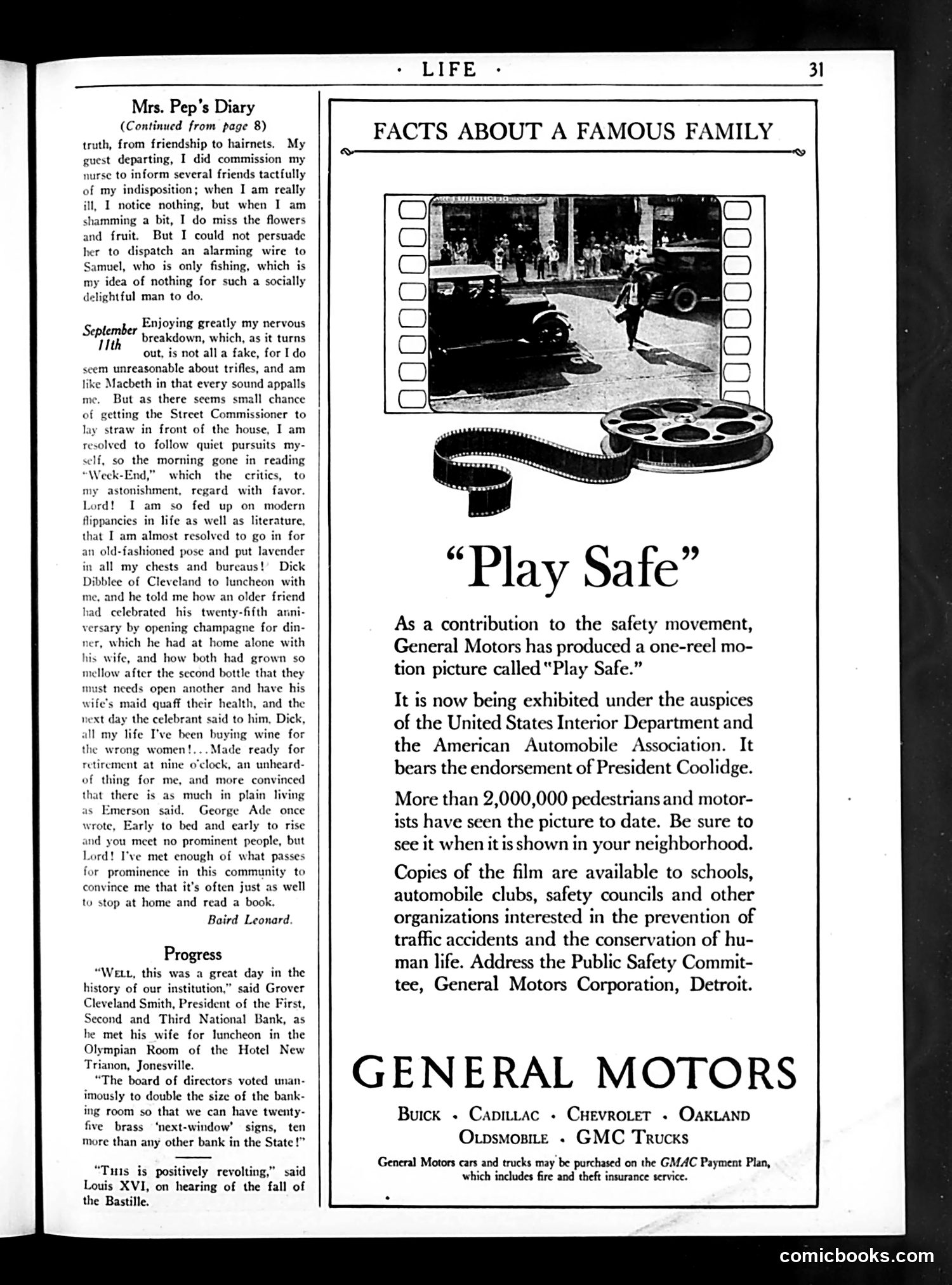
This page contains two distinct elements: **Main Content: "Play Safe" Advertisement** General Motors promotes a one-reel safety film aimed at preventing traffic accidents. Endorsed by President Coolidge and distributed through the U.S. Interior Department and American Automobile Association, it claims 2+ million viewers. The advertisement targets schools, clubs, and safety organizations—typical 1920s corporate social responsibility messaging positioning GM as a responsible corporate citizen. **Satirical Sections:** The left column contains diary entries and a "Progress" section mocking societal pretensions. Mrs. Pen's diary satirizes upper-class affectation and modern social anxieties. The "Progress" anecdote ridicules small-town banking pride—a bank president celebrates adding more "next-window" signs, accompanied by a Louis XVI quote about the Bastille's fall, sarcastically equating minor commercial expansion with revolutionary upheaval. This mocks provincial self-importance and misplaced historical comparison.
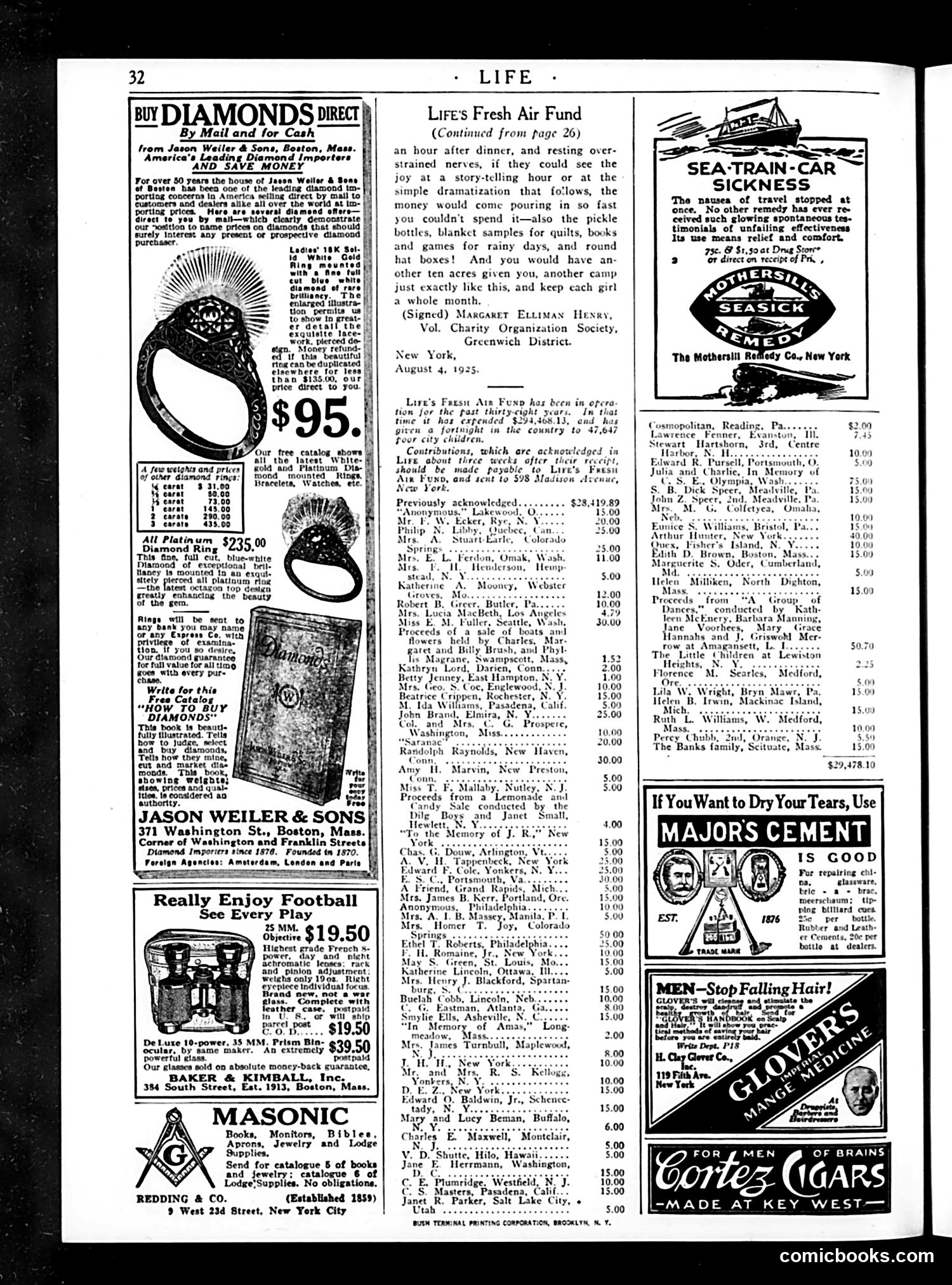
This page is primarily **advertising and charity content**, not political satire. The main features are: 1. **Diamond ring advertisements** from Jason Weiler & Sons (Boston jeweler) - showing elaborate engagement and cocktail rings priced at $95 and $235 2. **Life's Fresh Air Fund** - a charity appeal listing donor contributions for providing outdoor recreation to underprivileged children. The signed letter from Margaret Elliman Henery describes the fund's purpose. 3. **Various product advertisements** including sea-train-car sickness remedy, Masonic supplies, football radio sets, and men's hair loss treatments The page contains **no political cartoons or satire**. It reflects 1920s consumer culture and philanthropic concerns typical of Life magazine's format during this period.
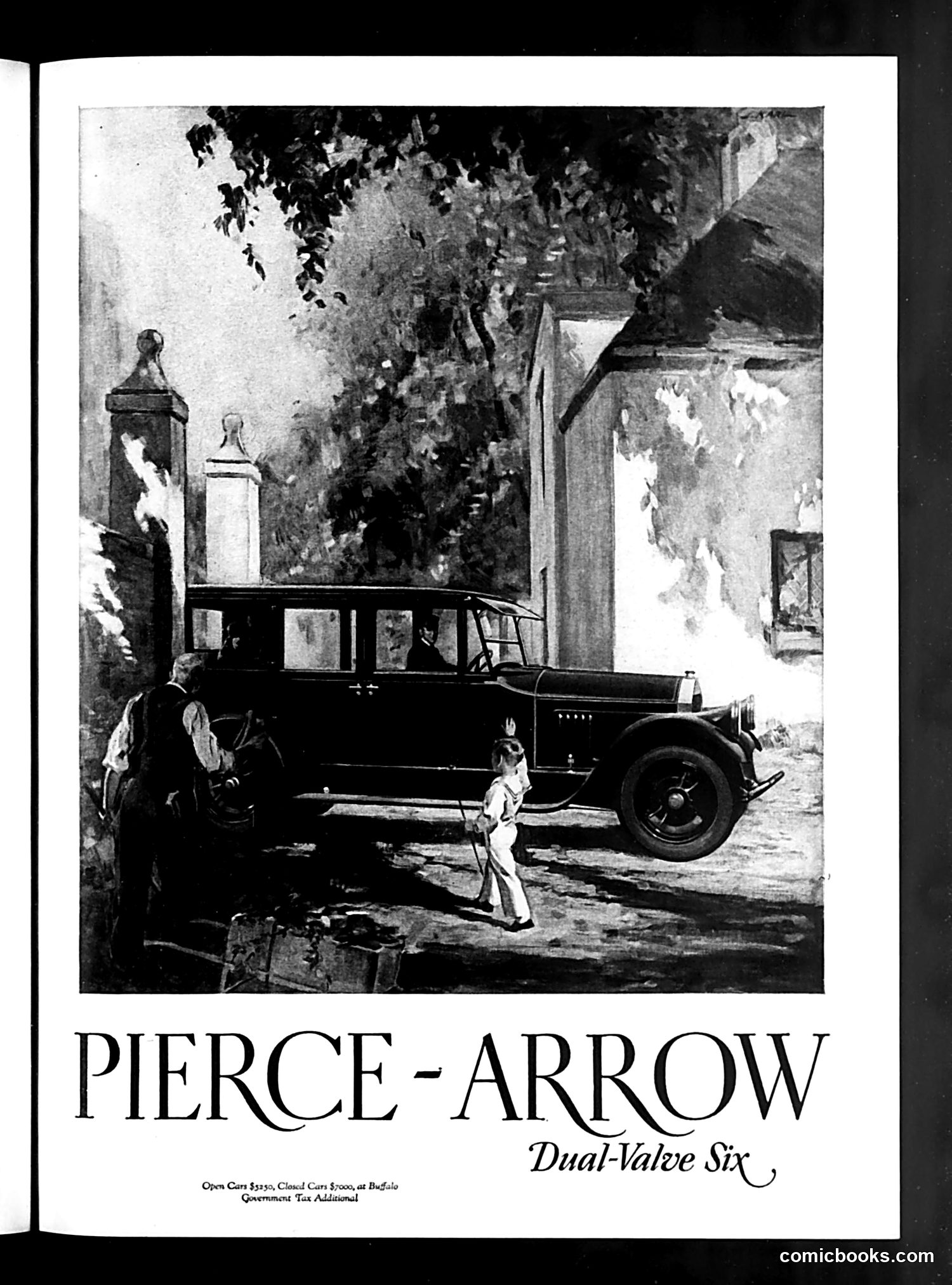
This is a **product advertisement**, not political satire. It depicts a Pierce-Arrow automobile (a luxury car brand) parked in what appears to be a Mediterranean or European courtyard setting with ivy-covered walls and classical urns. The ad promotes the "Dual-Valve Six" model with pricing information: open cars at $3,250 and closed cars at $7,000 (plus government tax). The scenic setting and well-dressed figures suggest this was marketed as a luxury vehicle for affluent buyers. There is **no political cartoon or satire present** on this page—it's a straightforward commercial advertisement from Life magazine's advertising section, likely from the 1920s based on the car's design and pricing.
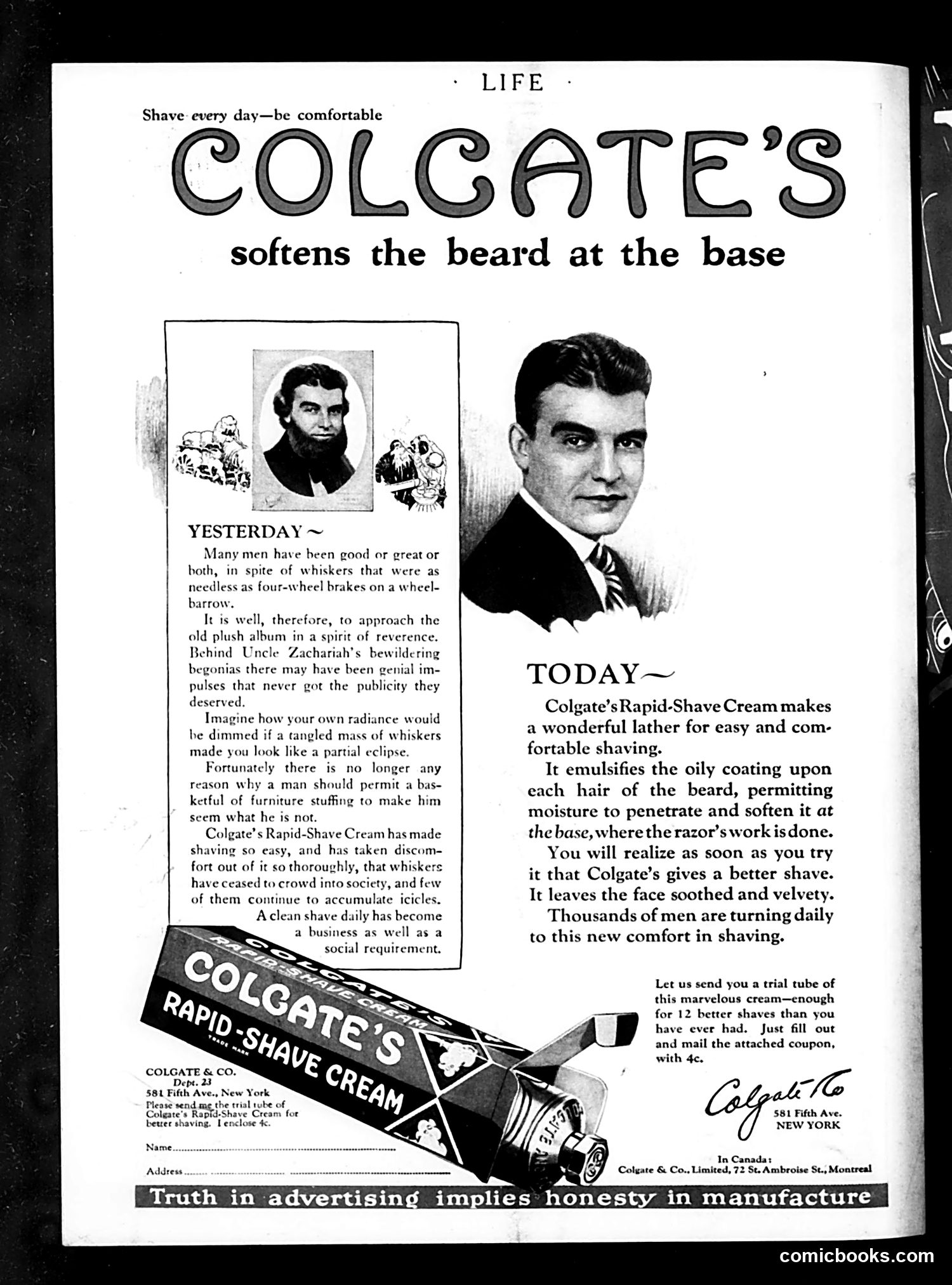
This is primarily a **product advertisement**, not a political cartoon. The "satire" is gentle and commercial rather than political. The ad uses a "Yesterday vs. Today" comparison structure. The left side mocks bearded men of the past—invoking "Uncle Zachariah" and old photographs—suggesting that visible whiskers made respectable men look ridiculous ("partial eclipse"). The ad humorously argues that historical figures succeeded *despite* their beards, implying they'd have done better clean-shaven. The right side presents a modern, clean-shaven businessman as the ideal. The copy emphasizes that daily shaving has become both a "business" and "social requirement"—a pitch that cleanliness and grooming equal respectability and success. The underlying message: **modern masculine success requires daily shaving with Colgate's product**. This reflects early 20th-century advertising's promotion of grooming as a marker of civilization and social fitness. There's no specific political figure or event referenced—just period attitudes about masculinity, modernity, and propriety.