
Life, 1925-09-17 · page 26 of 36
Life — September 17, 1925 — page 26: what you’re looking at
What you’re looking at
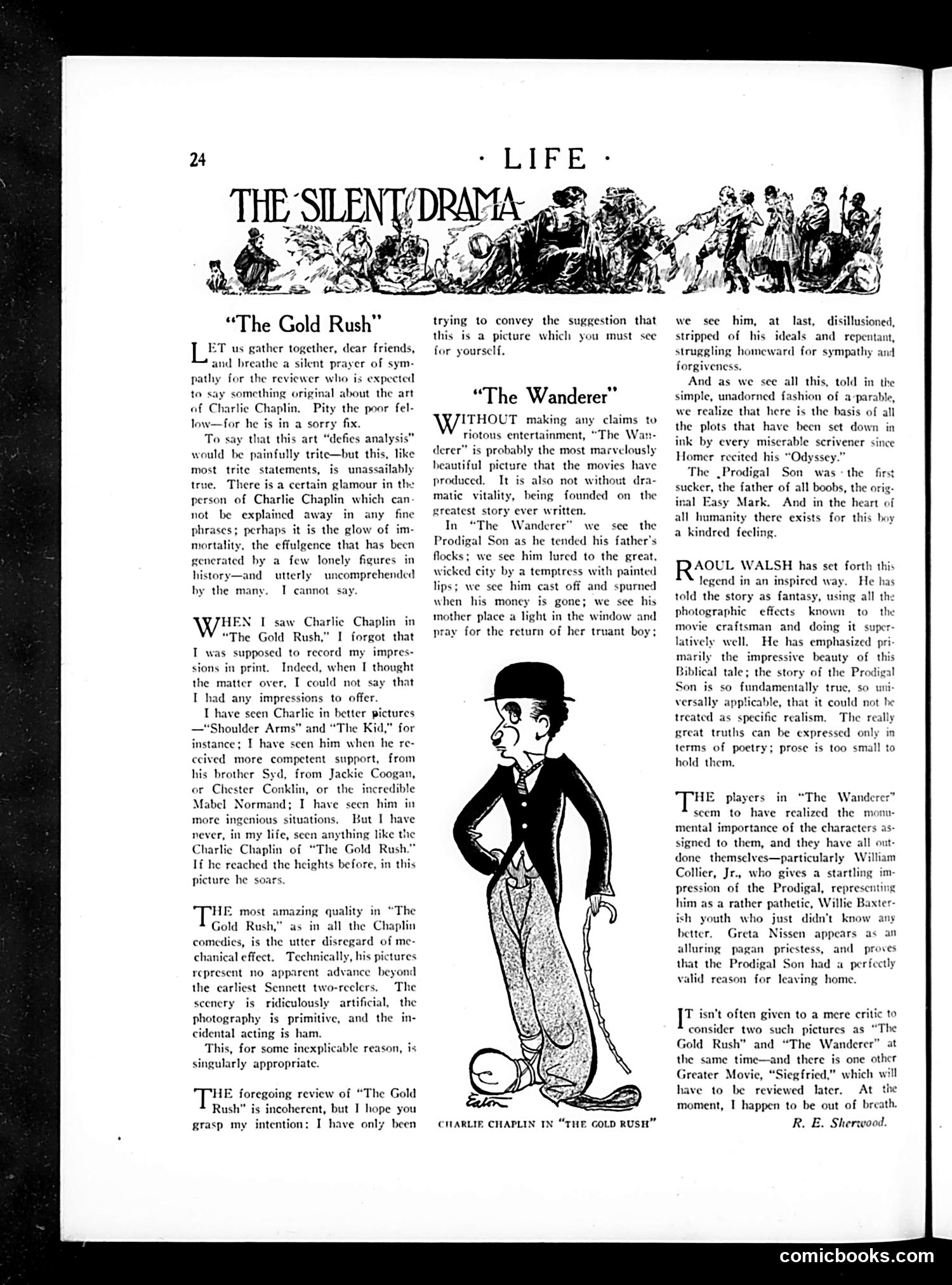
This page reviews two Charlie Chaplin films: **"The Gold Rush"** and **"The Wanderer."** The illustration shows **Chaplin's iconic "Tramp" character**—his bowler hat, cane, baggy pants, and mustache were his trademark silent-film persona. The reviewer (R.E. Sherwood) struggles to articulate Chaplin's appeal, acknowledging it's inexplicable yet undeniable. He praises *The Gold Rush* despite its technical primitiveness, arguing that Chaplin's star quality transcends mechanical filmmaking. The review of *The Wanderer* treats it as a faithful adaptation of the Biblical Prodigal Son parable, emphasizing that great truths require poetic rather than realistic treatment. The context: This appears to be from the 1920s, when silent films dominated cinema and Chaplin was arguably cinema's biggest star. The reverent tone reflects how seriously film criticism was emerging as a cultural medium.
📄 Transcribed text from this page (OCR, searchable)
Machine-transcribed from the original scan — historical spelling and the odd misread are preserved.
“The Gold Rush” T us gather together, dear friends, and breathe a silent prayer of sym- pathy for the reviewer who is expected to say something original about the art aplin, Pity the poor fel- say that this art “defies analysis” would be painfully trite—but this, like most trite statements, is unassailably true. There is a certain glamour in the person of Charlie Chaplin which can not be explained away in any fine phrases; perhaps it is the glow of im- mortality, the effulgence that has been generated by a few lonely figures in history—and utterly uncomprehended by the many. T cannot say. HEN I saw Charlie Chaplin in “The Gold Rush,” I forgot that T was supposed to record my impres- sions in print. Indeed, when I thought the matter over, I could not say that I had any impressions to offer. I have seen Charlie in better pictures —“Shoulder Arms” and “The Kid,” for instance; I have scen him when he re- ccived more competent support, from his brother Syd, from Jackie Coogan, or Chester Conklin, or the incredible Mabel Normand; I have seen him in more ingenious situations, But I have never, in my life, seen anything like the Charlie Chaplin of “The Gold Rush.” If he reached the heights before, in this picture he soars. HE most amazing quality in “The Gold Rush,” as in all the Chaplin comedies, is the utter disregard of me- chanical effect. Technically, his pictures represent no apparent advance beyond the carliest Sennett two-reclers, The scenery is ridiculously artificial, the photography is primitive, and the in- cidental acting is ham. This, for some inexplicable reason, is singularly appropriate. HE foregoing review of “The Gold Rush” is incoherent, but I hope you grasp my intention: I have only been trying to convey the suggestion that this is a picture which you must. see for yourself. “The Wanderer” ITHOUT making any claims to riotous entertainment, “The War derer” is probably the most marvelous! beautiful picture that the movies have produced. It is also not without dra- matic vitality, being founded on the greatest story ever written. In “The Wanderer” we see the Prodigal Son as he tended his father’s flocks; we see him lured to the great. wicked city by a temptress with painted lips; we see him cast off and spurned when his money is gone; we see his mother place a light in the window and pray for the return of her truant boy; CHARLIE CHAPLIN IN “THE GOLD RUSH” we see him, at last, disillusioned, stripped of his ideals and repentant, struggling homeward for sympathy and forgiveness. And as we see all this, told in the simple, unadorned fashion of a-parable, we realize that here is the basis of all the plots that have been set down in ink by every miserable scrivener since Homer recited his “Odyssey. The ,Prodigal Son was the first the father of all boobs, the ori; inal Easy Mark, And in the heart ¢ all humanity there exists for this boy a kindred feeling. Rice LSH has set forth this legend in an inspired way. He has told the story as fantasy, using all the photographic effects known to the movie craftsman and doing it super latively well. He has emphasized pri- marily the impressive beauty of this Biblical tale; the story of the Prodigal Son is so fundamer true, so uni versally applicable, that it could not treated as specific realism. The really great truths can be expressed only in terms of poetry; prose is too small to hold them. “THE. players in “The Wanderer” scem to have realized the mental importance of the characters as- signed to them, and they have all out- done themselves—particularly William Collier, Jr., who gives a startling im pression of the Prodigal, representing him as a rather pathetic, Willie Baxter- ish youth who just didn’t know any better. Greta Nissen appears as an alluring pagan. priestess, and proves that the Prodigal Son had a perfectly ‘alid reason for leaving home. I" isn’t often given to a mere critic to consider two such pictures as “The Gold Rush” and “The Wanderer” at the same time—and there is one other Greater Movie, “Siegfried,” which will have to be reviewed later. At the moment, I happen to be out of breath. R. E. Sherwood. comicbooks.com