
Life, 1925-09-17 · page 24 of 36
Life — September 17, 1925 — page 24: what you’re looking at
What you’re looking at
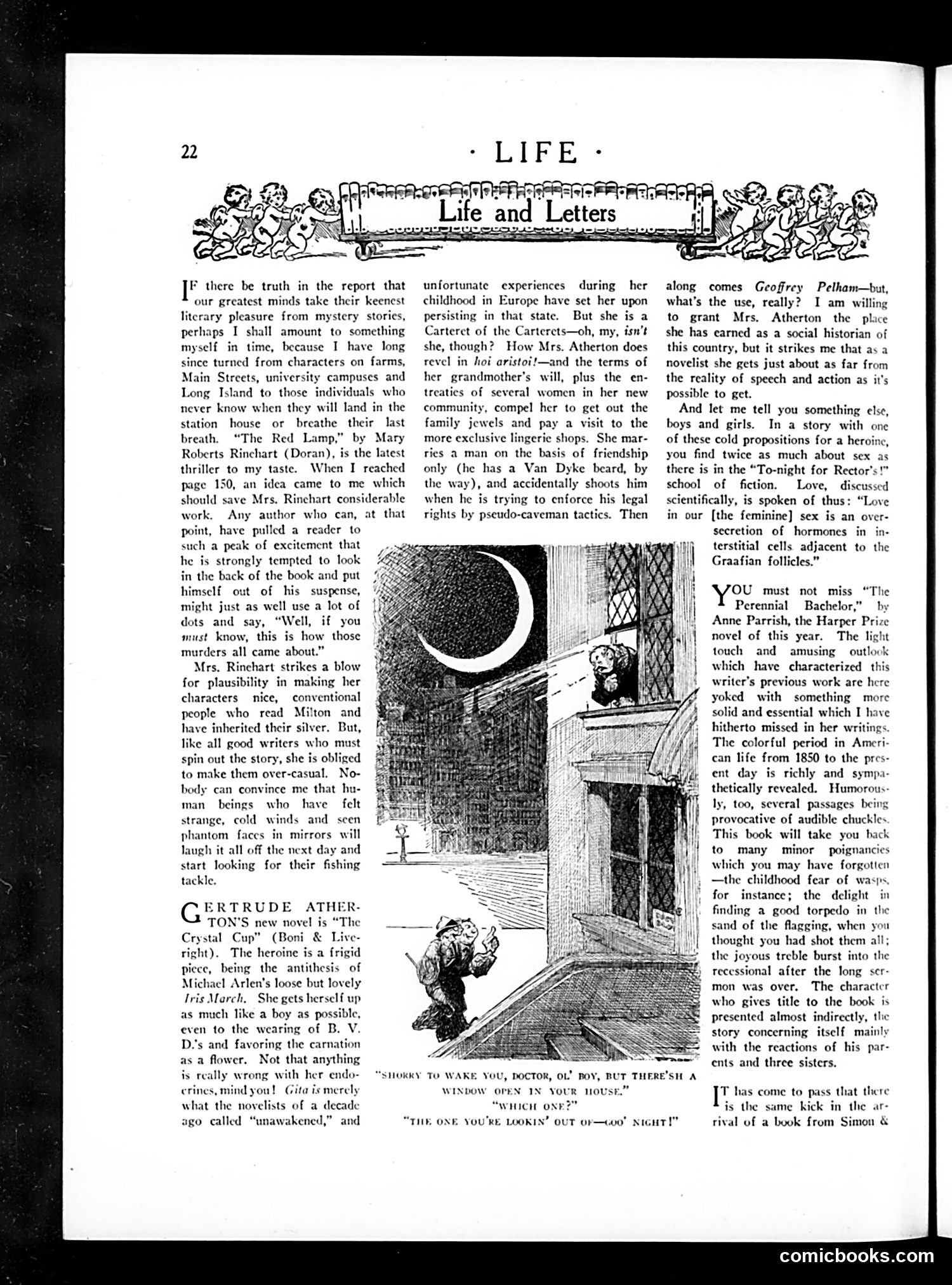
This page contains literary criticism of contemporary novels, illustrated with a charming line drawing of a figure at a window. The reviewer discusses three books: **"The Red Lamp"** by Mary Roberts Rinehart—a mystery thriller the critic praises for realistic characters, though noting the author artificially prolongs suspense. **"The Crystal Cup"** by Gertrude Atherton—criticized for its heroine who deliberately dresses and acts masculine ("unawakened" sexually). The reviewer mocks Atherton's pretentious focus on aristocratic lineage ("hoi aristoi") and her clinical, pseudo-scientific discussion of female sexuality using anatomical terminology rather than natural language. **"The Perennial Bachelor"** by Anne Parrish—praised as a Harper Prize winner with humor and historical depth about American life from 1850 onward. The overall tone is witty, somewhat gossipy criticism aimed at educated readers familiar with these popular authors. The reviews exemplify 1920s literary taste and attitudes toward women's sexuality in fiction.
📄 Transcribed text from this page (OCR, searchable)
Machine-transcribed from the original scan — historical spelling and the odd misread are preserved.
IF there be truth in the report that our greatest minds take their keenest literary pleasure from mystery stories, perhaps I shall amount to something myself in time, because I have long since turned from characters on farms, Main Streets, university campuses and Long Island to those individuals who never know when they will land in the station house or breathe their last breath, “The Red Lamp,” by Mary Roberts Rinchart (Doran), is the latest thriller to my taste. When I reached page 150, an idea came to me which should save Mrs. Rinehart considerable work. Any author who can, at that point, have pulled a reader to such a peak of excitement that he is strongly tempted to look in the back of the book and put himself out of his suspense, might just as well use a lot of dots and say, “Well, if you must know, this is how those murders all came about.” Mrs. Rinehart strikes a blow for plausibility in making her characters nice, conventional people who read Milton and have inherited their silver. But, like all good writers who must spin out the story, she is obliged to make them over-casual. No- body can convince me that hu- man beings who have felt strange, cold winds and scen phantom faces in mirrors will laugh it all off the next d. start looking for their fishing le. ERTRUDE ATH TON’S new novel is “ Crystal Cup” (Boni & Li right). The heroine is a frigid piece, being the antithesis of Michael Arlen’s loose but lovely Tris March, She gets herself up as much like a boy as possible, even to the wearing of B. V. D.’s and favoring the carnation a flower. Not that anything is really wrong with her endo- crines, mind you! Gita is merely what the novelists of a decade ago called “unawakened,” and unfortunate experiences during her childhood in Europe have set her upon persisting in that state. But she is a Carteret of the Carterets—oh, my, isn’t she, though? How Mrs. Atherton does revel in hoi aristoi!—and the terms of her grandmother's will, plus the en- treaties of several women in her new community, compel her to get out the family jewels and pay a visit to the more exclusive lingerie shops. She mar- rics a man on the basis of friendship only (he has a Van Dyke beard, by the way), and accidentally shoots him when he is trying to enforce his legal rights by pseudo-caveman tactics. Then WINDOW OPEN IN YOUR 10UsE.” “TILE ONE YOU'RE LOOKIN’ OUT Or—coo" NIGHT!” along comes Geoffrey what's the use, really? I am willing to grant Mrs. Atherton the place she has earned as a social historian of this country, but it strikes me that as a novelist she gets just about as far from the reality of speech and action as it's possible to get. And let me tell you something else, boys and girls. In a story with one of these cold propositions for a heroine, you find twice as much about sex as there is in the “To-night for Rector’s!” school of fiction. Love, discussed scientifically, is spoken of thus: “Love in our [the feminine] sex is an over- secretion of hormones in in- terstitial cells adjacent to the Graafian follicles.” Pelham—but, OU must not miss “The Perennial Bachelor,” by Anne Parrish, the Harper Prize novel of this year. The light touch and amusing outlook which have characterized this writer's previous work are here yoked with something more solid and essential which I have hitherto missed in her writings. The colorful period in Ameri- can life from 1850 to the pres- ent day is richly and sympa- thetically revealed. Humorous- ly, too, several passages being provocative of audible chuckles. This book will take you hack to many minor poignancies which you may have forgotten —the childhood fear of wasps, for instance; the delight in finding a good torpedo in the sand of the flagging, when you thought you had shot them all; the joyous treble burst into the recessional after the long ser- mon was over. The character who gives title to the book is presented almost indirectly, the story concerning itself mainly with the reactions of his par- ents and three sisters. “SHOKKY TO WAKE YOU, DOCTOR, OL’ ROY, BUT THERE’SH A T has come to pass that there is the same kick in the ar- rival of a book from Simon & comicbooks.com