
Life, 1925-09-17 · page 20 of 36
Life — September 17, 1925 — page 20: what you’re looking at
What you’re looking at
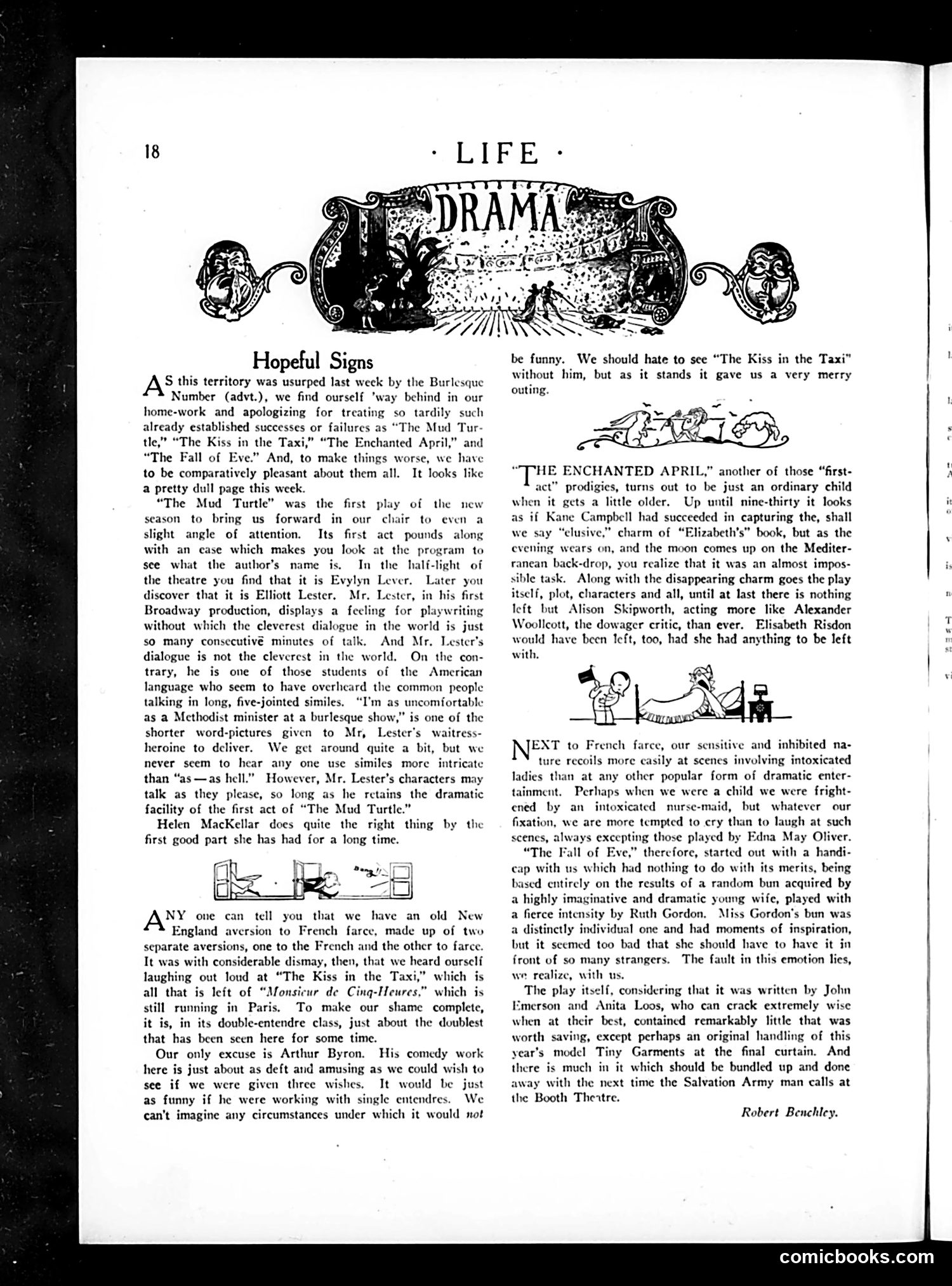
This is a drama criticism page reviewing four Broadway plays. The critic uses biting wit to assess recent productions: **"The Mud Turtle"** receives qualified praise for Elliott Lester's playwriting facility, though his dialogue relies heavily on overwrought similes ("as uncomfortable as a Methodist minister at a burlesque show"). Helen MacKellar performs well. **"The Kiss in the Taxi"** is a French farce adaptation the critic admits to enjoying despite their "New England aversion to French farce." Arthur Byron's comedic performance carries the entire production. **"The Enchanted April"** starts promisingly but deteriorates after 9:30 PM. Actress Alison Skipworth's performance increasingly resembles Alexander Woollcott—a reference to the famous theater critic, suggesting she's become pretentious and overwrought. The small decorative illustrations show theatrical scenes. The critic's tone is sophisticated, self-aware mockery of their own prejudices while delivering sharp assessments of performers and playwrights' abilities.
📄 Transcribed text from this page (OCR, searchable)
Machine-transcribed from the original scan — historical spelling and the odd misread are preserved.
Hopeful Signs AS this territory was usurped last week by the Burlesque Number (advt.), we find ourself "way behind in our home-work and apologizing for treating so tardily such already established successes or failures as “The Mud Tur- tle,” “The Kiss in the Taxi,” “The Enchanted April,” and “The Fall of Eve.” And, to make things worse, we have to be comparatively pleasant about them all. It looks like a pretty dull page this week. “The Mud Turtle” was the first play of the new season to bring us forward in our chair to even a slight angle of attention. Its first act pounds along with an case which makes you look at the program to see what the author's name is. In the half-light of the theatre you find that it is Evylyn Lever. Later you discover that it is Elliott Lester. Mr. Lester, in his first Broadway production, displays a feeling for playwriting without which the cleverest dialogue in the world is just so many consecutivé minutes of talk. And Mr. Lester's dialogue is not the cleverest in the world. On the con- trary, he is one of those students of the American language who seem to have overhcard the common people talking in long, five-jointed similes, “I'm as uncomfortable as a Methodist minister at a burlesque show,” is one of the shorter word-pictures given to Mr, Lester's waitress- heroine to deliver. We get around quite a bit, but we never scem to hear any one use similes more intricate than “as —as hell.” However, Mr. Lester’s characters may talk as they please, so long as he retains the dramatic facility of the first act of “The Mud Turtle.” Helen MacKellar does quite the right thing by the first good part she has had for a long time. AK. pee.” "a An one can tell you that we have an old New England rsion to French farce, made up of two separate aversions, one to the French and the other to farce. It was with considerable dismay, then, that we heard ourself laughing out loud at “The Kiss in the Ta: which is all that is left of “Monsieur de Cing-Heures,” which is still, running in Paris. To make our shame complete, it is, in its double-entendre class, just about the doublest that has been scen here for some time. Our only excuse is Arthur Byron. His comedy work here is just about as deft and amusing as we could wish to see if we were given three wishes. It would be just as funny if he were working with single entendres. We can’t imagine any circumstances under which it would not be funny. We should hate to sce “The Kiss in the Taxi” without him, but as it stands it gave us a very merry outing. HE ENCHANTED APRIL,” another of those “first- t” prodigies, turns out to be just an ordinary child when it gets a little older. Up until nine-thirty it looks as if Kane Campbell had succeeded in capturing the, shall we say “elusive,” charm of “Elizabeth's” book, but as the evening wears on, and the moon comes up on the Mediter- ranean back-drop, you realize that it was an almost impos- sible task. Along with the disappearing charm goes the play itself, plot, characters and all, until at last there is nothing left but Alison Skipworth, acting more like Alexander Woollcott, the dowager critic, than ever. Elisabeth Risdon would have been left, too, had she had anything to be left with. T to French farce, our sensitive and inhibited na- ture recoils more casily at scenes involving intoxicated ladies than at any other popular form of dramatic enter- tainment. Perhaps when we were a child we were fright- ened by an intoxicated nurse-maid, but whatever our fixation, we are more tempted to cry than to laugh at such scenes, always excepting those played by Edna May Oliver. “The Fall of Eve,” therefore, started out with a handi- cap with us which had nothing to do with its merits, being based entirely on the results of a random bun acquired by a highly imaginative and dramatic young wife, played with a fierce intensity by Ruth Gordon. Miss Gordon's bun was a distinctly individual one and had moments of inspiration, but it scemed too bad that she should have to have it in front of so many strangers. The fault in this emotion lies, we realize, with us, The play itself, considering that it was written by John Emerson and Anita Loos, who can crack extremely wise when at their best, contained remarkably little that was worth saving, except perhaps an original handling of this year’s model Tiny Garments at the final curtain. And there is much in it which should be bundled up and done away with the next time the Salvation Army man calls at the Booth Thertre. Robert Benchley. comicbooks.com