
A complete issue · 36 pages · 1925
Life — July 30, 1925
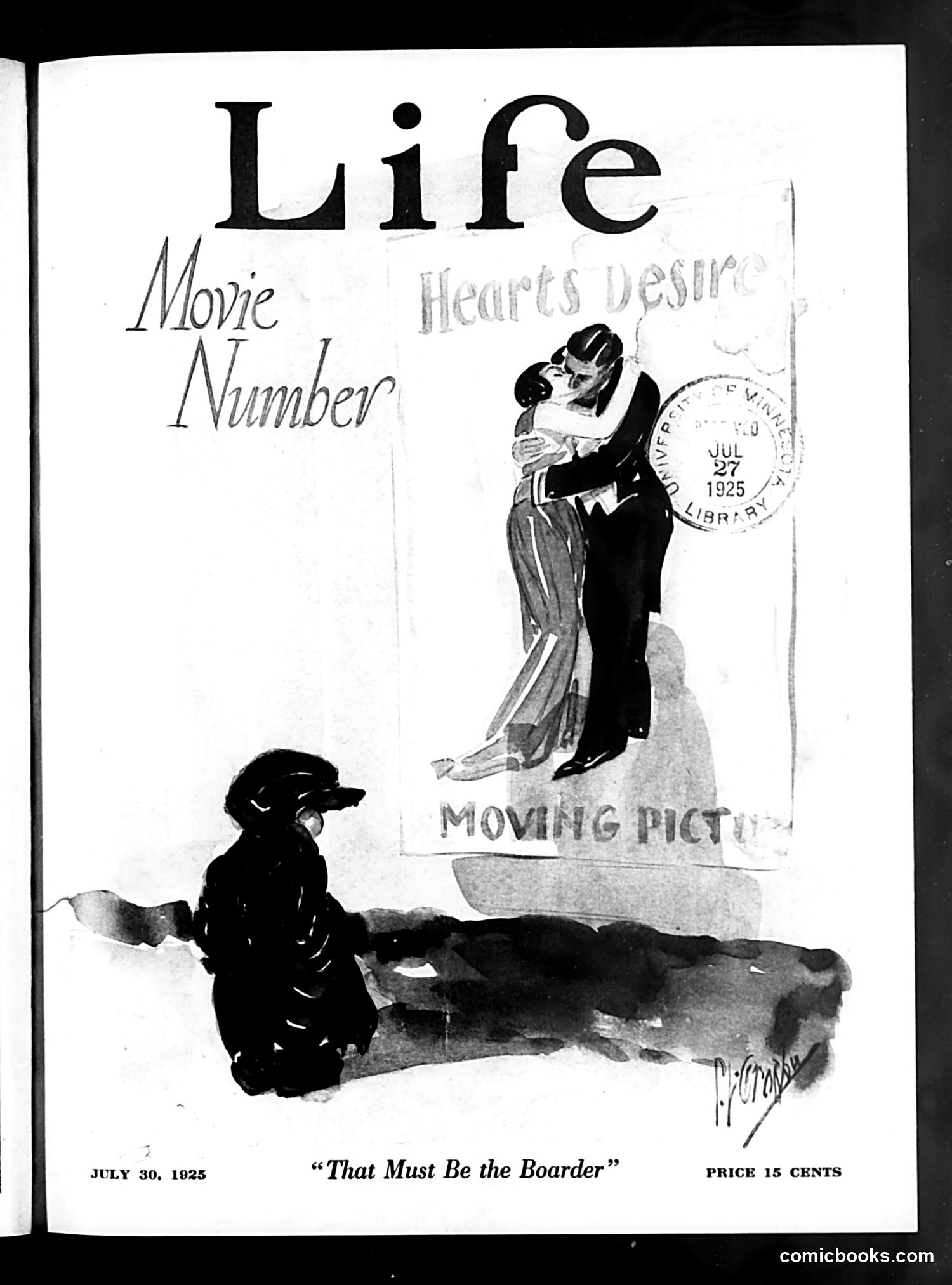
This is a cover for "Life" magazine's movie issue featuring the film "That Must Be the Boarder." The main illustration shows a romantic embrace between two figures—a man in formal attire and a woman in an elegant gown with a train. A silhouetted figure in the foreground (appearing to be a dog or possibly a boarder/tenant) watches from below, creating the joke: the title suggests this mysterious figure observing the intimate scene *must be* the boarder—an outsider witnessing romance in what's presumably shared housing. The humor exploits the 1920s trope of comedic boarding-house situations and the awkwardness of close quarters. The illustration's art deco styling and romantic tone contrast with the humorous scenario suggested by the title.
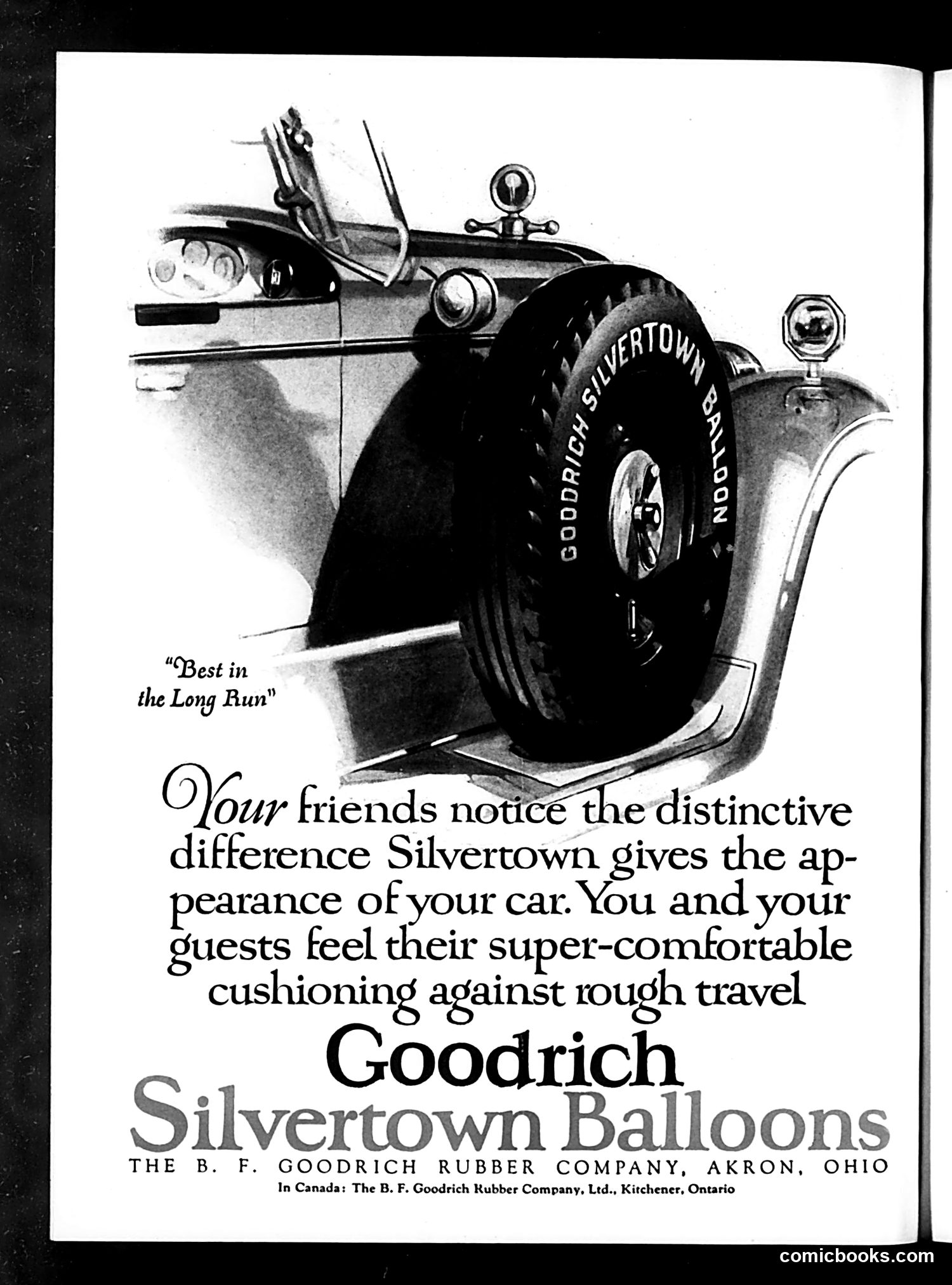
This is **not a political cartoon or satire**—it's a straightforward **product advertisement** for Goodrich Silvertown Balloons (tires), made by the B.F. Goodrich Rubber Company of Akron, Ohio. The ad features a detailed illustration of a vintage automobile with emphasis on its tire, which displays "GOODRICH SILVERTOWN BALLOON" text. The tagline "Best in the Long Run" promotes durability for extended driving. The sales pitch emphasizes that Silvertown tires give cars a distinctive appearance and provide "super-comfortable cushioning against rough travel"—highlighting the tire technology's comfort benefits to passengers. This represents typical early-20th-century automotive advertising focusing on tire quality and comfort as selling points.
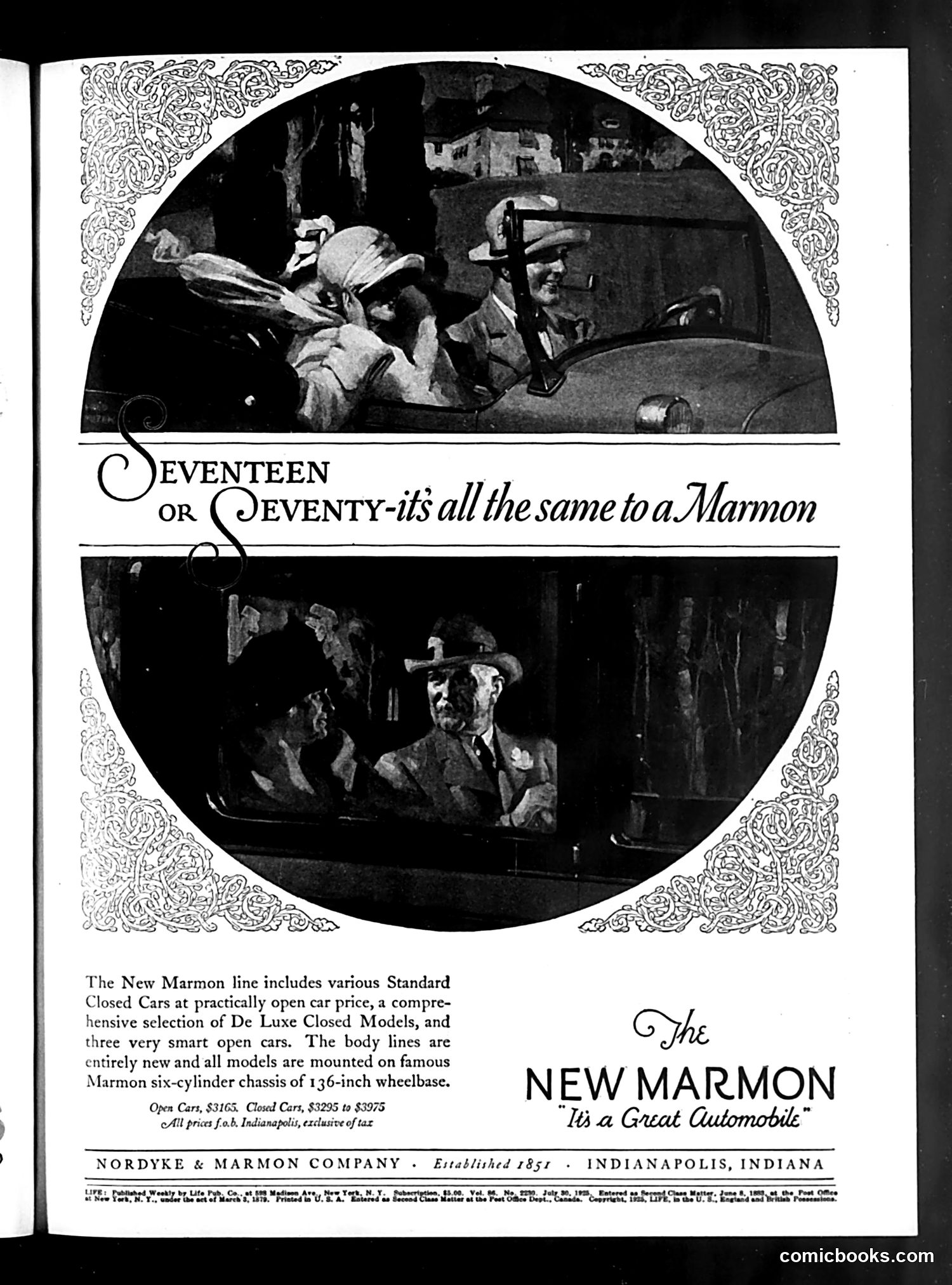
This is primarily a **Marmon automobile advertisement**, not political satire. The page shows two scenes of people in early automobiles with the headline "Seventeen or Seventy—it's all the same to a Marmon." The advertisement's humor relies on a social commentary: the joke suggests that regardless of a person's age (whether young at seventeen or old at seventy), everyone enjoys driving a Marmon car equally. This appeals to broad demographics by implying the vehicle's universal appeal and comfort. The decorative border and formal layout are typical of 1920s magazine advertising design. The text emphasizes Marmon's various car models, prices, and manufacturing details. The "Great Automobile" tagline reflects period marketing language promoting American automotive achievement.
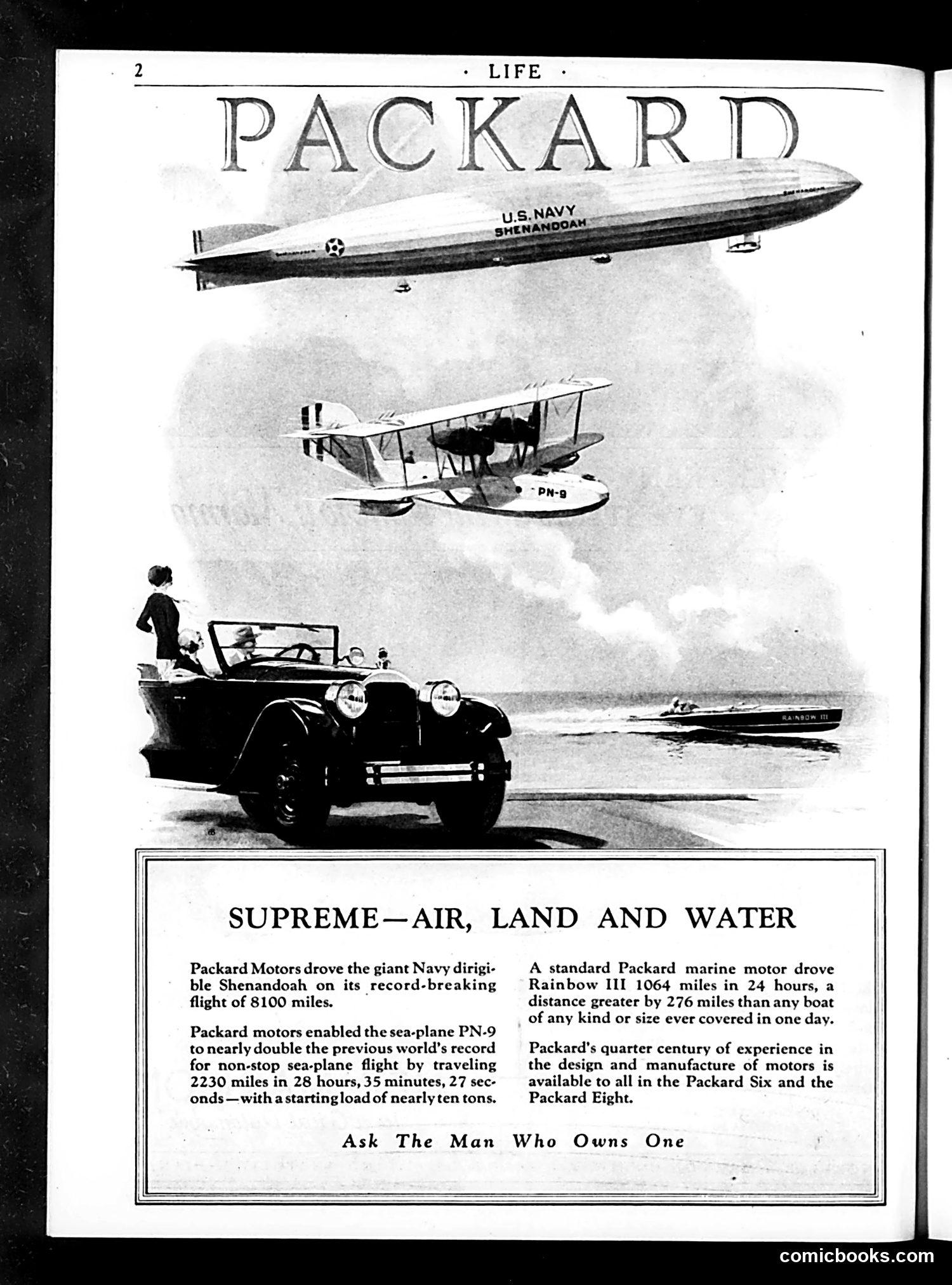
This page is **primarily an advertisement**, not political satire. It promotes Packard Motors' engineering achievements across three transportation modes. The ad highlights: - **U.S. Navy dirigible Shenandoah** powered by Packard engines, which flew 8,100 miles - **Seaplane PN-9** with Packard motors, setting a non-stop flight record of 2,230 miles in 28+ hours - **Packard automobile** shown alongside a speedboat, emphasizing the brand's dominance in "air, land and water" The tagline "Ask The Man Who Owns One" was Packard's famous slogan. This represents corporate boasting about technological superiority during the 1920s aviation boom, when such records were major news. The ad conflates military/aviation achievements with consumer automotive sales—implying Packard's reliability across all domains.
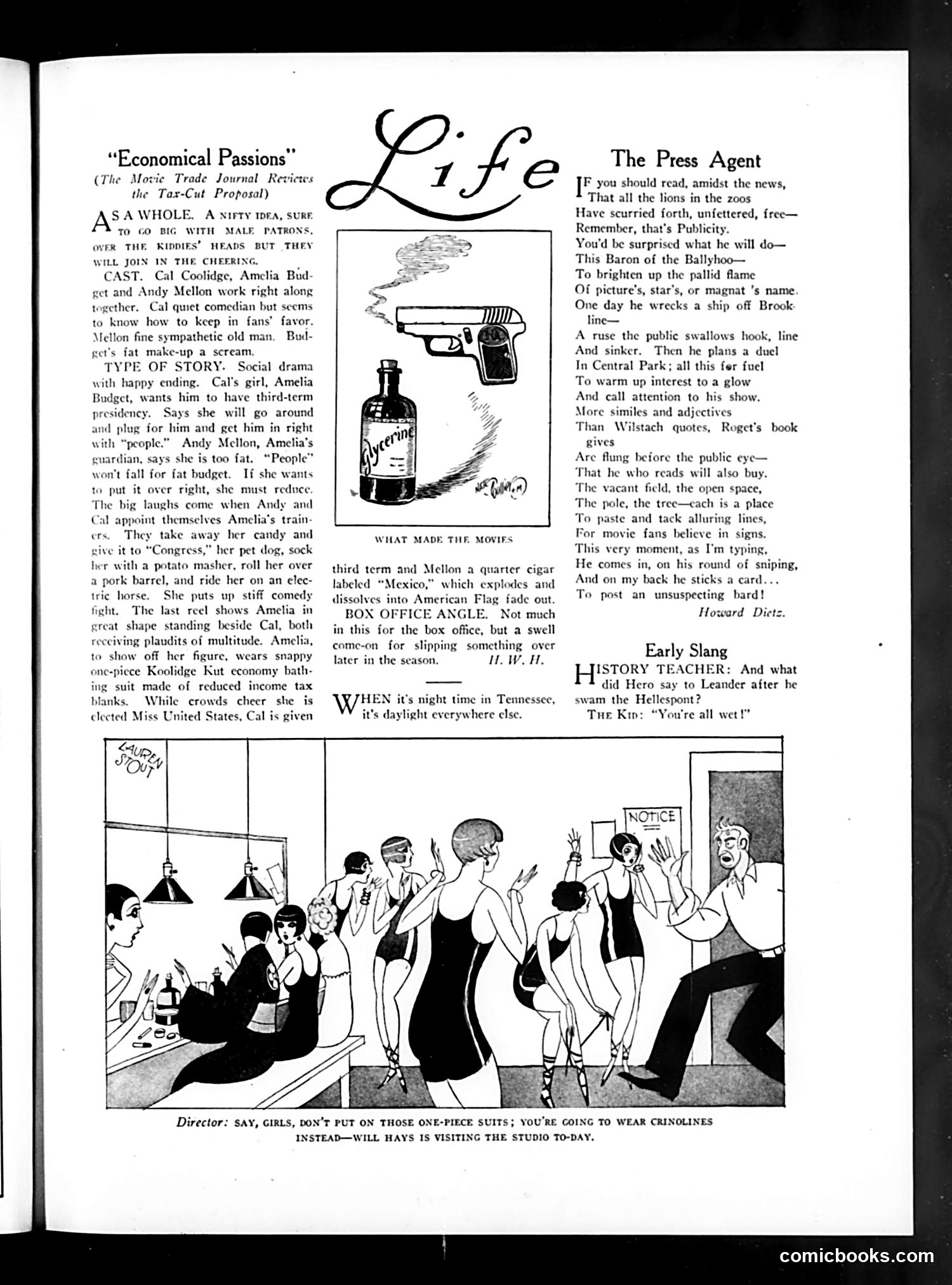
This page contains entertainment industry satire from the 1920s. The top section criticizes Hollywood's promotional tactics, particularly "The Press Agent" column by Howard Dietz, mocking how studios manufacture publicity through sensationalism—lions escaping zoos, staged incidents in Central Park—to generate newspaper coverage and draw audiences. The cartoon below depicts a film director instructing actresses to wear "crinolines" instead of one-piece swimsuits during a studio visit, implying that studios deliberately manipulate what visitors see to create false impressions of propriety. The joke satirizes Hollywood's hypocrisy: studios carefully controlled their public image while privately operating differently. This reflects 1920s anxiety about cinema's influence and Hollywood's manufactured personas.
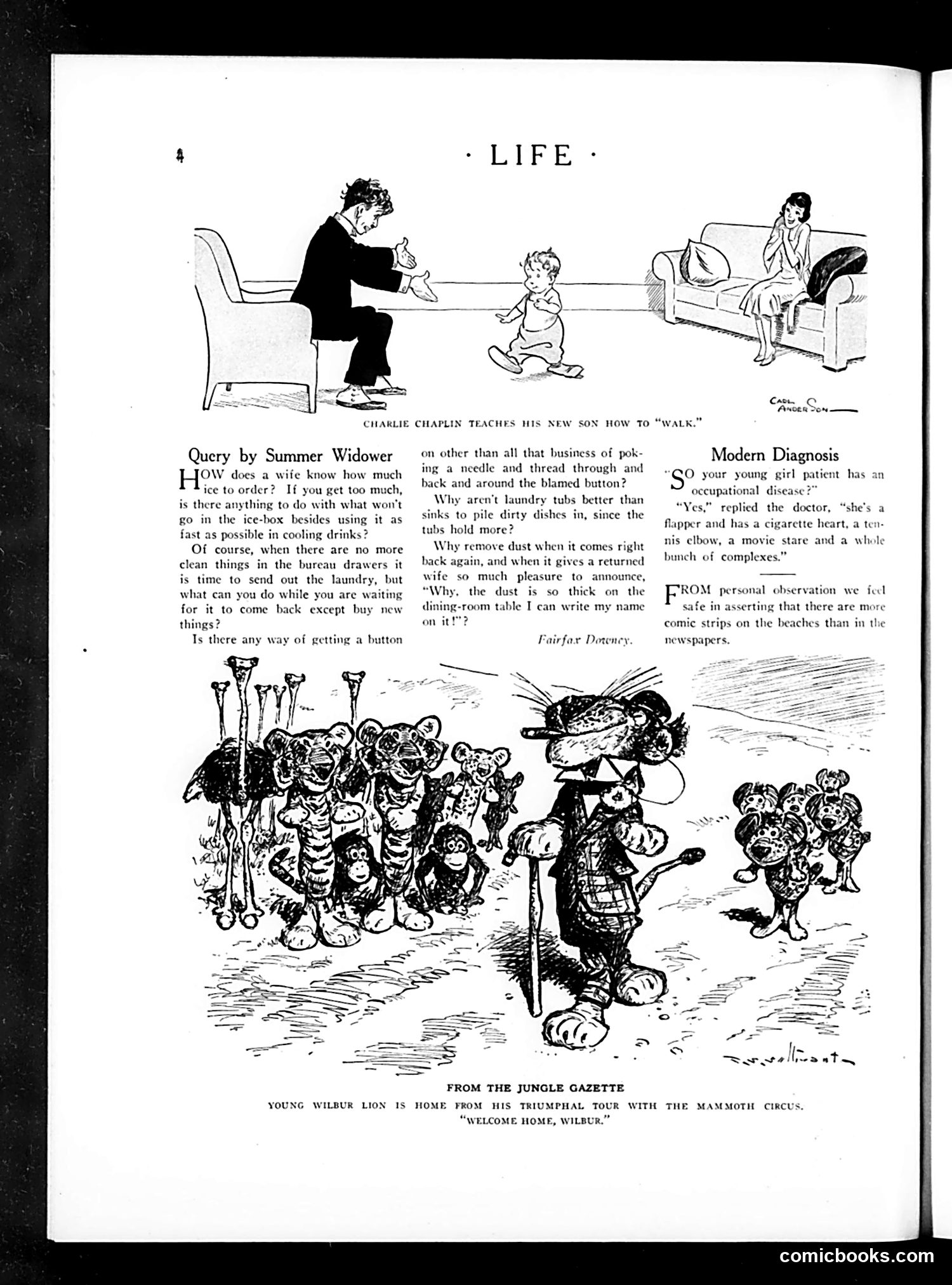
**Top Cartoon:** Charlie Chaplin teaches his young son to walk—a sentimental domestic scene referencing Chaplin's famous "Tramp" character and his real-life fatherhood. **"Query by Summer Widower":** Humorous advice column poking fun at domestic life during summer, when wives apparently manage households better than husbands. The jokes mock male incompetence at household tasks like cooking and laundry. **"Modern Diagnosis":** A brief quip about a young female patient diagnosed with multiple personality flaws (flirtatiousness, vanity, etc.)—satirizing pseudo-psychological trends of the era. **Bottom Cartoon:** "From the Jungle Gazette" depicts a lion's homecoming from circus tour. This appears to be whimsical animal humor rather than political satire, showing the lion greeted enthusiastically by family. The page blends domestic humor, gender-role satire, and absurdist animal comics typical of 1920s-era Life magazine.
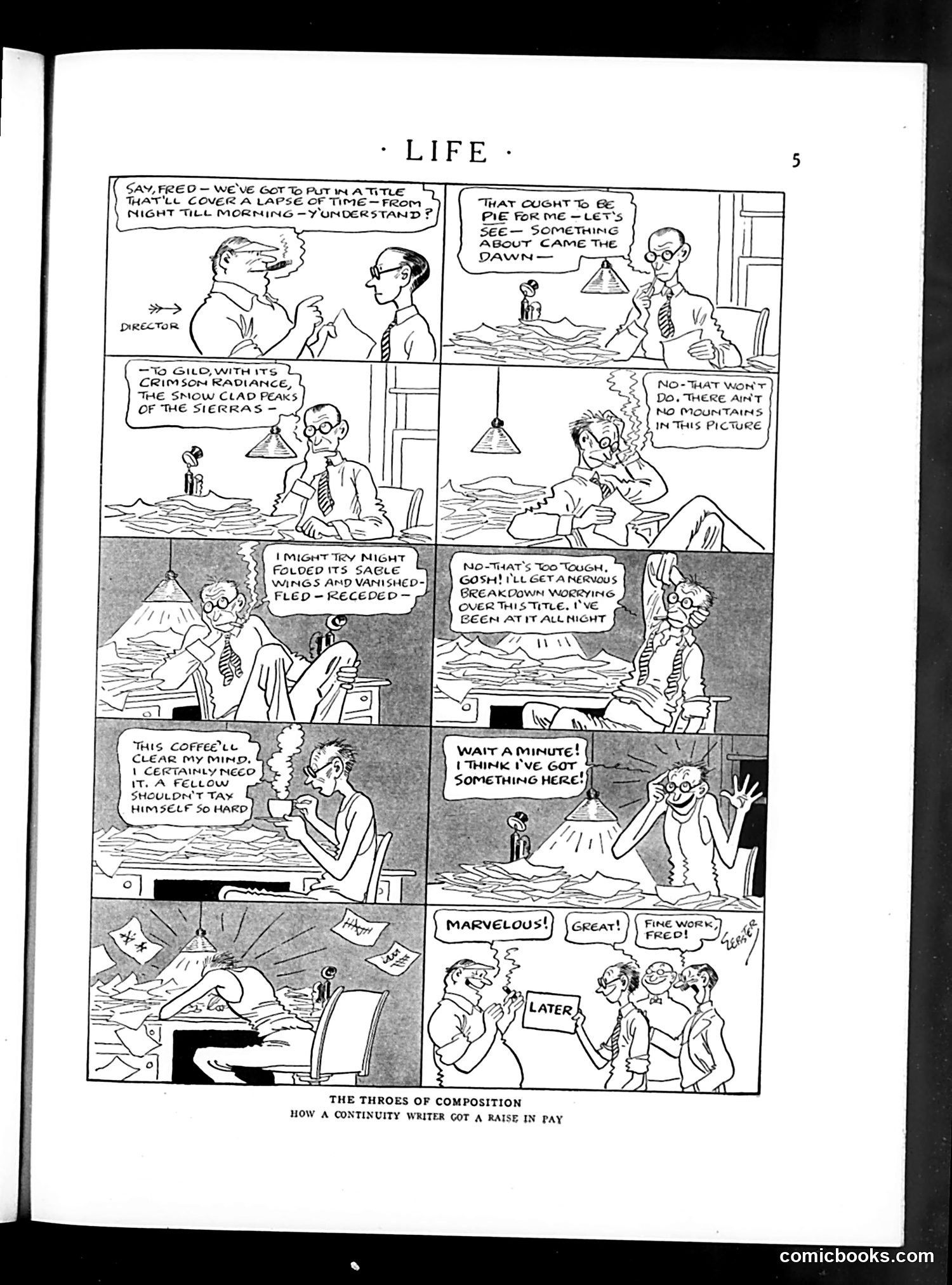
This comic satirizes the creative struggles of a pulp fiction writer working on serialized stories ("continuity" referring to ongoing comic strip or serial narratives). The director pressures the unnamed writer to produce a title covering "a lapse of time—from night till morning." The writer labors through the night, repeatedly rejecting story ideas as too clichéd (mountain vistas, bird imagery). Finally finding acceptable material, he excitedly presents his work to the director and colleagues, who praise it as "marvelous" and "great." The satire mocks both the formulaic nature of pulp fiction and the disconnect between creative struggle and easy acceptance—the writer's exhaustion and self-doubt contrast sharply with the effortless praise that apparently earns him his raise.
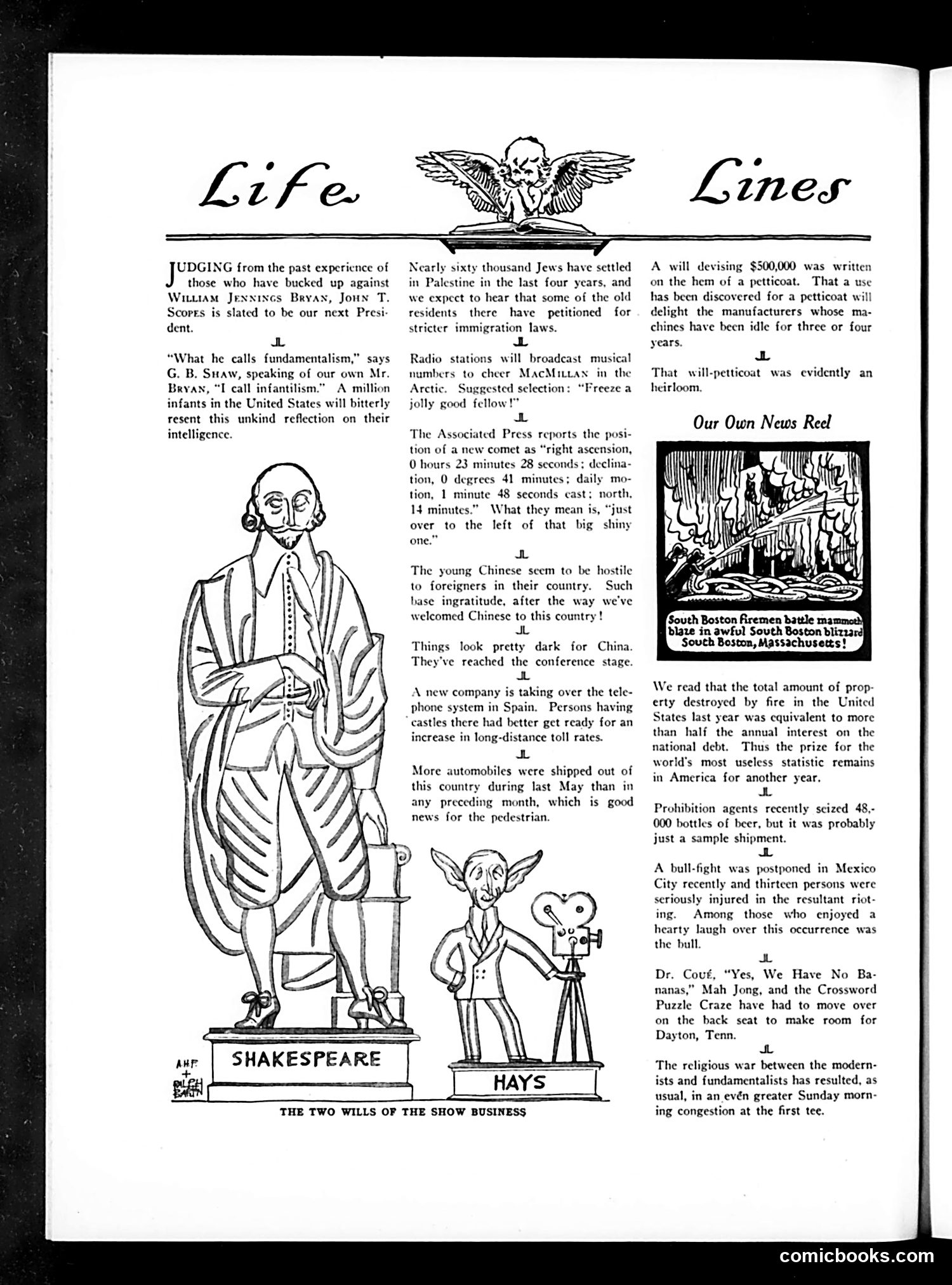
This cartoon compares Shakespeare and Will Hays, likely the film industry's censorship chief. Shakespeare is depicted as a skeletal anatomical figure—suggesting his classical, enduring importance but also his "death" or irrelevance. Hays appears as a small, demonic figure operating a movie camera, implying he controls modern entertainment. The satire suggests that Hays's censorship standards now govern American culture more powerfully than Shakespeare's literary legacy. The contrast in size emphasizes how a bureaucratic censor has replaced traditional artistic authority. This reflects 1920s anxieties about corporate control of entertainment and the loss of cultural autonomy to industry gatekeepers.
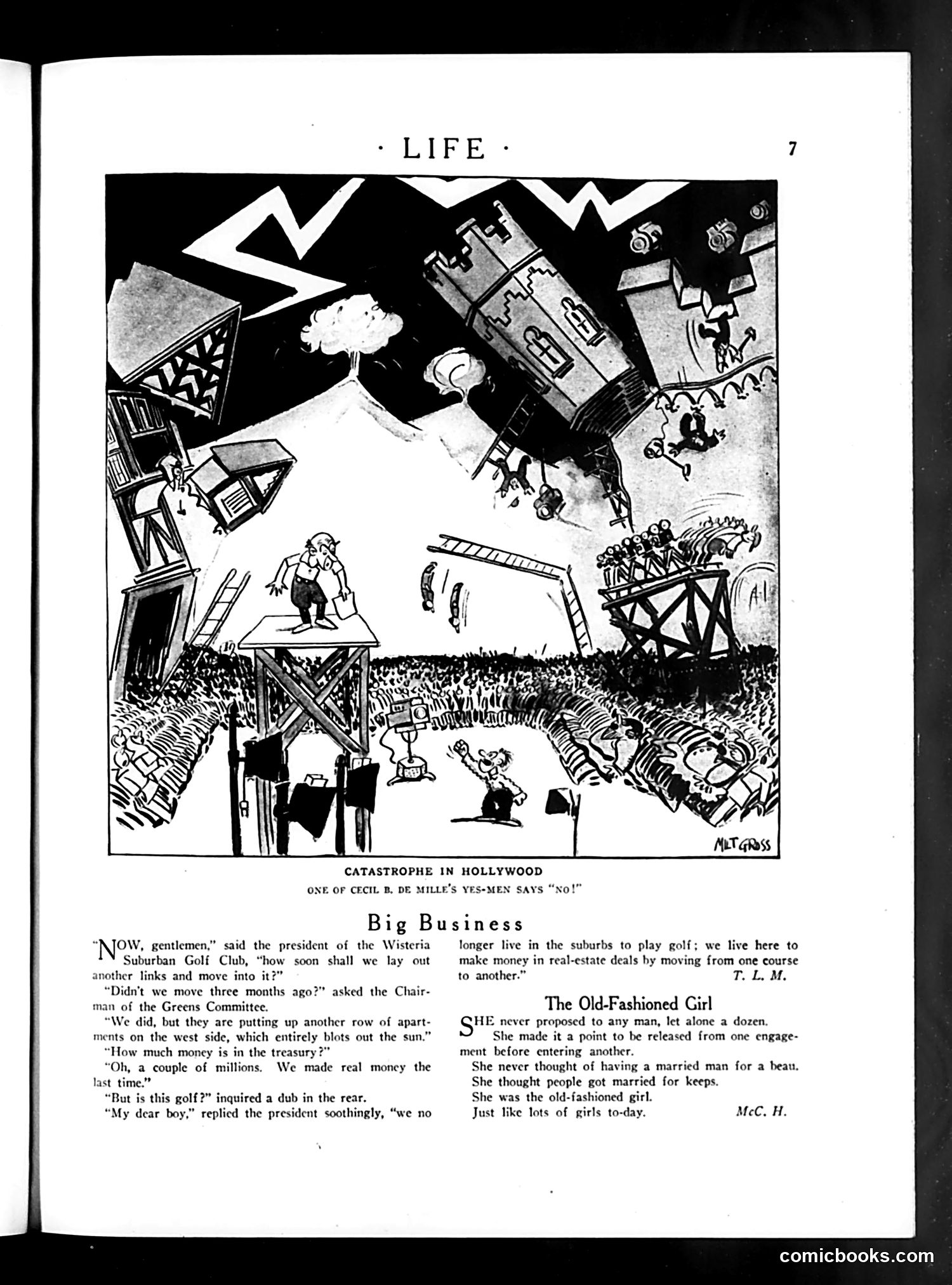
This cartoon satirizes the real-estate speculation boom of the 1920s. The chaotic scene depicts a movie studio lot collapsing into disaster—buildings toppling, crowds fleeing—while executives remain oblivious to the chaos around them. The caption attributes the disaster to Cecil B. DeMille's "Yes-Men," suggesting studios were run by yes-men who enabled poor decisions. The accompanying "Big Business" text mocks suburban golf-club developers planning endless real-estate schemes for profit rather than genuine need, saying "we no longer live in the suburbs to play golf; we live here to make money in real-estate deals." The satire targets both Hollywood's excess and the broader speculative mania that preceded the 1929 stock market crash, ridiculing both film industry hubris and real-estate profiteering culture.
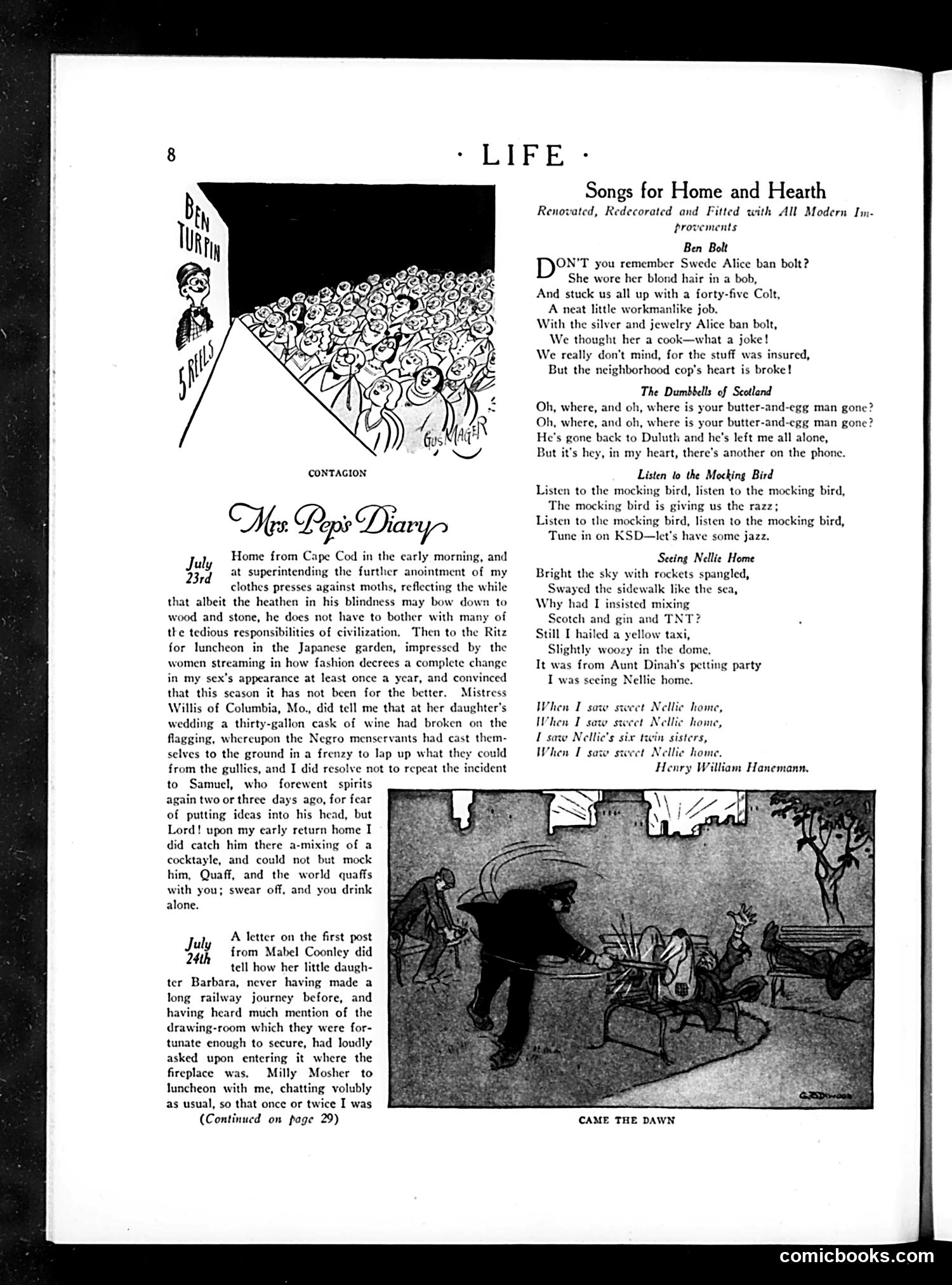
This page contains **Mrs. Pep's Diary**, a humorous domestic column, rather than political satire. The left side shows a cartoon labeled "CONTAGION" depicting a crowded theater or public venue, satirizing how infectious diseases spread in close quarters—a recurring public health concern of the era. The diary entries recount social mishaps: a woman mistaking a workmanlike maid for a cook, a broken cask of wine at a wedding causing chaos, and a tipsy guest. These are gentle mockeries of upper-middle-class domestic life and social embarrassments. The right side features sentimental poems and songs for "Home and Hearth," suggesting nostalgic Americana. The illustration "CAME THE DAWN" shows a romantic or pastoral scene, complementing the sentimental verse. This is lighthearted domestic humor, not political commentary.
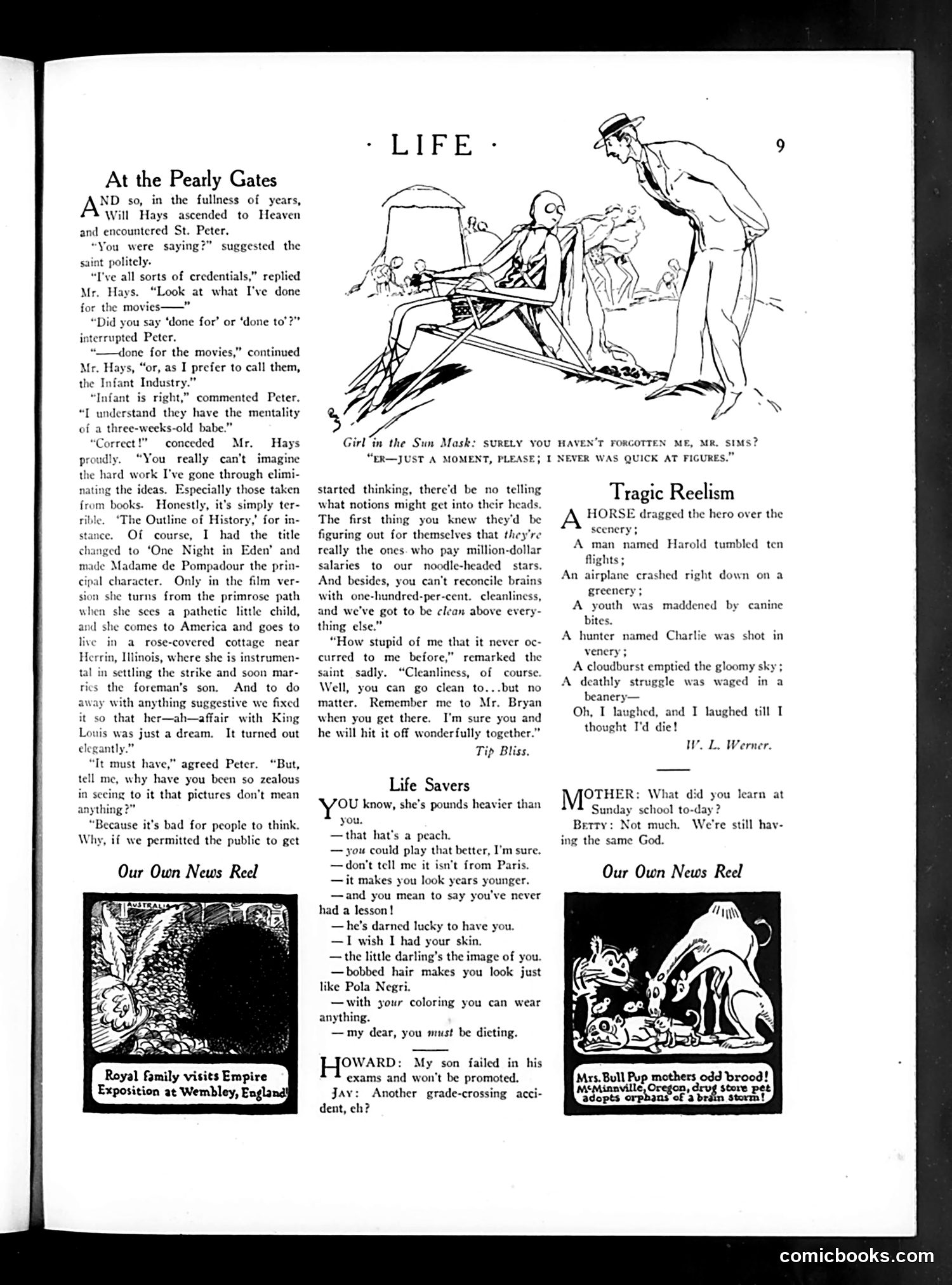
This page contains satirical commentary on Hollywood's film industry. The top section mocks Will Hays, the head of film censorship, who defended his work by claiming movies were the "Infant Industry." The dialogue jokes that if infants had the "mentality of a three-weeks-old babe," Hays's censorship standards made sense—insulting both the industry and its leadership. The cartoon "Girl in the Sun Mask" depicts a woman in outdoor leisure, with a man approaching. The caption humorously suggests she's forgotten him despite their previous acquaintance, poking fun at social interactions and vanity. Below are brief humorous anecdotes ("Life Savers") and comic strips titled "Our Own News Reel," including one about a royal family visit to Wembley Exposition and another about a dog producing odd offspring.
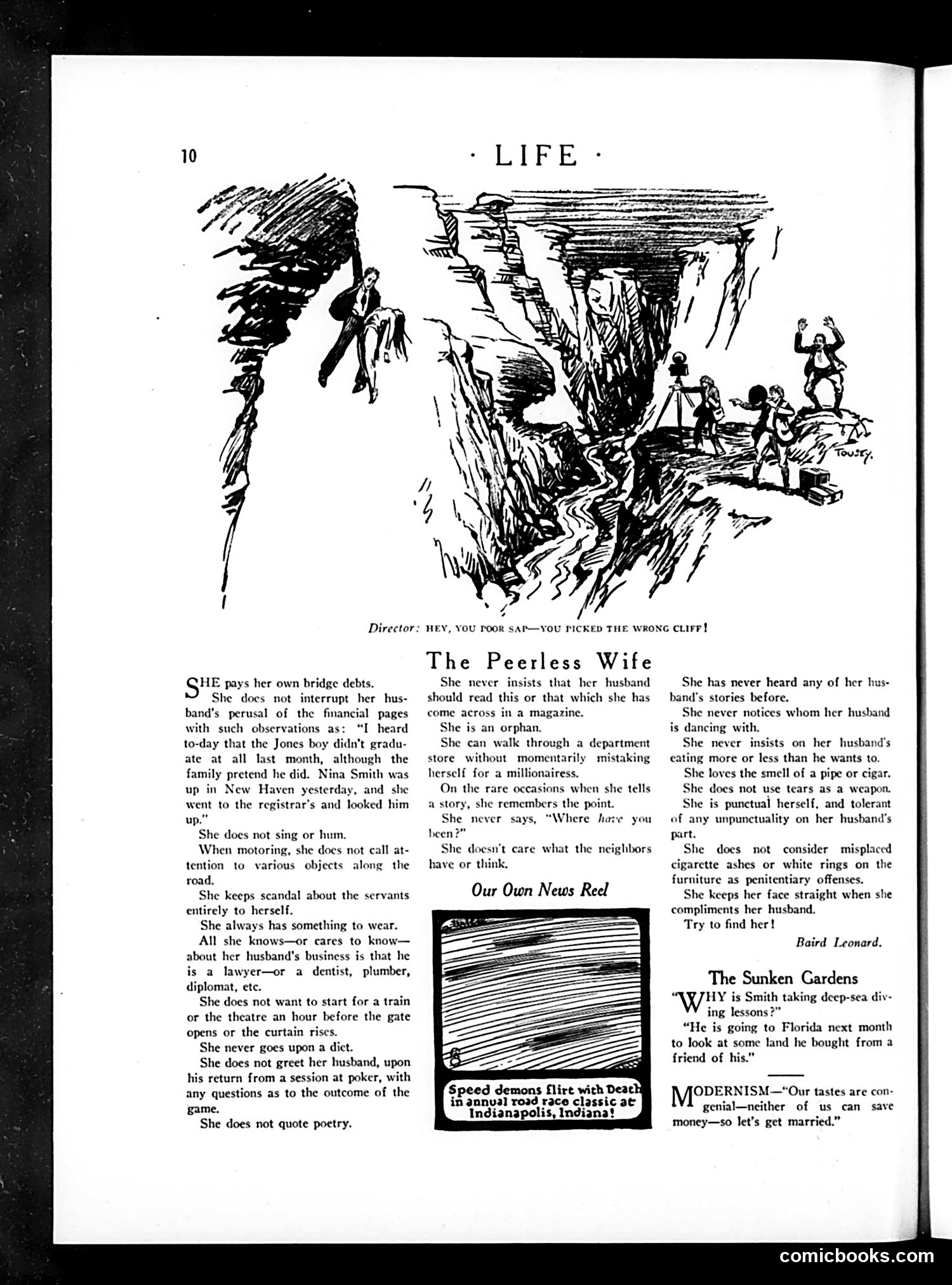
This page from *Life* magazine contains three distinct pieces of satirical content: **"The Peerless Wife"** (main article) satirizes the "ideal wife" through ironic praise. Rather than celebrating a woman's independence, it mocks societal expectations by listing behaviors considered desirable: she doesn't interrupt finances, never complains, doesn't sing or hum while motoring, keeps scandals hidden, and "never goes upon a diet." The satire critiques how women were expected to be invisible, undemanding, and self-effacing in early 20th-century marriages. **The cartoons above** depict what appears to be a film production scene with the caption "Director: HEY, YOU POOR SAP—YOU PICKED THE WRONG CLIFF!" This mocks silent-era filmmaking's theatrical dangers and possibly critiques early cinema's recklessness. The remaining items are brief humorous notes and an advertisement, not substantial satire.
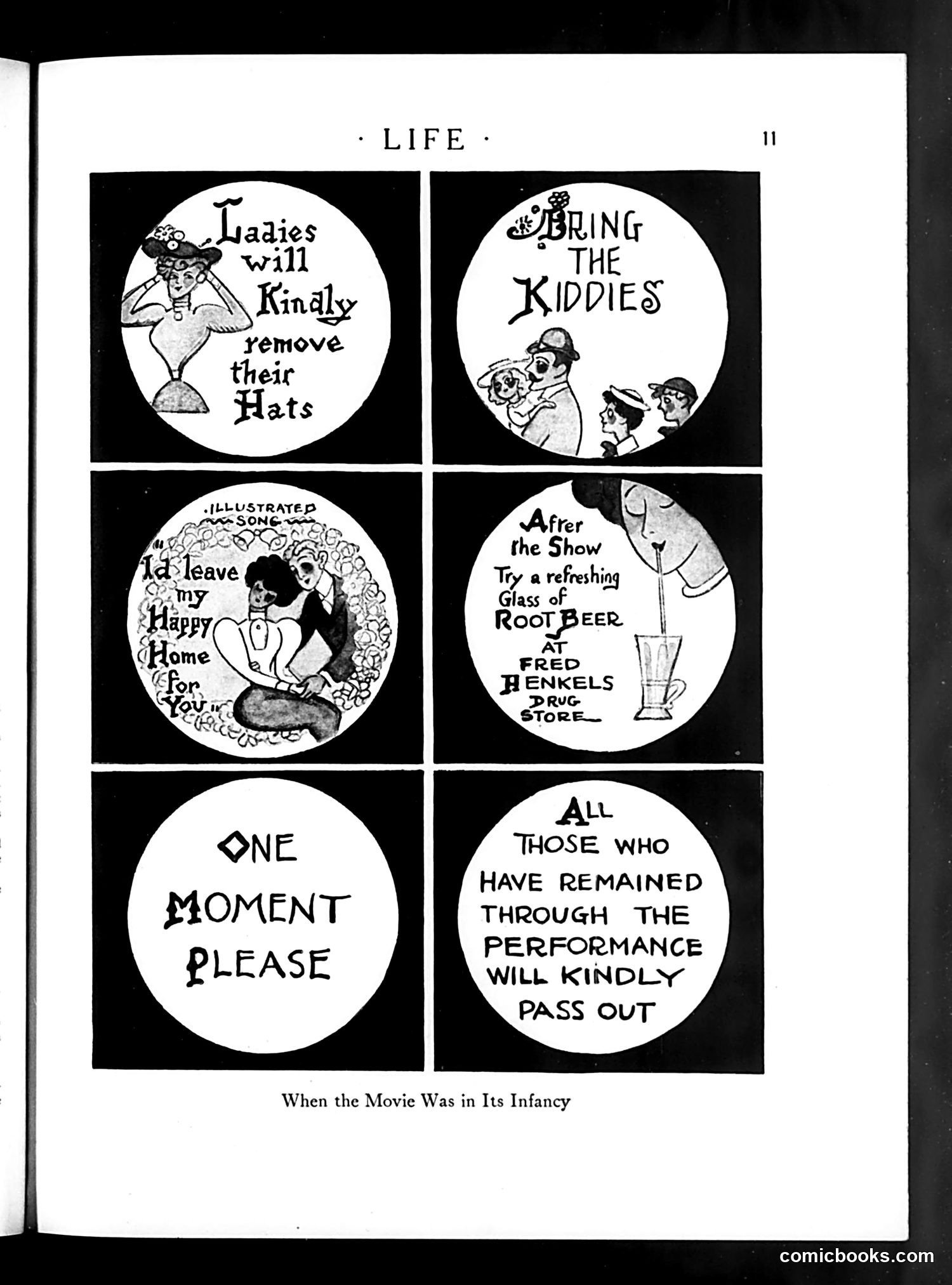
This page satirizes early cinema etiquette through six circular panels showing theater announcements. The humor contrasts primitive movie-going customs with what readers would recognize as current (1910s-era) practice. The panels mock outdated theater conventions: ladies removing hats (blocking other viewers' sight lines), bringing children, leaving early, and the theater passing out refreshments like root beer at the drugstore. The final panels—"One Moment Please" and announcements about audience behavior—suggest theaters had to constantly manage rowdy, disruptive patrons who didn't understand proper cinema conduct. The satire suggests that movie-going culture has matured from chaotic, undisciplined early days into a more refined social practice. It's essentially making fun of how uncivilized audiences once were.
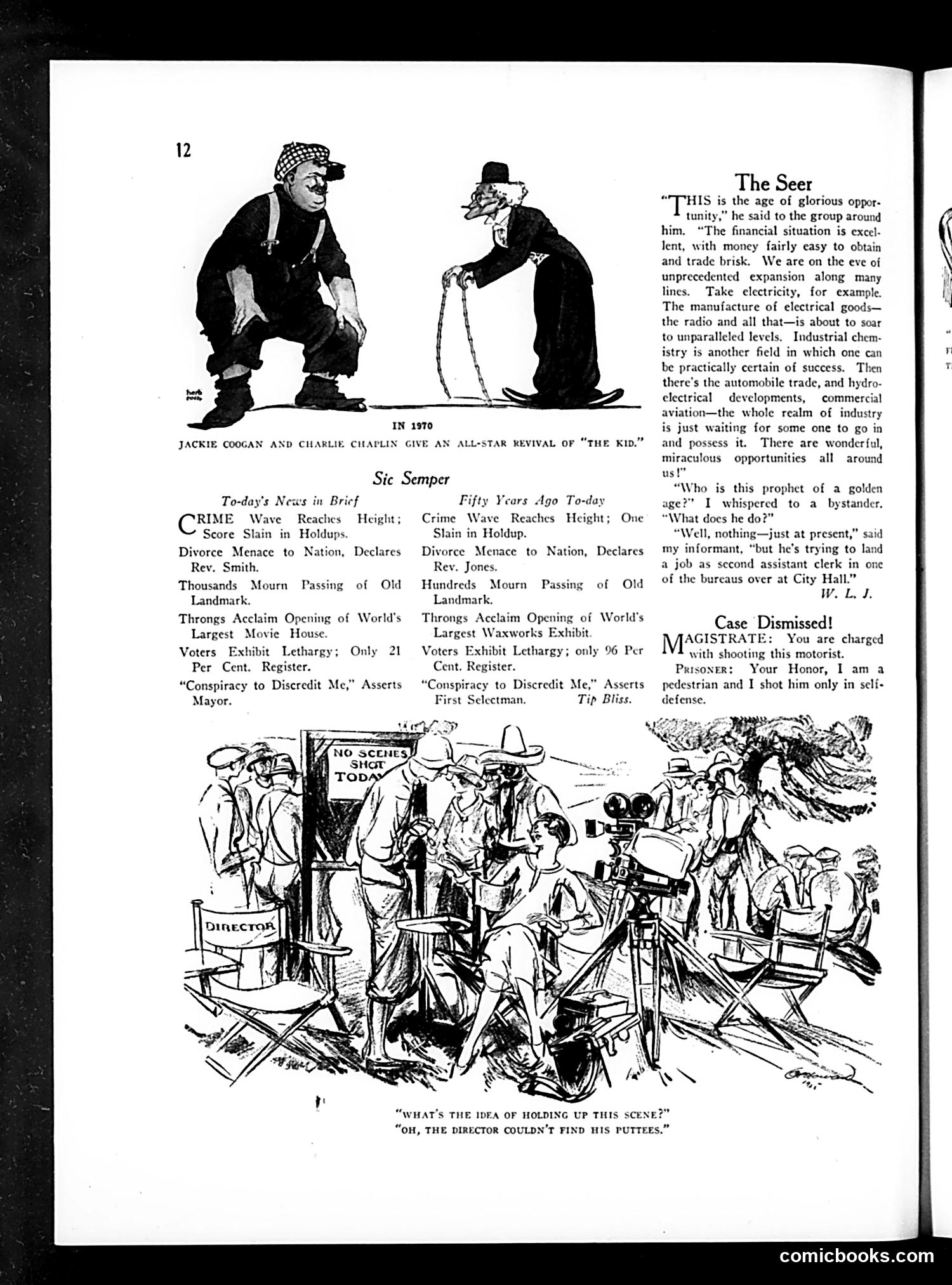
**Top cartoon** depicts Jackie Cogan and Charlie Chaplin in "The Kid" (1921), captioned as an "all-star revival." This references the famous silent film's success. **"Sic Semper"** section compares news headlines from today versus fifty years ago, sardonically suggesting little fundamental change despite progress claims—a common satirical trope. **"The Seer"** column presents an optimistic businessman predicting industrial expansion in electricity, automobiles, aviation, and chemicals—reflecting 1920s economic boom mentality. **Lower cartoon** mocks film production delays, showing a movie set with the director unable to locate his "putees" (leg wrappings), humorously explaining why scenes are being held up. This satirizes Hollywood's operational inefficiencies and behind-the-scenes chaos.
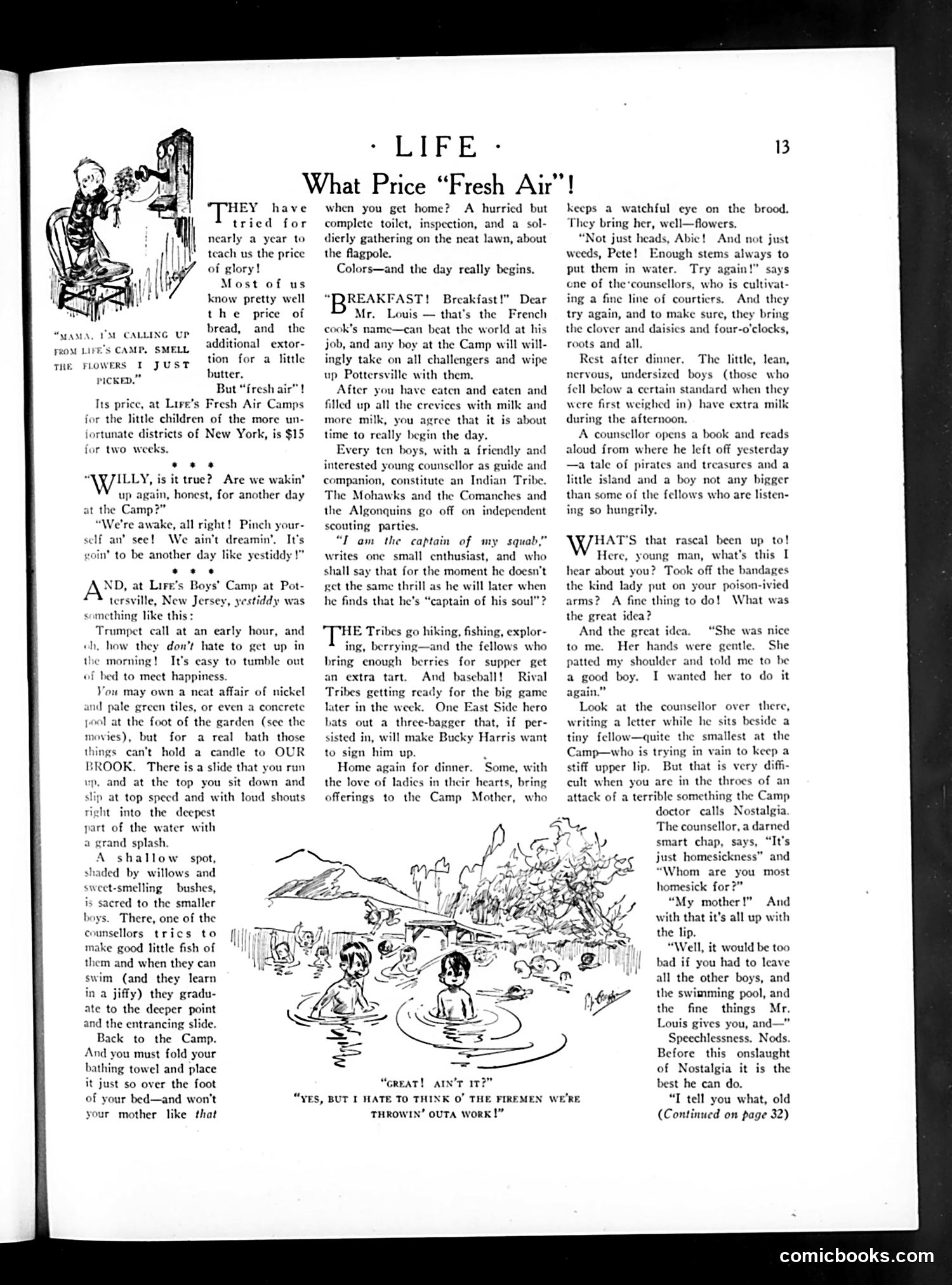
This article satirizes the supposed health benefits of summer camps for wealthy New York children. The piece mocks the exaggerated claims that camps provide "fresh air" and moral improvement, while revealing the actual experience: homesick children enduring uncomfortable conditions. The illustration shows boys swimming in what appears to be a modest pond or pool, with one saying "Great! Ain't it?" while another replies sarcastically about firemen throwing water out windows—suggesting the camp's water facilities are unremarkable. The satire targets the gap between parents' romantic notions of camp life and the mundane reality, while poking fun at the counselors' attempts to build character through activities like hiking and baseball. It's a gentle critique of upper-class pretensions about child-rearing.
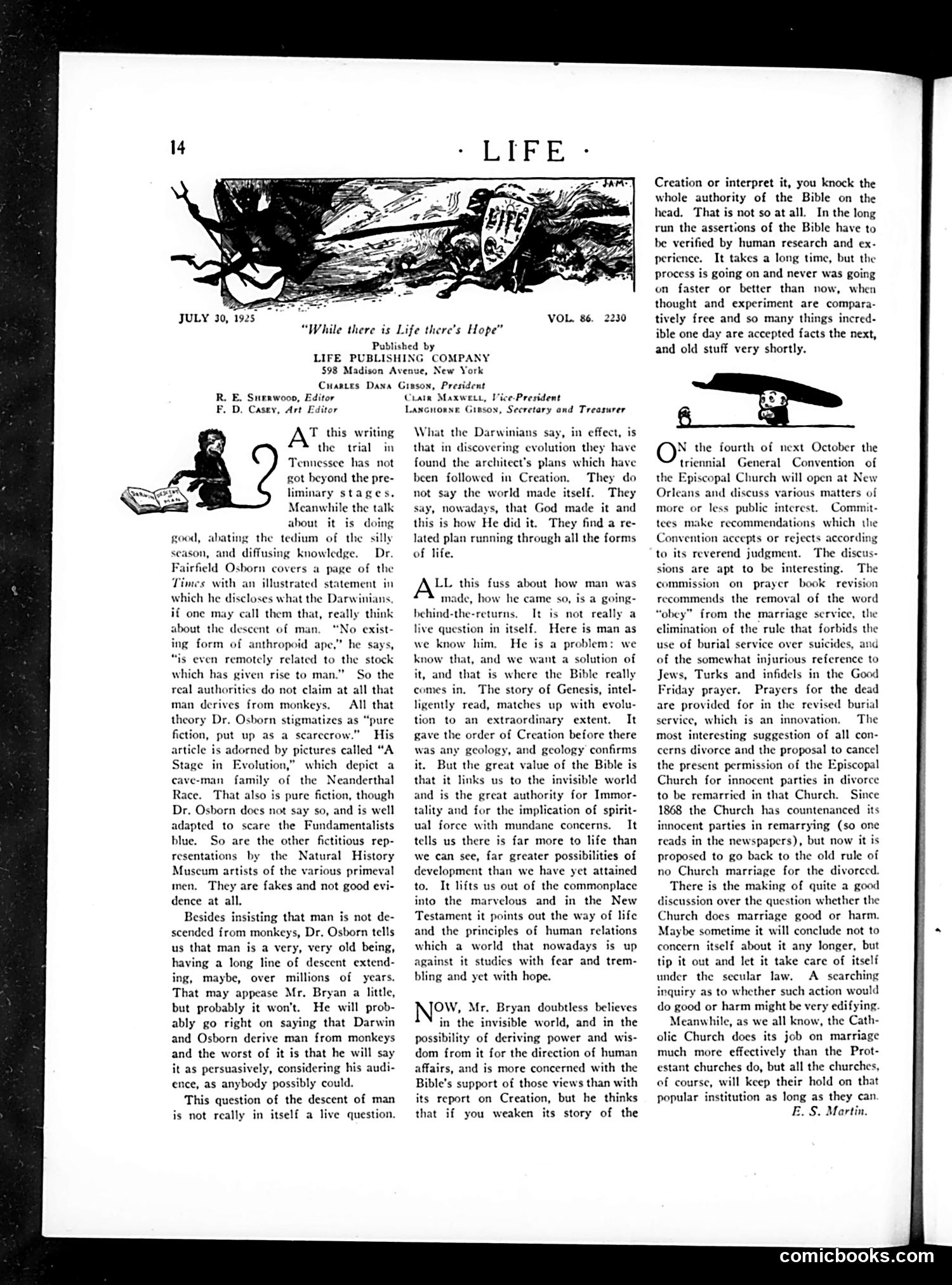
This page contains editorial text rather than a political cartoon. The main illustration at top shows a dead figure with a tombstone marked "R.I.P."—likely representing the "trial in Tennessee" mentioned in the article (referring to the Scopes "Monkey Trial" of 1925). The article critiques William Jennings Bryan and fundamentalist opposition to Darwinian evolution. It discusses the tension between Biblical creation accounts and scientific evidence, sarcastically noting that Bryan and Dr. Osborn "derive man from monkeys" while claiming the Bible's authority. The satire targets Bryan's anti-evolution stance during the famous Tennessee trial that year, presenting the debate as between outdated religious literalism and modern science.
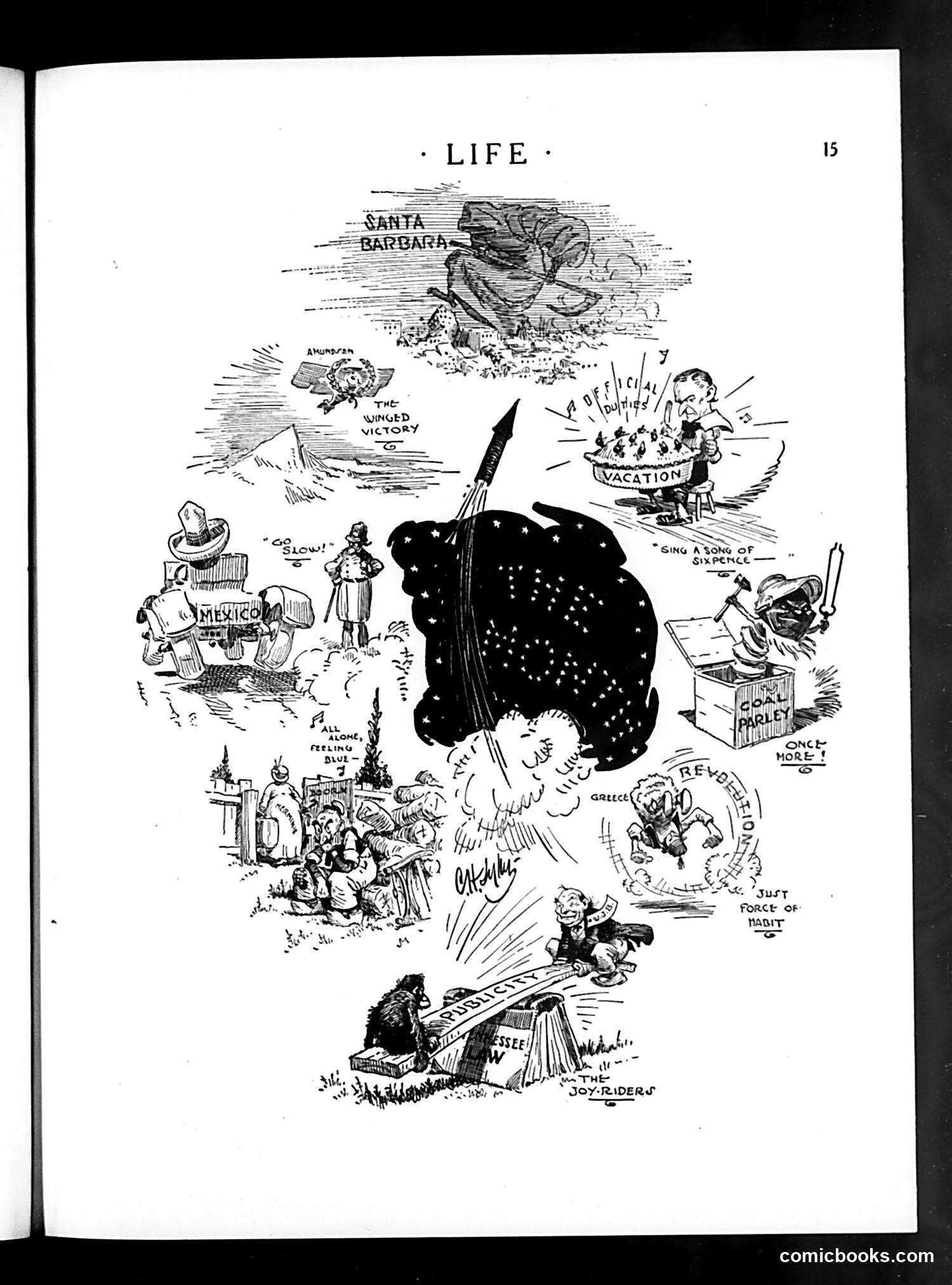
This is a satirical collage centered on a large bomb labeled with what appears to be military/political imagery. The surrounding vignettes mock various American anxieties and cultural preoccupations: - "Santa Barbara" (top) depicts indulgence - "The Winged Victory" references classical ideals - "Mexico" appears to reference foreign policy concerns - "Vacation" mocks leisure obsession - References to "Greece," "Force of Habit," and "Joy Riders" suggest commentary on international affairs and domestic behavior The large bomb acts as a visual metaphor for impending danger or crisis threatening to overwhelm these frivolous American pursuits. The overall message appears to be satirical criticism of American society's preoccupation with trivial pleasures while facing serious geopolitical threats—likely referencing Cold War anxieties or earlier 20th-century international tensions.
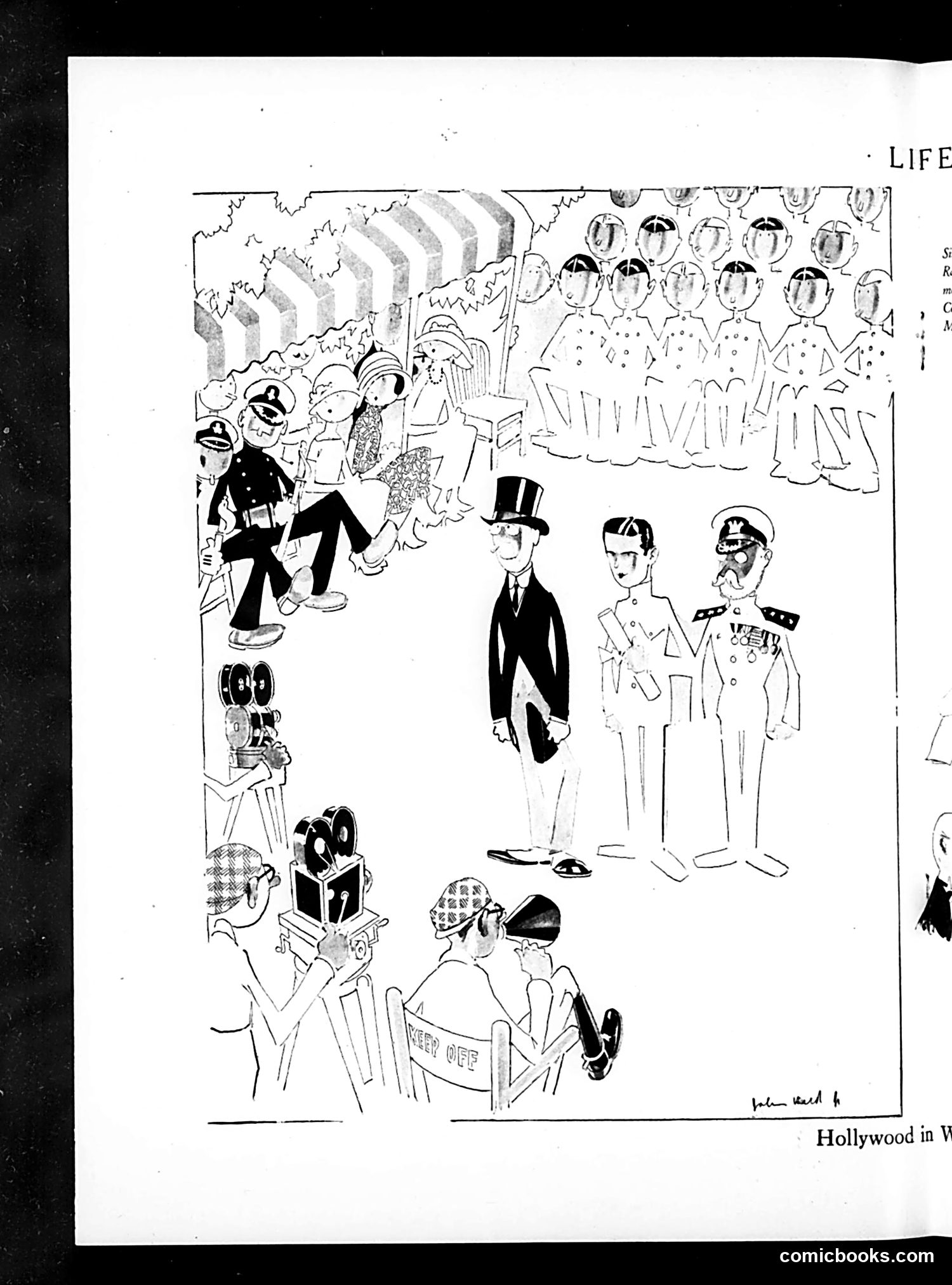
This appears to be a satirical cartoon about **Hollywood filmmaking**, likely from the early-to-mid 20th century. The image shows a film production scene with: - **Left side**: Cameramen, directors, and crew operating equipment - **Right side**: Three formally-dressed figures (a man in top hat, a woman in evening wear, and a military officer) who appear to be either actors or studio executives observing the production - **Background**: A large chorus or crowd of costumed performers The satire likely mocks the **contrast between behind-the-scenes Hollywood reality and polished on-screen appearances**—the casual chaos of production versus the formal elegance of the final product. The title fragment "Hollywood in W[ar]" suggests wartime context, possibly criticizing how studios managed productions during wartime or produced patriotic content. The exact figures remain unclear without additional context.
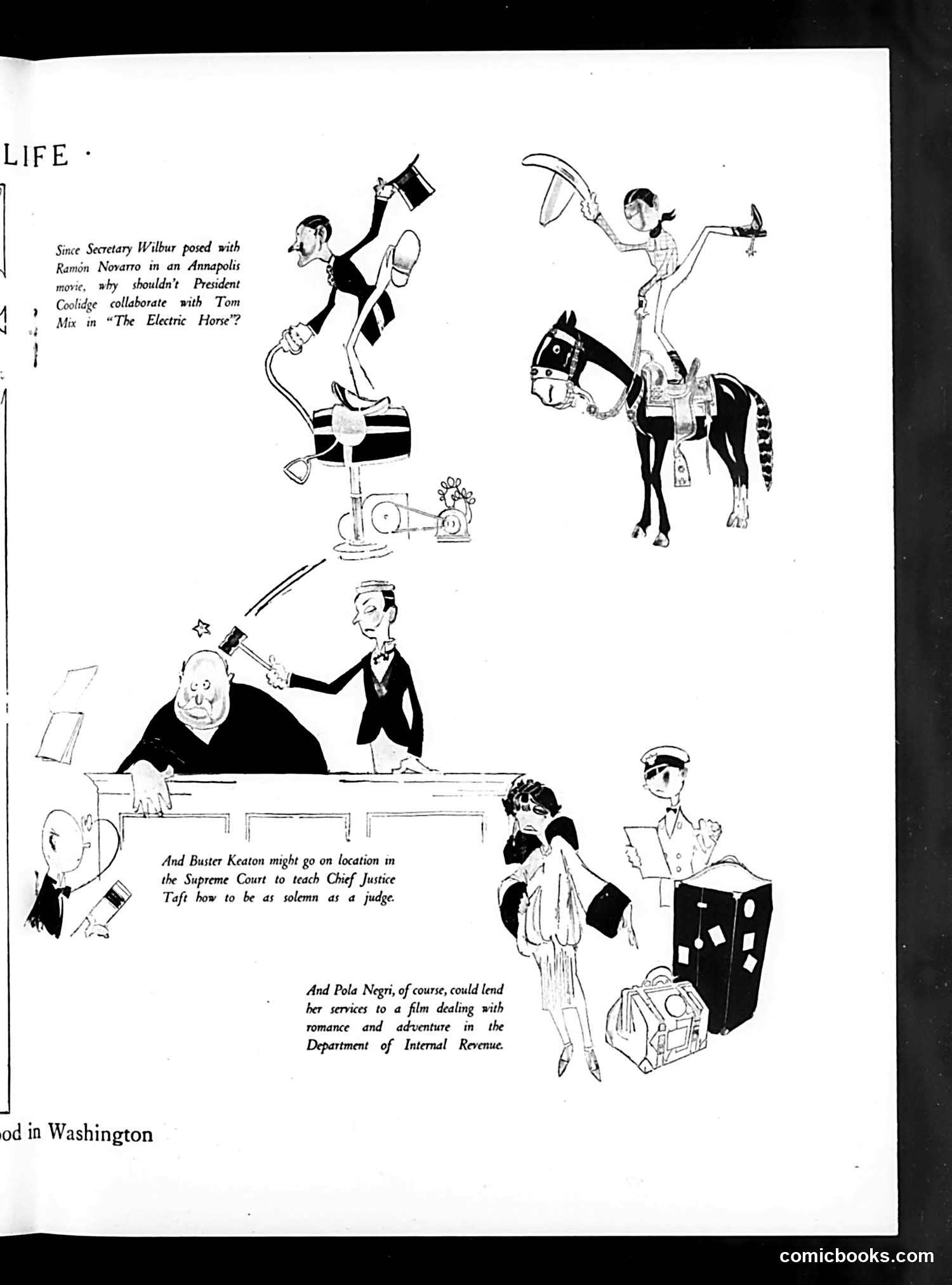
This page satirizes government officials collaborating with Hollywood celebrities on films. The joke suggests absurd pairings: **Key References:** - Secretary Wilbur posed with actor Ramón Novarro at Annapolis, prompting the satire - President Coolidge is jokingly proposed to work with Tom Mix (Western star) on "The Electric Horse" - Buster Keaton (silent comedian) teaching Chief Justice Taft solemnity - Pola Negri (exotic actress) making a film about the Internal Revenue Department **The Point:** The cartoons mock how government officials are eager to associate with celebrities for publicity, suggesting such collaborations are ridiculous and beneath their dignity. The humor lies in pairing serious institutions (Supreme Court, Treasury Department) with entertainment industry figures, highlighting the absurdity of politician-celebrity entanglement—a surprisingly modern concern for the 1920s.
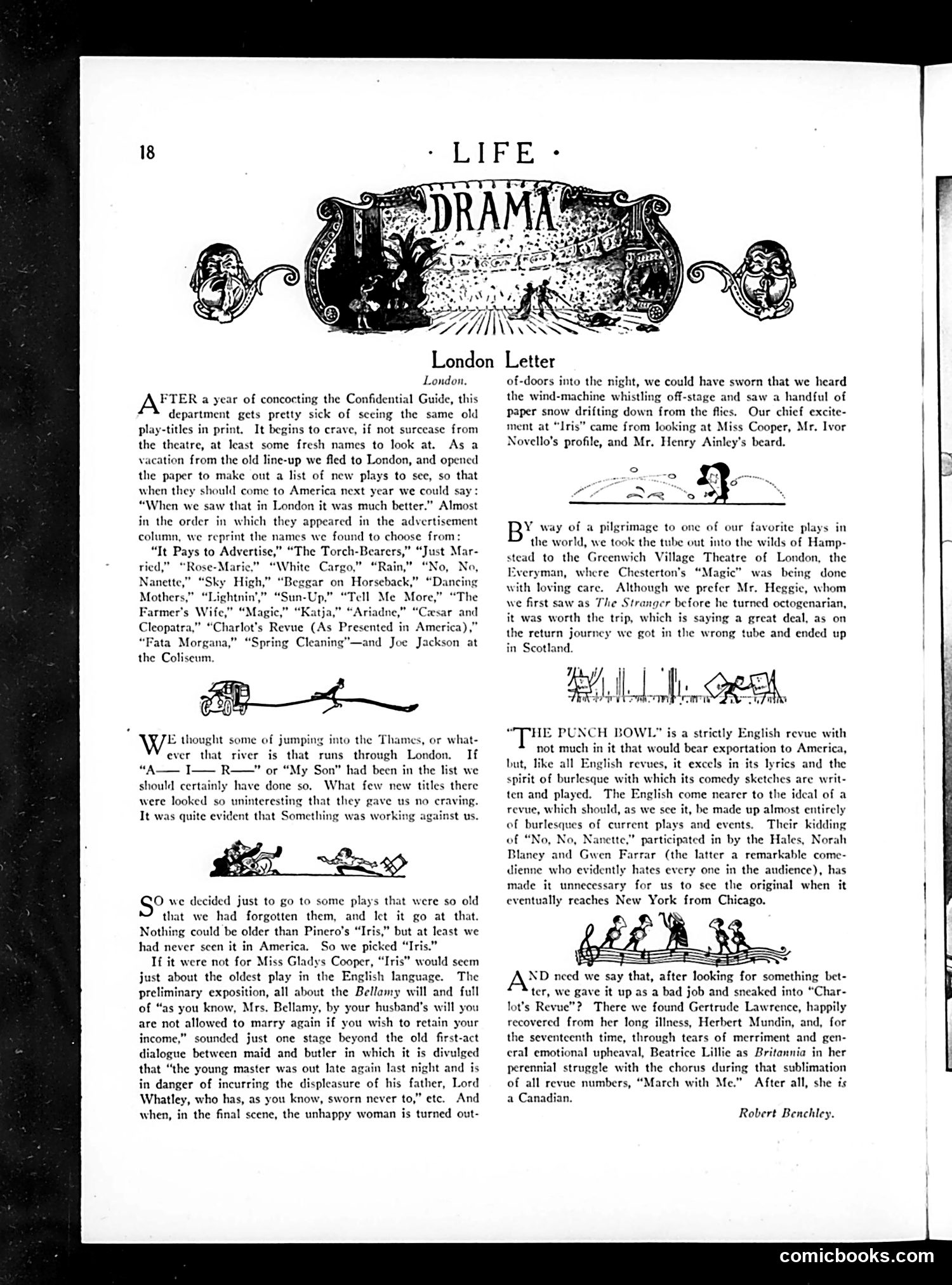
This is a theater review column from *Life* magazine's "Drama" section titled "London Letter." The author humorously recounts attending plays in London after getting tired of reviewing the same American theatrical productions. The main satire targets theatrical clichés: the author mocks the melodramatic plot exposition and creaky staging conventions of Arthur Wing Pinero's classic play "Iris" (featuring actress Gladys Cooper). The joke is that even a celebrated "old master" relies on tired devices—servants exposing plot points, wind machines creating artificial weather effects, and stock dramatic scenarios. The piece celebrates newer theatrical trends, particularly English revues (musical comedy review shows) that mock current plays and events. The author expresses enthusiasm for London's theatrical scene while gently satirizing both outdated dramatic conventions and the pretentious American habit of claiming London productions are "much better" than their New York equivalents. The decorative masque illustrations frame the theater-focused content typical of *Life*'s drama coverage.
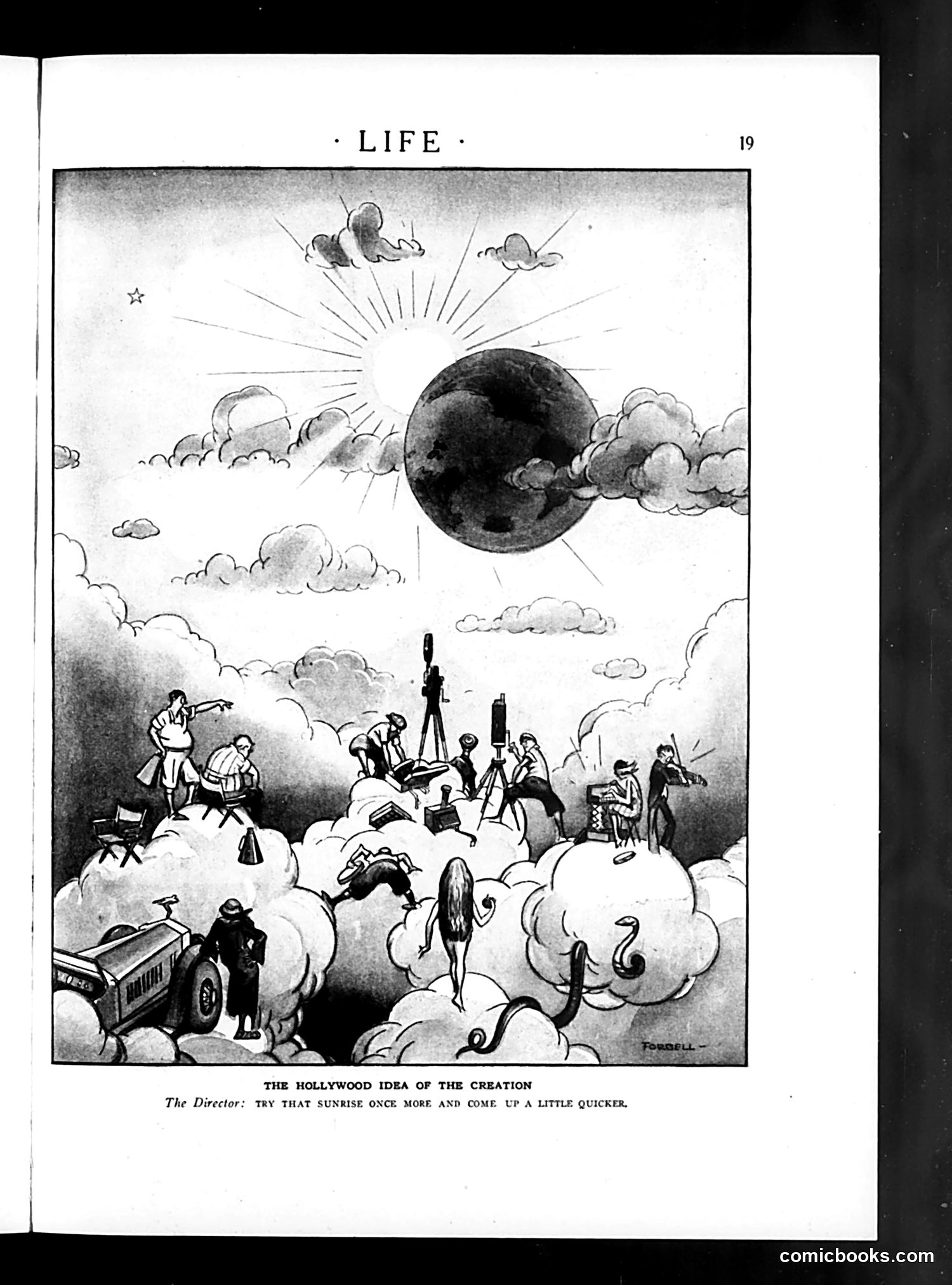
This satirical cartoon mocks Hollywood's film industry by depicting the Biblical creation story as a movie set. God creating the world becomes a film director's production, complete with a camera crew, equipment, lighting rigs, and a large spherical prop representing Earth. The caption shows the "Director" ordering a retake of the sunrise—a joke about Hollywood's obsession with retakes and perfectionism. The cartoon suggests filmmakers would treat even divine creation as just another production to tinker with endlessly. The satire targets Hollywood's grandiosity and pretension, implying the industry views itself as nearly godlike in its creative power. The period details (1920s-era vehicles and clothing visible) suggest this reflects early-to-mid 20th century attitudes about the film industry's cultural dominance and inflated self-importance.
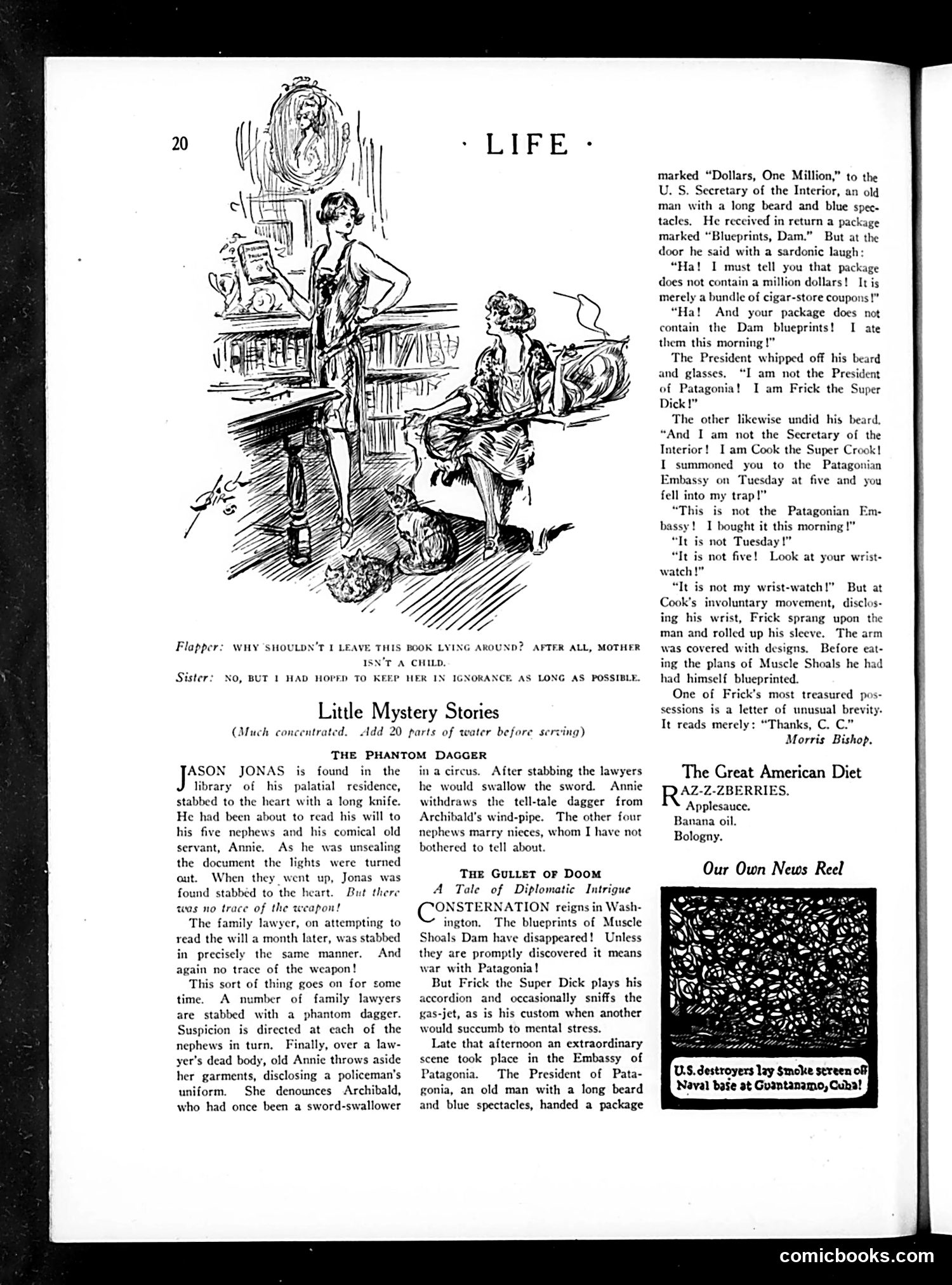
This page satirizes popular detective fiction and 1920s spy stories through absurdist parody. **"The Phantom Dagger"** mocks mystery novels: a murderer stabs multiple victims with a sword, then swallows it whole—revealed when the "comical old servant" is actually an undercover cop who retrieves the weapon from the killer's throat. The plot's implausibility is the joke. **"The Gullet of Doom"** parodies diplomatic intrigue stories. "Frick the Super Dick" and "Cook the Super Crook" are competing secret agents trading fake packages (cigar coupons for dam blueprints) at a Patagonian embassy—but keep discovering nothing is real: wrong country, wrong time, wrong wristwatch. The final twist: blueprints were tattooed on someone's arm. The escalating absurdity mocks spy-story convention. The top cartoon jokes about modern "flappers" (young women) and scandals, with an older sister worried a book might corrupt their mother's innocence. This reflects Life's satirical style: gently ridiculing popular entertainment and social anxieties through exaggeration and wordplay.
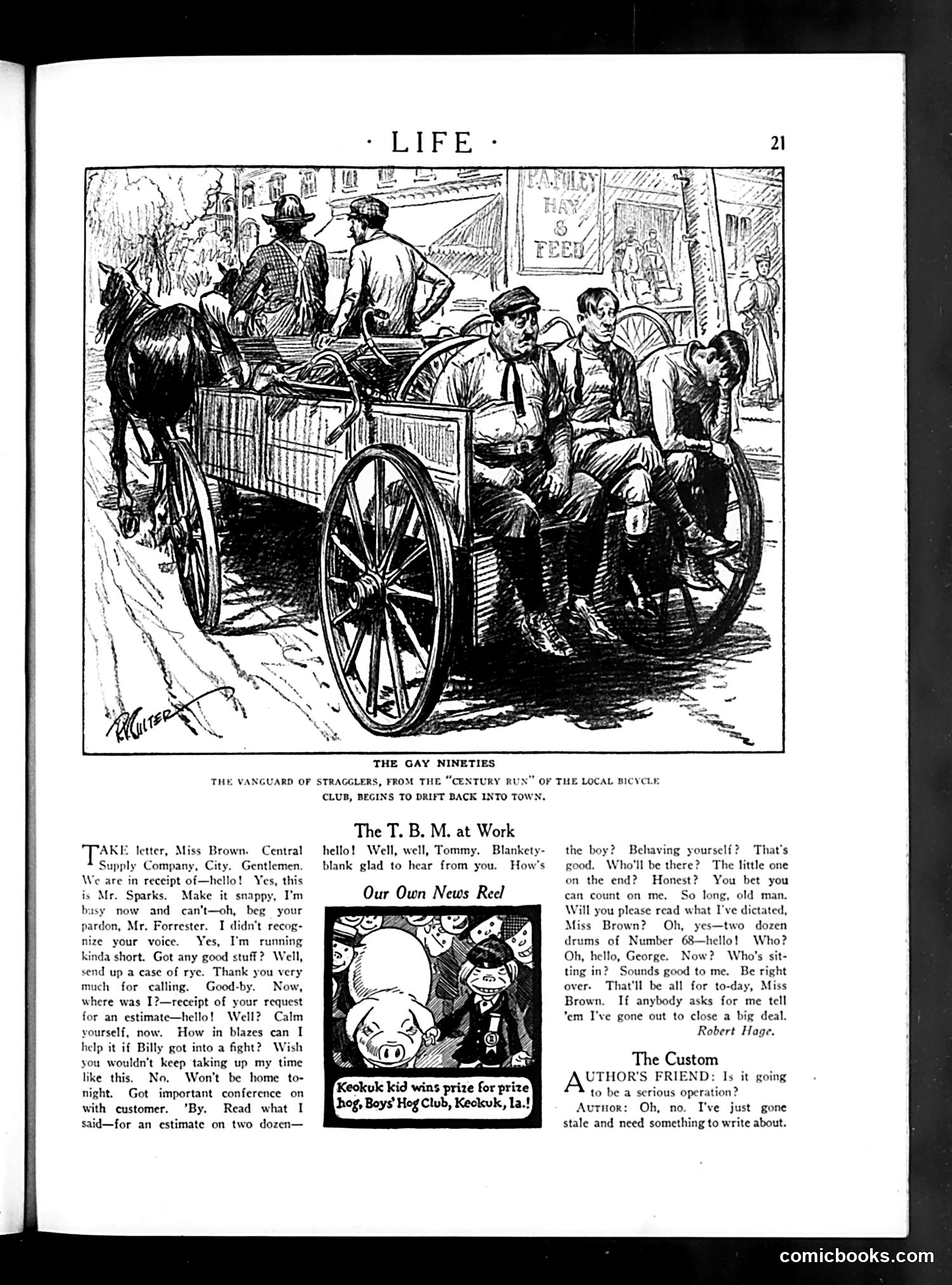
The top illustration satirizes the bicycle craze of the 1890s ("Gay Nineties"). It shows stragglers from a "Century Run" (a 100-mile bicycle club outing) returning to town—some on bicycles, others riding in horse-drawn wagons, suggesting they couldn't complete the grueling ride and had to abandon their bikes partway through. The satire mocks the pretensions of this fashionable sport and those who attempt it without sufficient stamina. Below, "The T.B.M. at Work" depicts a harried businessman (Mr. Sparks) constantly interrupted by phone calls—a satire on the chaotic nature of modern business communication via the newly prevalent telephone. He juggles work calls, personal matters, and social obligations while trying to dictate to his secretary, showing how technology was fragmenting attention rather than improving efficiency. The small cartoon about "Keokuk kid" appears to be a humorous note about a child's writing.
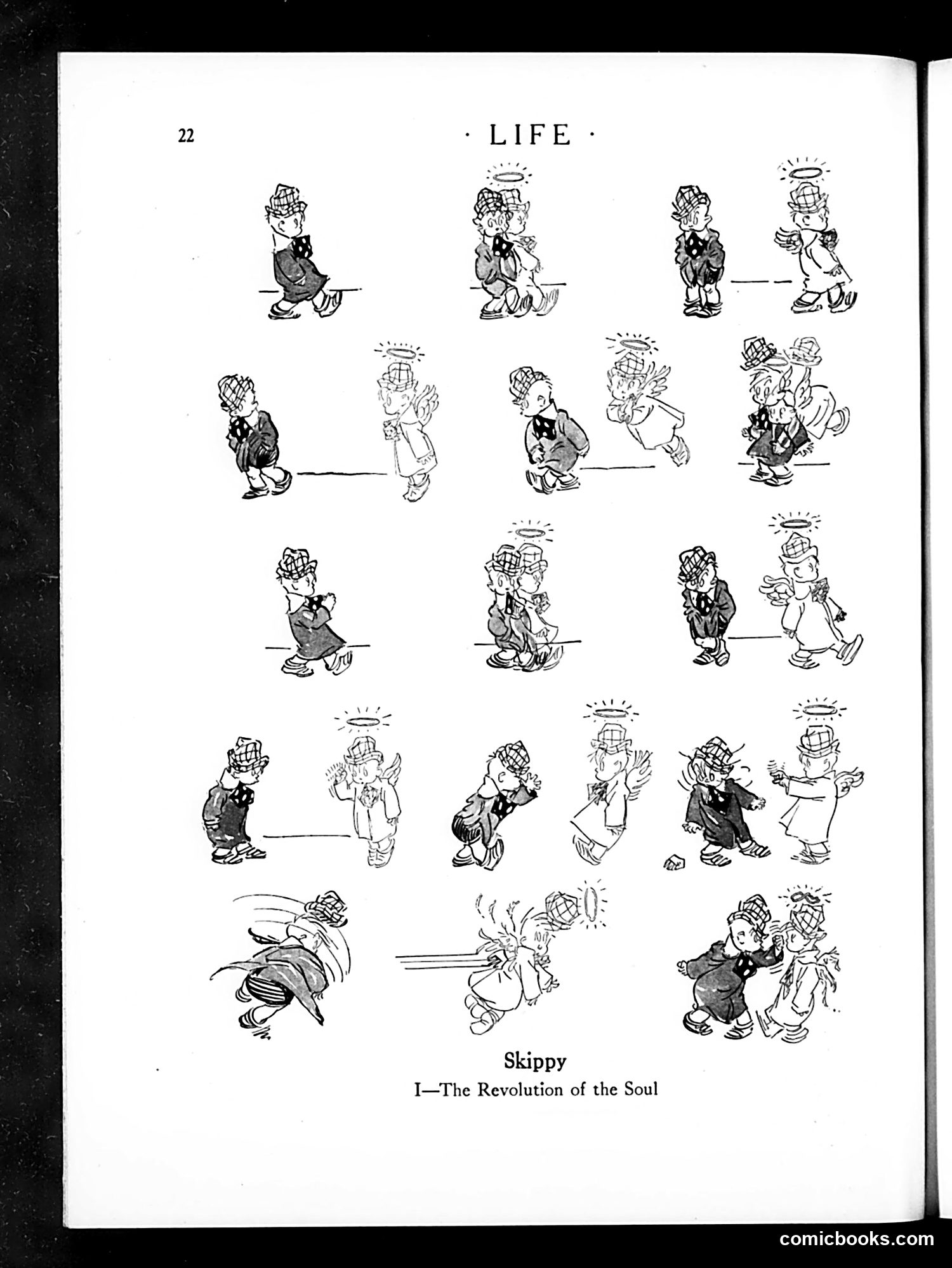
This is a comic strip sequence titled "Skippy" showing a character's emotional journey through various states of agitation and excitement. The repeated halo imagery above the character's head suggests spiritual or moral themes, fitting the subtitle "Revolution of the Soul." The strip appears to depict escalating emotional states—from initial disturbance to increasingly frantic behavior, culminating in physical comedy (falling or stumbling). The final panels show interaction with other characters, possibly illustrating how emotional turmoil affects relationships. The satire likely mocks the contemporary fascination with psychological theories and spiritual "awakenings," presenting the soul's "revolution" as merely childish tantruming. The title's grandiosity contrasts with the silly physical gags, creating humor through deflation of pretentious concepts.
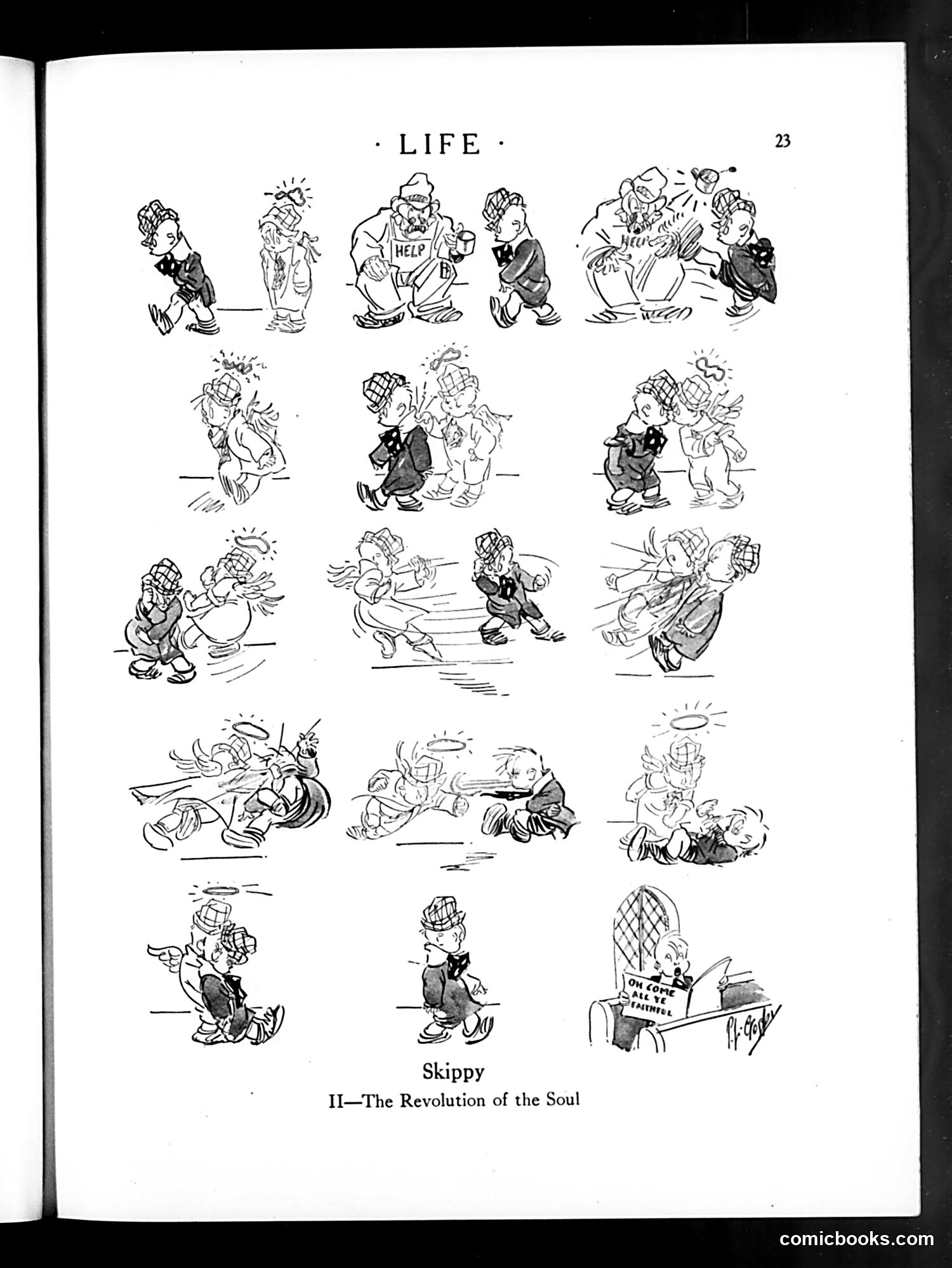
This is a sequential comic strip titled "Skippy" showing a young boy's escalating mischief and chaos. The narrative progresses from Skippy appearing innocent, through increasingly wild and destructive behavior (fighting, creating explosions, wreaking havoc), to ending with him sitting at a desk writing, apparently reformed or reflecting. The title "The Revolution of the Soul" suggests satirical commentary on personal transformation or moral awakening—the implication being that Skippy's chaotic "revolution" of troublemaking eventually leads to some form of introspection or change. The humor lies in the exaggerated physicality of his antics and the contrast between youthful destructiveness and the final image of contemplative solitude. It's a comedic take on childhood behavior and growth.
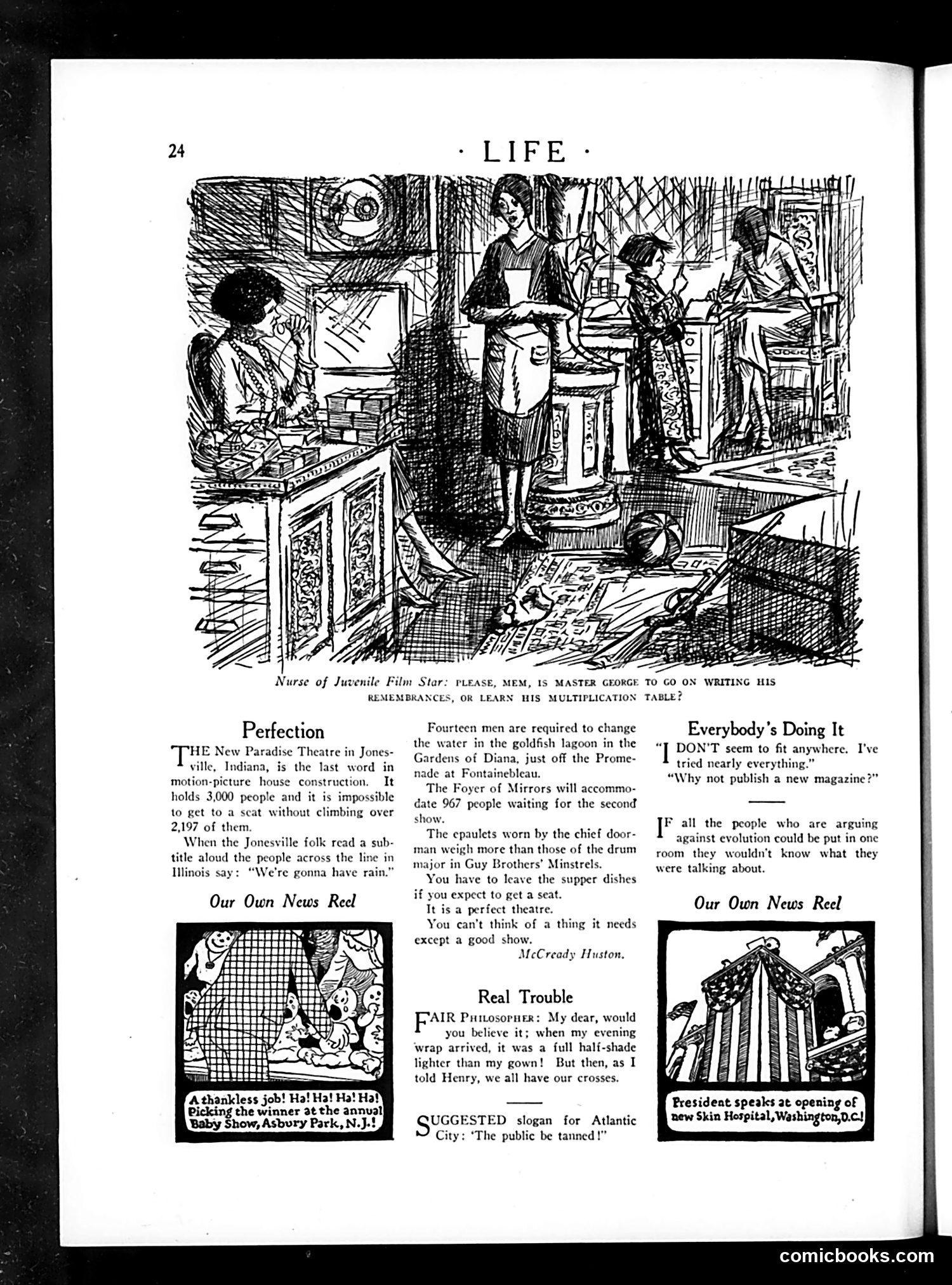
This page from *Life* magazine contains satirical commentary on 1920s American culture: **Main Cartoon**: The top illustration depicts a nurse asking a child film star's caregiver whether the boy should continue writing his memoirs or learn basic math—mocking child actors' premature autobiographies and the entertainment industry's exploitation of young performers. **"Perfection" Section**: Satirizes an overly elaborate theater that requires fourteen men to change goldfish tank water and obsesses over trivial details (doorman epaulets, mirror capacity) while neglecting what actually matters—*a good show*. The joke critiques American excess and misplaced priorities. **"Real Trouble"**: A wealthy woman complains that her evening wrap is a "half-shade lighter" than her gown—highlighting frivolous upper-class concerns divorced from real problems. **"Everybody's Doing It"**: Mocks both magazine proliferation and anti-evolution arguments, suggesting people arguing against evolution lack basic knowledge. The page satirizes consumerism, wealth obsession, entertainment industry practices, and manufactured sophistication in 1920s America.
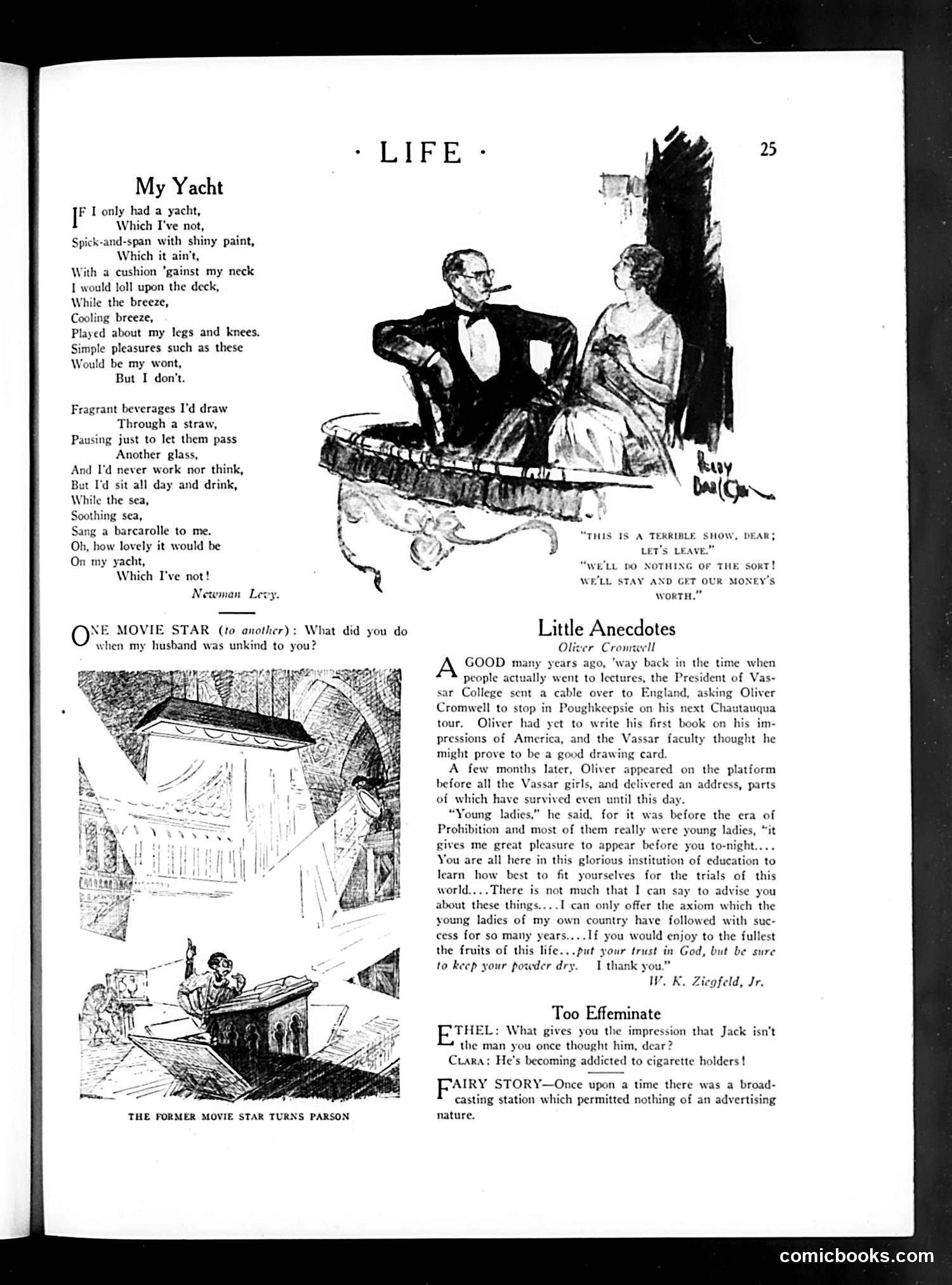
This page from *Life* magazine contains three distinct pieces of satirical content: **"My Yacht"** (poem by Newman Levy): A humorous lament about lacking wealth. The speaker fantasizes about leisure—lounging on a yacht, drinking through straws, never working—but admits he cannot afford such luxuries. It satirizes the aspirational daydreaming of working-class readers during economically uncertain times. **Movie Star Cartoon**: Two women at a theatrical performance discuss leaving. One insists they stay to "get our money's worth," satirizing post-Depression audiences' determination to extract maximum value from entertainment purchases, even from bad shows. **"Oliver Cromwell" Anecdote**: A humorous anachronism presenting the 17th-century historical figure as a modern lecturer touring American colleges. The joke lies in attributing the famous military maxim "keep your powder dry" to Cromwell addressing Vassar students, mocking both historical inaccuracy and lecture-circuit culture. **"Too Effeminate"**: A brief joke about masculinity—a woman suggests her boyfriend is becoming unmanly because he uses cigarette holders, reflecting period anxieties about male behavior and consumption. All reflect 1920s-era concerns about wealth, entertainment value, and gender norms.
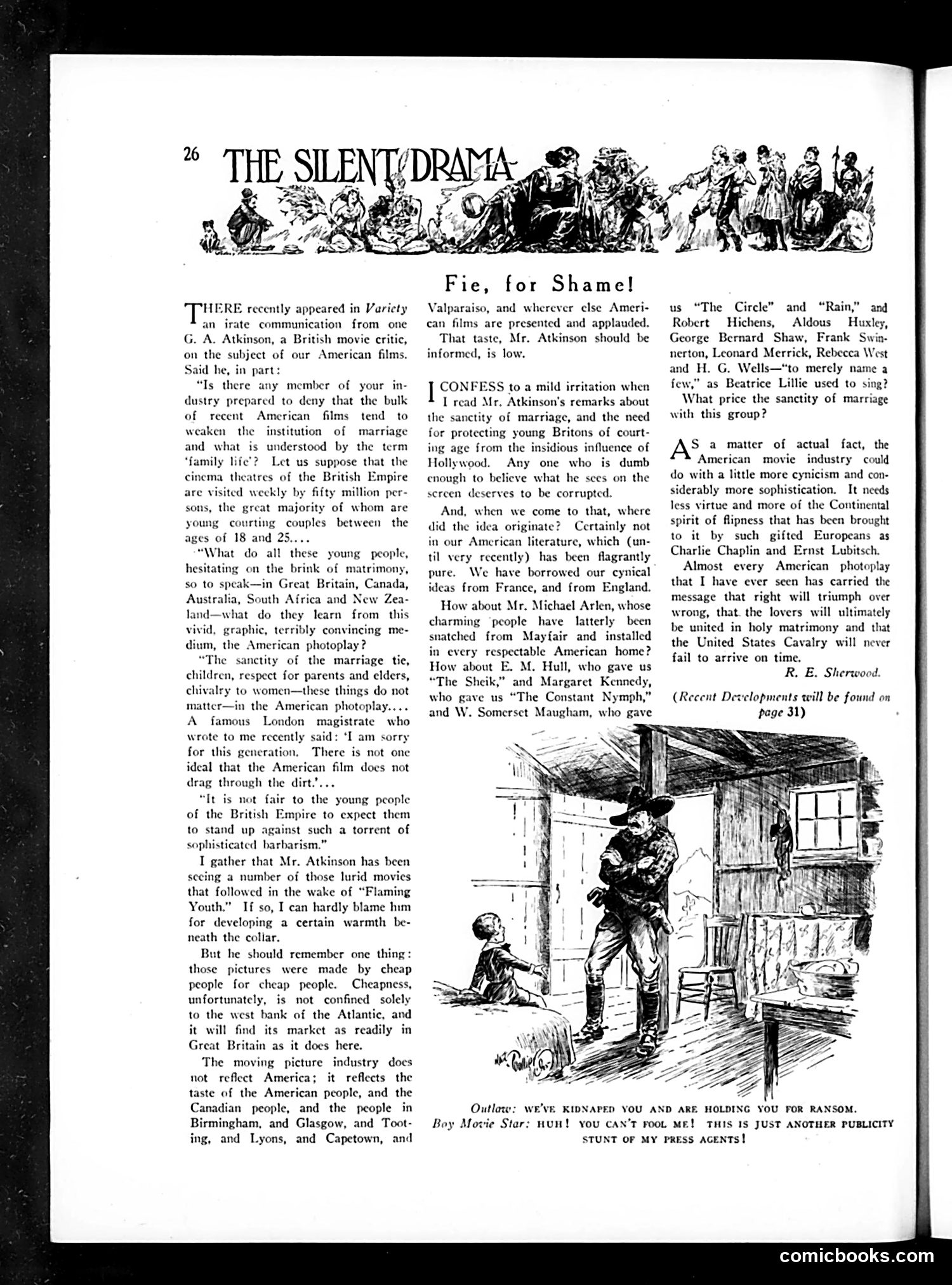
This page satirizes British film critic G. A. Atkinson's complaint that American movies undermine marriage and family values among young people throughout the British Empire. The article's author (R. E. Sherwood) defends American cinema by arguing that: 1. **The real culprit is audience taste, not filmmakers**: Cheap films reflect cheap popular taste on both sides of the Atlantic, not distinctly American corruption. 2. **Britain shouldn't lecture America**: The author points out that cynical attitudes about marriage come from British and European literature—Michael Arlen, E. M. Hull (*The Sheik*), Somerset Maugham, George Bernard Shaw, and others whose work was widely consumed in respectable British homes. 3. **American films need *more* sophistication, not less**: The author argues American cinema actually suffers from excessive virtue and moralism, lacking the Continental worldliness that European directors like Chaplin and Lubitsch bring to film. The accompanying sketch shows a melodramatic "outlaw" kidnapping scenario—likely satirizing the sensational plots Atkinson objected to. The piece uses humor to flip the blame back on British cultural hypocrisy.
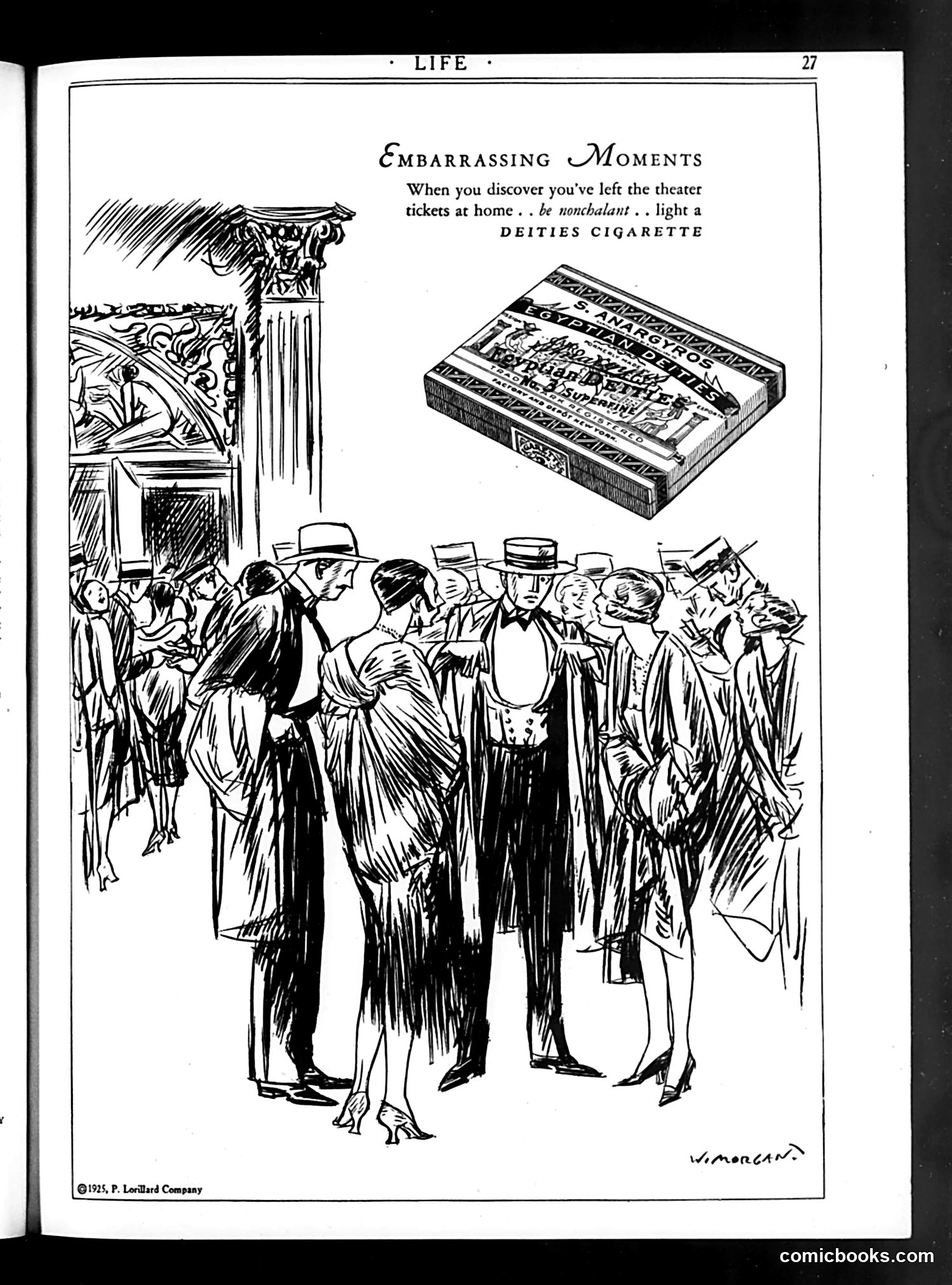
This is an advertisement disguised as a humorous cartoon. The "embarrassing moment" depicts a well-dressed man arriving at a theater with his companions, realizing he's forgotten the tickets at home. Rather than showing obvious distress, the suggested solution is to appear calm and composed by lighting a Deities cigarette—implying that smoking provides social confidence and composure in awkward situations. The satire works by presenting an absurd solution to a genuine problem: no cigarette will actually gain you theater admission, yet the ad suggests it provides the psychological composure to handle embarrassment with nonchalance. This reflects 1925 advertising practices that attributed almost magical social benefits to smoking, particularly in social situations where appearing unruffled was valued.
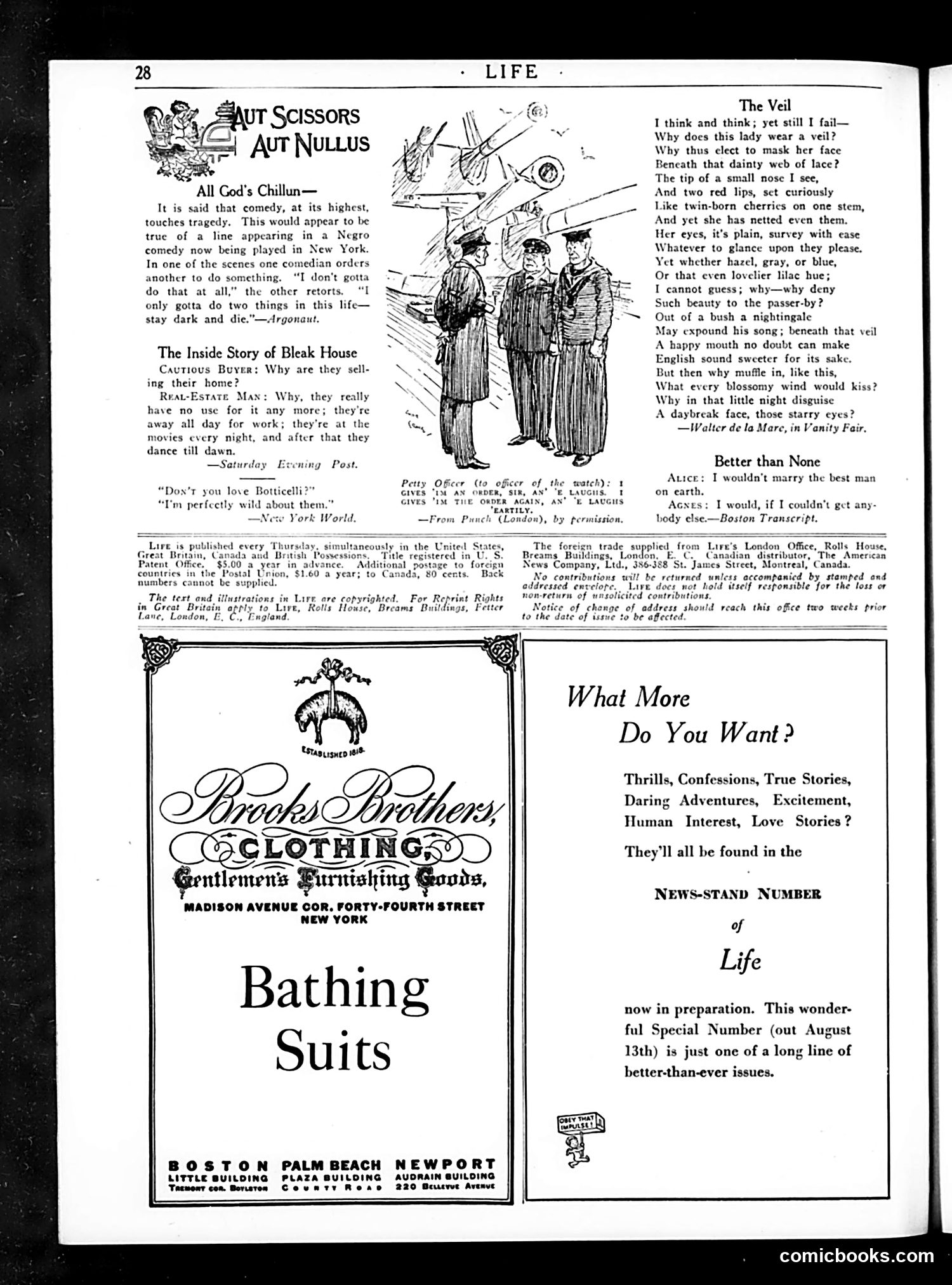
This page contains several brief satirical pieces typical of early-20th-century American humor magazines: **"All God's Chillun"** references a contemporary African American comedy playing in New York, quoting a darkly humorous line about racial constraint and mortality. **"The Inside Story of Bleak House"** satirizes modern urban life—a real estate agent explains why clients are selling: they work all day, go to movies nightly, and dance until dawn, leaving no time to actually use their home. The satire targets leisure-obsessed consumerism. **"The Veil"** is a poem (credited to Walter de la Mare in *Vanity Fair*) playfully questioning why an attractive woman hides her face behind a veil—a poetic conceit about feminine mystery. **"Better than None"** is a two-line joke about women's marriage standards, presented as dialogue. The page is primarily **advertising** (Brooks Brothers clothing, bathing suits) with scattered humor pieces—typical Life magazine layout of the era. No political cartoons appear; this is chiefly promotional content with light social commentary integrated throughout.
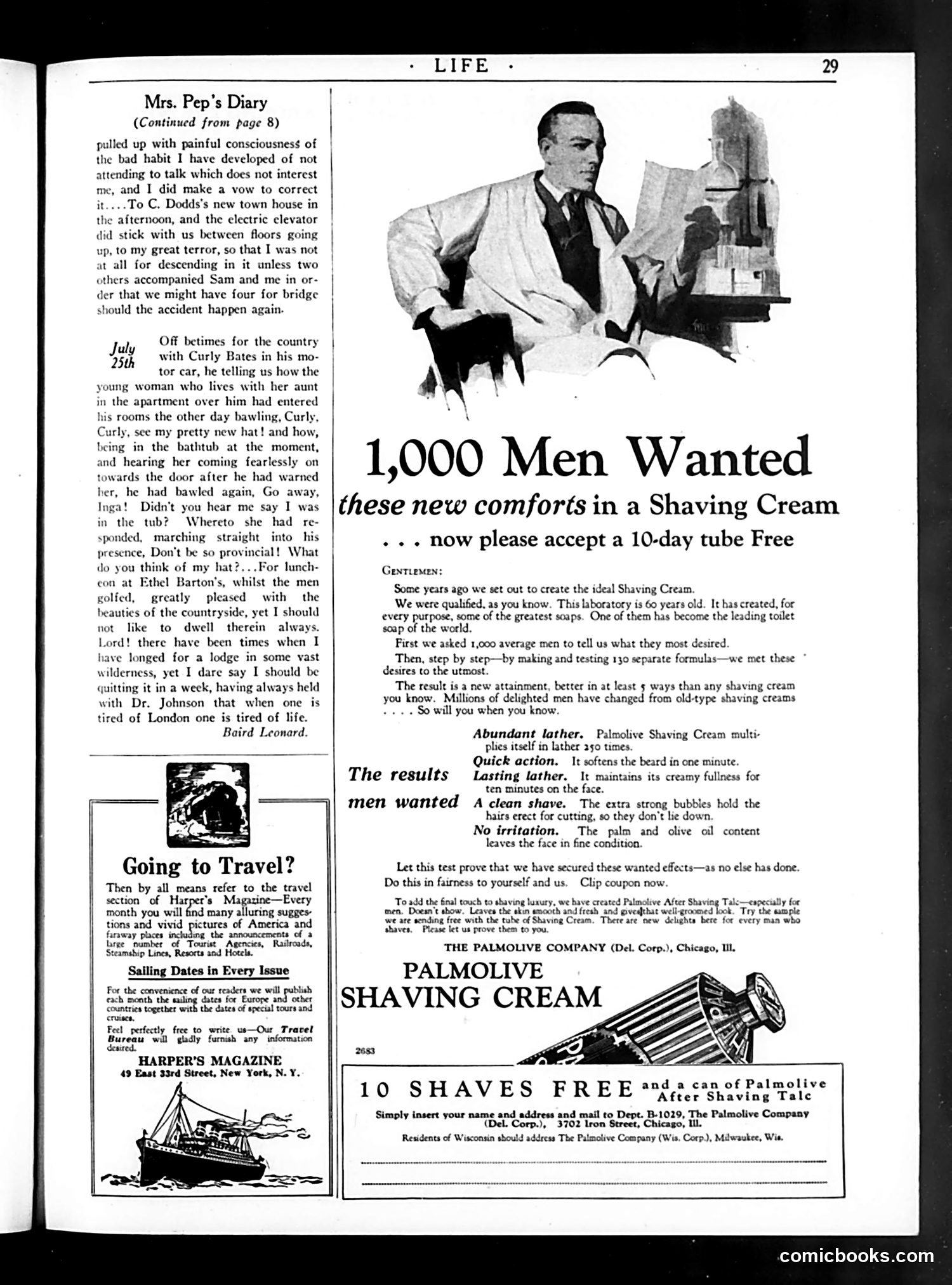
This page contains **no political cartoon**—it's primarily a diary excerpt and advertisements. **Mrs. Pep's Diary** (left column) is a humorous social commentary on upper-middle-class life, written by Baird Leonard. It satirizes genteel anxieties: fear of newfangled elevators, social pretension (the woman barging into the bathtub scene), and the diarist's conflicted feelings about country living versus urban sophistication. The reference to Dr. Johnson ("tired of London one is tired of life") underscores the satirical tension between romantic ideals and actual preferences. **Right side**: A full-page **Palmolive Shaving Cream advertisement** claiming 1,000 men were surveyed about ideal shaving cream qualities. The ad promises superiority in five ways and offers a free 10-day tube. This represents typical early-20th-century advertising strategy: invoking scientific research and consumer testimony to establish product authority. The page reflects 1920s consumer culture and gender dynamics (women's independent behavior was apparently noteworthy enough to mock humorously).
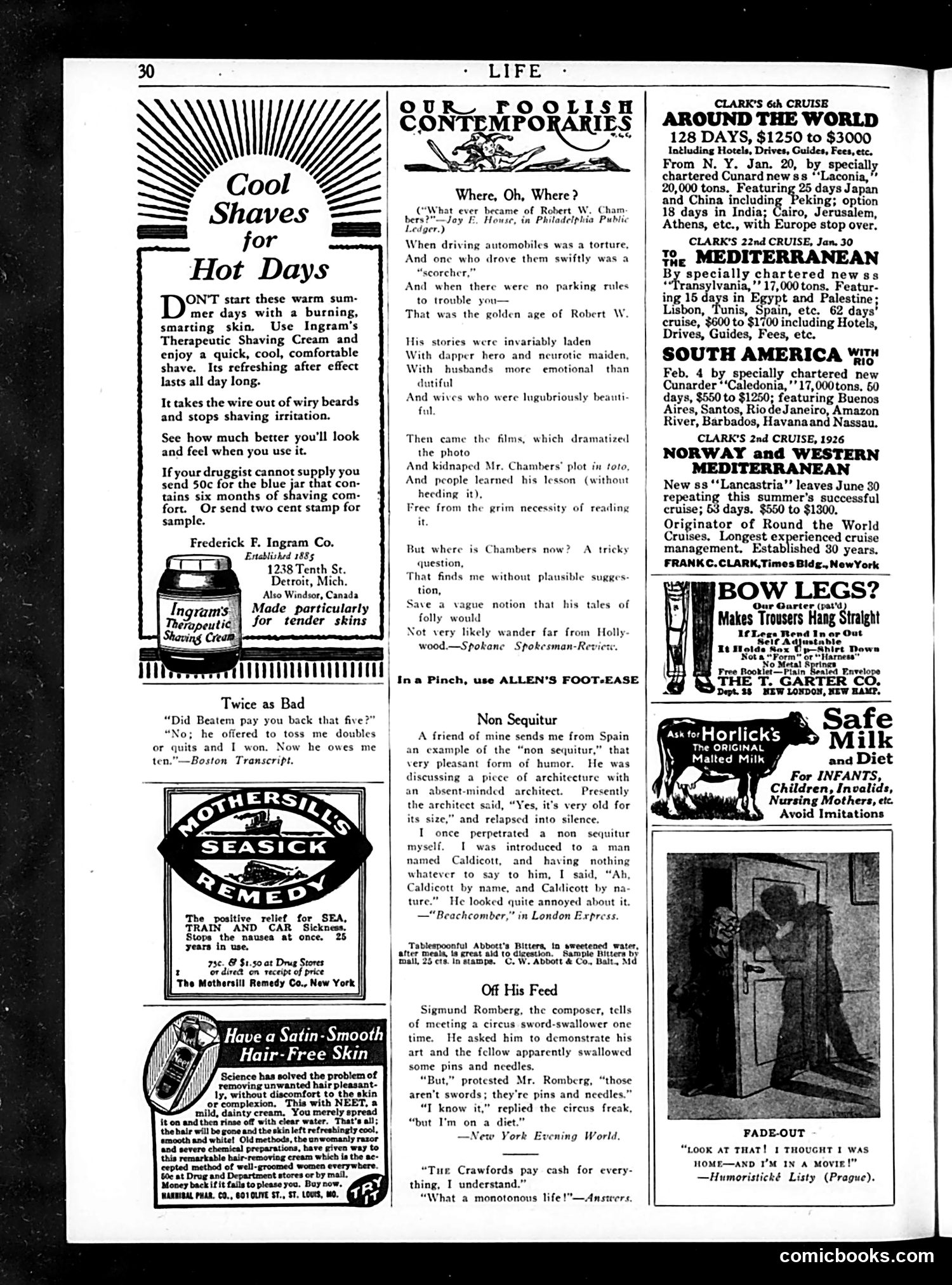
This page consists primarily of **advertisements and humorous columns** rather than political satire. The content includes: **Advertisements:** Ingram's shaving cream, Mothersill's seasickness remedy, and hair removal products dominate the left side—typical early 20th-century lifestyle ads targeting middle-class readers. **Humorous Columns:** The center features brief jokes and anecdotes, including: - A joke about settling a debt through gambling - A column asking "Where, Oh, Where?" about Robert W. Chambers, once-popular novelist whose work was overshadowed by film adaptations - Anecdotes about "non sequiturs" (illogical statements used for humor) - A quip about composer Sigmund Romberg meeting a dieting circus sword-swallower **Travel Advertisements:** The right side advertises Clark's cruise packages around the world. The page reflects Life magazine's format as a **satirical weekly featuring light humor, social commentary, and consumer advertising**—not focused on political cartooning. The Chambers reference is the closest to social observation, noting how cinema displaced literature.
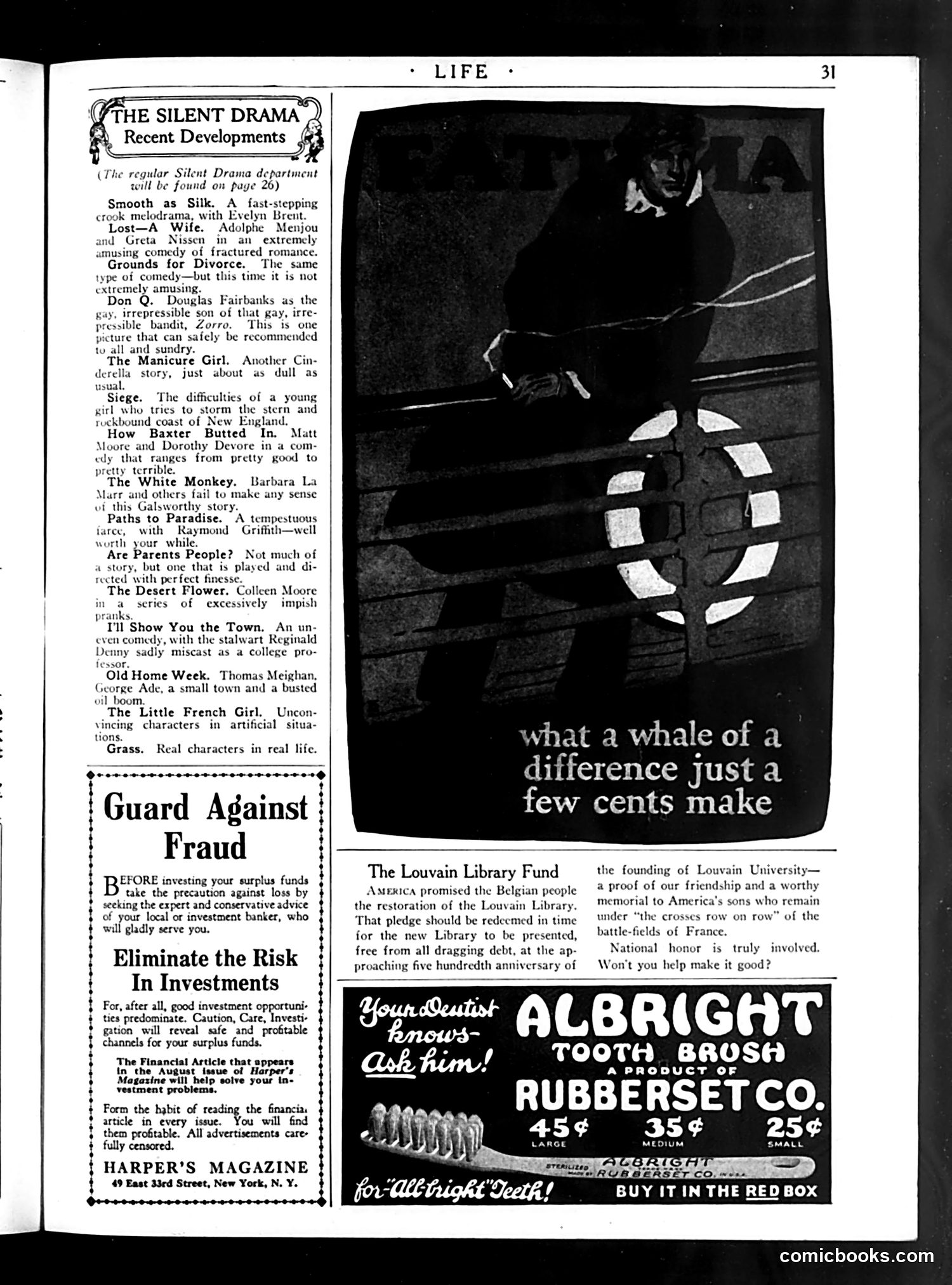
This page primarily contains **film reviews** ("The Silent Drama") critiquing contemporary movies, alongside **advertisements**. The main visual advertisement shows a whale or large fish, illustrating the copyline "what a whale of a difference just a few cents make"—a product comparison ad using hyperbole for emphasis. Below that, the **Louvain Library Fund** solicitation references America's post-WWI commitment to restore Belgium's Louvain University library, destroyed during the war. The phrase "crosses row on row" alludes to the famous war poem, appealing to American patriotism and remembrance of soldiers who died in France. The **Albright Tooth Brush ad** emphasizes price-point variations (25¢, 35¢, 45¢), supporting the "few cents make a difference" theme. A smaller **Harper's Magazine investment advisory** warns against investment fraud—reflecting 1920s concerns about financial safety and encouraging readers to seek professional guidance. The page reflects typical 1920s magazine content: entertainment criticism, patriotic fundraising, consumer goods, and financial caution.
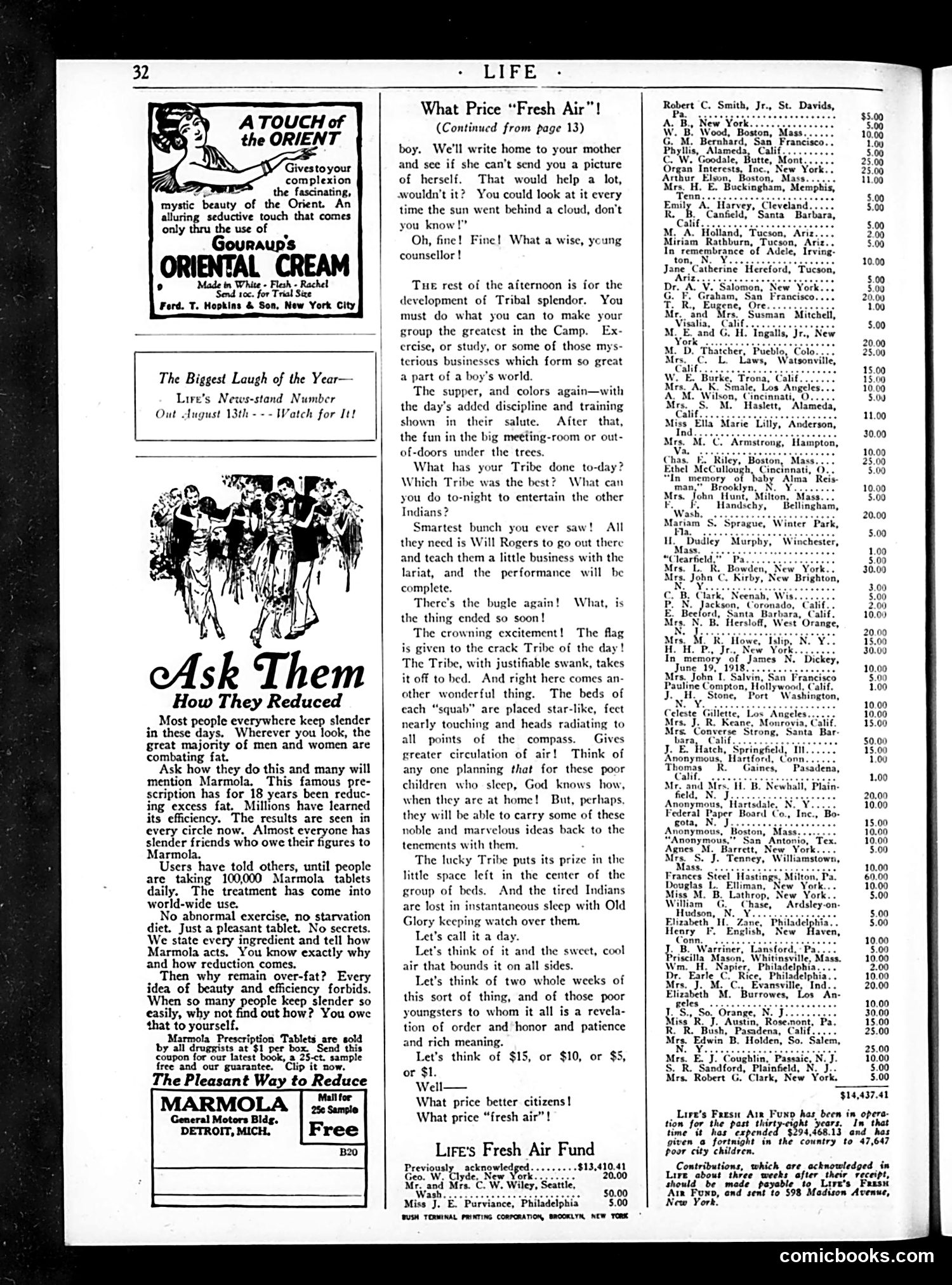
This Life magazine page contains **advertising and a serialized article** rather than political cartoons. The **"Oriental Cream" ad** reflects early 20th-century racist beauty standards—promoting skin lightening products by exoticizing Asian features as desirable yet "foreign," reinforcing harmful colorism prevalent in that era. The **main article, "What Price 'Fresh Air'!"** describes a summer camp program for underprivileged city children. The text celebrates the camp's structured activities—tribal competitions, flag ceremonies, organized sleeping arrangements—as character-building and morally uplifting for poor youth. The reference to "Will Rogers" (a famous rope-trick performer) and the patronizing tone ("poor youngsters") reflects Progressive Era attitudes: privileged institutions "civilizing" working-class children through discipline and order. The **Marmola advertisement** promotes weight-loss tablets to (apparently) middle-class readers anxious about body image—a recurring theme in this period's marketing. The page reflects 1920s anxieties about class, appearance, and social improvement through institutional intervention.
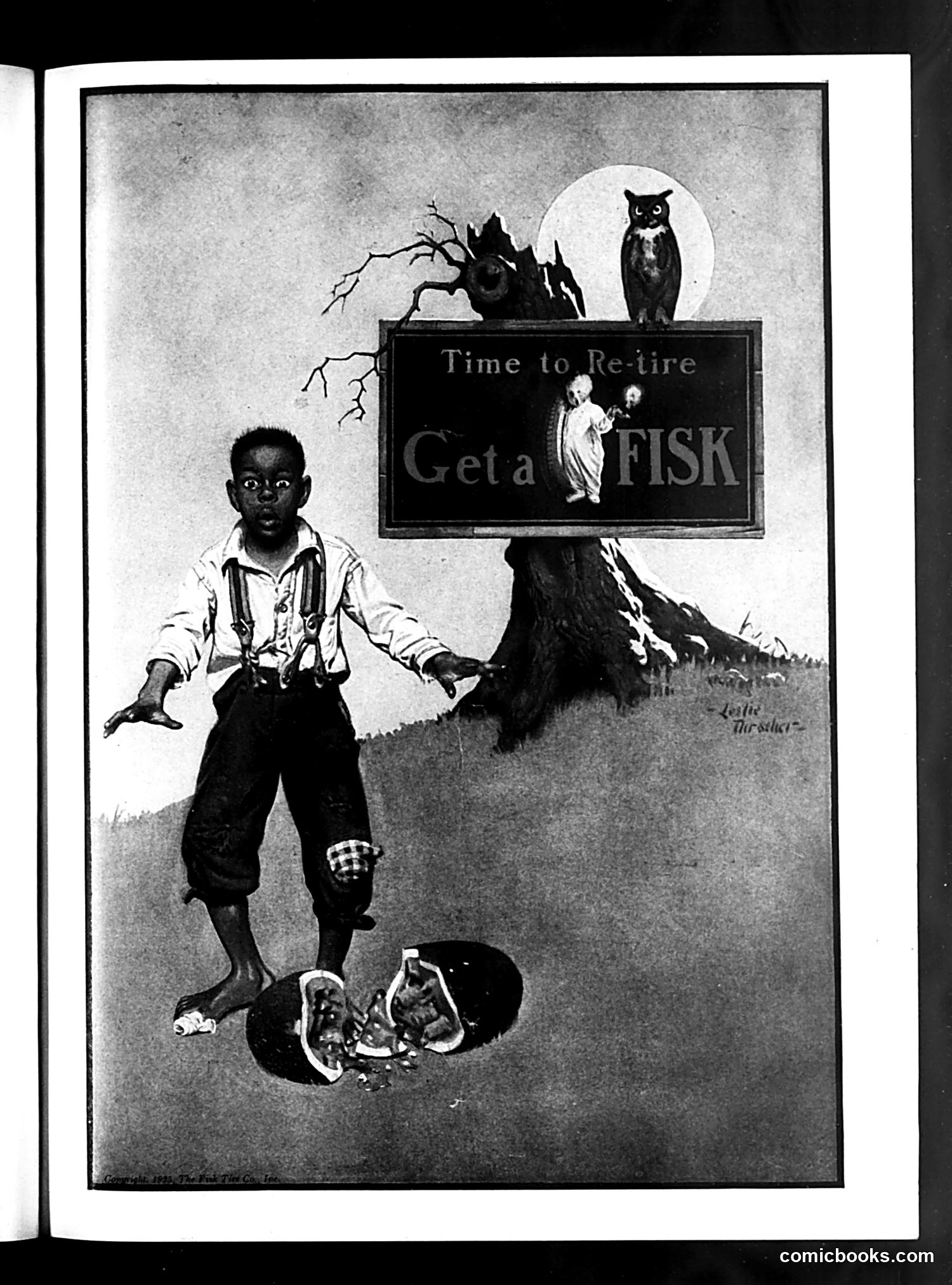
This is a satirical cartoon from *Life* magazine depicting a nightmarish scene. A young Black child stands barefoot before a haunted tree, with an owl perched atop a billboard advertising "Get a FISK" (likely Fisk tires or a related product). The text reads "Time to Re-tire." The cartoon uses racist imagery and fear-mongering stereotypes common to early 20th-century American advertising and entertainment. The grotesque tree, owl, and eerie moon create a deliberately frightening atmosphere associated with minstrelsy and racist caricature traditions. The satire appears to mock either the Fisk brand's advertising approach or broader American consumer culture that exploited and marginalized Black Americans through dehumanizing imagery. **Note:** This reflects deeply offensive historical propaganda; its inclusion here serves educational/archival purposes only.
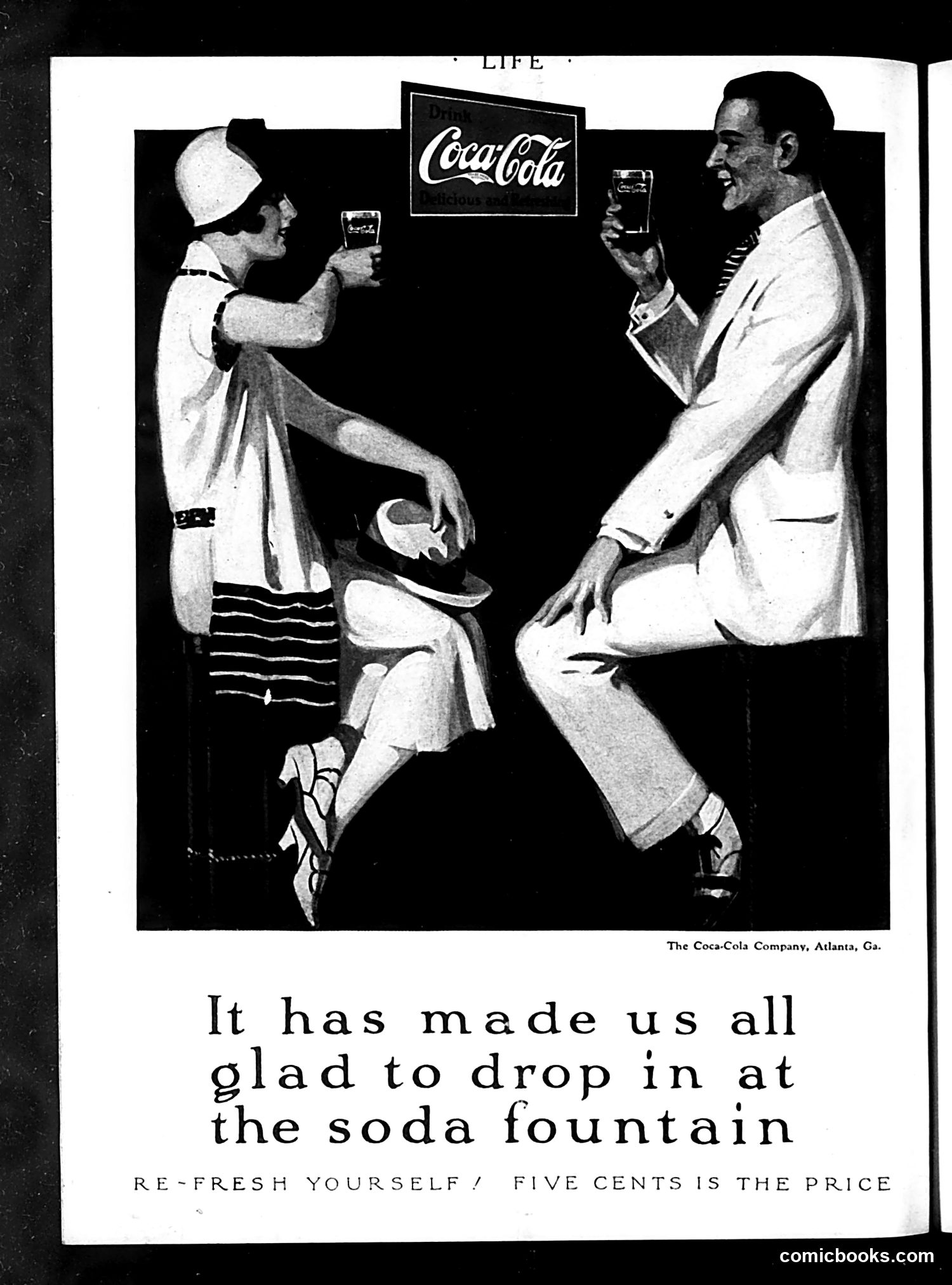
This is a Coca-Cola advertisement from Life magazine. The image depicts three people at a soda fountain—two men and a woman in 1920s-style bathing attire—socializing while holding Coca-Cola glasses. The ad's message is straightforward marketing rather than satire: it promotes Coca-Cola as an affordable refreshment (five cents) that brings people together in a convivial setting. The soda fountain was a popular social gathering place in early twentieth-century America, and this ad emphasizes how Coca-Cola has made such venues appealing destinations. There's no apparent political satire here—it's essentially a lifestyle advertisement positioning the product as central to leisure and social interaction, using the contemporary beach/bathing aesthetic to appeal to modern consumers.