
Life, 1925-07-30 · page 20 of 36
Life — July 30, 1925 — page 20: what you’re looking at
What you’re looking at
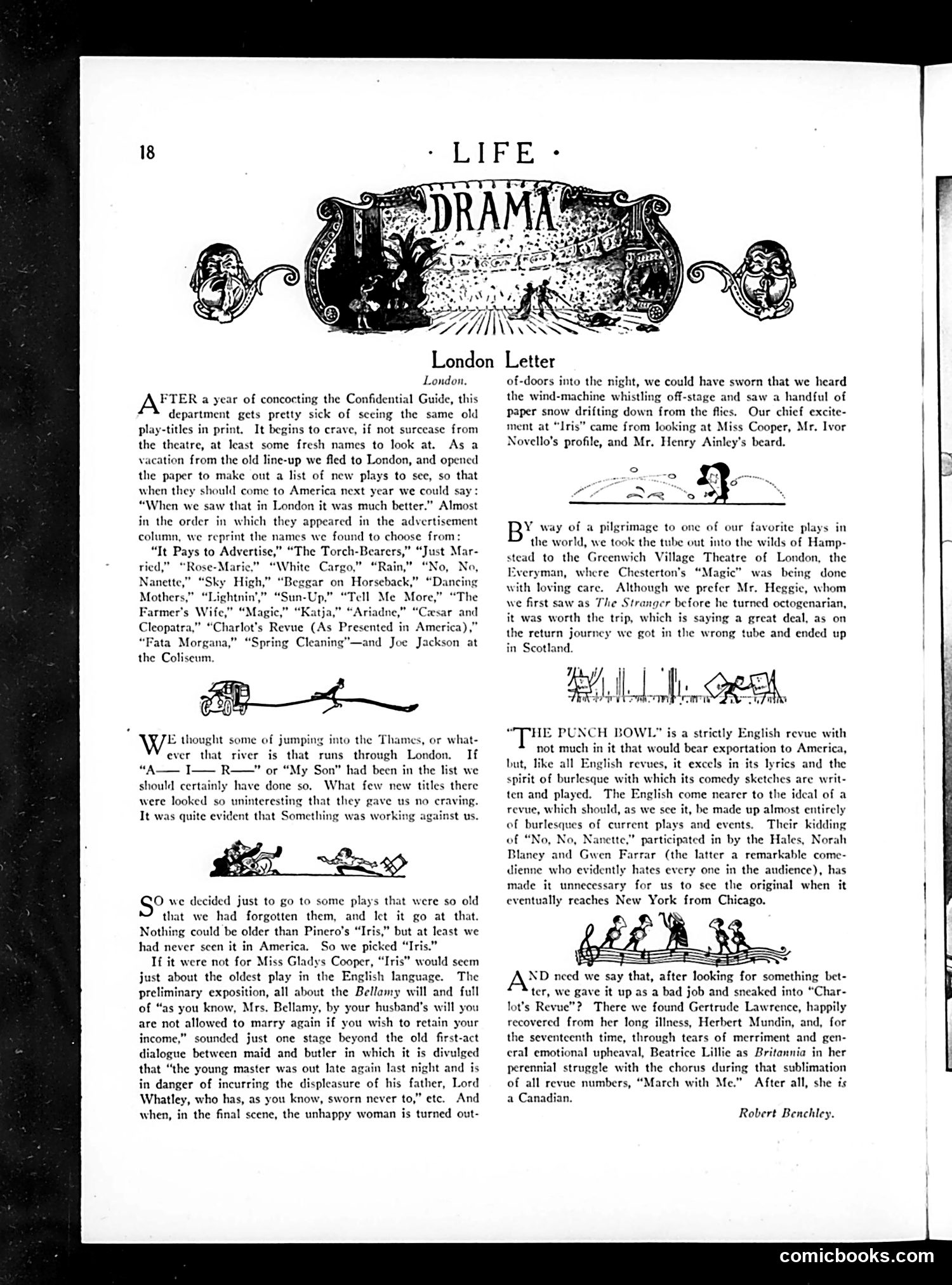
This is a theater review column from *Life* magazine's "Drama" section titled "London Letter." The author humorously recounts attending plays in London after getting tired of reviewing the same American theatrical productions. The main satire targets theatrical clichés: the author mocks the melodramatic plot exposition and creaky staging conventions of Arthur Wing Pinero's classic play "Iris" (featuring actress Gladys Cooper). The joke is that even a celebrated "old master" relies on tired devices—servants exposing plot points, wind machines creating artificial weather effects, and stock dramatic scenarios. The piece celebrates newer theatrical trends, particularly English revues (musical comedy review shows) that mock current plays and events. The author expresses enthusiasm for London's theatrical scene while gently satirizing both outdated dramatic conventions and the pretentious American habit of claiming London productions are "much better" than their New York equivalents. The decorative masque illustrations frame the theater-focused content typical of *Life*'s drama coverage.
📄 Transcribed text from this page (OCR, searchable)
Machine-transcribed from the original scan — historical spelling and the odd misread are preserved.
London Letter London. JAFIER a year of concocting the Confidential Guide, this department gets pretty sick of seeing the same old play-titles in print. It begins to crave, if not surcease from the theatre, at Icast some fresh names to look at. As a vacation from the old line-up we fled to London, and opened the paper to make out a list of new plays to see, so that when they should come to America next year we could say: “When we saw that in London it was much better.” Almost in the order in which they appeared in the advertisement column, we reprint the names we found to choose from: “It Pays to Advertise,” “The Torch-Bearers,” “Just Mar- ried,” “Rose-Marie,” “White Cargo,” “Rain,” “No, No, “Beggar on Horseback,” “Dancing ” “Tell Me More,” “The Ariadne,” “Cesar and Cleopatra,” “Charlot's Revue (As Presented in America),” “Fata Morgana,” “Spring Cleaning"—and Joe Jackson at the Coliseum fp_t—_ WE thought some of jumping into the Thames, of what- ever that river is that runs through London. If “A—— I—— R—" or “My Son” had been in the list we should certainly have done so. What few new titles there were looked so uninteresting that they gave us no craving. It was quite evident that Something was working against us. O we decided just to go to some plays that were so old that we had forgotten them, and Iet it go at that. Nothing could be older than Pinero’s “Iris,” but at least we had never scen it in America. So we picked “Iris.” If it were not for Miss Gladys Cooper, “Iris” would seem just about the oldest play in the English language. The preliminary exposition, all about the Bellamy will and full of “as you know, Mrs. Bellamy, by your husband's will you are not allowed to marry again if you wish to retain your income,” sounded just one stage beyond the old first-act dialogue between maid and butler in which it is divulged that “the young master was out late again last night and is in danger of incurring the displeasure of his father, Lord Whatley, who has, as you know, sworn never to,” ete. And when, in the final scene, the unhappy woman is turned out- of-doors into the night, we could have sworn that we heard the wind-machine whistling off-stage and saw a handful of paper snow drifting down from the flics. Our chief excite- ment at “Iris” came from looking at Miss Cooper, Mr. Ivor Novello’s profile, and Mr. Henry Ainley's beard. Y way of a pilgrimage to one of our favorite plays in the world, we took the tube out into the wilds of Hamp- stead to the Greenwich Village Theatre of London, the iveryman, where Chesterton’s “Magic” was being done with loving care. Although we prefer Mr. Heggic, whom we first saw as The Stranger before he turned octogenarian, it was worth the trip, which is saying a great deal, as on the return journey we got in the wrong tube and ended up in Scotland. “CHE PUNCH BOWL.” is a strictly English revue with not much in it that would bear exportation to America, but, like all English revues, it excels in its lyrics and the spirit of burlesque with which its comedy sketches are writ- ten and played. The English come nearer to the idcal of a revue, which should, as we sce it, be made up almost entirely of burlesques of current plays and events. Their kidding of “No, No, Nanette,” participated in by the Hales, Norah Blaney and Gwen Farrar (the latter a remarkable come- dienne who evidently hates every one in the audience), has made it unnecessary for us to sce the original when it eventually reaches New York from Chicago. AY. we gave it up as a bad job and sneaked into “Char- lot's Revue"? There we found Gertrude Lawrence, happily recovered from her long illness, Herbert Mundin, and, for the seventeenth time, through tears of merriment and gen- cral emotional upheaval, Beatrice Lillie as Britannia in her perennial struggle with the chorus during that sublimation of all revue numbers, “March with Me.” After all, she is a Canadian. Robert Benchley. comicbooks.com