
Life, 1925-07-30 · page 28 of 36
Life — July 30, 1925 — page 28: what you’re looking at
What you’re looking at
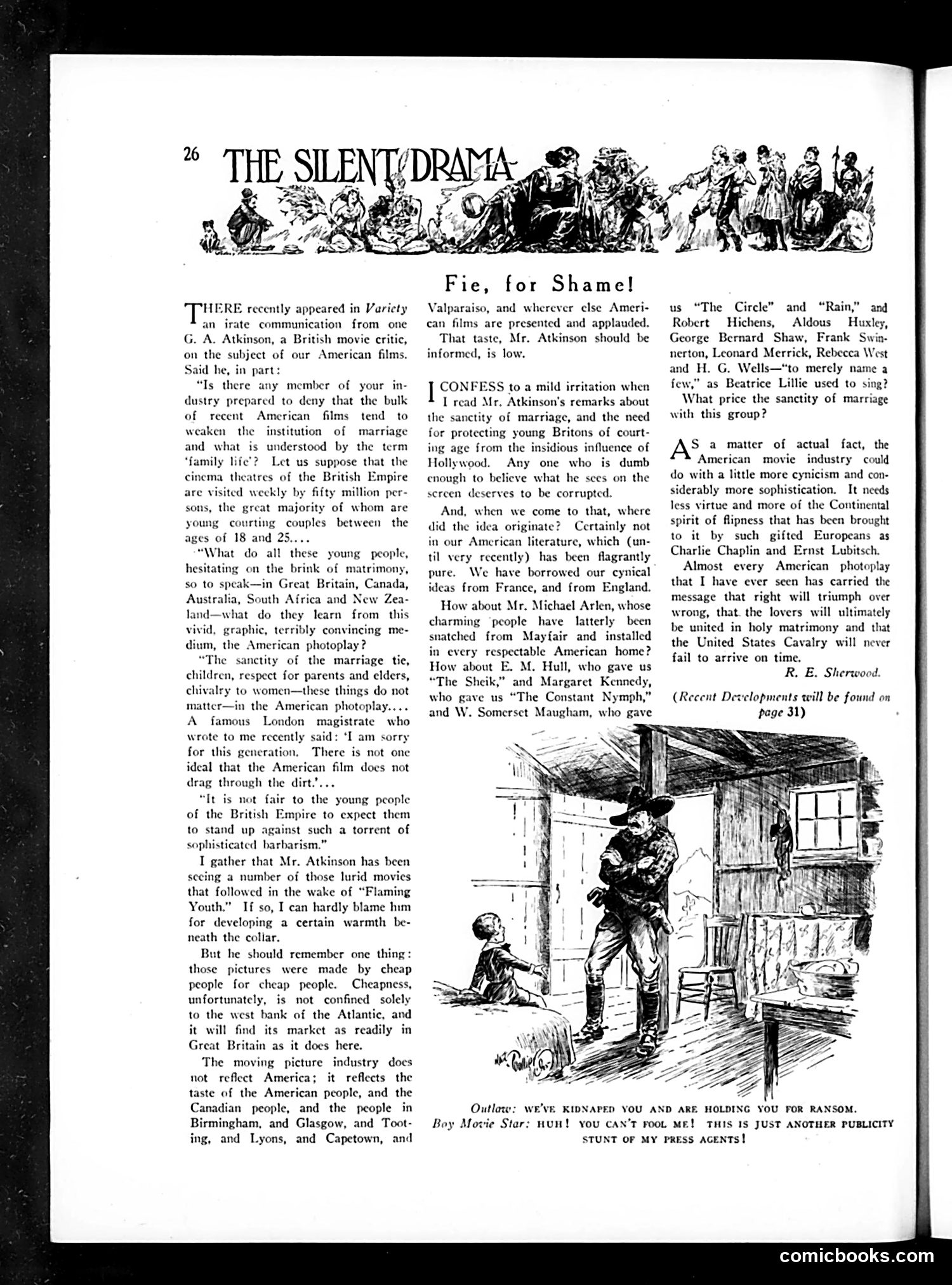
This page satirizes British film critic G. A. Atkinson's complaint that American movies undermine marriage and family values among young people throughout the British Empire. The article's author (R. E. Sherwood) defends American cinema by arguing that: 1. **The real culprit is audience taste, not filmmakers**: Cheap films reflect cheap popular taste on both sides of the Atlantic, not distinctly American corruption. 2. **Britain shouldn't lecture America**: The author points out that cynical attitudes about marriage come from British and European literature—Michael Arlen, E. M. Hull (*The Sheik*), Somerset Maugham, George Bernard Shaw, and others whose work was widely consumed in respectable British homes. 3. **American films need *more* sophistication, not less**: The author argues American cinema actually suffers from excessive virtue and moralism, lacking the Continental worldliness that European directors like Chaplin and Lubitsch bring to film. The accompanying sketch shows a melodramatic "outlaw" kidnapping scenario—likely satirizing the sensational plots Atkinson objected to. The piece uses humor to flip the blame back on British cultural hypocrisy.
📄 Transcribed text from this page (OCR, searchable)
Machine-transcribed from the original scan — historical spelling and the odd misread are preserved.
“THERE recently appeared in Variety an irate communication from one G. A. Atkinson, a British movie critic, on the subject of our American films. Said he, in part: “Is there any member of your in- dustry prepared to deny that the bulk of recent American films tend to weaken the institution of marriage and what is understood by the term ‘family life’? Let us suppose that the cinema theatres of the British Empire are visited weekly by fifty million per- sons, the great majority of whom are young courting couples between the ages of 18 and 25.... “What do all these young people, hesitating on the brink of matrimony, so to speak—in Great Britain, Canada, Australia, South Africa and New Zea- land—what do they learn from this vivid, graphic, terribly convincing me- dium, the American photoplay? “The sanctity of the marriage tie, children, respect for parents and elders, chivalry to women—these things do not matter—in the American photoplay.... A famous London magistrate who wrote to me recently said: ‘I am sorry for this generation, There is not one ideal that the American film does not drag through the dirt’... “It is not fair to the young people of the British Empire to expect them to stand up against such a torrent of sophisticated barbarism.” I gather that Mr. Atkinson has been secing a number of those lurid movies that followed in the wake of “Flaming Youth.” If so, I can hardly blame him for developing a certain warmth be- neath the collar. But he should remember one thing: those pictures were made by cheap people for cheap people. Cheapness, unfortunately, is not confined solely to the west bank of the Atlantic, and it will find its market as readily in Great Britain as it does here. The moving picture industry docs not reflect America; it reflects the taste of the American people, and the Canadian people, and the people in Birmingham, and Glasgow, and Toot- ing, and Lyons, and Capetown, and Fie, for Shame! Valparaiso, and wherever else Ameri- can films are presented and applauded. That taste, Mr. Atkinson should be informed, is low. CON S to a mild irritation when I read Mr. Atkinson's remarks about the sanctity of marriage, and the need for protecting young Britons of court- ing age from the insidious influence of Hollywood. Any one who is dumb enough to believe what he sces on the sercen deserves to be corrupted. And, when we come to that, where did the idea originate? Certainly not in our American literature, which (un- til very recently) has been flagrantly pure. We have borrowed our cynical ideas from France, and from England. How about Mr. Michael Arlen, whose charming ‘people have latterly been snatched from Mayfair and installed in every respectable American home? How about E. M. Hull, who gave us “The Sheik,” and Margaret Kennedy, who ¢: us “The Constant Nymph,” and W. Somerset Maugham, who gave Outlaw: us “The Circle” and “Rain,” and Robert Hichens, Aldous Huxley, George Bernard Shaw, Frank Swin- nerton, Leonard Merrick, Rebecca West and H. G. Wells—“to merely name a few,” as Beatrice Lillie used to sing? What price the sanctity of marriage with this group? S a matter of actual fact, the American movie industry could do with a little more cynicism and con- siderably more sophistication. It needs less virtue and more of the Continental spirit of flipness that has been brought to it by such gifted Europeans as Charlie Chaplin and Ernst Lubitsch. Almost every American photoplay that I have ever seen has carried the message that right will triumph over wrong, that. the lovers will ultimately be united in holy matrimony and that the United States Cavalry will never fail to arrive on time, R. E. Sherwood. (Recent Developments will be found on WEVE KIDNAPED YOU AND ARE HOLDING YOU FOR RANSOM. Boy Movie Star; wun! you CAN'T Foot ME! THIS IS JUST ANOTHER PUBLICITY STUNT OF MY PRESS AGENTS! comicbooks.com