
Life, 1925-07-30 · page 15 of 36
Life — July 30, 1925 — page 15: what you’re looking at
What you’re looking at
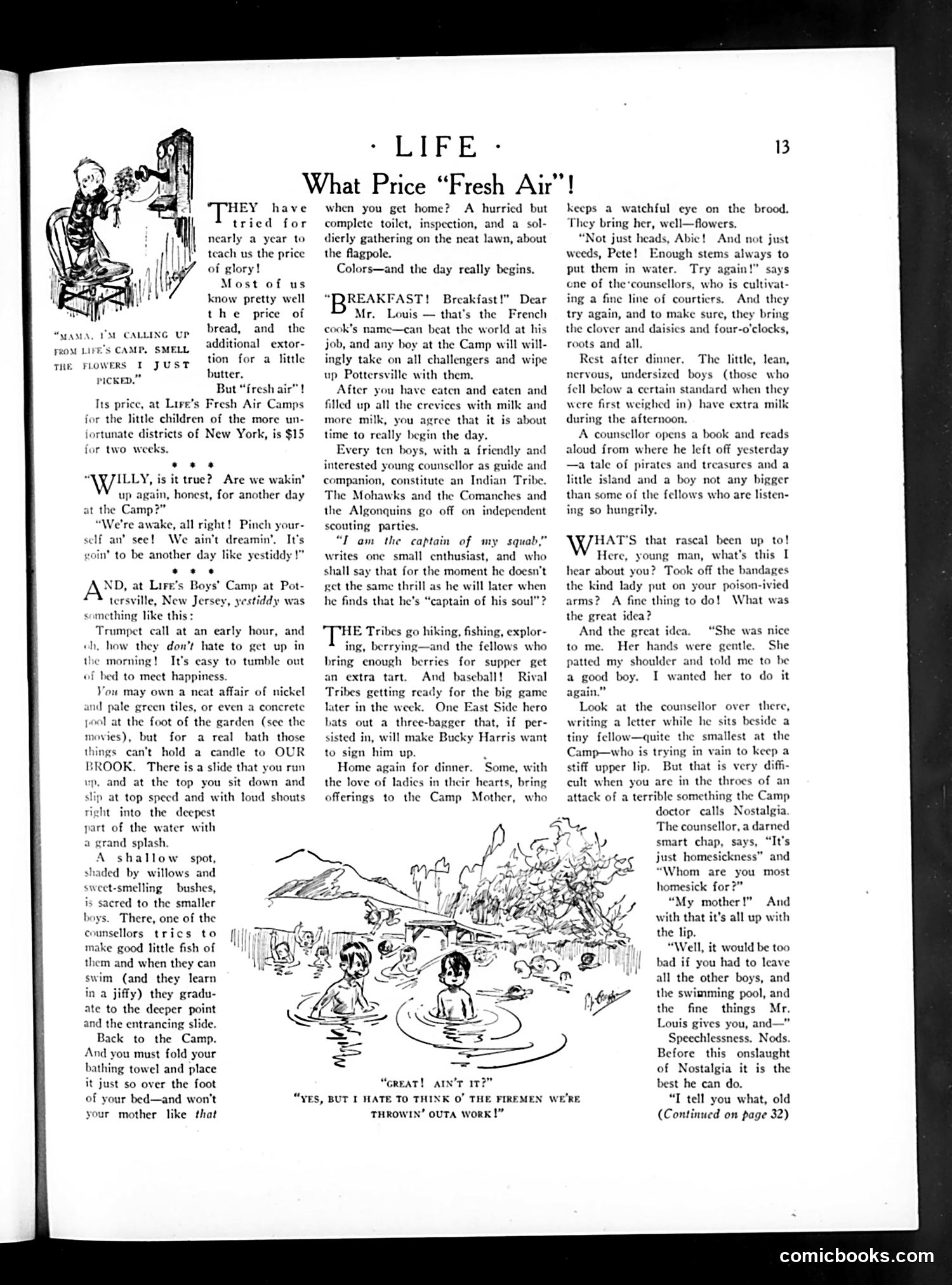
This article satirizes the supposed health benefits of summer camps for wealthy New York children. The piece mocks the exaggerated claims that camps provide "fresh air" and moral improvement, while revealing the actual experience: homesick children enduring uncomfortable conditions. The illustration shows boys swimming in what appears to be a modest pond or pool, with one saying "Great! Ain't it?" while another replies sarcastically about firemen throwing water out windows—suggesting the camp's water facilities are unremarkable. The satire targets the gap between parents' romantic notions of camp life and the mundane reality, while poking fun at the counselors' attempts to build character through activities like hiking and baseball. It's a gentle critique of upper-class pretensions about child-rearing.
📄 Transcribed text from this page (OCR, searchable)
Machine-transcribed from the original scan — historical spelling and the odd misread are preserved.
“MAMA FROM Life's CAMP, SMELL © LIPE = 13 What Price “Fresh Air’! EY have tried for nearly a year ach us the price of glory! Most of us know pretty well the price of bread, and the additional extor- tion for a little butter. But “fresh air”! Its price, at Lu Fresh Air Camps for the little children of the more un- fortunate districts of New York, is $15 for two w VM CALLING UP FLOWERS 1 PICKED,” Just sae ILLY, is it true? Are we wakin’ up again, honest, for another day at the Camp?” “We're awake, all right! Pinch your- self an’ see! We ain’t dreamin’. It's in’ to be another day like yestiddy ! Camp at Pot- tersville, New Jersey, yestiddy was something like this: Trumpet call at an early hour, and oh, how they don’t hate to get up in morning! It’s casy to tumble out of bed to meet happiness. You may own a neat affair of nickel and pale green tiles, or even a concrete ool at the foot of the garden (see the movies), but for a real bath those things can’t hold a candle to OUR BROOK. There is a slide that you run . and at the top you sit down and at top speed and with loud shouts right into the deepest part of the water with a grand splash. shallow spot, shaded by willows and sweet-smelling bushes, is sacred to the smaller bo: There, one of the unsellors trics to make good little fish of them and when they can swim (and they learn in a jiffy) they gradu- ate to the deeper point and the entrancing slide. Back to the Camp. And you must fold your bathing towel and place it just so over the foot of your bed—and won't your mother like that when you get home? A hurried but complete toilct, inspection, and a sol- dierly gathering on the neat lawn, about the flagpole. Colors—and the day really begins. “RREAKFAST! Breakfast!" Dear Mr. Louis — that’s the French cook’s name—can beat the world at his job, and any boy at the Camp will will- ingly take on all challengers and wipe up Pottersville with them. After you have eaten and eaten and filled up all the crevices with milk and more milk, you agree that it is about time to really begin the day. Every ten boys, with a friendly and interested young counsellor as guide and companion, constitute an Indian Tribe. The Mohawks and the Comanches and the Algonquins go off on independent scouting parties. “IT am the captain of my squab,” writes one small enthusiast, and who shall say that for the moment he doesn’t get the same thrill as he will later when he finds that he's “captain of his soul”? IE Tribes go hiking, fishing, explor- ing, berrying—and the fellows who bring enough berries for supper get an extra tart. And baseball! Rival Tribes getting ready for the big game later in the week. One East Side hero bats out a three-bagger that, if per- sisted in, will make Bucky Harris want to sign him up. . Home again for dinner. Some, with the love of ladies in their hearts, bring offerings to the Camp Mother, who “Great! ain’? 11? YES, BUT I HATE TO THINK O' THE FIREMEN WE'RE THROWIN’ OUTA Work!” keeps a watchful eye on the brood. They bring her, well—flowers. “Not just heads, Abie! And not just weeds, Pete! jough stems always to put them in water. Try again!” says ene of the-counsellors, who is cultivat- ing a fine line of courtiers, And they try again, and to make sure, they bring the clover and daisics and four-o'clocks, roots and all. Rest after dinner. The little, lean, nervous, undersized boys (those who fell below a certain standard when they were first weighed in) have extra milk during the afternoon. A counsellor opens a book and reads aloud from where he left off yesterday —a tale of pirates and treasures and a little island and a boy not any bigger than some of the fellows who are listen- ing so hungrily, HAT'S that rascal been up to! Here, young man, what's this I hear about you? Took off the bandages the kind lady put on your poison-ivied A fine thing to do! What was the great idea? And the great idea. “She was nice to me. Her hands were gentle. She patted my shoulder and told me to be a good boy. I wanted her to do it again.” Look at the counsellor over there, writing a letter while he sits beside a tiny fellow—quite the smallest at the Camp—who is trying in vain to keep a stiff upper lip. But that is very diffi- cult when you are in the throes of an attack of a terrible something the Camp doctor calls Nostalgia. The counsellor, a darned smart chap, says, “It's just homesickness” and “Whom are you most homesick for? “My mother!” And with that it’s all up with the li “Well, it would be too bad if you had to leave all the other boys, and the swimming pool, and the fine things M Louis gives you, and— Speechlessness. Nods. Before this onslaught of Nostalgia it is the best he can do. “T tell you what, old (Continued on page 32) arms? comicbooks.com