
Life, 1925-07-30 · page 16 of 36
Life — July 30, 1925 — page 16: what you’re looking at
What you’re looking at
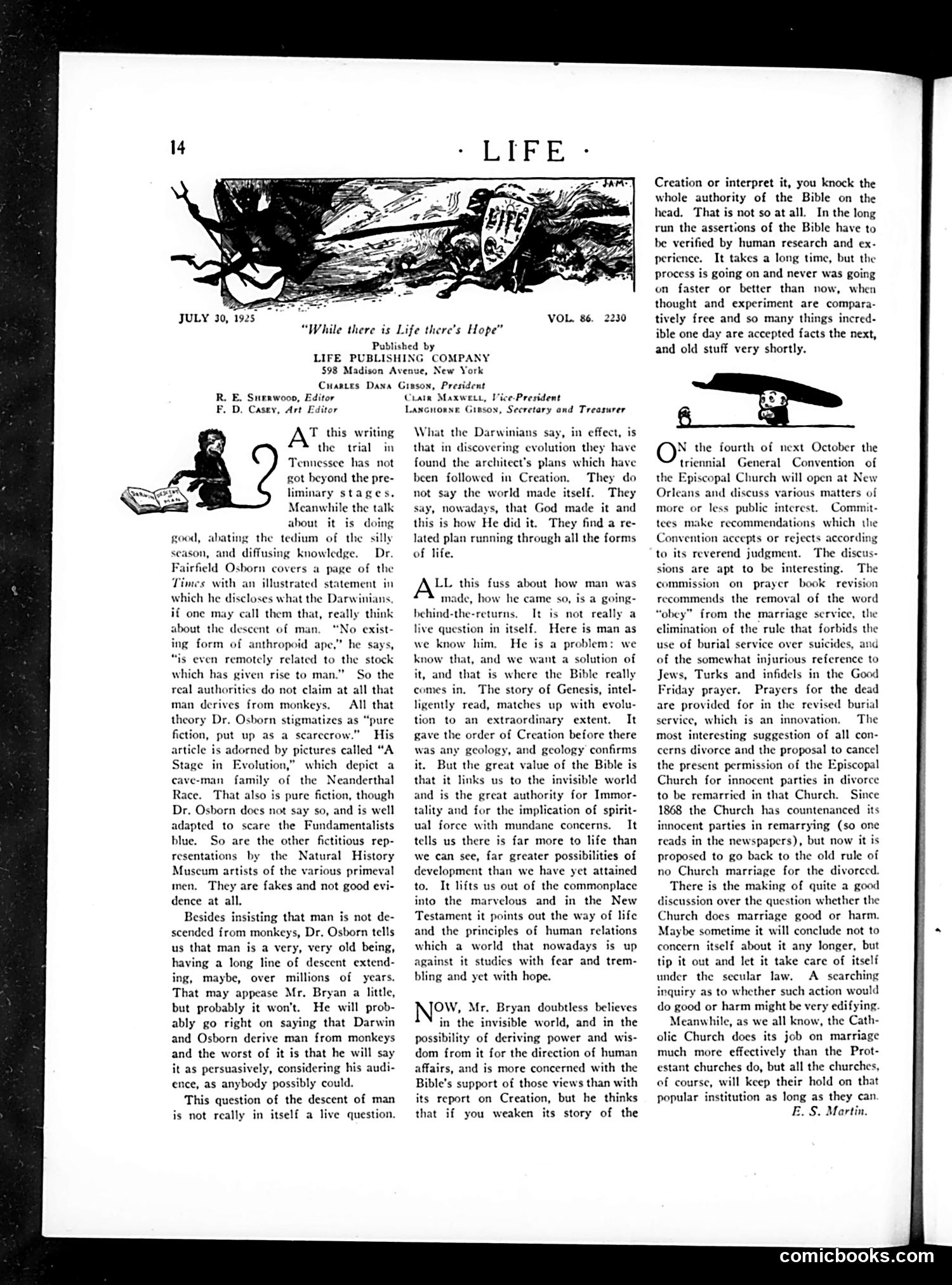
This page contains editorial text rather than a political cartoon. The main illustration at top shows a dead figure with a tombstone marked "R.I.P."—likely representing the "trial in Tennessee" mentioned in the article (referring to the Scopes "Monkey Trial" of 1925). The article critiques William Jennings Bryan and fundamentalist opposition to Darwinian evolution. It discusses the tension between Biblical creation accounts and scientific evidence, sarcastically noting that Bryan and Dr. Osborn "derive man from monkeys" while claiming the Bible's authority. The satire targets Bryan's anti-evolution stance during the famous Tennessee trial that year, presenting the debate as between outdated religious literalism and modern science.
📄 Transcribed text from this page (OCR, searchable)
Machine-transcribed from the original scan — historical spelling and the odd misread are preserved.
JULY 30, 1925 “While there is Life there’s Hope” Published by LIFE PUBLISHING COMPANY $98 Madison Avenue, New York Cuartes Dana Grnsox, President R. E. Surawoop, Editor FP. D. Casey, Art E T this wri the trial in Tennessee has not got beyond the pre- liminary stages. Meanwhile the talk about it is doing good, abating the tedium of the silly season, and diffusing knowledge. Dr. field Osborn covers a page of the Times with an illustrated statement in which he discloses what the Darwinians, if one may call them that, really think about the descent of man No exist- ing form of anthropoid ape,” he says, “is even remotely related to the stock which has given rise to man.” So the real authorities do not claim at all that man derives from monkeys. All that theory Dr. Osborn stigmatizes as “pure fiction, put up as a scarecrow.” His article is adorned by pictures called “A Stage in Evolution,” which depict a cave-man family of the Neanderthal Race. That also is pure fiction, though Dr. Osborn does not say so, and is well adapted to scare the Fundamentalists blue. So are the other fictitious rep- resentations by the Natural History Muscum artists of the various primeval men. They are fakes and not good evi- dence at all. Besides insisting that man is not de- scended from monkeys, Dr. Osborn tells us that man is a very, very old being, having a long line of descent extend- ing, maybe, over millions of years. That may appease Mr. Bryan a little, but probably it won't. He will prob- ably go right on saying that Darwin and Osborn derive man from monkeys and the worst of it is that he will say it as persuasively, considering his audi- ence, as anybody possibly could. This question of the descent of man is not really in itself a live question. Cuate Maxwett, | Lancnorne Gissox, Secretary and Treasurer President What the Darwinians say, in effect, is that in discovering evolution they have found the architect’s plans which have been followed in Creation. They do not say the world made itself. They say, nowadays, that God made it and this is how He did it. They find a re- lated plan running through all the forms of life. LL this fuss about how man was made, how he came so, is a going- behind-the-returns. It is not really a live question in itself. Here is man as we know him. He is a problem: we know that, and we want a solution of it, and that is where the Bible really comes in, The story of Genesis, intel- ligently read, matches up with evolu- tion to an extraordinary extent. It gave the order of Creation before there was any geology, and geology confirms it. But the great value of the Bible is that it links us to the invisible world and is the great authority for Immor- tality and for the implication of spirit- ual force with mundane concerns. It tells us there is far more to life than we can see, far greater possibilities of development than we have yet attained to. It lifts us out of the commonplace into the marvelous and in the New Testament it points out the way of life and the principles of human relations which a world that nowadays is up against it studies with fear and trem- bling and yet with hope. OW, Mr. Bryan doubtless believes in the invisible world, and in the possibility of deriving power and wis- dom from it for the direction of human affairs, and is more concerned with the Bible’s support of those views than with its report on Creation, but he thinks that if you weaken its story of the Creation or interpret it, you knock the whole authority of the Bible on the head. That is not so at all. In the long run the assertions of the Bible have to be verified by human research and ex- perience. It takes a long time, but the process is going on and never was going on faster or better than now, when thought and experiment are compara- tively free and so many things incred- ible one day are accepted facts the next, and old stuff very shortly. N the fourth of next October the triennial General Convention of the Episcopal Church will open at New Orleans and discuss various matters of more or less public interest. Commit- tees make recommendations which the Convention accepts or rejects according to its reverend judgment. The discus- sions are apt to be interesting. The commission on prayer book revision recommends the removal of the word “obey” from the marriage service, the elimination of the rule that forbids the use of burial service over suicides, and of the somewhat injurious reference to Jews, Turks and infidels in the Good Friday prayer. Prayers for the dead are provided for in the revised burial service, which is an innovation, The most interesting suggestion of all con- cerns divorce and the proposal to cancel the present permission of the Episcopal Church for innocent parties in divorce to be remarried in that Church. Since 1868 the Church has countenanced its innocent parties in remarrying (so one reads in the newspapers), but now it is proposed to go back to the old rule of no Church marriage for the divorced. There is the making of quite a good discussion over the question whether the Church does marriage good or harm. Maybe sometime it will conclude not to concern itself about it any longer, but tip it out and let it take care of itself under the secular law. A searching inquiry as to whether such action would do good or harm might be very edifying. Meanwhile, as we all know, the Cath- olic Church does its job on marriage much more effectively than the Prot- estant churches do, but all the churches, of course, will keep their hold on that popular institution as long as they can. E. S. Martin. comicbooks.com