
A complete issue · 40 pages · 1925
Life — July 16, 1925
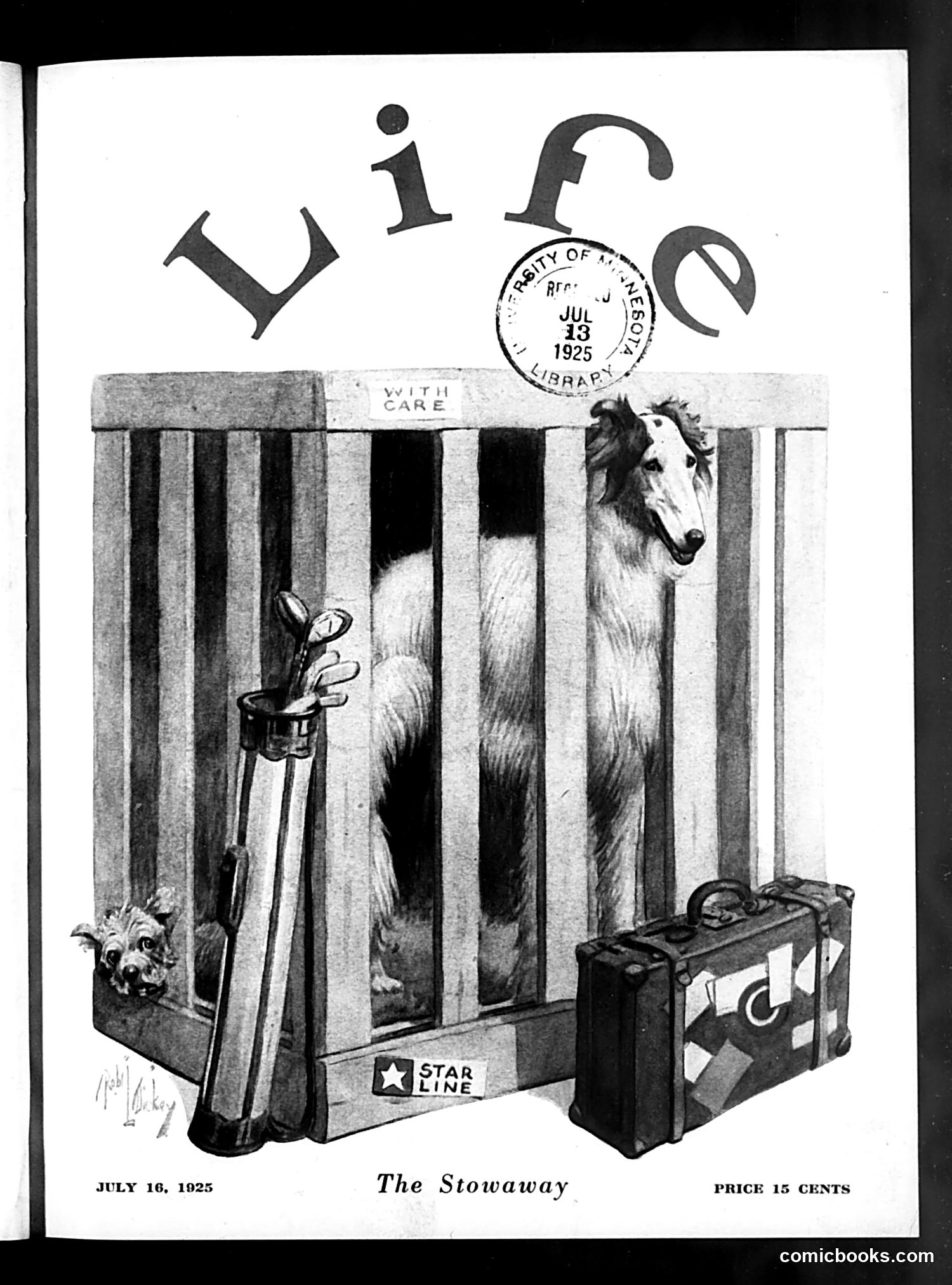
This cartoon illustrates the common immigration anxiety of the 1920s. The drawing shows a dog crate labeled "STAR LINE" (a shipping company) being opened at what appears to be a port or customs area. Inside the crate is a collie dog—a valuable purebred—that has apparently smuggled itself aboard as a stowaway. The satire works on multiple levels: it mocks both smuggling (a serious concern during Prohibition) and the period's obsession with pedigree and "quality" bloodlines. The dog's aristocratic breed suggests wealthy passengers might attempt similar concealment. The "WITH CARE" marking and luggage labeled with travel stickers emphasize the absurdity of an animal traveling like a first-class passenger in hiding.
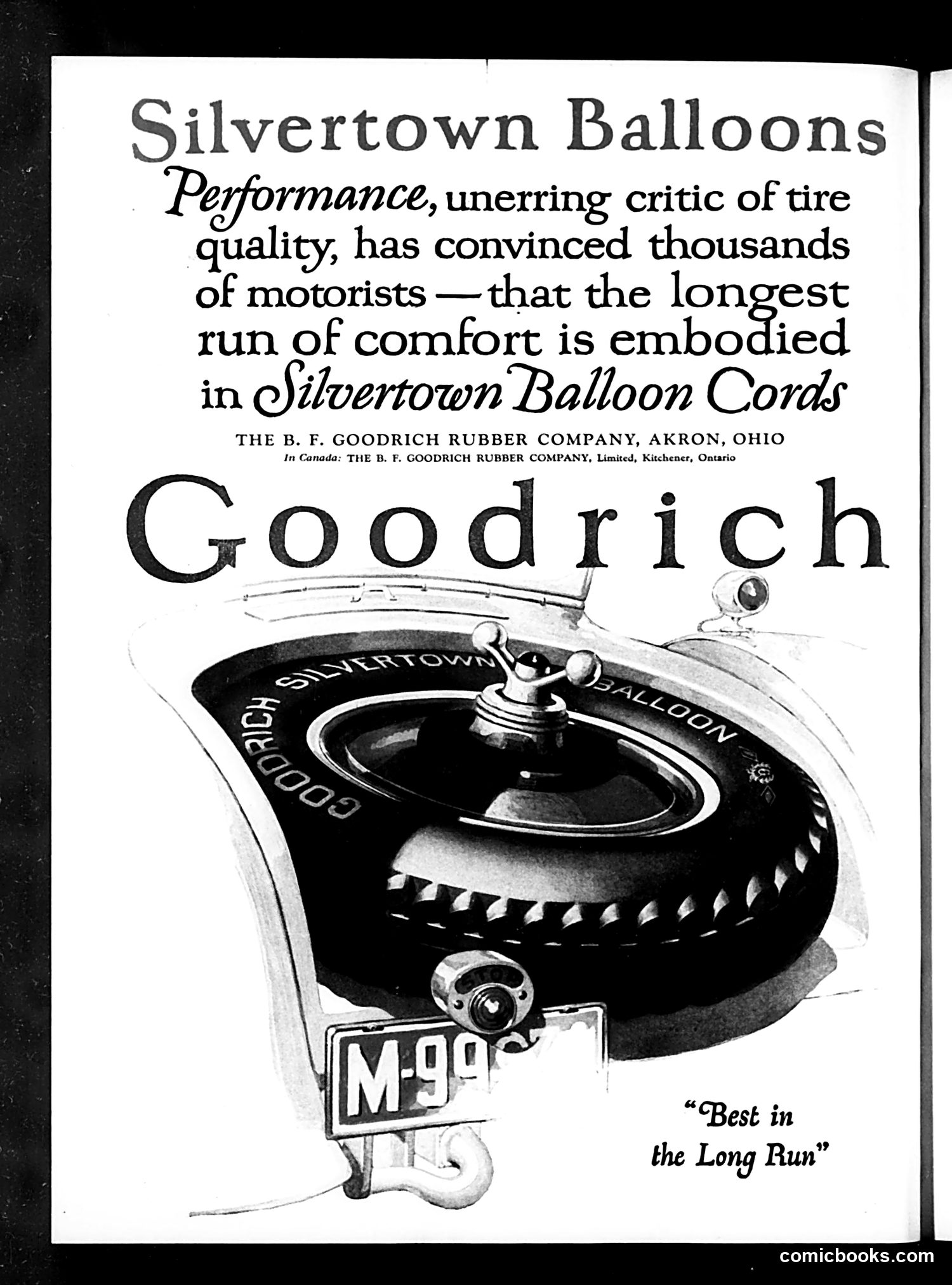
This is **not a political cartoon or satire page** — it's a straightforward **advertisement for Goodrich tires**, specifically their "Silvertown Balloon Cords" product line. The page features: - A product photograph showing a Goodrich tire mounted on a vehicle - A license plate reading "M-99" - Marketing copy emphasizing tire durability and comfort for long drives - Company information (B.F. Goodrich Rubber Company, Akron, Ohio) - The tagline "Best in the Long Run" The only humor present is mild wordplay in that tagline. This represents typical 1920s-era automotive advertising, when tire quality was a genuine selling point and consumer concern. There is no political or social satire intended.
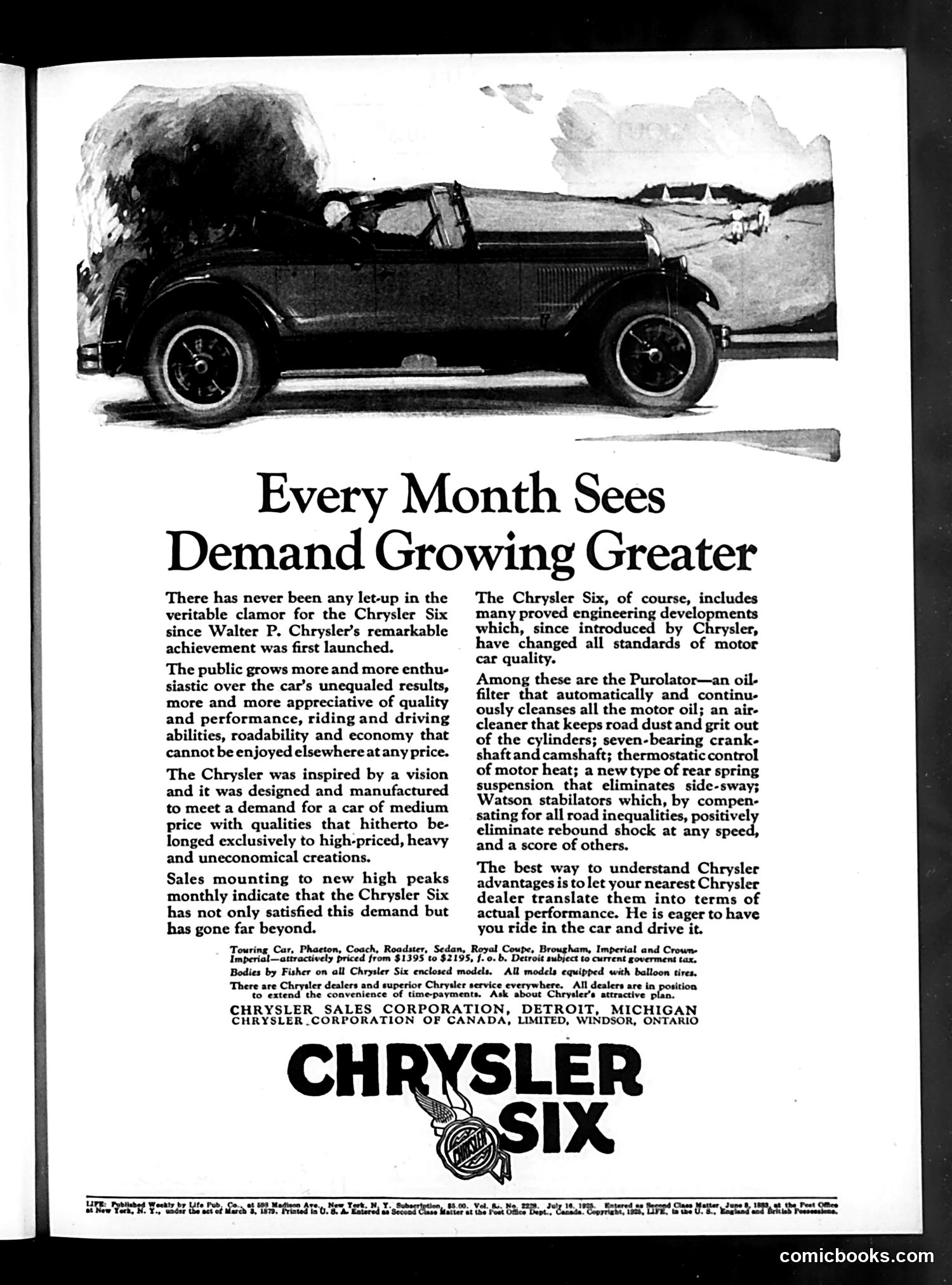
This is **not a satirical cartoon page**, but rather a **straightforward advertisement** for the Chrysler Six automobile, published in Life magazine. The image shows a side-profile illustration of a 1920s Chrysler Six convertible. The ad's headline claims "Every Month Sees Demand Growing Greater," asserting the car's increasing popularity. The text emphasizes engineering innovations (oil filter, air cleaner, suspension improvements) that supposedly set new industry standards. The ad encourages readers to visit a Chrysler dealer to experience the car firsthand. Pricing information indicates models ranging from $1,395 to $2,195. This represents standard automotive advertising of the era, not satire or political commentary.
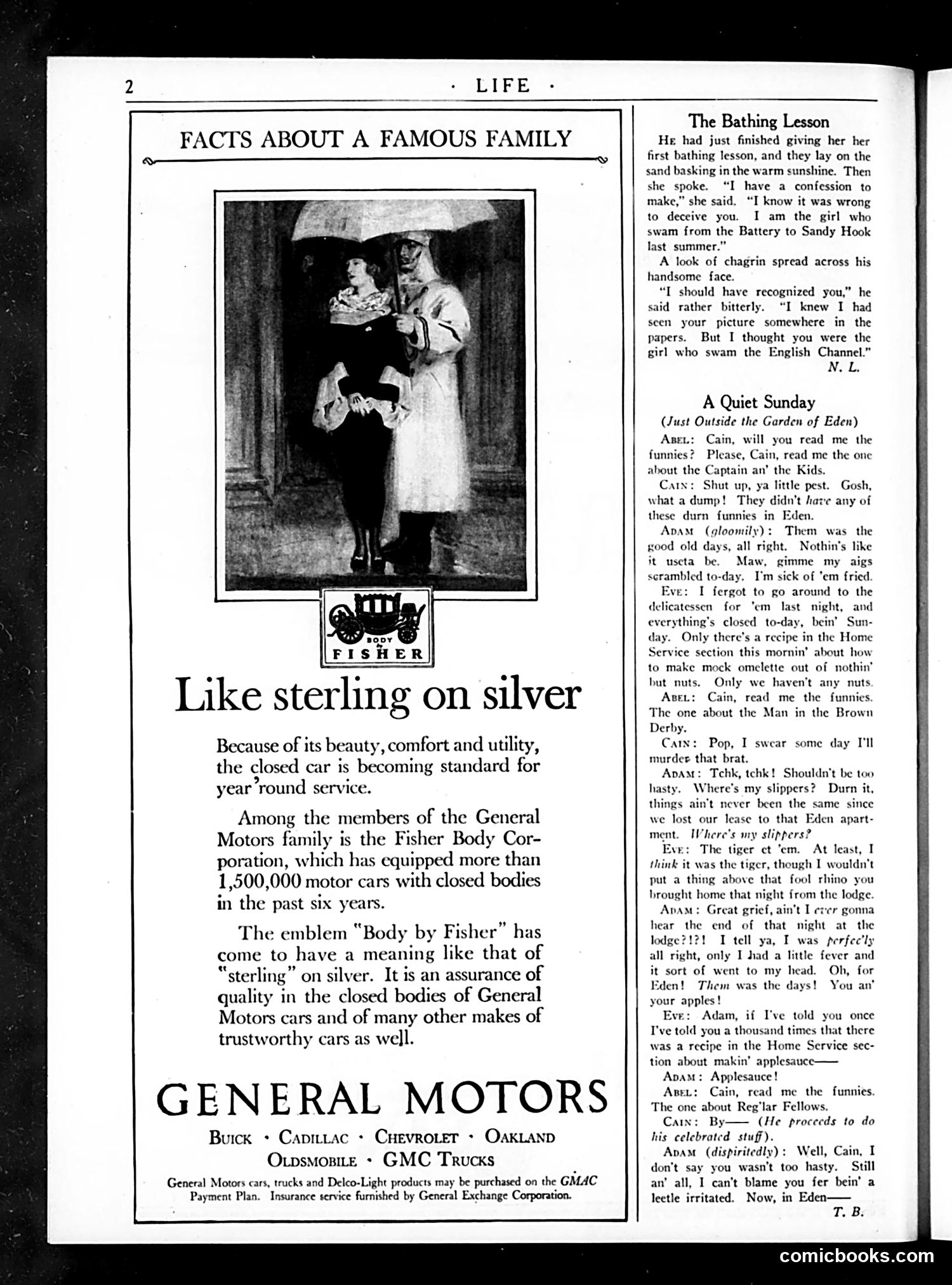
This page is primarily **advertising**, not political satire. The dominant content is a General Motors advertisement for Fisher Body-equipped cars, featuring a photograph of elegantly dressed figures under an umbrella. The ad's tagline—"Like sterling on silver"—compares Fisher Body's quality to precious metals, claiming that closed-car bodies have become standard for year-round driving. It notes Fisher Body has equipped over 1.5 million General Motors vehicles in six years. The right column contains a humorous domestic dialogue piece titled "A Quiet Sunday," depicting family members bickering about reading the funnies—lighthearted entertainment rather than political commentary. This represents typical 1920s-era magazine content: high-end automobile marketing alongside entertainment features.
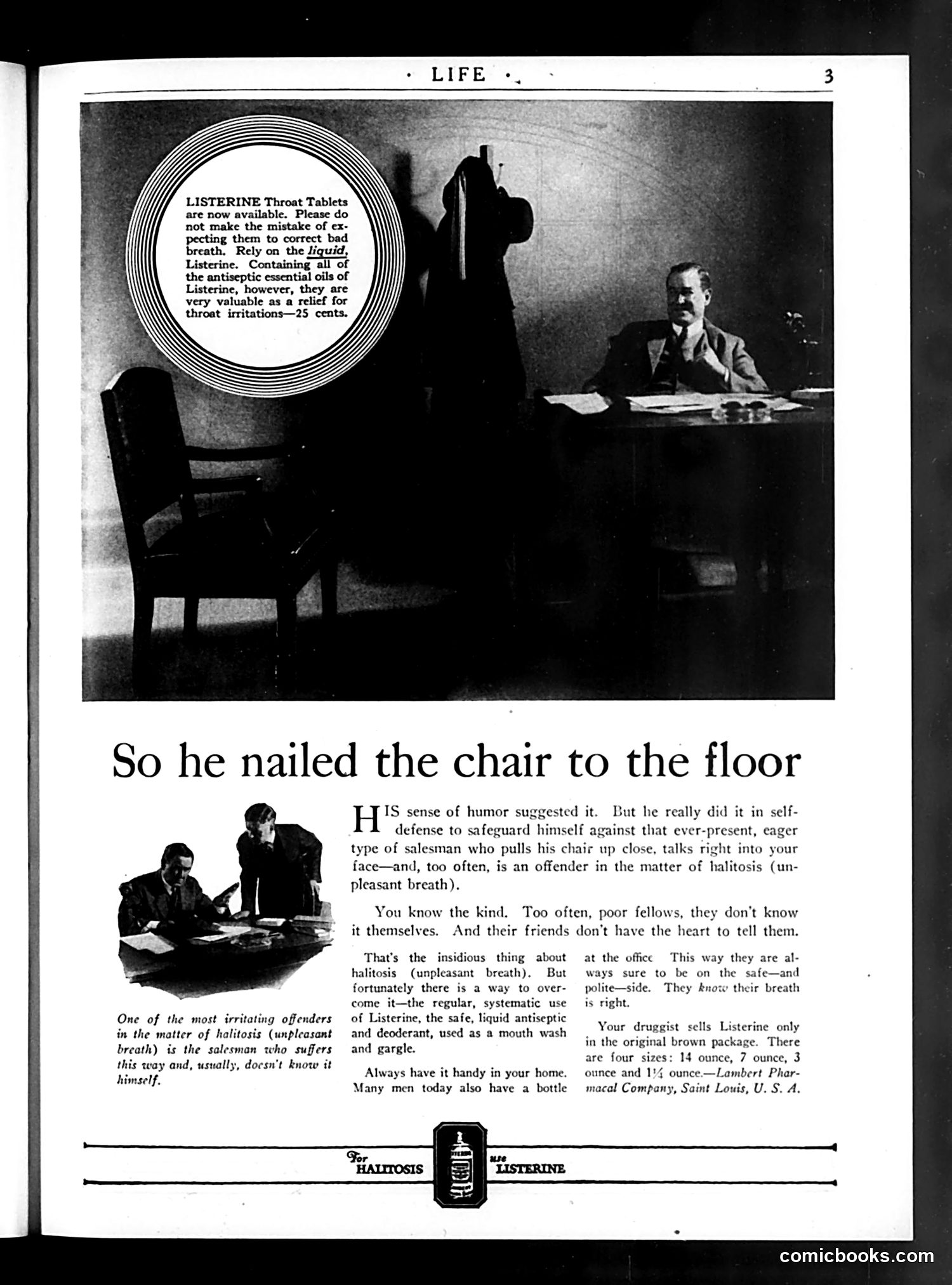
This page is primarily a **Listerine advertisement** disguised as editorial content—a common early 20th-century advertising technique. The cartoon illustrates a salesman's defensive behavior: he's literally nailed his chair to the floor to prevent an "ever-present, eager type" of salesman from moving closer during conversations. The joke satirizes aggressive sales tactics of the era, particularly the practice of invading personal space during pitch meetings. The advertisement then pivots to the real message: such salesmen often suffer from **halitosis (bad breath)**, an embarrassing social problem Listerine promises to solve. The text emphasizes that afflicted individuals often don't realize their problem themselves. The satire mocks both pushy salesmanship and the social anxiety around bad breath, while selling Listerine as the solution—a product originally marketed as a general antiseptic but repositioned here as a breath remedy.
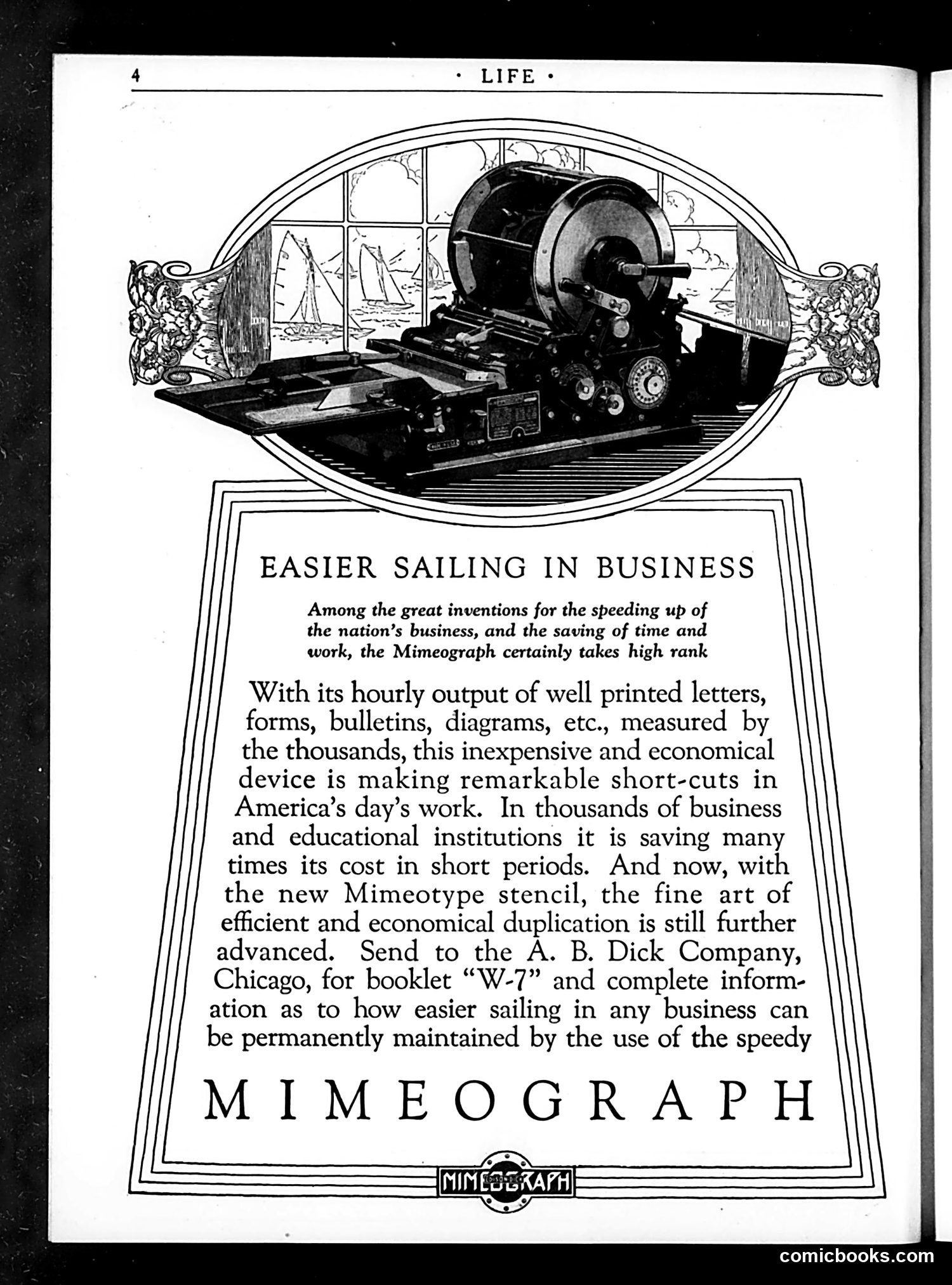
This page is primarily **advertising**, not satire or political commentary. It's a LIFE magazine ad for the Mimeograph machine, manufactured by the A.B. Dick Company of Chicago. The ad's headline "EASIER SAILING IN BUSINESS" uses nautical metaphor to promote the mimeograph as a labor-saving business device. The illustration shows the machine itself rather than caricatured figures. The text emphasizes the machine's efficiency: it produces "well printed letters, forms, bulletins, diagrams, etc., measured by the thousands" and saves costs for "business and educational institutions." The ad promotes a newer "Mimeotype stencil" innovation for improved duplication. This reflects early-20th-century enthusiasm for mechanical devices that promised to streamline office work and increase productivity.
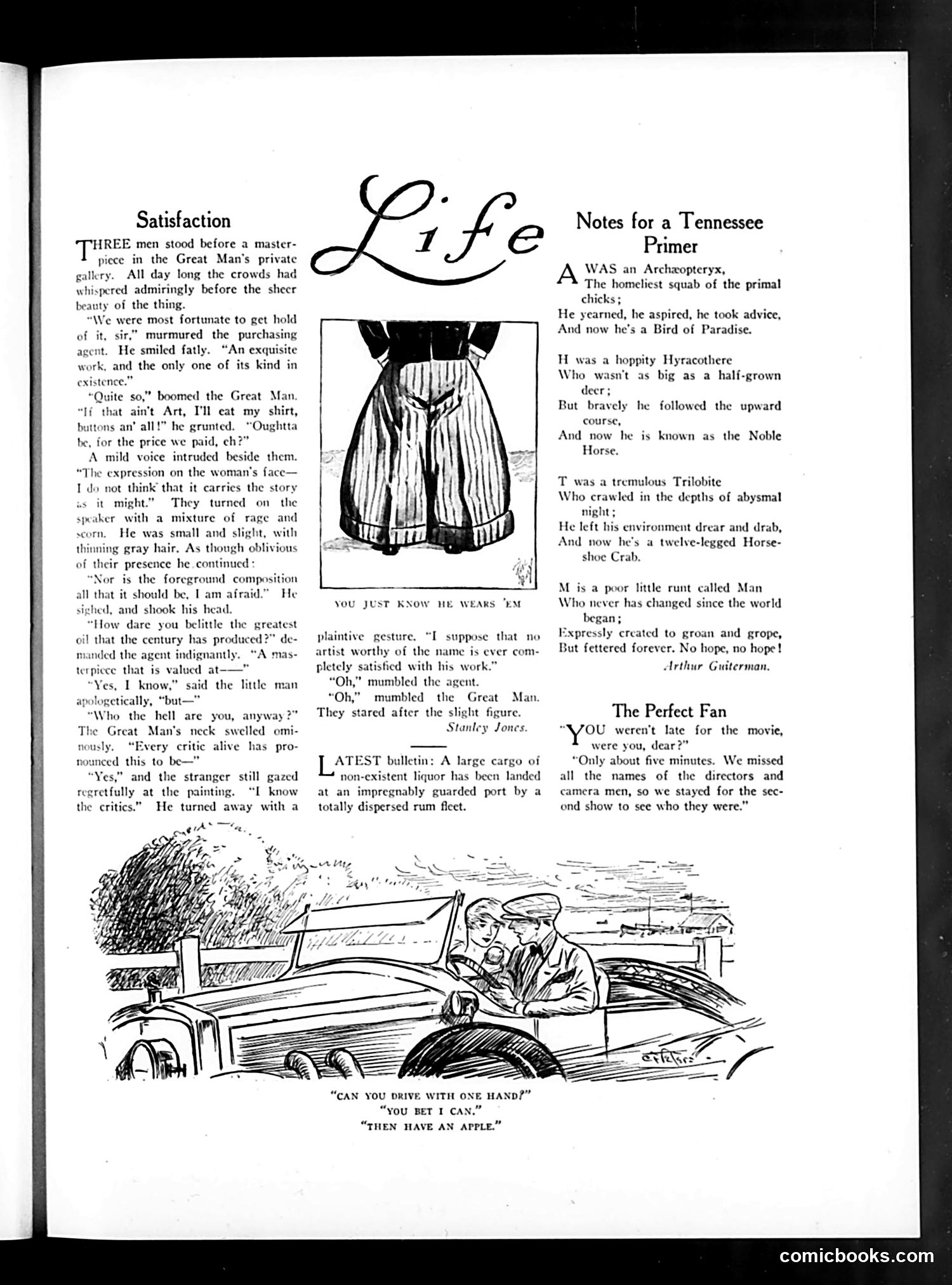
This page contains two distinct pieces: **"Satisfaction"** (left): A satirical story about three men purchasing art. The narrative mocks pretentious art criticism and collectors who lack genuine understanding. The Great Man dismisses the artwork's value while paradoxically praising it, exposing the hypocrisy of wealthy art patrons who follow fashionable opinions rather than developing authentic taste. **"The Perfect Fan"** (bottom): A cartoon showing a couple in a convertible car. The dialogue—"Can you drive with one hand?" / "You bet I can" / "Then have an apple"—is a flirtation joke, likely referencing dating customs of the era where young women tested men's driving ability as a pretext for romantic interaction. Both pieces satirize contemporary social pretension and courting behaviors.
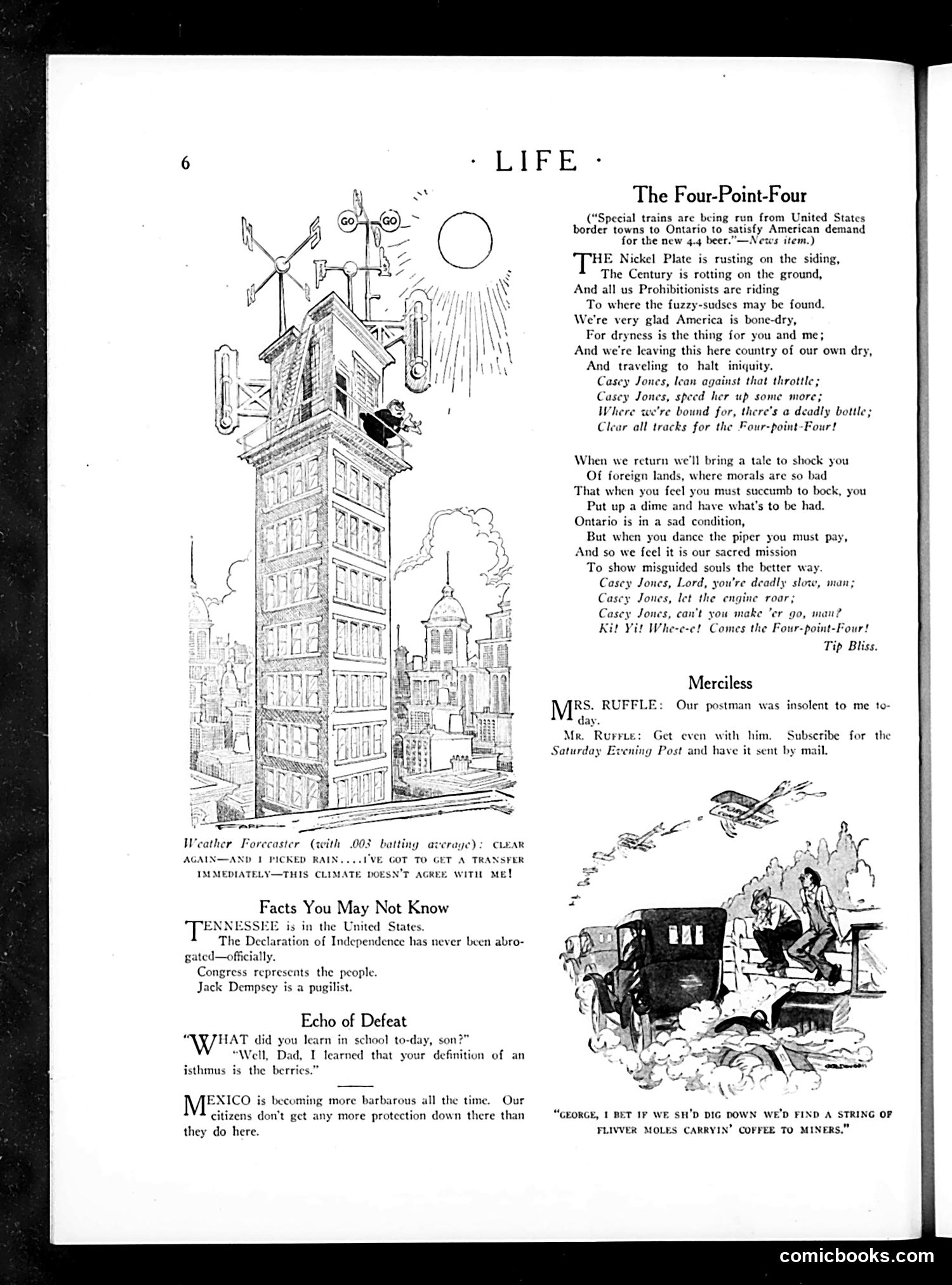
This page satirizes Prohibition-era smuggling and American hypocrisy. **"The Four-Point-Four"** is a poem mocking Prohibition enforcement failures—it references the "Nickel Plate" (railroad) and "Century" (train) being used to smuggle Canadian beer across the U.S. border. The accompanying tall building illustration depicts smuggling operations, with the caption "Weather Forecaster" sarcastically noting the climate "doesn't agree with me" regarding alcohol transport. The cartoons below mock other social absurdities: "Merciless" shows postal service complaints, while "Echo of Defeat" jokes about school education, and "Facts You May Not Know" offers tongue-in-cheek observations about Tennessee and Mexico. The aviation cartoon depicts miners seeking "Flivver Moles" (playing on Henry Ford's Model T), suggesting economic desperation or resource scarcity. Overall, the page lambastes Prohibition's ineffectiveness and American cultural contradictions of the 1920s-30s.
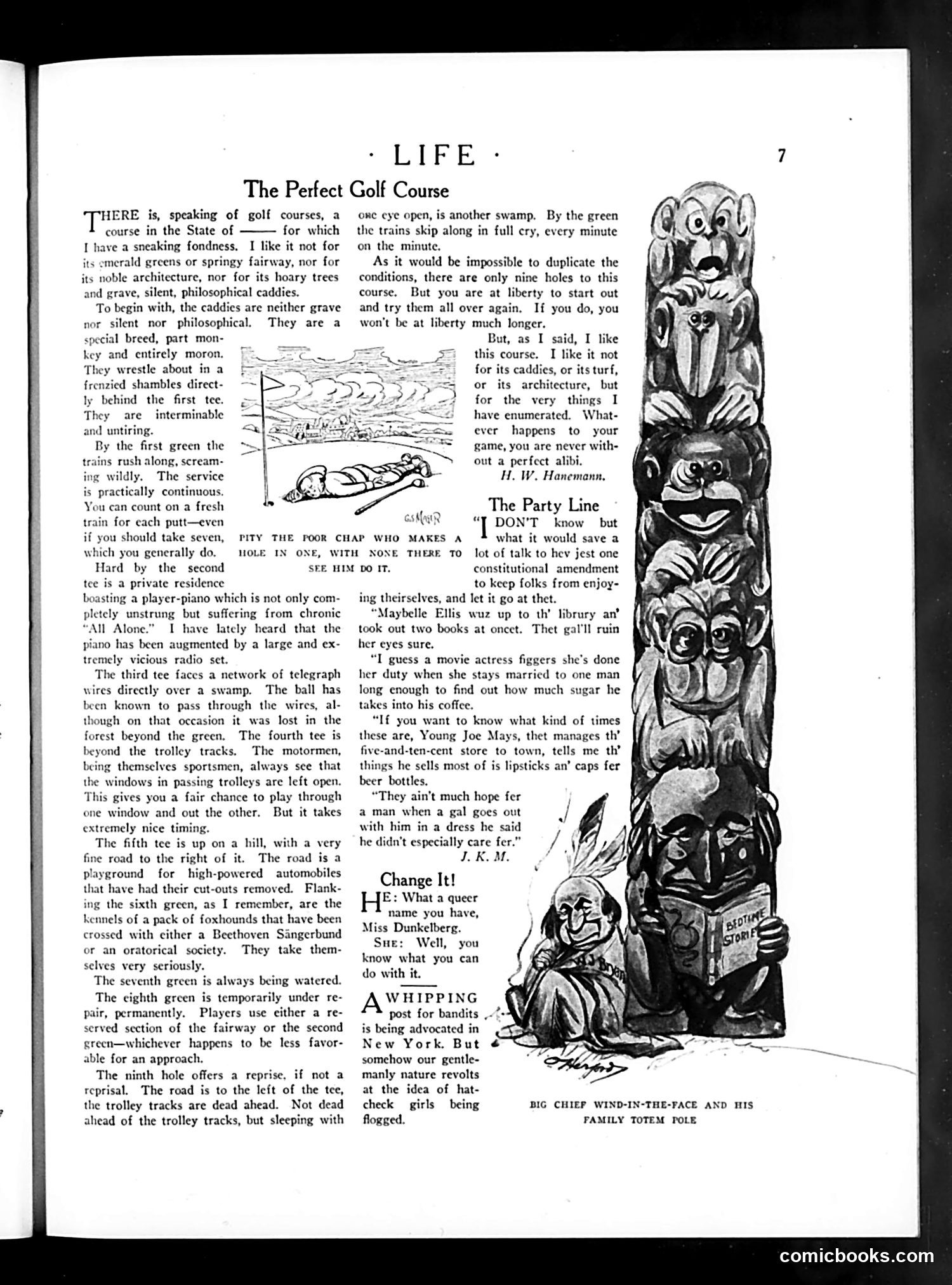
This page contains three humor pieces: "The Perfect Golf Course" (a satirical essay about an idealized, impossible golf course), "The Party Line" (a brief joke about a married woman discovering her husband's coffee preferences), and "Change It!" (a name-joke exchange). The main visual is a large illustration of a Native American totem pole labeled "Big Chief Wind-In-The-Face and His Family Totem Pole." This appears to be period humor playing on exaggerated Native American naming conventions for comedic effect—typical of early 20th-century American satire that relied on racial caricature. The smaller illustration shows a golfer lying exhausted, captioned about making a hole-in-one. The humor targets golf enthusiasts and married life stereotypes of the era.
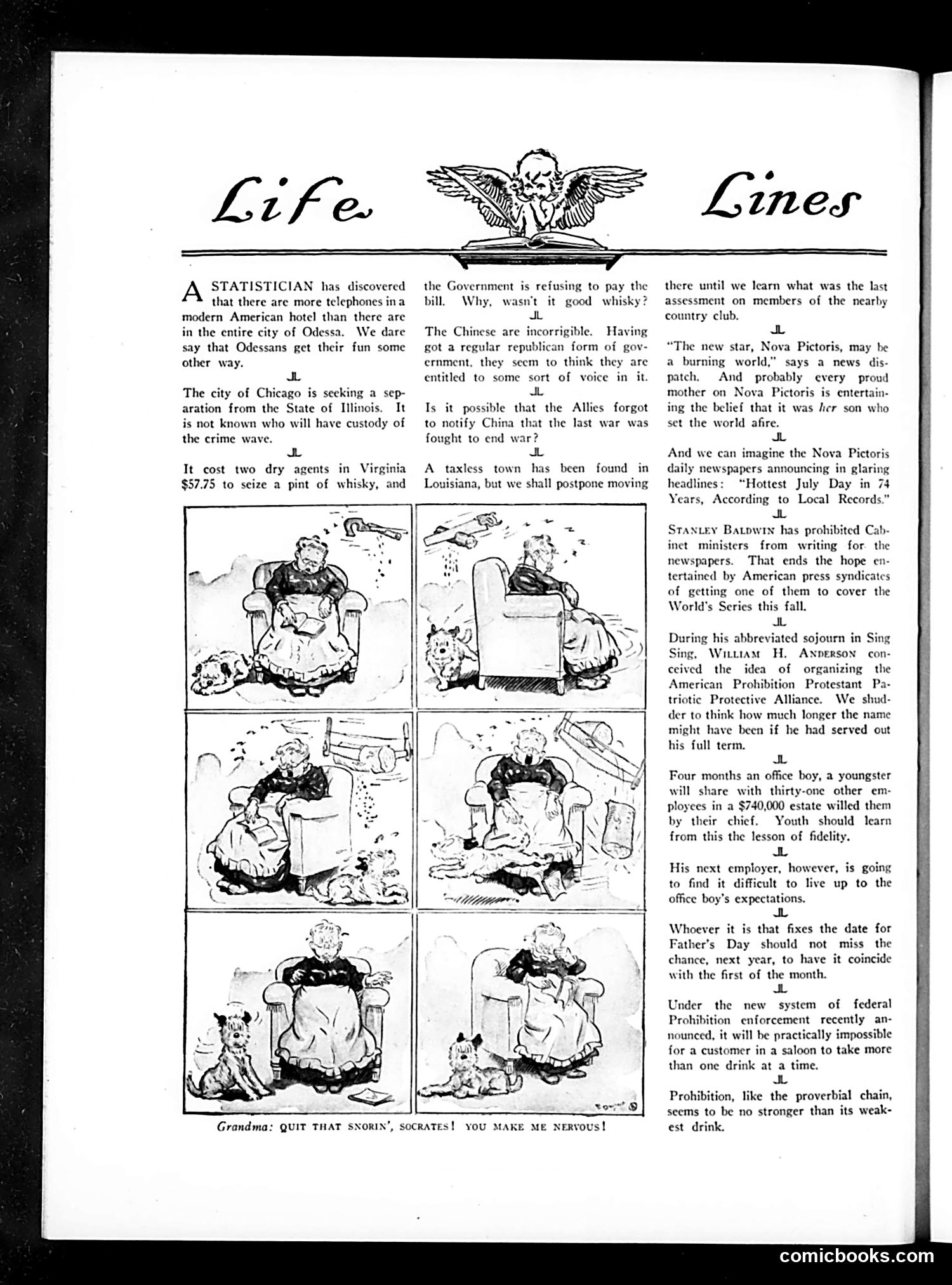
This satirical page from Life magazine contains several brief humor items and a six-panel comic strip titled "Grandma: Quit That Snoring, Socrates! You Make Me Nervous!" The strip depicts an elderly woman repeatedly attempting to silence her snoring grandmother through increasingly absurd methods—swatting at her, using what appears to be mechanical devices, and other physical interventions—all while the grandmother continues snoring undeterred. The surrounding text items mock Prohibition enforcement, Chinese government, Prohibition's impact on saloons, and press censorship. The humor derives from everyday frustrations: excessive telephones in Odessa, whiskey taxation costs, and the grandmother's unstoppable snoring. The satire reflects 1920s-era American concerns about government overreach, Prohibition's unpopular enforcement, and domestic annoyances.
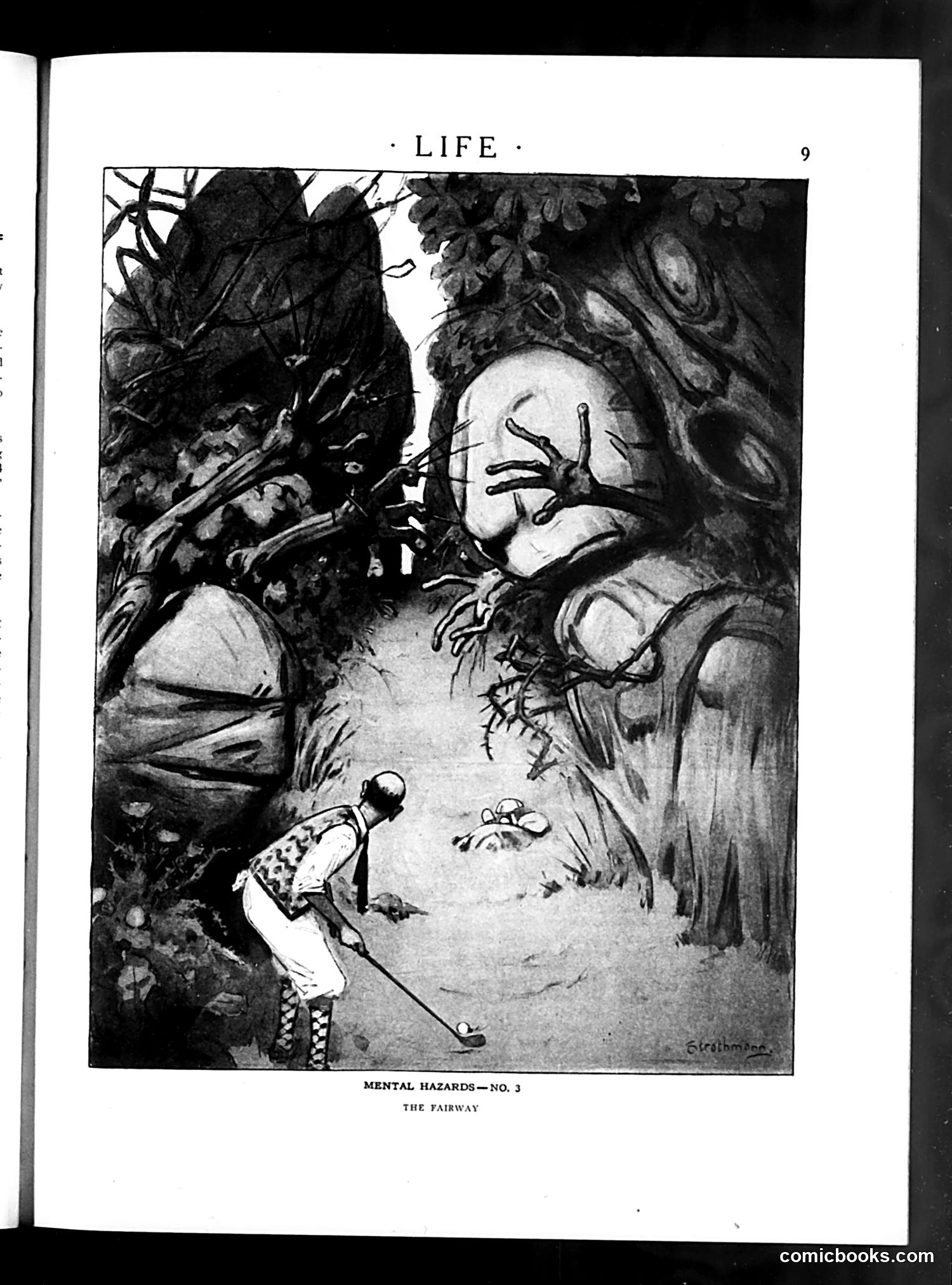
This is a satirical cartoon from *Life* magazine depicting golf as a source of psychological distress. The image shows a golfer in the foreground confronted by two menacing giant faces emerging from the landscape—likely representing the mental demons or anxieties golfers experience on the course. The title "Mental Hazards" suggests the cartoon critiques golf not merely as a physical game but as a psychologically torturous pursuit. The exaggerated, grotesque faces looming over the player suggest the intense pressure, frustration, and mental anguish the sport inflicts on its participants. This appears part of a series examining various psychological challenges of golf, using dark humor to mock both the game and golfers' obsessive devotion to it.
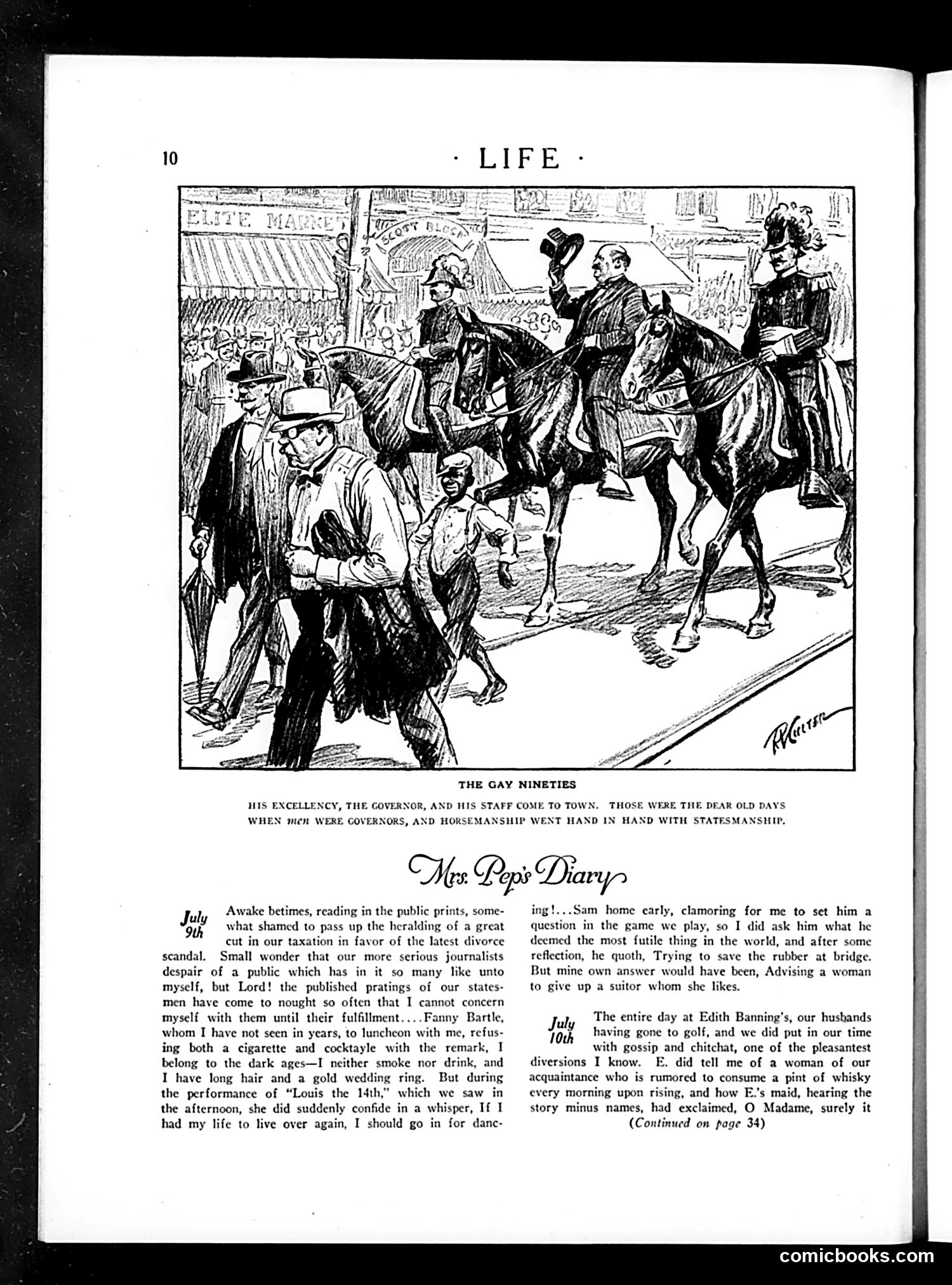
The illustration depicts a formal procession featuring well-dressed officials on horseback, labeled "His Excellency, the Governor, and his staff come to town." The caption expresses nostalgia: "Those were the dear old days when men were governors, and horsemanship went hand in hand with statesmanship." This is satirical commentary on contemporary governance (likely early 1900s). The cartoon mocks current politicians by contrasting them with an idealized past where leaders were skilled horsemen and "statesmen"—implying modern politicians lack both equestrian ability and genuine statesmanship. The satire suggests contemporary governance has declined in quality and dignity compared to an earlier era, though the "gay nineties" reference suggests this nostalgia may itself be somewhat ironic.
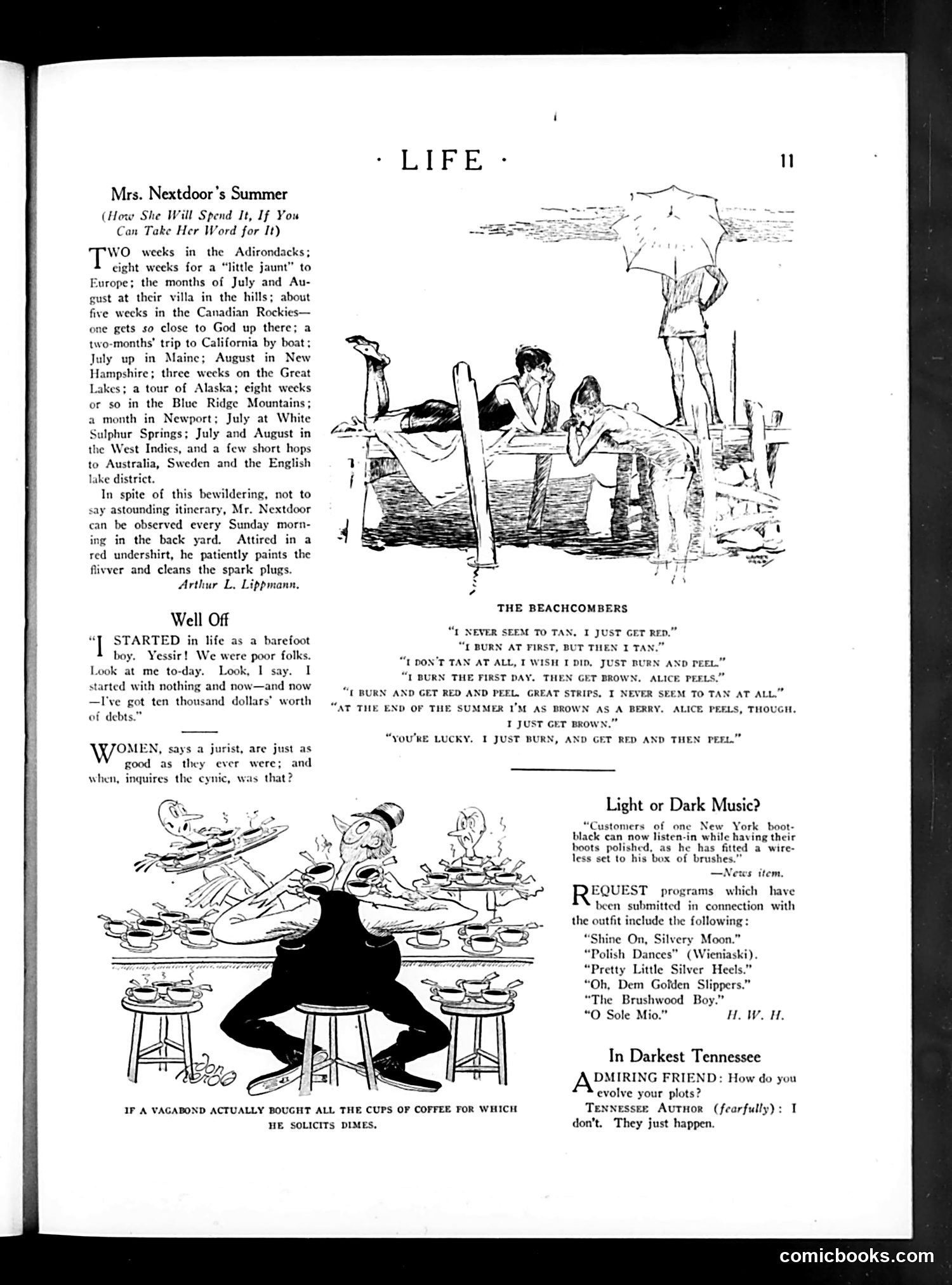
This page contains three satirical pieces: 1. **"Mrs. Nextdoor's Summer"**: A humorous article about wealthy social circles and their elaborate vacation schedules, illustrated with a sketch of leisure activities by a beach or lake. 2. **"Well Off"**: A short dialogue joke about a poor boy who became rich, featuring a cynical comment on women's constancy in romantic relationships. 3. **"The Beachcombers"**: A cartoon showing a figure surrounded by coffee cups, satirizing panhandlers or vagabonds who solicit small change ("dimes") by claiming to buy coffee. The joke suggests they're actually profiting significantly from these solicitations. The page's humor targets class pretension, social climbing, and street-level con artists—typical satirical subjects for Life magazine's middle-class readership.
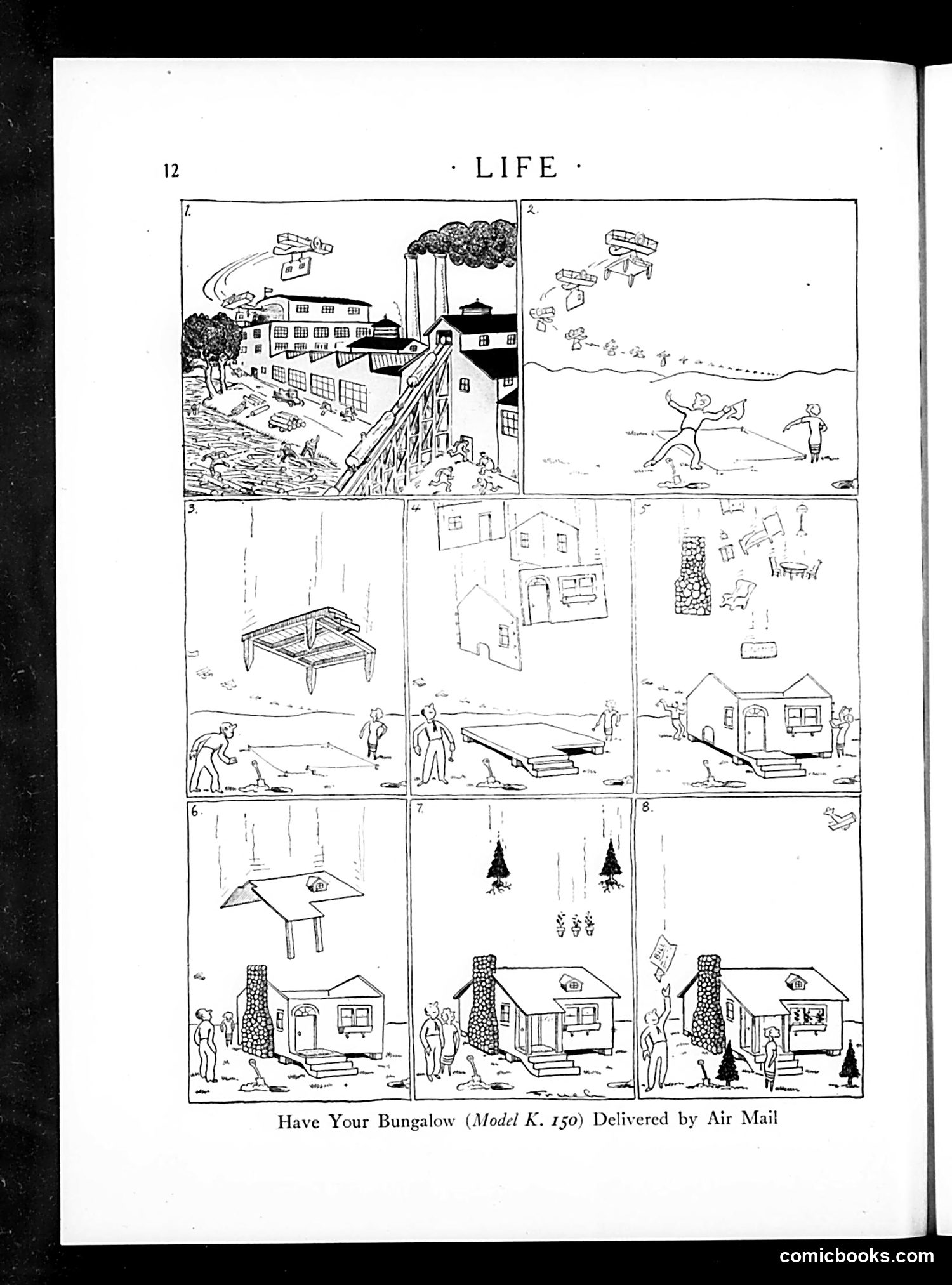
This is a satirical comic strip titled "Have Your Bungalow (Model K. 150) Delivered by Air Mail," depicting the delivery of a prefabricated house by aircraft. The eight-panel sequence shows the progression: industrial factories producing components (panel 1), planes dropping packaged building materials (panel 2), assembly instructions displayed as overhead floor plans (panels 3-5), and the final assembly of a small house at ground level by workers (panels 6-8), complete with trees planted nearby. The satire targets early 20th-century enthusiasm for mass production, prefabrication, and air transport as solutions to housing shortages. It mockingly suggests that modern technology could make homeownership as simple as mail-order shopping—a futuristic vision that was simultaneously appealing and absurd to contemporary readers. The humor lies in the gap between technological optimism and practical reality.
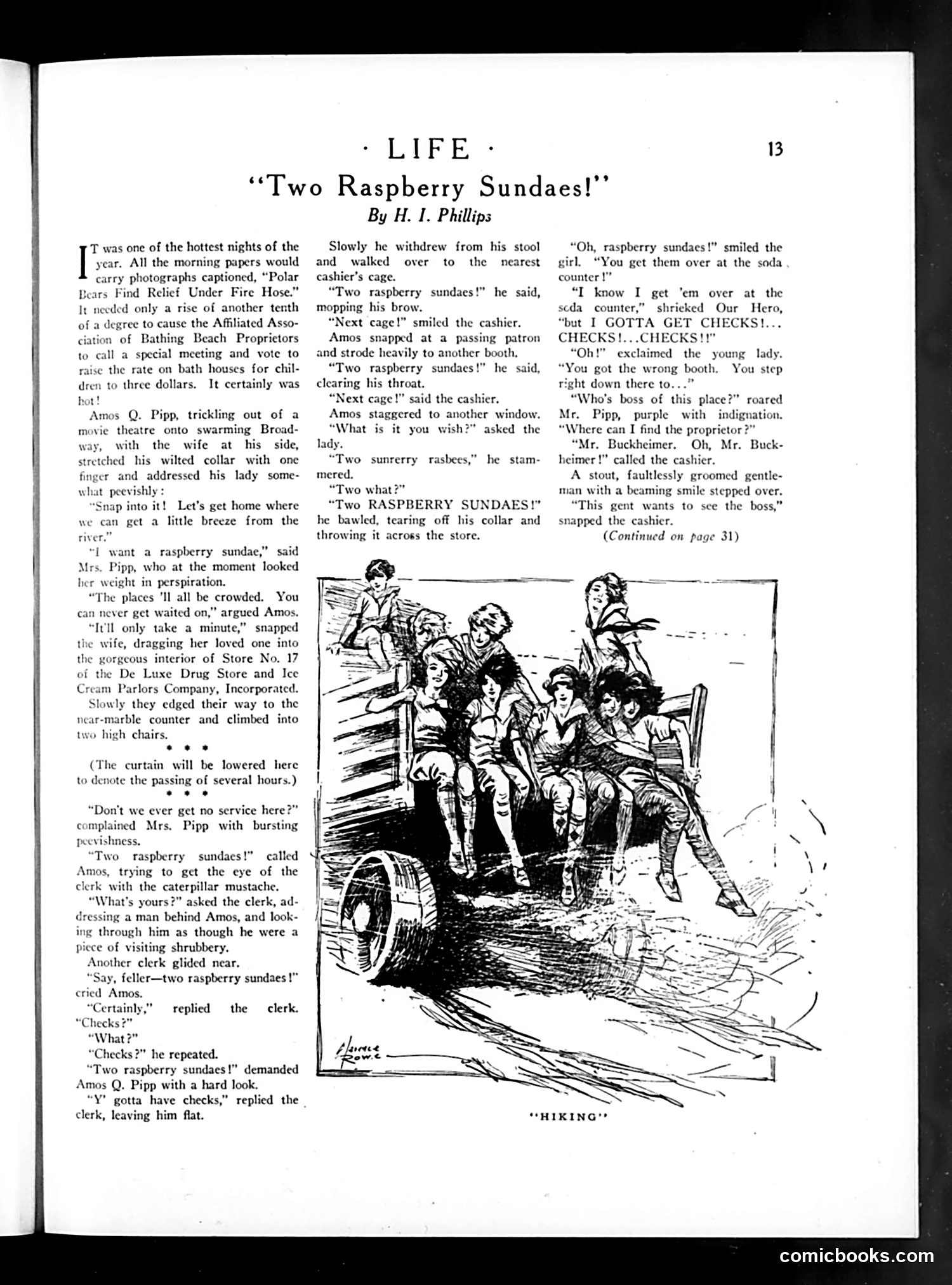
This page contains a humorous short story about a man (Amos Q. Pipp) and his wife visiting a crowded soda fountain on a hot night. The satire centers on a simple miscommunication: Amos repeatedly orders "two raspberry sundaes," but the increasingly frustrated clerk and staff mishear him as "two rasberry [sic] checks" or other variations. The accompanying sketch labeled "HIKING" shows people in an old-fashioned automobile, likely illustrating the couple's journey to the soda fountain. The humor derives from the chaos created by this repetitive misunderstanding in a busy establishment—a relatable scenario of customer-service frustration that satirizes both impatient customers and inattentive service workers. The story concludes on page 31.
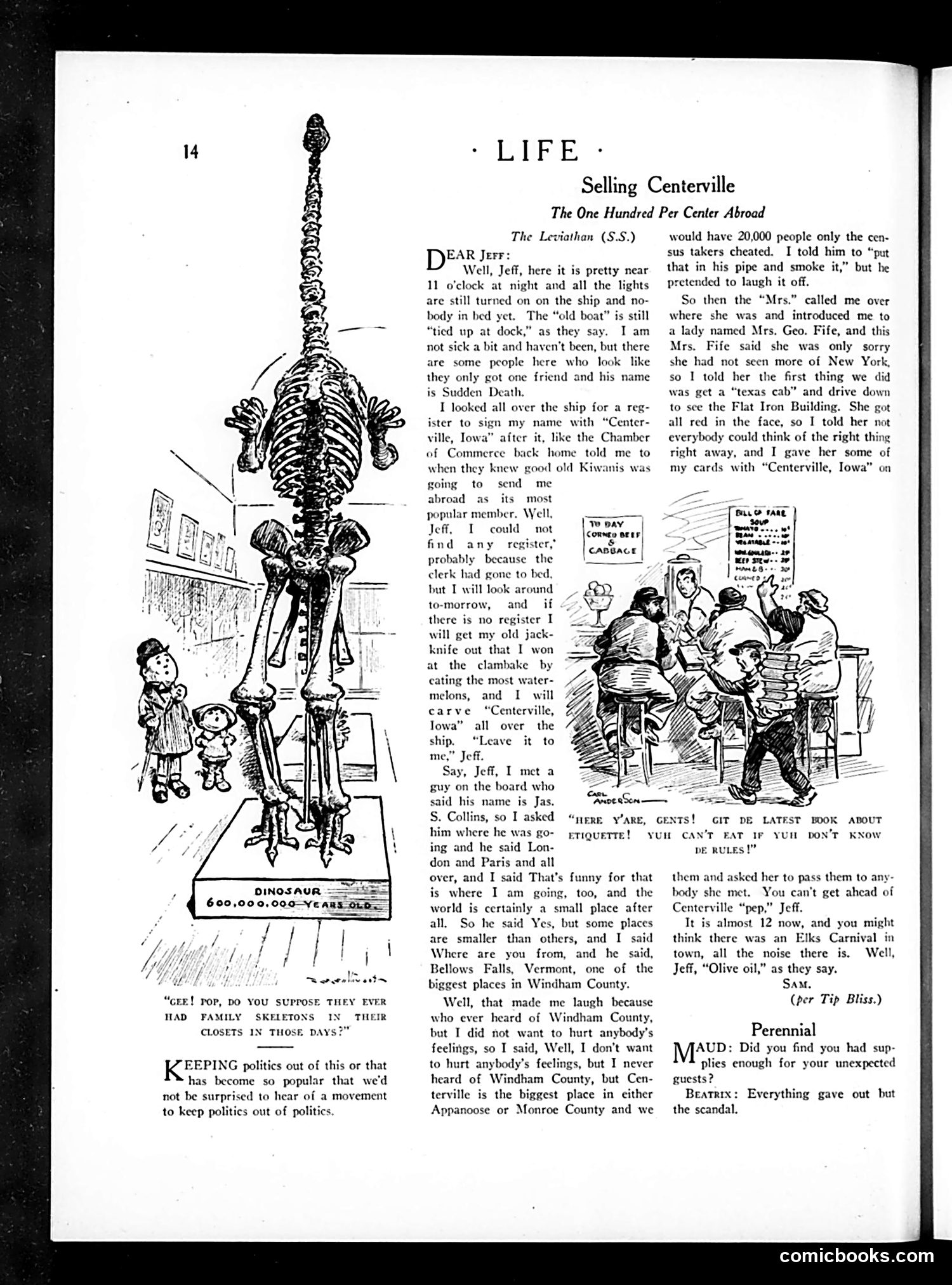
This page from *Life* magazine contains a humorous travel letter titled "Selling Centerville" about promoting a small Iowa town to ship passengers. **The Main Cartoon:** Shows a massive dinosaur skeleton labeled "600,000,000 Years Old" displayed on the ship, with children gazing up at it in wonder. This illustrates the letter writer's strategy: using an exotic attraction to promote tiny Centerville, Iowa as a tourist destination—the joke being that a prehistoric skeleton is the town's only notable feature. **The Social Satire:** The humor targets American small-town boosterism and civic pride—the tendency of towns to exaggerate their importance. The writer's absurd claim that Centerville is "the biggest place in either Appanoose or Monroe County" mocks provincial self-aggrandizement. The dinosaur skeleton represents the ridiculous lengths towns went to attract visitors during the early 20th century tourist boom.
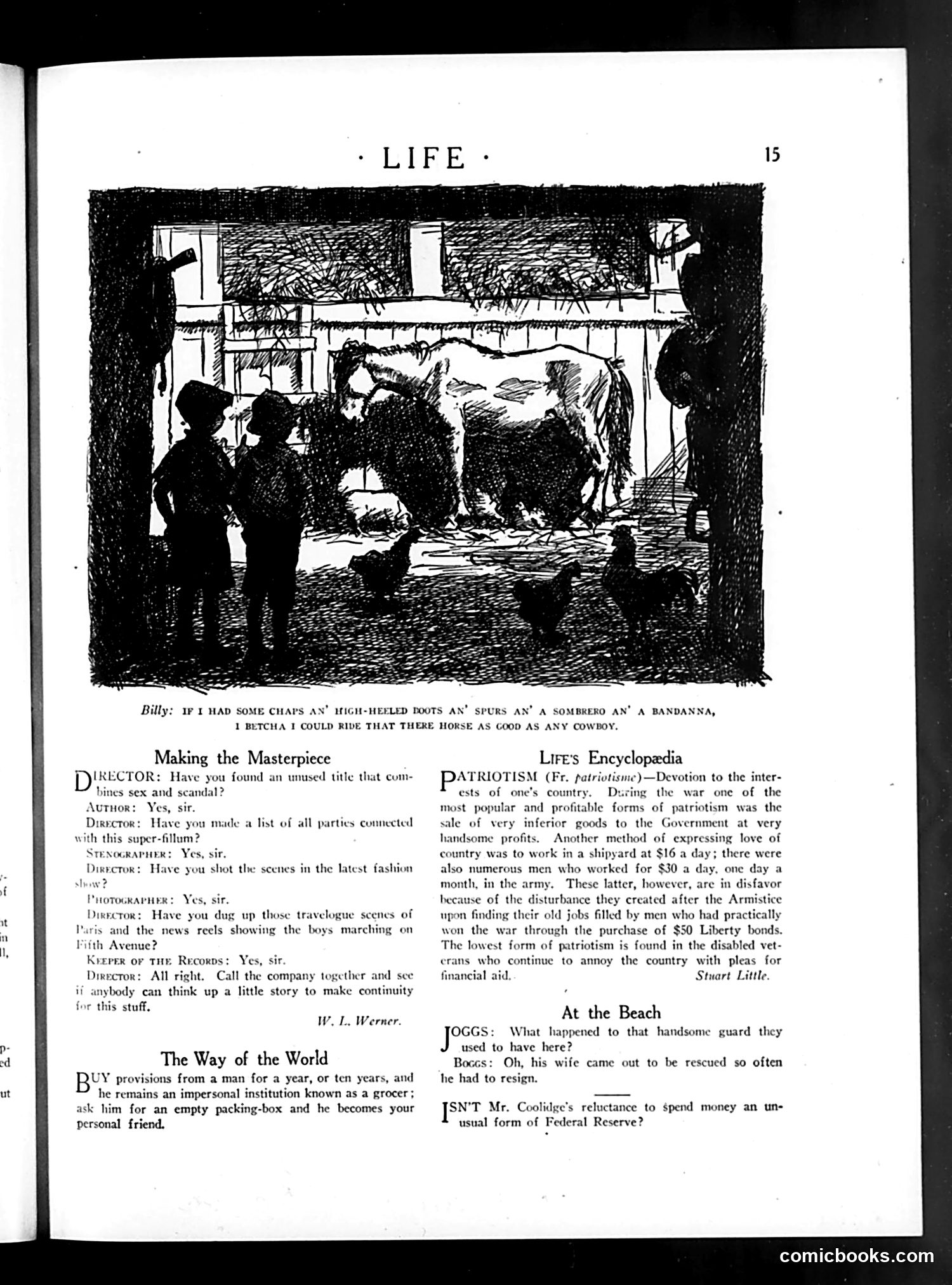
The main illustration depicts a horse being examined or displayed in a stable setting, with multiple figures gathered around it. The caption quotes "Billy" expressing a desire for cowboy gear to ride "that there horse as good as any cowboy." Below are three brief satirical pieces: 1. **"Making the Masterpiece"** - A dialogue mocking film production, suggesting directors fabricate scandal and artificially stage "fashionable" scenes for movies. 2. **"The Way of the World"** - A quip about the impersonal nature of commerce: buying provisions establishes a grocer as a "personal friend." 3. **"Life's Encyclopedia" entries** on patriotism (criticizing wartime profiteering) and a beach anecdote about a man repeatedly rescued by his wife. The humor targets commercialism, film industry phoniness, and wartime opportunism.
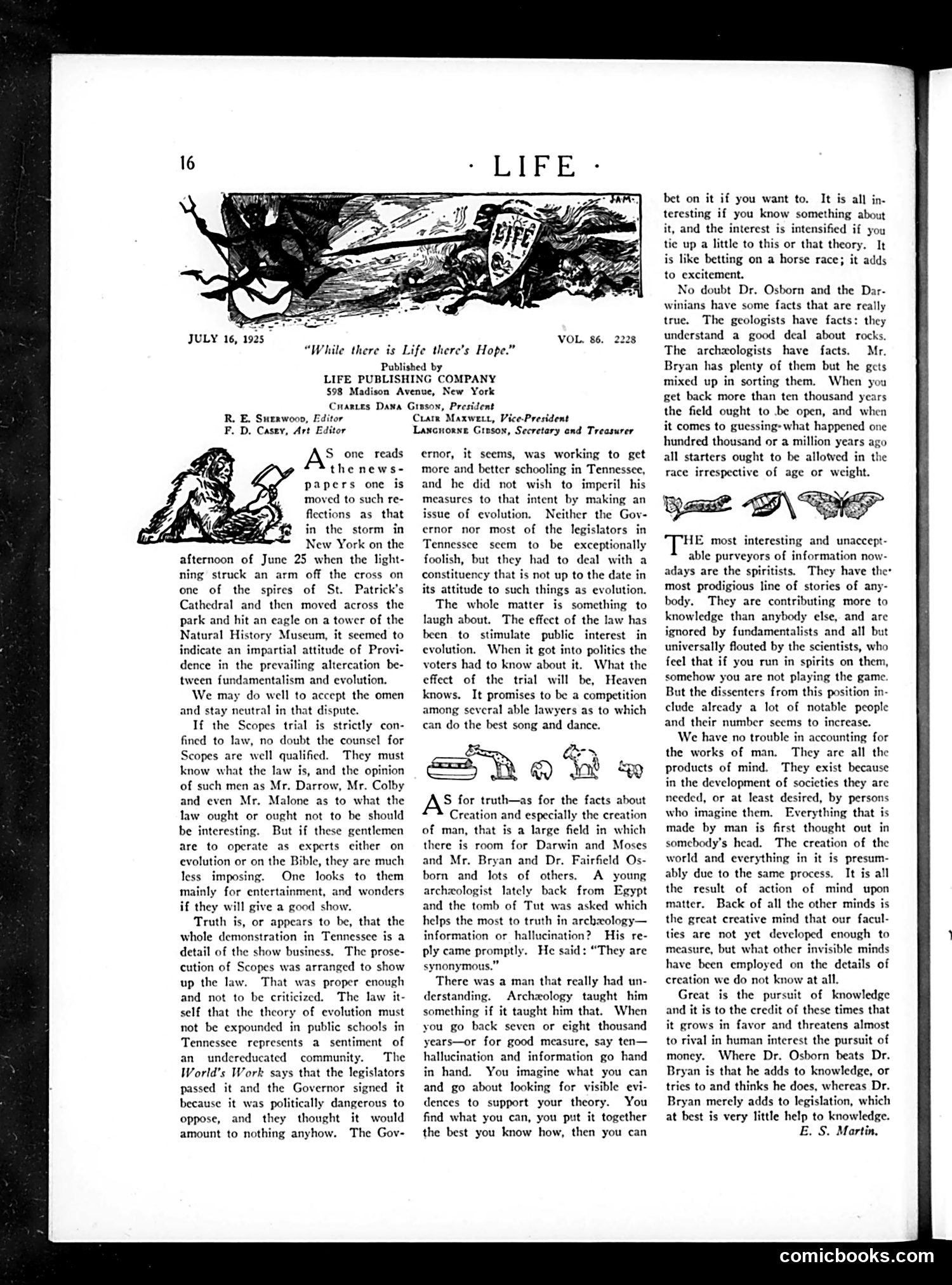
This Life magazine page satirizes the famous Scopes trial, where Tennessee prosecuted a teacher for teaching evolution. The article mocks the entire spectacle as theatrical "show business" rather than genuine intellectual inquiry. The key targets: William Jennings Bryan (who led the prosecution), Clarence Darrow and other defense lawyers, and Tennessee's anti-evolution law itself. The writer argues the law represents an "undereducated community" but notes even legislators knew it was politically dangerous to oppose publicly. The cartoon illustrations appear to depict the conflict between fundamentalist religion and scientific evolution—referenced by the June 25 lightning strike that damaged both St. Patrick's Cathedral and the Natural History Museum's eagle, suggesting "Providence" remains impartial. The satirist's main point: both sides are performing for entertainment rather than seeking truth. The closing anecdote about an archaeologist equating "information" with "hallucination" reinforces the cynical view that all historical reconstruction involves imagination shaped by theory.
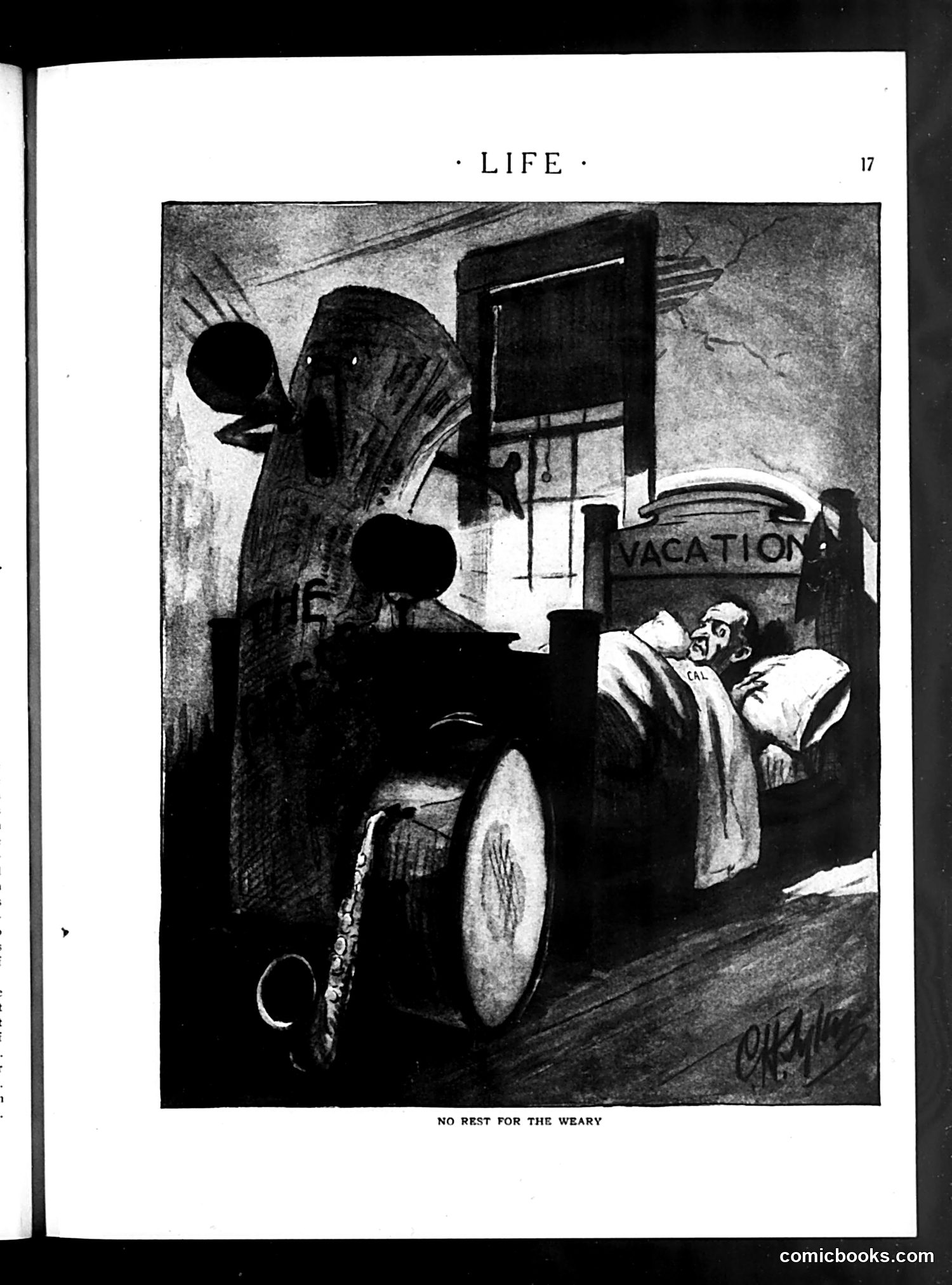
This cartoon satirizes the experience of vacation. A exhausted man lies in bed at what appears to be a vacation destination (marked "VACATION"), while Death—depicted as a skeletal figure in a long robe—looms menacingly over him. The joke operates on multiple levels: the vacationer is so worn out that even during his time off, he cannot escape hardship or find peace. The presence of Death suggests the vacation is so taxing it's literally life-threatening, or that the weary man is so exhausted he's approaching death itself. The title reinforces the irony: vacations, meant to provide rest, instead offer "no rest for the weary." This reflects a common early-20th-century sentiment about the paradoxes of leisure time and modern fatigue.
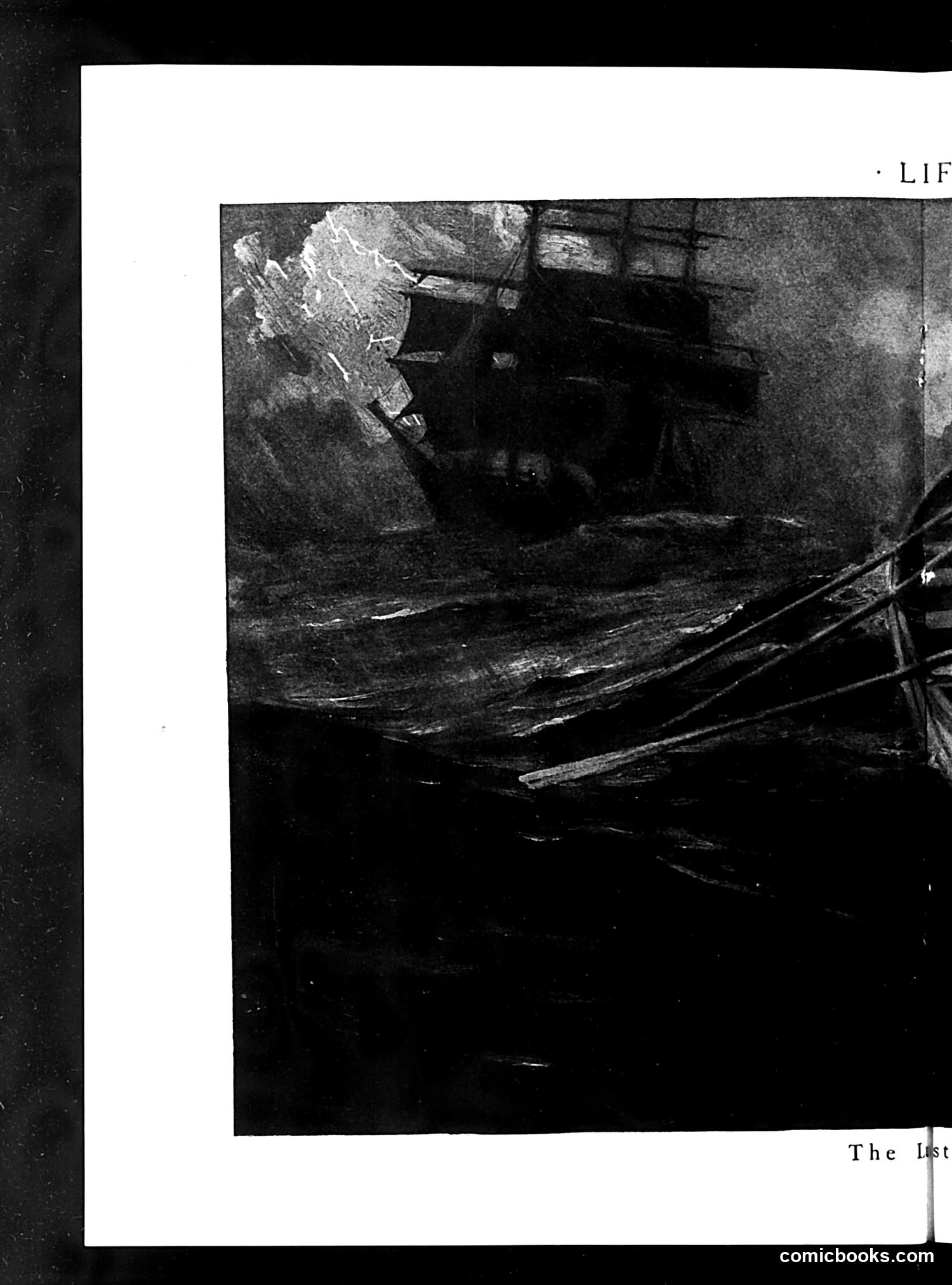
The image quality and OCR text are insufficient for reliable interpretation. The black-and-white photograph shows what appears to be an interior scene with figures and architectural elements, but details are too dark and unclear to identify specific individuals or caricatures with confidence. The visible text fragments ("LIF[E]" at top, "The list" at bottom) confirm this is from *Life* magazine, but without clearer imagery or more complete OCR text, I cannot accurately identify which figures are depicted, what political or social references are intended, or what the satirical point would be. To analyze this properly, a higher-resolution image or complete text transcription would be necessary.
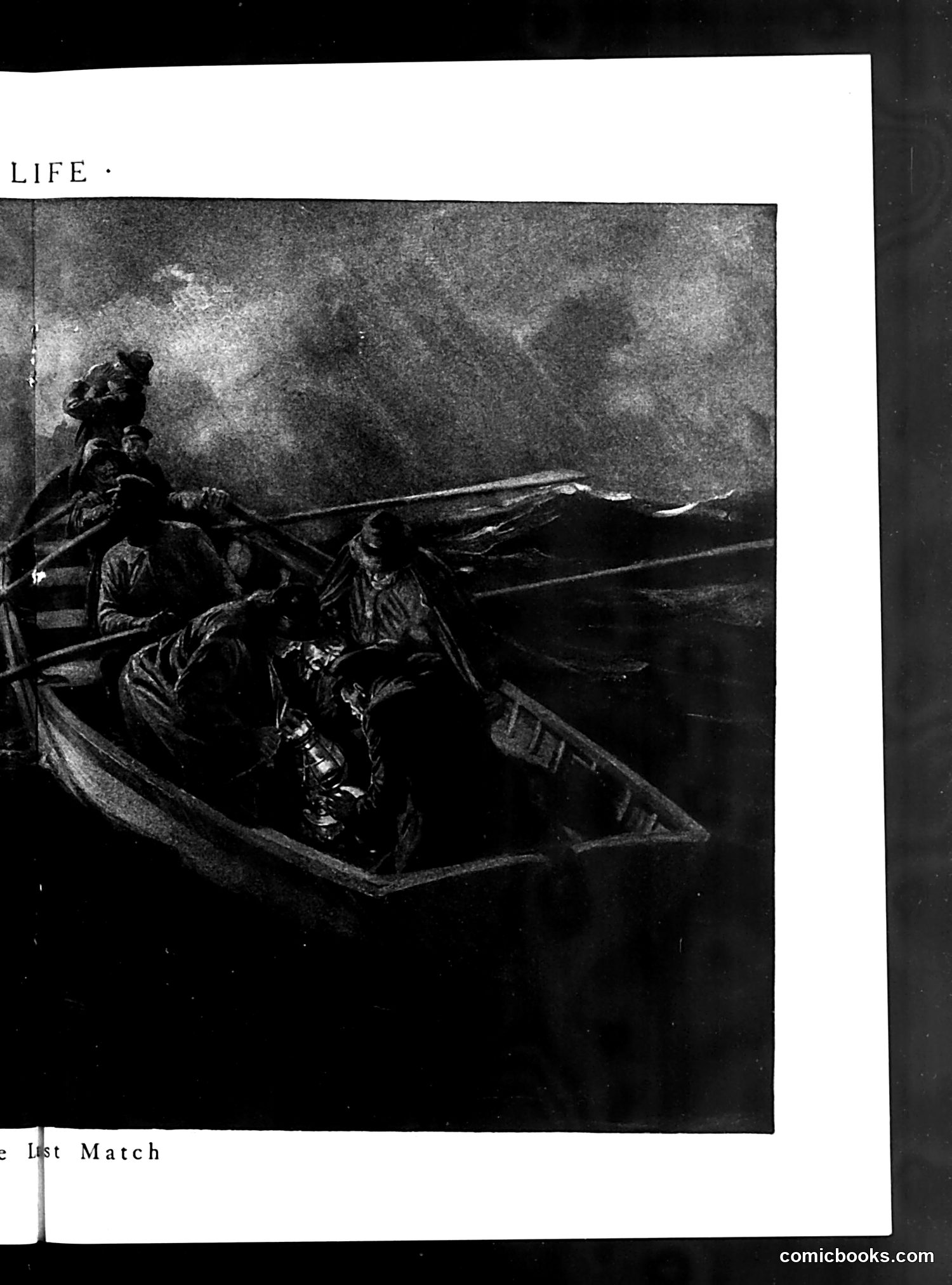
This appears to be a page from *Life* magazine showing an illustration titled "1st March" (visible at bottom). The dramatic black-and-white image depicts figures in a small boat on dark water beneath a stormy sky, with one figure appearing to hold a long pole or staff. Without additional context or caption text visible on this page, I cannot definitively identify the specific political figures, historical event, or satirical point being made. The scene has an ominous, allegorical quality—suggesting a journey through danger or uncertainty—but the particular reference requires additional OCR-readable text or dated context I cannot assert from the image alone. The artistic style is consistent with early-to-mid 20th century *Life* magazine illustration.
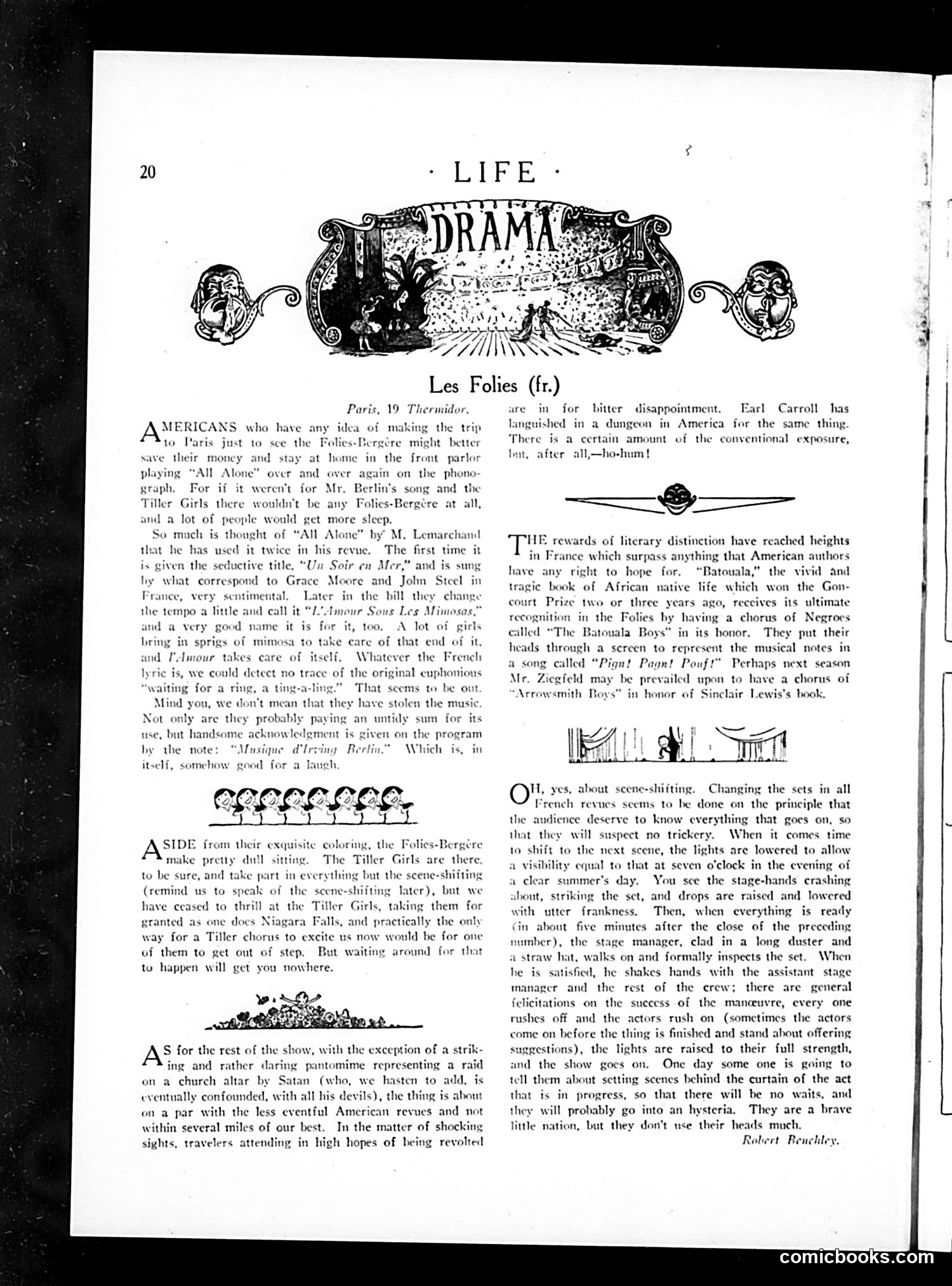
This is a theater review of the Folies-Bergère revue in Paris. The critic discusses how Americans romanticize the show through Irving Berlin's song "All Alone," though the actual production is mediocre—comparable to American revues rather than exceptional. The review notes the famous Tiller Girls (a precision dance troupe) are present but no longer exciting. It mocks the show's pretensions: a daring pantomime depicting Satan raiding a church altar, and a "Batouala Boys" chorus of Black performers representing musical notes in a song—presented as France's attempt to gain literary prestige from the novel *Batouala*, winner of the Goncourt Prize. The critic finds the production conventionally risqué but ultimately disappointing. The detailed description of scene-shifting—where stagehands work visibly in lowered light—reveals French theatrical practices the American audience should "expect." The overall tone is witty, slightly condescending toward both French and American entertainment values.
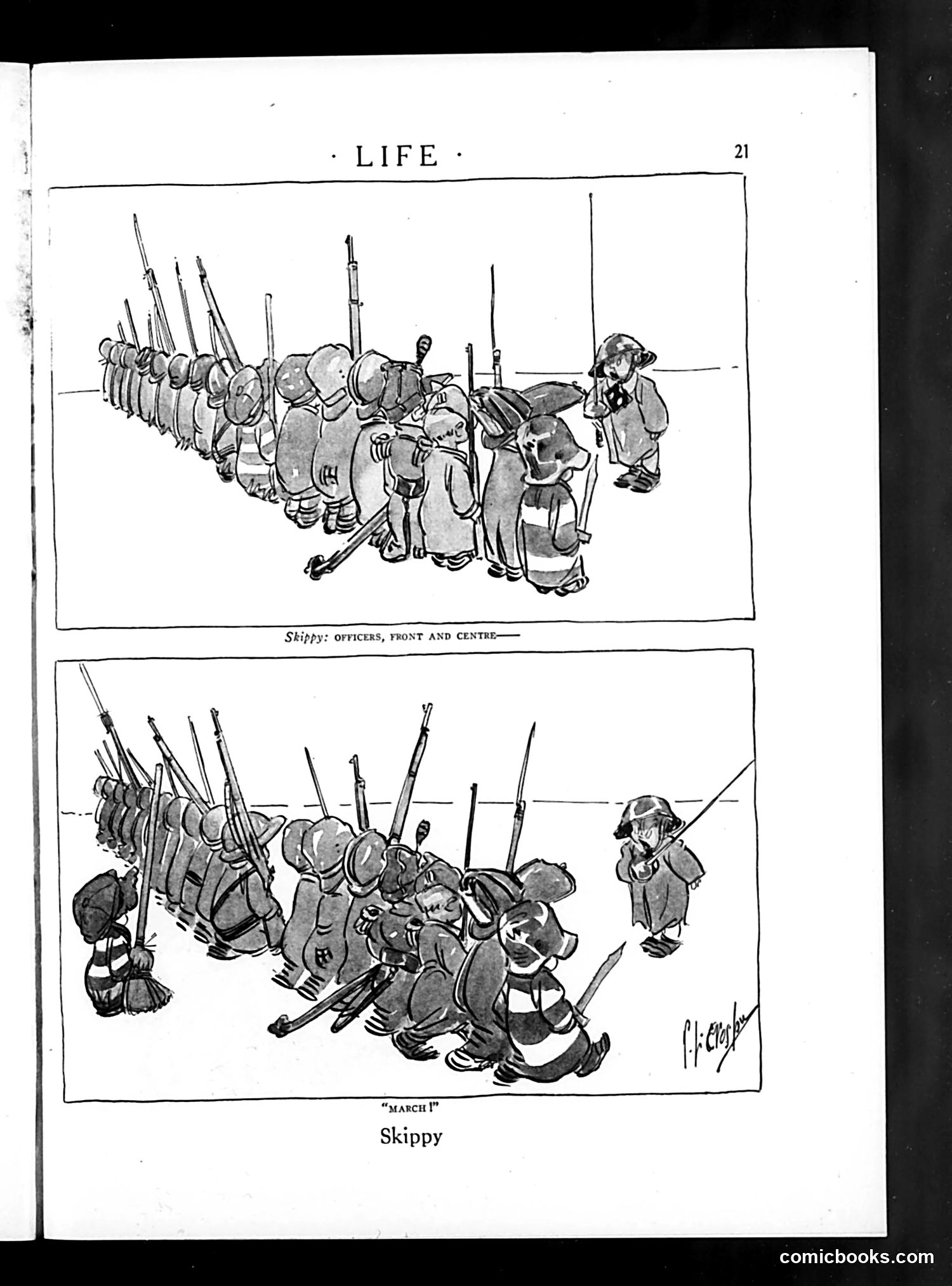
This page shows two panels from "Skippy," a comic strip about a mischievous boy character. The cartoons depict Skippy commanding a group of officers to assemble in formation—first in an organized line, then in a chaotic "March 1st" scene where they're disheveled and scattered. The humor appears to satirize military discipline and order. Skippy, despite being a child, is acting as an authoritative commander barking orders at uniformed officers who must obey. The contrast between the neat first formation and the messy second one (labeled "March 1st") suggests the breakdown of military precision or the difficulty maintaining order—possibly a commentary on early 20th-century military incompetence or bureaucratic chaos. The specific date reference "March 1st" may allude to a contemporary event, though context is unclear from this page alone.
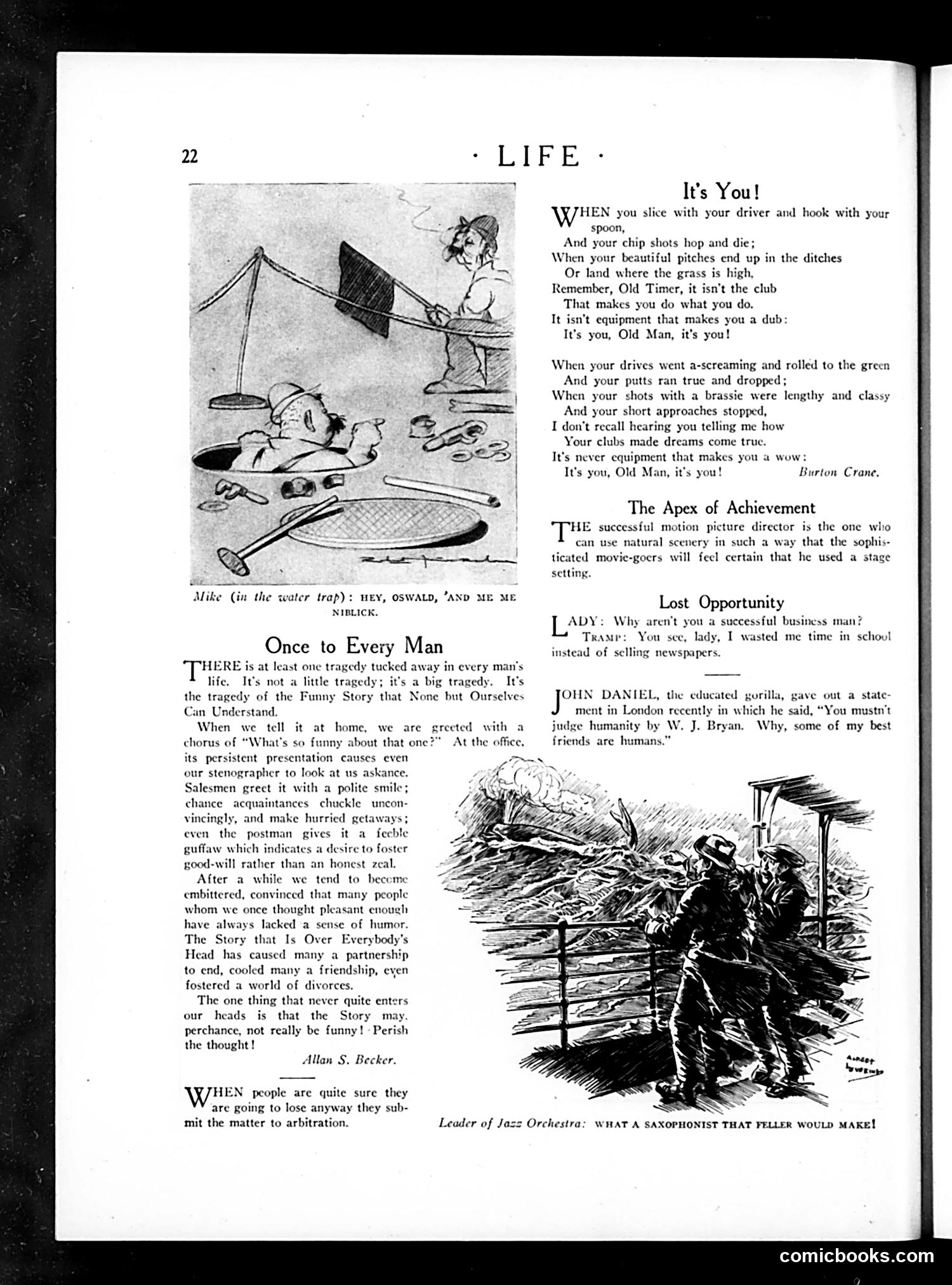
This 1920s **Life** humor page contains satirical commentary on American life and social pretension: **"Once to Every Man"** (by Allan S. Becker) mocks the universal human experience of telling a joke that only you find funny—a story so obscure or poorly executed that it alienates audiences (stenographers, salesmen, postmen) and damages relationships. The satire targets self-delusion: we blame others' lack of humor rather than admitting the story simply isn't funny. **"It's You!"** (by Burton Crane) is a golf poem satirizing golfers who credit their clubs for good shots but blame themselves for bad ones—exposing the hypocrisy of selective accountability. **Additional items** include jabs at motion pictures (directors using fake sets while pretending they used real scenery), a tramp who regrets wasting school time instead of selling papers (social climbing satire), and a dig at **W. J. Bryan** via an "educated gorilla" claiming humans as friends—likely referencing Bryan's anti-evolution stance during the Scopes Trial era. The golf cartoon illustration depicts a frustrated golfer and scattered equipment, visualizing incompetence.
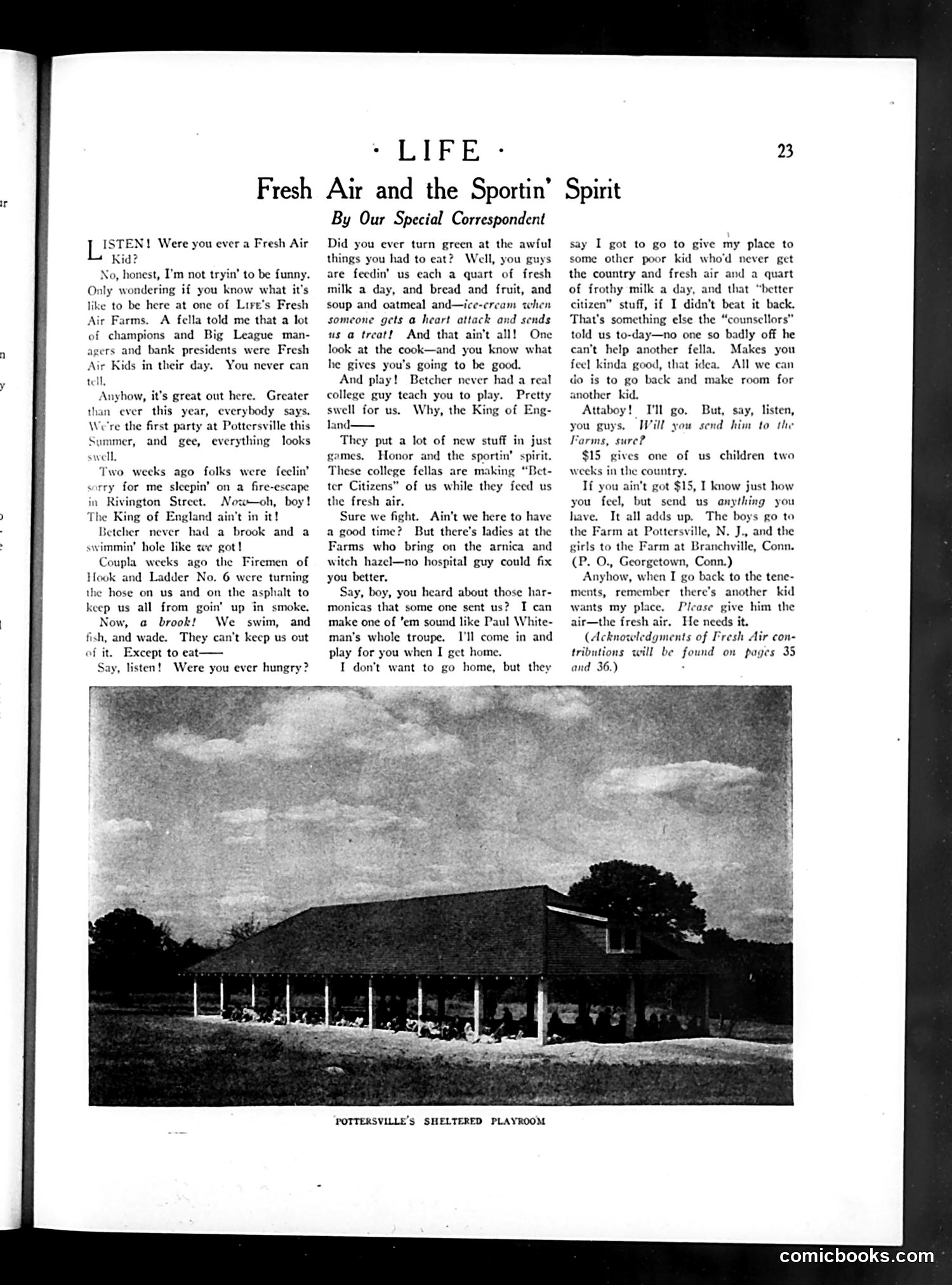
This is a fundraising appeal for Life magazine's "Fresh Air" program, which sent poor urban children from tenements to rural camps for summer stays. The piece uses first-person testimony from a grateful "Fresh Air Kid" to solicit donations. The appeal contrasts the child's previous miserable city life—sleeping on fire escapes in tenements, eating poor food, nearly perishing in summer heat—with the transformative experience at Pottersville Farm. Key selling points include: wholesome nutrition, recreational instruction from college volunteers, moral character-building ("Better Citizens"), and community spirit. The photograph shows the sheltered playroom facility. The $15 donation amount (substantial for the era) funded two weeks of summer camp. The piece concludes with an emotional appeal: the child must leave to make room for the next disadvantaged kid, emphasizing that even small donations "add up." This represents Progressive Era charity addressing urban poverty through rural-based character development.
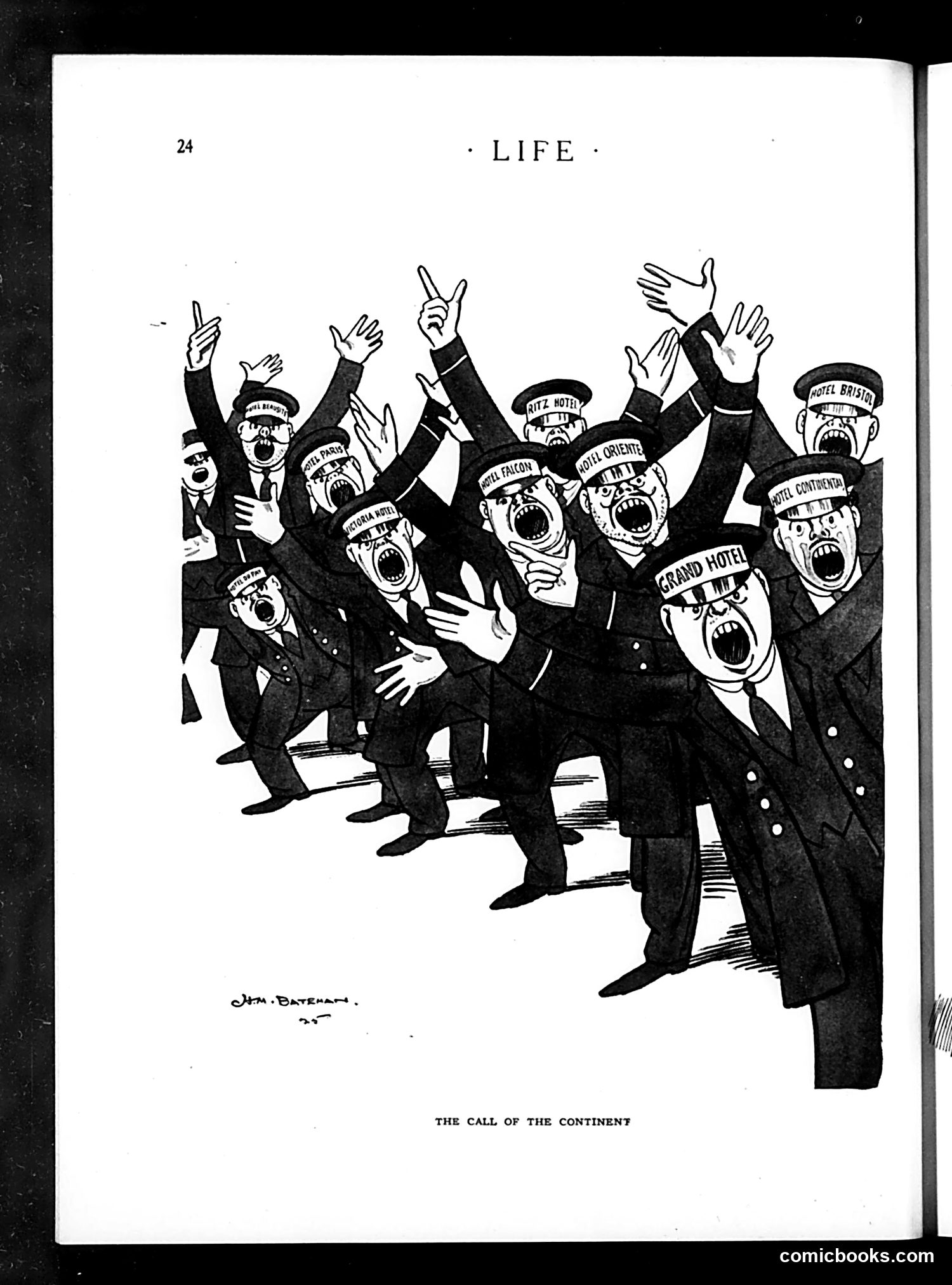
This political cartoon depicts a group of hotel bellhops and porters (identifiable by their uniform caps labeled with hotel names like "Hotel Bristol," "Grand Hotel," and "Hotel Oriental") celebrating with raised arms and exuberant gestures. The caption "The Call of the Continent" suggests this satirizes European hotels or hospitality workers responding to some call or opportunity. The caricatured style and exaggerated expressions convey mockery or ridicule of these figures. Without additional historical context from the magazine's date, the specific event being satirized remains unclear—it could reference post-WWI European recovery, tourism industry concerns, or labor movements among service workers. The artist's signature appears to read "John Barrymore" or similar.
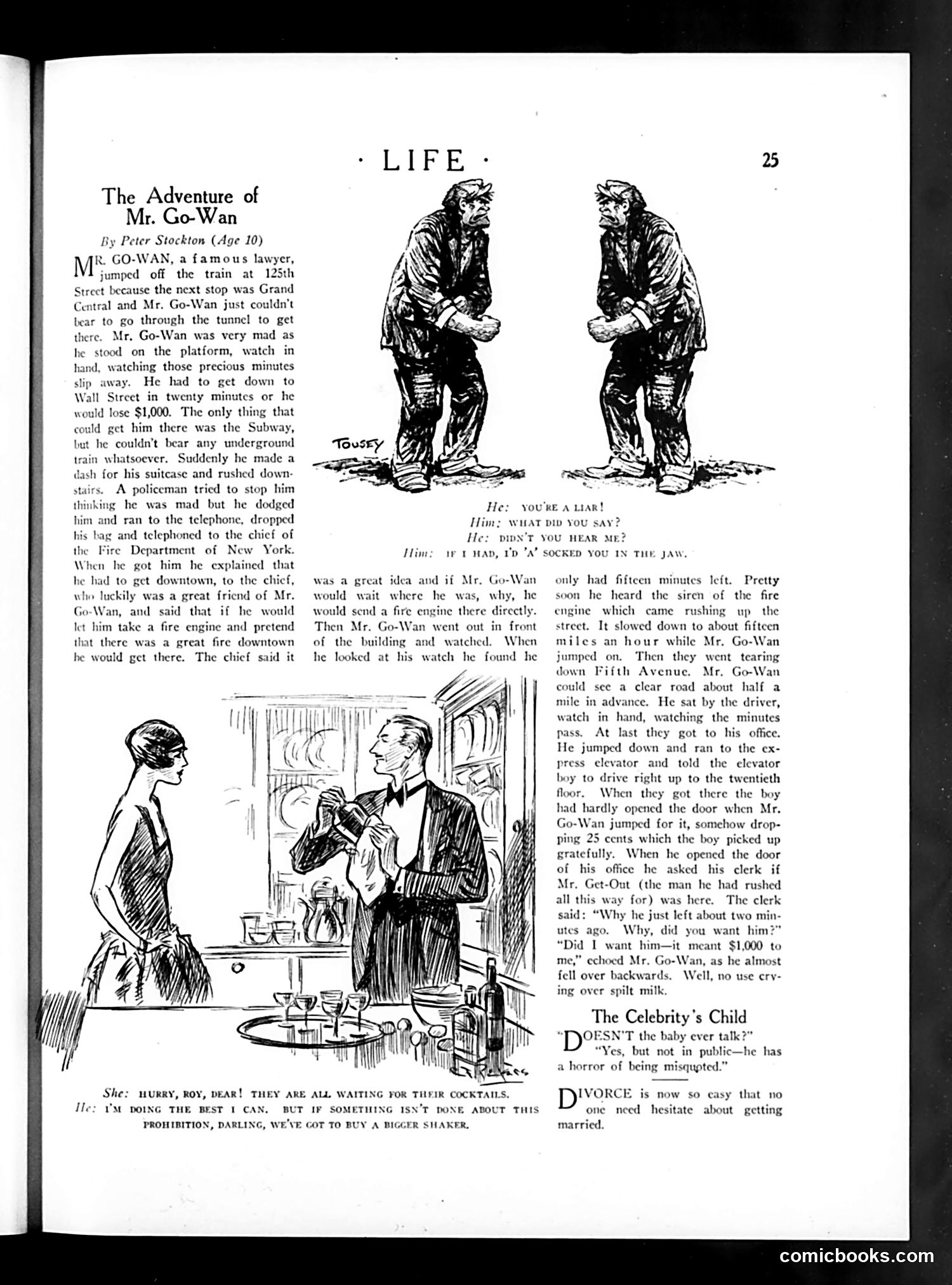
This is a humorous children's story by 10-year-old Peter Stockton satirizing urban anxiety and absurd problem-solving. Mr. Go-Wan, a lawyer desperate to reach Wall Street within 20 minutes to avoid losing $1,000, irrationally fears subway tunnels. Rather than use public transit, he phones the Fire Department chief (conveniently his friend) and commandeers a fire engine to rush downtown, arriving only to discover his client left 15 minutes earlier—making his frantic effort pointless. The satire mocks: - **Overreaction to minor inconveniences** (tunnel phobia) - **Class privilege** (using connections to abuse emergency services) - **Poor decision-making under pressure** - **Wasted effort for financial gain** The accompanying jokes reference **Prohibition** (the shaker joke) and celebrity culture, typical Life magazine content from the 1920s-30s era.
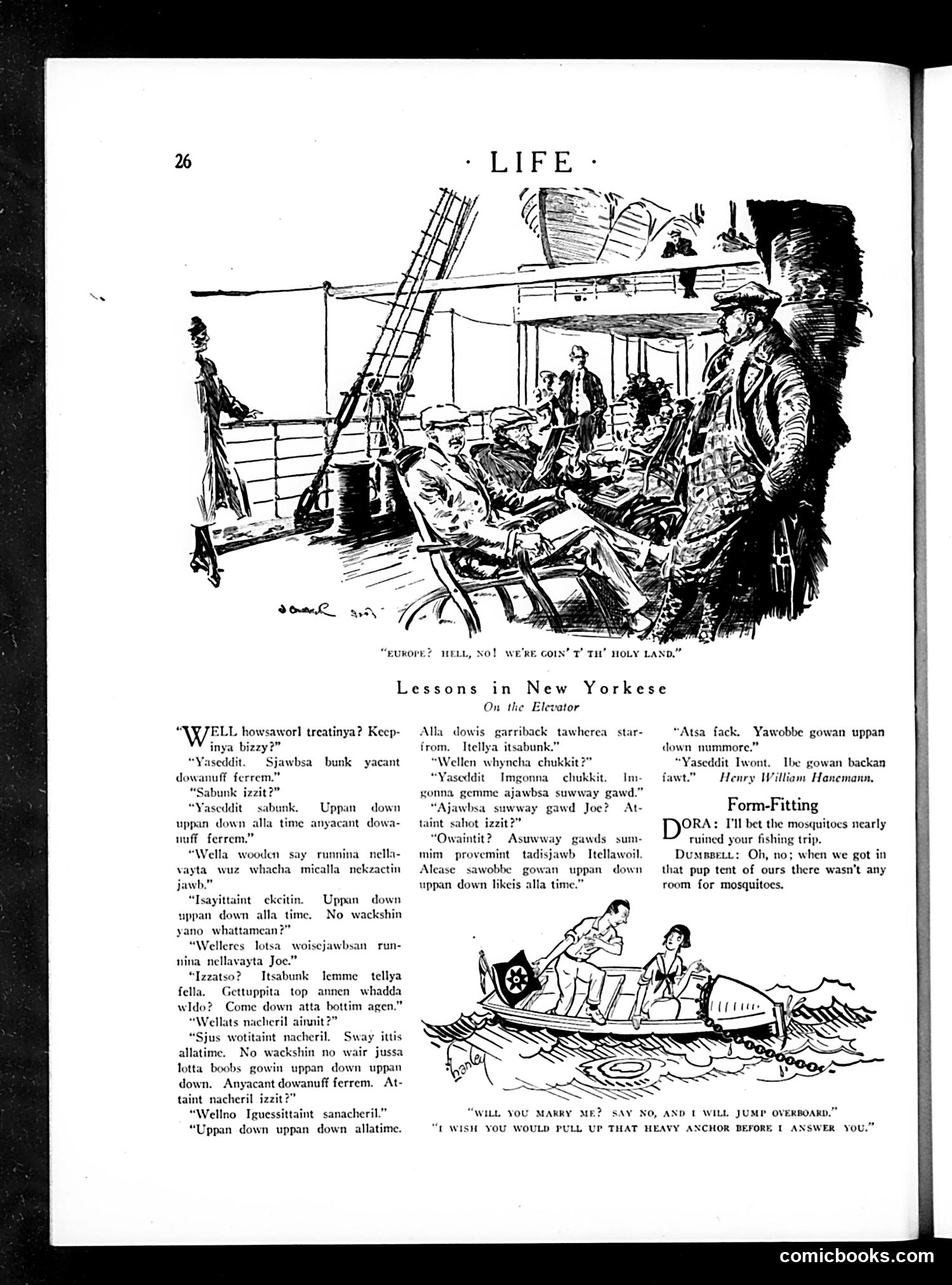
**Top Cartoon:** Depicts working-class immigrants on a ship's deck discussing their jobs in heavily phonetic, stereotyped dialect. The conversation mocks elevator operators' repetitive labor ("up and down all the time") with comic exaggeration. The title "Lessons in New Yorkese" satirizes immigrant speech patterns—the dialect rendering suggests these are likely Italian or Eastern European immigrants struggling with English. The satire targets both their labor conditions (monotonous work) and American attitudes toward immigrant speech as comical and inferior. **Bottom Two Cartoons:** Separate gag comics unrelated to the main piece. One involves a marriage proposal with comedic hesitation; the other jokes about mosquitoes and tent space during fishing. The page exemplifies early-20th-century American magazine humor that relied on ethnic caricature and stereotyped dialect for comedic effect—content reflecting period attitudes toward immigrant workers as subjects of ridicule rather than sympathy.
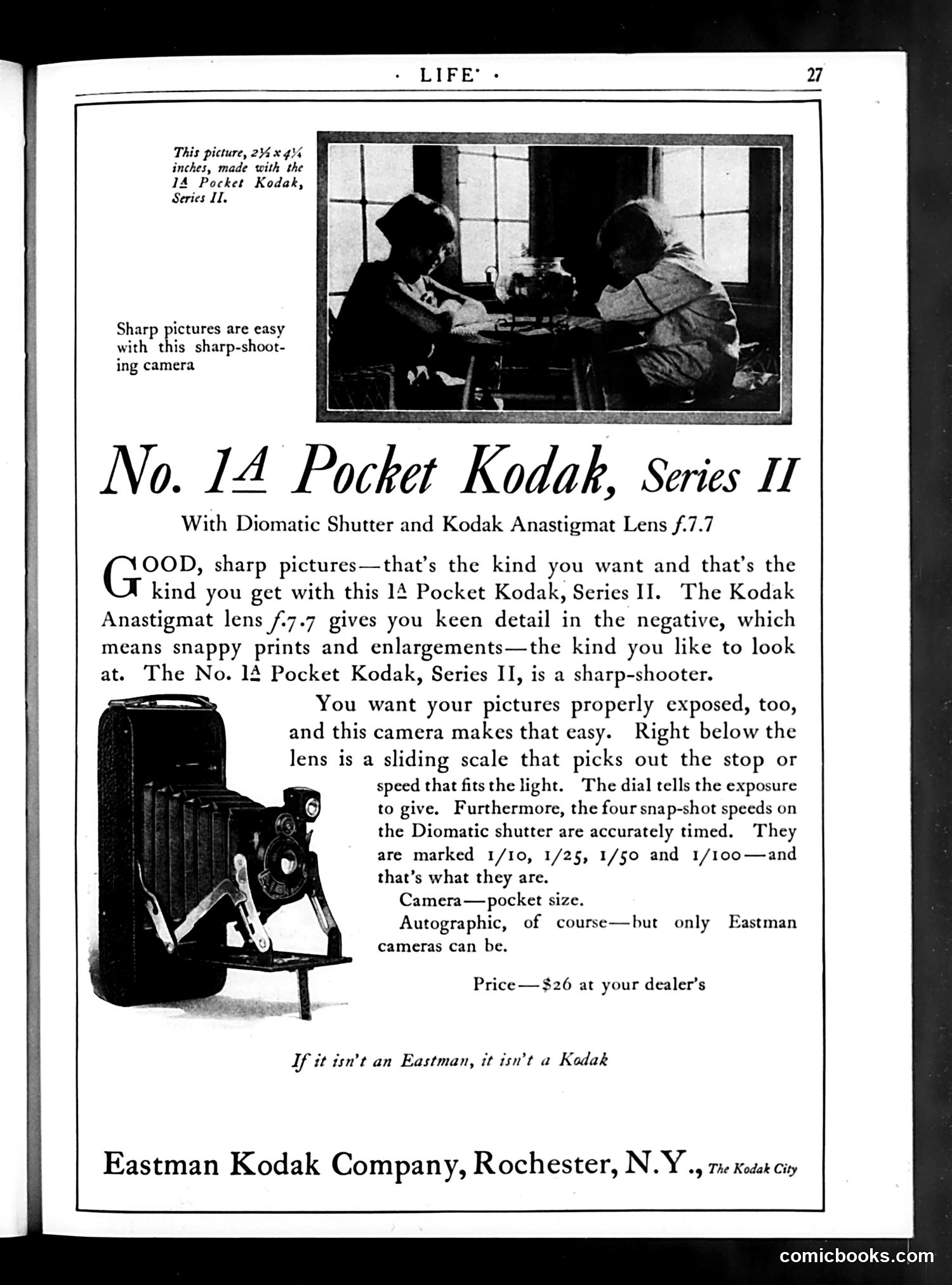
This is a **product advertisement**, not a cartoon or satire. The page promotes the No. 14 Pocket Kodak, Series II camera from Eastman Kodak Company. The image shows two people using the camera indoors by a window—a typical domestic scene meant to demonstrate the camera's ease of use. The advertisement emphasizes technical features: the Anastigmat lens, Diomatic shutter with precise speeds (1/10, 1/25, 1/50, 1/100), automatic exposure adjustment via a sliding scale, and "autographic" capability (allowing notes written on film). The slogan "If it isn't an Eastman, it isn't a Kodak" asserts brand dominance—essentially claiming Eastman owns the market category. At $26 (substantial money in this era), it was positioned as a premium "sharp-shooter" for consumers wanting quality snapshots and enlargements. There is no satire or political content; this is straightforward early-20th-century camera marketing.
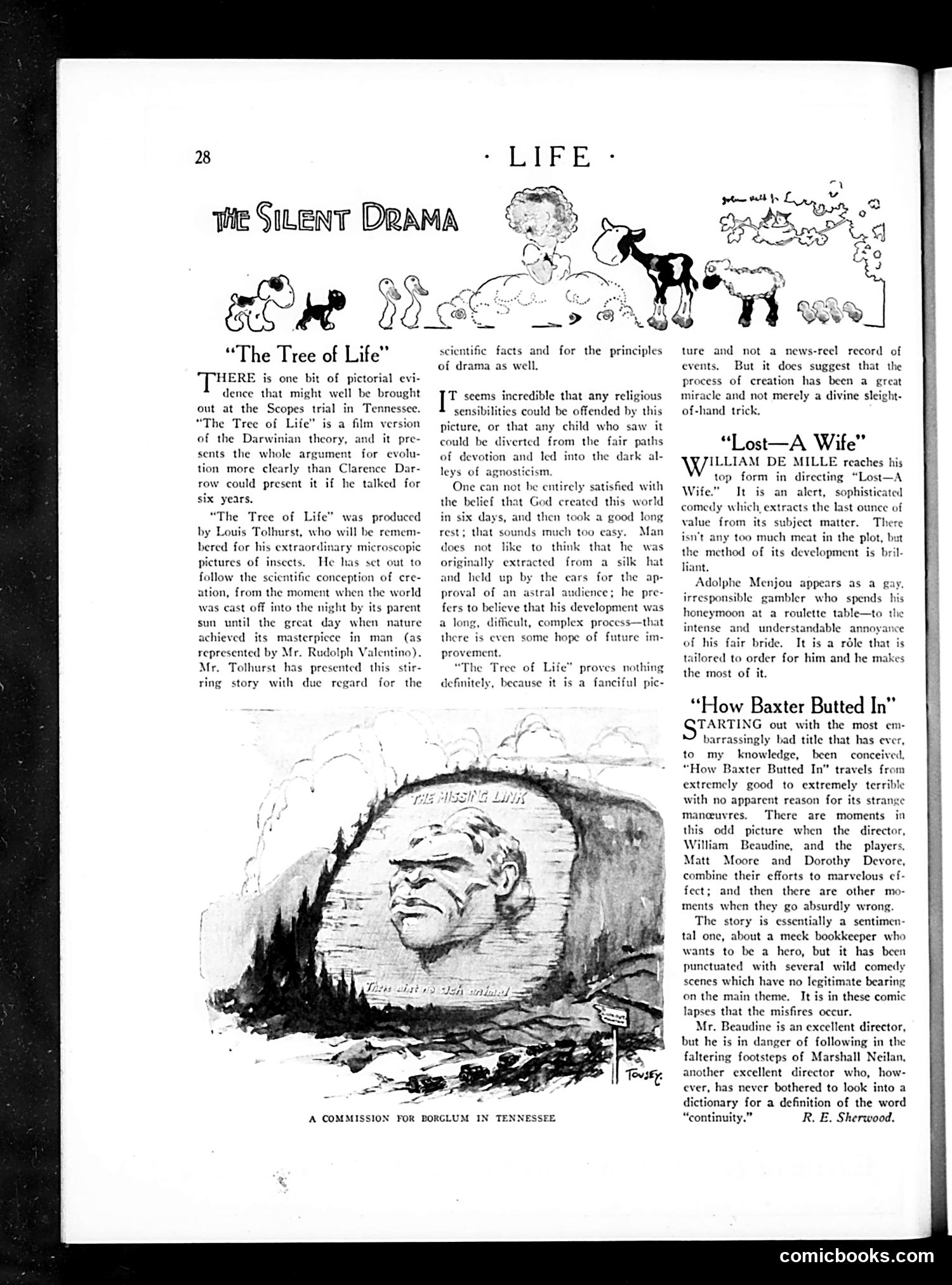
This page reviews three silent films while satirizing the famous **Scopes Trial** happening in Tennessee—the 1925 case prosecuting a teacher for teaching evolution. **"The Tree of Life"** is a documentary-style film presenting Darwin's evolutionary theory visually, culminating with actor Rudolph Valentino representing mankind's pinnacle. The review sardonically suggests this film proves evolution more effectively than courtroom argument could. The cartoon below (captioned "A Commission for Borglum in Tennessee") appears to reference sculptor Gutzon Borglum, likely mocking Tennessee's anti-evolution stance through artistic irony. The other two reviews cover comedies: William de Mille's "Lost—A Wife" and "How Baxter Butted In," both featuring popular silent-era actors. The page's core joke: Life's urbane New York readership could appreciate evolution's visual presentation while Tennessee remained locked in religious controversy—a pointed jab at regional intellectual divisions.
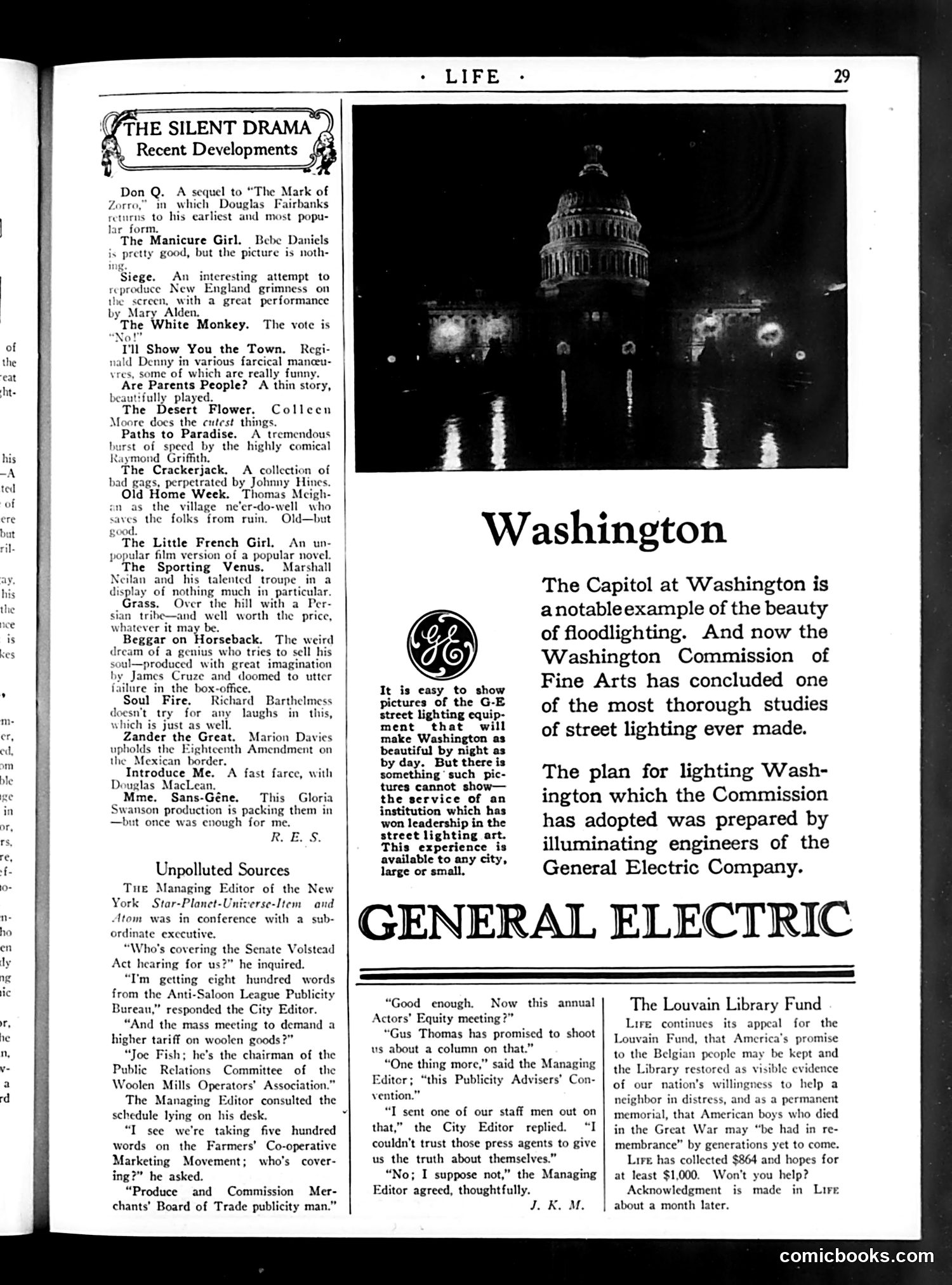
This short satirical piece mocks how newspapers obtain their news. The joke exposes a fundamental hypocrisy: a managing editor assigns coverage of major events—a Senate hearing on Prohibition, tariff debates, agricultural policy—but each story comes directly from interested parties' PR departments rather than independent reporting. The punchline reveals the editor's only skepticism: he won't trust actors' union spokespeople to report honestly about themselves, yet he happily accepts stories from the Anti-Saloon League, wool manufacturers, and agricultural lobbies without question. The satire highlights how institutional "publicity men" effectively control news coverage by feeding pre-written stories to newspapers, making journalism a vehicle for propaganda rather than investigation. This reflects 1920s anxieties about corporate influence on press independence—a concern that remains relevant today.
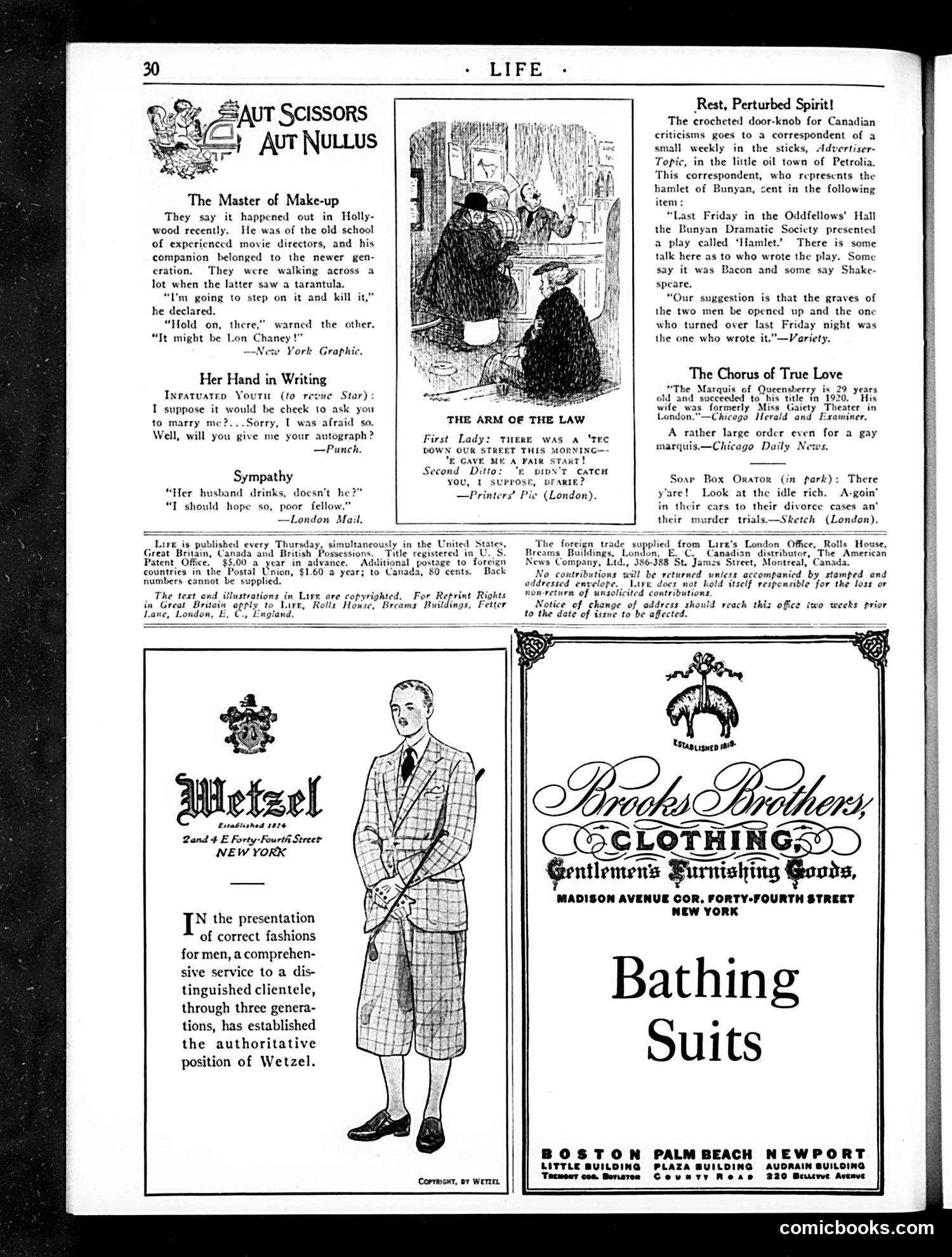
This page contains satirical humor items typical of 1920s Life magazine, plus period advertisements. **"The Master of Make-up"** jokes about silent film actor Lon Chaney, famous for elaborate disguises and transformations. The humor: a Hollywood director warns against stepping on a tarantula because it might actually be Chaney in disguise—mocking his reputation for unrecognizable character work. **"Her Hand in Writing"** and **"Sympathy"** are brief, genteel jokes typical of Punch magazine, involving romantic rejection and marital drinking. **"Rest, Perturbed Spirit!"** satirizes a small-town Canadian newspaper's absurd Hamlet criticism. The correspondent suggests opening Shakespeare and Bacon's graves to determine who wrote the play based on which corpse "turned over"—mocking provincial literary pretension and anti-Stratfordian authorship debates. **"The Chorus of True Love"** and **"Soap Box Orator"** make light of wealthy divorce scandals—common tabloid fare of the era. The advertisements feature high-end men's clothing (Wetzel, Brooks Brothers, bathing suits), reflecting the magazine's affluent readership.
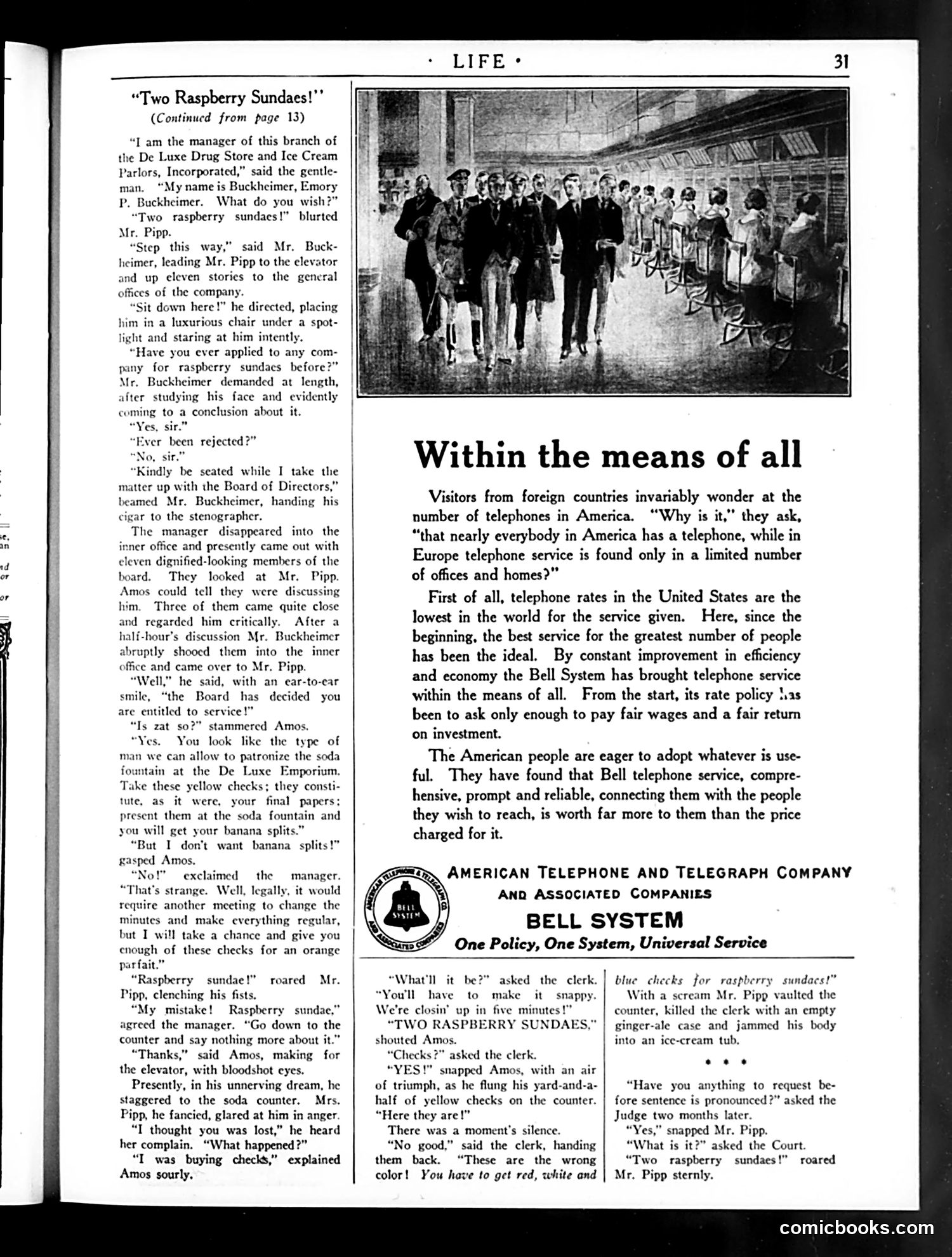
This story satirizes corporate bureaucracy run amok. A man named Amos Pipp simply wants to order two raspberry sundaes at a soda fountain, but the manager—Emory P. Buckheimer—treats this trivial request as a major corporate transaction. He takes Pipp to the executive offices, interviews him intensely, convenes an eleven-member Board of Directors to deliberate, and issues him "yellow checks" as official authorization. The satire mocks how 1920s corporations were becoming increasingly complex and hierarchical, turning simple transactions into byzantine procedures requiring multiple approvals. The joke's absurdity—needing board approval for a sundae—highlights how far removed corporate decision-making had become from actual customer needs. The accompanying Bell Telephone advertisement claiming service is "within the means of all" provides ironic contrast to the satirized bureaucratic bloat.
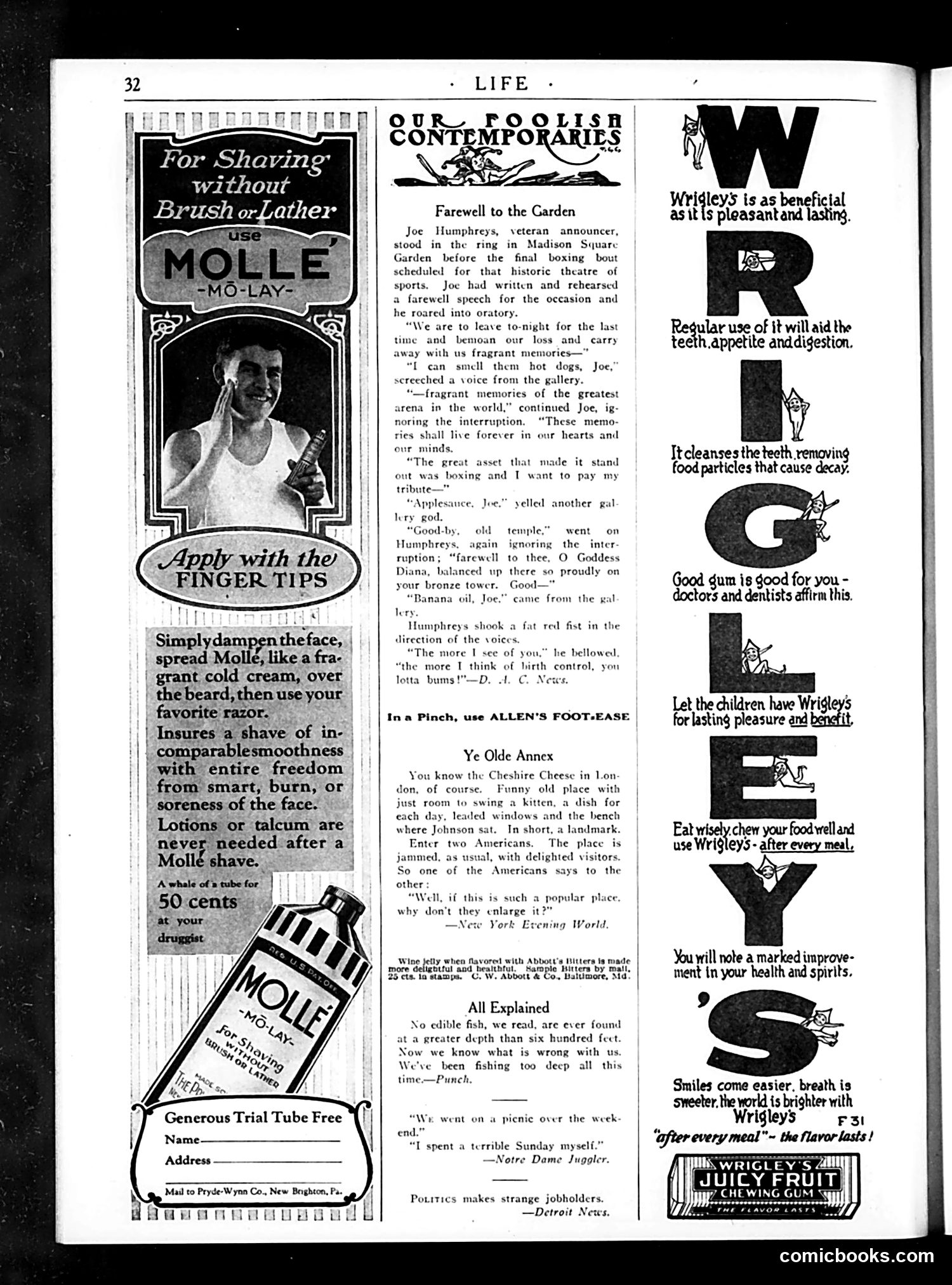
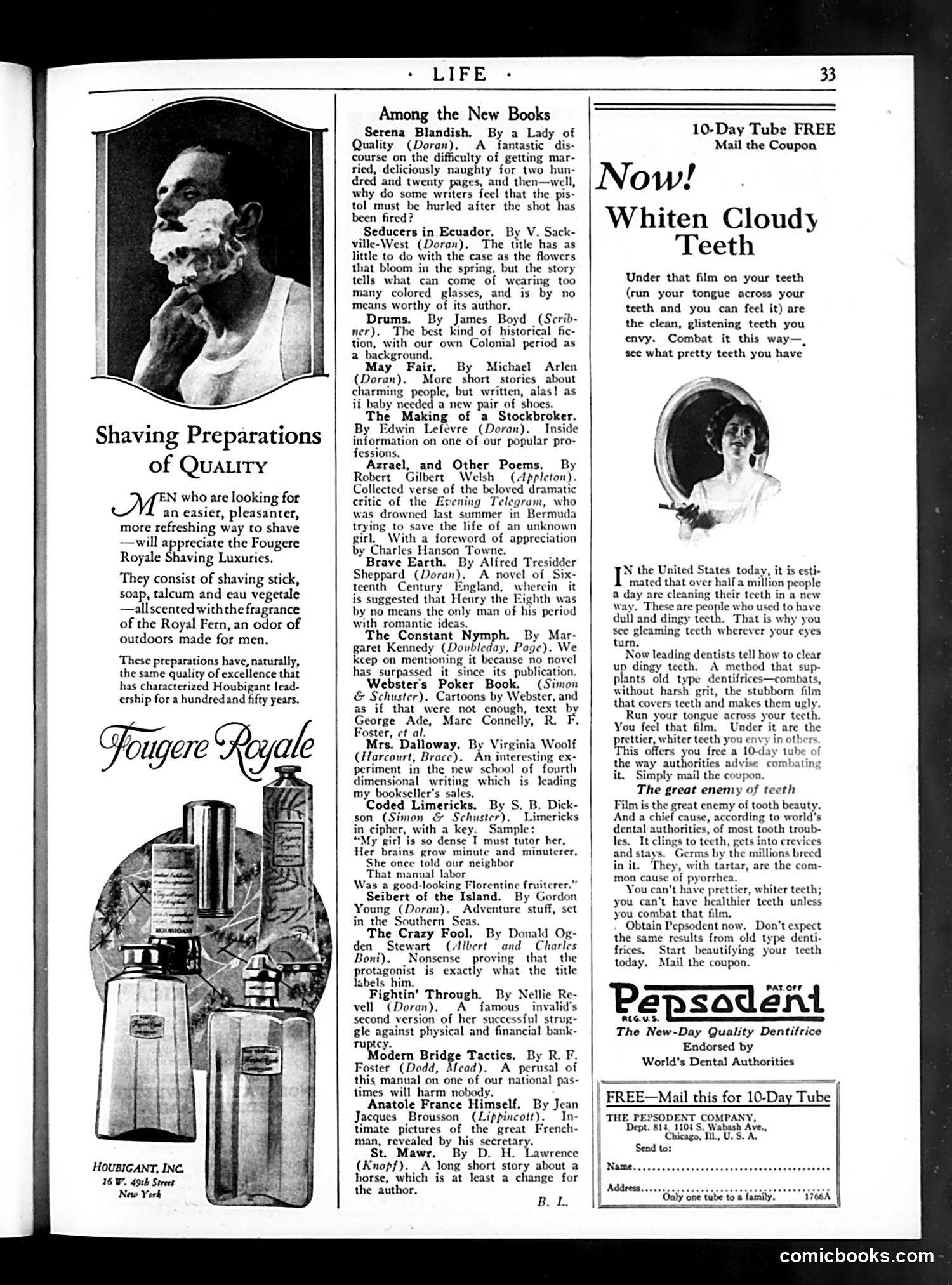
This page contains primarily book reviews and advertisements rather than political cartoons. The main content is a **book review section** critiquing recent literary releases from the 1920s, including works by Virginia Woolf, Michael Arlen, and D.H. Lawrence. The advertisements feature **Fougere Royale shaving products** (by Houbigant) and **Pepsodent toothpaste**, both emphasizing quality and modern refinement. The Pepsodent ad uses the then-common marketing phrase about removing film from teeth to reveal whiteness—a selling point that reflects early 20th-century dental hygiene messaging. The satirical tone in book descriptions (reviewer "B.L." makes witty jabs at authors' pretensions) is characteristic of Life magazine's literary criticism. There are no political cartoons visible on this page—it's primarily a cultural/consumer goods page from what appears to be the mid-1920s.
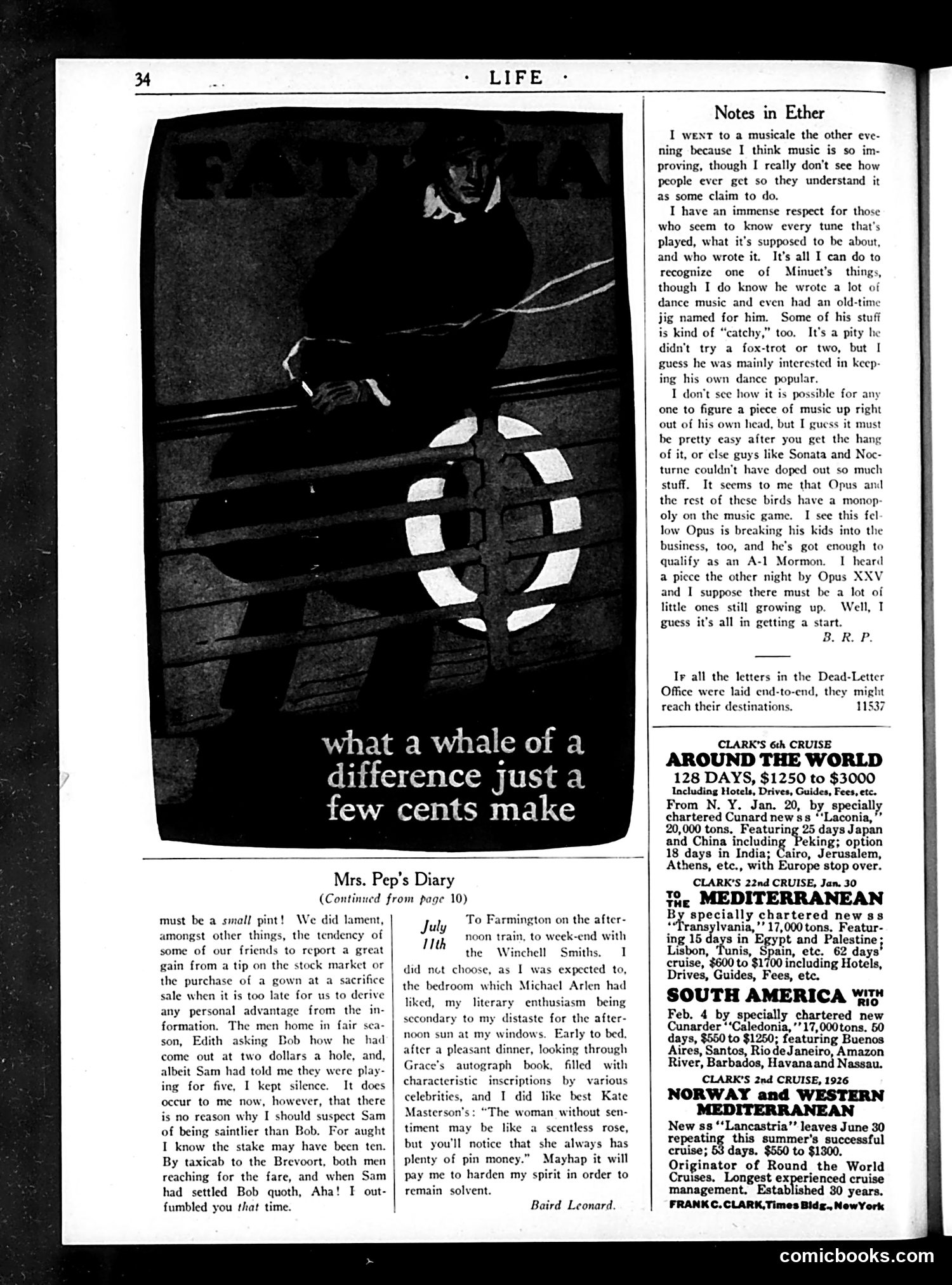
This page contains three separate pieces of content: **The Main Cartoon** (top left): An abstract woodcut-style image showing a hand/glove next to geometric shapes. The caption "what a whale of a difference just a few cents make" appears to be satirizing consumerism or penny-pinching—likely suggesting that small price differences drive purchasing decisions or that people obsess over trivial savings. **"Mrs. Pep's Diary"** (center): A gossip column about wealthy socialites' weekend activities—golf games, autograph books, and social visits. It satirizes upper-class pretension and small-mindedness, particularly women's concerns with fashion, gossip, and financial advantage from stock tips. **"Notes in Ether"** (right): Humorous commentary on classical music, written by someone admittedly ignorant about it. The author confuses composers' names ("Minuet," "Sonata," "Nocturne," "Opus") with actual pieces or people, mocking both musical pretension and her own cultural ignorance while poking fun at classical music's complexity. The rest of the page is travel advertisements.
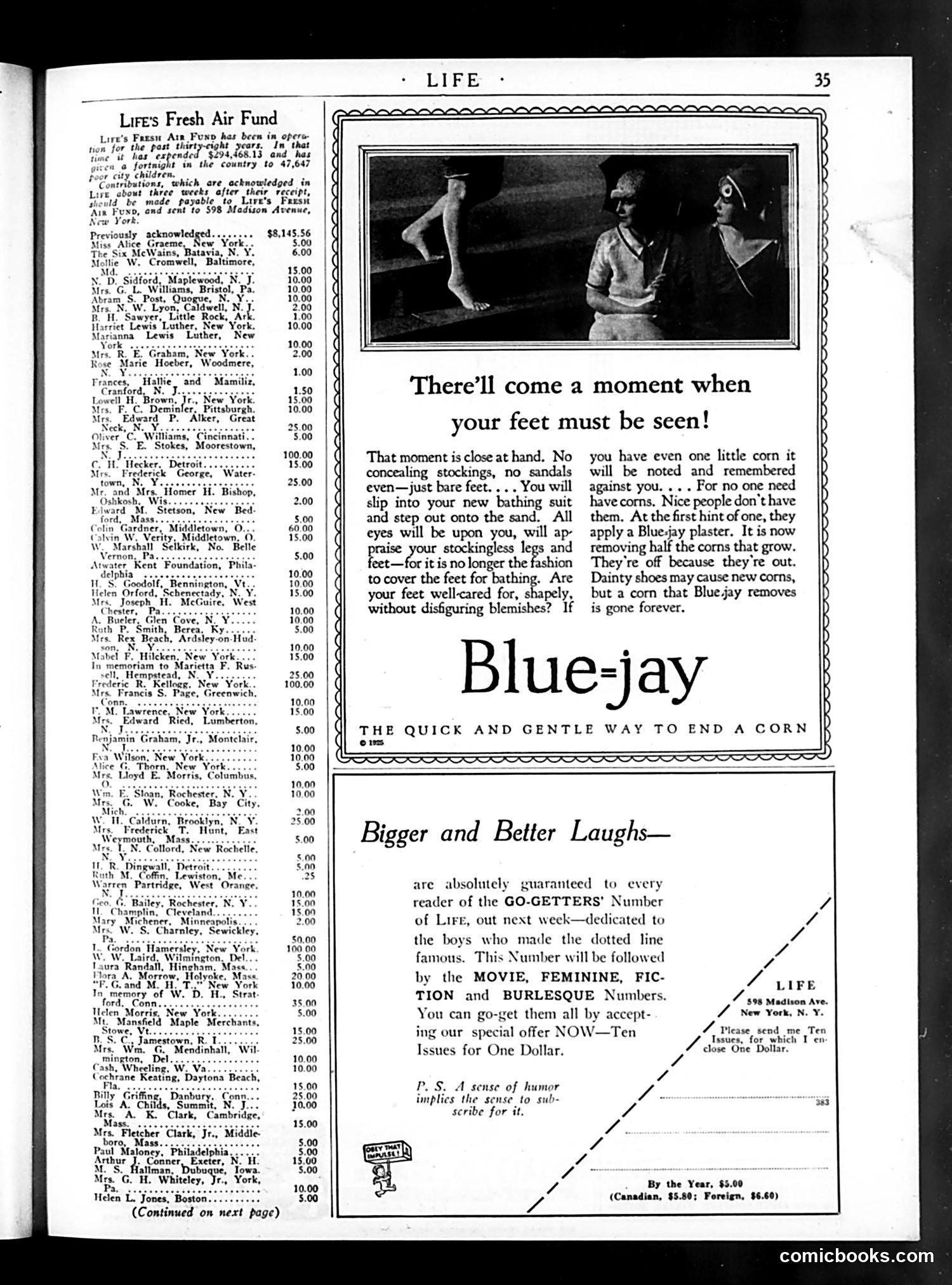
This page primarily contains **fundraising and advertising content** rather than political cartoons. **Left column:** A detailed list of donors to Life's Fresh Air Fund, an established charitable program (operating 38+ years) that sends poor city children to the countryside for health and recreation. The fund had distributed $294,468.15 to benefit 47,647 children. **Right side:** A **Blue-jay corn plaster advertisement** featuring a photograph of women in bathing suits. The ad exploits emerging 1920s fashion anxieties—specifically that hemlines and necklines were rising, making feet and legs visible. The advertisement warns readers that bare feet at the beach will be scrutinized, and corns are socially unacceptable ("Nice people don't have them"), positioning the plaster as essential for propriety. **Bottom:** Promotional copy for upcoming Life magazine issues themed around "GO-GETTERS," with promises of humor content in Movie, Feminine, Fiction, and Burlesque numbers. The page reflects 1920s consumer culture and body-consciousness tied to changing fashion norms.
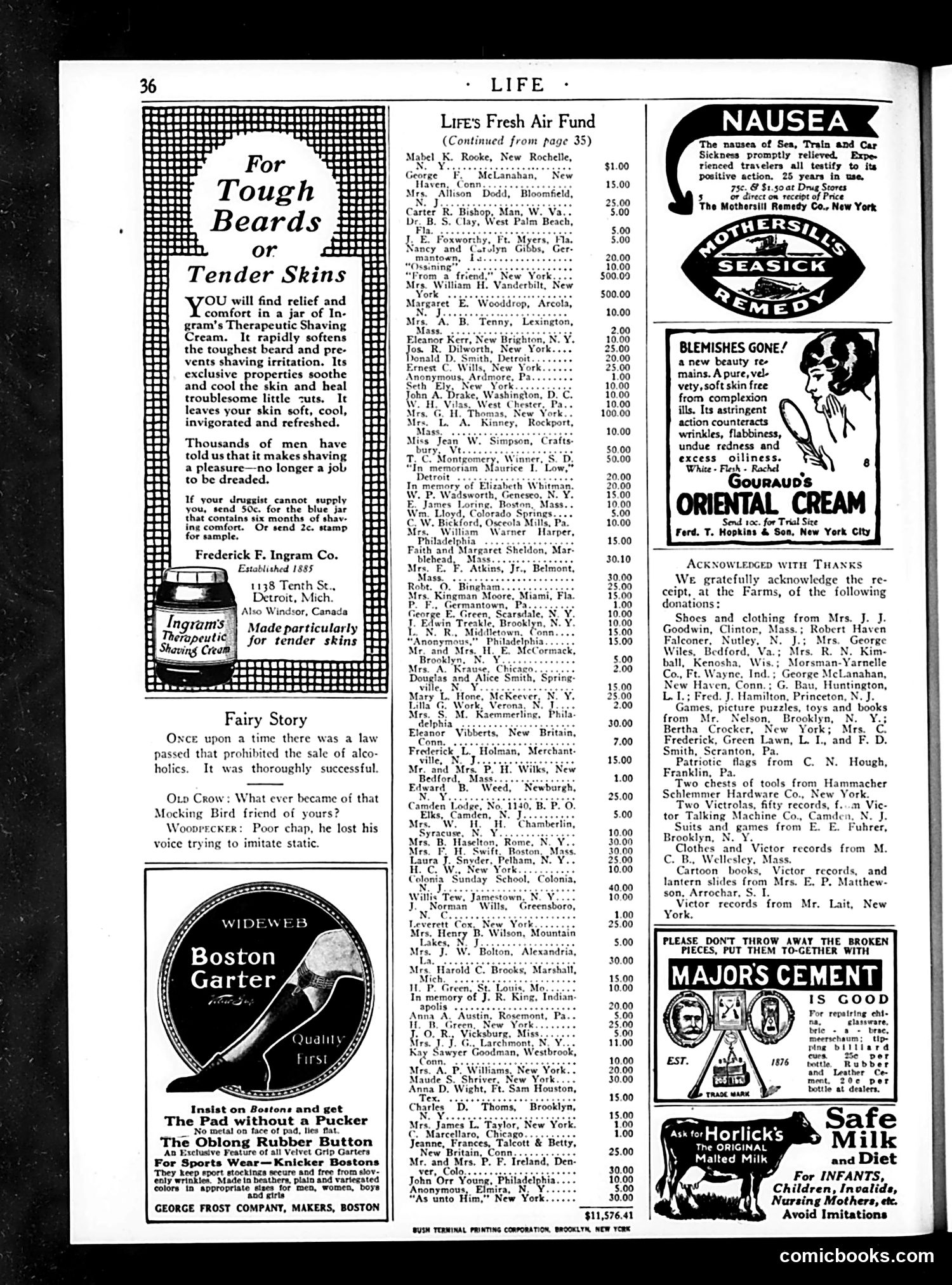
This page is primarily **advertising and administrative content** rather than political satire or comics with a satirical point. The "Fairy Story" section appears to be a brief anti-prohibition joke: it references a law prohibiting alcohol sales ("It was thoroughly successful"), seemingly mocking Prohibition's claimed success despite widespread failure. The Woodpecker joke is unrelated satire—a bird lost its voice imitating "static" (likely radio static), a modern-era joke. The page's main content is Life's Fresh Air Fund—a charitable effort listing donors and their contributions. The advertising dominates: shaving cream, garters, anti-nausea remedies, and beauty products occupy most space. This reflects LIFE magazine's business model of combining editorial content with paid advertisements. No caricatured political figures appear on this page. It represents LIFE during an era when satire coexisted with commercial messaging.
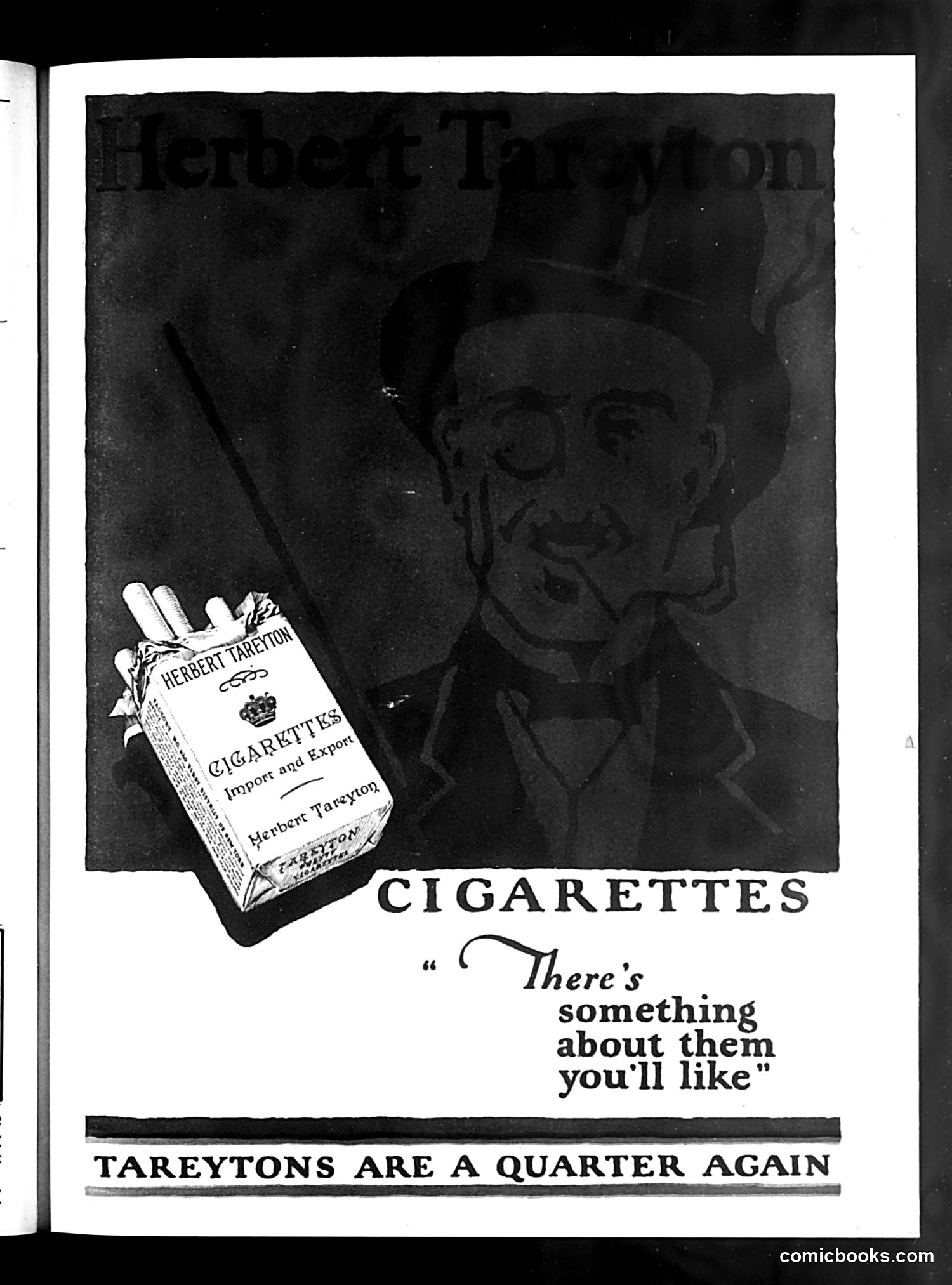
This is a **cigarette advertisement** for Herbert Tareyton brand cigarettes, not political satire. The page shows a caricatured male face in the background with an exaggerated, somewhat grotesque expression. A pack of Herbert Tareyton cigarettes is prominently displayed in the foreground. The ad's headline promises "There's something about them you'll like," using the appeal of mystery or intrigue. The bottom line, "TAREYTONS ARE A QUARTER AGAIN," likely refers to a price increase or package size change. The caricature's purpose appears to be attention-grabbing rather than satirical of any specific figure. This represents typical mid-20th century advertising strategy: using distinctive imagery to make the product memorable to consumers.

This page is a **straightforward advertisement**, not political satire or a cartoon. It advertises Beech-Nut Fruit Drops candy, priced at 5 cents—a standard confection from the early-to-mid 20th century. The ad features photographs of actual fruit (what appear to be citrus fruits and possibly another variety) alongside product packaging and individual wrapped candies. The marketing appeal emphasizes that the candy tastes "refreshing as fresh fruit" and comes in orange, lemon, and lime flavors. There is no political commentary, caricature, or satirical content present. This is simply a commercial advertisement from *Life* magazine's advertising pages.