
Life, 1925-07-16 · page 18 of 40
Life — July 16, 1925 — page 18: what you’re looking at
What you’re looking at
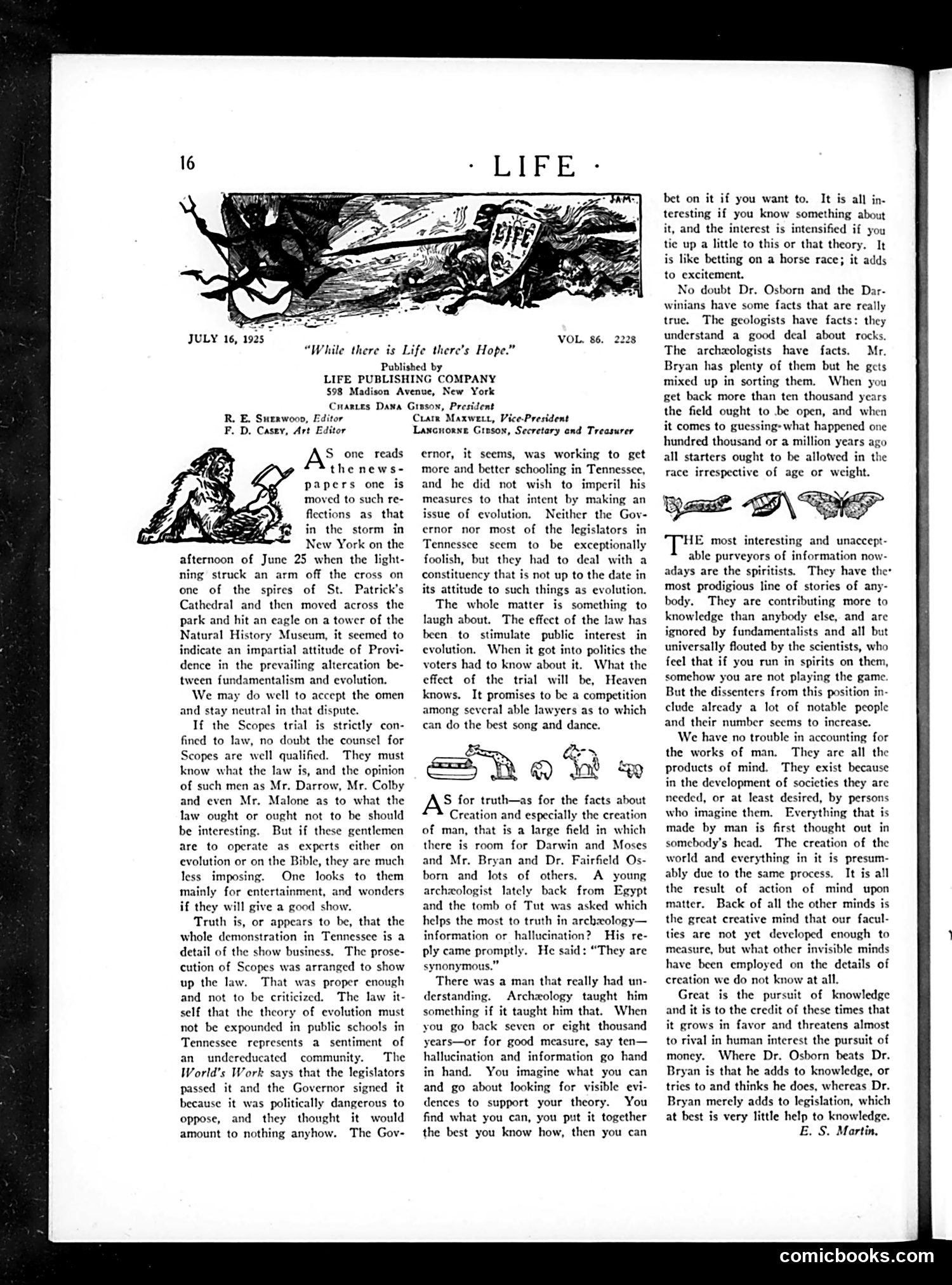
This Life magazine page satirizes the famous Scopes trial, where Tennessee prosecuted a teacher for teaching evolution. The article mocks the entire spectacle as theatrical "show business" rather than genuine intellectual inquiry. The key targets: William Jennings Bryan (who led the prosecution), Clarence Darrow and other defense lawyers, and Tennessee's anti-evolution law itself. The writer argues the law represents an "undereducated community" but notes even legislators knew it was politically dangerous to oppose publicly. The cartoon illustrations appear to depict the conflict between fundamentalist religion and scientific evolution—referenced by the June 25 lightning strike that damaged both St. Patrick's Cathedral and the Natural History Museum's eagle, suggesting "Providence" remains impartial. The satirist's main point: both sides are performing for entertainment rather than seeking truth. The closing anecdote about an archaeologist equating "information" with "hallucination" reinforces the cynical view that all historical reconstruction involves imagination shaped by theory.
📄 Transcribed text from this page (OCR, searchable)
Machine-transcribed from the original scan — historical spelling and the odd misread are preserved.
JULY 16, 1925 “While there is Life there’s Hope.” Published by LIFE PUBLISHING COMPANY $98 Madison Avenue, New York Crartes Dawa Grason, President R. E. Surawooo, Editor F. D. Casey, Art Editor S one reads the news- papers one is moved to such re- flections as that in the storm in New York on the afternoon of June 25 when the light- ning struck an arm off the cross on one of the spires of St. Patrick's Cathedral and then moved across the park and hit an eagle on a tower of the Natural History Museum, it seemed to indicate an impartial attitude of Provi- dence in the prevailing altercation be- tween fundamentalism and evolution. We may do well to accept the omen and stay neutral in that dispute. If the Scopes trial is strictly con- fined to law, no doubt the counsel for Scopes are well qualified. They must know what the law is, and the opinion of such men as Mr. Darrow, Mr. Colby and even Mr. Malone as to what the law ought or ought not to be should be interesting. But if these gentlemen are to operate as experts cither on evolution or on the Bible, they are much less imposing. One looks to them mainly for entertainment, and wonders if they will give a good show. Truth is, or appears to be, that the whole demonstration in Tennessee is a detail of the show business, The prose- cution of Scopes was arranged to show up the law. That was proper enough and not to be criticized. The law it- self that the theory of evolution must not be expounded in public schools in Tennessee represents a sentiment of an undereducated community. The World’s Work says that the legislators passed it and the Governor signed it because it was politically dangerous to oppose, and they thought it would amount to nothing anyhow. The Gov- Crare Maxwent, Vice-President Lancnoane Greson, Secretary and Treasurer ernor, it seems, was working to get more and better schooling in Tennessee, and he did not wish to imperil his measures to that intent by making an issue of evolution. Neither the Gov- ernor nor most of the legislators in Tennessce seem to be exceptionally foolish, but they had to deal with a constituency that is not up to the date in its attitude to such things as evolution. The whole matter is something to laugh about. The effect of the law has been to stimulate public interest in evolution. When it got into politics the voters had to know about it. What the effect of the trial will be, Heaven knows. It promises to be a competition among several able lawyers as to which can do the best song and dance. Sh oR w S for truth—as for the facts about Creation and especially the creation of man, that is a large field in which there is room for Darwin and Moses and Mr. Bryan and Dr. Fairfield Os- born and lots of others. A young archzxologist lately back from Egypt and the tomb of Tut was asked which helps the most to truth in archxology— information or hallucination? His re- ply came promptly. He said: “They are synonymous.” There was a man that really had un- derstanding. Archxology taught him something if it taught him that. When you go back seven or cight thousand years—or for good measure, say ten— hallucination and information go hand in hand. You imagine what you can and go about looking for visible evi- dences to support your theory. You find what you can, you put it together the best you know how, then you can bet on it if you want to. It is all in- teresting if you know something about it, and the interest is intensified if you tie up a little to this or that theory. It is like betting on a horse race; it adds to excitement. No doubt Dr. Osborn and the Dar- winians have some facts that are really true. The geologists have facts: they understand a good deal about rocks. The archzxologists have facts. Mr. Bryan has plenty of them but he gets mixed up in sorting them. When you get back more than ten thousand years the field ought to be open, and when it comes to guessing» what happened one hundred thousand or a million years ago all starters ought to be allotved in the race irrespective of age or weight. THE most interesting and unaccept- able purveyors of information now- adays are the spiritists. They have the most prodigious line of stories of any- body. They are contributing more to knowledge than anybody else, and are ignored by fundamentalists and all but universally flouted by the scientists, who feel that if you run in spirits on them, somehow you are not playing the game. But the dissenters from this position in- clude already a lot of notable people and their number seems to increase. We have no trouble in accounting for the works of man. They are all the products of mind. They exist because in the development of societies they are needed, or at least desired, by persons who imagine them, Everything that is made by man is first thought out in somebody's head. The creation of the world and everything in it is presum- ably due to the same process. It is all the result of action of mind upon matter. Back of all the other minds is the great creative mind that our facul- ties are not yet developed enough to measure, but what other invisible minds have been employed on the details of creation we do not know at all. Great is the pursuit of knowledge and it is to the credit of these times that it grows in favor and threatens almost to rival in human interest the pursuit of money. Where Dr. Osborn beats Dr. Bryan is that he adds to knowledge, or tries to and thinks he does, whereas Dr. Bryan merely adds to legislation, which at best is very little help to knowledge. E. S. Martin. comicbooks.com