
Life, 1925-07-16 · page 30 of 40
Life — July 16, 1925 — page 30: what you’re looking at
What you’re looking at
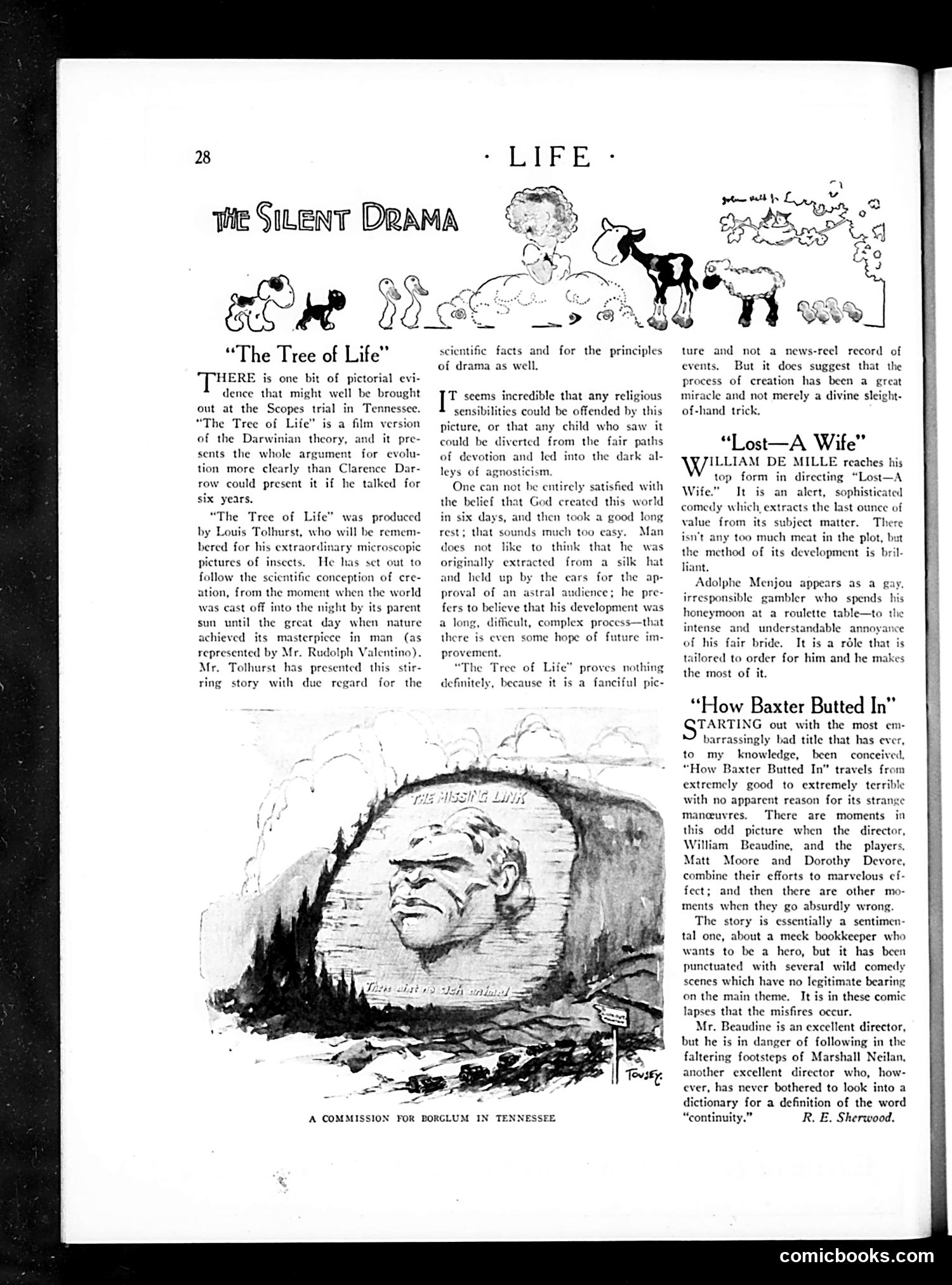
This page reviews three silent films while satirizing the famous **Scopes Trial** happening in Tennessee—the 1925 case prosecuting a teacher for teaching evolution. **"The Tree of Life"** is a documentary-style film presenting Darwin's evolutionary theory visually, culminating with actor Rudolph Valentino representing mankind's pinnacle. The review sardonically suggests this film proves evolution more effectively than courtroom argument could. The cartoon below (captioned "A Commission for Borglum in Tennessee") appears to reference sculptor Gutzon Borglum, likely mocking Tennessee's anti-evolution stance through artistic irony. The other two reviews cover comedies: William de Mille's "Lost—A Wife" and "How Baxter Butted In," both featuring popular silent-era actors. The page's core joke: Life's urbane New York readership could appreciate evolution's visual presentation while Tennessee remained locked in religious controversy—a pointed jab at regional intellectual divisions.
📄 Transcribed text from this page (OCR, searchable)
Machine-transcribed from the original scan — historical spelling and the odd misread are preserved.
28 “The Tree of Life” HERE is one bit of pictorial evi- dence that might well be brought out at the Scopes trial in Tennessee. “The Tree of Life” is a film version of the Darwinian theory, and it pre- sents the whole argument for evolu- tion more clearly than Clarence Dar- row could present it if he talked for six years, The Tree of Life” was produced by Louis Tolhurst, who will be remem- bered for his extraordinary microscopic pictures of insects. follow the scientific conception of ere- ation, from the moment when the world was cast off into the night by its parent sun until the great day when nature achieved its masterpicce in man (as represented by Mr. Rudolph Valentino). Mr. Tolhurst ha ring story with due regard for the He has set out to presented this stir- scientific facts and for the principles of drama as well. I? seems incredible that any religious sensibilities could be offended by this picture, or that any child who saw it could be diverted from the fair paths of devotion and led into the dark al- leys of agno: One can not be entirely satisfied with the belief that God created this world in six days, and then took a good long rest; that sounds much too easy. Man like to think that he was originally extracted from a silk hat and held by the cars for the ap- proval of an astral ience; he pre- fers to believe that his development was a long, difficult, complex process—that there is even some hope of future im- provement. “The Tree definitely, because it is a fanciful pic- does not of Life” proves nothing A COMMISSION FOR BORGLUM IN TENNESSEE ture and not a news-reel record of events. But it does suggest that the process of creation has been a miracle and not merely a divine sle of-hand trick. “Lost—A Wife” VW ILLIAM DE MILLE reaches his top form in directing “Lost—A Wife.” It is an alert, sophisticated comedy which, extracts the last ounce of value from its subject matter. There isn’t any too much meat in the plot, bu the method of its development is b liant. Adolphe Menjou appears as a gay, irresponsible gambler who spends hi honeymoon at a roulette table—to tl intense and understandable annoyance of his fair bride. It is a réle that is tailored to order for him and he makes the most of it. “How Baxter Butted In” TARTING out with the most em- barrassingly bad title that has ever, to my knowledge, been conceived. “How Baxter Butted In” travels from extremely good to extremely terril with no apparent reason for its strang maneuvres. There are moments this odd picture when the director, William Beaudine, and the players, Matt Moore and Dorothy Devor combine their efforts to marvelous ef- fect; and then there are other mo- ments when they go absurdly wrong. The story essentially a sentimen- tal one, about a meck bookkeeper who wants to be a hero, but it has been punctuated with several wild comed scenes which have no legitimate bearing on the main theme. It is in these comic lapses that the misfires occur. Mr. Beaudine is an excellent director, but he is in danger of following in the faltering footsteps of Marshall Neilan, another excellent director who, how- ever, has never bothered to look into a dictionary for a definition of the word “continuity.” R. E. Sherwood. comicbooks.com