
A complete issue · 42 pages · 1925
Life — July 9, 1925

This is a cover from **Life magazine's "Old Home Week" issue**, featuring a satirical illustration of American suburban life. The image depicts a globe or spherical representation of a small town, with "Main Street" labeled at the bottom. The cartoon satirizes the insular nature of American small-town life by literally wrapping it around the world—suggesting that Main Street represents the entire universe to its residents. The densely packed houses, buildings, and streets spiraling around the sphere represent how provincial communities view themselves as all-encompassing, despite their limited geographic scope. This reflects early-to-mid 20th century satirical commentary on American parochialism and the perceived narrow worldview of small-town Americans during an era of expanding global awareness.
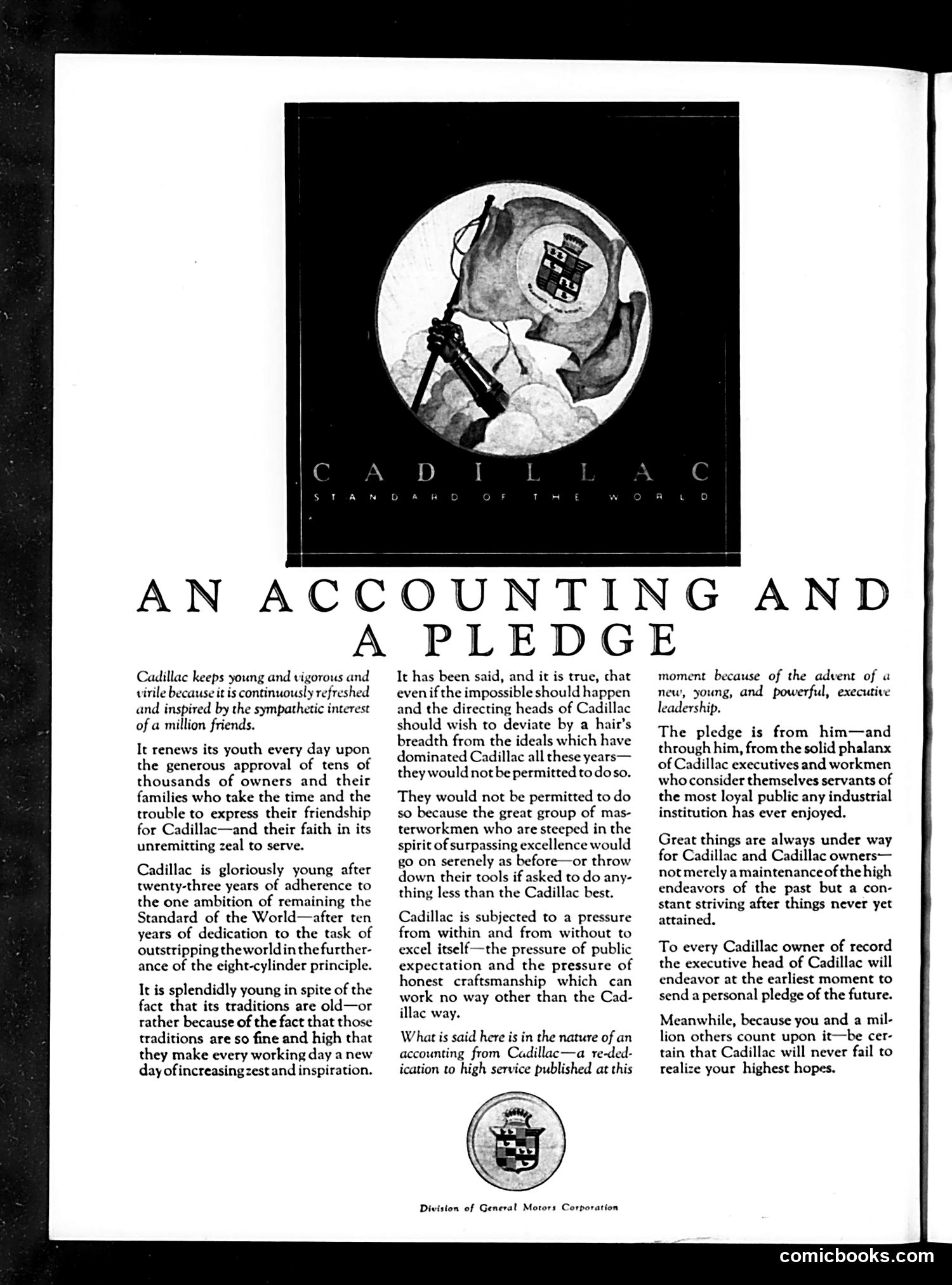
This page is **advertising, not satire**. It's a Cadillac advertisement from General Motors Corporation promoting the brand's reliability and craftsmanship. The circular illustration at top shows a globe or world sphere with Cadillac's coat-of-arms crest, representing "Standard of the World"—Cadillac's slogan emphasizing its global prestige and manufacturing excellence. The text uses corporate rhetoric praising Cadillac's "unremitting zeal to serve" and its adherence to quality standards. It appeals to owner loyalty while reassuring executives and workers that maintaining Cadillac's reputation requires unwavering commitment to excellence. This reflects 1920s-era automotive marketing emphasizing craftsmanship, tradition, and social status rather than satirizing anything political or social.
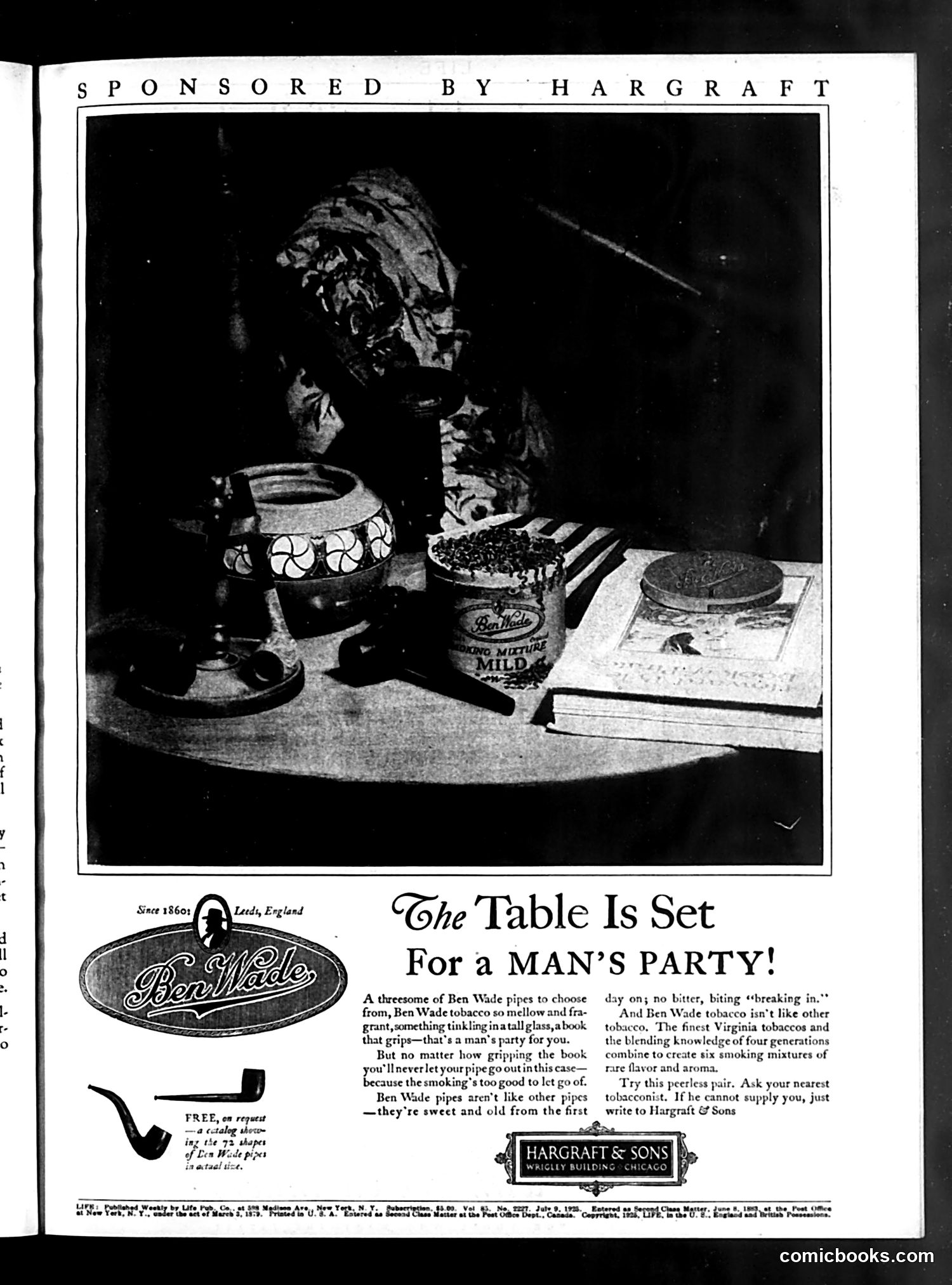
This is primarily a **Ben Wade tobacco advertisement**, not political satire. The page depicts an elaborate table setting for "a man's party" featuring Ben Wade pipes and tobacco products alongside decorative items like books and ornamental vessels. The advertisement's humor relies on early 20th-century gender conventions: it positions pipe-smoking and tobacco as distinctly masculine pursuits suitable for entertaining male guests. The "threesome of Ben Wade pipes" and premium Virginia tobacco blends are presented as sophisticated host gifts. The caricatured face visible in the composition appears decorative rather than representing a specific political figure. The ad emphasizes Ben Wade tobacco's quality, claiming superiority through "four generations" of blending expertise. This is fundamentally **commercial messaging** leveraging period notions of masculinity and social status, not political commentary.
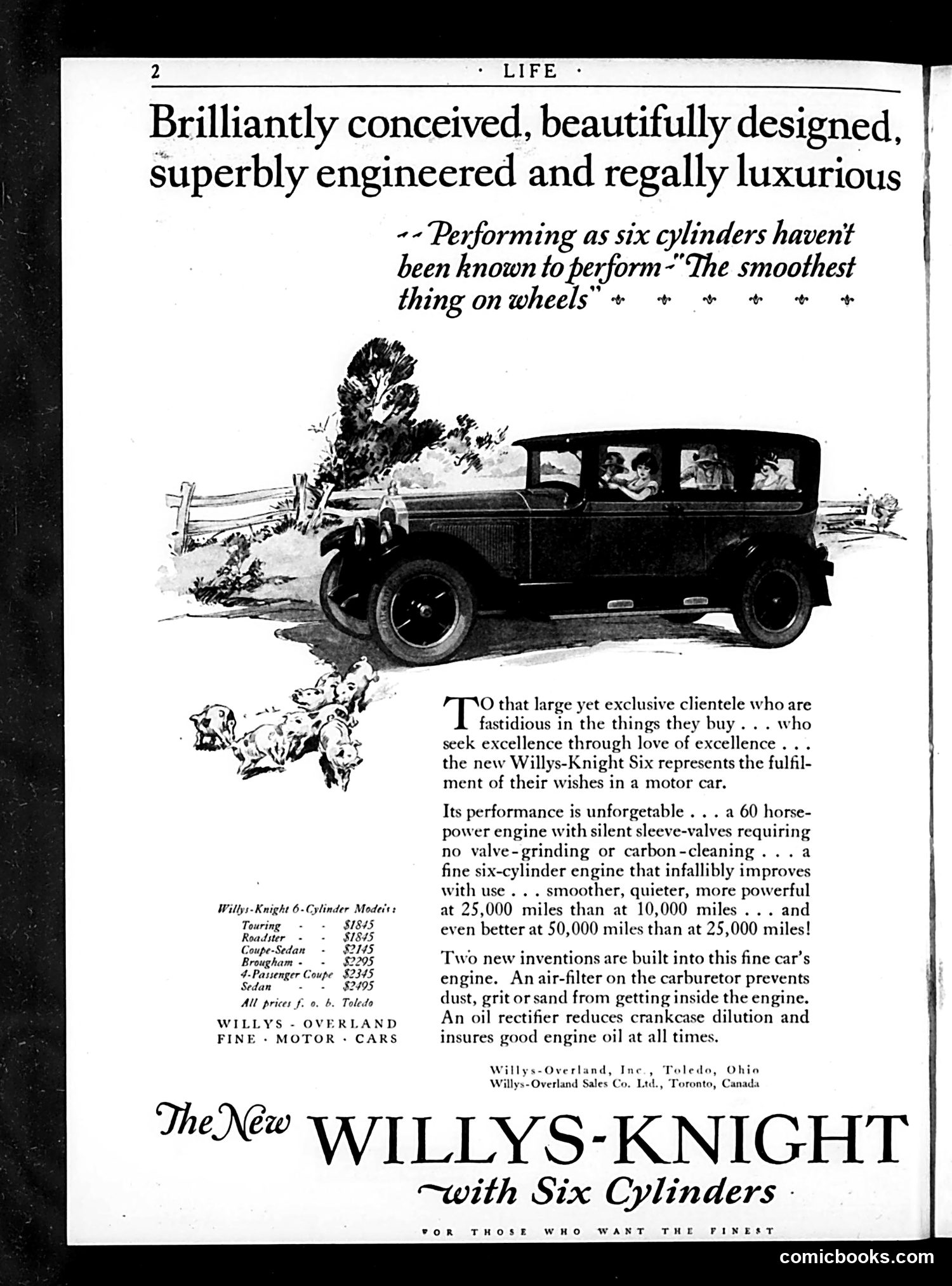
This page is **not a cartoon or satire** — it's a straightforward automobile advertisement for the Willys-Knight Six, placed in *Life* magazine. The ad promotes a luxury car through superlative language ("Brilliantly conceived, beautifully designed") and technical specifications (60 horsepower, six-cylinder engine). The illustration shows the vehicle in an idealized pastoral setting, appealing to affluent buyers seeking exclusivity and reliability. The decorative elements (dogs, rural fence) reinforce aspirational lifestyle messaging typical of 1920s automotive advertising. Technical innovations mentioned — an air filter and oil rectifier — were genuine selling points emphasizing durability and low maintenance. This represents straightforward commercial marketing rather than political commentary or satire.
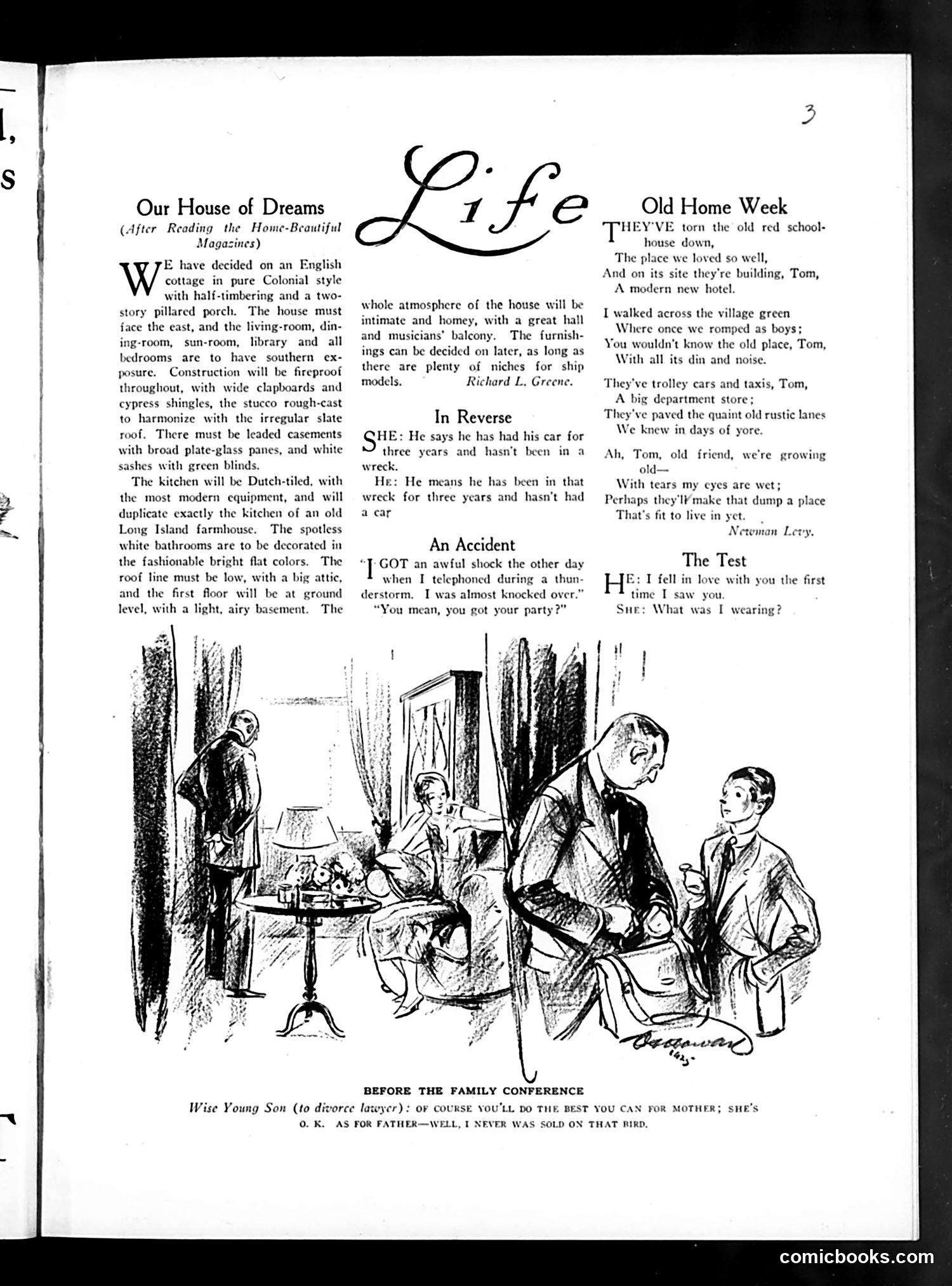
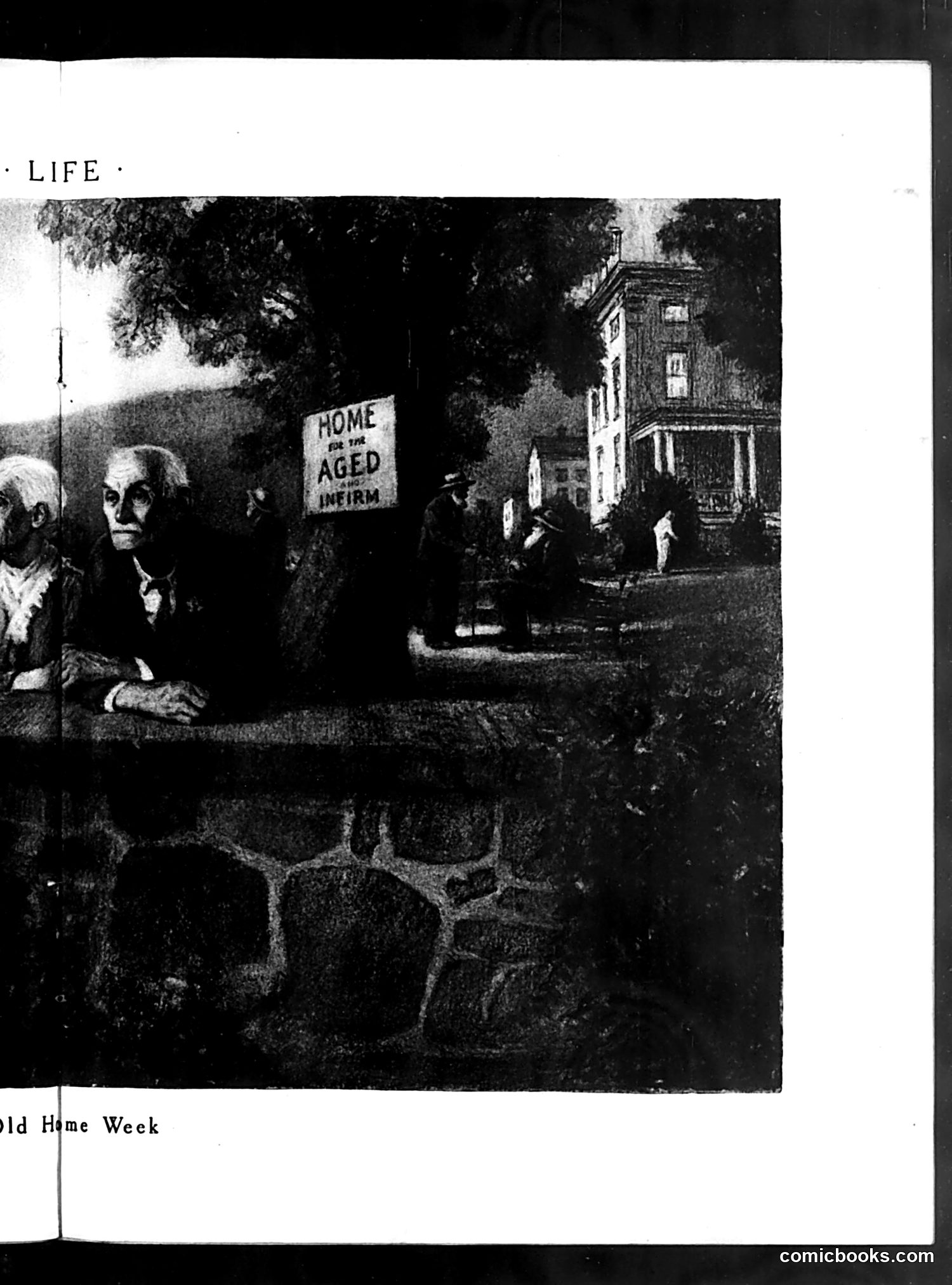
This page contains several humorous pieces and a cartoon rather than political satire. **"Our House of Dreams"** describes plans for an English Colonial cottage, detailing architectural and design choices. **"Old Home Week"** is nostalgic verse lamenting how a familiar village has changed—the schoolhouse is gone, replaced by a hotel; commercial development (trolley cars, department stores, paved roads) has transformed the rustic landscape the narrator remembers from youth. **"In Reverse," "An Accident,"** and **"The Test"** are brief comedic dialogues. The main cartoon, captioned **"Before the Family Conference,"** shows a domestic scene where a son seeks paternal advice about divorce, humorously promising to "do the best you can for Mother." The father's cynical response—"I never was sold on that bird"—jokes about marital skepticism rather than making political commentary.
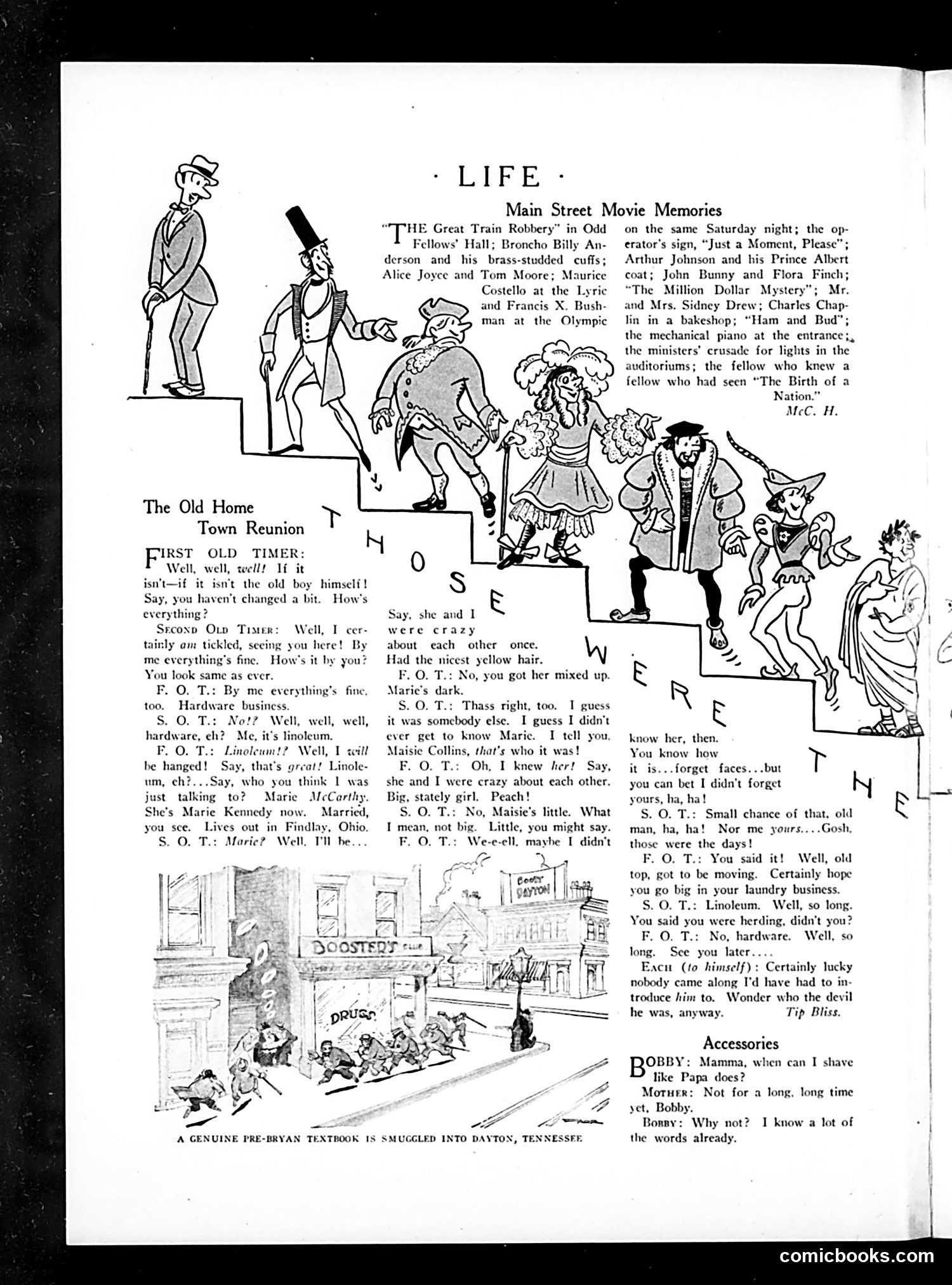
This page contains two distinct sections: **"Main Street Movie Memories"** is a humorous dialogue between "First Old Timer" and "Second Old Timer" discussing how their hometown has changed. They reminisce about old acquaintances and local businesses (hardware store, laundry), noting how people have moved away or changed careers. The joke centers on small-town nostalgia and how communities evolve—people scatter, businesses close, and old connections fade. **"Accessories"** is a brief comedic dialogue between Bobby and his Mother about shaving, playing on a child's eagerness to grow up and imitate adult behavior. The page's illustrations show a staircase descending into a movie theater and a street scene, visualizing the "old home town" theme. This appears to be gentle, relatable satire about American small-town life and generational change.
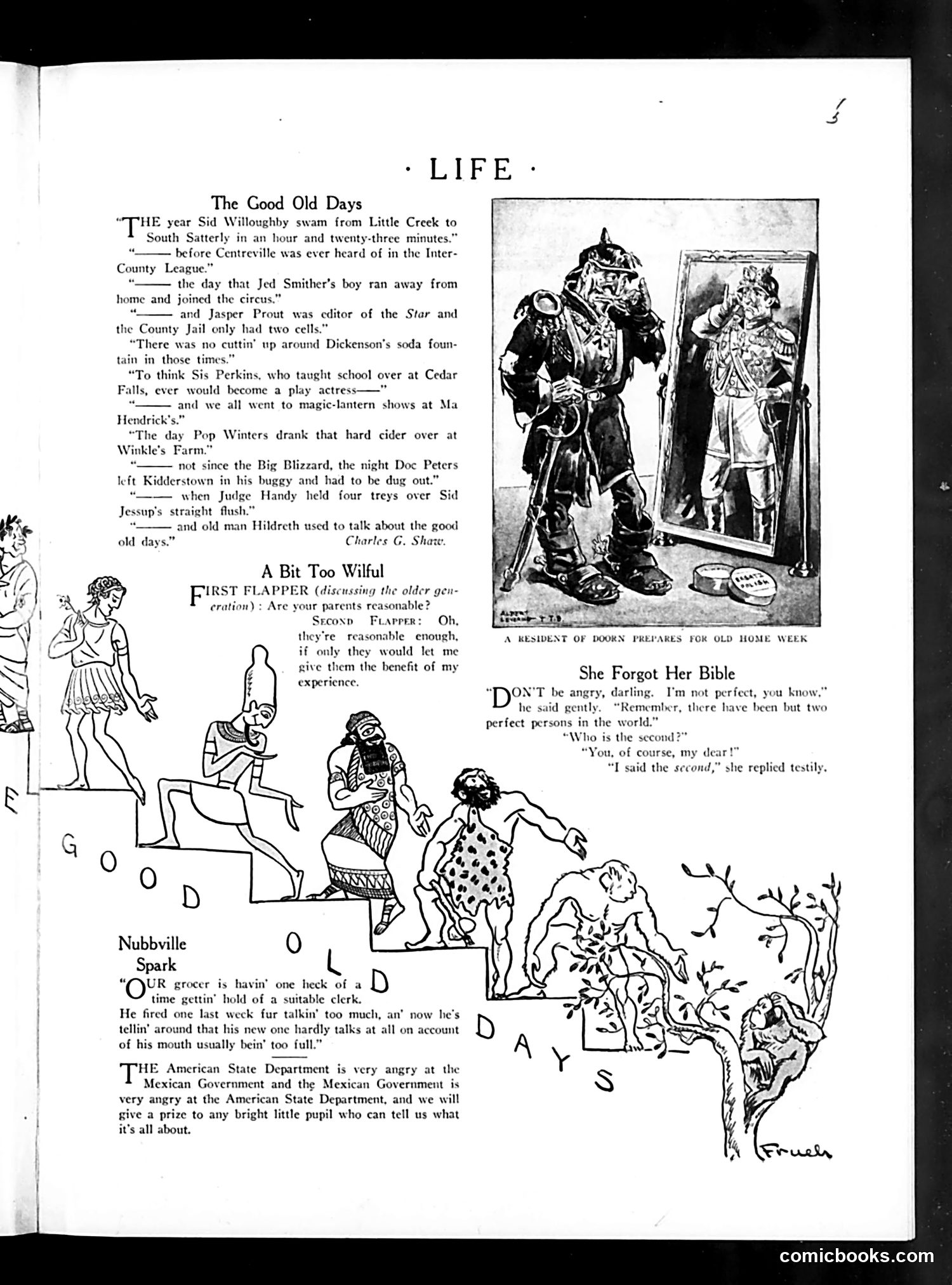
This page contains three satirical pieces: **"The Good Old Days"** nostalgically recounts small-town American life before modernization—swimming, circuses, and local characters. **"A Bit Too Wilful"** is a two-panel joke about generational conflict: an older generation parent claims children are unreasonable, while a younger "flapper" character argues parents should grant her freedom "for the benefit of my experience." This reflects 1920s debates over youth independence and changing social values. **"Nubbville Spark"** mocks incompetent local government—specifically a grocer hired as a clerk who talks excessively, making him unsuitable for the position. The bottom section includes an illustration labeled "She Forgot Her Bible," a brief domestic humor piece about a woman misquoting scripture. The "Good Old Days" cartoon uses perspective and text overlay to create visual wordplay with "GOOD OLD DAYS."
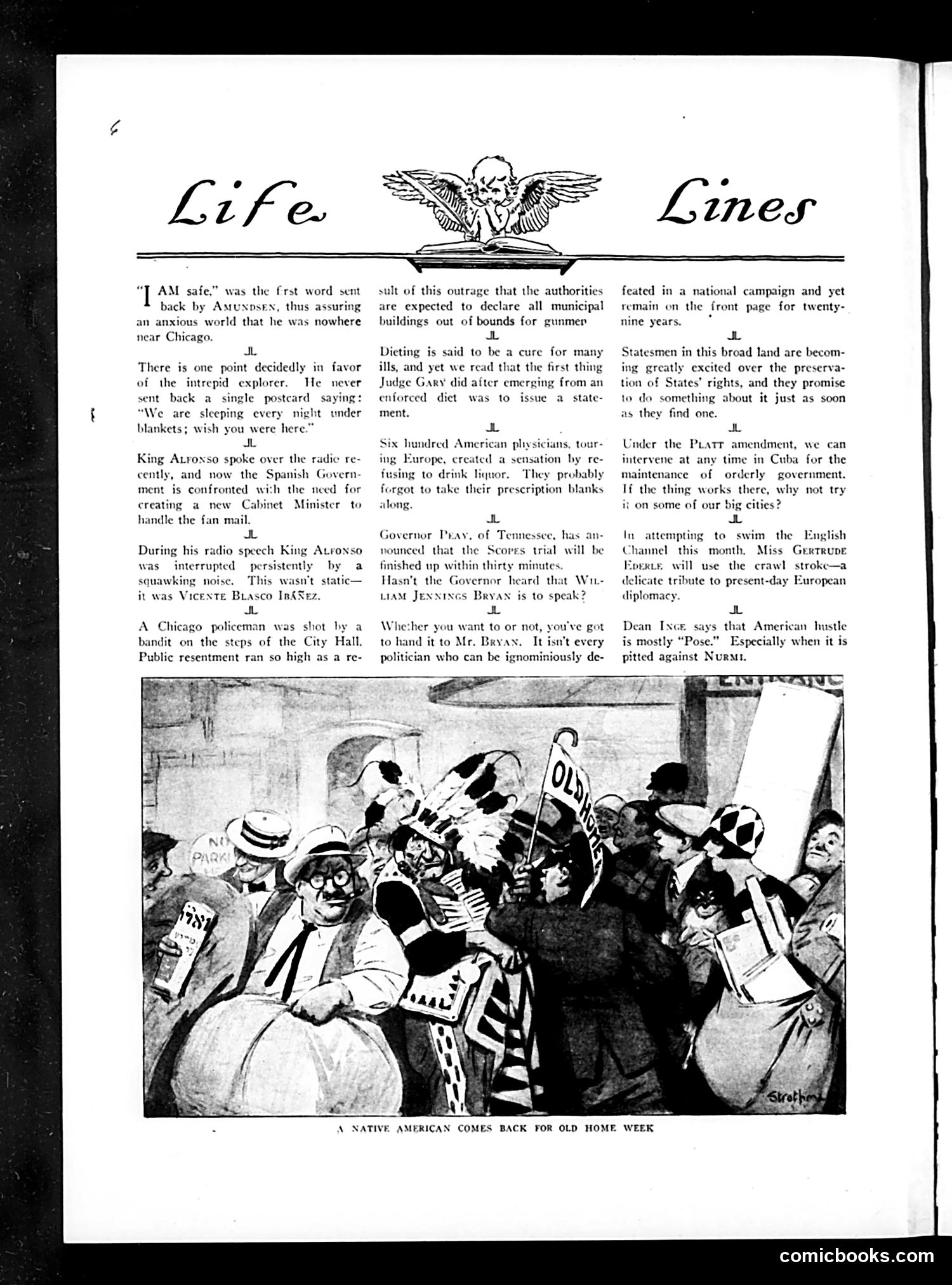
The cartoon titled "A Native American Comes Back for Old Home Week" depicts a Native American figure returning to a chaotic urban scene filled with protesters holding various signs and banners. The satire appears to comment on American social unrest and disorder—the Native American observer serves as an ironic witness to the very civilization that displaced indigenous peoples. The surrounding text discusses various contemporary issues: a policeman's shooting near Chicago's City Hall, radio interference during King Alonso's broadcast, dietary cures, and American tourists refusing alcohol in Europe. The cartoon suggests that despite America's claims of progress and civilization, the violence and chaos visible in cities like Chicago would strike an indigenous person as grimly ironic proof of the colonizers' supposed superiority.
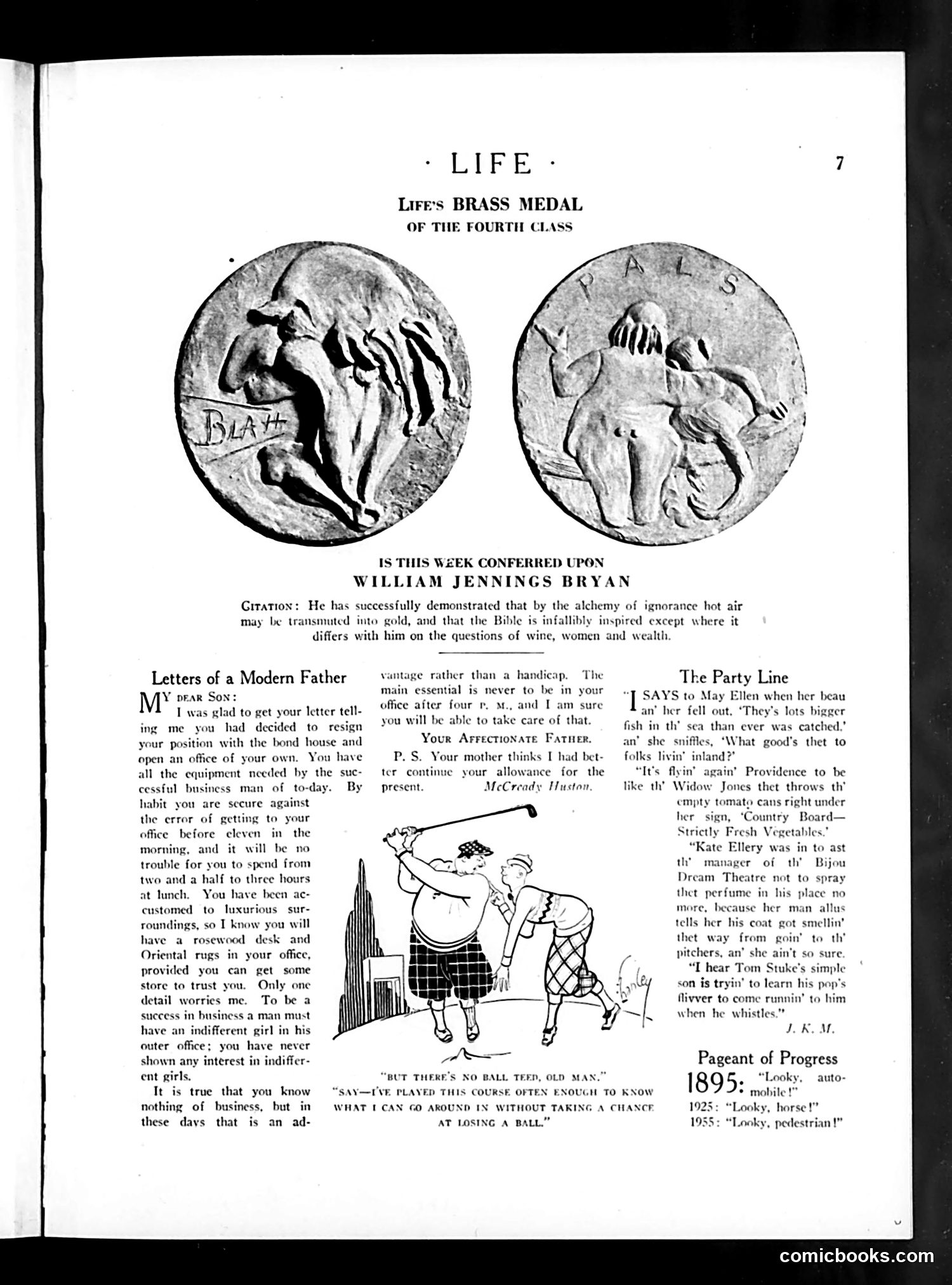
This page features a brass medal "of the Fourth Class" awarded to **William Jennings Bryan**, the three-time presidential candidate and prominent politician. The medal's citation satirizes Bryan's famous positions: his belief that "alchemy of ignorance hot air may be transmitted into gold" and his Biblical literalism "except where it differs with him on the questions of wine, women and wealth." The satire mocks Bryan's inconsistency—claiming religious devotion while contradicting Scripture on these specific topics. The page also includes unrelated content: a father's letter advising his son on business etiquette, a golf cartoon, and a section titled "The Party Line" with theatrical gossip and a "Pageant of Progress" showing changing transportation from 1895-1955.
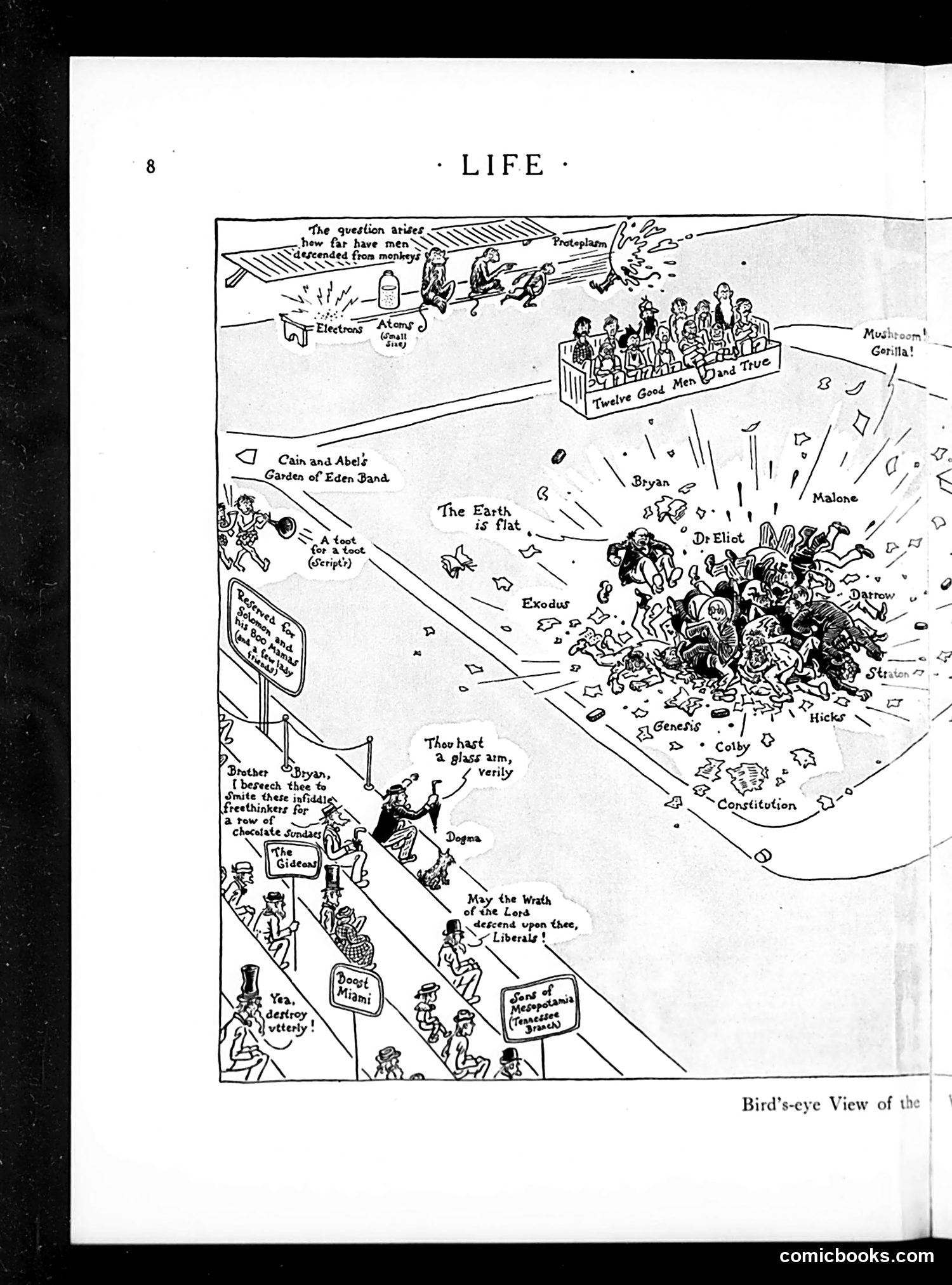
This satirical cartoon presents human history as a chaotic descent, viewed from above. At the top, figures labeled "Protoplasm" and "Atom" represent evolutionary origins. A boat carries "Twelve Good Men and True" (likely referencing juries or idealized citizens). The middle shows "The Earth is Flat" with biblical references: "Cain and Abel's Garden of Eden Sand" and "Exodus." Lower sections depict historical and political figures in tumultuous scenes labeled with names like "Bryan," "Malone," "Eliot," and "Colby"—likely early 20th-century American politicians or public figures. Text references "Dogma," "Wrath of the Lord," and "Constitution." The overall message satirizes human "progress" as actually regressive chaos, with civilization collapsing into disorder beneath the veneer of law and order.
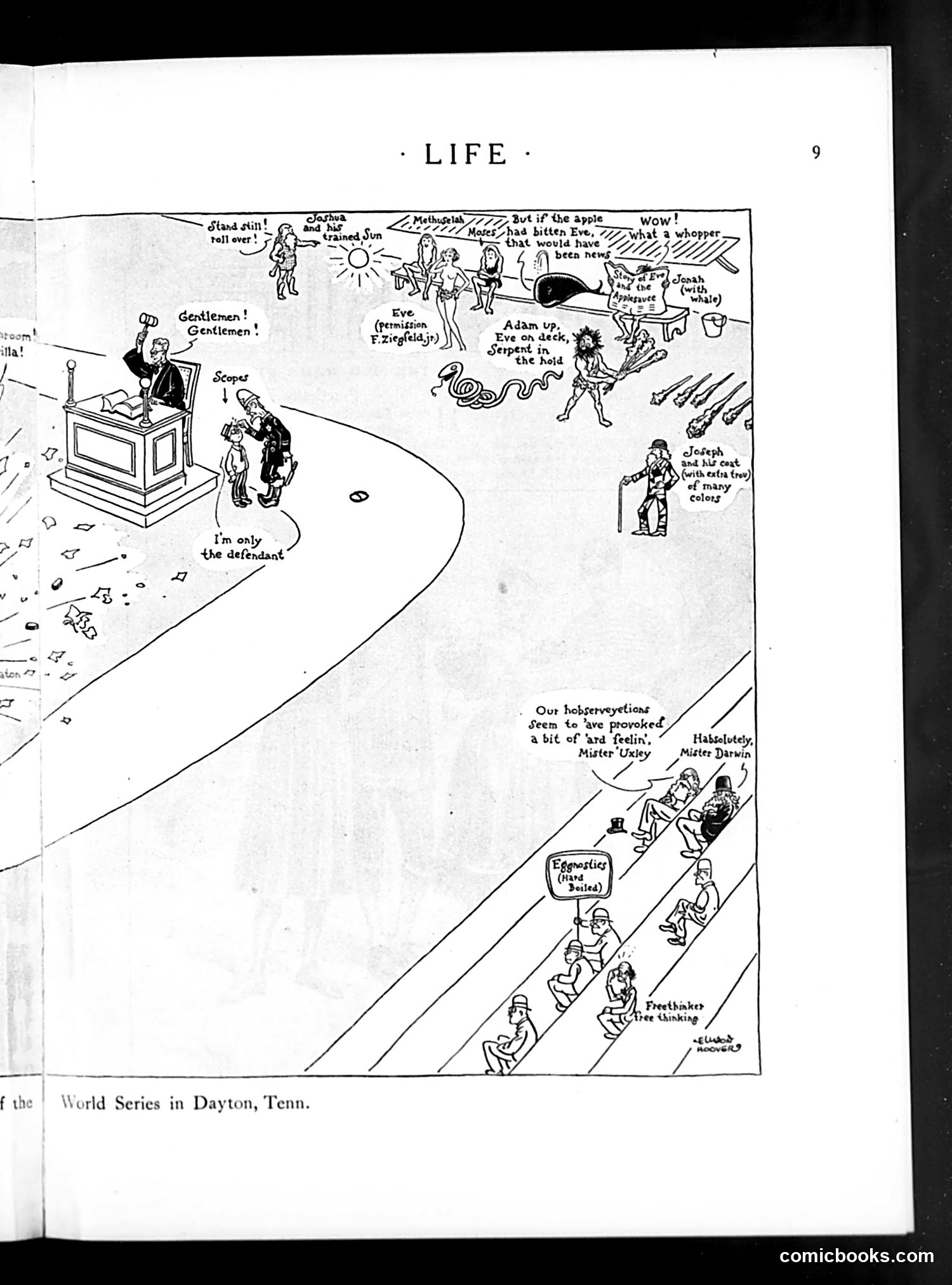
This is a satirical cartoon about the famous Scopes "Monkey Trial" (referenced in the caption mentioning "World Series in Dayton, Tenn."). The cartoon depicts a courtroom scene where evolution is on trial, with various historical and scientific figures positioned as witnesses or evidence. The central figure at the pulpit appears to be the prosecutor. Named figures include Eve, Adam, Joseph (identified as having "coat of many colors"), and references to Methuselah and the apple. At the bottom, figures labeled "Eugenics (Hard Boiled)," "Freethinks," and "Evolution" appear in descending rows, suggesting different evolutionary or intellectual positions. The satire mocks how the trial positioned religious tradition against scientific theory, treating evolution itself as the defendant.
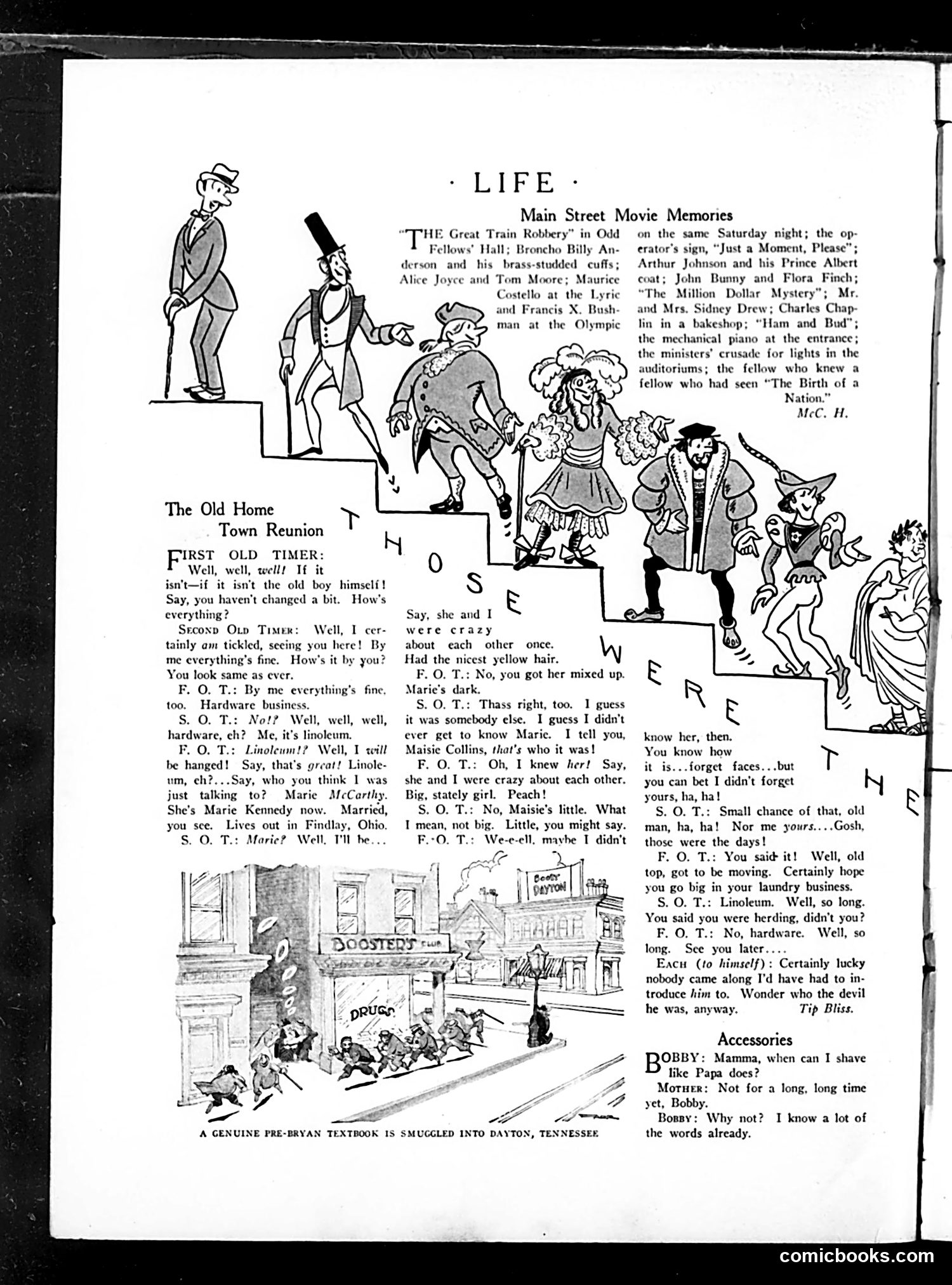
This page from *Life* magazine contains two distinct sections: **"Main Street Movie Memories"** (top right): A humorous dialogue among people reminiscing about silent films they watched together. The joke centers on unreliable memory—they disagree about which movie featured which actor, eventually admitting they "didn't ever get to know" the performers' names. It satirizes how audiences of that era consumed films casually, often unaware of or indifferent to cast details. **"The Old Home Town Reunion"** (left): A comedic conversation between old friends reuniting, discussing life changes. One mentions a friend named Marie Kennedy who married and moved to "Findlay, Ohio"—presented as unremarkable small-town life. **"A Genuine Pre-Bryan Textbook is Smuggled into Dayton, Tennessee"** (bottom): This references the 1925 Scopes Monkey Trial in Dayton, Tennessee, where teaching evolution was prosecuted. William Jennings Bryan opposed evolution. The cartoon jokes about contraband "modern" textbooks in this conservative town.
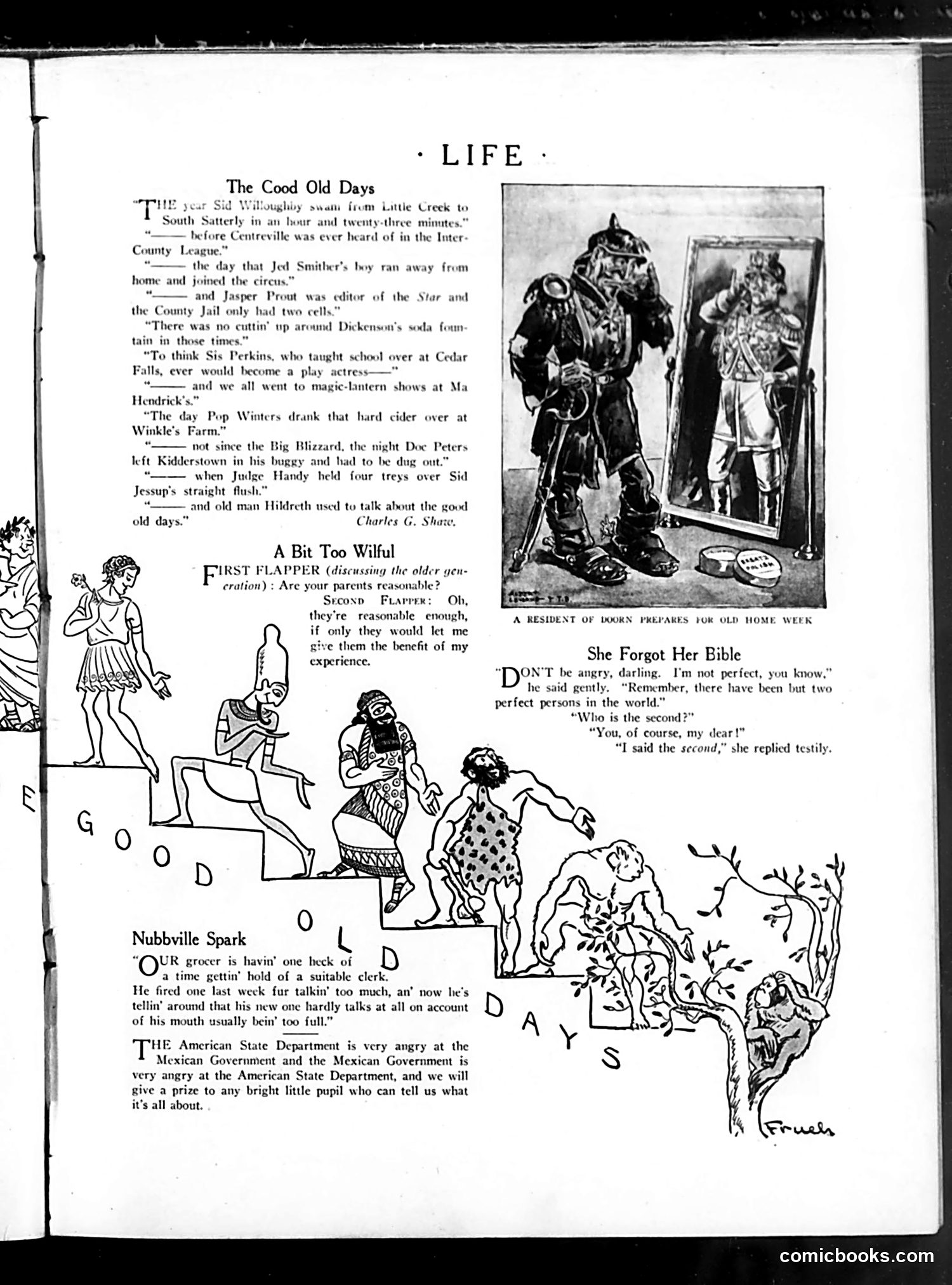
This page contains three separate satirical pieces: 1. **"The Good Old Days"** - Nostalgic anecdotes about small-town life, referencing local figures like Jed Smither and Sis Perkins. 2. **"A Bit Too Wilful"** - A joke about generational conflict where a young person asks their parents for permission to gain "experience," implying sexual or romantic freedom. The humor relies on the tension between parental authority and youth independence. 3. **"She Forgot Her Bible"** - A domestic humor piece where a woman defends her imperfection, sarcastically noting only two perfect people existed. 4. **"Nubbville Spark"** - A local gossip item about a grocer fired for talking too much, now selling a silent person. 5. **Bottom section** - Contains what appears to be a U.S. State Department complaint about Mexican government conduct, with a satirical challenge to readers to explain it. The cartoons use simple line drawings typical of 1920s-30s Life magazine's humorous, socially-observant style.
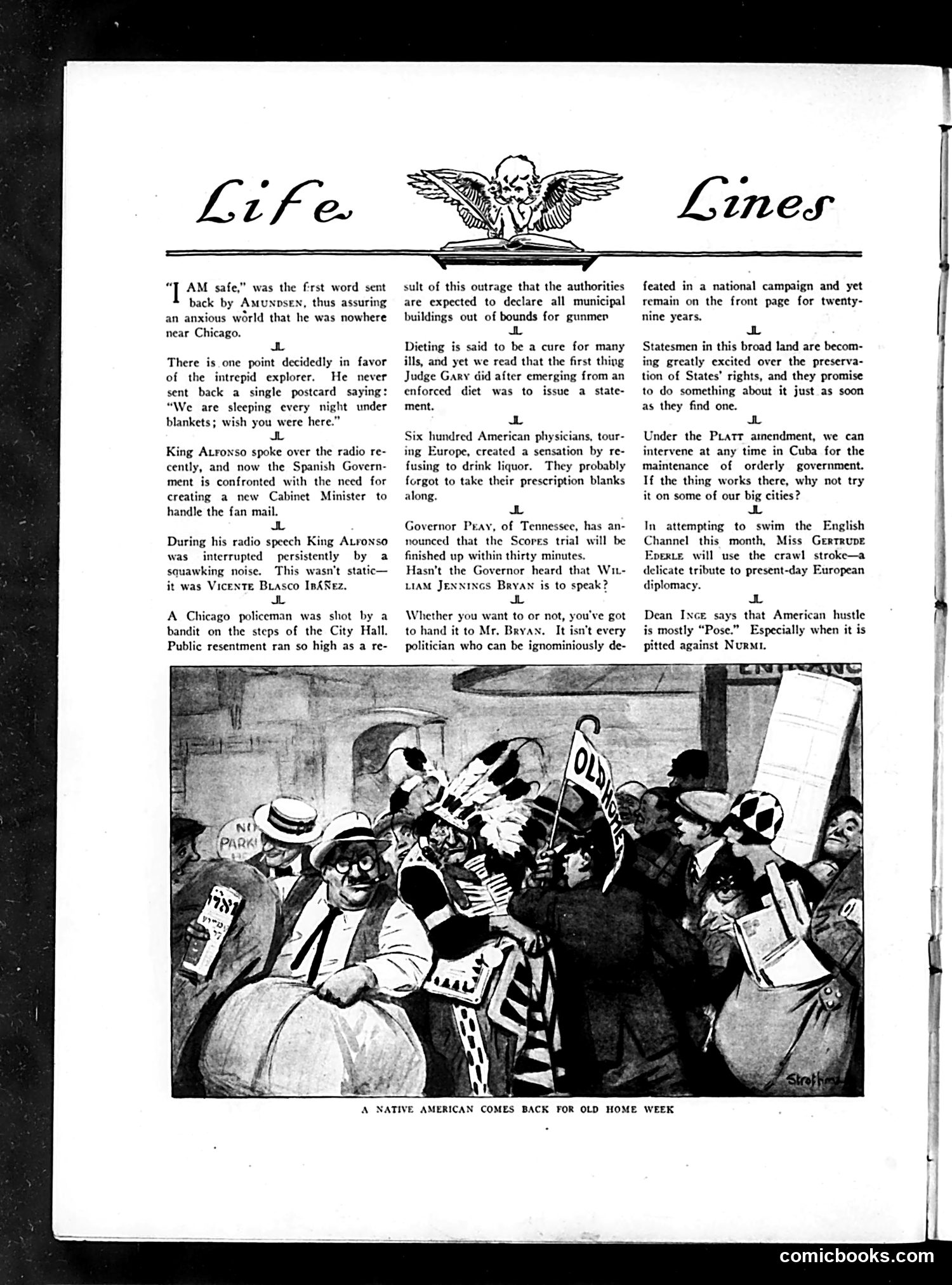
This page from *Life* magazine's satirical column features brief political and social commentary alongside a cartoon titled "A Native American Comes Back for Old Home Week." The cartoon depicts what appears to be a Native American figure (center, with feathered headdress) surrounded by crowds of people holding signs and flags, suggesting public commotion or celebration. The satire likely concerns Native American representation or appropriation in American culture during this era. The text above discusses various political matters: King Alfonso's Spanish radio address, a Chicago police shooting, dieting trends, European physicians avoiding alcohol, Tennessee's Sacco trial, and Cuban interventionism. The commentary is characteristically acerbic, criticizing politicians and social hypocrisy. Without the publication date visible, the specific historical context remains unclear, though the references suggest early 20th-century American politics.
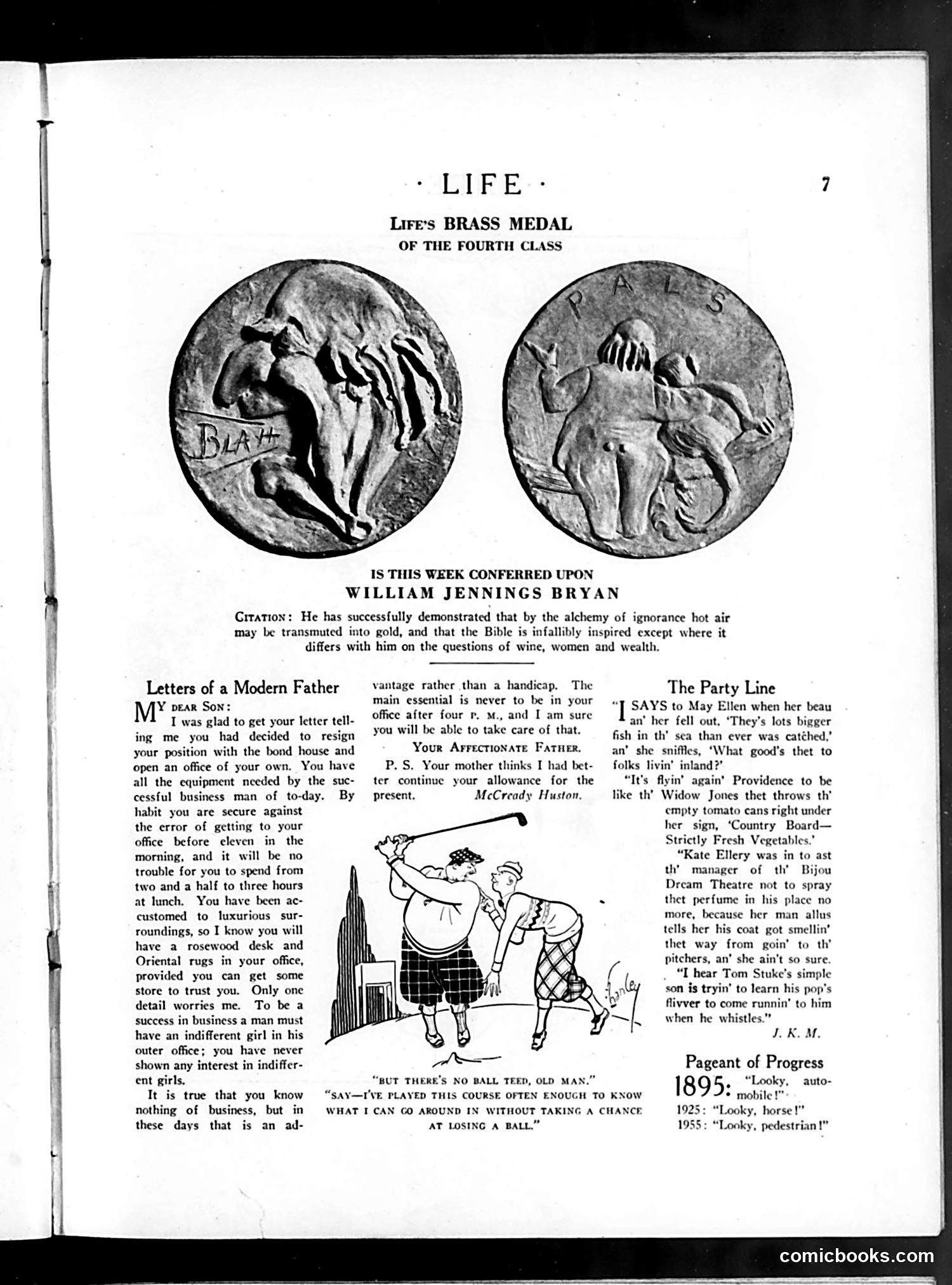
This page awards a satirical "medal" to **William Jennings Bryan**, the three-time presidential candidate and prominent politician. The citation mocks him viciously, claiming he's converted "ignorance hot air" into gold and that "the Bible is infallibly inspired except where it differs with him on the questions of wine, women and wealth." The cartoon below illustrates Bryan as an overweight golfer, captioned with his complaint that he plays the course often enough to know it without taking chances—a dig at his repetitive, risk-averse political behavior. This represents *Life* magazine's conservative editorial stance attacking Bryan's populism and religious literalism as hypocritical and foolish.
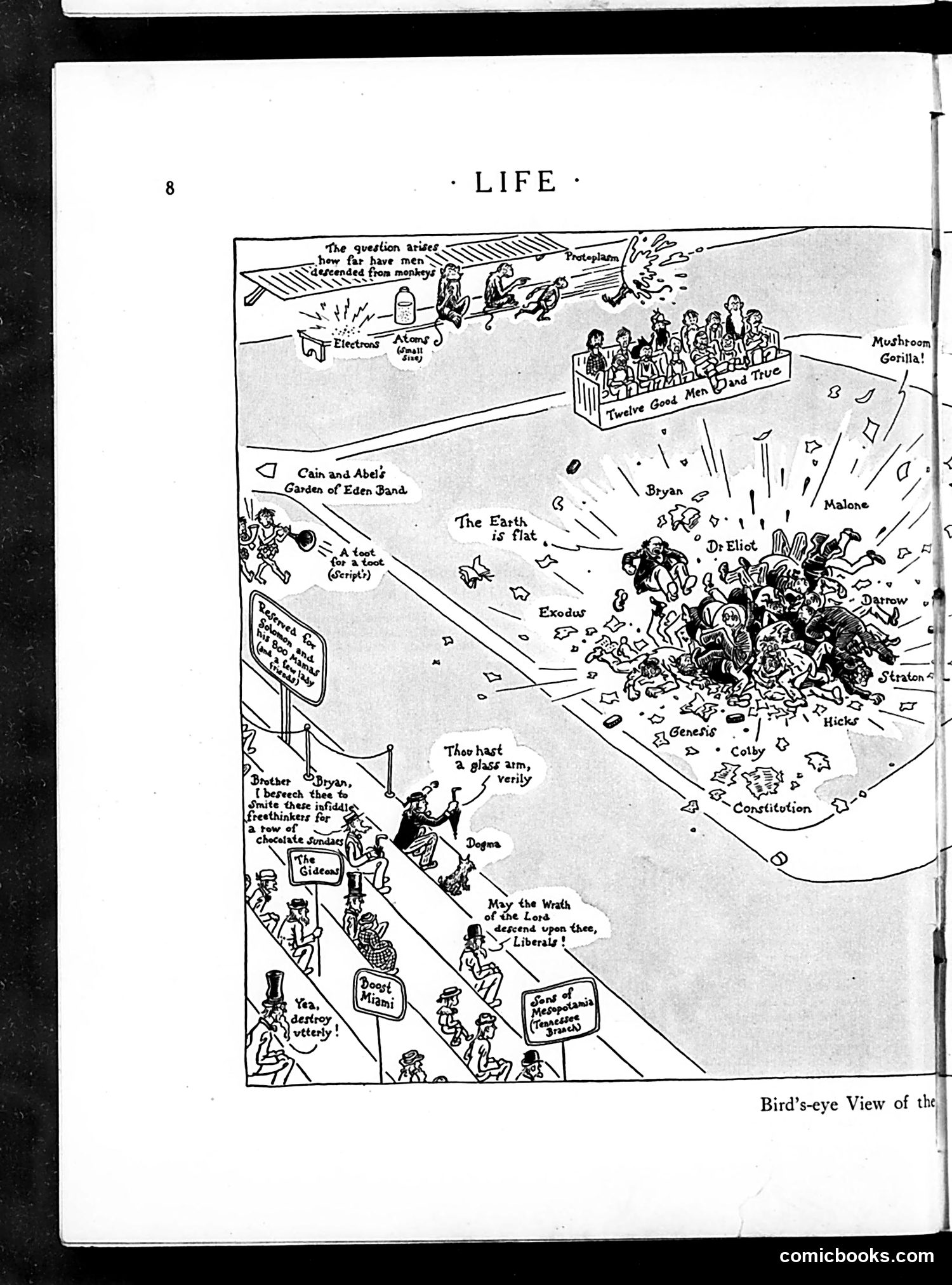
This is a satirical diagram depicting American society as a flat Earth, with various social groups and institutions arranged hierarchically. At the top, figures labeled "Twelve Good Men and True" ride in a box, while "Protoplasm" and evolutionary references appear above. The middle section shows "Cain and Abel's Garden of Eden Band" on the left, with a "test for good courage" referenced. The central area labels "The Earth is flat" and names various figures—Bryan, Dr. Eliot, Malone, Straton, and others—scattered in a crowd around "Exodus" and "Constitution." The bottom depicts religious/institutional authorities in descending layers, with references to "The Gideon," "Dogma," and phrases like "May the Wrath of the Lord descend upon thee, Liberals!" The cartoon appears to satirize American class divisions, religious authority, and evolutionary debates of the early 20th century.
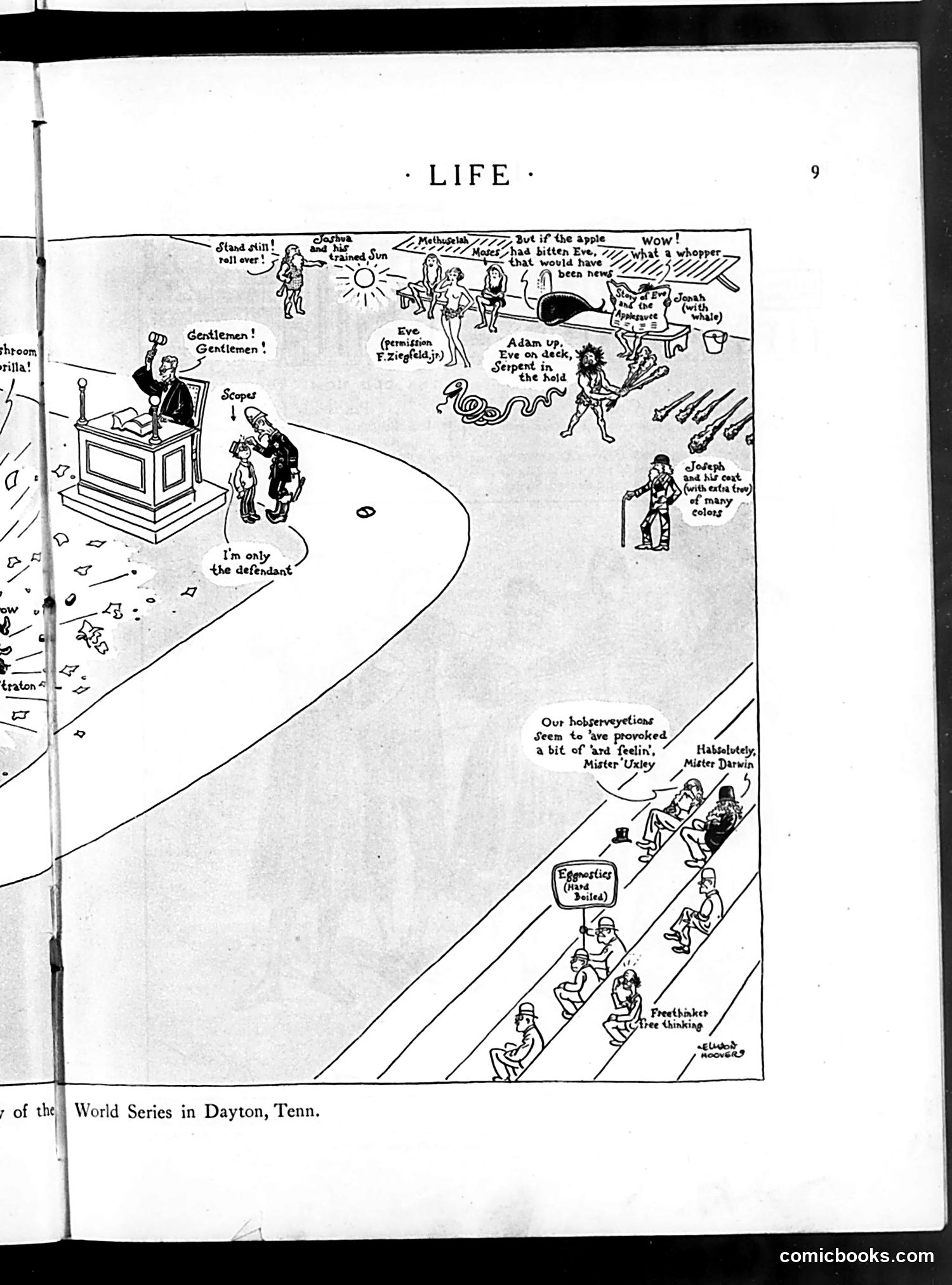
This is a satirical cartoon about the Scopes Monkey Trial, a famous 1925 legal case in Dayton, Tennessee. The image depicts courtroom chaos surrounding the trial of John Scopes, a teacher accused of teaching evolution. The cartoon labels key figures: "Scopes" (the defendant), and references to "Adam," "Eve," "the Serpent," and religious imagery at the top—mocking the clash between biblical creationism and evolutionary science. The bottom shows crowds labeled "Egotistics," "Freethinkers," and observers, with dialogue between apparent figures representing different worldviews ("Mister Usley" and "Mister Darwin"). The satire ridicules the trial's sensationalism and the fundamental conflict between religious belief and scientific theory that divided American society during this era.
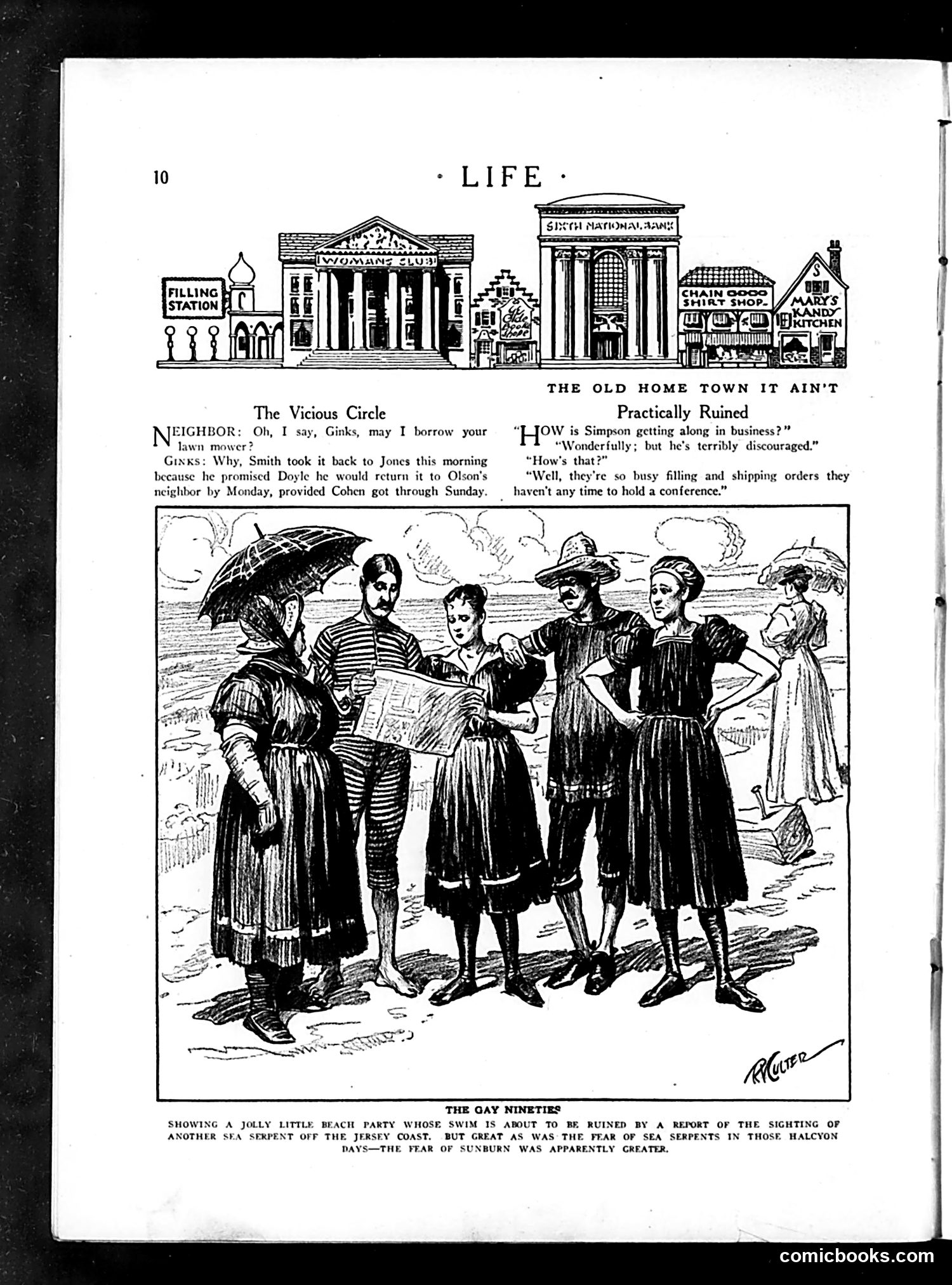
This page contains three separate satirical pieces from Life magazine: 1. **"The Vicious Circle"**: Mocks the endless chain of borrowed items among neighbors. A man asks to borrow a lawn mower, only to learn it's been passed through a complex chain of borrowers (Smith→Jones→Doyle→Olson) with conflicting promises. The satire targets suburban social obligations and the impracticality of such arrangements. 2. **"The Old Home Town It Ain't"**: Jokes about modern business culture. Simpson's company is so overwhelmed with orders they can't hold meetings—presented as absurdly ironic since most business complaints centered on excessive meetings and inefficiency. 3. **"The Gay Nineties"**: A beach party fears a sea serpent sighting (referencing 1890s folklore), yet the actual humor lies in the caption's observation that sunburn anxiety was apparently greater than sea monster fear—mocking the vanity of beachgoers. All three satirize aspects of contemporary (to Life's publication) American social and business life through exaggeration and ironic twist endings.
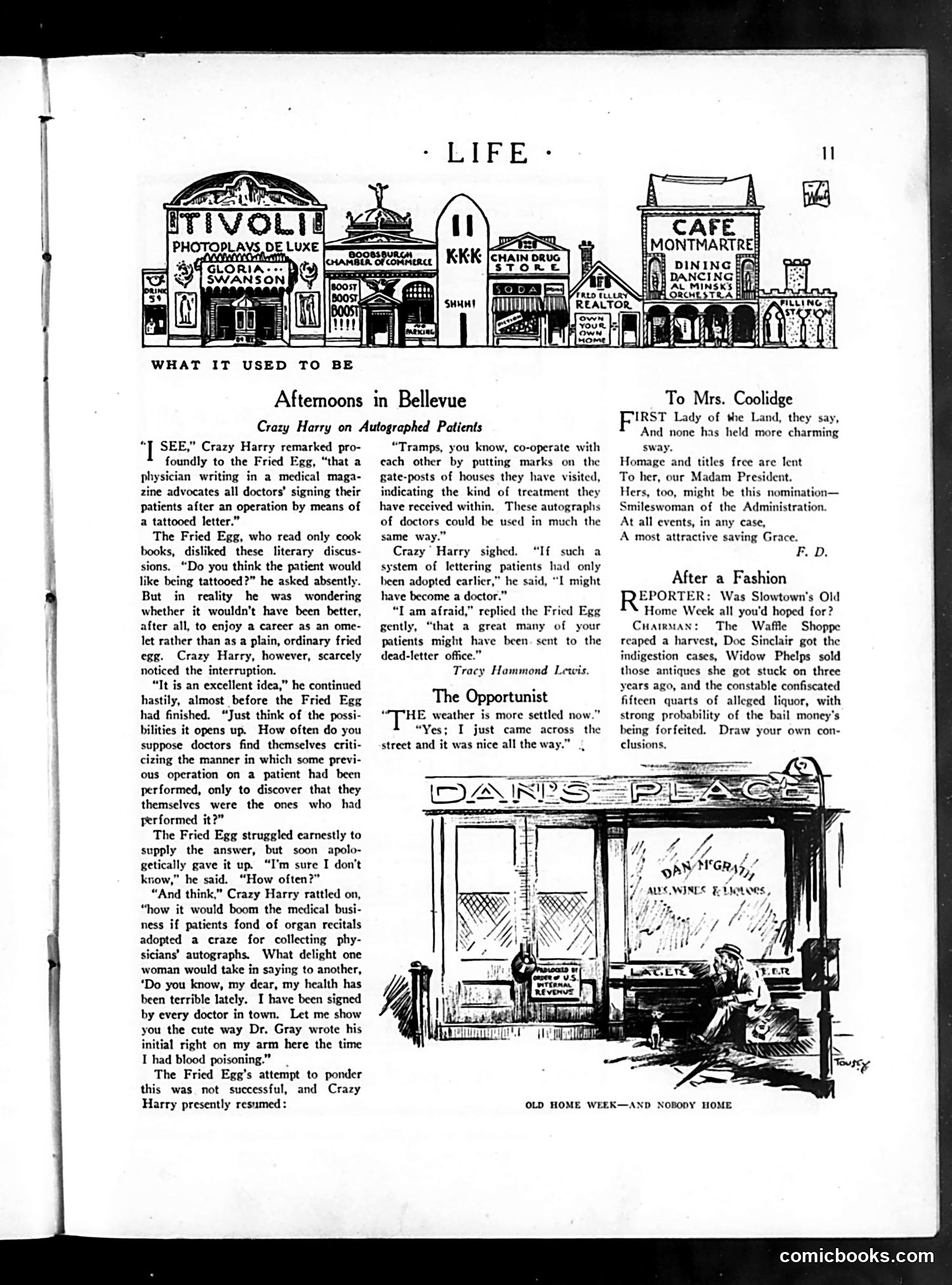
This page from *Life* magazine contains three satirical pieces mocking early 20th-century American society. **"Afternoons in Bellevue"** features dialogue between "Crazy Harry" and "the Fried Egg" (character names suggesting absurdist humor). The joke satirizes a medical proposal for doctors to tattoo their initials on patients post-surgery. Harry elaborates the ridiculous implications: patients collecting doctor "autographs" like hobos mark houses with codes indicating treatment quality, or doctors inadvertently signing patients they'd previously botched. The satire critiques both medical ego and the absurdity of formalizing such a practice. **"The Opportunist"** is a brief, deadpan exchange about weather—the humor lies in its anti-climactic ordinariness masquerading as witty dialogue. **"After a Fashion"** mocks small-town nostalgia through an "Old Home Week" reunion where the main beneficiaries are a waffle shop, a doctor treating indigestion, an antique dealer, and the constable confiscating illegal liquor. The title suggests such events deliver only shallow commercial benefits, not genuine community spirit. All three pieces employ *Life's* characteristic dry, observational humor targeting American pretension.
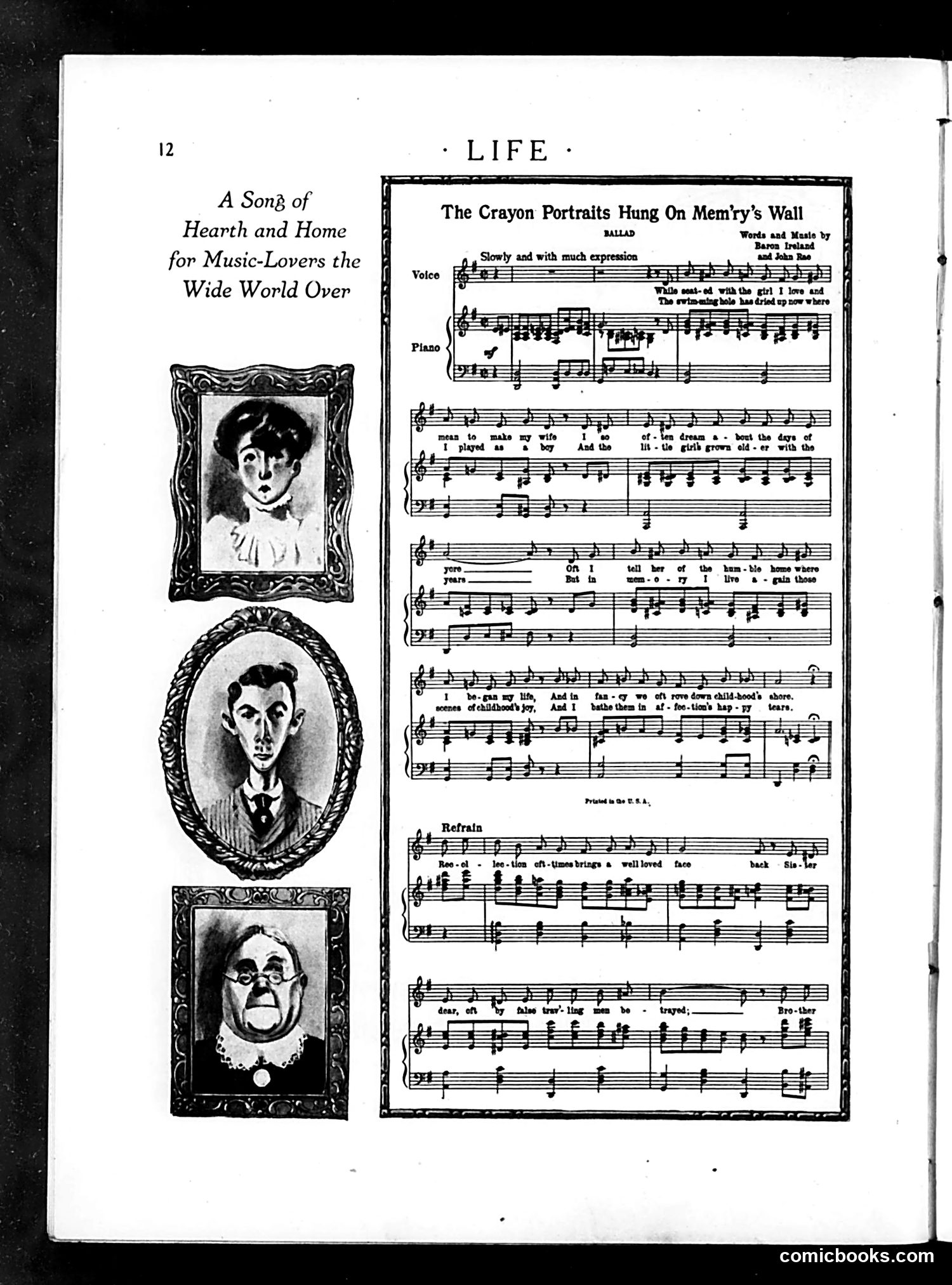
This page features a sentimental ballad with sheet music, positioned beside three portrait sketches in ornate frames. The left side shows "A Song of Hearth and Home for Music-Lovers the Wide World Over"—likely satirizing the era's preference for mawkish, nostalgic entertainment. The three portraits appear to be caricatures, though their specific identities aren't clearly labeled. The middle figure has distinctive facial features; the bottom portrait shows an older woman wearing glasses and a pendant. Without visible captions identifying these subjects, the satire's exact target remains unclear—though it likely mocks either sentimental popular music, specific public figures of the era, or the Victorian-era custom of keeping "crayon portraits" as memory tokens. The overall effect appears to be gentle mockery of sentimentality and mass-market entertainment.
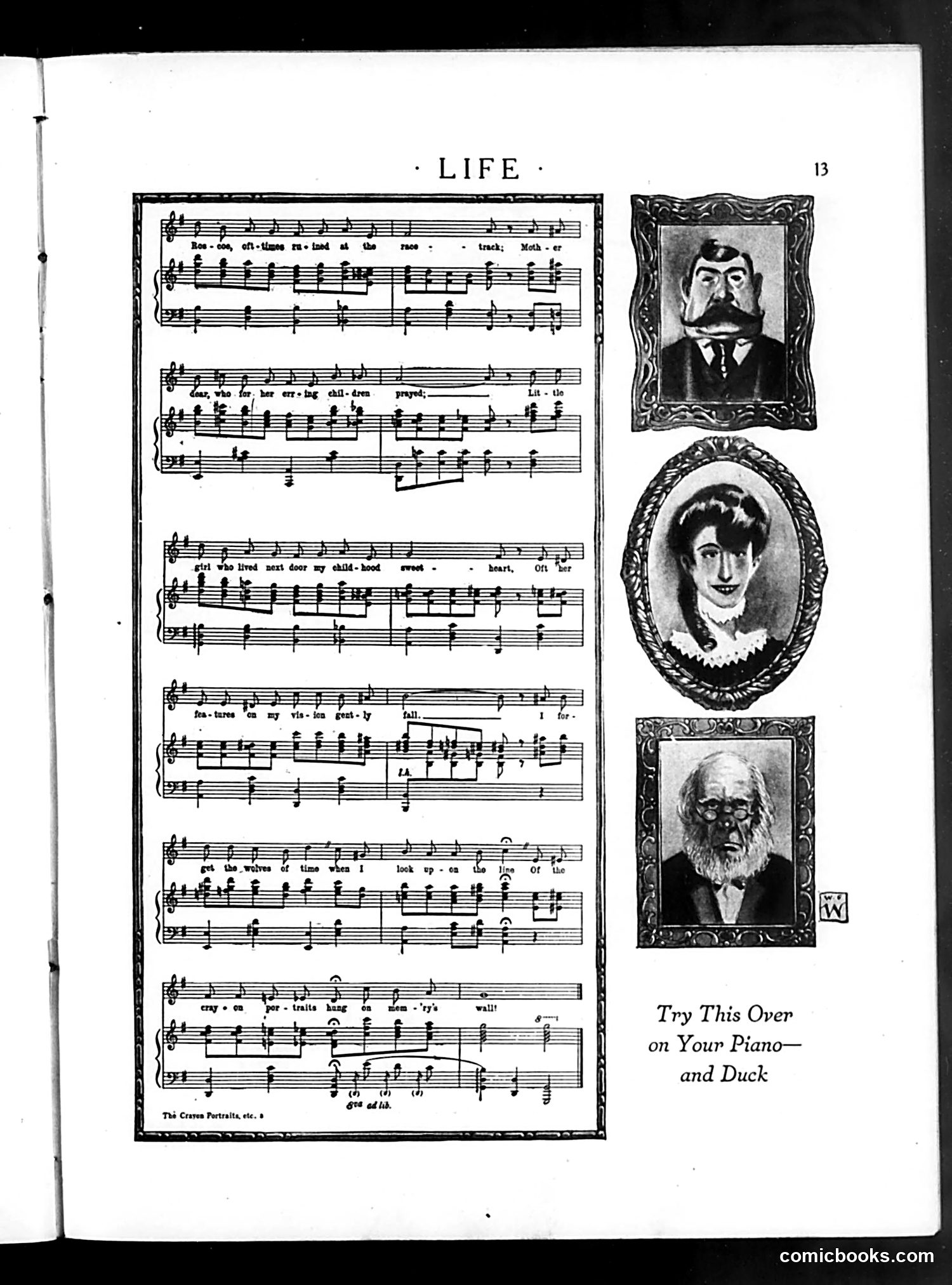
This page from *Life* magazine features sheet music with an accompanying joke. The text "Try This Over on Your Piano—and Duck" suggests the musical piece will provoke an angry reaction—likely from a spouse or household member forced to listen to amateur piano playing. The three portrait photographs on the right appear to be period figures (possibly composers or musicians), though their specific identities aren't clearly labeled on this page. The humor relies on a common domestic scenario: someone attempting to play a difficult or unpleasant-sounding piece on piano, resulting in literal or figurative retaliation from others in the household. This reflects early 20th-century domestic life where piano playing was common in middle-class homes.
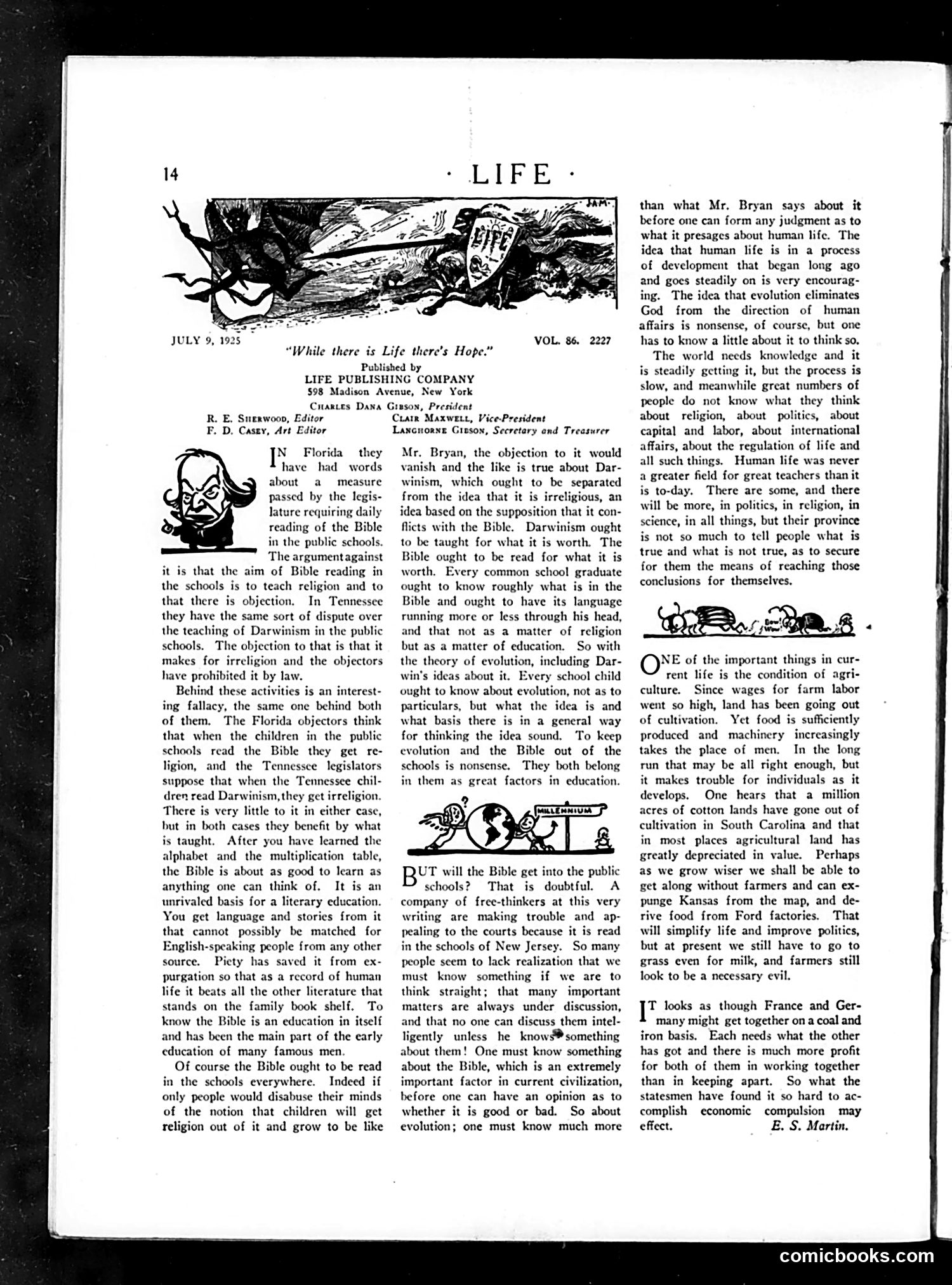
This editorial page addresses simultaneous controversies in Florida and Tennessee over teaching the Bible and Darwinism in public schools. The piece argues both subjects belong in curricula—not for religious or anti-religious purposes, but as education. The cartoon (upper left) appears to depict a demon or devil figure labeled "LIFE," likely representing the magazine's satirical voice mocking those who fear these subjects. The editor argues that opponents wrongly assume Bible-reading promotes religion and evolution teaching promotes irreligion. Instead, both should be taught factually: the Bible as literature and historical importance, evolution as scientific theory. The piece criticizes "free-thinkers" suing in New Jersey to prevent Bible reading, suggesting educated citizens must understand both subjects to think intelligently about contemporary issues. The implicit target is William Jennings Bryan (referenced), who opposed evolution teaching—a major figure in the famous 1925 Scopes Trial happening that same summer in Tennessee.
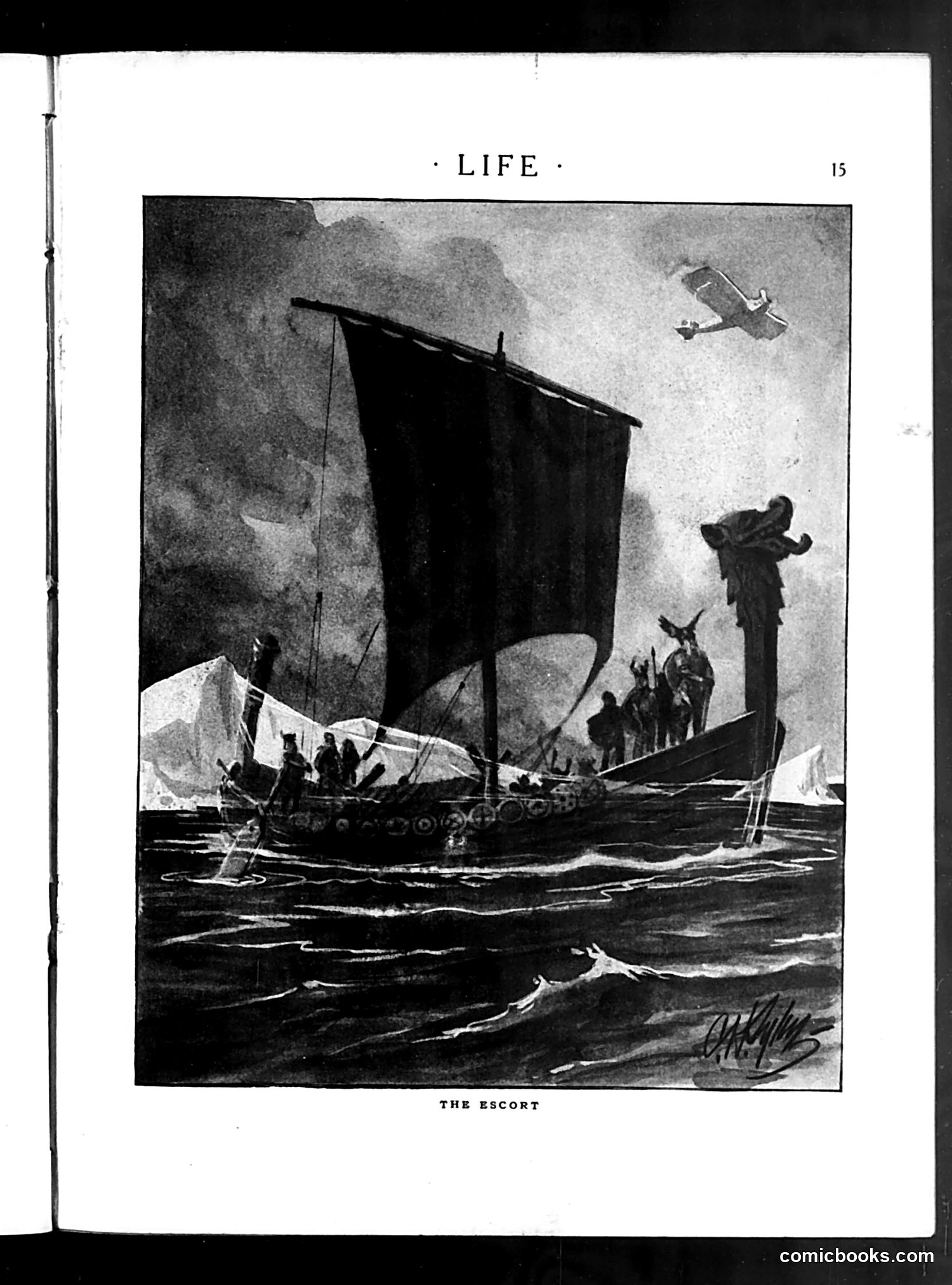
This illustration depicts a Viking-style longship with a large square sail, accompanied by what appears to be a small aircraft in the sky. The image is titled "The Escort." Without additional context from the magazine's date or surrounding articles, the specific historical reference is unclear. However, the juxtaposition suggests commentary on modern military or naval operations—possibly contrasting traditional maritime power with newer aviation technology, or satirizing some contemporary geopolitical situation involving naval escort duties. The artistic style and presence in *Life* magazine indicates this likely references an early-to-mid 20th century event, but identifying the precise political or military situation requires knowing the publication date and surrounding editorial content not visible here.
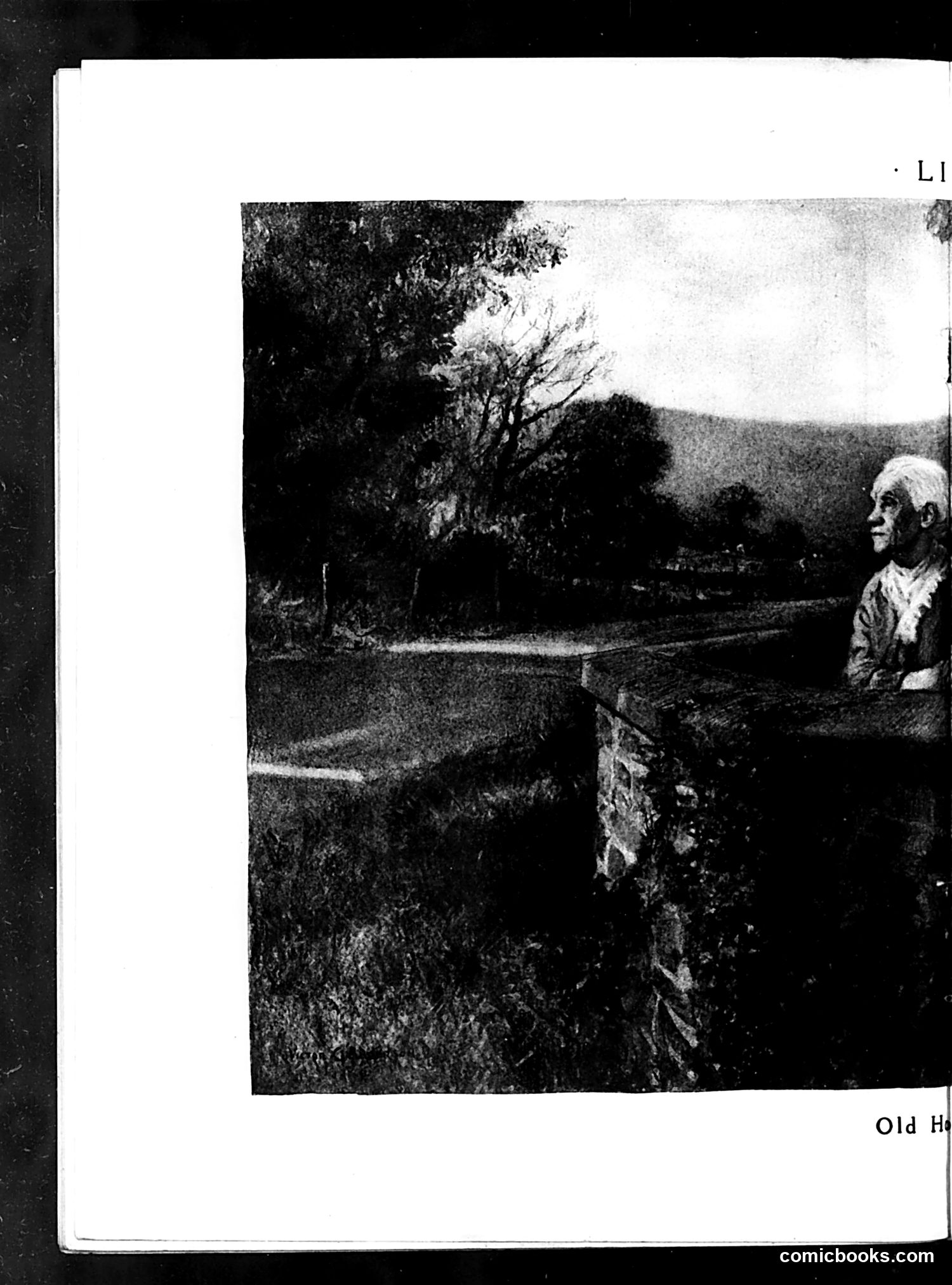
This appears to be a black and white photograph rather than a political cartoon. It shows an elderly man with white hair in profile, standing by a wooden fence overlooking a pastoral landscape with fields, trees, and hills. The caption reads "Old H[ouse]" (text cut off). Without the complete caption or additional context from the Life magazine issue, I cannot definitively identify the subject or determine what satirical point this image makes. The photograph's inclusion in a satirical publication suggests it may be commentary on a specific person or situation, but the fragmentary text prevents me from stating what that reference is. The rural, contemplative setting might suggest themes of reflection, legacy, or nostalgia, but this remains speculation without fuller context.
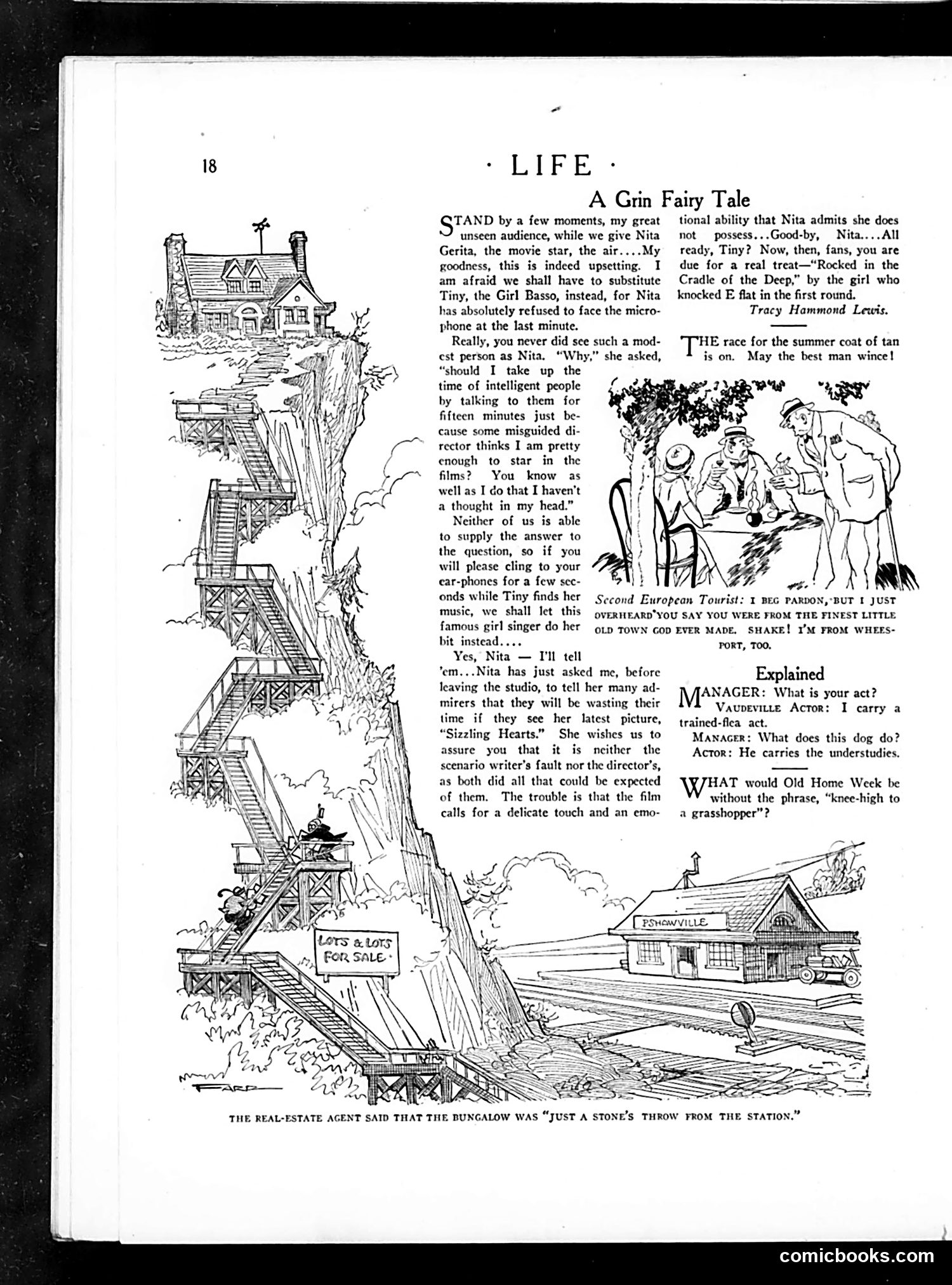
This 1920s satirical page mocks Hollywood's film industry through several interconnected jokes: **"A Grin Fairy Tale"** presents a fictional radio broadcast where actress Nita Gertis refuses last-minute to perform, forcing substitution of "Tiny, the Girl Basso." The satire targets Nita's false modesty—she claims not to possess "national ability" yet expects admirers to waste time on her film "Sizzling Hearts," which she dismisses as poorly written and directed. **The cartoons below** include a European tourist's humorous small-town boasting, a "trained-flea act" joke about theatrical understudies, and a real-estate agent's exaggeration about a bungalow being "just a stone's throw from the station"—implying it's actually very far away. The dominant left illustration shows an improbably tall house with multiple staircases descending a cliff, marked "LOTS & LOTS FOR SALE"—visualizing the absurd property claim. Overall, the page satirizes Hollywood vanity, theatrical pretension, and deceptive advertising common to 1920s American consumer culture.
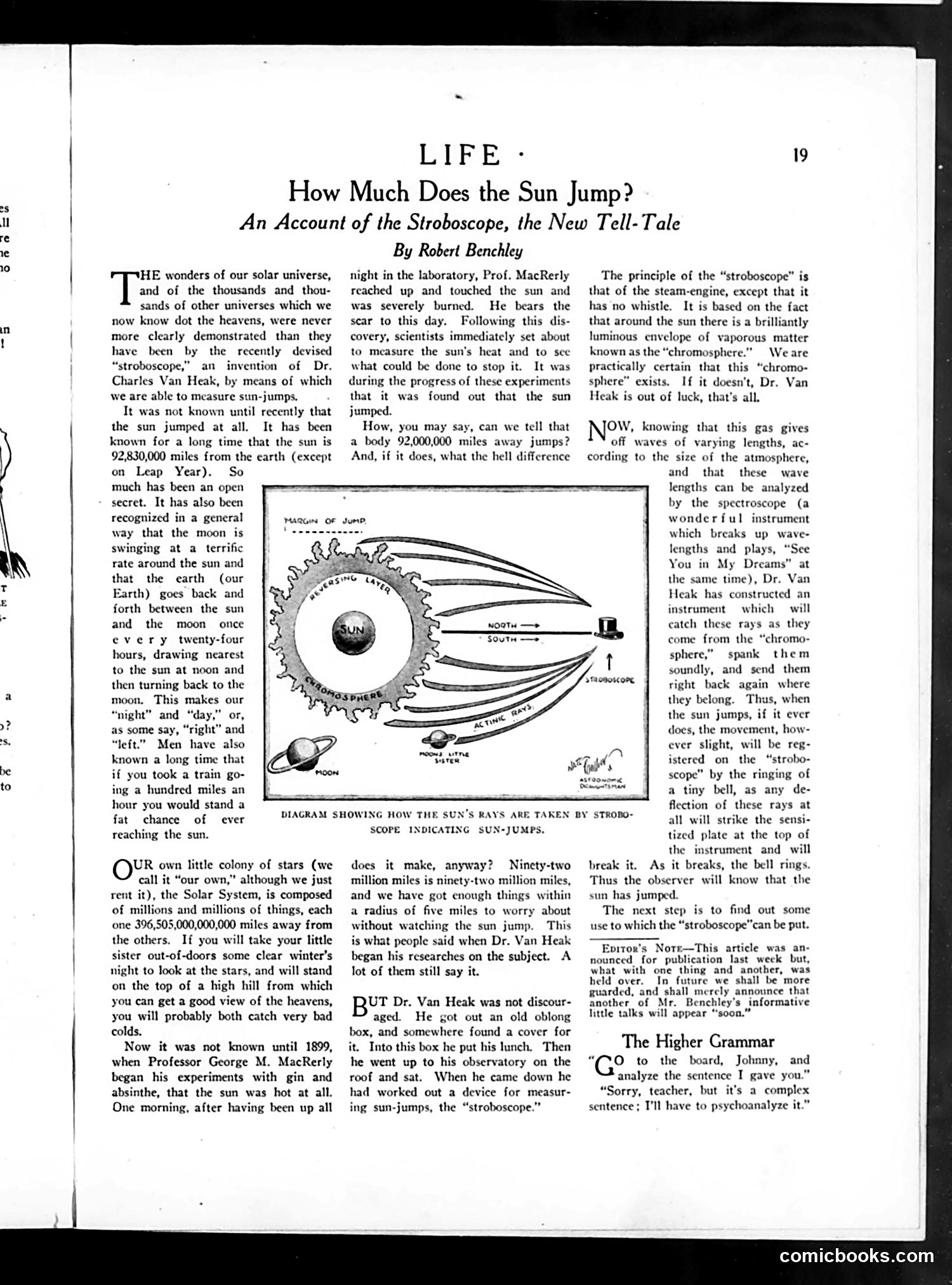
This is Robert Benchley's satirical article about a fictional scientific invention called the "stroboscope," purportedly invented by the made-up "Dr. Charles Van Heak." The humor lies in Benchley's deadpan absurdist writing style. The joke: Benchley presents increasingly ridiculous "scientific facts"—that the sun "jumps," that Professor MacRerly discovered the sun was hot in 1899 by touching it and burning himself, that a device measuring solar jumps serves any practical purpose. The fake technical language and elaborate diagram mock pseudo-scientific explanations and the earnest but overwrought scientific writing popular in early 20th-century publications. The satire targets credulous readers who accept scientific claims without skepticism, and publications that present dubious information as fact. Benchley's characteristic style—mixing mock-erudition with casual absurdity ("what the hell difference does it make, anyway?")—makes the hoax entertainment rather than deception.
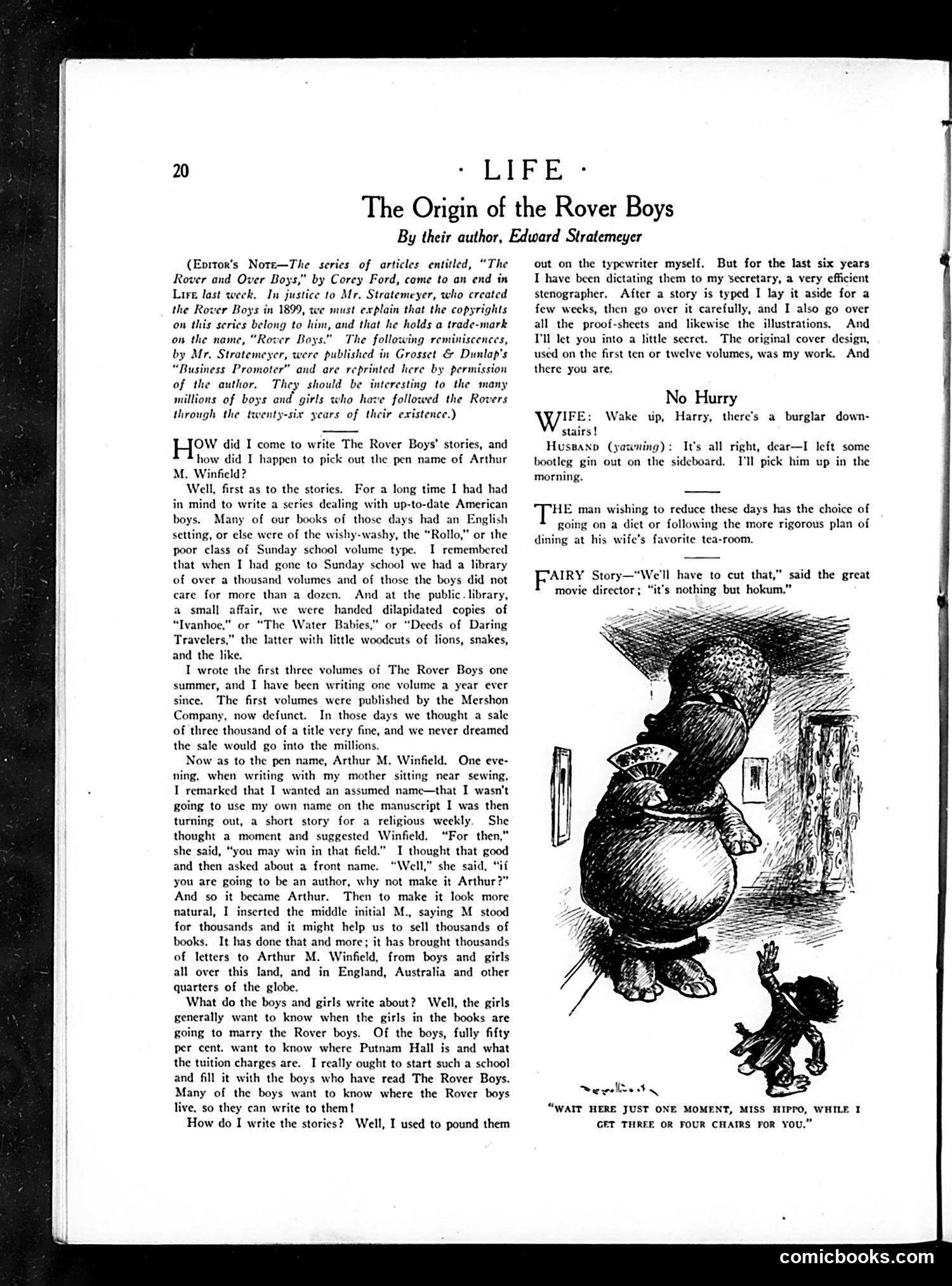
This page presents Edward Stratemeyer's behind-the-scenes account of creating the *Rover Boys* series, popular American adventure novels for young readers (published since 1899). The illustration depicts a hippo in Victorian dress seated in a chair—likely a humorous, unrelated cartoon typical of *Life* magazine's satirical format. The text reveals Stratemeyer's creative process: he deliberately chose "Arthur M. Winfield" as a pen name (inspired by his mother's suggestion to "win in that field"), inserted the middle initial to suggest "thousands," and intentionally wrote modern American stories rather than the dated, moralistic tales then available for boys. Stratemeyer notes the series' phenomenal success—from expected sales of 3,000 to millions of copies—and describes fan mail requesting information about the fictional Putnam Hall school and the characters' real addresses, demonstrating the books' cultural grip on American youth in the early 20th century.
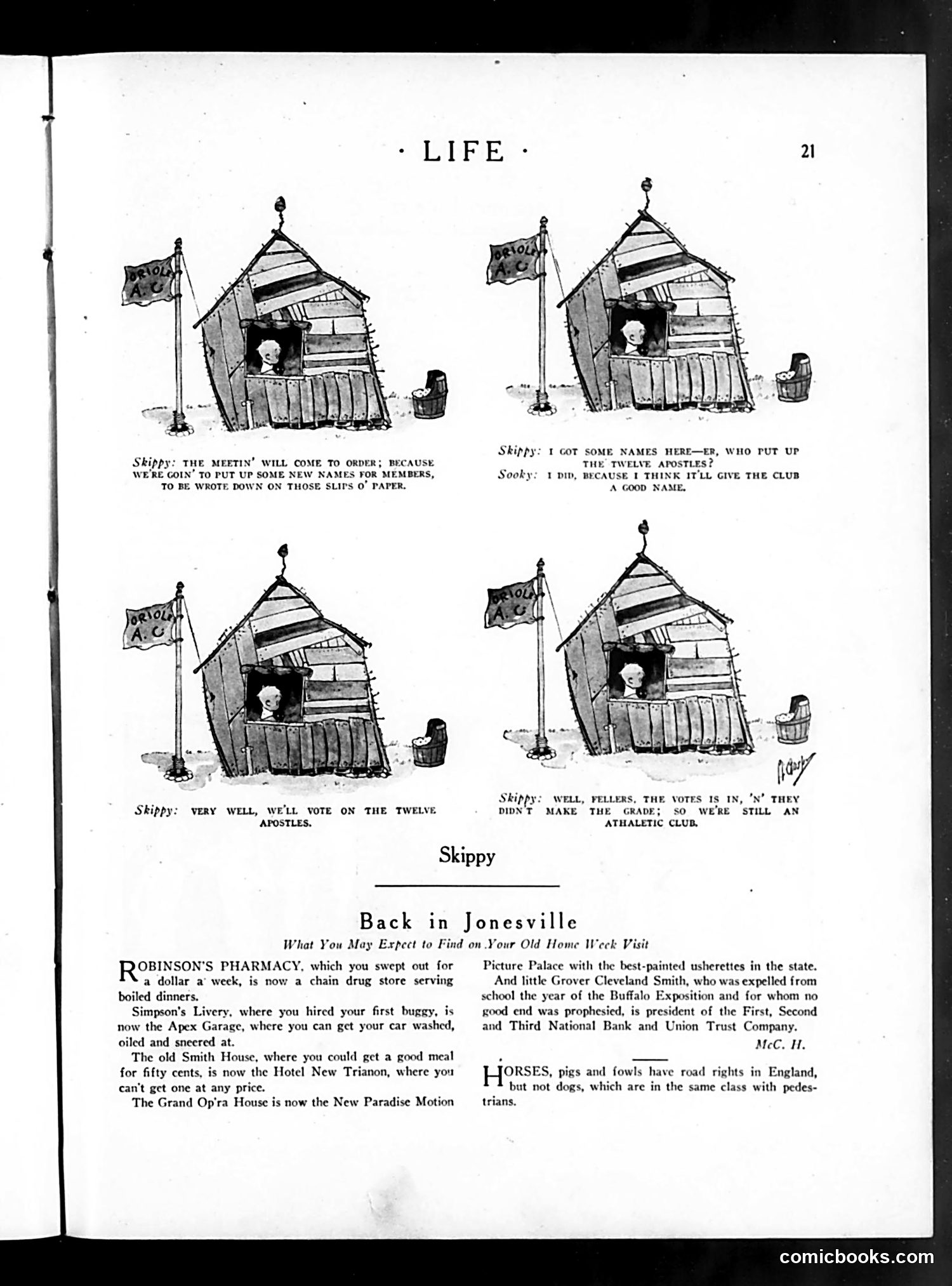
**"Skippy" Comic Strip (Top Section):** This four-panel strip shows children running a mock club. Skippy proposes nominating new members and suggests writing down "the Twelve Apostles" as candidates—a irreverent joke conflating religious figures with club membership. When the votes come in, the apostles "didn't make the grade," so the club remains merely athletic. The humor lies in children's casual, comedic misuse of formal parliamentary procedure and sacred references. **"Back in Jonesville" Article (Bottom Section):** This nostalgic piece humorously catalogs how a small town has changed: Robinson's Pharmacy is now a chain drugstore; Simpson's Livery became a garage; the affordable Smith House became an expensive hotel; the Opera House became a movie theater. The final irony: Grover Cleveland Smith, once expelled from school with no prospects, is now a bank president. The satire critiques both commercialization of small-town America and the unpredictability of success.
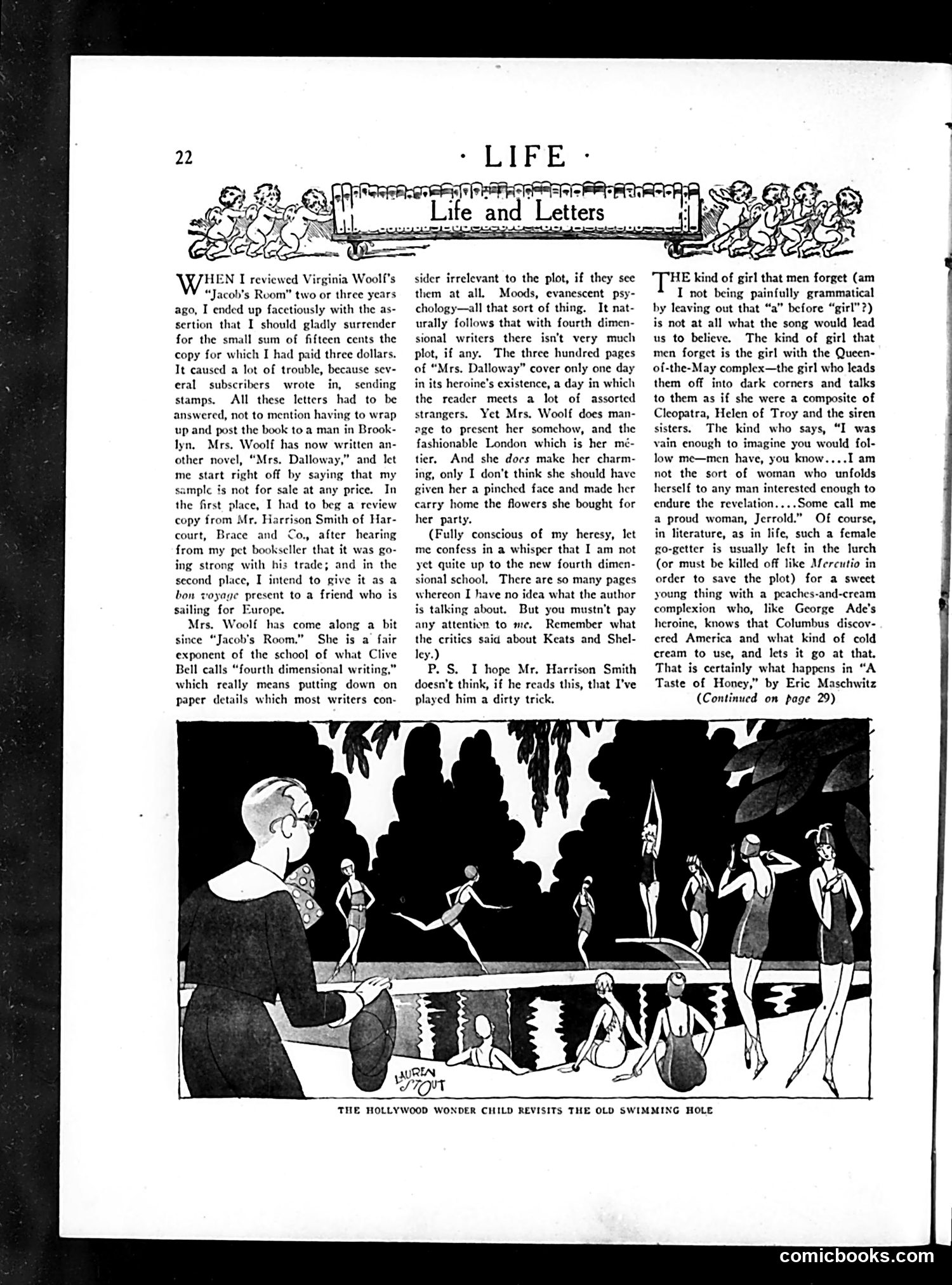
This page contains two literary reviews rather than political cartoons. The main text critiques Virginia Woolf's *Mrs. Dalloway*, calling it experimental "fourth dimensional writing" that prioritizes mood and psychological detail over plot—three hundred pages covering a single day. The reviewer admits confusion about portions of the novel but acknowledges Woolf's skill in characterization. The second review discusses female archetypes in literature, contrasting the forgettable "Queen-of-the-May" type (vain, dramatic) with the sweet, practical heroine who succeeds romantically—exemplified in *A Taste of Honey* by Eric Maschwitz. The illustration below, captioned "The Hollywood Wonder Child Revisits the Old Swimming Hole," depicts a nostalgic scene of an adult observing young swimmers—likely referencing a child actor revisiting an innocent past, though the specific identity remains unclear without additional context.
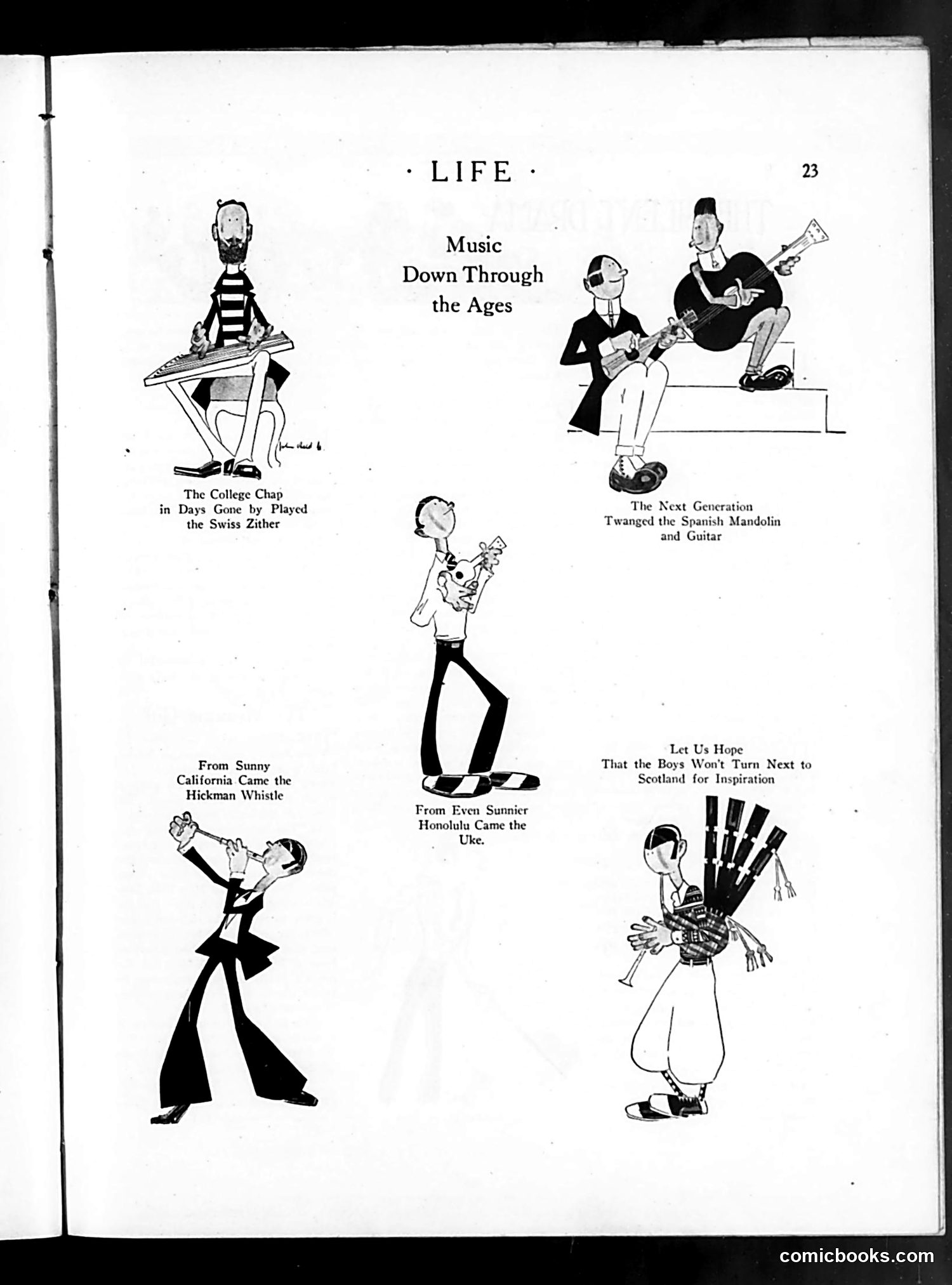
This satirical page traces changing musical fashions among young people. It mocks how each generation adopts different instruments as markers of style: - **College men** once played Swiss zithers - **The next generation** adopted Spanish mandolins and guitars - **California's "Hickman Whistle"** (likely referencing a popular musician) represented the latest fad - **Hawaiian ukuleles** arrived from Honolulu, becoming trendy The final panel's caption—"Let Us Hope That the Boys Won't Turn Next to Scotland for Inspiration"—expresses anxiety that young Americans might next embrace Scottish bagpipes, presented as a comically undesirable outcome. The humor targets generational musical trends and Americans' tendency to adopt exotic instruments as fashionable status symbols. It reflects 1920s-era concern about rapidly changing youth culture and foreign influences on American tastes.
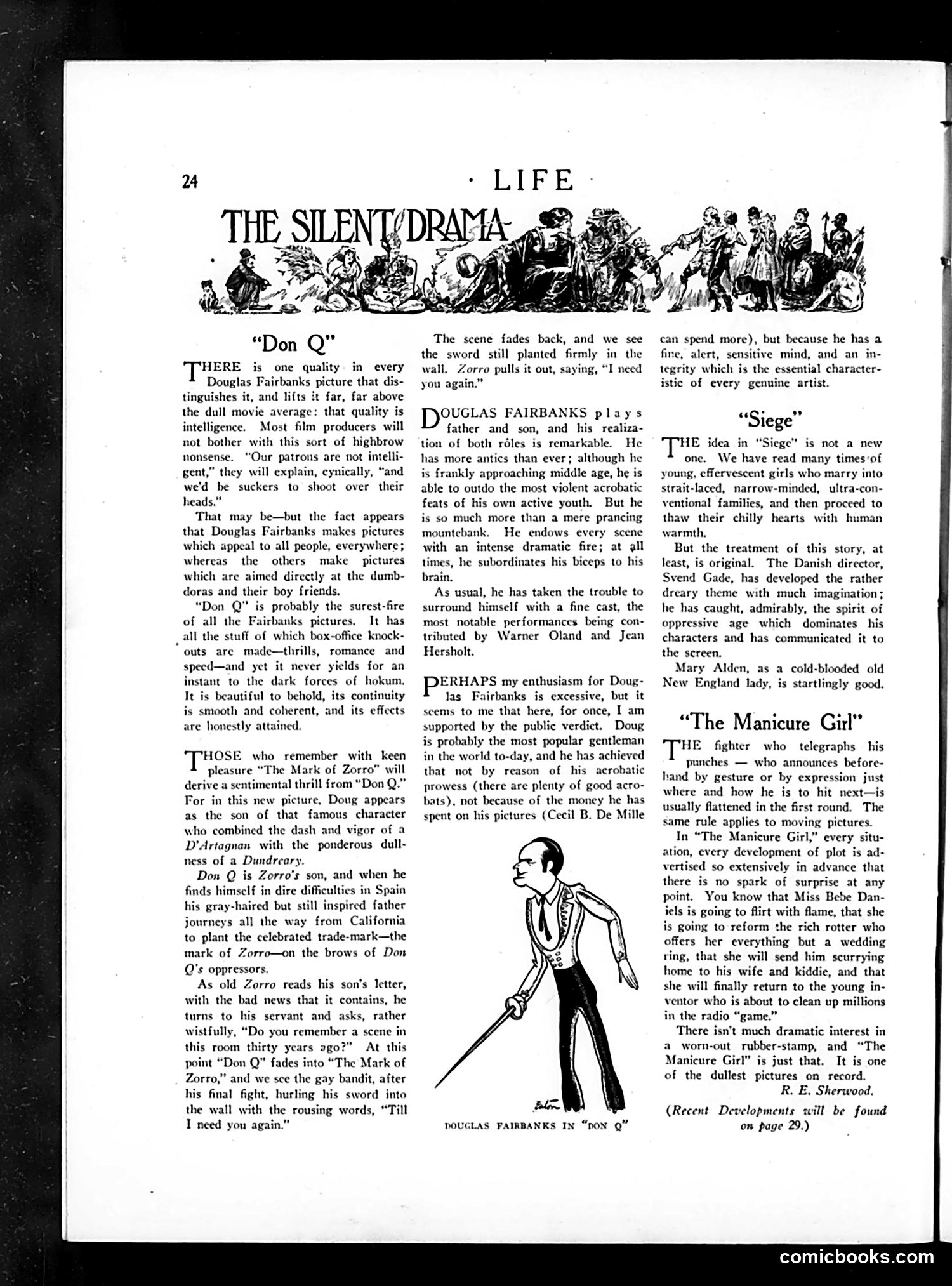
This page from *Life* magazine reviews three silent films. The main content discusses Douglas Fairbanks films—specifically praising "Don Q" (a sequel to "The Mark of Zorro") for combining entertainment with intelligence, arguing that Fairbanks succeeds where other producers fail by refusing to "shoot over [audiences'] heads" while still maintaining quality. The accompanying illustration shows Fairbanks in character as Don Q, dressed as a Spanish gentleman with a sword. Brief mentions also appear for "Siege" (a Danish film about a young woman warming a rigid family) and "The Manicure Girl" (described as a worn-out rubber-stamp plot about a manicurist reforming a wealthy rake). The reviewer's broader point: Fairbanks' success proves popular audiences aren't inherently stupid—they appreciate intelligent filmmaking when given the chance, contradicting industry cynicism of the era.
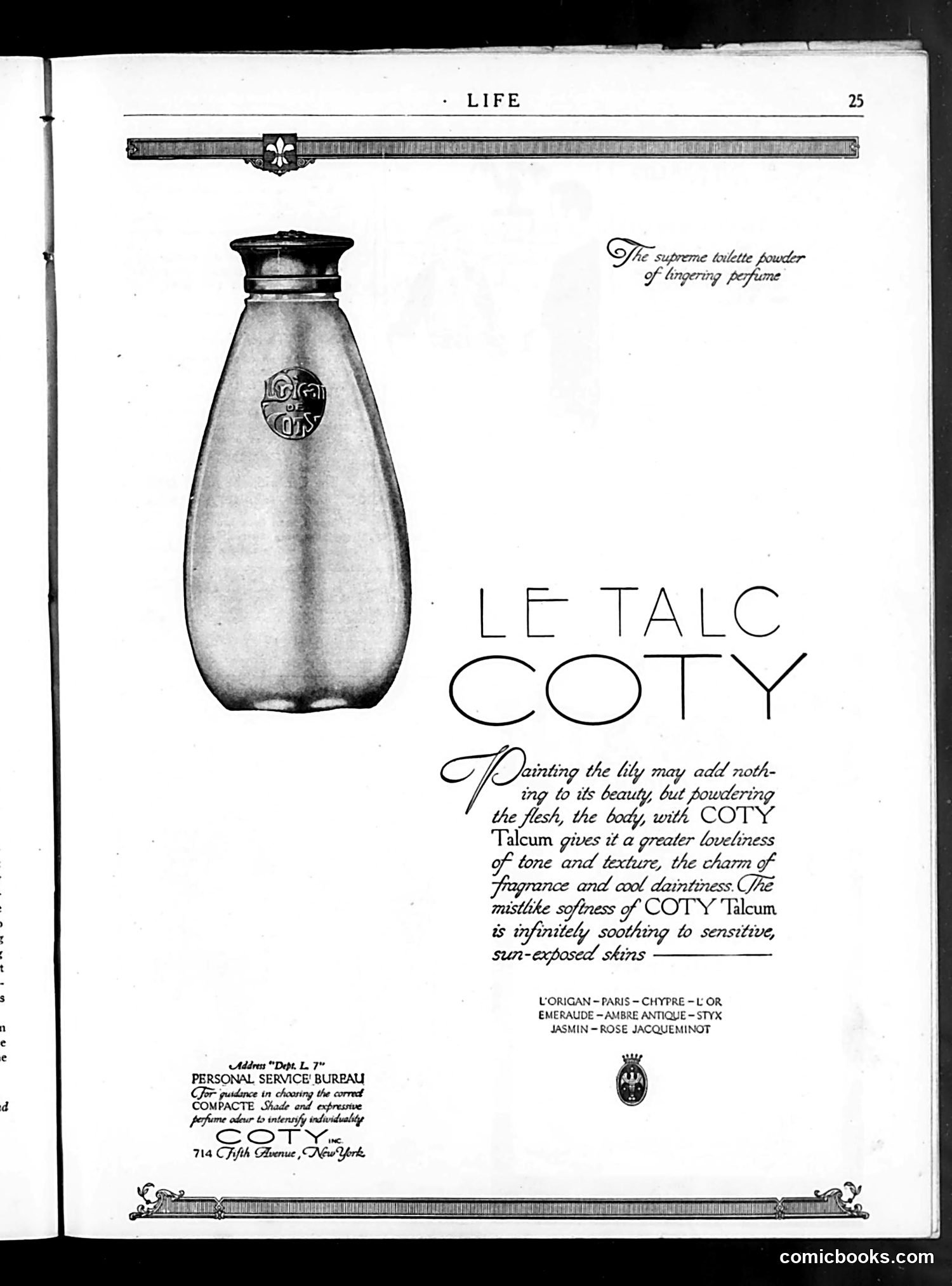
This is not a cartoon or satire—it's a full-page advertisement for Coty talcum powder from an early 20th-century *Life* magazine. The ad features a perfume bottle with an ornate stopper and promotes talcum powder as a beauty product for women's skin. The copy emphasizes that while makeup ("painting the lily") has limited value, powdering the body with Coty talcum provides superior "loveliness of tone and texture" and soothes "sensitive, sun-exposed skins." The ad lists multiple fragrance options (L'Origan, Chypre, Emeraude, etc.) and includes a "Personal Service Bureau" offering guidance on selecting appropriate scents. The address is given as 714 Fifth Avenue, New York. This represents typical early 20th-century beauty marketing targeting women concerned with refinement, delicacy, and sophisticated fragrance selection.
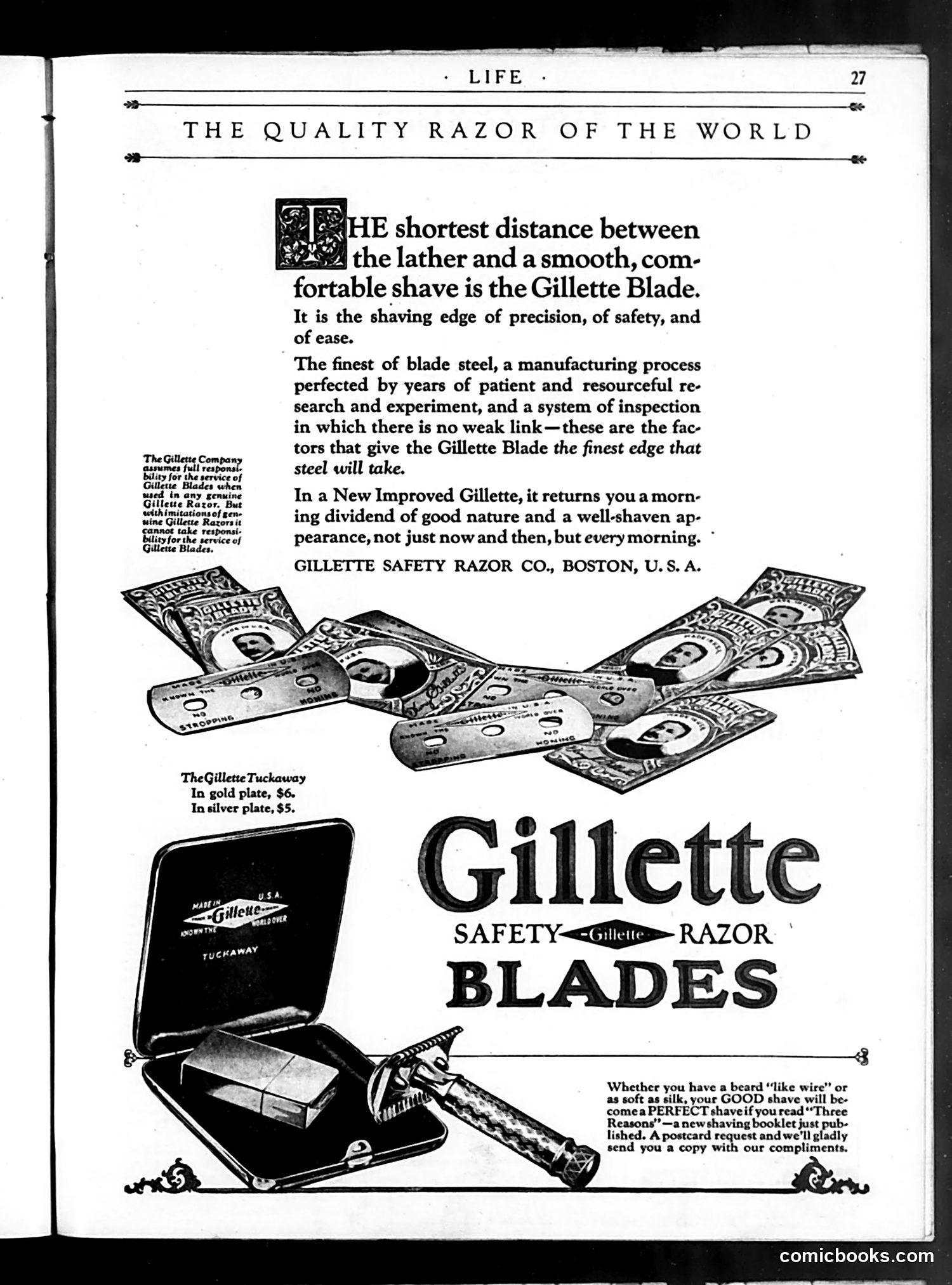
This page is a full-page advertisement for Gillette Safety Razor blades, published in *Life* magazine. There are no cartoons or political references to analyze. The ad promotes Gillette's product quality through marketing copy emphasizing precision manufacturing and consistent shaving performance. It displays the "Gillette Tuckaway" razor case (available in gold or silver plate at $5-6) and shows decorative images of blade packages. The text uses period-appropriate advertising language, claiming the blade provides "good nature and a well-shaven appearance" daily. The only notable element is a small offer: readers can request a booklet titled "Three Reasons" explaining why Gillette razors produce perfect shaves regardless of beard type. This represents early 20th-century direct-mail marketing strategy integrated into magazine advertising.
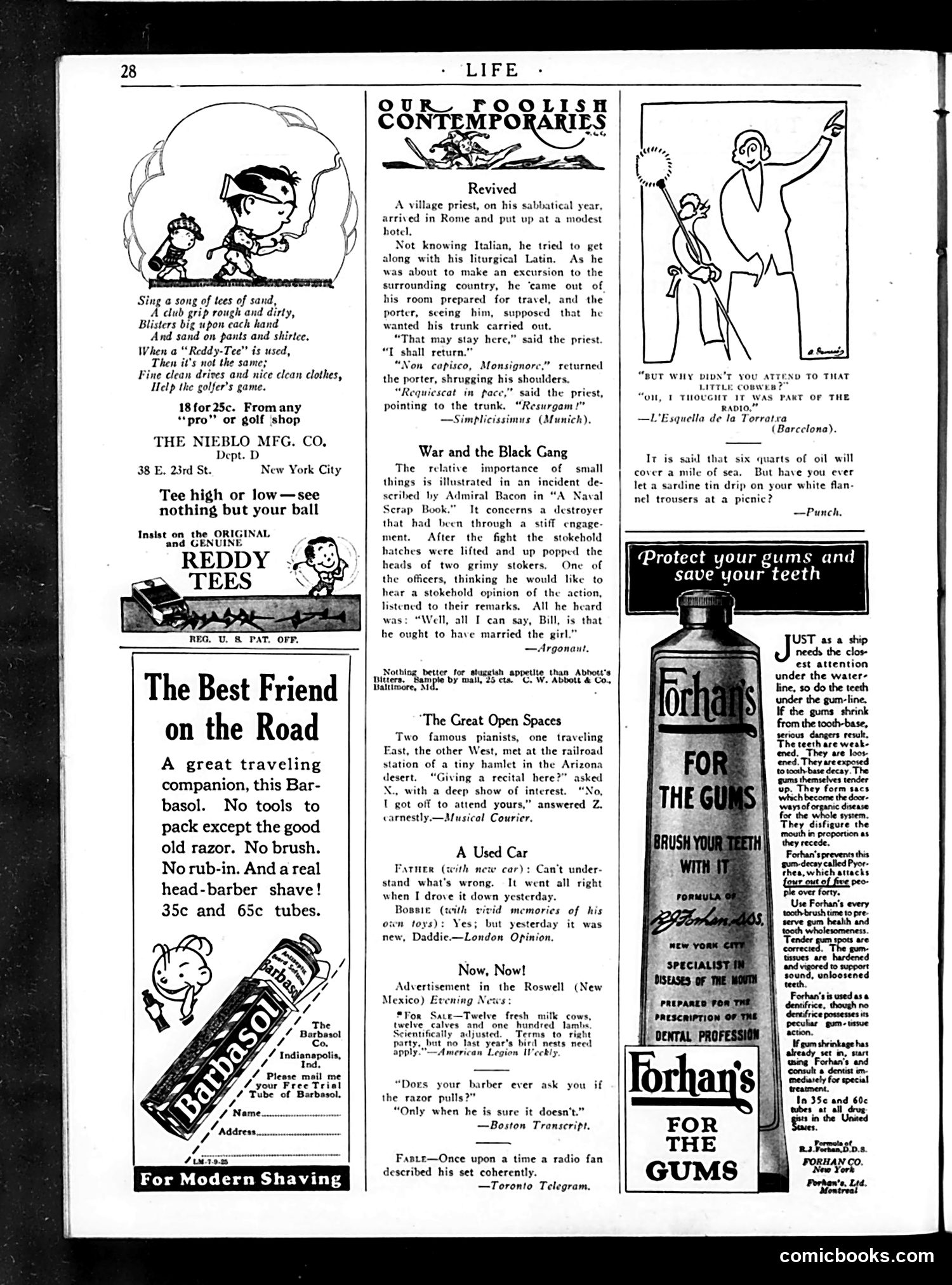
This is primarily an **advertising page** from Life magazine's satirical section "Our Foolish Contemporaries," which reprints humorous anecdotes and jokes from international publications. The cartoons depict two scenes: one showing children with a large egg or balloon, and another showing adults and children in animated poses—both drawn in simple, comic styles typical of the era. The main content consists of **reprinted jokes and brief anecdotes** poking fun at everyday situations. Notable examples include a priest's confusion using Latin with an Italian porter, soldiers' priorities after battle (marriage advice rather than military matters), and a radio fan who finally describes his set "coherently" (implying radio enthusiasts were typically incoherent). The **advertisements** promote golf tees, shaving products, and dental care—typical consumer goods from this period. The overall tone reflects **interwar-era humor**: gentle mockery of modern inconveniences, absurdities in communication, and the foibles of ordinary people navigating contemporary life.
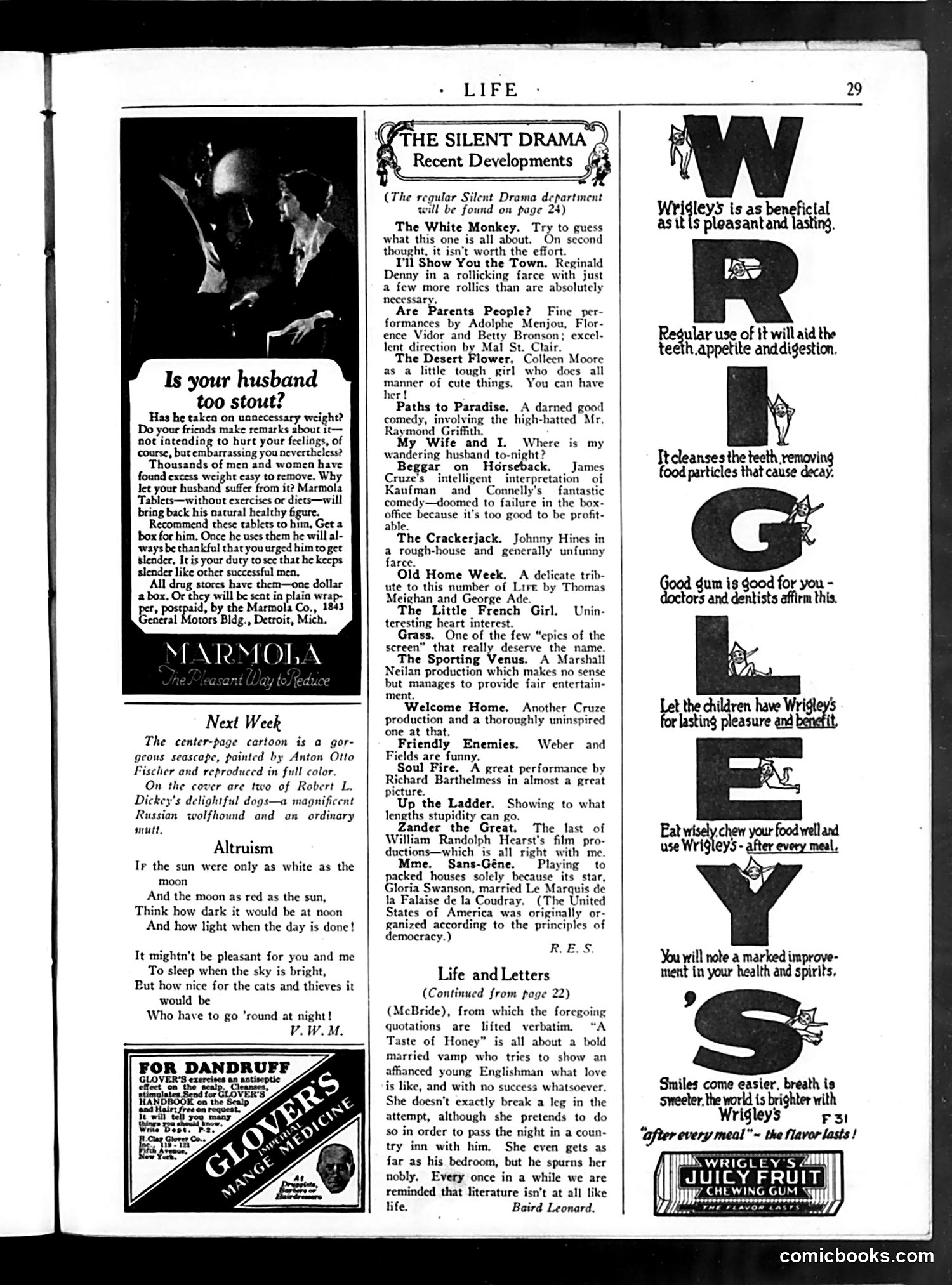
This is a **1920s Life magazine page** mixing entertainment criticism with period advertising that reveals uncomfortable social attitudes. **The Main Content:** The page reviews silent films (now mostly forgotten titles like "The White Monkey" and "Beggar on Horseback"), offering snide dismissals typical of the era's irreverent comedy magazine style. **The Problematic Ads:** Two advertisements expose period prejudices: 1. **Marmola tablets** shame men about weight gain, framing a wife's "duty" to keep her husband slim—reflecting rigid 1920s gender roles and appearance expectations. 2. **Glover's dandruff treatment** uses racist imagery (the OCR text is incomplete, but the ad mentions "antiseptic effect"). **The Satire:** A brief poem called "Altruism" humorously imagines reversed celestial bodies benefiting "cats and thieves" who operate at night—gentle, whimsical social commentary typical of Life's style. The page exemplifies how magazines normalized body-shaming and racist marketing as casual entertainment, now jarring to modern sensibilities.
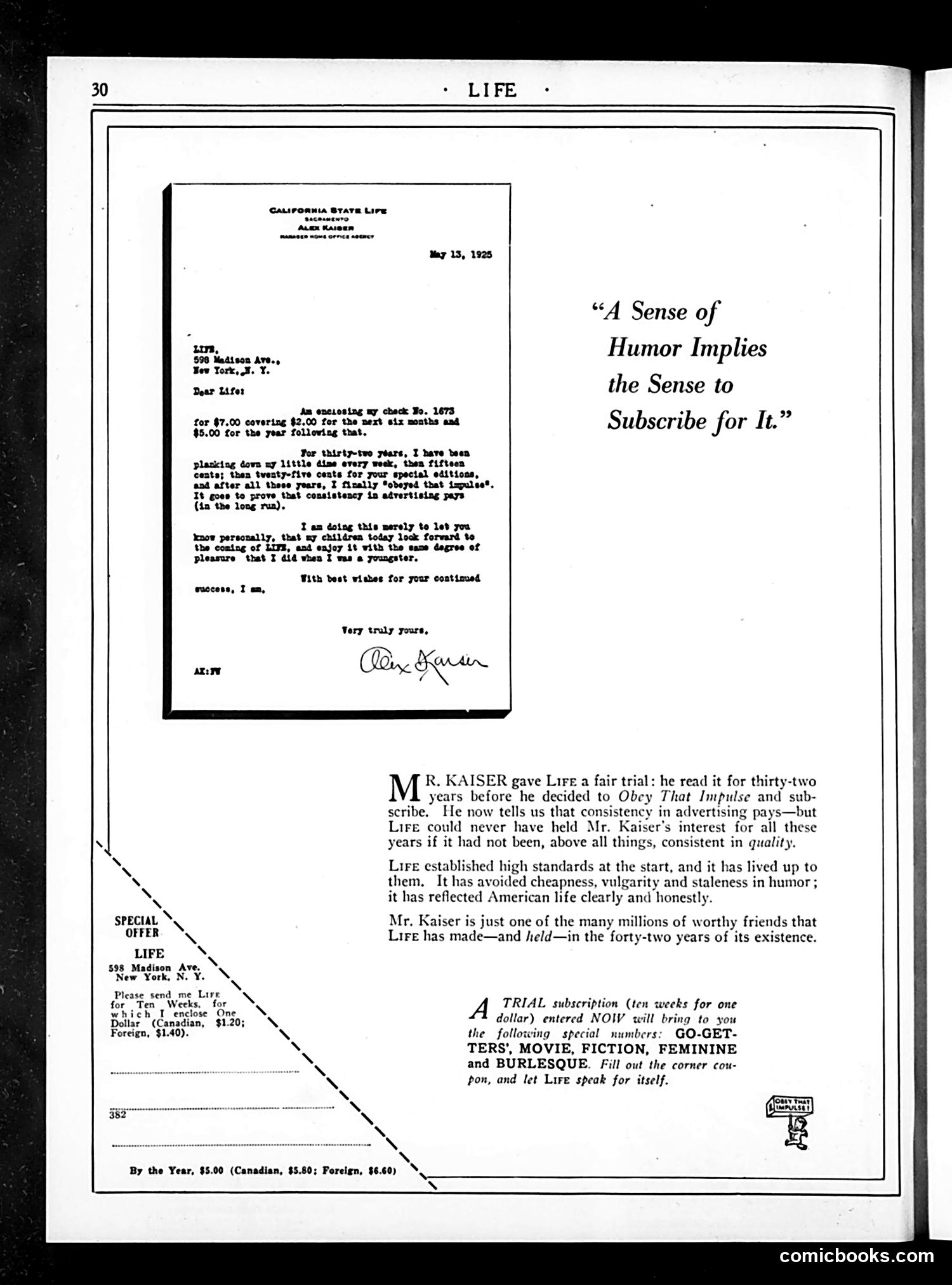
This page is primarily a **subscription advertisement** for *Life* magazine, not a political cartoon. It features a **testimonial letter** from a reader named Dr. Kaiser, dated May 13, 1925, praising the magazine's thirty-two years of consistent quality. The advertisement's key claim: Kaiser's long loyalty proves that "*consistency in advertising pays*"—Life's repeated presence in readers' homes builds trust and loyalty. The magazine emphasizes it has maintained high standards, avoided "cheapness, vulgarity and staleness in humor," and "reflected American life clearly and honestly." The ad offers a trial subscription (ten weeks for one dollar) and promotes special upcoming issues on "GO-GETTERS," movies, fiction, feminine topics, and burlesque. The sidebar pricing shows different rates for Canada and foreign subscriptions. This reflects *Life*'s positioning as a respectable, quality humor magazine appealing to middle-class families—the Kaiser letter serving as social proof of its enduring appeal across generations.
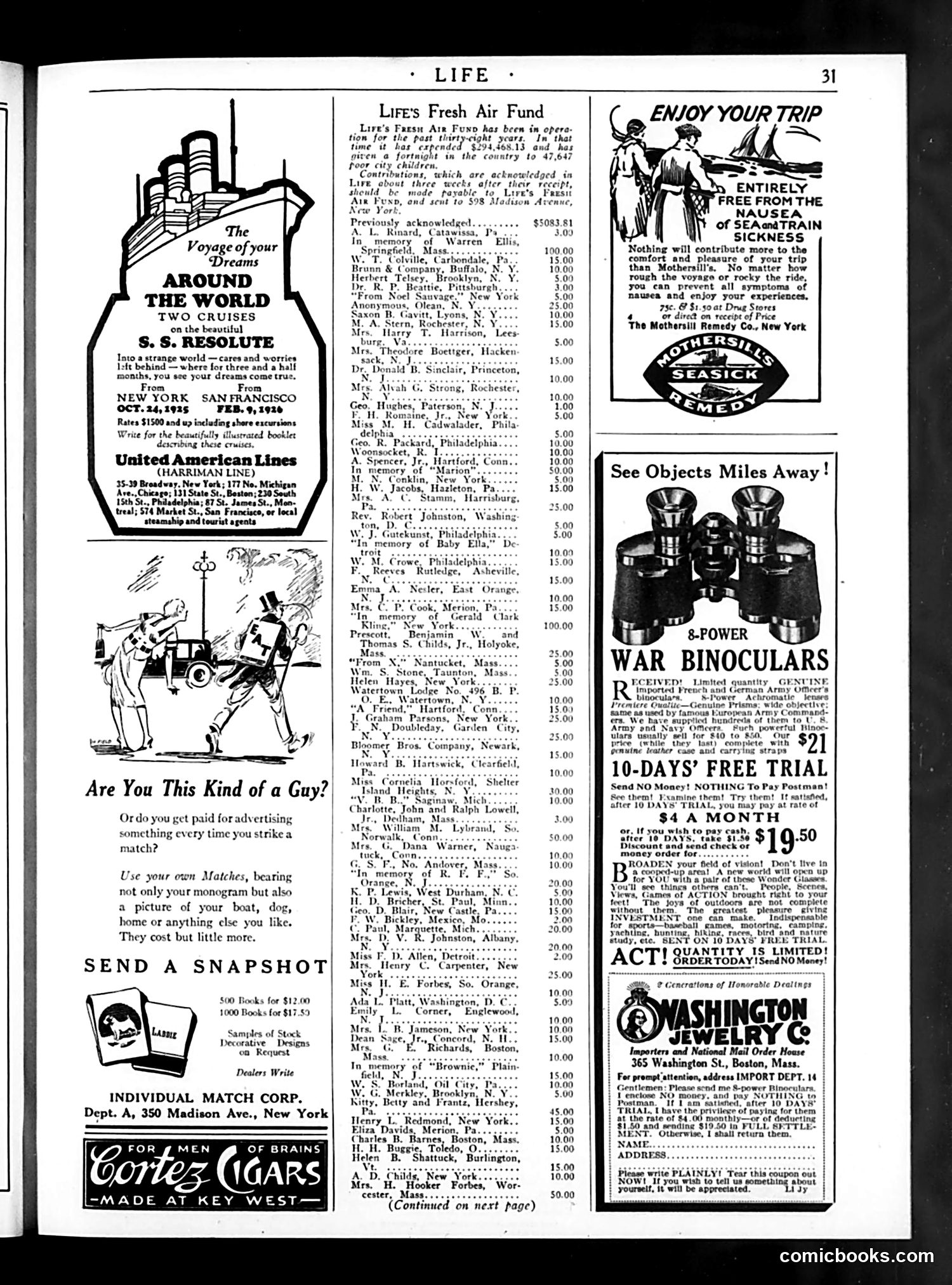
This page is primarily **advertising and donor listings**, not political satire. The main content includes: **Advertisements:** - Cruise ship promotions (S.S. Resolute world voyages) - Custom matchbooks with personal designs - War binoculars (surplus military equipment) - Mothersill's seasickness remedy - Washington Jewelry Company - Corves cigars **Editorial Content:** - Life's Fresh Air Fund donor list: a charitable column documenting contributions to send poor city children to the countryside—a common Progressive-era philanthropic cause **Social Context:** The "Are You This Kind of Guy?" matchbook ad humorously suggests personalized advertising on everyday items was aspirational—a status symbol of the 1920s. The Fresh Air Fund reflects genuine concern for urban child welfare. This is a typical magazine page mixing commerce with social responsibility, rather than containing political commentary or satire. The page reflects 1920s consumerism and middle-class charitable sensibilities.
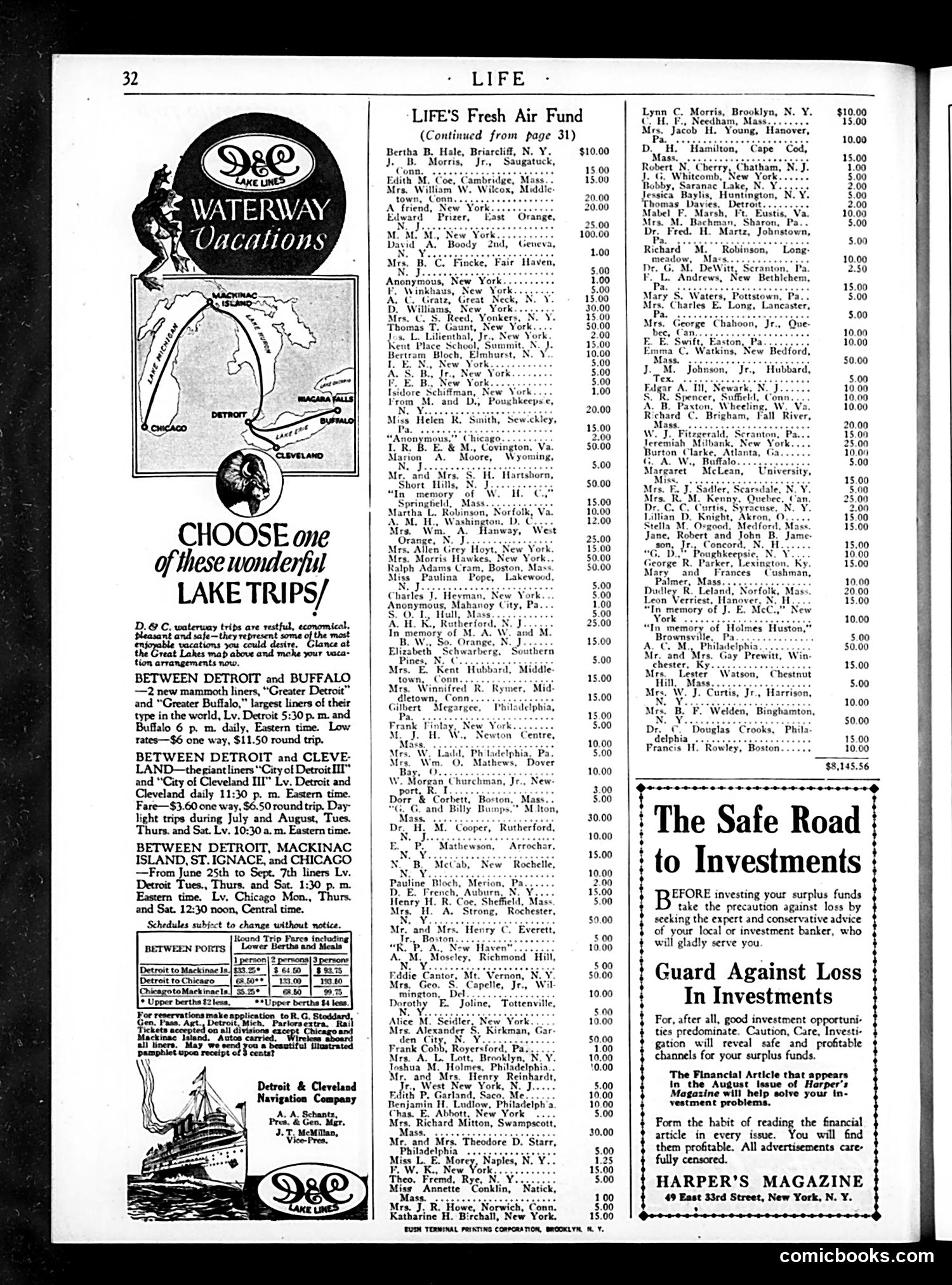
This page is primarily **advertising and fundraising**, not satire. The upper portion lists donors to **Life's Fresh Air Fund**—a charitable program that provided vacations for underprivileged urban children. The donations range from $1 to $50, suggesting widespread middle-class participation in this philanthropic cause. The dominant advertisement promotes **D&C Waterway lake cruises** between Detroit, Buffalo, Cleveland, and Chicago/Mackinac Island. The illustration features a map of the Great Lakes region and emphasizes luxury steamship travel as an accessible vacation option. A sidebar article titled **"The Safe Road to Investments"** advises readers to consult financial experts rather than risk loss through inexperienced investing—reflecting 1920s economic anxieties. The page reflects **Progressive Era charitable impulses** and the emerging leisure travel industry for middle-class Americans during the prosperous 1920s.
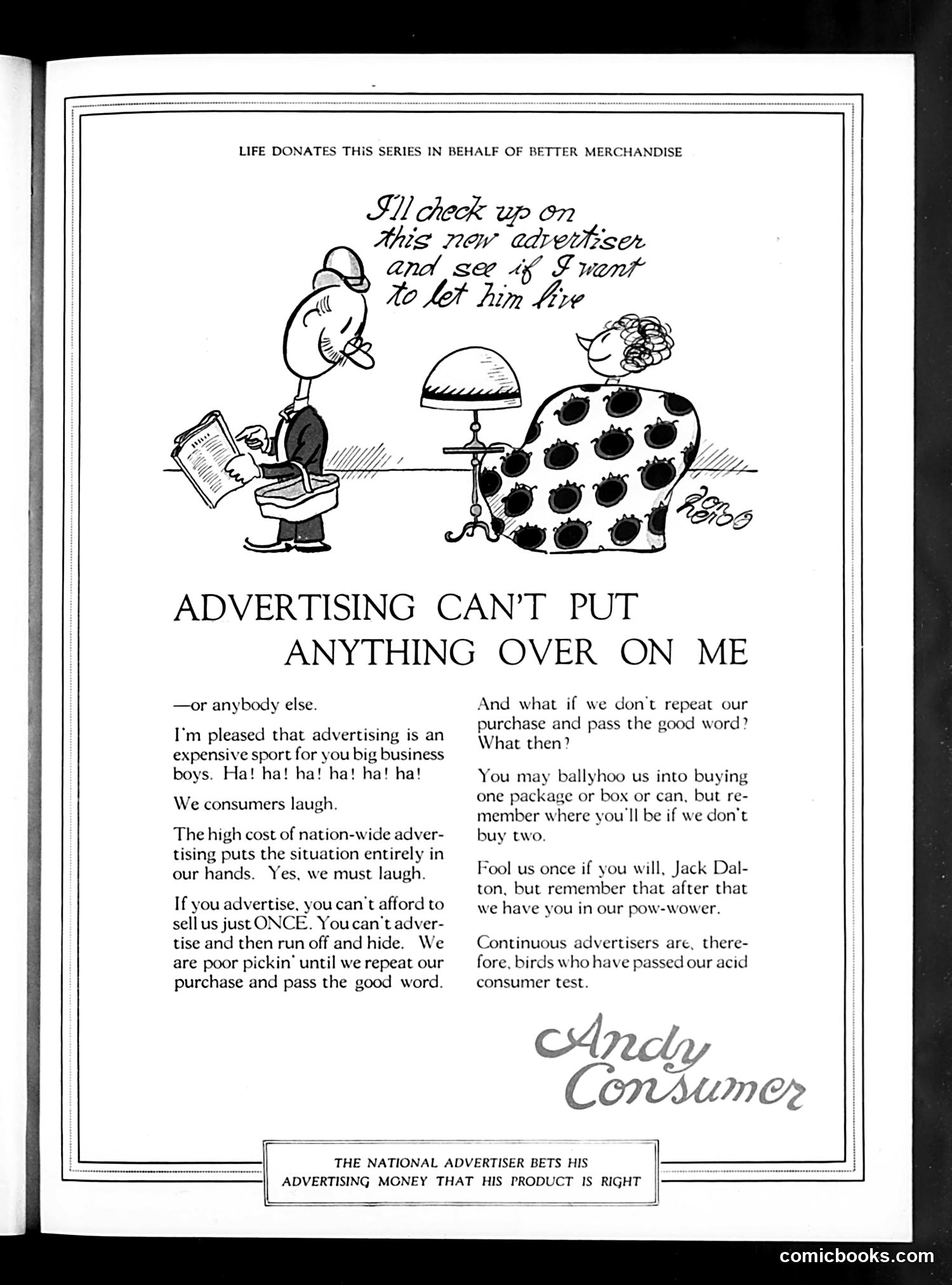
This satirical piece from Life magazine argues that **consumers hold power over advertisers**, not vice versa. The cartoon shows a smug consumer (labeled "Andy Consumer") dismissing advertising's influence. The argument: advertising is expensive, so companies can't afford one-time sales—they must continuously advertise to encourage repeat purchases and word-of-mouth recommendations. This means consumers control whether products succeed. If ads fool people once but the product disappoints, those consumers become adversaries ("pow-wower" = a gathering where grievances are aired). Only products that pass the "acid consumer test" through repeated purchases survive. The satire targets big business confidence in advertising's persuasive power. It's anti-advertising propaganda framed as consumer empowerment, published by Life to boost confidence in merchandise quality during an era when advertising was rapidly expanding and consumers remained skeptical of commercial manipulation.
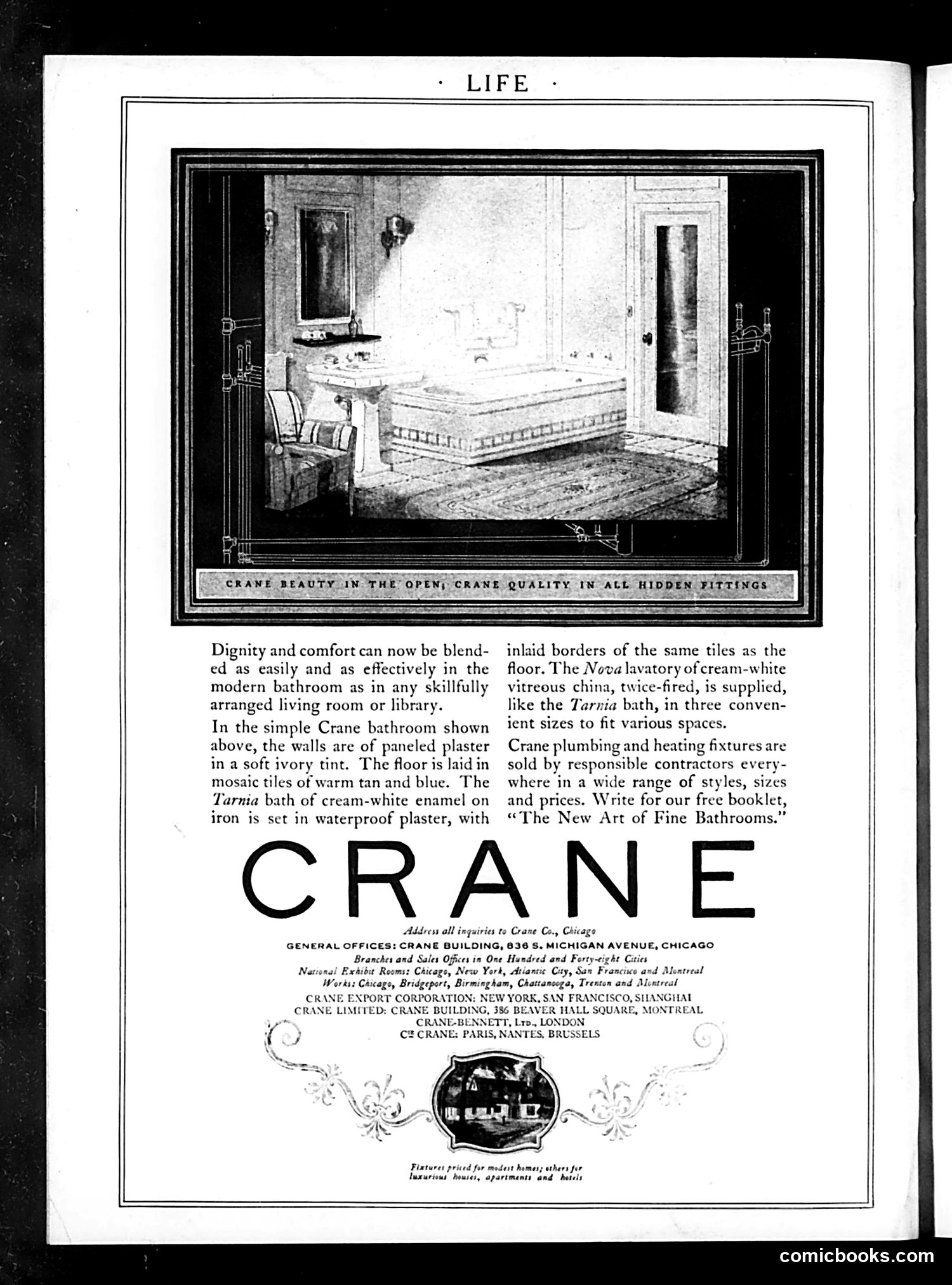
This is not a cartoon or satire—it's a **full-page advertisement** for Crane plumbing fixtures, appearing in *Life* magazine. The image shows a luxurious bathroom showcasing Crane products: a "Tarnia" bathtub in cream-white enamel, a "Nova" lavatory in vitreous china, and mosaic tile flooring. The accompanying text emphasizes that modern bathroom design can achieve "dignity and comfort" comparable to living rooms or libraries—a notable selling point for the era, when bathrooms were becoming central to home design. The ad targets middle and upper-class homeowners, emphasizing that Crane fixtures are "sold by responsible contractors everywhere in a wide range of styles, sizes and prices," suggesting products for "modest homes" through "luxurious houses." This represents early 20th-century American consumer advertising's focus on domesticity, comfort, and modernization as marks of social aspiration.