
Life, 1925-07-09 · page 30 of 42
Life — July 9, 1925 — page 30: what you’re looking at
What you’re looking at
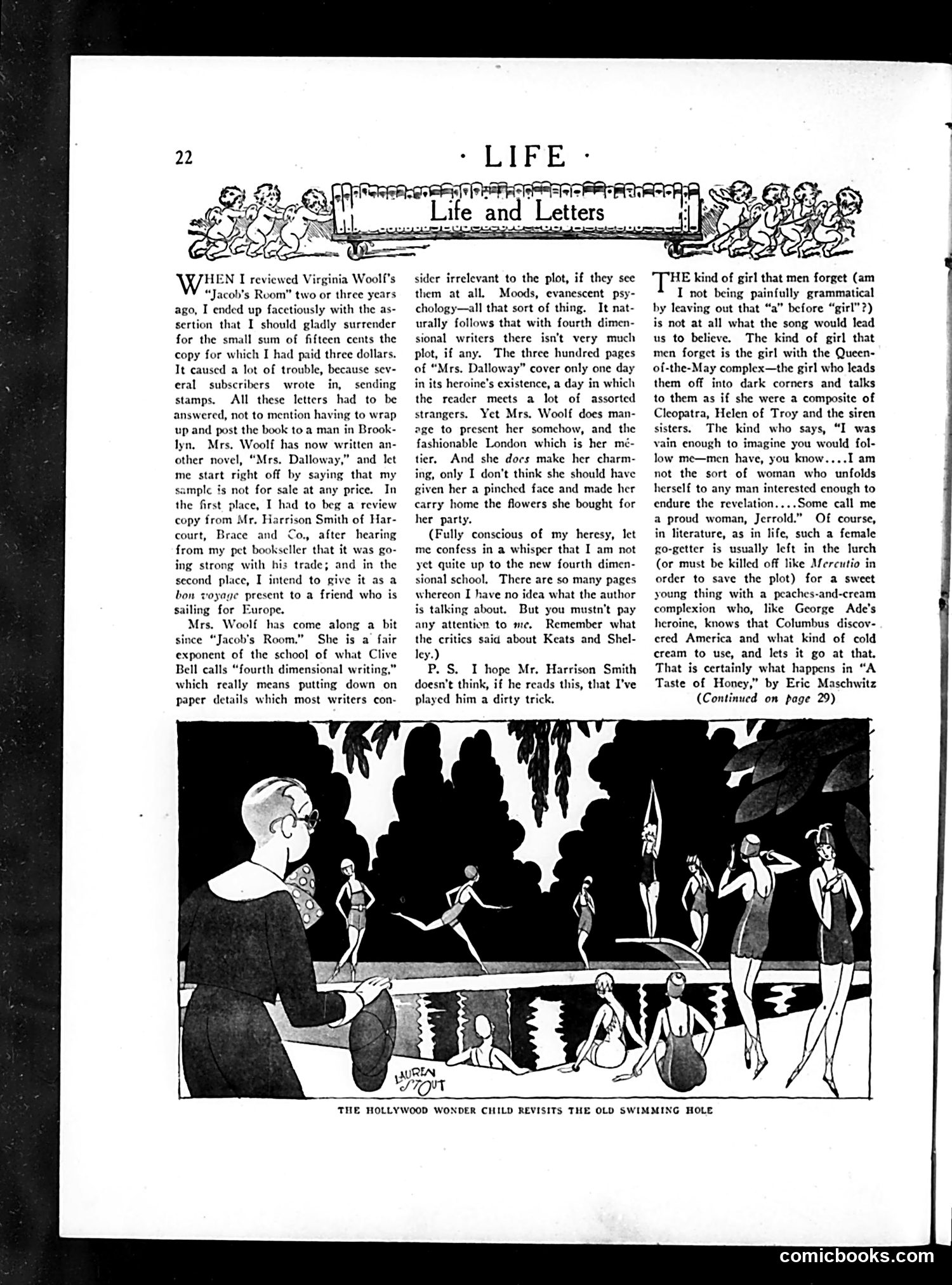
This page contains two literary reviews rather than political cartoons. The main text critiques Virginia Woolf's *Mrs. Dalloway*, calling it experimental "fourth dimensional writing" that prioritizes mood and psychological detail over plot—three hundred pages covering a single day. The reviewer admits confusion about portions of the novel but acknowledges Woolf's skill in characterization. The second review discusses female archetypes in literature, contrasting the forgettable "Queen-of-the-May" type (vain, dramatic) with the sweet, practical heroine who succeeds romantically—exemplified in *A Taste of Honey* by Eric Maschwitz. The illustration below, captioned "The Hollywood Wonder Child Revisits the Old Swimming Hole," depicts a nostalgic scene of an adult observing young swimmers—likely referencing a child actor revisiting an innocent past, though the specific identity remains unclear without additional context.
📄 Transcribed text from this page (OCR, searchable)
Machine-transcribed from the original scan — historical spelling and the odd misread are preserved.
HEN I reviewed Virginia Woolf's “Jacob's Room” two or three years ago, I ended up facctiously with the as- sertion that I should gladly surrender for the small sum of fifteen cents the copy for which I had paid three dollars. It caused a lot of trouble, because sev- eral subscribers wrote in, sending stamps. All these letters had to be answered, not to mention having to wrap up and post the book toa man in Brook- lyn. Mrs. Woolf has now wrii other novel, “Mrs. Dallow and let me start right off by saying that my sample is not for sale at any price. In the first place, I had to beg a review copy from Mr, Harrison Smith of Har- court, Brace and Co., after hearing from my pct bookseller that it was go- ing strong with his trade; and in the second place, I intend to give it as a bon voyage present to a friend who is sailing for Europe. Mrs. Woolf has come along a bit since “Jacob's Room.” She is a fair exponent of the school of what Clive Bell calls “fourth dimensional writing,” which really means putting down on paper details which most writers con- ‘Life sider irrelevant to the plot, if they sce them at all. Moods, evanescent psy- chology—all that sort of thing. It nat- urally follows that with fourth dimen- sional writers there isn't very much plot, if any. The three hundred pages of “Mrs. Dalloway” cover only one day in its heroine's existence, a day in which the reader mects a lot of assorted strangers. Yet Mrs. Woolf does man- age to present her somchow, and the fashionable London which is her mé- tier, And she docs make her charm- ing, only I don't think she should have given her a pinched face and made her carry home the flowers she bought for her party. (Fully conscious of my heresy, Ict me confess in a whisper that I am not yet quite up to the new fourth dimen- sional school. There are so many pages whereon I have no idea what the author is talking about. But you mustn't pay any attention to me. Remember what the critics said about Keats and Shel- ley.) P. S. I hope Mr. Harrison Smith doesn’t think, if he reads this, that I've played him a dirty trick. TH kind of girl that men forget (am I not being painfully grammatical by leaving out that “a” before “girl” ?) is not at all what the song would lead us to believe. The kind of girl that men forget is the girl with the Queen- of-the-May complex—the girl who leads them off into dark corners and talks to them as if she were a composite of Cleopatra, Helen of Troy and the siren sisters. The kind who says, “I was vain enough to imagine you would fol- low me—men have, you know....I am not the sort of woman who unfolds herself to any man interested enough to endure the revelation....Some call me a proud woman, Jerrold.” Of course, in literature, as in life, such a female go-getter is usually left in the lurch (or must be killed off like Mercutio in order to save the plot) for a sweet young thing with a peaches-and-cream complexion who, like George Ade's heroine, knows that Columbus discov- ered America and what kind of cold cream to use, and lets it go at that. That is certainly what happens in “A Taste of Honey,” by Eric Maschwitz (Continued on page 29) THE HOLLYWOOD WONDER CHILD REVISITS THE OLD SWIMMING HOLE comicbooks.com