
Life, 1925-07-09 · page 28 of 42
Life — July 9, 1925 — page 28: what you’re looking at
What you’re looking at
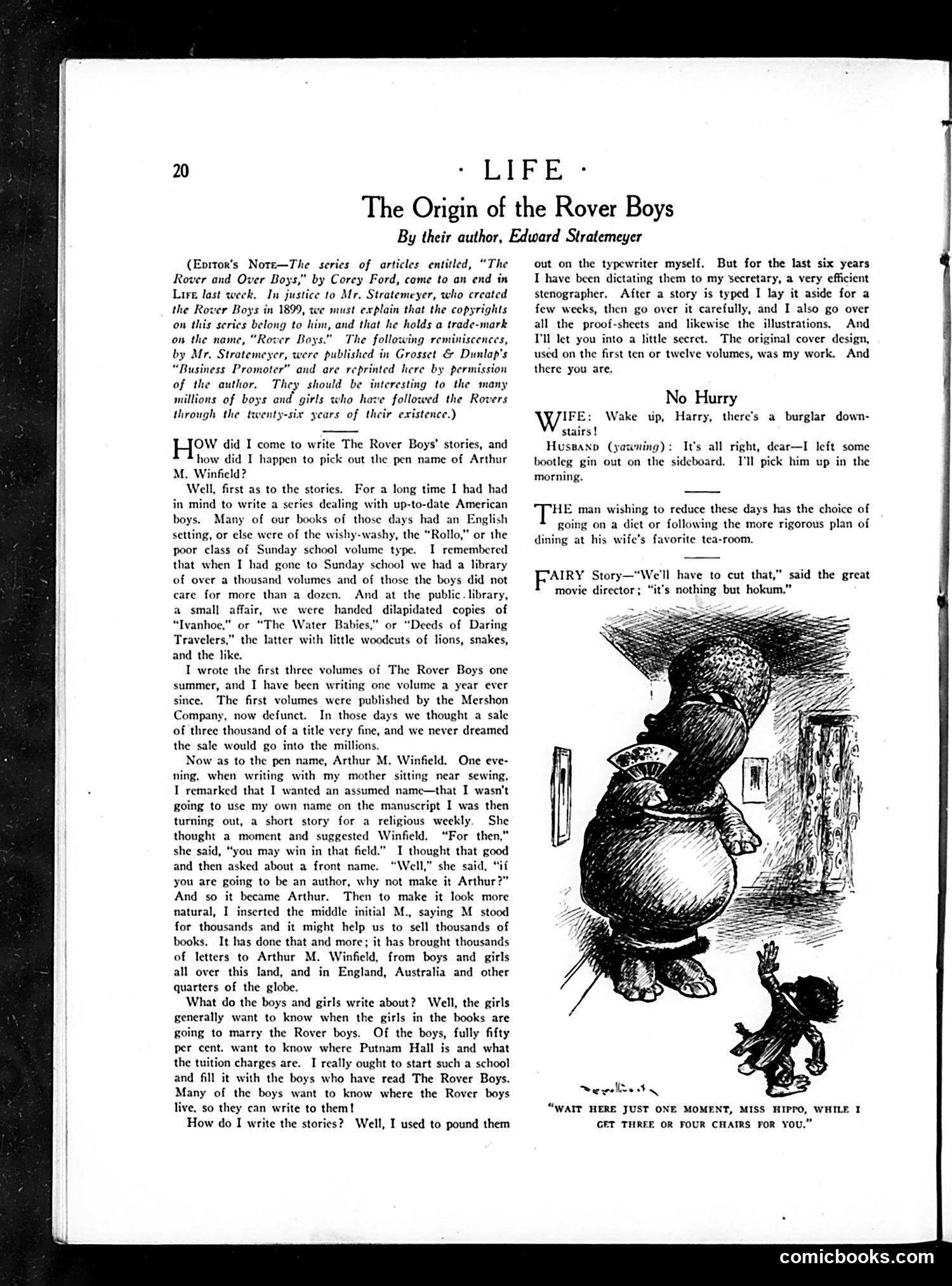
This page presents Edward Stratemeyer's behind-the-scenes account of creating the *Rover Boys* series, popular American adventure novels for young readers (published since 1899). The illustration depicts a hippo in Victorian dress seated in a chair—likely a humorous, unrelated cartoon typical of *Life* magazine's satirical format. The text reveals Stratemeyer's creative process: he deliberately chose "Arthur M. Winfield" as a pen name (inspired by his mother's suggestion to "win in that field"), inserted the middle initial to suggest "thousands," and intentionally wrote modern American stories rather than the dated, moralistic tales then available for boys. Stratemeyer notes the series' phenomenal success—from expected sales of 3,000 to millions of copies—and describes fan mail requesting information about the fictional Putnam Hall school and the characters' real addresses, demonstrating the books' cultural grip on American youth in the early 20th century.
📄 Transcribed text from this page (OCR, searchable)
Machine-transcribed from the original scan — historical spelling and the odd misread are preserved.
LIFE - The Origin of the Rover Boys By their author, Edward Stratemeyer (Epitor’s Note—The series of articles entitled, “The Rover and Over Boys,” by Corey Ford, come to an end in Lire last week. In justice to Mr. Stratemeyer, who created the Rover Boys in 1899, we must explain that the copyrights on this serics belong to him, and that he holds a trade-mark on the name, “Rover Boys.” The following reminiscences, by Mr. Stratemeyer, were published in Grosset & Dunlap’s “Business Promoter” and are reprinted here by permission of the author. They should be interesting to the many millions of boys and girls who have followed the Rovers through the twenty-six years of their existence.) Heov did I come to write The Rover Boys’ stories, and how did I happen to pick out the pen name of Arthur M. Winfield? Well, first as to the stories. For a long time I had had in mind to write a series dealing with up-to-date American boys. Many of our books of those days had an English setting, or else were of the wishy-washy, the “Rollo,” or the poor class of Sunday school volume type. I remembered that when I had gone to Sunday school we had a library of over a thousand volumes and of those the boys did not care for more than a dozen. And at the public. library, a small affair, we were handed dilapidated copies of “Ivanhoe,” or “The Water Babies,” or “Deeds of Daring Travelers,” the latter with little woodcuts of lions, snakes, and the like. I wrote the first three volumes of The Rover Boys one summer, and I have been writing one volume a year ever since. The first volumes were published by the Mershon Company, now defunct. In those days we thought a sale of three thousand of a title very fine, and we never dreamed the sale would go into the millions. Now as to the pen name, Arthur M, Winfield. One eve- ning, when writing with my mother sitting near sewing, I remarked that I wanted an assumed namc—that I wasn't going to use my own name on the manuscript I was then turning out, a short story for a religious weekly. She thought a moment and suggested Winfield. “For then,” she said, “you may win in that field.” I thought that good and then asked about a front name. “Well,” she said, you are going to be an author, why not make it Arthur? And so it became Arthur. Then to make it look more natural, I inserted the middle initial M., saying M_ stood for thousands and it might help us to sell thousands of books. It has done that and more; it has brought thousands of letters to Arthur M. Winfield, from boys and girls all over this land, and in England, Australia and other quarters of the globe, What do the boys and girls write about? Well, the girls generally want to know when the girls in the books are going to marry the Rover boys. Of the boys, fully fifty per cent. want to know where Putnam Hall is and what the tuition charges are. I really ought to start such a school and fill it with the boys who have read The Rover Boys. Many of the boys want to know where the Rover boys live, so they can write to them! How do I write the stories? Well, I used to pound them out on the typewriter myself. But for the last six years I have been dictating them to my secretary, a very efficient stenographer. After a story is typed I lay it aside for a few weeks, then go over it carefully, and I also go over all the proof-sheets and likewise the illustrations. And I'll let you into a little secret. The original cover design, used on the first ten or twelve volumes, was my work. And there you are. No Hurry IFE: Wake up, Harry, there's a burglar down- stairs! Huspanp (yawning): It’s all right, dear—I left some bootleg gin out on the sideboard. I'll pick him up in the morning. HE man wishing to reduce these days has the choice of going on a dict or following the more rigorous plan of dining at his wife’s favorite tea-room. ‘AIRY Story—“We'll have to cut that,” said the great movie director; “it's nothing but hokum.” Sewell ty “WAIT HERE JUST ONE MOMENT, MISS HIPPO, WHILE I GET THREE OR FOUR CHAIRS FOR YOU.” comicbooks.com