
Life, 1925-07-09 · page 32 of 42
Life — July 9, 1925 — page 32: what you’re looking at
What you’re looking at
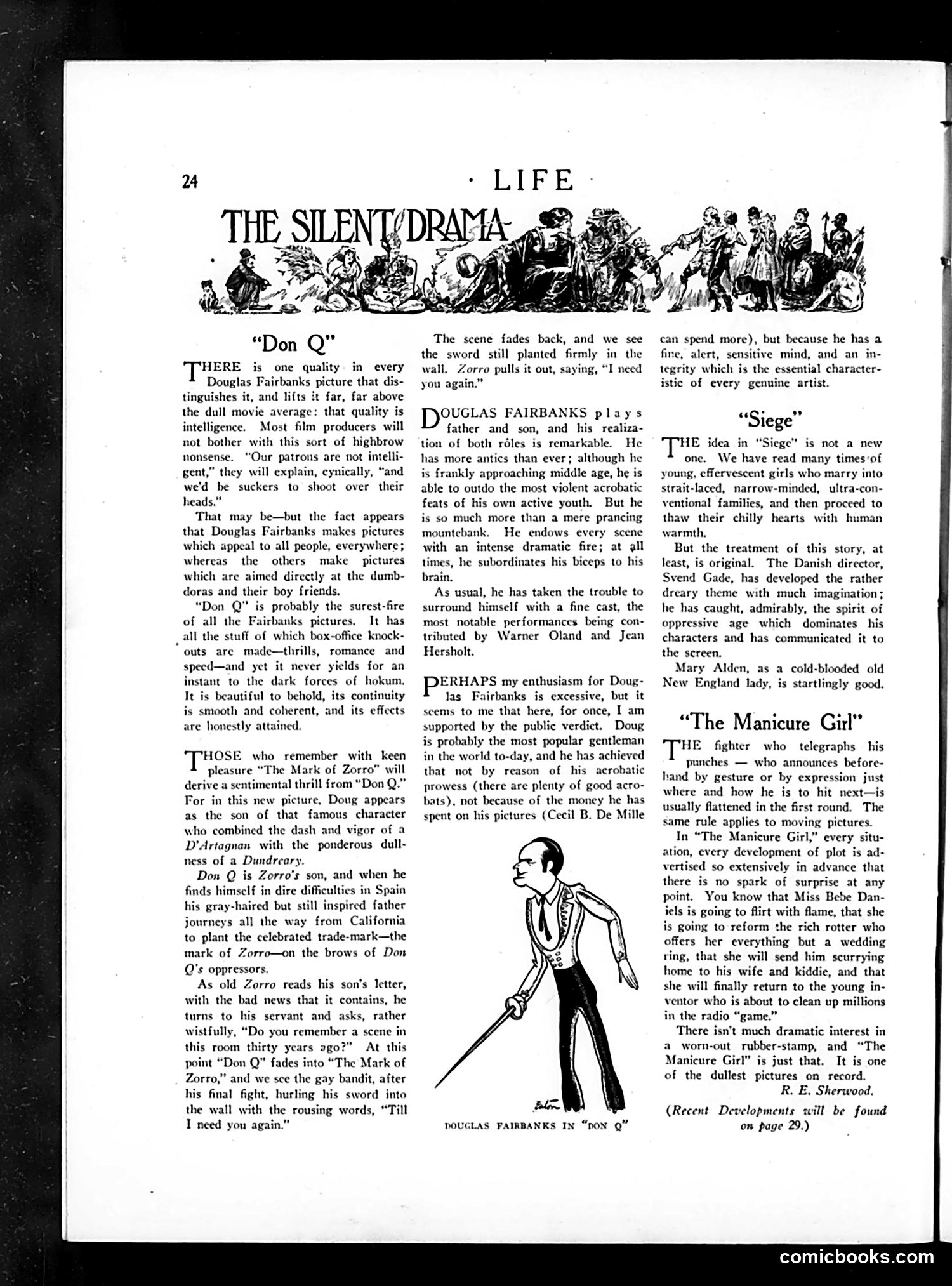
This page from *Life* magazine reviews three silent films. The main content discusses Douglas Fairbanks films—specifically praising "Don Q" (a sequel to "The Mark of Zorro") for combining entertainment with intelligence, arguing that Fairbanks succeeds where other producers fail by refusing to "shoot over [audiences'] heads" while still maintaining quality. The accompanying illustration shows Fairbanks in character as Don Q, dressed as a Spanish gentleman with a sword. Brief mentions also appear for "Siege" (a Danish film about a young woman warming a rigid family) and "The Manicure Girl" (described as a worn-out rubber-stamp plot about a manicurist reforming a wealthy rake). The reviewer's broader point: Fairbanks' success proves popular audiences aren't inherently stupid—they appreciate intelligent filmmaking when given the chance, contradicting industry cynicism of the era.
📄 Transcribed text from this page (OCR, searchable)
Machine-transcribed from the original scan — historical spelling and the odd misread are preserved.
HERE is one quality in every Douglas Fairbanks picture that dis- tinguishes it, and lifts it far, far above the dull movie average: that quality is intelligence. Most film producers will not bother with this sort of highbrow nonsense, “Our patrons are not intelli- gent,” they will explain, cynically, “and we'd be suckers to shoot over their heads.” That may be—but the fact appears that Douglas Fairbanks makes pictures which appeal to all people, everywhere; whereas the others make pictures which are aimed directly at the dumb- doras and their boy friends. “Don Q” is probably the surest-fire of all the Fairbanks pictures, It has _ all the stuff of which box-office knock- outs are made—thrills, romance and specd—and yet it never yields for an instant to the dark forces of hokum. It is beautiful to behold, its continuity is smooth and coherent, and its effects are honestly attained. HOSE who remember with keen pleasure “The Mark of Zorro” wi derive a sentimental thrill from “Don Q.” For in this new picture, Doug appears as the son of that famous character who combined the dash and vigor of a D'Artagnan with the ponderous dull- ness of a Dundreary. Don Q is Zorro’s son, and when he finds himself in dire difficulties in Spain his gray-haired but still inspired father journeys all the way from California to plant the celebrated trade-mark—the mark of Zorro—on the brows of Don Q's oppressors. As old Zorro reads his son's letter, with the bad news that it contains, he turns to his servant and asks, rather wistfully, “Do you remember a scene in this room thirty years ago?” At this point “Don Q” fades into “The Mark of Zorro,” and we sce the gay bandit, after his final fight, hurling his sword into the wall with the rousing words, “Till I need you again.” The scene fades back, and we see the sword still planted firmly in the wall. Zorro pulls it out, saying, “I need you again.” OUGLAS FAIRBANKS plays father and son, and his realiza- tion of both rdles is remarkable. He has more antics than ever; although he is frankly approaching middle age, he is able to outdo the most violent acrobatic feats of his own active youth. But he is so much more than a mere prancing mountebank. He endows every scene with an intense dramatic fire; at all times, he subordinates his biceps to his brain. As usual, he has taken the trouble to surround himself with a fine cast, the most notable performances being con- tributed by Warner Oland and Jean Hersholt. PERHAPS my enthusiasm for Doug- las Fairbanks is excessive, but it scems to me that here, for once, I am supported by the public verdict. Doug is probably the most popular gentleman in the world to-day, and he has achieved that not by reason of his acrobatic prowess (there are plenty of good acro- bats), not because of the money he has spent on his pictures (Cecil B. De Mille DOUGLAS FAIRBANKS IN “pon Q can spend more), but because he has a fine, alert, sensitive mind, and an in- tegrity which is the essential character- istic of every genuine artist. “Siege” HE idea in “Siege” is not a new one. We have read many times’of young, effervescent girls who marry into strait-laced, narrow-minded, ultra-con- ventional families, and then proceed to thaw their chilly hearts with human warmth, But the treatment of this story, at least, is original. The Danish director, Svend Gade, has developed the rather dreary theme with much imagination; he has caught, admirably, the spirit of oppressive age which dominates his characters and has communicated it to the screen. Mary Alden, as a cold-blooded old New England lady, is startlingly good. “The Manicure Girl” ‘TH fighter who telegraphs his punches — who announces before- hand by gesture or by expression just where and how he is to hit next—is usually flattened in the first round. The same rule applies to moving pictures. In “The Manicure Girl,” every situ- ation, every development of plot is ad- vertised so extensively in advance that there is no spark of surprise at any point. You know that Miss Bebe Dan- iels is going to flirt with flame, that she is going to reform the rich rotter who offers her everything but a wedding ring, that she will send him scurrying home to his wife and kiddie, and that she will finally return to the young in- ventor who is about to clean up millions in the radio “game.” There isn't much dramatic interest in a worn-out rubber-stamp, and “The Manicure Girl” is just that. It is one of the dullest pictures on record. R. E. Sherwood. (Recent Developments will be found on page 29.) comicbooks.com