
Life, 1925-07-09 · page 37 of 42
Life — July 9, 1925 — page 37: what you’re looking at
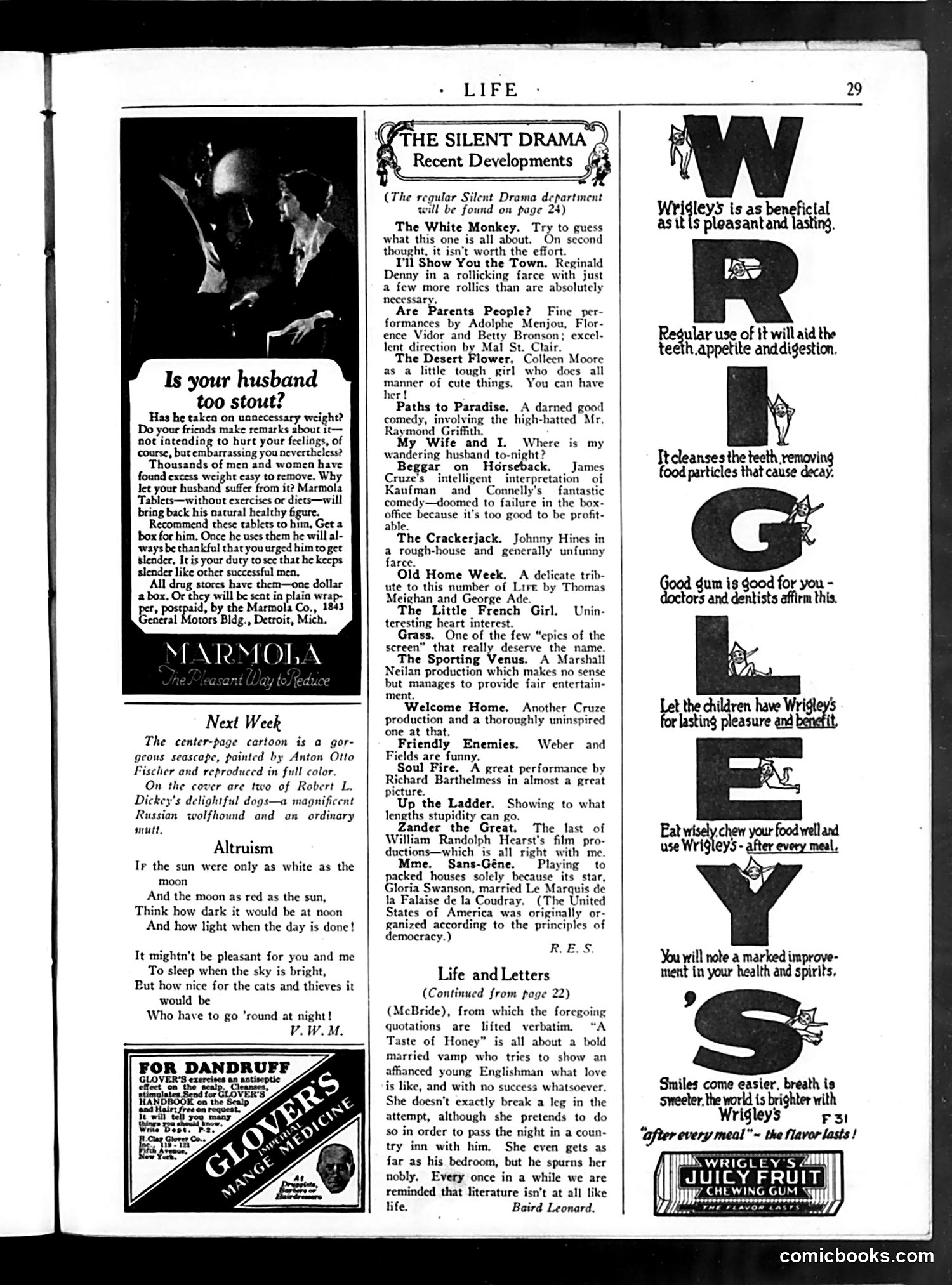
What you’re looking at
This is a **1920s Life magazine page** mixing entertainment criticism with period advertising that reveals uncomfortable social attitudes. **The Main Content:** The page reviews silent films (now mostly forgotten titles like "The White Monkey" and "Beggar on Horseback"), offering snide dismissals typical of the era's irreverent comedy magazine style. **The Problematic Ads:** Two advertisements expose period prejudices: 1. **Marmola tablets** shame men about weight gain, framing a wife's "duty" to keep her husband slim—reflecting rigid 1920s gender roles and appearance expectations. 2. **Glover's dandruff treatment** uses racist imagery (the OCR text is incomplete, but the ad mentions "antiseptic effect"). **The Satire:** A brief poem called "Altruism" humorously imagines reversed celestial bodies benefiting "cats and thieves" who operate at night—gentle, whimsical social commentary typical of Life's style. The page exemplifies how magazines normalized body-shaming and racist marketing as casual entertainment, now jarring to modern sensibilities.
📄 Transcribed text from this page (OCR, searchable)
Machine-transcribed from the original scan — historical spelling and the odd misread are preserved.
Is your husband too stout? Has he taken on unnecessary weight? Do your friends make remarks about it— not intending to hurt your feelings, of course, but embarrassing you nevertheless? Thousands of men and women have found excess weight easy to remove, Why Iet your husband suffer from it? Marmola Tablets—without exercises or dicts—will bring back his natural healthy figure. Recommend these tablets to hun, Get a box for him. Once he uses them he will al- ways be thankful that you urged him to get slender. It is your duty to see that he keeps slender like other successful men. All drug stores have them—one dollar a box. Or they will be sent in plain wrap- '» postpaid, by the Marmola Co., 1843 Bea Motors Bldg., Detroit, Mich. SEAR MOLA Next Week The center-page cartoon is a gor- geous seascape, painted by Anton Otto Fischer and reproduced in full color. On the cover are two of Robert L. Dickey’s delightful dogs—a magnificent Russian wolfhound and an ordinary mutt, Altruism Ir the sun were only as white as the moon And the moon as red as the sun, Think how dark it would be at noon And how light when the day is done! It mightn’t be pleasant for you and me To sleep when the sky is bright, But how nice for the cats and thieves it would be Who have to go ’round at night! V.W.M. FOR DANDRUFF GLOVER’S exercises an antiseptic effect on the scalp. Cleanses, stimalates Send for GLOVER'S Sealp reques HANDBOOK en the and Hair: free on | rr SC § THE SILENT DRAMA 4, Recent Developments (The regular Silent Drama department will be found on page 24) The White Monkey. Try to guess what this one is all about. On second thought, it isn’t worth the effort. I'll Show You the Town. Reginald Denny in a rollicking farce with just a few more rollics than are absolutely necessary. Are Parents People? Fine _per- formances by Adolphe Menjou, Flor- ence Vidor and Betty Bronson; excel- lent direction by Mal St. Clair. The Desert Flower. Colleen Moore as a little tough girl who does all namnee of cute things. You can have her! Paths to Paradise. A darned good comedy, involving the high-hatted Mr. Raymond Griffith. My Wife and I. Where is my wandering husband to-night? Beggar on Horseback. James Cruze’s intelligent. interpretation of Kaufman and Connelly’s fantastic comedy—doomed to failure in the box- once because it’s too good to be profit- able. The Crackerjack. Johnny Hines in a rough-house and generally unfunny farce. Old Home Week. A delicate trib- ute to this number of Lire by Thomas Meighan and George Ade. The Little French Girl, Unin- teresting heart interest. Grass. One of the few “epics of the screen” that really deserve the name. The Sporting Venus. A Marshall Neilan production which makes no sense but manages to provide fair entertain- ment. Welcome Home. Another Cruze production and a thoroughly uninspired one at that. Friendly Enemies. Weber and Fields are funny. Soul Fire. A great performance by Richard Barthelmess in almost a great picture. Up the Ladder. Showing to what lengths stupidity can go. Zander the Great. The last of William Randolph Hearst's film pro- ductions—which is all right with me. Mme. Sans-Géne. Playing to packed houses solely because its star, Gloria Swanson, married Le Marquis de la Falaise de la Coudray. (The United States of America was originally or- ganized according to the principles of democracy.) R.E. S. Life and Letters (Continued from page 22) (McBride), from which the foregoing quotations are lifted verbatim. “A Taste of Honey” is all about a bold married vamp who tries to show an affianced young Englishman what love is like, and with no success whatsoever. She doesn’t exactly break a leg in the attempt, although she pretends to do so in order to pass the night in a coun- try inn with him. She even gets as far as his bedroom, but he spurns her nobly. Every once in a while we are reminded that literature isn’t at all like life. Baird Leonard. ley is as beneficial es ais. ular use of it will aid the teeth,appetite anddigestion. It cleanses the teeth removin: food articles that cause cay Good is good foi - eae ant setts afin th is, the children have Wri ete ee ee You will note a marked improve- ment in your health and spits, Smiles come easier, breath is sweeter, the world is brighter with Wrigleys FBI comicbooks.com