
Life, 1925-07-09 · page 27 of 42
Life — July 9, 1925 — page 27: what you’re looking at
What you’re looking at
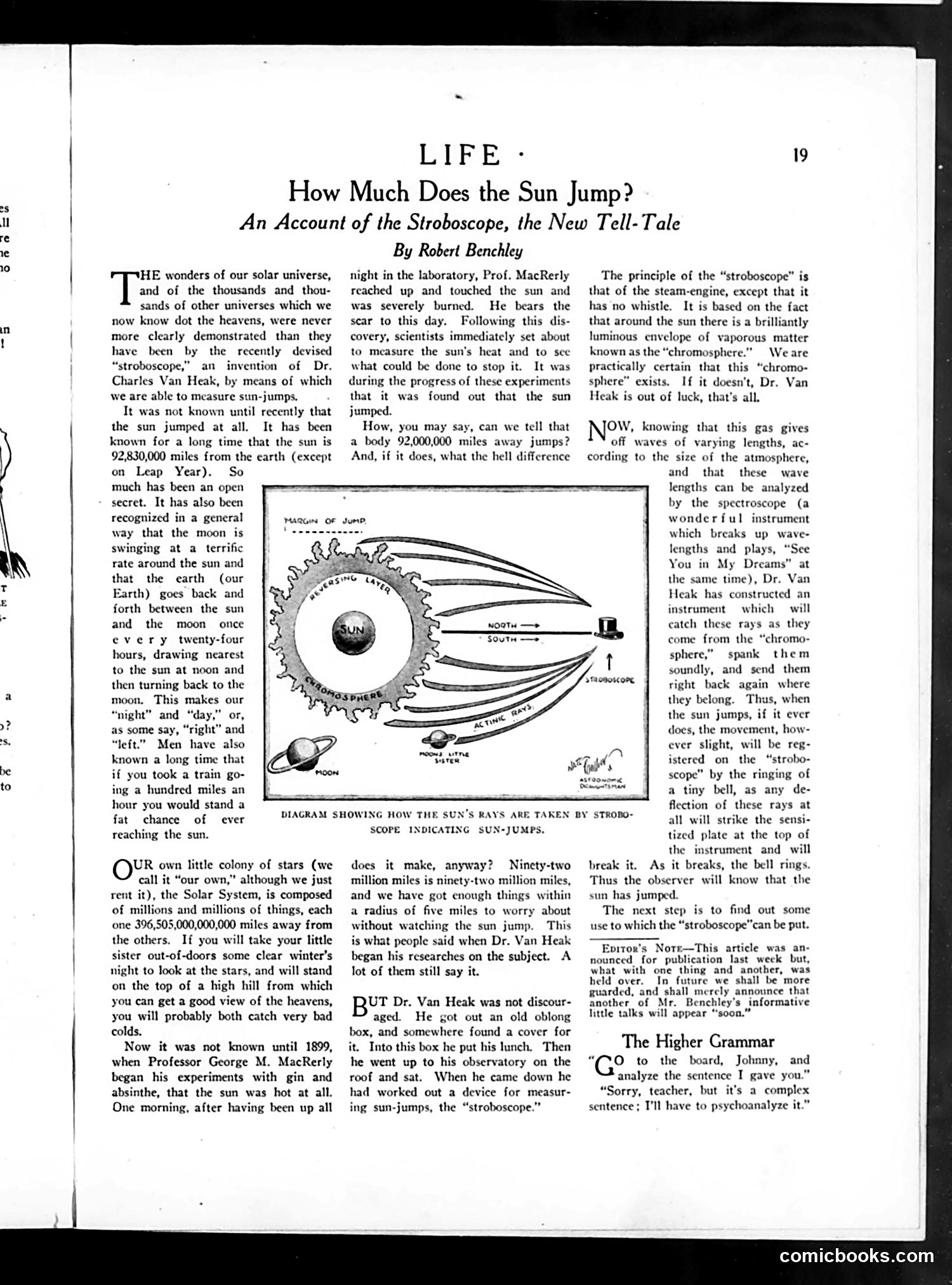
This is Robert Benchley's satirical article about a fictional scientific invention called the "stroboscope," purportedly invented by the made-up "Dr. Charles Van Heak." The humor lies in Benchley's deadpan absurdist writing style. The joke: Benchley presents increasingly ridiculous "scientific facts"—that the sun "jumps," that Professor MacRerly discovered the sun was hot in 1899 by touching it and burning himself, that a device measuring solar jumps serves any practical purpose. The fake technical language and elaborate diagram mock pseudo-scientific explanations and the earnest but overwrought scientific writing popular in early 20th-century publications. The satire targets credulous readers who accept scientific claims without skepticism, and publications that present dubious information as fact. Benchley's characteristic style—mixing mock-erudition with casual absurdity ("what the hell difference does it make, anyway?")—makes the hoax entertainment rather than deception.
📄 Transcribed text from this page (OCR, searchable)
Machine-transcribed from the original scan — historical spelling and the odd misread are preserved.
| EMPE + How Much Does the Sun Jump? An Account of the Stroboscope, the New Tell-Tale and of the thousands and thou- sands of other universes which we now know dot the heavens, were never more clearly demonstrated than they have been by the recently devised “stroboscope,” an invention of Dr. Charles Van Heak, by means of which we are able to measure sun-jumps. It was not known until recently that the sun jumped at all. It has been known for a long time that the sun is 92,830,000 miles from the earth (except on Leap Year). So much has been an open secret. It has also been recognized in a general way that the moon is swinging at a terrific rate around the sun and that the earth (our Earth) goes back and forth between the sun and the moon once every. twenty-four hours, drawing nearest to the sun at noon and then turning back to the moon. This makes our “night” and as some say, “right” and “left.” Men have also known a long time that if you took a train go- ing a hundred miles an hour you would stand a fat chance of ever reaching the sun. Ts wonders of our solar universe, UR own little colony of stars (we call it “our own,” although we just rent it), the Solar System, is composed of millions and millions of things, each one 396,505,000,000,000 miles away from the others. If you will take your little sister out-of-doors some clear winter’s night to look at the stars, and will stand on the top of a high hill from which you can get a good view of the heavens, you will probably both catch very bad colds. Now it was not known until 1899, when Professor George M. MacRerly began his experiments with gin and absinthe, that the sun was hot at all. One morning, after having been up all DIAGRAM SHOWING HOW THE SU. By Robert Benchley night in the laboratory, Prof. MacRerly reached up and touched the sun and was severely burned. He bears the scar to this day. Following this dis- covery, scientists immediately set about to measure the sun's heat and to see what could be done to stop it. It was during the progress of these experiments that it was found out that the sun jumped. How, you may say, can we tell that a body 92,000,000 miles away jumps? And, if it does, what the hell difference 5 tne Sieve SCOPE INDICATING SUN-JUMPS, does it make, anyway? Ninety-two million miles is ninety-two million miles, and we have got cnough things within a radius of five miles to worry about without watching the sun jump. This is what people said when Dr. Van Heak began his researches on the subject. A lot of them still say it. UT Dr. Van Heak was not discour- aged. He got out an old oblong box, and somewhere found a cover for it. Into this box he put his lunch. Then he went up to his observatory on the roof and sat. When he came down he had worked out a device for measur- ing sun-jumps, the “stroboscope.” RAYS ARE TAKEN BY STROBO- The principle of the “stroboscope” is that of the steam-engine, except that it has no whistle. It is based on the fact that around the sun there is a brilliantly luminous envelope of vaporous matter known as the “chromosphere.” We are practically certain that this “chromo- sphere” exists. If it doesn't, Dr. Van Heak is out of luck, that’s all. Now. knowing that this gas gives off waves of varying lengths, ac- cording to the size of the atmosphere, and that these wave lengths can be analyzed by the spectroscope (a wonderful instrument which breaks up wave- lengths and plays, “See You in My Dreams” at the same time), Dr. Van Heak has constructed an instrument which — will catch these rays as they come from the “chromo- sphere,” spank them soundly, and send them right back again where they belong. Thus, when the sun jumps, if it ever does, the movement, how- ever slight, will be reg- istered on the “strobo- scope” by the ringing of a tiny bell, as any de- flection of these rays at | will strike the sensi- tized plate at the top of the instrument and_ will break it. As it breaks, the bell rings. Thus the observer will know that the sun has jumped. The next step is to find out some use to which the “stroboscope”’can be put. asteomome wees) Epitor’s Note—This article was an- nounced for publication last week but, what with one thing and another, was held over. In future we shall be more guarded, and shall merely announce that another of Mr. Benchley's informative little talks will appear “soon.” The Higher Grammar “(VO to the board, Johnny, and analyze the sentence I gave you.” “Sorry, teacher, but it's a complex sentence; I'll have to psychoanalyze it.” comicbooks.com