
Life, 1925-07-09 · page 22 of 42
Life — July 9, 1925 — page 22: what you’re looking at
What you’re looking at
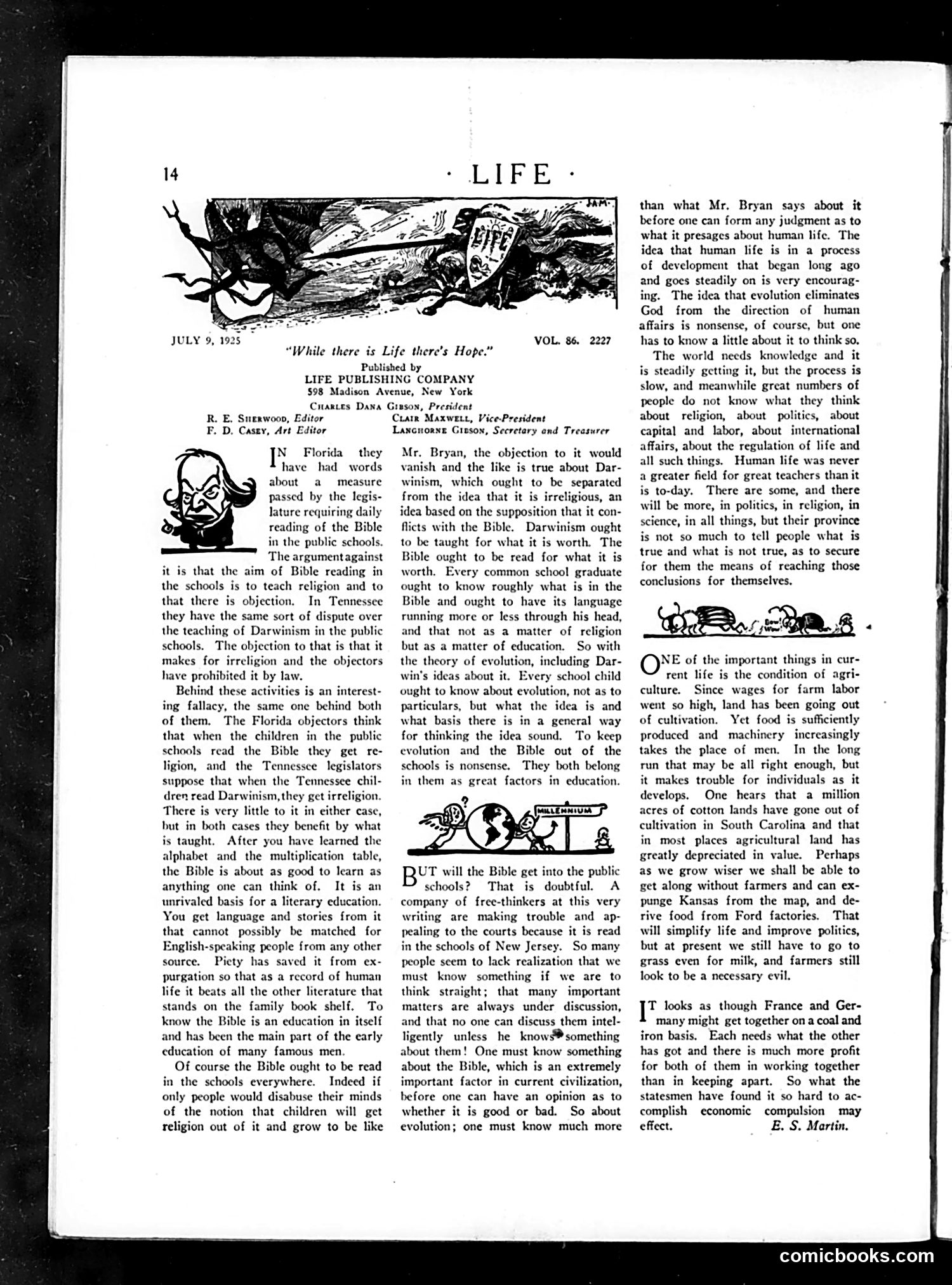
This editorial page addresses simultaneous controversies in Florida and Tennessee over teaching the Bible and Darwinism in public schools. The piece argues both subjects belong in curricula—not for religious or anti-religious purposes, but as education. The cartoon (upper left) appears to depict a demon or devil figure labeled "LIFE," likely representing the magazine's satirical voice mocking those who fear these subjects. The editor argues that opponents wrongly assume Bible-reading promotes religion and evolution teaching promotes irreligion. Instead, both should be taught factually: the Bible as literature and historical importance, evolution as scientific theory. The piece criticizes "free-thinkers" suing in New Jersey to prevent Bible reading, suggesting educated citizens must understand both subjects to think intelligently about contemporary issues. The implicit target is William Jennings Bryan (referenced), who opposed evolution teaching—a major figure in the famous 1925 Scopes Trial happening that same summer in Tennessee.
📄 Transcribed text from this page (OCR, searchable)
Machine-transcribed from the original scan — historical spelling and the odd misread are preserved.
JULY 9, 1925 VOL. 8. 2227 “While there is Life there’s Hope.” Published by LIFE PUBLISHING COMPANY $98 Madison Avenue, New York Cnartes Dana Ginson, President R. E, Suerwoon, Editor F. D. Casey, Art Editor N_ Florida have had words about a measure passed by the legis- lature requiring daily reading of the Bible in the public schools. The argumentagainst it is that the aim of Bible reading in the schools is to teach religion and to that there is objection. In Tennessee they have the same sort of dispute over the teaching of Darwinism in the public schools. The objection to that is that it makes for irreligion and the objectors have prohibited it by law. Behind these activities is an interest- ing fallacy, the same one behind both of them. The Florida objectors think that when the children in the public schools read the Bible they get re- ligion, and the Tennessce legislators suppose that when the Tennessee chil- dren read Darwinism, they get irreligion. There is very little to it in either case, but in both cases they benefit by what is taught. After you have learned the alphabet and the multiplication table, the Bible is about as good to learn as anything one can think of. It is an unrivaled basis for a literary education. You get language and stories from it that cannot possibly be matched for English-speaking people from any other source. Piety has saved it from ex- purgation so that as a record of human life it beats all the other literature that stands on the family book shelf. To know the Bible is an education in itself and has been the main part of the early education of many famous men Of course the Bible ought to be read in the schools everywhere. Indeed if only people would disabuse their minds of the notion that children will get religion out of it and grow to be like they Cain Maxwett, Vice-President Laxcnoane Gipson, Secretary and Treasurer Mr. Bryan, the objection to it would vanish and the like is true about Dar- winism, which ought to be separated from the idea that it is irreligious, an idea based on the supposition that it con- flicts with the Bible. Darwinism ought to be taught for what it is worth. The Bible ought to be read for what it is worth. Every common school graduate ought to know roughly what is in the Bible and ought to have its language running more or less through his head, and that not as a matter of religion but as a matter of education. So with the theory of evolution, including Dar- win's ideas about it. Every school child ought to know about evolution, not as to particulars, but what the idea is and what basis there is in a general way for thinking the idea sound, To keep evolution and the Bible out of the schools is nonsense. They both belong in them as great factors in education. But will the Bible get into the public schools? That is doubtful. A company of free-thinkers at this very writing are making trouble and ap- pealing to the courts because it is read in the schools of New Jersey. So many people seem to lack realization that we must know something if we are to think straight; that many important matters are always under discussion, and that no one can discuss them intel- ligently unless he knows® something about them! One must know something about the Bible, which is an extremely important factor in current civilization, before one can have an opinion as to whether it is good or bad. So about evolution; one must know much more than what Mr. Bryan says about it before one can form any judgment as to what it presages about human life. The idea that human life is in a process of development that began long ago and goes steadily on is very encourag- ing. The idea that evolution climinates God from the direction of human affairs is nonsense, of course, but one has to know a little about it to think so. The world needs knowledge and it is steadily getting it, but the process is slow, and meanwhile great numbers of people do not know what they think about religion, about politics, about capital and labor, about international affairs, about the regulation of life and all such things. Human life was never a greater field for great teachers than it is to-day. There are some, and there will be more, in politics, in religion, in science, in all things, but their province is not so much to tell people what is true and what is not true, as to secure for them the means of reaching those conclusions for themselves, CR OS of the important things in cur- O rent life is the condition of agri- culture. Since wages for farm labor went so high, land has been going out of cultivation. Yet food is sufficiently produced and machinery increasingly takes the place of men. In the long run that may be all right enough, but it makes trouble for individuals as it develops. One hears that a million acres of cotton lands have gone out of cultivation in South Carolina and that in most places agricultural land has greatly depreciated in value. Perhaps as we grow wiser we shall be able to get along without farmers and can ex- punge Kansas from the map, and de- rive food from Ford factories. That will simplify life and improve politics, but at present we still have to go to grass even for milk, and farmers still look to be a necessary evil. T looks as though France and Ger- many might get together ona coal and iron basis. Each needs what the other has got and there is much more profit for both of them in working together than in keeping apart. So what the statesmen have found it so hard to ac- complish economic compulsion may effect. E. S. Martin. comicbooks.com