
A complete issue · 44 pages · 1925
Life — June 4, 1925
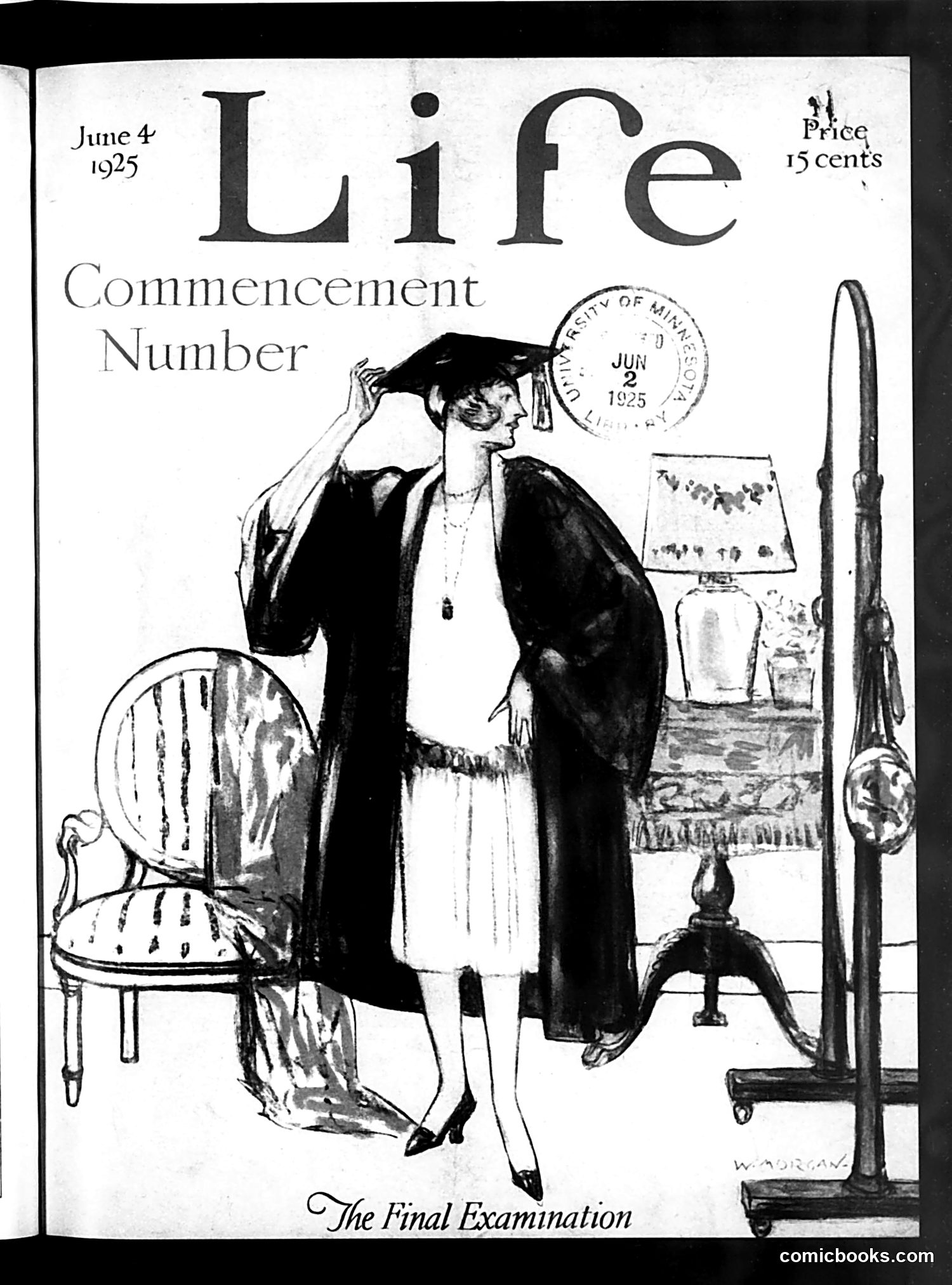
This is a "Commencement Number" cover depicting a young woman in graduation robes adjusting her mortarboard while surrounded by domestic objects: a mirror, chair, lamp, and skis. The title "The Final Examination" suggests ironic commentary on women's education and post-graduation prospects. The satire likely criticizes the gap between college education and women's actual life expectations in the 1920s. Despite earning degrees, female graduates faced pressure to prioritize domesticity (the furniture) and leisure (the skis, mirror) over careers. The "examination" appears to mock whether educated women will successfully transition to their "proper" roles as homemakers rather than professionals—a common anxiety of the era regarding women's changing social position.
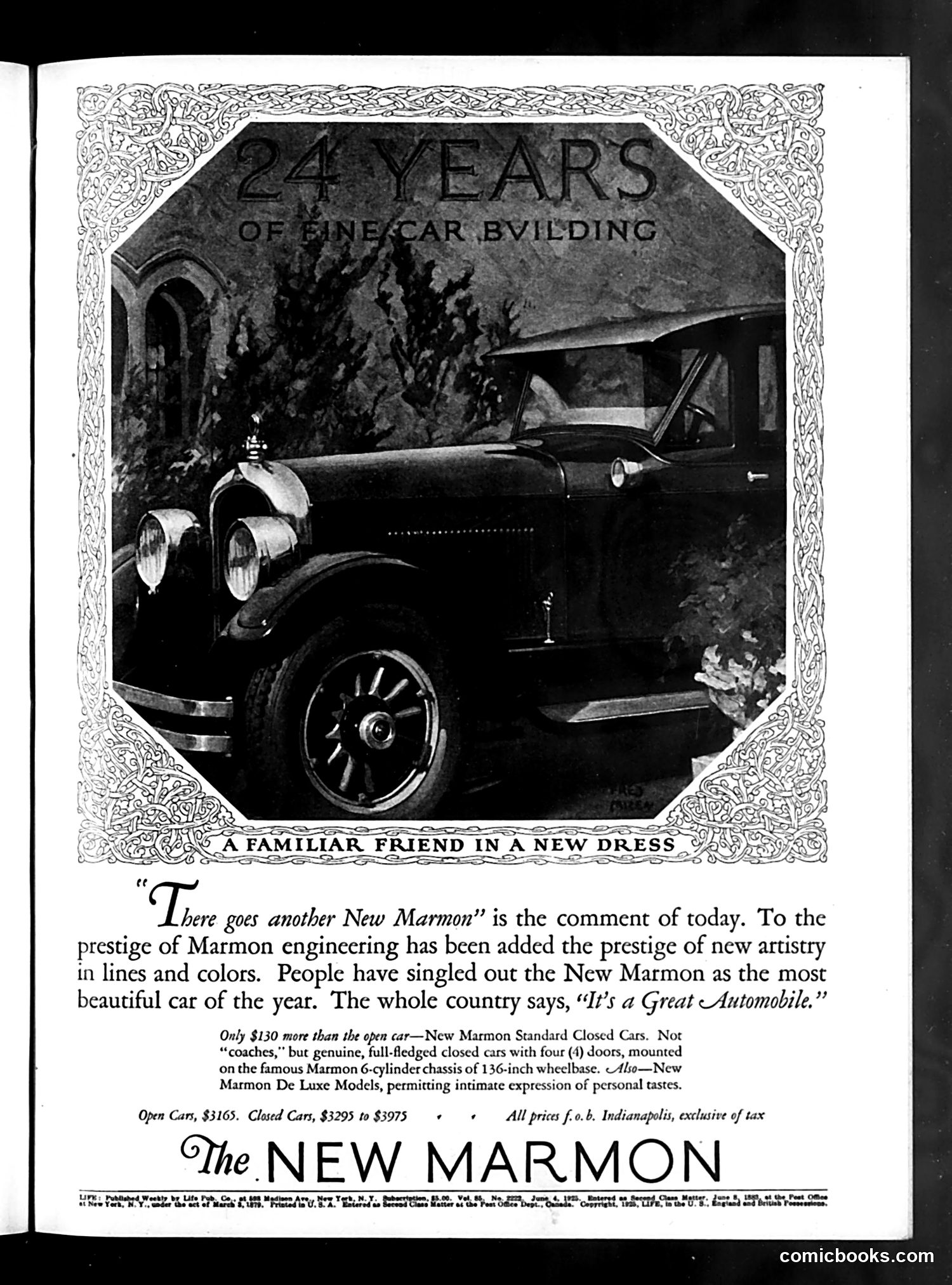
This is primarily a **Marmon automobile advertisement**, not political satire. The page celebrates the "New Marmon" car with the tagline "A Familiar Friend in a New Dress." The ad emphasizes that Marmon has updated its design while maintaining engineering excellence. The phrase "There goes another New Marmon" reflects the car's popularity and recognition. The text notes it's "the most beautiful car of the year"—reflecting broader 1920s automotive competition and consumer culture. The image shows a vintage closed car in what appears to be a scenic outdoor setting, typical of period advertising that associated automobiles with leisure and status. This represents straightforward commercial messaging rather than political commentary or satire. Life magazine carried extensive paid advertising alongside editorial content.
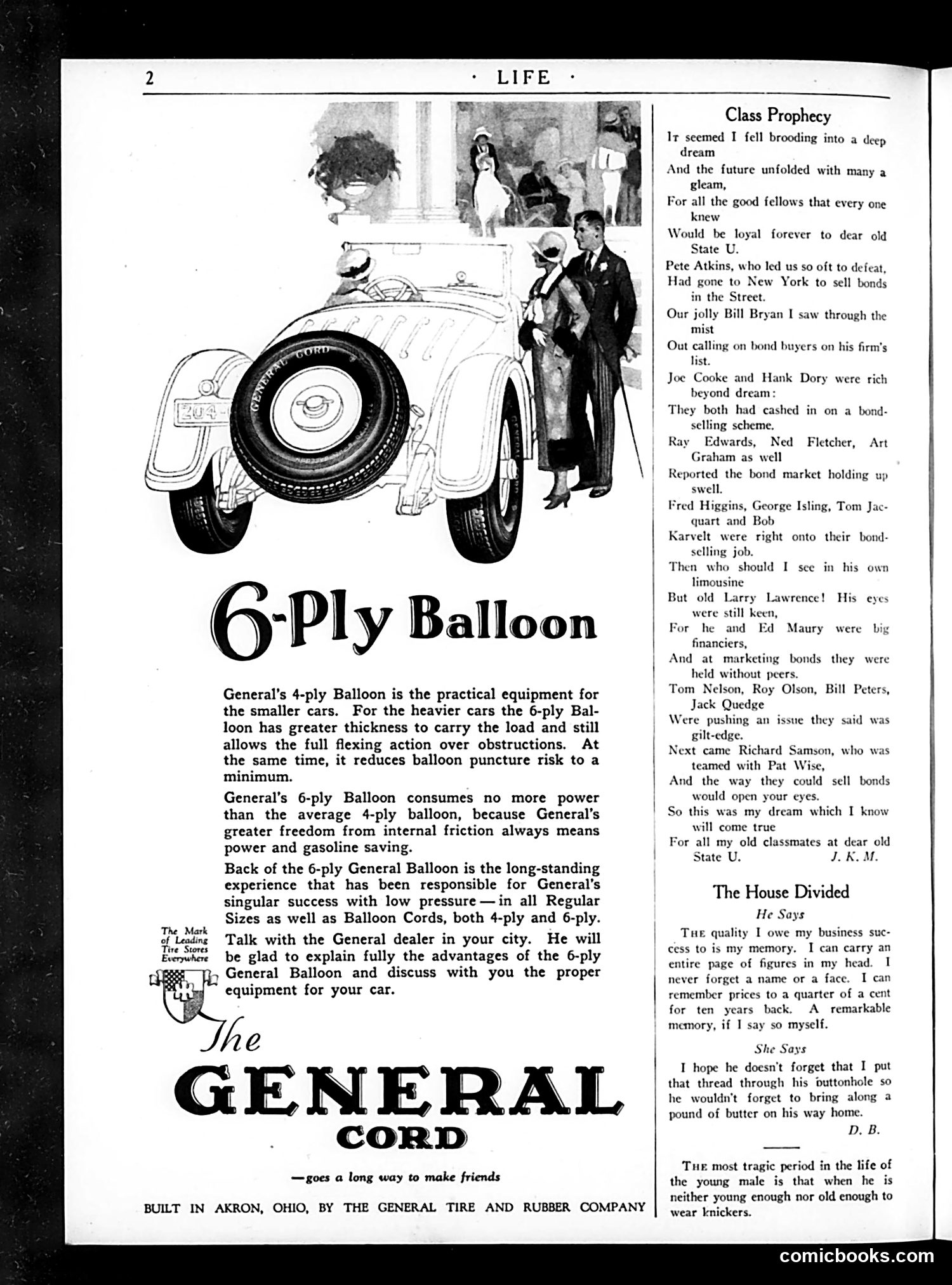
This page is primarily **advertising** for General Tire and Rubber Company's 6-ply balloon tires, featuring an illustration of a 1920s automobile with well-dressed figures. The right column contains two separate pieces: 1. **"Class Prophecy"** - a humorous poem predicting the futures of State U. classmates, mentioning specific individuals (Pete Atkins, Bill Bryan, Joe Cooke, etc.) entering bond-selling during what appears to be the post-WWI economic period. The satire mocks their commercial ambitions and financial schemes. 2. **"The House Divided"** - brief anecdotes about memory and domestic life, including a joke about a woman's remarkable memory for prices and a comment on young boys wearing knickers (then standard children's clothing). The content reflects 1920s collegiate humor and social commentary rather than political satire.
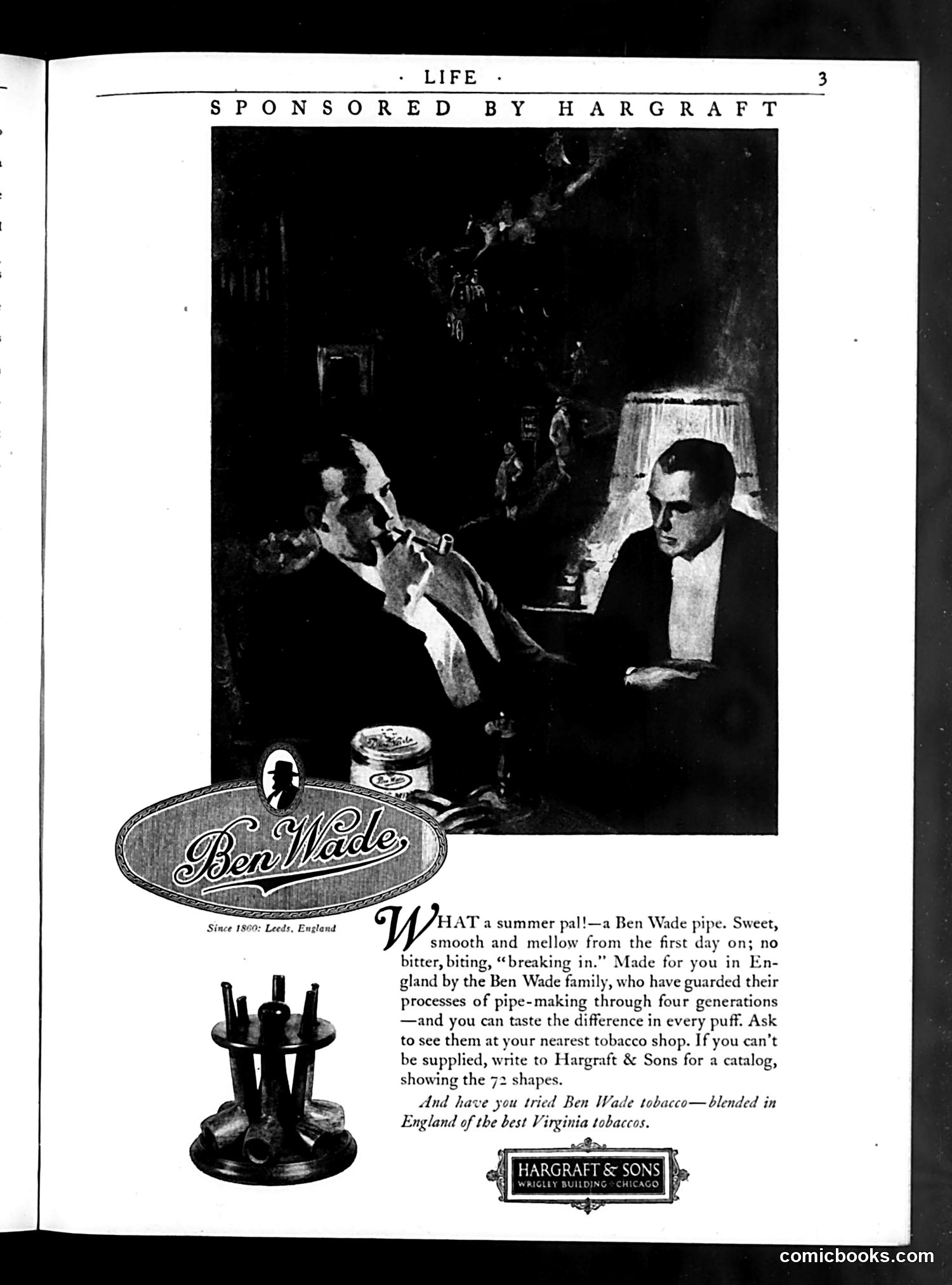
This page is primarily **advertising, not satire or political commentary**. It's a Ben Wade pipe tobacco advertisement sponsored by Hargraft. The black-and-white photograph shows two men in formal attire in what appears to be a dining or social setting. The ad copy emphasizes Ben Wade pipes as a premium product made in England since 1860, highlighting their smooth quality and lack of harshness ("no bitter, biting"). The visual appears designed to suggest sophistication and leisure—two well-dressed gentlemen in an upscale environment. The ad directs readers to tobacco shops or to request a catalog from Hargraft & Sons in Chicago, and mentions Ben Wade tobacco blended from Virginia tobaccos. There is no political cartoon or satire present on this page.
This is a **recruitment advertisement**, not a political cartoon. Life magazine is soliciting humor contributions from college students and other writers/artists. The page emphasizes that Life discovered several famous contributors early in their careers—mentioning **Charles Dana Gibson, Wallace Irwin, Rupert Hughes, James Montgomery Flagg, and Coles Phillips**—launching them toward success. The magazine claims it actively seeks undiscovered talent rather than established names. A historical anecdote describes how **Booth Tarkington** (the famous novelist) submitted jokes thirty years earlier, received $2 for one, and this payment launched his career. The advertisement includes a subscription offer and notes special upcoming themed issues on golf, economy, old home week, and other topics. This is essentially a want-ad for aspiring humorists, positioning Life as a prestigious launching pad for literary talent.
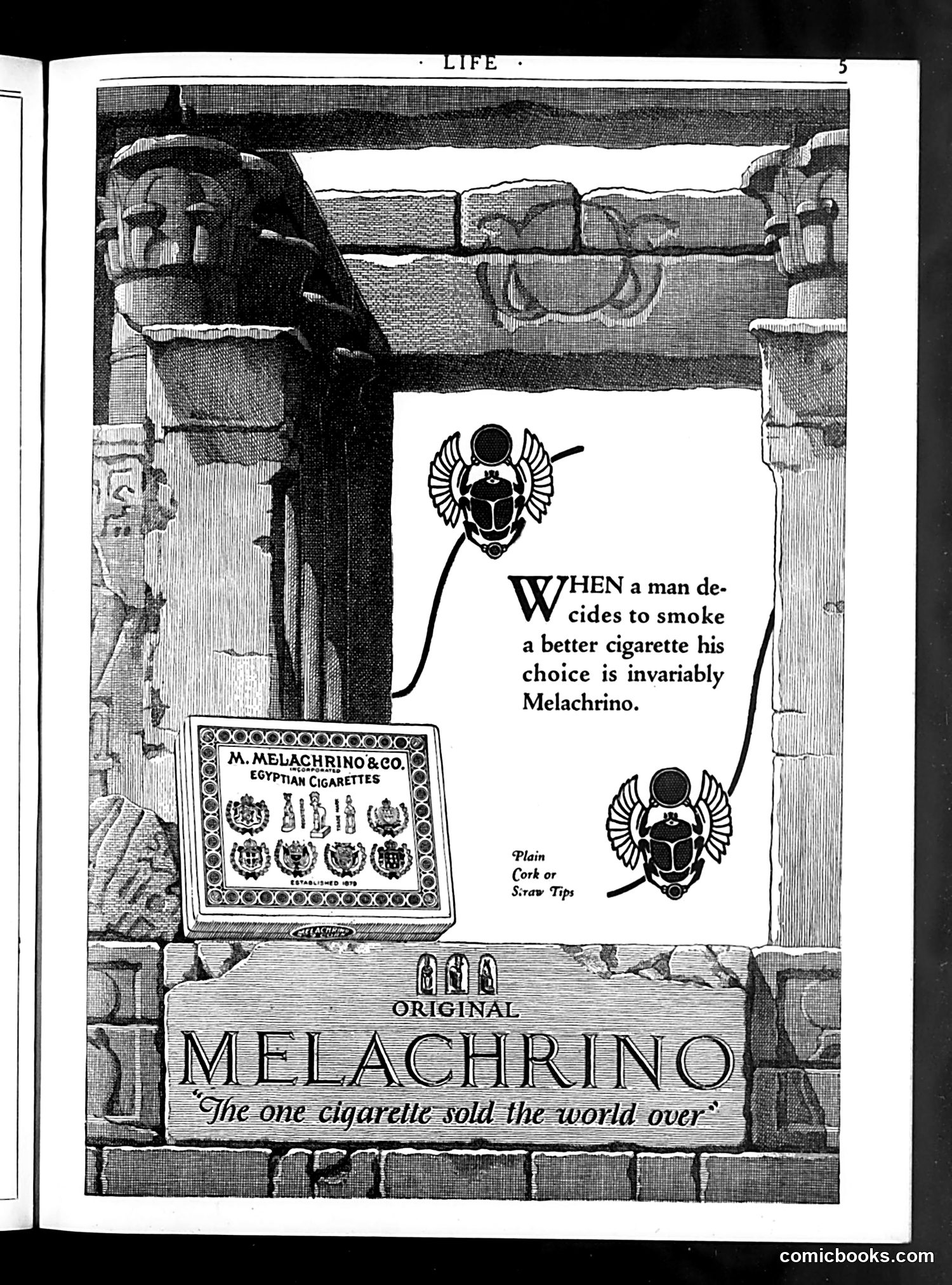
This is a cigarette advertisement rather than political satire. The page features Melachrino Egyptian cigarettes and uses Egyptian imagery—specifically two large stone pharaoh heads flanking the product box, styled like an ancient temple entrance. The advertisement's tagline claims Melachrino is "the one cigarette sold the world over," suggesting its global popularity and prestige. The winged scarab beetle symbols (Egyptian religious imagery) reinforce the "exotic" branding. Text notes the cigarettes come in "Plain Cork or Straw Tips." This reflects early-20th-century advertising's common practice of using Orientalist and ancient imagery to convey luxury, worldliness, and superiority—appeals designed to attract affluent consumers. The exotic Egyptian aesthetic was meant to suggest refinement and cosmopolitan taste.
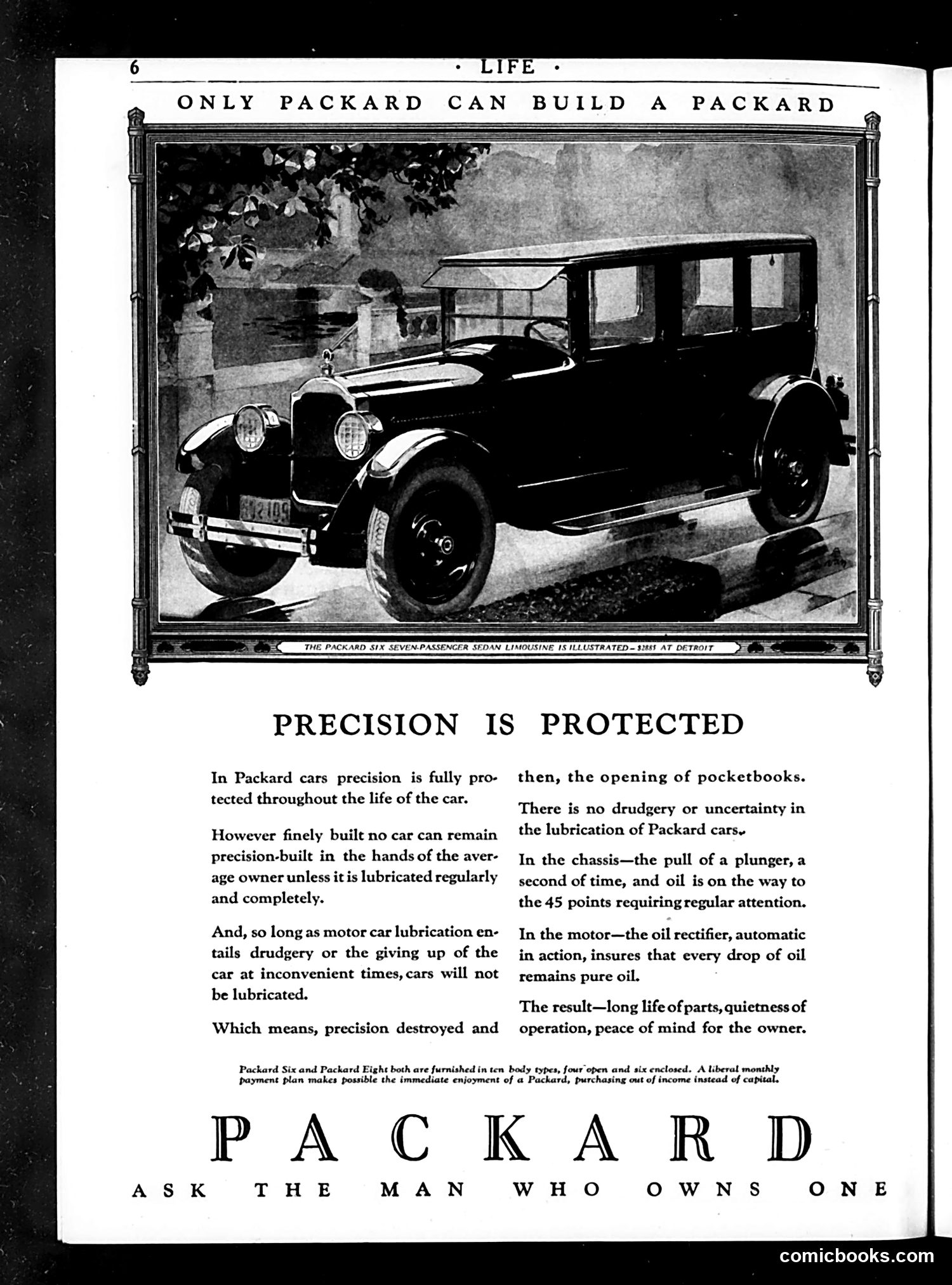
This page is primarily an **advertisement for Packard automobiles**, not political satire. The headline "ONLY PACKARD CAN BUILD A PACKARD" frames the sales pitch. The image shows a Packard Six Seven-Passenger Sedan Limousine. The accompanying text argues that Packard's quality depends on proper maintenance—specifically regular lubrication at 45 different points. The ad warns that even perfectly-built cars lose precision without consistent owner care. The closing line, "ASK THE MAN WHO OWNS ONE," was Packard's actual advertising slogan, inviting potential buyers to consult satisfied owners. This is straightforward automotive marketing emphasizing craftsmanship and the owner's responsibility for upkeep—typical early 20th-century luxury car advertising with no satirical content.
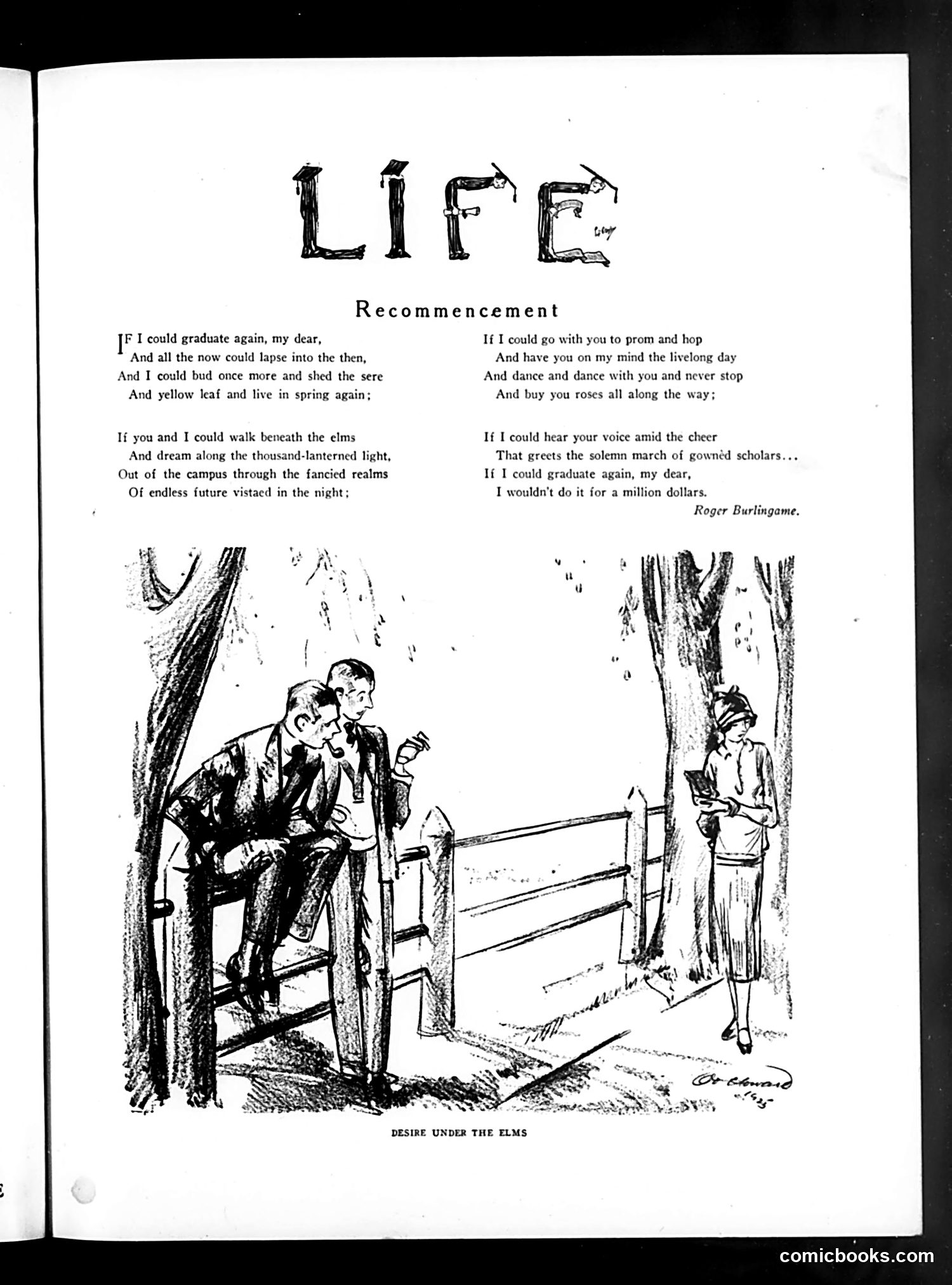
This is a commencement-themed literary page from *Life* magazine featuring a poem by Roger Burlingame titled "Recommencement." The poem nostalgically imagines revisiting college experiences—walking under elms, attending graduation ceremonies, dancing at proms. The accompanying illustration, captioned "Desire Under the Elms," depicts two young men sitting on a fence beneath trees, observing a young woman reading alone. The image plays on the poem's romantic nostalgia about college life and youthful romance. The page appears designed for spring/graduation season. The title references a famous play (*Desire Under the Elms* by Eugene O'Neill, 1924), adding literary sophistication to what is essentially sentimental commentary on college memories and lost youth—typical *Life* magazine fare blending humor, literature, and social observation about American life.
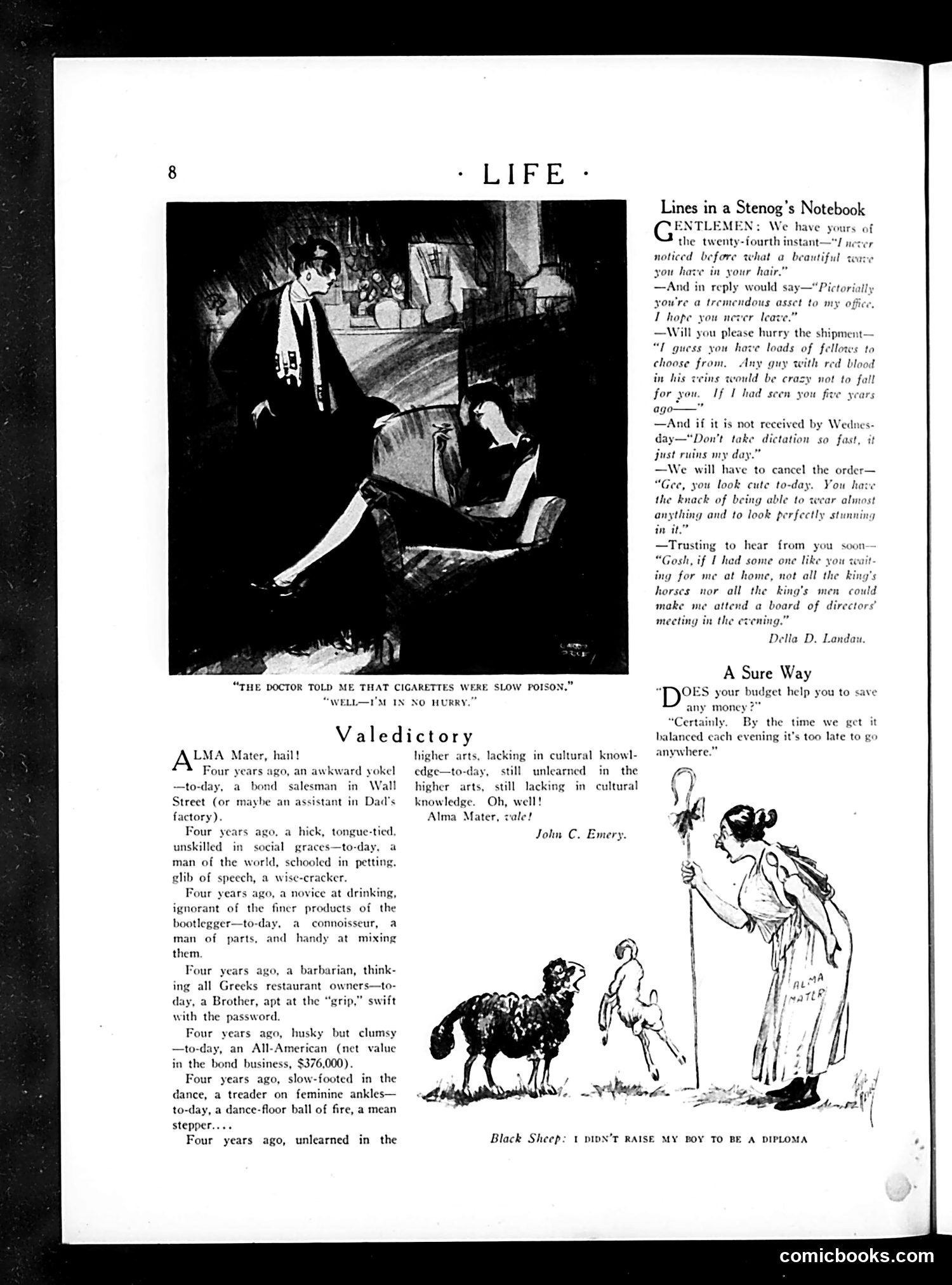
This page contains two distinct satirical pieces: **"Valedictory"** (left) by John C. Emery satirizes social climbing and pretension. It mocks "Alma Mater" — a person who four years ago was an awkward bond salesman but has now become a cultured connoisseur and "man of the world," despite lacking genuine cultural knowledge. The satire's point: superficial self-improvement and social aspiration can produce only shallow mimicry of sophistication. **"Black Sheep" cartoon** (bottom right) depicts a woman labeled "MOTHER" holding money while children play. The caption reads: "I didn't raise my boy to be a diploma" — satirizing parental concerns about education's cost-benefit. It suggests parents question whether expensive education justifies its price when practical success requires less formal credentials. Both pieces target early 20th-century American social anxieties about class mobility and education.
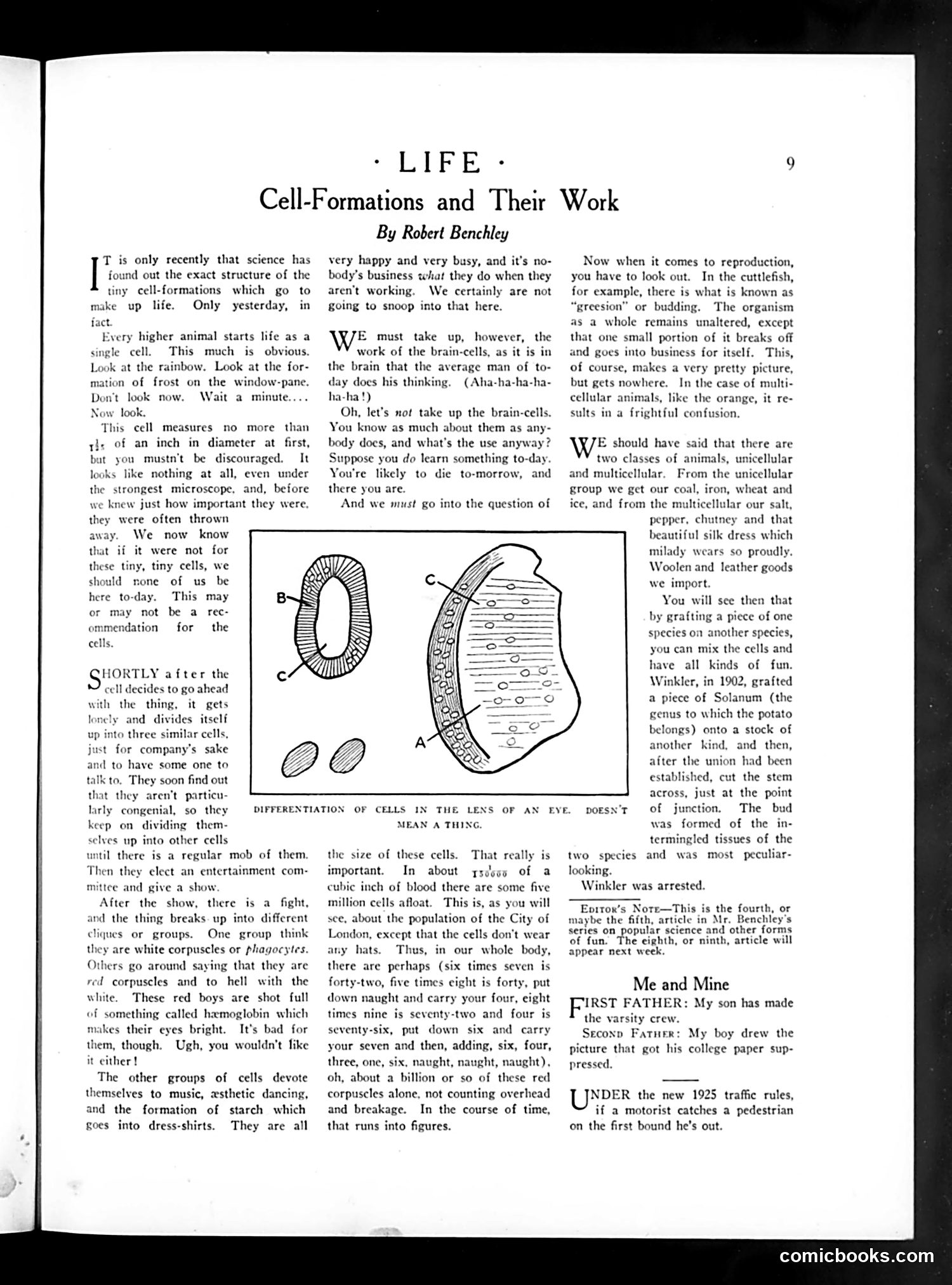
This page is primarily educational rather than satirical. It's an article titled "Cell-Formations and Their Work" by Robert Benchley explaining basic cell biology to a general audience. The only illustration shows a microscopic diagram of cells differentiating in an eye lens, with labeled parts (A, B, C) and smaller individual cells below. The image demonstrates how cells specialize and change form. The article uses accessible, humorous language typical of Benchley's style—comparing the number of blood cells to London's population, for instance—to make science engaging for lay readers. The brief sidebar items "Me and Mine" appear to be unrelated humor pieces. This represents Life magazine's educational mission alongside satire, making complex scientific concepts entertaining for 1920s readers.
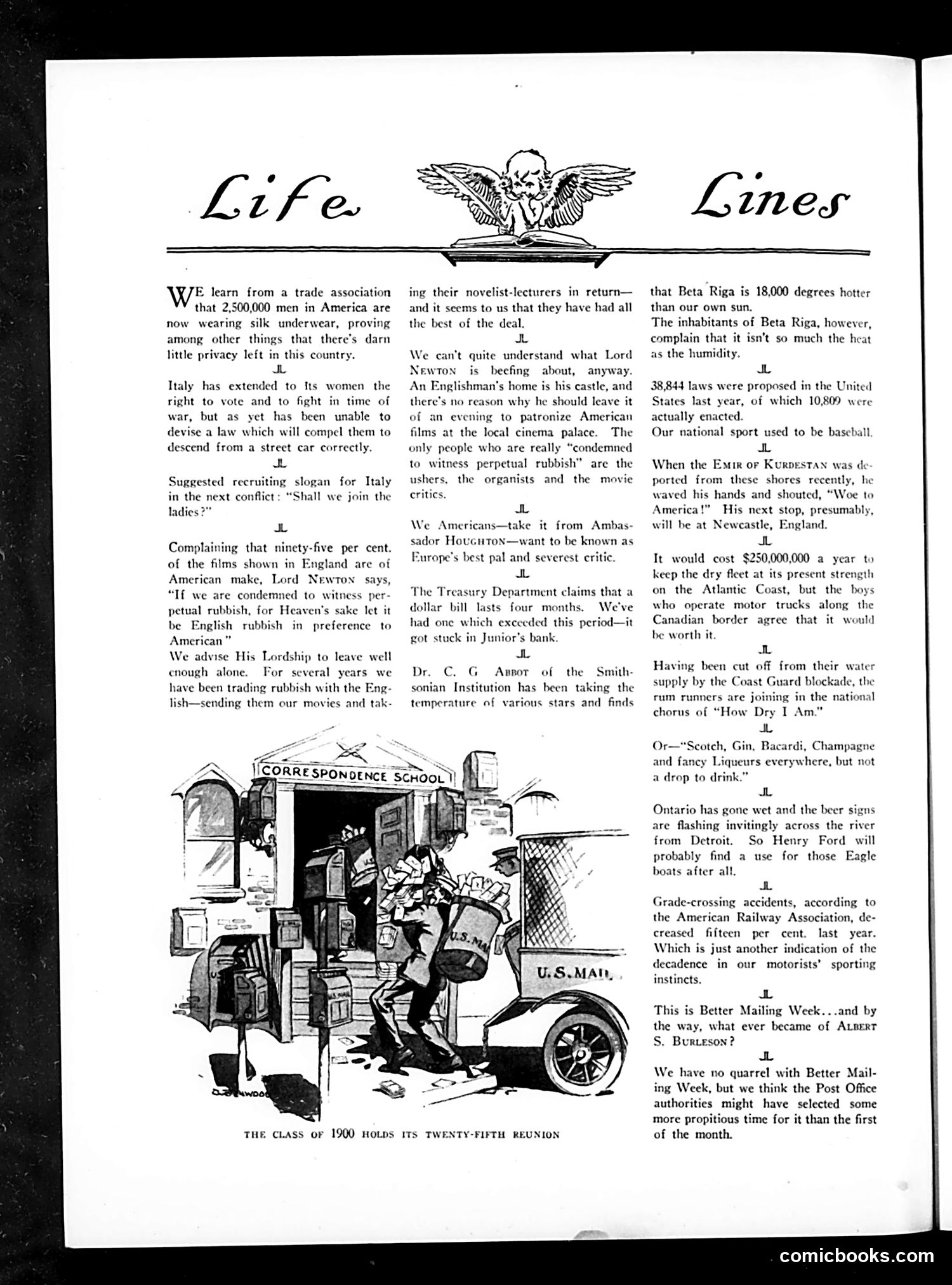
This "Life Lines" satirical commentary page features a central cartoon captioned "The Class of 1900 Holds Its Twenty-Fifth Reunion." The illustration depicts a chaotic mobile "Correspondence School" vehicle labeled "U.S. MAIL," suggesting the decline of traditional education institutions by 1925. The surrounding text mocks contemporary issues: Italy's women's suffrage efforts, Lord Newton's film patronage, proposed labor laws, and scientific observations about Beta Riga's temperature. The final items satirize Prohibition's effects (rum runners, beer signs flashing across borders into dry Ontario) and motorists' recklessness. The overall tone critiques modernization's unintended consequences—mechanization replacing proper schooling, legal restrictions breeding lawlessness, and safety concerns amid rapid technological change.
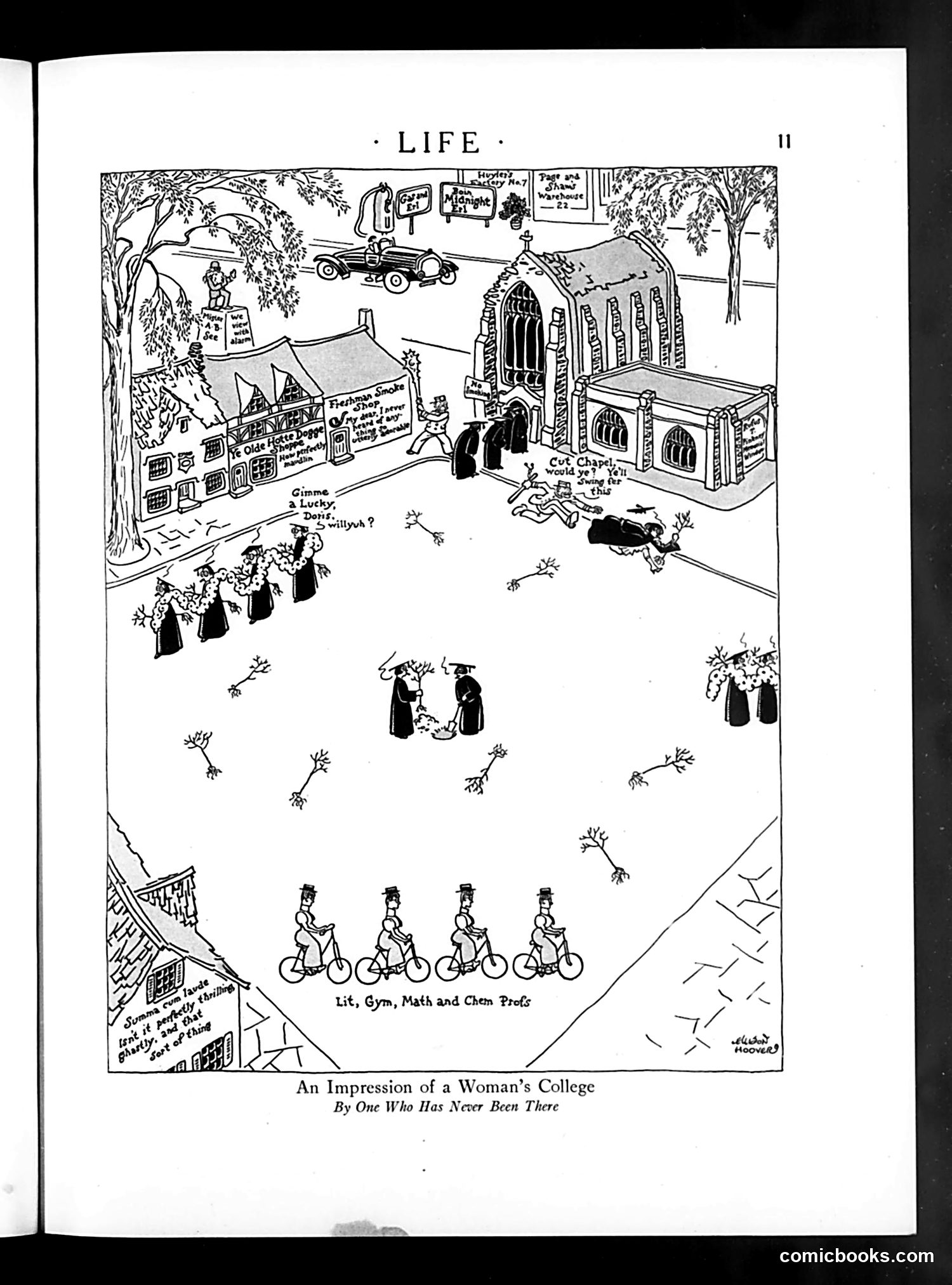
This is a satirical cartoon titled "An Impression of a Woman's College By One Who Has Never Been There." The subtitle explicitly signals this is exaggerated speculation rather than accurate reporting. The cartoon mocks misconceptions about women's colleges through absurd imagery: a chapel, various academic buildings, and unusual activities. Notable elements include what appears to be professors on bicycles (labeled "Lit, Gym, Math and Chem Profs"), people in formal academic dress, and various campus scenes that seem designed to appear bizarre or unfamiliar to contemporary readers unfamiliar with such institutions. The satire targets both the mystery surrounding women's higher education and likely the anxieties or stereotypes held by outsiders—suggesting that those unfamiliar with women's colleges imagine them as strange, foreign places. The humor relies on the disconnect between actual college life and wild speculation about it.
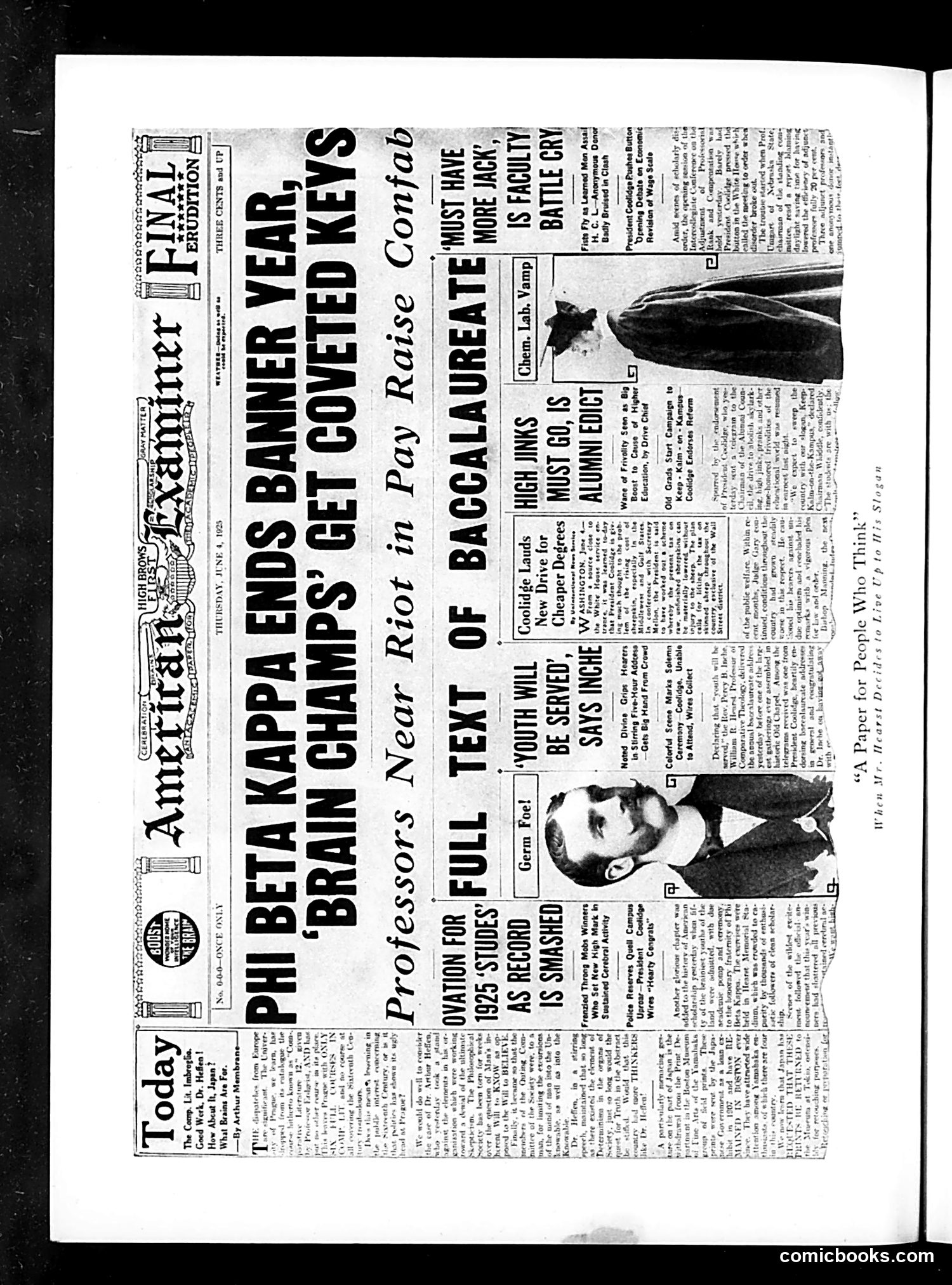
This page is primarily **advertising rather than editorial content**. The dominant feature is a large Kappa advertisement claiming "PHI BETA KAPPA ENDS BANNER YEAR GETS COVERED BRAIN CHAMPS" with text about "Professor's Near Riot in Pay Raise Commotion" and "Full Text of Bagoal Laureatre." The layout includes two photographs of men and various article snippets. However, the actual satirical or political cartoon content is **not clearly visible or legible** in this reproduction. The page appears to mix commercial advertising (particularly the Kappa promotion, which seems to be a fraternity or educational organization advertisement) with news content, which was common in Life magazine's format. Without clearer imagery of any actual cartoon illustrations, I cannot reliably identify specific figures, caricatures, or satirical points.
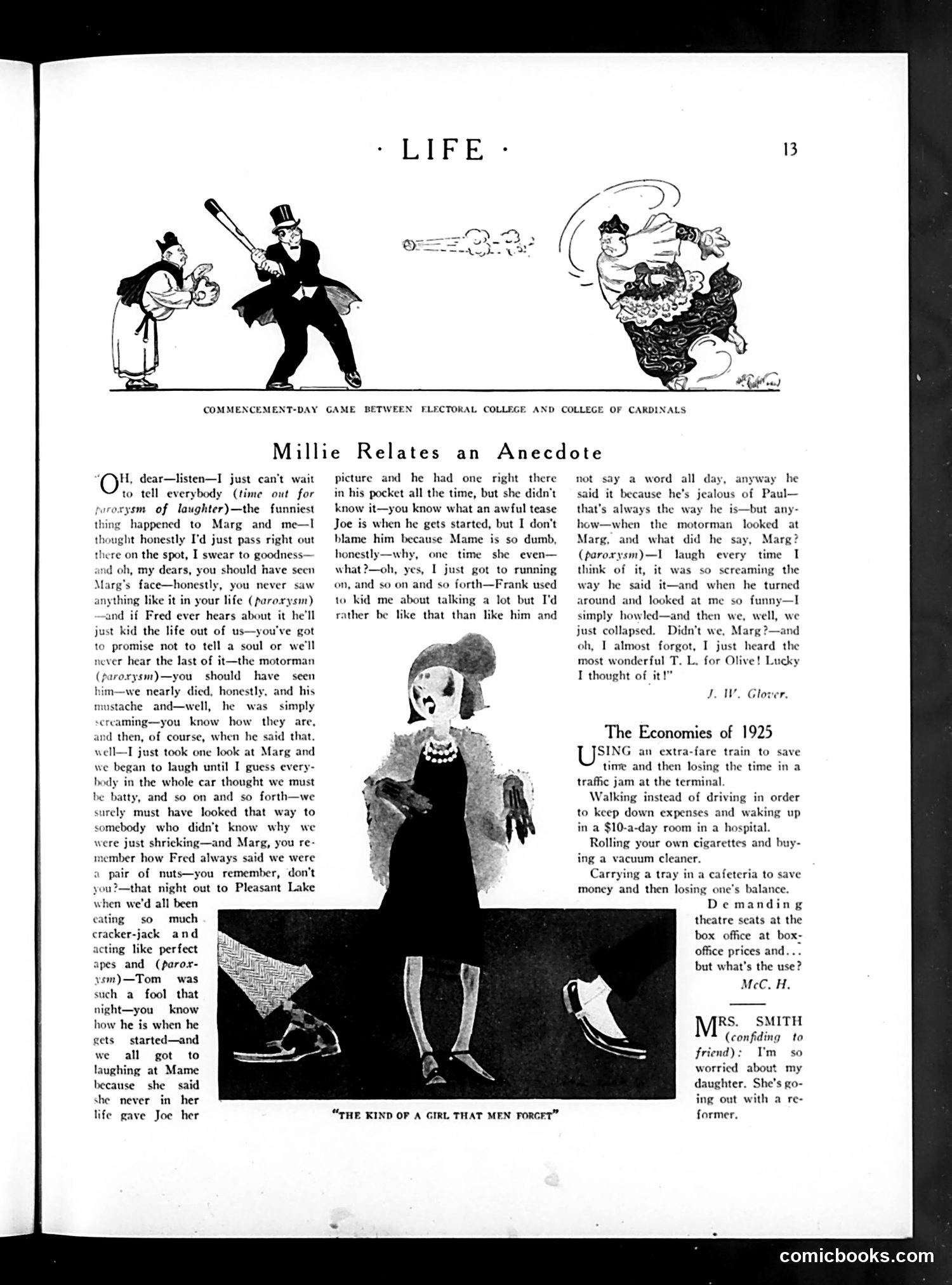
This page features humorous anecdotes and social commentary typical of 1920s American satire. The main cartoon, captioned "The Kind of a Girl That Men Forget," depicts a fashionably dressed woman in period attire, illustrating the story about "Millie" who relates an embarrassing incident involving her friend Mame at an Electoral College/College of Cardinals commencement game. The top comic strip shows a slapstick scene with figures in formal dress, likely satirizing political or academic pretension. Below are lighter pieces: "The Economies of 1925" mocks various penny-pinching habits, and "Mrs. Smith" discusses worries about her daughter dating a "reformer"—reflecting period anxieties about courtship and social propriety. The humor relies on contemporary references to fashions, social institutions, and dating customs of the 1920s Jazz Age.
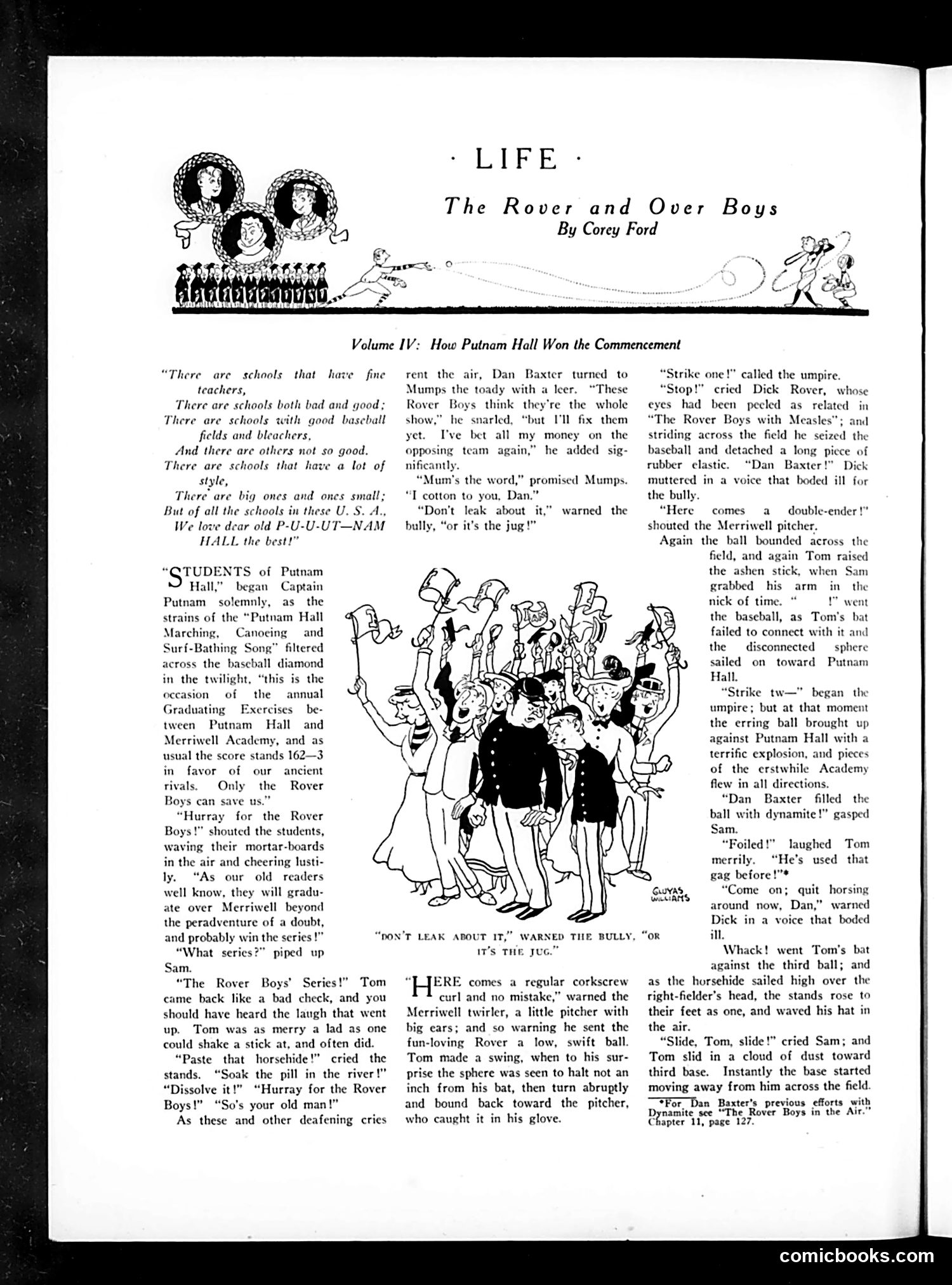
This is a humorous short story about a baseball game at Putnam Hall, a school. The narrative describes a match between Putnam Hall and their rivals, Merriwell Academy, during graduation exercises. The central joke concerns a malfunctioning baseball: a pitcher throws a deliberately rigged ball filled with dynamite that explodes on contact, scattering pieces across the field. The story plays on early 20th-century baseball fiction conventions (likely referencing the "Frank Merriwell" adventure series), exaggerating the competitive intensity of school rivalries into absurdist territory. The cartoon illustrates students enthusiastically cheering, capturing the satirical tone. Ford's humor mocks overwrought school sports narratives by literalizing the metaphorical "explosiveness" of competitive play.
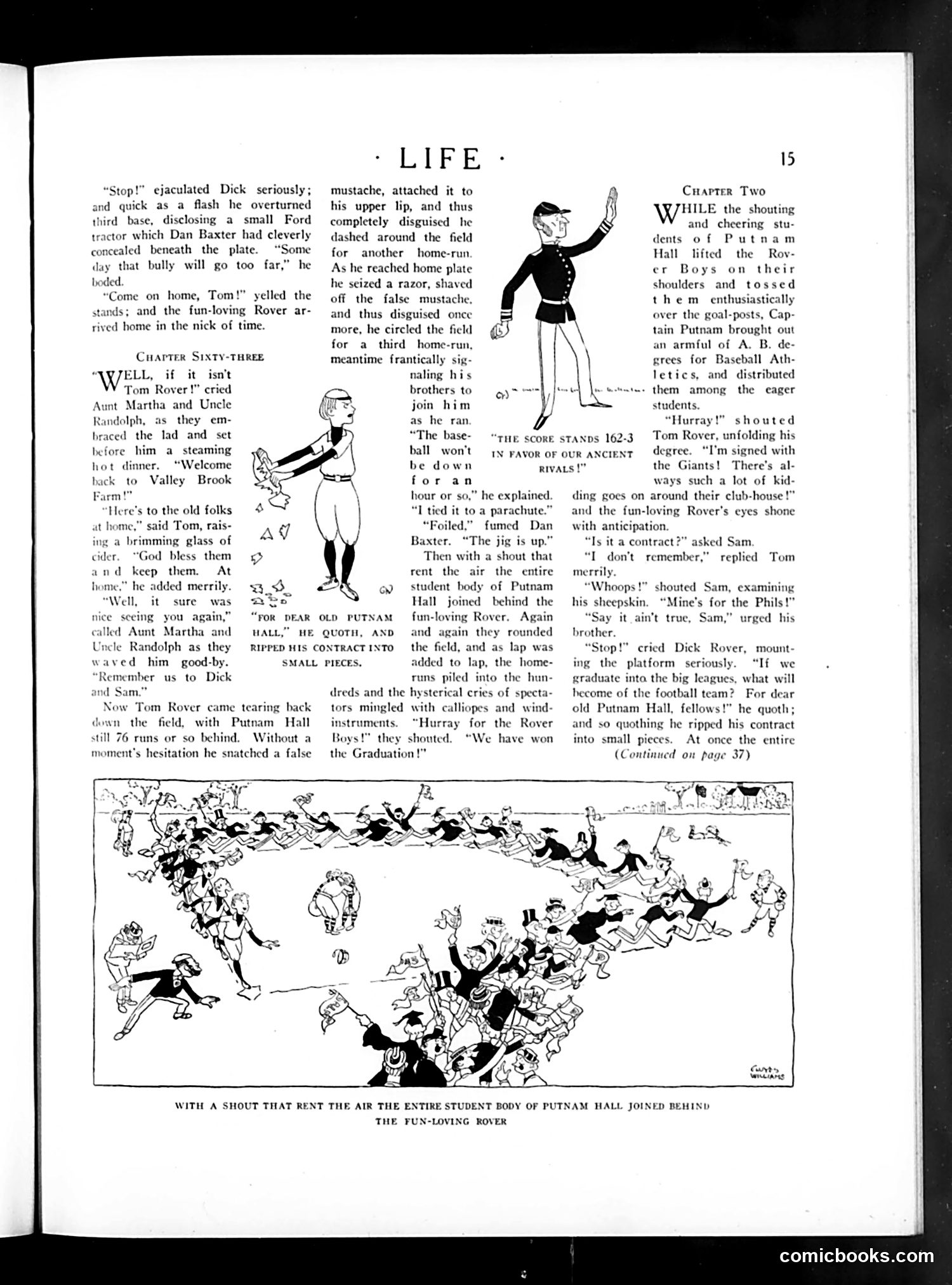
This page from *Life* magazine presents a serialized story titled "Life" about baseball at Putnam Hall. The narrative describes a baseball game where Tom Rover, a mischievous character, disrupts proceedings by disguising himself with a false mustache and creating chaos on the field. The large cartoon illustration depicts the comedic climax: students from Putnam Hall enthusiastically chasing after Rover in a chaotic stampede. The humor relies on slapstick comedy and the visual gag of mass pandemonium—a common satirical device in early 20th-century *Life* magazine. The joke is straightforward: Rover's pranks and disguise trigger absurd, exaggerated reactions from the student body, treating a baseball game as a stage for juvenile mischief. No specific political or social commentary is evident; this appears to be pure comedic entertainment aimed at readers amused by school-based hijinks.
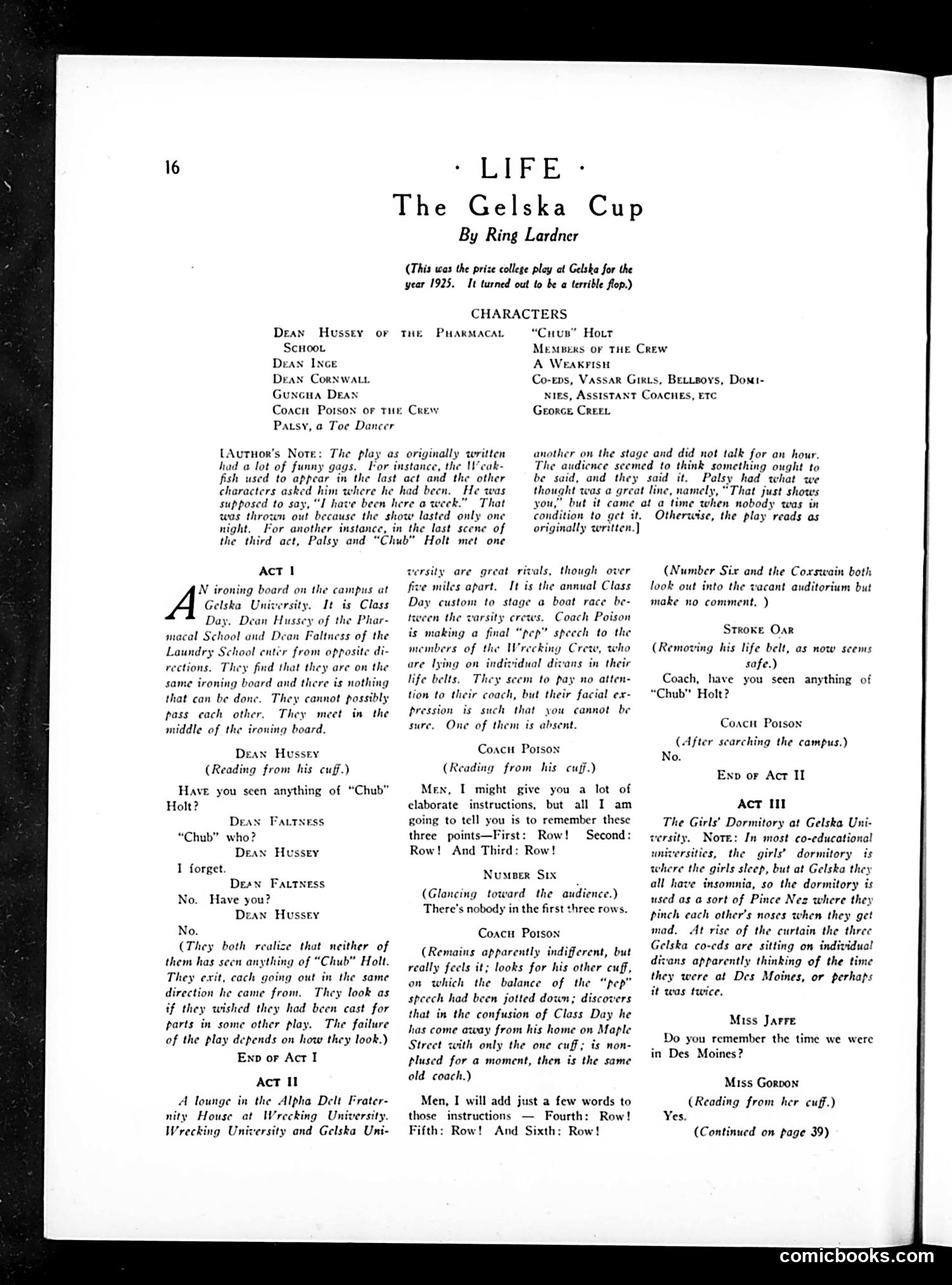
This is the opening of a satirical stage play mocking college theatrical productions. The frame narrative reveals the play "turned out to be a terrible flop"—it lasted only one night. The satire targets amateur dramatics: scenes set in absurd locations (an ironing board where characters cannot pass each other), incoherent plot (everyone searching for absent character "Chub" Holt), and cringe-inducing dialogue. Coach Poison's "pep speech" reduces to monotonous repetition ("Row! Row! Row!"), and he's so disorganized he loses his speech notes. The humor comes from exposing the pretentiousness and incompetence of college theatrical productions—the strained dialogue, missing actors, empty audiences, and desperate improvisation. Ring Lardner was a famous American humorist known for satirizing contemporary institutions. This piece mocks the earnest but amateurish college drama scene of the 1920s.
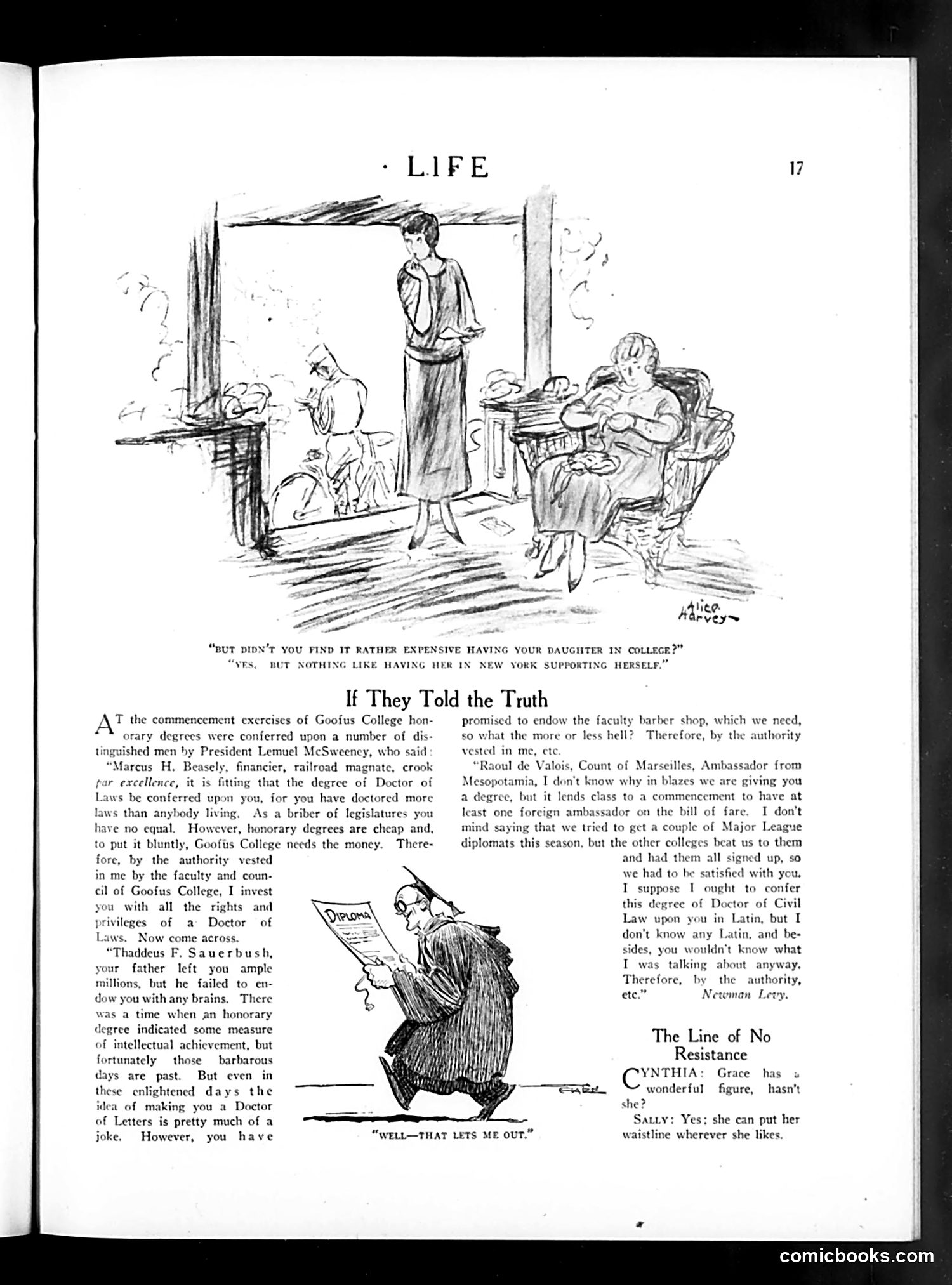
**Top Cartoon:** A conversation between two parents reveals the economic reality behind college costs. The joke satirizes that while college tuition is expensive, a young woman living independently in New York City (supporting herself without family help) costs even more—a comment on both the financial burden of education and the challenges of unmarried women's independence in this era. **"If They Told the Truth":** This satirical piece mocks the hypocrisy of honorary degree ceremonies. A fictional college president bluntly reveals the actual reasons for awarding degrees: bribing legislators, donating money for campus facilities, and social prestige (having a foreign ambassador present), rather than genuine intellectual achievement. The satire exposes how institutions compromise their standards for financial gain. **"The Line of No Resistance":** A brief joke about a woman named Grace whose figure is so flexible she can position her waistline wherever she wants—likely referencing 1920s fashion trends of loose, adjustable waistlines that contrasted with earlier corseted styles.
This commencement issue contains editorial commentary comparing political figures to biblical prophets. The main text discusses President **Woodrow Wilson**, analyzing why contemporaries considered him "a prophet" despite his many flaws and unpopular decisions. The author argues that Wilson, like Old Testament prophets, spoke uncomfortable truths to power—particularly regarding World War I and the League of Nations—even when authorities and the public disagreed. General **R.L. Bullard** (a retired military figure) had recently published critical retrospectives on Wilson's war leadership in the *Herald Tribune*. The piece then pivots to **Senator William Borah**, posing whether he too functions as a "prophet"—likely referencing his isolationist stance and challenges to prevailing foreign policy. The satire lies in the *prophet* framework: these political figures claim moral authority while being dismissed or contradicted by establishment powers, mirroring biblical prophets' perpetual conflicts with kings.
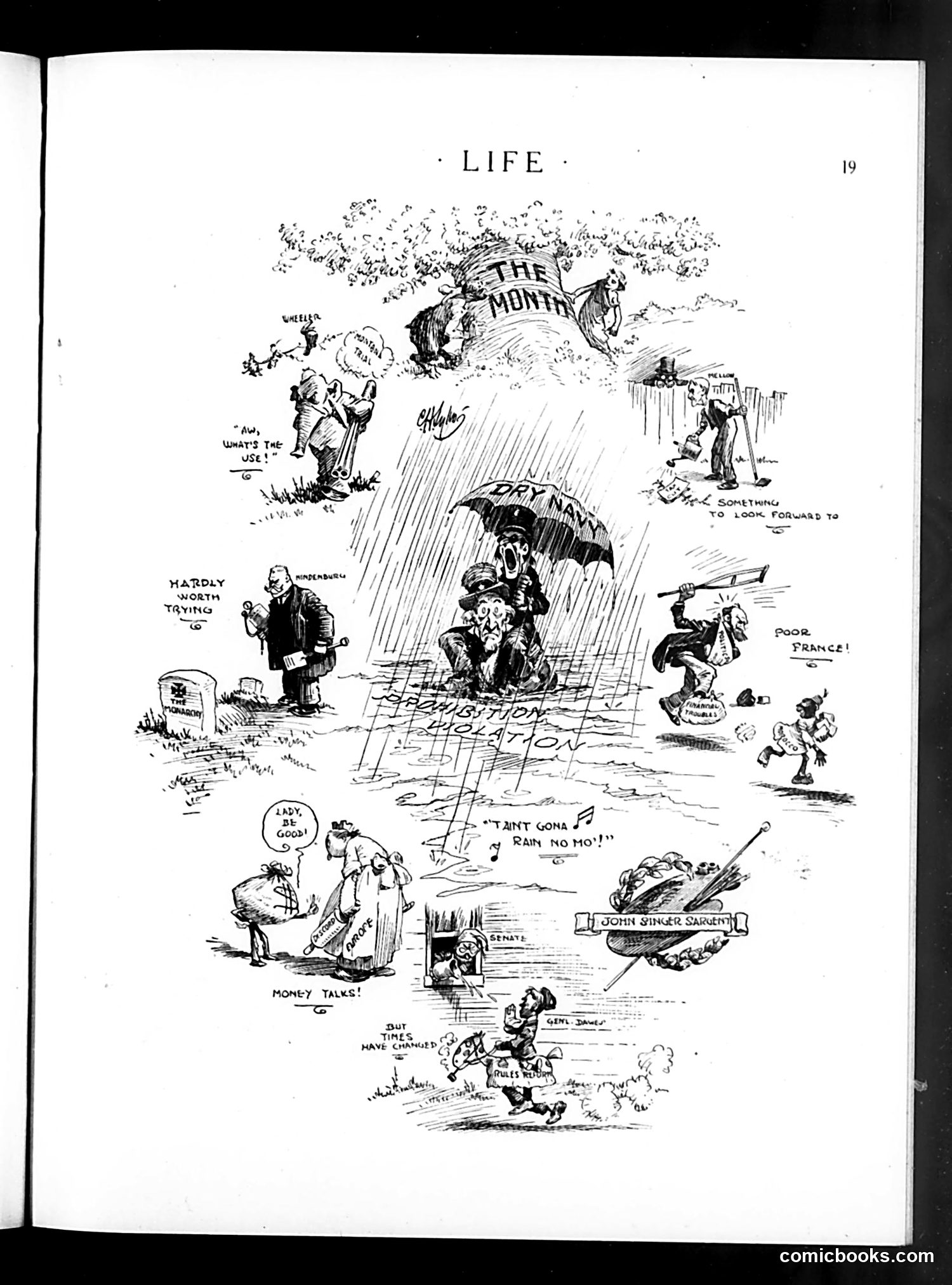
This Life magazine cartoon satirizes American optimism during difficult times, likely the early 20th century. Central figures appear to be politicians or public figures huddled under an umbrella labeled "EXPOSITION" during heavy rain labeled "PANIC" and "STAGNATION." The scattered vignettes mock various reassurances: "Money Talks," "It'll Be Good," and "'Taint Gonna Rain No Mo'" represent false promises from leaders. References include "Poor France," "John Ginger Sargent," and figures like "Gen. James" and senators offering platitudes while economic hardship persists below. The cartoon's point: despite politicians' cheerful rhetoric and exposition celebrations (possibly World's Fairs), ordinary citizens face real "panic" and "stagnation" that hollow optimism cannot address. The contrast between official cheerfulness and actual suffering drives the satire.
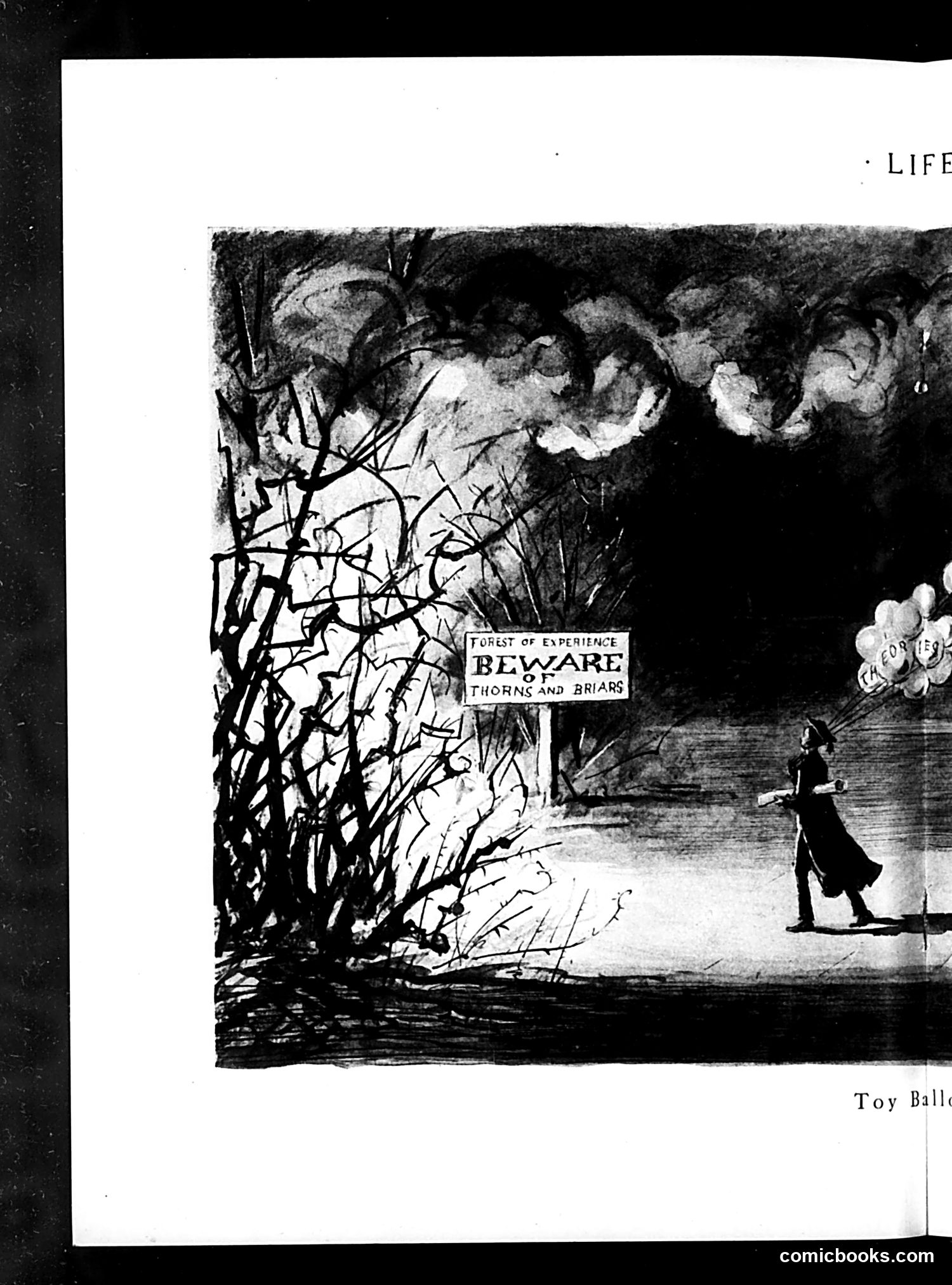
This illustration appears to be an allegorical cartoon about life's dangers and obstacles. A solitary figure stands before a thorny, bramble-filled forest labeled "Forest of Experience - Beware Thorns and Briars," with faces peering down from above (possibly representing fate, consequences, or society's judgment). The satire suggests that navigating life's "forest"—pursuing experience and ambition—requires caution against hidden dangers symbolized by thorns and briars. The looming faces may represent social pressures or inevitable hardships. The work seems to warn against naïve optimism, suggesting that experience gained through life's journey comes with unavoidable pain and difficulty. The exact artist and publication date remain unclear from the visible text.
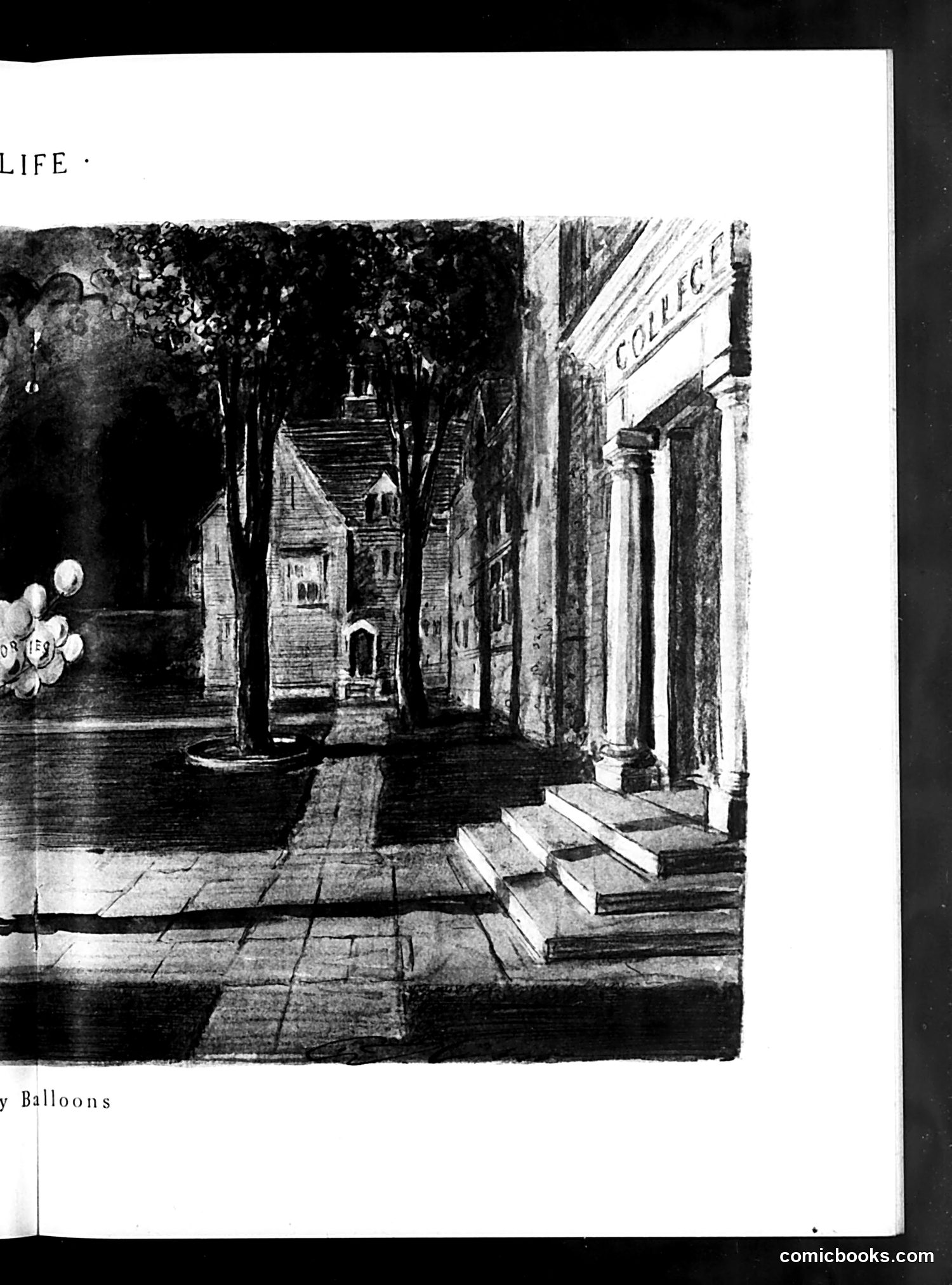
This page shows a black and white illustration of an architectural courtyard or colonnade scene, likely from an early 20th-century Life magazine. The image depicts classical columns, steps, and buildings arranged in perspective, with what appears to be balloons visible on the left side. The OCR text is too fragmentary to provide meaningful content. The visible text mentions "Balloons" at the bottom, suggesting the illustration may be satirizing something related to balloons—possibly a social event, architectural pretension, or political commentary involving balloon imagery. Without clearer text or a visible title, I cannot confidently identify the specific satirical target or historical reference. The classical architectural setting suggests commentary on institutional or formal society, but the exact point remains unclear from this page alone.
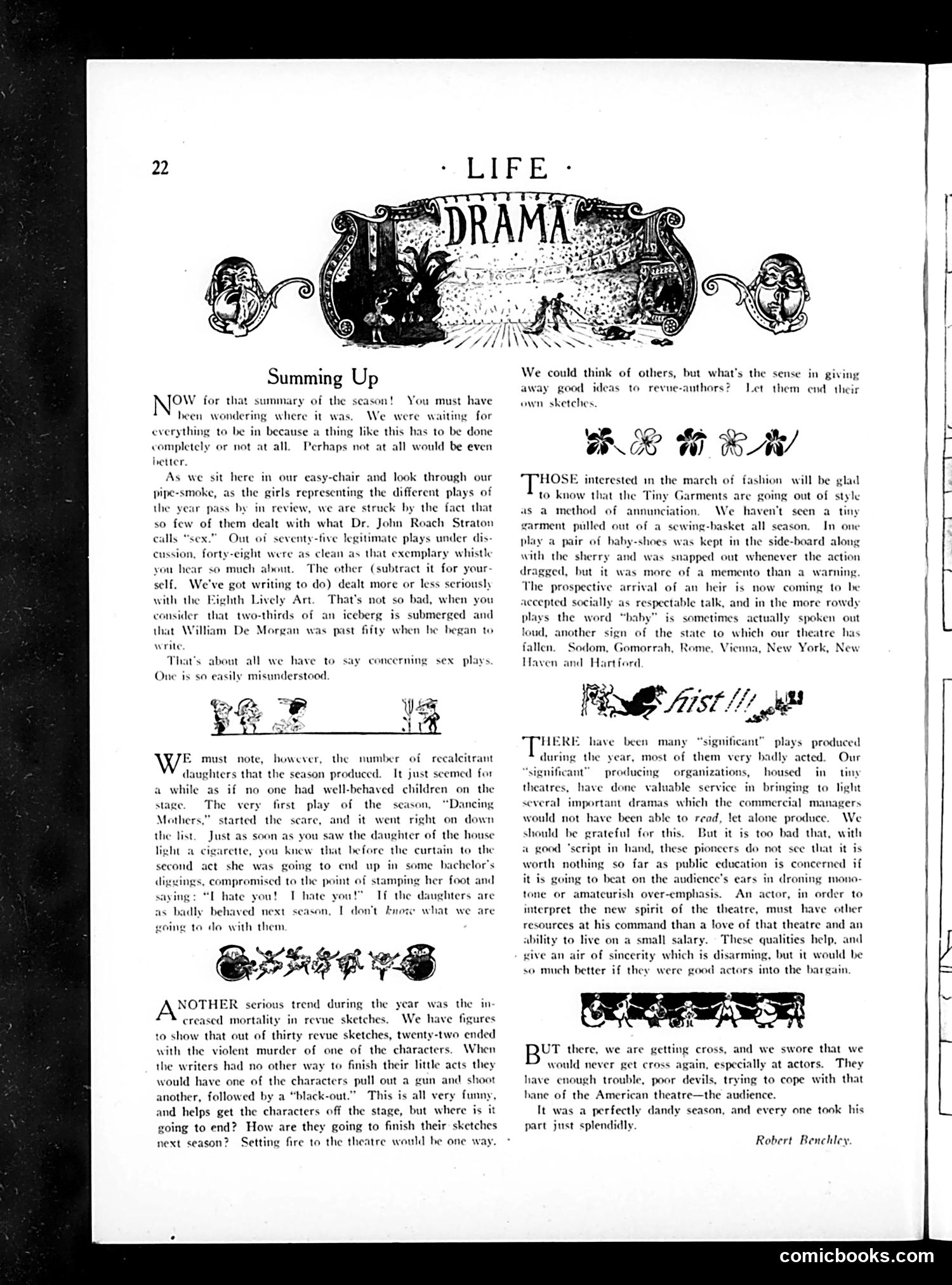
This is a year-end theatrical review from *Life* magazine satirizing Broadway's 1924-1925 season. The piece critiques several trends: **Sex plays**: The author mocks Dr. John Roach Straton (a real anti-vice crusader of the era) by noting that of 75 legitimate plays, only 27 dealt with "sex"—suggesting moralists were unnecessarily alarmed. **Rebellious daughters**: A common plot device where young women smoke cigarettes, compromise themselves morally, and face ruin before the second act curtain. **Revue sketch deaths**: The author humorously observes that 22 of 30 revue sketches ended with characters shooting each other to exit the stage. **Baby-announcement props**: The reviewer notes that tiny garments and baby shoes—once standard dramatic devices announcing pregnancies—have fallen out of fashion, replaced by frank discussion. **"Significant" amateur theatre**: While praising small experimental theatres for staging important dramas, the author criticizes overacting that undermines the material. The tone is witty, irreverent satire typical of *Life*'s sophisticated humor.
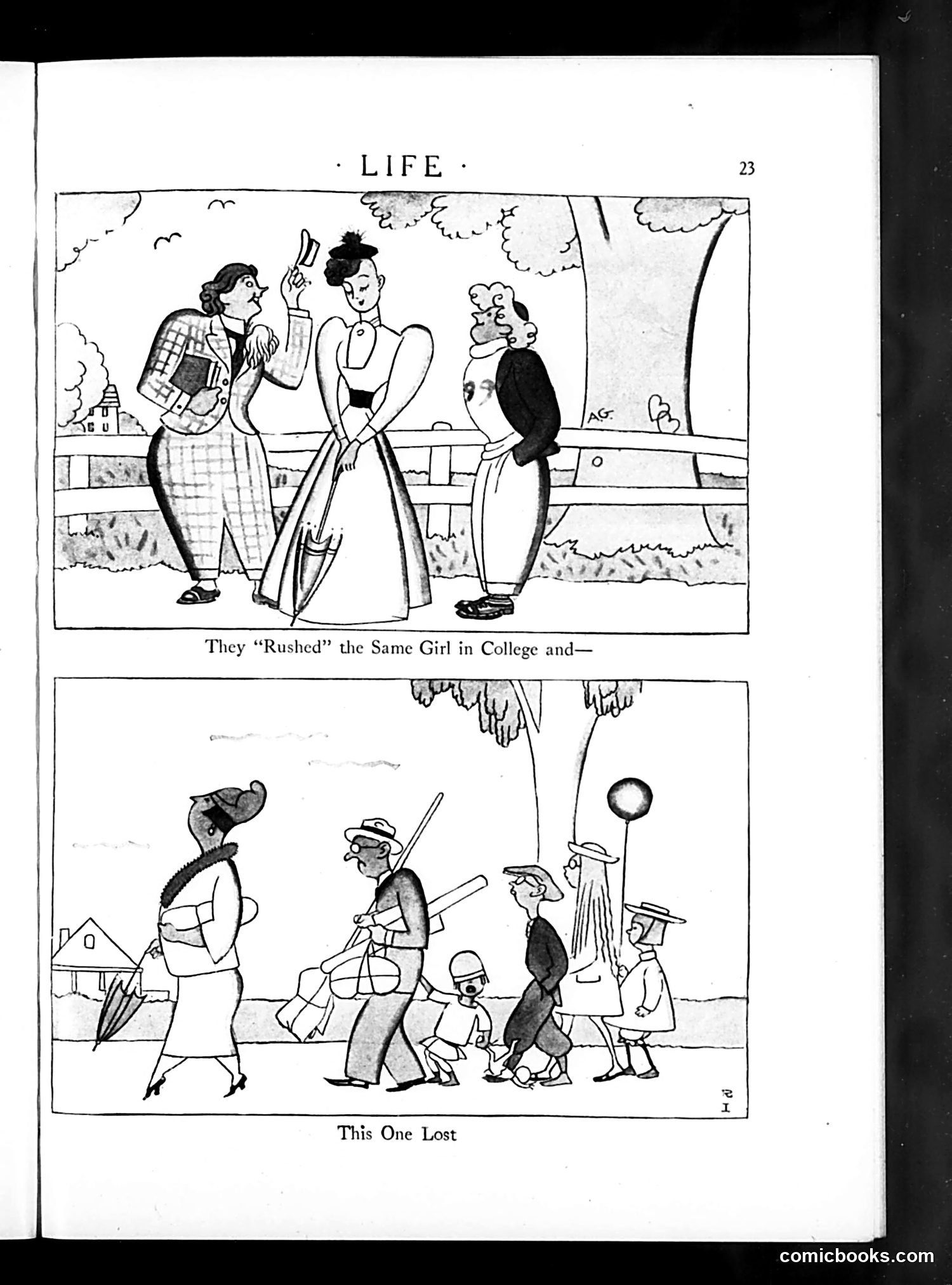
This two-panel cartoon satirizes the competitive social dynamics of courting in early 20th-century America. The top panel shows three women at what appears to be a college or social gathering, with text indicating they "rushed" the same girl in college—a reference to competitive recruitment practices in sororities and social circles. The bottom panel shows the punchline: while those women were competing for her attention, "this one lost"—depicted as a woman who married and now manages a household full of children and domestic chaos, surrounded by crying babies and overwhelmed by family life. The joke contrasts romantic social ambitions with the unglamorous reality of marriage and motherhood, satirizing how marriage transforms a desirable young woman into an exhausted parent.
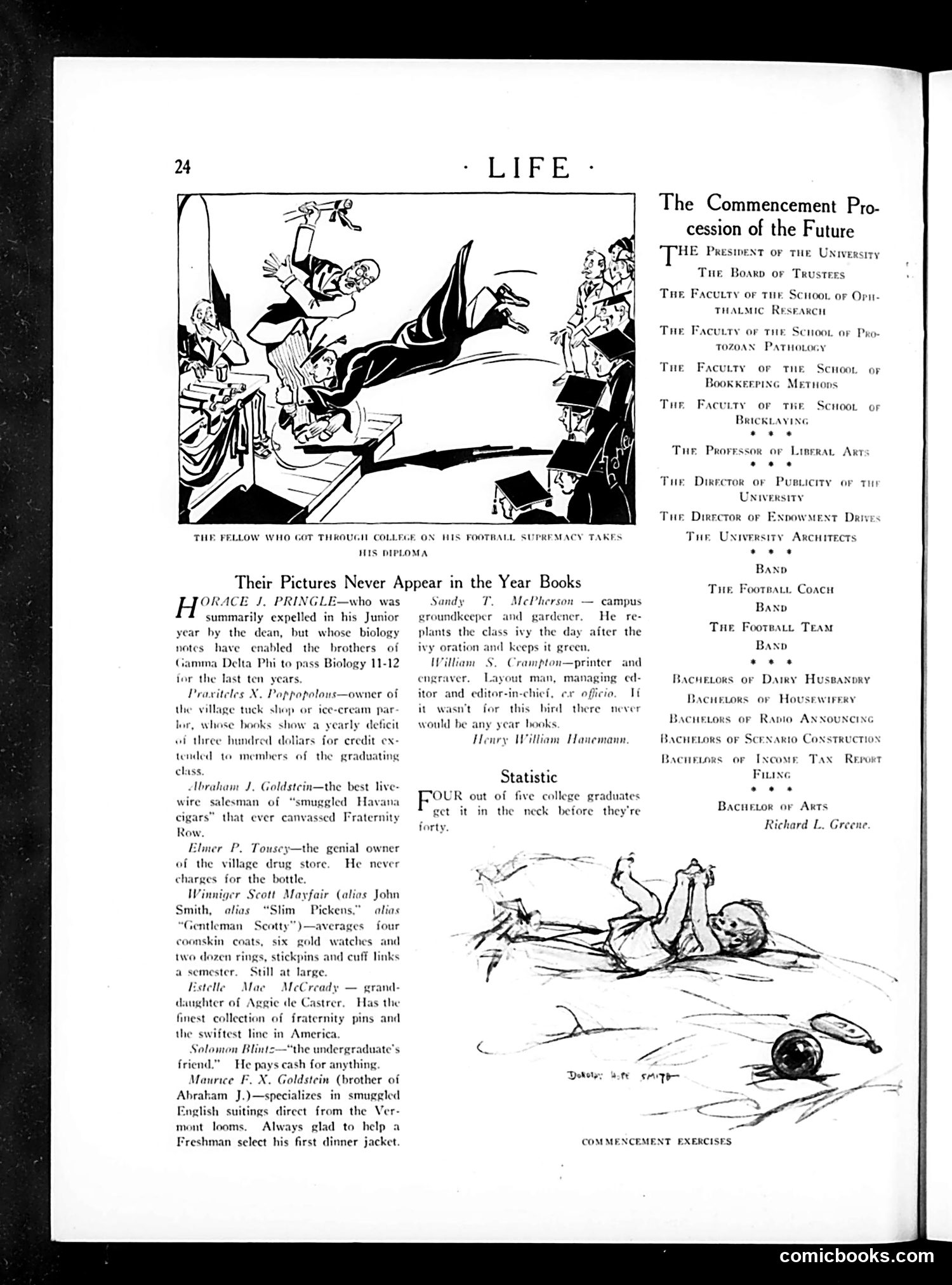
This page satirizes college life through two interconnected jokes: **Top section:** "Their Pictures Never Appear in the Yearbooks" mocks the campus underworld—students and townspeople who profit from or exploit college life but remain invisible in official records. These include a expelled biology note-taker, a shopkeeper extending credit to graduates, black-market cigar and alcohol smugglers, a girl collecting fraternity pins, and even the groundskeeper who replants ivy after class celebrations. The satire targets how institutions ignore the actual commerce and moral compromises surrounding student life. **Bottom section:** The cartoon and "Statistic" mock the proliferation of increasingly absurd academic programs. The procession lists legitimate departments alongside ridiculous ones ("Bachelors of Dairy Husbandry," "Radio Announcing," "Scenario Construction," "Income Tax Report Filing")—suggesting universities were becoming credentialing mills for any marketable skill rather than centers of learning. The statistic's dark joke: "Four out of five graduates get it in the neck before they're forty"—meaning financial ruin awaits most graduates regardless of their diploma.
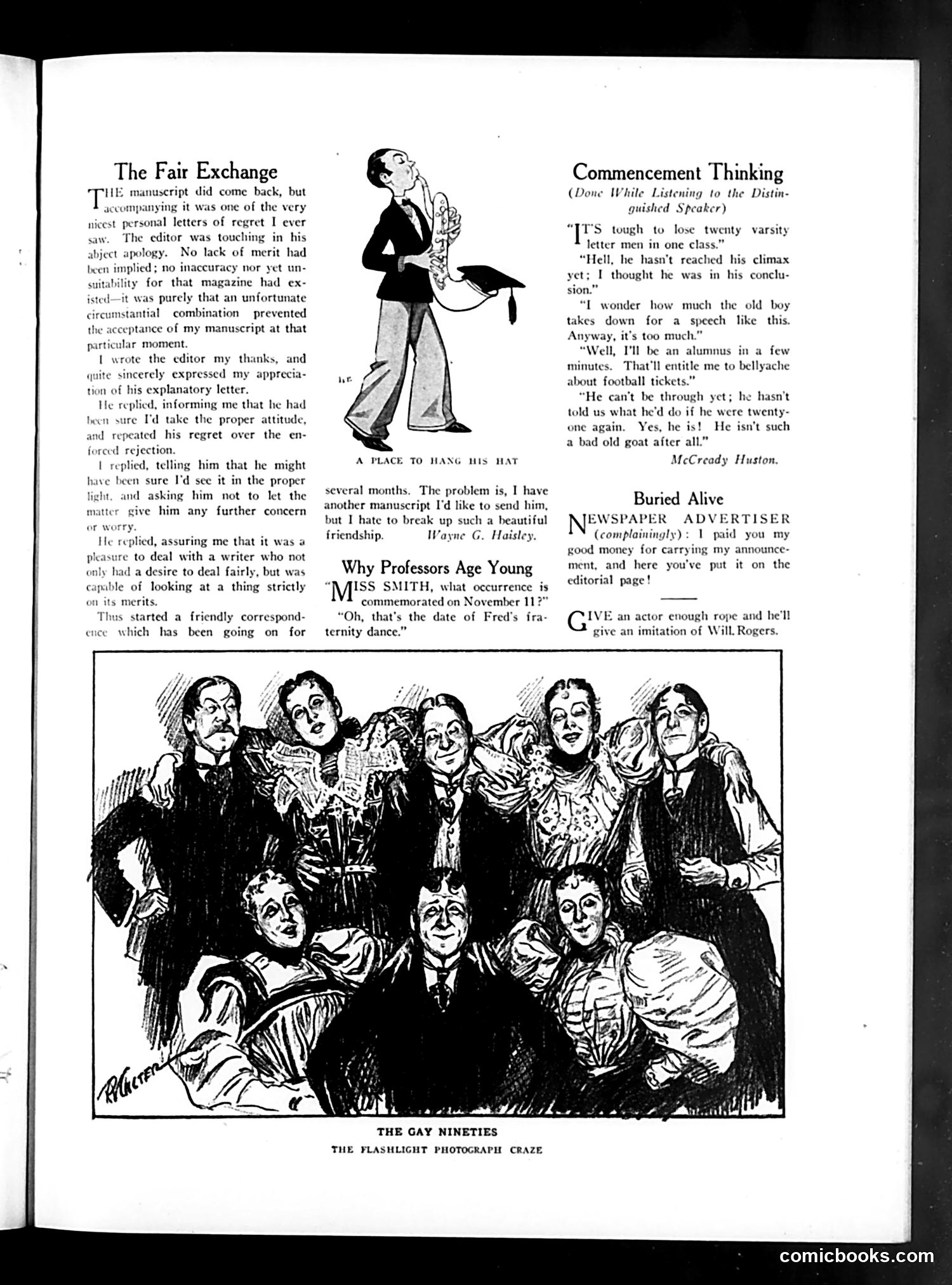
This page contains several short satirical pieces typical of Life magazine's humor: **"The Fair Exchange"** depicts a humorous correspondence between a writer and magazine editor—an ironic "friendship" born from polite rejection letters. The satire mocks the excessive courtesy both parties exchange, turning a simple manuscript rejection into an elaborate dance of mutual appreciation. **"Why Professors Age Young"** is a brief joke: Miss Smith attributes November 11th to her boyfriend Fred's fraternity dance, implying professors age from student social demands rather than academic work. **"Commencement Thinking"** satirizes graduating students' inattention during commencement speeches—they worry about losing athletes, misconstrue the speaker's conclusions, and anticipate complaining about football tickets as alumni. **"Buried Alive"** jokes about a newspaper advertiser's complaint: his paid advertisement was placed on the editorial page rather than the ads section—literally "buried." **The illustration** captioned "The Gay Nineties: The Flashlight Photograph Craze" shows eight people in 1890s dress posed for a photograph, apparently satirizing the era's enthusiasm for flash photography.
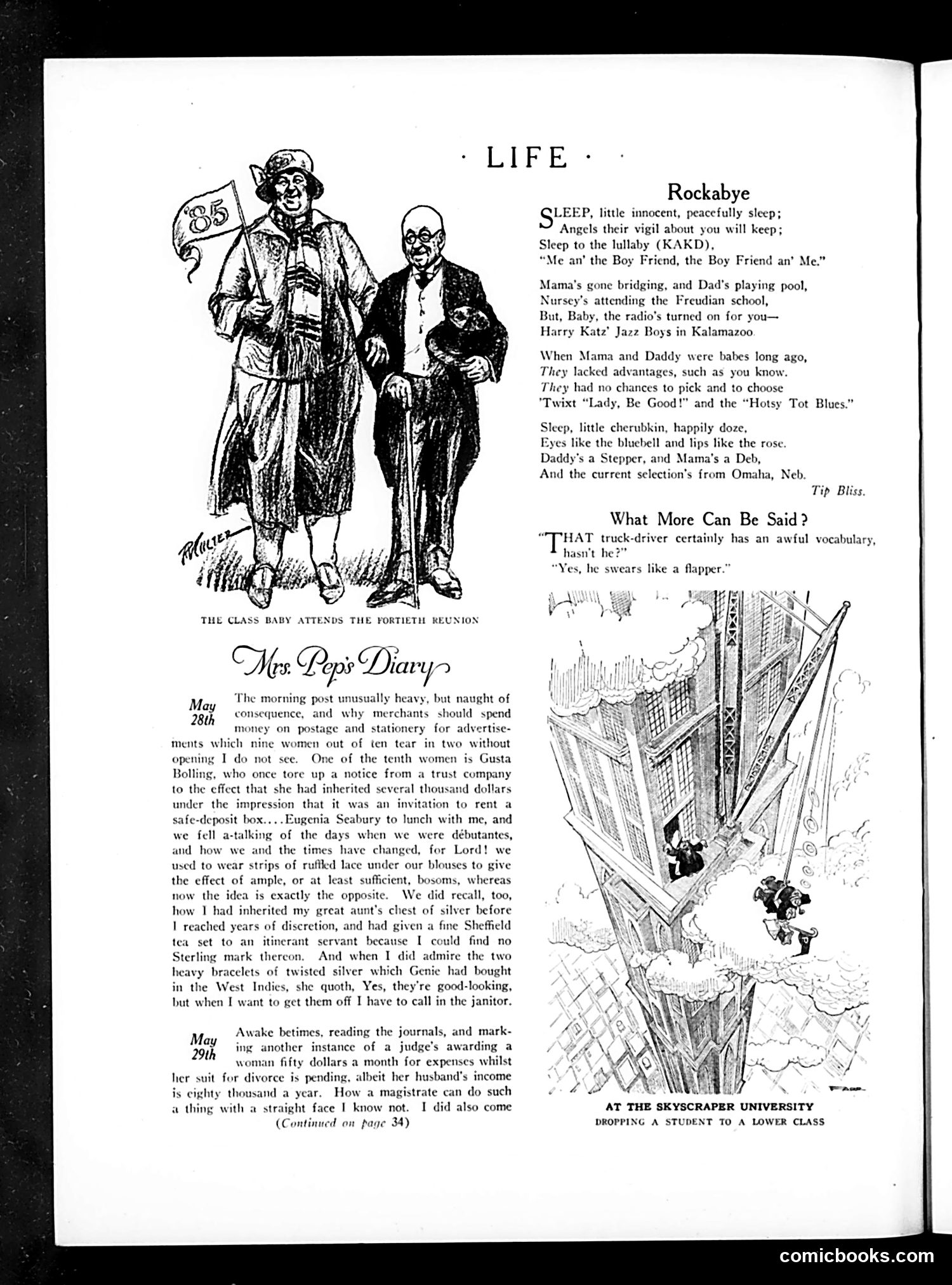
This *Life* magazine page satirizes 1920s modern life through multiple pieces: **"Rockabye"** (poem): Mocks how parents delegate childcare to entertainment. The baby sleeps to jazz radio while parents pursue leisure—bridging (card games), pool, and Freudian psychology (the trendy new fad). The sarcasm targets affluent parents who provide modern conveniences (jazz, radio) instead of traditional parental attention. References to period songs ("Lady, Be Good!") ground this in Jazz Age culture. **"What More Can Be Said?"**: A quick joke equating flappers' slang ("swearing like a flapper") with truck drivers' crude language—mocking both groups' loose speech. **"Mrs. Pep's Diary"** and the illustration: The diary excerpt complains about inherited wealth, divorce alimony, and changing fashion (women once wore padding for curves; now flatness is fashionable). The illustration captioned "Dropping a Student to a Lower Class" appears to show someone literally dropped from a building—likely visual satire of academic or social hierarchies. Overall, the page critiques Jazz Age excess, changing gender roles, and modern frivolousness.
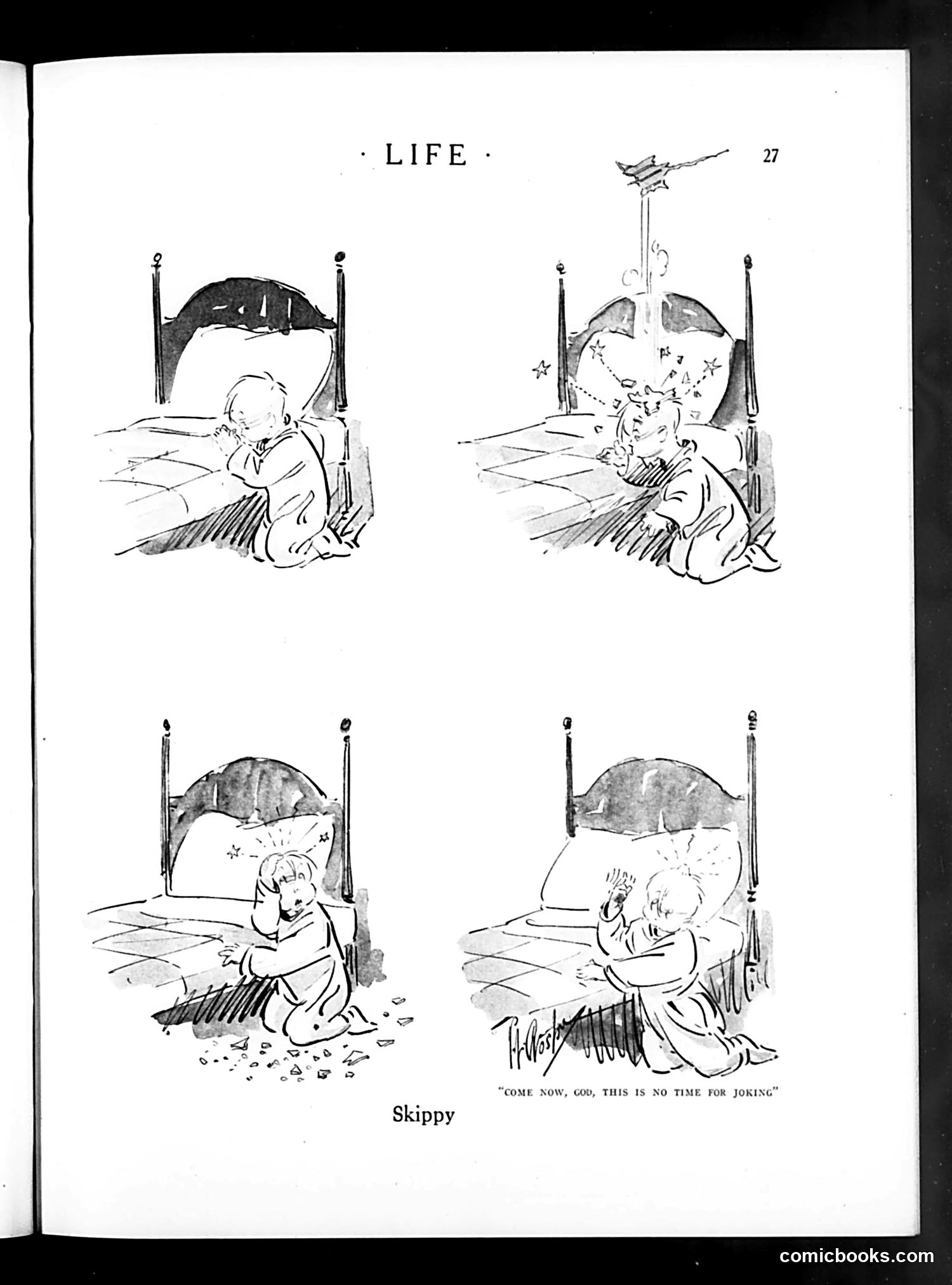
This is a four-panel comic strip titled "Skippy" showing a child's bedtime routine. The sequence depicts: 1. **Top left**: Child in bed, appearing to settle down 2. **Top right**: Child now awake, looking at something (possibly a toy airplane on the bedpost) 3. **Bottom left**: Child playing on the floor with toys/blocks, labeled "Skippy" 4. **Bottom right**: An adult (likely a parent) scolding the child in bed with the caption: "COME NOW, GOD, THIS IS NO TIME FOR JOKING" The humor targets parental frustration with bedtime resistance. The child keeps finding reasons to avoid sleep—first distraction, then active play—prompting the exasperated parent to invoke divine assistance, treating the child's behavior as a cosmic joke rather than genuine disobedience. This reflects early 20th-century domestic comedy about childhood misbehavior.
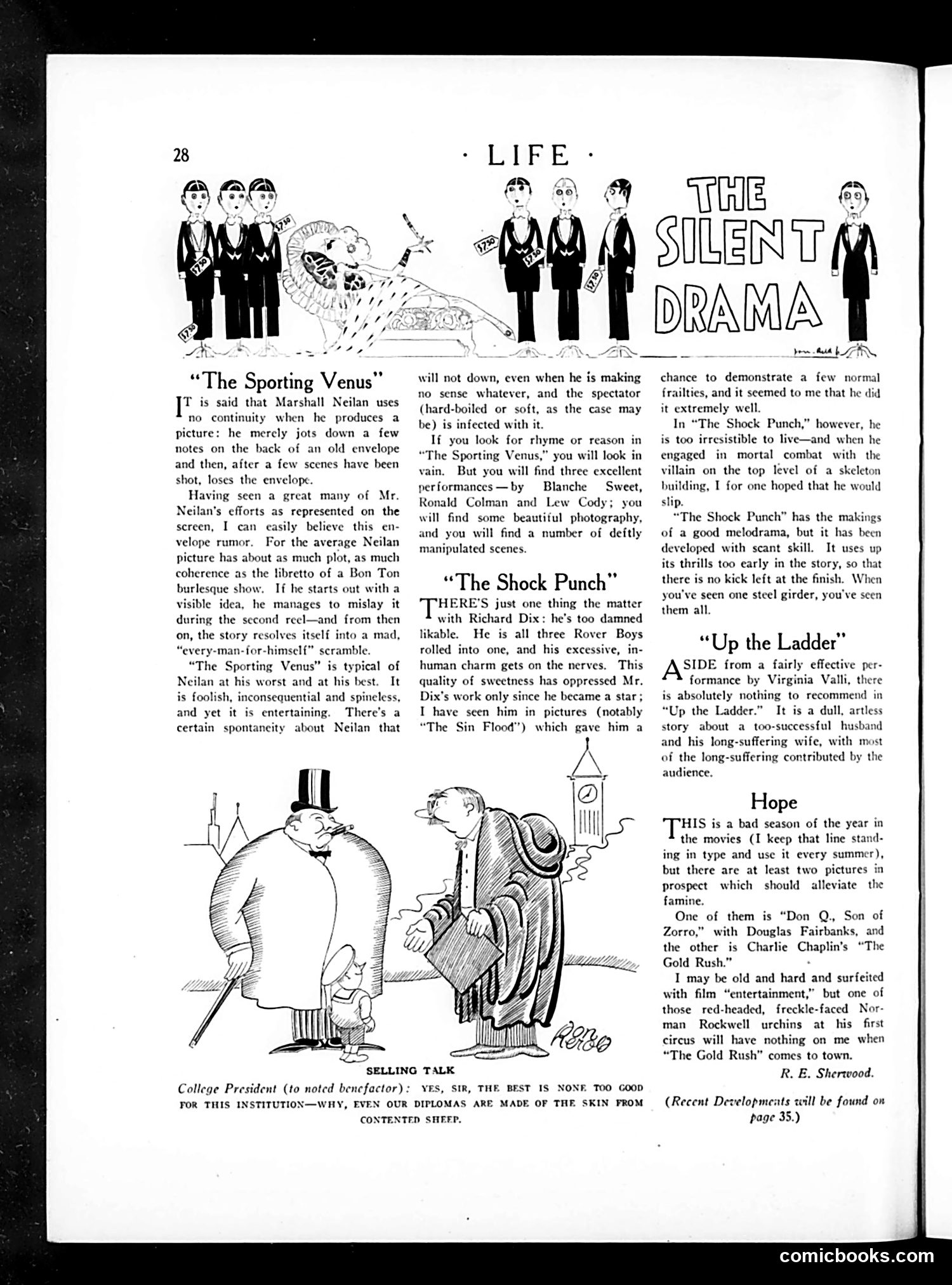
This page contains film criticism by R.E. Sherwood reviewing four recent silent movies. The reviews critique director Marshall Neilan's *"The Sporting Venus"* as plotless but entertaining due to charismatic performances by Blanche Sweet, Ronald Colman, and Lew Cody. *"The Shock Punch"* with Richard Dix is faulted for excessive likability making the protagonist unrelatable. *"Up the Ladder"* with Virginia Valli is dismissed as tedious. The cartoon at bottom satirizes academic credentialism: a college president boasts to a donor that diplomas are literally made from sheepskin, implying the institution produces nothing of substance—just ornamental credentials from cheap materials. This mocks the hollowness of diploma mills and commercialized higher education.
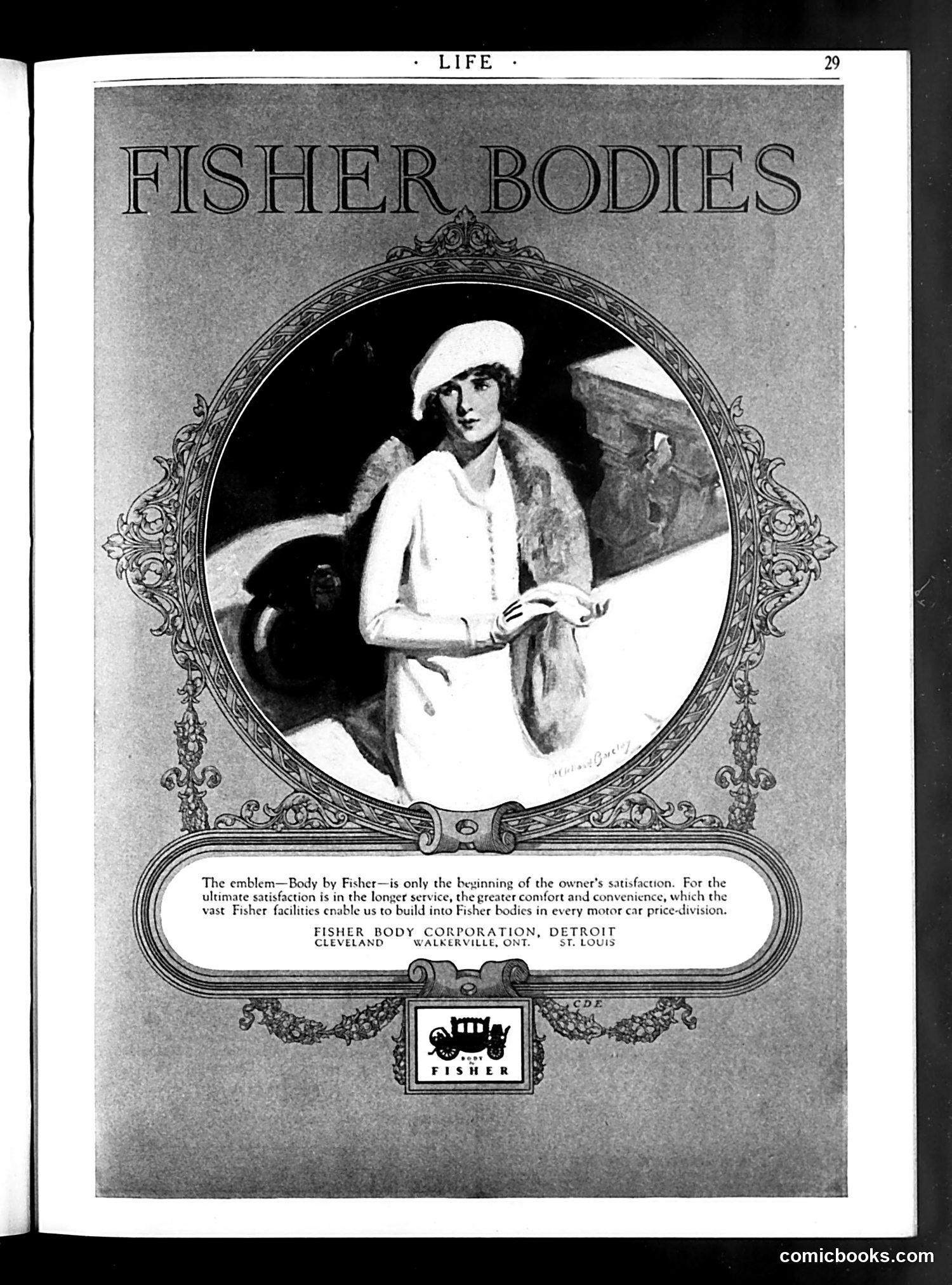
This is a Fisher Body Corporation advertisement, not political satire. It features an elegant woman in 1920s fashion (white dress, cloche hat, fur stole) posed with what appears to be an automobile, used to represent luxury and refinement. The ad's message targets affluent car buyers, emphasizing that Fisher Bodies' quality extends beyond mere appearance ("the emblem") to include superior service, comfort, and convenience across all price ranges. The ornate frame and glamorous imagery appeal to aspirational consumers seeking status and reliability. Fisher Body Corporation, a major auto body supplier based in Detroit with facilities across North America, positioned itself as synonymous with quality craftsmanship—a marketing strategy that remained effective for decades. The advertisement reflects 1920s consumer culture's emphasis on style, comfort, and the automobile as a marker of social standing.
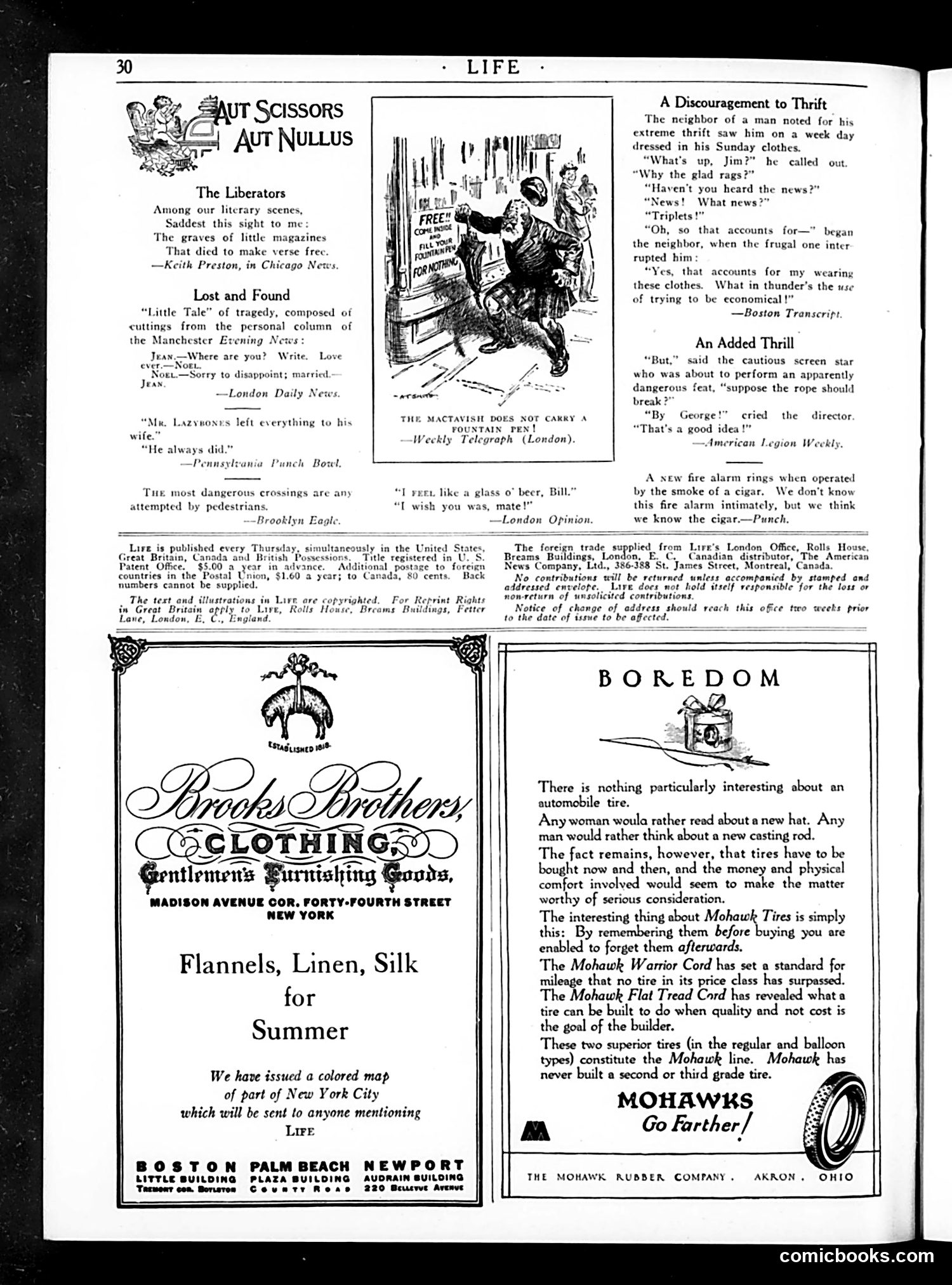
This page consists mainly of **short humor pieces and advertisements** rather than political cartoons. The cartoon shown depicts a man carrying newspapers and packages, illustrating the joke "A Discouragement to Thrift": a frugal neighbor asks why the thrifty man is wearing his Sunday clothes on a weekday. The reply—he's celebrating the birth of triplets—humorously suggests that major life events justify abandoning economical practices. Other brief jokes mock literary magazines that "died to make verse free," include personal-column tragedies from newspapers, and reference dangerous street crossings. The pieces satirize contemporary social attitudes: thrift culture, film industry safety practices, and automobile tire marketing. The page is primarily **advertising space** for Brooks Brothers clothing and Mohawk automobile tires, typical of Life magazine's revenue model. No specific political figures or major events are referenced—the humor targets everyday social conventions and consumer culture.
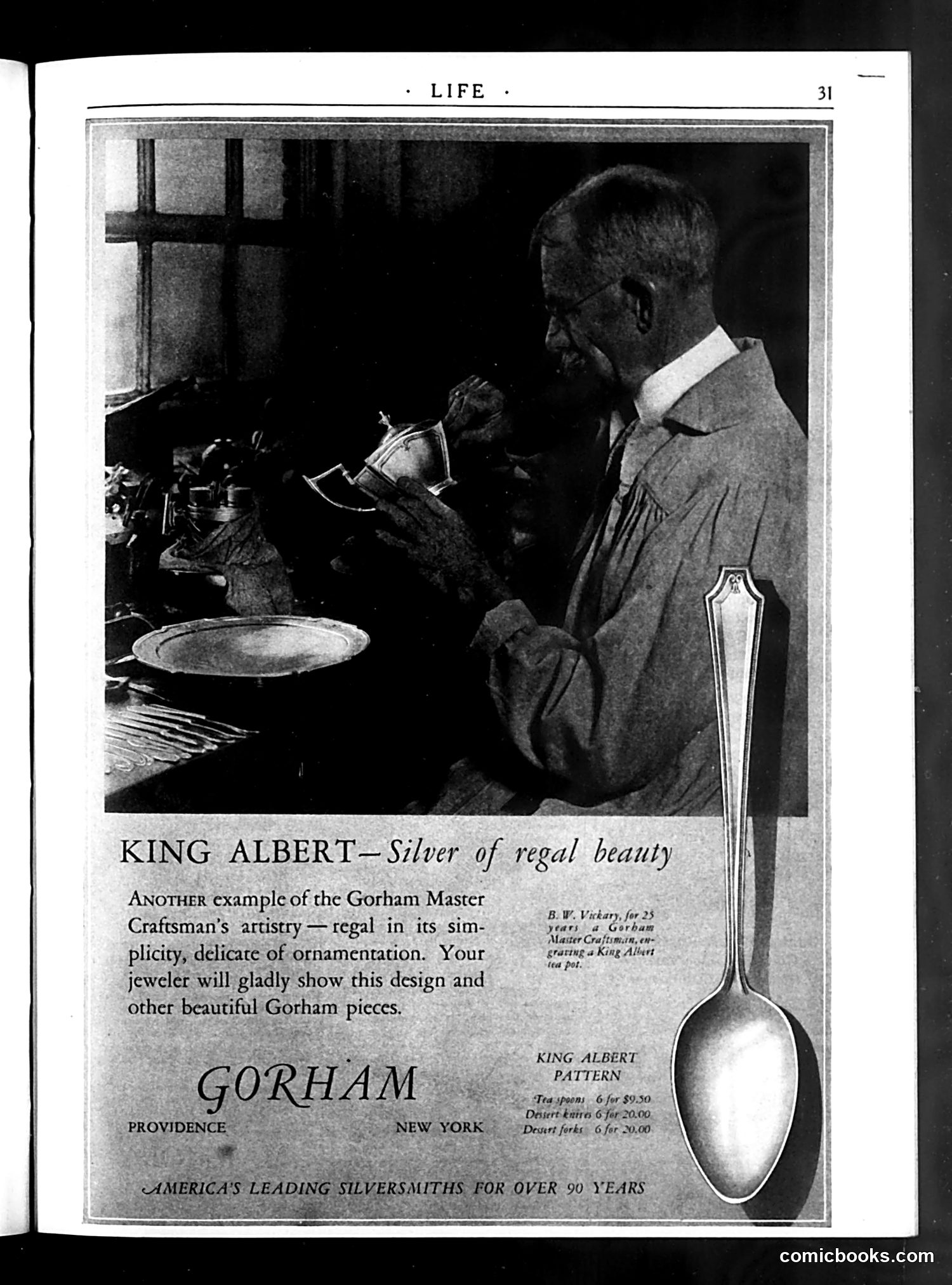
This page is an advertisement, not a cartoon. It promotes Gorham silverware's "King Albert Pattern," featuring a photograph of a craftsman (B.W. Vickary) engraving a silver teapot. The ad emphasizes "regal" craftsmanship and delicate design, positioning the product as elegant and refined. "King Albert" likely references Belgium's King Albert I, a figure of international prestige during the early 20th century when this ad ran. By associating their silverware with royalty and master craftsmanship, Gorham marketed the pattern to affluent Americans seeking status symbols. The pricing ($9.50 for six teaspoons) indicates this was luxury merchandise. This represents typical Life magazine advertising blending product promotion with aspirational imagery of skilled labor and European sophistication.
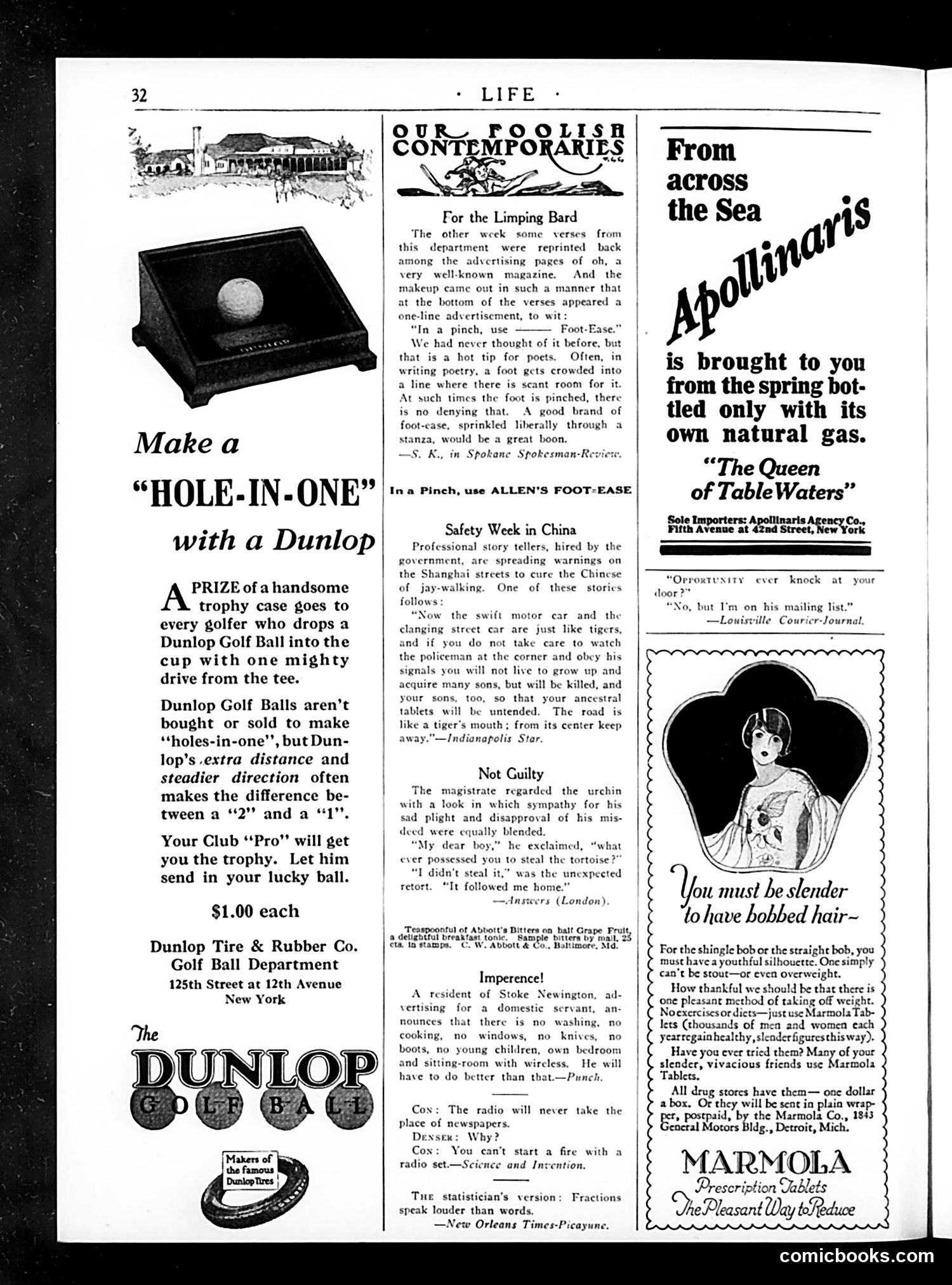
This page is primarily **advertising**, with small satirical humor pieces interspersed. The main advertisements promote **Dunlop Golf Balls**, **Marmola Tablets** (a weight-loss product), and **Apollinaris bottled water**. The satirical content includes brief jokes, such as one about a **foot-ease product cleverly placed near poetry verses** about cramped metrical "feet"—a pun on poetry terminology. Another piece mocks **Chinese government safety campaigns** using moral tales to prevent jaywalking. A joke about a magistrate involves a child claiming a stolen tortoise "followed" him home. The **Marmola ad is notably problematic by modern standards**, promoting extreme thinness and linking bobbed hairstyles (fashionable in the 1920s) to being underweight—reflecting era-specific beauty standards that would be considered unhealthy today. The overall tone reflects 1920s American consumer culture and casual, lightweight humor typical of *Life* magazine's satirical approach.
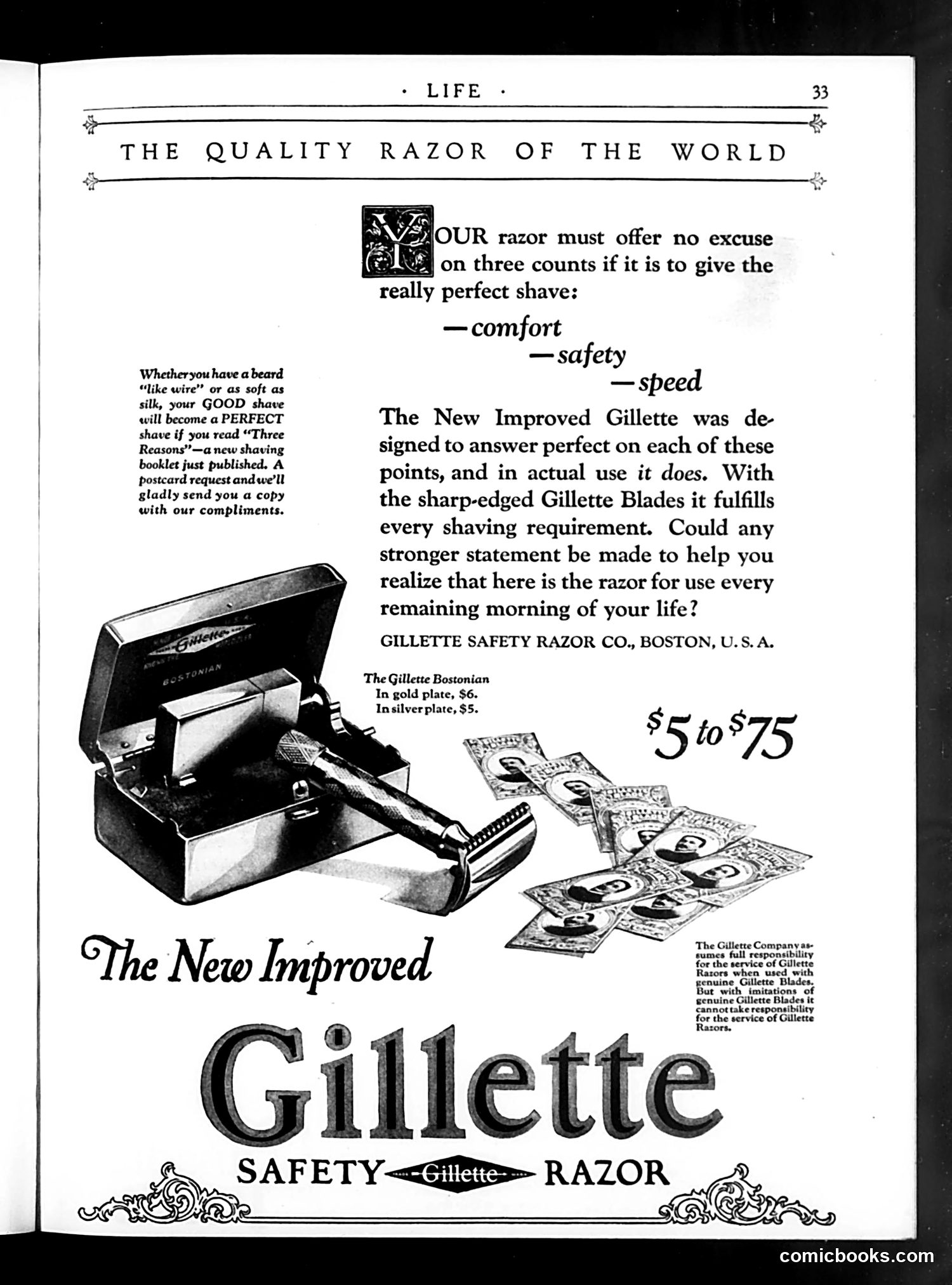
This is a **straightforward product advertisement**, not satire or political commentary. The page promotes the "New Improved Gillette Safety Razor" from Gillette Safety Razor Co., Boston. The ad emphasizes three selling points: **comfort, safety, and speed**—claims presented as essential for "the really perfect shave." The advertisement includes the razor's case, loose blades, and pricing ($5-$75 depending on materials: silver or gold plate). A notable element is the disclaimer about counterfeit blades: Gillette assumes responsibility only for razors used with *genuine* Gillette Blades, warning against imitations. This suggests early 20th-century concerns about product counterfeiting. The copy uses hyperbolic language ("the razor for use every remaining morning of your life"), typical of period advertising. There's also a reference to a separate publication, "Three Reasons," a shaving booklet available by postcard request. **This is purely commercial advertising, not editorial commentary.**
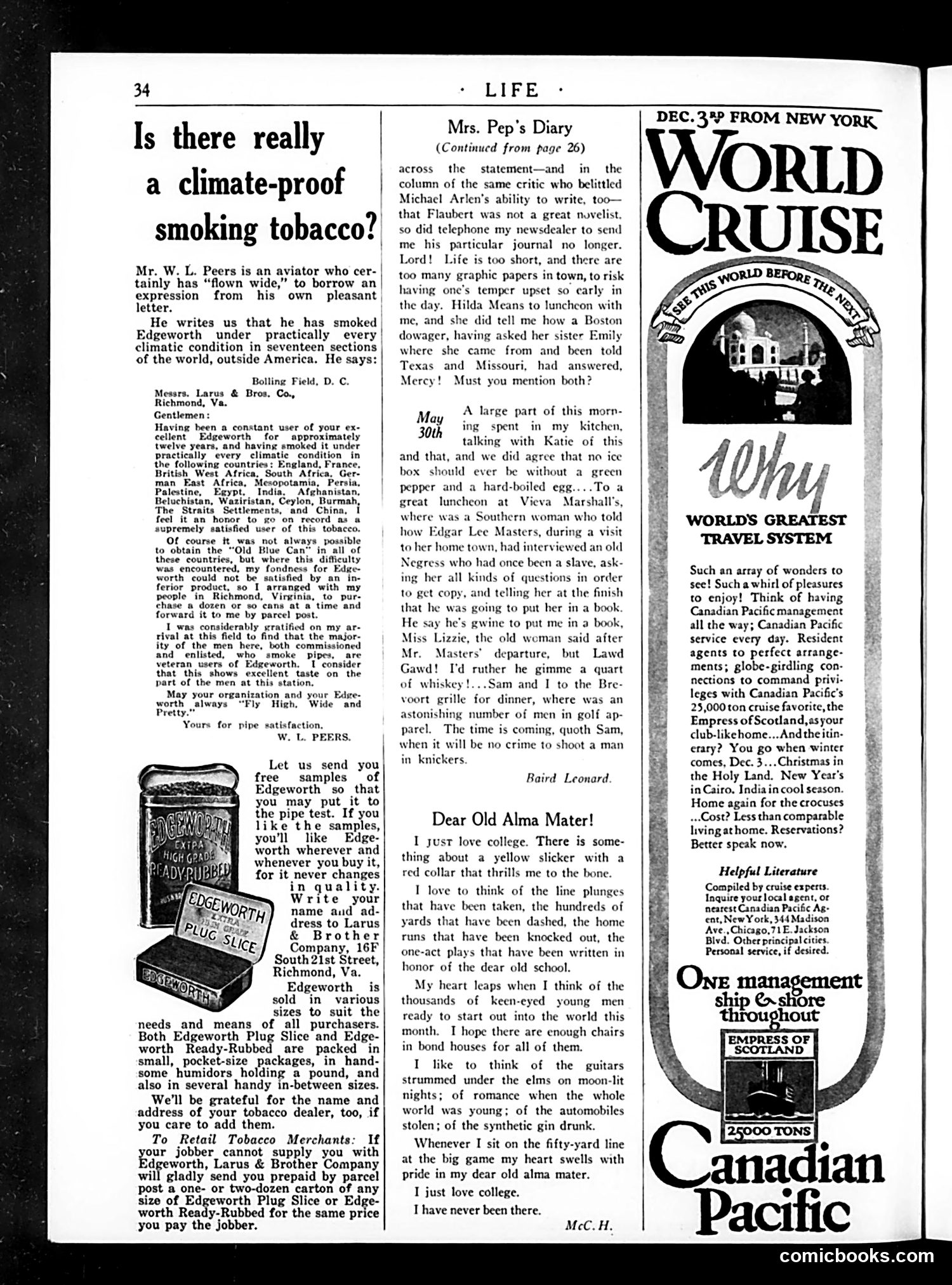
This page contains primarily **advertising and advice columns** rather than political cartoons. The main content is a **testimonial advertisement** for Edgeworth pipe tobacco, featuring a letter from aviator W.L. Peers claiming he's smoked the product successfully across seventeen countries in various climates—supposedly proving it's "climate-proof." This appears designed to appeal to worldly, adventurous readers by association with exotic travel. The page also includes **Mrs. Pep's Diary**, a gossip/lifestyle column discussing social interactions, literary criticism, and domestic matters (kitchen staff, luncheons). This reflects early 20th-century upper-class women's concerns. The **Canadian Pacific advertisement** promotes luxury cruise travel as aspirational leisure. Overall, this represents Life magazine's mix of commercial endorsements and society-focused editorial content, rather than satirical cartooning. The "satire" here is implicit: the magazine sells both consumer goods and lifestyle fantasies to affluent readers.
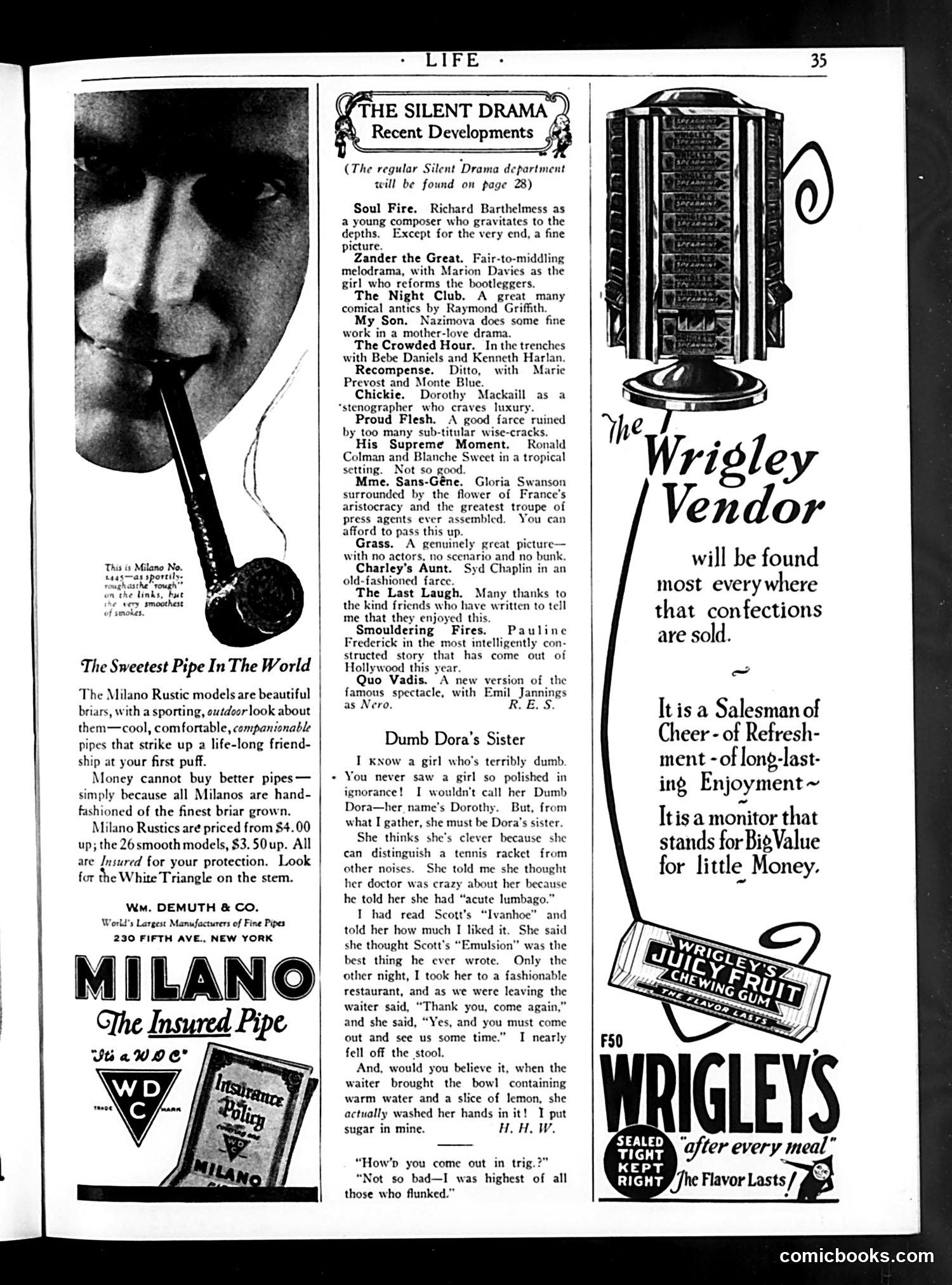
This page combines movie reviews with period advertisements and humor. **The Silent Drama section** reviews contemporary films (1920s era), including works by stars like Richard Barthelmess, Marion Davies, and Gloria Swanson. The reviews are brief, sometimes dismissive—notably mocking Swanson's film as surrounded by "the greatest troupe of press agents ever assembled." **"Dumb Dora's Sister"** is a humor piece satirizing a woman of spectacular ignorance: she confuses literary works ("Emulsion" for Scott's writing), misunderstands medical terms ("acute lumbago"), and commits social gaffes (washing her hands in the finger bowl meant for rinsing). The joke relies on slapstick misunderstandings popular in 1920s comedy. The advertisements (Milano pipes, Wrigley's gum, Wrigley's Vendor dispenser) are period product promotions with no satirical intent—standard commercial content in Life magazine.
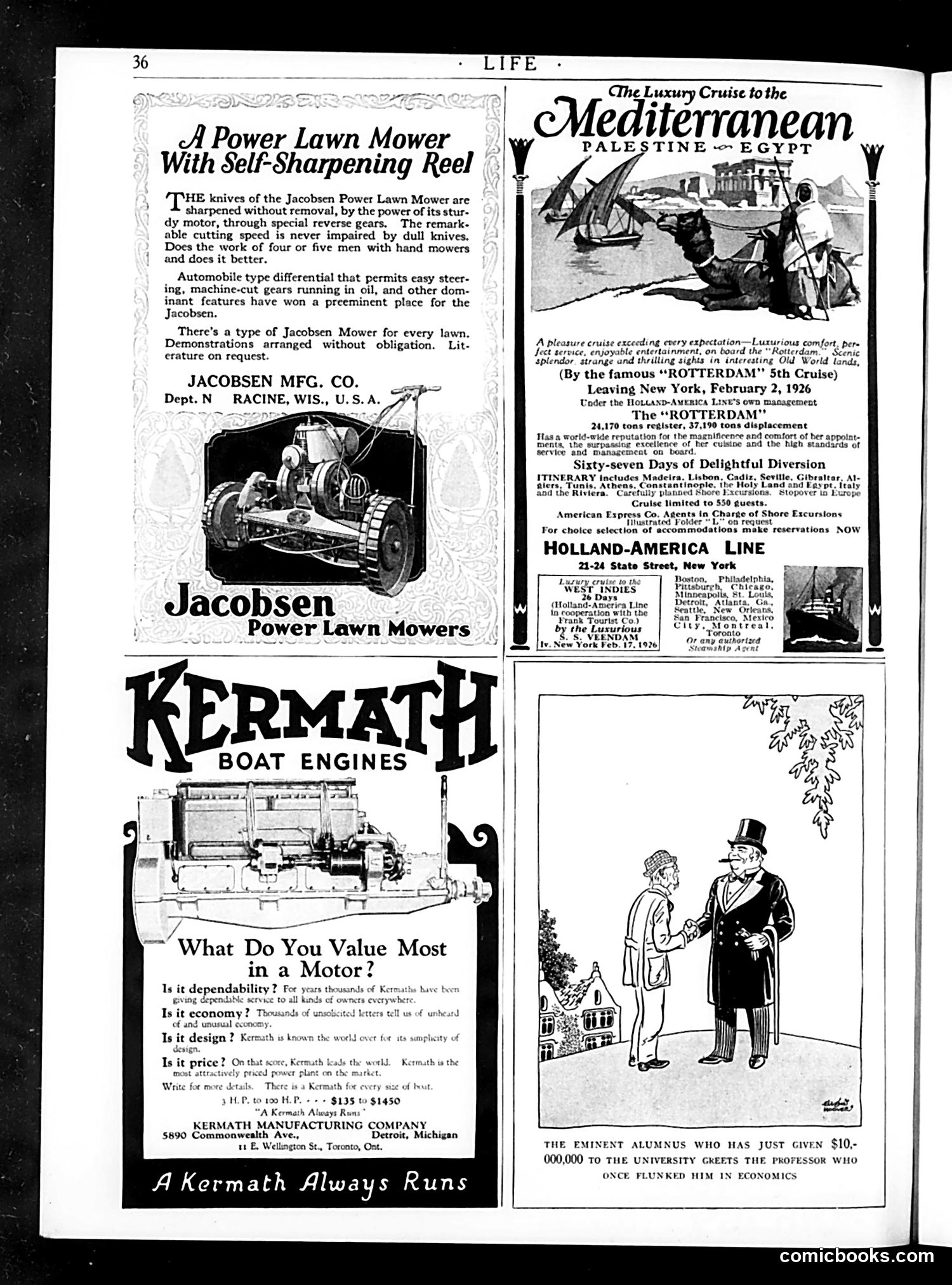
This page is primarily **advertisements** for industrial and consumer products (lawn mowers, boat engines, cruise ships). The only satirical cartoon appears in the bottom right. ## The Cartoon The cartoon depicts two men in formal dress shaking hands—one identified as a wealthy alumnus who just donated $10 million to a university, greeting a professor. The joke's irony: **the professor once failed this same student in economics**. The satire targets the absurdity of academic hierarchy and prestige reversing based on wealth. A man who apparently didn't understand economics well enough to pass the course is now powerful enough (through money) to be greeted deferentially by the professor who once judged him incompetent. It mocks both the professor's sudden respect for wealth over academic standards, and perhaps suggests that practical financial success matters more than scholastic achievement—or that money can erase past academic failure in society's eyes.
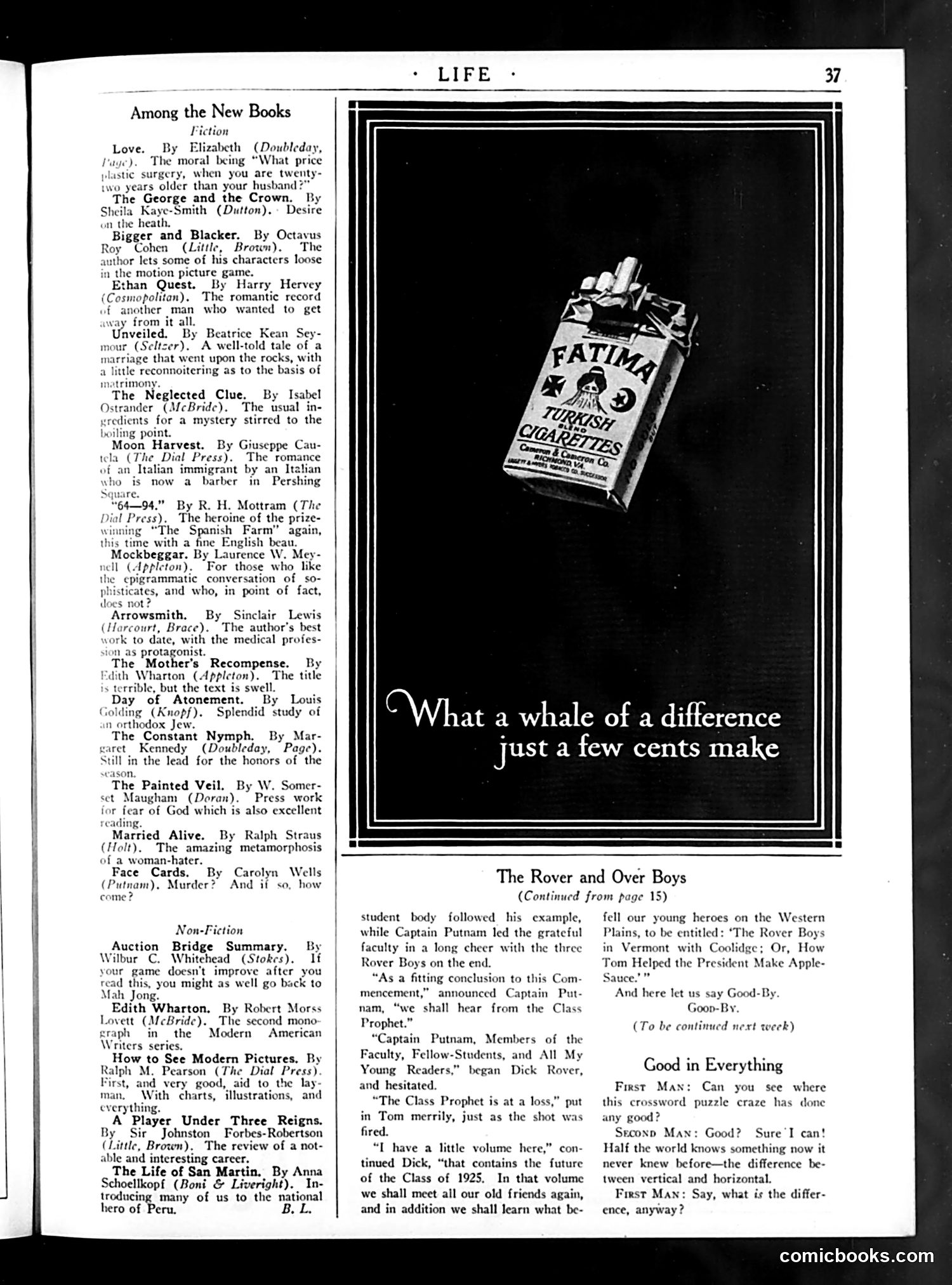
This page is primarily a **book review section** listing new fiction and non-fiction publications, with an **advertisement** for Fatima Turkish Cigarettes as the dominant visual element. The cigarette ad uses the slogan "What a whale of a difference just a few cents make"—a common early 20th-century marketing pitch suggesting premium quality at modest cost. The image shows an overflowing cigarette package, likely emphasizing value. Below this is a **serialized story conclusion** ("The Rover and Over Boys"), a humorous parody of the popular *Rover Boys* adventure series. The joke involves the Class Prophet announcing the future will include "The Rover Boys in Vermont with Coolidge; Or, How Tom Helped the President Make Apple-Sauce"—a absurdist reference to President Coolidge, satirizing the formulaic nature of these adventure stories by imagining them with contemporary political figures in ridiculous scenarios. The page reflects Life's focus on literary satire and topical humor for educated readers.
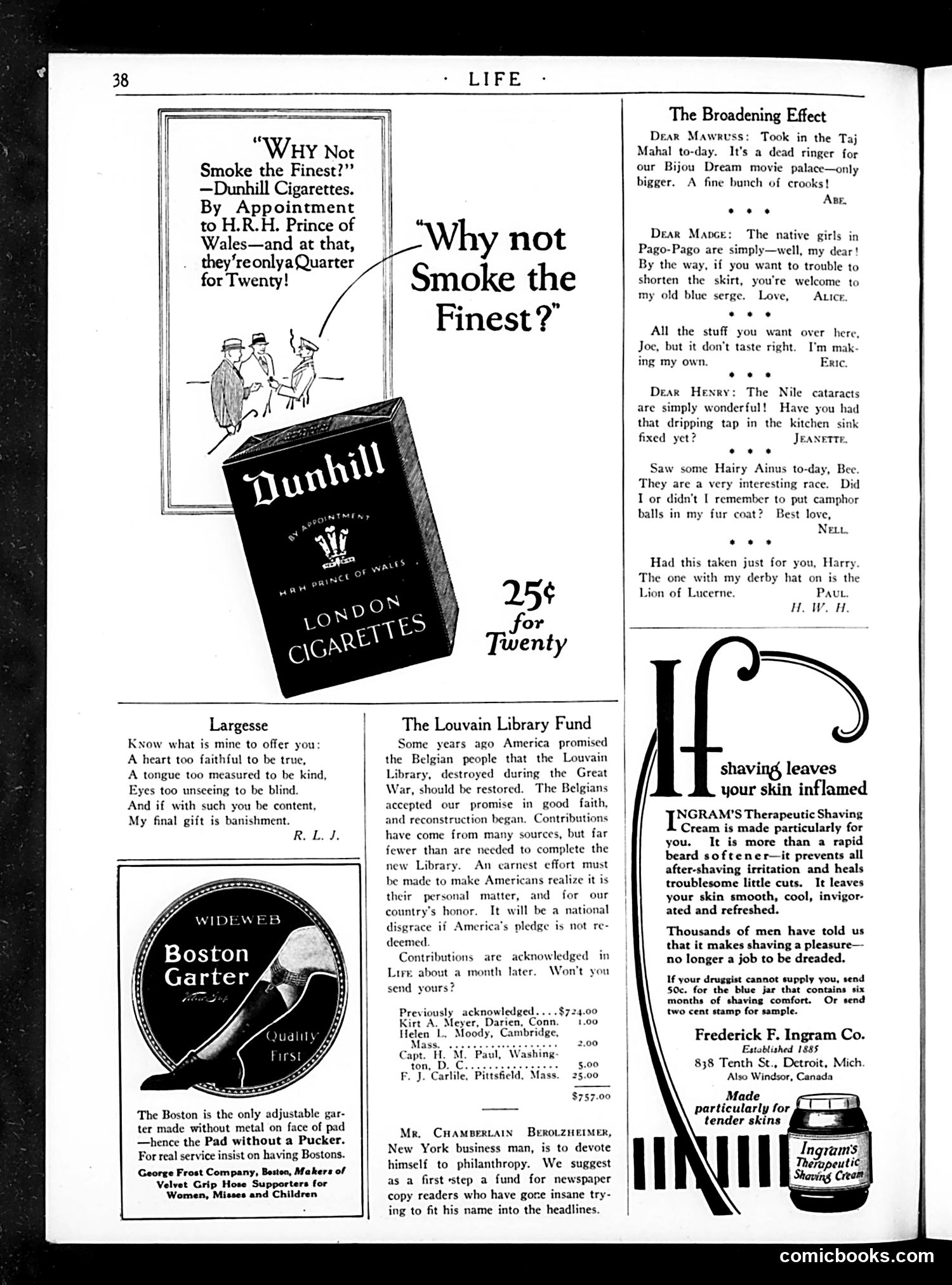
This page combines advertisements with satirical content typical of Life magazine's format. **The Main Cartoon:** The Dunhill cigarette ad features a satirical joke about British luxury goods. The advertisement notes that Dunhill cigarettes are "By Appointment to H.R.H. Prince of Wales," yet cost "only a Quarter for Twenty"—mocking the pretension of expensive luxury brands by noting their affordable price undermines their exclusivity claim. **"Largesse" Poem:** A short satirical verse about offering hollow gifts (faithlessness, unkindness, blindness, and banishment), likely poking fun at superficial generosity or insincere offerings. **"The Broadening Effect":** A series of humorous letters from travelers abroad who remain obsessed with mundane domestic concerns—one compares the Taj Mahal to a movie theater, another frets about a leaky kitchen tap while viewing the Nile. The satire mocks tourists who fail to appreciate foreign wonders, remaining fixated on trivial home matters. **The Louvain Library notice** is a serious fundraising appeal for post-WWI Belgian library reconstruction. The remaining content consists of period advertisements (Boston Garter, Ingram's Shaving Cream).
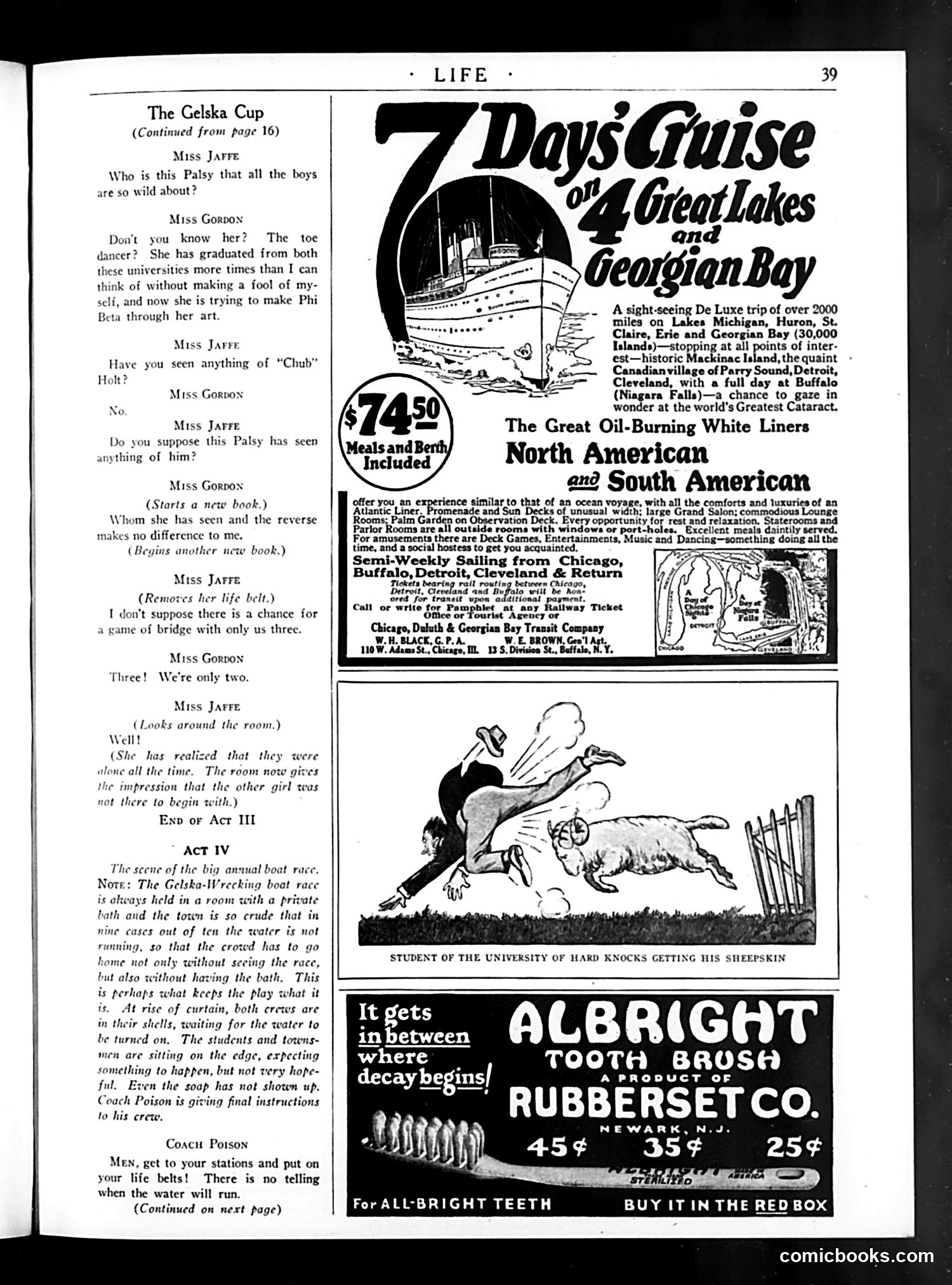
This page shows Act III-IV of a satirical play mocking elite university culture and social pretensions. The dialogue depicts two female students discussing peers' academic and romantic pursuits with affected indifference—Miss Gordon reads continuously to signal disinterest, while they discuss a student named "Palsy" (a toe dancer attending multiple universities) and a missing male named "Chub Holt." The humor lies in absurdist situations: Act IV's boat race occurs in a room with a private bath where water never runs, forcing spectators home without witnessing anything. Coach Poison instructs crews to don life belts despite no water appearing—the satire targets institutional incompetence and the gap between elaborate preparations and actual outcomes. The accompanying advertisements (Great Lakes cruises, Albright toothbrush) are period travel/consumer promotions unrelated to the play's satirical content.
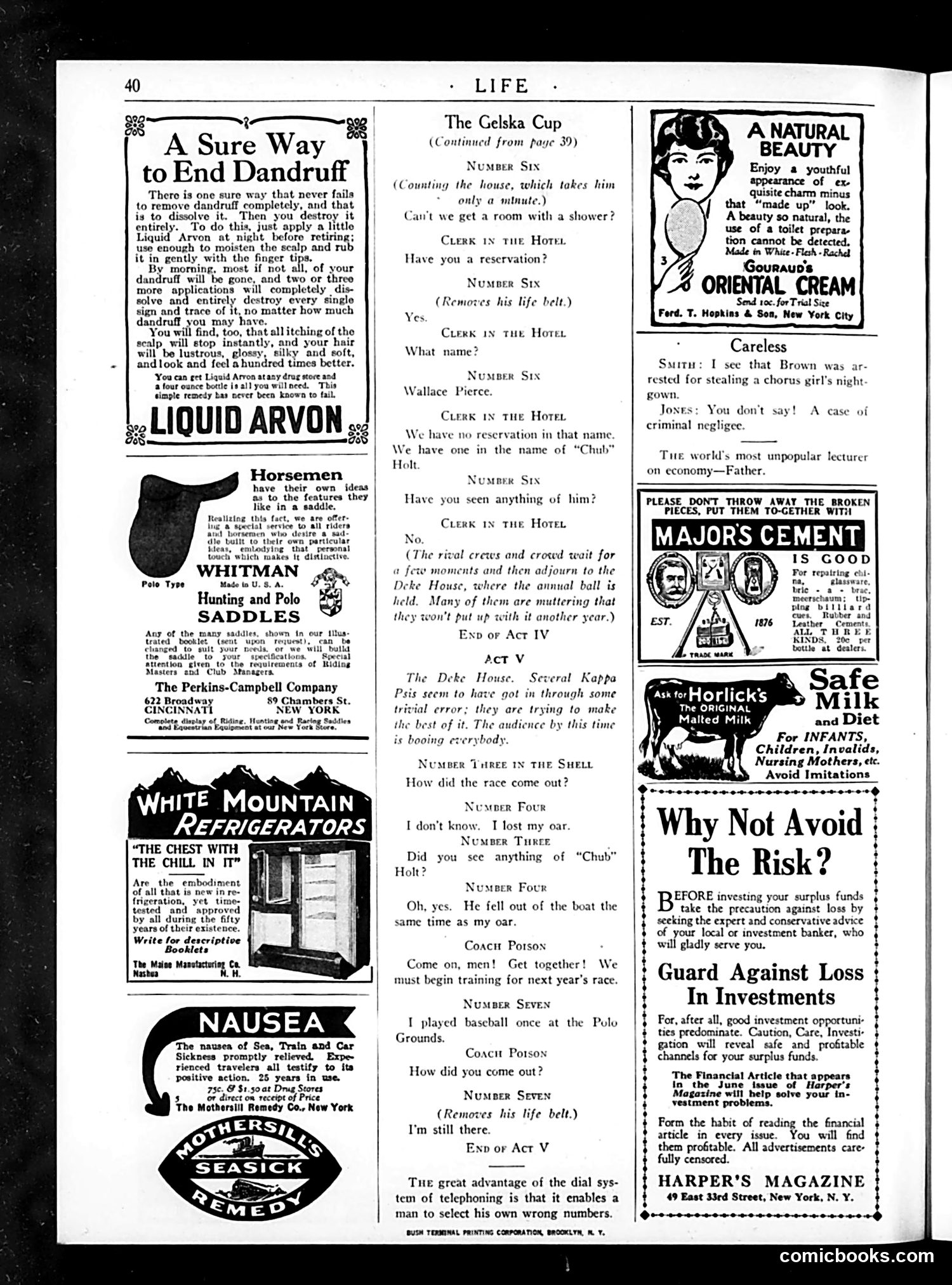
This is primarily an **advertising page** from Life magazine, with a brief theatrical sketch occupying the center-right column. **The Sketch: "The Gelska Cup"** This appears to be a humorous play excerpt about a college boat race. The comedy derives from physical comedy and absurdist situations—characters removing "life belts" indoors, confused hotel clerk interactions, and the punchline where a coach asks how a player "came out," only to learn he literally never left the field ("I'm still there"), having played baseball at the Polo Grounds years prior. The sketch satirizes college athletics culture and the confusion/chaos surrounding collegiate sporting events of this era. **Advertisements** The page features typical early 20th-century product ads: dandruff treatments, custom saddles for horsemen, refrigerators, seasickness remedies, beauty cream, and investment advice. These reflect period consumer concerns and marketing approaches. The ads assume readers' familiarity with specific brand names and product categories now largely obsolete or transformed. The overall page reflects *Life*'s format as a humor and advertising magazine targeting educated, affluent readers.

This is a **tire advertisement**, not political satire. It promotes Fisk Red-Top tires by presenting testimonials from satisfied customers across multiple states (Oklahoma, Kentucky, Nebraska, Mississippi, Wisconsin, Colorado, New York, Ohio, and Washington). The small cartoon in the upper right—showing a figure examining a tire with text "Time to Re-tire / Get a Fisk"—is a visual pun playing on the word "retire." The advertisement's strategy emphasizes durability under harsh conditions ("where roads are rough or loads are heavy"), citing real user experiences. References to "Fords" suggest these were common vehicles of the era. The claimed statistics (450% sales increase, tires outlasting competitors) and geographic diversity of testimonials aim to establish credibility and nationwide popularity. This reflects early-20th-century advertising tactics relying on customer endorsements rather than technical specifications.
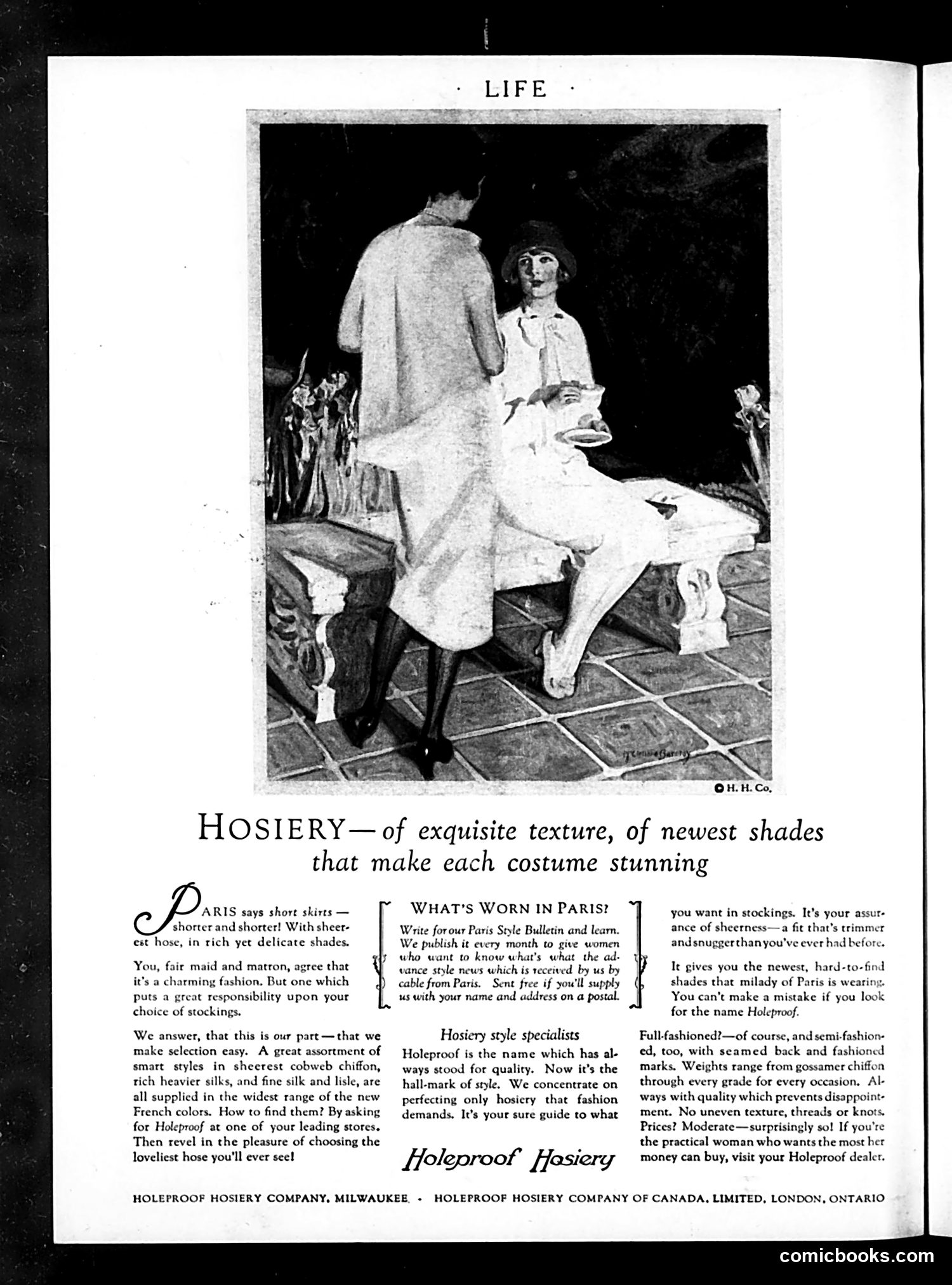
This is a **product advertisement**, not political satire. The page promotes Holeproof brand stockings, exploiting a genuine fashion trend of the 1920s: increasingly shorter skirts required women to pay close attention to visible hosiery quality and color. The illustration shows a woman displaying her legs and stockings to another figure (likely a fashion advisor or friend). The advertisement leverages Paris fashion authority—referencing a monthly "Paris Style Bulletin"—to drive sales by positioning Holeproof as the stylish choice for modern women. The "satire" is gentle commercial humor: the text acknowledges that short skirts place responsibility on women's stocking choices, then answers this "problem" by selling their product as the solution. It's marketing psychology disguised as helpful advice, targeting women concerned with fashion-consciousness and social propriety during the era of the "flapper."