
Life, 1925-06-04 · page 15 of 44
Life — June 4, 1925 — page 15: what you’re looking at
What you’re looking at
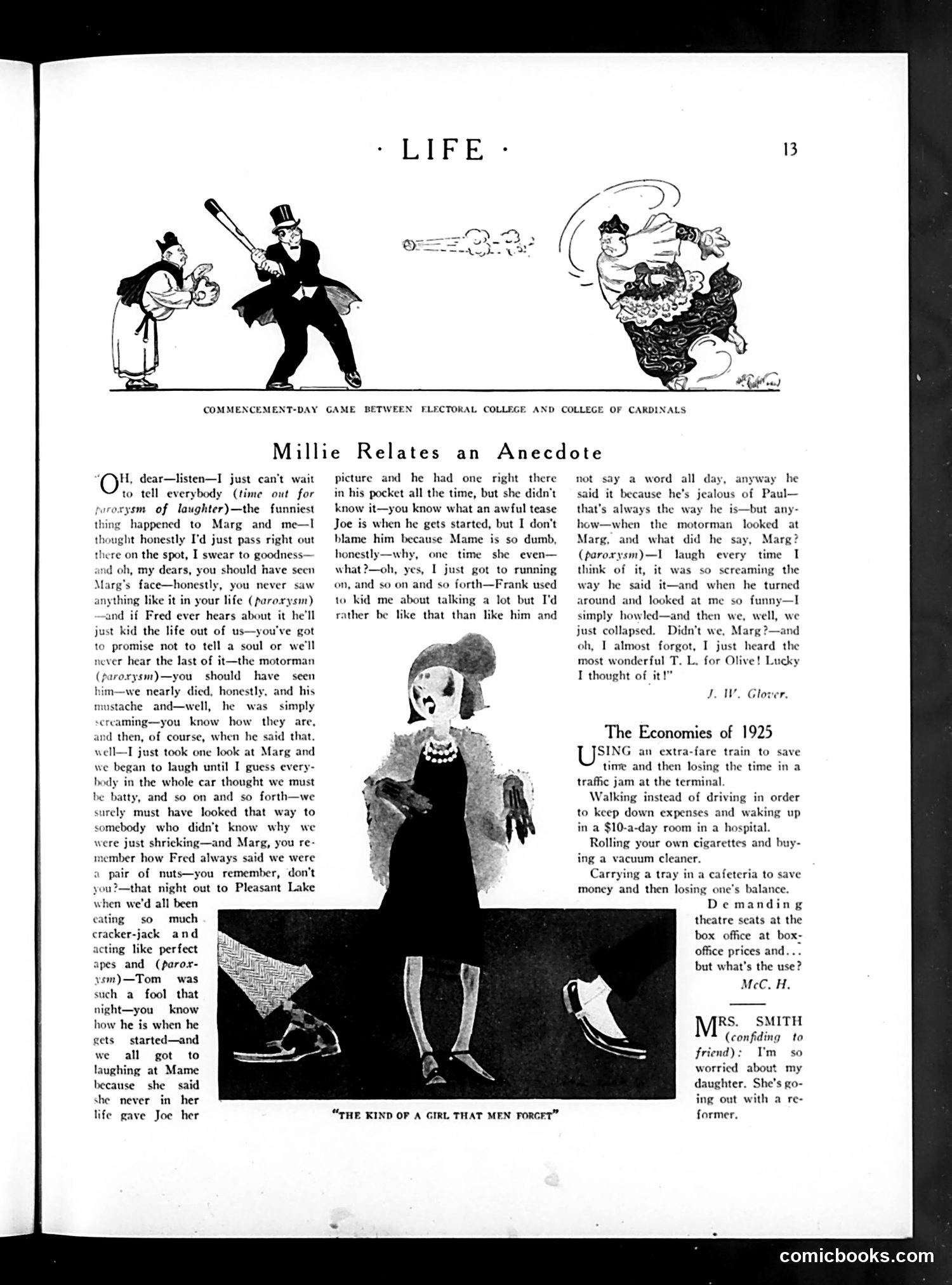
This page features humorous anecdotes and social commentary typical of 1920s American satire. The main cartoon, captioned "The Kind of a Girl That Men Forget," depicts a fashionably dressed woman in period attire, illustrating the story about "Millie" who relates an embarrassing incident involving her friend Mame at an Electoral College/College of Cardinals commencement game. The top comic strip shows a slapstick scene with figures in formal dress, likely satirizing political or academic pretension. Below are lighter pieces: "The Economies of 1925" mocks various penny-pinching habits, and "Mrs. Smith" discusses worries about her daughter dating a "reformer"—reflecting period anxieties about courtship and social propriety. The humor relies on contemporary references to fashions, social institutions, and dating customs of the 1920s Jazz Age.
📄 Transcribed text from this page (OCR, searchable)
Machine-transcribed from the original scan — historical spelling and the odd misread are preserved.
COMMENCEMENT-DAY GAME BETWEEN ELECTORAL COLLEGE AND COLLEGE OF CARDINALS Millie Relates an Anecdote “‘C)H, dear—listen—I just can't wait to tell everybody (time out for pirorysm of laughter)—the funniest thing happened to Marg and me—I thought honestly I'd just pass right out there on the spot, I swear to goodness— and oh, my dears, you should have seen Marg’s face—honestly, you never saw anything like it in your life (paroxysm) and if Fred ever hears about it he'll just kid the life out of us—you've got to promise not to tell a soul or we'll never hear the last of it—the motorman (parorysm)—you should have seen him—we nearly died, honestly, and his mustache and—well, he was simply sereaming—you know how they are, and then, of course, when he said that, well—I just took one look at Marg and we began to laugh until I guess every- body in the whole car thought we must be batty, and so on and so forth—we surely must have looked that way to somebody who didn’t know why we were just shricking—and Marg, you re- member how Fred always said we were pair of nuts—you remember, don’t you?—that night out to Pleasant Lake when we'd all been cating so much cracker-jack and ysm)—Tom was such a fool that night—you know how he is when he started—and we all got to laughing at Mame because she said she never in her life gave Joe her gets picture and he had one right there in his pocket all the time, but she didn’t know it—you know what an awful tease Joe is when he gets started, but I don't blame him because Mame is so dumb, honestly—why, one time she even— what ?—oh, yes, I just got to running ‘on, and so on and so forth—Frank used to kid me about talking a lot but I'd rather be like that than like him and “THE KIND OP A GIRL THAT MEN FORGET” a word all day, anyway he said it because he’s jealous of Paul— always the way he is—but any- how—when the motorman looked at nd what did he Marg? m)—I laugh every time I think of it, it was so screaming the way he said it—and when he turned around and looked at me so funny—I simply howled—and then we, well, we just collapsed. Didn't we, Marg ?—and oh, I almost forgot, I just heard the most wonderful T. L. for Olive! Lucky I thought of it!" J. IW. Glover. The Economies of 1925 SING an extra-fare train to save time and then losing the time in a traffic jam at the terminal. Walking instead of driving in order to keep down expenses and waking up in a $10-a-day room in a hospital. Rolling your own cigarettes and buy- ing a vacuum cleaner. Carrying a tray in a cafeteria to save money and then losing one’s balance. Demanding theatre seats at the box office at box- office prices and. but what's the use? McC. H. RS. SMITH (confiding to friend): I'm so worried about my daughter. She's go- ing out with a re- former, comicbooks.com